Bordeaux to Arcachon with a Private Driver: Complete Arcachon Bay Guide
155 km² between ocean and forest: the Belle Époque villas of the Ville d'Hiver, Gujan-Mestras oyster farms, the Teich Bird Sanctuary, the stilt huts of Île aux Oiseaux, the Dune du Pilat and Cap Ferret. This guide also explains how to reach Arcachon Bay from Bordeaux.
In a nutshell
| Data | Value |
|---|---|
| Area of the Basin at high tide | 155 km² at high tide and 40 km² at low tide — SIBA, Press Kit (accessed July 24, 2026) |
| Riverside municipalities | 10, approximately 155,000 residents year-round |
| Main City | Arcachon, population 11,092 (2023), divided into 4 neighborhoods (Winter, Summer, Spring, Fall) |
| Oyster Farming | 7,000 to 10,000 metric tons per year, ~780 ha of oyster beds, ~300 growers |
| Distance from Bordeaux | 49 to 67 km · 45 minutes to 1 hour by car · 50 minutes by TER |
| Best Times | June and September (nice weather, without the crowds of August) |
| Dedicated pages on this site | Dune du Pilat · Cap Ferret |
These are not competing measurements: they describe the area covered by water at two different stages of the tide. SIBA reports 155 km² at high tide and 40 km² at low tide. The Arcachon Bay Marine Natural Park explains this twice-daily rise and fall (accessed July 24, 2026).
Before You Go: What Arcachon Bay Really Is
At 7:30 a.m. in late September, the tide is out. The water has receded more than four meters, revealing kilometers of tidal flats, oyster beds, and channels winding toward the passes. A few oyster farmers in white boots are working among the rows, motionless, bent over, and methodical. A heron flies by. The light is golden, the air salty, and the Landes coast can be made out in the distance. It’s a moment when you understand why so many people return here every year.
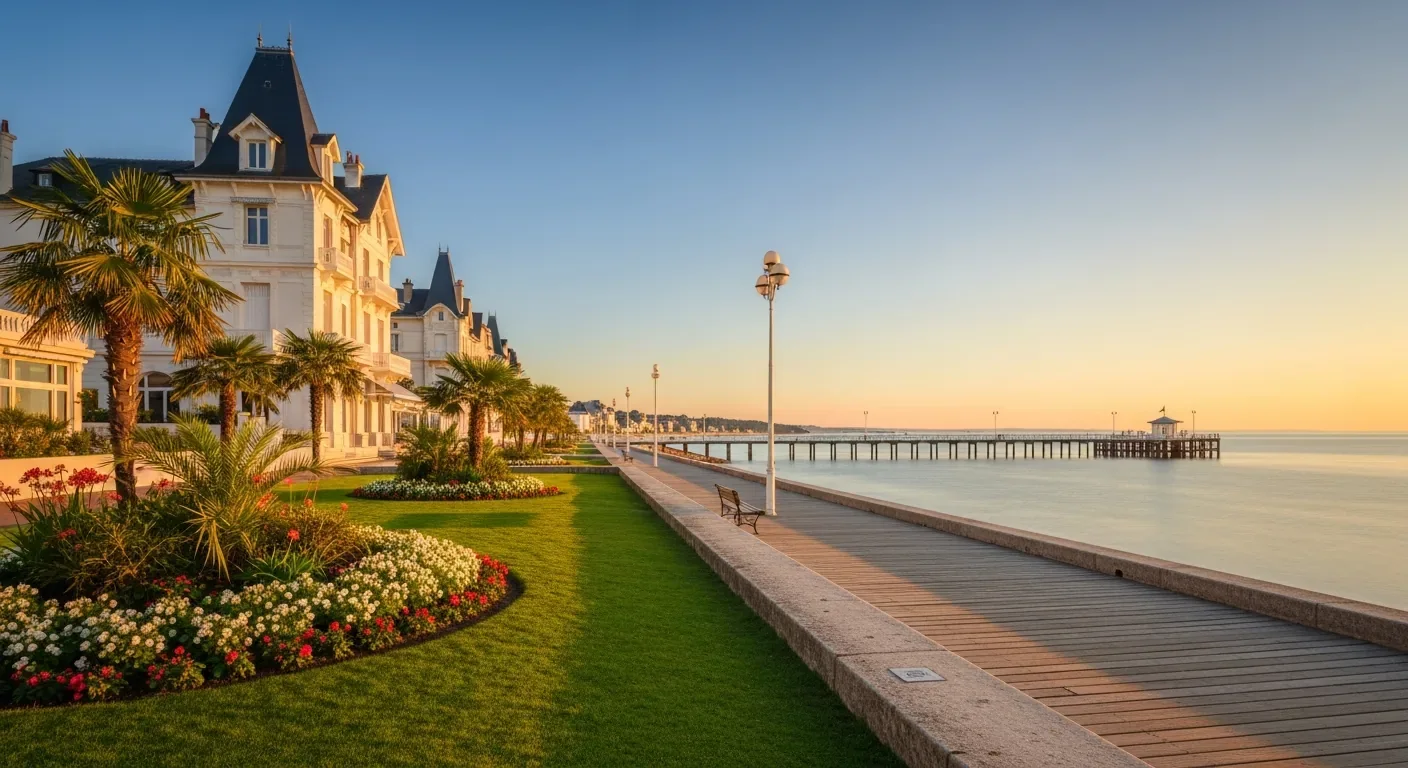
Arcachon Bay is neither an open sea nor a lake. It is an inland sea, a semi-enclosed body of salt water connected to the Atlantic by two narrow channels between Cap Ferret and the dune coast. This geography creates both spectacular tides, with a range approaching 5 metres during spring tides, and a sheltered microclimate where oysters can be enjoyed just 200 metres from a fine-sand beach.
This guide explains Arcachon Bay before you arrive. For practical information on travel, fares and available vehicles, see our page on the chauffeured transfer between Bordeaux and Arcachon.
Geography: 155 km² between the ocean and the forest
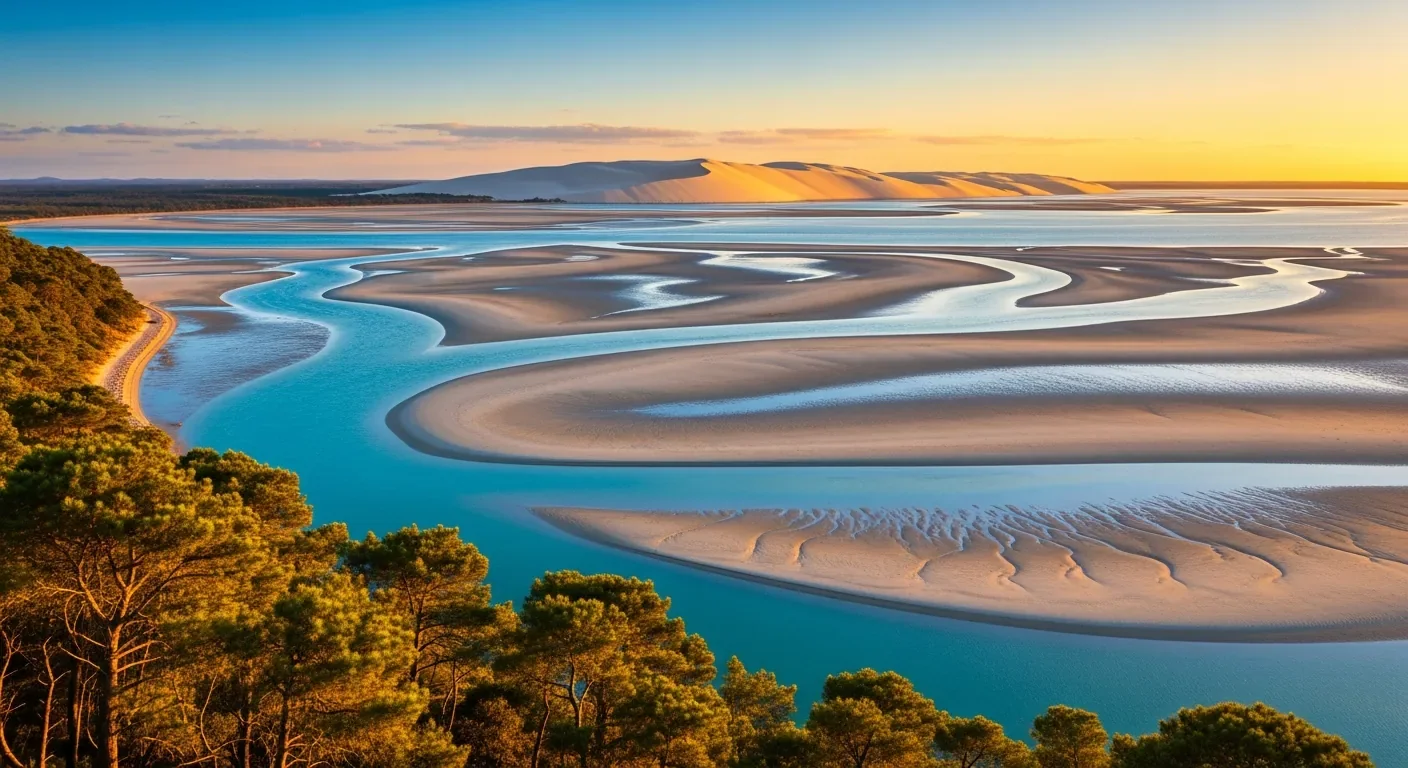
Arcachon Bay is a triangular body of water covering 155 km² at high tide, with only 40 km² remaining under water at low tide, according to SIBA. Four distinct geographical areas border it.
| Direction | Border | Details |
|---|---|---|
| West | Cap Ferret Peninsula | A 25-km-long sandy strip separating the basin from the ocean |
| South | Municipality of La Teste-de-Buch | With its crown jewel, the Dune du Pilat |
| East / North | South Basin + North Basin | Gujan-Mestras, Le Teich, Biganos · Audenge, Lanton, Andernos-les-Bains, Arès |
| Inland | Landes de Gascogne Forest | 1 million hectares of maritime pines planted beginning in 1857 |
The 10 waterside municipalities: Arcachon, La Teste-de-Buch, Gujan-Mestras, Le Teich, Biganos, Audenge, Lanton, Andernos-les-Bains, Arès and Lège-Cap Ferret. Administratively, they are divided between two intermunicipal communities, COBAS to the south and COBAN to the north; the latter also includes Marcheprime and Mios, two inland municipalities away from the shoreline.
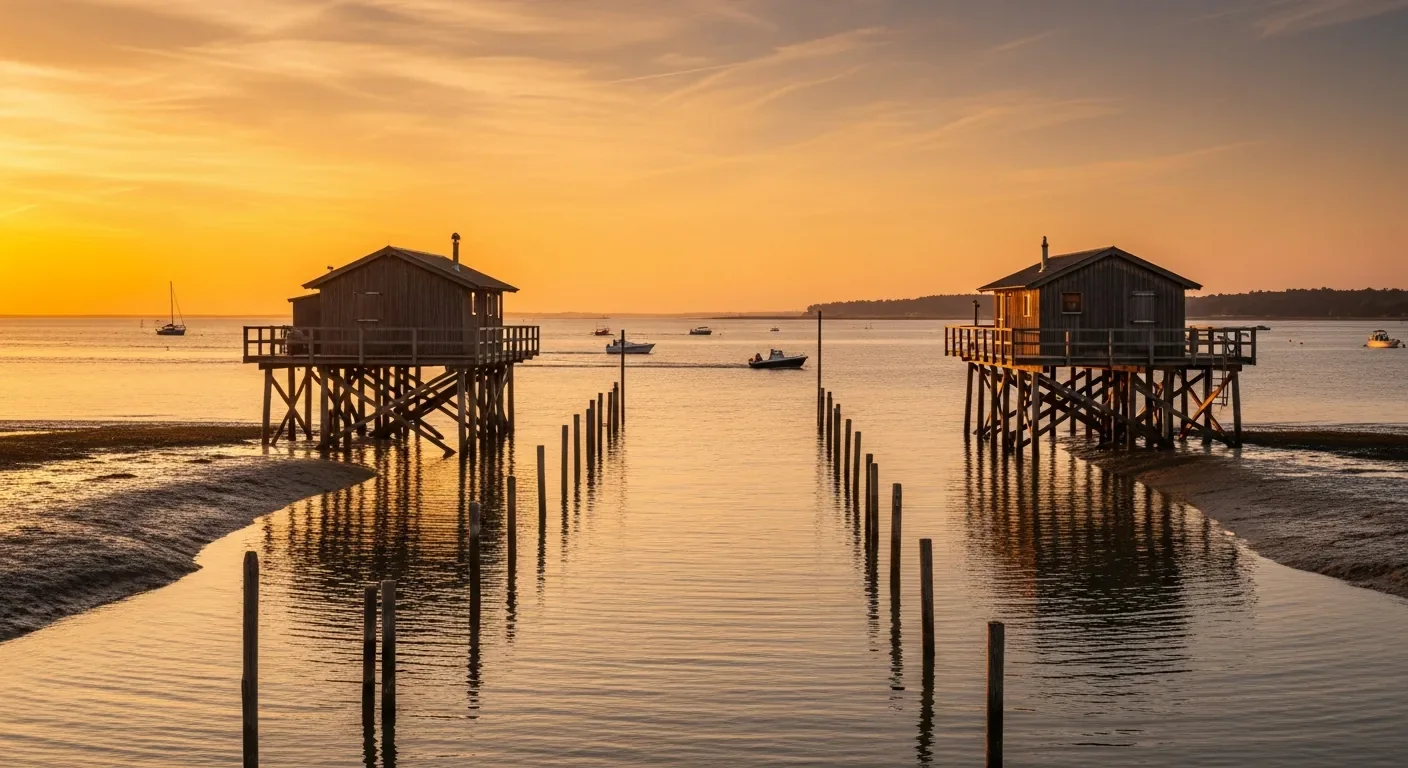
In the centre of the bay: Île aux Oiseaux, about 300 hectares at high tide, and its famous tchanquées cabins, two small stilt houses that have become the visual symbol of Arcachon Bay. Contrary to popular belief, they are not former oyster-farming watchtowers: they were built in 1946 and 1948 as leisure cabins on Île aux Oiseaux, which belongs to the municipality of La Teste-de-Buch.
A lagoon connected to the ocean by two channels
Arcachon Bay is a tidal lagoon, a saltwater body that empties and refills twice a day in step with the ocean. It connects to the Atlantic through two channels about 3 km wide, between the tip of Cap Ferret and the foot of the Dune du Pilat. These channels are not fixed: they slowly migrate southeast towards the dune over a cycle estimated at about 80 years. The sandbanks around them, including the famous Banc d'Arguin, are constantly shifting. This makes the entrance to the bay difficult to navigate and explains the long-standing presence of local pilots.
On land, the main source of fresh water is the Eyre (or Leyre), which flows into the bay near Le Teich. Its delta, a mosaic of channels, reed beds and salt marshes, was designated a Ramsar site (a wetland of international importance) in January 2012. To protect this fragile ecosystem, the Arcachon Bay Marine Natural Park was established on June 5, 2014. It is one of the few French marine parks to encompass a tidal lagoon.
For visitors, this tidal rhythm changes everything. At high tide, the bay becomes a stretch of water where sailboats and pinasses glide by; the beaches shrink and people swim at the foot of the villas. At low tide, the scene reverses: the water recedes several metres, revealing expanses of sand, mud and oyster beds crossed by rows of stakes, where shore gatherers and herons roam. Checking the tide tables before planning a boat trip, a shellfish-gathering outing or a swim is not a minor detail; it is the key to understanding Arcachon Bay.
Did you know? Approximately 370 million cubic metres of water flow back and forth between the bay and the ocean through the channels with each tidal cycle. The tidal range varies from 1.10 m during neap tides to 4.90 m during spring tides, with an average current of about 2 m/s in the channels. This constant mixing brings in the plankton on which oysters feed and prevents the shallow bay from silting up completely.
The Story: The Birth of Arcachon, a Sanatorium Town
Arcachon barely existed before the 19th century. There were dunes, pine trees, a few fishermen and the hamlet of Eyrac, then part of La Teste-de-Buch. One family changed everything: the Pereire brothers.
| Year | Event | Consequence |
|---|---|---|
| 1841 | The Pereire brothers open the Bordeaux → La Teste-de-Buch railway | The urban middle class can reach the coast in less than 2 hours from Bordeaux |
| 1857 | Extension to Arcachon · Decree by Napoleon III separating Arcachon from La Teste | Official establishment of the municipality of Arcachon, designed with the spa in mind |
| The 1860s | Construction of the Winter City | 300 villas for tuberculosis patients, an open-air sanatorium |
| 1864 | Tsarevich Alexander III comes to Arcachon for respiratory treatment | Arcachon becomes a fashionable European health resort |
The Founding of a Municipality (1857)
For a long time, Arcachon was little more than Eyrac, a hamlet among the dunes within the large municipality of La Teste-de-Buch. Development accelerated in the mid-19th century. The railway connected Bordeaux to La Teste in 1841 and reached Arcachon in 1857; a deep-water pier had already been built in 1845 to receive boats. On May 2, 1857, an imperial decree issued by Napoleon III officially separated Eyrac from La Teste and established Arcachon as a municipality in its own right. Its first mayor, Alphonse Lamarque de Plaisance, gave it a Latin motto that captures the transformation: “Yesterday a wilderness, today a village, tomorrow a city.”
The City of Four Seasons
Arcachon is often described as “the city of four seasons.” The expression does not come from the Pereire brothers, but from the tourist information office of the city, established on April 19, 1905, which was looking for a slogan to attract spa guests year-round. The urban vision, meanwhile, was developed in stages: the Summer Town (the lower town, laid out in a grid pattern, with its first housing development dating back to 1842) was the heart of the seaside resort; the Winter City was built on the hillside between 1862 and 1865 by the Pereire family; the City of Autumn and the City of Spring were added in the early 20th century. Each section served a specific purpose and was used during a specific season.
A Healthy City
Arcachon first promoted itself as a health resort. In the 19th century, visitors came for sea bathing and later for climate therapy, breathing the resin-scented pine air thought to ease respiratory illness. The discovery of the Sainte-Anne des Abatilles mineral spring in 1923 added a spa element to this therapeutic programme. The winding streets of the Ville d'Hiver are not merely decorative: their curves were designed to break the wind and create sheltered pockets for tuberculosis patients taking the air.
The Winter City: An Architectural Masterpiece
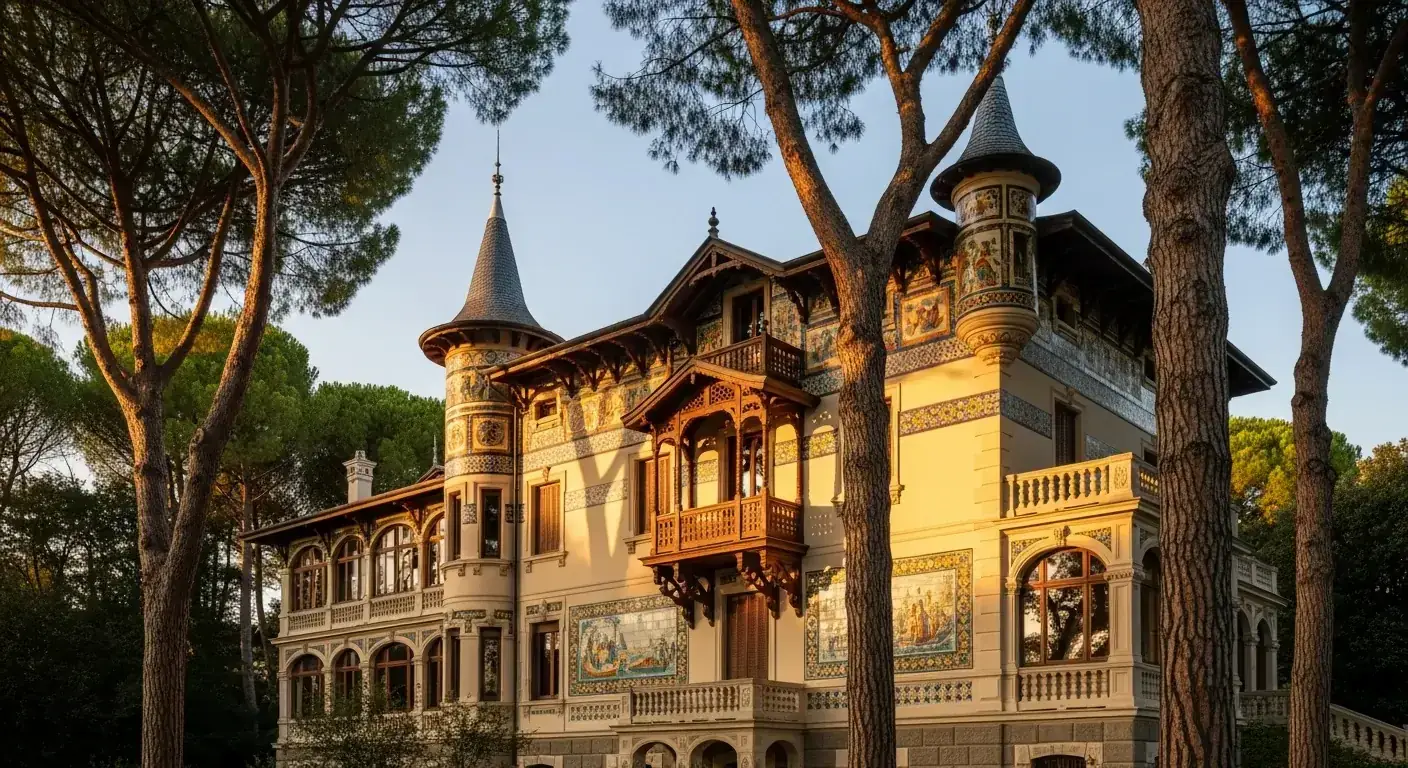
The Pereires' most visionary idea was the Ville d'Hiver. In the 19th century, tuberculosis was devastating Europe's affluent classes, and doctors prescribed pine-scented air as part of the cure. The Pereires saw the opportunity: on Arcachon's wind-sheltered hills, they created an entire district for wealthy patients, an open-air sanatorium where guests stayed in a private villa rather than a medical institution.
The result: more than 300 villas in the most eclectic styles (Swiss chalets, neo-Gothic mansions, Moorish pavilions, neoclassical facades, Hispano-Moorish palaces). An architectural masterpiece unique in France.
The project was, in fact, a vast property development led by the brothers Émile and Isaac Pereire, bankers and railway builders, with their nephew Paul Régnauld, a graduate of the École Polytechnique, overseeing the work. Across approximately 110 hectares of wooded dunes, they created an entire district devoted to “picturesque architecture”, combining Swiss chalet, Neo-Gothic, Moorish, colonial villa and Italian Renaissance styles, followed later by Art Deco. Each villa bears a name and a date: Toledo (1862), Brémontier (1863), Trocadéro (1863-1864), Craigcrostan (1880), Alexandre Dumas (1895), Vincenette (1895) and Iris (1925, Art Deco).
To connect two hills separated by a ravine about fifteen metres wide, Paul Régnauld commissioned a metal footbridge in 1862, the Saint-Paul Footbridge. A 25-year-old engineer named Gustave Eiffel worked on it, a quarter of a century before his famous Paris tower. Mauresque Park, the district's green heart, once lay below the Moorish Casino. It became an arboretum in 1992 and now contains tree species from around the world.
Casinos in Arcachon
The resort once had two major casinos. The first, Château Deganne, is an 1853 villa inspired by a Loire Valley château; it now houses the waterfront Casino de la Plage. The second, the lavish Moorish Casino, was built in 1863 to an Alhambra-inspired design by architect Paul Régnauld at the top of the Ville d'Hiver park. It captivated generations of holidaymakers before being destroyed by fire in 1977.
Famous Vacationers
Arcachon became one of Europe's most fashionable health resorts. Its guests included Queen Victoria, Empress Elisabeth of Austria (Sisi), Tsarevich Alexander III (the future Russian emperor), Toulouse-Lautrec, Debussy, Gabriele d'Annunzio and Alexandre Dumas. A cosmopolitan elite spent entire winters in the villas.
Today
Tuberculosis has receded, but the villas remain. The Winter Town is a listed site under France's 1930 law on the protection of natural monuments and sites: its northern section was listed on May 23, 1943, followed by the entire district on September 18, 1985. It is therefore not a “Historic Monument” in the strict sense, but a protected site recognised for its exceptional urban landscape. A walk through its narrow streets is perhaps the most surprising part of a visit to Arcachon: few expect to find such architecture on France's Atlantic coast.
The 4 Neighborhoods of Arcachon
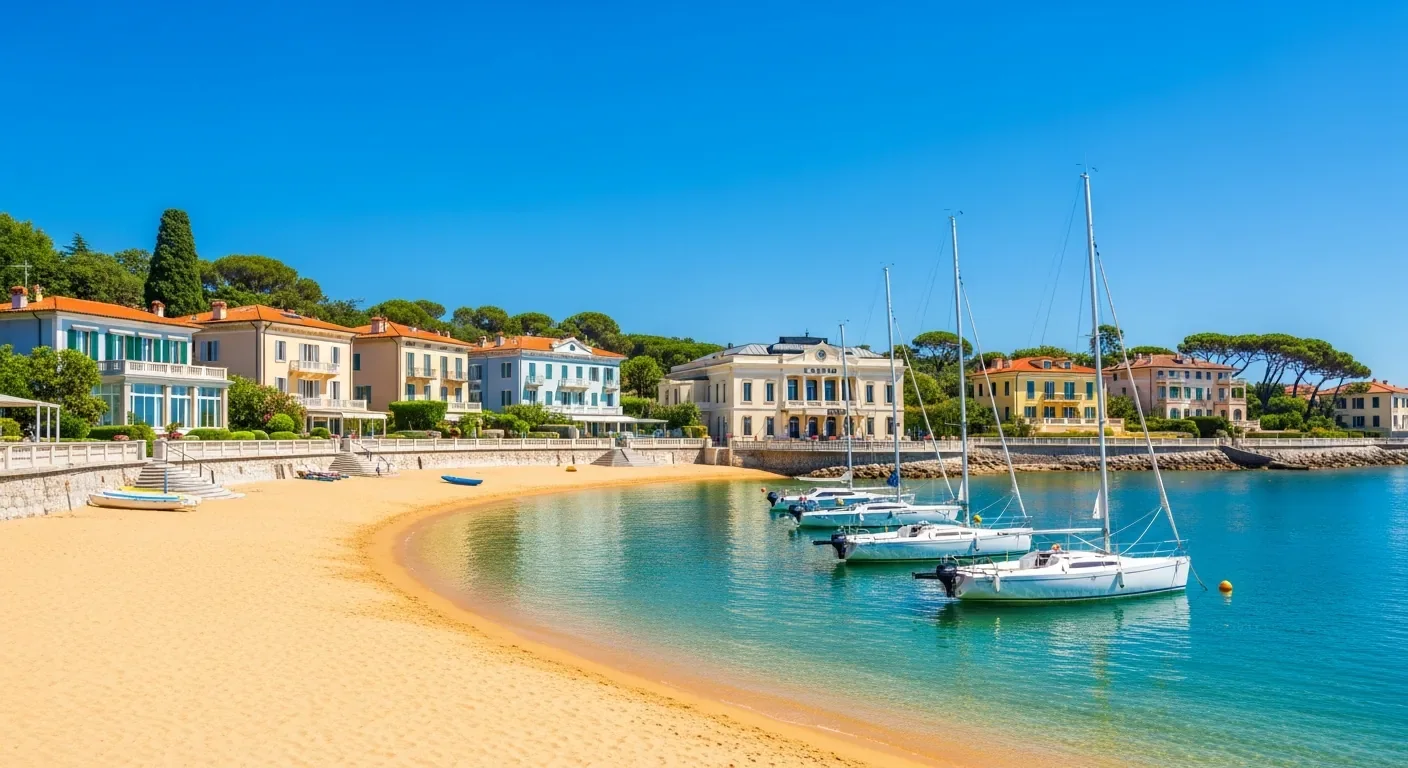
Arcachon is divided into four districts, each named after a season. This is more than a tourist conceit: it reflects an urban-planning tradition dating back to the 19th century, with each district designed for a different way of experiencing the town.
| Neighborhood | Position | Identity | Must-See |
|---|---|---|---|
| Winter City | Southern hills, sheltered from the wind | Sanatoriums and villas from the 1860s | 300 villas (Toledo, Brémontier, Dumas, Trocadéro) · Mauresque Park · Sainte-Cécile Observatory (1863) |
| Summer Town | Central Waterfront | Lively beach life | Lifeguard-patrolled beaches · casino · Baltard covered market · Thiers pier (Cap Ferret shuttle boats) · Eyrac pier |
| City of Spring | Southwest Pine Forest (Pereire, Abatilles, Moulleau) | Residential, tree-lined, quieter | Pereire Beach (family-friendly) · Source des Abatilles · Port of Arcachon (pinasse boats) · Le Moulleau (Neo-Byzantine church) |
| City of Autumn | Aiguillon Neighborhood (east) | Fishermen and oyster farmers | Marina · oyster huts · authentic oyster bars · top spots for seafood |
Winter City — the surprise highlight of the trip
Of the more than 300 villas originally built, over 200 can still be seen today, many in remarkably good condition. Mauresque Park (free admission) is the ideal starting point: the Moorish Casino that once overlooked it burned down in 1977, but the park itself, an arboretum since 1992, remains striking for its exotic trees. From the Sainte-Cécile Observatory, the view over the bay is superb. This 25-metre-high metal structure was designed in 1863 by architect and engineer Paul Régnauld; the young Gustave Eiffel contributed to the project, a quarter of a century before his tower. Allow 1½ to 2 hours for a walking tour. The tourist office offers guided visits from April to October.
Walking through the Winter City is like leafing through an open-air architectural catalog: a Swiss chalet facade stands next to a Moorish loggia, a neo-Gothic gable faces a colonial villa, and the names engraved on the gateways—Toledo, Trocadéro, Brémontier—unfold like the pages of a 19th-century novel. Take the time to look up at the intricately carved wooden balconies, turrets, and glass-enclosed verandas: each was designed to offer spa guests light, fresh air, and views of the pine trees. The silence of the narrow streets, away from the hustle and bustle of the waterfront, completes this neighborhood’s unique character—an intimate counterpoint to the seaside resort.
Summer Town — the seaside resort
In summer, the atmosphere is festive and lively. Outside the main season, the waterfront recovers a welcome sense of calm. Sunset from Thiers Pier, looking across the bay, is one of the finest sights on the Atlantic coast, especially in autumn and spring when the low light reaches the Dune du Pilat to the south.
Ville d'Automne — the other Arcachon
This is where you'll find the best fishmongers and the most down-to-earth oyster bars, well away from the waterfront's tourist traps. If you want to escape the summer crowds without leaving Arcachon, this is the district to choose. It is also the starting point for waterside walks heading east towards La Teste-de-Buch.
The waterfront: piers, casinos, and the aquarium
The Arcachon waterfront reads like an open-air history book. Between the “Summer Town” and the “Fall Town,” piers, casinos, and monuments tell the story of the resort’s golden age as a seaside destination—a time when the bourgeoisie came to “take the waters” and when people set sail for Cap Ferret from the wooden piers.
The Piers
The oldest is Eyrac Pier, built in 1845 by engineer Alphand, who would later design several of Paris's great parks. Originally wooden, it was rebuilt in reinforced concrete in 1903 and later officially renamed Pierre-Lataillade Pier. Thiers Pier was built between 1901 and 1903 and inaugurated on September 12, 1903. Initially known as the “New Pier”, it received its present name in 1907. Today, it is the departure point for Bateliers Arcachonnais (UBA) ferries to Cap Ferret, a crossing of about 30 minutes that avoids the long road detour around the head of the bay.
The Sailors' Cross and the Sailors' Monument
Beside La Chapelle Pier stands the Sailors' Cross. The first cross, made of wood and painted red, was erected in 1722; sailors saluted it as they left the harbour for the open sea. The present cross dates from 1902. Nearby, the memorial to sailors lost at sea, carved from Creuse granite, was erected in 1968. It is a reminder that the bay, for all its picture-postcard beauty, opens onto a dangerous ocean.
The Museum-Aquarium
The former Museum-Aquarium is a wooden building constructed in 1867 under Napoleon III, at the initiative of the Arcachon Scientific Society. Its aquarium hall was rebuilt between 1930 and 1935 by architect Marcel Ormières. It is often described as “one of the oldest aquariums in Europe”—a reputation that is more a credit to the local scientific society than an officially recognized record, but one that clearly illustrates Arcachon’s early status as a center of science as well as a resort town.
Casinos, Then and Now
Two casinos have left their mark on the resort. The Deganne Castle (1853), a villa inspired by a Loire Valley château, still stands on the waterfront, where it houses the Casino de la Plage. The second, the magnificent Moorish Casino from 1863 (designed by architect Paul Régnauld), crowned the Ville d'Hiver park in an Alhambra-inspired style, before being destroyed in a fire in 1977. The true spirit of Arcachon lies in the contrast between the two: the lower town, focused on seaside festivities, and the upper town, focused on rest and spa treatments.
Oyster farming: the economic and cultural heart of the Basin
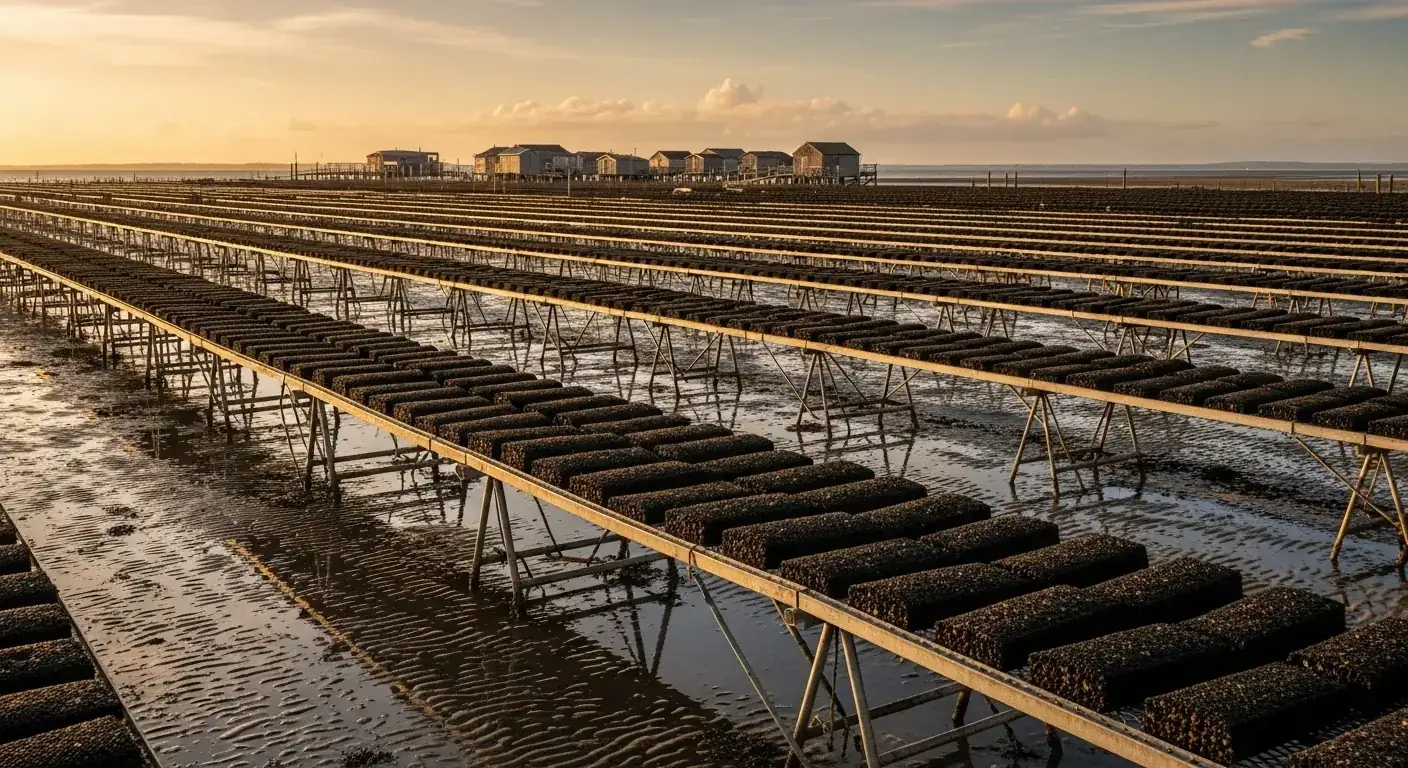
The oyster is the emblem of Arcachon Bay, just as wine is for Saint-Émilion or the Médoc. It is far more than a tourist cliché: it is a genuine local industry.
| Data | Value |
|---|---|
| Annual Production | 7,000 to 10,000 metric tons of market oysters |
| Oyster-bed area | Approximately 780 hectares of foreshore |
| Oyster Farming Companies | Approximately 300 growers, ~26 oyster-farming ports around the bay |
| Ports in Gujan-Mestras | 7 ports along a 7-kilometer stretch of coastline |
| Oyster spat (baby oysters) | The bay is one of the only two French oyster-growing areas where oysters reproduce naturally |
| Cultivated species | Pacific oyster Magallana gigas (formerly Crassostrea gigas), the only species farmed since 1970–1971 |
A history dating back to 1849
Modern oyster farming in Arcachon Bay dates from the mid-19th century. The first oyster-farming concessions were granted in 1849, before Napoleon III established the imperial oyster beds. Until then, oysters had been harvested from the wild; farming turned the activity into an organised industry.
| Landmark | Step |
|---|---|
| 1849 | First official oyster-farming concessions in the bay |
| 1856 | Napoleon III establishes the imperial oyster beds |
| 1865 | Development of the limewashed roof tile (Michelet method) for collecting spat |
| 1868 | Accidental introduction of the Portuguese oyster |
| The 1920s | Disease devastates the native European flat oyster |
| 1970-1971 | Epizootics wipe out the Portuguese oyster; the Pacific oyster permanently replaces it |
| Today | It takes 3 to 5 years to raise spat into market-size oysters |
Along with Marennes-Oléron, Arcachon Bay is one of only two areas in France where oysters reproduce naturally. This makes it a major supplier of spat, or juvenile oysters. Arcachon's natural spat is sent to other French oyster-growing regions, notably Brittany and Normandy, and exported as far as Ireland, Portugal and Spain. Today, the bay has approximately 780 hectares of oyster beds, about 300 oyster farmers and nearly 26 oyster-farming ports around its shores.
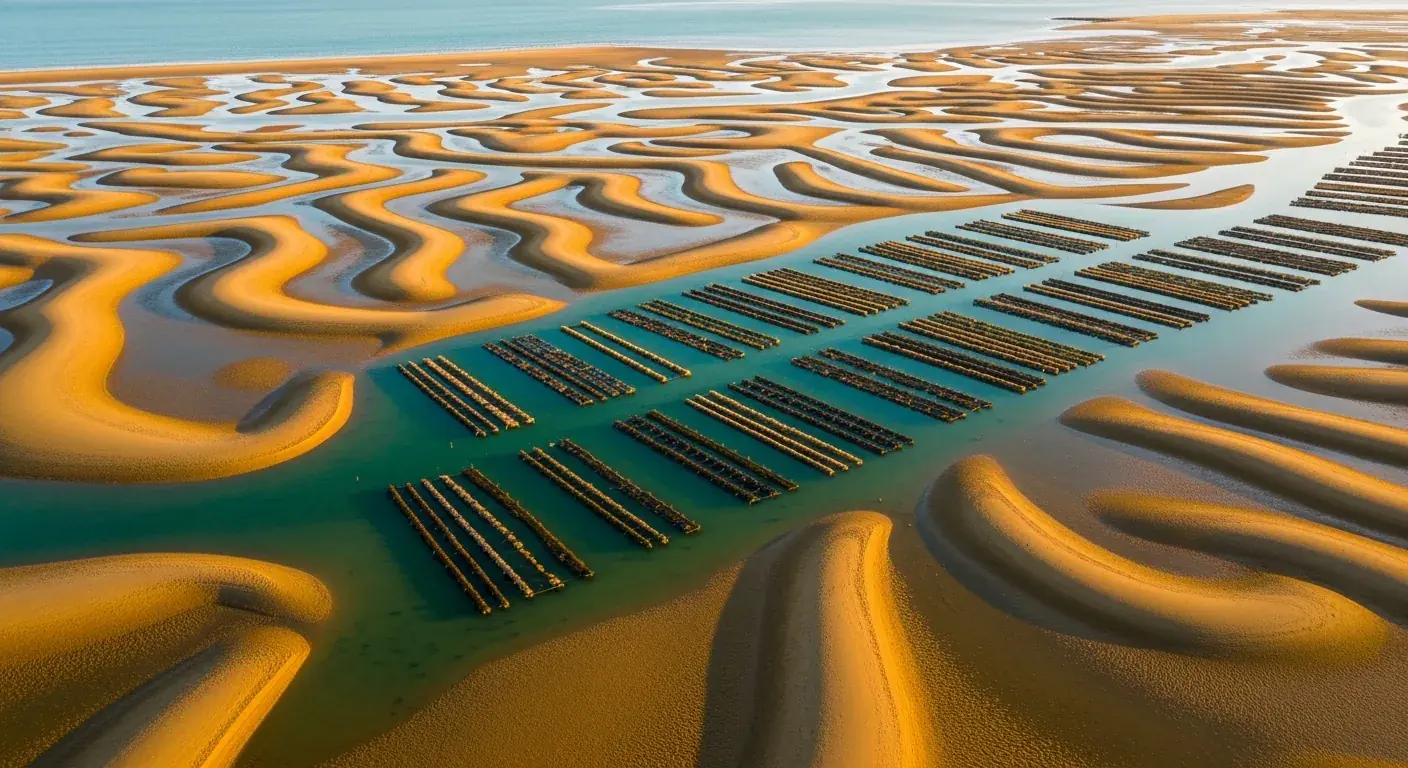
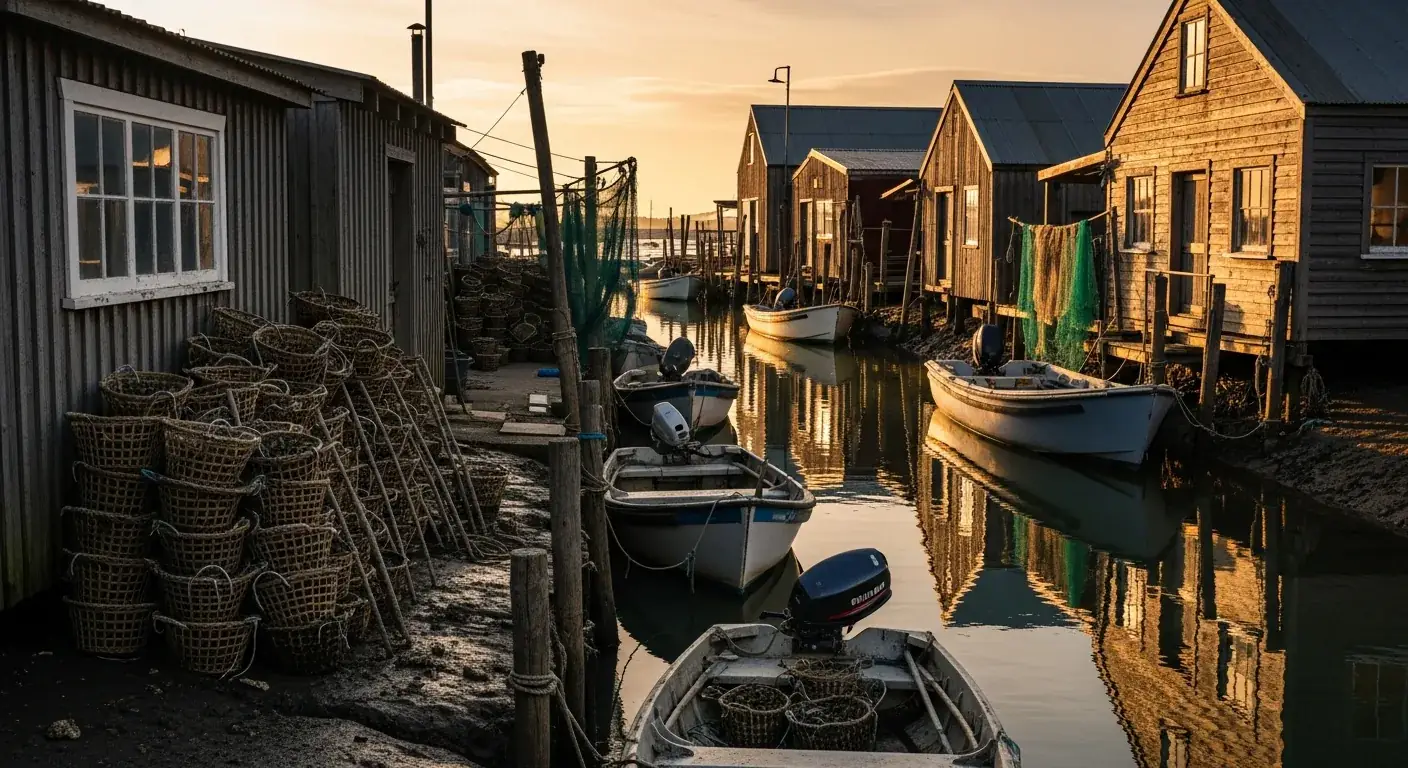
Oyster farming shapes the landscape as much as it drives the local economy. At low tide, the oyster beds come into view: rows of wire-mesh bags set on metal trestles, channels marked by stakes and colourful wooden cabins lining the ports. Oysters grow slowly here. It takes three to five years from collecting the spat to producing an oyster ready to eat, with many stages of separating, turning and grading along the way. This patient work explains why each grower champions a distinctive flavour shaped by the location of the bed, the water's salinity and the length of maturation.
The 7 oyster-farming ports of Gujan-Mestras
| # | Port | Atmosphere |
|---|---|---|
| 1 | La Hume | The southernmost, quiet |
| 2 | Meyran | Small port, local atmosphere |
| 3 | Gujan | Historic central port |
| 4 | Larros | The liveliest · Maison de l'Huître · oyster market on Thursday evenings in the summer |
| 5 | Le Canal | Low-key, more authentic |
| 6 | La Barbotière | Transshipment port |
| 7 | La Mole | To the north, toward Le Teich |
Port de Larros is a must-see. The Maison de l'Huître is open year-round and traces the history of oyster farming since the 19th century, from oyster beds and spat collection to grow-out and finishing.
Enjoy Oysters Like a Local
Tasting at the grower's cabin is the best way to experience the local oysters. As a guide, expect €6–12 for a dozen, depending on size, served on site with rye bread and lightly salted butter.
| Traditional pairing | Details |
|---|---|
| Rye bread + lightly salted butter + lemon | For the classics |
| Shallot Vinegar | For purists |
| Grey shrimp or whelks | In addition |
| Local dry white wine | Entre-Deux-Mers or white Graves (avoid Muscadet, which isn't local) |
Local etiquette: savour the oyster liquor before swallowing. If the oyster contracts when lemon touches it, that simply shows how fresh it is.
Seasonality: oysters are sold year-round around the bay, but the months containing an “r” (September to April) are traditionally favoured. The oysters are firmer, brinier and less milky; in summer, during the breeding season, they become creamier.
The Teich Bird Sanctuary
At the head of the bay, where the Eyre, the only river flowing into Arcachon Bay, reaches the lagoon, lies one of France's most remarkable natural sites and one of its oldest bird sanctuaries.
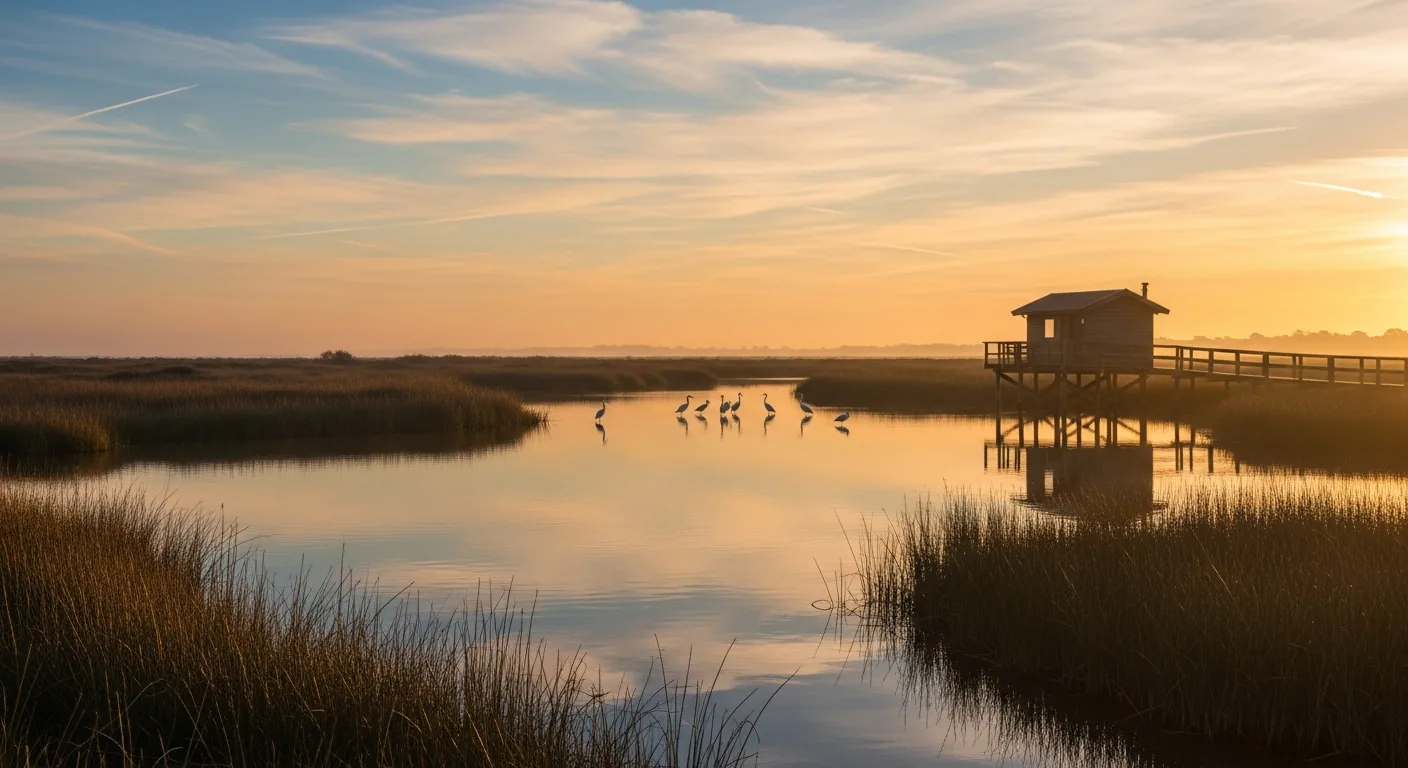
The reserve has been open to the public since 1972 and is managed by the municipality of Le Teich in partnership with the Landes de Gascogne Regional Natural Park. Its 110 hectares occupy former 18th-century fish-farming ponds at the mouth of the Eyre, now converted into a chain of wetlands ideal for birdlife. In total, 328 species have been recorded, of which approximately 80 breed on site.
| Data | Value |
|---|---|
| Area | 110 hectares of marshes, reed beds, lagoons and salt meadows |
| Bird Species | 328 recorded, including ~80 breeding birds |
| Migration peak | Some tens of thousands of birds in transit, depending on the season |
| Marked Trail | Main loop of approximately 6 km, 20 observatories (including 4 elevated ones) |
| Adult Rate | Approximately 9-10 € · Free for children under 5 |
| Duration of visit | 2 to 4 hours |
| Opening | All year round except December 25 · best times: early morning or late afternoon |
What You'll See There
White storks (present year-round, with spectacular nests) · grey herons, little egrets and spoonbills · pied avocets, godwits and curlews · common shelducks, teals and northern shovelers · ospreys in spring and autumn. In winter, tens of thousands of migratory ducks settle on the lagoons.
Particularly interesting in fall (migration) and late winter / early spring (mating displays). Binoculars are highly recommended (available for rent on site).
The tour is a self-guided walking tour along the marked loop trail: you walk in silence from one observation point to the next, binoculars around your neck, keeping an eye out for a stork in its nest or a spoonbill fishing. The elevated observation decks offer a panoramic view of the lagoons, while the low huts allow you to get close to the birds without disturbing them. Be sure to bring sturdy shoes, water, and a hat in the summer—and a little patience: the best sightings come to those who stay still for a few minutes.
The Northern Basin: Andernos, Audenge, Arès
When people think of Arcachon, they often think of the southern part of the Bay. But the north coast (between Lanton and Lège-Cap Ferret) offers a quieter, more local, and sometimes more authentic side.
| Municipality | Atmosphere | Things to See and Do |
|---|---|---|
| Andernos-les-Bains | A family-friendly beach resort—the liveliest in the north | Long pier, Friday morning market, family-friendly beaches (shallow water), pinasse boat tours, a sailing hotspot |
| Audenge | Peace and quiet, watery landscapes | Fish-farming ponds (19th century), levees, promenades |
| Arès | Northern tip, a well-preserved fishing village | Certes Estate, family-friendly beaches, Prés Salés d'Arès and Lège Nature Reserve (free) |
| Lanton, Biganos, Le Teich | Quiet Northeast Basin | Small ports, oyster huts, marshes—the best prices and peace and quiet during the off-season |
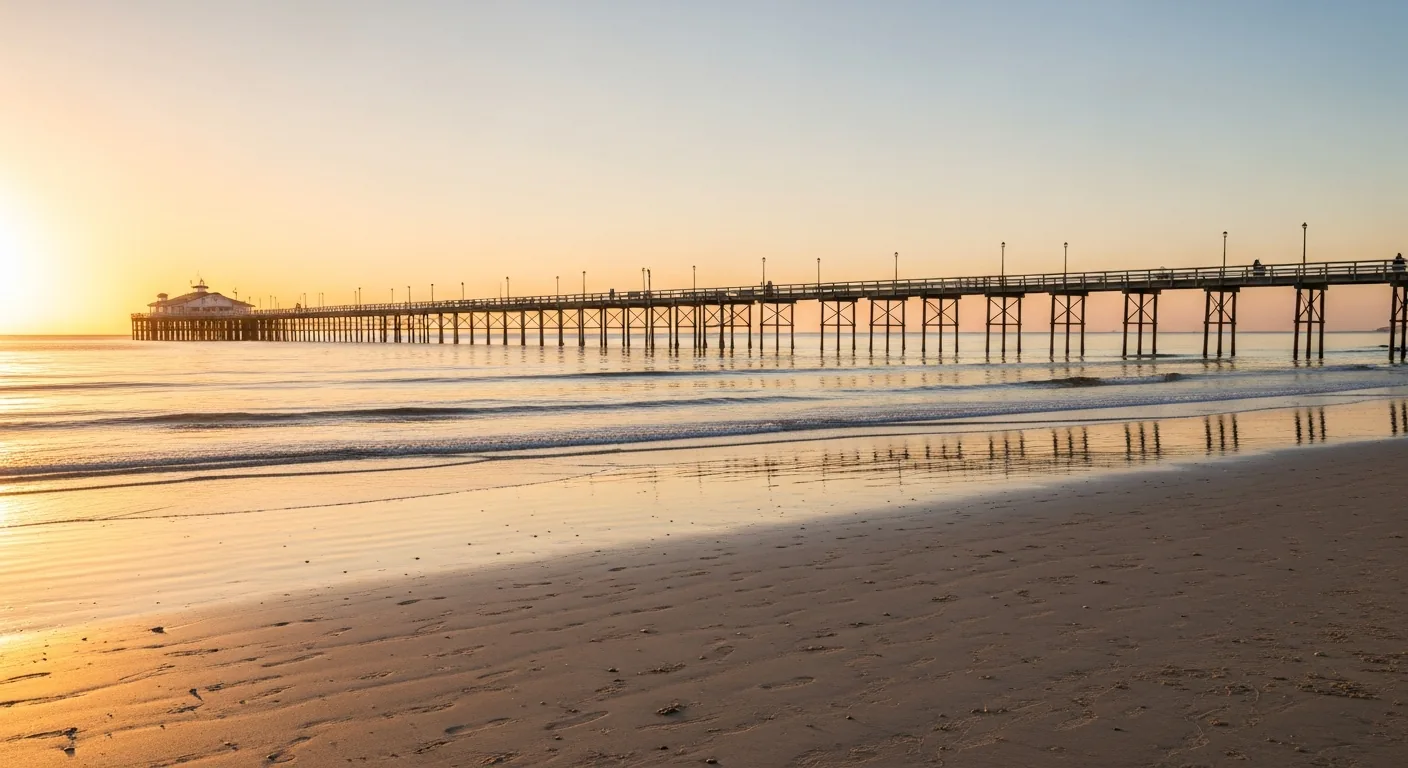
A few highlights make the case for stopping here. At Andernos-les-Bains, the pier stretches about 232 metres across the foreshore, making it one of the longest in France. Saint-Éloi Church and the nearby early Christian ruins reflect the area's long history of settlement. Audenge centres on its port and former fish-farming ponds, now popular for walks. At the northern end, Arès retains its oyster port and provides access to the Prés Salés d'Arès et de Lège-Cap-Ferret National Nature Reserve, which can be explored freely on foot among dykes and channels.
Activities in the Basin
Cycling: 330 km of bike paths
Arcachon Bay is one of France's best cycling destinations. More than 330 km of marked cycle paths circle the bay and run deep into the pine forest. The Vélodyssée, France's long-distance Atlantic cycle route, passes through the area.
| Itinerary | Distance | Who is it for? |
|---|---|---|
| Complete Arcachon Bay Tour (short route, bridges & ferries) | 80–90 km | Experienced cyclists, one day |
| Complete Tour of the Basin (Long) | 130 km | Experienced cyclists, two days |
| Arcachon → Cap Ferret via the southern route | 70 km | Fit cyclists, exceptional scenery |
| Arcachon → Le Moulleau → Pyla | 10 km | Easy, waterfront + pine forest |
| Andernos → Arès → Cap Ferret | Easy | Families |
Bike hire is available in every municipality: €15–25 per day for a standard bicycle and €30–50 for an electric mountain bike.
Boats: pinasses, ferries and oyster tours
The best way to understand the Basin is from the water.
| Formula | Duration | Estimated Price |
|---|---|---|
| Traditional Pinasse Boat Tour | 1 hour–1 hour and 30 minutes | 15-30 € |
| Île aux Oiseaux + stilt huts | 1 hour–1 hour and 30 minutes | 15-30 € |
| Banc d'Arguin (National Reserve, terns & seals) | 2 hours | 20-40 € |
| Tour of the Lagoon + Stop at an Oyster Farm & Tasting | Half-day | 50-80 € |
| Bateliers Arcachonnais (UBA) Shuttle Service to Cap Ferret | 30–45 min | 10–15 € one way |
Paragliding, sailing, kitesurfing, fishing
The bay is ideal for water sports. Sailing is particularly popular, with clubs in Andernos, Arcachon and Cap Ferret. Kitesurfing has grown rapidly in recent years, especially around Banc du Bernet and on selected Cap Ferret beaches. Paragliding offers the most spectacular views, with tandem flights from the Dune du Pilat. Shore gathering is permitted at low tide for clams, cockles and shrimp, subject to strict limits on sizes and quantities.
Two major destinations, each with its own page
The Dune du Pilat
| Data | Value |
|---|---|
| Location | 10 km south of Arcachon, in the town of La Teste-de-Buch |
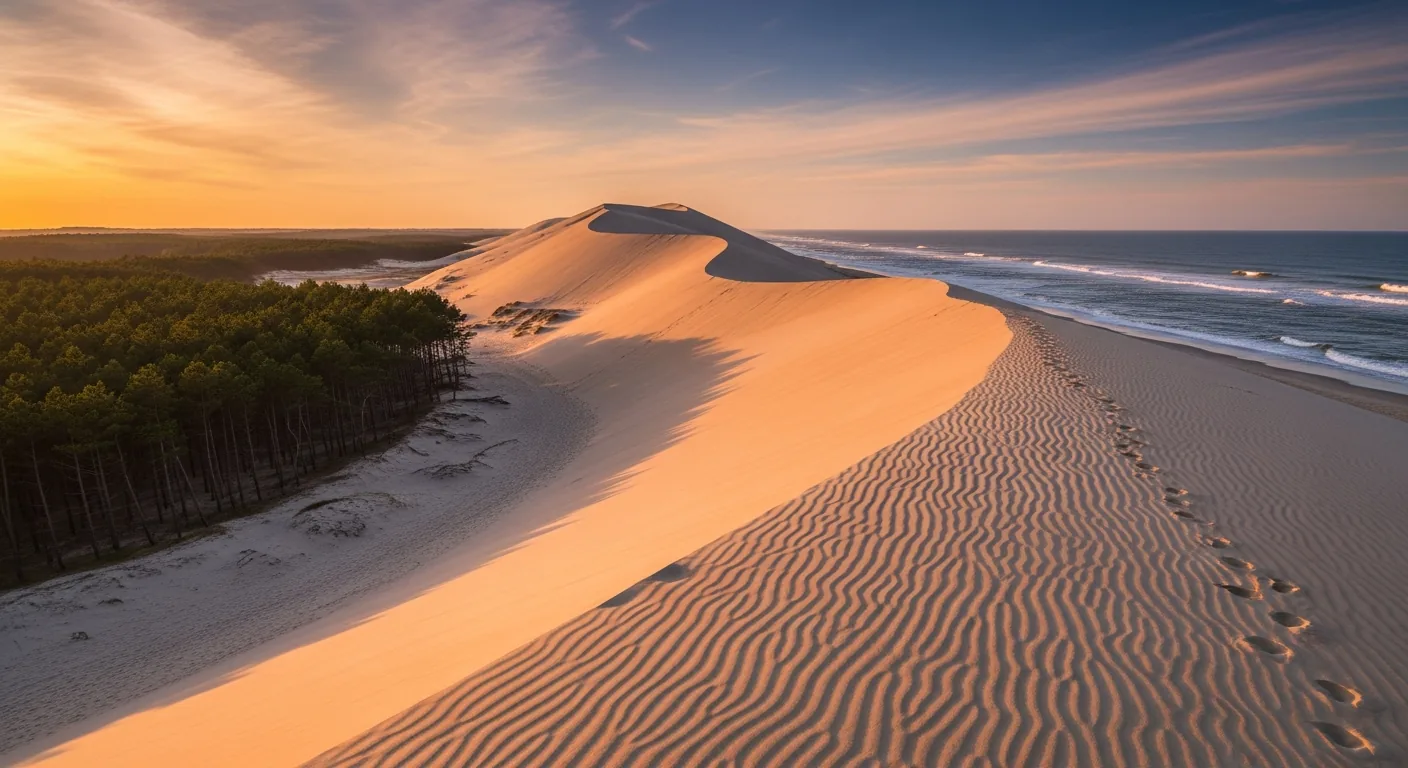
| Height | Approximately 100 meters · Europe's tallest sand dune |
| Length | 2.9 km |
| Attendance | Nearly 2 million visitors per year · The second most popular tourist destination in Nouvelle-Aquitaine |
For complete details (access via stairs or the sand, recommended times during peak season, parking, access, weather-based recommendations, dedicated chauffeured transfers): see our Guide to the Dune du Pilat.
The Cap Ferret Peninsula
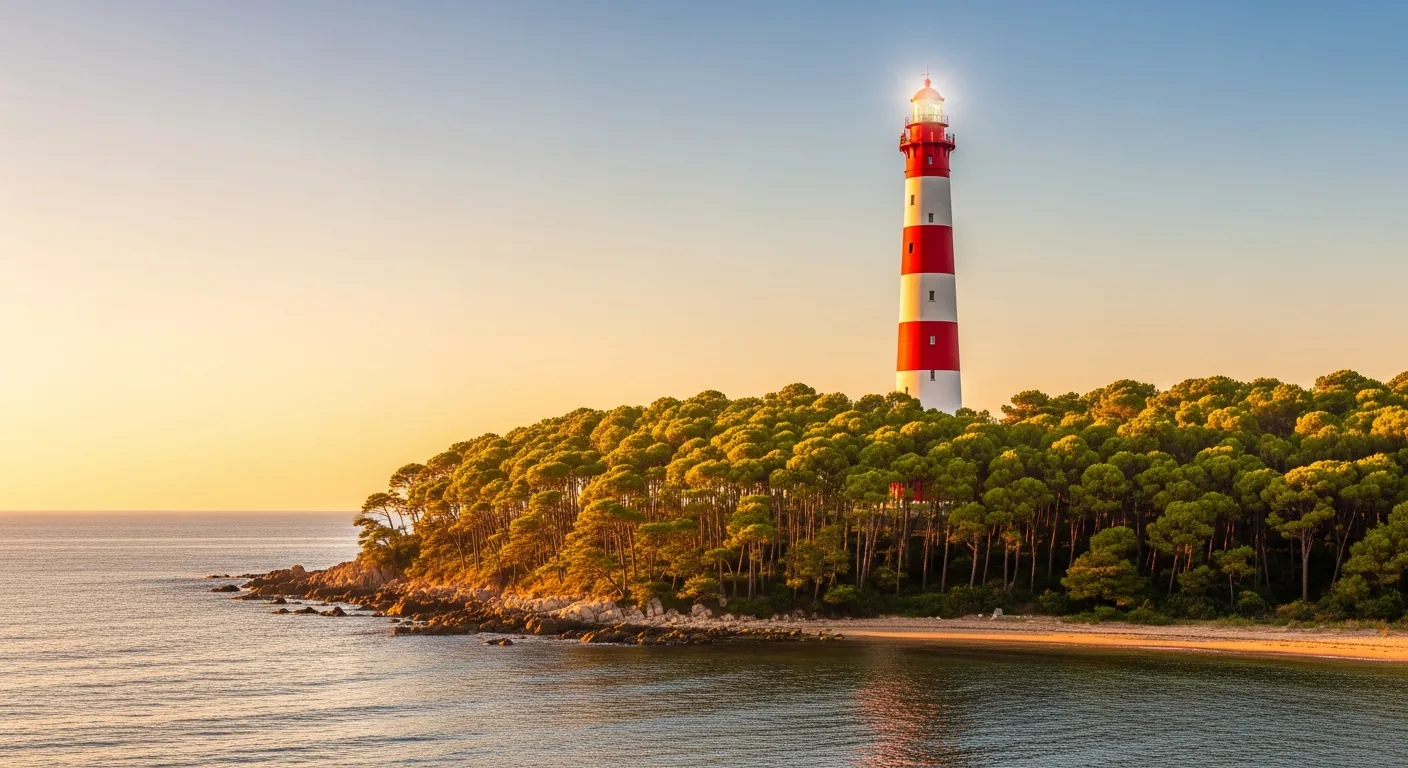
Along the western edge of Arcachon Bay, the Cap Ferret Peninsula is a 25-kilometre strip of sand separating the lagoon from the ocean. The atmosphere is very different from Arcachon: there is no urban waterfront or casino, but a succession of oyster-farming villages (L'Herbe, Le Canon, Piraillan and Lège), cycle paths, the lighthouse and two contrasting coastlines, with the calm bay to the east and the wild ocean to the west.
For complete details (oyster-farming villages, the Cap Ferret lighthouse, beaches, access from Arcachon by shuttle or from Bordeaux via a direct private chauffeur service): see our Guide to Cap Ferret.
When to Visit Arcachon Bay
| Period | Weather | Crowd | Tip |
|---|---|---|---|
| July–August | Warm, sunny | Very busy | Book everything in advance, and leave early in the morning |
| June | Nice, mild (20–25°C) | Moderate | Ideal: nice weather without overcrowding |
| September | Still warm, water temperature 20°C | Low to moderate | Our recommendation — best value for peace of mind |
| October–November | Variable, mild | Very low | Top-notch oysters, low prices, local vibe |
| December–February | Cool, windy | Very quiet | For wild landscapes and quiet walks in the Ville d'Hiver |
| March–May | Spring (15–22°C) | Low | Spectacular lights, flowers among the pine trees |
Upcoming Events
| Event | Period | Location |
|---|---|---|
| Oyster Festival | August | Gujan-Mestras (tastings, fireworks — major oyster festival) |
| Cabins on Parade | Summer | Larros (farmers' night markets) |
| Regattas | May through September | Throughout the bay (pinasse boats, sailboats, traditional boats) |
| Night Markets | July–August | Oyster-farming villages |
Two seasonal factors are worth remembering. First, oysters can be enjoyed year-round, but connoisseurs still favour the months containing an “r”, from September to April. At that time, the oysters are firmer and brinier; in summer, during their breeding season, they become milkier and milder. Then there are the markets, which set the weekly rhythm and showcase local produce: Arcachon's covered market every morning, Andernos on Fridays and growers' markets, sometimes held in the evening during summer, in the oyster ports. Visit outside July and August to enjoy them without the crowds.
Where to Eat around Arcachon Bay
Arcachon Bay is not primarily a fine-dining destination in the Michelin Guide sense. Its strength lies in exceptionally fresh produce, served simply.
| Format | Estimated price | Details |
|---|---|---|
| Oyster huts | €15–25 per person | Straight from the producer · oysters, shrimp, whelks, rye bread, white wine · reservations recommended during peak season |
| Seafood Restaurants | €25–45 per person | Aiguillon & Ville d'Été Neighborhoods in Arcachon · Focus on the daily specials |
| Fine Dining Restaurants | 60–150 € per person | A few Michelin-starred restaurants between Arcachon, Pyla-sur-Mer and Andernos · local Arcachon Bay produce |
| Local Markets | — | Arcachon Covered Market (every morning) · Markets in the oyster-farming villages · Andernos on Fridays |
Helpful tip: avoid the tourist traps along the Arcachon waterfront in July and August. Explore the side streets or head to the oyster cabins in the ports; the best addresses are rarely on the main promenade.
Whether you are preparing a picnic or shopping for dinner, the markets are the best place to start. The Baltard-style Arcachon Covered Market opens every morning; the market in Andernos takes place on Fridays; and the oyster-farming villages hold growers' markets, often in the evening during summer. Expect oysters, grey shrimp, whelks, the catch of the day, rye bread and dry white wines from inland Gironde, everything needed for an authentic local meal on the beach or beneath the pines.
How to Get to Arcachon from Bordeaux
| Option | Duration | Estimated Price | Ideal for |
|---|---|---|---|
| TER Train | ~50 min | 10–15 € one way | A day trip, with a focus on Arcachon |
| Private driver | 50 min–1 hr | from €107 (Le Teich) / from €125 (central Arcachon) | Multi-stop trips, luggage, groups and families |
| Personal car | 55–70 min | Fuel + parking | Freedom, but parking can be a challenge during peak season |
| TransGironde Bus | 1½–2 hours | €2–5 | Minimal budget, no rush |
The TER train between Bordeaux and Arcachon is direct and fast, making it ideal for a stay in central Arcachon. If you want to combine several places, such as the oyster ports of Gujan-Mestras, Le Teich and Le Moulleau, or if you are travelling with luggage, an executive car service offers greater flexibility: no changes, no parking and no fixed return time.
For travellers arriving at Bordeaux-Mérignac Airport, a direct chauffeured transfer to Arcachon Bay avoids changing at the railway station. See our Bordeaux Airport Transfer page. For route details and fares, see Bordeaux to Arcachon by private chauffeur.
Book Your Transfer to Arcachon Bay
| Destination | Economy Rate (1–3 people) | Details |
|---|---|---|
| Le Teich | from €107 | One-way transfer |
| Downtown Arcachon | from €125 | One-way transfer |
| Pyla / Dune du Pilat | from €124 | One-way transfer |
| 4-Hour Arcachon Bay Tour | based on a quote | Multi-stop itinerary (oysters + dune + Ville d'Hiver) |
| 6-Hour Arcachon Bay Tour | based on a quote | Chauffeur at your disposal, complete tailored itinerary |
| 8-Hour Arcachon Bay Day | based on a quote | Eight-hour chauffeured itinerary: Arcachon Bay + Cap Ferret + lunch |
24-hour reservations on our Arcachon page or directly on the booking page.
Frequently Asked Questions
How long do you need to explore Arcachon Bay?
One day to see the highlights (downtown Arcachon + Dune du Pilat + oysters). 2 to 3 days to really enjoy it.
When is the best time for oysters?
Months with "r" (September through April) — firmer, with a stronger sea flavor. In summer: creamier (breeding season).
Are there family-friendly beaches?
Andernos-les-Bains (very calm, shallow water), Pereire Beach in Arcachon, Le Moulleau.
How can you avoid the summer crowds?
(1) Leave early in the morning · (2) June or September rather than July–August · (3) explore the Northern Basin.
Budget per person for one day?
Excluding the chauffeured transfer from Bordeaux, budget €10–25 per person for local public transport, €15–25 for oysters, €15–30 for a meal and €7–100 for activities. The private transfer to central Arcachon is listed separately from 125 € per vehicle. Rates checked in July 2026.
Arcachon and Saint-Émilion in a single day?
Feasible. Half a day for each. See our Saint-Émilion service.
What is a "pinasse"?
A traditional Arcachon Bay boat: flat-bottomed, 7–12 m long and designed for shallow waterways.
What are "tchanquées" huts?
Two houses on stilts built in 1946 and 1948 as vacation cabins on Île aux Oiseaux (in the town of La Teste-de-Buch). No. 53 is the most frequently photographed. They can be seen from pinasse boat tours.
Accessibility for people with disabilities?
Accessibility varies by pier, path and site conditions. Before setting out, check the route with the Arcachon Tourist Office and the Teich Bird Sanctuary. When booking, specify the wheelchair type, whether a ramp is needed and the number of accompanying guests so the Bordeaux chauffeur service can confirm an appropriate vehicle in writing.
How do tides work?
There are two tides per day; the tidal range varies from 1.10 m at neap tides to 4.90 m at spring tides. Check the tide schedules before going on a boat trip or beachcombing.
Why is Arcachon called the "City of Four Seasons"?
The nickname comes from the city’s tourist office, founded on April 19, 1905, which sought to attract spa guests year-round. Arcachon is, in fact, divided into four neighborhoods, each named after a season: the Winter Town (on the wooded hills, for spa treatments), the Summer Town (the seaside promenade), the Spring Town (a residential pine forest), and the Fall Town (fishermen and oyster farmers). The Winter City was built between 1862 and 1865 by the Pereire brothers; the Spring and Autumn districts were added in the early 20th century.
What is the Winter City?
This is the historic district of Arcachon, built on the hillside between 1862 and 1865 by the Pereire brothers to accommodate wealthy spa guests, at a time when tuberculosis was treated with pine-scented air. Spanning approximately 110 hectares, more than 300 villas featuring “picturesque architecture” (Swiss chalet, Neo-Gothic, Moorish, colonial, Art Deco) were built here, of which more than 200 still stand. Please note: this is not a “historic monument” but a site designated under the 1930 law (the northern section in 1943, the entire neighborhood in 1985).
How many oysters are produced in Arcachon Bay?
Approximately 7,000 to 10,000 metric tons of edible oysters per year, harvested from nearly 780 hectares of oyster beds by some 300 oyster farmers spread across about twenty oyster-farming ports. Most importantly, along with Marennes-Oléron, it is one of only two basins in France where oysters reproduce naturally: Arcachon thus supplies a large portion of the spat (young oysters) for other French oyster-farming regions and exports it as far as Ireland, Portugal, and Spain. It takes 3 to 5 years to raise an edible oyster.
How do I get from Arcachon to Cap Ferret?
The easiest and fastest option is the Bateliers Arcachonnais (UBA) ferry from Thiers Pier. The crossing takes about 30 minutes and avoids the long road detour around the head of the bay, more than 60 km and about an hour by car. From Bordeaux, you can also travel directly to Cap Ferret without passing through Arcachon; see our Cap Ferret guide for detailed directions.
Further Reading
- Private Chauffeur Service for Arcachon Bay (Packages, Rates, Reservations): Private Chauffeur Service: Bordeaux ↔ Arcachon
- The Dune du Pilat in Detail : Guide to the Dune du Pilat
- Cap Ferret in Detail : Guide to Cap Ferret
- Travel directly from the airport to Arcachon Bay: Bordeaux Airport Transfer
- Getting there from Saint-Jean Station : Private Chauffeur Service at Saint-Jean Station
- Combining Arcachon Bay and the Vineyards: Saint-Émilion and Médoc
Sources and References
- Arcachon Bay Tourist Office
- Arcachon Tourist Office (Ville d'Hiver Tours)
- SIBA — Arcachon Bay Press Kit — areas at high and low tide
- Arcachon Bay Marine Natural Park — How the Tides Sustain the Bay — lagoon dynamics
- Teich Bird Sanctuary
- Maison de l'Huître — Gujan-Mestras
- Arcachon-Aquitaine Regional Shellfish Farming Committee
- Arcachon Boatmen (UBA)
- Landes de Gascogne Regional Nature Park
Article updated on July 2, 2026.