
Bordeaux to Dune du Pilat: access, stairs and visitor tips
Europe's tallest dune: its unique location between the forest and the ocean, measurements from the OCNA, the staircase, access and parking, the view of the Banc d'Arguin—and how to get there from Bordeaux. Everything you need to know before you go.
In a nutshell
- The Dune du Pilat is the tallest sand dune in Europe: between 100 and 110 meters depending on the year; the most recent published figure is 101.7 m in May 2025. 2.9 km long, 616 m wide, approximately 60 million m³ of sand.
- Location: the town of La Teste-de-Buch (Gironde), at the southern entrance to the Arcachon Basin. 10 km south of Arcachon, 64 km from downtown Bordeaux (~57 min by car without traffic).
- Nearly 2 million visitors a year—the second most-visited tourist attraction in Nouvelle-Aquitaine after the Cité du Vin in Bordeaux.
- The site has been a protected area since 1943 (the designation was expanded in 1994, bringing the protected area to 6,875 hectares) and has been managed since late 2007 by the Syndicat mixte de la Grande Dune du Pilat. As a member of the Réseau des Grands Sites de France, the Dune is pursuing “Grand Site de France” certification—the application is currently pending and has not yet been granted.
- Free access for pedestrians and cyclists. For cars, the official parking fee ranges from 1 to 11 € depending on the duration and season, according to the rate schedule verified on July 24, 2026.
- A staircase with 130 steps in 2025 (the number varies between 130 and 160 depending on the year), installed from Easter to All Saints' Day, eco-designed using recycled plastic from fishing nets since the post-fire renovation in 2022.
- Best times to visit: May–June and September.
Pilat or Pyla? The Spelling Question
The first thing to clarify before anything else: Pilat or Pyla?
Both spellings coexist and cause constant confusion. Here is the rule:
- "Pilat" is the official spelling of the natural site—it is the name of the Dune du Pilat. This spelling is used on the official website (ladunedupilat.com), on government signs, in documents from the Conservatoire du littoral, and in communications from the Syndicat mixte.
- "Pyla" is the spelling used for Pyla-sur-Mer, the neighboring seaside village (in the municipality of La Teste-de-Buch). It is also sometimes used as an alternative spelling for the dune in everyday language—but it is not the official name.
The name is of Gascon origin — "Pilat" means "pile" or "mound" in the local dialect. The spelling "Pyla," on the other hand, was popularized in 1913 — in the 20th century, then, and not the 19th — when the developer Daniel Meller founded the seaside resort of Pyla-sur-Mer, Hellenizing the name to give it a more elegant ring.
So: the dune is spelled "Pilat," and the village is spelled "Pyla."
Before You Go: What the Dune Really Is
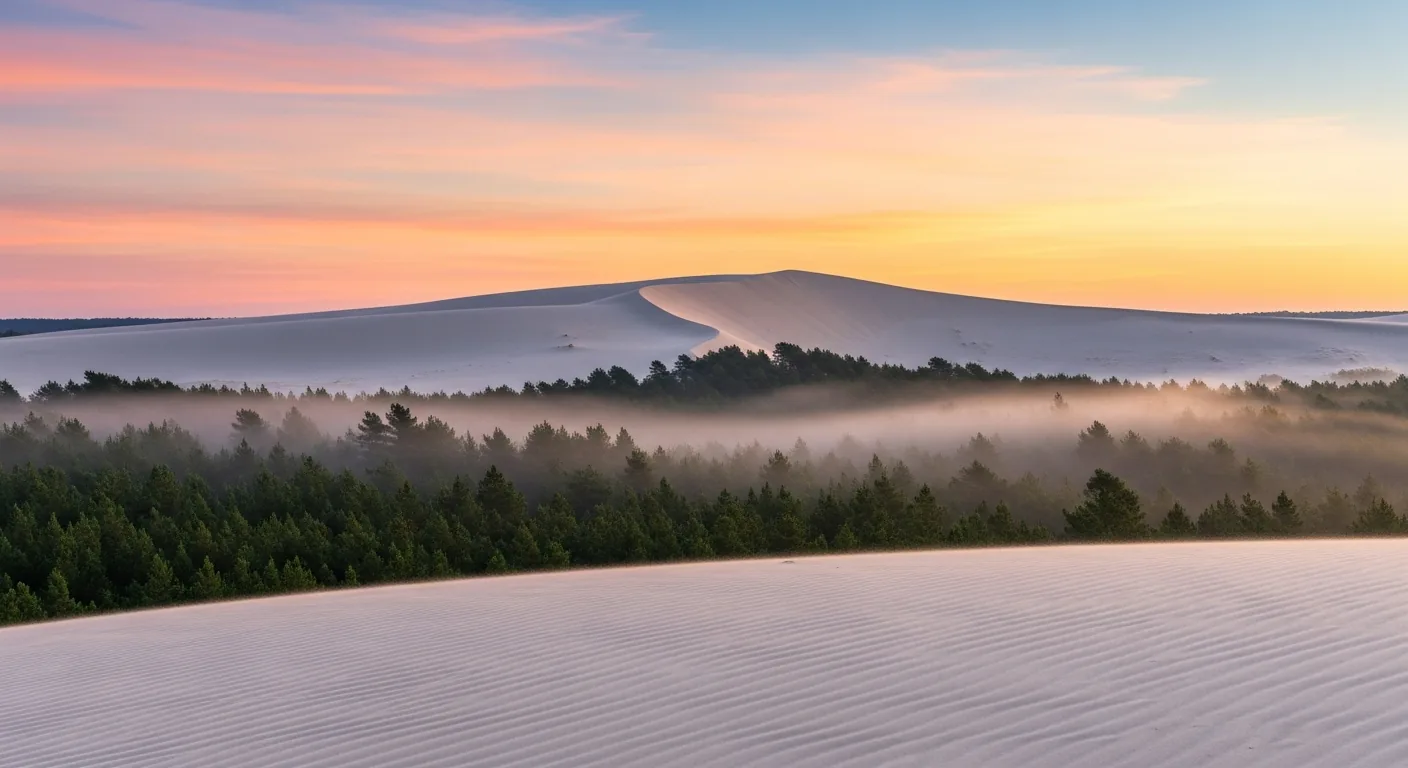
At 7 a.m., in late September. You climb the wooden staircase—130 eco-friendly steps made from recycled plastic derived from fishing nets, installed each spring and then taken down after All Saints’ Day. The slope is gentle, but halfway up you realize why everyone stops at least once. You reach the ridge. And that’s where everything changes.
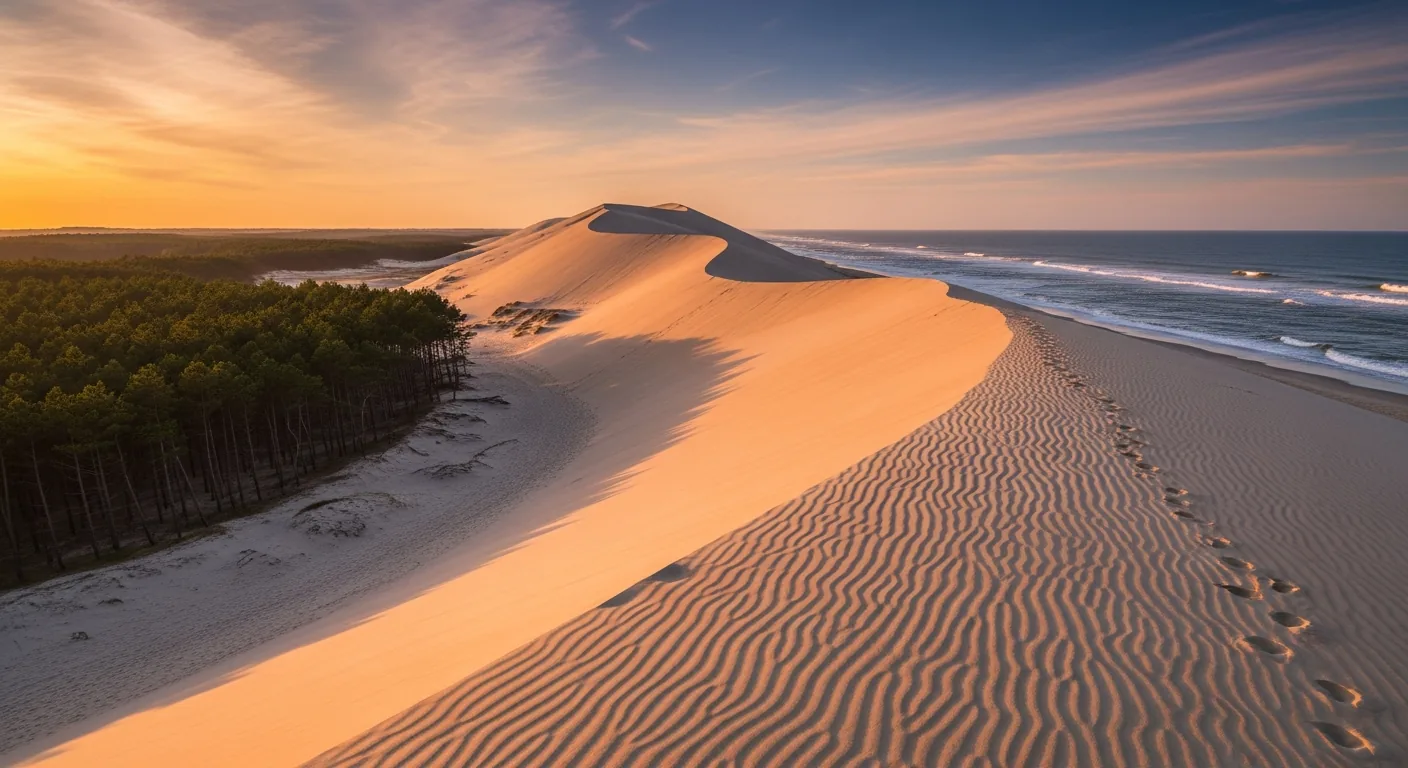
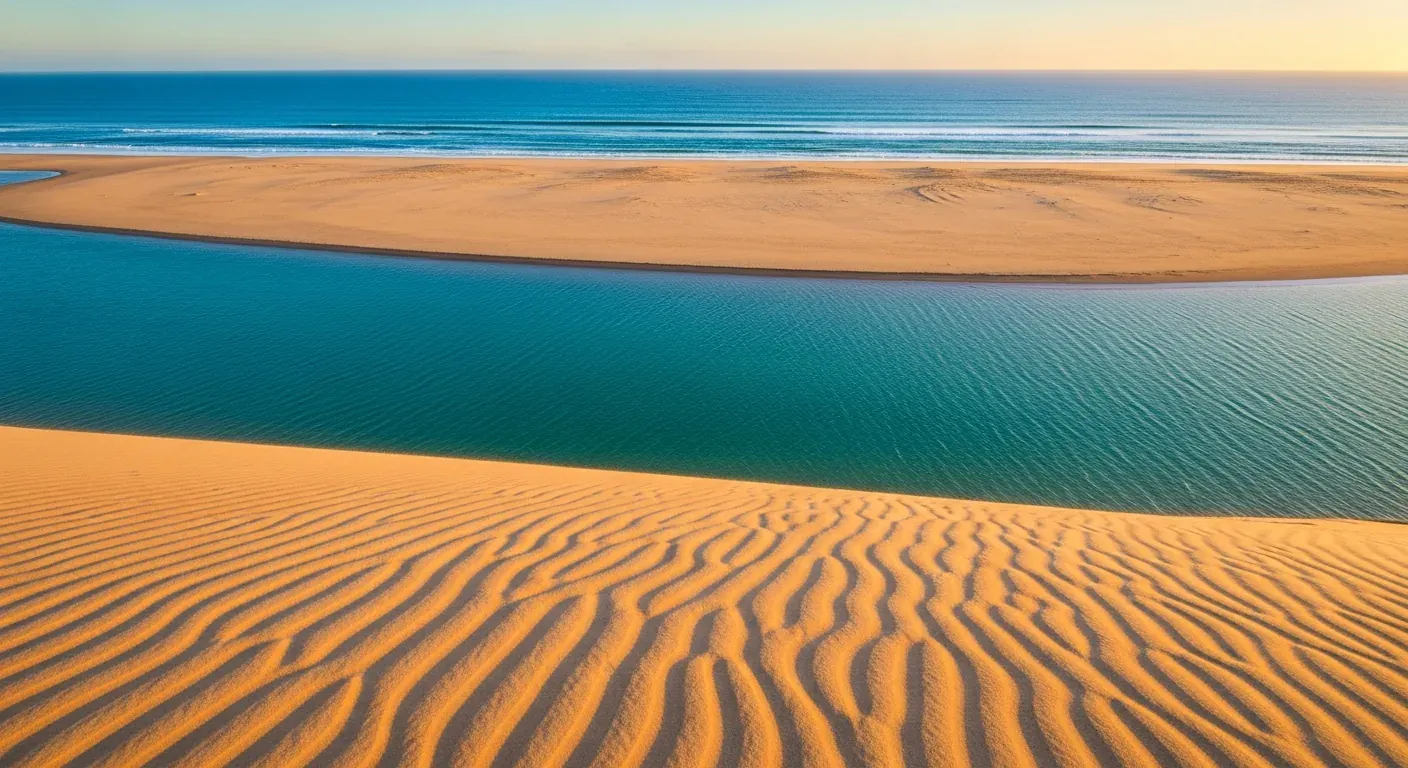
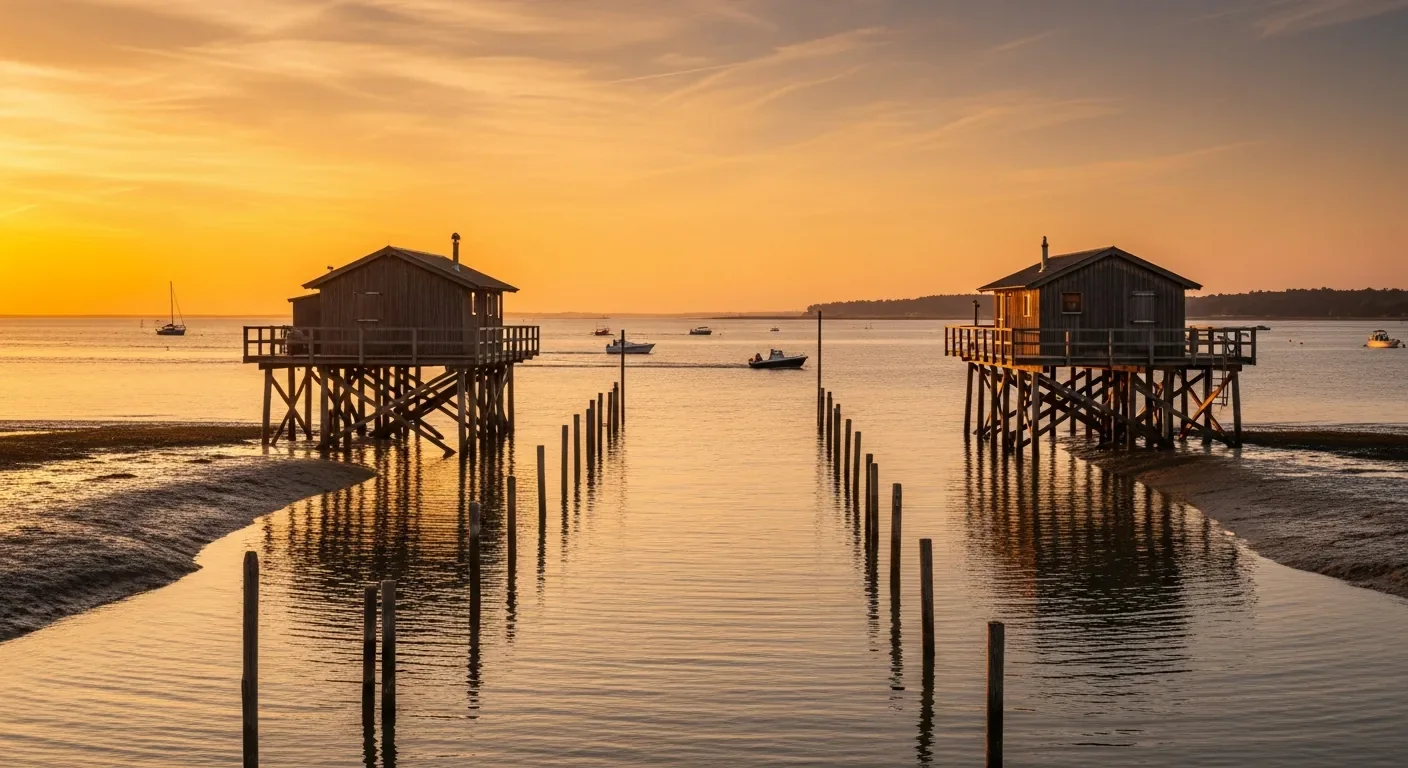
To the west: the Atlantic Ocean stretching as far as the eye can see, the Banc d'Arguin at low tide, and in the distance, the tip of Cap Ferret. To the east: the Landes pine forest, a green expanse stretching toward the horizon, still marked by the scars of the July 2022 fire. To the north: the Arcachon Basin, with its oyster beds and oyster huts. To the south: the Landes coastline stretching down toward Biscarrosse.
The Dune du Pilat is the tallest sand dune in Europe, located at the southern entrance to the Arcachon Basin, in the town of La Teste-de-Buch in the Gironde department. Its height ranges between 100 and 110 meters depending on the year; the latest published official measurement was 101.7 m in May 2025. It stretches 2.9 km from north to south and 616 m from west to east, and contains approximately 60 million m³ of sand. This unique location between the Atlantic Ocean, the Landes Forest, and the Arcachon Basin creates a 360° panorama of rare visual power—the sun sinking into the Atlantic to the west, the Banc d’Arguin at low tide, the tip of Cap Ferret on the horizon, and the maritime pines to the east. The dune is alive: it advances eastward by 1 to 5 meters per year and changes shape with every storm, which explains the annual measurements taken by the OCNA.
One point deserves to be clarified right from the start: We often read that the Dune has been designated a “Grand Site de France” since 2013. In reality, it does not yet hold this certification. The site has been protected since the decree of June 5, 1943, the scope of which was expanded in 1994 to reach 6,875 hectares, and it has been managed since late 2007 by the Joint Authority for the Grande Dune du Pilat. The Dune is Member of the Réseau des Grands Sites de France and has been working for years toward “Grand Site de France” certification—but the application is still pending: a An unfavorable progress report was issued in late 2024, related to the reconstruction of the campgrounds destroyed by the 2022 fire. The certification has therefore not yet been granted.
This guide is designed to help you understand all of this before you come. For practical information (how to get there, how much it costs, and what services are available), see our dedicated page on Bordeaux ↔ Dune du Pilat.
Geography: Why Exactly Here?
The Dune du Pilat is located at a very specific spot: the southern entrance to the Arcachon Basin, facing the southern strait that separates the tip of Cap Ferret from the Landes coast. This location is no coincidence.
Three geographical forces converge at this exact point:
The prevailing westerly winds constantly carry sand in from the ocean. Along the Aquitaine Atlantic coast, westerly winds blow with rare regularity, transporting the marine sand deposited by the tides.
Coastal currents (known as “littoral drift”) carry sediments from the Gironde estuary to the north and push them southward. This fine, uniform sand feeds the entire Landes coastline—and it is in this specific area that it accumulates.
The Landes Barrier halts the eastward advance of the sand. Without this vast forest of maritime pines planted in the 19th century under Napoleon III (more than one million hectares), the dune would have continued to spread and would have become flat. It is the contrast between the shifting dune and the stationary forest that creates its spectacular height.
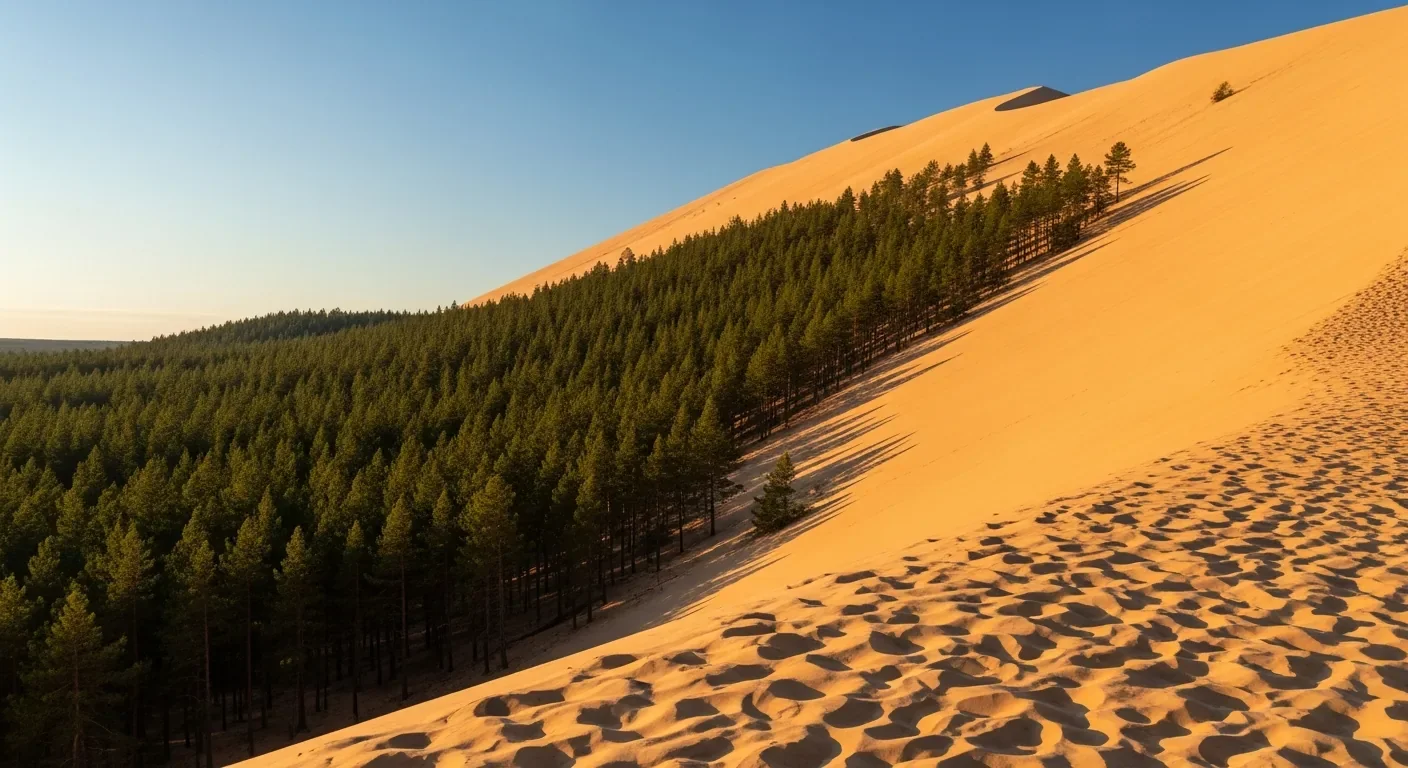
The result of these three geographical forces is a sandy structure over 100 meters high, in a state of unstable equilibrium, that advances eastward at an average rate of 1 to 5 meters per year across the pine forest. At the foot of the forested slope, one can still see dead pine trees half-buried—silent remnants of the forest swallowed up by the dune’s advance over the decades. The Dune du Pilat is now the last “shifting dune” in the Aquitaine dune system: all the other neighboring dunes were stabilized by the planting of maritime pines in the 19th century under Napoleon III. Due to its exceptional height and its exposure to westerly winds, the Pilat has escaped this stabilization and continues its inexorable geological movement, measured every spring since 2009 by the Nouvelle-Aquitaine Coastal Observatory.
Geological History: A Young Yet Ancient Dune
The Dune du Pilat, in its current form, is relatively young on a geological scale: its current shape dates back about 2,500 to 4,000 years, or even less, depending on the study. It formed on top of the remains of older dunes, dating from before the last ice age.
A little-known fact: the Dune du Pilat sits atop an older dune called the Dune de la Grave. Around 1860, marine erosion destroyed the vegetation that had held this older dune in place; the sand, now free again, began to shift, and the Dune du Pilat started to advance , burying the Dune de la Grave. What we climb today is therefore a superimposition of two large dune systems, one buried beneath the other.
Several construction phases followed one after another:
- During the coldest periods of the Quaternary, sea levels were much lower than they are today. The Atlantic coast was located much further west, and vast expanses of sand accumulated on what is now the continental shelf.
- At the end of the last ice age (about 18,000 years ago), melting ice caused sea levels to rise. The sand was redistributed by ocean currents and winds.
- The first dune ridges formed gradually. The current dune was formed through accumulation, in several stages, on top of older dunes.
Geologists describe a process of land formation that spanned approximately 4,000 years, occurring in five major phases, driven by the alternation between cold, dry, and windy periods—during which sand accumulates—and warmer, wetter periods—during which vegetation stabilizes it.
On the western face of the dune (the “windward” face, facing the ocean), this history can be read in cross-section thanks to paleosols—ancient soils that were buried and then exposed by erosion. In particular, we can see:
- The underlying paleosol, which preserves tree stumps in their original positions—remnants of a forest that once grew there before it was buried by sand.
- Layers containing kitchen waste: shells, pottery shards dating from the 11th to the 13th century, and flint tools—evidence of a medieval human presence at the site itself.
- A forest floor in the Landes region dating from the early 19th century, corresponding to the pine forest that had become established just before the dune resumed its advance.
Around 1910, the dune is believed to have reached its highest known elevation, approximately 115 meters—significantly higher than the current ~102 to 104 meters. Its growth was indirectly facilitated by the large-scale project to stabilize the sands of the Landes region: at the turn of the 18th and 19th centuries, engineer Nicolas Brémontier developed a technique for stabilizing dunes by planting maritime pines, a practice made widespread by the law of June 19, 1857, which mandated the reclamation and afforestation of the Landes de Gascogne. By stabilizing the entire surrounding dune system, this reforestation isolated the Pilat, which has since remained the only free-standing dune on the coast.
Today, the Dune du Pilat is the last “shifting dune” in the Aquitaine dune system. All the other nearby dunes were stabilized by the planting of pine trees in the 19th century. Due to its height and exposure, the Pilat has escaped this stabilization and continues to advance.
The Atlantic Wall: The Submerged Bunker Complex
The Dune du Pilat doesn’t just bury pine trees. Between 1942 and 1944, as part of the Atlantic Wall, the Todt Organization had a battery of about fifteen bunkers built on and around the dune—the Gaillouneys Battery, located south of the dune—tasked with monitoring and defending the southern entrance to the Arcachon Basin. The massive construction project reportedly mobilized nearly 1,000 prisoners and forced laborers. It was still unfinished at the time of the D-Day landings in June 1944.
Since then, the sea has reclaimed the land. The coastal retreat — in the range of 150 meters in about 60 years in this sector—caused the structures to collapse. Some of the bunkers now lie submerged, at a depth of about 20 meters and more than 150 meters offshore: They were rediscovered in 2005 by underwater archaeologists. Others, on the other hand, reappear on the beach, at low tide, about 200 meters from the dune's current base, half-buried in the sand.
It’s the same process that is swallowing up the forest on the eastern side, but in reverse: there, the dune advances and engulfs the pine trees; here, the ocean advances and engulfs the concrete. The geography of the Pilat is a machine that buries—and sometimes unearths—its own traces.
The La Teste Community Forest: A Pine Forest Like No Other
At the eastern foot of the dune lies a forest that is often mistaken for a simple commercial pine forest. We're wrong. This is the La Teste-de-Buch Community Forest, approximately 3,800 hectares which make up one of the the rare, near-natural forests of the Landes Massif: not planted in rows by human hands in the 19th century, but inherited from a centuries-old forest management system.
This forest is governed by a medieval system of usage rights that is still in effect today. The oldest known charter is the “baillette” of 1468, in which Jean de Foix-Grailly, Captal of Buch, confirmed to the inhabitants—the “users ”— the right to gather deadwood, cut wood for building, and practice tapping, the harvesting of pine resin. Reaffirmed over the centuries, these rights are still exercised today and give the forest its irregular, tangled appearance, a world apart from the neat rows of commercial pine plantations.
The forest covers most of the municipality of La Teste-de-Buch, one of the largest municipalities in metropolitan France at 180.20 km²—and the Dune du Pilat lies entirely within its boundaries. Walking at the foot of the dune means strolling alongside a natural and legal heritage site that is unique in France.
Key Figures: What the OCNA Has Been Tracking Since 2009
As of July 24, 2026, the OCNA has not yet published a 2026 measurement of the height of the Dune du Pilat. According to the Grand Site and its OCNA survey, the latest official figure available is 101.7 meters in May 2025. The height varies naturally; no value of 2026 should be assumed.
Since 2009, the Nouvelle-Aquitaine Coast Observatory has been measuring the dune annually as part of a topographic survey. The measurements are used to track dune advancement and coastal line shifts; the historical data below is secondary to the most recent measurement.
Recent changes in elevation:
| Year | Measured height |
|---|---|
| 2009 (1st measurement) | ~108 m |
| 2017 (record) | 110.5 m |
| 2022 | 102.4 m |
| 2023 | 103.6 m |
| 2024 | 101 m |
| 2025 | 101.7 m in May |
| 2026 | measure not published as of July 24, 2026 |
Other stable measures:
- Length: 2.9 km from north to south
- Width: 616 m from west to east
- Volume: approximately 60 million m³ of sand
The dune is advancing: according to OCNA measurements, the crest shifted approximately 120 meters to the northeast between 2022 and 2023. The retreat of the dune crest (on the forest side) averages 1.6 meters per year. The base of the dune on the ocean side is also retreating: the northern section is experiencing chronic erosion, with an average retreat of 4 meters per year since 2009.
A visible sign of this is the dead pine trees half-buried on the eastern side, which are the remnants of the forest swallowed up by the dune. The process is slow but inexorable.
Asymmetrical shape: The dune has a gentle slope on the ocean side (the side exposed to the winds) and a steep slope on the forest side (where sand grains accumulate at the top and fall). This is a morphological feature in an unstable equilibrium—each storm can reshape its profile.
A point that is often debated: The Dune du Pilat is indeed the Europe's tallest sand dune, a fact confirmed and regularly reiterated by official figures. However, one sometimes reads that it is “the tallest in the world”: That's not true.. Several deserts far exceed it in size—the dunes of the Namib, in Namibia, or those of the Peru, reach heights of several hundred meters. The Pilat holds the European record, but not the world record.
The July 2022 Fire: What Has Changed
The July 2022 wildfire remains the most significant event in the recent history of the Pilat region. In La Teste-de-Buch, two major fires ravaged the Landes forest around the Dune for several days: approximately 7,000 hectares went up in smoke, and the pine forest near the site was severely affected. In Landiras, further south, 13,800 hectares burned at the same time. The Dune itself was spared—the sand stopped the flames—but the forest landscape was scarred for years to come, with kilometers of charred pine trees still lining the edges of the site today. This event accelerated the complete renovation of the facilities (footbridges, a new eco-designed staircase made from recycled plastic derived from fishing nets). A budget of 4.2 million euros was allocated in 2024 for reforestation. Visitors in 2025–2026 will still pass through these scarred areas of the forest.
The Dune itself has been spared. Sand stops the flames. But all around, The landscape will be marked for years to come. Kilometers of charred pine trees still line the edges of the site today.
Long-term consequences:
- Complete renovation of the facilities on the Dune (wooden walkways, stairs, signage): The fire accelerated a redesign of the visitor center.
- The new staircase, installed as part of the renovation, is eco-designed using recycled plastic made from fishing nets—a notable environmental innovation.
- Replanting budget: Local governments have allocated 4.2 million euros for post-fire reforestation (2024 budget).
- Fire Safety Alert: During peak season, access restrictions may be enforced on days of high risk (wind + drought). Check with local authorities on days when a fire alert is in effect.
- Cigarettes and Barbecues: Strictly prohibited throughout the entire designated site; fines of up to 750 €.
For visitors in 2025–2026: Don’t be surprised to find that some parts of the surrounding forest still bear visible marks. This, too, is part of the site’s current history—and a striking reminder of the fragility of the Landes ecosystem.
The Staircase of the Dune
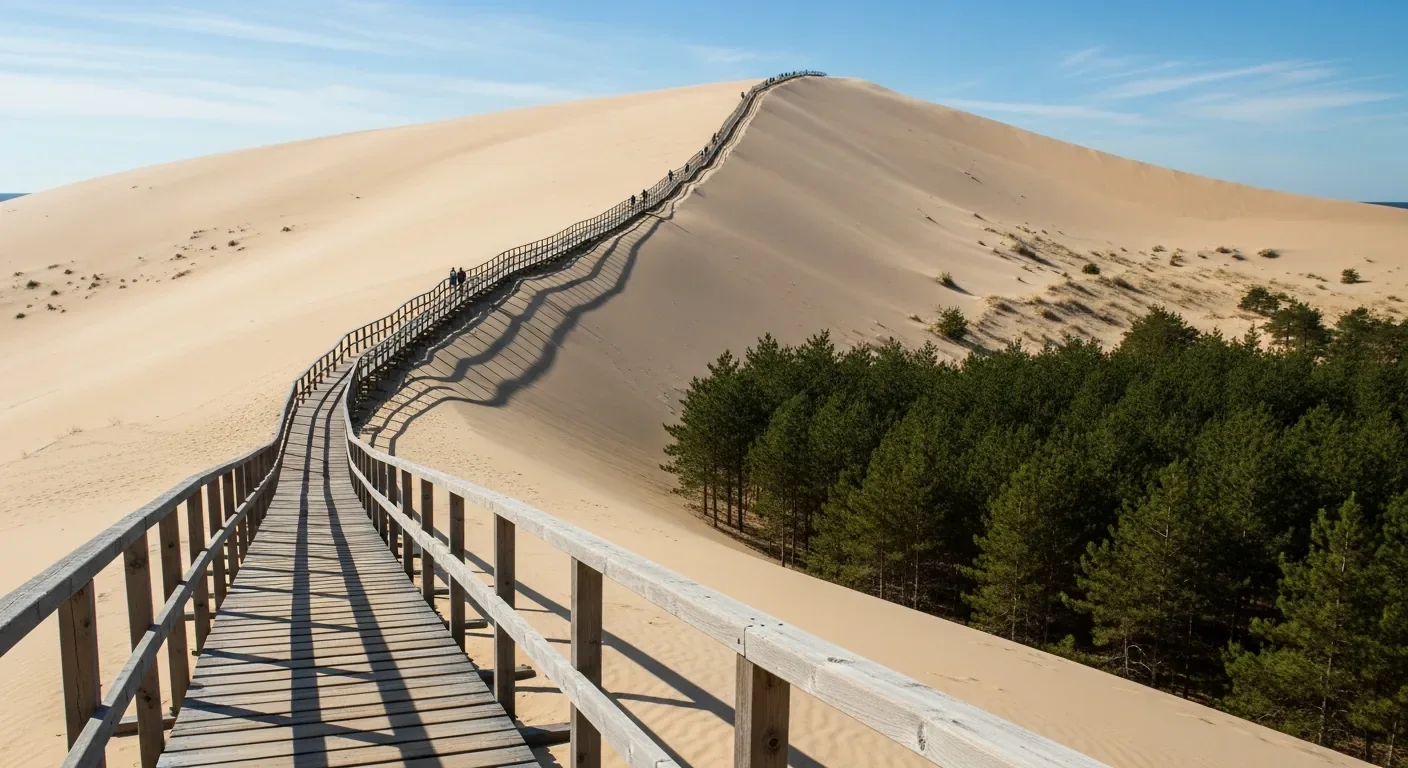
The staircase is one of the site's most visible features—and one of its most intriguing logistical challenges: it is taken down every winter and reinstalled every spring.
Calendar
- Installation: Around Easter each year (March–April)
- Dismantling: after the All Saints' Day break (early November)
- Winter: No stairs. The climb is on sand.
Features
- 130 steps in 2025 (the number varies each year between 130 and 160, depending on the height of the dune and the slope of the installation)
- Eco-designed using recycled plastic from fishing nets, since the post-fire renovation in 2022
- Free — Admission to the site is free; only parking is charged during the season
- Ascent time: 15 to 25 minutes, depending on physical fitness
Tips
- Proper footwear: sneakers or athletic shoes. The sand can burn bare feet in the summer.
- Water: There are no water sources at the summit. Bring your own water bottle.
- Early in the morning: In July and August, head out before 9 a.m. to avoid the crowds on the stairs. The sand is also cooler then.
- Running down the sand: Many visitors climb up the stairs and then run back down the sandy slopes on the north or south side—a liberating experience that’s fun for all ages.
How to Get to the Dune du Pilat
By car
This is the most commonly used method.
Directions from Bordeaux: Take the A630 (ring road), then the A660 toward Bassin d'Arcachon, Exit 1 Pyla-sur-Mer, then the D259 toward the dune. Allow about 1 hour in light traffic; the distance is 64 km.
Official GPS coordinates: Route de Biscarrosse, RD 218, 33115 La Teste-de-Buch.
The Grand Site's official parking lot is located in the visitor center area, just a few minutes' walk from the base of the dune.
According to the Official Price List for the Grand Site, as of July 24, 2026, a car costs €7 for 4 hours, €9 for 8 hours, or €11 for 12 hours during peak season; the rates are €1, €2, and €4, respectively, during off-peak season. The first 30 minutes are free.
| Duration | Car — peak season | Car — off-season |
|---|---|---|
| 30 minutes | Free | Free |
| 4 hours | 7 € | 1 € |
| 8 o'clock | 9 € | 2 € |
| 12 o'clock | 11 € | 4 € |
Parking is prohibited between 2 a.m. and 5 a.m., with a fine of €50. The annual pass costs €15 for a car or motorcycle. The Grand Site defines the high season as running from the first day of winter break to the last day of All Saints' Day break, across all zones.
Check availability before departure
Visitor numbers vary greatly depending on the weather and holidays. Check the parking lot occupancy and the official rate schedule on the day of departure; do not count on finding free off-site parking, as its availability and regulations may change.
Fire Risk and Forest Access
According to the Dune du Pilat Grand Site, the red forest fire alert in effect as of July 24, 2026, prohibits access to the forest and prohibits smoking throughout the entire site. Restrictions vary depending on the risk level: be sure to check the official alert before each visit.
By public transportation
There's no direct route from Bordeaux, but it's definitely doable:
- Train from Bordeaux Saint-Jean to Arcachon (TER line, about 50 min, several departures per hour, ~€15 one way)
- From the Arcachon train station, take the Baïa bus, Line 3, to the Dune du Pilat stop (~30 min; several trips per day during the season)
- Only in July and August, the 101 Express line provides a direct connection from the Arcachon train station to the Dune du Pilat in about 20 minutes—a convenient option for visitors without a car
Showtimes and tickets at www.bus-baia.fr.
By private chauffeur or taxi driver
To avoid the hassle of finding parking—especially during peak season—a private chauffeur service from Bordeaux is the most convenient option. Fixed rate, drop-off right at the site entrance, no waiting in line. Prices start at €126 for a private transfer from Bordeaux to the Dune du Pilat in a sedan (1–3 passengers); the fixed price is provided in advance. There is a surcharge for nighttime, weekend, and holiday travel, and a van is required for groups of more than 4 people. For details (packages, rates, reservations): see our page on the private chauffeur service between Bordeaux and the Dune du Pilat.
By bike
The Grand Site has been certified "Bike-Friendly" and is located along the route of the Vélodyssée, a cycling route along the Atlantic coast. From Arcachon, allow about 10 km of bike paths secure. Some bike racks are available on site. Bike rentals in Arcachon (15–25 €/day for a standard bike).
Activities at the Dune du Pilat
Climb to the top
The essentials, of course. But a few details make all the difference.
Recommended equipment:
- Athletic shoes or sneakers (the sand gets very hot in the summer between 11 a.m. and 4 p.m.)
- Plenty of water — no spring at the summit
- Sunscreen and a hat (no shade)
- Sunglasses (the sand is very reflective)
Recommended total duration: at least 2 hours; ideally, half a day to enjoy it at a leisurely pace.
Tip: Go early in the morning or late in the afternoon. The sand is cooler, the light is more beautiful, and there are fewer people. At noon in the middle of summer, it’s like an oven.
The sunset from the ridge
Probably the most memorable experience at the site. The 360° view is a riot of extraordinary colors: the sun plunges into the Atlantic Ocean, the Landes pine trees blaze with golden hues, and the Arcachon Basin turns pink and purple. A thousand photos, but none of them do it justice.
Estimated sunset times:
- June–July: ~9:45 p.m.
- August: ~9:00–9:30 p.m.
- September: ~8:00–8:30 p.m.
- October: ~7:00–7:30 p.m.
- November–February: ~5:30–6:00 p.m.
- March–May: ~7:30–8:30 p.m.
Arrive an hour early to hike up, find a good spot on the ridge (the northern end is usually the least crowded), and enjoy the transition.
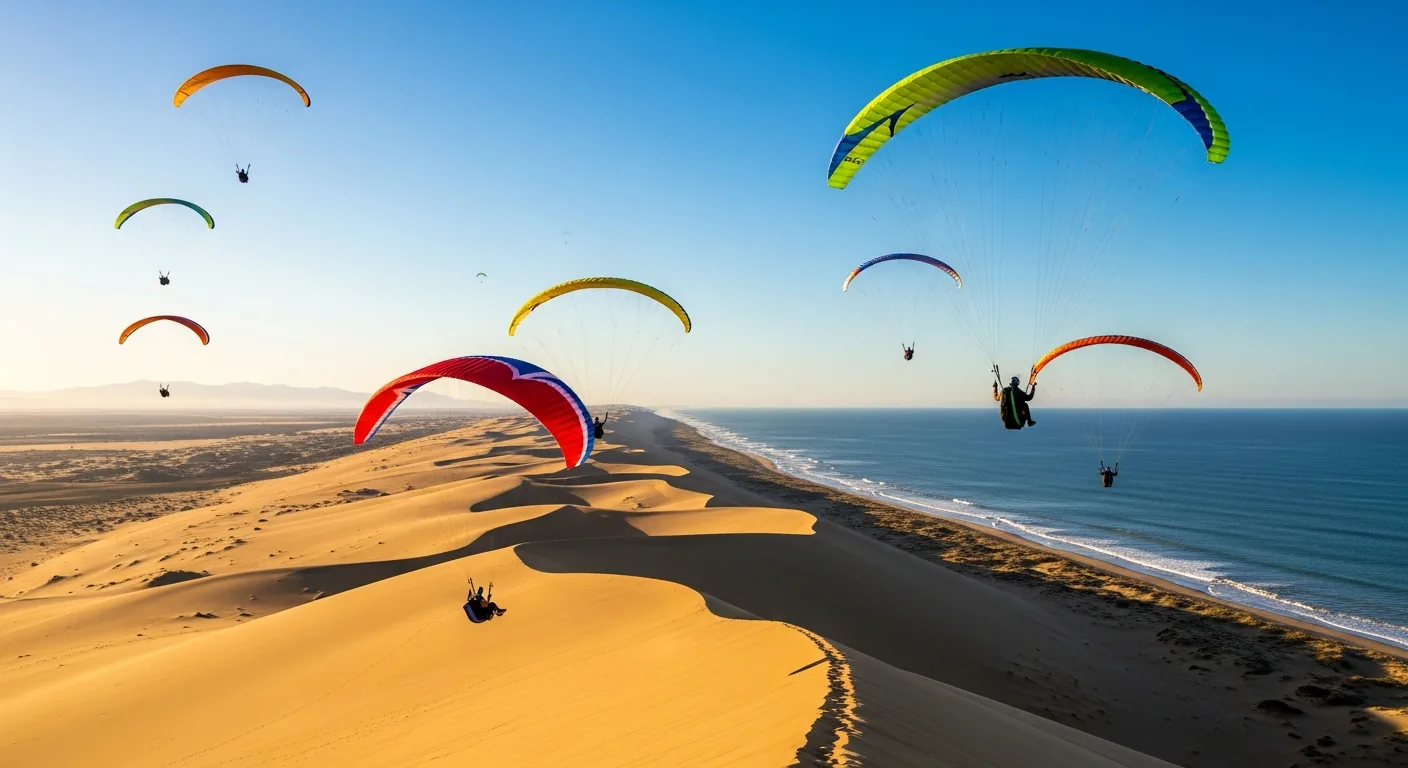
Paragliding
Several FFVL-certified schools operate at the foot of the Dune. The Tandem flights for first-timers are offered year-round, weather permitting. Flying is best from March to October thanks to the thermal breezes generated by the contrast between the sea and the forest.
Among the schools located at the foot of the dune are Waggas School—one of the oldest on the site (introductory flights available for children as young as 6)—Pyla Parapente, and Dune Parapente. All of them provide instruction for flights with state-certified instructors affiliated with the FFVL (French Free Flight Federation).
Prices: Starting at €90 for an introductory flight (15–20 minutes), up to €150 for longer packages. Reservations are required during the summer—slots fill up quickly.
Swimming
Two options from the Dune:
Beach on the Arcachon Bay side (east side, at the foot of the dune): calm, shallow water, ideal for children. A few minutes' walk from the parking lot.
Ocean-side beach: accessible from the summit by walking down the sandy western slope, or via La Salie-Sud Beach a little further south. Waves averaging 1 to 2.5 m, patrolled by CRS lifeguards from June through September. Excellent spot for surfing and kitesurfing. Note: You’ll have to walk back up when you’re done.
The Hike
At the base of the dune on the east side, the pine forest offers shaded trails. There, you can see the dead pine trees half-buried due to the dune's advance.
The Coastal Trail (GR8) connects La Dune to Cap Ferret over a distance of 25 km—for fit hikers, it’s one of the most beautiful coastal hikes in France.
Duration: 1 to 2 hours for a local loop, half a day for the Pilat → Arcachon hike, and a full day for Pilat → Cap Ferret.
The Banc d'Arguin
Visible from the top of the Dune at low tide, the Banc d'Arguin is a shifting sandbar designated a national nature reserve by the decree of August 4, 1972, and now covering approximately 4,360 hectares (boundaries amended by Decree No. 2017-945 of May 10, 2017). It is managed by SEPANSO, the federation of nature conservation associations in Aquitaine.
It is a premier bird sanctuary. It is home to, among others:
- The main French colony of sandwich terns—the largest in Europe in the 1980s and 1990s, peaking at about 4,700 pairs in 1991, but declining since then due to the dwindling supply of the small fish on which the bird feeds;
- Rare coastal breeding birds such as the ringed plover and the oystercatcher;
- In winter, a a stopover site for more than 30,000 shorebirds (shorebirds);
- In the surrounding marine area, there are gray seals and bottlenose dolphins.
Accessible only by boat from Arcachon or Cap Ferret (allow 2 to 3 hours for the trip), the reserve is subject to strict regulations: disembarkation is limited to authorized areas, disturbing the colonies is prohibited, and approaching nesting birds is restricted in the spring.
Iconic Hotels and Restaurants
La Co(o)rniche — the institution
Perched on the heights of the Pyla, La Co(o)rniche is probably the most iconic hotel-restaurant on the entire Basque-Landes coast. Taken over and redesigned by Philippe Starck some twenty years ago, the establishment combines 1930s architecture with contemporary design, offering a breathtaking view of the Bay and the Dune.
The terrace restaurant, with its panoramic views, has become a must-visit destination for affluent travelers in the Bassin region. The infinity pool is a classic feature of postcards from Aquitaine.
Practical: A restaurant that requires reservations well in advance during peak season. Meal budget: 80–150 € per person.
Haaïtza Hotel
Another historic landmark in Pyla. L'Haaïtza is a traditional hotel that has been open since the early 20th century and, since its founding, has hosted a select group of the “true” Bordeaux and Parisian elite. Its architecture is more classical than La Co(o)rniche’s, the atmosphere is more understated, but its hospitality is renowned.
A restaurant that isn't particularly visually striking, but serves excellent traditional cuisine.
Other addresses
Many restaurants and snack bars are available at the foot of the dune, near the official parking lot and along Avenue de la Plage. The quality varies, and prices are geared toward tourists during the high season. Pyla-sur-Mer offers more authentic spots by steering clear of the crowds of tour buses.
Tip: If you're looking for a gourmet dining experience, be sure to make a reservation in advance at one of the two restaurants listed above. Otherwise, downtown Arcachon (a 10-minute drive away) offers a wide variety of dining options to suit every budget.
Things to Do Near the Dune du Pilat
Here are a few nearby destinations to enhance your stay:
| Location | Distance | Recommended duration | Ideal for |
|---|---|---|---|
| Arcachon City | 8–10 km | Half-day to full-day | Belle Époque architecture, 4 neighborhoods, Ville d'Hiver |
| Cap Ferret | ~25 km by road (or 30 min by boat via Arcachon) | Half-day to full-day | Oysters, oyster-farming villages, lighthouses |
| Gujan-Mestras (7 oyster ports) | 15 km | 2–3 hours | Oyster Tasting Directly at the Oyster Farm |
| Banc d'Arguin (Nature Reserve) | Boat from Arcachon | 2–3 hours | Nature, birds, seals |
| La Teste-de-Buch | 6 km | 1–2 hours | Market, local cuisine, harbor |
| Biscarrosse (southern Landes) | 30 km | Half-day | Lake, beach, surfing, water sports |
| Landes Forest | Around the Dune | 1–2 hours | Hiking, nature, cool weather in the summer |
To plan a day trip to the Arcachon Basin, see our complete guide to the Arcachon Basin. To travel to Cap Ferret from the region, see the Cap Ferret Guide.
When to Visit the Dune du Pilat
La Dune is open year-round, 24 hours a day. But not all times of the year are the same.
The site’s impact on tourism is considerable: the eco-counter installed at the base of the staircase records more than one million people climbing to the summit each year, and the figure of approximately 2 million visitors— all purposes combined—is often cited. On some days in August, more than 10,000 people climb the dune, and the direct economic impact on the region amounts to several million euros. The practical takeaway can be summed up in one sentence: the earlier you come—both early in the day and early in the season—the better your experience of the Dune will be.
| Period | Attendance | Weather | Benefits | Disadvantages |
|---|---|---|---|---|
| January–March | Very low | Chilled (8–12°C) | Absolute calm, magnificent winter light | Cold, staircase dismantled, limited services |
| April–May | Low to moderate | Mild (15–20°C) | Our recommendation: not many people, stairs on the way back, beautiful lighting | There may be a few days of rain |
| June | Moderate | Good (20–25°C) | An excellent balance between crowd size and weather conditions | Weekends are starting to get busy |
| July–August | Very high (240,000 visitors in July 2025) | Excellent (25–30°C) | All activities available, hot water | Full parking lot, crowds, heat, waiting |
| September | Moderate | Good (20–25°C) | Our other recommendation: still warm, with mild sea temperatures | The days are getting shorter toward the end of the month |
| October | Low | Variable (10–18°C) | Fall colors, golden light | Services on sale; staircase to be dismantled at the end of the month |
| November–December | Very low | Refrigerated (8–12°C) | Absolute tranquility, low hotel rates | Staircase dismantled; some services closed |
Our recommendation: May–June or September, without a doubt. You’ll enjoy pleasant weather, easy parking, the staircase in place, and a dune without the crowds.
If you're visiting during peak season (July–August), the only way to enjoy your visit without stress is to arrive before 9 a.m. or after 5 p.m. Any other approach will leave you dealing with a full parking lot, heat, and crowds.
Practical Information
| Info | Details |
|---|---|
| Access to the site | Free (pedestrians, cyclists), year-round |
| Parking | Fee applies during the season (1–14 € depending on duration and season); free during the off-season |
| Staircase | Free, open from Easter to All Saints' Day (~130 steps in 2025) |
| Hours of Operation | Open 24 hours a day, all year round |
| Recommended duration of visit | At least 2 hours; half a day is ideal |
| Catering | Restaurants and snack bars at the foot of the Dune (some are closed during the off-season) |
| Accessibility for People with Disabilities | Very limited—the sand makes it difficult to access in a wheelchair. The reception area is accessible at ground level, but the ramp is not. |
| Animals | Allowed on a leash during the off-season; restrictions apply in certain areas during the high season |
| Overnight Parking | Prohibited between 2 a.m. and 5 a.m. (fine ~50 €) |
| Wild Camping | Strictly prohibited throughout the entire area |
| Fire / Cigarettes | Prohibited; fines of up to €750 (forest fire prevention) |
| Sand Extraction | Prohibited; fine of up to 1 500 € |
Frequently Asked Questions
Is the Dune du Pilat free to visit?
Yes, access to the Dune is completely free for pedestrians and cyclists. Only the official parking lot charges a fee during the season (1 to 14 €, depending on duration and time of year). The staircase itself is free. You only pay if you arrive by car during the season.
How long does it take to visit the Dune du Pilat?
Allow at least 2 hours to hike up, enjoy the view, and hike back down. A half-day is ideal if you want to head down to the beach, go for a swim, or take a walk in the forest. A full day is worth it if you combine the hike with a swim and lunch there.
When is the best time to visit to avoid the crowds?
May–June and September are the best times to visit: pleasant weather, accessible parking, the staircase is in place, and there are far fewer people than in July–August. During the off-season (October–March), it’s completely peaceful, but some services are closed and the staircase is taken down.
Can you go swimming at the Dune du Pilat?
Swimming depends on which areas are open and the conditions on any given day. At the base of the dune and near the passes, currents, erosion, and temporary restrictions mean you must follow the on-site signage. For a family swim, choose an officially supervised beach and check the day’s arrangements with the City of La Teste-de-Buch or the Grand Site; do not assume that supervision is guaranteed during a specific time period.
Is there a parking lot at the Dune du Pilat?
Yes. The Grand Site’s official parking lot has about 950 spaces, located 400 m from the base of the dune. There is a fee during the season (1–14 €). In July and August, it’s often full by 9 a.m. Tip: There are free parking spots on Avenue Louis Gaume near La Corniche, a 5- to 10-minute walk further away.
Is the Dune du Pilat accessible by public transportation from Bordeaux?
Yes, but you'll need to transfer. From Bordeaux Saint-Jean: Take the TER to Arcachon (~50 min), then take the Baïa bus, line 3, to the Dune du Pilat stop (~30 min). In July and August only, the 101 Express line runs directly from the Arcachon train station to the Dune in ~20 min.
How much does a trip from Bordeaux to the Dune du Pilat cost with a private driver?
A private transfer from Bordeaux to the Dune du Pilat starts at €157 in a sedan, for 1 to 3 passengers, as a direct door-to-door trip (about 1 hour, 64 km from downtown). This rate is fixed and provided in advance, with no unpleasant surprises due to traffic. A surcharge applies at night, on weekends, and on holidays. For groups of more than 4 people or those with a lot of luggage, we’ll switch to a van at an adjusted rate. You’ll be dropped off as close as possible to the entrance, without having to wait in a parking line—which is invaluable during peak season.
Can you go paragliding at the Dune du Pilat?
Yes. Several FFVL-certified schools offer tandem introductory flights year-round, weather permitting. Flying conditions are best from March through October. Prices start at 90 €. Reservations are recommended during the summer.
Is the Dune du Pilat accessible to people with limited mobility?
Access is very limited for people in wheelchairs. The sand makes it difficult to get around. The parking lot and reception area are accessible, but the slope itself is not. An information point with explanatory signs is available at the base of the site.
What will be the exact height of the Dune in 2026?
As of July 24, 2026, the OCNA has not yet published the 2026 measurement. According to the latest official survey presented by the Grand Site, the highest point measured 101.7 meters in May 2025. Since the dune is constantly shifting, it would be inaccurate to estimate a precise height for 2026.
Why is the staircase taken down in the winter?
To prevent it from being buried under the sand. Winter winds and storms shift large amounts of sand down the slope. If it weren't taken down, the structure would quickly become unusable. The staircase is set up every spring (around Easter) and taken down after the All Saints' Day break.
What were the effects of the 2022 fire?
The July 2022 fires in La Teste-de-Buch burned approximately 7,000 hectares of forest around the dune. The dune itself was spared (the sand stopped the flames), but the surrounding forest still bears visible signs of the fire. A budget of 4.2 million € has been allocated for the replanting of maritime pines. You’ll see these marked areas if you take a walk in the forest.
Pilat or Pyla: Which spelling is correct?
"Pilat" for the dune (official spelling, natural site). "Pyla" for the nearby seaside village (Pyla-sur-Mer, in the municipality of La Teste-de-Buch). The word comes from the Gascon word "pilat," which means "pile" or "mound."
Is *Dune* really moving forward?
Yes, at a rate of 1 to 5 meters per year toward the east. The dead, half-buried pine trees visible at the base of the forested slope are the remnants of the forest that has been swallowed up by the advancing glacier. The OCNA has been measuring these movements since 2009.
Further Reading
- Private chauffeur service to the Dune: see our page on private chauffeur service between Bordeaux and the Dune du Pilat (packages, rates, reservations)
- Arcachon Bay in detail: see the Arcachon Bay Guide and private chauffeur service between Bordeaux and Arcachon
- Cap Ferret in detail: see the Cap Ferret Guide and private chauffeur service between Bordeaux and Cap Ferret
- To get from the airport directly to La Dune: see Bordeaux Airport Transfer
- Getting there from Saint-Jean Station: see the private chauffeur service at Saint-Jean Station
Sources and References
- Grand Site — OCNA height measurement — 101.7 m in May 2025; latest measurement published on July 24, 2026
- Grand Site — Rates and Annual Pass — Parking Fees and Rules Verified on July 24, 2026
- Grand Site — Regulations — Fire Risk, Forest Access, and Applicable Ordinances
- Baïa Bus — Arcachon Bay Transit System — Schedules for Lines 3 and 101 Express
- La Teste-de-Buch Tourist Office — Activities, Accommodations, Events Calendar
- Coastal Conservation Agency — Dune du Pilat — Protection and History of the Site
- SEPANSO — Banc d'Arguin National Nature Reserve — Management and Wildlife of the Banc d'Arguin Reserve
- La Teste-de-Buch Communal Forest (HTBA) — Medieval Usage Rights and the History of the Communal Forest
Article published on , verified on .
On the Way to the Dune
Direct door-to-door ride from Bordeaux (~1 hour), dropped off as close as possible to the entrance, with no parking lines in the summer. Combine a trip to the Dunes with a visit to Arcachon or Cap Ferret in the same day. Get a written, fixed-price quote within 30 minutes.