
Become a professional chauffeur in Bordeaux, the career guide
The Complete Guide to Becoming a Professional chauffeur in Bordeaux: eligibility requirements (driver’s license, criminal record, medical fitness), knowledge tests and the practical exam, training organizations, cost and duration, the professional license valid for 5 years, the steps to begin working, employment status, income, and the day-to-day realities of the job.
Key Points at a Glance
- Becoming a chauffeur means working in the regulated field of passenger transportation—either as a self-employed individual or as an employee—after passing an exam and obtaining a professional license.
- Eligibility requirements: Must have held a Class B driver's license for at least 3 years (2 years of accompanied driving), a clean criminal record, and a medical fitness examination by a certified physician.
- The professional chauffeur exam consists of knowledge tests—including regulations on sexist or sexual offenses and discrimination—followed by a practical driving test, both of which are administered by the chambers of trades.
- The training is optional but highly recommended: expect to pay anywhere from a few hundred to over 1,500 €, whether in-person or online, depending on the provider you choose.
- The professional chauffeur licence is issued by the prefecture, is valid for 5 years, and is renewed after completing 14 hours of mandatory continuing education.
- To operate as a self-employed driver: registration with the REVTC registry (~€170), a financial guarantee of €1,500 per vehicle unless you can provide proof of ownership or a lease of more than six months, a red sticker (~€35), and professional liability insurance.
- There are two main employment statuses: employee of a service company with a chauffeur, or self-employed as a micro-business owner or through a company, each with its own advantages and limitations.
- Context in Bordeaux: The business can benefit from foot traffic related to the train station, the airport, conferences, and the vineyards, but demand varies depending on the season, the market segment, and the acquisition channel.
Becoming a Professional chauffeur: Where to Start?
In Bordeaux, the business can benefit from foot traffic related to the train station, the airport, conferences, and the vineyards, but demand varies depending on the season, the niche, and the acquisition channel. Before you get started, compare a conservative estimate of your delivery volume with your total expenses; this article does not guarantee a specific number of deliveries or a certain level of income. This guide explains everything, in order: the requirements you must meet, the knowledge tests and practical exam, training providers and their costs, obtaining the five-year professional license, and then the steps to actually start working—registration, financial guarantee (including exemptions), insurance, and a compliant vehicle. We also cover legal status, realistic income levels, and the day-to-day realities of the job, without sugarcoating anything.
Becoming a licensed chauffeur means entering a regulated profession in the passenger transportation industry, driving a car reserved in advance by the customer.
The term “executive car service” refers to a “chauffeur-driven car”: a personalized, fixed-price service that is very different from a meter-based taxi.
If you're still unsure about the general definition, check out our article “ What is a chauffeured service? "lays the groundwork before delving into the profession itself."
Good news: No degree is required to enter the profession. However, you must pass an official exam and then obtain a professional license.
This license is issued by the prefecture after your application has been reviewed. It authorizes you to transport passengers for a fee.
The process consists of four main steps: checking the requirements, passing the exam, obtaining the license, and then completing the necessary procedures to begin practicing.
This guide follows this logical sequence—from the first prerequisite to your first client—so that you don't miss anything important on your path to becoming a professional.
Becoming a chauffeur isn't something you can just wing: each step has its own logic, and taking them in the right order helps you avoid wasting time and unpleasant surprises.

A regulated profession, not just a driving job
Transporting passengers for a fee is no trivial matter: it is an activity governed by the Transportation Code, which protects both the customer and the professional.
The Grandguillaume Act of December 29, 2016, reorganized the entire private passenger transportation sector by strengthening driver training and oversight.
In practical terms, a registered chauffeur is identified, insured, and subject to oversight, and must carry a personalized card that he or she must be able to present at any time.
This framework clearly distinguishes professional chauffeur services from unlicensed transportation: professionals assume liability and comply with specific, verifiable obligations.
For a detailed overview of the legal framework governing operations, our comprehensive guide to regulations governing professional chauffeur services breaks down each requirement, article by article, in detail.
This strictness is not an unnecessary constraint: it reassures the customer and sets the reliable driver apart from the improvised or illegal options on the market.
Becoming a Professional chauffeur in Bordeaux: Assessing Demand
In Bordeaux, the business can benefit from foot traffic related to the train station, the airport, conferences, and the vineyards, but demand varies depending on the season, time slot, and acquisition channel. Before you get started, compare a conservative estimate of your trip volume with your total expenses; this article does not guarantee a specific number of trips or a specific income.
Requirements for Becoming a Licensed chauffeur
Before even thinking about taking the exam, three eligibility requirements must be met: a valid, long-held license; a clean criminal record; and medical fitness.
These criteria are not mere formalities: they determine whether you can register for the exam and subsequently receive your license, and an incomplete application will halt the entire process.
Good news regarding age and education: there is no maximum age, and no specific level of education is required to become a chauffeur in France.
Career transitions are therefore open to a wide range of candidates, from young professionals to employees seeking independence, as well as professionals from other sectors.
This low barrier to entry explains the appeal of the profession: no years of study are required—just motivation, diligence, and a commitment to service.
Driver's License, Driving Experience, and Supervised Driving
The first requirement is to hold a valid Class B driver's license that is no longer in the probationary period: a permanent license without the restrictions for young drivers.
The required driving experience is at least three years, reduced to two years if you obtained your license through an early driver's education program.
This requirement ensures real-world driving experience, which is essential for safely transporting passengers in the heavy traffic of a major city.
A recently suspended or revoked license bars you from working in the profession: therefore, managing your point total and complying with traffic laws are essential.
It’s therefore best to make sure your driving is up to par well before you hit the road, because a driver’s license remains a driver’s most important tool—without it, nothing is possible.
Criminal Record and Medical Fitness
The prefecture checks the criminal record: Form No. 2 must not list any convictions that are incompatible with the transportation of passengers.
This requirement for good character is the foundation of trust: passengers entrust their safety to a professional whose integrity has been verified by the authorities.
You must also undergo a medical examination by a doctor approved by the prefecture, who will certify that you are physically fit to drive for professional purposes.
This examination checks, among other things, vision, reflexes, and general health; it is repeated periodically throughout the driver's career.
These qualities of reliability and thoroughness are, in fact, consistent with the criteria for a good professional chauffeur—qualities that Bordeaux customers value and seek out.
Meeting these three requirements is by no means impossible, but it is a strict prerequisite: without them, it is simply impossible to register for the exam.
Check the eligibility requirements and required documents in the official fact sheet “Becoming a Professional Chauffeur,” accessed on July 22, 2026.
| Condition | Requirement | Clarification |
|---|---|---|
| Class B Driver's License | valid, permanent, ≥ 3 years | 2 years if driving with an instructor |
| Age | no maximum age | of legal age, license without a probationary period |
| Criminal Record | Bulletin No. 2 (Compatible) | no disqualifying offense |
| Medical Fitness | visit to a licensed physician | vision, reflexes, health status |
| Degree | None required | Recommended training; not required |
The professional chauffeur exam: Written and Practical Tests
The key part of the process of becoming a chauffeur is the exam: a mandatory step, organized by the Chambers of Trades and Crafts, that consists of two distinct parts.
The first part is a theory test in the form of a series of questions; the second part is a practical driving test. You must pass both to obtain your license.
Registration is done online on the website of your region’s CMA. In Bordeaux, the CMA Nouvelle-Aquitaine provides details on the registration process and platform; the registration fee, which is separate from the cost of the training, is approximately €200 per application.
If you fail a section, you retain credit for the sections you passed for a limited time, which means you don't have to retake the entire exam all at once.
The exam is by no means insurmountable for a well-prepared candidate, but it cannot be passed without hard work: it is the screening process that ensures the integrity of the profession.
Schedule verified on July 13, 2026 on the official page Public Service F31027 — Become a Professional Chauffeur.

What knowledge tests make up the written exam?
The eligibility assessment evaluates professional knowledge through questionnaires and questions within a time limit. The current official outline covers the following areas:
- business management and accounting;
- negotiation and customer retention;
- regulations governing professional chauffeur services;
- regulations on sexist and/or sexual offenses and discrimination: definition, prevention, and applicable penalties;
- traffic safety rules;
- Proficiency in French and English.
The official program is Service-Public F31027, verified on July 13, 2026. Our guide to the legal framework can supplement the revisions, but does not replace the CMA’s materials.
The Practical Driving Test
Once you've passed the written test, it's time for the practical test: a driving exam under real-world conditions to assess your ability to transport passengers safely and comfortably.
The examiner assesses the candidate's control of the vehicle, compliance with traffic laws, smooth and fuel-efficient driving, and customer service skills: greeting, assistance, and courtesy.
Unlike the driver's license exam, the focus here is on professionalism: anticipation, passenger comfort, and business etiquette all factor into the score.
It is this dual set of skills—technical and interpersonal—that distinguishes a chauffeur from an ordinary driver and forms the basis of the quality perceived by the customer.
Practicing on a variety of urban routes with real passengers remains the best way to prepare for this challenge, where confidence is just as important as technique.
| Event | Contents | Objective |
|---|---|---|
| Theoretical | professional knowledge tests | validate business knowledge |
| Management and Business | accounting, negotiation, customer retention | manage and grow the business |
| Regulations for Professional Chauffeur Services | Pre-booked chauffeur service, professional obligations | understand the scope of the profession |
| Prevention and Discrimination | sexist or sexual offenses, discrimination | define, prevent, and understand penalties |
| Security and Languages | road safety, French and English | drive and welcome passengers |
| Practical | driving under real-world conditions | Travel safely and comfortably |
Professional Chauffeur Training: Providers, Cost and Duration
Professional chauffeur training is not legally required to take the exam, but it is strongly recommended given the breadth of the theoretical curriculum.
Many private organizations offer comprehensive training—either in person or online—that includes course materials, practice exams, and driving lessons.
Choosing a reputable organization often makes the difference between getting it right the first time and having to go through repeated presentations, which are costly in terms of both time and money.
Before enrolling, check the school's reputation, its advertised success rate, the content of the practical training, and the available financing options.
Many candidates first have questions about the profession itself; our comparison between taxi driving and professional chauffeur services provides useful insight into this career choice.
How much does licensed chauffeur training cost?
The cost of chauffeur training varies widely: from a few hundred euros for an online course to more than €1,500 for a comprehensive in-person program.
In addition to this budget, there are exam registration fees of approximately €200 per attempt, paid directly to the organizing Chamber of Trades.
Some training programs may be eligible for funding through programs such as the Personal Training Account, subject to certain conditions, which reduces the out-of-pocket costs for the participant.
It’s wise to compare several quotes and be wary of very low-cost offers, which often neglect the practical preparation—which is, however, crucial.
A good organization also assists with administrative procedures and exam registration, which saves a significant amount of time for those new to the field.
How long does it take to become a professional chauffeur?
The duration of the program depends mainly on your pace of learning and the exam scheduling deadlines, which vary by session and region.
In practice, you should expect it to take two to four months from the start of the preparation process until you receive your card, including training, the exam, and all the necessary procedures.
An intensive training program lasting a few weeks is available for full-time students, while evening classes are spread out over a longer period of time.
In addition to this timeframe, there is the time required for the prefecture to review the application; the prefecture issues the card once the exam has been passed and the documents have been verified.
Although this timeline is well-planned, it remains realistic: in one quarter, a motivated candidate can go from a simple idea to actually practicing their new profession.
| Position | Approximate range | Note |
|---|---|---|
| Theoretical Training | €300 to €1,500 | in-person or remote |
| Exam Registration | ~€200 per presentation | paid to the Chamber of Trades |
| Medical Examination | ~€35 to €70 | physician licensed by the prefecture |
| Total duration | 2 to 4 months on average | depending on the schedule and call-ups |
| Funding | CPF may be available under certain conditions | Things to check before registering |
Obtain a professional chauffeur licence
Once you have passed the exam, the next step is to have your chauffeur's license issued by the prefecture in your department—the Gironde, for a driver from Bordeaux.
This professional license is the key to practicing the profession: without it, it is impossible to practice legally, regardless of one’s status—whether as an employee or a self-employed professional.
You must present it during inspections and display it prominently in the vehicle so that customers and law enforcement officers can identify it.
The application package includes the certificate of passing the exam, proof of identity, the medical examination report, and a criminal record check verified by the administration.
This card is also a mark of quality for the customer: it is one of the criteria for a good driver that a savvy passenger checks for.

A Licence Valid for Five Years
The professional chauffeur licence is valid for five years from the date of issuance, a period that allows time to establish and grow one's business.
It is not permanent: its renewal is subject to a specific condition designed to maintain drivers' skill levels over time.
As long as it's valid, the card follows you from one employer to another or supports you as a self-employed person anywhere in France—not just in Bordeaux.
If you lose your card or your circumstances change, you must contact the prefecture to obtain a replacement or update your personal information.
Renewal and Continuing Education
To renew their license after five years, drivers must complete 14 hours of mandatory continuing education provided by an accredited organization.
This training course brings your knowledge up to date on regulatory changes, road safety, management, and customer relations in a rapidly evolving industry.
Planning ahead for this training course prevents any interruption in business: it’s best to start the process several months before the deadline to ensure a seamless renewal of the card.
This regular update helps to ensure the long-term professionalization of the field and to maintain a consistent level of service for customers.
Above all, she emphasizes that being a chauffeur is a long-term commitment—not just a matter of passing an exam at a specific point in time.
Keeping your license up to date protects your business and your credibility: a driver who is in good standing inspires confidence in both customers and partners.
Steps to Take to Become Self-Employed
A professional chauffeur licence authorizes you to drive, but operating as an independent contractor requires additional steps specific to professional chauffeur services.
These requirements provide security for customers and the market: they distinguish licensed professionals from illegal transport operators, who are subject to severe penalties under the law.
A salaried driver is exempt from this requirement, since it is the employer who is responsible for the business, the fleet, insurance, and registration with the national registry.
Our guide to regulations governing professional chauffeur services details each of these operational requirements, which we summarize here for prospective chauffeurs.
REVTC Registry, Financial Guarantee, and Sticker
All operators must register with the national registry for professional chauffeur services, the REVTC, maintained by the Ministry of Transportation, for a fee of approximately €170, valid for five years.
Check the amounts, exemptions, and required documents on the official Service-Public form F31027, updated on July 13, 2026.
You must also provide proof of a financial guarantee of at least €1,500 per vehicle in operation, intended to cover any debts related to the business.
This guarantee is not required if the operator owns the vehicle or leases it for more than six months, provided that proof is provided.
A distinctive red sticker, costing about €35, is affixed to the windshield and rear window to officially identify the vehicle as a chauffeur-driven transport.
Combined with the driver's card, these elements ensure that the business is fully legal and subject to oversight—a prerequisite for working with platforms and directly with clients.
These formalities may seem cumbersome, but they are completed once and for all at the outset and then simply renewed at regular intervals.
Insurance, Vehicle Compliance, and Status
Professional liability insurance is mandatory: failure to have it can result in a heavy fine and seriously jeopardize the driver’s liability.
The vehicle must also meet the following requirements: it must be less than seven years old, at least 4.50 m long and 1.70 m wide, have a power output of at least 84 kW, and seat between four and nine people.
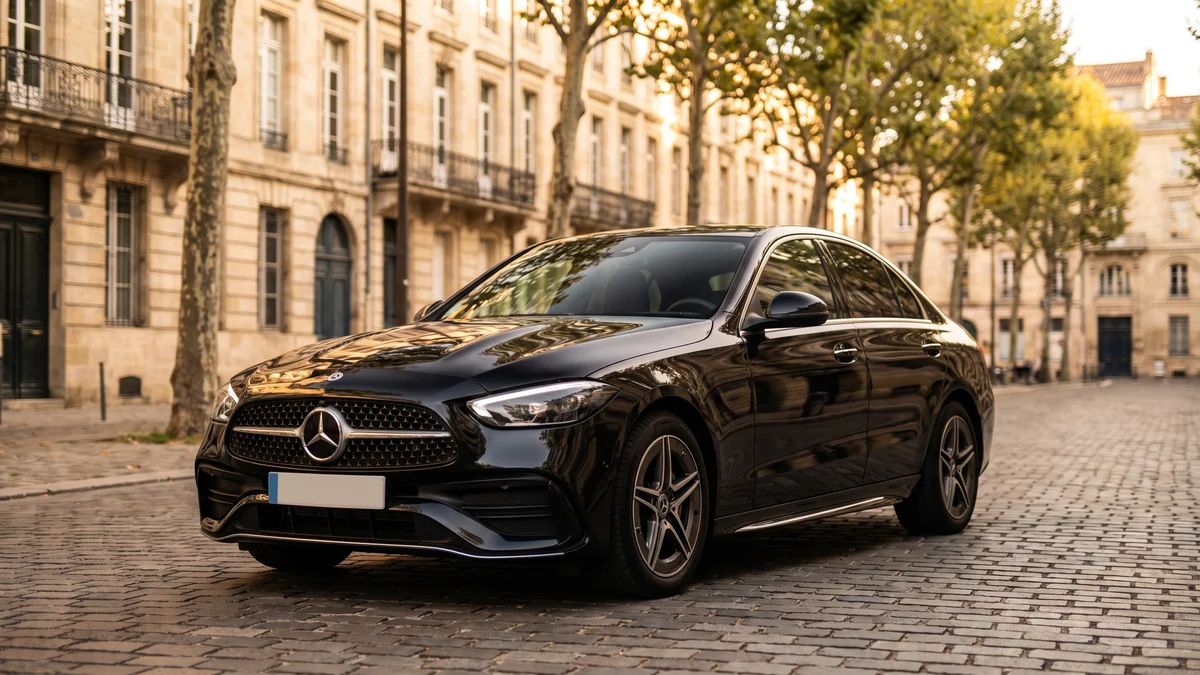
These criteria explain why people often choose a sedan like the Mercedes C-Class or a van to transport groups and their luggage on the same trip.
Finally, you need to choose a legal status and register your business—a process detailed below—since this determines the driver’s tax status and social security coverage.
Seeking the guidance of a certified public accountant when starting a business helps avoid many mistakes and ensures you choose the right legal structure, a decision that often sets the tone for years to come.
| Approach | Key Figures | Role |
|---|---|---|
| REVTC Registration | ~€170 / 5 years | National Registry of Operators |
| Financial Guarantee | 1,500 € per vehicle | Exemption if the vehicle is owned or leased for more than 6 months, with proof |
| Red sticker | ~35 € | marks the vehicle as an executive chauffeur service |
| Professional Liability Insurance | required | covers damage to third parties |
| Compliant Vehicle | < 7 years, ≥ 4.50 m, ≥ 84 kW | 4 to 9 seats, 4 doors |
Employment Status, Income and Career Opportunities
Once you have the license, two main paths are open to you: becoming an employee of a service company with a licensed chauffeur, or starting your own business as a self-employed individual.
This decision affects your daily life, your taxes, and your social security coverage; there is no one-size-fits-all answer—only the one that fits your situation.
Many start out as employees to learn the trade without taking any risks, before going into business for themselves once they have gained experience and built up a client base.
Others aim for independence from the outset, drawn by the freedom to organize, even if it means taking on the administrative burden and dealing with the initial challenges.

Employee or Self-Employed: Which Status Should You Choose?
Employee status provides a steady income, vacation time, and social security coverage in exchange for a relationship of subordination and work schedules that are often imposed.
Self-employed individuals determine their own work arrangements and keep all their revenue, but they are solely responsible for expenses, insurance, maintenance, and slow periods.
Under the basic exemption, a micro-enterprise does not charge VAT and cannot deduct it. However, it may become liable for VAT once it exceeds the applicable thresholds or may choose to register for VAT; have this choice validated based on your projected revenue and the vehicle’s financing.
Setting up a company such as an EURL or an SASU involves more paperwork, but it protects your personal assets and is suitable for an ambitious project involving a financed vehicle.
Nothing is set in stone: you can start out as a micro-enterprise and then transition to a corporation once your business grows and claiming the VAT becomes worthwhile.
Realistic Revenues, Expenses, and Market Opportunities
Income varies widely depending on employment status, the number of hours worked, the client base, and cost control: no single figure accurately reflects the reality of the profession.
A self-employed person must think in terms of net income—after fuel, maintenance, insurance, platform fees, and contributions: gross income says nothing about final income.
Building a direct and loyal customer base, rather than relying solely on platforms, remains the key to stable revenue and sustained profit margins over the long term.
In Bordeaux, business can benefit from foot traffic related to the train station, the airport, conferences, and the vineyards, but demand varies depending on the season, the market segment, and the acquisition channel.
Before you get started, compare a conservative estimate of the number of trips you’ll make with your total expenses; this article does not guarantee either the number of trips or your income.
To fully understand the value as perceived by customers, our article on private drivers in Bordeaux provides a detailed description of the experience customers can expect on a daily basis.
A driver who understands these expectations is better able to market their service and build customer loyalty: passenger satisfaction remains the primary driver of sustainable revenue.
To get an idea of the service to be provided, the article “ What is a pre-arranged car service? "It simply reminds the customer what they're actually buying when they make a reservation."
| Status | Benefits | Limitations |
|---|---|---|
| Employee | steady income, social security coverage | mandatory schedules, subordination |
| Micro-business | simplicity, reduced workload | Revenue cap; VAT not deductible under the basic exemption |
| Company (EURL/SASU) | protected heritage, recoverable VAT | Administrative Procedures and Costs |
| Career Opportunities | transfers, secondments, events | Demand varies depending on the season and time slot |
| Income Key | direct and loyal customer base | net expenses to be controlled |
Becoming a Chauffeur in Bordeaux: Day-to-Day Life on the Job
Beyond the formalities, becoming a professional chauffeur means embracing a service-oriented career in which driving is only part of the work actually performed each day.
Punctuality, discretion, a clean vehicle, and good interpersonal skills make all the difference: customers remember the welcome just as much as the ride itself.
A typical day involves scheduled trips, fixed-schedule transfers, waiting time, and administrative tasks: billing, customer service, and tracking reservations.
Flexible schedules are appealing, but they require discipline: demand varies depending on the season, time slot, and acquisition channel.

Assess the demand before getting started
In Bordeaux, the business can benefit from foot traffic related to the train station, the airport, conferences, and the vineyards, but demand varies depending on the season, time slot, and acquisition channel. Before you get started, compare a conservative estimate of your trip volume with your total expenses; this article does not guarantee a specific number of trips or a specific income.
Compared to taxis, professional chauffeur services stand out for their advance booking and fixed-rate pricing; our comparison of taxis and professional chauffeur services details these differences in business models.
Standing Out and Thriving in the Industry
Success isn't just about the number of rides; it's based on building customer loyalty, word of mouth, and a reputation earned ride by ride.
Taking good care of your vehicle, its appearance, and your communication, and offering premium, honest service: that’s what keeps customers coming back and encourages them to recommend you to others.
The qualities expected closely align with the criteria for selecting a good driver: punctuality, discretion, and a thorough knowledge of the local area.
Finally, strictly adhering to regulations helps ensure the long-term viability of your business; that is the purpose of our guide to the legal framework for professional chauffeur services, which you should keep on hand.
Becoming a licensed chauffeur in Bordeaux, then, means combining driving skills, strong interpersonal skills, and rigorous management to build a lasting career.
Successful drivers have one thing in common: they treat every ride as an encounter, not just a trip to complete as quickly as possible.
If this project appeals to you, take it one step at a time, seek out good advice, and make quality your hallmark right from your very first ride.
Frequently Asked Questions
What are the requirements to become a chauffeur?
You must have held a permanent Category B driving licence for at least three years—or two years if you drove under supervised conditions—have a criminal record that does not preclude transporting passengers, and be declared medically fit by a doctor approved by the prefecture. No degree is required, and there is no maximum age limit. Once these conditions are met, you can register for the professional chauffeur exam; passing this exam is a prerequisite for the prefecture to issue your professional chauffeur licence.
Do you need a degree to become a licensed chauffeur?
No, no degree is required to become a chauffeur. However, you must pass the official exam and obtain a professional license. The knowledge tests cover topics such as management and accounting, business negotiations, regulations governing professional chauffeur services, regulations regarding sexist or sexual offenses and discrimination, road safety, as well as French and English. Preparatory training is not mandatory but is strongly recommended.
What does the professional chauffeur exam entail?
The professional chauffeur exam consists of two parts. The knowledge tests cover management and accounting, business negotiations, regulations governing professional chauffeur services, regulations on sexist or sexual offenses and discrimination, road safety, as well as proficiency in French and English. The practical test then evaluates driving skills, safety, customer service, and knowledge of the local area. The exam is administered by the CMAs; program verified on July 13, 2026, on Service-Public F31027.
How long does it take to become a chauffeur?
In practice, you should generally expect it to take two to four months from the start of your preparation until you receive your professional license, including training, the exam, and administrative procedures. The actual duration depends on your learning pace, the availability of exam sessions, and the time it takes the prefecture to process your application. An intensive, full-time training program shortens the process, while evening classes extend it over a longer period.
How much does it cost to train to become a professional chauffeur?
The cost varies widely depending on the organization and format chosen: from a few hundred euros for a distance learning course to more than €1,500 for comprehensive in-person instruction that includes driving lessons. On top of that, there are exam registration fees—around €200 per attempt—and the cost of the medical exam. Some training programs may be eligible for funding through the Personal Training Account, subject to certain conditions. Compare quotes and be wary of very low-cost offers that neglect practical training.
Is a professional chauffeur licence valid for life?
No, the professional chauffeur licence is valid for five years from the date of issuance by the prefecture. Renewal requires completion of a mandatory 14-hour continuing education course, provided by an accredited organization, which brings participants up to date on regulations, safety, and customer relations. It’s best to plan for this training several months before the card’s expiration date to avoid any interruption in your work. As long as it’s valid, the card is valid throughout France, whether you’re working for one employer or another or as a self-employed driver.
Is it possible to become a chauffeur without being your own boss?
Yes. You can work as an employee of a chauffeured car service company: in this case, the employer is responsible for the business, the fleet, insurance, and registration with the national registry, and you do not have to handle the administrative procedures required of an operator. However, you will retain your personal professional license. This status offers a steady income and social security coverage, in exchange for schedules that are often dictated by the employer. Many people start out this way to learn the trade before going into business for themselves once they’ve gained experience.
What steps do you need to take to operate a chauffeur service as a self-employed individual?
To operate as an independent operator, you must register with the National Registry of Professional Chauffeur Services (REVTC) for a fee of approximately €170, valid for five years; display a red sticker (approximately €35); and purchase professional liability insurance. A financial guarantee of €1,500 is required for each vehicle used on a regular basis, unless the operator owns the vehicle or leases it for more than six months, with supporting documentation. The vehicle must meet regulatory standards, and you must choose a legal status.
What kind of vehicle should you choose to become a professional chauffeur?
The vehicle must meet specific criteria: it must be less than seven years old, at least 4.50 m long and 1.70 m wide, have a power output of at least 84 kW, seat four to nine people, and have four doors. Hybrid and electric models qualify under certain criteria. In practice, many drivers choose a comfortable sedan like the Mercedes C-Class, or a van to transport groups and their luggage for up to seven passengers. The vehicle’s comfort is part of the service sold to the customer.
What legal status should you choose for a service provided by an independent licensed chauffeur?
There are two main options. Under the basic exemption, a micro-enterprise does not charge VAT and cannot deduct it. However, it may become liable for VAT once it exceeds the applicable thresholds or may choose to register for VAT; make sure to validate this choice based on your projected revenue and the vehicle’s financing. Forming a company, such as an EURL or an SASU, involves more paperwork and administrative costs, but it protects your personal assets and allows you to claim back VAT, which is better suited to an ambitious project involving a financed vehicle. The choice depends on your projected business volume.
How much does a chauffeur earn?
There is no single figure: income varies greatly depending on employment status, the number of hours worked, the client base, and how well expenses are managed. A self-employed person must think in terms of net income—after fuel, maintenance, insurance, platform fees, and social security contributions; gross revenue does not reflect actual income. Building a direct and loyal client base, rather than relying solely on executive car service platforms, remains the key to a stable income and sustained profit margins over the long term.
Is a career as a professional chauffeur a promising one in Bordeaux?
In Bordeaux, the business can benefit from foot traffic related to the train station, the airport, conferences, and the vineyards, but demand varies depending on the season, time slot, and acquisition channel. Before you get started, compare a conservative estimate of your trip volume with your total expenses; this article does not guarantee a specific number of trips or a specific income.
Do you need to speak English to become a licensed chauffeur?
Yes, a certain level of English is required for the exam: the subject is assessed at the A2 level of the Common European Framework of Reference for Languages. It’s not about being bilingual, but about being able to welcome international customers, understand simple requests, and provide basic information. This skill is particularly useful in Bordeaux, a major tourist destination where many foreign customers book a driver for the airport, the train station, or a day in the vineyards. Targeted preparation is sufficient to reach the expected level.
Further Reading
- The Legal Framework in Detail: Our Guide to Regulations Governing Professional Chauffeur Services, Operational Requirements Article by Article
- Choosing a Good Driver: Criteria for Selecting a Chauffeur in Bordeaux, from the Customer's Perspective
- Understanding Professional Chauffeur Services: « What is a chauffeured service, and how does it work? ", the definition and how it works
- Taxis vs. Professional Chauffeur Services: Our Comprehensive Comparison of Taxis and Professional Chauffeur Services —Two Models and Two Pricing Structures
- The Customer Experience: A Guide for Private Drivers in Bordeaux —What Passengers Expect from a Chauffeur-Driven Car
Sources and References
- Public Service — Becoming a Professional Chauffeur (Form F31027) — eligibility requirements, written and practical exams, professional license valid for 5 years, 14 hours of continuing education
- Légifrance — Law No. 2016-1920 of December 29, 2016 (Grandguillaume Law) — reorganization of private passenger transportation, enhanced training for licensed chauffeurs
- Légifrance — Transportation Code, Articles L3120-1 and L3122-1 — General Framework for T3P, Definition of Pre-booked chauffeur service, and Requirement for Advance Reservation
- Gironde Prefecture — Taxis and Professional Chauffeur Services: Regulations in Gironde — Local procedures, professional license, and registry for drivers in the Gironde department
- Public Service — Becoming a Professional Chauffeur (Form F31027) — REVTC Registry, €1,500 Financial Guarantee and Exemptions, License Plate, and Operator Requirements
Article updated on July 22, 2026.
Our Latest Guides
 Regulations & Industry
Regulations for Professional Chauffeur Services: Legal Framework, Professional License, Vehicle
Read the guide → Regulations & Industry
How to Choose a Licensed chauffeur in Bordeaux: Criteria
Read the guide → Taxi, Executive chauffeur service & Rates
What Is a Pre-arranged car service? Definition and How It Works
Read the guide →Need a driver in Bordeaux?
While you wait to obtain your professional license, discover the service we provide to our customers every day: a dedicated, punctual, and discreet driver in a Mercedes C-Class sedan or van, at a fixed price guaranteed in writing starting at €50, with quotes confirmed within 30 minutes, 24 hours a day in Bordeaux and the Gironde region.