
Bordeaux to Sarlat-la-Canéda: the jewel of the Périgord Noir
The capital of the Périgord Noir: the medieval old town preserved under the Malraux Law, the truffle and foie gras market, movie filming locations, La Roque-Gageac and Beynac, Lascaux just 25 minutes away—and how to get to Sarlat from Bordeaux. Everything you need to know before you go.
In a nutshell
- Sarlat-la-Canéda is the capital of Black Périgord, in the Dordogne. About 10,000 residents per year, more than1 million annual visitors.
- Preserved Area: The historic center of Sarlat features many protected sites mentioned in this guide.
- The first pilot city for France's "sectors under protection," a program created by André Malraux in 1962 to preserve historic city centers.
- Goose Market Square : three bronze geese by François-Xavier Lalanne, installed on July 3, 1992 — which have become symbols of the city.
- Distance from Bordeaux: 217 km via the A89, or about 2 hours and 30 minutes door-to-door by private driver. Direct TER trains also connect Bordeaux to Sarlat; schedules vary by date.
- Best times to visit: September–October (autumn light, first truffles) and May–June. An exceptional winter for food lovers (truffles, foie gras, Fest'Oie).
- Sarlat is in a class of its own: a medieval and Renaissance town, a frequent filming location for French movies (Les Visiteurs, Jeanne d'Arc, Le Pacte des Loups, The Da Vinci Code), and the gastronomic capital of southwestern France.
Before You Go: What Sarlat Is Really Like
It’s 7:30 a.m. in late September. The light fog has not yet lifted from the lauze roofs—that flat stone characteristic of Périgord roofing, laid without mortar, which gives the houses of Sarlat their distinctive silhouette. You walk down Rue des Consuls, which is still deserted. The wood of the shutters creaks in the damp air. At the Place du Marché aux Oies, Lalanne’s three bronze geese stand alone in the center of the square, just as the artist had envisioned them—discreet, nearly life-size, in a silent flock.
At 8 a.m., the market begins to set up on Place de la Liberté. At 9 a.m., the first visitors arrive. By around 11 a.m., Sarlat will be packed. But that hour before, that moment when the town is just waking up, is probably the best time to get to know it. Sarlat is a town that deserves to be savored—one to be explored at a leisurely pace, discovered in its covered arcades (those medieval passageways between the houses) and in the cobblestone alleys that wind their way up to the Renaissance mansions.
Sarlat isn’t just a pretty town. It’s unique in France—and perhaps in Europe. It has the highest ratio of historic monuments per square meter in France. It was the first pilot city for the Malraux Law. It’s a frequent filming location for French cinema. It’s the gastronomic capital of the Southwest. With its 10,000 residents and one million annual visitors, it’s a living museum that hasn’t forgotten it’s also a place where people live.
This guide is designed to help you understand all of this before you arrive. For practical information (how to get there, prices, and services), see our page on private chauffeur services between Bordeaux and Sarlat.
History: From a Carolingian Abbey to the Malraux Law
Medieval Origins (9th–12th Centuries)
Sarlat grew up around a Benedictine abbey founded during the Carolingian period. The earliest written records of the abbey date back to 9th century, but the city's real development began in 12th century, when the monastic community attracted artisans and merchants, and a town began to form around the abbey church.
1318: The abbey church became a cathedral when Pope John XXII established the Diocese of Sarlat. The city then shifted from a monastic economy to an urban one—lawyers, merchants, notaries, and the bourgeoisie. It is this social change that explains the concentration of Renaissance mansions still visible today.
Wars and Resistance (14th–15th Centuries)
The Hundred Years' War between France and England had a profound impact on the Périgord region. Sarlat remained French but suffered a siege, the plague, and food shortages. The Treaty of Brétigny in 1360 ceded part of the region to the English, who occupied the Périgord until its final reconquest in 1453.
Sarlat’s location away from major rivers was, paradoxically, an advantage: less vulnerable to attacks by water, the town preserved its medieval urban fabric better than many others. Sarlat definitively returned to French rule in 1459 and began a prosperous renaissance in the 16th century.
The Renaissance and the Golden Age
The 16th century was Sarlat’s golden age. The town was filled with Renaissance mansions built by families of lawyers, magistrates, and wealthy merchants. This was the period when the most remarkable buildings were constructed: Plamon Hotel, Hôtel de Maleville, Maison de La Boétie (where it begins Étienne de La Boétie in 1530, future author of the Discourse on Voluntary Servitude and a close friend of Montaigne).
The Wars of Religion then ravaged the region in the late 16th century, but Sarlat weathered this period without suffering any major destruction.
Sleep and Forgetfulness (18th–19th Centuries)
Sarlat lay dormant for two centuries. The French Revolution abolished the bishopric. The town remained isolated from major transportation routes (no main railroad line, no navigable river). Paradoxically, this isolation would prove to be Sarlat’s saving grace in terms of its heritage: no abrupt modernization, no Haussmann-style gutting of buildings, and no massive demolitions.
In the early 20th century, Sarlat was a poor town in southwestern France, whose magnificent Renaissance mansions were falling into ruin.
1962: The Malraux Act and the Renaissance
The defining moment in the history of modern Sarlat. In 1962, Minister of Culture André Malraux secured the passage of the law on protected areas, which established a system unprecedented in France: one that sought to protect not just individual monuments, but entire historic neighborhoods in their urban context.
Sarlat was designated as the first pilot city for the program. In 1964, it was one of the first ten historic preservation districts in France, and restoration work continued for more than ten years (source: Sarlat City Hall, accessed July 24, 2026). The facades were cleaned, the slate roofs were restored, and the narrow streets were repaved.
Today:
- Many of the protected sites in the conservation zone, as presented in this guide (historical overview provided by the Sarlat City Hall)
- City of Art and History (official designation)
- UNESCO World Heritage Tentative List since 2002
- More than 1 million visitors per year
Sarlat owes its status as a tourist destination to Malraux. Without the 1962 law, the town would likely have lost part of its heritage—just like so many other small towns in the Southwest.
The Old Town: Must-See Attractions
Sarlat is best explored on foot. In fact, it’s the only way to truly understand it. Here are the must-see sights, organized into a logical walking tour.
Saint-Sacerdos Cathedral
The historical starting point of the city. The current cathedral was largely rebuilt in the 16th and 17th centuries, but its Romanesque bell tower dates from the 12th century and bears witness to the former Benedictine abbey church. Inside, there is an 18th-century organ case, side chapels, and medieval remains.
The Garden of the Dead and the Lantern of the Dead
Right behind the cathedral, the Jardin des Enfeus (former abbots' cemetery) is home to the famous Lantern of the Dead — a 12th-century cylindrical tower, one of the best-preserved in France. Its exact purpose is a matter of debate: a funeral tower? A religious bell tower? A memorial? The mystery remains, but the building’s elegance is striking.
Goose Market Square
One of Sarlat’s most iconic squares. In the center: the bronze “Three Geese” by François-Xavier Lalanne (1927–2008), a world-renowned French sculptor (creator of the famous bronze “sheep” that fetch astronomical prices at auction).
The Three Geese of Sarlat were commissioned by the city and installed on July 3, 1992. Lalanne deliberately chose a nearly life-size group rather than an imposing monument: "This square didn't call for a larger monument. Too much bronze here would have detracted not only from the square but also from the artwork itself."", the artist explained. A symbol of Périgord cuisine (the goose, the foie gras)—they have become the iconic image of Sarlat.
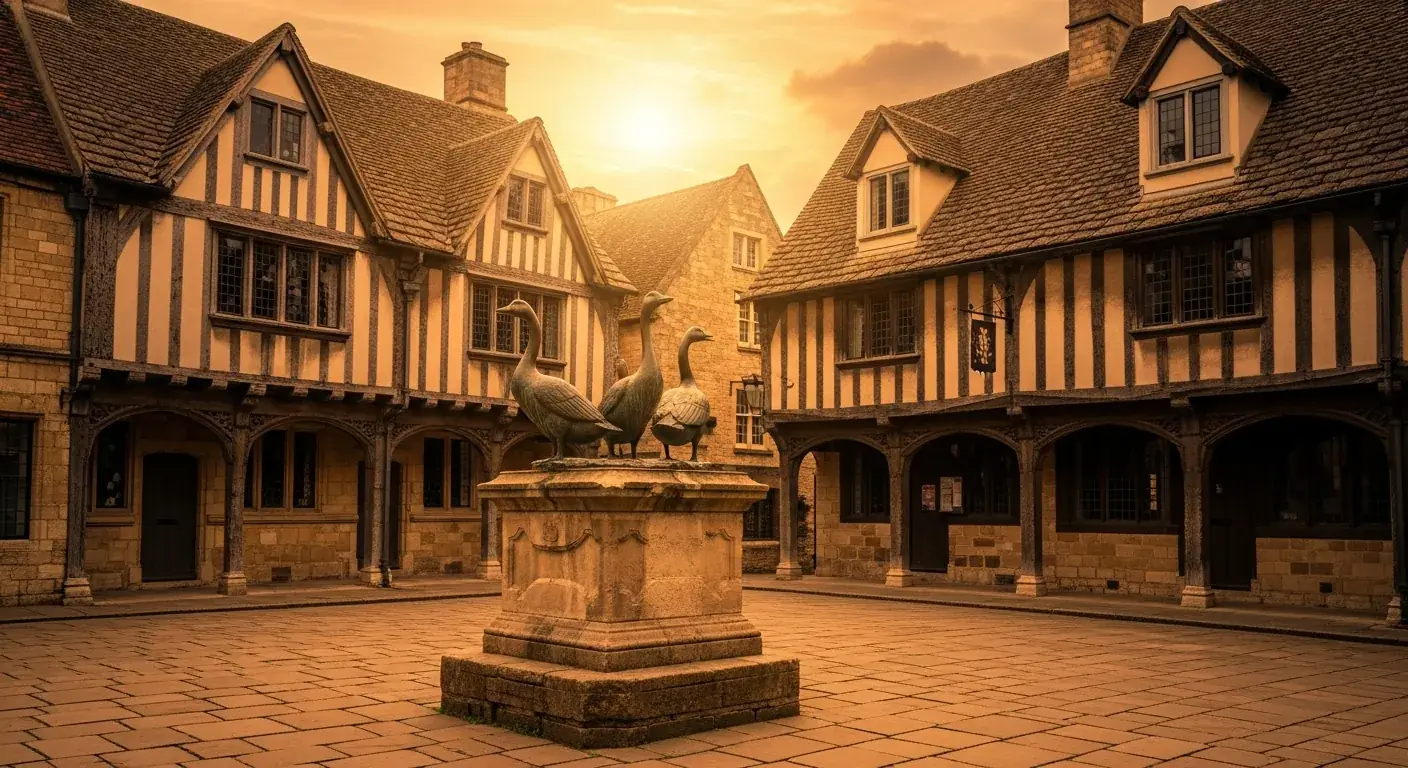
The square itself is surrounded by magnificent 15th- and 16th-century mansions. The Manoir de Gisson (15th century, a listed historic monument) dominates the scene; today it is a private museum that offers a glimpse into the world of Sarlat’s bourgeoisie (period furniture, mullioned windows, slate roofs, and a carinet of curiosities). Next to it, the Hôtel Plamon and the Hôtel de Vassal (which houses the Truffle Museum) round out the ensemble.
Every Saturday from March through December, the square comes alive with the traditional market. Once a year, in early March, the Fest'Oie transforms the square into a living theater: parades of live geese, foie gras tastings, and cooking demonstrations.
Consuls Street
The main street of Old Sarlat, lined with the town's most beautiful mansions:
- Plamon Hotel (or Maison des Consuls) — featuring superimposed Gothic and Renaissance facades, one of the most photographed buildings
- Hôtel de Maleville — a classic Renaissance building, constructed in the 16th century by an advisor to Henry IV
- Hôtel de Grézel — 15th–16th centuries
- Birthplace of Étienne de La Boétie — where the author of *Discourse on Voluntary Servitude* was born in 1530
Liberty Square
The beating heart of Sarlat. This is where the large market is held on Wednesday and Saturday mornings, and where the café terraces are concentrated. The town hall (a Renaissance-style building) overlooks the entire square from its arcades. It is also on this square that Gérard Auliac, a local sculptor who died in 2009, installed “Le Badaud”—a bronze sculpture of a motionless figure who seems to be gazing eternally at the old town.
St. Mary's Church and the panoramic elevator
The former Sainte-Marie Church is one of the most ambitious projects in Sarlat’s restoration effort. Built in the 14th century and deconsecrated during the French Revolution, it was renovated by architect Jean Nouvel (himself a native of the Périgord region, born in Fumel, 30 km away) in the early 2000s (1996–2001).
Today, the building houses:
- The covered market (open daily), featuring foie gras, truffles, cheeses, and cold cuts
- Thepanoramic elevator (The "steel balls" on the monumental pivoting doors are a Nouvel signature) leading to a platform offering a 360° view of the slate-roofed houses in the Old Town
The Nouvel development divides opinion—some residents miss its contemporary boldness—but the view is well worth the detour.
The curtain walls and covered passageways
A little-known feature of Sarlat’s architecture: the “courtines,” covered passageways between houses that form a network of often dim, sometimes vaulted side streets, where visitors can discover a more intimate side of the town. Best explored without a map, simply by wandering at your leisure.
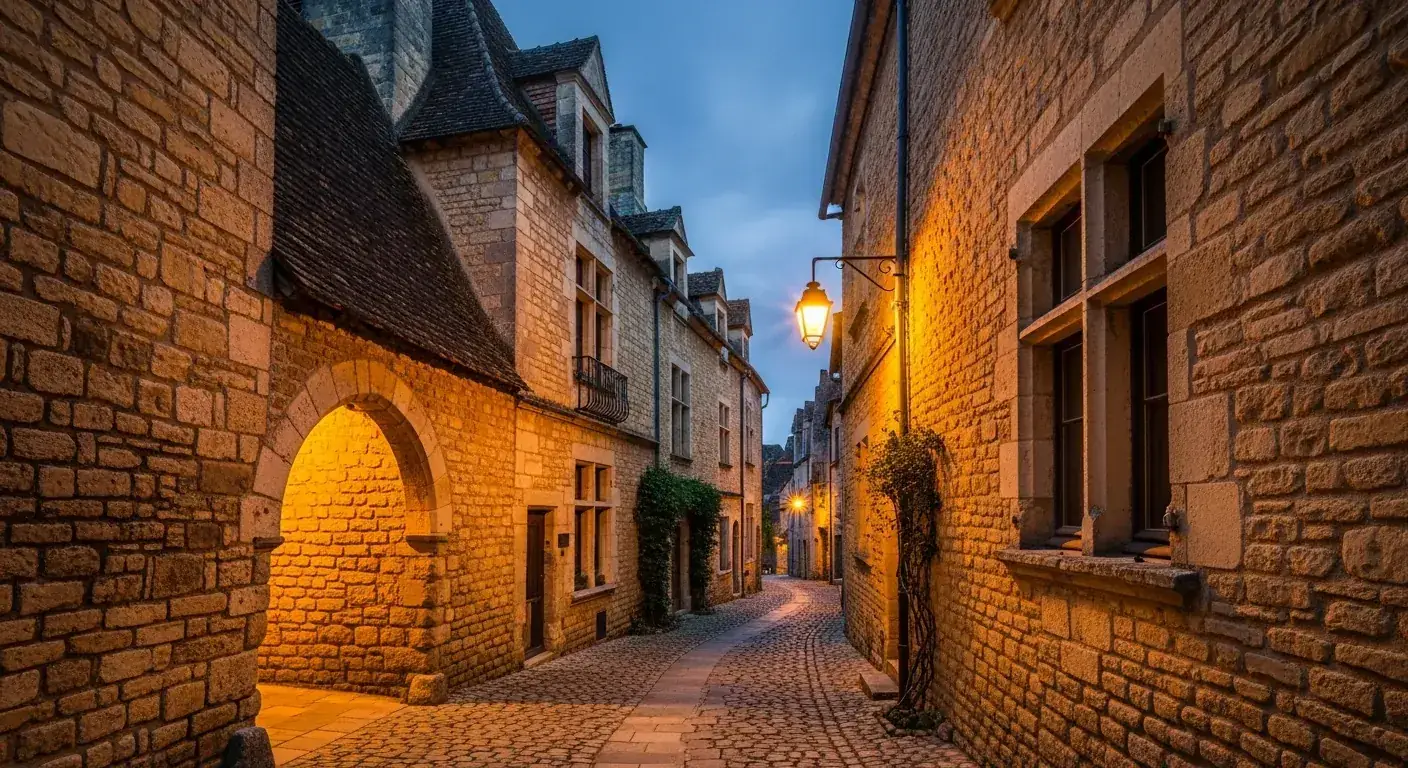
Slate Roofs: An Architectural Signature
Lauze is a flat limestone or schist slab, laid without mortar in an overlapping pattern, which forms the characteristic roofs of Périgord architecture. A lauze roof can weigh more than 600 kg/m²—it requires a massive roof frame to support it and specific expertise to install it. Only a few craftsmen in France still master this technique.
Sarlat has several hundred restored or preserved slate-roofed buildings—this is what gives the town its unique silhouette when viewed from above.
Sarlat, a film set
A fact often overlooked by visitors: Sarlat is a frequent filming location for French cinema, particularly for period or historical films. Over the decades, the town has hosted:
- "The Visitors" (1993) — a few scenes
- "Joan of Arc" by Luc Besson (1999)
- "The Wolf Pact" (2001)
- "The Da Vinci Code" (2006) — prologue scenes set at Saint-Sulpice filmed in Sarlat
- "Manon des Sources" by Claude Berri
- "Amélie" (2001) — selected scenes
- Several French and English TV series (Versailles, The Tudors, etc.)
For movie-loving visitors, the tourist office sometimes offers themed tours of filming locations. This pop-culture angle also makes the stroll more fun for children and teenagers.
Cuisine: foie gras, black truffles, walnuts, wines
| Specialty | Season | Where to Buy | Marker |
|---|---|---|---|
| Foie gras | All year round | Fat Market (Saturday morning) | Périgord PGI |
| Black truffle (Melanosporum) | December–March | Truffle Market (Wed. & Sat. mornings) | 700–1,500 €/kg |
| Nuts | September–November | Markets and Farms | AOC Périgord Walnuts |
| Duck Confit | All year round | Gras Market, restaurants | Artisanal Canned Goods |
| Wines from Domme & Bergerac | All year round | Wine Shops and Restaurants | Red wines, sweet white wines |
| Carécou | All year round | Local Cheese Makers | AOP Goat Cheese |
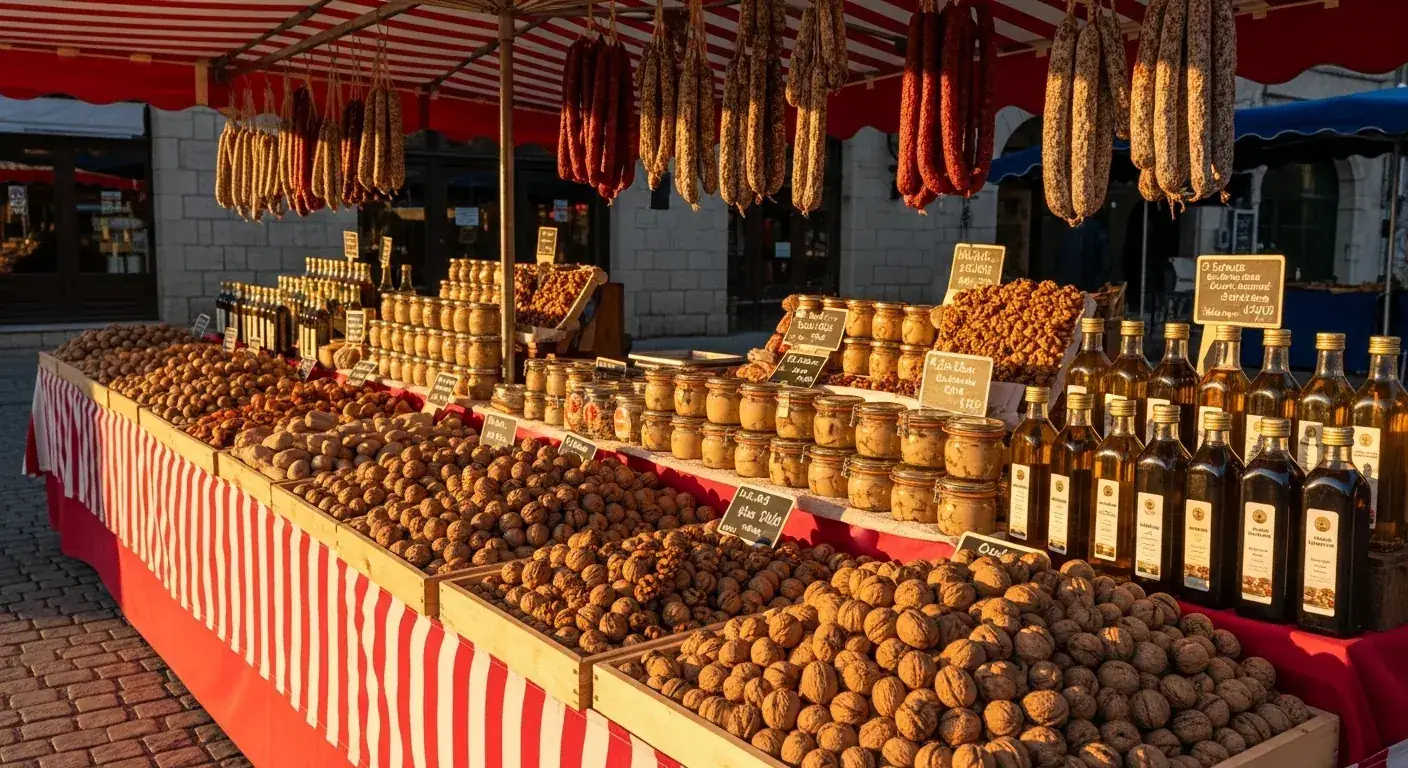
Perigord cuisine is built on four pillars that are easily recognizable at all the markets in Sarlat: foie gras (mostly duck with the Sud-Ouest PGI designation; the traditional goose variety is rarer), the black truffle Tuber melanosporum (800 to 1,500 € per kilo, harvested from December to March), Périgord walnuts (AOP since 2002, varieties include Marbot, Corne, Grandjean, and Franquette), and wines from Bergerac, 75 km away (red Pécharmant, sweet Monbazillac, and dry Bergerac). These products come together at three markets in Sarlat: the traditional market on Wednesday and Saturday mornings (Place de la Liberté), the weekly foie gras market on Saturday mornings from late November to mid-March, and the truffle market on Wednesdays and Saturdays from December to March. The Truffle Festival in mid-January and the Fest’Oie in early March make winter the premier gastronomic season. Budget: 50–120 € per person at a gourmet restaurant, 25–45 € at a bistro, and 12–18 € at the summer night market.

Foie gras
The culinary identity of the Périgord. Two variations:
Duck foie gras: the most common type in local production. It has a stronger flavor, is more rustic, and is more affordable. Look for the “Canard à Foie Gras du Sud-Ouest” PGI label at the market: a guarantee of origin and quality.
Goose foie gras: rarer, more delicate, and melt-in-your-mouth. Historically produced locally, but production is now limited. Expect it to cost 30 to 50% more than duck foie gras of equivalent quality.
How to buy it in Sarlat:
- At the market (Wednesday and Saturday mornings, Place de la Liberté) — straight from the farmers
- At the meat market (Saturday mornings, late November through mid-March) — whole fresh livers, to prepare at home
- At the covered market (Sainte-Marie, daily) — jarred versions
Farm tours: Many farms around Sarlat offer tours and direct sales. Maison Pèlegris (Les Farges, near Lascaux) has been a fixture at the Sarlat market since 1890—one of the area’s historic landmarks.
The Black Périgord Truffle (Tuber melanosporum)
The "black diamond". Harvested from December through March in the oak forests of the Périgord. Prices vary depending on the season and quality, but generally speaking: 800 € to 1,500 € per kilo for top-quality fresh truffles (prices may rise even higher in years of low production).
The Truffle Market is held in Sarlat on Wednesday and Saturday mornings from December through March, in the Town Hall Square. The market is regulated: every truffle sold is inspected by an expert, ensuring that even first-time buyers can purchase truffles at a fair price and of the right quality.
The Truffle Festival (mid-January) is Sarlat’s premier winter culinary event. Highlights include a truffle market, cooking workshops, truffle-hunting demonstrations (searching for truffles with truffle-hunting dogs), and lectures. Thousands of the famous “croustous” (Périgord tapas made with truffles and foie gras) are served there.
Périgord walnuts (PDO since 2002)
The Périgord walnuts benefits from a AOP (Protected Designation of Origin) since 2002. Main varieties: Marbot, Corne, Grandjean, Franquette. It comes in all forms: fresh walnut kernels in the fall, walnut oil (Use it raw, never cooked—its delicate flavor is lost when cooked), cakes, liqueurs.
Périgord walnut oil is one of the region's finest products. Try it in a vinaigrette over a warm goat cheese salad or as an accompaniment to fresh goat cheese.
The Wines of Bergerac
Located 75 km from Sarlat, the Bergerac wine region produces reds, whites, rosés, and sweet wines that pair perfectly with Périgord cuisine. Here are a few appellations to keep in mind:
- Pécharmant: a prestigious red wine appellation north of Bergerac. The perfect accompaniment to pan-seared foie gras or duck breast.
- Monbazillac: a sweet wine appellation south of Bergerac. A traditional pairing for foie gras as an appetizer, blue cheese, and desserts.
- Bergerac red: a broader appellation, offering good value for the price.
- Dry Bergerac (white): predominantly Sauvignon Blanc, crisp, best enjoyed with seafood or goat cheese.
Other Specialties You Should Know About
- Sarladaise potatoes: made with duck fat, garlic, and parsley. A signature dish of the grandmothers of the Périgord.
- Duck confit: preserved in its own fat, a staple ingredient in many traditional dishes.
- Porcini, chanterelles, morels: seasonal mushrooms available at the market in the fall (porcini) and in the spring (morels).
- Goat cheeses: Carécou du Périgord, Rocamadour AOP (technically from the Lot department but sold throughout the Périgord region).
- Walnut cakes: local variations that are often excellent.
Where to Eat in Sarlat
Fine dining: Michelin-starred or highly rated restaurants are concentrated around Place de la Liberté and Rue des Consuls. Reservations are essential during peak season, especially on Saturdays (market day). Meal budget: 50–120 € per person.
Bistros and traditional restaurants: The best spots are often located outside the immediate tourist area. Check out the side streets around Place Boissarie, or the nearby villages (La Roque-Gageac, Beynac, Castelnaud). Budget: 25–45 €.
On a tight budget: The summer night markets in the surrounding villages (July–August) let you enjoy local cuisine for 12–18 € per person—platters of local specialties, a festive atmosphere, and outdoor music.
Helpful tip: Avoid restaurants right on Place de la Liberté in July and August. Prices are high for tourists, and quality varies. The best spots are tucked away in the side streets or nearby villages.
Must-See Villages Around Sarlat
| Village | Distance to Sarlat | A Must-See | Ideal for |
|---|---|---|---|
| La Roque-Gageac | 10 km | A cave-dwelling village on the Dordogne River, gabares | Photo, boat ride |
| Beynac-et-Cazenac | 11 km | Perched medieval castle, most beautiful villages | Medieval History |
| Domme | 12 km | Royal country house perched on a hill, panoramic view of the Dordogne | Sunset |
| Castelnaud-la-Chapelle | 10 km | Castle and Museum of Medieval Warfare | Families, children |
| Marqueyssac | 9 km | Hanging Gardens with 150,000 trimmed boxwood trees | Walk, photo |
| Lascaux IV (Montignac) | 27 km | Replica of a world-famous prehistoric cave | Prehistory, Culture |
The charm of the Périgord Noir lies as much in Sarlat as in the cluster of medieval villages that surround it. Within a 30-kilometer radius, you’ll find what is likely the highest concentration of villages designated as “Most Beautiful Villages of France” in the country.
La Roque-Gageac (12 km)
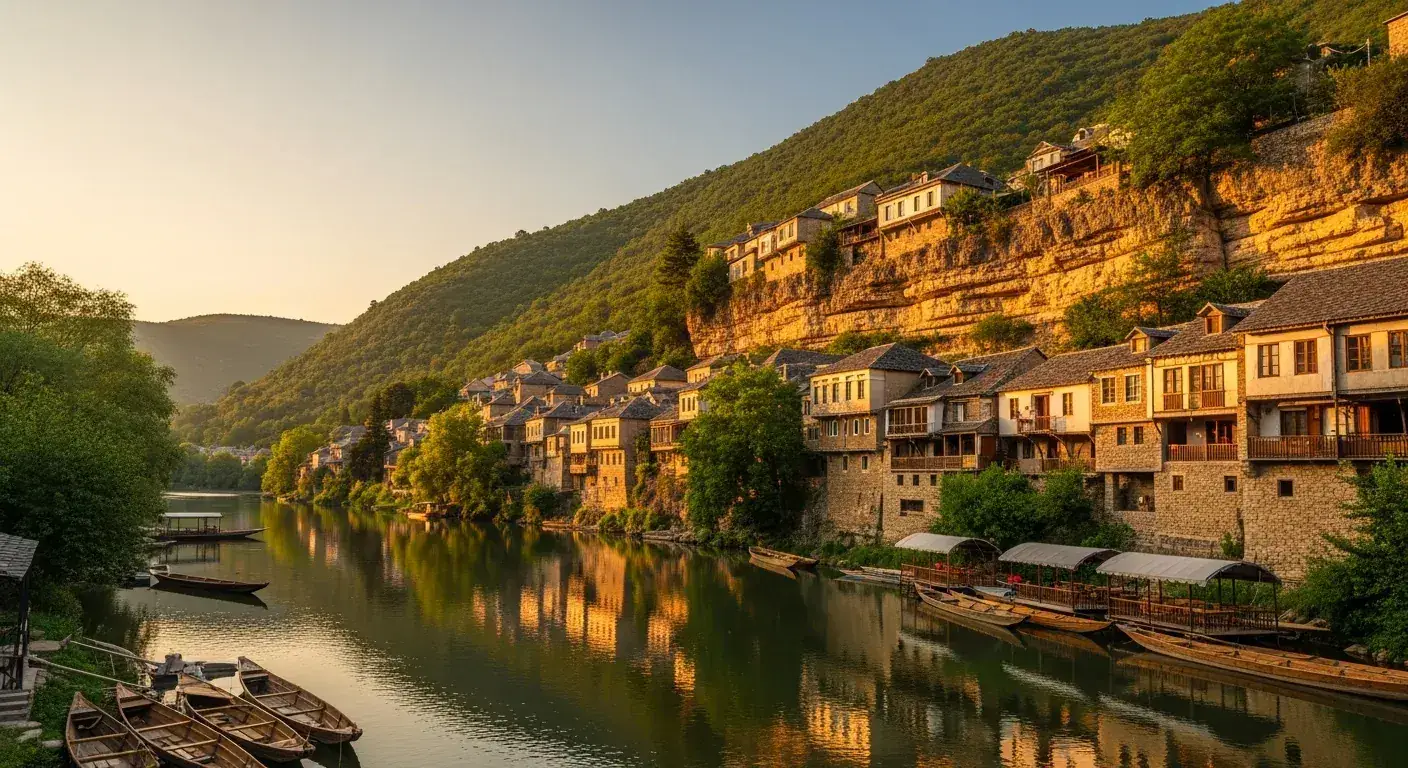
A troglodyte village nestled against a limestone cliff over 100 meters high, on the banks of the Dordogne River. Designated one of the "Most Beautiful Villages of France" since 1982. Don't miss:
- The cave fort, accessible via stairs carved into the cliffside (spectacular view)
- The Exotic Garden, with palm trees, banana trees, and cacti—the microclimate sheltered by the cliff allows these Mediterranean species to thrive
- A ride on a gabarre (a traditional flat-bottomed boat) on the Dordogne River, departing from the village pier
Domme (12 km)
A royal bastide founded in 1281, perched 150 meters above the valley. The view from the “Barre de Domme” is one of the most beautiful in the Périgord Noir—a panoramic view of the Dordogne Valley, with the castles of Castelnaud and Beynac visible in the distance.
Beneath the village market halls, natural caves served as shelters for the villagers during the Middle Ages. Guided tours are available.
Beynac-et-Cazenac (12 km)
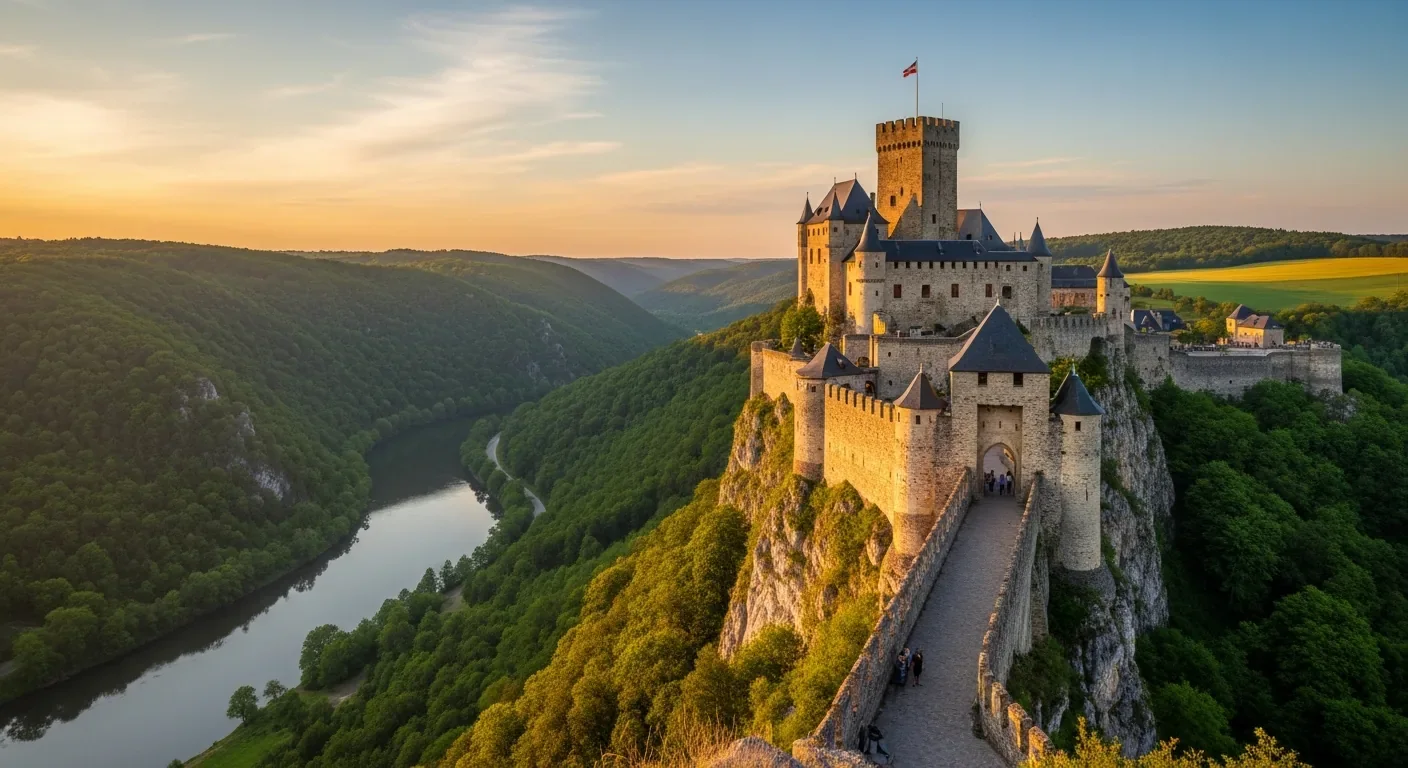
One of the best-preserved medieval castles in France. Perched on a vertiginous cliff overlooking the Dordogne, this 12th-century fortified castle has weathered five centuries of history—from Richard the Lionheart (in the 12th century) to the Hundred Years' War. The climb up to the castle is steep, but the view of the “Valley of the Five Castles” is unforgettable.
Beynac faces its historic rival: the Château de Castelnaud (5 km away), which served as an English stronghold during the Hundred Years' War. The two castles have watched each other warily and fought one another for centuries.
Castelnaud-la-Chapelle (8 km)
Castelnaud Castle is now home to a museum dedicated to warfare in the Middle Ages—one of the most educational in France. It features life-size replicas of trebuchets, mangonels, ballistas, and other medieval siege engines. Firing demonstrations are held during the season.
Les Eyzies-de-Tayac (20 km)
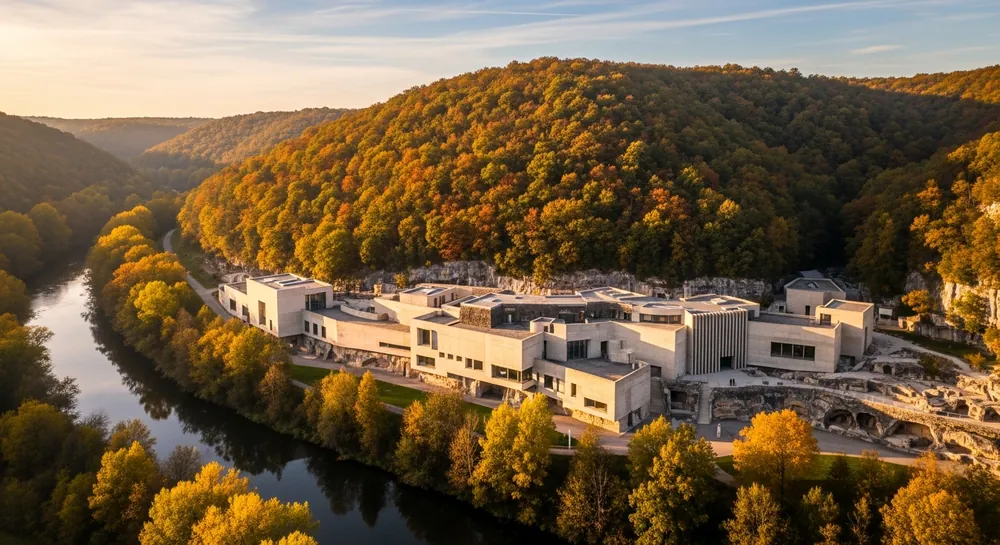
The World Capital of Prehistory. This is where the National Museum of Prehistory is located, housed in a medieval castle overlooking the village, which holds one of the richest Paleolithic collections in Europe.
In the immediate vicinity: the Font-de-Gaume Cave and the Cap Blanc Rock Shelter (see the “Prehistory” section below).
Montignac-Lascaux (26 km)
The village that is home to Lascaux IV, the International Center for Cave Art. A charming village on the banks of the Vézère River.
Rocamadour (60 km)
Technically located in the Lot (and not in the Dordogne), but it fits naturally into a trip to the Périgord. A sanctuary perched on a 150-meter cliff, it has been one of France’s most important Christian pilgrimage sites since the Middle Ages. The most devout pilgrims climb the 216 steps of the Pilgrims’ Staircase on their knees.
Saint-Cyprien (16 km)
A lesser-known medieval village that is more authentic and less crowded than its neighbors. It’s known for its Sunday morning market.
Prehistory: The Dordogne's Other Treasure
The Vézère Valley, a few kilometers north of Sarlat, is the cradle of European prehistoric art. Fifteen major sites there have been listed as UNESCO World Heritage Sites since 1979.
Lascaux IV (International Center for Cave Art)
History : the September 12, 1940, four teenagers from Montignac—Marcel Ravidat and his friends—discover a cave after their dog falls into a hole. They explore it and come across one of the the greatest archaeological discoveries of the 20th century.
The original frescoes date back 17,000 to 18,000 years and depict approximately 2,000 figures, including about 600 identifiable animals (horses, bulls, deer, bison, big cats) and mysterious symbols. The original cave was open to the public from 1948 to 1963, welcoming 1 million visitors, before being permanently closed: the CO₂ and humidity emitted by visitors were causing irreparable damage to the paintings.
Lascaux IV, which opened in December 2016, features a complete and exact replica of the original cave (source: Lascaux IV official website, accessed July 24, 2026). The tour continues through several areas dedicated to cave art:
- The facsimile: a full-scale reproduction of the cave
- Understanding Lascaux: Models and Large-Scale Facsimile Replicas
- The Theater of Cave Art: The Work of Prehistorians
- Lascaux 3D: An Augmented Reality Experience
- Rock Art and 20th-Century Art: Virtual Gallery
- Virtual Reality: 3 Standalone Immersive Devices
Practical Information:
- Distance from Sarlat: 26 km, about 30 min
- Open: year-round (except for a few days in January)
- Extended hours during the summer (until 10 p.m.)
- Reservations are strongly recommended at lascaux.fr; some time slots fill up several days in advance during peak season
- Several tour options : guided tour, self-guided tour with audio guide, storytelling tour for children, Prestige (in-depth small-group tour)
The Font-de-Gaume Cave (Les Eyzies)
The most valuable prehistoric site in the Périgord—and one of the rarest in the world. Font-de-Gaume is one of the last caves decorated with paintings that is open to the public in France (source: Centre des monuments nationaux, accessed July 24, 2026). Daily visitor numbers and the amount of time visitors may spend inside the cave are limited to preserve its climatic and microbiological balance.

Listed as a UNESCO World Heritage Site since 1979, the cave contains more than 230 rock art depictions dating from approximately 14,000 to 17,000 years ago: bison, horses, mammoths, and reindeer. The famous “reindeer facing each other” scene, in which one reindeer appears to be licking the forehead of another, is one of the most moving prehistoric depictions known.
Practical Information:
- Distance from Sarlat: 20 km, about 25 min
- Reservations are required at sites-les-eyzies.fr
- Seats are very limited (only a few dozen per day) and often sell out several months in advance during peak season
- Closed on Saturdays
- Guided tours only, in small groups
L'Abri du Cap Blanc (Les Eyzies)
2 km from Font-de-Gaume, theCap Blanc Shelter presents a a frieze that is unique in the world : horses, bison, and deer life-size, carved directly from limestone, there are about 14,000 years. The monumental prehistoric sculpture has no equivalent anywhere else.
Reservations are also required.
The International Center for Prehistory (PIP)
In Les Eyzies, this free interpretation center offers the perfect introduction to prehistory before visiting the caves. Ideal for families and first-time visitors.
When to Visit Sarlat: Seasonal Calendar
| Season | Period | Benefits | Disadvantages | Events |
|---|---|---|---|---|
| Spring | April–June | Moderate crowds, lush greenery, pleasant temperatures | A few sites that are still ramping up for the season | Theater Games Festival (June) |
| Summer | July–August | Night markets, entertainment, long evenings | Very crowded, full parking lots, high prices | Village Night Markets |
| Fall | September–October | Best time to visit: vibrant colors, fewer crowds, the first white summer truffles | The days are getting shorter | Film Festival in late October, start of truffle season |
| Winter | November–March | Authenticity at its best, truffle and lard markets, medieval Christmas | Some restaurants are closed; the weather is changeable | Truffle Festival (mid-January), Fest'Oie (early March) |
Our recommendation: September–October. The golden autumn light on the pale stone buildings of the Périgord is incomparable. The tourists have left. The restaurants have regained their tranquility. The first truffles appear at the markets. And the hilltop villages (Beynac, Domme, La Roque-Gageac) return to their usual tranquility.
Winter has its own charms. The “Gras” market (Saturday mornings, late November through mid-March), the truffle market (Wednesday and Saturday mornings, December through March), the Truffle Festival in mid-January, and the Fest’Oie in early March make winter an exceptional gastronomic season. Sarlat under the snow (rare but possible) is an unforgettable sight.
Avoid the period from July 14 to August 15 if you don't like crowds. The city is overrun with tourists, prices skyrocket, parking is a nightmare starting at 9 a.m., and the surrounding villages (Beynac, La Roque-Gageac) experience heavy traffic jams around midday.
How to Get to Sarlat from Bordeaux
| Mode of travel | Travel time from Bordeaux to Sarlat | Cost (2 people) | Verdict |
|---|---|---|---|
| Personal car/rental car | ~2.5 hours (217 km via the A89) | 30–50 €/day + fuel + tolls | Freedom, but driving after tasting |
| Direct TER | ~2:19–2:32, depending on the train | Prices vary depending on the date | 5 to 6 trains per day, depending on the date; check before departure |
| Private Chauffeur Service in Bordeaux | ~2.5 hours door-to-door | Starting at 348 € · one-way | Comfort, exclusive castles and villages, English-speaking |
| Bus (Flixbus, BlaBlaCar Bus) | Variable | ~20-40 € | Limited hours, inconvenient for villages |
By personal or rental car
Main route: A89 via Périgueux, then D6089 / D704 toward Sarlat. Allow about 217 km and 2 hours and 30 minutes door-to-door. Tolls.
Alternative route: Take the A20 via Brive-la-Gaillarde, then the D703 along the Dordogne River. It’s a longer route, but the final stretch runs along the river and takes you through spectacular scenery. This is the route to take if you have time.
Parking in Sarlat: The old town is largely pedestrian-only. Main parking lots:
- Bouquerie Parking Lot (paid parking, west side, near downtown)
- Plantier Parking Lot (paid parking, east side of the Old Town)
- Cordeliers Parking Lot (paid parking, north of downtown)
- Outlying parking lots (free, 500 meters to 1 kilometer away, shuttle service during the season)
In July and August, all downtown parking lots are full by 10 a.m. Arrive early or use the outlying parking lots.
By train
There are direct TER trains from Bordeaux Saint-Jean to Sarlat. SNCF Connect listed six departures for July 24, 2026, with the shortest travel time being 2 hours and 17 minutes; service and schedules vary by date (source: SNCF Connect, accessed July 24, 2026).
The train isn't very convenient for exploring the villages of the Périgord: without a car once you arrive, you're limited to Sarlat and a few local bus routes. Consider renting a bike or a car when you arrive.
Private chauffeur service with a private chauffeur
The most convenient option for travelers who want to fully enjoy the region without any logistical hassles: no stress about parking, the freedom to stop in villages, and the chance to taste local wines without worrying about driving.
It's also the best option for groups, families with children, and travelers who want to combine Sarlat and Lascaux or Sarlat and several villages in a single day.
For details (packages, rates, reservations): see our page on private chauffeur service between Bordeaux and Sarlat.
By bus (Flixbus, BlaBlaCar Bus)
There are a few bus routes available, but with limited schedules and inconvenient connections for exploring the Périgord countryside. This option is only suitable for a trip centered on the town of Sarlat, without visiting the surrounding villages.
Practical Information
Recommended duration
- Day 1: Sarlat only (old town + market if it's Saturday). First impressions, just skimming the surface.
- 2–3 days: Sarlat + La Roque-Gageac + Beynac + Domme. The minimum amount of time needed to really enjoy the area.
- 4–5 days: Sarlat + villages + Lascaux + Les Eyzies. The perfect itinerary for exploring the entire Périgord Noir, with time for tastings at local producers.
- One week: Sarlat + the Black Périgord + the Green Périgord (Brantôme, Bourdeilles) + the Purple Périgord (Bergerac and its vineyards). A true immersion.
Accommodations
In the old town of Sarlat: charming hotels and bed-and-breakfasts in historic buildings. Expect to pay 120 to 280 € per night during peak season. A unique experience; limited availability. Book 3–6 months in advance for July–August.
On the outskirts: vacation rentals, castles, and estates located 10–20 km from Sarlat. They’re often more spacious, have swimming pools, and are less expensive. Ideal for families.
Campgrounds: There are many in the Dordogne Valley. Some are premium 4- or 5-star campgrounds with swimming pools, restaurants, and spas.
Estimated budget per day per person
| Profile | Daily Budget | Accommodations | Dining |
|---|---|---|---|
| Backpacker | 60-80 € | Campground or inn | Markets and grocery stores |
| Family | 120-180 € | Holiday rental outside town | Bistros and Picnics |
| Couple | 150-280 € | Charming Hotel | Fine-dining restaurants |
| Premium | 300 € and up | Castle or estate | Michelin-Starred Restaurants |
Accessibility for People with Disabilities
The old town is largely cobblestone and hilly, which makes it difficult for people with limited mobility. Accessible locations: Place de la Liberté, the covered market (ground-level entrance), and certain sections of Rue de la République. The panoramic elevator at Sainte-Marie Church is accessible.
Festivals and Events
- Theater Games Festival (late July/early August) — one of the oldest theater festivals in France
- Sarlat Film Festival (late October / early November) — aimed at high school and film students
- Truffle Festival (mid-January) — a must-see for foodies
- Fest'Oie (early March) — goose festival, tastings, demonstrations, parades
- Summer Night Markets in the Surrounding Villages (July–August)
Frequently Asked Questions
Is Sarlat really worth the trip from Bordeaux?
Yes, without a doubt. Sarlat is about 2.5 hours door-to-door by private car from Bordeaux and offers an authentic medieval-Renaissance experience that few cities in France can match. Its historic district features many of the protected sites mentioned in this guide. Add to that the local cuisine, the villages in the valley, and Lascaux, and you have one of the country’s most enriching destinations.
How long does it take to visit Sarlat?
Half a day for the old town alone. A full day if you include the Saturday market and the immediate surroundings. 2 to 3 days for Sarlat and the villages in the valley (La Roque-Gageac, Beynac, Domme). 4 to 5 days for the entire Périgord Noir region, including Lascaux and Les Eyzies.
When is the best time to visit Sarlat?
September–October is ideal: fewer crowds, beautiful light, and the first truffles of the season. Winter (November–March) is excellent for foodies, with truffle and foie gras markets. Avoid July–August if you don’t like crowds.
Is it possible to visit Sarlat and Lascaux in a single day?
Yes, it's doable. Lascaux IV is 26 km from Sarlat (30 minutes). A well-planned day could include the morning market in Sarlat, a tour of the old town in the early afternoon, and Lascaux IV in the late afternoon. Book your visit to Lascaux IV in advance at lascaux.fr—morning time slots fill up quickly.
Is the market in Sarlat held every day?
The traditional open-air market is held on Wednesday and Saturday mornings from 8 a.m. to 1 p.m. The covered market in Sainte-Marie Church (designed by Jean Nouvel) is open every day. In winter, the truffle market takes place on Wednesdays and Saturdays, and the foie gras market is held every Saturday morning from late November through mid-March.
Is Sarlat a good place for families with children?
Yes, that's great. The medieval alleyways fascinate children, the market is a fun experience, and the surrounding area offers plenty of activities: a boat ride on the Dordogne, Lascaux IV with its immersive technology, demonstrations of medieval siege engines in Castelnaud, and canoeing on the Dordogne during the season. Please note: the cobblestone streets of the old town are difficult to navigate with strollers.
Who created the Three Geese at Goose Market Square?
François-Xavier Lalanne (1927–2008), an internationally renowned French sculptor, famous for his animal sculptures (notably his “Sheep,” which are highly sought after at auction). The Three Geese of Sarlat were commissioned by the city and installed on July 3, 1992. A symbol of the local cuisine, they have become Sarlat’s most photographed landmark.
What is the origin of the name "Sarlat"?
Its origin remains a matter of debate. Some trace it back to the Gaulish word *sarra* (rock, hill), while others link it to a person’s name. The Latin form *Sarlatum* appears in medieval charters as early as the 9th century.
Why is Sarlat so well-preserved?
Three reasons. (1) Geography: Sarlat is located away from major transportation routes (no major railroad, no navigable river). (2) History: The town remained economically stagnant during the 18th and 19th centuries, thus escaping the destruction wrought by industrial modernization. (3) Politics: The 1962 Malraux Law on protected areas made Sarlat the first pilot city under the program, leading to 25 years of systematic restoration.
Where can you eat in Sarlat without breaking the bank?
Several options: the summer night markets in the surrounding villages (a full meal for 12–18 €), the bakeries and specialty food shops in the old town for a high-quality picnic, and the bistros outside the immediate tourist area (the narrow streets around Place Boissarie). Avoid the restaurants right on Place de la Liberté if you’re on a tight budget.
How can you get around the villages of the Périgord Noir without a car?
This is the region’s main challenge. Public transportation between villages is very limited. Your options include: bike rentals (the Dordogne Valley is relatively flat, with beautiful bike paths), car rentals in Sarlat, or a private chauffeur service from Bordeaux on a flat-rate basis. In the summer, a few tourist shuttles connect the most popular sites.
Is Sarlat a film location?
Yes, it’s one of the most frequently used filming locations in French cinema. Among the films shot in part in Sarlat are: *Joan of Arc* (Luc Besson, 1999), *Brotherhood of the Wolf* (2001), *The Da Vinci Code* (2006), *The Visitors* (1993), *Manon des Sources* (Claude Berri), and several TV series (*Versailles*, *The Tudors*). The tourist office sometimes offers themed tours of these locations.
Further Reading
- Private chauffeur service for Sarlat: see our page on private chauffeur service between Bordeaux and Sarlat (packages, rates, reservations)
- To get from the airport directly to Sarlat: see Bordeaux Airport Transfer
- Getting there from Saint-Jean Station: see the private chauffeur service at Saint-Jean Station
- Combine a visit to Sarlat with a trip to the Arcachon Basin: see private chauffeur service Bordeaux ↔ Arcachon, private chauffeur service Bordeaux ↔ Cap Ferret, or private chauffeur service Bordeaux ↔ Dune du Pilat
- Add a day in the vineyards: see private chauffeur service Bordeaux ↔ Saint-Émilion or private chauffeur service Bordeaux ↔ Médoc
Sources and References
- Sarlat Périgord Noir Tourist Office — events calendar, guided tours, lodging, ticket sales
- Lascaux IV — International Center for Cave Art — ticket office, hours, admission prices
- Font-de-Gaume Cave — Reservations Required — Buy Tickets Online
- Dordogne Périgord Tourism — Schedule of Truffle Markets and Events
- National Museum of Prehistory in Les Eyzies — Admission Prices and Hours
- Gisson Manor — Sarlat — tour of the historic monument
- TER Nouvelle-Aquitaine — Train Schedules and Routes Between Bordeaux and Sarlat
Article updated on .
Off to the Périgord Noir
Direct door-to-door trip from Bordeaux (~2.5 hours), with optional stops in Saint-Émilion or Bergerac along the way; can be combined with a visit to Lascaux. Written fixed-price quote within 30 minutes; sedan or van; English-speaking driver.