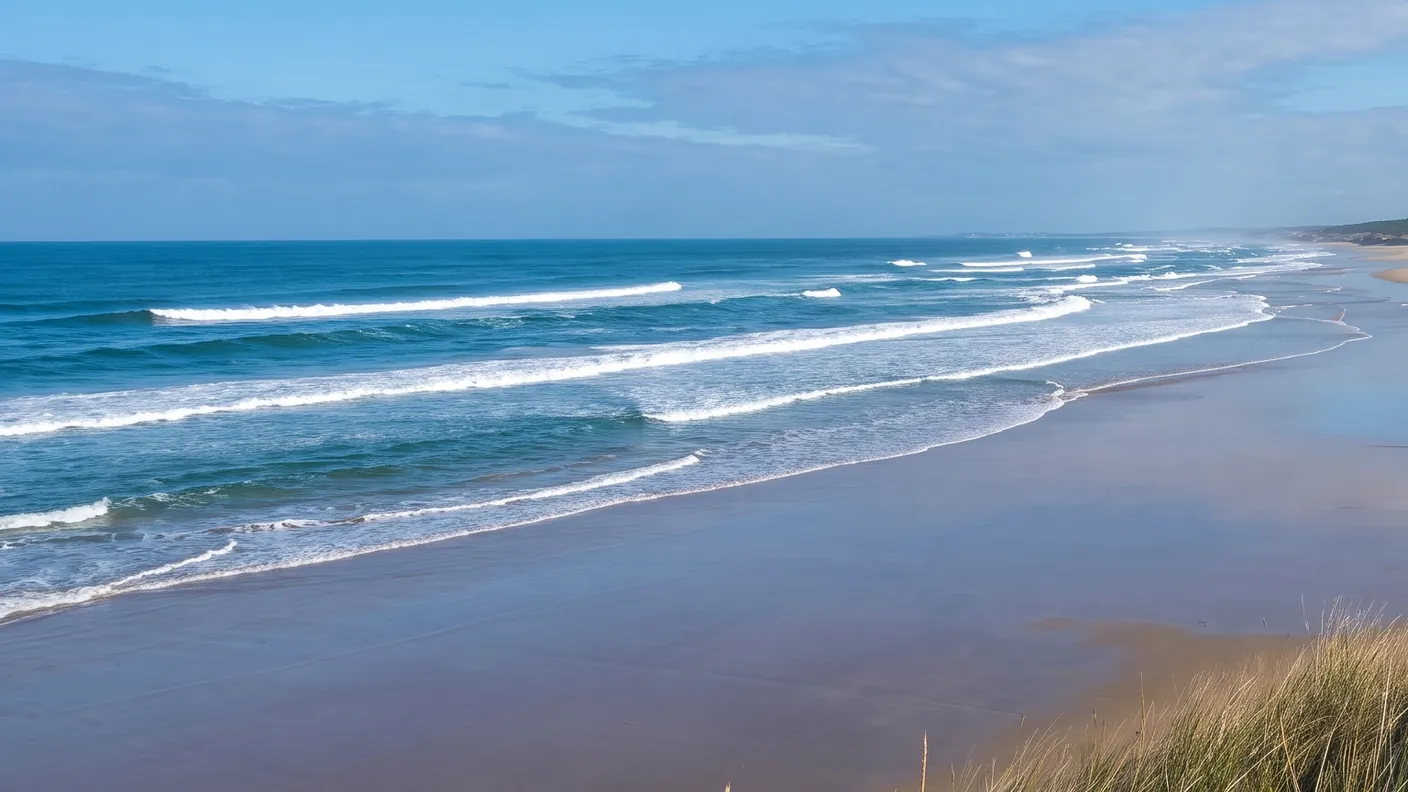
Bordeaux to Biscarrosse-Plage: Atlantic Beaches
Four lifeguard-patrolled beaches, a spot that has produced champions, and a promenade leading to the dunes: Biscarrosse-Plage, a seaside resort established in 1879 with a checkerboard-patterned boardwalk facing the ocean, its seven surf schools, and the Vélodyssée bike route leading to Pilat—just 1 hour and 16 minutes from Bordeaux.
Biscarrosse-Plage at a Glance
Biscarrosse-Plage is the ocean resort town of Biscarrosse, located about 84 km from Bordeaux (1 hr 16 min): four lifeguard-patrolled beaches—including South Beach, which is patrolled from May 1st through mid-October—a surf spot that launched the career of Kauli Vaast, a future Olympic champion, and, in the spring of 2026, a restored waterfront following the spectacular collapse of its boardwalk in January. Laid out in 1879 with a checkerboard street plan facing the ocean, the resort embraces a dual heritage: the wooden villas of the Belle Époque and surf culture, supported by seven surf schools. This guide separates fact from fiction: the resort does not date back to “the 1920s,” the French Surfing Championships are not held there (though the WSL Junior Pro is), and the Dune du Pilat cannot be reached along the beach—it is an 18-km drive or the Vélodyssée bike route. We’ll finish with the easiest way to get there: a private door-to-door transfer.
Here are the key details to know before you go. Distances are calculated door-to-door from Bordeaux; the fare shown is for an executive car service at a fixed price provided in advance, with no unexpected meter charges. The information has been verified using Wikipedia, the city of Biscarrosse, the Grands Lacs Community of Municipalities, the ONF, the WSL, and the Bisca Grands Lacs tourist office; event times and dates, which are subject to change, should be confirmed on site. Finally, a note on methodology: the resort is best explored with its three horizons in mind—the ocean ahead, the forest behind, and the Great Lakes to the east—and this guide covers them in that order, from the sand to the pines, before providing the cost of the trip.
| Key fact | Details |
|---|---|
| Resort | Biscarrosse-Plage (municipality of Biscarrosse, Landes) |
| Location | the village of Born; 4 km of sandy beach at the foot of the dune ridge, with a national forest behind it |
| Singularities | 4 supervised beaches · Kauli Vaast Beach · the restored waterfront (2026) |
| Must-See | the beaches, the new boardwalk, La Lette du Vivier, the Vélodyssée trail toward Pilat |
| Distance from Bordeaux | about 84 km · about 1 hour and 16 minutes by car (A63/A660) |
Where is Biscarrosse-Plage located?
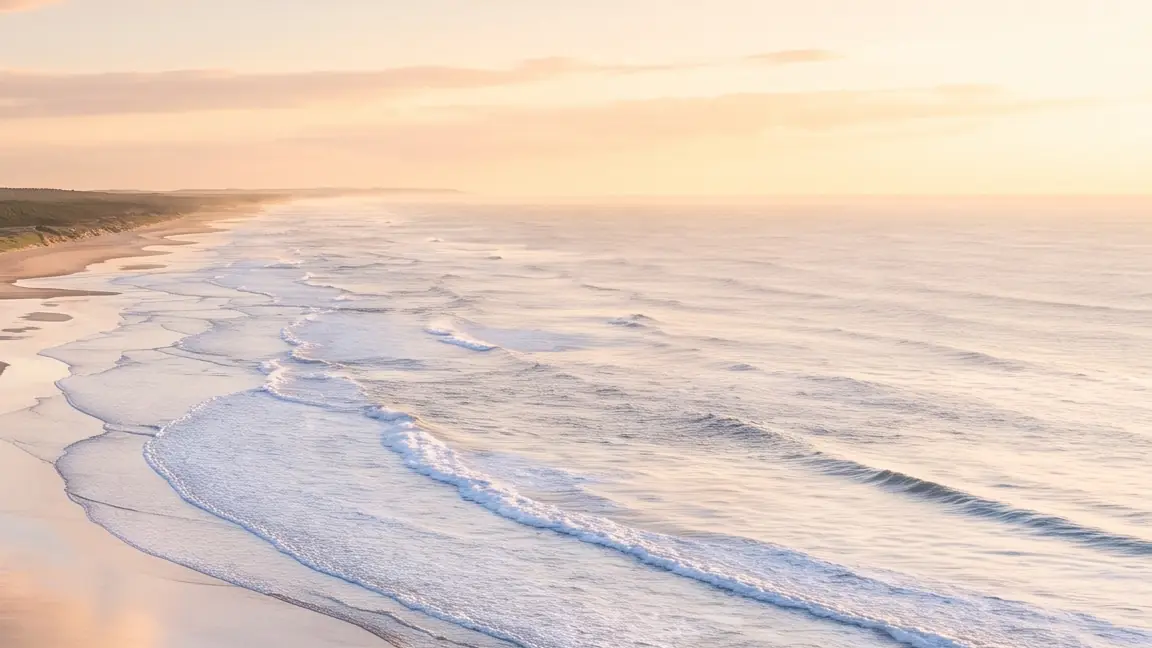
Biscarrosse-Plage is located on the Landes coast, in the Pays de Born region, about 84 km from Bordeaux—a 1-hour, 16-minute drive via the A63 and A660. Interestingly, it takes almost as long to reach the resort as it does to reach the town center, even though the town is 10 kilometers closer. It is one of the three districts of Biscarrosse (population 15,836, the 3rd-largest town in the Landes), along with the town center—about ten kilometers away—and Biscarrosse-Lac: our Biscarrosse Guide covers the city, the lakes, and the seaplanes.
The resort boasts 4 km of fine sand at the foot of the dune ridge—the town has 9 km of oceanfront, and the tourist office lists 5 km of developed beaches—backing onto the Biscarrosse National Forest, some 12,000 hectares of pine trees stretching from here to Mimizan. To the east, two large lakes frame the town: Cazaux-Sanguinet to the north and Biscarrosse-Parentis to the south. And along the coast, there are two features that few resorts can boast: to the north, the Vélodyssée bike path winds its way toward the Dune du Pilat; to the south… we’ll come back to that—the beach ends abruptly at a military base.
A checkerboard from 1879 overlooking the ocean
You can read the resort’s layout from the dune: a regular checkerboard of streets running perpendicular to the ocean—the untouched imprint of the original 1879 development, when about 180 rectangular lots were sold to the town’s residents, who built their wooden villas there; the figure comes from local history, but the layout can be seen with the naked eye. The train station followed in 1909 and the Grand Hôtel in 1912, before the golden age of the 1930s, when—according to local tradition—the resort was a favorite vacation spot for people from Bordeaux. The semi-detached villas "La Rafale" and "Les Embruns," survivors of the 19th century, still retain the scent of wood and salt. A resort older than we think, so: 1879, not the Roaring Twenties—we’ll come back to this in the chapter on fact and fiction.
The Hotel with Its Tea Dances and the Little Train Loop
Two stories capture the spirit of the place. The story of theHôtel de la Plage, first of all: built of wood in the early 1900s by the Condou family, rebuilt in 1912, it was equipped in 1948 with a Tea Dance Hall where the resort stands facing the ocean—before decades of neglect and a rebirth in July 2013, making it the oldest surviving building on the waterfront today. Then came the little train: as early as 1909, it was carrying swimmers to the new beach; twenty years later, the seaplanes from Latécoère roared across the nearby lake, with Mermoz and Saint-Exupéry making stopovers—the Belle Époque of seaside resorts intersecting with the epic history of the Aéropostale, just ten kilometers apart. The passenger line closed in 1950, but the loop is superb: The old railroad track has been turned into a bike path, now part of the Vélodyssée—today’s cyclists follow the route where the train once ran.
Four beaches are patrolled during the summer, including the South Beach from May through October
Biscarrosse-Plage has four supervised ocean beaches—South, Central, North, and Vivier—with one of the widest stretches along the coast: South Beach, the main station, is supervised from May 1st through mid-October, and all four locations are open from 11 a.m. to 7 p.m. from July 4 through August 31. The system, including the channels, was inspected in July 2026 in the Official Monitoring Schedule for the City of Biscarrosse.
From the main office to the secluded beach
The system extends from south to north. The South Beach, the main station, offers the longest monitoring season in the area: from May 1st through mid-October (12:30 p.m.–6:30 p.m. outside the peak summer season) — a rarity in the Landes region. Central Beach, at the end of the pedestrian street, is home to many families and businesses; the North, which has been under surveillance since mid-June, watches the surfing competitions; and the Vivier Beach, which has been extended through early September, offers a wild experience: it can be accessed via 700 meters of forest trail from the parking lot. Dogs are allowed only at its northern end. Beyond that point, there is a tacit acceptance of naturism, though the area is unsupervised—we mention this without designating it as an official facility, as there is no official decree establishing it. Four different atmospheres, but one common requirement: know how to enjoy the Landes coast.
Baïnes and Flags: A Guide to the Landes Way
The beauty of this coastline comes with its own rules. In the height of summer—from July 4 to August 31—the four stations are open from 11 a.m. to 7 p.m., staffed by civilian lifeguards supported by CRS officers, with both land and water patrols: one of the most extensive coverage systems along the Landes coast, in terms of both duration and scope. This coverage addresses a phenomenon that no swimmer should ignore: “baïnes”, troughs that form between sandbars and, as the tide fills or empties them, generate currents capable of sweeping a swimmer out to sea without them even realizing it. The solution is simple: swim between the red and yellow flags, facing the lifeguard station—the white and black flags, meanwhile, mark the areas reserved for water sports. Simple, vital—and the reason why the very long lifeguard season at South Beach is not a luxury, but a service that few resorts offer.
The competition that launched an Olympic champion
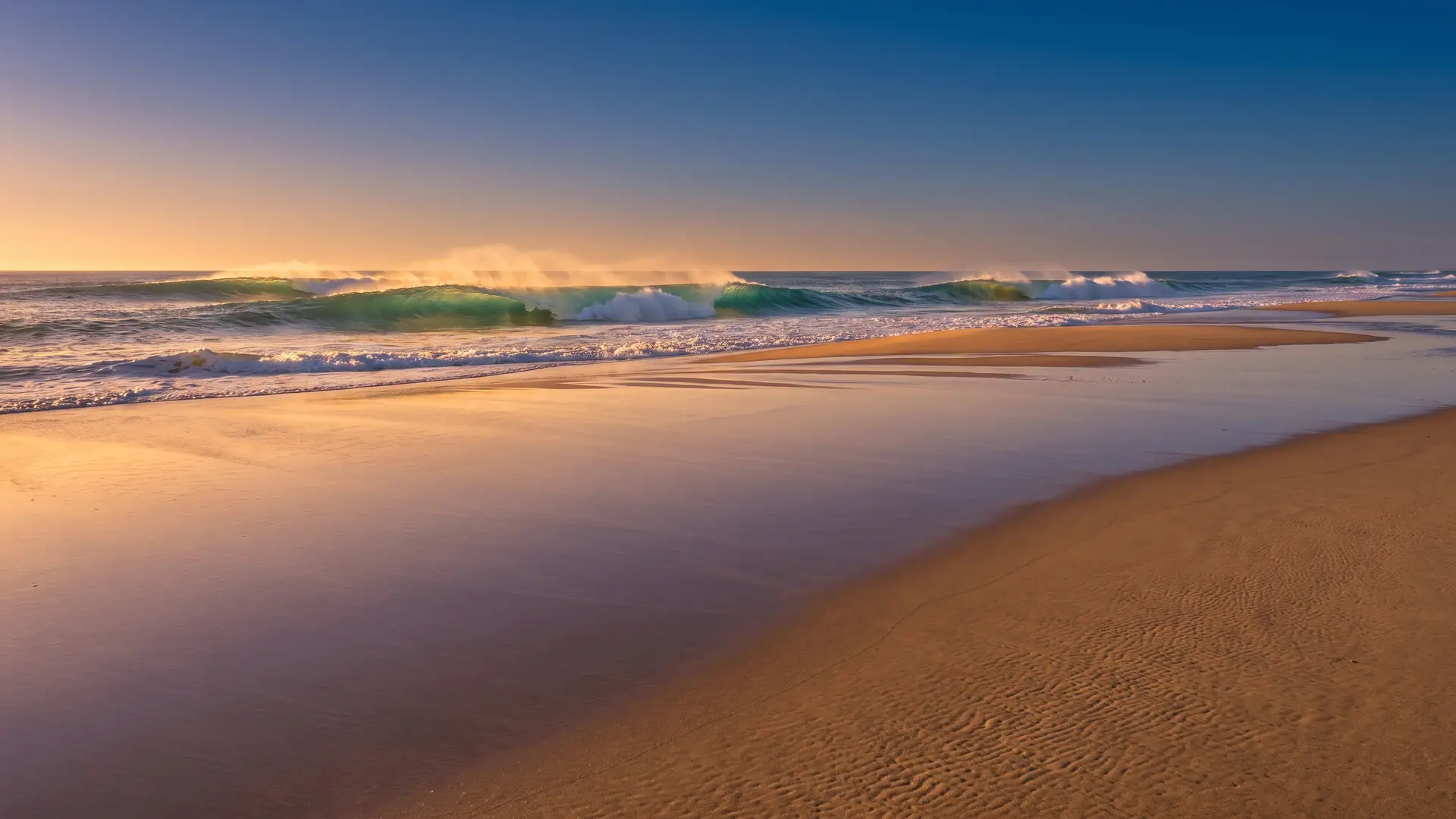
The Biscarrosse beach break—"one of the most popular spots on the Atlantic coast," according to the tourism office—hosted the WSL Junior Pro from 2016 to 2018: it was here that 15-year-old Kauli Vaast won his first international competition before going on to become the Olympic surfing champion at Teahupo’o in 2024. It is the proven track record of a spot that nurtures champions.
From the Junior Pro to Teahupo'o
This story is worth its weight in gold. From 2016 to 2018, the Junior Pro Biscarrosse—a stop on the WSL Junior World Tour—was held on the North Beach; the first edition was won by Titouan Boyer and Ariane Ochoa from the Basque Country. And it was at this very spot that Kauli Vaast, a 15-year-old from Tahiti, claimed his very first victory in a WSL competition—the same Vaast who would go on to be crowned Olympic surfing champion at Teahupo’o during the 2024 Paris Olympics. Biscarrosse can rightfully claim to have launched a legend. The spot has also hosted French Longboard, SUP, and tandem competitions, and even the 2014 Tandem Surfing World Cup, held during the Kiwi Surf Festival between the North Roundabout and Central Beach—one of the few world-class competitions in this acrobatic discipline ever organized in France.
Seven schools, one club, a local hangout
A note on accuracy, since captions sometimes go beyond the facts: the French Surfing Championships are not held here. Biarritz has traditionally hosted them, and the 2026 event will take place in Seignosse, Hossegor, and Capbreton. And the local club isn't called the "Biscarrosse Surf Club" but Lou Bisca Surf Club, affiliated with the French Surfing Federation and located on Avenue de la Côte d'Argent—it was this club that organized the Tandem World Cup. Around the club, seven schools cover all levels: La Vigie — the pioneer, founded in 1995 —, Kiwi Surf, Xpérience Gliss, Gang Surf, Biscaradise, Point Break, and Monkey Surf, during a season that runs fromApril through October, when the sandbars create the best waves. The connoisseurs, on the other hand, head straight to Vivier Beach, the locals’ favorite spot, at the end of its forest trail. The tourist office traces the local surfing culture back to the 1960s; that’s their claim—but the passion is undeniable.
2026: The Resort That Gave Its Concrete Back to the Dune
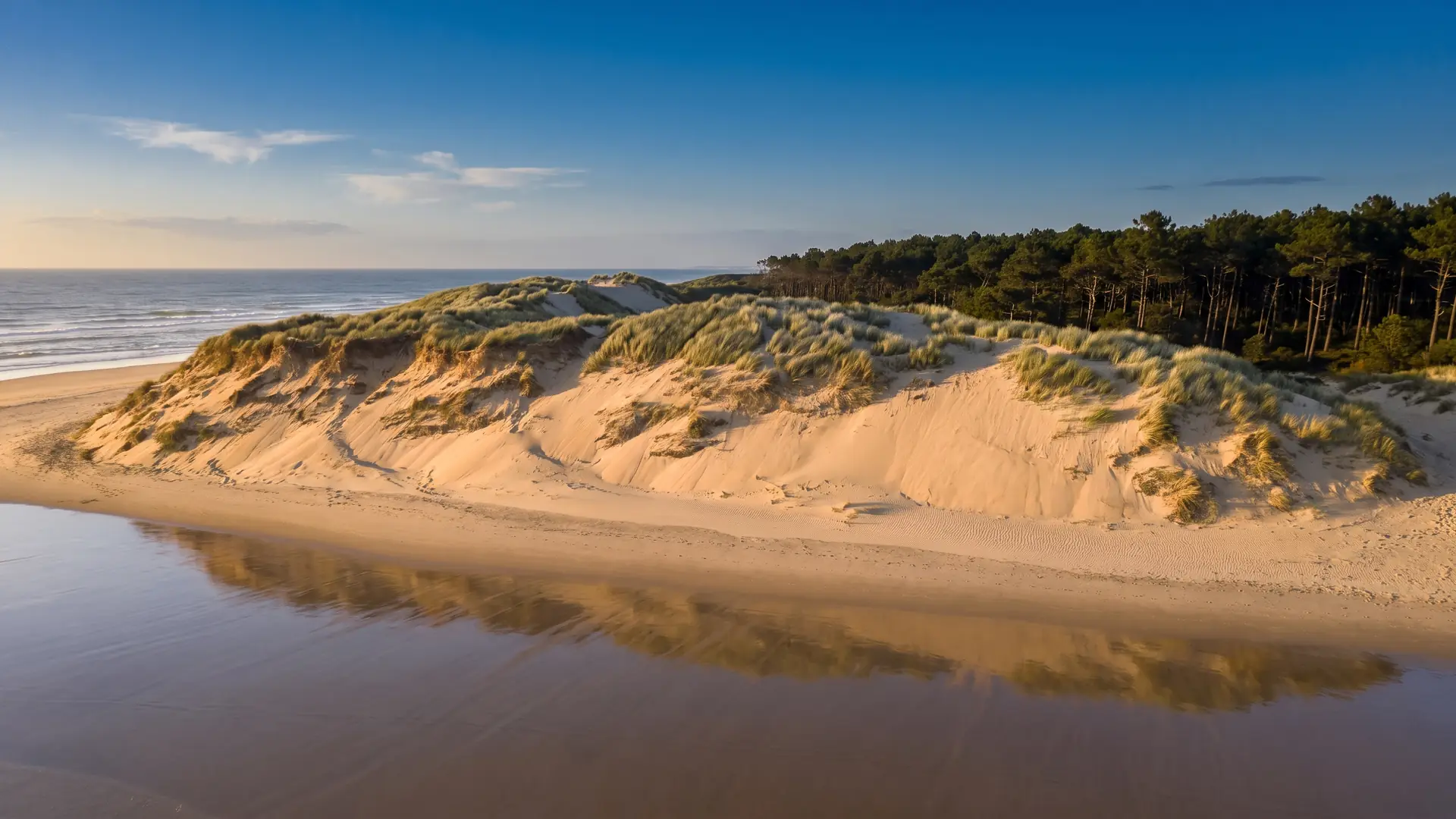
The waterfront restoration project is scheduled to take place from October 2025 to March 2026. The project includes the construction of a wooden boardwalk, the restoration of the white dune, the removal of the North roundabout, and the conversion of Boulevard des Sables to one-way traffic. The goal is to adapt the resort to the retreating coastline. Source: Grands Lacs Community Council, published on January 2, 2026, updated on January 13, 2026.
Down 1.70 meters per year: the ocean decides
The shoreline is receding here by an average of about 1.70 meters per year. To limit the effects of erosion, sand replenishment operations have been conducted every spring since 2001, with sand sourced from south of the station. Source: Great Lakes Commission, page accessed in July 2026.
The winter of 2025–2026 brought the phenomenon to light: in late January, about 30 meters of a concrete promenade collapsed under the onslaught of the Atlantic, even as the renaturation project was already underway.
Wood, picket fences, and strategic retreat
The renaturation, carried out from October 20, 2025, through March 2026, changed everything: concrete gave way to a panoramic wooden walkway lined with wooden fencing, a reshaped and replanted white dune, the removal of the North roundabout and its parking lot beside the dune, and one-way traffic on Boulevard des Sables—all funded by six partners, ranging from the European Union to the city, including the national government, the region, the department, and the community of municipalities. Set to open upon completion of the 2025–2026 construction project, the new promenade exemplifies the strategic retreat: stop fighting the ocean and give it back its buffer zone. Not to be confused with the other waterfront project—the pedestrian street, renovated in two phases between 2008 and 2020 at a cost of approximately 1.5 million euros, which opens onto Central Beach. The 19th-century twin villas and the Grand Hôtel, built in 1912, are described as “doomed to disappear” in the long run as the shoreline retreats—the next chapter in a story that began in 1879 on the shores of the same ocean.
Le Vivier, La Lette, and the Forbidden Forest of the South
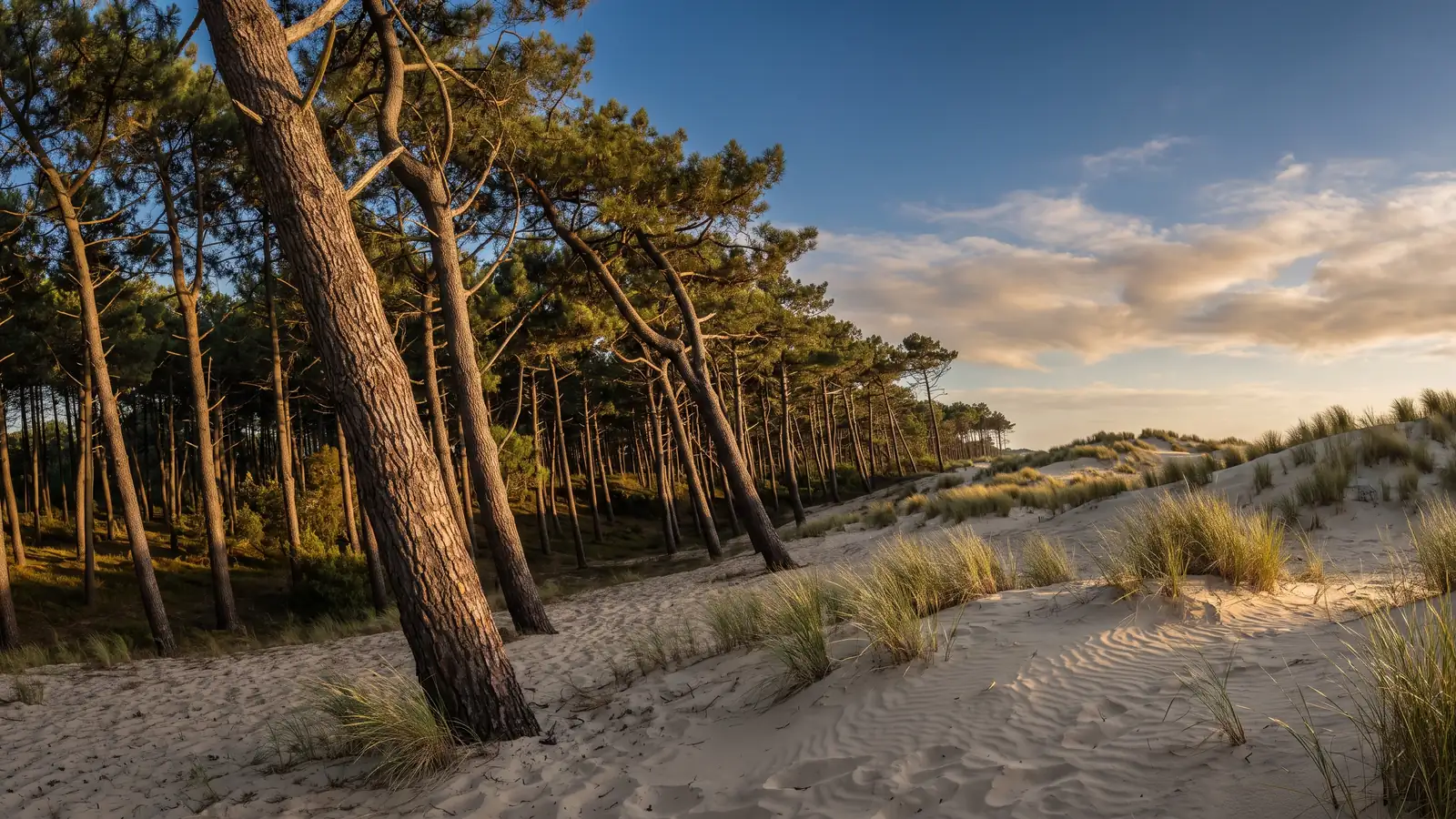
The northern part of the resort hides its natural treasures: the wild Vivier Beach at the end of its forest trail, and the Lette du Vivier—a 1.5-kilometer ONF loop on boardwalk around a pond behind the dunes, which opened in 2024. To the south, the exact opposite: ten kilometers of off-limits beach. Here is the verified geography of extremes.
La Lette: A Window onto the Other Side of the Dune
On the north side, the Lette du Vivier is the area’s newest nature attraction: inaugurated on July 10, 2024, by the ONF, this educational trail on raised boardwalks winds 1.5 km around a “lette” pond—these wet depressions that form between dune ridges, serving as refuges for flora and fauna normally inaccessible to hikers. The boardwalks allow visitors to explore the area without trampling the habitat: a rare glimpse behind the scenes of the dune landscape. The trail is the perfect complement to Vivier Beach and its 700-meter forest approach—the ideal combination for a morning in the wilderness, beneath the canopy of the Biscarrosse National Forest, some 12,000 hectares of maritime pines managed by the ONF between here and Mimizan.
To the south, Missile Beach
On the south side, the contrast is stark: between Biscarrosse-Plage and Mimizan lie about ten kilometers of beach that are off-limits—the DGA Missile Testing Facility, successor to the Landes Testing Center established in 1962 across more than 15,000 hectares of dunes and forest, marked by “Danger, Firing” signs. A practical consequence that tourist maps never show: the beach is continuous only to the north, and Mimizan-Plage, which is nearby as the crow flies, can only be reached by road—a 48-kilometer, one-hour detour inland. Yet another unique feature for a resort that has no shortage of them: bordered to the north by Europe’s tallest dune and to the south by a military firing range—few French beaches can claim the same.
1920, the Championships, walking on the dunes: what we often read
Several claims are circulating about Biscarrosse-Plage that deserve to be corrected, with supporting sources—which is the whole point of a reliable guide. The resort’s history, its surfing achievements, and the routes: here’s what’s true and what’s false.
A resort from 1879, a Junior Pro (not the French Championships)
First correction: the resort does not date back to “the 1920s and 1930s”—the original housing development dates back to 1879, the train station to 1909, and the Grand Hôtel to 1912; the 1930s were the golden age, not the beginning. Second: the French Surfing Championships are not held here—the spot’s already impressive list of events includes the WSL Junior Pro (2016–2018, featuring Kauli Vaast’s first world title), the French Longboard/SUP/Tandem Cups, and the 2014 Tandem World Cup. Third: the “Biscarrosse Surf Club” does not exist—the federation-affiliated club is called Lou Bisca Surf Club. Fourth: Maguide Beach, often cited among the resort’s beaches, is a lake beach—it belongs to the lake area. And the town’s population is 15,836 (2023), up nearly 12% since 2017—not the “14,000” figure copied year after year.
The Dune du Pilat by Road: The Southern Route Is Closed
As for itineraries, here are two clarifications based on actual conditions. The Dune du Pilat cannot be reached “by taking a stroll along the beach”: it’s 18 km away by road (about 20 minutes) in the town of La Teste-de-Buch, or by bike via the Vélodyssée—no official source describes a coastal walking route, and the 15-kilometer stretch of sand has neither water nor emergency services. To the south, the matter is settled: access to the beach is prohibited for about ten kilometers (DGA property, 1962). One final, recent clarification: the “redeveloped waterfront” actually encompasses two separate projects—the pedestrian street renovated between 2008 and 2020, and the 2025–2026 restoration project prompted by the erosion emergency, following the January collapse and with construction scheduled through March 2026. As for the “modest nightlife” sometimes mentioned: no source supports this claim—the facts point to a daily night market in the summer and dance floors on festive evenings. The resort speaks for itself.
What is there to do in Biscarrosse-Plage?
In Biscarrosse-Plage, you can choose from four lifeguard-patrolled beaches, take your first surfing lessons at one of the seven schools, stroll along the brand-new, restored boardwalk, walk the loop of the Lette du Vivier on its boardwalks, bike the Vélodyssée toward the Dune du Pilat—and enjoy the daily night market and summer fireworks. The actual, verified program, including dates through 2026.
- The beaches—South (lifeguard-patrolled from May 1 through mid-October), Central, North, and Vivier; 4 lifeguard stations, 11 a.m.–7 p.m., from July 4 through August 31
- Surfing — 7 schools, including La Vigie (1995) and Kiwi Surf; Lou Bisca Surf Club; best time: April–October
- The Renaturalized Walking Trail — Panoramic Woodland and White Dune Reprofiled During the 2025–2026 Construction Project
- La Lette du Vivier — a 1.5-km ONF loop trail on boardwalk around the back-dune pond (2024)
- The Vélodyssée — Arcachon ↔ Biscarrosse-Plage: 26 km, 100% bike-friendly route via La Salie and the Dune du Pilat
- The market — Place Dufau: Saturdays year-round; in the summer, every morning except Thursdays, plus a daily night market from 8:00 p.m. to midnight
- Upcoming Events for 2026 — Fireworks and a DJ on July 14; Fête de la Mer on August 15 (flower wreath for surfers); Summer Games on August 1–2; “Rue des Étoiles” circus on August 21–24
- Surfcasting — fishing with a long rod from the beach, May through December without a license; introductory sessions hosted by the club on Wednesdays and Saturdays during the summer
Summer evenings: somewhere between a night out and a trip to the beach library
The summer of 2026 showcases the resort’s expertise in hosting festivities. The foundation: the daily night market, from 8 p.m. to midnight at Place Dufau—a rarity for a resort of this size—which turns every evening into a leisurely stroll. Highlights include July 14 (fireworks at 11 p.m. and a DJ stage) and the Fête de la Mer on August 15, with its heartwarming tradition—a floral wreath presented to surfers in the morning—before the fireworks and the dance. In between, there are the Summer Games (August 1–2), the DJs Summer Fest at Place Dufau (July 10 and August 7), and, from August 21 to 24, the Rue des Étoiles circus festival, held at the Latécoère site. The perfect counterpoint can be found on the sand of the South Beach: a pop-up library features over 200 books facing the ocean, from July 6 to August 22—read with your feet in the sand between swims at the supervised beach. Who said “modest nightlife”?
A five-meter fishing rod facing the ocean
It remains the most photogenic activity on the beach as the towels are being folded up: surfcasting, or “casting into the waves.” The technique commands respect—rods ranging from 4.50 to 5 meters, casts exceeding 100 meters beyond the first breaking waves, and the patience of the angler standing facing the setting sun, his luminous rod tips planted in the sand. The sport runs from May through December, with no license required—recreational sea fishing doesn’t require one—and the Biscarrosse Surfcasting Club offers introductory sessions on Wednesday and Saturday mornings during the summer: an ideal introduction to learn the basics, even if you don’t come away with a sea bass. This is the other side of Biscarrosse’s beaches: the day belongs to the surfers, the twilight to the anglers—and the ocean serves as the arbiter for both.
| Activity | Where / When | Good to Know |
|---|---|---|
| Beaches | 4 monitored stations | South: May 1 through mid-October — a rare range |
| Surfing | 7 schools, open from April through October | WSL Junior Pro 2016–18; Lou Bisca Surf Club |
| Walk & Dune | restored waterfront | construction project from October 2025 to March 2026 |
| Lette du Vivier | 1.5 km ONF trail on a boardwalk | + 700 m through the forest toward Vivier Beach |
| Market | pl. Dufau · daily in the summer (except Thursdays) | Open every evening from 8 p.m. to midnight |
| Vélodyssée | toward the Dune du Pilat and Arcachon | 26 km, 100% bike path |
What to see nearby: Pilat, Arcachon, the lakes
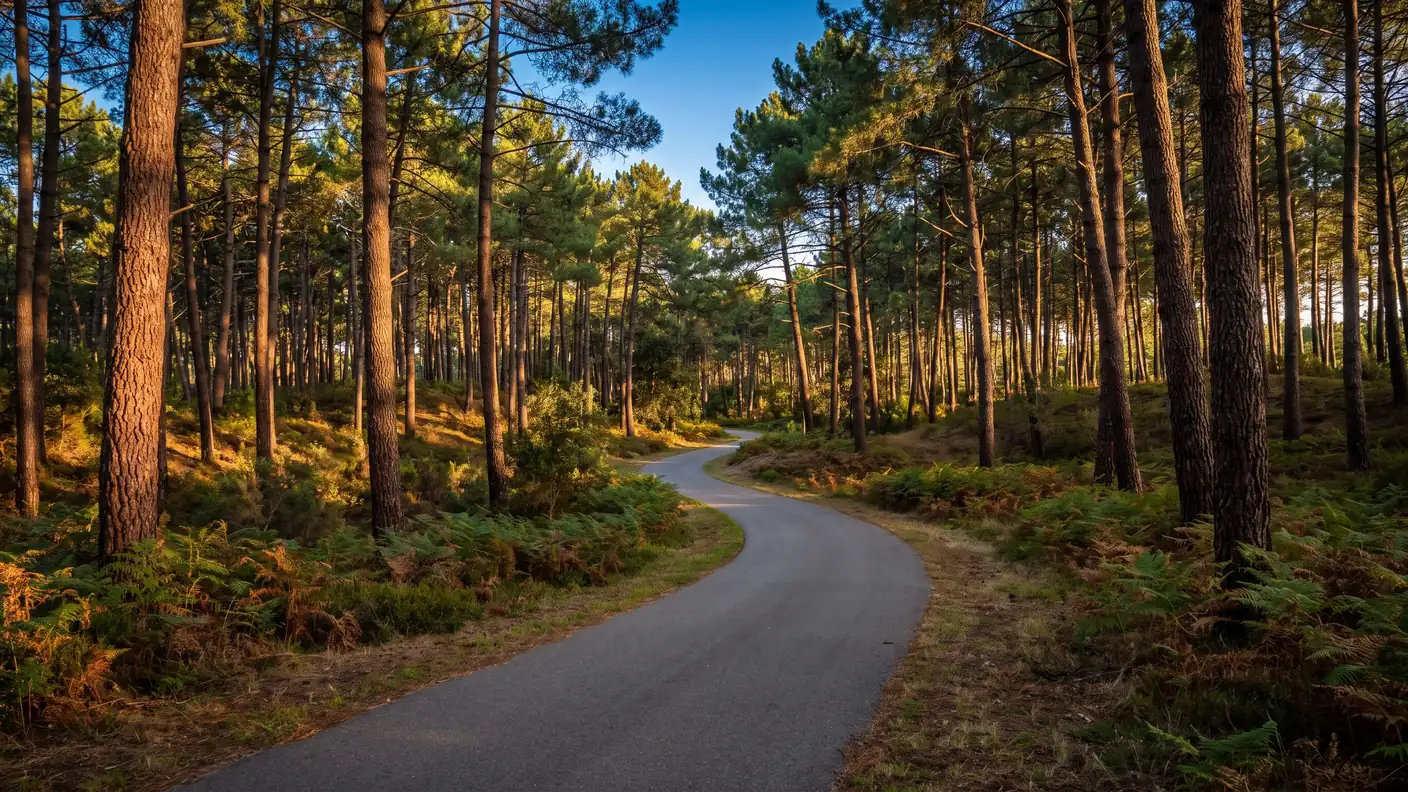
Biscarrosse-Plage is a hub: the Dune du Pilat is 18 km (21 minutes) away, Arcachon is 30 km away, the town center and its museums are about 10 km away, and the lake beaches of Navarrosse and Maguide are a quarter of an hour away. And a truly memorable leg of the Vélodyssée. Here are the verified distances.
The highlight of the stage: 26 km to the foot of Mount Pilat
The highlight of the trip is the bike ride: the Arcachon ↔ Biscarrosse-Plage leg of the Vélodyssée covers 26 km that are entirely bike-friendly, winding through the Landes Forest, via Salie Nord Beach (supervised swimming area) and the base of the Dune du Pilat — the tallest in Europe, 18 km away by road for non-cyclists: see our guide to the Dune du Pilat. The town is also the Landes gateway to EuroVelo 1: 163 km of coastline stretching to Tarnos begins here. Inland, the town (10–11 km) is home to the Musée de l’Hydraviation and the markets—see our guide to Biscarrosse—and the lake beaches of Navarrosse and Maguide offer calm waters when the ocean is rough; Sanguinet and its submerged villages complete the triangle. Arcachon (30 km) rounds out the lineup on the Bassin side. Helpful reminder: Mimizan-Plage, to the south, is accessible only by road (48 km)—the military base cuts across the coast.
Giant lakes: Plan B for days with rough seas
This overview would be incomplete without mentioning the two large lakes that flank the town: Cazaux-Sanguinet to the north—one of the two largest natural freshwater lakes in France—and Biscarrosse-Parentis to the south. When the ocean gets too choppy for the kids or the westerly wind whips up the beach, the lake shores of Navarrosse and Maguide take over: calm, warm water, supervised swimming during the season, pedal boats, and stand-up paddleboarding—all just a quarter of an hour from the resort. This also clears up a common misunderstanding: Maguide Beach, often listed among the beaches “of Biscarrosse-Plage,” is actually a lake beach. To get around all these different settings, the bike remains king: more than 50 km of bike paths crisscross the town, connecting the ocean, the village, and the lake shores without ever touching a road. The ocean in the morning, the lake in the afternoon: the signature experience of the Pays de Born.
| Destination | Distance / time from the station | Must-See |
|---|---|---|
| Biscarrosse town | 10–11 km · 14 min | Hydraviation Museum, markets, Saint-Martin Church |
| Dune du Pilat | 18.1 km · 21 min | Europe's tallest dune; also accessible by bike via the Vélodyssée |
| Navarrosse / Guide | ~8–10 km · 12 min | supervised lake beaches, 27-hole golf course |
| Sanguinet | ~20 km · 22 min | Submerged Villages, Lake Museum |
| Arcachon | 30.2 km · 32 min | waterfront, piers, Ville d'Hiver |
| Mimizan-Plage | 48.5 km · 1 hr | by road only (military area to the south) |
When is the best time to visit Biscarrosse-Plage?
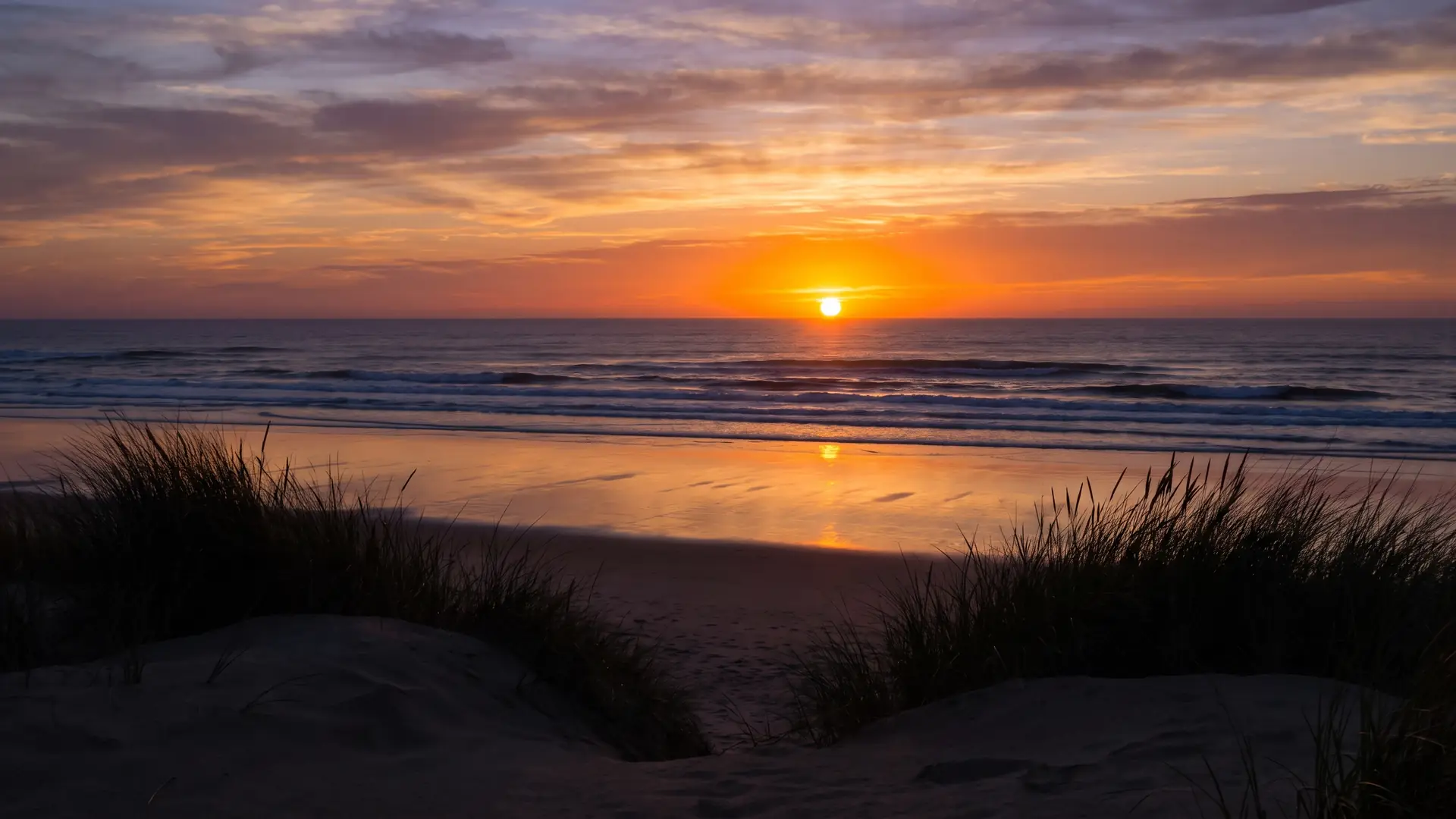
South Beach is patrolled from May 1st through mid-October—one of the longest seasons on the Landes coast—surfing is enjoyed from April through October, and the summer of 2026 will debut a brand-new waterfront: the resort is bustling for a full six months. Here is the verified schedule.
| Season | What's in Store for You |
|---|---|
| Spring (May–June) | South Beach is already patrolled; spring swells for surfers; a new, peaceful promenade |
| Summer (July–August) | 4 positions, 11 a.m.–7 p.m., daily night market, July 14 fireworks display, August 15 Sea Festival, beach library |
| Fall (Sept.–Oct.) | South Beach is open until mid-October, with excellent swells and the golden Vélodyssée |
| Winter | Spring tides and the ocean's impact on the dunes, a peaceful retreat, spectacular sunsets |
Seasonal Tip
The summer of 2026 has a special feel to it: it’s the first since the promenade was restored—with its light-colored woods, replanted dunes, and roundabout returned to the sand—and the resort has a sense of rebirth. To enjoy it without the crowds, aim for June or the first half of September: the South Beach is lifeguard-patrolled, the ocean is swimmable, and depending on the month, you can enjoy evening events or late-season illuminations—and until September 6, Vivier Beach even keeps its lifeguard station open, a rare luxury for a wild beach.
Surfers know their prime times—April through June and September through October, when the sandbars are in good condition and the schools are on break; families will take over in July and August, with its four-hour time slots. Winter, finally, offers a raw spectacle: the spring tides that sculpt the dunes—and serve as a reminder of why the boardwalk is now made of wood. No matter the season, the evening ritual remains the same: the sunset due west, the sun sinking into the Atlantic—the resort’s only attraction that has never needed to be redesigned.
How much does the trip cost, and how do I get there?
A private transfer from Bordeaux to Biscarrosse-Plage costs 154 € in Economy class (1–3 passengers), a fixed price provided in advance, for a distance of approximately 84 km and a 1-hour, 16-minute drive via the A63 and A660. If you don’t have a car, the nearest train stations are La Teste-de-Buch and Ychoux, 25–30 km away. Here’s an honest comparison.
By car from Bordeaux
The route follows the town's layout all the way to the lakes: the bypass, then the A63 and A660 toward Arcachon, before the D652 and D146 head west to the ocean— about 84 km, 1 hr 16 min (realistic estimate: 1 hour 16 minutes to 1 hour 20 minutes, depending on the starting point). On summer Saturdays, the resort’s traffic bottleneck and parking add another quarter of an hour; the new waterfront, in fact, removed the parking lot at the North roundabout, back at the dune—arriving relaxed has never been more valuable. With a private driver, the trip is door-to-door—from your home, Mérignac Airport, or Saint-Jean Train Station to the resort, campground, or surf school—with surfboards and bikes loaded. The price is set and confirmed before the trip: 154 € in Eco, 8-seater van available upon request for families and surf trips.
Without a car: La Teste or Ychoux, then by road
The train does not stop at this station: the nearest stations are La Teste-de-Buch (TER Bordeaux-Arcachon with frequent service, ~25 km) and Ychoux (Bordeaux-Hendaye line, ~30 km). From there, summer transportation options are unreliable: you’ll need to finish the trip by car. The smoothest option for a traveler with a lot of luggage—family, surfboards, bikes—is still a private transfer all the way from Bordeaux, or the TER to La Teste followed by a private chauffeur, a smart way to combine the Bassin and the ocean in the same trip. Once there, biking is king: the Vélodyssée bike path runs through the resort, the 1909 narrow-gauge railway trail connects to the town center, and some 145 km of bike paths crisscross the Grands Lacs region—enough to reach ocean beaches, lake shores, and markets without ever getting behind the wheel. The Born equation, one last time: plan your trip, then cycle your way through it—between a giant dune and an ocean that reshapes the beach every winter.
| Option | Duration | What You Need to Know |
|---|---|---|
| Chauffeur Service (Door-to-Door) | ~1 hr 16 min | 154 € in Economy (1–3 passengers), fixed price, 8-passenger van available upon request |
| Personal car | ~1 hour 16 minutes–1 hour 20 minutes | A63/A660, then D652/D146; North parking lot removed (land restoration) |
| TER Bordeaux → La Teste + drive | ~40 min + 30 min | ~25 km remaining; a great option to combine with the Bassin |
| Vélodyssée (cyclotourism) | step | Arcachon → Biscarrosse-Plage: 26 km, 100% bike-friendly |
Frequently Asked Questions
Where is Biscarrosse-Plage located?
On the Landes coast, in the Born region, about 84 km from Bordeaux (1 hour and 16 minutes via the A63 and A660). It is the ocean resort of the town of Biscarrosse—one of its three main areas, along with the town center (about ten kilometers away) and Biscarrosse-Lac. It boasts 4 km of fine sand at the foot of the dune ridge, backed by the national forest, with the Dune du Pilat 18 km to the north and… a military missile-testing range closing off the beach to the south. The grid pattern of its streets extends from the original settlement established in 1879.
What are the beaches in Biscarrosse-Plage?
Four lifeguard-patrolled ocean beaches, from south to north: the South Beach—the main station, patrolled from May 1 through mid-October, one of the longest seasons on the coast— Central Beach at the end of the pedestrian street, North Beach (patrolled starting in mid-June, the site of surfing competitions), and Vivier Beach, the wild one, at the end of a 700-meter forest trail. In the height of summer (July 4–August 31), all four stations are open from 11 a.m. to 7 p.m., staffed by lifeguards (MNS) and lifesaving volunteers (CRS). As is the rule in the Landes region: swim only between the flags due to the strong rip currents.
Why do people say that Biscarrosse is where Kauli Vaast got his
start?
Because the future Olympic champion secured his very first victory in a WSL competition there: at age fifteen, the Tahitian won the Junior Pro Biscarrosse, held on the North Beach—a few years before his Olympic title at Teahupo'o during the 2024 Paris Olympics. The spot hosted the Junior Pro from 2016 to 2018 (the first edition was won by Titouan Boyer and Ariane Ochoa), the French Longboard, SUP, and Tandem Cups, and the 2014 Tandem Surfing World Cup. The local club is the Lou Bisca Surf Club, and seven schools offer lessons at this renowned beach break from April through October.
What happened to the Biscarrosse-Plage waterfront?
In late January 2026, about 30 meters of the concrete boardwalk collapsed under the waves—the shoreline here is receding by approximately 1.70 meters per year. The restoration project, already underway (October 2025–March 2026), has returned the site to the dunes: a wooden scenic promenade, a reshaped white dune, the removal of the North roundabout and its parking lot, and Boulevard des Sables now one-way. This new-generation waterfront exemplifies the “strategic retreat” in the face of erosion: stop fighting the ocean and give it back its buffer zone.
How much does a trip from Bordeaux to Biscarrosse-Plage cost with
a private driver?
A private transfer from Bordeaux to Biscarrosse-Plage costs 154 € € in Economy (1–3 passengers), with a fixed price provided before the trip—no meter and no surprise surcharges. The trip covers approximately 84 km in 1 hour and 16 minutes via the A63 and A660, door-to-door: from your home, Mérignac Airport, or Saint-Jean Train Station to the resort, campground, or surf school, with surfboards and bikes included. An 8-passenger van is available upon request—the ideal option for families and surf trips.
What is there to do in Biscarrosse-Plage?
Choose from four lifeguard-patrolled beaches (the South Beach is open from May 1 through mid-October), try your hand at surfing at one of the seven schools, stroll along the restored boardwalk that reopened in April 2026, and complete the Lette du Vivier loop — a 1.5-km-long ONF boardwalk around a pond behind the dunes —, bike along the Vélodyssée toward the Dune du Pilat (26 km, 100% bike-friendly), stroll through the daily summer night market at Place Dufau, try surfcasting (introductory sessions offered by the club on Wednesdays and Saturdays), and enjoy the fireworks on July 14 and at the Fête de la Mer.
Can you walk to the Dune du Pilat along the beach?
No—and this is an important clarification: there is no official coastal hiking trail connecting the resort to the dune, which is 15 to 17 km of sand with no water sources or emergency services. The Dune du Pilat (in the town of La Teste-de-Buch) can be reached by car—18 km, about 20 minutes—or, more enjoyably, by bike via the Vélodyssée: the Biscarrosse-Plage ↔ Arcachon segment (26 km, 100% bike path) runs right at its base via La Salie Beach. In the summer, leave early: the dune’s parking lot fills up by mid-morning.
Why is access to the beach prohibited south of Biscarrosse-Plage?
Because this is where the DGA Missile Testing Facility is located—the former Landes Test Center, established in 1962 on more than 15,000 hectares between Biscarrosse and Mimizan: about ten kilometers of coastline closed to the public, marked by “Danger, Missile Firing” signs. The practical result: the beach is continuous only to the north, and Mimizan-Plage, though nearby, can be reached only by road (48 km, about an hour). This is one of the least known peculiarities of the Landes coast.
On what day is the market held in Biscarrosse-Plage?
Saturday mornings year-round at Place Dufau. In the summer (late June through late August), things really pick up: a market every morning except Thursday (8 a.m.–1 p.m.) and, best of all, a daily night market from 8 p.m. to midnight—a level of activity rarely seen in a resort town of this size, turning every summer evening into a stroll among artisans and ice cream shops. Add to that the pop-up library on South Beach (over 200 books overlooking the ocean, from July 6 to August 22, 2026) for a quiet afternoon, and the Summer Fest DJs at the same Place Dufau (July 10 and August 7) for a dance-filled evening.
Does the Biscarrosse-Plage resort date back to the 1920s?
No—it’s much older: the original subdivision dates back to 1879, when about 180 checkerboard-patterned lots were sold to the town’s residents, who built their wooden villas there—the current layout is a direct descendant of that. Next came the small train station in 1909 (its tracks have since been converted into a bike path), the Grand Hôtel in 1912, and then the golden age of the 1930s, when the resort town thrived alongside the seaplanes on the lake. The twin villas “La Rafale” and “Les Embruns” still bear witness to the 19th century—facing an ocean that is rising by 1.70 m per year.
What is the closest train station to Biscarrosse-Plage?
La Teste-de-Buch, about 25 km away, on the frequent-service Bordeaux-Arcachon TER line; the alternative in the Landes region is Ychoux (~30 km), on the Bordeaux-Hendaye line. There are no reliable public transportation options to reach the resort; a car is required. Most visitors without a car choose the direct private transfer from Bordeaux (84 km, ~1 hr 16 min, 154 € € in Economy) or the TER to La Teste followed by a private chauffeur—a smart combination for exploring both the Arcachon Basin and the Landes coast.
When is the best time to visit Biscarrosse-Plage?
Aim for June or the first half of September for the best balance: a lifeguarded southern beach (it’s lifeguarded from May 1 through mid-October—a rare stretch), swimmable ocean, and a smooth-running resort. Summer 2026 also offers a unique attraction: it’s the first summer since the promenade was restored and reopened on April 30—the resort is getting a makeover. Surfers will prefer April–June and September–October; families will prefer July–August, with its four lifeguard stations, daily evening sessions, and the Fête de la Mer on August 15—including the traditional wreath of flowers presented to the surfers. Winter offers high tides and magnificent sunsets.
Further Reading
- The town, the lakes, and the seaplanes: see the Biscarrosse Guide (Seaplane Museum and lakeside beaches, 10 km away)
- The Submerged Villages: See the Sanguinet Guide (lacustrine archaeology and Musée de France, 20 km away)
- Europe's tallest dune: see the Guide to the Dune of Pilat (18 km away; also accessible by bike)
- The Basin : see the Guide to the Arcachon Basin (piers and the town of Hiver, 30 km away)
- Book your trip: book online or browse all our destinations
Sources and References
- City of Biscarrosse — Beach Safety — 4 supervised beaches (South, Central, North, Vivier), supervision dates and times, rip currents, and flags
- City of Biscarrosse — History — Biscarrosse-Plage Train Station (1909), passenger service discontinued in 1950; Latécoère, Mermoz, and Saint-Exupéry seaplanes
- City of Biscarrosse — markets — Place Dufau Market: Saturdays year-round; in the summer, every morning except Thursdays, plus nightly from 8:00 p.m. to midnight
- Wikipedia — Biscarrosse — Population: 15,836 (2023); 9 km of ocean coastline; coastal retreat of ~1.70 m/year; beach nourishment costs of ~400,000 €/year; La Rafale and Les Embruns residential developments
- Great Lakes Community Council — Waterfront Restoration — Construction October 2025–March 2026: wooden boardwalk, reshaped dune, North Roundabout reintegrated into the dune; construction scheduled to continue through March 2026
- World Surf League — Junior Pro Biscarrosse — 2016–2018 WSL Junior Series event, North Beach; first edition won by Titouan Boyer and Ariane Ochoa; Kauli Vaast’s (age 15) first WSL victory
- French Surfing Federation — French Longboard/SUP/Tandem Cups and the 2014 Tandem Surfing World Cup in Biscarrosse; French Championships held elsewhere
- Bisca Grands Lacs Tourist Office — Surf Spots — a spot “among the most popular on the Atlantic Coast”; 7 surf schools; Summer 2026 events on the Tourist Office’s calendar
- ONF — La Lette du Vivier: an educational boardwalk trail inaugurated on July 10, 2024, a 1.5-km loop around the pond behind the dunes
- The Vélodyssée — Arcachon ↔ Biscarrosse-Plage segment — 26 km, 100% bike path via La Salie and the Dune du Pilat; the Landes gateway to EuroVelo 1
Article updated in July 2026.
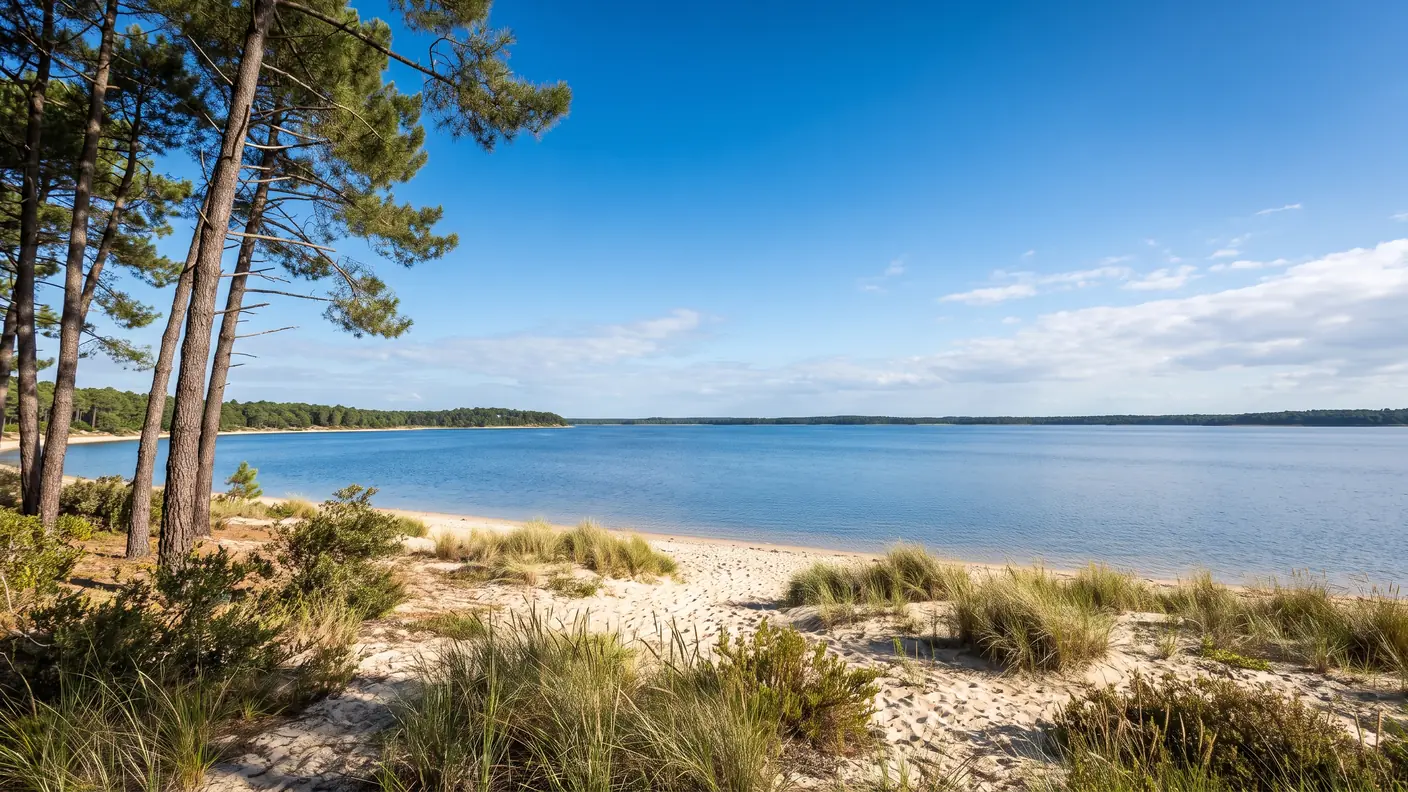
Heading for the Born Ocean
Direct transfer from Bordeaux (~1 hr 16 min via the A63/A660) to Biscarrosse-Plage, with its beaches and brand-new boardwalk—from your home, the airport, or the train station to the resort, the campground, or the surf school, surfboards and bikes included, followed by an optional trip to the Dune du Pilat.