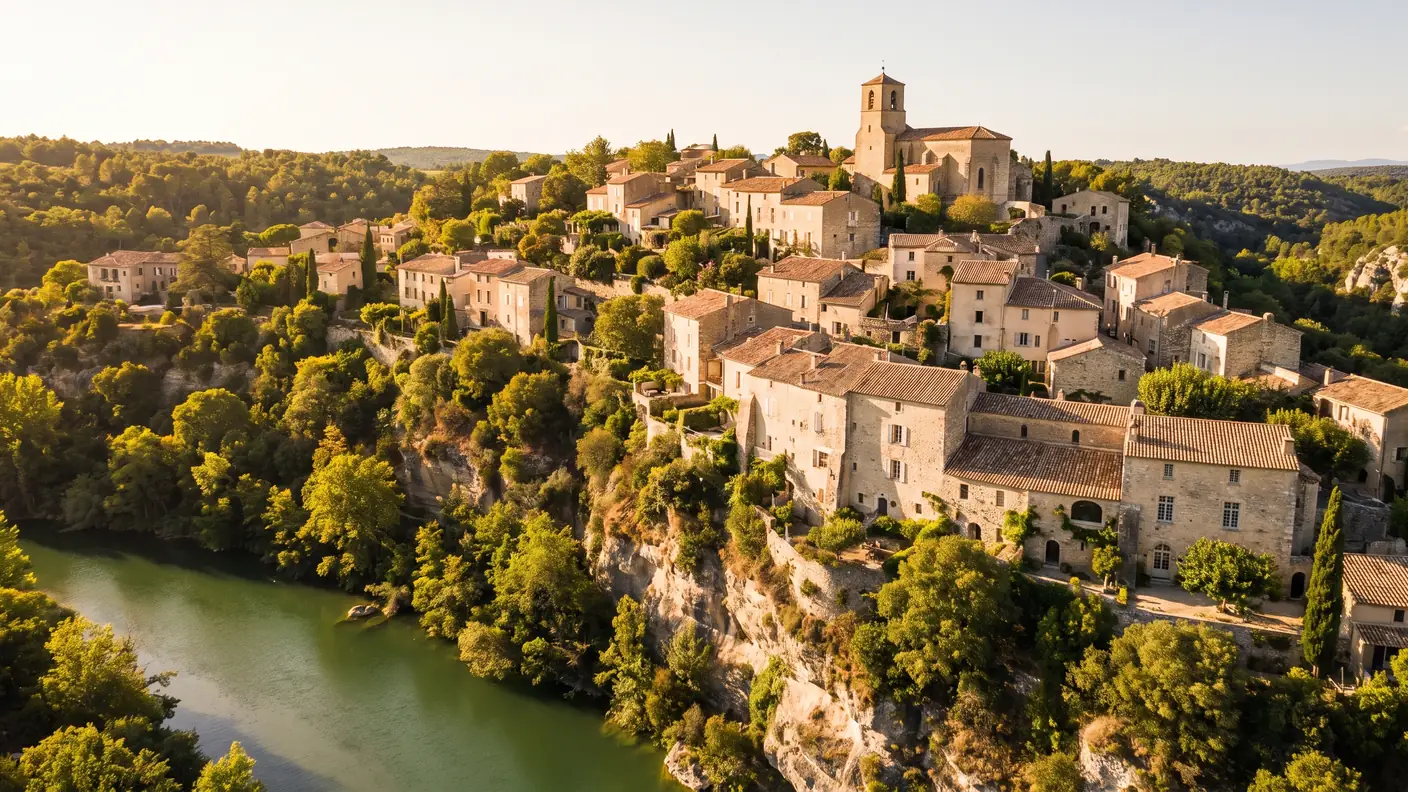
Bordeaux to Aubeterre-sur-Dronne: a village carved into rock
A village built of light-colored limestone perched above the Dronne River, a massive underground church carved by hand into the cliff face, and the only “Most Beautiful Village in France” in the Charente region. Aubeterre-sur-Dronne, with its two churches, castle, and river where you can swim, is about 1 hour and 33 minutes from Bordeaux.
Aubeterre-sur-Dronne at a Glance
Aubeterre-sur-Dronne is a village built of light-colored limestone, perched on terraces above the Dronne River in southern Charente, on the border with the Dordogne. It is the only village in Charente to bear the “Most Beautiful Villages of France” designation, and it owes its fame to an extraordinary underground church, the monolithic Church of Saint-Jean, entirely carved by hand into the cliff face: a nave about twenty meters long with a vaulted ceiling, carved from the rock rather than built. Source: Les Plus Beaux Villages de France. At the top of the village stands a second church, the Saint-Jacques Collegiate Church, of which only a magnificent Romanesque façade remains. Between the two, steep, pale-stone alleyways climb toward a castle overlooking the valley. At the foot of the village, the Dronne River offers swimming and canoeing in season. From Bordeaux, it’s about 99 km and a 1-hour, 33-minute drive; transfers start at 182 €.
| Landmark | Details |
|---|---|
| Department / Region | Charente (16) · Nouvelle-Aquitaine |
| Status | Municipality, Angoulême district · the only “Most Beautiful Village in France” in the Charente department |
| Population | approximately 312 residents (2023) · the residents of Aubeterre |
| Must-Sees | Saint-Jean Monolithic Church · Saint-Jacques Collegiate Church · Castle · the Dronne River |
| From Bordeaux | about 99 km · 1 hr 33 min · transfer starting at 182 € |
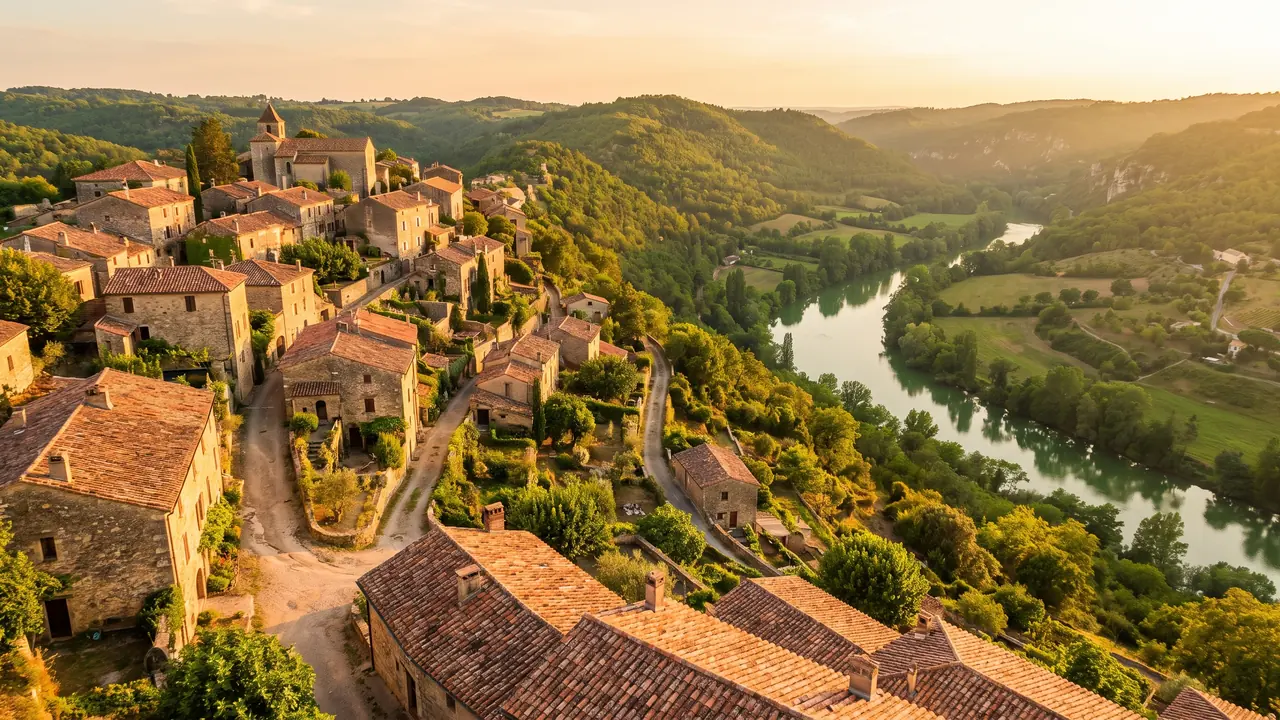
Some villages are simply pretty, while others hide a secret. Aubeterre-sur-Dronne belongs to the latter category. Seen from the opposite bank, this small town in Charente appears to be nothing more than a cascade of reddish-brown tiled roofs cascading down a white chalk cliff, punctuated by pale facades and a bell tower. Nothing hints that, beneath this picturesque slope, lies one of the largest underground churches in France: a vast hall, with its pillars, high gallery, and staircase, entirely carved out of the rock by human hands. The village’s name says it all: “Aubeterre” comes from the Latin alba terra, meaning “white earth,” a reference to the light-colored limestone in which the inhabitants have, over the centuries, both carved and built.
Aubeterre nestles along a bend in the Dronne River, on the border between the Charente and the Dordogne, just a few kilometers from the Périgord border. Here, you can already breathe in the atmosphere of the Périgord Vert—the gentle valleys, the oak trees, the pale stone—without ever leaving the Charente. With just over three hundred residents, the village moves at a leisurely pace most of the year, then comes alive on Sunday mornings around its market and, in the summer, to the rhythm of a music festival whose concerts are held—a rare occurrence—inside the church carved into the rock. It is this contrast—an extraordinary heritage sustained by a tiny community—that gives Aubeterre its unique character and makes it one of the most beautiful day trips from Bordeaux.
This guide covers everything that makes this place so interesting: the underground church and its dimensions, the collegiate church and its surviving façade, the castle that crowns the village, the turbulent history of a contested site, the figure of Ludovic Trarieux—who was born here and went on to become president of the Bordeaux Bar Association— the Dronne River and its swimming spots, as well as practical information for planning your visit. It also helps clear up some of the most common misconceptions, as Aubeterre is often misplaced on maps and its heritage is sometimes misattributed. The goal is simple: to provide an accurate and vivid picture of a village that, despite its small size, packs a rare concentration of history and beauty—all just a morning’s drive from the Gironde.
Where is Aubeterre-sur-Dronne located?
Aubeterre-sur-Dronne is located in the very south of the Charente department, in the Angoulême district, in the canton of Tude-et-Lavalette, and within the Lavalette Tude Dronne community of municipalities. Administratively, the municipality has the INSEE code 16020 and the ZIP code 16390; it covers a modest area of 2.39 km² and had a population of approximately 312 as of the 2023 census. The population, which still stood at 410 in 2013, has been declining slowly with each census, as is the case in many rural towns in southern Charente. This in no way detracts from the area’s rich heritage: few villages of this size can boast such a concentration of historic monuments.
A geographical clarification is in order, as misconceptions are persistent. Aubeterre-sur-Dronne is indeed located in Charente, in Nouvelle-Aquitaine. It is often described as a village in the Périgord, or even in the Dordogne—but this is inaccurate. It simply borders the Dordogne—the bastide town of Saint-Aulaye is only eight kilometers away—and is culturally close to the Périgord Vert. But it does not border the Gironde, contrary to what some hasty guidebooks claim. The correct description is “on the border between the Charente and the Dordogne.” Nor should it be confused with the other Aubeterre, in the Aube department: the suffix “-sur-Dronne,” which has been official since 1962, serves precisely to eliminate this ambiguity.
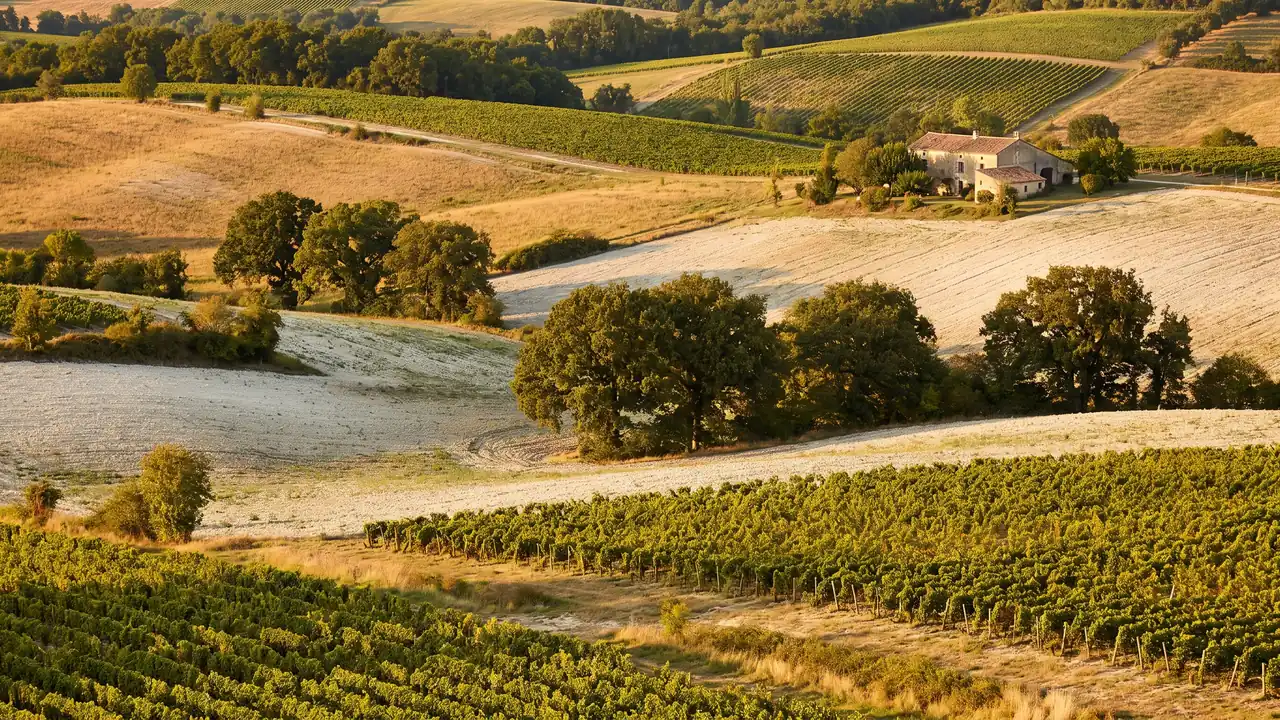
The site itself is spectacular. The village is built in terraces along the concave bank of a bend in the Dronne River, clinging to a spur of white chalk. From the water’s edge, at an elevation of 38 meters, up to the plateau that rises to 111 meters, the houses climb in terraces, connected by steep alleys and stairways. This topography explains it all: the prevalence of light-colored stone, the cliff face into which an entire church was carved, and the panoramic views that, from the top of the village, take in the green valley and the wooded hills of neighboring Périgord.
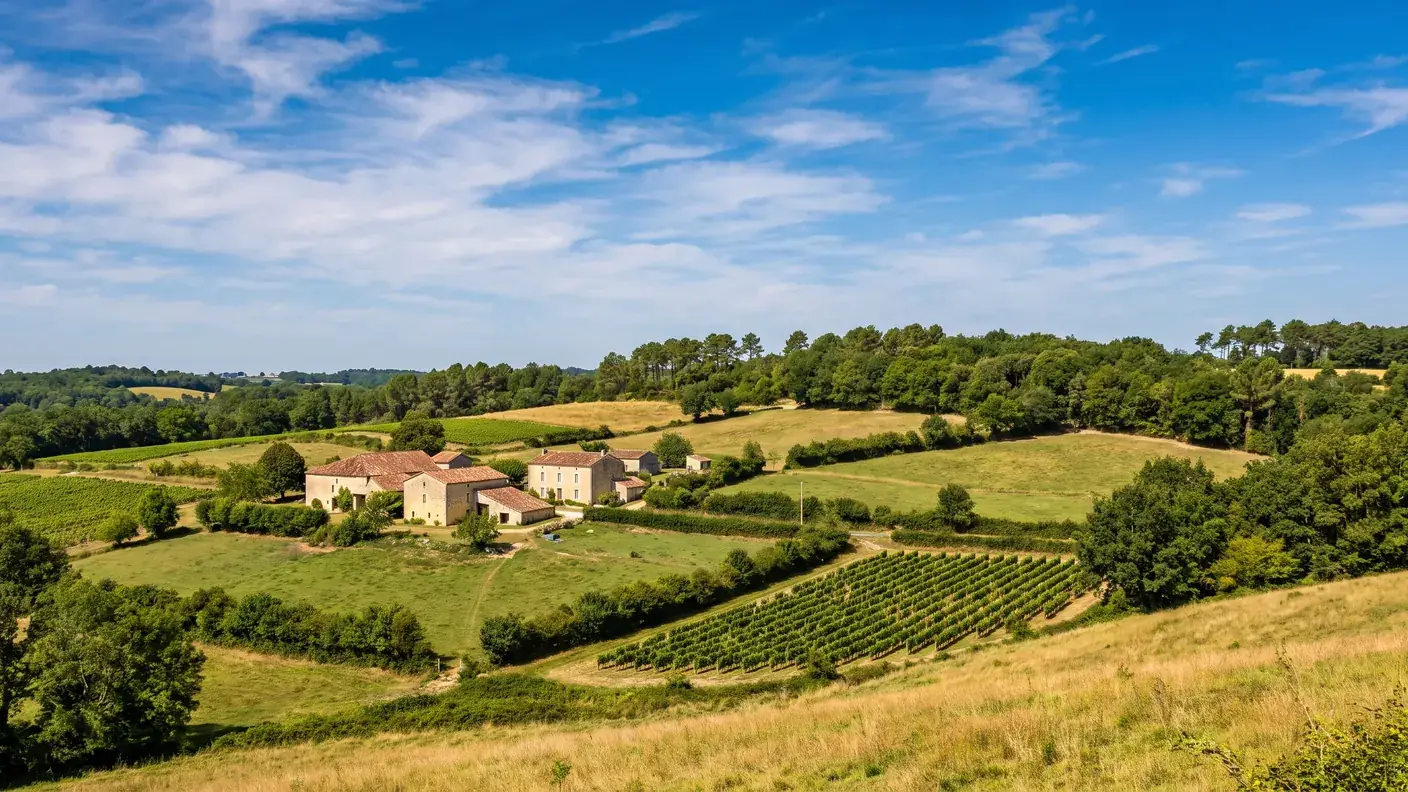
This border location is by no means insignificant. It places Aubeterre at the crossroads of several regions: the Charente to the north, with Angoulême—the prefecture—about three-quarters of an hour away; the Périgord Vert to the east, with Ribérac and Brantôme as its gateways; and the Dordogne just across the river, with Saint-Aulaye as its closest neighbor. This border location has shaped its history, making it at times an English stronghold, at times a French one, and at times a Protestant bastion. It also explains the blend of its architecture and cuisine, which combines influences from the Charente and the Périgord. For visitors coming from Bordeaux, it offers a practical advantage: Aubeterre serves as an ideal base from which to explore southern Charente, the Dronne Valley, or the Cognac region, all within an hour’s drive.
How far is it from Bordeaux?
From Bordeaux, it’s about 99 km and a 1-hour, 33-minute drive to Aubeterre-sur-Dronne, usually via the N10 northbound and then the country roads of southern Charente. You may sometimes see “75 km from Bordeaux”: this figure is the distance as the crow flies and has no practical value, since no road runs in a straight line through the Entre-deux-Mers and Libournais regions. The actual drive is quite reasonable for a day trip and takes you through landscapes that gradually shift from the vineyards of Bordeaux to the valleys of the Charente. The nearest train station is Chalais, on the Angoulême–Bordeaux TER line, about a dozen kilometers from the village; however, you’ll still need to cover that final stretch, which is poorly served by public transportation.
| Since… | Driving distance | Estimated time |
|---|---|---|
| Chalais | ~12 km | ~15 min |
| Ribérac | ~17 km | ~22 min |
| Périgueux | ~43 km | ~50 min |
| Angoulême | ~45 km | ~55 min |
| Bordeaux | ~99 km | ~1 hr 33 min |
The Monolithic Church of St. John
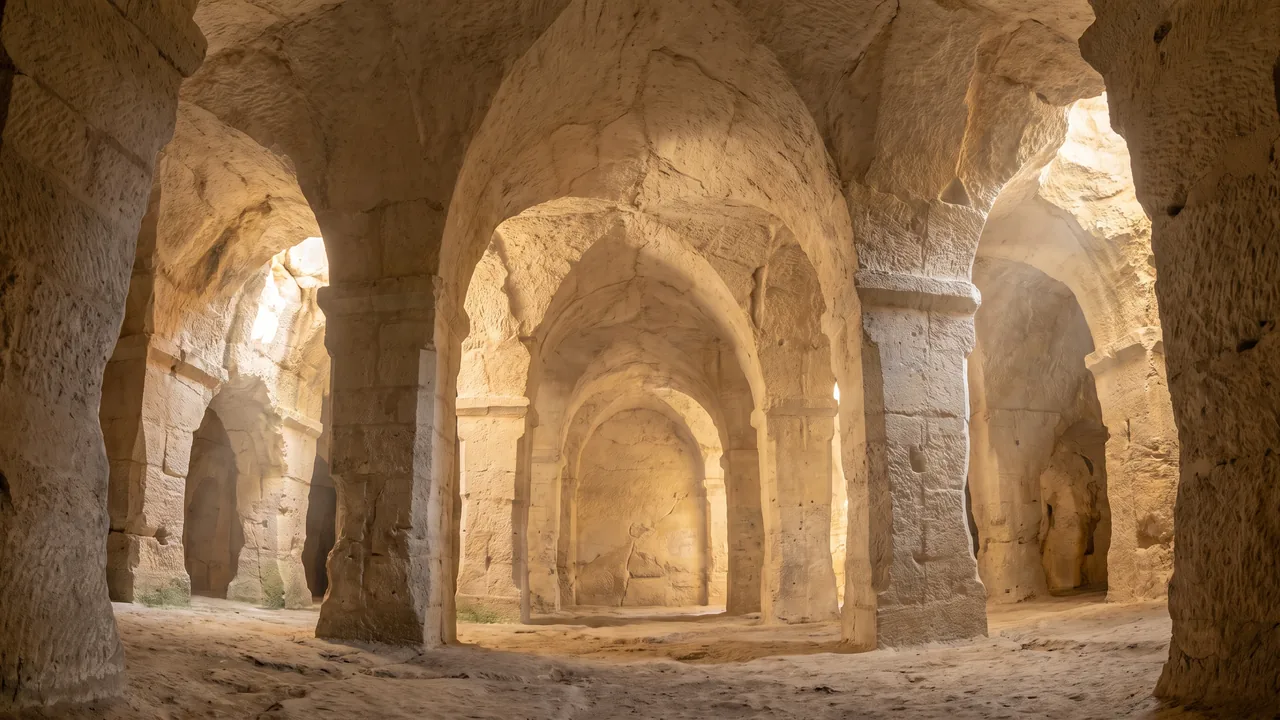
This monument alone makes the trip worthwhile. The Church of Saint-Jean in Aubeterre wasn’t built—it was carved out. Directly into the soft limestone cliff overlooking the Dronne River, generations of laborers hollowed out a colossal chamber, gradually revealing the nave, the pillars, the vault, and even the staircase. It is referred to as a monolithic or underground church—the term “troglodyte” is also appropriate—to describe this inverted architecture in which material is removed rather than stones being stacked. It is among the largest underground churches in France, a conservative estimate confirmed by the official website of the underground church. The POP listing PA00104234 separately confirms its classification and construction phases.
A cathedral carved out of the earth
The dimensions are staggering when you consider that everything had to be carved away with chisels and picks. The hall is approximately 27 meters long by 16 meters wide, and the nave rises some 20 meters to the vaulted ceiling, according to figures published by Sud Charente Tourisme. Monolithic octagonal pillars, carved directly from the rock, support the entire structure; a gallery—a sort of triforium—runs at a height of about 15 meters along three sides of the building, and a staircase, also carved into the rock, provides access to it. One enters this space through a modest entrance, and then the hall opens up—cool and silent—bathed in that distinctive light streaming through a few openings.
The history of the building is longer and more nuanced than is commonly believed. Its origins date back to the 7th or 8th century, as evidenced by early Christian baptismal fonts adorned with a Greek cross, remnants of an earlier sanctuary. But the monumental hall we visit today is the result of a major expansion carried out in the 12th century. Tradition attributes it to Pierre de Castillon, Viscount of Aubeterre—and not “Castellane,” an unrelated Provençal family—who is said to have undertaken this project upon his return from the Crusades to house relics brought back from the Holy Land. The church was initially dedicated to Saint Savior; it was not renamed Saint John until the 16th century, during the Wars of Religion.
A persistent legend holds that the sanctuary was carved out by disciples of Saint Maur at the very dawn of local Christianity. This origin story is rooted in pious tradition rather than proven fact, and should be viewed with caution, as should the entire hagiographic narrative surrounding the monument. The same applies to the idea that relics from the Holy Land may have inspired a commemorative replica of the Holy Sepulcher: it is an appealing scholarly interpretation, but it remains just one interpretation among many. What is certain, however, is that the church has endured through the centuries, changing in function and patron saint, bearing the scars of each era—medieval fervor, the fury of the Wars of Religion, and revolutionary utilitarianism. Distinguishing historical fact from legend is part of the pleasure of the visit.
Reliquary, necropolis, and saltpeter
In the center of the hall stands a strange monolithic monument about six meters high, also carved from a single block of stone: a tiered reliquary said to resemble the Holy Sepulcher in Jerusalem, a stone memorial to a distant pilgrimage. Long forgotten, it was rediscovered in 1848. This rediscovery should not be confused with the much later archaeological excavations: it was between 1958 and 1961 that some eighty medieval sarcophagi were unearthed from the church floor, revealing a vast rock-cut necropolis. The church did, in fact, serve as a burial site until 1865.
The building has had other, more surprising uses. In 1794, at the height of the Revolution, a saltpeter factory was set up there to produce gunpowder for the armies—a decidedly secular use for a thousand-year-old sanctuary. The excavation technique, meanwhile, intrigues experts: it has been compared to the rock-cut sanctuaries of Cappadocia in Anatolia, from which Pierre de Castillon may have drawn inspiration, and it is often said that the stones quarried from the cliff were used to build the castle overlooking it. These captivating tales stem more from tradition and scholarly interpretation than from proven fact: it is best to present them as such. The church was designated a historic monument on September 3, 1912. In 2014, it welcomed some 65.000 visitors—a considerable number for a village of three hundred people.
| Feature | Details |
|---|---|
| Type | Underground church / monolith, carved into the cliff |
| Dimensions | ~27 m long × ~16 m wide · nave ~20 m high under the vault |
| Origins | 7th–8th centuries (early Christian baptisteries) · monumental expansion in the 12th century |
| Notable Features | monolithic reliquary ~6 m · high gallery · ~80 sarcophagi (excavations 1958–1961) |
| Protection | Designated a Historic Monument on September 3, 1912 |
| Attendance | ~65.000 visitors in 2014 |
St. James Collegiate Church
Aubeterre has a second church, and it is important not to confuse it with the first: they are two distinct buildings. While the Church of Saint-Jean is underground, carved into the base of the cliff, the Collegiate Church of Saint-Jacques stands above ground, at the top of the village. Consecrated in 1171—at which time it belonged to the Diocese of Périgueux—it was located on one of the routes to Santiago de Compostela, as its very name suggests. Pilgrims journeying to Santiago de Compostela would stop here, in this corner of the Charente where medieval piety left a deep imprint.
A facade that survived the Wars of Religion
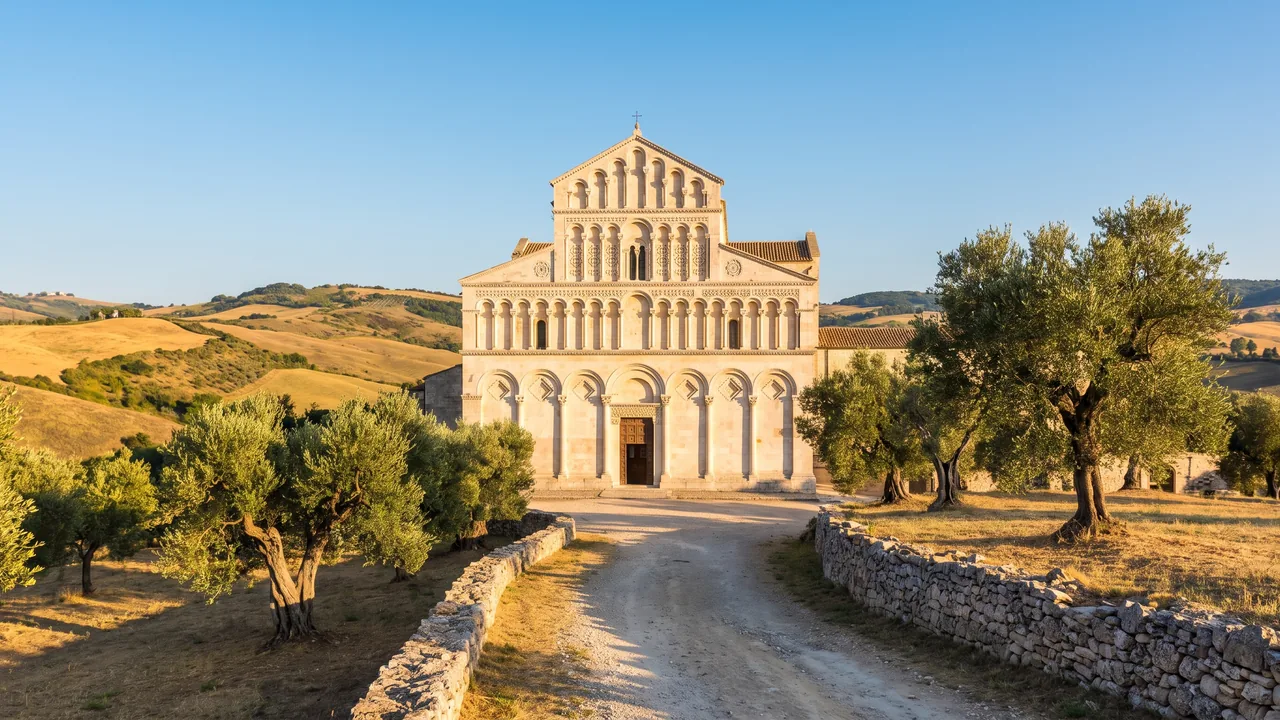
The history of the collegiate church is one of disaster and survival. On May 13 and 14, 1562, in the midst of the First War of Religion, the building was devastated by the Protestants. Of the medieval church, only the Romanesque façade survived; the ruined interior was not rebuilt until 1710. What we admire today is, in a sense, an “orphaned” façade: a section of richly carved wall that has stood the test of time while everything else crumbled. It measures approximately 18.40 meters wide by 12 meters high and is distinguished by a poly-lobed portal with Hispano-Moorish influences, a rare decorative feature in these parts. One can make out scallop shells—symbols of the pilgrimage—and signs of the zodiac running along the moldings.
One aspect of its heritage status deserves to be emphasized, as it is often misreported: only the façade of Saint-Jacques is listed as a historic monument under the 1862 list, not the entire building. This early designation—part of one of the very first waves of classifications in France—attests to the exceptional value recognized very early on for this Romanesque structure. Together, the underground church and the collegiate church form an unparalleled monumental pair: one carved into the rock, the other soaring toward the sky; one intact, the other reduced to its most beautiful form. It is this dialogue between the two saints that gives Aubeterre its unique depth.
The facade’s decoration is a treat for the observant eye. The scallop shells serve as a reminder that this is a pilgrimage route to Santiago de Compostela, a spiritual stopover for generations of pilgrims coming from the north and the east. The zodiac signs running along the moldings are part of a common medieval motif, where the celestial calendar interacts with the sacred. As for the poly-lobed portal, with its festooned arches, it reveals Hispano-Moorish influences from Spain—a distant echo, carved into Charente stone, of the cultural exchanges that once spanned Romanesque Europe. This façade, now isolated from the building it once heralded, reads today almost like a painting: a page of sculpture that time and people have preserved while everything else crumbled away.
The hilltop village and the castle
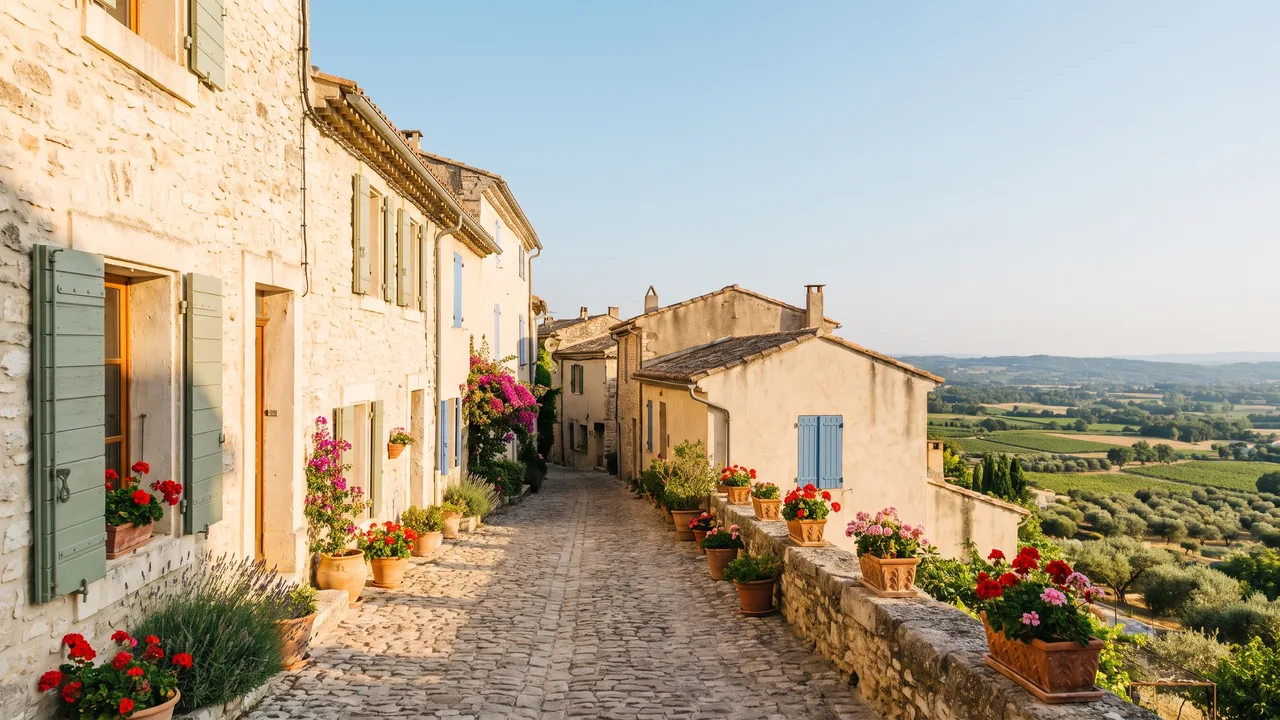
Between its two churches, Aubeterre unfolds a maze of steep alleyways that can only be explored on foot. The pale stone houses, with their wooden shutters and weathered lintels, cling to the cliff face and rise in terraces up to the Champ de Foire, the large square that crowns the village. Squares, fountains, washhouses, vaulted passageways: everything here is made of that light limestone that gives the village its very special light, almost southern in feel on sunny days. Aubeterre has also been awarded a “flower” in the 2025 Villes et Villages Fleuris rankings, a distinction that recognizes the care taken to maintain this already exceptional setting.
Aubeterre’s charm lies in this mineral consistency: no jarring contrasts, but everywhere the same pale stone, weathered by the centuries, found from the thresholds of houses to the well curbs. The Champ de Foire, a vast, shaded esplanade at the top of the village, serves as a gathering place—it’s where the Sunday market is held and where you park your car before walking down to the underground church. Along the way, you’ll pass artisan stalls, potters’ workshops, and a few cafés with terraces facing the valley. Nothing here is excessive, except for its heritage; you can explore the village in an hour or two of leisurely strolling, but you can easily spend the whole day there, letting time slip by.
"Alba terra," the white land
The village’s name reflects its location. “Aubeterre” is derived from the Latin *alba terra*, literally “white earth,” in reference to the light-colored limestone cliff on which it is built. The form “Albaterra” is attested as early as the year 1000, around 1004, and in Occitan it became “Aubaterra.” The village was simply called “Aubeterre” until 1962, when it officially adopted the suffix “-sur-Dronne,” both to evoke its river and to distinguish itself from its namesake in the Aube department. Few place names are as self-explanatory: here, the name, the stone, and the landscape all convey the same meaning.
The castle overlooking the village
Perched at the highest point, the castle overlooks the village and the valley. It was first mentioned around 1004, making it one of the oldest landmarks in the history of Aubeterre. Over the centuries, the fortress was associated with several prominent families, including the Esparbès de Lussan family—François d’Esparbès was appointed Marshal of France in 1620. The complex still features a postern gate, a residential wing, a Renaissance chapel, a section of the ramparts, and a tower known as Saint-Jean. From a heritage perspective, one distinction is essential here: the castle is listed as a historic monument by decree of March 1, 1973—listed, not classified, unlike the underground church. This difference in status is not trivial: “classification” offers stronger protection than “listing.” Keep in mind, therefore, that Aubeterre combines three different levels of protection—Saint-Jean is classified, the façade of Saint-Jacques is classified, and the castle is listed. Source: POP Database.
From the castle grounds, the view stretches far across the meandering Dronne River and the rooftops that cascade down the slope. It is from here that one best understands the logic of the site: a fortress at the summit, a village clinging to the cliff face, and the river below serving as a natural moat. Tradition holds, moreover, that the stones quarried from the cliff to excavate the underground church were used to build or reinforce this castle—a beautiful image of reversibility, where the void carved out below sustains the solid structure above. Again, this is an interpretation passed down through local memory rather than a documented fact, but it aptly captures the unity of material and destiny that binds all the elements of Aubeterre.
Aubeterre Through the Centuries
The history of Aubeterre is that of a coveted stronghold, tossed about by the major conflicts that ravaged the Southwest. As early as the 11th century, the town was a castellany, the seat of a small feudal territory organized around its castle. Its location, on a natural barrier overlooking the Dronne River at the border between English Guyenne and the Kingdom of France, made it a strategic military stronghold. During the Hundred Years’ War, Aubeterre thus changed hands seven times between the English and the French between 1356 and 1412—a back-and-forth that epitomizes the instability of these contested borderlands.
This back-and-forth is nothing out of the ordinary for the region: the entire southwest of France, between English Aquitaine and the royal domain, has lived through these decades marked by sieges, truces, and reconquests. But Aubeterre offers a striking distillation of it all. Each side that took the town left a garrison there, collected taxes, and reinforced the defenses. The castle, rebuilt several times, bears witness to these shifts in control. This long period of instability shaped the town’s character and partly explains the sturdiness of its buildings: here, people built to last and to withstand the elements, using the white stone that the cliff provided in abundance.
From the Wars of Religion to the Ruins of the Collegiate Church
The 16th century brought Aubeterre its most dramatic episode. Viscount François Bouchard defected to the Protestant side and eventually fled to Geneva, the cradle of the Reformation. The village was plunged into turmoil: it was captured by the Duke of Anjou, and it was against this backdrop that the Saint-Jacques Collegiate Church was ransacked on May 13 and 14, 1562. The town, once a Protestant stronghold in the Angoumois region, became a battleground for religious conflict. Tradition holds that Poltrot de Méré, the future assassin of the Duke of Guise in 1563, was a page to Viscount Bouchard—a compelling account that must, however, be treated with caution due to a lack of historical certainty. These upheavals left their mark in stone: the patron saint changed from Saint-Sauveur to Saint-Jean, and the collegiate church was reduced to its façade—all scars that are still visible today.
| Timeline | Event |
|---|---|
| 7th–8th centuries | First underground sanctuary (early Christian baptismal fonts) |
| around 1004 | First mention of the castle; place name “Albaterra” |
| 1171 | Consecration of the Saint-Jacques Collegiate Church |
| 12th century | Monumental Expansion of the Underground Church (Pierre de Castillon) |
| 1356-1412 | The square changed hands seven times (Hundred Years' War) |
| May 13–14, 1562 | The Sacking of the Collegiate Church by the Protestants |
| 1794 | The underground church converted into a saltpeter factory |
| 1912 / 1973 | St. John's Church, designated a historic monument / castle listed as a historic monument |
Ludovic Trarieux, from Aubeterre, a member of the Bordeaux Bar Association
A bridge connecting the village in Charente to the city
Aubeterre gave France one of the great champions of civil liberties. Jacques Ludovic Trarieux was born there on November 30, 1840, and died in Paris on March 13, 1904. He founded the League for Human Rights in 1898, serving as its first president from 1898 to 1903, in the wake of the Dreyfus Affair: he was one of the key figures behind the retrial of the famous case. Source: LDH. As a minister, he served as Minister of Justice in 1895. It is important not to oversimplify his convictions: Trarieux was a liberal republican, a moderate, and not a “left-wing activist”—in fact, he served as rapporteur for the 1894 laws that restricted civil liberties in response to anarchist terrorism.
His career forged a natural link between this village in Charente and Bordeaux. A member of the Bordeaux Bar from 1862 to 1881, he became its president in 1877, before being elected to the National Assembly and then to the Senate representing Gironde. The journey of this native of Aubeterre—from the Bordeaux courtroom to the highest offices of the Republic—weaves a subtle yet real connection between the white soil of the Dronne and the Gironde metropolis—yet another thread, among so many others, that brings Aubeterre closer to Bordeaux.
Trarieux’s legacy extends far beyond the borders of his native village. The League for Human Rights, which he founded at the height of the Dreyfus affair, still exists today and remains one of France’s leading organizations dedicated to the defense of civil liberties. The fact that this institution was born of the conviction of a man from southern Charente, who trained in law in the courts of Bordeaux, adds an unexpected dimension to a visit to Aubeterre: behind the churches and the castle lies this republican legacy—more discreet but just as enduring. For a visitor from Bordeaux, this is yet another reason to feel at home in this village where one of the city’s most distinguished bar association presidents was born.
The Dronne River: Swimming and Canoeing
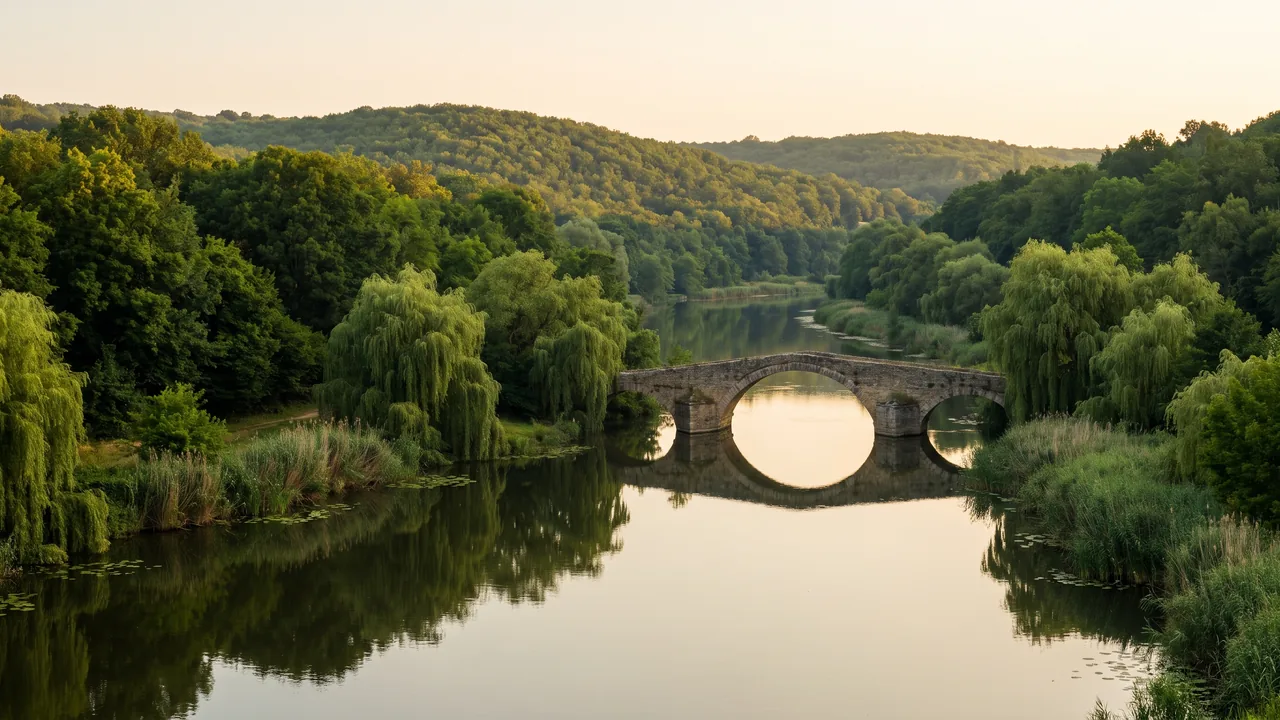
At the foot of the village flows the Dronne, a peaceful river that has shaped the area and given it its second name. At 200.6 kilometers long, it originates in Haute-Vienne, in Bussière-Galant, flows through fifty-one municipalities, and is the main tributary of the Isle, into which it flows at Sablons, in Gironde. It is, therefore, a true waterway connecting Limousin to Gironde, flowing beneath the ramparts of Aubeterre. Lined with willows and reeds, green and slow-moving, it offers the village a mirror and a counterpoint: the verticality of the white cliff is balanced by the soothing horizontality of the river.
A waterfront recreation center
Below the village, a recreation center stretches along the banks of the Dronne River. There, you can rent canoes, kayaks, stand-up paddleboards, and pedal boats to take a leisurely trip down the river, and the site also features a playground and a beach volleyball court. Swimming is supervised in July and August, making it a popular stop for families during the Charente summer. Specific details—opening dates, lifeguard hours, and rental rates—vary by season; to be on the safe side, contact the South Charente Tourist Office or the town hall at 05 45 98 50 33 before visiting. The mild, oceanic climate, with an annual average temperature of around 13°C, is ideal for days spent by the water—from a visit to the underground church in the morning to a canoe trip in the afternoon.
Canoeing down the Dronne is undoubtedly the most beautiful way to experience the area. From the water, the village reveals itself in all its vertical grandeur: the white cliff face, the rooftops clinging to it, and the bell tower rising above the treetops. The river, designated for the quality of its ecosystems within the Dordogne basin, is home to unobtrusive wildlife—kingfishers, herons, and occasionally an otter—and flows between gently sloping, wooded banks. This is a completely different side of Aubeterre from that of its stone-paved alleyways: greener, cooler, and more intimate. Alternating between exploring the architectural heritage and a getaway on the water gives the day a rare balance between culture and nature, without ever straying far from the village.
What is there to do in Aubeterre-sur-Dronne?
In Aubeterre, a day fills up effortlessly. You usually start with the two main attractions: a visit to the cool and impressive monolithic Church of Saint-Jean, followed by a look at the Romanesque façade of the Collegiate Church of Saint-Jacques, at the top of the village. In between, take time to stroll through the light-colored stone alleyways, climb up to the castle, and linger at the Champ de Foire, the beating heart of the town. On Sunday mornings, the Champ de Foire hosts a market from around 8 a.m. to 1 p.m., where local farmers, cheesemakers, and oyster sellers gather—Charente oysters are never far away. In the afternoon, the Dronne River beckons for swimming, canoeing, or paddleboarding during the season. And in the summer, Aubeterre offers a rare treat: festival concerts held right inside the underground church, whose stone acoustics are one-of-a-kind.
Must-See Attractions During Your Stay
- Visit the Saint-Jean Monolithic Church, one of the largest underground churches in France, and its reliquary carved out of the rock.
- Admire the Romanesque façade of the Saint-Jacques Collegiate Church, which survived the Wars of Religion, with its multi-lobed portal.
- Stroll through the steep, light-colored limestone alleyways up to the castle and the Champ de Foire.
- Stroll through the Sunday morning market at the Champ de Foire: local products, cheeses, and oysters.
- Paddle down the Dronne River by canoe, kayak, or stand-up paddleboard from the recreation center, and go swimming during the season.
- Attend a concert this summer as part of the Festival des Nuits Musicales, held in the underground church.
- Take advantage of seasonal events, such as the potters' festival, by checking the tourist office's calendar.
Concerts Under the Rock
One of Aubeterre’s most unique events is the Festival des Nuits Musicales, with some concerts held in the summer right inside the underground church. Imagine an early music ensemble or a recital performed beneath a twenty-meter vault carved out of the rock, the stone’s acoustics enveloping the audience in a way no modern concert hall could. It’s a rare experience, where the monument itself becomes an instrument. Throughout the year, Aubeterre also hosts more artisanal events, such as the potters’ festival, which highlights the village’s deep roots in the pottery trade. Since dates and programs vary from season to season, it’s always a good idea to check the tourist office’s calendar before planning a visit around a specific event.
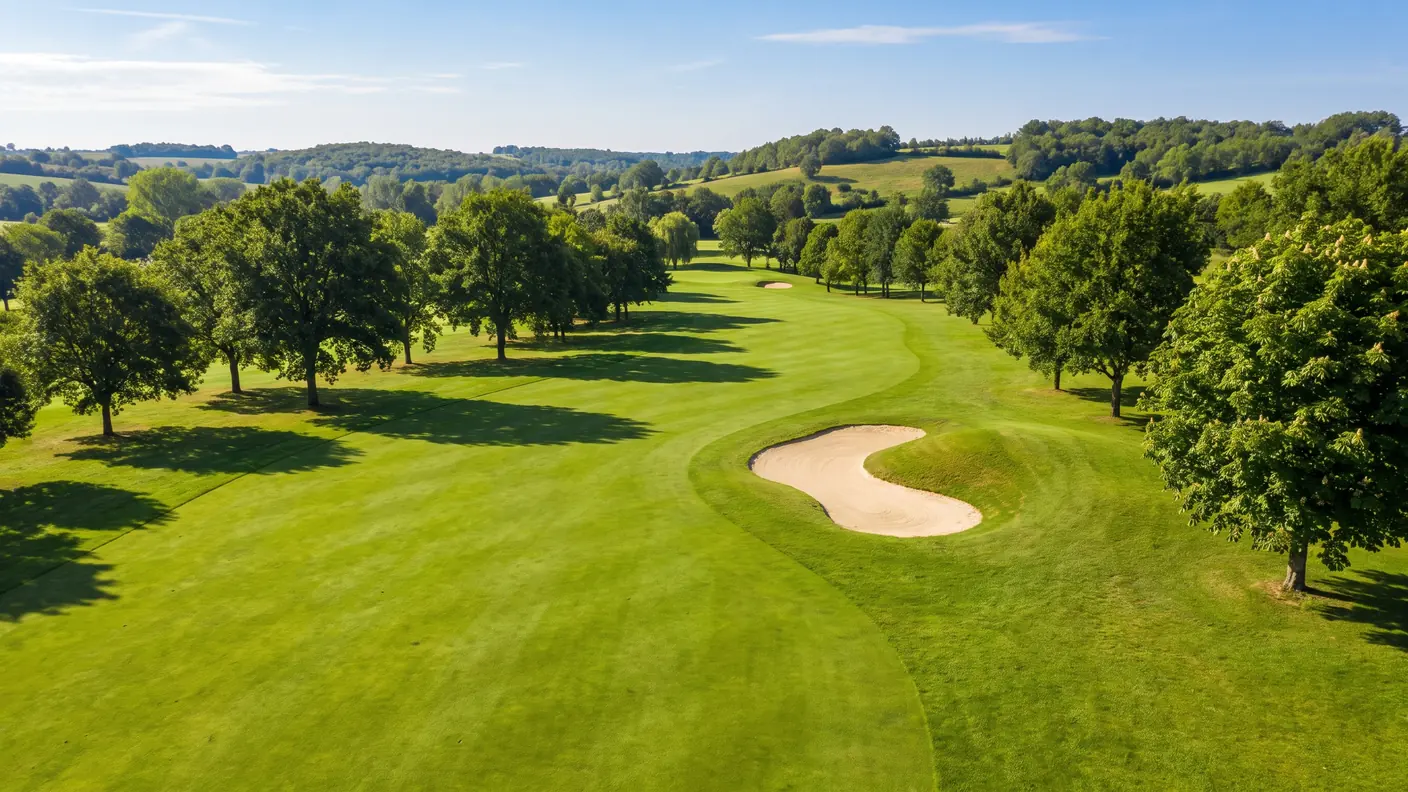
Two useful points to note so you won’t be disappointed. The golf course sometimes associated with Aubeterre is not actually located in the town: it’s the Longeveau course, in the town of Pillac, a few kilometers away—a nine-hole, par-32 course that can be played twice to make a full round. In addition, a night market is traditionally held on the first Thursday in August, but some editions have been canceled depending on the year: it’s best to check the tourist office’s calendar before making the trip for a specific date.
| Activity | When | Good to Know |
|---|---|---|
| St. John's Monolithic Church | All year round | Paid tour · the highlight of the trip |
| Saint-Jacques Collegiate Church | All year round | Romanesque façade listed as a local landmark |
| Market | Sunday morning (around 8 a.m.–1 p.m.) | Champ de Foire · Local Specialties, Oysters |
| Swimming & Canoeing on the Dronne River | During the season (July–August) | Summer Surveillance · Check with City Hall |
| Musical Nights | Summer | Concerts in the underground church |
Around Aubeterre: The Most Beautiful Nearby Villages
Aubeterre is the only village in the Charente to hold the “Most Beautiful Villages of France” designation, and it’s important to keep this in mind when planning your visit to the surrounding area, as information about this designation is sometimes misrepresented. Several neighboring towns, often mistakenly presented as members of the association, are worth a visit under their true designations. Saint-Aulaye, about eight kilometers away in the Dordogne, is a beautiful 13th-century bastide with “Station Verte” status, but it is not one of the “Most Beautiful Villages”; since 2016, it has been part of the new municipality of Saint-Aulaye-Puymangou. Villebois-Lavalette, with its seven-towered castle and 17th-century market halls, is classified as a “Petite Cité de Caractère” (Small Town of Character), not a “Most Beautiful Village.” As for Brantôme, nicknamed the “Venice of the Périgord,” it is not a member of the association, despite its fame.
Where to extend your getaway
If you’re looking for an authentic “Most Beautiful Village” to combine with a visit to Aubeterre, head to the Périgord Vert and Saint-Jean-de-Côle, which is indeed a member of the association and boasts a remarkable medieval townscape. Closer by, you can head to the Longeveau golf course in the town of Pillac, continue on to Ribérac—about fifteen minutes away—or stop by Chalais, about twelve kilometers away. Heading north, the Charente River winds through its vineyards, leading you to the Cognac region, another major attraction in the area. A day trip starting from Bordeaux can thus be organized as a loop, combining Aubeterre with one of these neighboring destinations, depending on your preferences.
Each of these neighboring towns has its own unique character. Saint-Aulaye, nestled in the Dordogne just eight kilometers away, charms visitors with its bastide layout and the banks of the Dronne River, embodying the “Station Verte” spirit focused on nature. Villebois-Lavalette impresses with its castle featuring seven towers and its 17th-century market halls, a jewel among the “Petite Cité de Caractère” (Small Towns of Character). Brantôme, further into the Périgord, truly deserves its nickname, the “Venice of the Périgord,” with its winding waterways and abbey. Ribérac, the capital of the Ribérac region, hosts a renowned market and serves as the gateway to the valley’s Romanesque churches with their domes. Taken together, these stops trace a route of rare richness—with Aubeterre as the highlight, the only “Most Beautiful Village” in the Charente.
| Nearby Destination | Distance from Aubeterre | What You'll Find There |
|---|---|---|
| Chalais | ~12 km | Château, Angoulême-Bordeaux TER Station |
| Ribérac | ~17 km | A well-known market, Dronne Valley |
| Saint-Aulaye | ~8 km | 13th-century bastide, “Station Verte” (Dordogne) |
| Longeveau (Pillac) | a few kilometers | 9-hole golf course, par 32 |
| Cognac | further north | Wine merchants, vineyards |
Getting to Aubeterre from Bordeaux
The drive from Bordeaux to Aubeterre-sur-Dronne is about 99 kilometers and takes 1 hour and 33 minutes, typically via the N10 northbound and then the roads of southern Charente. The drive is anything but tedious: it winds through a variety of landscapes, from the vineyards of Bordeaux to the valleys of Charente, and leads to this village perched high above the Dronne River. By public transportation, things get significantly more complicated: the nearest train station, Chalais, is about a dozen kilometers away, with no convenient direct connection to the village, which makes a door-to-door trip particularly appealing for a day trip.
How much does the ride cost?
The Bordeaux → Aubeterre-sur-Dronne transfer is available starting at €182 during the day for a sedan accommodating one to three people, with a fixed rate confirmed in writing before departure—no meter and no unpleasant surprises. Surcharges apply at night, on weekends, and on holidays. For a pickup from Bordeaux-Mérignac Airport, or for a round-trip journey combining Aubeterre with Cognac or a neighboring village, the fare is based on a quote, depending on the route and the time spent at the destination.
| Route | Distance / Duration | Rates |
|---|---|---|
| Bordeaux → Aubeterre-sur-Dronne | ~99 km · ~1 hr 33 min | starting at 182 € |
| Bordeaux-Mérignac Airport → Aubeterre | based on a quote | based on a quote |
| Aubeterre + Cognac Loop | based on a quote | based on a quote |
Why hire a private driver?
Aubeterre is a hilltop village with steep, narrow streets, where parking spots are hard to come by during peak season. Hiring a chauffeur service means you can avoid the hassle of driving, searching for a parking spot, and the drive back after a busy day: you’ll be dropped off right at the entrance to the underground church, explore at your own pace, stroll through the market or walk down the Dronne River, and then return home stress-free. It’s a comfortable alternative to driving your own car, designed for those who want to fully enjoy the “White Land” without worrying about logistics. The quote is fixed, provided in writing, and non-binding.
Frequently Asked Questions
How much does a trip from Bordeaux to Aubeterre-sur-Dronne cost, and how long does it take?
The transfer from Bordeaux to Aubeterre-sur-Dronne is approximately 99 km, or about 1 hour and 33 minutes by car via the N10 and then the roads of southern Charente. Rates start at 209 € during the day for a sedan carrying one to three passengers; this is a fixed price confirmed in writing before departure, with no meter charge. Surcharges apply at night, on weekends, and on holidays. For a pickup from Bordeaux-Mérignac Airport or a round trip including Cognac, the price is determined by quote based on the itinerary and time spent at the destination.
What to See and Do in Aubeterre-sur-Dronne?
The two must-see sights are the monolithic Church of Saint-Jean—a massive sanctuary carved into the cliff—and the Romanesque façade of the Saint-Jacques Collegiate Church, at the top of the village. Next, take a stroll through the light-colored stone alleyways to the castle and the Champ de Foire, where the Sunday morning market is held. During the season, the Dronne River offers swimming, canoeing, and stand-up paddleboarding from the recreation center. In the summer, the Festival des Nuits Musicales hosts concerts inside the underground church itself, which boasts unique acoustics. A full day is enough to see it all.
Why is Saint-Jean Church called the “monolithic church”?
Because it was not built but carved out: it was entirely hewn from the limestone cliff, with the nave, the octagonal pillars, the vault, and the staircase carved directly from the rock, rather than by stacking stones. It is referred to as a monolithic, underground, or troglodyte church. Its nave rises approximately 20 meters under the vault and is some 27 meters long, making it one of the largest underground churches in France. Its origins date back to the 7th–8th centuries, but the monumental hall that visitors see today dates from its expansion in the 12th century.
Is the monolithic church in Aubeterre the largest in Europe?
This is a tourist superlative that isn’t well-established and is best avoided. The exact wording is more cautious: the underground Church of Saint-Jean is “among the most important” monolithic churches in France. It remains, nonetheless, extraordinary, with a nave about twenty meters long under a vaulted ceiling, a high gallery running along three sides, and a six-meter-tall monolithic reliquary carved directly from the rock. For a village of three hundred residents, having such a large structure entirely carved out of the rock is exceptional in itself, without the need to add an unverifiable record.
Is Aubeterre-sur-Dronne in the Dordogne or the Charente?
Aubeterre-sur-Dronne is located in Charente (16), in Nouvelle-Aquitaine, in the Angoulême district. It is often mistakenly believed to be in the Dordogne or the Périgord, but this is incorrect: it merely borders the Dordogne—the bastide town of Saint-Aulaye is about eight kilometers away—and is culturally close to the Périgord Vert. It does not border the Gironde. The correct description is “on the border between Charente and Dordogne.” Be careful not to confuse it with the other Aubeterre, located in the Aube department: the suffix “-sur-Dronne” serves precisely to eliminate any ambiguity.
What is the difference between Saint-Jean Church and Saint-Jacques Collegiate Church?
These are two distinct buildings that should not be confused. The Church of Saint-Jean is an underground structure, carved into the base of the cliff, and is the monolithic monument that has made the village famous; it has been designated a Historic Monument since 1912. The Saint-Jacques Collegiate Church, on the other hand, stands above ground at the top of the village; consecrated in 1171, it was devastated by Protestants in 1562, and only its Romanesque façade remains, the sole part designated as a historic monument. One is intact and carved into the rock, while the other has been reduced to its most beautiful architectural feature.
Is Aubeterre accessible to people with limited mobility?
Aubeterre is a hilltop village, situated at an elevation ranging from 38 to 111 meters, with steep, often cobblestone streets connected by stairways: the topography makes some routes difficult to navigate. The monolithic church itself features a staircase carved into the rock leading to the upper gallery. It is still possible to drive to the vicinity of the main sites and plan your visit according to your abilities, asking to be dropped off as close as possible to the entrance of the underground church. To find out the specific access conditions and any available accommodations, it’s best to contact the South Charente Tourist Office.
When is the best time to visit Aubeterre-sur-Dronne?
Spring and summer are the busiest times of year. In the summer, you can enjoy swimming and canoeing on the Dronne River—which is supervised in July and August—as well as concerts from the Festival des Nuits Musicales held in the underground church. On Sunday mornings, all year round, the Champ de Foire market is worth the trip. The mild oceanic climate, with an annual average of around 13 °C, makes the off-season a pleasant time to visit the monuments without the crowds. The underground church, which stays cool in every season, also offers a welcome refuge on hot days.
Can you swim in the Dronne River in Aubeterre?
Yes, at the foot of the village, a recreation center located along the Dronne River offers swimming, canoeing, kayaking, stand-up paddleboarding, and pedal boats, along with a playground and a beach volleyball court. The swimming area is supervised in July and August, making it a popular stop for families. Opening dates, supervision hours, and rates vary by season: before you go, it’s a good idea to check with the South Charente Tourist Office or the town hall, which can be reached at 05 45 98 50 33, to find out the exact conditions for the current season.
Who was Ludovic Trarieux, a native of Aubeterre?
Jacques Ludovic Trarieux, born in Aubeterre on November 30, 1840, and died in Paris in 1904, was the founder and first president, from 1898 to 1903, of the League for Human Rights, which was created in the wake of the Dreyfus Affair—a case in which he was one of the key figures behind the exoneration. A liberal and moderate Republican, he served as Minister of Justice in 1895. He had strong ties to Bordeaux: a member of the Bordeaux Bar from 1862 to 1881, he became its president in 1877, before serving as a deputy and then a senator for the Gironde—a natural bridge between this village in the Charente and the Gironde metropolis.
Are there any other "Most Beautiful Villages of France" near Aubeterre?
Aubeterre is the only village in the Charente department to hold this designation. Be aware of common misconceptions: Saint-Aulaye, in the Dordogne, is a bastide designated as a “Station Verte,” not one of the “Most Beautiful Villages”; Villebois-Lavalette is a “Petite Cité de Caractère”; and Brantôme, the “Venice of the Périgord,” is not a member of the association. The only true “Most Beautiful Village” nearby that’s worth visiting alongside Aubeterre is located in the Périgord Vert: Saint-Jean-de-Côle. You can also extend your trip to Ribérac, Chalais, the Longeveau golf course in Pillac, or head up toward the Cognac region.
Is the golf course in Aubeterre a good one?
No. The golf course often associated with Aubeterre is actually the Longeveau course, located in the neighboring town of Pillac, a few kilometers away. It is a nine-hole, par-32 course that can be played twice to make a full round—not an 18-hole course in Aubeterre itself. This is a common misunderstanding, similar to the one that attributes the bastide of Saint-Aulaye or the market halls of Villebois-Lavalette to Aubeterre: each attraction belongs to its own town. However, it’s easy to combine a visit to the village with a round of golf at Longeveau in a single day.
How can I get to Aubeterre-sur-Dronne without a car?
It’s not easy: the nearest train station is Chalais, on the Angoulême–Bordeaux TER line, about a dozen kilometers from the village, with no convenient direct connection from there. Public transportation doesn’t serve this final rural stretch very well. That’s precisely why a door-to-door transfer with a driver is so convenient: you depart from your address in Bordeaux or the airport and are dropped off as close as possible to the underground church, without having to worry about parking in a hilltop village with steep, narrow streets. The trip takes about 1 hour and 33 minutes, for a flat rate starting at 182 €.
Further Reading
- A nearby village and its golf course: see the Guide to Pillac and Longeveau, just a few kilometers from Aubeterre, to extend your getaway in Charente.
- The golf course and manor house in the Aubeterre region: discover the Guide de Longeveau, its 9-hole golf course, and its rolling landscape—perfect to combine with a visit to the Terre Blanche.
- Head north toward the wineries: combine a visit to Aubeterre with the Cognac Guide, its wine merchants, and its vineyards for a loop through the Charente region starting from Bordeaux.
Sources and References
- The Most Beautiful Villages of France — Aubeterre-sur-Dronne — designation, monolithic church, collegiate church
- Mérimée Database / POP — Saint-Jean Underground Church — entry PA00104234
- Sud Charente Tourism — Aubeterre Underground Church — Dimensions and Tour
- INSEE — Municipality of Aubeterre-sur-Dronne (16020) — Demographics
- Human Rights League — Ludovic Trarieux — founder born in Aubeterre, president of the Bordeaux Bar Association
Article published and updated on .
Our Latest Guides
On the Way to the White Land
Direct transfer from Bordeaux (~1 hr 33 min) to Aubeterre-sur-Dronne, with its monolithic church and collegiate church. Written, fixed-price quote with no obligation.