Beynac, the fortress guarding the valley
The fortress of the Périgord Noir: the Barons’ Castle, perched 150 meters above the Dordogne; Richard the Lionheart and Mercadier; views across to Castelnaud; the pale-stone village; the gabarres; and Joséphine Baker’s Les Milandes, just 13 minutes away. Everything you need to know before you visit, 2 hours and 58 minutes from Bordeaux.
In a nutshell
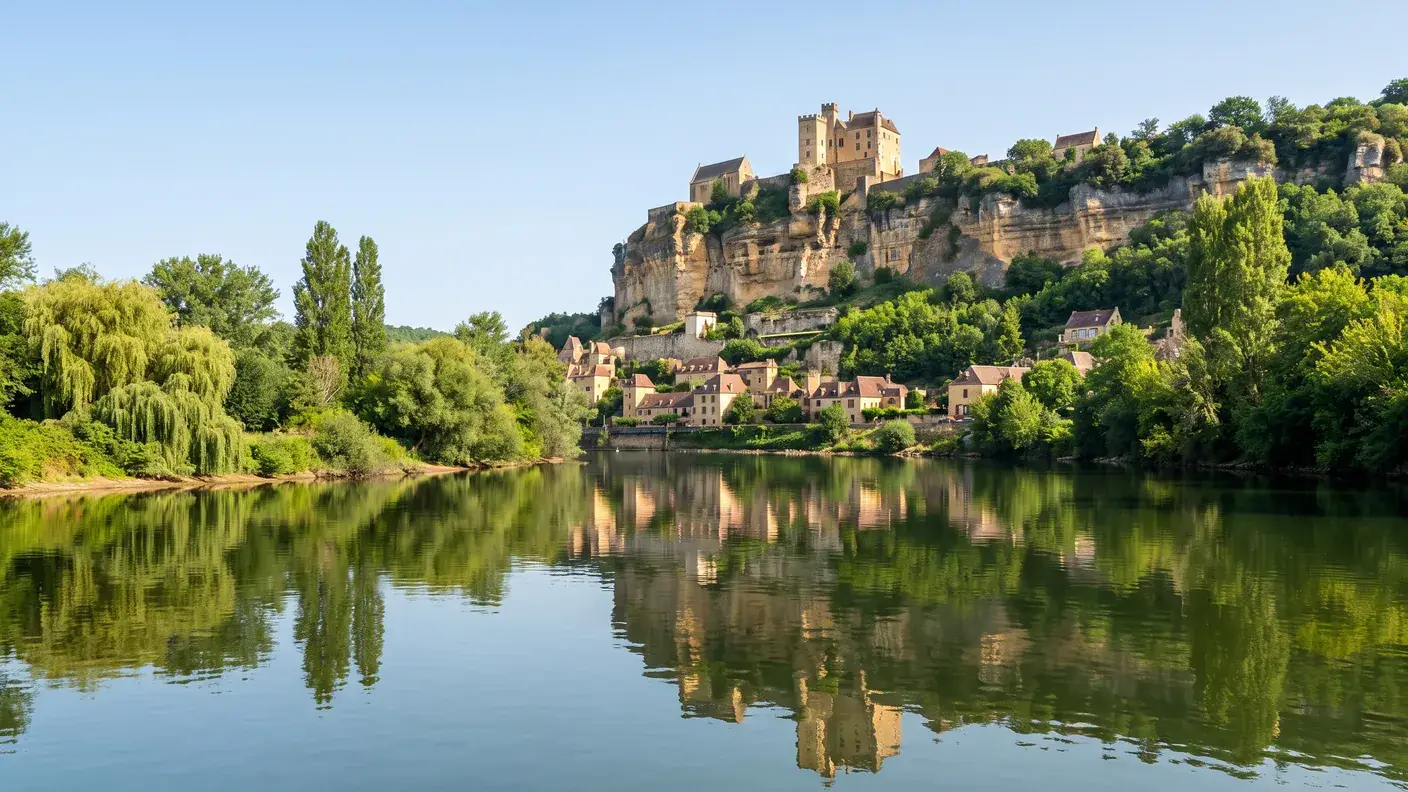
- Beynac-et-Cazenac is dominated by a 12th-century castle, built by the Barons of Beynac on a cliff overlooking the Dordogne from 150 meters.
- Beynac was the seat of one of the four baronies of the Périgord — along with Biron, Bourdeilles, and Mareuil — whose barons claimed the privilege of to carry the bishop's throne in Périgueux.
- In 1194, the vacant barony passes to Richard the Lionheart, who gives it to his truck driver Mercadier — murdered in Bordeaux Easter Monday, 1200.
- During the Hundred Years' War, Beynac (camp French) faces Castelnaud (camp English), barely 3 km as the crow flies on the other side of the river.
- The village of light-colored stone, certified The Most Beautiful Villages of France, now has only 397 residents (2023) — exactly the figure from the 1946 census.
- The castle, purchased at auction in 1962 by Lucien Grosso and restored over the course of more than half a century by the couple, has received 125.000 visitors in 2022. The adult admission price is listed at €12.50 on the official website (price verified on July 24, 2026).
- Recurring film set: The Visitors 2, Joan of Arc by Besson, Chocolate, The Last Duel by Ridley Scott, the series Fortune of France.
- 10 minutes away: Castelnaud, Marqueyssac, and Les Milandes, the castle of Josephine Baker — four of the "Most Beautiful Villages of France" within a 12-kilometer radius.
- Count 229 km and 2 hours, 58 minutes from Bordeaux via the A89 and then through the Dordogne Valley.
Before You Go: What Beynac Is Really Like
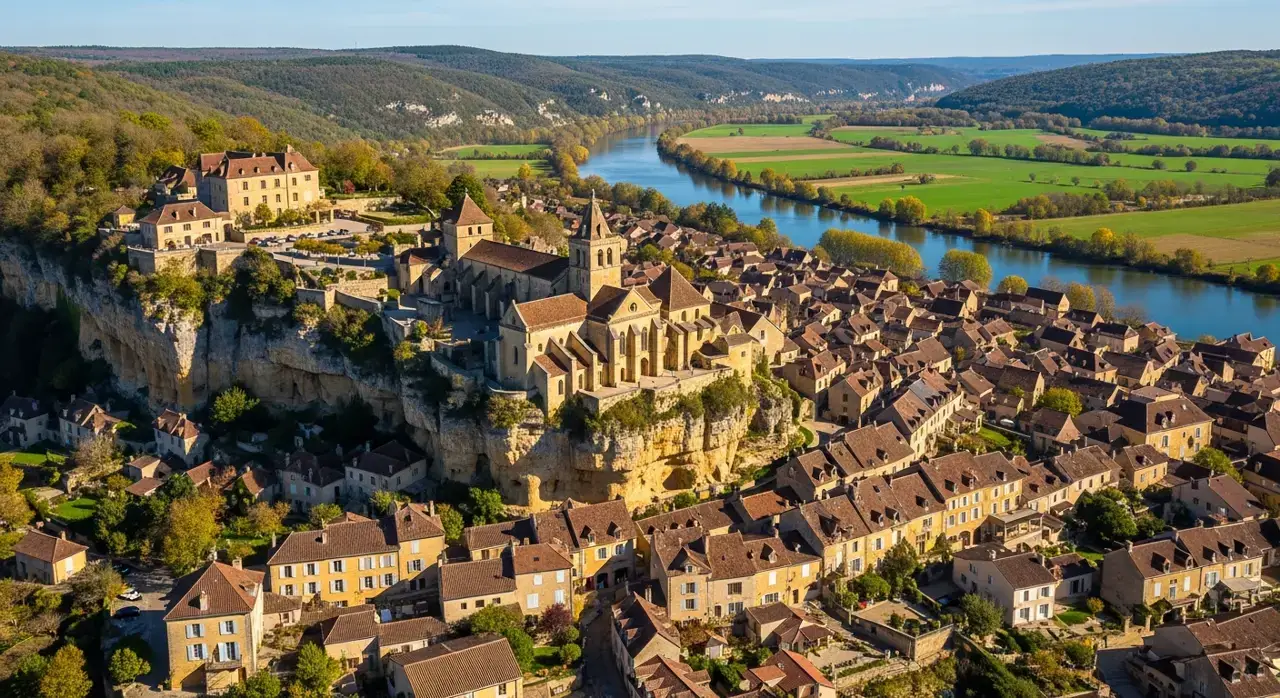
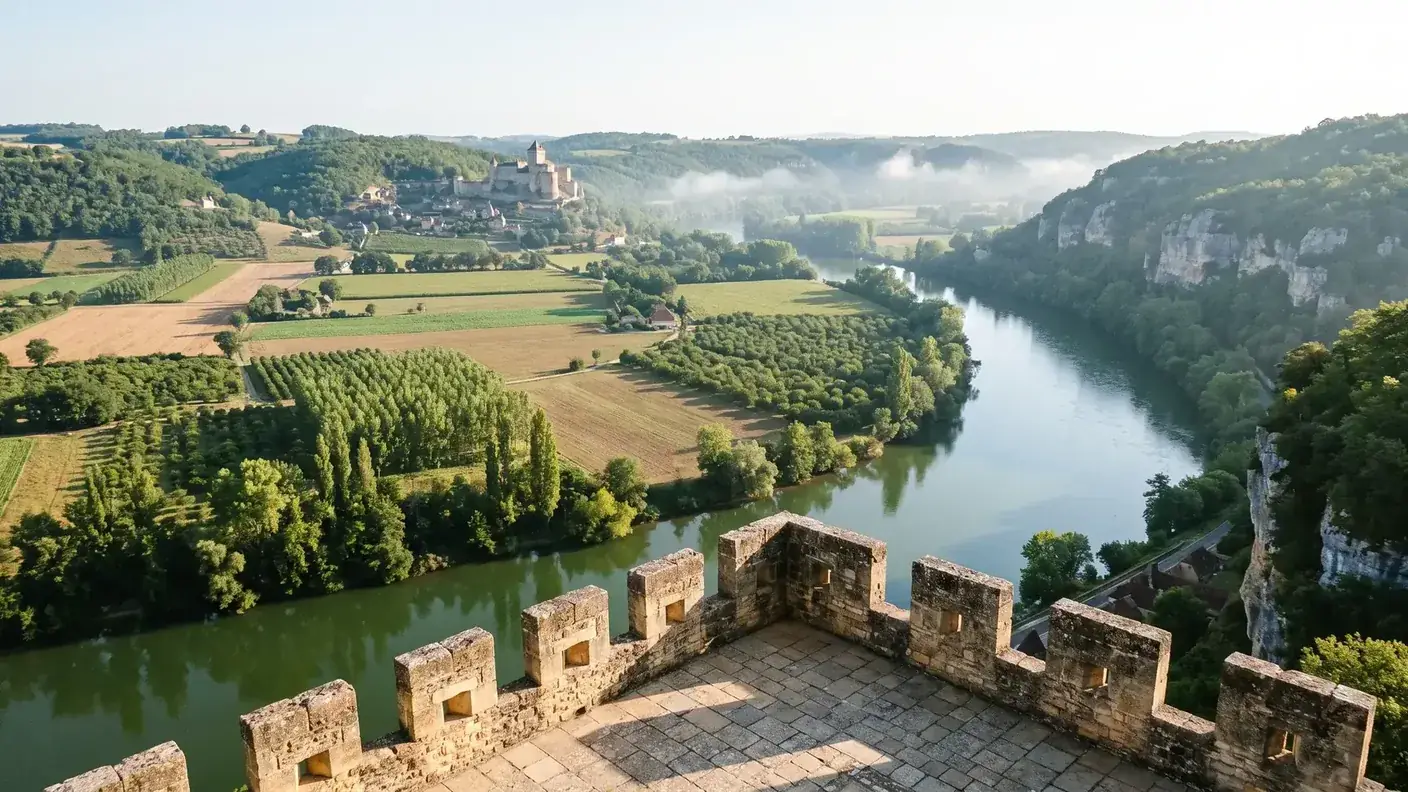
7:30 p.m. on a July evening at Calvaire. From this promontory overlooking the village, the valley glows: the Dordogne flows below, and one can count the castles just as one might count the lighthouses along a coastline— Castelnaud across from, Fayrac his lookout, Marqueyssac and its gardens, Lacoste in its little valley. Beneath your feet, the mass of the Beynac Castle, virtually unchanged for eight centuries. You can see at a glance what textbooks call a border: it’s right there—it used to be the river.
Beynac is not only one of the most beautiful villages in France—it has been, for centuries, one of the centers of power in the Périgord: seat of a barony, a tax checkpoint on the river (each ferry paid a toll to the lord), and a French stronghold facing England. The village of pale stone that climbs up toward the fortress is its direct legacy.
One figure sums up the current paradox: 397 residents per year… and more than 10,000 vehicles per day Summer on the road that winds between the cliffs and the river—the famous bypass, which was blocked by the courts, has become a national case study. Our driver's tip: aim for the early in the morning or the Summer Night Events the castle (open until 10 p.m. on weekdays, July–August).
This guide covers everything in order—the baronies, Richard the Lionheart, the Hundred Years' War, the castle room by room, the village, Cazenac, the gabarres, and the Valley of the Castles—as well as practical information, including how to get to Beynac from Bordeaux, by car or View the fixed-price transfer from Bordeaux to Beynac.
Beynac at a Glance: Geography and Demographics
Beynac-et-Cazenac is located in the right bank of the Dordogne, in the heart of the Périgord Noir, across from Castelnaud-la-Chapelle—the river runs along the town for one and a half kilometers. The area is forested throughout two-thirds (66.5%), resting on a Cretaceous limestone bedrock from which the light-colored stone of the village.
| Data | Value |
|---|---|
| Status | Municipality in the Dordogne (24), Périgord Noir |
| Label | The Most Beautiful Villages of France · 1 flower (2025 awards) |
| Population | 397 residents (2023) — the residents of Beynac-et-Cazenac |
| Castle Cliff | 150 m perched high above the Dordogne |
| Elevation of the municipality | 53 m to 288 m |
| Area | 12.74 km² |
| Sarlat-la-Canéda | ~13 km by road (15–20 min) |
| Castelnaud | ~6 km by road · 2.7 km as the crow flies |
| Distance from Bordeaux | 229 km (2 hours and 58 minutes by car) |
The demographic data tells a bittersweet story: 865 residents at its peak in 1851, 397 today—exactly the same number as in the census of 1946. The recent decline has been sharp (−27,4 % between 2017 and 2023, when the Dordogne saw slight growth): the impact of second homes in one of France’s most-visited villages. In the summer, the 125.000 visitors per year Four hundred residents pass by the castle. Source: INSEE
Name details: The municipality is double since 1827, the year Beynac and Cazenac, a hamlet perched 3 km to the northwest—we’ll come back to that. In Occitan: Bainac-et-Casenac. And the cliff is part of the Natura 2000 site known as the valley’s limestone hillsides, a refuge for the Greater and Lesser Horseshoe Bats, two protected bat species.
Geography also has its downsides: wedged between a cliff and a river, the town has been recognized six times declared a natural disaster for floods and mudslides between 1982 and 2021, and a flood risk prevention plan has covered the valley since 2011. The D703, which runs alongside the river at the foot of the village, lives and breathes with the Dordogne—in every sense of the word.
One of the four baronies of Périgord
1115: the first mention
Beynac enters the annals of history in 1115, when Maynard de Beynac made a donation to the nuns of Fontevrault. The Romanesque keep A stone building was constructed in the early 12th century on the rocky outcrop; a wooden dwelling (domicilium) accompanies it; it was replaced with a stone version at the end of the 12th century. The name is transcribed as Beinacum in 1147.
Beynac, Biron, Bourdeilles, Mareuil
Feudal Périgord is organized around four baronies: Beynac and Biron to the south, Bourdeilles and Mareuil to the north—lineages and castle sites, the oldest of which date back to around the year 1000. Each of the four barons laid claim to the title of "First Baron of Périgord", and the bloc of four exerted its full influence at the end of the Hundred Years' War.
Their most spectacular privilege: carrying the bishop of Périgueux, seated on his pontifical chair, from Saint-Pierre Church to the Saint-Étienne Cathedral, on the day of his coronation. A privilege so fiercely contested that it sometimes eluded them: the June 15, 1513, the disputes over precedence were such thatnone Of the four, only the bishop was appointed—four other nobles were named in their place. And it is reported that in 1532, Bourdeilles and Biron arrived, each escorted by several thousand armed men… so much so that the consuls of Périgueux carried the throne themselves.
At the castle, the Chamber of Deputies It takes its name from the meetings that were most likely held there by the four barons in the 15th century—serving as a council of the baronies, a banquet hall, and a seigneurial court all at once.
What about the other three baronies?
To put the competition in perspective: Bourdeilles, on the Dronne River, stands a 35-meter-tall octagonal keep with walls 2.50 meters thick, construction of which began around 1283—it was besieged for eleven weeks in 1369 by the Counts of Cambridge and Pembroke, and recaptured by Du Guesclin in 1377. Biron, on the edge of Guyenne, showcases eight centuries of overlapping architectural styles. Mareuil...in the north, even produced a bishop… from Bordeaux, Raymond de Mareuil, in 1142. In 2022, Beynac (125.000 visitors) attracted more than twice as many visitors as Biron (53,000) and nearly four times as many as Bourdeilles (32,000)—this is the driving force behind the baronies.
The latest chapter in the family's history: the Barony of Beynac remained divided in two for 138 years — divided in 1241 between the brothers Gaillard and Mainard; the two branches did not reunite until 1379, through the marriage of Philippe de Beynac to his cousin Pons, Lord of Commarque, the other fortress in the castellany.
The River's Economic Bottleneck
If we built here, it wasn't for the view: the Dordogne was the commercial focus from the Périgord to Bergerac and the Bordeaux region. Walnuts, chestnuts, timber, and wine were transported down gabarres — and each boat paid a right of way under the lord of Beynac. As early as the 13th century, some manorial fisheries Farms renowned for their salmon supplemented their income. Controlling this bend in the river meant controlling a flow of wealth.
Richard the Lionheart, Mercadier, and the “Four Arches of Satan”
It is the most dramatic decade in the castle's history—and nearly every twist and turn is confirmed by the historical sources.
1194: The vacant barony passes to the King of England
Adhémar de Beynac, a crusader in the Second Crusade (1147), dies without a direct heir around 1194. Since the barony was part of the Duchy of Aquitaine, it rightfully reverted to its suzerain: Richard the Lionheart, Duke of Aquitaine and King of England. Richard rightfully owns it—and offers it to Mercadier, his loyal captain of truck drivers, the man to whom he had entrusted the care of his castles in Aquitaine during the crusade. A professional warlord rather than a local nobleman: typical Plantagenet style.
1199–1200: two deaths four calendar days apart
The April 6, 1199, Richard is killed by a crossbow bolt during the siege of Châlus-Chabrol, in Limousin—historians most often identify him as a minor local nobleman, Pierre Basile, to whom the dying king granted a pardon. A year later, the Easter Monday, April 10, 1200, Mercadier is murdered in the middle of the street in Bordeaux, by a man from the rival Brandin family, just as he was coming to pay his respects to the old queen Eleanor of Aquitaine. The barony reverts to the original family: Pons I of Beynac (1200-1209).
1214: Simon de Montfort and the “Four Arches of Satan”
In 1214, the Albigensian Crusade moves up the valley: Simon de Montfort tackles what the columns refer to as the "4 Arches of Satan" — Domme and Montfort are shaved, the towers and walls of Beynac dismantled, a garrison stationed at Castelnaud. The Beynacs regained their castle as early as 1217, thanks to the intervention of Philip Augustus—and in the 13th century launched the major campaign that provided the site with its defenses on the plateau side: double wall, double moat, double barbican.
Across the way, the year was even more brutal: Castelnaud, stronghold of the Cathar lord Bernard de Casnac, captured by Montfort in 1214, was recaptured “through treachery” the very next year—Casanac had the garrison commander hanged—before being burned down in 1215 by the army of the Archbishop of Bordeaux. The current castle was rebuilt in the mid-13th century. Indeed, at every turning point in this story, Bordeaux is never far away.
| Date | Event |
|---|---|
| 1115 | First mention: donation of Maynard de Beynac in Fontevrault |
| 1147 | Adhémar de Beynac participated in the Second Crusade |
| ~1194 | Adhémar's Death Without an Heir — Richard the Lionheart Beynac offers Mercadier |
| April 6, 1199 | Richard dies at the siege of Châlus-Chabrol |
| April 10, 1200 | Mercadier Murdered in Bordeaux, on Easter Monday |
| 1200-1209 | Pons I of Beynac restores the lineage |
| 1214 | Simon de Montfort demolished the towers and walls |
| 1217 | The Beynacs reclaim the castle (Philip Augustus) |
That is four changes of ownership in a quarter-century (1194–1217): a king of England, a mercenary captain, the original barons, a crusade leader—few fortresses in the Périgord can claim the same. A side note: the barony would then remain in the family until 1753 — and the last marquis, Pierre de Beynac, also died… in Bordeaux.
Beynac vs. Castelnaud: The Border in the Middle of the River
In the 14th and 15th centuries, the valley became a front line: Beynac stands by the King of France, Castelnaud for the King of England — two fortresses facing each other, at 2.7 km as the crow flies, with the Dordogne River as their only border. From the rampart walk of one, one can make out the walls of the other: there are few examples in Europe of such a close-quarters military standoff that is so well preserved.
A war fought more with chess moves than with assaults
There is no record of any assault on Beynac during the Hundred Years' War—its defenses (a 150-meter cliff, a double wall, and a double moat) made such an attempt a losing proposition. The only documented siege is diplomatic: under the Treaty of Brétigny (May 8, 1360), the entire Périgord came under English sovereignty—including Beynac—without a single sword being drawn—until Charles V broke the treaty in 1368.
This Treaty of Brétigny warrants a brief digression on Bordeaux: it sealed the king’s ransom John II the Good, captured at Poitiers in 1356 — three million gold écus, which were never paid in full—and the captive king was initially held… in Bordeaux, before London. France lost a quarter of its territory there; eight years later, everything had to be rebuilt.
Across the way, Castelnaud is experiencing a very different kind of war: the castle switches sides many times. Occupied by the English for sixteen years, recaptured in March 1437 by Jean de Carbonnières, and lost again as early as 1439, it was besieged for three weeks by the troops of Charles VII in 1442—the English garrison negotiated its surrender in exchange for 400 gold écus, the October 7, 1442. An interesting detail: a Beynac Bridge was among the besiegers. The millennia-old rivalry came to an end with Beynac at the foot of the walls of Castelnaud.
Eleven years later, the Battle of Castillon (July 17, 1453) and then the siege of Bordeaux brought the war to an end—along the very same road that takes you from Bordeaux to Beynac today.
Tour the castle: keep, Hall of States, painted chapel
Beynac is a textbook example of castle architecture: eight centuries of architectural layers coexist, from the Romanesque keep to the classical staircase. Allow a good hour visiting hours (self-guided, with QR codes), and a 15-minute walk uphill from the bottom of the village—or a 2-minute walk from the upper parking lot.
The Romanesque keep and the guardroom
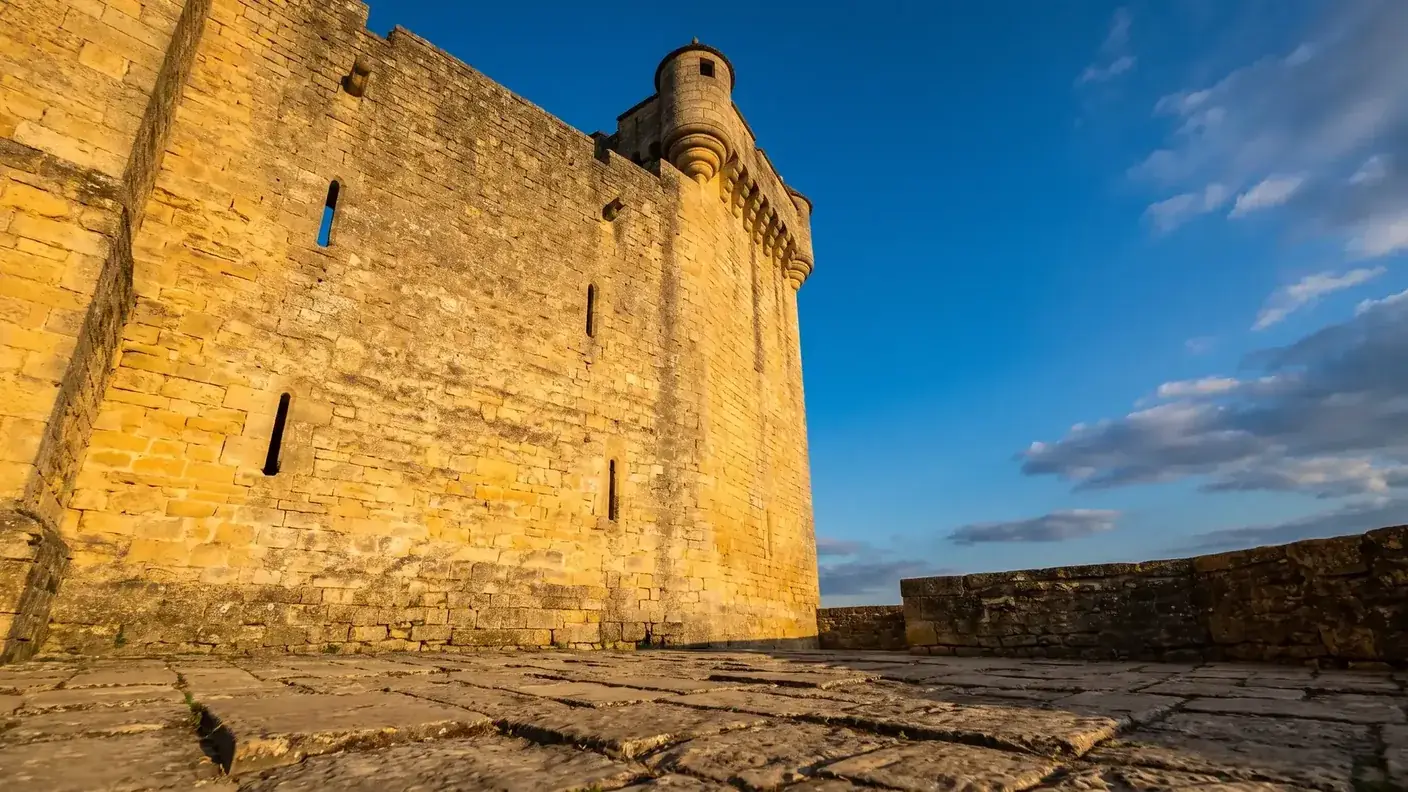
The square keep Dating from the early 12th century, the castle’s core features thick walls, few and narrow openings, and a parapet and a watchtower overhanging. The original access was via on the first floor, via a retractable ladder—remove the ladder, and the keep becomes airtight. In the duty room (late 12th century), the lord and his sergeants-at-arms would enter on horseback; the lower room of the keep was used as a stable.
The Hall of States and the Oratory with its frescoes
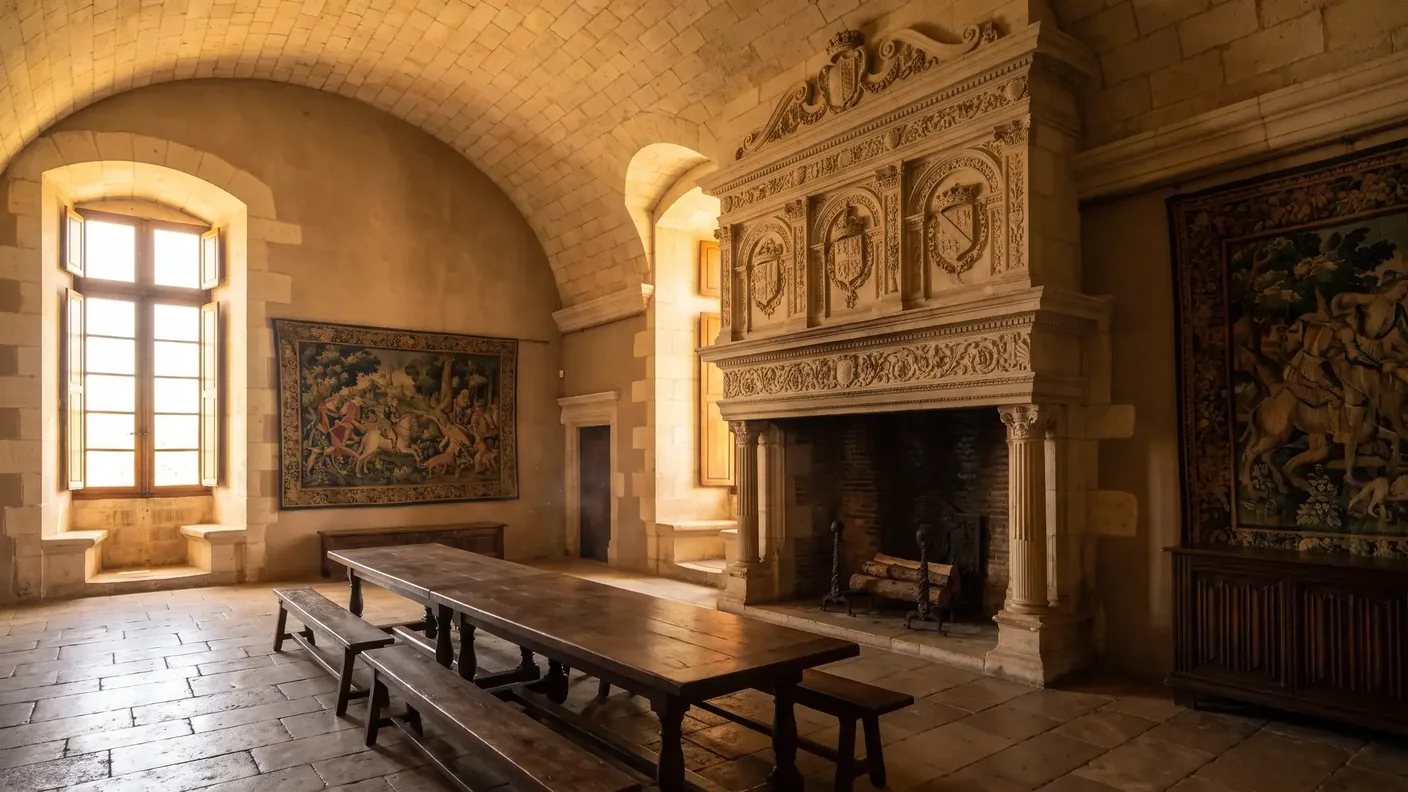
The Chamber of Deputies, beneath its 14th-century broken barrel vault, houses a Renaissance fireplace carved from bucrania — these ox heads adorned with garlands in the classical style — and rosettes. The adjoining oratory is entirely painted with 15th-century frescoes: a Pietà, a Saint Christopher, and a Last Supper in which Saint Martial, the evangelist of Limousin, appears in head waiter. In the main section of the spur, the windows are flanked by seats, these stone benches for reading in the daylight.
Staircases, terraces, and a barbican... from the 19th century
An end spiral staircase Adjacent to the keep is a staircase leading to the crenellated terrace; a second staircase, square and classical in style (17th century), leads to the apartments. From the terraces, the "Valley of the Five Castles" — Marqueyssac, Fayrac, Lacoste, Castelnaud… the fifth, as the official program notes, is none other than Beynac itself. Heritage transparency: the barbican The entrance is a reconstruction 19th-century educational philosophy, built to demonstrate how crossfire works. The castle has been designated a Historic Monument since February 11, 1944.
| Castle Tour (2026) | Details |
|---|---|
| Rates | Adults €12.50 · Ages 10–17 €7 · Free for children under 10 — price verified on July 24, 2026 |
| Season | Open from February 7 to December 18 |
| Summer Hours | 10 a.m.–7 p.m.; July 4–August 30: 9 a.m.–10 p.m. on weekdays (evening hours), 9 a.m.–8 p.m. on weekends |
| Duration | About 1 hour · self-guided tour with QR codes (free smartphone guide) |
| Access | 2 min from the upper parking lot · 15-minute walk from the lower part of the village |
| Good to Know | Dogs on a leash are welcome · online ticket sales with flexible dates |
From 640 Years of Barons to the Grosso Legacy: Who Owns Beynac?
The Beynac family has held onto their rock for nearly six and a half centuries: the line died out in 1753 with Marquis Pierre de Beynac—who, as it turns out, died in Bordeaux. Through marriage, the château passed to the Beaumont-Beynac, who kept it until it was sold in 1961; the Marquis Geoffroy de Beaumont (1857–1940) had already restored it over the course of nearly sixty years.
Then comes the most unlikely chapter: in 1962, the castle was sold at auction for 170,000 francs to Lucien Grosso, who had made his fortune in the casinos and nightclubs of Marseille and Abidjan. Together with his wife Denise, he devoted the rest of his life to the restaurant business — more than half a century a joint project (Lucien died in 2008 at the age of 98, and Denise in 2016). Since they had no children, the couple had decided as early as 1999 to bequeath Beynac to the senator Albéric de Montgolfier, a heritage enthusiast whose family now manages the castle.
It is this century of continuous restorations—first by Beaumont, then by Grosso—that explains the “exceptional state of preservation” praised by Ridley Scott during the filming of the Final Duel.
The Village: Blonde Stone, Barrys, and the Promenade des Artistes
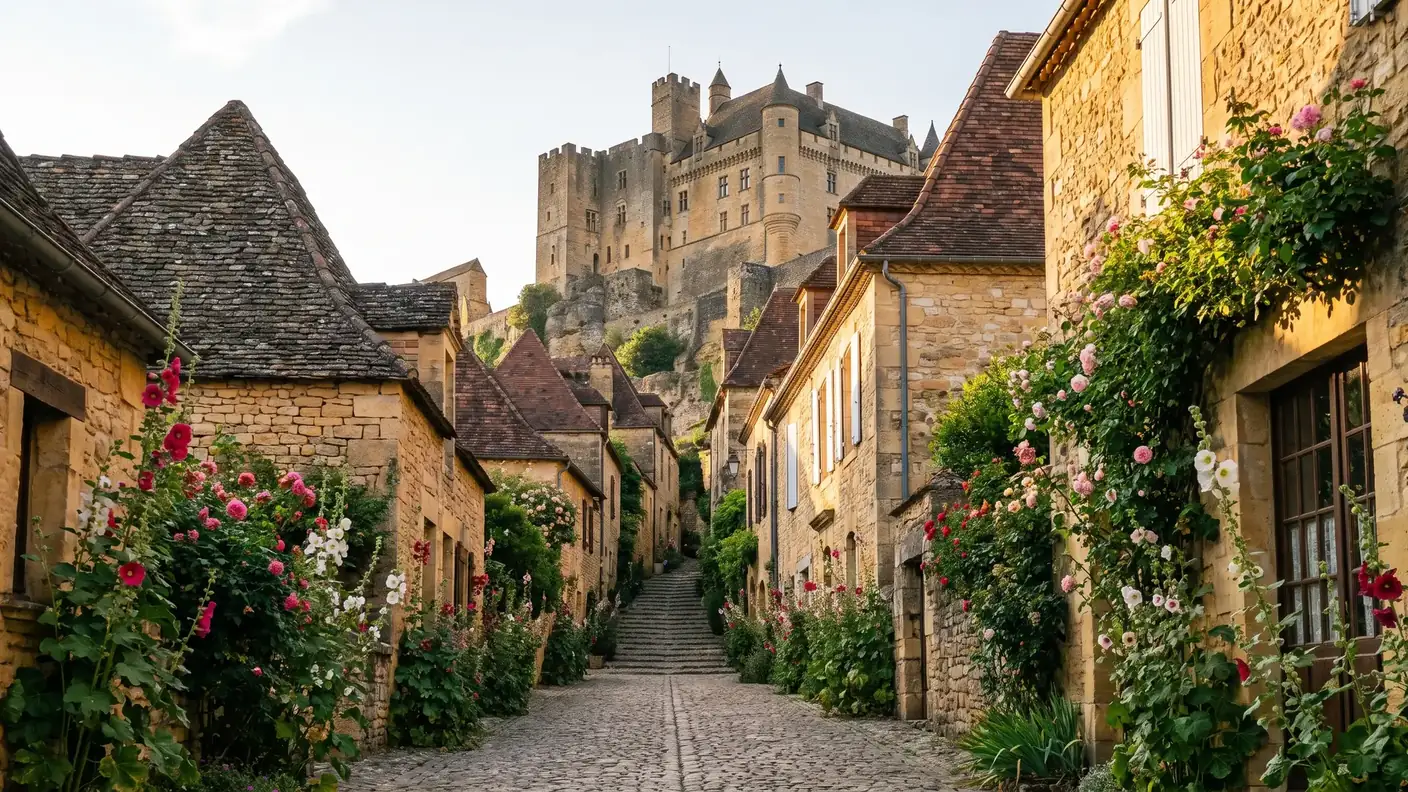
Below the castle, the village stretches out cobbled alleys between houses in light-colored stone on the rooftops of Périgord slate, situated on the Turonian limestone bedrock. The neighborhoods here have local names: each one is called a "Barry". Some of the alleys are so steep that they're more like stairs than streets—be sure to wear sturdy shoes.
The Church of Our Lady of the Assumption, the oldest of the monuments
At the very top, the old Romanesque castle chapel Dating from the 12th century and built within the castle's first defensive wall, it has become the church Our Lady of the Assumption: slate roof, bell wall with five openings — and a monumental altarpiece measuring 6.5 m by 5 m, with the central Assumption painted in 1715 by François Joseph Vaincque, after Rubens. Designated a Historic Monument as of 1912, built 32 years before the castle, is open to the public free of charge.
Calvary and the Artists' Promenade
Up on the hills, the Calvary offers THE view of the village—five castles in a single glance, perfect at sunset. And as you stroll, follow the Artists' Promenade: thirteen panels dedicated to painters who have depicted Beynac, including Paul Signac, Félix Vallotton and O'Galop — the creator of the Michelin Man. One final fun fact: in 1957, the French postal service issued an 18-franc stamp featuring the village… spelled “Beynac-Cazenac,” without the “et.”
Cazenac, the other forgotten half of the town
Almost all visitors are unaware that the town is double. In 1827, the towns of Beynac and Cazenac have merged—hence the hyphen. The hamlet of Cazenac, perched on the hillsides 3 km northwest of the village, offers a beautiful view of the hills… and a silence that the village no longer experiences in the summer.
People mainly go up there to see the church Saint-Martial (12th and 15th centuries, listed as a Historic Monument in 1948): Romanesque portal, bell tower, Gothic interior with ribbed vaulting, slate roof, and a small adjoining cemetery. Restored in 1989, it received Contemporary Stained-Glass Windows by Sophie Gaudin representing rural life—a little-known counterpoint to the tourist circuit.
The Elegance of Chance: Saint Martial, the head of the church in Cazenac, is precisely the figure depicted as the steward in the painted Last Supper in the castle's oratory. The town has a total of five historic monuments — the castle, the two churches, the tower known as the “convent tower” (13th century), and the ruins of the Abrillac convent.
Beynac on the Big Screen: A Setting of Authenticity
Few French locations have hosted as many period film shoots—the reason can be summed up in one word: theauthenticity. No reenactments or major alterations: what the camera captures is, for the most part, what a 13th-century witness would have seen.
- Le Capitan (1960), starring Jean Marais—the pioneer;
- D'Artagnan's Daughter by Bertrand Tavernier (1994);
- The Visitors 2: The first take of the film was shot there on March 13, 1997 — Beynac serves as the setting for Godefroy de Montmirail’s castle in the Middle Ages (the interiors, however, are by Biron);
- Forever (1998) and Joan of Arc by Luc Besson (1999);
- Chocolate (2000): Juliette Binoche filmed on Rue de l'Ancienne-Poste, in the village;
- The Last Duel by Ridley Scott: filmed in 2020 (released in 2021), up to 500 people on location at the height of filming;
- The Series Fortune of France (2024), in which Beynac plays the role of the Baron de Frontenac’s “terrible castle.”
We can add the miniseries to that Gaston Phébus (1978), the comedy She sees dwarves everywhere! (1982) and Fanfan the Tulip (2003). For The Visitors 2 (with a budget of 23 M€), the Dordogne Departmental Council is even listed in the credits as a production partner—and Christian Clavier recalls the first take being called “in weather cold enough to dehorn oxen.”
Ridley Scott, meanwhile, captivated by the site’s “exceptional state of preservation,” had begun location scouting as early as August 2019—filming was interrupted by the pandemic in March 2020 and completed in Ireland that fall. For those curious about older images: Signac and Vallotton had already set up their easels here a century earlier.
Rafts, the harbor, and the river: the Dordogne at the foot of the castle
Before tourism, the Dordogne River served as the main thoroughfare of the Périgord: around 1850, the barge was still ensuring 60% of trade in goods between Bergerac and Bordeaux. The Beynac Port It remained in use until the 19th century—wine, timber, and nuts were transported downstream to Bordeaux, and each boat used to pay a toll to the lord. The first bridge on the Beynac side dates back only to the 19th century; before that, people crossed by ferry.
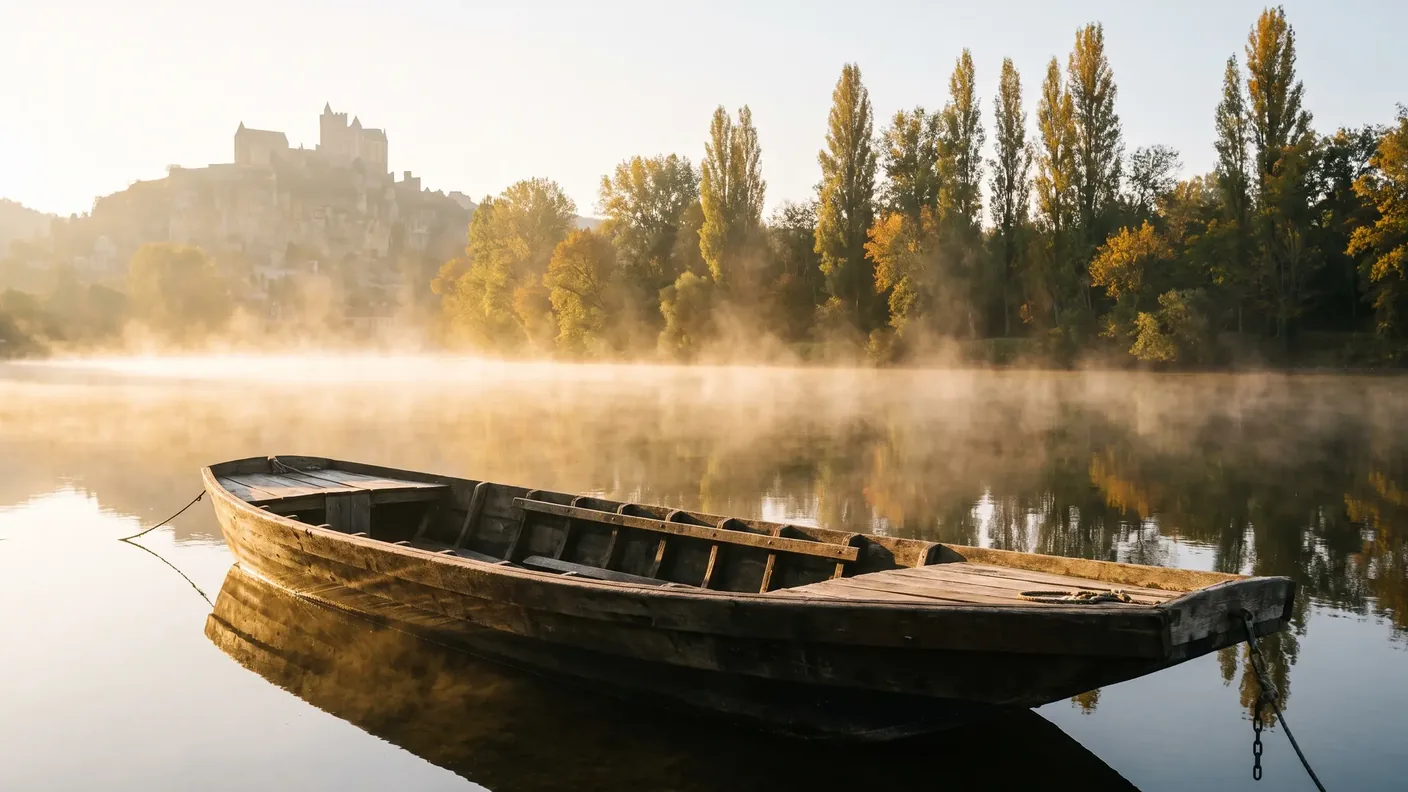
The gabarre ride today
The Beynac Rafts Boarding takes place at the foot of the village parking lot, across from the post office: 50 minutes with commentary along the river, with views of Beynac, Castelnaud, Marqueyssac, and Fayrac. The official rate is 10 € per adult and €5.50 per child, with one child free per paying adult on morning departures (price verified on July 24, 2026). Season runs from April 1 to October 31. By canoe, the descent Vitrac → Beynac (16 km, ~3 hours) is where the “Valley of the Five Castles” unfolds.
⚠ Summer 2026 and the bypass saga
Something current you should know: the Beynac Bypass has become a national legal saga. The 3.2-kilometer, 32-million-euro project, approved in January 2018, was suspended by the Council of State on December 28, 2018 — even though five bridge piers had already been poured and 15 million euros had already been spent —, deemed to lack a “compelling reason of major public interest” in 2019, and then Permanently canceled on June 29, 2020. Because it failed to demolish the structure, the Department was ordered to pay 1.4 million euros in 2024; a revised project, the “Multimodal Loop,” was in turn rejected in late 2025 (the government filed an appeal in January 2026).
Work related to the old piers of the bypass may cause changes to departure times in 2026; please check on the day of travel The official schedule for the Gabarres de Beynac. That's also why the D703 stays loaded: more than 10,000 vehicles per day In the summer, when crossing through the village—set out early. A small historical consolation: the first tourist cruise on a gabarre took place in 1971, and four companies are now reviving the inland waterway shipping industry in the department.
Around Beynac: the Valley of the Castles
Beynac is at the heart of the densest concentration of castles in France: Four of the "Most Beautiful Villages of France" within a 12-kilometer radius (Beynac, Castelnaud, La Roque-Gageac, Domme), and three of their immediate neighbors rank among the top 5 most-visited sites in the Dordogne.
Castelnaud and its War Museum (6 km)
The eternal rival, now an ally: the Castelnaud Castle has been home to the Museum of Medieval Warfare — France's second-largest collection of medieval weapons, including full-scale siege engines — and received 245.000 visitors in 2022, the department's second-most visited site after Lascaux. The irony of the story is that it is Philippe Rossillon, mayor of Beynac, who bought the ruins of Castelnaud in 1965—at the time a stone quarry—and whose son Kléber turned it into a museum. The English rival was saved by the mayor across the street.
Les Milandes, Joséphine Baker's Castle (11 km)
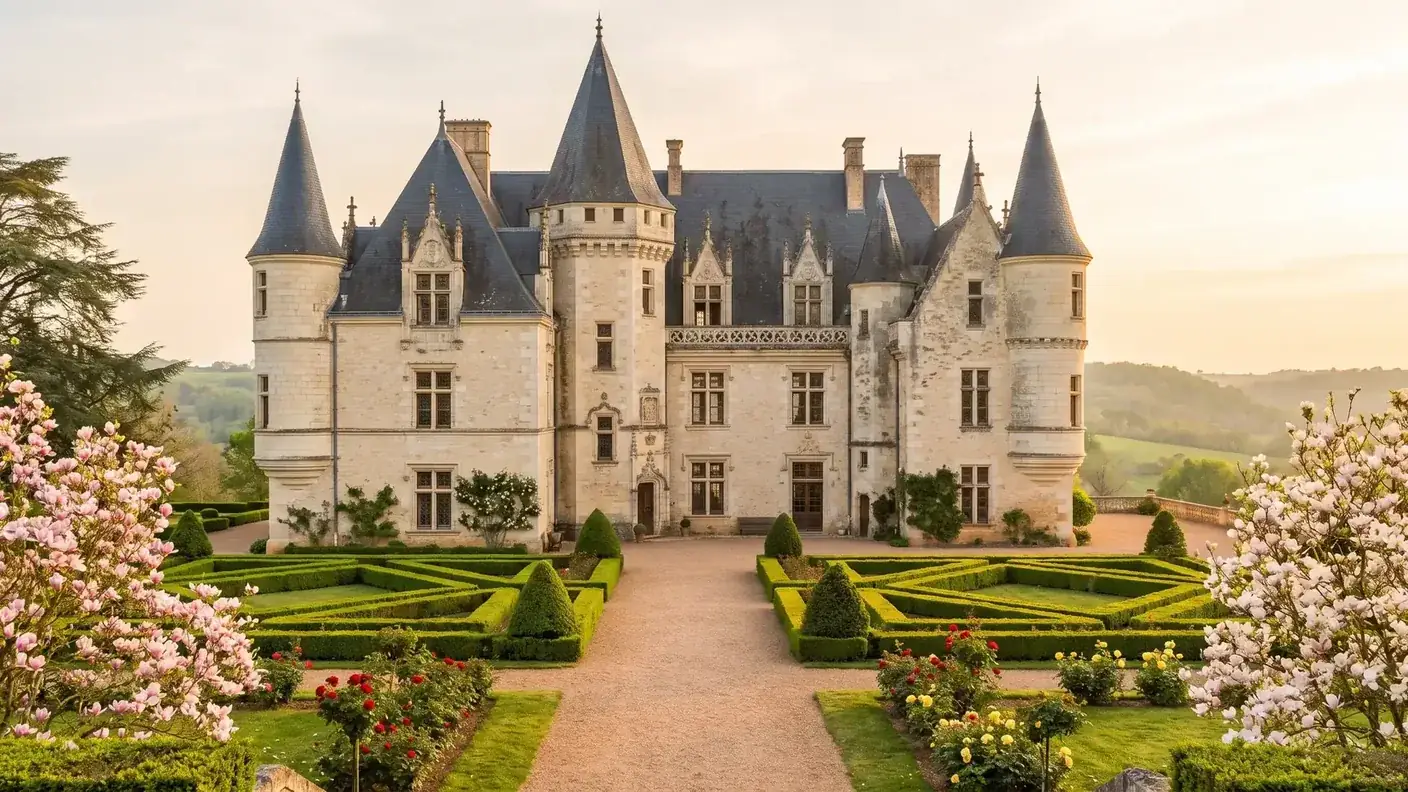
Built in 1489 For the Caumonts—who were also lords of Castelnaud—the castle of the Milandes was the home of Josephine Baker: a tenant starting in 1937, then a homeowner in 1947, she raised her Twelve adopted children of nine nationalities — her “rainbow tribe” — and was awarded the Legion of Honor there in 1961, in the park. Then came bankruptcy: an auction was announced as early as 1964 despite appeals from Brigitte Bardot and François Mauriac’s committee; the property was sold in 1968 “for a tenth of its value,” and she was evicted in March 1969—she spent a night on the front steps.
Inducted into the Pantheon on November 30, 2021 — 84 years to the day after she became a French citizen —, she is the the first Black woman in the Pantheon. The tour (200,000 visitors in 2022, Maison des Illustres) is complemented by a bird of prey show in the gardens. A legal curiosity: the chapel from 1503 where Joséphine married Jo Bouillon—a property that was lost due to a land registry error in the early 20th century and classified as “vacant and ownerless”—was not returned to the estate until 2018–2019 — along with its crypt and its 4-meter-tall painting of Saint Christopher.
Marqueyssac, Fayrac, La Roque-Gageac, Domme, Sarlat
Less than 10 minutes away, the Marqueyssac Gardens (Vézac) hand-carved 150,000 century-old boxwoods on a rocky outcrop 130 m above the valley — Candlelight Evenings on Thursdays in the summer (2,000 candles), skeleton ofAllosaurus purchased at auction in 2016, and ranked 2025th among the The 25 Most Beautiful Gardens in the World according to The New York Times. Debunk the myth: these gardens were not designed by Le Nôtre—the first terraces are said to have been created by one of his students, Porcher, and the art of boxwood topiary dates back to Julien de Cerval, after 1861, upon his return from Italy.
Across from, Fayrac (15th–19th centuries, designated a historic monument in 1928), the “Castelnaud watchtower” that kept watch over Beynac from across the river—it is private property and not open to the public, but it is there thatAndré Malraux went into hiding for a few weeks in 1944, when he joined the Resistance. Then La Roque-Gageac and its cave fort, which reopened in 2020 (10 min), Domme the royal country estate and its 450-meter cave (15 min — see our guide), and Sarlat, the capital of the Périgord Noir region and the first city in France to be preserved under the Malraux Law (15–20 min — see our guide).
| Field Trip | Directions from Beynac | Why Go There |
|---|---|---|
| Marqueyssac Gardens | ≈ 5 km · 9 min | 150,000 boxwood trees, a lookout point 130 m away, Candles in the summer |
| Castelnaud Castle | ≈ 6 km · 9 min | Museum of Medieval Warfare, 245.000 visitors |
| La Roque-Gageac | ≈ 7 km · 10 min | PBVF, heavily cave-like, exotic garden |
| Château des Milandes | ≈ 11 km · 13 min | Josephine Baker, a show featuring birds of prey |
| Domme | ≈ 12 km · 16 min | Royal bastide dating from 1281, 450-meter cave |
| Sarlat-la-Canéda | ≈ 14 km · 16 min | Capital of the Périgord Noir, markets |
| Fayrac Castle | as seen from the shore/from the water | The “lookout” — not open to visitors |
When to Visit Beynac
- Early in the morning or late in the day In the summer: 10,000 vehicles pass along the D703 each day—and the evening light sets the golden stone ablaze;
- Castle Night Tours: open until 10 p.m. on weekdays from July 4 to August 30 — a rarity in the Périgord;
- Monday morning (mid-June through mid-September): Local Farmers' Market in the village parking lot — walnuts, strawberries, farm-fresh cheeses, foie gras;
- August 15: a bodega and a big fireworks show—the village's real highlight;
- Thursday evenings in July and August: Candlelit Evenings in Marqueyssac, 9 minutes away.
| Season | Atmosphere | Strengths | Good to Know |
|---|---|---|---|
| Spring (April–June) | Green, peaceful | Castles starting in February, gabarres starting in April, a valley in bloom | Our Favorite Season |
| Summer (July–August) | Very crowded | Late-night shopping until 10 p.m., Monday market, August 15 fireworks display | Heavy traffic—please arrive early. Construction work related to the old piers of the bypass may affect departure times in 2026; please check on the day of your trip The official schedule for the Gabarres de Beynac. |
| Fall (Sept.–Oct.) | Golden | Stunning lights, gabarres on display through the end of October | Ideal for photos |
| Winter (Nov.–Feb.) | Secret | The castle is open through Dec. 18, then again starting Feb. 7; the village is open for you | Closed boats |
At the weather station: the reference station records an annual average of 12.9 °C and 918 mm of rain — but July has only 6.4 days of precipitation, compared with 12.1 in January. Summers in the Périgord are predictable; it’s the crowds, not the weather, that need managing.
The perfect one-day itinerary: visit the castle right when it opens, take a gabarre ride in the late morning (free for children on morning departures), have lunch in the village, then visit Castelnaud or Marqueyssac in the afternoon—and see the Calvaire at sunset.
How to Get to Beynac from Bordeaux
Beynac is in 229 km from Bordeaux — count 2:58. The final stretch along the D703, winding between cliffs and the river from La Roque-Gageac to Beynac, is one of the most beautiful roads in the Périgord.
| Transport | Travel time from Bordeaux to Beynac | Estimated cost | Good to Know |
|---|---|---|---|
| Personal car | 2:58 (229 km) | Varies depending on the vehicle and route | A89 via Périgueux, then D704/D57 toward the valley |
| Chauffeured transfer (door-to-door) | 2:58 | from €332 · one-way | Optional stops (Périgueux, Sarlat, La Roque-Gageac…) |
| Train + Road | ≈ 2.5 hours by TER + 14 km | View the official TER fare schedule + taxi or chauffeur service | TER from Bordeaux to Sarlat (~6 per day), then ~15-minute drive |
| Car / Plane | — | — | There is no direct connection between Bordeaux and Beynac |
By car: Directions
Main Route: Take the A89 to Périgueux, then the D704 toward Sarlat and the D57 to Beynac. Valley Variant: Exit the highway earlier and drive up the Dordogne River via Trémolat and Saint-Cyprien—it takes longer, but the river will take you all the way to the castle.
By train
The TER Bordeaux–Sarlat (Line 33, via Libourne and Bergerac) takes about 2 hours and 30 minutes, at a rate of about 6 trains per day. That leaves 14 km To Beynac, with no reliable bus service: take a taxi or hire a driver from the Sarlat train station.
With a private chauffeur
A door-to-door service comes into its own on a touring itinerary: stop at Saint-Émilion or Périgueux on the way, arrive through the valley, then divide the afternoon between Castelnaud, Marqueyssac, and Les Milandes without searching for parking at every stop. With a private chauffeur, you can decide these detours as you go — with a fixed rate guaranteed in writing, from €332 one way for 1 to 3 passengers.
Practical Information
How long will you be staying there?
Half a day for the castle, the village, and the barge. A day by adding Castelnaud or Marqueyssac. Two days for the full loop through the valley—the five castles, La Roque-Gageac, Domme, Sarlat—without running.
Parking and the walk up to the castle
| Parking | Rates | Good to Know |
|---|---|---|
| Le Crouzet (lower part, riverside) | 2 hours = 3 € · 4 hours = 4 € · 8 hours = 6 € — price verified on July 24, 2026 | 40 seats · followed by a 15-minute walk uphill |
| Château Parking Lots No. 1 and No. 2 (Upper) | paid | The castle entrance is 2 minutes away |
| Great Deal | — | Dropped off right at the top by your driver: no need to walk up |
The climb from the bottom of the village is steep (cobblestone streets): people with limited mobility should aim for the upper parking lot. There is no shuttle service in the village—the one part of the “multimodal loop” project was blocked by the courts in late 2025.
Estimated Budget
| Profile | Daily Budget | Accommodations | Catering |
|---|---|---|---|
| Small budget | View the official price list | Campgrounds in the Valley | Monday Market + Picnic at Calvaire |
| New Couple | View the official price list | Hotel or bed-and-breakfast (Beynac, Vézac, La Roque) | Waterfront Terraces |
| Comfort/Fine Dining | View the official price list | Characteristic Homes (Valley, Sarlat) | Perigord Cuisine, Truffles in Season |
Families: Free boat rides for kids in the morning, the Castelnaud chairlifts, the Milandes birds of prey, and canoeing starting in the spring—the winning quartet. Good to Know: The village has not had a post office (postal agency) since September 2025, and the local tourist office is in Sarlat. An Alsatian nod: Beynac has been twinned since 1985 with Sundhouse — hence the “Place d’Alsace,” which serves as a parking lot.
Frequently Asked Questions
When was Beynac Castle built?
The square Romanesque keep dates from the early 12th century and was built by the Barons of Beynac on their 150-meter-high cliff. The castle was subsequently expanded in successive phases: a 13th-century defensive complex (double wall, double moat), the vaulted ceiling of the Hall of States in the 14th century, frescoes in the oratory in the 15th century, a Renaissance fireplace in the 16th century, and a square staircase in the 17th century. The entrance barbican, however, is a 19th-century reconstruction built for educational purposes.
What is the connection between Richard the Lionheart and Beynac?
Upon the death of the crusader Adhémar de Beynac, who had no heir, around 1194, the barony rightfully passed to Richard the Lionheart, Duke of Aquitaine and King of England—who granted it to his loyal captain of mercenaries, Mercadier. Richard died in 1199 during the siege of Châlus; Mercadier was assassinated in Bordeaux on Easter Monday, 1200, and the barony reverted to the de Beynac family.
What are the four baronies of the Périgord?
The four major lordships that formed the structure of feudal Périgord: Beynac and Biron in the south, Bourdeilles and Mareuil in the north. Their barons claimed the privilege of carrying the bishop’s throne during his enthronement in Périgueux—a privilege so hotly contested that in 1513, none of the four carried it. At the Château de Beynac, the Salle des États takes its name from their likely meetings there in the 15th century.
Why were Beynac and Castelnaud rivals?
During the Hundred Years' War, the Dordogne River served as a border: Beynac was held by the King of France, while Castelnaud was held by the King of England—two fortresses facing each other, 2.7 km apart as the crow flies. Castelnaud changed sides numerous times before its final surrender in exchange for 400 gold écus in 1442—with Pons de Beynac among the besiegers. Beynac, on the other hand, did not come over to the English side until a treaty was signed (Brétigny, 1360–1368).
How much does it cost to visit Beynac Castle?
The Official admission price for the castle is €12.50 per adult and €7 per youth, with free admission for children under 10 (price verified on July 24, 2026). The self-guided tour takes about an hour. Allow 15 minutes for the climb from the bottom of the village, or 2 minutes from the upper parking lot.
How much time should you set aside to visit Beynac?
Half a day is enough to see the castle (1 hour), the village’s narrow streets, and take a gabarre boat ride (50 minutes). Allow a full day if you include Castelnaud and Marqueyssac, both less than 10 minutes away. If you’re using this as a base, two days will cover the entire valley: the five castles, La Roque-Gageac, Domme, and Sarlat.
Which movies were filmed in Beynac?
*Le Capitan* (1960), *D'Artagnan's Daughter* (1994), Les Visiteurs 2—which began filming in Beynac on March 13, 1997—À tout jamais (1998), Luc Besson’s Jeanne d’Arc (1999), *Chocolat* (2000, filmed in the village with Juliette Binoche), Ridley Scott’s *The Last Duel* (filmed in 2020) and the series *Fortune de France* (2024), in which the castle serves as the “terrible castle” of Baron de Frontenac.
Is Beynac listed among the Most Beautiful Villages of France?
Yes—and this is actually the heart of the label’s most concentrated cluster: Beynac-et-Cazenac, Castelnaud-la-Chapelle, La Roque-Gageac, and Domme—four of France’s Most Beautiful Villages within a 12-kilometer radius. The village has also earned its first “flower” in the 2025 “Villes et Villages Fleuris” rankings.
How do I get from Bordeaux to Beynac?
By car: 229 km and 2 hours 58 minutes — take the A89 to Périgueux, then the D704 and D57 towards the valley. By train: TER from Bordeaux to Sarlat (~2 hours 30 minutes), then 14 km by taxi or chauffeur service; view the official TER timetable and fares. Door-to-door executive car service: from €332 one way (1–3 passengers), with optional stops in Périgueux, Sarlat or La Roque-Gageac.
Where can I park in Beynac?
At the Crouzet parking lot, down by the river, the municipal rates The signs indicate €3 for 2 hours and €6 for 8 hours (rates verified on July 24, 2026), followed by a 15-minute walk uphill; or at the Château Parking Lots No. 1 and No. 2, at the top, 2 minutes from the entrance. In the summer, arrive early—or have your driver drop you off at the top.
Can you take a gabarre ride in Beynac?
Yes: The Gabarres de Beynac depart from across from the post office for a 50-minute guided tour, with views of Beynac, Castelnaud, Marqueyssac, and Fayrac. The official rate is €10 per adult and €5.50 per child, with one child admitted free in the morning for each paying adult (price verified on July 24, 2026). Season: April–October; check the official calendar before you go.
What is the “Valley of the Five Castles”?
The stretch of the Dordogne where five castles can be seen at a glance: Beynac, Castelnaud, Fayrac, Marqueyssac, and La Malartrie. This is the setting for the Vitrac→Beynac canoe trip (16 km, ~3 hours) and gabarre boat tours. A six-castle route adds Lacoste, tucked away in the Céou Valley. The best viewpoint on foot is still the Calvaire, above the village.
What is there to see at the Château des Milandes?
Josephine Baker’s home: a tenant starting in 1937 and the owner by 1947, she raised her twelve adopted children—her “rainbow tribe”—there before it was sold off in 1968. The château (1489), located 13 minutes from Beynac, traces her life as an artist, Resistance fighter, and activist; she was enshrined in the Panthéon on November 30, 2021. Don’t miss the birds-of-prey show in the gardens (200,000 visitors in 2022).
Further Reading
- The hilltop village just 15 minutes away: see the Domme Guide (cave, Porte des Tours, lookout point)
- The capital of the Périgord Noir: see the Guide to Sarlat (market, old town)
- Prehistory Just 40 Minutes Away: see the Lascaux Guide and the Vézère Valley
- A stop at a vineyard along the way: see the Guide to Saint-Émilion
- Plan Your Trip: Book a private driver from Bordeaux to Beynac or explore all our destinations
Sources and References
- Wikipedia — Beynac-et-Cazenac — history, landmarks, demographics, bypass
- Wikipedia — Beynac Castle — architecture, history
- Beynac Castle (official website) — History, prices, and schedules; visitor guide
- Sarlat Tourism — Beynac Castle — visit, village
- The Most Beautiful Villages of France — the village, the Artists' Promenade
- Beynac Rafts — Gabarre boat tours, 2026 rates
- Wikipedia — Château des Milandes — Josephine Baker at Les Milandes
- Château des Milandes (official website) — tour, raptor show
- Castelnaud Castle — Museum of Medieval Warfare
- Marqueyssac Gardens — the hanging gardens
- INSEE — Complete Report on Beynac-et-Cazenac — demographic data
Article updated on .