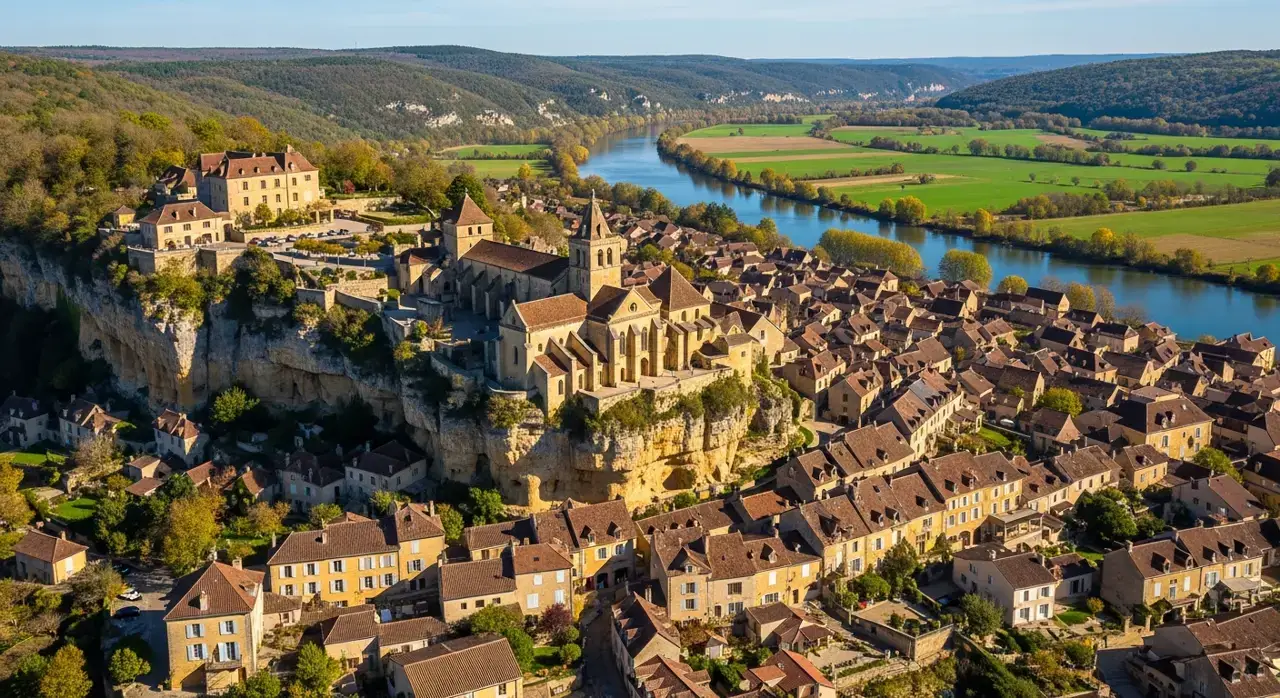
Domme, the Balcony of the Dordogne
The royal bastide of the Périgord Noir: founded in 1281, perched 210 m above the river—the Porte des Tours and its Templar legend, a 450-meter-long cave beneath the market hall, the Barre lookout point, Maleville and the Civil Code, and Vivans’s heroic feat in 1588. Learn all about it before you visit—about 2 hours and 50 minutes from Bordeaux.
In a nutshell
- Domme is a royal bastide founded in 1281 by Philip III the Bold — the founding treaty, signed in Cahors on March 7, 1281, is held at the National Archives.
- The village is perched on a cliff at an elevation of 210 meters, overlooking the Dordogne by about 150 meters—a site so steep that the bastide is laid out in a trapezoidal shape rather than the classic grid pattern.
- 906 residents in 2023 (the people of Dommois)—there were 2,115 in 1851; the village has been designated one of the Most Beautiful Villages of France.
- The Gate of the Towers (late 13th–early 14th century) preserves about a hundred graffiti long attributed to 70 imprisoned Templars—a legend that is now widely disputed.
- In 1588, the Huguenot captain Geoffroy de Vivans captured the “impregnable” bastide by scaling the cliff at night—after failing twice, in 1572 and 1573.
- Beneath the market hall lies the largest developed cave in the Périgord Noir: 450 meters of tunnels, discovered in 1912, with an exit via a panoramic elevator in the cliff.
- The Thursday morning market at Place de la Halle carries on the tradition of the fairs established by the royal charter—Domme even had the privilege of minting its own coins.
- A native of the village: Jacques de Maleville (1741–1824), one of the four drafters of the Civil Code of 1804—his bust stands guard over the Barre lookout.
- It's about 211 km and roughly 2 hours and 50 minutes from Bordeaux, via the A89 and then through the Dordogne Valley.
Before You Go: What Domme Is Really Like
Thursday morning, Place de la Halle. The market stalls are set up between the stone pillars of the market hall, just as they have been every week since the royal charter granted the town its fairs. One farmer stacks his crates of Périgord strawberries, while another lines up shelled walnuts. Fifty meters away, behind the balustrade of the La Barre Lookout, the void: 150 meters of sheer drop, and the Dordogne River, which winds its way from the Château de Montfort to La Roque-Gageac. You can see in an instant why a king of France wanted this rock.
Domme is a royal bastide founded in 1281 on the initiative of Philip III the Bold. Built on a rocky outcrop facing English Guyenne, it adapts the regular layout of bastides to the constraints of the terrain, featuring orthogonal streets, squares, and a market hall.
Eight centuries later, the village boasts a dizzying density of stories per square meter: a fortified gate covered in enigmatic graffiti, a 450-meter-long cave hidden beneath the market square, the most daring military feat of the Wars of Religion in Périgord, a co-author of the Civil Code, a writer who lived in the caves—and one of the most beautiful panoramic views of the Dordogne Valley.
This guide covers everything in order—the history, the Knights Templar, Vivans, the bastide, the cave, the restaurant, and the valley—as well as practical information, including how to get to Domme from Bordeaux, whether by car or with a private chauffeur.
Domme at a Glance: Geography and Demographics
Domme is located at the southern end of the Black Périgord, on the edge of Quercy, on the left bank of the Dordogne. The river runs along the edge of the town for nearly 12.5 km and forms a major meander there, to the northeast of the town: the Cingle de Montfort, whose limestone cliffs provide a breeding ground for the peregrine falcon.
| Data | Value |
|---|---|
| Status | Royal Bastide (1281), municipality in the Dordogne (24) |
| Region | New Aquitaine — Périgord Noir |
| Population | 906 residents (2023) — the residents of Dommois |
| Elevation | Village at 210 m; cliff rising about 150 m above the Dordogne River |
| Area | 24.91 km² (population density: 36.2 people/km²) |
| Label | The Most Beautiful Villages of France |
| Sarlat-la-Canéda | ≈ 10 km north (12 km by road) |
| Gourdon (Lot) | ≈ 15 km southeast as the crow flies |
| Distance from Bordeaux | ≈ 211 km (~2 hours 50 minutes by car) |
The demographic data reflect two centuries of rural exodus: 2,115 residents in 1851, 876 in 1968, a rebound to 1,036 in 2006—the highest level in half a century—followed by a stabilization around 900. Net migration remains positive (+1.4% per year between 2016 and 2022): people continue to move to Domme, though this does not fully offset the aging population—in 2022, 44 residents were 90 years old or older.
Domme, which served as the seat of its own canton from 1790 to 2015, is now part of the Vallée Dordogne canton and the Sarlat-la-Canéda catchment area. The village was awarded 2 flowers in the 2025 Villes et Villages Fleuris rankings.
1281: The Founding of a Royal Bastide
Friday, March 7, 1281: A treaty was signed in Cahors
Domme's birth certificate is dated to the exact day. On Friday, March 7, 1281, in Cahors, Simon of Melun, the king's seneschal Philip III the Bold, acquired the hill from Guillaume de Domme “to build a fortress on the said mountain for the service of His Majesty the King” — to build a bastide on this hill, for the benefit of His Majesty the King. The original parchment is still preserved at the National Archives (Box J. 295, No. 32).
Background: Since the mid-13th century, the kings of France and the kings of England—who were then dukes of Aquitaine—have founded hundreds of new towns in the Southwest to settle the area, collect taxes, and hold the ground. Domme is the French response to the English positions in Quercy and the Agenais. At the same time, Edward I was founding his own bastides—Lalinde, Beaumont, Molières, and then Monpazier, January 7, 1284, almost exactly three years after Domme. A clash of urban planning as much as of armies.
1283: The Charter, Six Consuls, and a Currency
In 1283, Philip the Bold granted the new town its charter of privileges—its union with the crown, confirmed in Toulouse in 1369. Domme was governed by six consuls, had a seat of royal justice, organized fairs—and was granted an extremely rare privilege: the right to mint its own coins. The consulate’s seal bore the fleurs-de-lis, “as a testament to its founding by our kings.” Trade is centered on two squares: the Place de la Halle and the Place de la Rode.
Around 1300–1310: the 1.2-km-long wall
During its first few decades, the bastide relied solely on the protection provided by the escarpment. Construction of the ramparts of Domme began between 1300 and 1310: the city wall is 1.2 km long and still has three gates. The Fondation du Patrimoine also documents their recent restoration efforts, carried out with support from the Mission Patrimoine.
As for the famous “checkerboard layout” of the bastides: in Domme, it had to adapt to the rock. The streets do intersect at right angles, but the overall layout “resembles a trapezoid” (Wikipedia), with the fortifications following the contours of the cliffs—the exact opposite of the perfect rectangle of Monpazier, its English rival on the plain.
"Captured Five Times by the English": Domme During the Hundred Years' War
The Hundred Years' War (1337–1453) turned the Dordogne Valley into a border: Beynac held out for France, Castelnaud for England, with the river running between them. Perched above, Domme was one of the most hotly contested strongholds—a scholar from the Périgord region, Gustave Charrier, calculated in 1902 that the bastide was “captured five times by the English.”
| Date | Event |
|---|---|
| 1346-1347 | The English surprise and take Domme—their first conquest |
| 1347 | Guillaume de Montfaucon, seneschal of Périgord, recaptured the fortress with “improvised militias” |
| 1364 | Marshal of France Mouton de Blainville recaptured the fort from the Anglo-Navarrese |
| 1369 | The famous English captain Chandos lays siege to Domme… and fails |
| 1393 | Routiers from the great mercenary companies occupy the bastide |
| 1437 | Domme's Permanent Return to French Territory |
| July 17, 1453 | The Battle of Castillon—on the road to Bordeaux—brought the war to a close |
Two details give a sense of the times. In 1369, the failure of John Chandos—one of the most feared English captains of the war—cemented the site’s reputation for being impregnable. And during times of alarm, the residents took refuge… right beneath their feet: the cave that extends beneath the market hall served as a shelter during the Hundred Years’ War, and again during the Wars of Religion.
A bit of geographical trivia: The Battle of Castillon (July 17, 1453), which ended the conflict and returned Bordeaux to France, took place at Castillon-la-Bataille—practically along the route that takes you from Bordeaux to Domme today.
The Gate of the Towers and the Templar Mystery
It is the most widely told story about Domme—and the most controversial. It begins on Friday, October 13, 1307 : on the orders of Philip the Fair, all the Knights Templar in France were arrested at the same time. The operation had been under wraps for a month—the sealed instructions had been sent out as early as the September 14, with a prohibition on opening before D-Day.
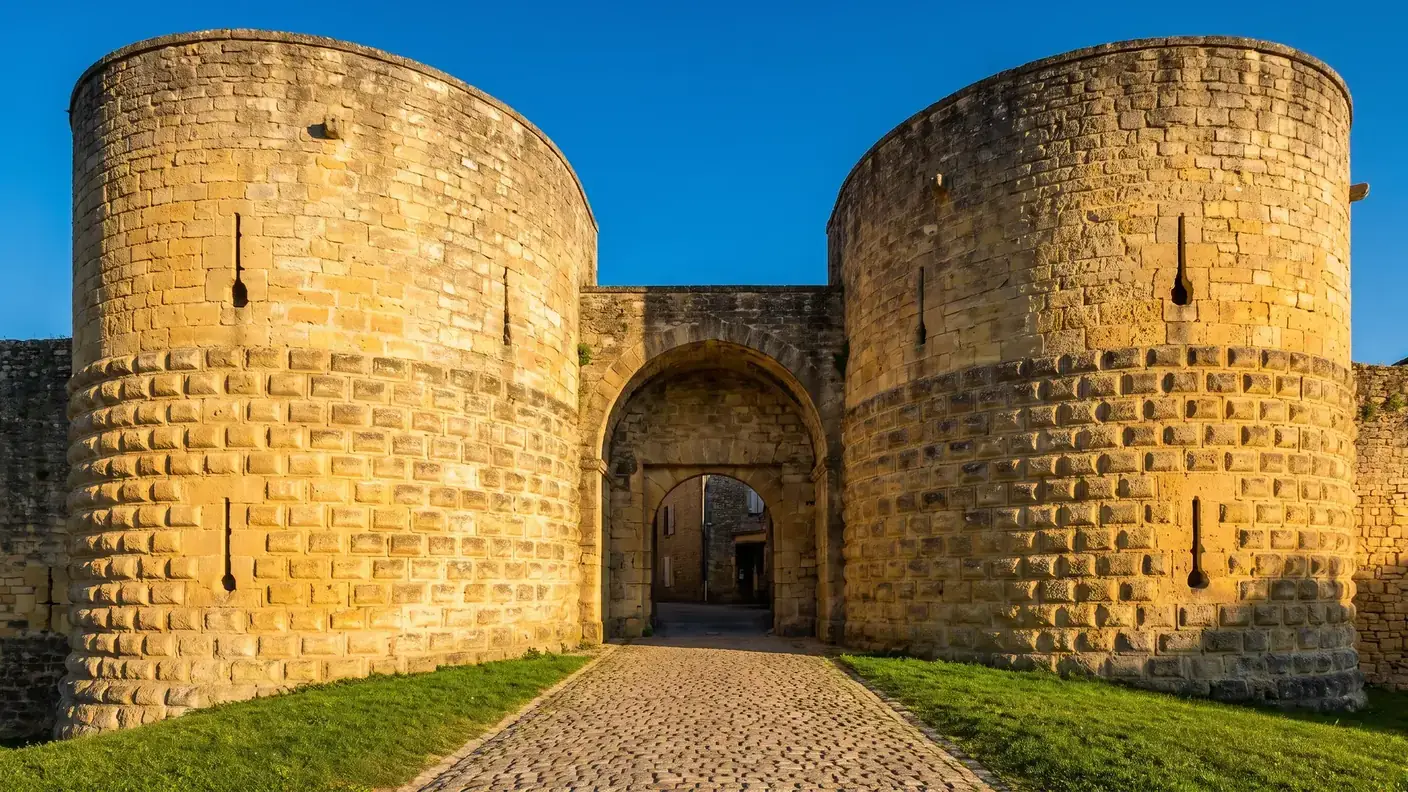
The tradition: 70 Templars at the Porte des Tours
According to tradition, 70 Knights Templar are said to have been locked up in the Gate of the Towers — the most imposing of the bastide’s three gates, with its two round, rusticated towers, its portcullis, its bretèche, and its machicolation. They are said to have engraved about a hundred graffiti : crucifixions, crosses, depictions of the Virgin Mary, figures—and, according to records from the 1970s, angry inscriptions directed against the pope, such as "Clemens V, Destroyer of the Templars" (Clement V, destroyer of the Temple).
A Templar attribution that is now disputed
Local tradition attributes these engravings to Knights Templar who were imprisoned in Domme. However, this interpretation remains disputed: the town hall’s historical publication on the founding of the bastide describes earlier writings on the subject as questionable. The engravings do exist, but their dates and creators have not been established with certainty.
| Date | The Templar Affair—and Its Legend in Domme |
|---|---|
| September 14, 1307 | Philip the Fair issues the sealed arrest warrants |
| October 13, 1307 | Mass Roundup of the Knights Templar in France |
| March 22, 1312 | The papal bull *Vox in excelso* suppresses the order (Council of Vienna) |
| 1314 | Jacques de Molay, the last Grand Master, dies at the stake |
| 1970 | Canon Tonnelier publishes his “Templar” records from Domme |
| 2007 | The Vatican Publishes the Chinon Parchment: The Knights Templar Rehabilitated |
| 2018 | The epigraphic study of Domme refutes the Templar interpretation |
Does that mean you should skip the tour? Not at all: the graffiti remains “an exceptional collection,” and the guided tour “The Mysterious Graffiti” (7 stops; tickets available at the tourist office) is specifically dedicated to this treasure hunt that blends legend and history. Few monuments offer such a vivid lesson on how myths are created.
1588: The Night Geoffroy de Vivans Climbed the Cliff
If there were only one story to remember about Domme, it would be this one. During the Wars of Religion, the Catholic bastide taunted the Huguenots from the top of its rocky outcrop. The Protestant captain Geoffroy de Vivans—born in 1543 at the Château de Castelnaud, directly across from it—failed to take it twice: on October 18, 1572, and then on February 4, 1573.
The Siege of October 25, 1588
Sixteen years later, he got his revenge. The October 25, 1588, two hours before dawn, Vivans and his men climbed the north face of the cliff — precisely the spot that its “supposedly impregnable verticality” had left unguarded. Once inside the sleeping town, they opened a gate to let the main force in. The bastide, reputed to be impregnable, had fallen without a siege, through the one spot that no one was looking at.
Henri of Navarre—the future Henri IV—tasked him with defending the city; Vivans installed the first Protestant pastor there, named Bopoil, and had the church demolished. The current church, Notre-Dame-de-l'Assomption, was rebuilt in the 17th century using stones from the demolished building.
Three years of a war of attrition—and a hefty bill
What followed was less glorious: an attack by the Catholic lords in August 1590 while Vivans was held up in Paris, the seat of the Marshal de Matignon with 4,000 men in June 1591… The January 10, 1592, Vivans handed Domme over to the Lord of Thémines, in exchange for 40,000 pounds. The occupation ruined him: he claimed 18,000 écus in defense costs that were never reimbursed—Henry IV granted him 4,000, on paper. Seven months later, on August 21, 1592, Vivans died from a musket shot he received during the siege of Villandraut, in Gironde.
Epilogue from the Périgord: No sooner had calm returned than the bastide had to face two more peasant revolts by the *croquants*, in 1594 and then in 1637—before gradually falling into a state of dormancy, which, paradoxically, has preserved it for us to this day.
Exploring the bastide: market hall, governor’s residence, gates, and ramparts
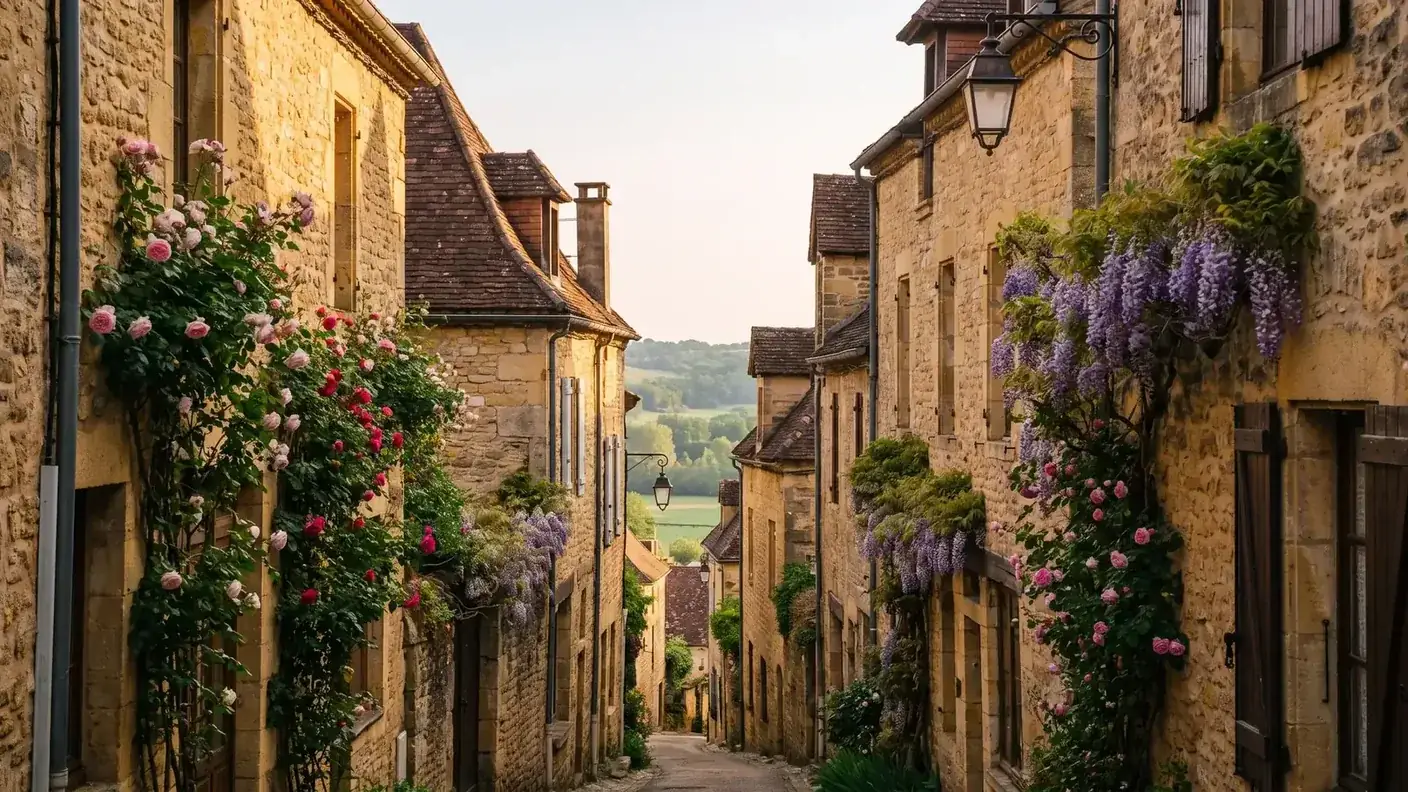
A tour of Domme can be covered within a rectangle spanning just a few hundred meters—but every pale stone facade has a story to tell. The Grand’Rue, which is pedestrian-only during the tourist season, winds its way up from the gates toward the Place de la Halle; the adjacent alleyways, lined with roses and wisteria, lead to the scenic viewpoints.
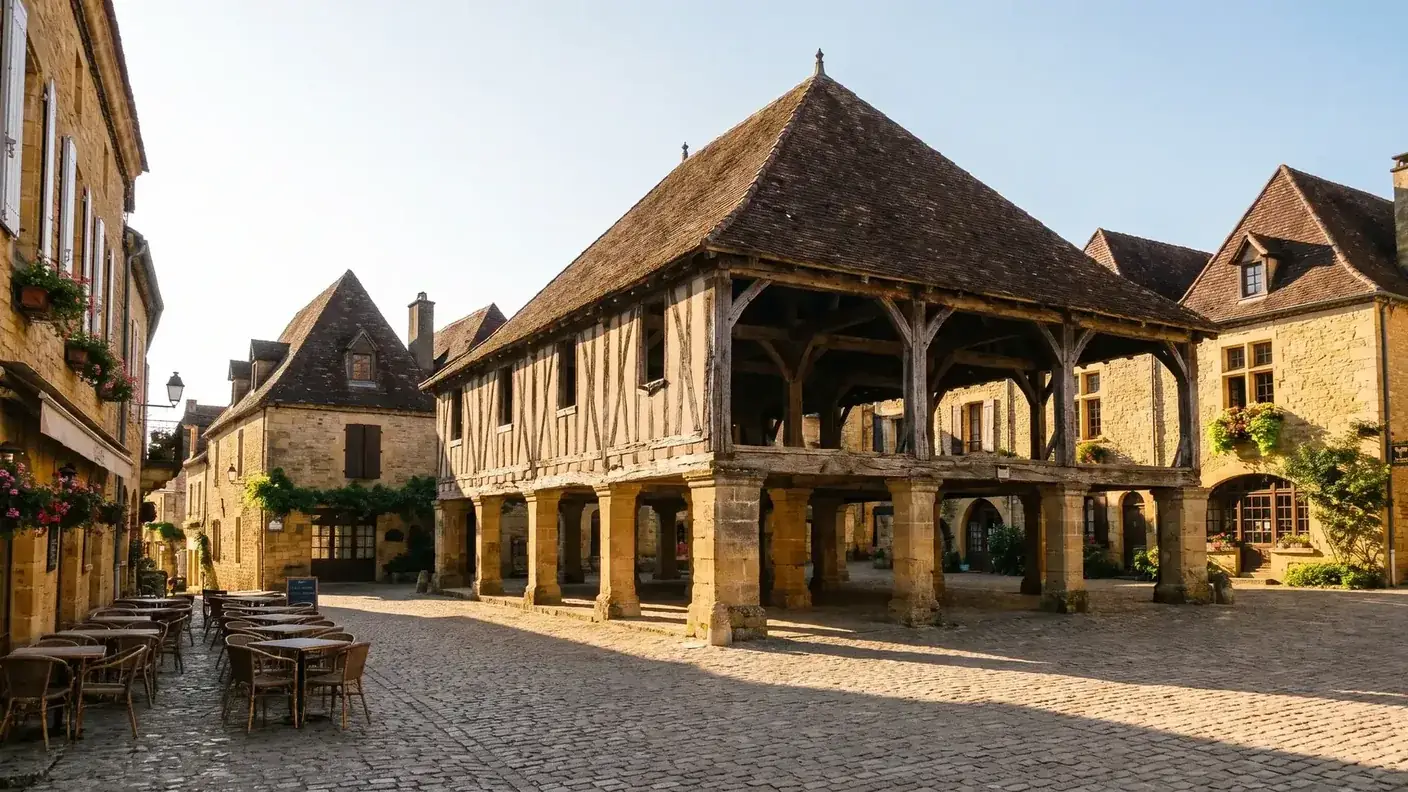
Place de la Halle, the beating heart of the city since 1281
The hall, built in the 17th century and remodeled in the 18th, has a roof structure supported by cut-stone pillars—it has been listed as a Historic Monument since 1942. Across from it, the Governor's Residence (officially the “Governor’s and Consuls’ Hotel,” listed as a historic monument in 1949) dates back in its core structure to the founding of the bastide; it was expanded in the 16th century with a French-style staircase, Renaissance fireplaces, and a watchtower: it now houses the tourist office. The Domme Museum, located on the same square, reopened its doors in August 2025 after renovation.
Place de la Rode and the Mint Master's House
The second market square mentioned in the charter, Place de la Rode—historically associated with executions—still features the mint master’s house with its trefoil windows: a stone reminder of the bastide’s monetary privilege.
Three gates, 1.2 km of ramparts
You can still walk through the enclosure via the Gate of the Towers, the Porte del Bos and the Porte de la Combe. Between Del Bos and La Combe, you walk along the southern ramparts. The Heritage Foundation Profile, updated in 2026, details local efforts and the funding provided for their preservation.
| Monument | Period | Protection |
|---|---|---|
| City Walls and Gates | Late 13th–early 14th century | Designated as Historic Monuments in 1943 |
| Halle | 17th–18th | Listed as MH 1942 |
| The Governor's and Consuls' Hotel | 13th–17th | Listed as a Historic Monument in 1949 |
| Le Touron House | — | Listed as a Historic Monument in 1946 |
| Le Castelet House | — | Listed as a Historic Monument in 1956 |
| Chapel of the Augustinian Convent | 14th | Listed as a Historic Monument in 1971 |
| Church of Our Lady of the Assumption | 17th century (rebuilt) | — |
Historical tidbit: The Augustinian monastery, founded in the early 14th century under the patronage of Philip the Fair, belonged after the Revolution to Count Colonna Walewski, a descendant of Napoleon I. And in 1968, Jean Gabin and Louis de Funès filmed *Le Tatoué* in the village—the church and the ramparts were part of the cast.
The Domme Cave: 450 meters of tunnels beneath the market hall
Beneath the market hall lies the entrance to the natural cave of Domme. The town hall indicates that the tour is about 450 meters long, located about 20 meters below the village, and that visitors can return to the surface via a panoramic elevator. The Dordogne Valley Tourist Office also describes the developed trail and its exit onto the cliff.
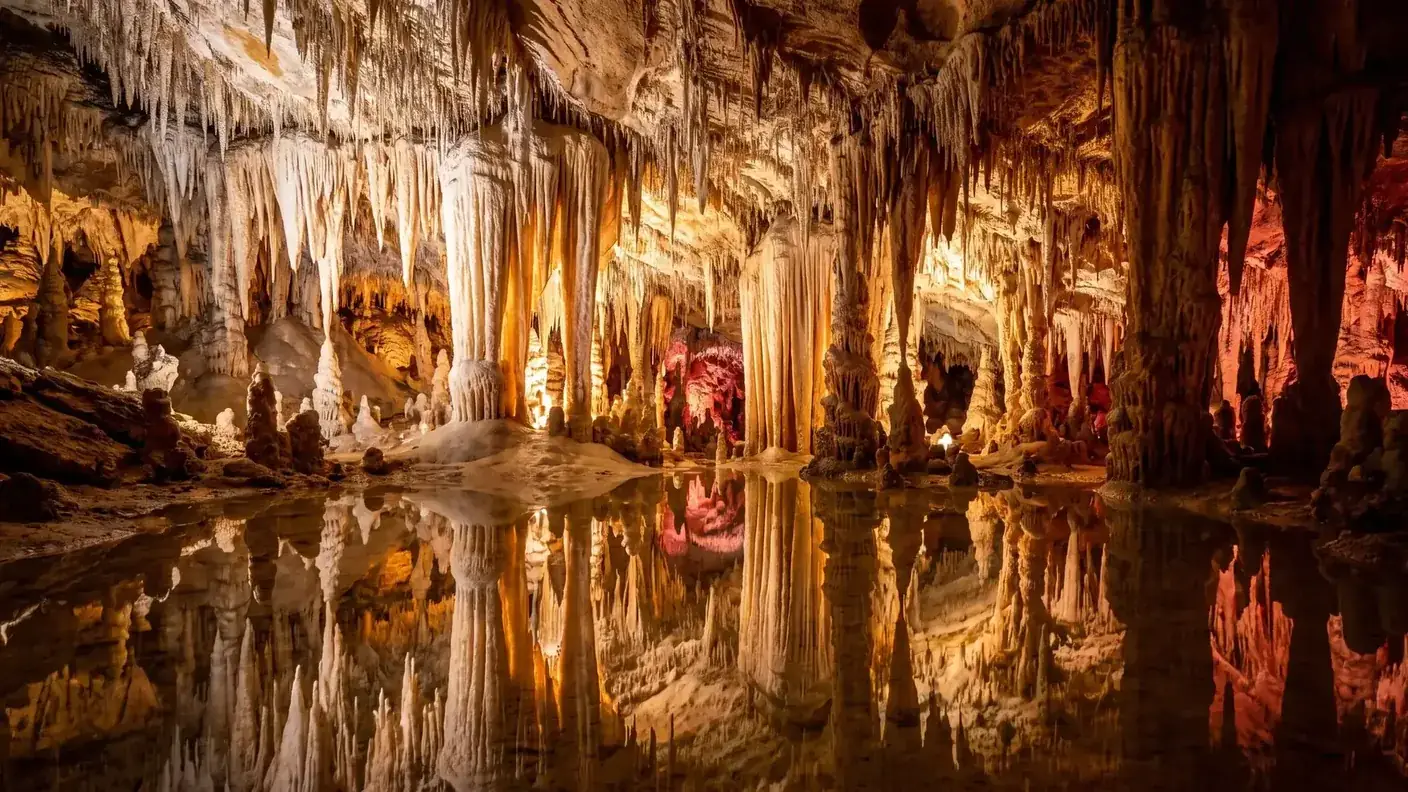
The route passes stalactites, stalagmites, columns, draperies, and reflective pools, enhanced since 2021 by eco-friendly lighting and, since 2022, by a light and music show at the end of the tour. The remains of bison and a prehistoric rhinoceros are also displayed there. And history is never far away: these galleries once served as a refuge for residents during the Hundred Years' War, and then during the Wars of Religion.
The finale is the village’s most spectacular surprise: a panoramic elevator takes you up to the heart of the cliff and drops you off with a view of the Dordogne Valley—150 meters of scenery all at once.
| Tour of the cave | Details |
|---|---|
| Access | Entrance under the market hall, Place de la Halle |
| Formula | Tour guided only, ~45 min, in French (worksheets in EN/NL/DE/ES) |
| Rates | €10 for adults · €9 for students · €8 for children |
| Opening | From the February break through December 31 |
| Temperature | A steady 13–15 °C — bring a light sweater |
| Good to Know | Groups limited to 54 people · No photography · Exit via the panoramic elevator |
The Barre Lookout: The Balcony Overlooking the Dordogne Valley
At the far end of Place de la Halle, the terrace of La Barre looks out over the void. This is THE panoramic view of the Périgord Noir: 150 meters below, the Dordogne winds its way through walnut groves, poplar trees, and fields—and the view takes in the valley from the Château de Montfort upstream all the way to La Roque-Gageac and Beynac downstream.
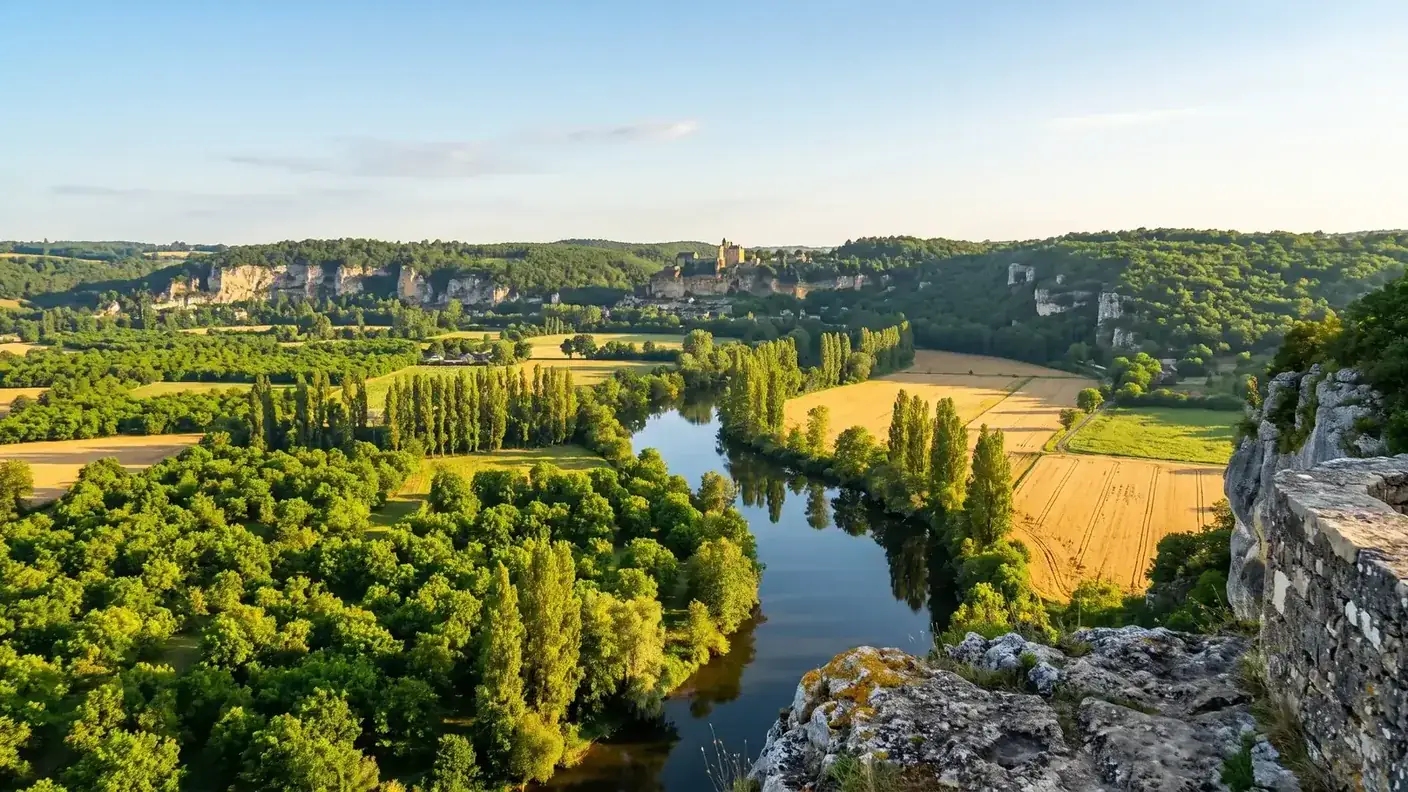
Continue along the Cliff Walk, which runs along the sheer cliff face to the Jubilee Public Park, wedged between the cliff and Moulin du Roy. Along the way, two landmarks: the bust of Jacques de Maleville, the local native who went on to become a co-author of the Civil Code, who watches over the esplanade; and, below, the cliffs of the Cingle de Montfort (a 45-hectare ZNIEFF) where the peregrine falcon nests.
The best time? Early in the morning, when the mist still hangs over the river—or at the end of the day, when the castles’ golden stone glows. It was also along this north face, reputed to be impassable, that Geoffroy de Vivans climbed in 1588: just imagine the sheer drop—and the feat.
Maleville, Augiéras, Tilho: Domme, a village full of character
Jacques de Maleville, the Domme Native Who Helped Draft the Civil Code
Born in Domme on June 19, 1741, the son of a merchant from the town, Jacques de Maleville drafted his town's list of grievances in 1789—and eleven years later, on August 14, 1800, Bonaparte appointed him to the commission of four jurists tasked with drafting the Civil Code, alongside Tronchet, Portalis, and Bigot de Préameneu. As secretary of the commission and an advocate for the written law of the Midi, he saw the Code promulgated on March 21, 1804 — more than half of the original articles were still in effect two centuries later.
What followed was a story straight out of a novel: he became a baron of the Empire (1808), then a count (1810); he voted to depose Napoleon and ended up as a marquis and Peer of France (1817) under Louis XVIII. He died in Domme in November 1824; there is a street named after him and a bronze bust of him on the Esplanade de la Barre. His descendant Lucien de Maleville, a painter known as the “champion of the Périgord,” won the gold medal at the 1937 Salon des Artistes Français with… *La Place de la Halle à Domme*.
François Augiéras, the hermit of the cliffs
In the late 1960s, the writer and painter François Augiéras (1925–1971), who was destitute, actually lived in the caves of the Domme cliffs, writing in school notebooks. He drew Domme, or An Attempt at Occupation, rejected during his lifetime, published in 1982—and has since become a cult classic. He has been buried in the Domme cemetery since December 1971; a Corten steel sculpture has paid tribute to him since 2001, and the painter Miquel Barceló organized an Augiéras exhibition in Spain in 2025.
Jean Tilho, the Explorer of Lake Chad
Born in Domme on May 1, 1875, the general Jean Tilho, a member of the Academy of Sciences, led the mission (1906–1908) that established the border between Niger and Nigeria—and drew up the First accurate map of Lake Chad.
The village’s history also includes: Aymeric de Peyrac (c. 1340–1406), abbot of Moissac and chronicler, born in Domme during the Hundred Years’ War; the writer Eugène Le Roy, author of *Jacquou le Croquant*, who served as a tax collector in Domme during his career in the Périgord; and a surprising libertarian presence—the Dutch anarcho-syndicalist theorist Christiaan Cornelissen died there in 1942, and the village museum was long named after the activist Paul Reclus.
Domme wine, walnuts, and truffles: the cuisine of the Domme region
The revived vineyard—which once stretched all the way to Bordeaux
Here’s a story that few visitors know: in the 19th century, the Domme region had 2,700 to 2,800 hectares of vineyards—the second-largest wine-growing area in the Dordogne after Bergerac. Its wines were transported down the river in gabarres to Libourne and Bordeaux, where they were used to “blend” with lighter wines. Phylloxera wiped out the entire region in the 1870s.
The modern revival began in the 1990s: an association founded in 1993 in Bouzic, a first 0.5-hectare plot planted by seven winemakers in 1994, a first harvest in 1996, and the Moncalou winery built in 1998 in Florimont-Gaumier. Today, Domme wine—which has held the Périgord IGP designation since 2011—covers 18 hectares (53% Merlot, 36% Cabernet Franc), half of which are farmed organically. Next to the winery, the Moncalou observation tower (23 m) overlooks the Céou vineyards: an unbeatable combination of wine tasting and scenic views.
Walnuts, truffles, strawberries, foie gras: the four seasons of the Périgord
Around the bastide, the region boasts a wealth of designations. The Périgord walnut (AOC 2002, AOP 2004—Corne, Franquette, Grandjean, Marbot) is right at home here: 17,000-year-old walnut shells have been found in prehistoric settlements in the Périgord, and walnut cake remains the region’s signature dessert. Black truffles are harvested from December through February—the certified market in Sarlat on Saturday mornings serves as the local trading hub; a 1.147 kg specimen was found in the Dordogne in 1999. The Périgord strawberry, Europe’s first strawberry protected by a PGI (2004), is in season from late April to late October. And the Périgord foie gras duck (PGI Sud-Ouest) must meet strict specifications: a minimum of 81 days of free-range rearing.
| Product | Label | Since | Good to Know |
|---|---|---|---|
| Domme Wine | IGP Périgord — Domme Wine | 2011 | 18 hectares, Moncalou winery, 50% organic |
| Périgord Walnuts | AOC / AOP | 2002 / 2004 | 4 varieties; oil from the Moulin de la Tour (Sainte-Nathalène) |
| Périgord Strawberry | IGP | 2004 | Europe's first IGP strawberry; in season from April to October |
| Black truffle | Tuber melanosporum | — | Truffle hunting: Dec.–Feb.; Sarlat farmers’ market on Saturdays |
| Périgord Foie Gras Duck | IGP Southwest | 2000 | Raised, fattened, and processed domestically |
| Rocamadour (cabécou) | AOC / AOP | 1995 / 1999 | Raw-milk goat cheese, produced nearby |
Where can you try all of this?
At the Domme market, every Thursday morning (8 a.m.–1 p.m.) at Place de la Halle—a direct continuation of the fairs established by the charter of 1283. On Tuesdays, the Cénac market is held at the foot of the cliff; in the summer, the night markets in neighboring villages (Bouzic, among others) turn into giant dinner tables. And for a hands-on lesson: the Moulin de la Tour in Sainte-Nathalène (~20 km) still presses walnut oil using a 16th-century millstone.
Around Domme: The Valley of the Castles
Domme is the perfect base camp: within a 10-kilometer radius, you’ll find three other “Most Beautiful Villages of France,” two major castles, a garden ranked among the most beautiful in the world—and the Dordogne River connecting it all, whether by canoe or gabarre.
La Roque-Gageac, nestled between cliffs and the river (4 km)
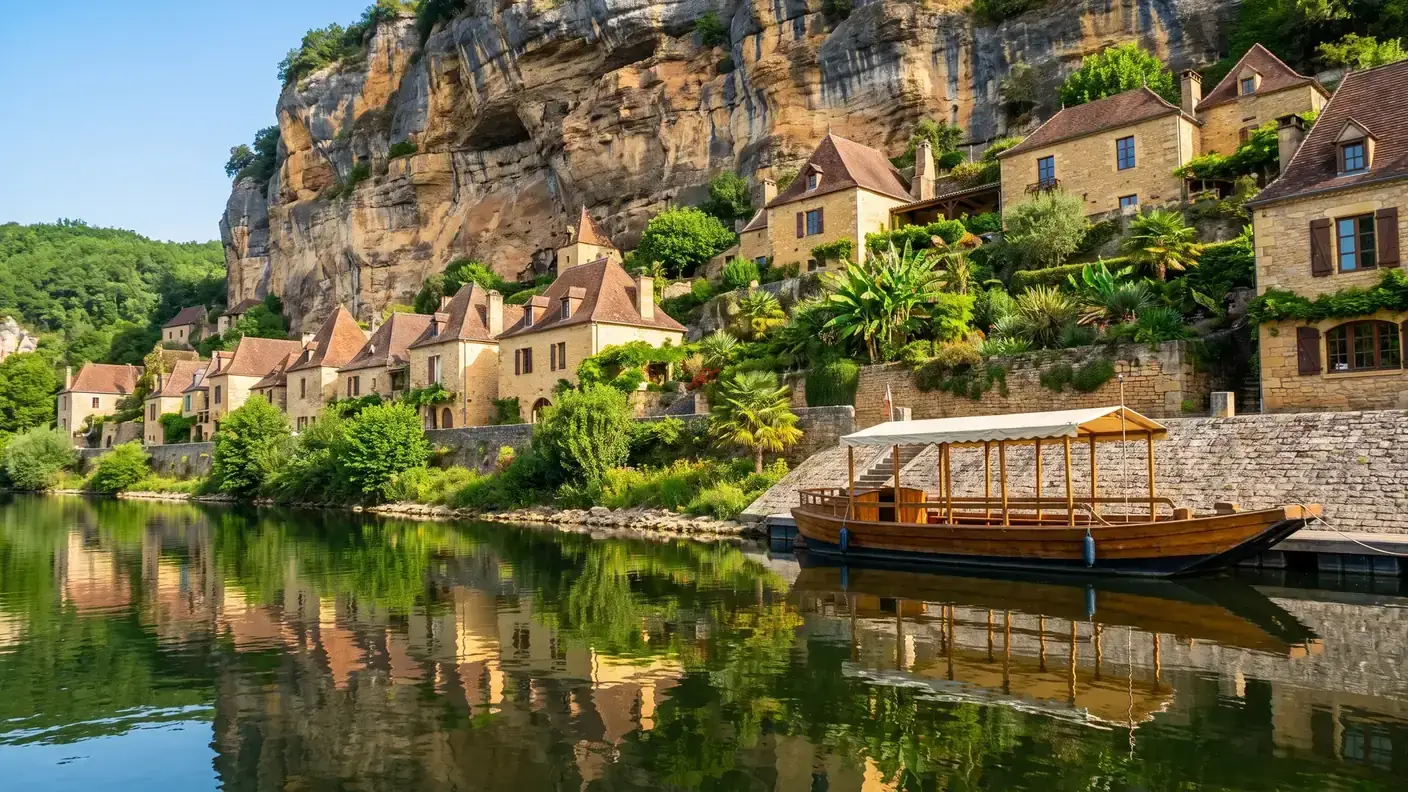
A ribbon village nestled between the sheer cliff and the Dordogne River, La Roque-Gageac (One of the Most Beautiful Villages in France) features rows of pale-colored houses beneath a 12th-century cave fortress — never captured during the Hundred Years' War, reopened in 2020 after ten years of renovations. Its microclimate fosters an astonishing exotic garden ; its pier preserves the memory of the port, which in the 18th century saw 200 gabarres per year.
Castelnaud and its War Museum (5 km)
Across from Beynac, its “eternal rival,” Castelnaud Castle—the ancestral stronghold of Geoffroy de Vivans—has housed the Museum of Medieval Warfare since 1985: 300 pieces of weaponry and life-size replicas of siege engines. With 245,000 visitors (2022), it is the second-most-visited site in the Dordogne, behind Lascaux. In 1442, the besieged English surrendered it in exchange for… 400 gold écus.
Beynac, the French fortress (7 km)
Beynac Castle, perched 150 meters above the river, served as a French stronghold during the Hundred Years' War—Richard the Lionheart once gifted it to his captain, Mercadier. Purchased at auction in 1962 and restored over the course of half a century, it’s a standout on screen: *Les Visiteurs 2*, Besson’s *Joan of Arc*, and Ridley Scott’s *The Last Duel* were all filmed there.
Marqueyssac, the Hanging Gardens (5 km)
On its rocky outcrop, 130 meters above the Dordogne River, Marqueyssac hand-cut 150,000 century-old boxwoods — In 2025, The New York Times ranked it among the The 25 Most Beautiful Gardens in the World. An unexpected bonus: a skeleton ofAllosaurus Almost complete, on display in the park.
Cénac, Montfort, Sarlat, Gourdon
At the foot of the cliff, Cénac is home to a 12th-century Romanesque church (a priory founded by Moissac), partially destroyed by… Vivans—him again. Further upstream, the Château de Montfort—first mentioned in 866, destroyed and rebuilt five times—oversees its river bend (it is not open to visitors). Sarlat, the capital of the Périgord Noir, is 10 km away: market, the Malraux Law, Jean Nouvel—see our dedicated guide. On the Lot side, Gourdon (15 km as the crow flies) leads to the prehistoric paintings in the Cougnac caves.
Exploring the Dordogne by canoe or gabarre
The river—whose watershed is designated as UNESCO Biosphere Reserve since 2012 — goes down into canoe From the starting points in Domme and Vitrac: a 9-km loop around the Cingle de Montfort, or a 16-km route through the “Valley of the Five Castles” to Beynac. Gabarres depart at La Roque-Gageac and Beynac for a 50-minute guided river tour. Atlantic salmon and Atlantic shad still swim upstream—a biotope protection order has safeguarded them since 1991.
| Field Trip | Distance | Why Go There |
|---|---|---|
| Cénac-et-Saint-Julien | 1 km (on foot) | 12th-century Romanesque church, Tuesday market, canoeing |
| La Roque-Gageac | ≈ 4 km | PBVF, a stronghold of troglodytes, an exotic garden, gabarres |
| Castelnaud-la-Chapelle | ≈ 5 km | PBVF, Museum of Medieval Warfare |
| Marqueyssac Gardens | ≈ 5 km | 150,000 boxwood trees, lookout point 130 m away |
| Montfort Castle | ≈ 5 km | The Cingle and its silhouette (not open to the public) |
| Beynac-et-Cazenac | ≈ 7 km | PBVF, a French fortress from the Hundred Years' War |
| Sarlat-la-Canéda | ≈ 10 km | Capital of the Périgord Noir — see our guide |
| Gourdon & the Cougnac Caves | ≈ 15–20 km | La Bouriane du Lot, Gravettian Paintings |
When to Visit Domme
- Thursday morning, all year round: the market under the covered market—the village at its most authentic;
- Late April through October: Périgord strawberry season and gourmet markets;
- September: Domme Wine Harvest and Canoe Marathon on the Dordogne;
- December–February: truffles — the regulated market in Sarlat on Saturday mornings;
- Cave: Open from the February school break through December 31.
| Season | Atmosphere | Strengths | Good to Know |
|---|---|---|---|
| Spring (April–June) | Floral, sweet | A peaceful bastide, strawberries, and canoeing starting in May | Our Favorite Season |
| Summer (July–August) | Very lively | Nearby night markets, the river, long evenings | The village gets crowded during the day—come early |
| Fall (Sept.–Nov.) | Golden | Grape harvest, fresh walnuts, porcini mushrooms, stunning light | Perfect photo spot at the lookout |
| Winter (Dec.–March) | Secret | Truffles in Sarlat; the bastide almost to yourself | Cave closed in January and early February |
Insider tip: Aim for Thursday morning (outside of summer)—visit the market, the cave right when it opens, enjoy a Périgord-style lunch, and explore the lookout point and the Porte des Tours in the afternoon. You’ll experience Domme at the pace that best captures its essence.
How to Get to Domme from Bordeaux
Domme is about 211 km from Bordeaux—allow about 2 hours and 50 minutes, as the A89 only takes you to the edge of the Périgord Noir; the last third of the journey is along the valley roads, which are also the most scenic.
| Transport mode | Travel time from Bordeaux to Domme | Estimated cost | Good to Know |
|---|---|---|---|
| Personal car | ≈ 2 hours 50 minutes (211 km) | Gas + tolls ≈ 45–55 € | A89 via Périgueux, then D704 toward Sarlat and D46 |
| Private chauffeur service (door-to-door) | ≈ 2 hours 50 minutes | Starting at €355 · one-way | Optional stops (Périgueux, Sarlat, La Roque-Gageac…) |
| Train + Road | ≈ 2 hours and 30 minutes by TER + 12 km | ≈ 25–35 € + taxi/private chauffeur service | TER from Bordeaux to Sarlat (~6 per day), then 12 km with no reliable bus service |
| Coach / plane | — | — | There is no direct connection between Bordeaux and Domme |
By car: Directions
Main route: A89 to Périgueux, then D6089/D704 toward Sarlat and D46 to Domme via Cénac. Scenic alternative: Leave the valley at Beynac and head up the left bank—La Roque-Gageac, then the climb to the bastide, one of the most beautiful approaches to the Périgord.
By train
The Bordeaux–Sarlat TER serves Sarlat via Libourne and Bergerac. Since the frequency of service varies depending on the date and roadwork, please check the latest TER Nouvelle-Aquitaine timetable. From the Sarlat train station, it is about 12 km to Domme: plan to take a taxi or hire a driver.
As a private driver
Door-to-door service really comes into its own on a tour: stop in Périgueux or Saint-Émilion on the way there, return via La Roque-Gageac and Beynac, or a combination of Domme, Sarlat, and Lascaux for a full day. With a private chauffeur, these detours can be decided along the way—a fixed rate guaranteed in writing, starting at 355 € one way for 1 to 3 passengers.
Practical Information
How long will you be there?
Half a day to explore the bastide, the cave, and the lookout point. A full day if you add the Porte des Tours (guided tour), the little train, and a traditional Périgord lunch. Two or three days as a base: La Roque-Gageac, Castelnaud, Beynac, Marqueyssac, Sarlat—everything is less than 20 minutes away.
Parking and Access: What You Need to Know Before You Arrive
You have to earn your way into the bastide: light vehicles are allowed at a speed limit of 30 km/h through the Porte del Bos and Porte des Tours gates; the Grand'Rue is pedestrian-only during the season; and buses and RVs are prohibited within the city walls (Pradal parking area). Parking is subject to a fee from 9 a.m. to 7 p.m.:
| Parking | Rates (9 a.m.–7 p.m.) | Good to Know |
|---|---|---|
| Inside the bastide (Rode, Rue du Repos) | 3 hours = 4 € · 5 hours = 5 € · 8 hours = 7 € · 10 hours = 25 € | The price discourages people from staying the whole day |
| Outdoor Areas (St. James, Le Pradal) | 4 hours = 4 € · 6 hours = 5 € · 8 hours = 6 € | A 10-minute walk—the perfect day trip |
| Electrical Terminals | 2 bus stops near the Esplanade | — |
Tours and Tickets
The main ticket office is located at Tourism Office, 9 Place de la Halle (05 53 31 71 00) : cave (€10, guided tour, 45 min), tour "The Mysterious Graffiti" at the Porte des Tours, and little white train (20-minute guided tour, €6, audio guide available in 6 languages, from Easter to All Saints' Day) — combined tickets are available.
Estimated Budget
| Profile | Daily Budget | Accommodations | Catering |
|---|---|---|---|
| Small budget | 50-80 € | Campgrounds in the valley, budget hotels in Cénac/Sarlat | Market + Picnic at the Lookout |
| New Couple | 110-160 € | Hotel or bed-and-breakfast in the bastide | Perigord cuisine, Domme wine |
| Comfort/Fine Dining | 170-250 € | Historic Homes (Domme, Sarlat, the valley) | Gastronomy, in-season truffles |
Accessibility: cobblestone and sloped alleys—the lookout point and Place de la Halle remain accessible by car for people with limited mobility; the cave, however, is not. Families: the cave + the little train + the siege engines at Castelnaud = a winning combination.
Frequently Asked Questions
When and by whom was the bastide of Domme founded?
Domme was founded in 1281 by King Philip III the Bold of France to secure the border against English-held Guyenne. The deed is dated to the exact day: the treaty was concluded in Cahors on Friday, March 7, 1281, by Simon de Melun, the king’s seneschal—the parchment is preserved in the National Archives. The charter of 1283 established six consuls, trade fairs, and even the privilege of minting coins.
Were any Knights Templar actually imprisoned in Domme?
Local tradition attributes these engravings to Knights Templar who were imprisoned in Domme. However, this interpretation remains disputed: the town hall’s historical publication on the founding of the bastide describes earlier writings on the subject as questionable. The engravings do exist, but their dates and creators have not been established with certainty.
Can we see the graffiti on the door of Les Tours?
Yes, only as part of a guided tour: “The Mysterious Graffiti” showcases the seven engravings in the chambers of the Porte des Tours—crucifixions, crosses, and figures. Tickets are available at the Tourist Information Center, 9 Place de la Halle (05 53 31 71 00), including combined cave and Porte des Tours tickets. The gate itself, restored in 2016, can be viewed freely from the outside.
How can I visit the Domme Cave?
The entrance is located beneath the market hall, right in the center of the bastide. Tours are guided only: 45 minutes to explore 450 meters of galleries (featuring stalactites, water mirrors, and bison and rhinoceros bones), at a constant temperature of 13–15 °C. Prices: €10 for adults, €9 for students, €8 for children; open from the February school break through December 31. Visitors exit via a panoramic elevator in the heart of the cliff.
On what day is the Domme market held?
Thursday mornings at Place de la Halle, from 8 a.m. to 1 p.m. (food stalls 8:30 a.m.–12:30 p.m.), year-round. This market is a direct continuation of the fairs authorized by the royal charter of 1283. On Tuesdays, the Cénac market is held at the foot of the cliff; in the summer, night markets bring the neighboring villages, such as Bouzic, to life.
Who conquered Domme by climbing the cliff?
The Huguenot captain Geoffroy de Vivans, on October 25, 1588, during the Eighth War of Religion. After two failed attempts in 1572 and 1573, he scaled the north wall at night—which was considered so inaccessible that it was unguarded—and opened a gate for his troops. He held the city for three years before surrendering it on January 10, 1592, in exchange for 40,000 livres. The church, destroyed by his men, was rebuilt in the 17th century.
Who is Jacques de Maleville?
Domme’s most illustrious son: born in the bastide on June 19, 1741, he was one of the four drafters of the Civil Code of 1804 (along with Tronchet, Portalis, and Bigot de Préameneu), for which he served as secretary. First a baron, then a count of the Empire, and finally a marquis and peer of France, he died in Domme in 1824. His bronze bust overlooks the valley from the Esplanade de la Barre.
How much time should I plan for a visit to Domme?
Half a day is enough to see the bastide, the cave, and the Barre lookout point. Allow a full day if you include the guided tour of the graffiti, the little train ride, and lunch. If you’re using this as a base, two to three days will allow you to also visit La Roque-Gageac (4 km), Castelnaud (5 km), Beynac (7 km), Marqueyssac, and Sarlat (10 km).
How do I get from Bordeaux to Domme?
By car: ~211 km, about 2 hours and 50 minutes — Take the A89 to Périgueux, then the D704 toward Sarlat and the D46 to the bastide. By train: TER Bordeaux-Sarlat; check the official TER schedule for times, then about 12 km by taxi or private chauffeur. By private door-to-door driver: starting at €355 one way (1–3 passengers), with stops as desired in Périgueux, Sarlat, or La Roque-Gageac.
Where can I park in Domme?
Paid parking from 9 a.m. to 7 p.m. In the bastide (Place de la Rode, Rue du Repos): 3 hours = €4, 8 hours = €7, but 10 hours = €25—a deterrent for all-day parking. The St. James and Le Pradal parking lots outside the town walls are more affordable (8 hours = €6) and are a ten-minute walk away. Buses and RVs are prohibited within the town walls (Le Pradal parking area), and the Grand’Rue is pedestrian-only during the tourist season.
What is Domme wine?
A revived vineyard: 2,700 to 2,800 hectares in the 19th century—the second-largest in the Dordogne, with wine shipped to Bordeaux by gabarre— wiped out by phylloxera, then replanted starting in 1994 (just 0.5 ha to begin with!). Today: 18 hectares under the Périgord IGP designation—Vin de Domme, predominantly Merlot, vinified at the Moncalou winery (Florimont-Gaumier), beneath the 23-meter-tall observation tower overlooking the vineyards.
What's there to see around Domme?
The best of the Dordogne Valley within a 10-km radius: La Roque-Gageac and its cave fortress (4 km), Castelnaud Castle and its Museum of Medieval Warfare (5 km, 245,000 visitors), Beynac, the French fortress (7 km), the 150,000 boxwood trees of Marqueyssac (5 km), and Sarlat (10 km). Not to mention canoeing and gabarre boat rides on the river, designated a UNESCO Biosphere Reserve.
Domme with kids: a good idea?
Highlights: the cave and its panoramic elevator (45 min, the perfect length), the little white train (20 min, audio guide in 6 languages, €4 for ages 4–12), the life-size siege engines at Castelnaud, 5 km away, and canoeing on the Dordogne starting in the spring (a 9-km family-friendly route around the Montfort bend). Just be sure to wear sturdy shoes: the bastide is on a hill.
Further Reading
- The capital of the Périgord Noir, 10 km away : see the Guide to Sarlat (market, old town, Malraux Act)
- Prehistory Just 45 Minutes Away: See the Lascaux Guide and the Vézère Valley
- Continue on to Corrèze: see the Brive-la-Gaillarde Guide (Collonges-la-Rouge, Turenne)
- Wine-tasting stop along the route: see the Saint-Émilion Guide
- Plan your trip: Book a private driver from Bordeaux to Domme or explore all our destinations
Sources and References
- Domme Town Hall — History of the Bastide — Founded in 1281, Map, and Fortified Gates
- Domme Town Hall — Heritage and Tourism — Cave, Panorama, and Graffiti
- Sarlat Tourism — The Treasures of the Bastide of Domme — Tours, Cave, Panoramic View
- The Most Beautiful Villages of France — The Designation and Its Criteria
- Dordogne-Périgord Tourism — Domme Market, Events Calendar
- Fondation du Patrimoine — Domme City Walls — 2022–2024 Restoration Project
- Winemakers of the Céou Hills — Domme Wine — The Revived Vineyard, Moncalou Winery
- Castelnaud Castle — Museum of Medieval Warfare
- Marqueyssac Gardens — The Hanging Gardens
- INSEE — Demographic Data
Article updated on .
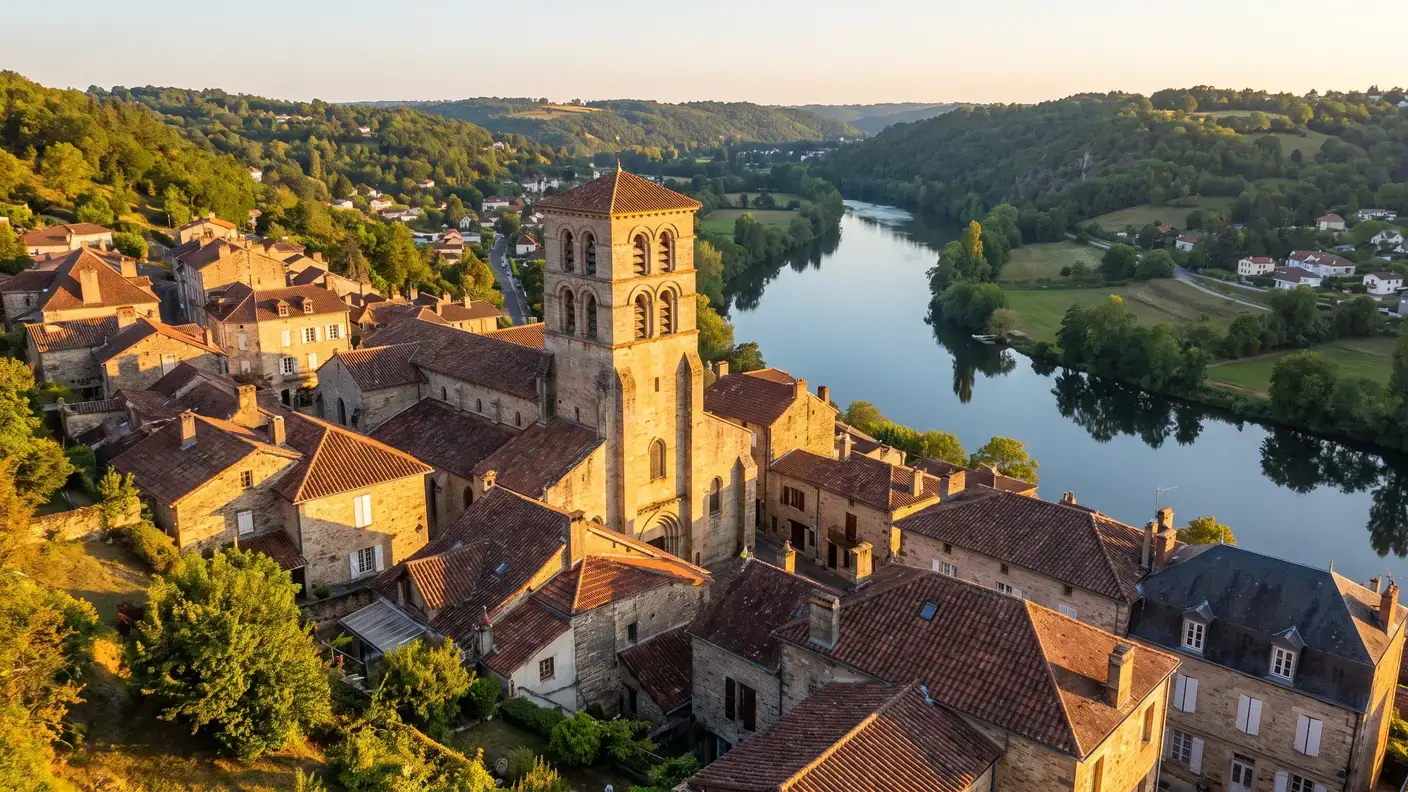
On the way to the bastide
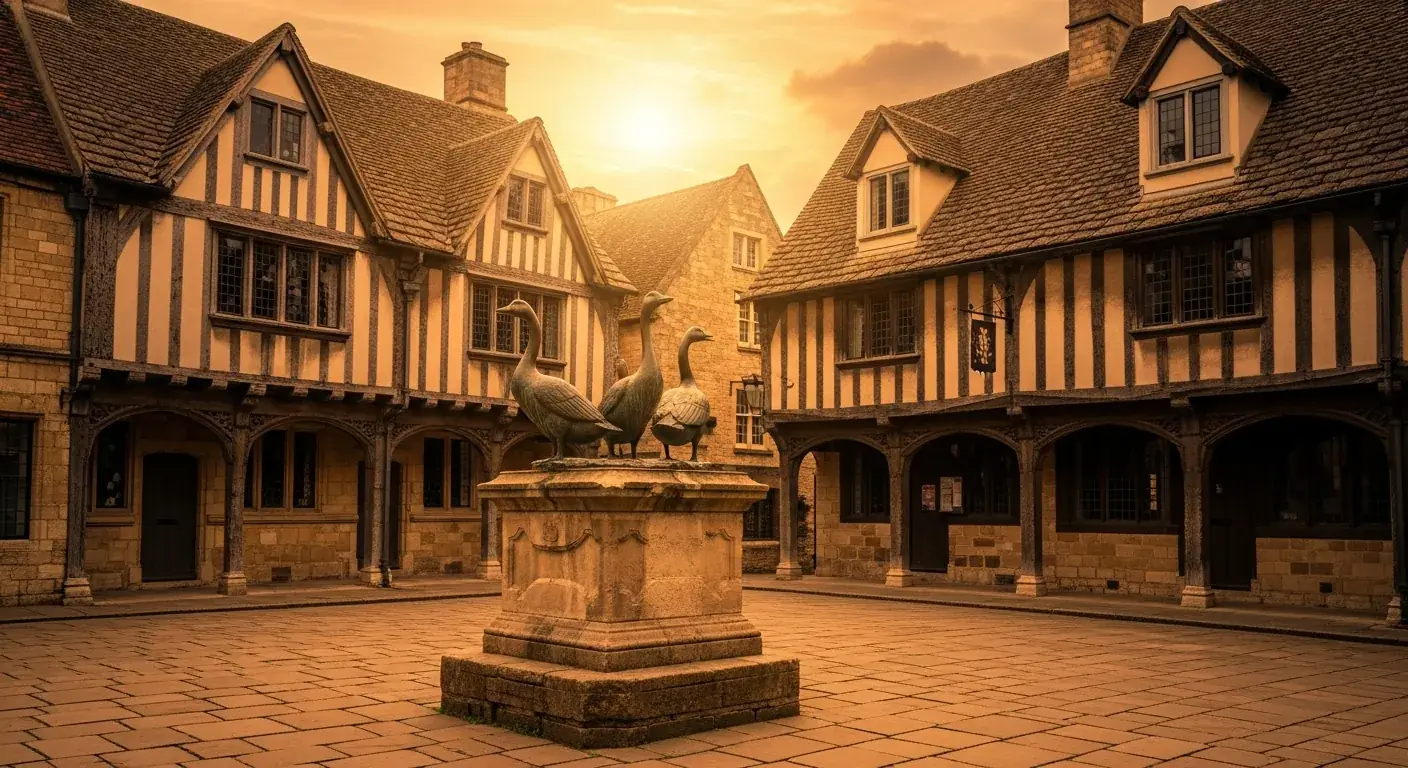
Direct trip from Bordeaux (~2 hours 50 minutes), with stops along the way as desired—Périgueux, Sarlat, La Roque-Gageac. Written fixed-price quote within 30 minutes; sedan or van; English-speaking driver.