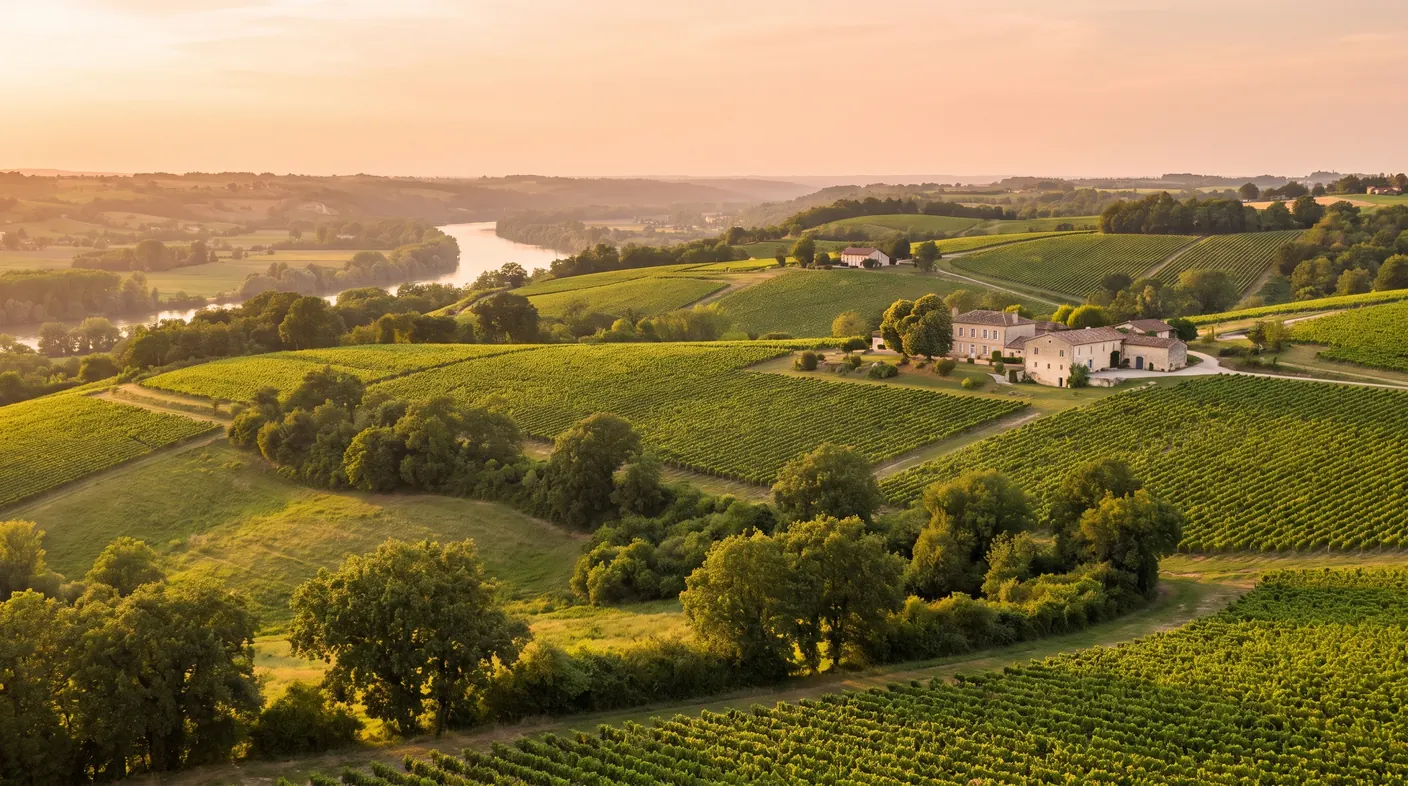
Villenave-de-Rions from Bordeaux: vineyards on the Garonne hillsides
A tiny village nestled among limestone hills on the right bank of the Garonne, in the Cadillac Côtes de Bordeaux region. A church with a Romanesque apse, an organic château, the fortified town of Rions just five minutes away, and the Gironde’s last remaining alluvial wetland nearby—about fifty minutes from Bordeaux.
Villenave-de-Rions at a Glance
Villenave-de-Rions is a small wine-growing town with a population of 374, nestled on the limestone hillsides along the right bank of the Garonne River, about 30 kilometers southeast of Bordeaux. Don’t confuse it with Villenave-d’Ornon, the large suburb of Bordeaux: these are two distinct towns, with neighboring INSEE codes but very different fates. Here, everything fits within 2.56 km² of vineyards and woods: a church, Saint-Martin, whose Romanesque apse has stood for eight centuries; a neo-Gothic château that has become an organic estate; and, all around, a rare tapestry of wine appellations dominated by Cadillac Côtes de Bordeaux—and not, contrary to popular belief, by the Entre-deux-Mers AOC, from which the town is excluded. Just five minutes away, Rions unfolds its listed medieval ramparts; nearby, Île de Raymond is home to a sensitive natural area in the Garonne Valley. This guide distinguishes verified facts from common misconceptions: INSEE statistics, sourced facts, and common misunderstandings corrected.
| Landmark | Details |
|---|---|
| Location | Gironde (33), Nouvelle-Aquitaine · right bank of the Garonne |
| Status | Wine-growing village · Langon district · Entre-Deux-Mers canton · Créonnais Community of Communes |
| Population | 374 residents (INSEE 2023), the residents of Villenave |
| Must-Sees | St. Martin's Church, the vineyards, and Rions—all just five minutes away |
| From Bordeaux | ~31 km · ~50 min · starting at 76 € |
This guide follows a simple thread: first, pinpointing the exact location of Villenave-de-Rions and clearing up the most persistent confusion—the one that equates it with Villenave-d'Ornon; then to count its residents, trace the origin of its name, and explore its unique architectural heritage: the Church of Saint-Martin and Fauchey Castle. Next comes the heart of the matter for a hillside village: its vineyards and appellations, which are often misnamed. We then venture into nature—the Île de Raymond, a sensitive natural area in the Garonne Valley—and toward Rions, the neighboring fortified town, before compiling a practical list of things to do there, exploring the surrounding area, and finally explaining how to get there from Bordeaux. At every step, facts are attributed to a source and common misconceptions are highlighted, as this small region has an astonishing number of them.
Where is Villenave-de-Rions located?
Villenave-de-Rions is a commune in the Gironde department (33) in the Nouvelle-Aquitaine region. It has the INSEE code 33549 and the ZIP code 33550, and covers just 2.56 square kilometers—making it one of the smallest communes in the area. Administratively, it falls under the Langon arrondissement, the Entre-Deux-Mers canton, and the Créonnais community of municipalities. Beware of a common pitfall: many databases still list it as part of the “canton of Cadillac,” an administrative division that was abolished during the 2015 redistricting. Cadillac is now merely a nearby landmark, less than ten kilometers away. The village stretches across the limestone hillsides on the right bank of the Garonne, within the geographical region of Entre-Deux-Mers—a vast plateau situated between the Garonne and the Dordogne.
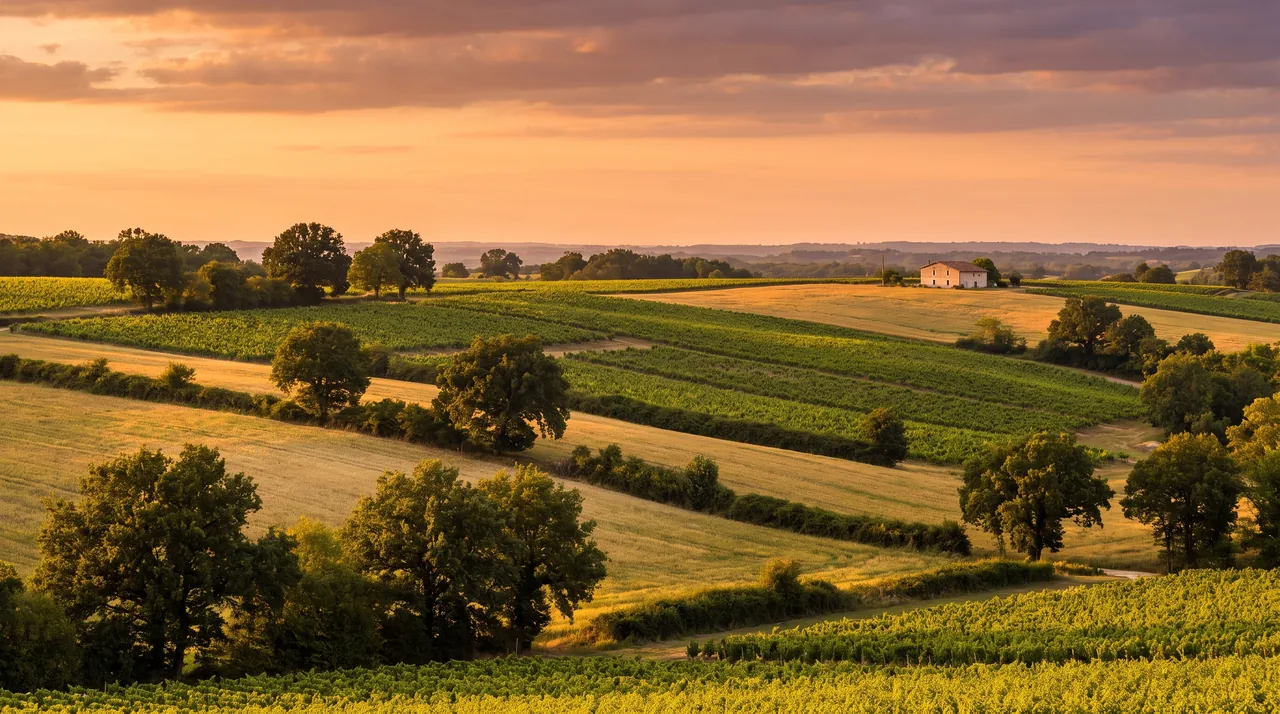
The landscape can be summed up in a few features: rolling limestone hills, a very scattered settlement pattern, vineyards covering more than half the territory, and woods crowning the high ground. There is no densely populated town in Villenave-de-Rions, but rather a scattering of farms, estates, and hamlets connected by small roads. The town is bordered by Capian to the north, Cardan to the southeast, Rions to the south, and Paillet to the west; only one departmental road, the D237, actually passes through the village. Here, we are on the ridge overlooking the Garonne Valley, facing the Graves region on the left bank—a location that explains both the quality of the wine-growing terroir and the absence of any urban development.
Villenave-de-Rions or Villenave-d'Ornon?
This is the number one source of confusion, and it’s almost inevitable. Villenave-de-Rions (INSEE 33549) and Villenave-d'Ornon (INSEE 33550) have consecutive codes, share the same demonym—the Villenavais—and each has a Saint-Martin Church. Yet everything sets them apart. Villenave-d’Ornon is a large municipality in the southern suburbs of Bordeaux, part of Bordeaux Métropole, with a population of about 35.000 spread over more than 21 square kilometers. Villenave-de-Rions, on the other hand, is a rural village of 374 residents, about thirty kilometers away, in the Langon district. Search engines, as well as certain automated tools, regularly confuse the two: the rule is simple—always write the full name and check the INSEE code if in doubt.
How far is it from Bordeaux?
From downtown Bordeaux, it’s about 31 kilometers and roughly a 50-minute drive. The route follows the right bank of the Garonne and its winding hillside roads, which are more twisting and take longer than the motorway: a more direct route via the A62 and the Podensac interchange reduces the distance to about 30 kilometers and the travel time to 42 minutes, but requires crossing the river. Exit No. 2 “Podensac” on the A62 is about ten kilometers away on the left bank, as are the Podensac and Cérons TER train stations, eight or nine kilometers away, on the Bordeaux–Sète line. This short distance makes Villenave-de-Rions an easy getaway, perfect to combine with visits to Rions, Cadillac, and the neighboring sweet wine regions.
| From Villenave-de-Rions | Approx. distance | Note |
|---|---|---|
| Rions | ~5 km · 7 min | Fortified town designated as a historic monument |
| Cadillac | ~9 km · 12 min | Bastide and Ducal Castle |
| Loupiac | ~11 km · 14 min | Sweet Wines from the Right Bank |
| Bordeaux | ~31 km · ~50 min | Right Bank, hillside roads |
How many people live in Villenave-de-Rions?
Villenave-de-Rions had 374 residents according to the 2023 census, a figure that became the official population as of January 1, 2026 (INSEE, official population data accessed on July 24, 2026). That’s not many—but it’s significantly more than what is often reported. The town hall’s website still lists “approximately 330 residents,” a rounding based on older data (332 in 2018, 348 in 2019), and many sources continue to repeat these outdated figures. The correct figure is that from INSEE: 374 residents. Spread over an area of 2.56 square kilometers, this population results in a density of about 146 residents per square kilometer—respectable for such a rural town, but one that actually reflects a very scattered settlement pattern among the vineyards.
The demographic history of Villenave-de-Rions reflects, in miniature, that of many villages in the Gironde: a decline, followed by a rebound. The town’s population fell to 216 in 1975—its lowest point of the century—before rising steadily: 261 in 1982, 286 in 1990, 331 in 2012—to reach 374 in 2023, representing an increase of more than 70% over half a century. Population density, meanwhile, has nearly doubled, rising from 84 to 146 residents per square kilometer. Most of this growth occurred between 2007 and 2012, a period during which the town gained about 60 residents all at once. Villenave-de-Rions is now part of the outer ring of the Bordeaux metropolitan area: people come here to enjoy the tranquility of the hillsides while working in the metropolitan area.
Who are the people of Villenave?
The residents of Villenave-de-Rions are known as Villenavais and Villenavaises. The demonym is derived from “Villenave” (the new town), not from “Rions”: so one does not say “les Rionnais,” which refers to the residents of the neighboring village. This point is all the more confusing because the same demonym, “Villenavais,” also applies to the residents of Villenave-d’Ornon. As is the case throughout this hilly region, some of the Villenavais live according to the rhythm of the vineyards—estate owners, vineyard workers, and seasonal harvest workers—while others, who have moved here more recently, were drawn to the town for its rural setting within easy reach of Bordeaux. The village thus combines agricultural tradition with suburban development.
| Data | Value |
|---|---|
| Municipal Population | Population: 374 (INSEE 2023) |
| Area | 2.56 km² |
| Density | ~146 people/km² |
| Demonym | Men from Villenavais, Women from Villenavais |
| ZIP Code | 33550 |
| INSEE Code | 33549 |
Where does the name Villenave-de-Rions come from?
The name Villenave-de-Rions is read in two parts. “Villenave” is the French adaptation of villa nova, meaning “new town”—a place name of medieval origin found throughout the Southwest, often used to refer to a settlement founded or reestablished during the Middle Ages. In Gascon, the town is actually called Vilanava de Rions, where the same root is easily recognizable. This part of the name is firmly established: Villenave is indeed the “new town,” which has stood on its vineyard-covered hillside for centuries.
The origin of the name “de Rions” is more complicated. The most widely accepted interpretation sees it as evidence of a former dependence on the seigneury of Rions, the neighboring town to the south, which is said to have given its name to this satellite village. The explanation is plausible and consistent with the geography—Rions was a stronghold, a center of medieval power—but it remains more of a hypothesis than a proven fact: no leading scholarly reference definitively settles the matter. Caution is therefore warranted: we present this connection in the conditional tense, distinguishing between what is certain (the “new town”) and what is not (the precise connection to the lord of Rions).
Is there a connection to the Rions seigneury?
Probably, but not with absolute certainty. Villenave-de-Rions came into existence as a municipality during the French Revolution, when the former parish of Saint-Martin was elevated to municipal status. Before that, the village was part of the Rions area, whose ramparts and church still bear witness to its former importance. The suffix “de Rions” would reflect this historical subordination, much like so many French municipalities whose names include a seigneurial or geographical determiner. However, in the absence of explicit primary sources, it is best to adhere to the caution exercised by toponymists: while the hypothesis is appealing and plausible, it does not constitute proof. What is certain is the close, long-standing, and enduring relationship between the two villages.
Saint-Martin Church and Fauchey Castle
Villenave-de-Rions has no protected historic monuments—a fact that should be clearly stated, given how widespread the confusion is. Its built heritage consists of two buildings, both of which are of interest but are not listed: the Saint-Martin parish church, in the heart of the former parish, and Fauchey Castle, perched at the highest point of the municipality. Neither appears on the list of buildings protected as historic monuments: an official search using the INSEE code 33549 simply returns no results. The listed monuments in the area, as we shall see, are located in neighboring towns—starting with Rions.
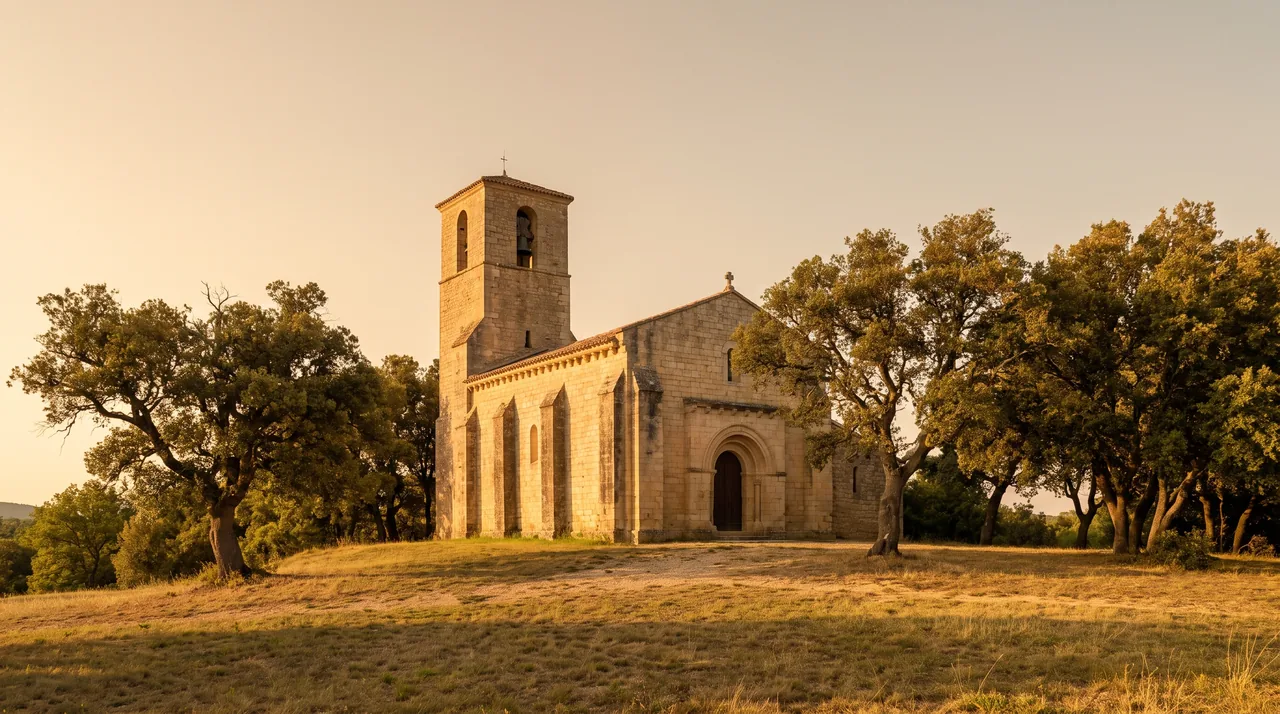
Saint-Martin Church is the oldest structure in the village. Its origins date back to the 12th century, during the height of the Romanesque period, but the building we see today is a blend of different eras. Destroyed during the Revolution, it was extensively rebuilt and renovated in the second half of the 19th century; the spire of the bell tower, in particular, is an addition from this period and therefore has no medieval features. This is a textbook example of rural heritage in the Gironde: a precious ancient core, enveloped by later additions, which one must be able to distinguish so as not to mistake the 19th century for the 12th.
A Romanesque apse
The true treasure of Saint-Martin is its apse. Only this part—the cul-de-four, or quarter-sphere vault characteristic of Romanesque art—actually survives from the 12th century; the choir, on the other hand, dates from the 14th century (Villenave-de-Rions Town Hall, entry accessed on July 24, 2026). It is there, at the rear of the church, that one must look to get a sense of the true medieval village atmosphere, beneath the layers of the 19th century. Let’s be clear: this Romanesque apse is neither classified nor listed. The beautiful, listed Romanesque church in the area is Saint-Seurin, in Rions, just five minutes away—a stylistic homonym that explains many misunderstandings. In Villenave-de-Rions, the apse can be viewed from the outside, as a modest but authentic remnant.
A local tradition, as reported by the town hall, adds a touch of romance to this peaceful place. A cavalry officer, killed in a fall during the anti-Protestant persecutions that preceded the Revocation of the Edict of Nantes in 1685, is said to have been buried beneath the church floor “for five sous.” The anecdote is a colorful one, but no primary sources support it: it is presented for what it is—a village legend passed down orally, to be taken with a grain of salt. It does, however, reveal something true about this region: the right bank of the Garonne had a strong Protestant presence in the 16th and 17th centuries and experienced its share of religious unrest.
Fauchey Castle
At the highest point of the town stands Fauchey Castle—or Castel Fauchey. Contrary to what its silhouette might suggest, it is not a medieval building: it is a Neo-Gothic structure built beginning in 1864, based on plans by architect Vignaux (town hall, entry accessed July 24, 2026), featuring medieval-inspired sculpted decorations that pay homage to the Middle Ages without appearing dated. It replaced a 15th-century noble residence, which was also called “Castel Fauchey.” Today, the château is the heart of an organically farmed vineyard—a rare mark of quality for such a small town. Among its outbuildings stands a beautiful 18th-century barn, with wine cellars and fermentation vats restored in the 19th century; the estate thus blends several centuries of agricultural architecture.
There are two stories surrounding the castle, both of which should be taken with a grain of salt. The first claims that the 15th-century noble residence was burned down during the Revocation of the Edict of Nantes, as the property had been a Protestant fief; the second claims that the Neo-Gothic castle built in 1864 was constructed “based on the plans of a Scottish abbey.” The first story stems from oral tradition, while the second is a detail repeated by tourism websites without confirmation from an official inventory record. Neither claim has been established: they are cited in the conditional tense, without being treated as facts. Château Fauchey, for its part, is not protected as a historic monument.
The Vineyard: Cadillac Côtes de Bordeaux
On the limestone hillsides of the right bank, Villenave-de-Rions is first and foremost a wine-growing region: vineyards cover more than half of its territory. But what exactly does it produce? The answer immediately dispels a persistent misconception. Although the town is located within the geographical region of Entre-deux-Mers, it does not produce Entre-deux-Mers AOC wine. The municipalities bordering the Garonne River—Villenave-de-Rions, as well as Rions, Cardan, Capian, and Paillet—are excluded from this appellation’s production area; the specifications include them only within its “immediate vicinity,” that is, solely for winemaking purposes. The correct statement is therefore as follows: on the hillsides of the right bank, within the geographical region of Entre-deux-Mers, the municipality primarily produces Cadillac Côtes de Bordeaux.
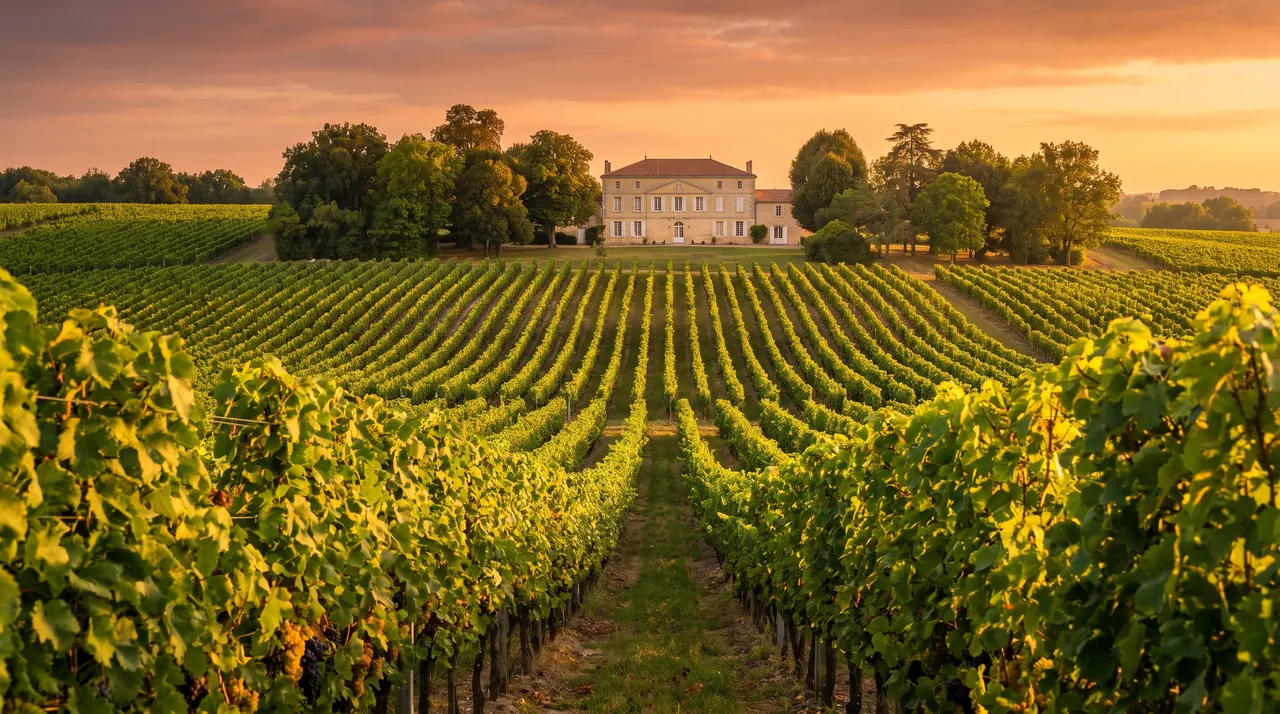
The flagship appellation for the commune’s red wines is, in fact, the AOC Cadillac Côtes de Bordeaux. Here again, a clarification is in order, as the appellation has changed. Until the 2008 vintage, the region’s reds were known as “Premières Côtes de Bordeaux”; since the 2009 “Côtes de Bordeaux” decree, they have fallen under the AOC Cadillac Côtes de Bordeaux, which is dominated by Merlot. The term “Premières Côtes de Bordeaux” still exists, but it is now reserved for sweet white wines. To write today that the reds from Villenave-de-Rions are “Premières Côtes de Bordeaux” would therefore be an anachronism.
Villenave-de-Rions falls under the Cadillac Côtes de Bordeaux AOC for its red wines (INAO, official specification accessed on July 24, 2026). For a complete list of appellations and surrounding areas, consult the official INAO specifications.
Château Fauchey and Château Lezongars
Two estates are responsible for the town’s reputation as a wine-producing region. The first is Château Fauchey, mentioned earlier, which is farmed organically—a rarity for such a small village. The second is Château Lezongars, located on Route de Roques, perched on a limestone escarpment overlooking the Garonne River, facing the Graves region on the opposite bank; its Cadillac Côtes de Bordeaux wines are listed in the Guide Hachette. The town hall’s official website also mentions the Domaine de Cazères, Château La Rose Mathiot, Vignobles Guindeuil, Château Haut Floranne, and Château de Guillorit. One final note: Château Mont-Pérat, often associated with this area, is not located in Villenave-de-Rions but in Capian, the neighboring town—an erroneous attribution that should be corrected.
Raymond Island and the Hillsides
Beyond the vineyards, Villenave-de-Rions opens up to a more secluded landscape of wooded valleys, streams, and wetlands. The town does not have its own protected natural area, but just a few kilometers away, it provides access to one of the valley’s most remarkable sites: Île de Raymond, located downstream along the Garonne River. It is there, between the river and the hillsides, that the area’s true ecological richness lies.
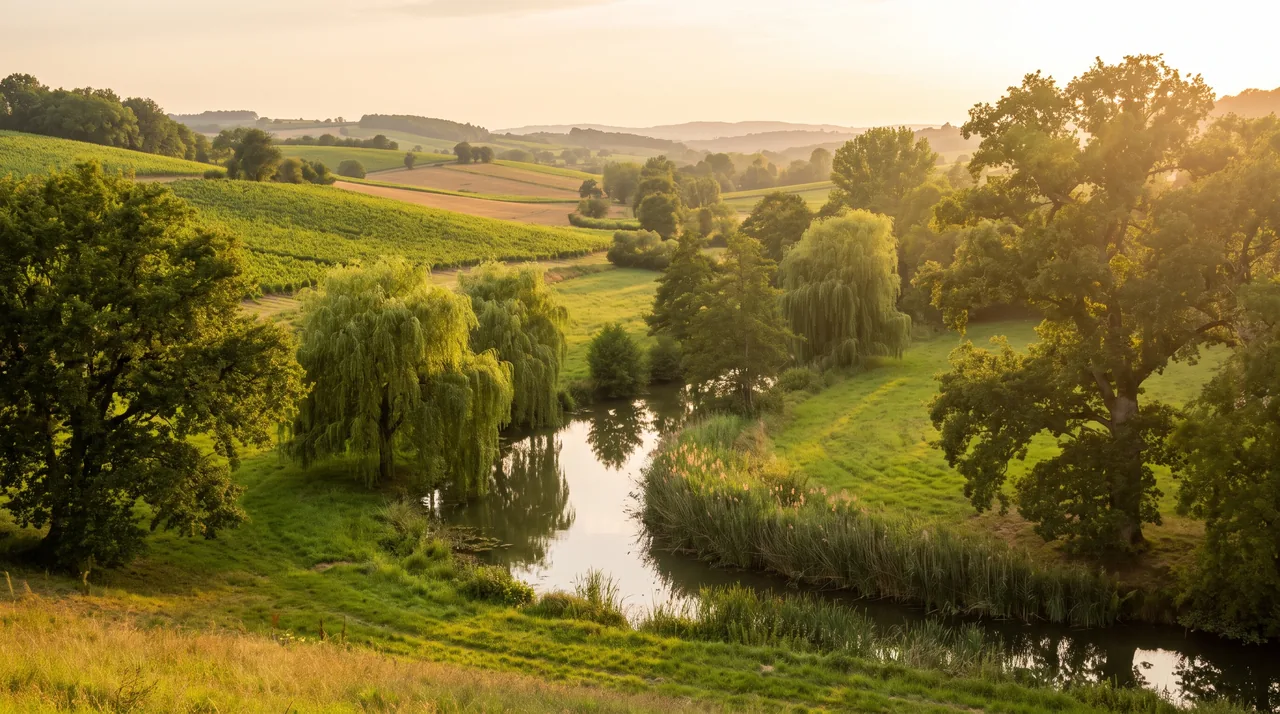
Raymond Island, the Last Wetland in Gironde
Raymond Island is a former oxbow lake of the Garonne River, now separated from the river, that stretches across the neighboring municipalities of Rions, Paillet, and Lestiac-sur-Garonne, about five kilometers from Villenave-de-Rions. Designated a Sensitive Natural Area, it covers more than 45 hectares (Convergence Garonne Community of Municipalities, accessed July 24, 2026)—a remnant of the habitats that once lined the entire course of the river. Two marked trails—one to the north and one to the south, each 1.9 kilometers long—allow visitors to explore the area on foot, free of charge. Birdwatchers come here for its rich avifauna: passerines, raptors, black kites, and storks frequent these floodplains and wet woodlands. It’s the nature walk not to be missed near Villenave-de-Rions.
A Fragile Agricultural Region
The rest of the municipality is purely agricultural. According to the European Land Use Inventory, vineyards and permanent crops cover 53.5% of the territory, and agricultural land in the broad sense covers 78.5%: Villenave-de-Rions is cultivated far more than it is built up. This hillside soil, however, is fragile. All of the registered buildings—159 in 2019—are located in areas with a moderate or high risk of clay shrinkage and swelling, compared to 84% across the department: clay soils shrink during periods of drought and swell when rains return, which weakens foundations. This is a subtle but real aspect of life on these limestone hillsides, where the very same terroir that gives the wine its finesse also imposes constraints on the built environment.
Rions, the neighboring fortified town
Just five minutes and five kilometers to the south, Rions boasts all the architectural heritage that Villenave-de-Rions lacks. It’s the natural complement to a visit: while the neighboring village remains unassuming, Rions features ramparts, gates, towers, and a listed Romanesque church. Many people mistakenly refer to it as a “bastide.” This is an error that must be corrected, as it conveys the exact opposite of its history.
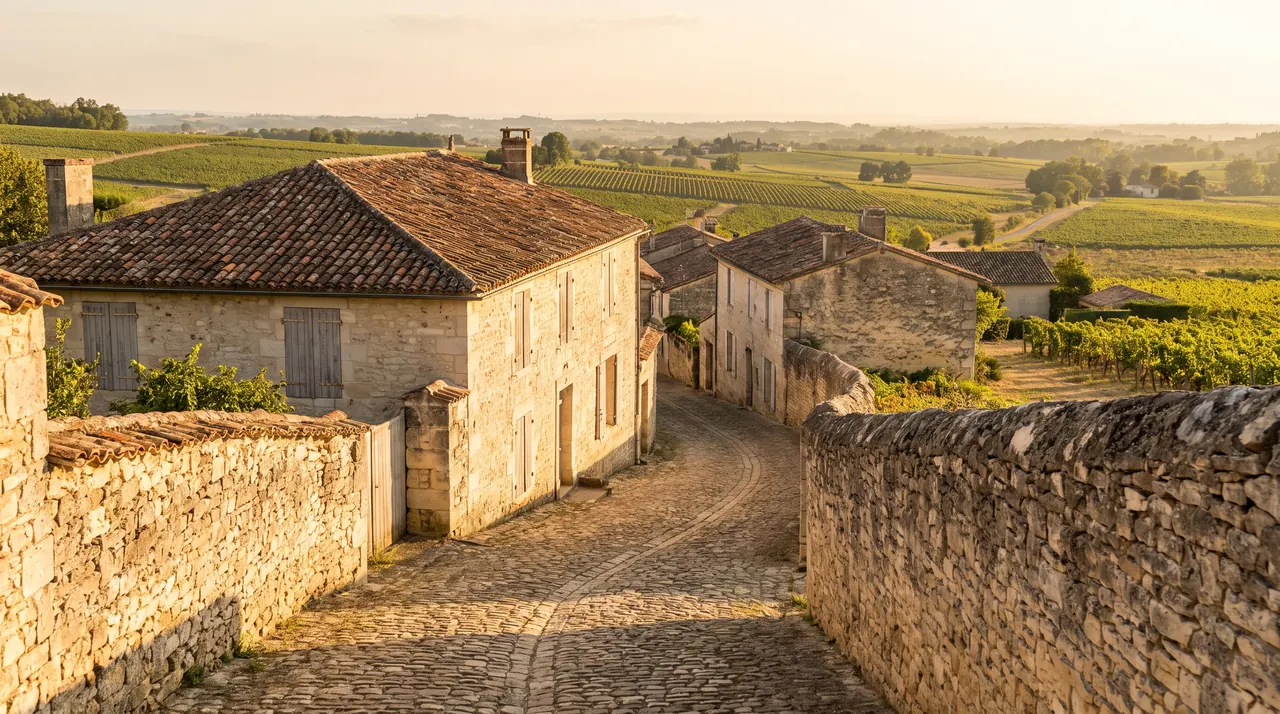
A fortified city, not a bastide
Rions is not a bastide—one of those new medieval towns with a grid layout, founded all at once, like Cadillac. It is a fortified town, a former English fort in Guyenne. Its ramparts were authorized by King Edward III of England in 1313 and then built by Guillaume Seguin around 1330, at a time when Guyenne was part of the territory ruled by the Anglo-Gascon king-duke. The 14th-century fortified enclosure has been listed as a historic monument since the very first list in 1862. Visitors can still see the Porte du Lhyan to the south, the Citadel—a square tower facing the Garonne River—the Guet Tower, and the parallel moats that once protected the city. It is one of the best-preserved medieval fortified complexes on the right bank.
Saint-Seurin Church and the Hidden Gems of Rions
Rions is also home to its own listed Romanesque church, Saint-Seurin, built in the 12th century and remodeled in the 14th. Designated a historic monument by decree on December 1, 1908, it retains a semicircular apse and historiated capitals—this is the famous “listed Romanesque church” of the area, not to be confused with Saint-Martin in Villenave-de-Rions, which is not listed. The village is home to other points of interest: an 18th-century market hall nicknamed the “pea market,” and, above all, a Roman epitaph carved in marble, dated May 26, 466, now housed at the Musée d’Aquitaine in Bordeaux—a rare testament to Late Antiquity in the Gironde region. Not far away, on April 9, 1841, the Broussey Monastery was the site of the very first reestablishment of the Discalced Carmelite Order in France following the Revolution.
One last story, to be taken for what it is: a cave at the foot of the ramparts of Rions is called the “Charles VII Cave.” Tradition has it that the King of France came there to rest and quench his thirst after the Battle of Castillon in 1453, which ended the Hundred Years’ War and restored Guyenne to the Kingdom of France. It’s a charming anecdote that fits well with the history of this contested border, but it’s a local legend with no established historical basis. It’s told in the conditional tense—like so many stories on this right bank that blend grand history with the memories of the villages.
What is there to do in and around Villenave-de-Rions?
In Villenave-de-Rions and the surrounding area, you can spend an entire day without ever getting bored—as long as you accept one obvious fact: with 374 residents, no protected monuments, and no market, the village thrives mainly because of its neighboring towns. In the village itself, visitors come to see the Romanesque apse of Saint-Martin Church and step inside a winery to taste a Cadillac Côtes de Bordeaux. Then you can explore the surrounding area: Rions and its listed ramparts are five minutes away, Île de Raymond and its nature trails are just a bit further, Cadillac and its ducal castle are a quarter of an hour away, and Loupiac and its sweet wines are right on the way. It’s this star-shaped layout that makes a stay here so appealing—Villenave-de-Rions as a peaceful base, and the surrounding villages as so many stops along the way. Here’s a concrete look at what you can do there.
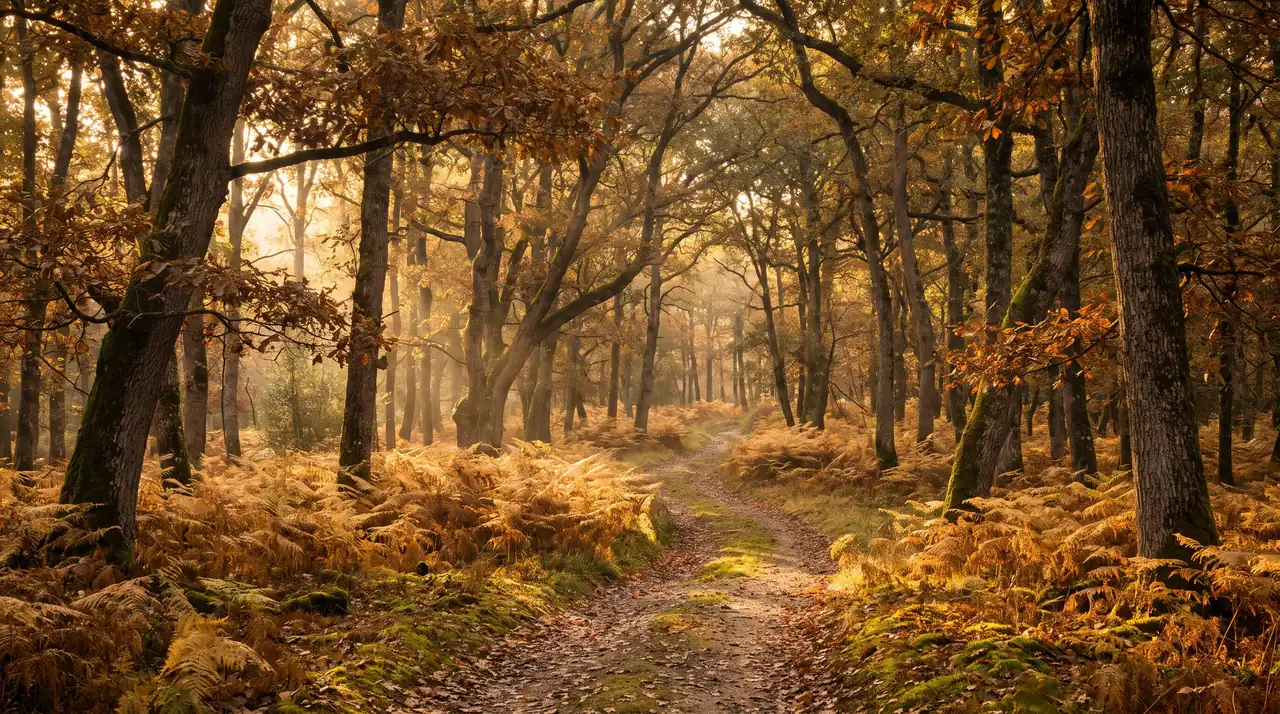
- Visit the Church of Saint-Martin in Villenave-de-Rions and its Romanesque semicircular apse, a 12th-century remnant—view the exterior only, as the building is not a listed historic site.
- Enjoy a tasting on-site at Château Fauchey, which is farmed organically, or at Château Lezongars, perched overlooking the Graves region—usually by appointment.
- Explore the fortified town of Rions (~5 km): the medieval city walls and Saint-Seurin Church, both designated as Historic Monuments; the “aux petits pois” market hall; and the interpretive trail; guided tours are available through the Entre-deux-Mers Tourist Office.
- Hiking on Île de Raymond (~5 km): two marked trails, each 1.9 km long; free and open to the public; birdwatching in a sensitive natural area of the Garonne Valley.
- Visit Cadillac (~9 km): a bastide dating from 1280, the Château des Ducs d'Épernon, open to visitors (Centre des monuments nationaux), and the listed Saint-Martin Church with its ducal tombs.
- Visit the Cadillac Market on Saturday morning at Place de la République, with its hundred or so vendors—the area’s major weekly event.
- Continue on to Loupiac (~11 km): sweet white wine, a Gallo-Roman villa with mosaics and thermal baths, a Romanesque church, and the Château du Cros overlooking the Garonne.
Things to Do There
Within the Villenave-de-Rions area itself, there are two must-do activities. The first is related to cultural heritage: take a tour of Saint-Martin Church, paying special attention to its Romanesque apse, the only truly medieval part of the building. Since it is not a listed historic site and serves as a parish church, it can mainly be viewed from the outside, depending on opening hours. The second is a wine-tasting experience: book a tasting at one of the local wineries. Château Fauchey, an organic winery, and Château Lezongars, listed in the Guide Hachette, are the two best-known options, but the town hall also lists Domaine de Cazères, Château La Rose Mathiot, Vignobles Guindeuil, Château Haut Floranne, and Château de Guillorit. In any case, calling ahead will help you avoid finding the doors closed: small estates rarely have continuous visiting hours.
The Neighbors' Section
Most of the program, however, takes place within a radius of a few kilometers. Rions, just five minutes away, is a must-see: there, you can explore the 14th-century ramparts, the Porte du Lhyan, and the Saint-Seurin Church, before strolling through the pea market; the Entre-deux-Mers tourist office offers guided tours and an interpretive trail. The nearby Île de Raymond offers a nature-focused experience. Cadillac, a quarter of an hour away, adds a monumental dimension with its ducal castle managed by the Centre des monuments nationaux, its ramparts, and its Saturday morning market. Finally, Loupiac rounds out the experience with sweet wine and archaeology, featuring its Gallo-Roman villa, which will be listed in 2024. In a single day, you can take in medieval heritage, nature, and vineyards without ever having to drive very far.
| Activity | Where / When | Good to Know |
|---|---|---|
| St. Martin's Church | Villenave-de-Rions | Romanesque apse · exterior tour · unlisted |
| Wine Tasting at the Winery | Château Fauchey (organic), Château Lezongars | Cadillac Côtes de Bordeaux · by appointment |
| The Fortified Town of Rions | ~5 km | Listed ramparts and church · tourist office |
| Raymond Island | ~5 km | 2 trails, 1.9 km each · free · birdwatching |
| Cadillac Market | ~9 km · Saturday morning | Place de la République · ~100 exhibitors |
| Loupiac | ~11 km | Sweet · Gallo-Roman villa · Château du Cros |
Around Villenave-de-Rions
Villenave-de-Rions is ideally situated to explore the right bank of the Garonne, a string of wine-growing villages and historic sites facing the Graves region. To the south, just nearby, Rions unfolds its fortified town. A little further on, Cadillac boasts its 1280 bastide and the castle of the Dukes of Épernon, which served as a women’s prison for many years before becoming a national monument. To the north, as you travel upriver, Langoiran preserves the ruins of its mighty medieval fortress, overlooking the Garonne Valley. All these destinations lie within a radius of about ten kilometers.
To the southeast, the right bank becomes the land of sweet wines. Loupiac, Sainte-Croix-du-Mont, and Cadillac make up the famous “trilogy” of sweet wines from the right bank, which stand in contrast to the great sweet wines of the left bank—Sauternes, Barsac, and Cérons. Sainte-Croix-du-Mont boasts a unique geological curiosity: a cliff of fossilized oysters, millions of years old, which can be viewed near the village church. Loupiac, for its part, boasts a sweet wine, a Gallo-Roman villa with mosaics listed in 2024, a Romanesque church listed on the very first register of historic monuments in 1840, and the Château du Cros, a medieval fortress that has been converted into a winery.
The Right Bank Sweet Wine Trilogy
This trio—Cadillac, Loupiac, and Sainte-Croix-du-Mont—deserves special mention, as it serves as the Right Bank counterpart to the famous sweet wines of Sauternes. They share the same grape varieties (led by Sémillon) and the same principle of late harvesting and concentrated grapes, but in a style that is often more accessible and less well-known. From Villenave-de-Rions, you can easily reach these villages from those on the left bank by crossing the Garonne River and put together a full day of wine tasting. To extend your exploration, our guides highlight Rions and its fortified town, Cadillac with its bastide and ducal castle, Langoiran and its fortified castle, and Cérons, the lesser-known sweet wine of the Graves on the opposite bank. All are featured in our itineraries departing from Bordeaux.
| Destination | Approx. distance | Interest |
|---|---|---|
| Rions | ~5 km | Fortified city; ramparts designated as historic monuments |
| Cadillac | ~9 km | Bastide from 1280, ducal castle (CMN) |
| Langoiran | ~10 km | Fortified castle, Garonne Valley |
| Loupiac | ~11 km | Sweet wine, Gallo-Roman villa, Château du Cros |
| Sainte-Croix-du-Mont | ~15 km | Liquoreux, fossil oyster cliff |
How to Get to Villenave-de-Rions from Bordeaux
The drive from Bordeaux to Villenave-de-Rions is about 31 kilometers and takes about 50 minutes. The route follows the right bank of the Garonne along winding hillside roads—the D10 and then the D237—which are slower but more scenic than the motorway. You can also take the left bank and the A62 to the Podensac interchange, then cross the river: this route is slightly shorter in kilometers, but requires a river crossing. The nearest TER train stations, Podensac and Cérons, are on the other bank, eight or nine kilometers away. Suffice it to say that, without a car, Villenave-de-Rions is a bit of a challenge to reach: it’s a hillside town, off the main roads, which is also part of its charm.
How much does the ride cost?
The Bordeaux → Villenave-de-Rions route is available starting at €76 during the day, for a sedan that seats 1 to 3 passengers. This rate is fixed and confirmed in writing before departure: no meter, no surprises upon arrival. Surcharges apply at night, on weekends, and on holidays, and for groups of 4 or more passengers, a van seating up to 7 people replaces the sedan. Extensions to neighboring villages—Rions, Cadillac, Loupiac, Sainte-Croix-du-Mont—or from the Bordeaux-Mérignac Airport are priced on a quote basis, depending on the itinerary and the day’s schedule. The principle remains the same everywhere: a price known in advance, tailored to the number of passengers and the itinerary of the outing.
| Route | Distance / Duration | Rates |
|---|---|---|
| Bordeaux → Villenave-de-Rions | ~31 km · ~50 min | Starting at €76 |
| Nearby villages (Rions, Cadillac, Loupiac, etc.) | variable | based on a quote |
| Bordeaux Airport → Villenave-de-Rions | variable | based on a quote |
Why hire a private driver?
Because wine and the hills don't mix well with driving. At Villenave-de-Rions and the surrounding area, you’ll go from one tasting to the next—Cadillac Côtes de Bordeaux on-site, sweet wines in Loupiac or Sainte-Croix-du-Mont—and travel along small, winding roads through the vineyards. Leaving the driving to a private chauffeur lets you taste in moderation without getting behind the wheel, move from one estate to another stress-free, and return home peacefully in the evening. It also offers the freedom of true door-to-door service: you leave from your address in Bordeaux and return the same way, at your own pace throughout the day, without a set schedule or having to search for parking in the middle of a village. For a wine and heritage getaway on the Right Bank, this is the most relaxing option available.
Frequently Asked Questions
Where is Villenave-de-Rions located?
Villenave-de-Rions is a rural commune in the Gironde department (33), in the Nouvelle-Aquitaine region, located on the limestone hillsides along the right bank of the Garonne River, about 30 kilometers southeast of Bordeaux. It has the INSEE code 33549 and is part of the Langon arrondissement, the Entre-Deux-Mers canton, and the Créonnais community of municipalities—not the “Cadillac canton,” an administrative division that was abolished in 2015. Its neighboring municipalities are Capian, Cardan, Rions, and Paillet. It is a very small wine-growing area covering 2.56 square kilometers, not to be confused with Villenave-d’Ornon, a suburb of Bordeaux.
Villenave-de-Rions or Villenave-d'Ornon?
These are two very distinct municipalities in the Gironde department, often confused because their INSEE codes are consecutive (33549 and 33550) and because they share the same demonym, the Villenavais, as well as a church dedicated to Saint Martin. Villenave-d'Ornon is a large municipality in the southern suburbs of Bordeaux, within the Bordeaux Métropole region, with approximately 35.000 residents spread over more than 21 km². Villenave-de-Rions is a rural village with 374 residents, located about 30 kilometers away in the Langon district. When people talk about the vineyards, the hillsides, and Rions, they are always referring to Villenave-de-Rions. If in doubt, the INSEE code settles the matter.
What is there to do at Villenave-de-Rions?
While there, visitors can explore the Romanesque apse of Saint-Martin Church (from the outside, as the building is not a listed historic site) and enjoy a tasting at a winery, such as the organic Château Fauchey or Château Lezongars. The real highlights, however, are in the surrounding area: the fortified town of Rions and its listed ramparts just five minutes away, Île de Raymond and its nature trails nearby, Cadillac and its ducal castle a quarter of an hour away, the Cadillac market on Saturday mornings, and the sweet wines of Loupiac a little further on. Villenave-de-Rions serves as a peaceful base from which to explore the right bank.
Is the church in Villenave-de-Rions a listed building?
No. The Saint-Martin Church in Villenave-de-Rions is neither classified nor listed as a historic monument: the town has no protected monuments. However, it does feature one element of real interest: its Romanesque semicircular apse, a remnant from the 12th century; the choir dates from the 14th century, and most of the church was rebuilt in the 19th century following the destruction caused by the Revolution. The confusion stems from the neighboring church: the listed Romanesque church in the area is Saint-Seurin de Rions, which was designated a historic monument in 1908. In Villenave-de-Rions, the apse can be seen from the outside, as a modest yet authentic remnant.
What kind of wine does Villenave-de-Rions produce?
Mainly red wines from the Cadillac Côtes de Bordeaux AOC, the appellation that replaced the “Premières Côtes de Bordeaux” reds in 2009. Villenave-de-Rions falls under the Cadillac Côtes de Bordeaux AOC for its red wines (INAO, official specification accessed on July 24, 2026). For a comprehensive list of appellations and surrounding areas, consult the official INAO specifications. However, despite its location within the geographical region of Entre-deux-Mers, it does not produce AOC Entre-deux-Mers wines: the municipalities bordering the Garonne River are excluded from this appellation. The leading estates are Château Fauchey (organic) and Château Lezongars.
How much does a trip from Bordeaux to Villenave-de-Rions cost with a private chauffeur?
The Bordeaux → Villenave-de-Rions route is available starting at €76 during the day for a sedan accommodating 1 to 3 passengers. This rate is fixed and confirmed in writing before departure, with no meter and no surprises upon arrival. Surcharges apply at night, on weekends, and on holidays; for groups of 4 or more passengers, a van seating up to 7 people replaces the sedan. Extensions to neighboring villages—Rions, Cadillac, Loupiac, Sainte-Croix-du-Mont—or from Bordeaux-Mérignac Airport are priced on a quote basis, depending on the itinerary and the day’s schedule.
How many people live in Villenave-de-Rions?
Villenave-de-Rions had 374 residents according to the 2023 census; this figure is recognized as the official population as of January 1, 2026. One often sees “approximately 330 residents,” including on the town hall’s website: this figure corresponds to older census data (332 in 2018, 348 in 2019) and should be disregarded in favor of the INSEE data. Based on an area of 2.56 square kilometers, the population density is approximately 146 inhabitants per square kilometer. The village has seen a marked rebound since its low of 216 inhabitants in 1975. Its residents are known as Villenavais.
Where does the name Villenave-de-Rions come from?
“Villenave” comes from *villa nova*, meaning “new town”—a place name of medieval origin commonly found in the Southwest; in Gascon, the name is *Vilanava de Rions*. This much is certain. The qualifier “de Rions” suggests a former dependence on the seigneury of Rions, the neighboring town to the south, but this specific connection remains a hypothesis, in the absence of conclusive scholarly sources: it is presented in the conditional tense. The town itself was established during the French Revolution, when the former parish of Saint-Martin was elevated to municipal status.
Does Villenave-de-Rions produce Entre-deux-Mers AOC wine?
No, and this is a persistent misconception. Villenave-de-Rions is indeed located in the geographical region of Entre-deux-Mers—the plateau between the Garonne and Dordogne rivers—but it is excluded from the production area of the Entre-deux-Mers AOC. The specifications include the municipalities bordering the Garonne—including Villenave-de-Rions, Rions, and Paillet—only within its “immediate vicinity,” meaning solely for winemaking purposes. The commune’s wines therefore fall under other appellations, foremost among which is Cadillac Côtes de Bordeaux for the reds.
What is Fauchey Castle?
Fauchey Castle is the most prominent building in Villenave-de-Rions, standing at the highest point of the town. Despite its medieval appearance, it is a Neo-Gothic structure built beginning in 1864 by the architect Vignaux on the site of a 15th-century nobleman’s residence. It is not listed as a historic monument. Today, it serves as the centerpiece of an organically farmed vineyard, with a remarkable 18th-century barn among its outbuildings. It is said—though this is not confirmed—that the original noble residence was burned down during the Revocation of the Edict of Nantes.
Is Rions a bastide?
No. Rions, the neighboring town, is not a bastide—one of those new medieval towns laid out in a grid pattern—but a fortified town, a former English fort in Guyenne. Its ramparts were authorized by Edward III in 1313 and built by Guillaume Seguin around 1330. The 14th-century wall has been classified as a Historic Monument since 1862, as has the Romanesque Church of Saint-Seurin since 1908. The true bastide of the region is Cadillac, founded in 1280 by Jean I de Grailly. It is therefore more accurate to refer to Rions as a “fortified village” or a “fortified town.”
What is Raymond Island?
Raymond Island is a former oxbow lake of the Garonne River, located about five kilometers from Villenave-de-Rions, along the municipalities of Rions, Paillet, and Lestiac-sur-Garonne. Designated a Sensitive Natural Area, it covers more than 45 hectares and is considered a key natural habitat in the Garonne Valley. Two marked trails, 1.9 kilometers long, running north and south, allow visitors to explore the area on foot for free. It is an excellent spot for birdwatching—passerines, raptors, black kites, and storks frequent its floodplains. It is the most beautiful nature walk in the area.
How far is Villenave-de-Rions from Bordeaux?
Villenave-de-Rions is located about 31 kilometers southeast of Bordeaux, about a 50-minute drive along the right bank of the Garonne and its hillside roads. A more direct route via the A62 motorway and the Podensac interchange shortens the distance to about 30 kilometers and the travel time to 42 minutes, but requires crossing the river. The nearest TER train stations, Podensac and Cérons, are on the left bank, eight or nine kilometers away. It’s an easy getaway from Bordeaux, ideal to combine with a visit to Rions and Cadillac.
What to see in Rions, near Villenave-de-Rions?
Just five minutes from Villenave-de-Rions, Rions is home to the area’s most significant historical landmarks. There, visitors can explore a 14th-century fortified wall designated a Historic Monument—including the Porte du Lhyan, the Citadel, and the Guet Tower—as well as the Romanesque Saint-Seurin Church, which is also a designated Historic Monument. The village still has an 18th-century market hall known as the “Halle aux Petits Pois” and has contributed a Roman epitaph dating from 466, now on display at the Musée d’Aquitaine. A cave at the foot of the ramparts, known as the “Charles VII Cave,” is the subject of a charming local legend, though its veracity should be taken with a grain of salt.
Further Reading
- Book your trip from Bordeaux to Villenave-de-Rions: fixed-price quote confirmed in writing, door-to-door service, no obligation.
- All our destinations departing from Bordeaux: castles, vineyards, and villages in the Gironde.
- Let's Laugh: The Fortified Village on the Banks of the Garonne.
- Cadillac: the country estate, the ducal castle, and the sweet wine.
- Langoiran: The Fortified Castle and the Garonne Valley.
Sources and References
- Villenave-de-Rions — Wikipedia — Geography, Demographics, Heritage
- Villenave-de-Rions Town Hall — viticulture — local wineries, Château Fauchey
- INSEE — Complete Villenave-de-Rions Report (33549) — Official Population, Area, Population Density, and Administrative Affiliations
- Saint-Seurin Church in Rions — Mérimée PA00083701 — Romanesque church designated a historic monument in 1908 (in neighboring Rions)
- Fortified Enclosure of Rions — Mérimée PA00083702 — ramparts designated as Historic Monuments (in neighboring Rions)
- AOC Cadillac Côtes de Bordeaux — red wines from the right bank
- Raymond Island — Convergence Garonne — Sensitive Natural Area, Wetland
Article updated on .
Our Latest Guides
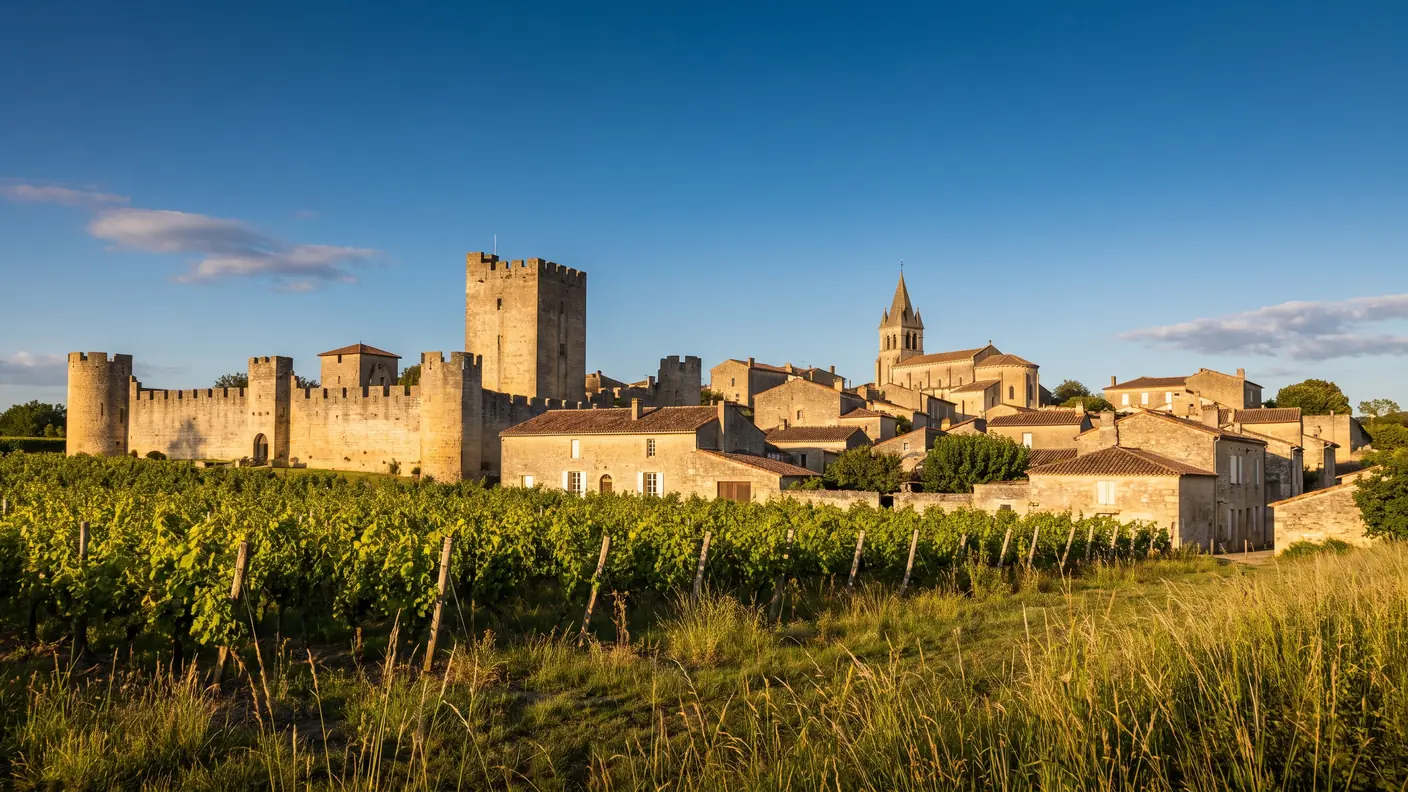 Entre-deux-Mers & Southern Gironde
Rions: The Fortified Village on the Banks of the Garonne
Read the guide →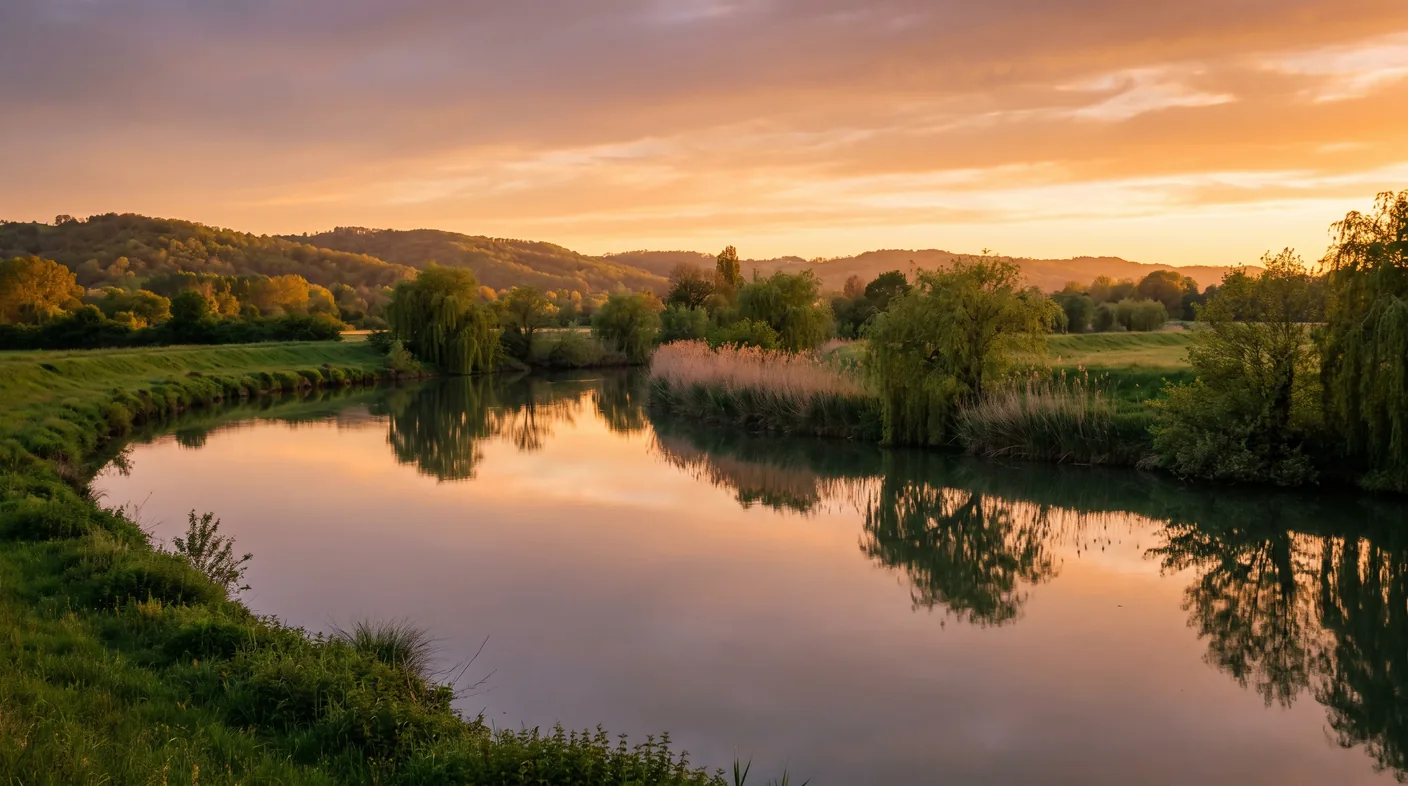 Entre-deux-Mers & Southern Gironde
Cadillac: The Bastide, the Ducal Castle, and the Sweet Wine
Read the guide →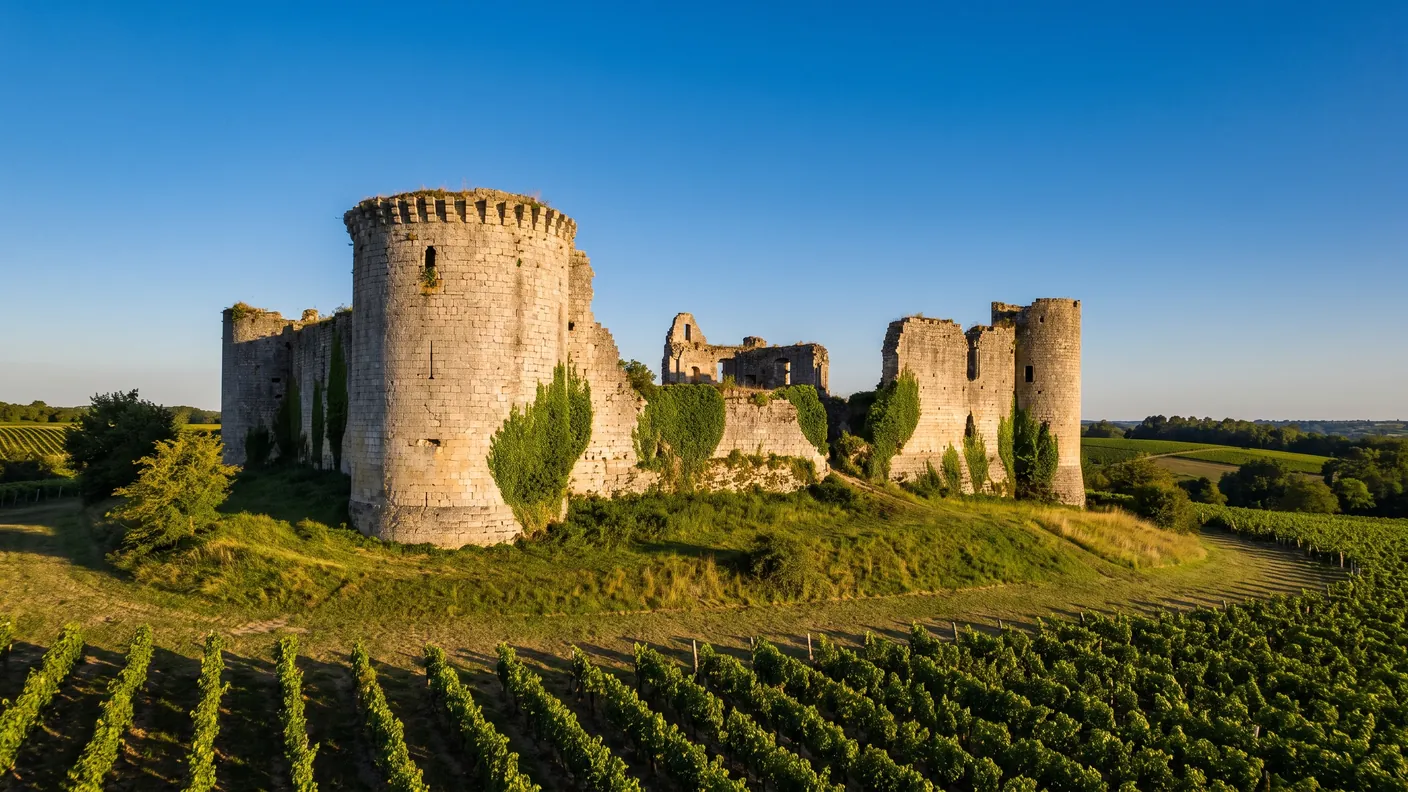 Entre-deux-Mers & Southern Gironde
Langoiran: The Fortified Castle and the Garonne Valley
Read the guide →Off to the hillsides on the right bank
Direct transfer from Bordeaux (~50 min) to Villenave-de-Rions, Rions, and the Cadillac Côtes de Bordeaux vineyards. Written, fixed-price quote with no obligation.