Bordeaux to Angoulême with a Private Driver: Comics and Ramparts
A Romanesque cathedral featuring 70 sculpted figures, an upper town surrounded by ramparts, and the world capital of comic books. Perched on a promontory overlooking the Charente River, Angoulême, the “Balcony of the Southwest”, combines Romanesque architecture, painted murals, and a legendary festival, about 1 hour and 40 minutes from Bordeaux.
Angoulême at a Glance
Angoulême, prefecture of the Charente (16) in Nouvelle-Aquitaine, is perched on a limestone promontory above a bend in the Charente River, hence its nickname "Balcony of the Southwest". Its best-known modern title is "comic book capital", a cultural designation that originated with the 1974 festival, rather than an administrative status. There, you can visit a 12th-century Romanesque cathedral with a sculpted facade, an upper town surrounded by ramparts, and the International Comics City. From Bordeaux, allow ~127 km and about 1 hour 40 minutes via the A10/N10, with fares starting at €212 by chauffeured transfer, door-to-door to the pedestrian-only upper town.
| Landmark | Details |
|---|---|
| Department | Charente (16) · Nouvelle-Aquitaine |
| Status | Prefecture · “Comic Book Capital” (nickname / title) · “Balcony of the Southwest” |
| Population | 41,908 residents (Angoumoisins), as of 2023 |
| Must-Sees | St. Peter's Cathedral · city walls & upper town · Comic Book City · painted walls |
| From Bordeaux | ≈ 127 km · ~1 hr 40 min via the A10/N10 · starting at €212 by chauffeured transfer |
Angoulême is often reduced to its comic book festival, that major event in late January that draws crowds of industry professionals and readers. But that overlooks a city of art with a much longer history. Before becoming the capital of comics, Angoulême was a medieval stronghold, a county of the Valois dynasty, a center of the French paper industry, and, as early as the 12th century, home to a Romanesque cathedral whose sculpted façade is considered one of the most ornate in the Southwest. The upper town, surrounded by ramparts and perched on a limestone plateau, can be explored on foot from one end to the other. Looking up at the Romanesque stonework and giant frescoes, you’ll quickly understand why the comic book found its capital here.
This guide brings together everything you need to know before you visit: where Angoulême is located and what sets it apart from its neighbor, Charente-Maritime; the history behind its cathedral; the significance of its ramparts and the Count’s Castle; how its “comic book world” connects the festival, the Cité, and the painted walls; what you can actually do while you’re there; and how to arrive well-rested from Bordeaux without worrying about parking in an upper town that’s largely pedestrian-friendly. Every date and figure cited here has been cross-checked against the official sources listed at the end of the article; when a common misconception is circulating, we correct it rather than repeat it.
Where is Angoulême located?
Angoulême is the prefecture of Charente (16), an important point because it is often confused with Charente-Maritime (17), whose prefecture is La Rochelle. Both departments are named after the same river, but Angoulême, like its neighbor Cognac, is indeed located in Charente, in the Nouvelle-Aquitaine region (formerly the Poitou-Charentes region). The municipality (INSEE code 16015, ZIP code 16000) covers an area of 21.85 km² and had 41,908 residents in 2023; its residents are the Angoumoisins, named after Angoumois, the former region and county of which the city was the capital. Including its outskirts, the urban area has a population of nearly 110,000, and the Greater Angoulême metropolitan area has a population of approximately 140,000.
The geography of Angoulême can be summed up in a single image: a hilltop town perched on a limestone promontory which overlooks a bend in the Charente River. The elevation rises from 27 meters at the river’s edge to 133 meters on the plateau, and this difference in elevation explains it all—the layout of the ramparts, the cathedral’s commanding position, and the famous nickname of "Balcony of the Southwest", the guide’s only nickname, which is based on a geographical reality rather than a mere label. From the ramparts of the upper town, the view stretches far across the green valley and over the tiled rooftops. The Charente River flows for about 381 kilometers from its source in Chéronnac, in Haute-Vienne, to the Bay of Biscay: Angoulême lies on its upper reaches, where it remains navigable all the way to the sea.
How far is it from Bordeaux?
From Bordeaux, allow about 127 km and a 1-hour, 40-minute drive via the A10 motorway and then the N10, heading due north. The route is direct and well-known, with no complicated detours: you leave the city of Bordeaux and reach the Charente region in just over an hour and a half, arriving at the foot of the upper town. For train enthusiasts, the high-speed line (LGV) puts Angoulême about 35 minutes from Bordeaux and just under 2 hours from Paris; but the train station is below the plateau, so you have to hike up to it. A door-to-door transfer saves you from having to transfer and drops you off right in the old town, which makes all the difference on a festival day when the city is packed.
| From Angoulême | Driving distance | Duration |
|---|---|---|
| Cognac | ≈ 46 km | ~45 min |
| Saintes | ≈ 75 km | ~1 hr 10 min |
| Périgueux | ≈ 87 km | ~1 hour 30 minutes |
| Bordeaux | ≈ 127 km | ~1 hr 40 min |
| La Rochelle | ≈ 150 km | ~1 hr 50 min |
The very name of the city speaks to its antiquity. The Late Latin forms Iculisma, first attested around 380–390, and later Ecolisma, predate Angoulême’s establishment as the capital of the visual arts by several centuries. Between this ancient place name and today’s comic-book murals lie more than fifteen centuries of history; it is precisely this depth of history, more than the festival alone, that gives the city its richness. Its central role in the region is nothing new either: at the crossroads of roads leading to Bordeaux, Cognac, Saintes, Périgueux, and Limoges, Angoulême has always controlled the passage between the Bordeaux region, the Charentes, and the Limousin, making it today a convenient base from which to explore the entire northern part of Nouvelle-Aquitaine.
St. Peter's Cathedral
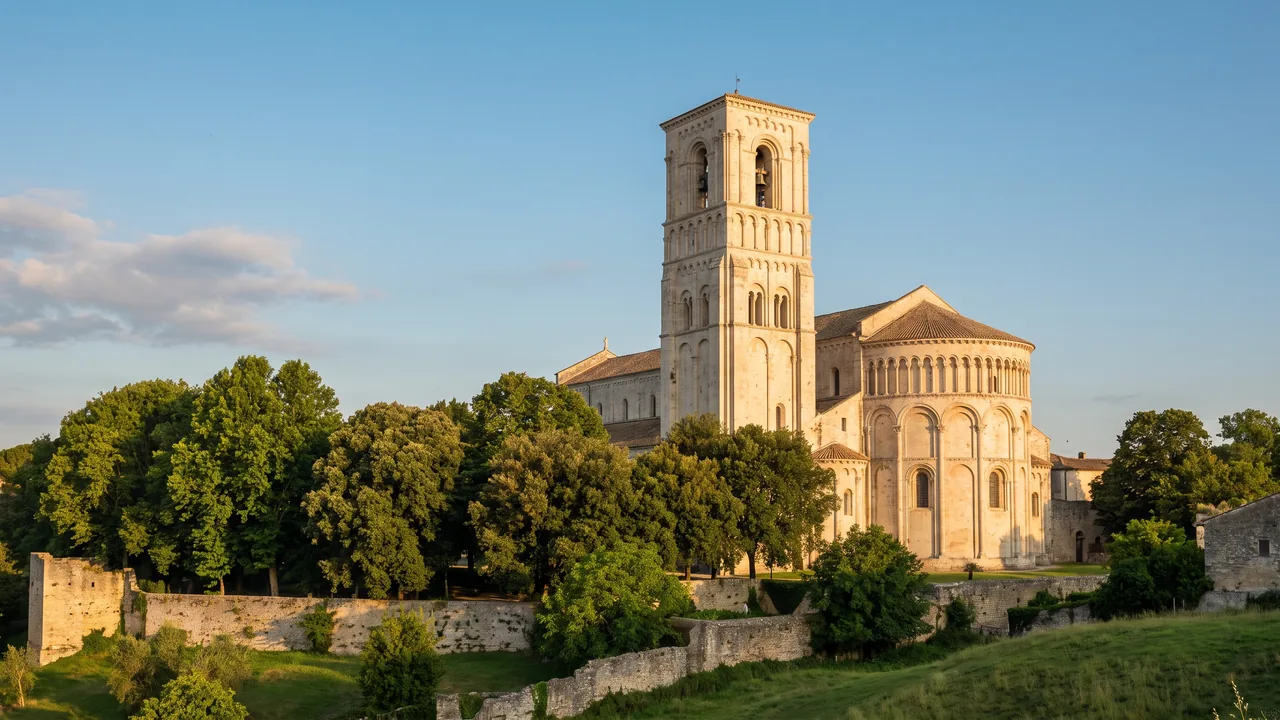
St. Peter's Cathedral is Angoulême's most iconic landmark and one of the great Romanesque buildings of southwestern France. Its façade features more than 70 sculpted figures according to local tourism statistics. The Official Notice POP PA00104203 (accessed July 24, 2026) confirms the significance of the sculpture and its 1840 classification, without providing details on this count. The programme notably includes the Ascension of Christ and the Last Judgment.
A facade that has been a historic landmark since 1840
The cathedral is one of the very first protected monuments in France: it is designated a Historic Monument in 1840, on the founding list known as the “Mérimée” list — POP entry PA00104203. The long history of this protection speaks volumes about its importance in the eyes of the early advocates of national heritage. The subjects depicted in the carvings remain the Ascension and the Last Judgment; it should be noted, however, that some art historians have believed they recognized scenes from The Song of Roland — the capture of Zaragoza, Archbishop Turpin, Roland himself. This reading remains a debated iconographic interpretation, to be taken with a grain of salt, not as an established fact: it’s better to present it as such, “it has sometimes been interpreted as…”, rather than stating it as fact. As for the bell tower, it rises to 59 meters above the upper town.
Paul Abadie's Restoration in the 19th Century
The current silhouette owes a great deal to the 19th century. From the late 1850s to the 1870s, the architect Paul Abadie undertook an extensive restoration of the cathedral in the distinctive Neo-Byzantine style of the time: he added a triangular gable flanked by two bell turrets and had the domes rebuilt. It was this same Abadie who, a few years later, would design the Sacré-Cœur in Montmartre in Paris. Angoulême served, in a sense, as a testing ground for the future architect of the Parisian basilica. Two points need to be clarified to avoid common misconceptions: Paul Abadie Jr., the architect behind these projects, was not from Angoulême. He was born in Paris in 1812 and died in Chatou in 1884, and should not be confused with his father, Abadie the Elder, who was also an architect. His connection to Angoulême stems from his construction projects, not his birthplace.
| St. Peter's Cathedral | Details |
|---|---|
| Style and Period | Romanesque · nave c. 1110, façade c. 1118–1128, consecrated in 1128 |
| Property Status | Designated a Historic Monument in 1840 (entry PA00104203) |
| Carved facade | More than 70 figures · The Ascension of Christ + The Last Judgment |
| Bell Tower | 59 meters |
| 19th-Century Restoration | Paul Abadie (1850s–1870s), Neo-Byzantine style |
The City Walls and the Upper Town
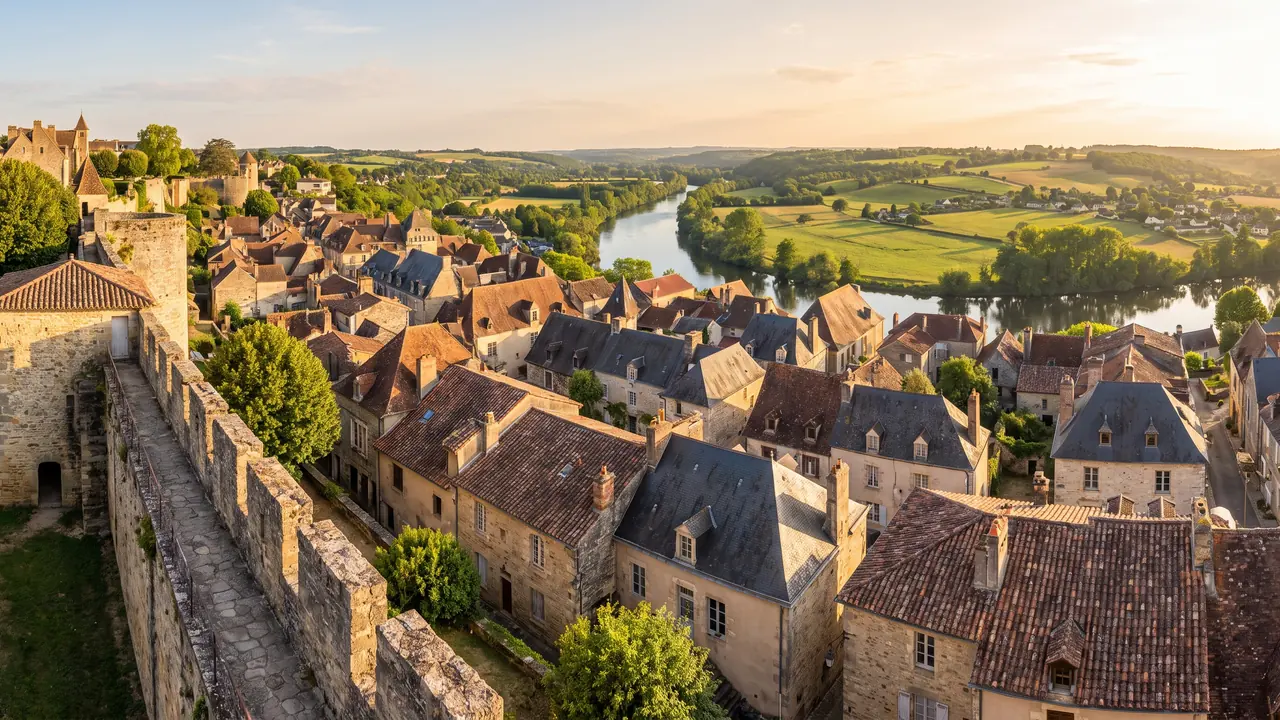
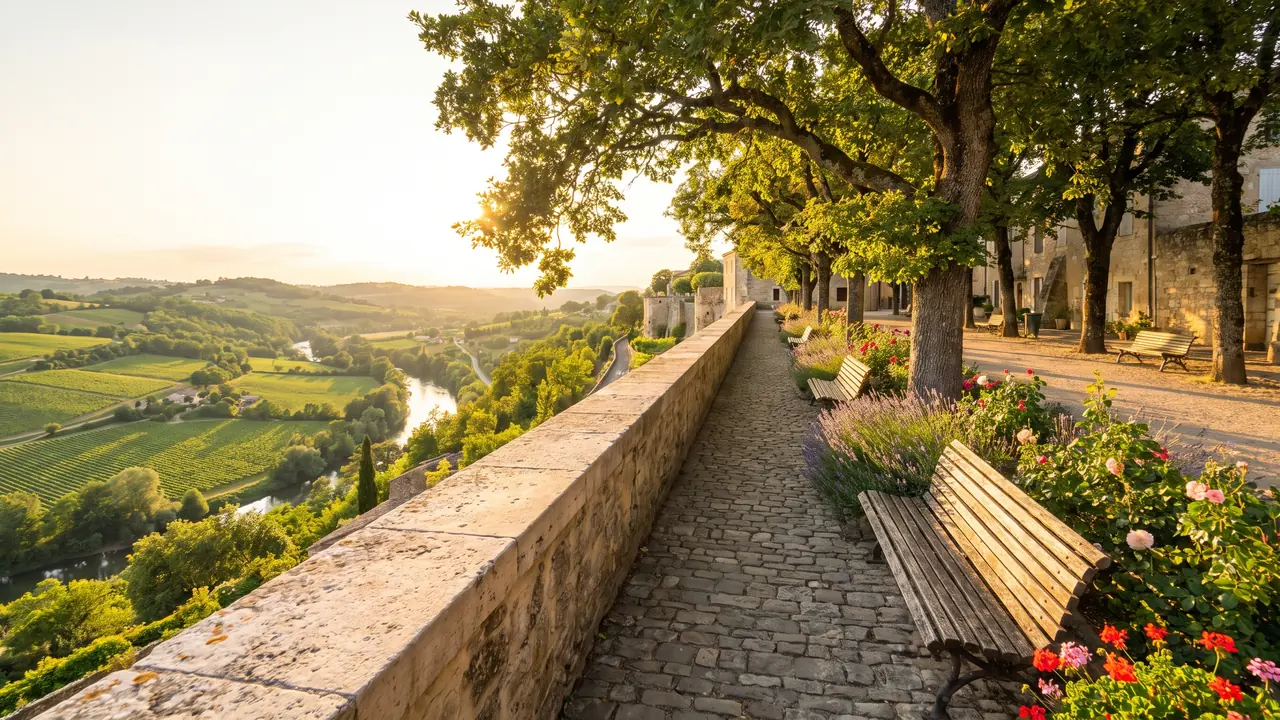
What gives Angoulême its fortress-like appearance are its city walls. The city walls of the Upper Town extend for approximately 2,280 meters and surround a plateau of about twenty hectares—nearly 24 to 25 hectares of the old town perched on the promontory. You can still see arrowslits and gun ports from the late 13th century, bearing witness to the square’s defensive functions. Today, the ramparts have been transformed into a scenic walk: as you walk along the ramparts, with the Charente Valley spreading out below, you can see at a glance why the city remained impregnable for so long. This is one of the great pleasures of a visit: walking around the plateau at the top, with the drop-off on your left.
Listed, not classified
It’s worth clarifying a point of terminology, since it comes up often. The ramparts of Angoulême are listed as Historic Monuments by an order dated December 18, 1958 — POP record PA00104228 — and not classified. The two designations are not synonymous: listing provides a basic level of protection, while classification offers enhanced protection. The cathedral, for example, is classified; the ramparts, on the other hand, are listed. This distinction is important for anyone seeking to describe the city’s heritage accurately, and it illustrates a broader reality: Angoulême has a total of 38 protected monuments. Under the Historic Monuments designation, a minority are classified and a majority are listed. Few cities of this size can boast such a collection.
The great thing about Angoulême’s ramparts is that you can walk the entire length in one go. The route encircles the upper town and transforms the defensive wall into a boulevard for strolling, dotted with gardens, benches, and scenic viewpoints. You move from the tiled rooftops to the green valley, from the cathedral square to the towers of City Hall, without ever losing sight of the horizon. It’s also the best way to get a feel for the city’s topography: as you walk around the plateau, you’ll see how the city has nestled within the shelter of its walls, hugging its narrow streets, while the suburbs slope down toward the river. Be sure to wear comfortable shoes and set aside some time: the loop is worth taking your time to explore, camera in hand, preferably at the end of the day when the light skims across the light-colored stone.
City Hall and the Counts' Castle
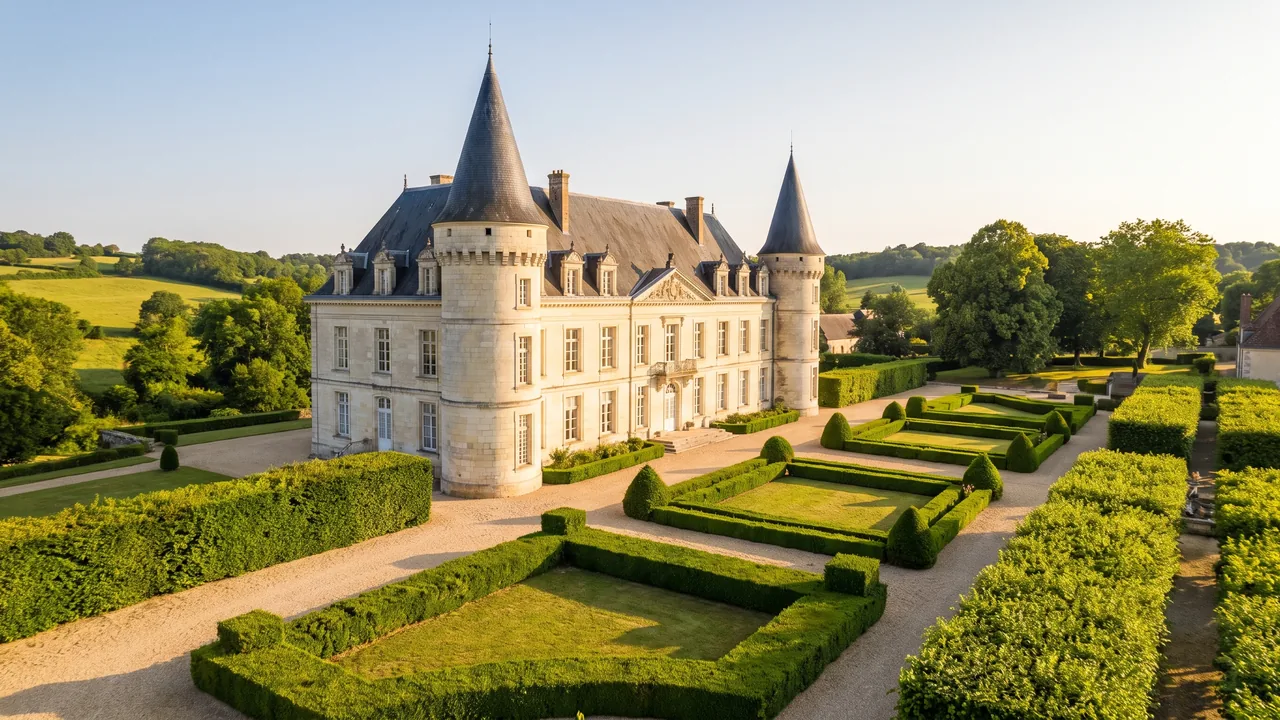
In the heart of the Upper Town, the city hall stands on the site of the former Castle of the Counts of Angoulême. Once again, we owe this to Paul Abadie, who built it between 1858 and 1869 in an eclectic neo-medieval style, on the ruins of the count's fortress. The building is Designated a Historic Monument in 2013 — POP record PA00104211. But the site’s main attraction lies in what Abadie chose to preserve: two towers from the old castle, incorporated into his 19th-century building. These two towers are not from the same period and do not resemble one another; confusing them is the most common mistake people make here. On the contrary, they must be carefully distinguished, as each tells a different story of the count’s power in Angoulême.
Two towers that should not be confused
The first is the Lusignan polygonal keep, built in the 13th and 14th centuries by this powerful family that ruled the region—a massive, defensive tower with cut-off corners. The second is a round tower, known as the Valois Tower or Marguerite Tower, built in the 15th century. The two should neither be merged nor redated: they are indeed two separate works, one polygonal and medieval, the other round and from a later period. This detail is not merely a scholar’s quirk: the round tower of Valois is precisely the one where, in 1492, one of the great figures of the French Renaissance was born, as we shall see later. By incorporating these two landmarks into its town hall, Abadie has preserved the memory of the count’s castle at the heart of today’s administrative center.
From the Count's Castle to City Hall
The history of this site alone encapsulates the history of Angoulême’s power. Where the residence of the Counts of Angoulême—the Lusignans, then the Valois-Angoulême—once stood, the town hall of Angoulême now stands, crowned by its two preserved towers. The transition from feudal castle to republican city hall, which took place in the 19th century, illustrates a transformation experienced by many French cities: the lord’s fortress gave way to the city’s administrative center. In Angoulême, this transition is particularly evident, since the medieval ruins were not demolished but reused, framing Abadie’s neo-medieval main structure. Today, it is one of the landmarks of the upper town, just a short walk from the cathedral and the ramparts, and a good starting point for understanding the topography of the plateau.
Angoulême, the capital of comics
It's the headline that made headlines around the world: Angoulême, "comic book capital". Just to be clear from the start, so there’s no confusion: this is a nickname and a cultural label, which grew out of a festival founded in 1974 and has become an established institution over the decades, rather than from an official administrative status. That said, the label is firmly grounded: the city is home to an internationally renowned festival, a major museum dedicated to the ninth art, a school and a program specializing in visual arts, and a trail of giant murals that make comics a permanent part of the urban landscape. You could spend an entire day there without exhausting the subject. Three hubs form the backbone of this “comic book planet”: the winter festival, the International City of Comics and Visual Arts beside the river, and the painted walls scattered throughout the city.
The International Comics Festival
The International Comics Festival (FIBD) began in 1974. Its first edition, held from January 25 to 27, 1974, drew approximately 10,000 visitors to a wing of the Angoulême Museum, on the initiative of Francis Groux, Jean Mardikian, and Claude Moliterni. Originally called the “Salon” (from 1974 to 1996), it was later renamed the “Festival” and is held every year in late January. Its current attendance is around 200,000 visitors — a ratio of 1 to 20 compared to the first edition, in a city with just over 40,000 residents. Its most prestigious awards are the Angoulême City Grand Prix, which honors an author for their entire body of work, and the Golden Fauve, awarded to the best album of the year. For four days, the entire city is transformed into a giant open-air bookstore.
An important update to keep in mind before planning a trip: the 2026 edition of the festival has been canceled (announced on 1st December 2025), amid an institutional conflict, and replaced by a free “Grand OFF” running from 29 January to 1st February 2026. The festival’s history at the Cité de la bande dessinée. It’s therefore a good idea to check the festival’s schedule and dates with the organizers before planning a trip: the event takes place usually in late January, though the exact dates vary from year to year. For the rest of the year, the city embraces its comic book heritage on a daily basis through its Cité, its specialty bookstores, and its trail of murals—all of which help capture the spirit of the festival even outside of its main week.
The International City of Comics and Visual Arts
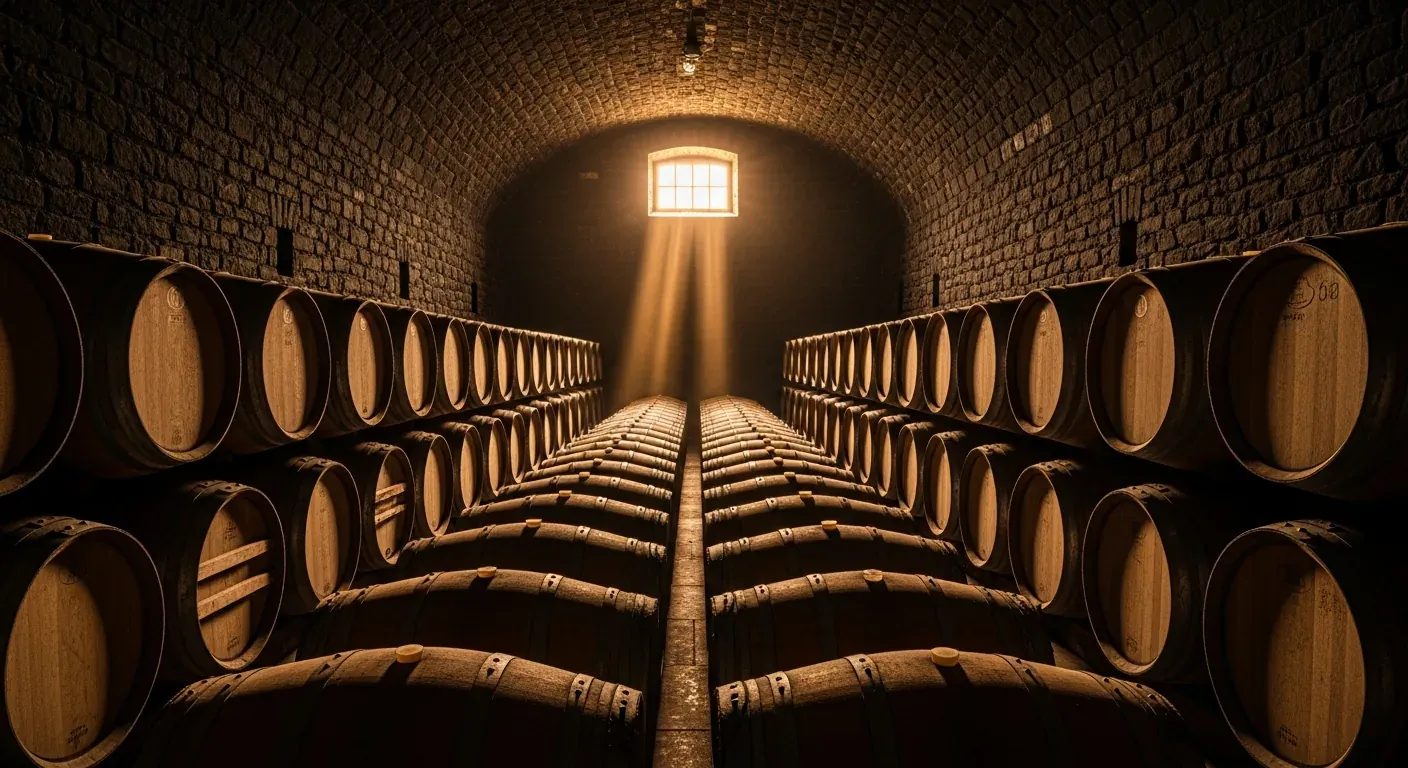
The International City of Comics and Visual Arts (CIBDI) brings together several facilities dedicated to the ninth art. Its official website presents the Comic Book Museum, its collections, and visitor information (accessed July 24, 2026). Housed in the former wine cellars along the Charente River, the museum offers an exhibition dedicated to the history of comic books and their creators.
The Painted Walls Trail
Here, comic art spills out of museums and takes over building facades. The Painted Walls Tour features between 20 and 30 monumental murals—Corto Maltese, Asterix, Titeuf, Blake and Mortimer, as well as works by Schuiten, Boucq, Zep, and Dupuy-Berberian. The first painted wall dates back to 1982, as part of the “Walls in France” initiative launched by Jack Lang and inspired by the Icelandic artist Erró. The collection is now considered one of the most important in the world, often ranked second only to Brussels. It’s the most carefree and fun way to explore the city: a stroll with your nose in the air, from gable to gable, searching for the heroes of your childhood as you wander the streets.
| Comic-book institution | What It Is | Good to Know |
|---|---|---|
| Festival (FIBD) | A major event established in 1974, with ~200,000 visitors | Usually in late January · 2026 edition canceled; check the dates |
| City of Comics (CIBDI) | Comic Book Museum, Media Library, Authors' House | In former wine cellars on the banks of the Charente · museum opened in 2009 |
| Painted Walls | ~25–30 giant murals throughout the city | Free walking trail · first wall built in 1982 |
Marguerite of Angoulême and the Valois
Long before comic books, Angoulême was the birthplace of one of the great families of the French Renaissance: the Valois-Angoulême. It was here, in the round tower of the count's castle, that Marguerite of Angoulême was born on April 11, 1492. She was the daughter of Charles d'Orléans, Count of Angoulême, and Louise of Savoy. After becoming Queen of Navarre and a patron of the arts and humanists, she was the author of the Heptaméron, a collection of short stories that remains famous. This powerful and witty woman is the older sister of the future Francis I, and, through her daughter Jeanne d'Albret, the grandmother of the future Henry IV. Angoulême can thus take pride in being the birthplace of one of the most influential figures in French royalty, just a few steps from its cathedral.
Francis I was not born in Angoulême
This is where the most common pitfall in all the guidebooks on the region lies, and it’s best to address it head-on. We often read that Francis I is said to have been born in Angoulême : this is false. The future king was born on September 12, 1494, at the Château de Cognac, about fifty kilometers away. Only his older sister, Marguerite, was actually born in Angoulême, in 1492. The misunderstanding stems from the character’s title: François was Count of Angoulême, a title he inherited from his father, Charles d'Orléans, before becoming king. He is sometimes referred to as the “Duke of Angoulême,” but this is inaccurate: the county was not elevated to the status of duchy until 1515, and the title of “Duke of Angoulême” was primarily held, much later, in the 19th century, by Louis-Antoine d'Artois, a namesake not to be confused with the Renaissance king.
The Angoumois: A Land of Paper Manufacturing
Angoumois, the former county of which Angoulême was the capital, was also one of the major centres of the French paper industry. The Charente Valley and its tributaries were home to one of the oldest paper-making industries in the kingdom: the first documented paper mill in the Charente region, the Négremus (or Négre-Mure), converted from a former fulling mill in 1516, was located in Palluaud, on the Lizonne River, and was part of a priory affiliated with Saint-Cybard Abbey in Angoulême. Another mill was established in 1533 by Étienne de Prouzac in La Couronne. These original mills were located in neighboring towns, not in Angoulême itself, but it was indeed the Angoumois region that produced these papers as early as the 16th century. They are recognizable by their iconic watermark, “the ship and the sphere.” From the paper of yesterday to the images of today, the city’s thematic continuity is striking: five centuries of expertise in the art of paper and imagery.
What is there to do in Angoulême?
In Angoulême, you can spend a wonderful day without ever getting back in the car, since the Upper Town is packed with so many attractions. First, head up to admire the cathedral's sculpted facade, follow the ramparts for sweeping views, then hunt for painted walls with your eyes raised before heading down toward the river for the Comic Book City. Museum lovers are spoiled for choice: the Angoulême Museum and its famous Celtic helmet, and the Paper Museum housed in former factories. As for markets, Les Halles is open almost every morning. And depending on the season, two major events mark the year: the Circuit International des Remparts, a classic car race in September, and the Musiques Métisses festival at the start of summer. Here are some must-see activities to check out while you're there.
- Admire the facade of St. Peter's Cathedral: more than 70 figures carved around the Ascension and the Last Judgment, a 12th-century “comic book in stone”, listed as early as 1840.
- Take a walk along the ramparts: 2,280 meters of ramparts transformed into a scenic promenade, offering a bird's-eye view of the Charente Valley.
- Follow the route of the painted walls: About 20 to 30 giant murals (Corto Maltese, Asterix, Titeuf…), which you can explore for free as you walk around the city.
- Visit the Cité de la bande dessinée (CIBDI): The Comic Book Museum, with its collection of more than 25,000 original comic book pages, housed in former wine cellars along the river.
- Explore the Angoulême Museum: Opened in 1920 in the former bishop's palace, next to the cathedral; it houses the famous Agris Helmet, a 4th-century BC Celtic helmet made of gold-plated iron (discovered in Agris, about 25 km away).
- Visit the "Le Nil" Paper Museum: Housed in a former paper mill on the banks of the Charente River, it has served as a museum since 1988, offering insight into the Angoumois region’s paper-making heritage.
- Shopping at Les Halles: Central covered market made of metal, glass, and cast iron, open Tuesday through Sunday mornings (approximately 7 a.m.–1 p.m.).
- Time your visit to coincide with a major event: the Circuit des Remparts (vintage cars, 3rd weekend in September) or Musiques Métisses (world music, early June).
Three museums not to be confused with one another
Watch out for a common pitfall: Angoulême has three separate museums, which should not be confused with each other. The Angoulême Museum is the municipal museum of fine arts and archaeology, which opened in 1920 in the former bishop’s palace, next to the cathedral, and was renovated from 2002 to 2008. It showcases the archaeology and prehistory of the Charente region, art from Africa and Oceania, and fine art from the 16th to the 20th century. It houses the Agris Helmet, one of the most beautiful examples of European Celtic art. The comic book museum, on the other hand, is run by the CIBDI and is located in the wine cellars along the river. Finally, the "Le Nil" Paper Museum, which opened in 1988 in the former Lacroix/Joseph-Bardou paper mills (closed in 1972), tells the story of the paper industry. Three locations, three addresses, three worlds: it’s best to choose based on your personal taste.
A racetrack that hasn't changed since 1939
Depending on the season, there are two major events worth planning your trip around. The Circuit International des Remparts is a rare curiosity: an urban racetrack that hasn't moved a single meter since it was built. Designed in 1938–1939, it hosted its first race on July 2, 1939, won by Raymond Sommer. Its 1,279-metre, seven-turn circuit, running along the ramparts of the upper town, has remained unchanged since 1939 — making it one of the last urban circuits in France, along with Monaco and Pau. From its very beginnings, it has seen racing legends such as Sommer, Trintignant, and Wimille compete behind the wheel of iconic brands: Bugatti, Alfa Romeo, Delahaye, and Maserati. Now a major classic car gathering, it takes place every third weekend in September; the 54th event is scheduled for 18–20 September 2026.
Musiques Métisses, at the start of summer
Musiques Métisses is one of the oldest world music festivals in France: founded in 1976, it will celebrate its 50th anniversary in 2026. Contrary to a persistent misconception, it does not take place in September but in spring or early summer. The 2026 edition is scheduled for June 4, 5, and 6, traditionally around Pentecost. It takes place on the esplanade of the Magelis wine cellars, on the banks of the Charente River, in the same cultural district as the Cité de la BD. Here’s how to avoid a common scheduling mistake: if you’re looking for the music festival, you’ll need to come in June; only the Circuit des Remparts takes place in September. Two dates, two atmospheres—be sure not to mix them up.
| Activity | Where / When | Good to Know |
|---|---|---|
| St. Peter's Cathedral | Upper Town | Facade featuring over 70 figures · listed since 1840 |
| Tour of the City Walls | Upper Town | ~2,280 m · scenic walk |
| Walls Painted with Comic Book Motifs | The whole city | Free walking tour · ~25–30 murals |
| City of Comics (CIBDI) | Charente Riverbank | Musée de la BD · >25,000 original pages |
| Angoulême Museum | Former Bishop's Palace | Agris Helmet · opened in 1920 |
| Les Halles Market | Place des Halles | Tuesday through Sunday morning (approx. 7 a.m.–1 p.m.) |
The Charente River and the Green Corridor
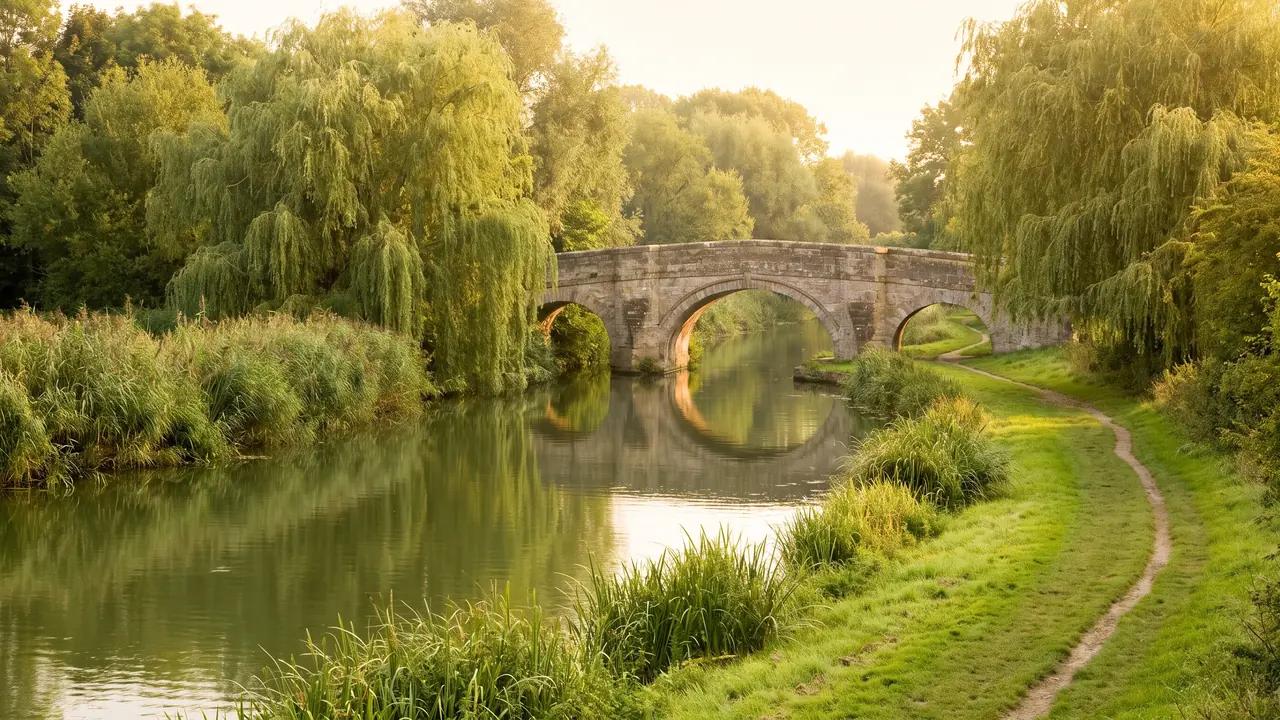
Below the upper town flows the Charente, and here, along the waterfront, another side of Angoulême unfolds: greener, more peaceful, and geared toward walking and biking. The river here is navigable all the way to the sea, dotted with locks and small arched bridges, and its banks have been transformed into a long ribbon of nature that winds through the city. It’s the perfect way to round out a morning spent in the hilltop alleyways: after exploring the Romanesque stonework and the ramparts, head down to take a breath of fresh air along the water’s edge. Two itineraries guide this exploration: the green corridor for a local stroll and the Flow Vélo for long-distance cyclists; you can also travel by water, as long as you know where the boats actually depart from.
The Green Corridor and Flow Vélo
The green corridor is a former towpath that has been converted for use by pedestrians and cyclists, running for approximately 20 kilometers between Saint-Yrieix-sur-Charente and Nersac, as it winds through Angoulême. Lined with small ports and locks, it offers a flat, shaded path away from traffic—ideal for a late-afternoon stroll. More ambitious cyclists will hop on the Flow Vélo, a bike route connecting the Dordogne (at Thiviers) to Île d'Aix, in Charente-Maritime, over a distance of approximately 290 kilometers — up to about 350 km, including its extensions. It runs along the Charente River and passes through Angoulême, making the city a natural stop on this long-distance route. In between, everyone can set their own pace: whether it’s an hour-long stroll after a meal or a multi-day bike trip along the river.
Where can I board the river cruise?
A word of caution for river-cruise enthusiasts, as there is often some confusion. The main gabare cruises, aboard traditional flat-bottomed boats, do not depart from central Angoulême. They set off from Saint-Simon, downstream on the Charente River, and from Saintes. In Angoulême itself, you’ll find mostly small pleasure boats and, above all, the greenway where you can walk or bike along the river. So it’s best not to attribute to the city what belongs to its neighbors: if you’re tempted by a gabare ride, you’ll have to go a little further downriver to experience it. For a combined excursion, an executive car service can take you to Angoulême’s upper town in the morning and then to Saint-Simon for a boat ride in the afternoon, without any logistical hassles.
Strolling through the Old Town
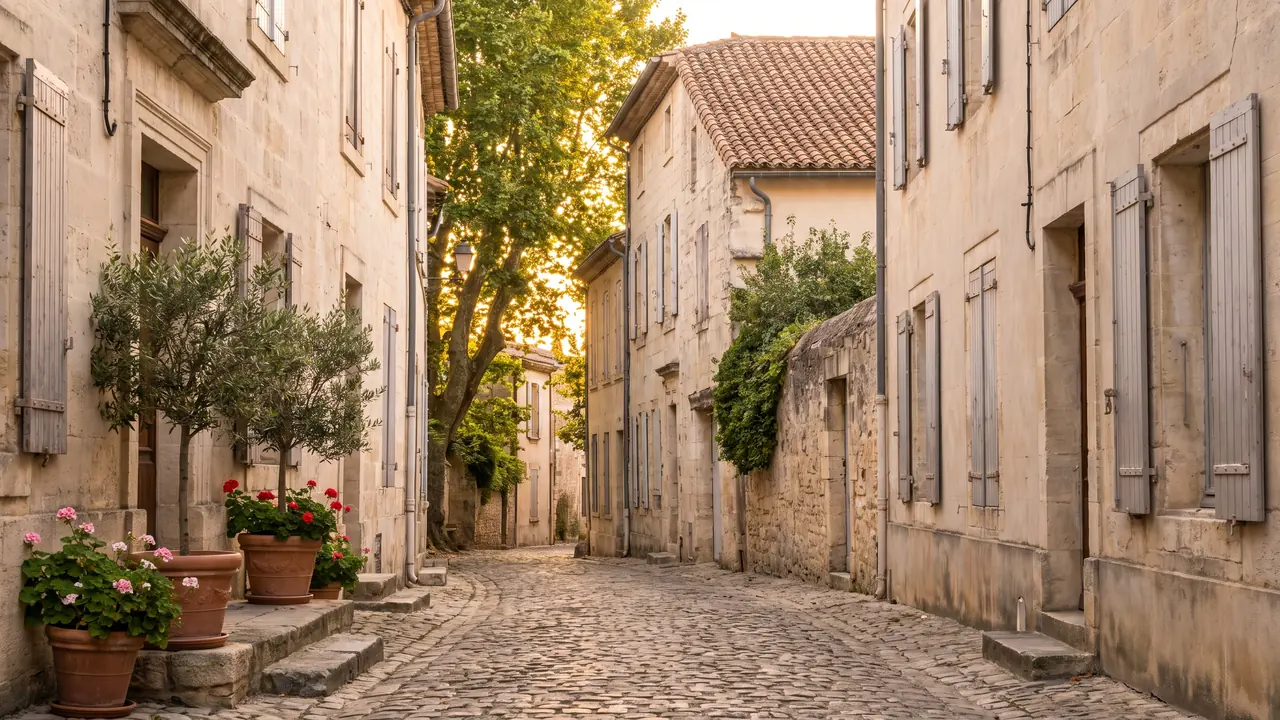
Beyond its major landmarks, Angoulême is best enjoyed on foot, as you wander through its Upper Town (within the city walls). The entire plateau can be explored on foot: cobblestone alleys, light-stone mansions, small squares, and sudden views of the valley from a corner of the ramparts. Everything is compact and interconnected—from the cathedral to City Hall, from Les Halles to the museum, you can walk from one point of interest to another in just a few minutes. It has the atmosphere of a hilltop city of art, both provincial and refined, where you take the time to look up: here a sculpted facade, there a painted wall rising between two buildings, further on a glimpse of a panoramic view. Strolling here is an activity in its own right, and undoubtedly the best way to experience the spirit of the place.
The Joy of Walking on the Plateau
The Upper Town is designed for pedestrians, and that’s one of its greatest assets. Distances are short, the views keep changing, and every street holds a surprise: an old archway, a comic book store sign, a monumental mural. You’ll alternate between narrow alleyways and open squares, stroll along the ramparts to enjoy the fresh air, and head back down to Les Halles for a gourmet break. Unlike many historic centers overrun by cars, the heart of Angoulême remains largely pedestrian-friendly, making a stroll both pleasant and safe. This is also why, upon arrival, it makes more sense to use a drop-off zone as close as possible to the old town rather than embark on a long search for parking: once you’re up there, you put away your map and let yourself be carried along.
The Upper Town is also revealed in the details of its stones. As you stroll around, you come across mansions light-colored limestone, a legacy of the days when the paper industry and trade brought prosperity to the Angoumois region, ancient porticos, and hidden courtyards. At every corner of the ramparts, a view opens up onto the valley: these points of view are one of the great pleasures of a stroll and change as the daylight shifts. Take the time to get lost: between the cathedral square, the town hall gardens, and the terraces overlooking the river, the upper town reveals itself in small glimpses, without a set itinerary. It is this freedom—walking without a plan, looking up, following a mural or a gap in the buildings—that gives Angoulême its unique charm and distinguishes a true stroll from a simple guided tour.
Around Angoulême
Angoulême is an ideal base for exploring the northern part of Nouvelle-Aquitaine. All around it lies the region of cognac, whose vineyards begin just a few kilometers away, and it’s less than an hour from several major historic cities. In half a day or a full day, you can combine the hilltop heritage of Angoulême with the Cognac distilleries, the Roman ruins of Saintes, or the medieval streets of Périgueux. This central location is what makes a stay in the region so convenient: you can settle in Angoulême and plan your excursions from there. Most of these destinations are accessible via fast, direct routes, allowing you to visit two in a single day without rushing, while leaving the logistics and scheduling to a driver who knows the region well.
Less than two hours
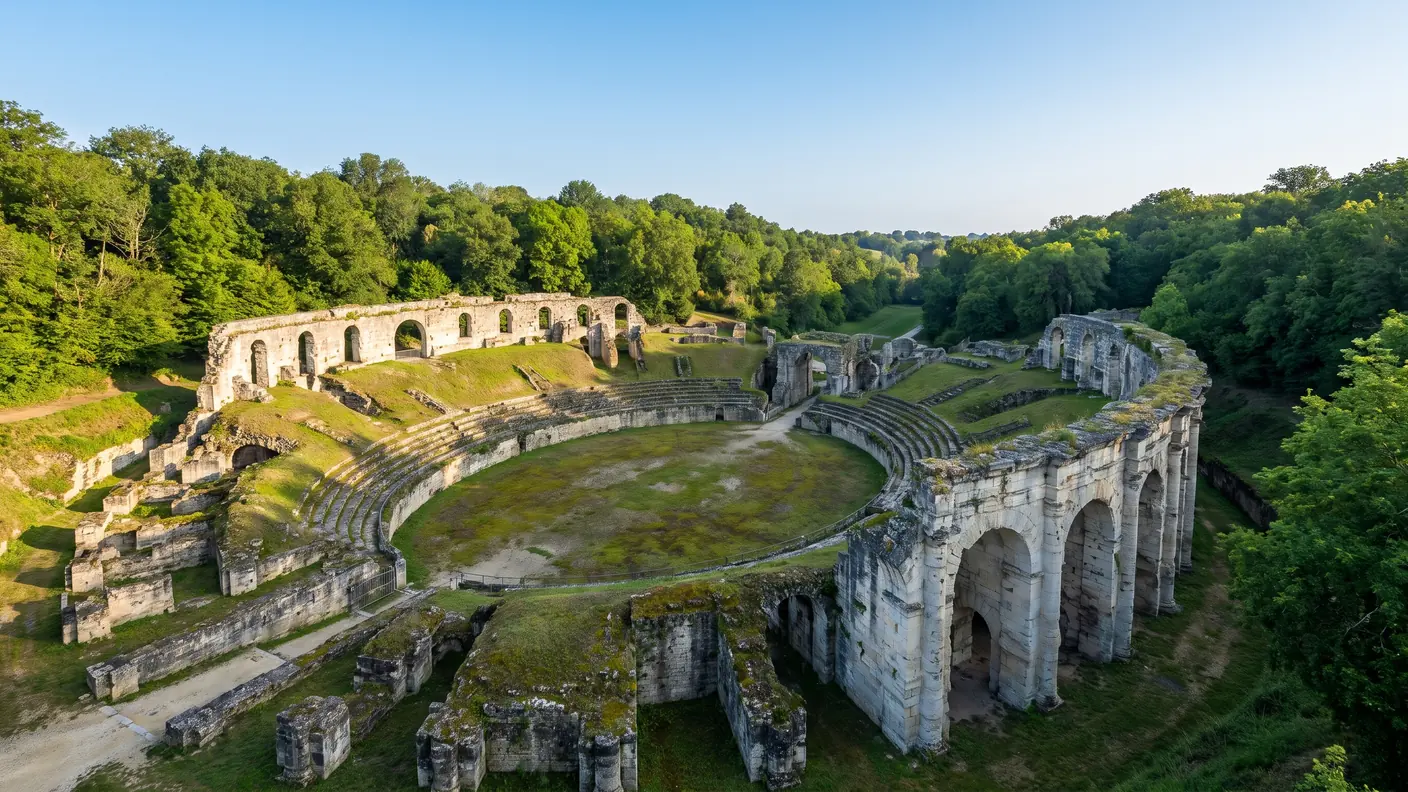
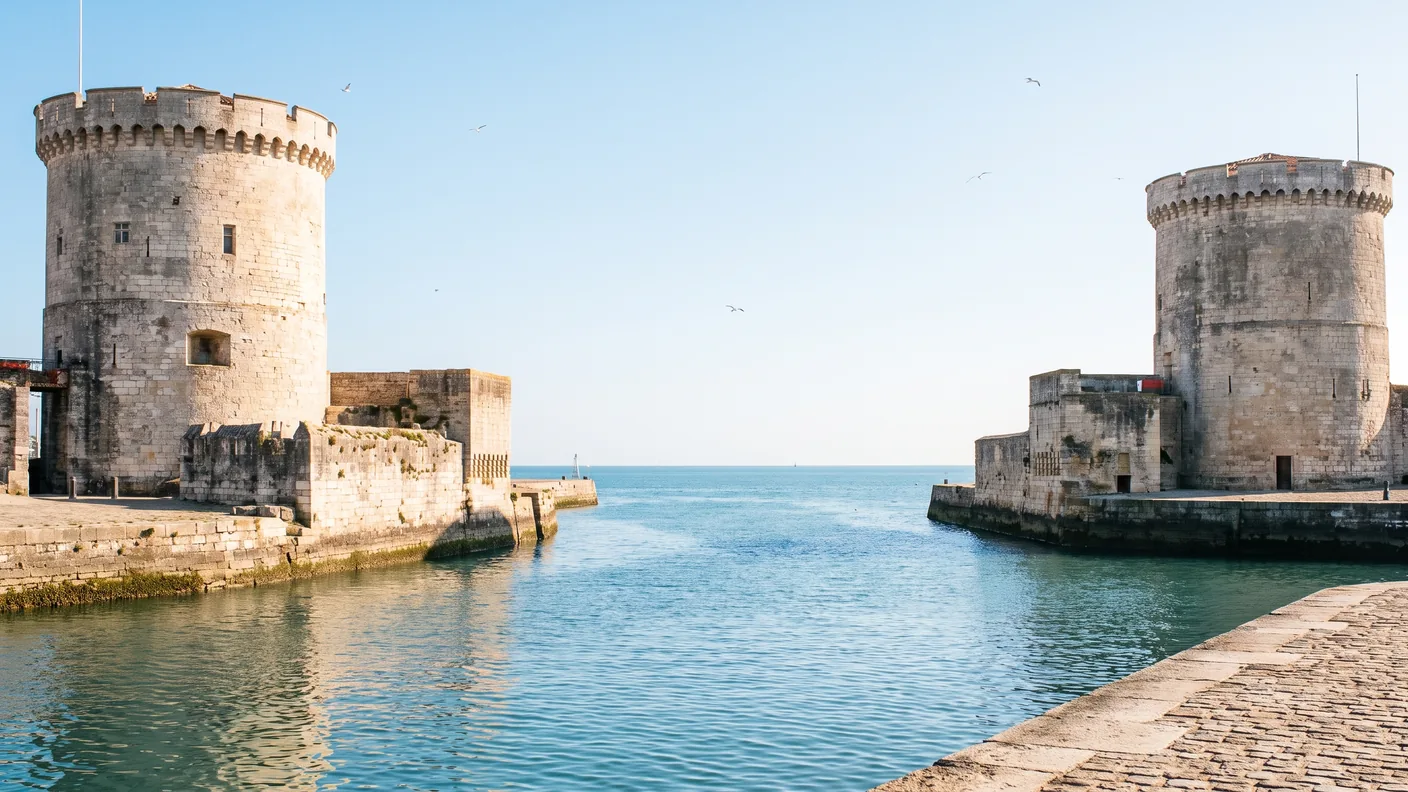
The most obvious destination is Cognac, just about a 45-minute drive away: it was there, need we remind you, that François Ist was born in 1494, and it is, above all, the world capital of brandy, where you can visit the major distilleries and cellars—see our Cognac Guide. Further down the Charente River, Saintes (~1 hr 10 min) features a Roman amphitheater and two gems of Romanesque art: our Saintes Guide describes the “Rome of Aquitaine.” To the south, Périgueux (~1 hr 30 min) and its Saint-Front Cathedral serve as the gateway to the Périgord; to the west, La Rochelle (~1 hr 50 min) and its Old Port lead to the Atlantic—check it out in our La Rochelle Guide. All of these routes can be easily connected by chauffeured car.
| Destination | Distance from Angoulême | Must-See |
|---|---|---|
| Cognac | ≈ 46 km · ~45 min | Wine cellars, distilleries, the castle where Francis I was born |
| Saintes | ≈ 75 km · ~1 hr 10 min | Roman Amphitheater, Abbaye aux Dames, Saint-Eutrope Basilica |
| Périgueux | ≈ 87 km · ~1 hr 30 min | Saint-Front Cathedral, Gallo-Roman city |
| La Rochelle | ≈ 150 km · ~1 hr 50 min | Old Port, three medieval towers |
Getting to Angoulême from Bordeaux
The easiest way to get to Angoulême from Bordeaux is to take the direct route via the A10 and then the N10. With a chauffeured transfer, you’ll depart from your address or Bordeaux-Mérignac Airport and arrive as close as possible to the Upper Town, without having to worry about parking in a largely pedestrianized downtown area or transferring to a train. This is especially convenient on festival days or during the Circuit des Remparts, when parking becomes a real headache and the train station, located below, still requires you to climb up to the plateau.
How much does the ride cost?
The route from Bordeaux to Angoulême covers about 127 km in 1 hour 40 minutes via the A10/N10. Our rates start at €244 during the day for a sedan carrying up to 3 passengers, a fixed price confirmed in writing before departure, with no meter and no surprise on arrival. The exact quote depends on the specific pickup address, the time of day (a surcharge applies at night, on weekends, and on holidays), and the vehicle selected; request a quote online for a quick response. A day trip to Cognac or a “heritage and vineyards” loop tour is also priced on a quote basis, with the same driver handling all routes and schedules.
| Route | Distance | Duration | From |
|---|---|---|---|
| Bordeaux → Angoulême | ≈ 127 km | ~1 hr 40 min | 212 € |
| Bordeaux-Mérignac Airport → Angoulême | ≈ 120 km | ~1 hr 35 min | based on a quote |
| Angoulême → Cognac (extension) | ≈ 46 km | ~45 min | based on a quote |
Why choose a chauffeur service?
A private chauffeur transforms the day: you can read, relax, or plan your visit during the ride, you’ll be dropped off as close as possible to the cathedral and the city walls, and we’ll pick you up wherever you’d like—at the foot of the Cité de la BD, after a Musiques Métisses concert, or following a Cognac tasting. This option is ideal for an outing with family or friends—without needing a designated driver—as well as for business travel. The vehicle is clean, air-conditioned, equipped with water, and driven by a uniformed driver, and you’ll travel at your own pace, free from the constraints of train schedules or the hassle of finding parking in the upper town.
Frequently Asked Questions
How much does a private driver cost from Bordeaux to Angoulême?
The trip from Bordeaux to Angoulême (approximately 127 km, 1 hour 40 minutes via the A10/N10) starts at 244 € during the day for a sedan carrying up to 3 passengers. The price is fixed, confirmed in writing before departure, and there is no meter. The exact amount depends on the pickup address, the time of day, and the vehicle selected.
How long does it take to get from Bordeaux to Angoulême?
Allow about 1 hour and 40 minutes by car—127 km via the A10 highway and then the N10 northbound. By train, the LGV high-speed line puts Angoulême about 35 minutes from Bordeaux, but the train station is located below the upper town, so you’ll need to make your way up there afterward.
In which department is Angoulême located?
Angoulême is the prefecture of Charente (16) in the Nouvelle-Aquitaine region. Be careful not to confuse it with Charente-Maritime (17), whose prefecture is La Rochelle. Angoulême, like Cognac, is indeed in Charente, inland, on a promontory overlooking the Charente River.
Why is Angoulême known as the “capital of comics”?
It is a nickname and a cultural label, stemming from the International Comics Festival founded in 1974, and not an official administrative status. Every winter, the city hosts this festival, is home to the Cité internationale de la bande dessinée, and features a series of giant murals along its streets.
Was Francis I born in Angoulême?
No, that's a common mistake. Francis I was born on September 12, 1494, at the Château de Cognac, about 50 kilometers away. Only his older sister, Marguerite d'Angoulême, was born in Angoulême, in 1492. François was Count of Angoulême, which explains the confusion.
What is there to see at Saint-Pierre Cathedral in Angoulême?
Its 12th-century Romanesque façade, carved with more than 70 figures depicting the Ascension of Christ and the Last Judgment, is a veritable “comic book in stone.” The cathedral has been designated a Historic Monument since 1840, and its bell tower rises to a height of 59 meters. It was restored in the 19th century by Paul Abadie.
Will the Angoulême Comic Book Festival take place in 2026?
The 2026 edition of the International Comics Festival was canceled (announced on December 1, 2025) amid an institutional conflict and replaced by a free “Grand OFF” event in late January. The festival is usually held in late January; it’s best to check the dates with the organizers before planning a trip.
What is the Angoulême Comics Festival?
The International City of Comics and Images (CIBDI), founded in 2008, houses the Comics Museum—the only “Musée de France” designated for comics—a media library, and the Maison des auteurs, all located in former wine cellars on the banks of the Charente River. Its collections include more than 25,000 original comic art pages.
Where can you see the comic-book murals in Angoulême?
A free walking tour connects about 20 to 30 giant murals throughout the city: Corto Maltese, Asterix, Titeuf, Blake and Mortimer, and works by Schuiten, Boucq, and Zep. The first mural dates back to 1982; the collection as a whole is one of the largest in the world.
Was the Helmet of Agris discovered in Angoulême?
No. This 4th-century B.C. Celtic helmet, made of gold-plated iron, was discovered in Agris, about 25 km to the northeast. It is, however, preserved and on display at the Angoulême Museum, which opened in 1920 in the former episcopal palace, next to the cathedral.
When does the Circuit des Remparts d'Angoulême take place?
The Circuit international des Remparts, a major classic car gathering, is held every third weekend in September—the 2026 event is scheduled for September 18–20. Its 1,279-meter street circuit, featuring seven turns, has remained unchanged since the first race in 1939.
Is it possible to take a gabare cruise from Angoulême?
Long-distance cruises on gabares do not depart from downtown Angoulême but from Saint-Simon, downstream, and from Saintes. From Angoulême, you’ll find small pleasure boats and, above all, the “coulée verte”—a 20-kilometer-long former towpath—where you can walk or bike along the Charente River.
Can the driver visit both Angoulême and Cognac in a single day?
Yes. Cognac is only about 45 minutes from Angoulême. Many guests combine a morning tour of Angoulême’s Upper Town with an afternoon tasting at the cognac houses, all with the same driver who handles the transportation and schedule. This “heritage and vineyards” tour is priced on a per-trip basis.
Further Reading
- The Cognac Capital: see the Cognac Guide (the distilleries and the castle where Francis I was born, 45 minutes from Angoulême)
- The Rome of Aquitaine: see the Guide to Saintes (The Roman amphitheater and Romanesque art, both on the Charente River)
- The Old Port: see the Guide to La Rochelle (the three medieval towers and the Atlantic Ocean)
- Plan the journey: see The private chauffeur service from Bordeaux to Angoulême and its flat rate, then Submit your reservation request.
Sources and References
- Angoulême Tourism — cathedral, ramparts, painted walls, calendar of events
- International City of Comics and Visual Arts (CIBDI) — Comic Book Museum, Statistics
- Mérimée Database / POP (Ministry of Culture) — Cathedral PA00104203, City Hall PA00104211, City Walls PA00104228
- Cité de la BD — the International Comics Festival — FIBD, History, Publications
- INSEE — Municipality of Angoulême (16015) — demography
- Angoulême Museum — Agris Helmet, Collections
Article updated on July 17, 2026.