
Bordeaux to Coussac-Bonneval: a thousand years of Limousin history
A village in Upper Limousin, in the Haute-Vienne department, on the border between Périgord and Corrèze. Its castle has been held by the same family for a thousand years; a workshop there minted gold in the 7th century; and Bonneval Pasha, the reformer of the Ottoman artillery, was born there. About 2 hours and 45 minutes from Bordeaux.
Coussac-Bonneval at a Glance
- Coussac-Bonneval, whose residents are known as Coussacois, is a rural commune in the southeastern part of Haute-Vienne (87500), in the Limousin region, on the border between Périgord and Corrèze.
- Its castle in Bonneval has been in the same family for about a thousand years—some thirty generations—a continuity of ownership that is extremely rare in France.
- The Historical Dictionary of the Haute-Vienne Departmental Archives, consulted in July 2026, describes a trient attributed to the Cociaco workshop, bearing the inscriptions “COCIACO FIT” and “BONOALDO MO.”
- This is where Claude-Alexandre de Bonneval was born—the officer under Louis XIV who became Bonneval Pasha, the reformer of the Ottoman artillery in the 18th century.
- Its fortified Gothic Church of Saint-Saturnin is listed as a Historic Monument; the village also preserves a medieval lantern of the dead.
- The town has lost nearly two-thirds of its population since its peak of 3,672 residents in 1901—it now has 1,262 residents, spread across a vast area of 66.73 km².
- From Bordeaux: ~227 km, about 2 hours and 45 minutes by car — starting at €380 with a private driver. No train station (the nearest one is Saint-Yrieix-la-Perche).
Before You Go: What Coussac-Bonneval Really Is
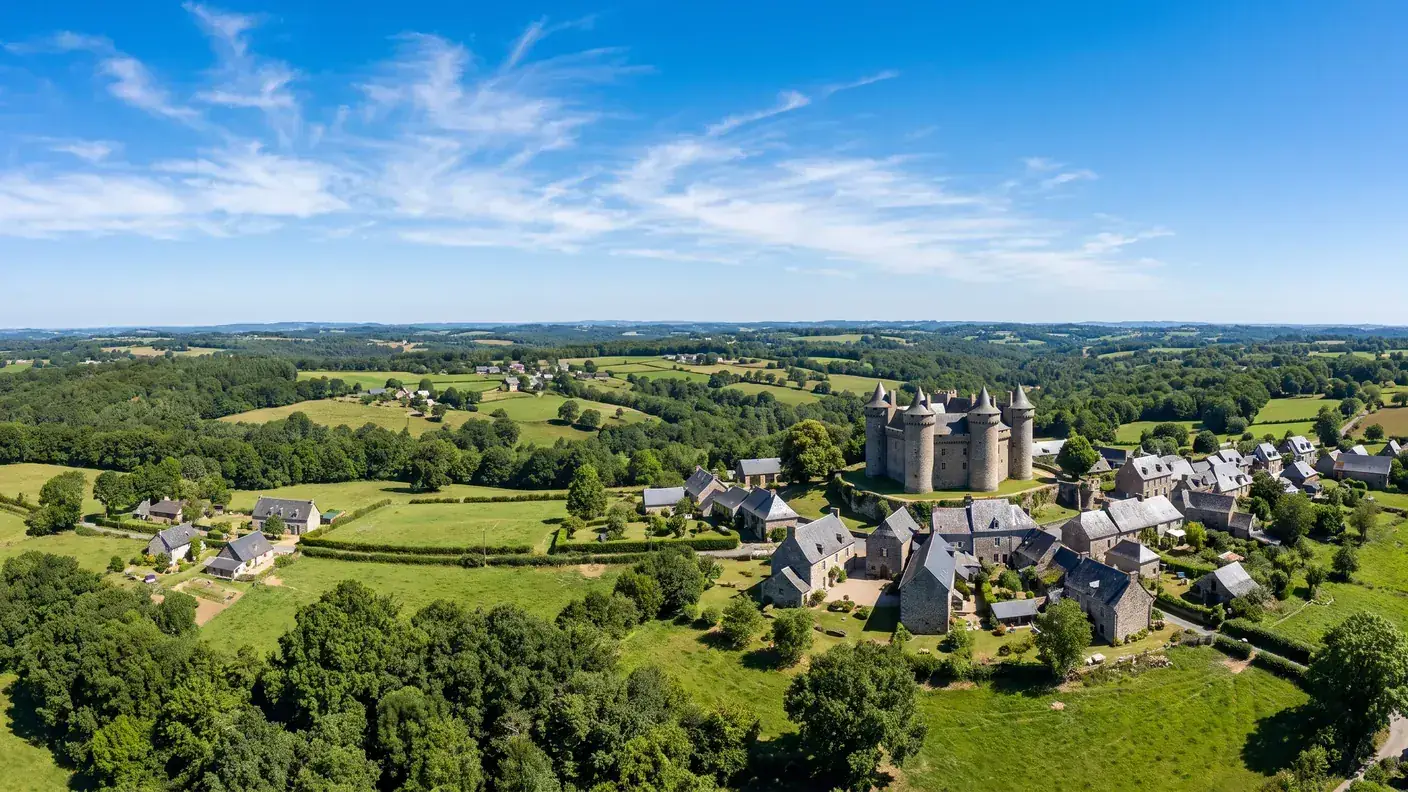
One morning on the high plateau of Limousin. On the border between Périgord and Corrèze, a large medieval castle watches over a village built of gray granite, its four round towers topped with slate dominating the countryside. At first glance, nothing sets Coussac-Bonneval apart from the other villages deep in the Limousin—except for three extraordinary stories: that of a family that has owned the same castle for a thousand years, that of a workshop that minted gold thirteen centuries ago, and that of a local boy who became a pasha in Constantinople. Welcome to Coussac-Bonneval, a quiet village with a history that stretches back through the ages.
Coussac-Bonneval lies in Limousin, in the southeastern part of Haute-Vienne, in a transitional zone between the Périgord and the Bas-Limousin region of Corrèze. It is a region of hills, forests, and wooded countryside, off the beaten path of major tourist routes—yet with an extraordinary wealth of history, making it a prime destination for lovers of heritage and genealogy.
This guide distinguishes between verified facts and approximations, because even the most wonderful stories are sometimes told inaccurately. The Mérimée entry for the castle, accessed in July 2026, confirms its listing as a Historic Monument and describes the current building as a structure whose construction began in the 14th century. The document from the Haute-Vienne Departmental Archives describes the gold coin and its two distinct inscriptions, COCIACO FIT and BONOALDO MO.
In terms of access, Coussac-Bonneval is landlocked and has no train station (the nearest one is in Saint-Yrieix-la-Perche). Allow about 2 hours and 45 minutes from Bordeaux. To explore the castle, the church, and the surrounding area—including Saint-Yrieix and Pompadour—without worrying about the route, a chauffeur service from Bordeaux remains the simplest door-to-door option.
A Vast Territory Where Three Historic Regions Meet
Coussac-Bonneval is located in the southeastern part of Haute-Vienne, on the border of Limousin, Périgord, and Corrèze—a transitional zone between the oceanic influence of Aquitaine and the more continental climate of the Massif Central. The territory is vast for the region: 66.73 km² (6,673 hectares), making it one of the largest municipalities in the area, yet it has a population density of only 19 inhabitants per km². It is a rural area with very scattered settlements, dominated by farmland (more than 70%) and forests, on a plateau ranging in elevation from 280 to 454 meters.
Eight neighboring towns, two departments
The town is surrounded by eight neighboring towns, straddling two departments: Château-Chervix, Meuzac, La Roche-l'Abeille, Saint-Priest-Ligoure, and Saint-Yrieix-la-Perche in Haute-Vienne; Lubersac, Montgibaud, and Saint-Julien-le-Vendômois in Corrèze. This border location is significant: it reflects the former area of contact between Upper Limousin and Lower Limousin in Corrèze, a cultural reality dating back to the Ancien Régime. Today, Coussac is part of the Pays de Saint-Yrieix Community of Municipalities.
| Data | Value |
|---|---|
| ZIP Code / INSEE | 87500 / 87049 |
| Department / Region | Haute-Vienne / Nouvelle-Aquitaine (Limousin) |
| Intermunicipal Cooperation | Pays de Saint-Yrieix Community of Communes |
| Area | 66.73 km² (6,673 ha) |
| Elevation | 280 m to 454 m |
| Population | 1,262 residents (2023) — the residents of Coussac |
| Density | ~19 people per km² |
| Must-See | Bonneval Castle (Historic Monument), Saint-Saturnin Church (Historic Monument), the "Lantern of the Dead" |
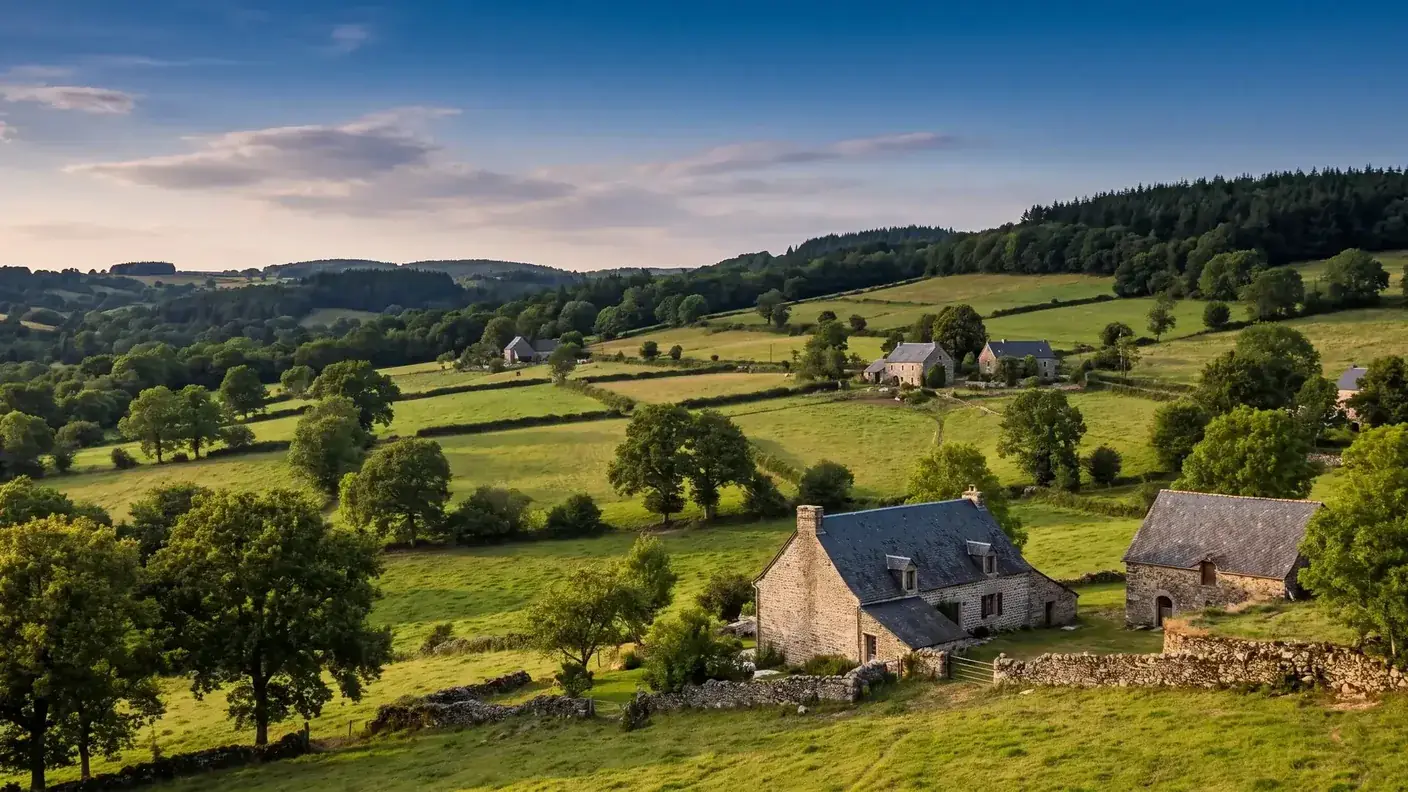
We're in the Deep Limousin: long stretches of meadows bordered by hedgerows, oak and chestnut woods, scattered granite hamlets, and a few ponds. A region that once had a population of nearly four thousand and now thrives on agriculture, forestry, and niche heritage tourism—centered, above all, on its thousand-year-old castle.
One of the most dramatic population declines in the Limousin region
What is striking about the history of Coussac-Bonneval is the scale of its decline. We tend to imagine French villages as having always had a few hundred residents—but that’s not the case here. Coussac was a large town, almost a small rural town. In the 1901 census, it had 3,672 residents— nearly three times its current population. Since then, it has lost nearly two-thirds of its residents.
| Year | Population |
|---|---|
| 1793 | 2,363 residents |
| 1886 | 3 597 |
| 1901 | 3,672 (all-time high) |
| 1921 | 3,154 (after World War I) |
| 1968 | 2 008 |
| 2023 | 1,262 residents |
A peak reached as early as 1896
The figure of 3,672 residents warrants further clarification: this peak is not an isolated high point but a plateau, reached twice—in the 1896 census and again in the 1901 census; the decline began as early as 1906, with 3,581 residents. The rise had been long and steady: 2,711 residents in 1821, 3,007 in 1851, 3,597 in 1886—nearly a century of continuous growth, driven by agriculture, which at the time employed the majority of the canton’s workforce.
Wars, followed by rural exodus
Each break in the curve tells the story of France. The First World War depopulated the countryside of its young men: Coussac lost about 350 residents between 1911 and 1921. The Second World War dealt another blow. But above all, it is the rural exodus during the Glorious Thirty (1950–1980), a period that transformed the village: agricultural mechanization, the disappearance of small farms, and the pull of the cities. In the span of a generation, between 1946 and 1975, the population was nearly halved.
The decline in population can be traced census by census: 2,635 residents in 1946, 2,008 in 1968, 1,723 in 1975, 1,447 in 1990, and 1,379 in 1999. In total, since the peak in 1896–1901, the municipality has lost approximately 66% of its population—one of the sharpest declines in the Limousin region, despite the fact that its territory has remained unchanged at 66.73 km².
Since the 1990s, the population has continued to decline, albeit at a much slower rate, hovering around 1,300 residents (1,262 in 2023, a decrease of 4.18% compared to 2017). Coussac-Bonneval remains a typical rural area of the Limousin region, with scattered settlements—yet every hamlet and every farm bears traces of a time when the countryside was much more densely populated than it is today.
Coussac and Bonneval: An Ancient Estate and a Family
The town’s name combines two very distinct realities. “Coussac” has its roots in antiquity: it derives from the Gallo-Roman estate Cocciacum, formed from the Latin personal name Coccius and the Gallic suffix -acum, which denotes ownership of an agricultural estate. This is a classic toponymic pattern in southwestern France, giving rise to countless names ending in “-ac.” The Occitan form Coçac has, in fact, survived through the centuries in the local language.
Bonneval, a family name
"Bonneval", on the other hand, has nothing to do with geography: it is the family name of the aristocratic family that owns the castle. And this family has a long history: the earliest known reference to it dates back to 1055, with a man named Géraud de Bonneval—making it one of the oldest noble families still living on their ancestral lands in the entire Limousin region. Their Occitan motto, "Victory against all odds" ("Victorious Against All Dangers") sums up the spirit of a lineage that weathered the Wars of Religion, the Revolution, and two world wars without ever losing its castle.
A telling detail of the Ancien Régime’s genealogical claims: the coat of arms engraved on the entrance tower in the 16th century bears the inscription “S.P.Q.R. ” (Senatus Populusque Romanus, “the Roman Senate and People”)—a claim to prestigious Roman ancestry, whether real or imagined, as certain noble families were fond of boasting.
1242: The Siege of the Bré Citadel
The region has not always been peaceful. In 1242, Gui IV, Viscount of Limoges, laid siege to and dismantled the nearby citadel of Bré—an event that restored Coussac’s strategic role in the feudal conflicts of the Limousin. It was against this backdrop of rival fiefdoms, motte-and-bailey castles, and towers that the Bonneval family built—and later preserved—their castle.
Gold Coinage in the 7th Century: The Merovingian Mint at Cociaco
This is where Coussac stands out from the other villages in the Limousin region. By the mid-7th century, during the Merovingian period, a mint operated here, striking gold coins under the Latin place name Cociaco. Very few rural towns in France can claim to have minted their own coins nearly 1,400 years ago.

A gold trient preserved at the BnF
The Historical Dictionary of the Haute-Vienne Departmental Archives, consulted in July 2026, describes a gold trient weighing 1.20 g attributed to Coussac and held in the Medal Collection of the National Library. It bears the inscription “COCIACO FIT” on the obverse and “BONOALDO MO” on the reverse.
A thorough reading of the inscriptions also sheds light on how these workshops operated. On the reverse, the full inscription is “X BONOALDO MO”: the “MO” is an abbreviation for monetarius, the official title of the mint master, while the “FIT” on the obverse literally means “made (at Cociaco).” This is the standard convention in Merovingian numismatics—the obverse indicates the place of minting, and the reverse the name of the mint master, who vouches for the metal’s fineness and weight. Only one mint master is thus attested for Coussac: Bonoaldo.
More than 800 workshops in Gaul
To appreciate the significance of this workshop, it is important to consider the context. Merovingian Gaul had no royal monopoly on coinage: it is estimated that between 585 and 675, more than 800 mints were active there—nearly every city, every large estate, and every bishopric minted its own coins. Coussac occupied an intermediate position: neither a major center like Limoges or Bordeaux, nor a marginal mint, but a mint active enough that its production is documented today by numismatists.
This proliferation did not last. As early as 755, Pepin the Short’s reform replaced the gold trient with a silver denier minted under strict royal control; Charlemagne continued the centralization, and the number of authorized mints plummeted. Like most small Merovingian mints, Coussac did not survive: its coinage declined in favor of Brive, which was better situated along the trade routes of Lower Limousin. All that remains of this forgotten monetary history is this small gold coin—a tangible fragment of an era when a Limousin village could mint gold in its own name.
Bonneval Castle: A Thousand Years, One Family
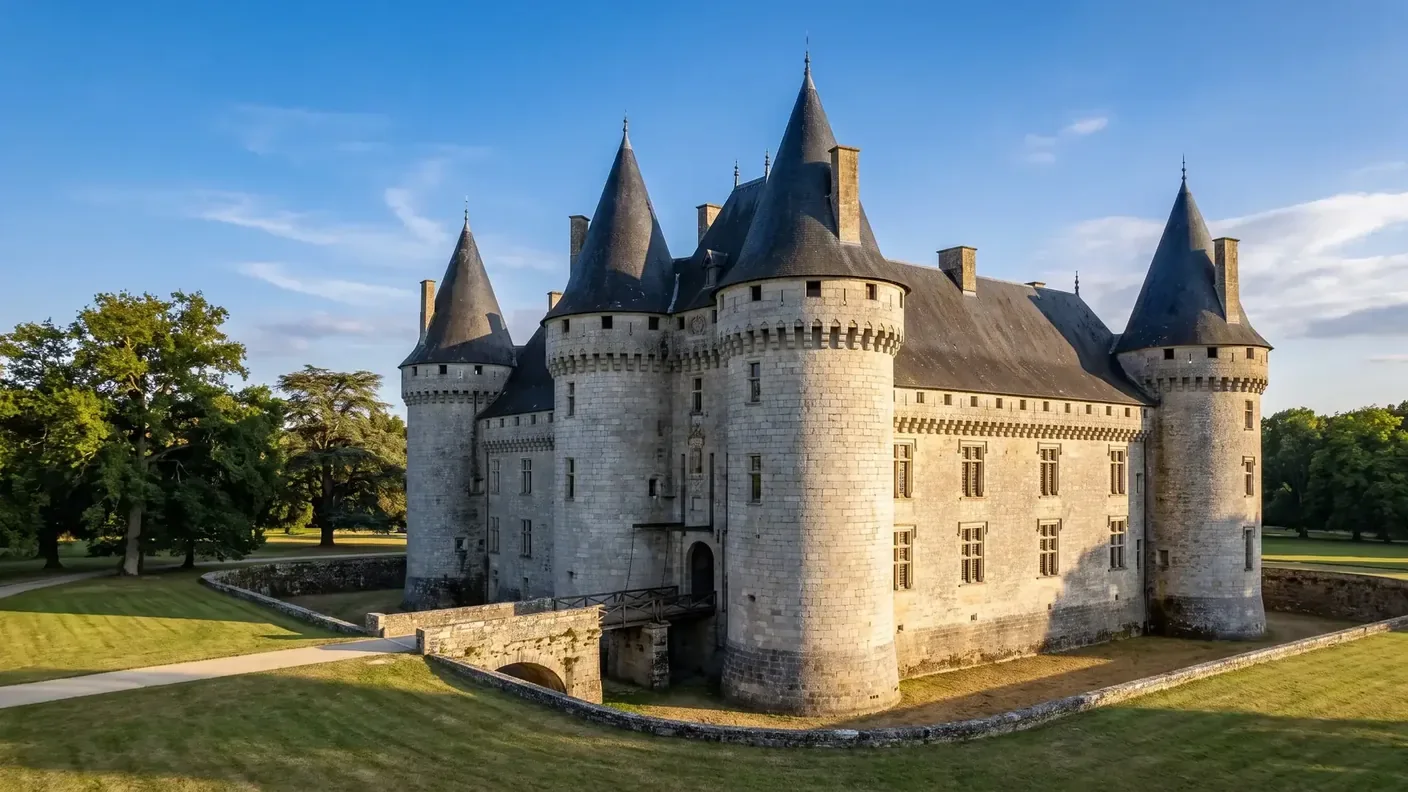
While the coin workshop is Coussac’s archaeological surprise, the Bonneval Castle has been its beating heart for a millennium. The oldest evidence of a fortification at the site dates back to the year 930 — a date engraved on a stone set into the entrance tower. The current castle, for its part, dates primarily from the early 14th century, a reconstruction (cautiously) attributed to Jean I of Bonneval.
Du Guesclin, Captured by a Trick
In fact, the fortress proved its strength against the most famous captain of the Hundred Years' War: Bertrand du Guesclin he himself was only able to seize it by trickery, in 1360 — a sign that the frontal assault was futile. The episode ended amicably: the constable returned the castle to Aymeric de Bonneval in 1363, and the family reclaimed a property that it has never relinquished since. Two centuries later, the castle welcomed an even more illustrious guest: Henry of Navarre, the future Henry IV, whose visit gave its name to the "the so-called King's Chamber" — one of the three elements expressly protected by its designation as a Historic Monument.
An Architectural Palimpsest
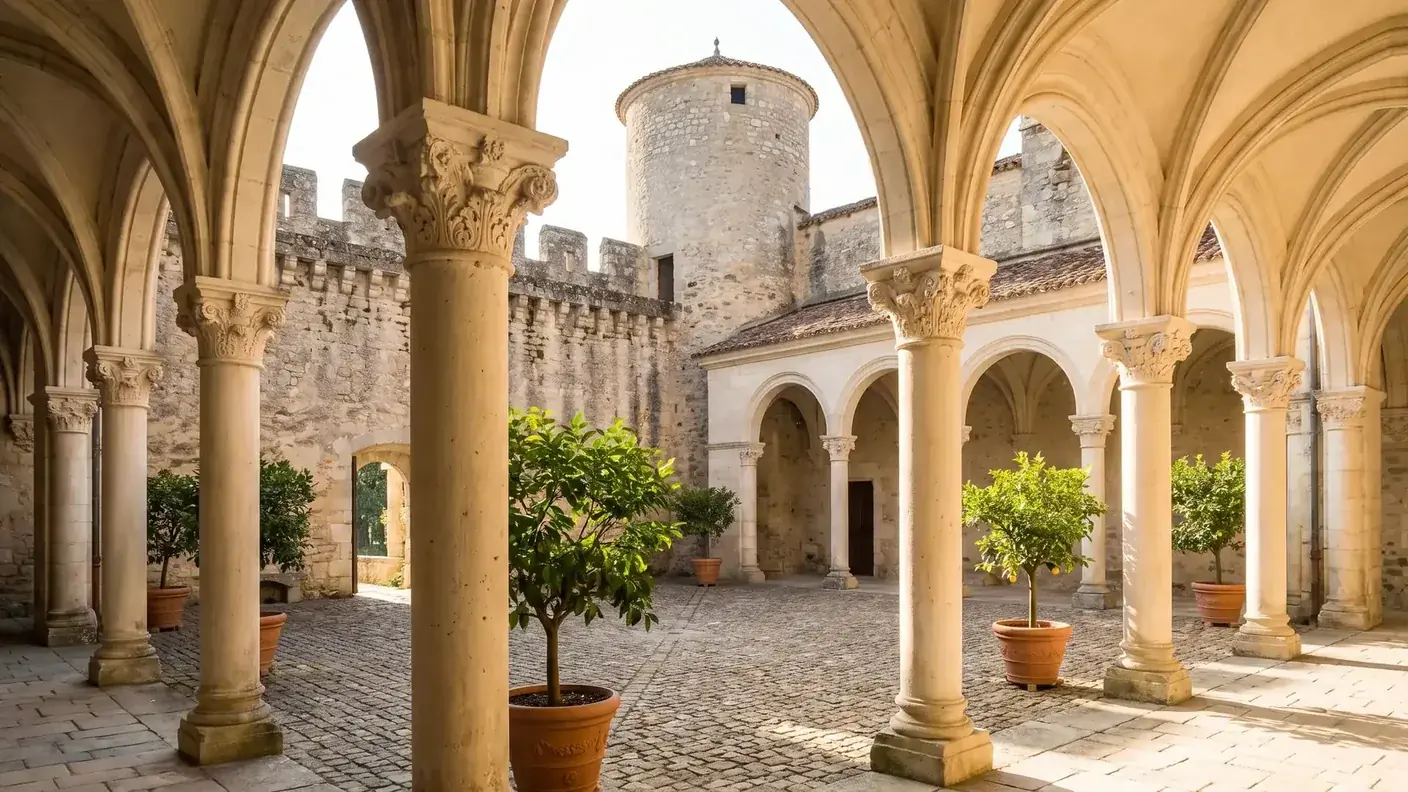
It is an architectural palimpsest, altered over the centuries. A major restoration took place in 1771–1772, led by the architect Broussaud; another followed in 1900, in the existing Renaissance courtyard. The result is a quadrangle flanked by four round towers with machicolations, surrounded by moats. Several architectural styles are evident: medieval, 17th-century (with mullioned windows), and 18th-century (the southwest facade, rebuilt around 1780). The inner courtyard is adorned with a Renaissance colonnaded gallery, and the entrance retains a 16th-century gatehouse, once equipped with a double drawbridge, flanked by the keep and the tower known as the “Marquis’s Tower.”
The attic features a rare architectural detail: a roof structure featuring inverted hulls, dating from the late 15th century, whose trusses resemble upturned ship hulls—a technique typically used by shipwrights, applied to a castle in the Limousin region, hundreds of kilometers from any body of water. The 1960 listing order specifies precisely what the government protects: the facades and roofs, the grand salon, and the so-called King’s Chamber—a partial protection focused on the elements deemed most remarkable.
A thousand years, thirty generations
The family lineage, often described as spanning “a thousand years,” is not dated in the national heritage record. The Ministry of Culture’s POP database, consulted in July 2026, cautiously states that the current building was likely built by Jean I, Lord of Bonneval, in the early 14th century, and that it was subsequently expanded and remodeled in the 15th, 18th, and 19th centuries. It is this institutional chronology that is adopted here.
Bonneval Pasha: From the Sun King to the Sultan
Among the thirty or so generations that have lived at the château, one figure stands out for his truly novelistic life story: Claude-Alexandre de Bonneval, born at the castle on July 14, 1675, and died in Constantinople under the name ofAhmed Pasha.
An Officer of the Sun King, Twice Condemned
His youth was that of an officer under the Sun King. He joined the Royal Navy at thirteen years, he transferred to the infantry and served in the Italian campaigns under Louis XIV’s great marshals—Catinat, Villeroi, and Vendôme. Brave but touchy, he fell out with Chamillart, the Minister of War: a court-martial sentenced him to death in 1704, and he fled. Taking refuge in the Holy Roman Empire, he found a protector in the person of the Prince Eugene of Savoy and served Austria with distinction, where he was seriously wounded at the Battle of Peterwardein in 1716. But his temperament gets the better of him: a quarrel with the Marquis de Prié lands him in second conviction, commuted to imprisonment and then to exile.
His break with France was by no means a covert whim: it was announced in writing. In his letter to Chamillart, Bonneval issued an ultimatum that has remained famous: “If, within three months, I do not receive satisfaction… I will enter the Emperor’s service.” ” He kept that promise to the letter—and repeated it: every time one power condemned him, he moved on to the next. This consistency in breaking ties, as much as his military talent, explains the uniqueness of his career.
Ahmed Pasha, Commander of the Ottoman Bombardier Corps
Rejected by Europe’s two greatest military powers, Bonneval then made the most radical decision of his life: he offered his services to the Ottoman Empire and converted to Islam in 1730, during the reign of Mahmud I. He “traded his hat for a turban,” took the name Ahmed, and was appointed pasha. His mission: to modernize the Ottoman artillery, a European expertise that was highly sought after by the Sublime Porte at the time. Around 1735, he established the corps of bombardiers, hence his historic nickname, “Humbaracı Ahmed Paşa”—the commander of the bombardiers.
He rendered valuable military service to the sultan, particularly against Russia and against the formidable Nader Shah of Persia, and was appointed governor of the island of Chios. But his position at court remained precarious. He died in Constantinople on March 23, 1747, at the age of 72, marked the end of one of the most unconventional life stories in French nobility: born in a centuries-old castle in Limousin, he died in the Ottoman capital under an identity and a religion he had chosen in defiance of his country of origin. Even today, at the Château de Bonneval, a room bears his name.
Quieter Final Years and a Street in Istanbul
His final years were not a triumph: after serving the sultan, he experienced fall from grace with the Sublime Porte and a temporary ban on the shores of the Black Sea — as if fate had in store for him, right to the very end, the same cycle of favor and downfall. Istanbul, however, granted him a level of fame rare for a foreign convert: he is buried in the Galata Mevlevihane Cemetery, and a street in the Galata neighborhood still bears his nickname, the Kumbaracı Street — literally “Bombardier Street.”
Saint-Saturnin Church and the Lantern of the Dead
The second landmark in the town is the Saint-Saturnin Church, dedicated to Saint Saturnin of Toulouse. The current building was rebuilt in 15th century built on the site of an earlier 11th-century sanctuary—evidence of an organized Christian presence dating back to the early Middle Ages, around the time when the nearby mint was still in operation.
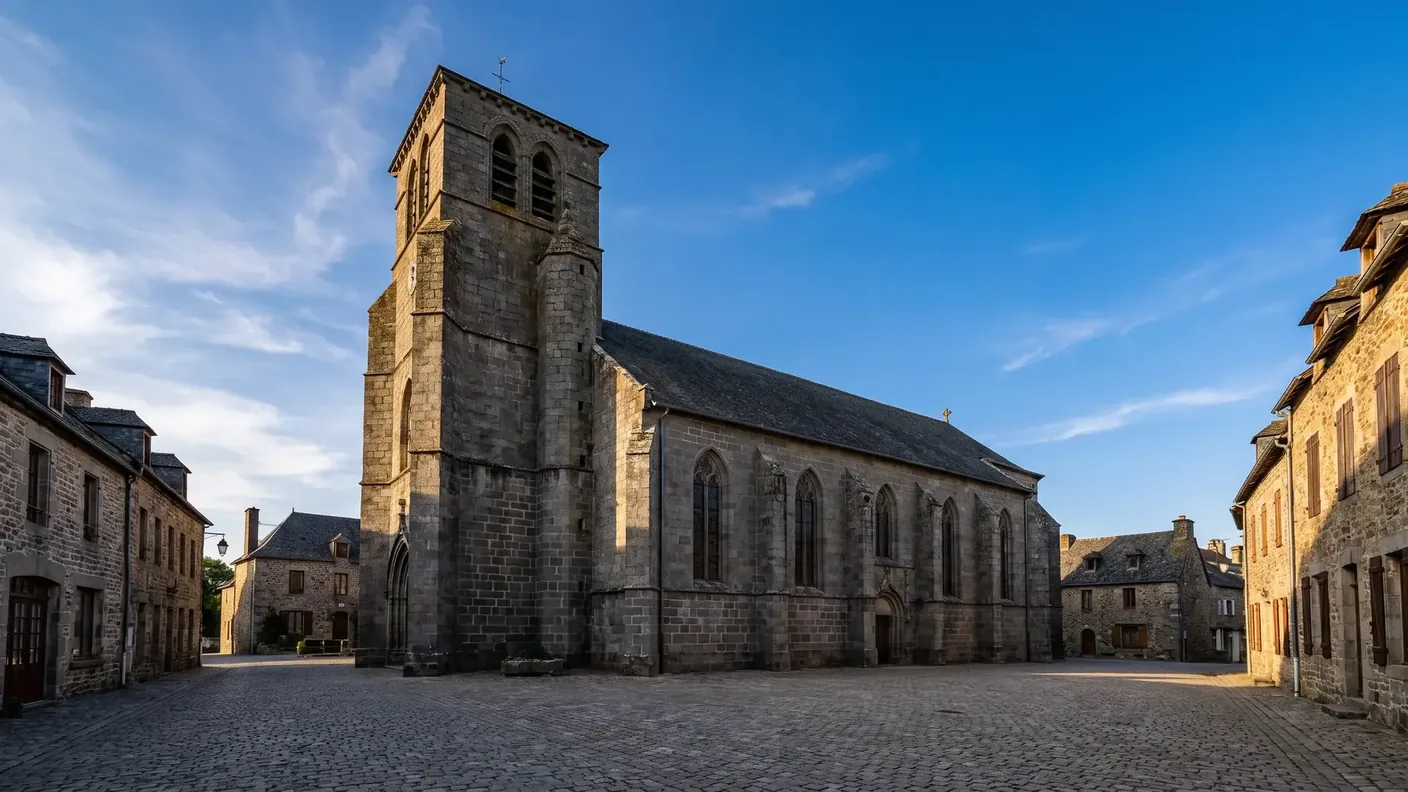
In the style of Gothic, built in the shape of a Latin cross, it features a two-bay rib-vaulted nave, a transept, and a pentagonal apse, as well as a 15th-century Limousin portal with five arches. But its most striking feature is its appearance strict, almost military: a massive bell tower and austere walls reminiscent of the fortified churches so common in medieval Limousin, a region regularly exposed to unrest and the passage of troops. The building has, in fact, suffered from Religious Wars in 1589. It has been listed as a historic monument since 1978.
Rediscovered Murals and Antique Furniture
The interior holds surprises that restoration efforts have gradually revealed: frescoes rediscovered beneath layers of whitewash, a 16th-century funeral band—that painted strip bearing the lord’s coat of arms that encircled the church upon the death of a family member— painted vault arches, as well as remarkable furnishings: a wooden Pietà and a Virgin of the Rosary. All of these bear witness to a rural parish that, for centuries, lived in the shadow of its castle.
A "lantern of the dead" listed as early as 1939
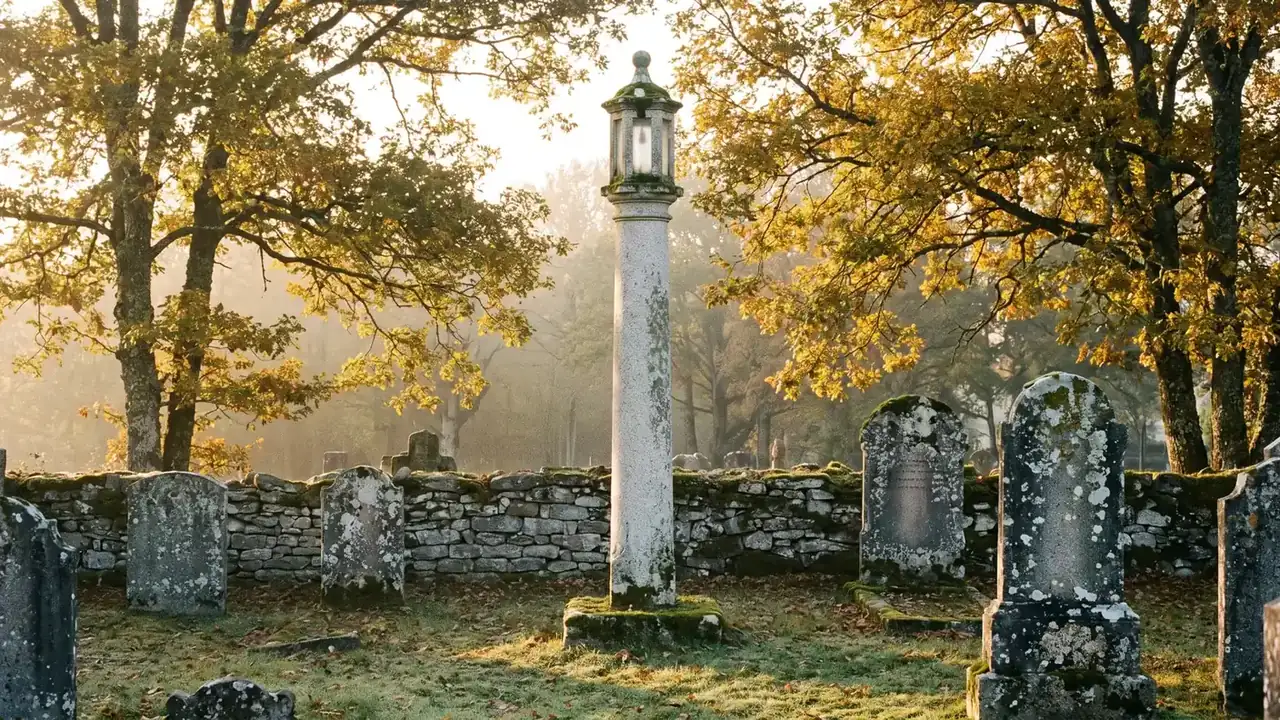
The village is home to another hidden treasure: its “lanterne des morts,” a type of medieval funerary monument unique to the Limousin and Poitou regions. It is a tall, hollow column, once topped by a light that was lit at night to mark the location of the consecrated cemetery. Also worth mentioning, in the hamlet of Bret, the Bré castle mound, a remnant of a separate seigneury whose complex feudal history saw it pass, over the centuries, from the Viscounts of Limoges to the Pompadour family—until it became part of the large estate of the neighboring Pompadour stud farm.
The one from Coussac-Bonneval, dated 12th century and about 6 meters, belongs to a category of monuments that has become extremely rare: there are now onlyabout twenty-six survivors, concentrated mainly between Poitou and Limousin. Notably, it was ranked Designated a historic monument as of February 9, 1939 — nearly forty years before the church was built, and with the highest level of protection (classification, not merely a listing). It has its own Mérimée entry, separate from that of the church.
| Monument | Protection | Date |
|---|---|---|
| Lantern of the Dead | Listed as a Historic Monument | February 9, 1939 |
| Bonneval Castle | Listed as a Historic Monument (facades, roofs, grand salon, King’s Chamber) | August 24, 1960 |
| Saint-Saturnin Church | Listed as a Historic Monument | March 30, 1978 |
Bré: From the Viscounts of Limoges to Madame de Pompadour
The history of the Bré estate is also linked to one of the most famous names of the 18th century. Sold in 1490 to Geoffroy Hélie de Pompadour, the land then follows the fortunes of that family, until 1730, when the Prince of Conti sold Pompadour and Bret to Jeanne Poisson — the future Marquise de Pompadour, a favorite of Louis XV, who took her title from this estate before selling it in 1760. A hamlet in Coussac-Bonneval was thus, for thirty years, the property of the most influential woman at the French court.
The Limousin region: forests, ponds, and horse farms
Beyond its monuments, Coussac-Bonneval is first and foremost a vast natural area. Across its 66 km², the bocage landscape unfolds with its meadows and hedgerows, dotted with oak and chestnut groves, granite farmhouses with slate roofs, and a few ponds—a landscape typical of the Upper Limousin, green, lush, and quiet, where scattered homes blend into the countryside.
The town is also just a stone’s throw from one of the region’s top attractions: the Pompadour National Stud Farm, located nearby in Corrèze—the birthplace of Anglo-Arabian horse breeding and nicknamed the “City of Horses.” Heritage enthusiasts will be happy to extend their visit to Saint-Yrieix-la-Perche, a subprefecture with a rich history (it was here that the kaolin was discovered that made the Limoges porcelain industry’s fortune), or to Arnac-Pompadour and its pink castle.
It’s a destination for taking your time and exploring with curiosity: people don’t come to Coussac-Bonneval just to check a box, but to take the time to understand a place—a family with a thousand-year history, a forgotten gold coin, an Ottoman destiny born within these walls. A niche form of tourism, prized by history buffs, in one of the most authentic corners of the Limousin region.
Coming from Bordeaux: Distances and Directions
Coussac-Bonneval is a rural, landlocked town with no train station; the nearest one is in Saint-Yrieix-la-Perche, about ten kilometers away. From Bordeaux, it’s about 227 km and a 2-hour, 45-minute drive, a route that passes through part of the Périgord region. Limoges, the prefecture, is about 54 km away by road (a distance often given as “38 km,” but that’s as the crow flies).
| From / To | Distance | Weather |
|---|---|---|
| Bordeaux → Coussac-Bonneval | ~227 km | ~2 hours 45 minutes |
| Limoges (prefecture) | ~54 km | ~45 min |
| Saint-Yrieix-la-Perche | ~13 km | ~15 min |
| Arnac-Pompadour (stud farm) | ~15 km | ~18 min |
| Périgueux | ~73 km | ~1 hour 15 minutes |
A stop connected by on-demand transit in 2026
The official Connec'TER on-demand service page (Line 23), accessed in July 2026, indicates that this reservation-based service covers every station on the Saint-Yrieix–Objat section of Line 23 — including Coussac-Bonneval — with a transfer to the train at Saint-Yrieix-la-Perche. It therefore does not list the town as a station served directly by a regular train.
With no rail service and a very scattered population, a car is essential here. For a day trip in this corner of the Limousin—Bonneval Castle, Saint-Saturnin Church, the Pompadour Stud Farm, Saint-Yrieix—without worrying about the route or parking, a executive car service departing from Bordeaux allows you to visit each stop door-to-door, at your own pace. A fixed, written quote is provided before departure.
Please note: Bonneval Castle is a private property that is still inhabited by the family; visiting hours vary by season. It is best to check in advance with the castle’s official channels or the Pays de Saint-Yrieix tourist office before planning your visit.
Frequently Asked Questions
Where is Coussac-Bonneval located?
In the southeastern part of Haute-Vienne, in Limousin (Nouvelle-Aquitaine), on the border between Périgord and Corrèze, within the Pays de Saint-Yrieix Community of Municipalities. ZIP code 87500. It is a large rural municipality (66.73 km²) with a population of approximately 1,262, located about 227 km (2 hours and 45 minutes) from Bordeaux and 54 km from Limoges by road.
How long has the same family lived at Bonneval Castle?
The Bonneval family has owned the castle since its construction, representing a continuity of about a thousand years and some thirty generations—an exceptionally rare occurrence in France. The family is first recorded on these lands as early as 1055 (Géraud de Bonneval). The castle, a stone in whose entrance tower bears the date 930, is now listed as a Historic Monument (1960).
What was the Coussac mint?
The Historical Dictionary of the Haute-Vienne Departmental Archives, consulted in July 2026, describes a gold trient weighing 1.20 g attributed to Coussac and held in the Medal Collection of the National Library. It bears the inscription “COCIACO FIT” on the obverse and “BONOALDO MO” on the reverse.
Who was Bonneval Pasha?
Claude-Alexandre de Bonneval (1675–1747), born at the Château de Coussac-Bonneval, was a French officer who served Louis XIV and later Austria (wounded at Peterwardein in 1716), before converting to Islam in 1730 and becoming Ahmed Pasha in the service of the Ottoman Empire. There, he reorganized the artillery and created the corps of bombardiers, hence his nickname “Humbaracı Ahmed Paşa.” He died in Constantinople in 1747.
Can we visit Bonneval Castle?
Bonneval Castle is a private property that has been continuously inhabited by the same family for about a thousand years and is listed as a Historic Monument. Visiting hours vary by season; it is advisable to check in advance through the castle’s official channels or the Pays de Saint-Yrieix tourist office. The purpose of this guide is to present the castle’s history and architecture.
Is the church in Coussac-Bonneval a historic monument?
Yes: The Gothic-style Saint-Saturnin Church, with its fortified appearance, has been listed as a Historic Monument since 1978. Rebuilt in the 15th century on the foundations of an 11th-century structure, it features a rib-vaulted nave, a transept, a pentagonal apse, and a Limousin-style portal with five arches. The village also preserves a medieval funeral lantern, which is likewise protected.
How much does a ride from Bordeaux to Coussac-Bonneval cost with a chauffeured transfer?
Starting at €439 for a one-way, door-to-door trip for 1 to 3 passengers in a Mercedes C-Class sedan—estimated price for ~227 km and approximately 2 hours and 45 minutes of driving time. The exact price depends on the schedule, the vehicle (sedan or van seating up to 8 passengers), and any requested stops. A fixed, written quote is provided before departure.
Why has the population declined so much since 1901?
Coussac-Bonneval had a population of 3,672 in 1901, its all-time high. World War I (resulting in the loss of approximately 350 residents between 1911 and 1921), followed by World War II, led to significant population losses. The rural exodus from the 1950s to the 1980s—driven by agricultural mechanization and the pull of cities—then nearly halved the population, before it stabilized somewhat beginning in the 1990s (1,262 residents in 2023).
What is the "Lantern of the Dead" by Coussac-Bonneval?
It is a 12th-century medieval funerary monument: a tall, hollow column about 6 meters high, once topped by a light that was lit at night to mark the consecrated cemetery. This type of structure, unique to the Poitou and Limousin regions, has become extremely rare—only about twenty-six examples remain today. The one in Coussac-Bonneval has been classified as a Historic Monument since February 9, 1939—nearly forty years before the Church of Saint-Saturnin—and holds the highest level of protection.
Does Coussac-Bonneval still have a working railway station?
Not by a regular train. The official schedule for Line 23, accessed in July 2026, lists Coussac-Bonneval as a reservation-only service and includes a transfer at Saint-Yrieix-la-Perche. Check the schedule with TER Nouvelle-Aquitaine before departure; for a direct trip from Bordeaux, driving remains the door-to-door option.
What is there to see around Coussac-Bonneval?
The Pompadour National Stud Farm (“City of the Horse”), located nearby in Corrèze, and its Arnac-Pompadour Castle; Saint-Yrieix-la-Perche, a subprefecture with a rich history (the birthplace of the kaolin used in Limoges porcelain); and further south, the Corrèze region and Brive-la-Gaillarde. Coussac serves as a peaceful base for exploring this corner of Limousin, where heritage and nature meet.
Further Reading
- The capital of the neighboring department of Corrèze: see the Brive-la-Gaillarde Guide (market, collegiate church, rugby)
- A village in Corrèze on the edge of Limousin: see the Juillac Guide (castles, market)
- The Green Périgord, near Limousin: see the Lanouaille Guide (Bugeaud, Pomme d'Or)
- Plan your trip: Book a private chauffeur from Bordeaux to Coussac-Bonneval or explore all our destinations
Sources and References
- Haute-Vienne Departmental Archives — Historical Dictionary — The Coussac Mint and Description of the Trient
- BnF General Catalog — Claude-Alexandre de Bonneval — authority record and biographical notes
- POP/Mérimée Database — Bonneval Castle — listed as a historic monument on August 24, 1960 (facades, roofs, grand salon, King’s Chamber)
- POP/Mérimée Database — Saint-Saturnin Church — designated a historic monument on March 30, 1978
- INSEE — Coussac-Bonneval (87049) — population, demographic series, peak in 1901
- SNCF TER Nouvelle-Aquitaine — Connec'TER on-demand service, Line 23 (Saint-Yrieix – Objat) — 2026 Service from Coussac-Bonneval via reservation-based transportation
Article updated in July 2026.
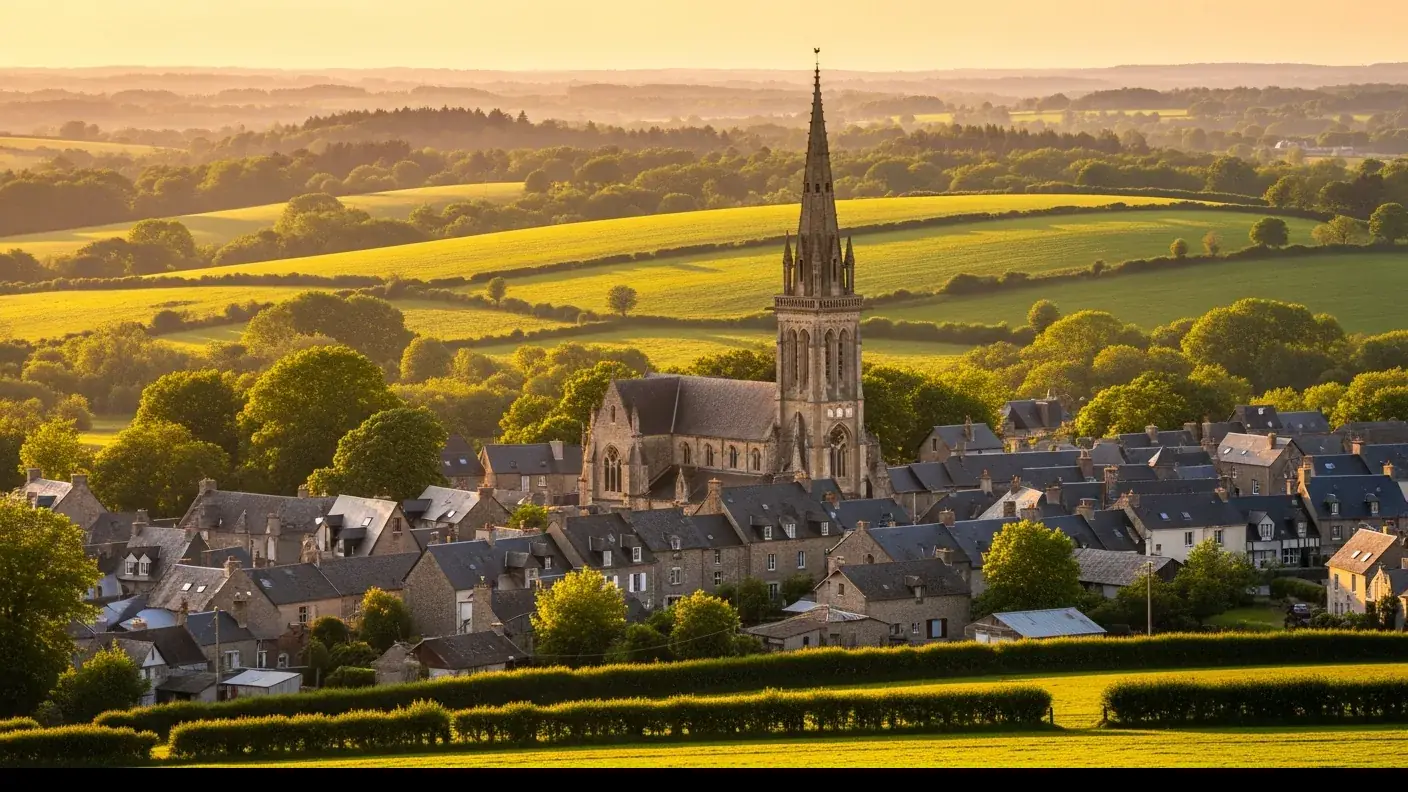
Heading to Upper Limousin
Direct trip from Bordeaux (~2 hours 45 minutes) to Coussac-Bonneval and the Saint-Yrieix region, with stops along the way as desired—the Pompadour Stud Farm, Arnac-Pompadour, and the Corrèze region. Fixed-price quote in writing within 30 minutes; sedan or 8-passenger van; English-speaking driver.