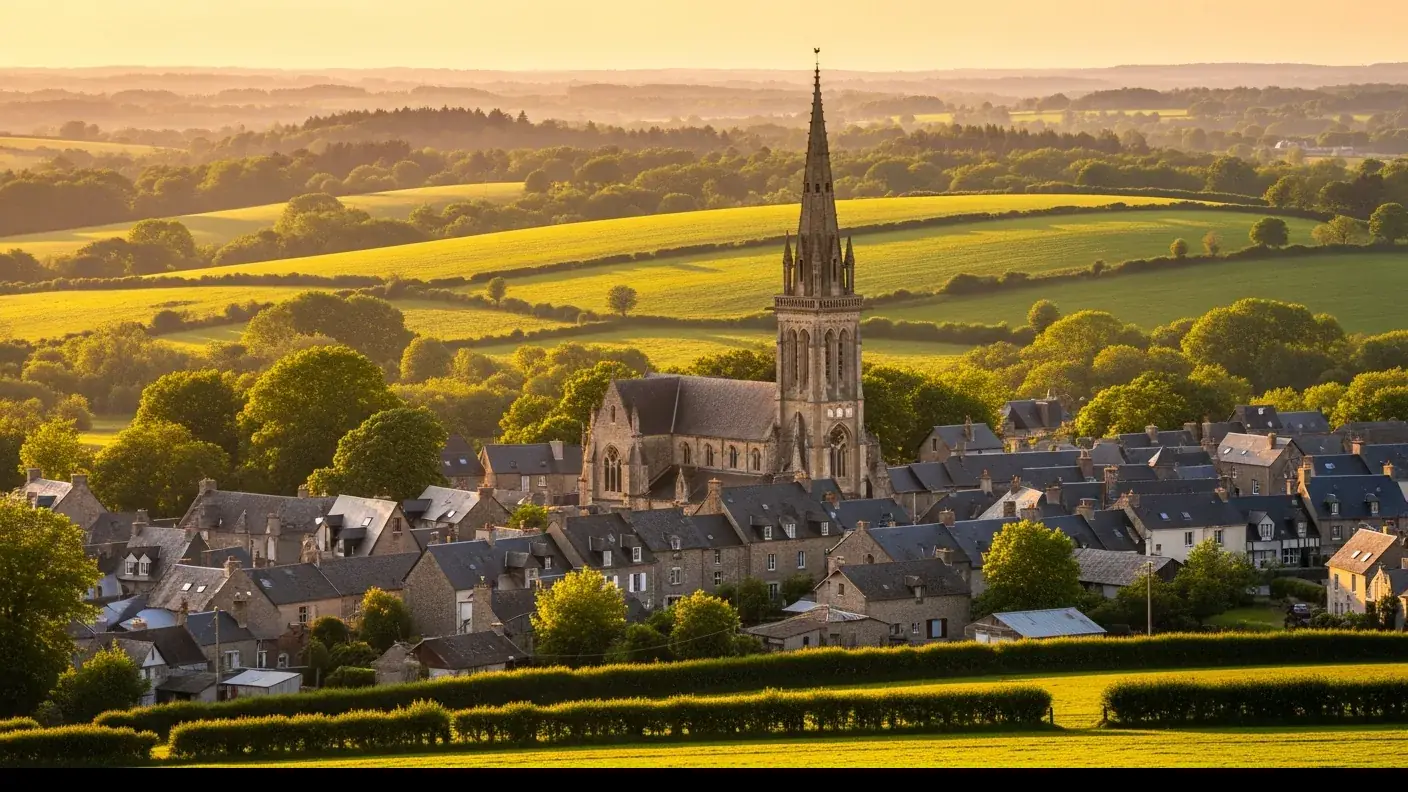
Bordeaux to Lanouaille: Bugeaud, the Golden Apple and Green Périgord
A village of 926 residents with a remarkable history: Marshal Bugeaud’s retirement home as an agronomist, an agricultural fair first documented in 1824 and still held every fall, the birthplace of the “Kaolin Man” of Limoges, the capital of Limousin AOP apples—and the Périgord Vert region all around. Everything you need to know before you visit, about 2 hours and 40 minutes from Bordeaux.
In a nutshell
Lanouaille is a commune in the Périgord Vert region, in the northeastern part of the Dordogne, on the border with Limousin. The town served as the canton seat from 1801 to 2015 and remains a rural hub on the plateau. Its history is linked to Marshal Bugeaud, who served as mayor and was the owner of the Durantie estate, as well as to the surgeon Jean-Baptiste Darnet, who was involved in the discovery of kaolin in Saint-Yrieix. The region produces the Limousin AOP apple, showcased at the Maison de la Pomme d’Or, and continues to host a traditional agricultural fair in the fall. The neo-Gothic Saint-Pierre-ès-Liens Church, the orchards, and the Loue Valley round out the visit. Lanouaille does not have a train station; from Bordeaux, the driving route listed on this page is approximately 201 km and takes 2 hours and 40 minutes. Event schedules, tours of private properties, and local transportation must be confirmed before departure.
- Lanouaille is a municipality of 926 residents (2023)[6] in the northeastern part of the Dordogne (24270), right in the middle of Green Périgord, on the border of the Limousin region.
- It served as the canton seat for 214 years (1801–2015), overseeing ten rural municipalities, before being incorporated into the canton of Isle-Loue-Auvézère (with its administrative office in Excideuil).
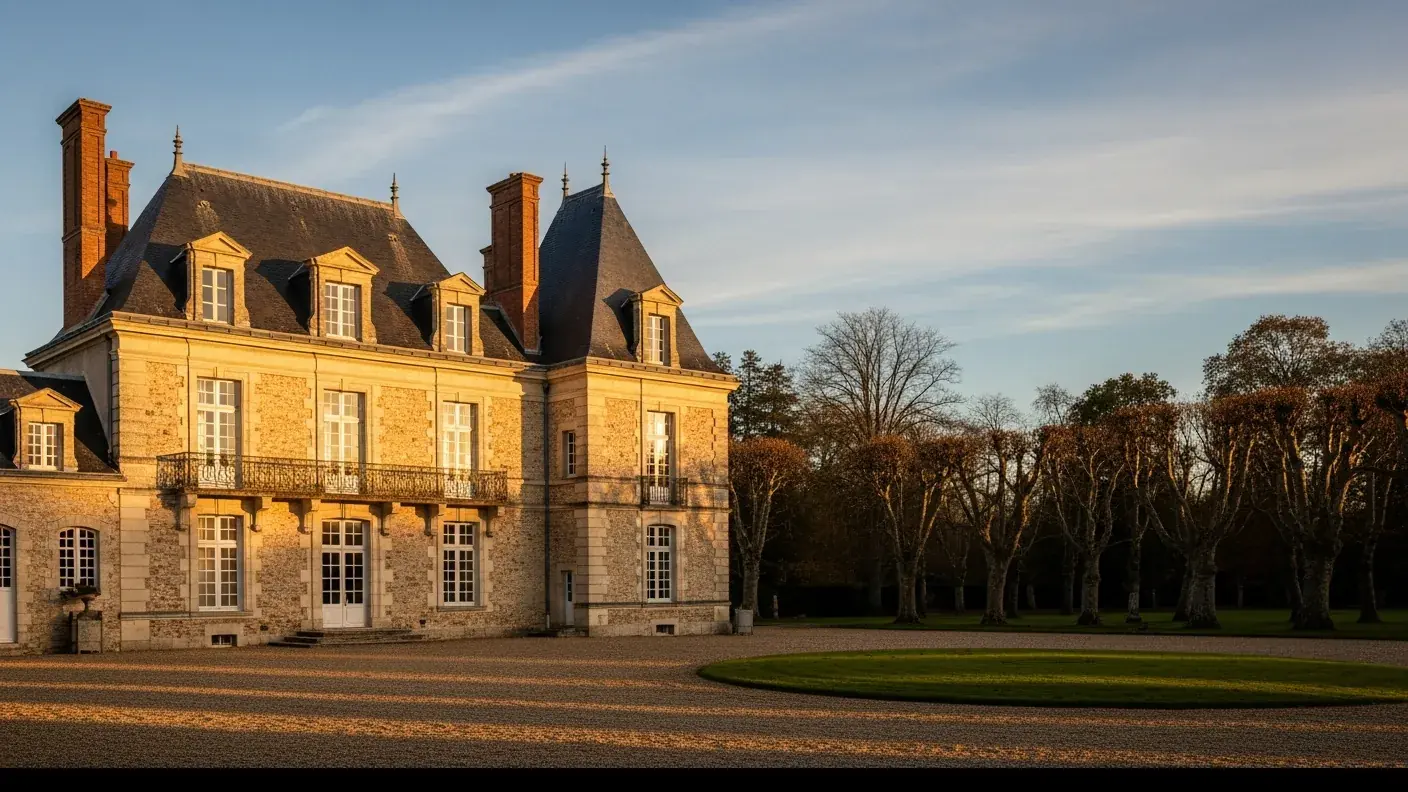
- Its most iconic landmark is neither a market hall nor a keep: it is the Château de la Durantie (1845), the agricultural retreat of Marshal Bugeaud—a major and controversial figure of 19th-century France.
- The agricultural fair, which has been documented since 1824[2], is usually held in the fall; check with the town for the date and schedule.
- Lanouaille is also the birthplace of Jean-Baptiste Darnet (1722–1781), the surgeon who discovered kaolin[1]—the mineral that gave rise to Limoges porcelain.
- The local capital of Limousin AOP apples[5]: Maison de la Pomme d'Or, orchards stretching as far as the eye can see—and a record-breaking apple pie measuring 15.20 meters in diameter, made in 2000.
- A flower parade has been bringing the town to life every Easter weekend since 1980 (the 45th edition will be held in 2026).
- Less than 20 km away: Excideuil and its motte-and-bailey castle, Hautefort and its historic castle, the Auvézère Valley, and Ségur-le-Château.
- It's 201 km and about 2 hours and 40 minutes from Bordeaux—there is no train station in the town; this guide is intended for history buffs, genealogists, and travelers planning a tour of the Périgord Vert.
Before You Go: What Lanouaille Really Is
Easter weekend, early afternoon. Floats covered in paper flowers parade down the main street amid a shower of confetti: Lanouaille’s flower parade has been held every year since 1980. The agricultural fair, first documented in 1824, is usually held in the fall; check with the town for the date and schedule.
People often drive right through Lanouaille without stopping, on the D704 that runs from Limoges to Sarlat. It’s a shame: this village of 926 residents is packed with an astonishing wealth of history—an agronomist who was a Marshal of France, the man behind Limoges kaolin, one of the oldest agricultural fairs in France, and the capital of an orchard-filled region where the Golden Delicious apple holds protected designation of origin status.
Here, we are in the Périgord Vert—the Périgord of meadows, chestnut trees, and lush valleys, the least well-known of the four. The pale stone of central Périgord gives way to granite and schist, and the cliffs to rolling hills: Limousin begins somewhere between two hedgerows, though no one knows exactly where.
This guide covers what you need to know before you come—the history, Bugeaud and the Durantie region, apples, and the surrounding area—as well as practical information, including how to get to the village from Bordeaux without driving, for example, by hiring a private driver.
Where is Lanouaille located? Geography and Administrative Status
Lanouaille occupies the northeastern quarter of the Dordogne (24), in Nouvelle-Aquitaine, in the Nontron district—the heart of what is known as the Périgord Vert, the northernmost and least populated of the four Périgord regions.
| Data | Value |
|---|---|
| Department | Dordogne (24) |
| Region | New Aquitaine |
| Borough | Nontron |
| Natural Region | Green Périgord |
| Current Canton | Isle-Loue-Auvézère (since 2015, with an office in Excideuil) |
| Former canton | Lanouaille (1801–2015, canton seat) |
| ZIP Code | 24270 |
| Area | ≈ 24 km² |
| Elevation | from 198 m (confluence of the Loue and Haute Loue) to 342 m |
| Population | 926 residents (2023) |
Two twin rivers: the Loue and the Haute Loue
The municipality is bordered to the northwest by the Loue River and crossed by its tributary, the Haute Loue. Their confluence, in the southwest of the municipality, marks its lowest point (198 m). These modest but deeply incised waterways have carved out a network of wet valleys that contrasts with the drier plateaus—the entire area is part of the Dordogne basin, within the larger Adour-Garonne region.
An intersection of departmental roads on the Limoges-Sarlat route
The town was built at the intersection of Departmental Roads 75, 81, 704, and 707. The D704 is the historic route connecting Limoges to Sarlat via Saint-Yrieix-la-Perche and Montignac-Lascaux—the road taken by hurried vacationers, precisely the one you should know to avoid. Points of interest: Excideuil 9 km away, Hautefort ~15 km away, Périgueux ~50 km away, Limoges ~60 km away, Brive-la-Gaillarde ~70 km away.
Eight municipalities border Lanouaille—including Sarlande, Angoisse, Dussac, Savignac-Lédrier, Génis, Preyssac-d'Excideuil, Anlhiac, and Saint-Médard-d'Excideuil—a string of villages that, for the most part, made up its former canton. In late 2002, the municipality joined the intermunicipal community now known as Isle-Loue-Auvézère en Périgord.
A Brief History: From “Novalia” to Lanouaille
A name that straddles the line between marshland and cleared land
There are two competing etymologies for the village’s name. The Occitan term “la noalha” is said to refer to a pond or marsh—the wet valleys along the Loue River support this theory. But the most likely origin remains the Latin *novalia*, meaning “newly cleared land”: a place name associated with medieval land clearing, very common in the French countryside. The archives record variations in spelling—Nobilia in the 15th century, “La Noaille” in the 16th, “La Nouailhe” in 1652, and “La Noilie” in 1742. In Occitan, it is still pronounced La Noalha.
November 18, 1801: The Birth of a County Seat
Modern administrative history begins with the decree issued by the Consuls on November 18, 1801, which created the Lanouaille canton to replace the districts of Dussac and Payzac. Lanouaille emerged as the winner: it became the canton seat, at the expense of Dussac. The canton ultimately comprised ten municipalities — Angoisse, Dussac, Lanouaille, Nanthiat, Payzac, Saint-Cyr-les-Champagnes, Saint-Sulpice-d'Excideuil, Sarlande, Sarrazac, and Savignac-Lédrier — for a total of 5,453 residents as of January 1, 2011.
Two Centuries of Rural Centrality
For 214 years, the town served as the hub for the institutions of a rural area: the cantonal council, public services, shops, and a school. Historical tidbits: Between 1833 and 1848, the cantons of Lanouaille and Thiviers shared the same general councilor; between 1907 and 1919, the municipality had two district councilors—a sign of its greater political influence at the time.
2015: The End of the Canton
The Decree of February 21, 2014, which took effect for the March 2015 departmental elections, abolished the canton. Nine out of ten municipalities, including Lanouaille, joined the Isle-Loue-Auvézère canton, whose administrative center was established in Excideuil; only Nanthiat moved to Thiviers. Its role as the canton seat came to an end[4] — but in practice, Lanouaille remains the go-to spot in this part of the Dordogne.
| Date | Event |
|---|---|
| 15th century | The place appears as "Nobilia" in the archives |
| 1652 | Spelling of “La Nouailhe” |
| Nov. 18, 1801 | Creation of the Lanouaille canton (10 municipalities) |
| The 1820s | Bugeaud launches one of France's very first agricultural fairs in Lanouaille |
| 1845 | Construction of the Château de la Durantie |
| Mid-19th century | Architect Émile Vauthier built the neo-Gothic Saint-Pierre-ès-Liens Church |
| 1980 | First Easter Flower Parade |
| 2000 | Opening of the Maison de la Pomme d'Or; record-breaking 15.20-meter tart (October 22) |
| 2015 | Abolition of the canton after 214 years; incorporation into Isle-Loue-Auvézère |
| The 1820s | The agricultural fair, which has been documented since 1824, is usually held in the fall; check with the town for the date and schedule. |
The Château de la Durantie and Marshal Bugeaud
If you had to pick just one place to visit in Lanouaille, this would be it. The Château de la Durantie bears no resemblance to a medieval fortress: it is a mansion built in 1845, commissioned by a man whose name resonates far beyond the Périgord — Thomas Robert Bugeaud, Marquis de La Piconnerie, Duke of Isly, Marshal of France.[3]
Who was Bugeaud?
Born in Limoges on October 15, 1784, Bugeaud pursued a military career during the Empire, before the turning point of 1815: discharged from the army during the Second Restoration, he retired to the Durantie family estate and spent fifteen years improving his land. It was here, in the Périgord Vert, that he built a reputation as an innovative agronomist — introducing artificial grasslands and combating fallow land — true to his famous motto: "Ense et Aratro," "by the sword and by the plow".
Mayor of Lanouaille and pioneer of the agricultural fair
Mayor of Lanouaille, and later elected deputy for the Excideuil constituency in July 1831, Bugeaud turned his village into a testing ground: it was under his leadership, beginning in 1824, that the archives document one of the very first agricultural fairs in France—featuring contests, demonstrations, and awards for innovation. The fair, documented as early as 1824, is usually held in the fall; check with the town for the exact date and schedule.
The Other Side: Algeria
History does not end at the borders of the Périgord. As Governor-General of Algeria from 1840 to 1846, Bugeaud played a decisive role in the colonization of Algeria and the suppression of resistance movements—a policy of conquest whose brutality is now the subject of fierce historical criticism, to the point that several public tributes to him have been removed or renamed. Promoted to Marshal of France in 1843 after the Battle of Isly, he died of cholera in Paris on June 10, 1849. To understand Lanouaille is to grasp both sides of the man: the agronomist from the Durantie region and the controversial military figure.
La Durantie Today
Built in 1845 at the height of his career, the estate stands as a testament to this steadfast attachment: a man at the pinnacle of his success chose a plateau of orchards in the Périgord Vert over the salons of Paris. The château is now privately owned and is used primarily for receptions and stays—it is not open to the public, but its silhouette and grounds can be glimpsed from the surrounding area.
The Church of Saint-Pierre-ès-Liens, designed by Émile Vauthier
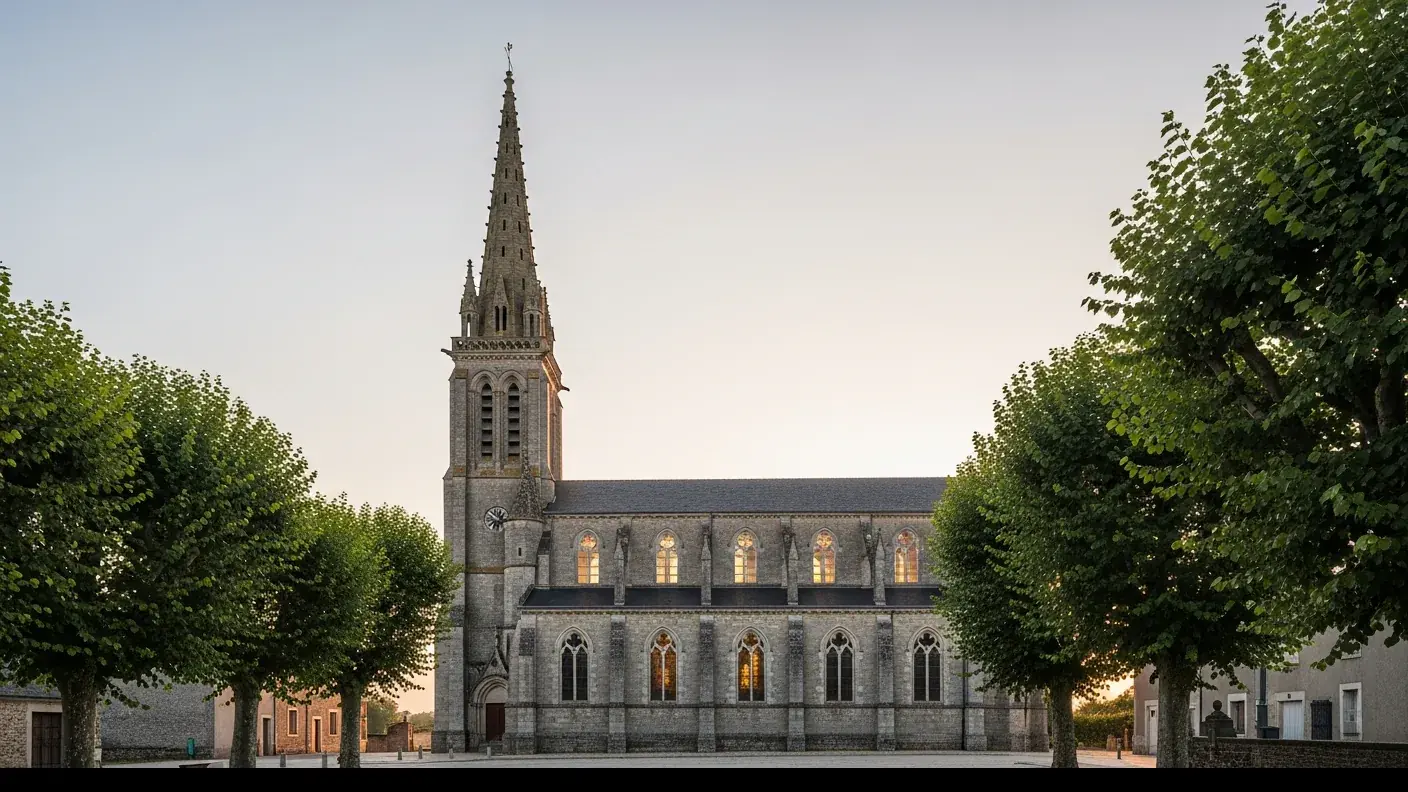
The parish church, dedicated to Saint Peter in Chains (Saint Peter “of the Chains,” in memory of his deliverance from prison), is a 19th-century Neo-Gothic structure designed by architect Émile Vauthier (1823–1866). With its slender spire and pointed-arch windows, it embodies the wave of religious reconstruction that endowed so many French towns with new churches during the Second Empire—here, at the very time when Bugeaud was modernizing the surrounding countryside.
One sometimes reads that the building is said to contain older elements or remarkable painted decorations: take this with a grain of salt—verifiable sources primarily describe Vauthier’s Neo-Gothic church. In any case, the bell tower remains the town’s landmark, visible from afar across the plateau.
Beaulieu, the Golden Apple: A Low-Key Heritage Site
Beaulieu Castle
Less well-documented than the Château de Durantie, the Château de Beaulieu is one of the “low-key castles” of the Périgord Vert, far from the tourist trails. As it is privately owned, it is not open to the public, but its silhouette is a part of the town’s built landscape.
The House of the Golden Apple
Opened in 2000, the House of the Golden Apple is the interactive exhibit dedicated to the plateau’s most prized fruit: the Limousin apple. It tells the story of the orchards that revitalized the local economy—a thread that runs through Lanouaille, from Bugeaud’s agronomy to today’s AOPs. In the year it opened, the village marked the occasion in its own way: on October 22, 2000, an apple pie 15.20 meters in diameter (47.75 m in circumference!) was made there—a record that has remained etched in local memory.
Land of the Golden Apple: Lanouaille and the Limousin Apple AOP
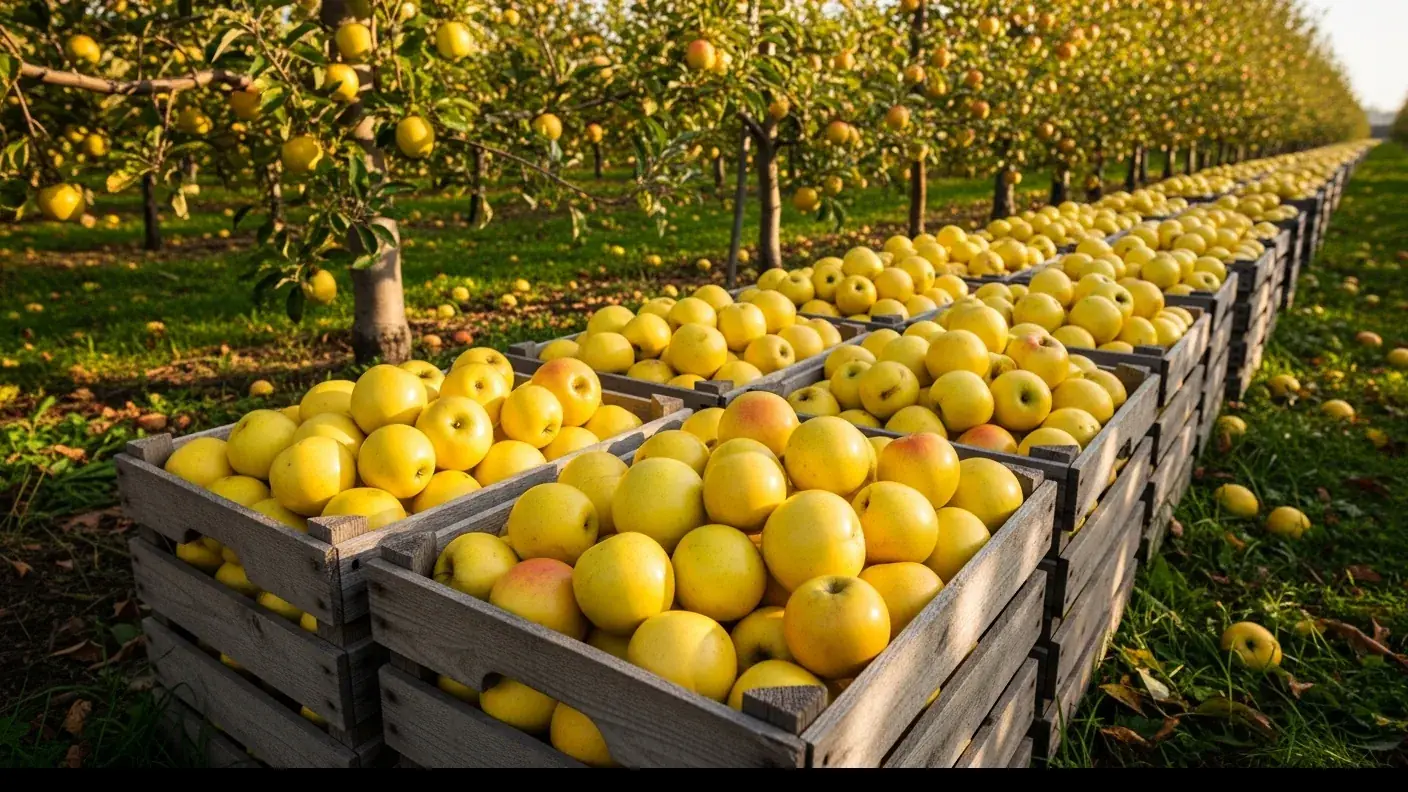
Lanouaille is located in the heart of the Limousin apple-growing region—a mid-altitude Golden Delicious variety grown on the hillsides of the Dordogne, Corrèze, Haute-Vienne, and Creuse, protected by an AOC designation since 2004 and an AOP designation since 2007: the first apple in France to hold a protected designation of origin.
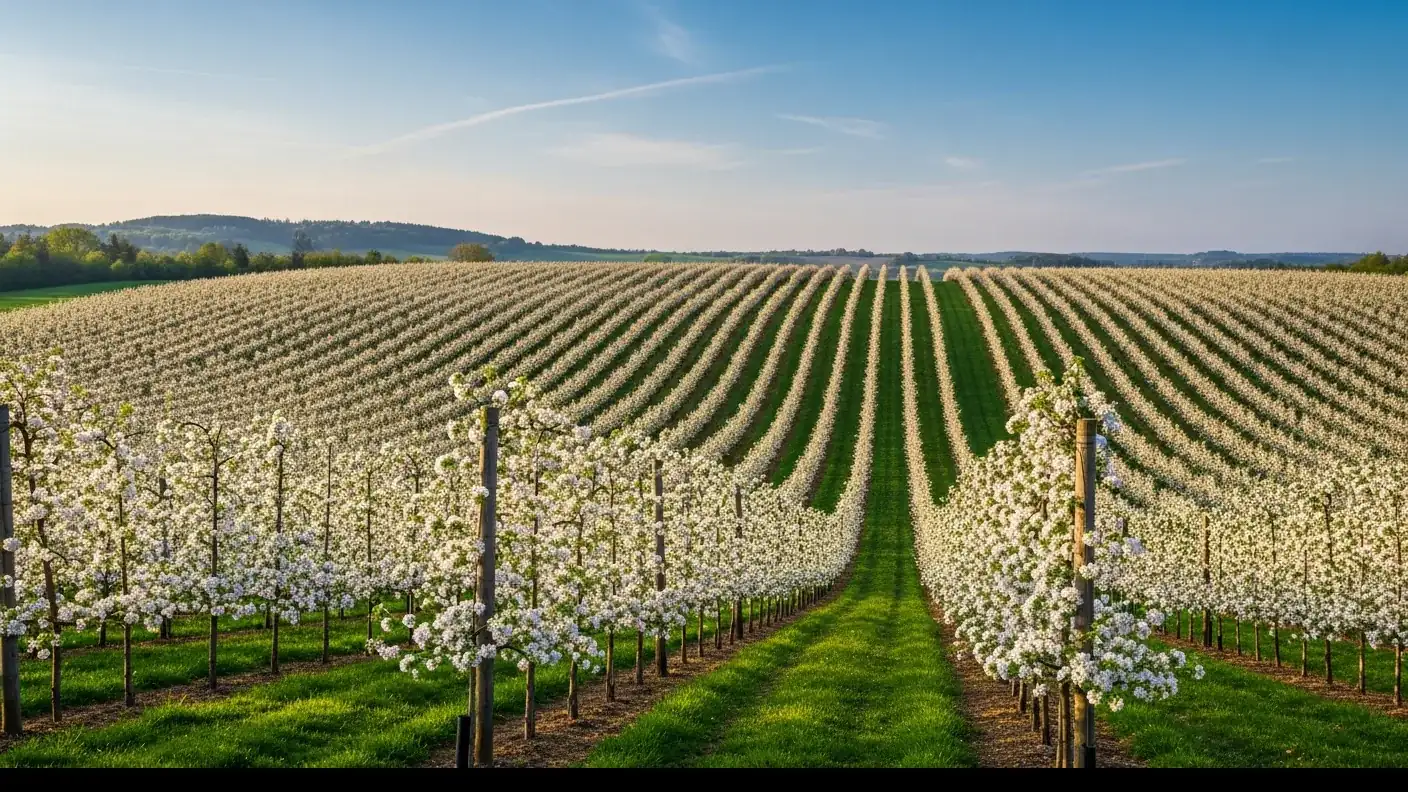
On the plateau, the trellised orchards shape the landscape: white blossoms in April and May, hail nets in the summer, and overflowing wooden crates in October. The altitude (300 meters on average) and cool nights give this Golden Delicious apple its balance of sweetness and acidity and its famous pink “dimple.” Fruit juices, farmhouse ciders, and pastries all revolve around the apple—the giant tart from 2000 was no accident: here, the apple is as much a part of the local identity as it is the local economy.
Jean-Baptiste Darnet: The Man from Lanouaille Who Pioneered Limoges Porcelain
This is the village’s other great story, far less well-known than that of Bugeaud—and yet. Jean-Baptiste Darnet, born in Lanouaille in 1722, a military surgeon by profession, was the man behind the discovery of the kaolin deposits—that pure white clay near Saint-Yrieix-la-Perche—whose identification would lead to the creation of Limoges porcelain.
Without the kaolin from Saint-Yrieix, there would be no French hard-paste porcelain, no Limoges factories, and no industry that brought glory to an entire region in the 19th century. That the starting point of this adventure can be traced to a child from Lanouaille who died in 1781—ten years before the industrial boom he had made possible—remains one of the village’s most beautiful paradoxes.
Other Notable People from Lanouaille
- Frédéric-Marie Bergounioux (1900–1983), born in Lanouaille: priest, paleontologist, geologist, and theologian—a well-rounded scholar of a kind rarely seen in the 20th century;
- Henri Laville (1937–1995), a prehistorian born in the village—a twist of fate in this region of the Périgord, the cradle of humanity;
- Jean-Pierre Cubertafon (born in 1948), mayor of Lanouaille from 1995 to 2017, who subsequently became involved in national politics.
An agronomist, a pioneer of the porcelain industry, a paleontologist in a cassock, and a prehistorian: for a town of 926 residents, the concentration of such unique lives commands respect.
Lanouaille Today: Demographics and Local Life
A population that is declining, yet remains attractive
In 2023, the municipality had 926 residents, a decrease of −8.95% compared to 2017—when the Dordogne department saw a slight increase (+0.97%). The most recent peak was in 2016, with a population of around 1,000.
| Year | Population | Trend |
|---|---|---|
| 1990 | 976 | — |
| 1999 | 966 | stability |
| 2011 | 989 | slight increase |
| 2016 | ≈ 1 019 | recent peak |
| 2022 | 938 | erosion |
| 2023 | 926 | −8.95% since 2017 |
However, a closer look reveals an important nuance: the net migration rate is positive (new residents are moving in, led by new rural residents and young retirees), but it does not yet offset a negative natural increase—an inevitable result in a population where those aged 65 and older make up a significant proportion and where women (54.5%) are in a clear majority. Lanouaille is attracting people—it simply isn’t renewing its population fast enough yet.
Schools, businesses, organizations
As a former canton seat, the town still has a town hall, a school, and local shops, making it the go-to place for daily needs for the surrounding hamlets, halfway between Excideuil and Payzac. On the sports front, the Lanouaille Football Club—Dordogne champion in 1983, which became an intermunicipal league in 2013—and local clubs set the pace for the year, from the Easter parade to the fall agricultural fair.
Thinking of moving to Lanouaille?
The positive net migration figure speaks for itself: people are moving here. The selling points are those of the Périgord Vert region—affordable housing, a school in town, essential shops, and the D704 highway, which puts Périgueux and Limoges within an hour’s drive—plus a vibrant community life that keeps the village bustling year-round, from the corso to the agricultural fair. The downside is typical: medical services are limited here, so you’ll need to go to Excideuil or Périgueux, and a car is essential. As is always the case in deeply rural areas: come spend a Tuesday in January here before signing on the dotted line—don’t just visit for a weekend during the corso.
Landscapes: The Périgord Vert in All Its Natural Beauty
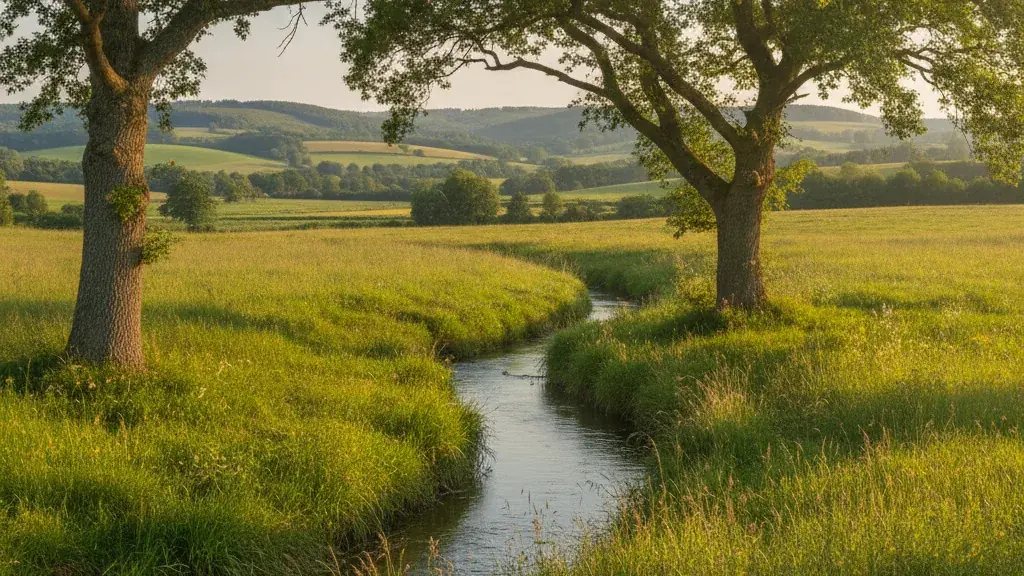
The area is part of the hilly plateau of the Périgord Limousin: an ancient bedrock, composed of granite and schist in places, very different from the pale limestone of central Périgord. The terrain rises and falls constantly—from 198 m at the confluence of the two Loues rivers to 342 m on the higher ground—without ever featuring any sheer cliffs: gentle slopes, woods, and wet meadows.
The Périgord-Limousin border, visible to the naked eye
The transition is evident in the landscape as much as in the architecture: the roofs change in pitch, the light-colored stone gives way to gray granite, and the chestnut and oak trees of the Limousin region mingle with more southern species. The Périgord Vert owes its name to these meadows that remain green in the summer—a privilege of the cool, mid-altitude lands.
The Loue Valley, the backbone
The Loue River runs along the western edge of the town, while the Haute Loue flows through it: together, they form a network of about thirty kilometers of waterways and cool valleys—a haven for fishermen and herons—that stands in stark contrast to the orchard-covered plateaus. The hiking trails in the area follow these valley floors before climbing up to the viewpoints on the plateau.
On foot or by bike: you have to earn your way up to the plateau
No tourist traps here: the hiking takes place on rural paths and small county roads that connect hamlets, orchards, and valley bottoms—with the marked trails in the Excideuil area and the Auvézère Valley serving as the highlights. Cyclists enjoy the rolling, nearly deserted roads, even if they do include a few steep climbs; fall, with its orchards heavy with fruit and rust-colored forests, is the most beautiful season for cycling.
Flower Parade, Agricultural Fair, Book Fair: When to Visit
For a village of this size, the festival calendar is surprisingly full—and each event is verifiable over time:
- Easter Weekend: the flower parade, since 1980 (45th edition in 2026) — flower-decorated floats and marching bands in the town’s streets;
- Late June–early July: the Périgord-Limousin Book Fair (12th edition in 2026);
- Early August: the patron saint's festival, lasting two days;
- The agricultural fair, which has been documented since 1824, is usually held in the fall; check with the town for the date and schedule.
| Season | Atmosphere | Strengths | Good to Know |
|---|---|---|---|
| Spring (April–June) | Easter Procession, Orchards in Bloom | Apple trees in bloom in late April, book fair | The most spectacular |
| Summer (July–August) | Patron Saint's Day | Meadows still green, cool valleys | Perfect for a leisurely hike |
| Fall (Sept.–Oct.) | Comice, apple harvest | Golden AOP, Colors, Plateau Markets | Our Favorite Season |
| Winter (Nov.–March) | Deep calm | Mist in the valleys, chimneys | Few places are open |
Near Lanouaille: Excideuil, Hautefort, and the Auvézère Valley
Lanouaille is an excellent base for exploring the Périgord away from the crowds, straddling the Dordogne and Corrèze departments.
Excideuil, the castle on its mound (9 km)
The neighboring town—and the canton's new office—is dominated by its medieval castle built on a feudal motte, which has been besieged several times over the course of various wars. With its markets, shops, and market halls, Excideuil serves as the region’s convenient hub.
Hautefort, the grand classical-style castle (15 km)
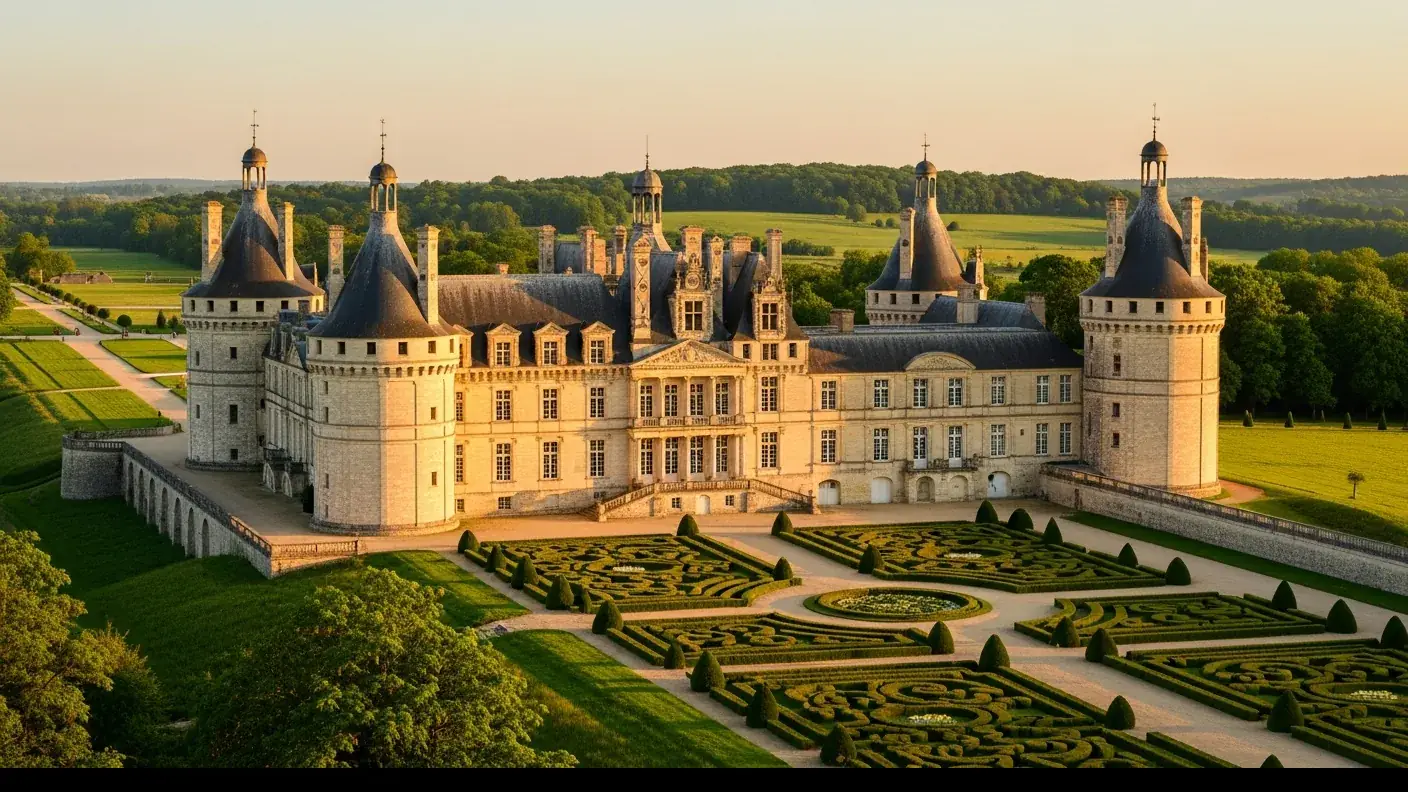
A fifteen-minute drive and a change of scenery: Hautefort is home to one of the most majestic castles in the Périgord, listed as a Historic Monument[7]—owned by the de Born family (the family of the troubadour Bertran de Born) from 1160 to 1398, and later remodeled into a classical palace with French-style gardens. It’s also a nod to our neighboring guides: it was the Marquises of Hautefort who purchased the seigneury of Juillac, on the Corrèze side, in 1643.
The Auvézère Valley: Forges and Gorges (8–20 km)
To the east, the Auvézère River carves through the wildest landscapes of the Périgord Vert: wooded gorges, mills—and the historic forge at Savignac-Lédrier, a testament to the valley’s long tradition of metalworking. Following the river upstream, you reach Ségur-le-Château (one of the Most Beautiful Villages of France) and then the Pompadour region and its stud farm.
Périgueux, the capital, 50 km away
For a more urban day out, Périgueux offers the Saint-Front Cathedral with its Byzantine domes—a stop on the Way of St. James—a protected medieval and Renaissance district, and the Vesunna Gallo-Roman Museum, built atop an ancient domus. It’s also the true gateway to the Périgord Vert when arriving from Bordeaux via the A89.
| Destination | Distance | Why Go There |
|---|---|---|
| Excideuil | 9 km | Motte castles, markets, market halls |
| Savignac-Lédrier | ≈ 8 km | Historic Blacksmith Shop in the Auvézère Valley |
| Hautefort | ≈ 15 km | Castle designated a historic monument, French-style gardens |
| Ségur-le-Château | ≈ 20 km | "Most Beautiful Villages of France," Auvézère River Bend |
| Arnac-Pompadour | ≈ 22 km | The Marquise's Castle, National Stud Farm |
| Juillac (Corrèze) | ≈ 25 km | The other side of the ridge — see our guide |
| Saint-Yrieix-la-Perche | ≈ 20 km | Darnet Kaolin, Collegiate, Porcelain |
| Périgueux | ≈ 50 km | Saint-Front, Vesunna, Old Town |
How to get to Lanouaille from Bordeaux
From Bordeaux, Lanouaille is accessible by road over a distance of 201 km, taking approximately 2 hours and 40 minutes according to the posted travel time estimate. The route mainly follows the A89 to the Périgueux area, then takes departmental roads via Excideuil. Since there is no train station in the town, door-to-door transfer by sedan starts at €453 during the day.
| Mode of transport | Travel time from Bordeaux to Lanouaille | Estimated cost | Good to Know |
|---|---|---|---|
| Personal car | ≈ 2 hours 40 minutes (201 km, A89 + D) | Cost varies depending on the vehicle and the day's tolls | Final leg on county roads |
| Private chauffeur service (door-to-door) | ≈ 2 hours 40 minutes | Starting at €338 · one-way | No fatigue, stops at your convenience (Périgueux, Excideuil, Hautefort) |
| Train + final leg | Bordeaux → Périgueux according to today's TER schedule, then about 50 km by road | Today's TER Fares | Last leg must be booked separately |
| Bus | Limited local connections | — | Not suitable for the entire trip |
Travel Tips
On the way there, taking the route through Périgueux allows for a stop in the old town or near Saint-Front Cathedral; a detour to Hautefort (castle and gardens) fits naturally into the trip before arriving. On the return trip, heading back down through Excideuil and then through the Auvézère Valley creates a loop without having to take the same route twice. With a chauffeur service, you’re free to decide on these stops along the way—a fixed rate guaranteed in writing, starting at €338 one-way for 1 to 3 passengers.
Practical Information
How long will you be there?
Half a day to visit the village (church, Maison de la Pomme d'Or, silhouette of La Durantie)—ideally on a holiday or during a local fair. A day along with Excideuil and Hautefort. A weekend for the entire Auvézère-Pompadour-Ségur loop, or even the connection to Juillac on the Corrèze side.
Accommodations and Dining
It has the charm of a rural village: a few food stores and simple addresses in the village, such as rural vacation rentals in the hamlets—including event rentals near the area’s castles. For traditional lodging, Excideuil (9 km) and Périgueux (50 km) offer additional options.
Estimated Budget
| Profile | Daily Budget | Accommodations | Dining |
|---|---|---|---|
| Small budget | 35-55 € | Simple vacation rental, local campground | Markets + Picnic |
| Mid-range | 80-120 € | Comfortable Country Inn | The Excideuil and Plateau Tables |
| Comfort / touring base | 130-190 € | Charming Bed and Breakfasts, Périgueux | Tables from the Périgord region |
Frequently Asked Questions
Where exactly is Lanouaille located in the Dordogne?
In the northeastern quarter of the Dordogne department, in the Nouvelle-Aquitaine region, in the Nontron district—this is the Périgord Vert, on the border with Limousin. The town lies at the intersection of the D75, D81, D704 (the Limoges–Sarlat route), and D707, 9 km from Excideuil, ~15 km from Hautefort, ~50 km from Périgueux, ~60 km from Limoges, and ~70 km from Brive-la-Gaillarde.
How many people live in Lanouaille?
926 residents according to the 2023 census, down 8.95% from 2017, following a peak of around 1,000 residents in 2016. An important caveat: net migration remains positive—the town is attracting new residents—but it does not yet offset the negative natural growth rate of an aging population, in which women account for 54.5% of the residents.
Who was Marshal Bugeaud, and what is his connection to Lanouaille?
Thomas Robert Bugeaud (Limoges, 1784 – Paris 1849), Marshal of France and Duke of Isly, retired after 1815 to the family estate at La Durantie in Lanouaille, where he served as mayor before being elected deputy for Excideuil in 1831. For fifteen years, he experimented with modern agronomy there—true to his motto “Ense et Aratro,” “by the sword and by the plow ”—before becoming Governor-General of Algeria (1840–1846), a colonial role whose brutality is today strongly criticized. He had the current Château de la Durantie built in 1845.
Can we visit the Château de la Durantie?
No, not freely accessible: it is private property, used primarily for receptions and stays. Its silhouette and grounds can be seen from the surrounding area. The agricultural fair, first documented in 1824, is usually held in the fall; check with the town for the date and program.
What to See in Lanouaille?
You can explore the town in half a day: the neo-Gothic Saint-Pierre-ès-Liens Church (designed by architect Émile Vauthier), the Maison de la Pomme d'Or dedicated to the Limousin AOP apple, the orchards on the plateau, and the silhouette of the Château de la Durantie. It’s best to time your visit to coincide with a major event: the flower parade at Easter, the book fair in early July, the patron saint’s festival in early August, or the agricultural fair in the fall.
What is the Lanouaille Agricultural Fair?
An agricultural fair first documented in 1824, initiated by Bugeaud, then mayor—one of the very first of its kind in France. The fair, first documented in 1824, is usually held in the fall; check with the town for the date and program.
Why do people refer to the “golden apple” at Lanouaille?
The Lanouaille plateau lies at the heart of the Limousin apple-growing region—a high-altitude Golden Delicious variety protected by an AOC designation since 2004 and an AOP designation since 2007, making it France’s first apple to receive such a designation. The Maison de la Pomme d’Or, opened in 2000, is dedicated to this apple; that same year, the village created a record-breaking apple pie measuring 15.20 meters in diameter. Orchards continue to dominate the local economy.
Who is Jean-Baptiste Darnet, born in Lanouaille?
A military surgeon born in the village in 1722, he was responsible for the discovery of kaolin deposits near Saint-Yrieix-la-Perche—the white clay that led to the creation of Limoges porcelain. He died in 1781 and is one of the most unjustly overlooked figures in the industrial history of the Limousin region. Saint-Yrieix, about twenty kilometers away, is a natural addition to the tour.
Has Lanouaille always been an important town?
In its own right, yes: the seat of the canton of Lanouaille from its creation by the Consuls’ decree of November 18, 1801, until the 2015 reform—214 years serving ten municipalities (5,453 residents in 2011). Since March 2015, it has belonged to the canton of Isle-Loue-Auvézère, whose administrative office is in Excideuil, but it remains the de facto focal point of the plateau in everyday life.
Is Lanouaille part of the Périgord or the Limousin?
Administratively, this is the Dordogne, and thus the Périgord—specifically its northeastern quarter, the Périgord Vert. But culturally and geologically, we’re at a crossroads: granite and schist rather than limestone, chestnut trees, roofs with varying pitches, Limousin Occitan (“La Noalha”). The Limousin begins somewhere between two hedgerows, with no clear boundary.
How do I get to Lanouaille without a car?
Lanouaille does not have a train station. Check today’s route and schedule on TER Nouvelle-Aquitaine, then plan in advance for the remaining 50 km or so from Périgueux; be sure to confirm the availability of local bus routes before departure.
How much does an executive car service cost from Bordeaux to Lanouaille?
Prices start at €338 for a one-way, door-to-door trip (1 to 3 passengers, 201 km, approximately 2 hours and 40 minutes), a fixed rate confirmed in writing before departure, with stops of your choice along the way—Périgueux, Excideuil, or the Château de Hautefort are natural stops on the route. This option is ideal for a multi-stop tour of the Périgord Vert.
Further Reading
- The Corrèze side of the ridge: see the Juillac Guide (Pompadour, Ségur-le-Château)
- Continue on to the Périgord Noir: see the Sarlat Guide and the Lascaux Guide
- Book your Périgord Vert tour: get a fixed-price quote in 30 minutes
Sources and References
- Municipality of Lanouaille — Local History — Darnet, Bugeaud, and Heritage
- Dordogne Departmental Archives — Online Inventories — Lanouaille Collection, 1824–1913
- National Assembly — Thomas Robert Bugeaud — Parliamentary Career and Agriculture
- Légifrance — Dordogne Departmental Decree — Isle-Loue-Auvézère and Excideuil
- INAO — Limousin Apple — AOP Status and Geographical Area
- INSEE — Municipality of Lanouaille (24227) — Population 2023
- The Château de Hautefort Foundation — Official History — The Castle and Gardens
Article updated in July 2026.
Off to the Périgord Vert
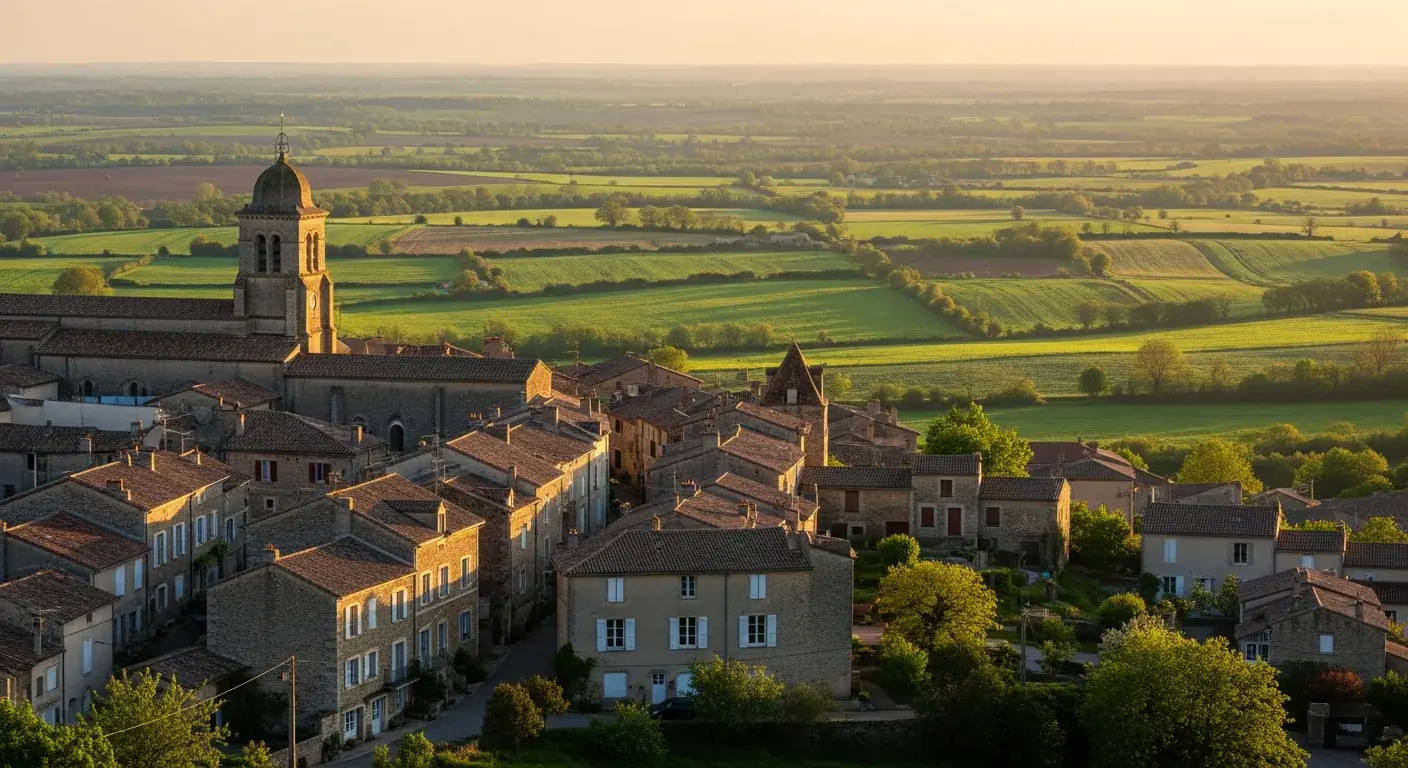
Direct door-to-door trip from Bordeaux (~2 hours 40 minutes), with stops along the way as desired—Périgueux, Excideuil, and the Château de Hautefort. Written fixed-price quote within 30 minutes; sedan or van; English-speaking driver.