Bordeaux to Eymet: the English bastide of Purple Périgord
Founded in 1270 as a bulwark against the English, today it is the most “English” of all the bastides: recaptured by Du Guesclin in 1377 and dear to Henry IV, the small town of Le Dropt brings its Franco-British history full circle. A medieval castle, a square lined with arcades, and a Thursday market that has been held for seven centuries. About 1 hour and 35 minutes from Bordeaux.
Eymet at a Glance
- Eymet (whose residents are known as Eymétois) is a bastide in the Dordogne (24500), in the Bergerac region—the “Purple Périgord”—, built in a bend of the Dropt, on the border with Lot-et-Garonne. INSEE code 24167.
- Founded by a charter granted on June 28, 1270, by Alphonse of Poitiers, brother of Saint Louis, as a Capetian stronghold against the Anglo-Aquitanian domain of the Plantagenets.
- Ceded to the English as early as 1279 and contested throughout the Hundred Years' War, it was recaptured by Bertrand du Guesclin in 1377.
- Sound 13th-century castle, with its Monseigneur Tower (also known as the “Tower of the English”) has been listed as a Historic Monument since December 30, 1994.
- Its Place des Arcades (Place Gambetta) has hosted a market on Thursdays for nearly seven and a half centuries.
- It's ironic: this once anti-British town has become the most "British" of all the towns—about one in five residents is British, hence the nickname "Dordogneshire."
- 2,569 residents (2023), with a population density of 82 people per square kilometer: Eymet is a true small town, with an airport nearby (Bergerac) offering flights to the United Kingdom.
- From Bordeaux: ~119 km, about 1 hour and 35 minutes by car — starting at €211 for a private driver, door-to-door. There is no train station in Eymet.
Before You Go: What Eymet Is Really Like
One Thursday morning, under the arcades of Place Gambetta. The market stalls are overflowing with cheeses, Périgord strawberries, and Bergerac wine; on the terraces, the lilting accent of the Southwest blends with the more subdued accent of the English Midlands. At the corner of the square, a 13th-century square tower still watches over the nearby Dropt River. This is Eymet: a bastide founded to stand up to the English, which seven centuries later has become one of the most British villages in France. Everyone here finds the irony amusing—and they even embrace it.
Eymet is a border bastide, one of those new towns founded in the 13th century in the border region between the Kingdom of France and the English domain of Aquitaine. Its history forms a fascinating cycle: a bulwark against the English in 1270, an English stronghold by 1279, a contested territory throughout the 14th century, recaptured by Du Guesclin in 1377—and, eight centuries later, freely chosen as a place to live by hundreds of Britons. All set against a postcard-perfect backdrop: a covered market square, half-timbered houses, and a medieval castle on the riverbank.
This guide distinguishes fact from fiction. Given that this bastide is such a popular destination, a few charming legends circulate—a “diminutive suffix,” a “battle” of Eymet, a “house of Henry IV”—which we present for what they are. We rely on solid facts: the charter of 1270, the reconquest of 1377, the castle’s designation as a Historic Monument, and a very real British community.
As for access, Eymet doesn’t have a train station (the old Eymet-Bordeaux line closed in 1987) and can be reached by car, about 1 hour and 35 minutes from Bordeaux. Whether you’re visiting the bastide, dining on the square while enjoying a few glasses of Bergerac, or exploring the nearby vineyards and villages, a chauffeur service from Bordeaux offers the easiest door-to-door service.
A bastide in a bend of the Dropt River
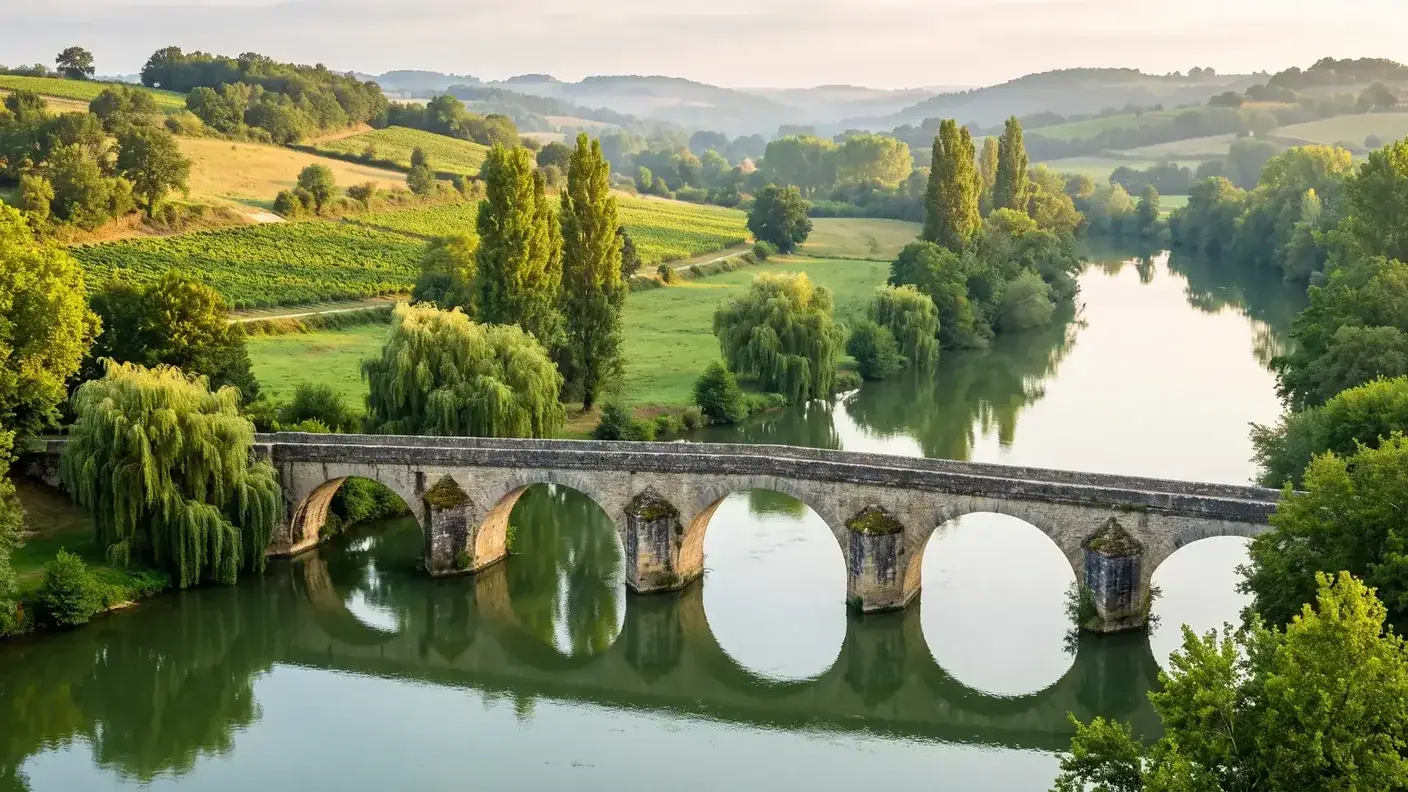
Eymet is located in the far south of the Dordogne, in the Bergerac region (the “Purple Périgord,” known for its vineyards), on the border with Lot-et-Garonne—the town borders five municipalities in the neighboring department. The town is built along a bend in the Dropt, a 132-kilometer-long river that originates in Capdrot, in the Dordogne, and flows into the Garonne at Caudrot, in the Gironde (two near-anagrams). The Dropt flows through the area for eleven kilometers and once served as its natural border.
Topography, Water, and Landscapes
The territory, covering 31.25 km², ranges in elevation from 41 to 133 meters. In addition to the Dropt, several smaller waterways (the Escourou, the Réveillou, the Barbeau, and the Boudou) form a network spanning about 40 kilometers, complemented by Lake Escourou. It is a landscape of vineyard-covered hillsides and farmland, typical of this southern part of the Bergerac region, which already borders the Duras vineyards.
A few key figures round out the picture. The bastide is located at 44°40'07" north latitude and 0°23'56" east longitude, at an average elevation of approximately 86–88 meters, depending on the reference system. The municipality’s waterway network totals 47 kilometers of watercourses, and Lake Escourou borders the area for nearly three kilometers—a body of water popular with anglers and hikers. The Dropt River itself, 132.47 kilometers long, joins the Garonne on its right bank: this modest river was long the lifeline of the region, carrying barges loaded with wine and timber downstream.
| Data | Value |
|---|---|
| ZIP Code / INSEE | 24500 / 24167 |
| Natural Region | Bergerac Region, Purple Périgord |
| Borough | Bergerac |
| Area | 31.25 km² |
| Elevation | 41 m to 133 m |
| Waterways | the Dropt River (11 km within the municipality) |
| Population | 2,569 residents (2023) — the residents of Eymet |
| Density | 82 people per square kilometer |
| Foundation | Charter of June 28, 1270 (bastide) |
A town with a population of 2,569 Eymétois
According to INSEE (2023 population figures, published in July 2026), Eymet has 2,569 residents, or 82.2 inhabitants per square kilometer. This rural town constitutes a small urban unit in its own right. What sets it apart from its neighbors is its large British community, which is discussed further on without assigning it an official percentage.
Administratively, Eymet falls under the jurisdiction of the Bergerac District. The town was the seat of the Eymet canton from 1790 to 2015 — nearly two and a quarter centuries — before the territorial reform turned it into the central office of the new canton of Sud-Bergeracois. A quick note for statistics buffs: Eymet’s INSEE code is 24167, not to be confused with 24166, which refers to Eyliac, another town in the Dordogne—two consecutive numbers for two villages that have nothing to do with each other, a classic pitfall of poorly targeted searches.
1270: A frontier bastide founded from Tunis
According to the town of Eymet, the charter of customs was granted on June 28, 1270, by Alphonse de Poitiers and his wife Jeanne. The charter established the new town and granted certain freedoms intended to attract residents to this strategic location, including market rights and a municipal structure.
A charter signed in Tunis
A fascinating—and very real—detail: neither Alphonse nor Jeanne ever set foot in Eymet. On June 28, 1270, the couple was… in Tunis, having set sail on the Eighth Crusade with Saint Louis (who was to die there). The bastide was therefore founded and administered from afar by the seneschals of Agen. Alphonse himself died the following year, in 1271, without ever having seen his new town.
The charter itself was by no means improvised: it was a Castelsagrat-style charter of customs, named after a model bastide whose text served as a template for several of Alfonso’s settlements. The count’s administrators thus had a tried-and-true template at their disposal, which they adapted to each specific site: proof that the colonization of the Southwest in the 13th century was the result of a genuine, standardized, and methodical development policy, rather than isolated initiatives.
The Capetian Lock on the Dropt River
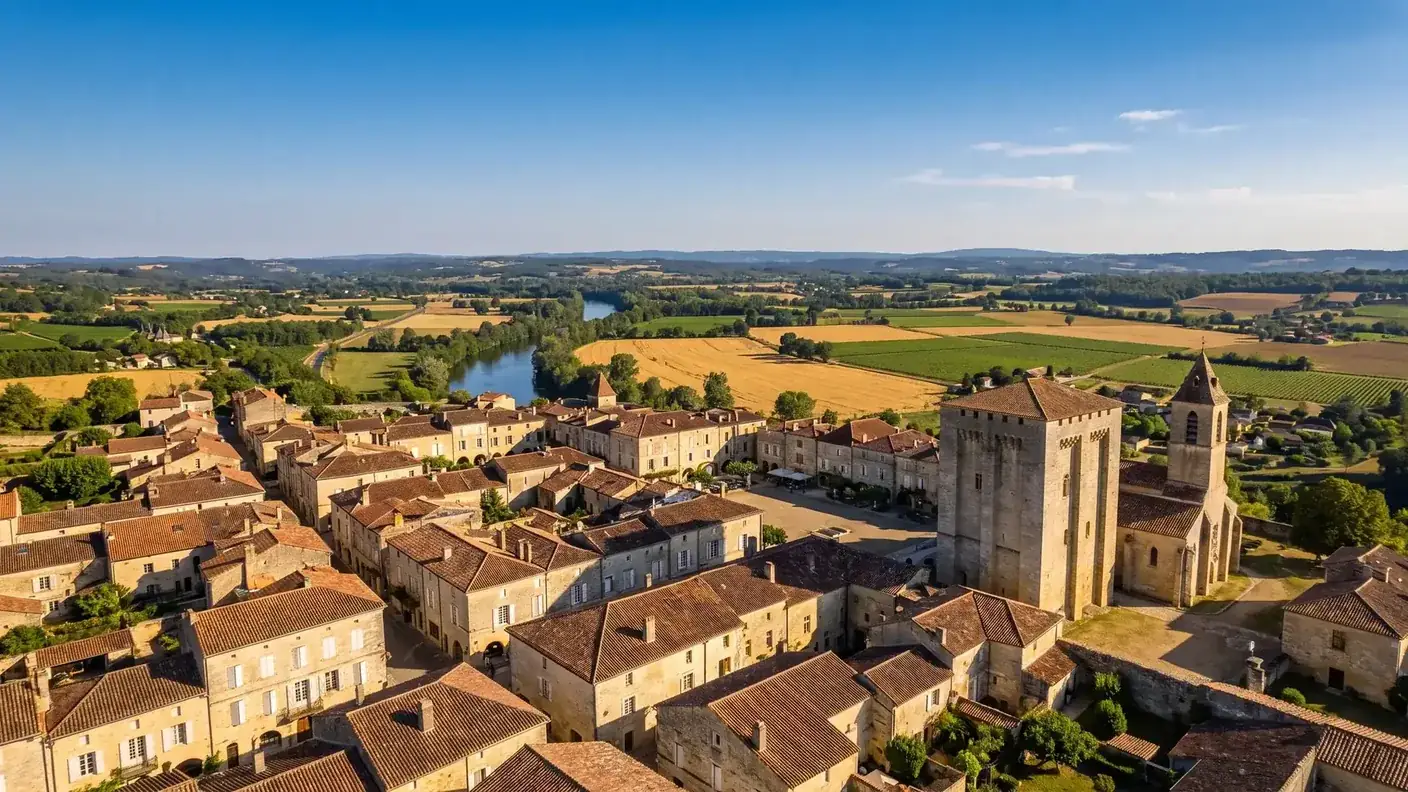
The bastides of southwestern France are not mere villages: they are new towns with political and military purposes, born out of the rivalry between the Capetians (kings of France) and the Plantagenets (kings of England, dukes of Aquitaine since Eleanor). Situated on the banks of the Dropt River, in this border region, Eymet served as a defensive stronghold: controlling the thoroughfares and asserting French presence in the face of English ambitions. Like its neighbor Sainte-Foy-la-Grande, it features a regular layout with a central square lined with arcades.
The Origins of the Name
The very name of the place is ancient. Toponymists cautiously link it to a figure of Germanic origin, *Ametus* (the reconstructed form), from which the attested spellings are thought to derive: Aymetum (1308), Bastida Emeti (1360), and Aymet in the 16th century. In Occitan, the town is called Aimet.
The archives allow us to trace the name’s evolution over more than four centuries—a sort of spelling saga in which the spelling wavered for a long time before settling on a definitive form:
| Date | Attested form |
|---|---|
| 1308 | Aymetum (Latinized form) |
| 1360 | Bastida Emeti (“the bastide of Eymet”) |
| 16th century | Aymet |
| 1714 | Emez |
| 1751 | Aymet (again) |
| Today | Eymet — Aimet in Occitan |
It is worth noting that the name “Bastida Emeti,” dating from 1360—in the midst of the Hundred Years’ War—already enshrined the town’s status as a bastide in its official name; furthermore, the spelling “Aymet,” still in use in the 18th century, is the very same one that Henry of Navarre would use in his correspondence.
From English to French Hands: Du Guesclin, 1377
No sooner had the bastide been founded than it switched sides. As early as May 23, 1279, under the Treaty of Amiens, Eymet came under the sovereignty of the King of England Edward I — an illustration of the vulnerability of these border territories, which changed hands with each new treaty. Upon Alphonse’s death (1271), the fief first reverted to the French crown, before being ceded to England eight years later.
A Century of War on the Dropt River
The real upheaval came with the Hundred Years' War (beginning in 1337). For over a century, Eymet became one of the key battlegrounds where supporters of the King of France and the King of England clashed, with the town changing hands several times as campaigns ravaged the Southwest.
The most significant event took place on September 1, 1377: while the town was held by an English garrison, French troops led by Bertrand du Guesclin—Constable of France under Charles V and one of the greatest military commanders of his time—besieged and captured the castle. The recapture of Eymet was part of the vast, methodical reconquest that Du Guesclin was then carrying out against the strongholds of Aquitaine. Few villages of this size can boast of having seen the most famous constable in French history pass beneath their walls.
1453: The End of English Guyenne
The city continued to change hands until the end of the conflict. The July 17, 1453, the Battle of Castillon brought an end to the English presence in Guyenne; Bordeaux surrendered in October. That same year, a document—the Treaty of Bordeaux—recorded the statement “ Monsignor d'Aymet ", referring to Bertrand de Pellegrue, a local lord to whom Louis XI restored his rights. That is where the keep gets its name from Monseigneur Tower; its other nickname, “Tour des Anglais,” refers to the recapture of 1377.
The timeline of the war's end warrants further clarification, given how gradual it was. After the French victory at Castillon, Bordeaux surrendered on October 14, 1453, bringing to a close three centuries of English rule in Guyenne; but no general peace treaty was signed at that time, and it would not be until the Treaty of Picquigny, 1475, so that the conflict could reach an official diplomatic resolution. For Eymet, the essential points had already been settled by 1453: the Treaty of Bordeaux of September 12 restores Bertrand de Pellegrue—"previously registered and granted to Monseigneur d'Aymet," as the text states—to his seigneurial rights, and the border bastide finally ceases to be a border.
The Castle and the Monseigneur Tower
According to the Mérimée entry PA00132928 from the Ministry of Culture, the Château d'Eymet dates from 13th century, was incorporated into the fortifications of the bastide founded in 1270 and has been listed since December 30, 1994. Its location, near the Dropt River, explains its defensive role within the city walls.
The Monseigneur Tower, Room by Room
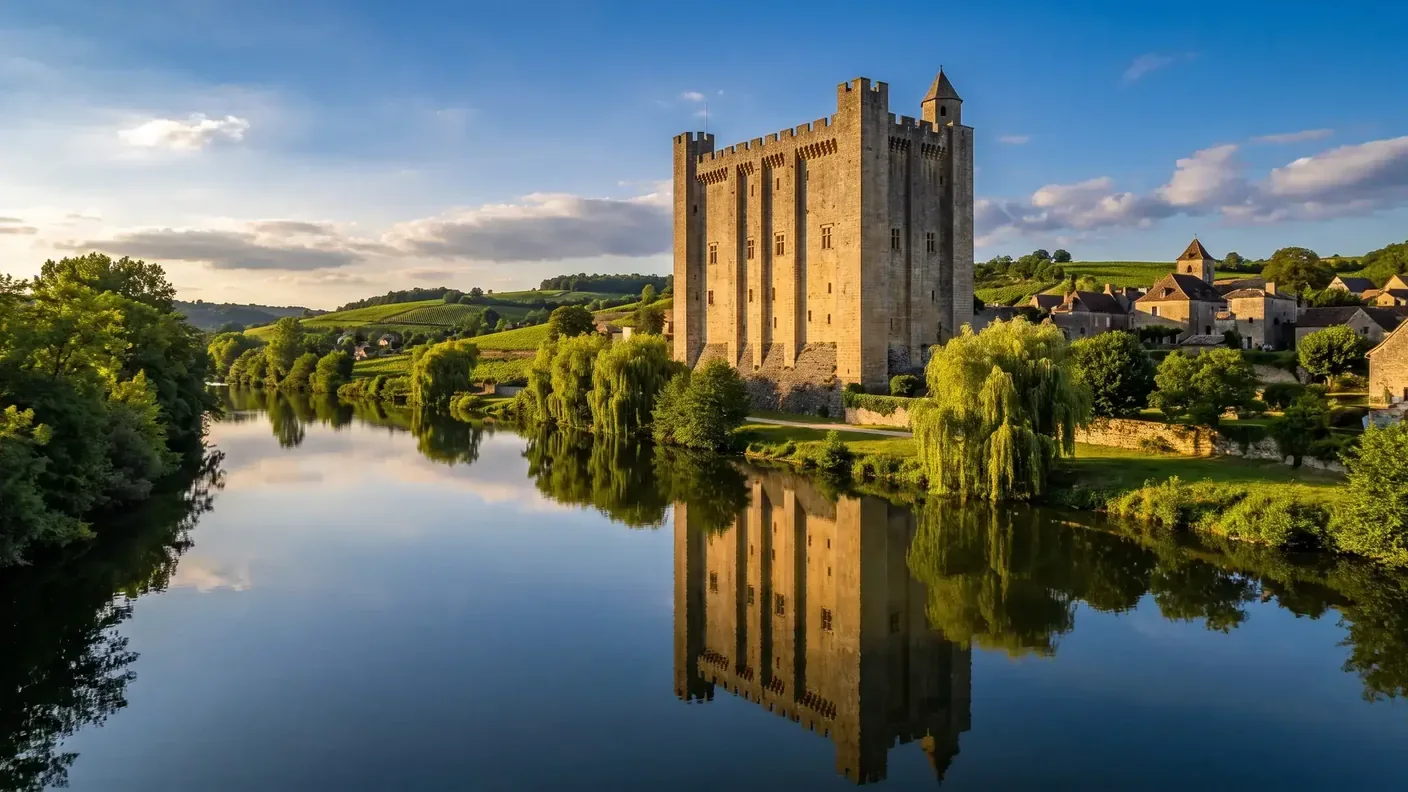
The heart of the castle is its square keep, the Tour Monseigneur. It contains three vaulted rooms, each measuring about 30 m², with vaults nearly six meters high:
- to the ground floor, a windowless dungeon with no openings served as a prison;
- Upstairs, the lord's chamber shows signs of a certain level of comfort: a fireplace, a sink, latrines, and windows with built-in seats (these stone seats set into the window recesses).
The wall retains the classic elements of medieval military architecture—machicolations, battlements, a corner tower, a bretèche (the overhanging structure above a gate), and an échauguette (the corbelled watchtower). In the 14th century, amid the tensions of war, the lords of Pellegrue reinforced the wall. The main residence, however, was rebuilt in the 19th century in a more peaceful style.
Originally, the keep was even more imposing than it is today: it had three crenellated stories and a drawbridge. Its top terrace rises 21 meters above the ground—a military lookout from which the sentry could take in the entire bastide, the Dropt Valley, and the surrounding hills at a single glance. The drawbridge is gone, but the tower’s square silhouette has lost none of its imposing presence.
From the Lookout Post to the Museum
Since 1963, the castle has housed a museum (featuring archaeological and natural history collections); it was designated a Historic Monument by decree on December 30, 1994. Now owned by the municipality, it hosts exhibitions and cultural events—its terrace, about twenty meters above the ground, offers the best vantage point over the entire bastide.
Place des Arcades, the heart of the bastide
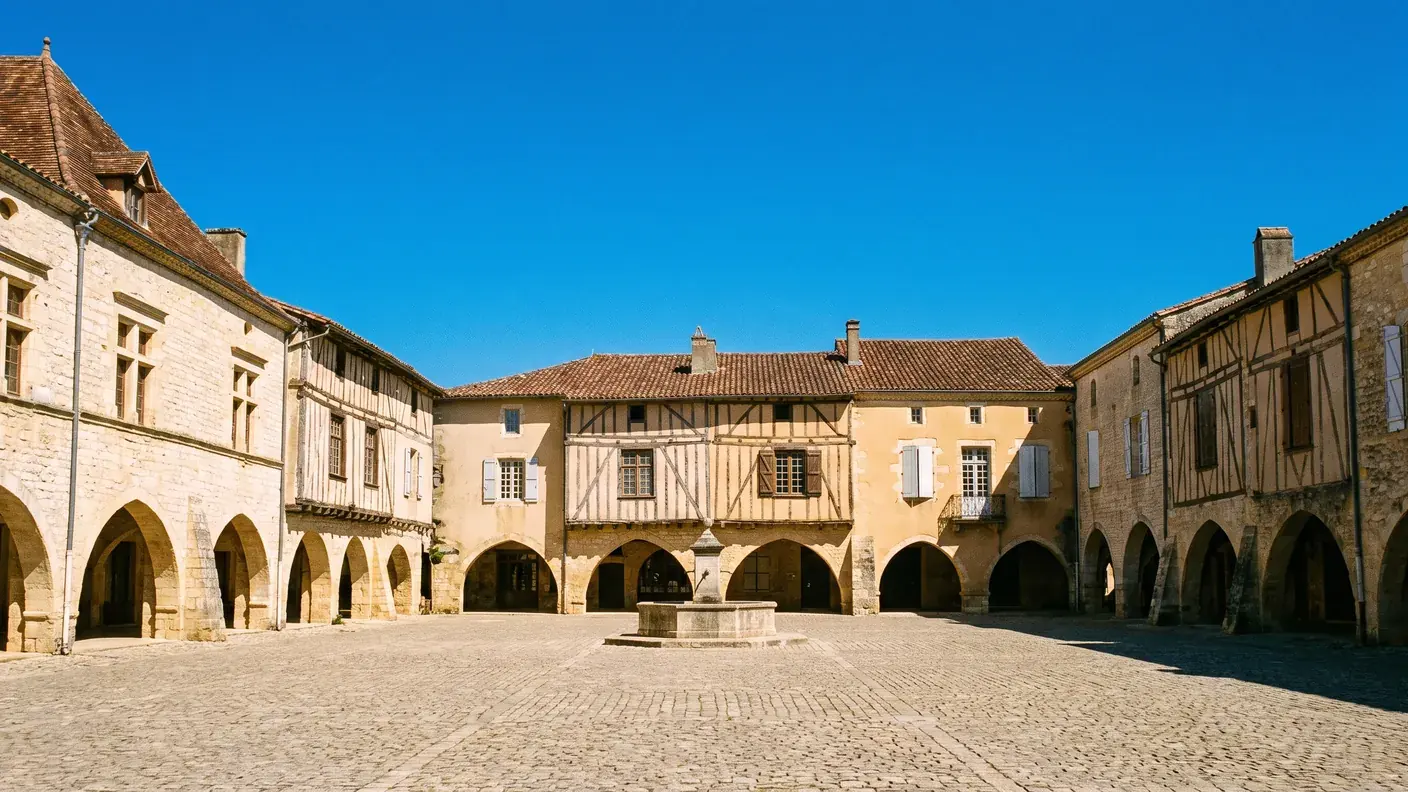
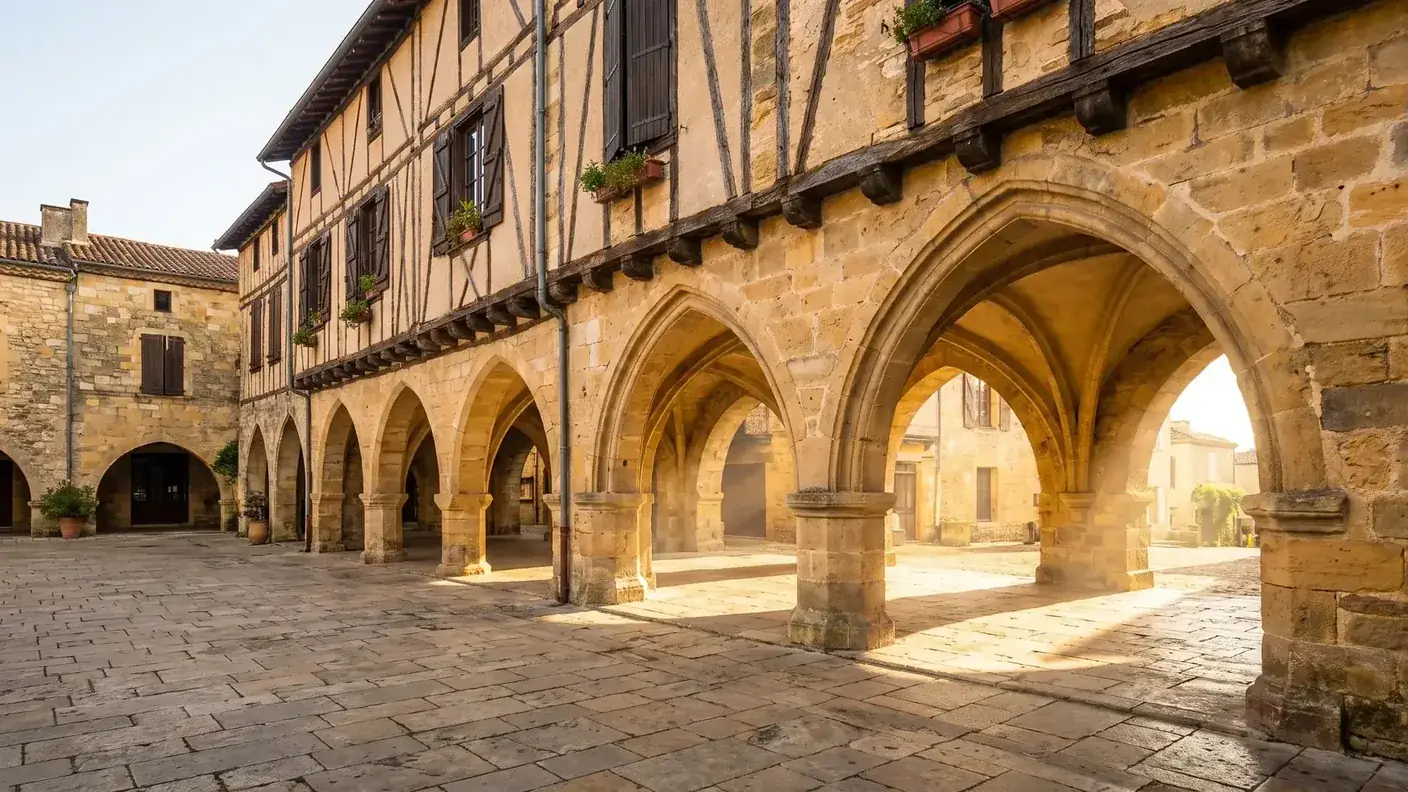
While the castle embodies the military function, Place des Arcades embodies the civil and commercial functions. Officially known as Place Gambetta (it is also called Place des Cornières or Place d’Armes), it is bordered on all four sides by stone-covered arcades—the “couverts”—which have housed merchants and market stalls for centuries—and today feature shops, cafés, and outdoor seating areas.
A spot off to the side near the river
One feature sets Eymet apart from other bastides with their perfect grid layout: its town square is not located at the geometric center of the town, but is instead situated off-center to the west, very close to Dropt—where there used to be a landing stage which was used to transport wood and wine to Bordeaux by barge. In this respect, Eymet resembles its neighbor Sainte-Foy-la-Grande, which also faces the river. The square measures approximately forty meters on each side; beneath the arcades stand a row of half-timbered houses some of whose facades were redesigned in the 15th century.
From the market hall of 1270 to the fountain of 1830
The center of the square has changed dramatically: a central hall supported by wooden pillars, which housed the market and the administrative offices, disappeared in 1793 (traces of it were discovered during excavations in 1994); it was replaced in 1830 by the fountain that now stands at the heart of the square. At one end stands the castle, bringing together in a single vantage point the two functions of the bastide: defense and commerce.
The square retains a royal air. There stands a house known as “Henri IV’s”—more a local tradition than a documented residence. What is certain, however, is that Henri of Navarre, the future Henri IV, dated a love letter from Eymet: On March 15, 1588, he wrote to his mistress Diane d’Andouin, “the beautiful Corisande,” from “Aymet,” sending her “a thousand million kisses.” A local restaurant took its name from this passionate note: “La Maison d’Amour.”
The anti-English bastide that became “the most English”
There is a paradox in Eymet’s recent history that its residents always point out with a smile: this bastide, founded to stand up to the English, has become—seven centuries later—one of the most British towns in France.
Fifty Years of British Presence
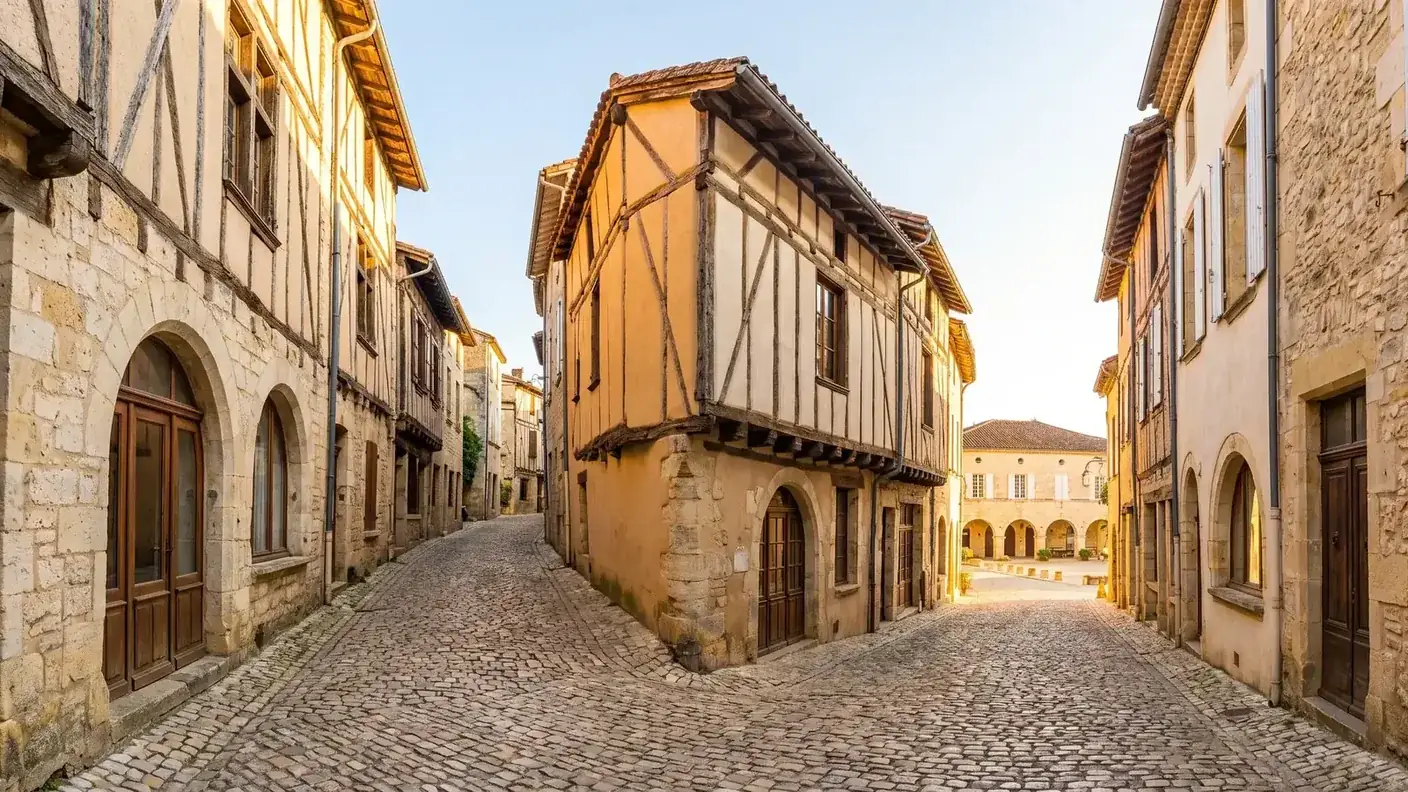
The first British settlers began arriving as early as the 1970s: retirees drawn by a milder climate than that of the British Isles, stone houses in need of renovation at prices far below those on the English market, and a well-preserved rural setting. By buying and restoring buildings that had sometimes been left to fall into disrepair, these pioneers—often without even intending to—helped save a portion of the historic architecture. The trend gained momentum in the 1980s and 1990s, with entire families opening businesses and founding organizations—they even started a cricket club there.
Today, it is estimated that British residents make up about one in five of the population—a figure based more on media hype than on an official INSEE statistic, but one that’s enough to earn Eymet the nickname “little capital of ‘Dordogneshire’ ” (the term, modeled after English counties, actually refers to the entire department). At the market, the accents of southwestern France mingle with those of the Midlands; French-English sports matches liven up the outdoor cafes. Brexit (2020) introduced some administrative uncertainty for these long-time residents, but the community has remained firmly rooted—deeply attached to this village, which, for many, is much more than just a second home.
"Dordogneshire": From Nickname to Dictionary Entry
Estimates of this presence vary depending on the source: the media cite “one in five,” while others, taking a more cautious approach, put the figure at around 10% of the population—since INSEE does not publish a breakdown by nationality on this scale, a reasonable range is between 10% and 20%. As for the word “Dordogneshire,” it has come a remarkable way: modeled after English counties (Yorkshire, Devonshire…), it has now entered the lexicon, with its own entry in Wiktionnaire. Few local jokes have achieved such recognition. The phenomenon can also be explained by logistics: Bergerac Airport, just twenty minutes away, is served by Ryanair, Jet2, and British Airways from London, Birmingham, Bristol, and Manchester—making it just as easy to visit family as it is from an English suburb.
The Thursday Market, a centuries-old tradition
The Thursday morning market takes place under the arcades of the square, and it is one of the liveliest events in the southern Bergerac region. Tradition holds that it dates back to the very founding of the bastide: in the Middle Ages, having a guaranteed market day was a decisive factor in attracting residents and helping a new town thrive. While there is no primary source to confirm that the charter of 1270 specifically designated this day, the the market in this location has been operating continuously for centuries...she, on the other hand, is very real—nearly seven and a half centuries in the same place.
In addition to this weekly tradition, a more recent event takes place in the summer: night markets on Tuesday evenings in July and August, held in the town square and on the church forecourt. Local producers, tables set with tableware, and a friendly atmosphere: the central square continues to fulfill the role that the bastide assigned it from the very beginning—that of the beating heart of community life.
What to See Around Eymet
Eymet is an ideal base for exploring the Périgord Pourpre and the Dropt region, at the junction of the Dordogne and Lot-et-Garonne departments. Here are the actual driving distances from the bastide:
| Destination | Distance / time from Eymet | Interest |
|---|---|---|
| Bergerac | ~25 km · ~27 min | Cyrano, Old Town, gabarres, vineyards, airport (flights to the UK) |
| Issigeac | ~20 km · ~25 min | A circular medieval village with a renowned Sunday market |
| Duras (47) | ~20 km · ~25 min | The Dukes' Castle, AOC Côtes de Duras Vineyard |
| Monbazillac | ~25 km · ~30 min | Château Renaissance, a famous sweet wine |
| Monpazier | ~45 km · ~50 min | The most famous bastide in the Périgord (1284), with covered courtyard |
| Bordeaux | ~119 km · ~1 hr 35 min | Metropolis, Saint-Émilion Along the Way |
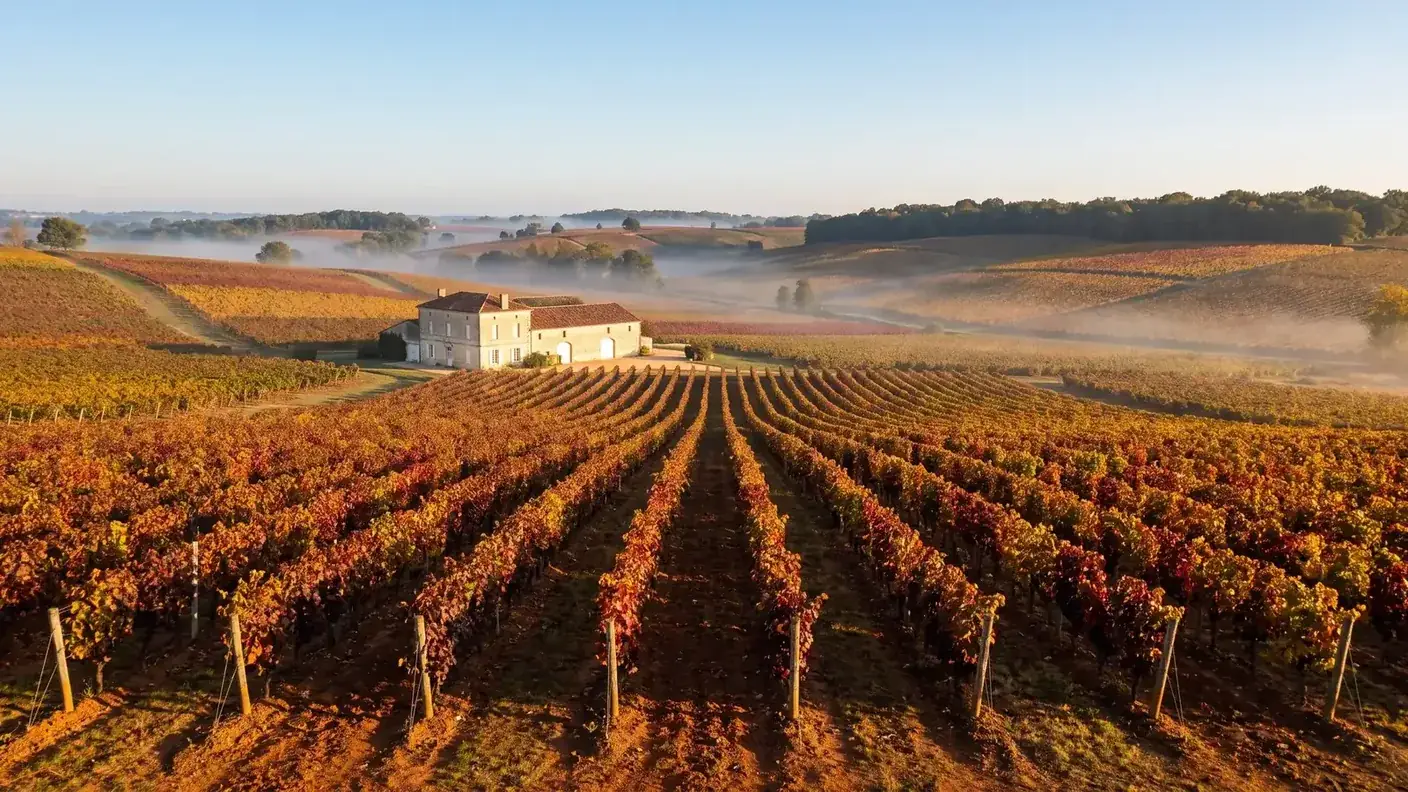
The Eymet region is home to a wealth of bastides (Eymet, Monpazier, Villeréal, Castillonnès) and vineyards (Bergerac, Monbazillac, Saussignac, Duras). A region of markets, castles, and stone villages, still off the beaten path of the large tourist crowds in the Périgord Noir.
Getting to Eymet from Bordeaux
Eymet is about 119 km from Bordeaux, or ~1 hour and 35 minutes by car — and not the “79 km” that is sometimes cited, which is only the distance as the crow flies. The bastide can be reached via the departmental roads in the southern Bergerac region (RD 18, 25, and 933); it has no more train stations since the Eymet-Bordeaux line was closed to passenger service (1987).
| Fashion | Duration | Estimated cost | Details |
|---|---|---|---|
| Chauffeured transfer | ~1 hour 35 minutes | Starting at €211 · one-way | Door-to-door service from Bordeaux, with stops at your choice (Saint-Émilion, vineyards) |
| Personal car | ~1 hour 35 minutes | ~20–26 € for gas and tolls | Take the A89 or the N21, then the departmental roads toward Le Dropt |
| Train + Transfer | 2 hours–2 hours and 30 minutes | ~15–25 € (TER) + road trip | Take the TER to Bergerac, then ~25 km with no direct transportation |
| Airplane (UK context) | — | — | Bergerac Airport (~25 km): flights to London, Bristol, Manchester… |
By road, train, and air
Yet the train did exist: an Eymet-Bordeaux line operated from 1899 to 1987—nearly nine decades of direct rail service between the bastide and the capital of the Gironde—before the railroad withdrew from the Dropt countryside. All that remains is the memory—and the necessity, from now on, to travel by road.
By car, you can reach the southern part of the Bergerac region from Bordeaux via the A89 or the N21. The nearest train station is Bergerac (~25 km), on the Bordeaux-Sarlat line, but from there you’ll need to continue by road to Eymet. An interesting fact related to the British community: Bergerac-Dordogne-Périgord Airport, about 20 minutes away, offers direct flights to the United Kingdom (London, Birmingham, Bristol, Manchester).
By private chauffeur
If you’re coming from Bordeaux and want to avoid a transfer in Bergerac, and then explore the bastides and vineyards, a executive car service from Bordeaux is the simplest option: a direct, door-to-door trip of about 1 hour and 35 minutes, with stops as desired (Saint-Émilion is along the way) and a fixed rate known in advance, starting at €211 one way.
Practical Information
- Recommended duration: half a day in Eymet (Place des Arcades, the castle, half-timbered streets), with the option to extend the trip to Issigeac, Monbazillac, or the Duras vineyards.
- The main event: the Thursday morning market under the arcades; in the summer, the Tuesday night markets.
- Must-see sights: the 13th-century keep (Tour Monseigneur, a listed historic monument), Place Gambetta and its covered arcades, and the half-timbered houses. The bastide has been designated a protected site, safeguarding its medieval ensemble.
- Shops & Services: Eymet is a truly lively town, with plenty of shops, cafés, and restaurants—some of which are run by the British community.
- Transportation: No train station. A car or private chauffeur is recommended. The train station and airport (for UK flights) are in Bergerac (~25 km).
- Best time to visit: Thursdays for the market; spring and summer for the outdoor cafes, vineyards, and night markets.
Frequently Asked Questions
When and by whom was Eymet founded?
Through a charter of customs granted on June 28, 1270, by Alphonse de Poitiers, Count of Toulouse and Poitiers and brother of Saint Louis, along with his wife Jeanne. Fun fact: the couple never set foot in Eymet—they were in Tunis at the time, participating in the Eighth Crusade. The bastide was founded and administered from afar.
Why has Eymet changed hands several times?
Because it was located on the border between the possessions of the King of France (the Capetians) and the Anglo-Aquitanian domain of the Plantagenets. As early as 1279, it came under the rule of the English crown. Throughout the Hundred Years’ War (1337–1453), it was captured and recaptured as military campaigns unfolded.
What is the connection between Du Guesclin and Eymet?
Bertrand du Guesclin, Constable of France under Charles V and one of the greatest military commanders of the Hundred Years' War, besieged and recaptured the Château d'Eymet from the English on September 1, 1377. It is from this recapture that the keep derives one of its nicknames, the “Tower of the English.”
What can you see at Eymet Castle?
The castle retains its 13th-century square keep, the Tour Monseigneur, as well as parts of its defensive walls: machicolations, battlements, a corner tower, a bretèche, and a watchtower. Listed as a Historic Monument since December 30, 1994, it has housed a museum (since 1963) and hosts exhibitions.
Why does Eymet have a large British community?
The British community dates back to the 1970s (retirees drawn by the climate, homes in need of renovation, and the cost of living), and grew in the 1980s and 1990s as entire families moved there. It is estimated that about one in five residents is British, earning Eymet the nickname “capital of Dordogneshire.”
How many people live in Eymet?
Eymet had a population of 2,569 according to the 2023 census, a slight decrease (−2.32%) compared to 2017, with a population density of 82 people per square kilometer. It is a truly small rural town, lively and well-served by local businesses.
What is Place des Arcades?
This is the town’s central square, officially known as Place Gambetta. Surrounded on all four sides by covered stone arcades (known as “couverts”) and half-timbered houses, it measures about forty meters on each side. Unusually, it is offset toward the Dropt River, near the former river landing stage.
How long has the Thursday market in Eymet been around?
The Thursday market has been held under the arcades for centuries—tradition traces its origins back to the founding of the bastide in 1270. This continuity of nearly seven and a half centuries in the same location makes it one of the oldest markets in the area.
Does Henry IV have any connection to Eymet?
Yes, a romantic and very real connection: On March 15, 1588, Henri de Navarre (the future Henri IV) dated a letter from Eymet to his mistress Diane d’Andouin, “the beautiful Corisande,” sending her “a thousand million kisses from Eymet.” A local restaurant, “La Maison d’Amour,” keeps the memory alive.
How far is Eymet from Bordeaux?
About 119 km, or ~1 hour and 35 minutes by car. With a chauffeured transfer, the door-to-door trip starts at €211 one way. Be careful with the “79 km” distance sometimes listed: that’s just the distance as the crow flies, not the actual driving distance.
How can you get to Eymet without a car?
Eymet no longer has a train station (the line was closed to passenger service in 1987). The nearest train station is in Bergerac (~25 km), on the Bordeaux-Sarlat line, as is the Bergerac airport (with flights to the United Kingdom). From Bergerac to Eymet, a taxi or professional chauffeur is still required.
Why is the Eymet keep called the “Tour Monseigneur”?
The name derives from the Treaty of Bordeaux dated September 12, 1453: In it, Louis XI ceded his rights to the local lord, Bertrand de Pellegrue, referred to in the text as “the previously registered and appointed Lord of Aymet.” The 13th-century square keep took on this name. Its second nickname, “Tour des Anglais,” recalls Du Guesclin’s recapture of the stronghold in 1377—two names, two pivotal moments in the Hundred Years’ War.
What is there to see around Eymet?
Bergerac and its vineyards (~27 min), the medieval village of Issigeac, the Château de Monbazillac, the bastide town of Monpazier, and the vineyards and Château de Duras. A region of fortified towns and vineyards, straddling the border between the Dordogne and Lot-et-Garonne departments.
Further Reading
- The capital of the Périgord Pourpre region, about 27 minutes away: see the Bergerac Guide (Cyrano, gabarres, Monbazillac)
- A neighboring wine-growing village (Saussignac): see the Monestier Guide (unfinished bastide, Michelin-starred golf course)
- Just outside the Duras vineyards, nearby: see the Armillac Guide (a village in the Val du Dropt)
- The capital of the Périgord Noir and its bastides: see the Sarlat Guide
- Plan your trip: Book a private driver from Bordeaux to Eymet or explore all our destinations
Sources and References
- Wikipedia — Eymet — geography, history, castle, demographics
- INSEE — Complete Report on Eymet (24167) — Population 2023, Population Density
- Wikidata — Eymet (Q864102) — area, elevations, coordinates
- Eymet Town Hall / City of Eymet — Charter of 1270, Tour Monseigneur, History of the Bastide
- Pays de Bergerac Tourist Office — Eymet — Place des Arcades, Market, Henri IV / Corisande
- POP/Mérimée Database — Château d'Eymet — Listed as a Historic Monument on December 30, 1994
- Wikipedia — Battle of Castillon (1453) — End of the English Presence in Guyenne
- Wikipedia — the Dropt — source at Capdrot, flows into the Garonne at Caudrot
Article updated in July 2026.
Off to the Land of the Bastides
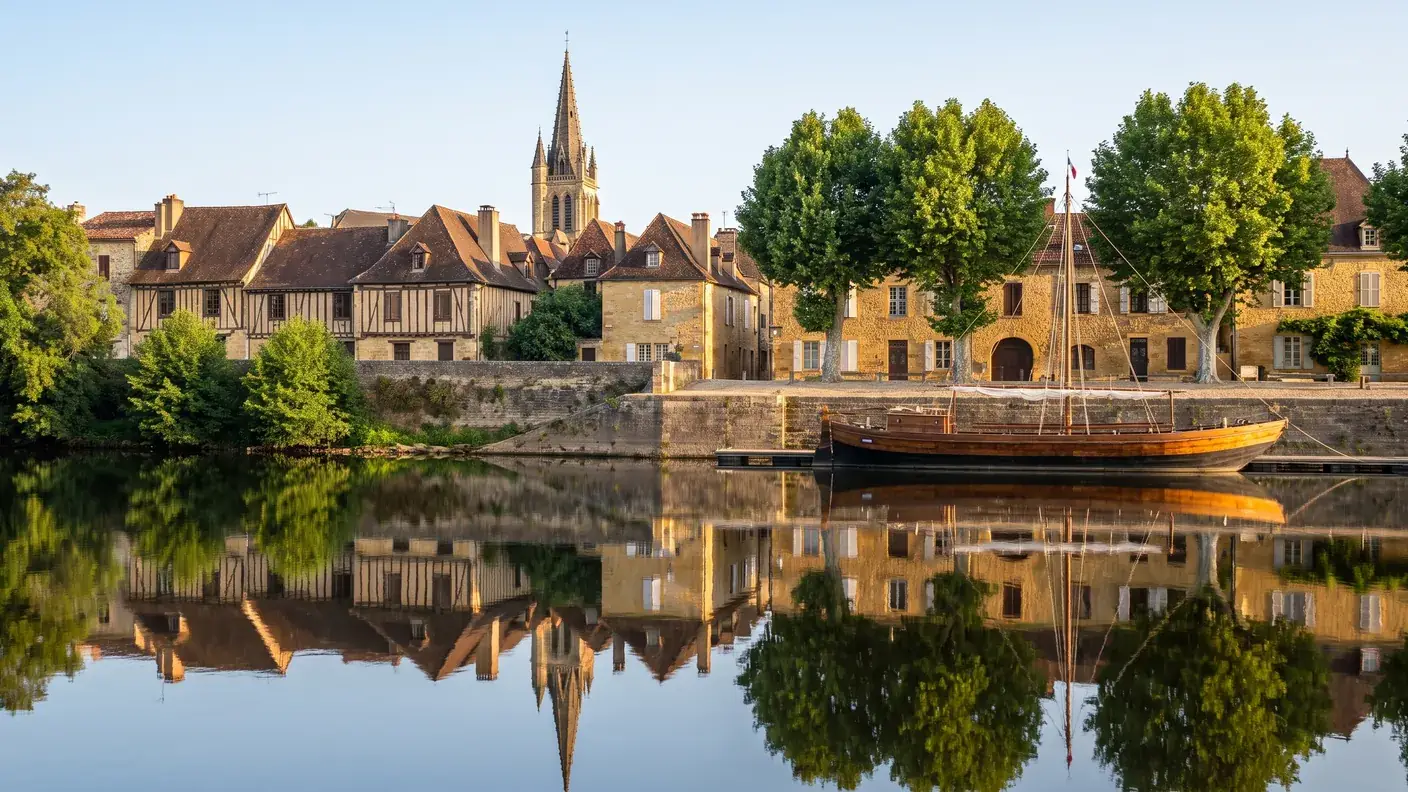
Direct trip from Bordeaux (~1 hour 35 minutes) to the southern Bergerac region, with stops of your choice along the way—Saint-Émilion, the vineyards, and nearby bastides. Written fixed-price quote within 30 minutes; sedan or 8-passenger van; English-speaking driver.