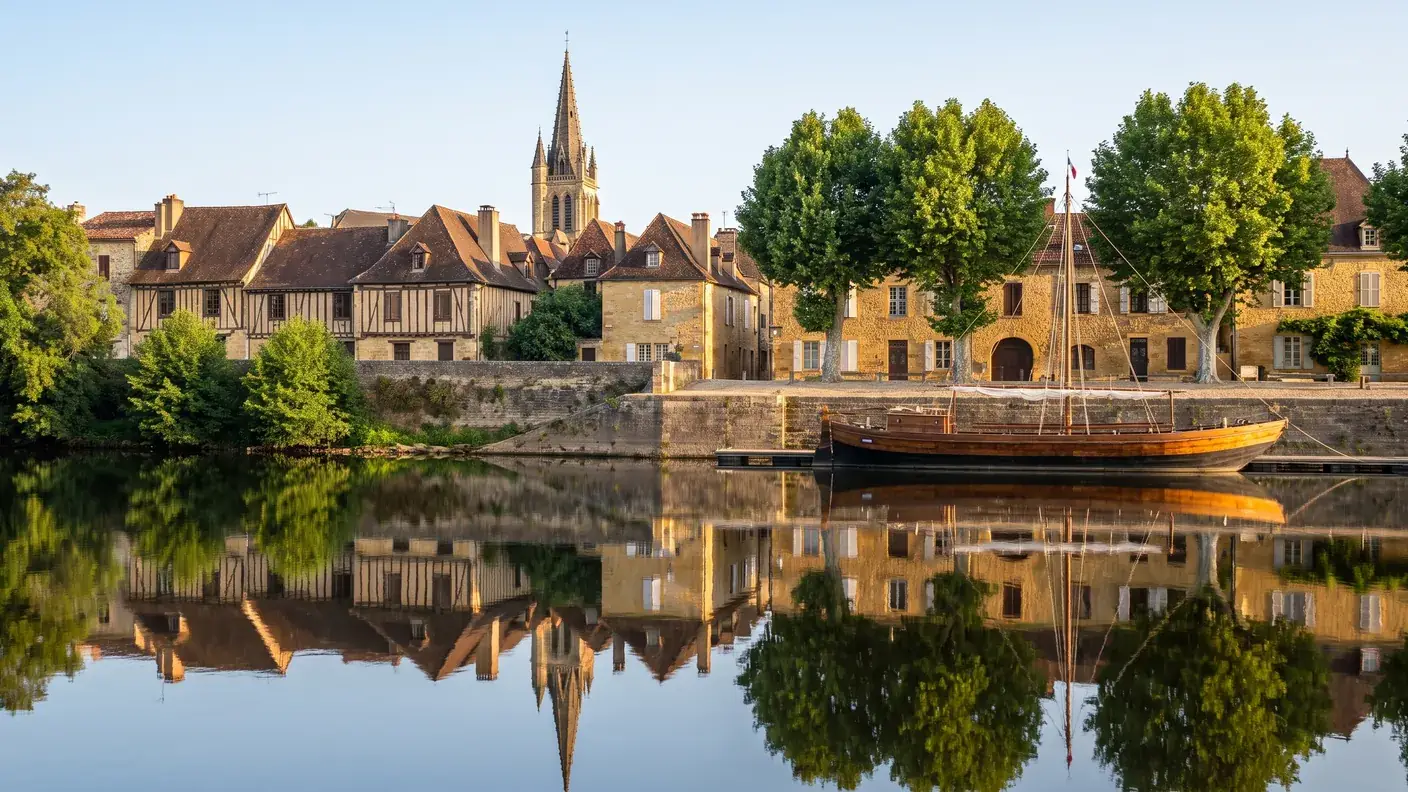
Bergerac, the Périgord Pourpre with panache
A city with two faces: a theatrical hero who never actually lived there, a royal peace treaty signed by the future Henry IV, gabarres on the Dordogne, and nine AOCs surrounding its half-timbered houses. Everything you need to know before you visit, just 1 hour and 31 minutes from Bordeaux.
Bergerac at a Glance
- Bergerac (27,110 residents [INSEE]) is the second-largest city in the Dordogne and the capital of the “Périgord Pourpre”, a region known for its vineyards: 9 AOCs around the city, including sweet Monbazillac.
- On September 17, 1577, the Treaty of Bergerac was signed here. Henri of Navarre himself initialled the text that ended the Sixth War of Religion and foreshadowed the Edict of Nantes.
- The city was predominantly Protestant in the 17th century (~6,000 Huguenots) and earned the nickname “Little Geneva”, before the dragonnades and forced abjurations of 1685 devastated the community.
- Cyrano never set foot here: the writer was Parisian; his “Bergerac” was an estate in the Chevreuse Valley. The town has embraced the mix-up, with two statues.
- On the Dordogne, the gabarres retrace the wine barrels’ former route every summer on a 50-minute cruise from Quai Salvette (April–October).
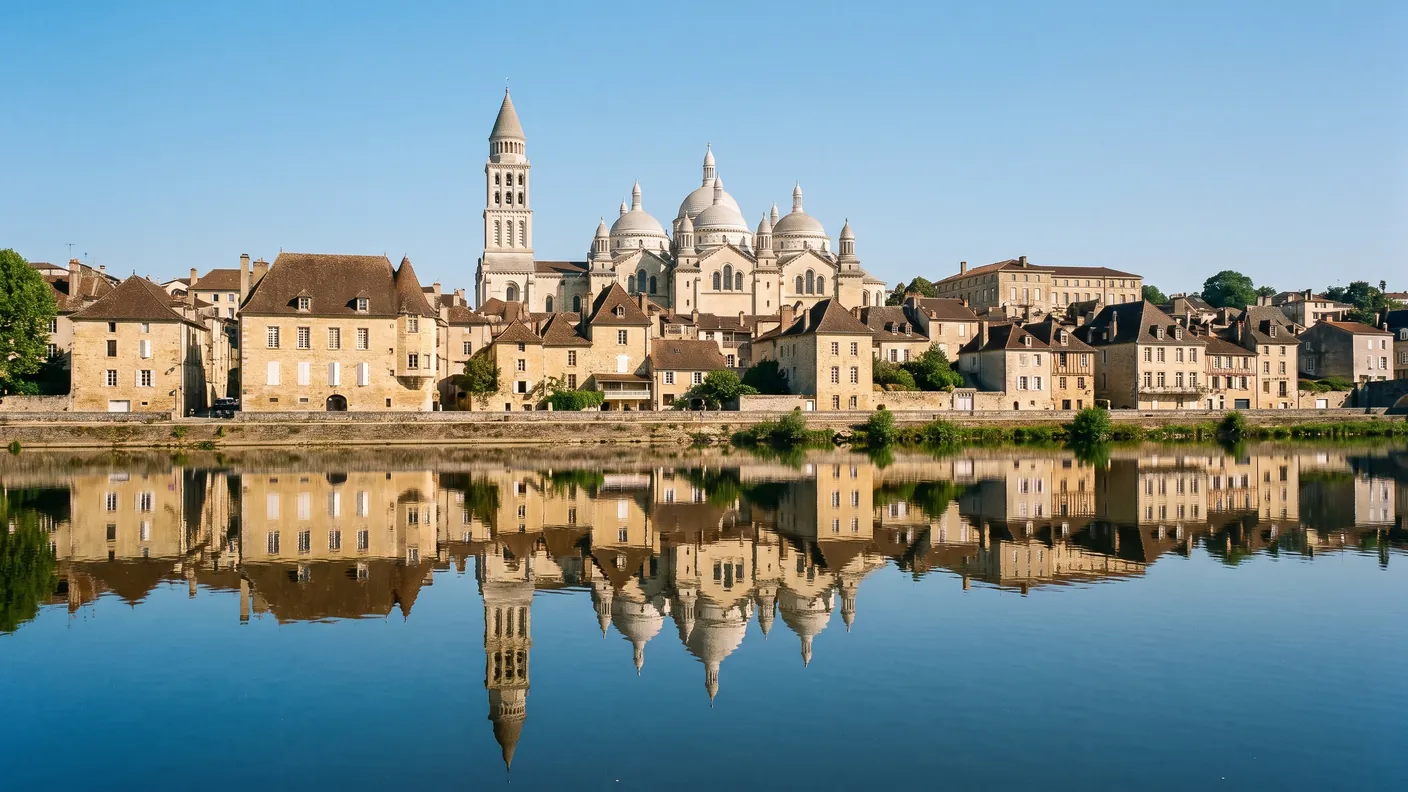
- The Old Town features half-timbered houses, the renovated market hall, the Récollets cloister—now known as Quai Cyrano—and the tourist office/Maison des Vins, where you can enjoy wine tastings overlooking the quays.
- At 12 minutes, the Monbazillac Castle (1550) stands proudly among its vineyards; the local Michelin-starred restaurant, La Tour des Vents, overlooks the vineyard from the Malfourat mill.
- By car from Bordeaux: 117 km, approximately 1 hour 31 minutes — from 200 € with a door-to-door chauffeur service.
Before You Go: What Bergerac Is Really Like
6:00 p.m., Place Pélissière. The bronze statue of Cyrano gazes down at the Church of Saint-Jacques, nose in the wind, plume standing at attention—a theatrical hero who never saw the city, yet was immortalized in stone by it twice. A hundred meters away, a street is called “Rue des Conférences”: it was there, in a half-timbered house, that Henri of Navarre negotiated a peace treaty in 1577 that goes by the name of Bergerac in all the history textbooks. The city of France’s most celebrated literary myth is also the setting for a true story that almost no one knows.
Bergerac is a city of two sides: on the postcard side, the half-timbered houses, the gabarres, the vineyards, and Cyrano’s nose; on the historical side, one of the great Protestant regions of the kingdom, a national peace treaty signed within its walls, a river port that shipped its barrels to England and Holland, and a tobacco capital that has preserved its museum—"unique in Europe." As a subprefecture with 27,110 residents and the second-largest city in the Dordogne, it is now the heart of a wine-growing region comprising nine AOCs—and the airport for British residents of the Périgord.
This guide separates fact from fiction: the true details of the 1577 peace treaty (who signed what, and where), the dragonnades and forced abjurations of August 1685, the precise genealogy of Cyrano’s “de Bergerac”—a fief in the Chevreuse Valley, sold when the writer was 17—the statues (1977 in light-colored stone, 2005 in painted bronze), the 2026 rates for the gabarres and the Château de Monbazillac, and the actual condition of the airport following Ryanair’s winter withdrawal. With all road distances verified.
Logistics: the Bordeaux–Bergerac TER works well (1 hour 10 minutes to 1 hour 30 minutes on the Sarlat line), but a car becomes essential if you want to explore Monbazillac, Issigeac or Saint-Émilion along the wine route. A chauffeured transfer from Bordeaux (1 hour 31 minutes via the A89) turns a day in Bergerac into a relaxed tour with wine tastings included.
The second-largest city in the Dordogne, capital of the Périgord Pourpre
Bergerac stretches along the Dordogne River, in the heart of the tourist region named in the 1980s for the color of the vine leaves in the fall: the Purple Périgord — now promoted under the brand name “Pays de Bergerac, vineyards and bastides” (2013), but everyone still calls it “pourpre.” A crossroads location: not quite the Bordeaux vineyards, nor quite the Périgord Noir region of the châteaux—precisely what made its commercial fortune, back when the river was the only “highway” in the Southwest.
| Data | Value |
|---|---|
| Status | Subprefecture of the Dordogne (including Nontron and Sarlat) — The department's second-largest city |
| Population | 27,110 residents (2023) — The People of Bergerac |
| Metropolitan Area | urban area: 65,219 residents (22 municipalities) · catchment area: 74,553 residents |
| Area | 56.10 km² — the 11th-largest municipality in the Dordogne |
| River | the Dordogne River, regulated by the 1852 dam—the last reservoir before the estuary |
| Vineyard | 9 AOCs around the city (~12,000 ha, including Duras) |
| Label | City of Art and History (2013) |
| Distance from Bordeaux | 117 km (1 hr 31 min via the A89, Exit 13, then the D709) |
The population has remained stable here, even as so many other subprefectures are losing residents: around 27,000 residents for the past half-century, with a record high of 28,063 in 2013 and a recent slight uptick driven by new arrivals (+0.9% annual net migration). The river, for its part, retains its landmarks: the Bergerac Dam (1839–1852), built to raise the water level by 2.25 m to facilitate the passage of gabarres; it has housed a turbine for EDF since 1966 and was equipped with a fish passage in 1984, at which time the longest in Europe. In the spring, dead shad can be seen on the riverbanks—95% die of exhaustion after spawning, a spectacular sign of the return of migratory fish.
"Little Geneva": When Bergerac Was Predominantly Protestant
This is the least familiar, yet most formative, chapter in the city’s history. The Reformation took root as early as the 1540s: in January 1543, crosses and relics were removed from the convents; in July 1544, the statue of Our Lady was thrown into the Dordogne. Reformed worship is documented from 1553, a church was established in 1558 with a pastor sent from Geneva, and in 1561, after a public debate, the town’s bourgeoisie embraced the Reformation, a choice led by its river merchants. Having sided with the Protestants as early as 1562–1563, Bergerac officially became a Huguenot refuge under the Edict of Nantes (1598).
The Wars of Religion played out here in full. In March 1563, the Baron de Piles captured the town and executed the Catholic garrison and parish priest; the convents were looted and St Catherine’s Church demolished. The first Protestant temple rose on its ruins, led by a Scottish former monk. In 1567, the people of Bergerac cut their own bridges to stop Catholic troops crossing the Dordogne. Charles IX passed through in 1565 and Henry of Navarre in 1576; fifteen kilometres away came the next treaty, the Peace of Fleix (1580). Two royal peace treaties were concluded in the same valley within three years.
The scale of the phenomenon has been documented: approximately 6,000 Protestants in the 17th century—that is, the majority of the population. A royal decree of 1681 explicitly recognized this, excluding Reformed Protestants from the consulate precisely because they were “more numerous than the Catholics.” The city had its own Protestant college (founded in 1564, reestablished in 1577 thanks to a donation from Henry of Navarre), its pastors, and its printing presses—which earned it the nickname “ Little Geneva ". And its ramparts: the Bourbarraud Bastion, known as the Bastion des Carmes, built between 1577 and 1621 using stones from the convent it replaced, made Bergerac “one of the most powerful bastioned strongholds in the Southwest.” Louis XIII came in person to have them razed in July 1621—by the Huguenots themselves. A remnant of the tip of the Carmes spur, unearthed at Place de la République in 2007–2008, still bears witness to this.
September 17, 1577: The Peace of France, known as the Peace of Bergerac
Few French cities have lent their name to a national peace treaty. In the spring of 1577, following the Sixth War of Religion, negotiators settled in Bergerac, a Huguenot stronghold considered safe. The talks began on May 15 at Maison Doublet and lasted four months. The royal side was represented by the Duke of Montpensier and Marshal de Biron; Henry III never set foot in Bergerac. On the Protestant side stood Henri of Navarre himself, the future Henry IV, whose signature “HENRY DE BOURBON” appears at the top of the list of signatories dated September 17, 1577. The text was then ratified by the Royal Edict of Poitiers on October 8. Rue des Conférences in the old town preserves the memory of the negotiations.
- The Reformed Church is permitted in the suburbs of only one city per bailiwick—and wherever it was practiced as of September 17.
- The lords and chief justices hold services in their primary residence; ordinary gentlemen, “for their family only,” are allowed ten guests.
- The number of mixed courts is reduced from eight to four chambers (Bordeaux, Grenoble, Aix, Montpellier), with about two-thirds Catholic and one-third Protestant judges.
- Eight places of safety, including Périgueux and La Réole but not Bergerac, were granted to the Protestants for six years.
- Catholic worship is restored everywhere, prisoners are released without ransom and a general amnesty is proclaimed, except for “heinous cases”.
- A chilling clause: the massacre of the Saint Barthélemy is declared “not an act of hostility”—and is therefore excluded from any compensation.
The Peace of Bergerac lasted nearly two years—a record for the time—and, above all, it served as a model: the Edict of Nantes of 1598 quotes word for word “the edict of pacification issued in the year seventy-seven” and adopts its mechanisms. The man who signed the treaty in Bergerac in 1577 was the same man who would sign the Edict of Nantes twenty-one years later. The draft and the final document, both from the same hand.
1685: The Dragoons, Forced Abjurations, and the Wine Paradox
A century after negotiating peace, Bergerac paid the price for the kingdom’s reversal, and ahead of schedule: its grand octagonal temple, built in 1637, was demolished as early as November 1683 by order of Parliament, two years before the Revocation; the faithful gathered on its ruins to pray and sing. Events then accelerated. The first dragoon companies arrived in August 1685; the intendant summoned local leaders and forced abjurations multiplied. The Edict of Fontainebleau, issued on October 18, merely formalised the crackdown. Protestant books were burned, men were sent to the galleys and clandestine “Desert” assemblies were repressed.
Among the fugitives was Lucas Bouyssavy, a Huguenot from the Bergerac area, who sold his share of the family estate in Couze in July 1685, fled via Bordeaux, and started a new life in Amsterdam under the name Boissevain. His descendants would go on to form a dynasty of Dutch bankers—one of them would finance the Canadian Pacific Railway, and a city in Manitoba bears their name today. From Couze to Canada, via exile.
Faith, however, endured through the era of the Desert. On February 21, 1745, a clandestine gathering near the Château du Fauga brought together more than 6,000 people; before the Revolution, 25 to 30 barns served as secret places of worship around Bergerac, and the consistory was re-established as early as 1756. The Protestant town would be reborn, producing figures such as Samuel Pozzi (1846–1918), the celebrated Bergerac-born surgeon portrayed by Sargent and commemorated in the name of the local hospital.
The exodus is real—the national exodus takes 150,000 to 200,000 people, and Bergerac loses some of its “most active and most educated” merchants. But history holds a paradox: the Bergerac diaspora in Amsterdam boosts the wine trade from France to Holland, a market that peaked around 1740–1750—hence the nickname for Monbazillac, “ Protestant wine ". And memory has its own living place: during the Revolution, the consistory purchased the former Récollets Church on Place du Cayla, which had been consecrated on November 9, 1792—the grand temple It still hosts religious services and concerts, next to the cloister that has been converted into the Maison des Vins. In Bergerac, history has a way of playing ironic neighborhood games.
The Truth About Cyrano: The Most Beautiful Misunderstanding in French Literature
Let's be clear: Savinien de Cyrano de Bergerac never set foot in the Périgord. Baptized on March 6, 1619, in Paris, at the Saint-Sauveur parish; died in 1655 in Sannois at the age of 36, he was a Parisian through and through—a libertine writer, a dueler, and the author of States and Empires of the Moon, one of the earliest works of science fiction. His “de Bergerac”? A family estate in the Chevreuse Valley, near Saint-Forget in the Yvelines: a house, a barn, and 46 arpents, purchased by his grandfather around 1582 and sold by his father in 1636, when Savinien was 17 years old. In fact, he did not begin signing his name as “de Bergerac” until 1645—nine years after the sale of the fief.
The real Cyrano, however, is worth getting to know: a soldier in the French Guards in Carbon de Castel-Jaloux’s company (Rostand did not invent that part), wounded by a musket shot at Mouzon and then by a sword thrust to the throat during the siege of Arras in 1640; according to his friend Le Bret, the hero of a solo fight against “a hundred men” at the Porte de Nesle; and a man who died mysteriously after a piece of wood struck his head, whether by accident or attempted murder remains unknown. Roxane really existed: Madeleine Robineau was Cyrano’s real-life cousin, and her husband, the Baron de Neuvillette, was indeed killed during the siege of Arras. When Edmond Rostand premiered his play on December 28, 1897, at the Porte-Saint-Martin, he expected a flop and even apologised to his lead actor. Instead, it became a sensation, running for 400 consecutive performances and linking the hero to the city’s name for ever.
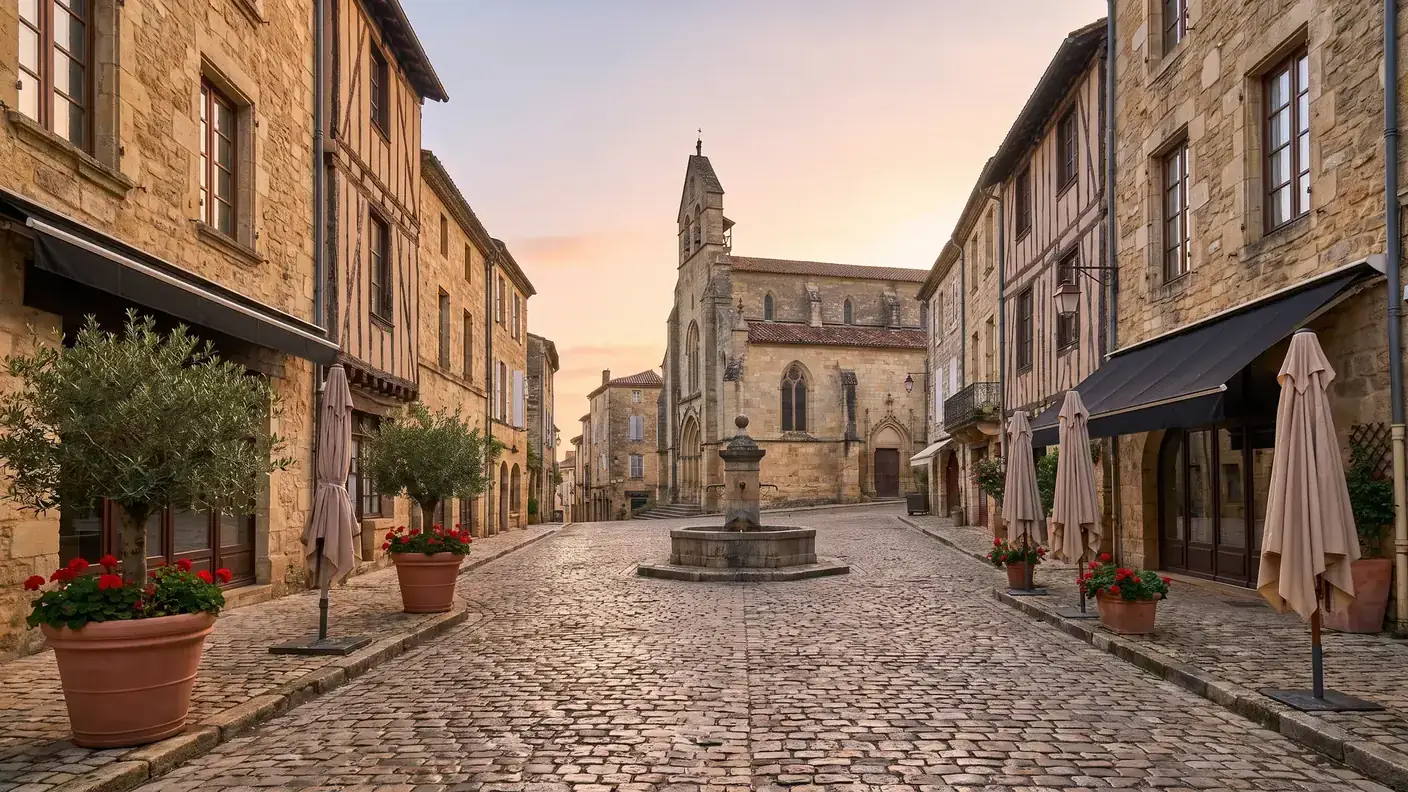
And what about Bergerac in all this? The city has made the elegant choice toembrace the myth — without ever really deceiving anyone. Two statues face each other there, a hundred meters apart: Place de la Myrpe, the 1977 Cyrano by Pierre Claire (Varoqueaux/Dorillac), with its sleek, very '70s silhouette; place Pélissière, the polychrome bronze of Mauro Corda (2005, €90,000), brimming with detail—the sculptor based the body on a real model but invented the face: “It wasn’t a matter of just sticking Pinocchio’s nose on him.” Shops named Cyrano or Roxane, the official “Les Pas de Cyrano” walking tour… The only city in France to celebrate twice a character who never visited it—and who knows it perfectly well.
The Old Town: half-timbered buildings, the Halle Neuve, and the Récollets Cloister
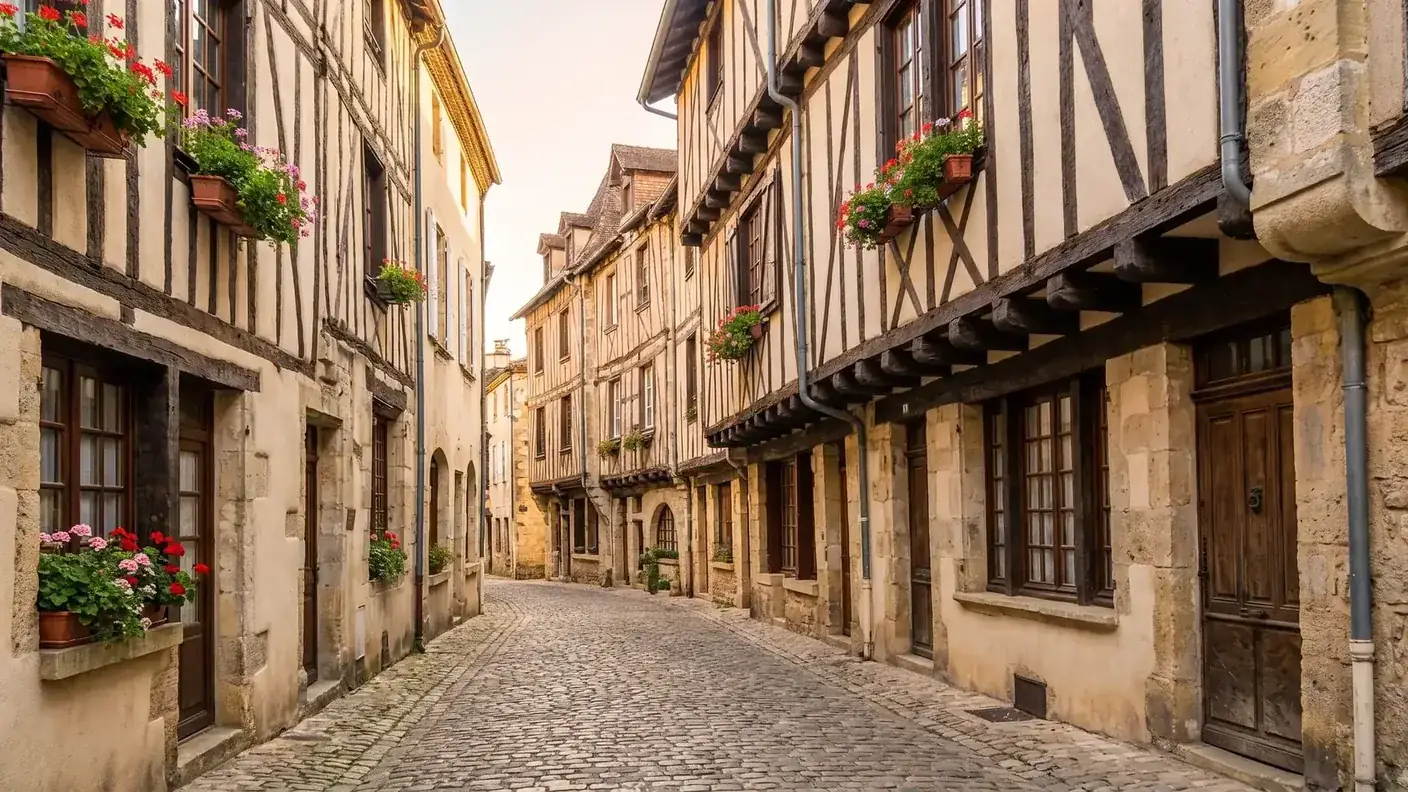
You can explore Old Bergerac by following a triangular route between the harbor and the squares. The streets Saint-James and Saint-Clar feature rows of 15th- to 17th-century half-timbered houses with sloping corbelled eaves; the Grand'Rue A pedestrian walkway connects the market hall to Notre-Dame Church; and the church Saint-Jacques, a stop on the Via Lemovicensis to Santiago de Compostela, overlooks Place Pélissière. All of this is located in a historic district that has been protected since the 1970s.
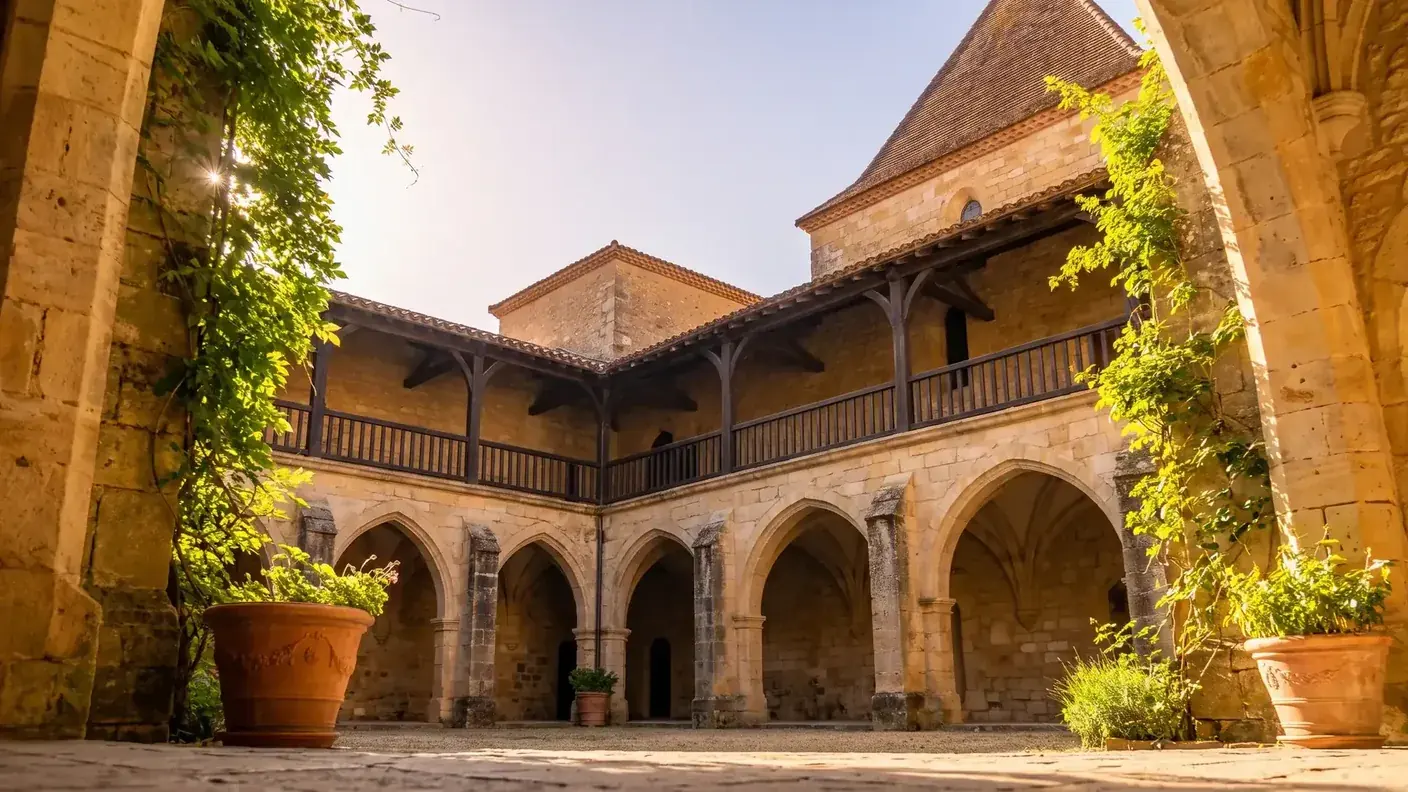
Two food-themed stops and one monumental one. The indoor hall, on Place Louis-de-la-Bardonnie, was completely renovated and reopened in December 2023—seven food shops, including a “Crèmerie Cyrano,” of course. The markets are in the center on Wednesday and Saturday mornings (7 a.m.–1 p.m.), along with the truffle sellers from December through February. And the Récollets Cloister, a 17th-century convent with wooden galleries, has been home to the Cyrano Wharf: The tourist office and the Bergerac-Duras Wine Center are combined here; admission is free—we’ll come back to this in the section on wine. An interesting historical detail to savor: the former church of the same convent, right next door, has become the main Protestant church. The Catholic cloister and the Huguenot church have shared the same block since 1792.
In the summer, the festivities move down to the harbor: the Local Cuisine Dinners set up their large tables by the water on six Mondays in July and August (6:00 p.m.–11:00 p.m., producers and winemakers), the July 14 The festivities include regattas, duck races, and fireworks, and an Italian village takes over Place de la République in late August. Bergerac is all about the outdoors—and Bergerac was included in the 2026 Tour de France route, with the finish of the Périgueux → Bergerac stage announced on July 11.
Nine AOCs surrounding a city: the Bergerac wine region
Bergerac is a full-fledged wine-growing capital: nine AOCs surround him — Bergerac (red, rosé, white), Côtes-de-Bergerac, Monbazillac, Pécharmant, Rosette, Saussignac, and the three Montravel wines—that is, along with their variations and the neighboring Duras, seventeen AOP wines. The reds are blends of Merlot and Cabernets, while the whites are made from Sémillon, Sauvignon, and Muscadelle. This diversity of appellations defines the Périgord Pourpre region and its wine route.
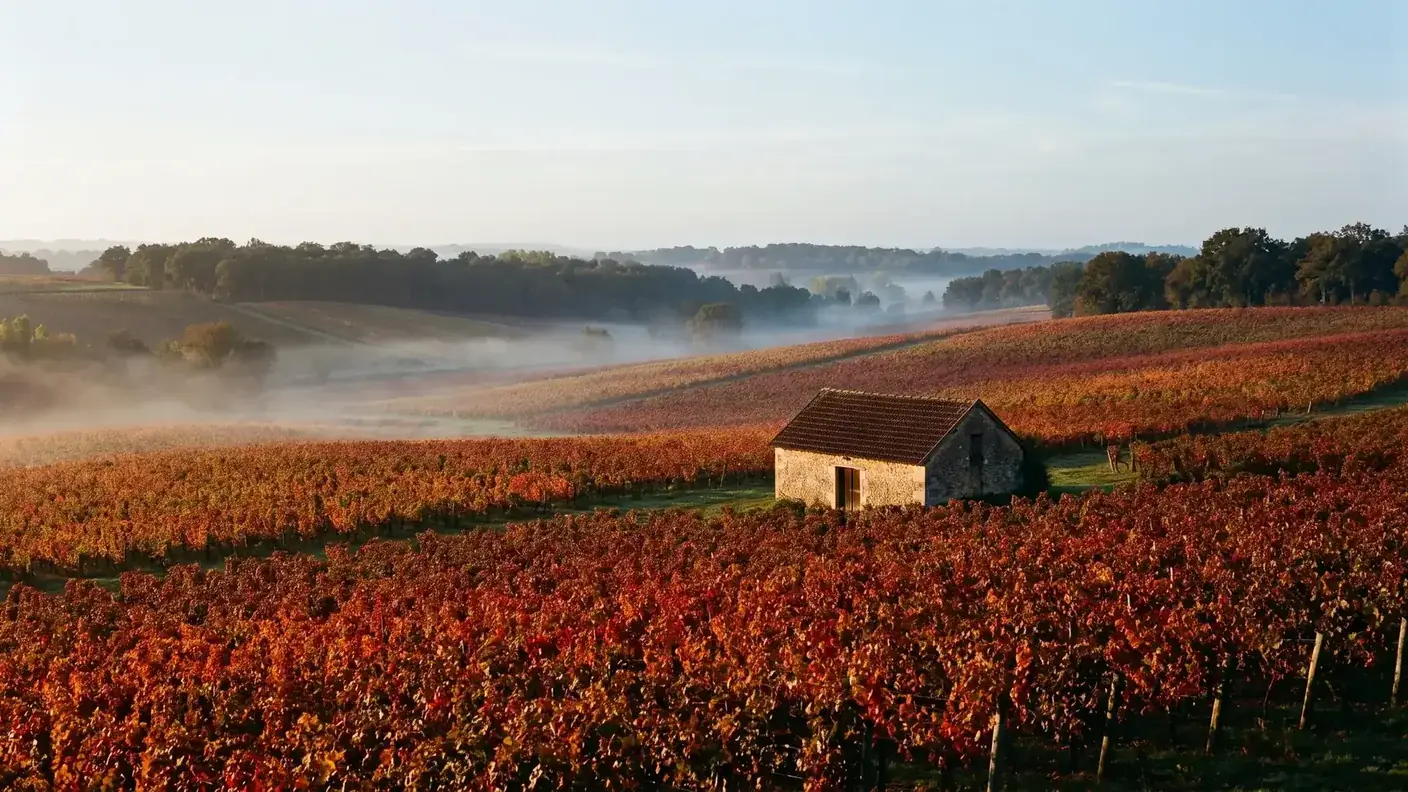
The ideal place to get started is in the city: at the Cyrano Wharf, in the Récollets cloister, the Maison des Vins features 140 items de Bergerac-Duras, a weekly selection of nine wines by the glass, a terrace with a panoramic view of the riverbanks—and, from mid-June to mid-September, A different winemaker every day comes to offer tastings of his wines. Free admission, including the permanent exhibition “Le Vin est Voyage.” From there, the wine route unfolds naturally: Pécharmant to the northeast, Saussignac to the west, and due south, the golden hills of Monbazillac.
Monbazillac: The Château Amid the Vineyards and the “Protestant Wine”
To 7 km south (12 minutes), the Monbazillac Castle stands guard over the valley: a rectangular structure with four round towers and machicolations, built in a single stretch toward 1550 for Charles d'Aydie—part fortress, part Renaissance mansion, designated a historic monument in 1941. A unique feature: since 1960, it has belonged to the Monbazillac Cooperative Winery, which has made it the appellation’s showcase—50,000 visitors per year. In 2026: admission €12 with a complimentary tasting; guided workshop featuring three wines for €18; open daily (until 8 p.m. in July).
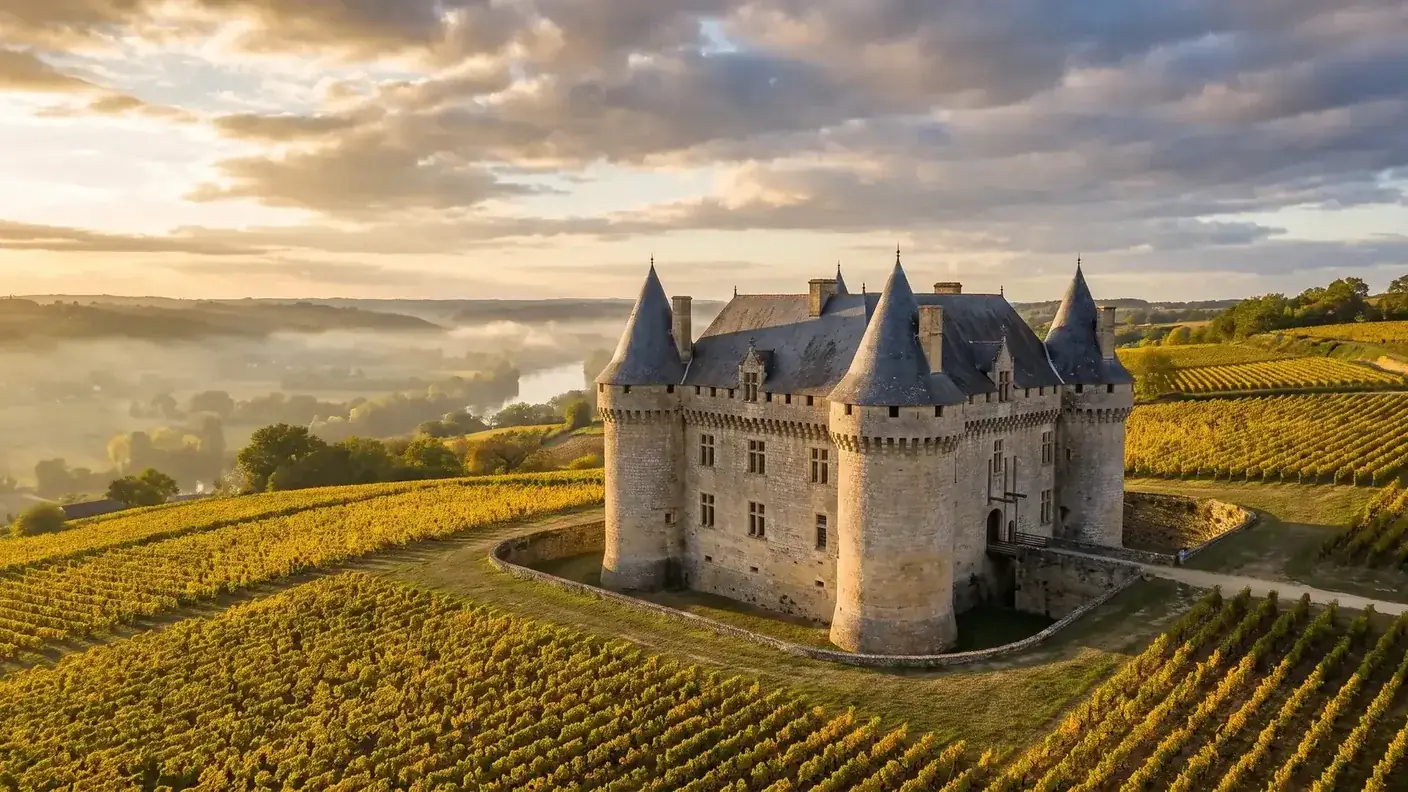
Wine, on the other hand, is a meteorological miracle: 2,300 hectares made from Sémillon, Sauvignon, and Muscadelle grapes grown in the morning mists of the Dordogne, which promote the noble rot — Botrytis, which concentrates the sugars. Hand-harvested in successive sorting passes, machine prohibited as specified in the specifications. And a history that ties in with that of the city: exported on a massive scale to Holland by the Huguenot diaspora, this golden sweet wine earned its nickname, “the wine of the Protestants.” For the table: The Tower of the Winds, at the nearby Malfourat mill, is theMichelin star in the Bergerac region since 2010 (chef Damien Fagette), with a panoramic view of the vineyards—and seven guest rooms so you don’t have to go back down.
Gabarre Boats: From Waterway Highway to Cruise Experience
Before the railroad, the Dordogne was the country's only real trade route: the gabarres — flat-bottomed boats designed for shallow waters — carried wine, timber, and paper downriver to Libourne and Bordeaux, from where the barrels from Bergerac were shipped to England and Holland. The entire port thrived on this trade: coopers, boatmen, and merchants. The dam built in 1852 was, in fact, constructed for them, raising the river’s level by 2.25 meters. Then the railroad put an end to river transport—and tourism has revived it.
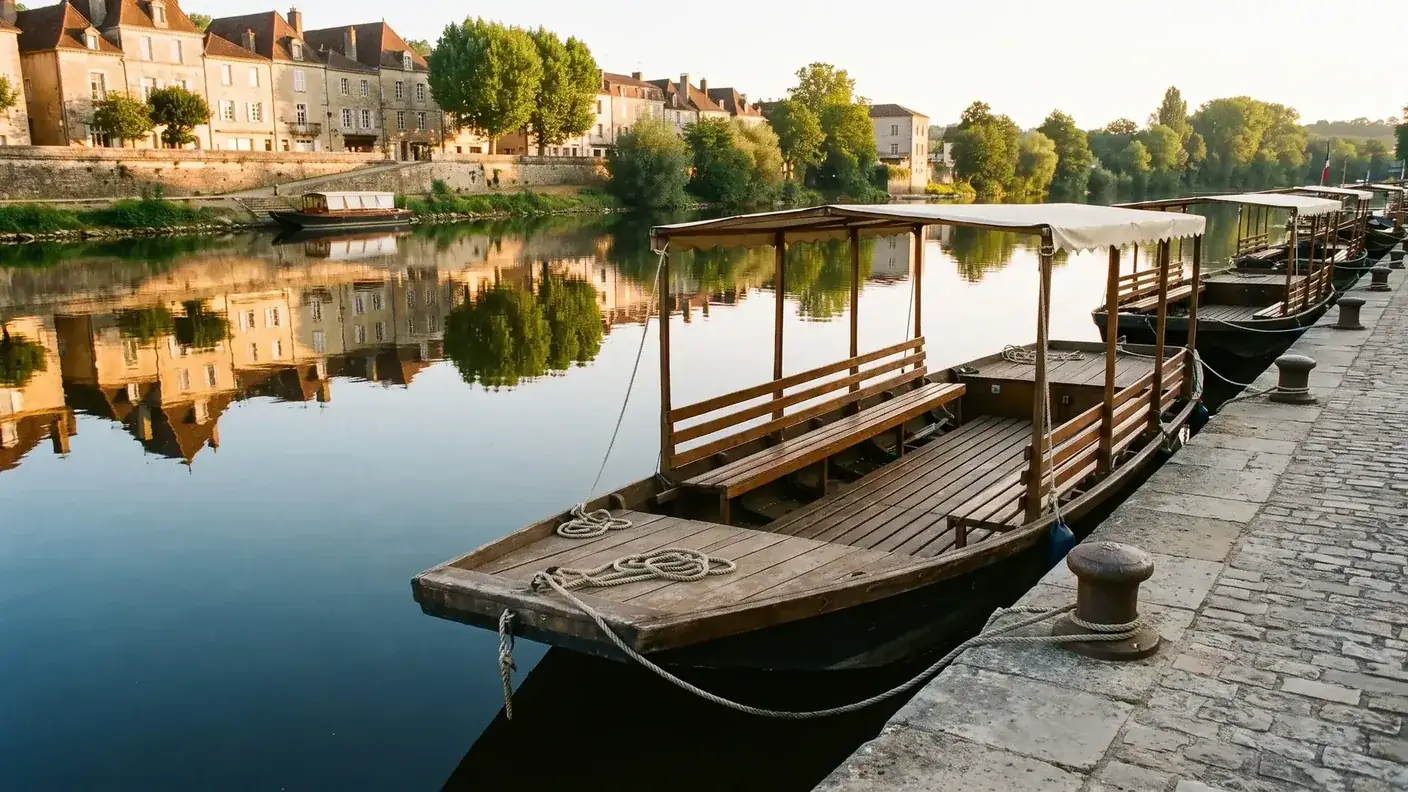
Practical details for 2026: The Gabarres de Bergerac set sail from Salvette Wharf April 1 through October 31 — 50-minute guided tour (€12.50 for adults, €9.50 for children), up to nine departures per day in the height of summer, and wine-tasting cruises on Tuesdays and Thursdays in July and August (1 hour 30 minutes, €15). Reservations at 05 53 24 58 80. To extend your river experience: the V91 bike route runs along the Dordogne for 30 km on a greenway through the port, and 15 minutes upstream, the fish lift at Tuilières Dam is open to visitors free of charge in the summer—the salmon literally swim upstream in a lift.
Tobacco: The Little-Known Capital (and Its Museum, Unique in Europe)
Bergerac’s other “brown gold” isn’t meant to be drunk. Introduced to France by André Thevet (1556) and later by Jean Nicot—who offered it to the court as a remedy for migraines and gave his name to nicotine— tobacco found one of its prime growing regions in the Dordogne Valley: its cultivation was officially authorized in the Dordogne on December 26 1857, 2,066 planters were recorded as early as 1863. In 1927, Bergerac received theExperimental Tobacco Institute, a research center unique in Europe with its collection of more than 1,100 species of Nicotiana. That chapter has recently come to a close: the institute shut down, the last laboratory followed suit in 2022, and the last French processing plant, in Sarlat, ceased operations in the fall of 2024—about a hundred growers remain in the Dordogne, France’s leading Burley-growing region.
As for the memory, it’s superbly housed: the Tobacco Museum, “a museum of tobacco anthropology of national significance,” is located at the Peyrarède House — a private mansion dating from 1604 known as the “Château Henri IV,” where Louis XIII stayed in 1621 on his way to raze the Huguenot ramparts. Three thousand years of history of the plant “sometimes divine, sometimes cursed”: Native American pipes, 18th-century snuffboxes, a pipe-bowl carving machine from 1863, signs from the state monopoly, and even works on loan from the Louvre and the Centre Pompidou. Open year-round (€5.50, free for visitors under 18), with a temporary exhibition running through September 20, 2026. Unique in Europe—literally: no other museum on the continent is entirely dedicated to this subject.
Bordeaux → Bergerac: 117 km, about 1 hour 31 minutes (and an airport that comes and goes)
There are two routes from Bordeaux: the faster one—the N89, then A89 to Exit 13 "Bergerac-Mussidan," then the D709 (117 km, about 1 hr 31 min) — and taking a detour, the D936 via Castillon-la-Bataille and the valley route—toll-free, slower but tempting—runs just past Saint-Émilion.
| Option | Duration | Good to Know |
|---|---|---|
| Private chauffeur | 1 hour 31 minutes | door-to-door, starting at 200 € — possible stop at Saint-Émilion on the way |
| Personal car | 1 hour 31 minutes | A89, Exit 13 + D709 · or D936 (toll-free), travel time varies |
| TER Line 33 | 1 hour 10 minutes to 1 hour 30 minutes | 16 round trips on weekdays; the station is 1.2 km from downtown — also serves Saint-Émilion |
| Airplane (season) | — | Airport 5 km from downtown — but virtually closed to scheduled flights from late October through late March |
A few words about Bergerac-Dordogne-Périgord Airport, the historic gateway for British travellers to the Périgord (240,000 passengers in 2025, ten routes, including eight to the United Kingdom during the high season): Ryanair suspended all flights for winter 2025–2026 as part of its tax dispute with France and will not resume service until late March. There is no regular shuttle service to the city centre (regional buses are available only when booked the day before). From October through March, the valley effectively relies on Bordeaux-Mérignac, making a direct chauffeured transfer (~1 hr 35 min from the airport) the missing link in the journey.
| Website | Directions from Bergerac | The Essentials |
|---|---|---|
| Monbazillac | 7 km · 12 min | château (€12) + sweet wine vineyard + Michelin-starred La Tour des Vents |
| Issigeac | 19 km · 21 min | Circular medieval village, large Sunday market |
| Eymet | 26 km · 28 min | A bastide dating from 1270, the most British of the Périgord |
| Monpazier | 46 km · 51 min | An English country house dating from 1284, with a perfectly shaped arcaded courtyard |
| Saint-Émilion | 58 km · 1 hour 5 minutes | along the D936 and through the vineyards — see our guide |
| Sarlat-la-Canéda | 73 km · 1 hour 20 minutes | through the Dordogne Valley — see our guide |
| Lascaux (Montignac) | ~80 km · 1 hour 25 minutes | The Majesty of Prehistory — see our guide |
Our Tips for Success in Bergerac
- Come by on a Wednesday or Saturday: markets in the heart of the old town (7 a.m.–1 p.m.), the renovated market hall, and truffles from December through February.
- Take the Cyrano tour in order: the stone statue of Myrpe (1977), the bronze statue of Corda at Place Pélissière (2005) — and look for the hidden details in the latter.
- Start with the wine at Quai Cyrano (Récollets Cloister, free admission): 140 wines, one winemaker featured each day during the summer—then head to Monbazillac to visit the château (€12, tasting included).
- Hop aboard a gabarre at the end of the day (€12.50, 50 min, Quai Salvette): golden light on the facades, with the history of the port as a bonus.
- Book La Tour des Vents (Michelin-starred, Moulin de Malfourat) for dinner overlooking the vineyards—seven on-site rooms for those who can resist the temptation.
- Head out to Issigeac on Sunday morning (21 min): The market in the circular village is one of the most charming in the Southwest.
- From October through March, forget about flying: Ryanair is on hiatus and there is no shuttle. The chauffeur service from Bordeaux (1 hr 31 min, starting at 200 €) remains the year-round door-to-door option.
Bergerac is a city that embraces its identities: it celebrates a hero who never visited it, preserves the temple next to the cloister, transforms its former merchant barges into cruise ships, and turns its past as the tobacco capital into a unique museum. Amid the half-timbered architecture, history runs deep—a royal peace treaty signed by the future Henry IV, a Huguenot majority shattered in a single summer, and a vineyard that owes its golden age to its exiles. Perhaps this is the lesson of Bergerac: what the city has lost in legend, it has always regained in memory. And it’s just 1 hour and 31 minutes from Bordeaux—vineyards and all.
Frequently Asked Questions
How much does a private chauffeur service from Bordeaux to Bergerac cost?
The chauffeured Bordeaux → Bergerac journey starts at 200 € one way (1 to 3 passengers, sedan), door-to-door. The price is fixed and confirmed in advance — no meter and no surprise surcharges. An 8-seat van is available for families and small groups. Request a quote: written response within 30 minutes.
How long does the trip from Bordeaux to Bergerac take?
Count about 1 hour and 31 minutes for 117 km: Take the N89, then the A89 to Exit 13 “Bergerac-Mussidan,” and finally the D709. The alternative route via the D936 and Castillon-la-Bataille is toll-free and more scenic—it passes close to Saint-Émilion, making it a perfect stop—but travel time varies depending on traffic conditions.
Did Cyrano de Bergerac really live in Bergerac?
No—and this has been verified from start to finish: Savinien de Cyrano de Bergerac, baptized in Paris in 1619 and who died in Sannois in 1655, did not no documented link with the city. His “de Bergerac” comes from a family estate in the Chevreuse Valley (Yvelines), which was sold in 1636. It was the triumph of Edmond Rostand’s play (1897) that forged a bond between the hero and the city—which embraced the legend with two statues, in 1977 and 2005.
What was the Peace of Bergerac of 1577?
The treaty that ended the Sixth War of Religion, negotiated over four months at the Maison Doublet and signed in Bergerac on September 17, 1577 — by Henri of Navarre himself, the future Henri IV. Ratified by the Royal Edict of Poitiers, it established the coexistence of the two faiths (regulated worship, partitioned rooms, and eight places of refuge) and served as the direct model for the Edict of Nantes of 1598.
Why is it said that Bergerac was Protestant?
Because that was largely the case: worship services are documented as early as 1553, and the Reformation was publicly adopted by the bourgeoisie in 1561, approximately 6,000 Protestants in the 17th century — A royal decree of 1681 acknowledged that they were “more numerous than the Catholics.” Its printing presses and college earned it the nickname “Little Geneva.” The dragonnades and forced abjurations of 1685 shattered this community. The Grand Temple on Place du Cayla has preserved its memory since 1792.
What is there to see in Bergerac's Old Town?
The Golden Triangle: the Place Pélissière and the Church of Saint-Jacques (with the bronze statue of Cyrano), the Place de la Myrpe (The Stone Cyrano), the streets Saint-James and Saint-Clar the half-timbered building, the renovated covered market (2023), the Récollets Cloister — now known as Quai Cyrano, home to the tourist office and the Maison des Vins — and the quays where the gabarres set sail. Allow half a day to explore on foot; everything is concentrated in this area.
Can you take a gabarre ride in Bergerac?
Yes, from April 1 through October 31: Les Gabarres de Bergerac offers a 50-minute guided tour at Quai Salvette (€12.50 for adults, €9.50 for children), with up to 9 departures per day in summer, and wine-tasting cruises on Tuesdays and Thursdays in July and August (1.5 hours, €15). Reservations are recommended at 05 53 24 58 80.
What is there to see at the Château de Monbazillac?
Located 12 minutes from Bergerac, this four-towered castle dating from 1550—owned by the cooperative winery Since 1960—a unique case—it is open to visitors every day (€12 with a complimentary tasting; a three-wine workshop for €18). Surrounding it are the 2,300 hectares of sweet wine vineyards: the mists of the Dordogne, noble rot, mandatory hand-harvesting—the “wine of the Protestants,” which owes its Dutch golden age to the Huguenots exiled from Bergerac.
Where can you eat well in Bergerac?
The Michelin-starred restaurant in the Bergerac region is The Tower of the Winds in Monbazillac (Chef Damien Fagette, one Michelin star since 2010, panoramic view of the vineyards, seven rooms). In town: The Covered Market Table (bistronomic restaurant across from the market hall, menus €39–62) and Vin'Quatre, both of which are featured in the Michelin Guide, plus the bistros in the old town. Reservations are strongly recommended during the summer.
Is the Tobacco Museum open?
Yes—despite a rumor circulating online that it is closing (due to confusion over the dates of a temporary exhibition). The museum, which is unique in Europe, is located at the Peyrarède House (1604), known as the “Château Henri IV,” Place du Feu: 3,000 years of tobacco history, collections of national significance. Admission €5.50 (reduced rate: €3, free for visitors under 18), closed on Mondays, temporary exhibition through September 20, 2026.
How can you get to Bergerac without a car?
TER Line 33 between Bordeaux, Bergerac and Sarlat works well: 16 return services on weekdays, taking 1 hour 10 minutes to 1 hour 30 minutes, with the station 1.2 km from the old town. The train also stops at Saint-Émilion. Air service is seasonal, mostly from the UK, with almost no flights from late October to late March and no airport-to-city shuttle. To explore Monbazillac, Issigeac or the bastides, a private chauffeur (1 hr 31 min from Bordeaux, starting at 200 €) remains the most flexible option.
On which days are the markets held in Bergerac?
The Wednesday and Saturday mornings (7 a.m.–1 p.m.), at three locations in the city center: the covered market at Place Louis-de-la-Bardonnie (renovated in 2023, with seven year-round food shops), Place de Lattre-de-Tassigny around Notre-Dame, and Place des Deux-Conils. From December through February, vendors selling truffles set up shop there. And on Sunday mornings, the market in Issigeac (21 min) is worth the trip on its own.
What is there to do around Bergerac?
The Southern Périgord, Spreading Out Like a Fan: Monbazillac (12 min, castle + vineyards), Issigeac the circular medieval town (21 min), the Anglo-style bastide ofEymet (28 min), the perfect spot for Monpazier (51 min) — and via the D936, Saint-Émilion 1 hour and 5 minutes away. Sarlat and the Dordogne Valley are 1 hour and 20 minutes away, and Lascaux is 1 hour and 25 minutes away: Bergerac makes an excellent base for wine tours between the Bordeaux region and the Périgord Noir.
Further Reading
- The World's Vineyard Village, Along the Route: see the Guide to Saint-Émilion (UNESCO jurisdiction, badges)
- The 2,000-Year-Old Prefecture: see the Guide to Périgueux (Vesunna, Saint-Front)
- The capital of the Périgord Noir: see the Guide to Sarlat (through the Dordogne Valley)
- The Venice of the Périgord: see the Guide to Brantôme (cave abbey)
- Plan your trip: Book a private driver from Bordeaux to Bergerac or explore all our destinations
Sources and References
- Wikipedia — Bergerac (Dordogne) — geography, demography, history, statues
- Wikipedia — Peace of Bergerac — Treaty of September 17, 1577, negotiators
- École nationale des chartes — Edict of Poitiers (full text) — clauses, signatories, secret provisions
- Wikipedia — History of Protestantism in Bergerac — Little Geneva, dragoon raids, temple
- Protestant Museum (Bersier Foundation) — 6,000 Protestants, abjurations, the Refuge
- Wikipedia — Savinien de Cyrano de Bergerac — biography, the Chevreuse estate, legends
- City of Bergerac — "Les Pas de Cyrano" walking tour, markets, museums, summer festivals 2026
- Pays de Bergerac Tourist Office — Quai Cyrano, barges, restaurants, hours
- The Gabarres of Bergerac — 2026 Rates and Season, Quai Salvette
- Wikipedia — Monbazillac Castle — Built in 1550, cooperative winery, AOC
- IVBD — Wines of Bergerac & Duras — appellations, vineyards, Maison des Vins
- INSEE — Complete Report on Bergerac — population, urban area, catchment area
Article published and updated on .
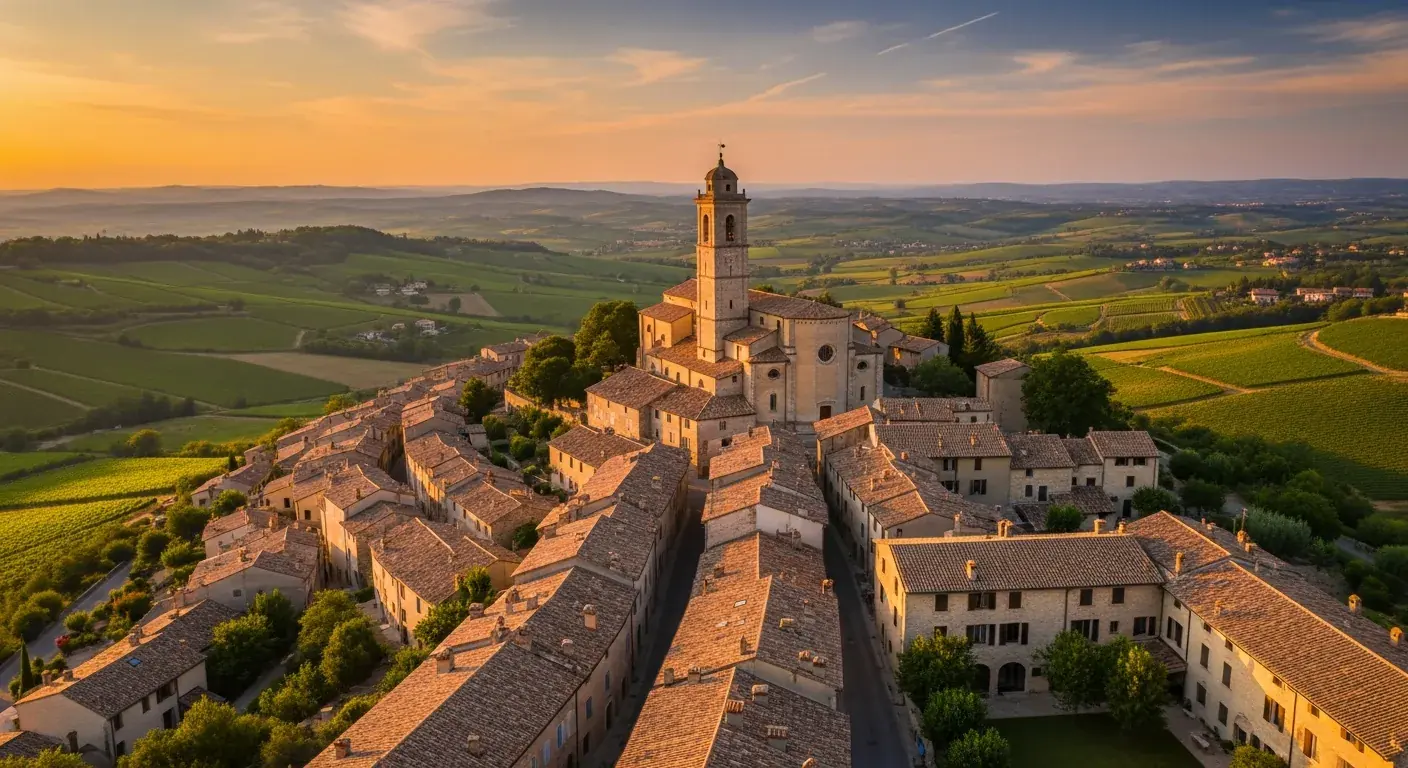
Off to the Périgord Pourpre
Direct route from Bordeaux (1 hr 31 min) via the A89, or the vineyard route through Saint-Émilion—stop as you please, with Monbazillac right after. Written fixed-price quote within 30 minutes; sedan or 8-passenger van; English-speaking driver.