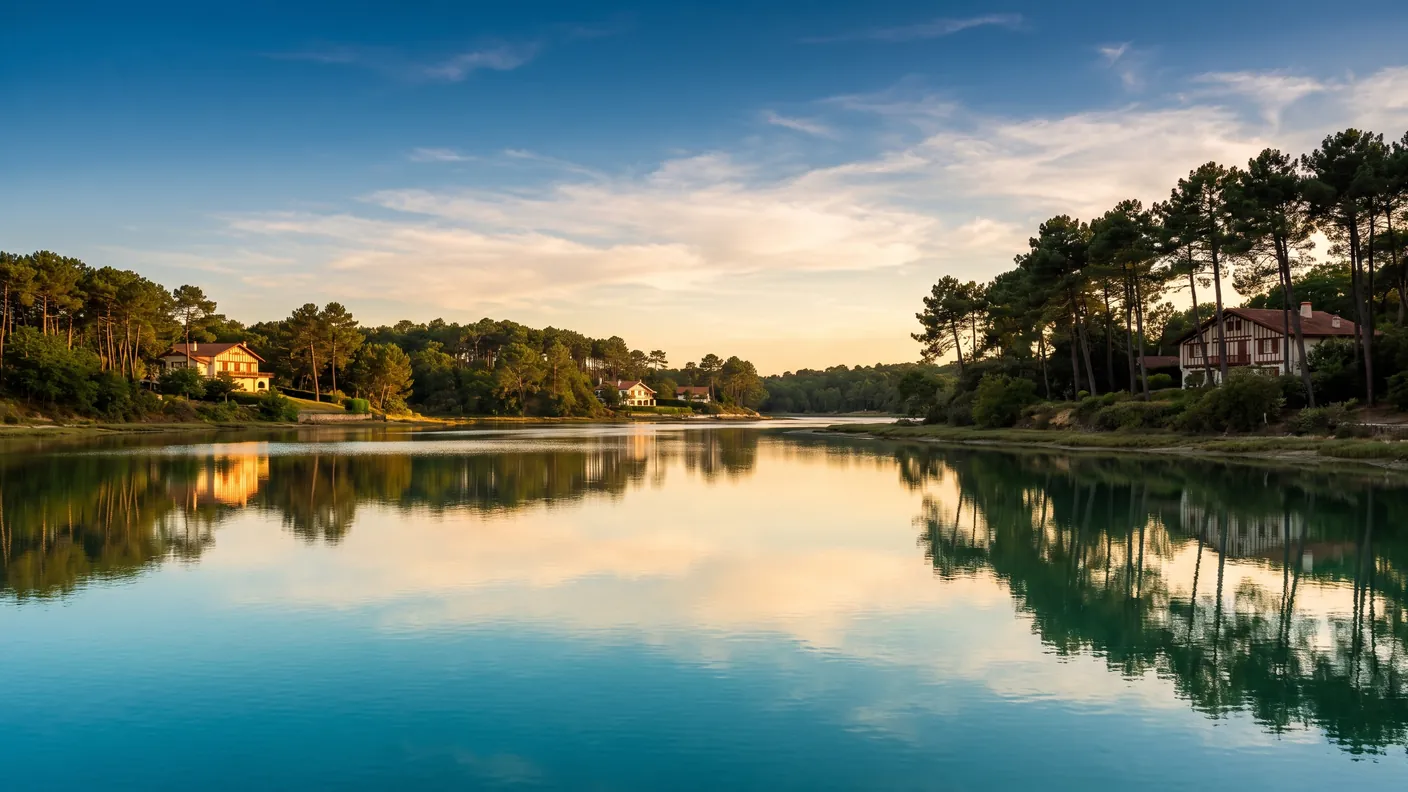
From Bordeaux to Hossegor: ocean, lake and surf
A marine lake that ebbs and flows with the tides and waves—among the most famous in the world: Hossegor, on the southern coast of the Landes region, with its Gravière Beach, its Basque-Landes-style villas, and its 1930s golf course—plus your private door-to-door transfer from Bordeaux, with no need to worry about parking.
Hossegor at a Glance
Hossegor is a chic seaside resort on the southern coast of the Landes region, in the town of Soorts-Hossegor, about 171 km south of Bordeaux—famous for its marine lake, legendary waves, and Basque-Landes architecture. Often referred to as the “surfing capital of Europe,” it combines two distinct atmospheres: the tranquility of a lake that ebbs and flows with the tides, lined with villas nestled among pine trees, and the power of the ocean at La Gravière, one of the world’s most beautiful beach breaks. This guide separates fact from fiction: Hossegor hosted the world’s surfing elite until 2019 (the event has since moved to the qualifying circuit); “surfing capital” is a nickname, not an official title; and its Sporting-Casino is listed (but not classified). We then outline the easiest way to get there: a private door-to-door transfer, including your boards and luggage.
Here are the key details to know before you go. Distances are calculated door-to-door from Bordeaux; the fare listed is for a private driver reservation at a fixed price provided in advance, with no unexpected meter charges. The information has been verified using Wikipedia, the Mérimée database, INSEE, the tourist office, and the Hossegor golf course; event dates and operating hours, which may vary, should be confirmed on site.
| Landmark | Details |
|---|---|
| Station | Hossegor (municipality of Soorts-Hossegor, Landes) |
| Location | the southern coast of the Landes, between Capbreton and Seignosse |
| Residents | 3,817 Hossegor residents (2023) |
| Must-See | the marine lake, La Gravière Beach, Basque-Landes architecture, the golf course |
| Distance from Bordeaux | about 171 km · about a 2-hour drive (A63) |
Where is Hossegor located?
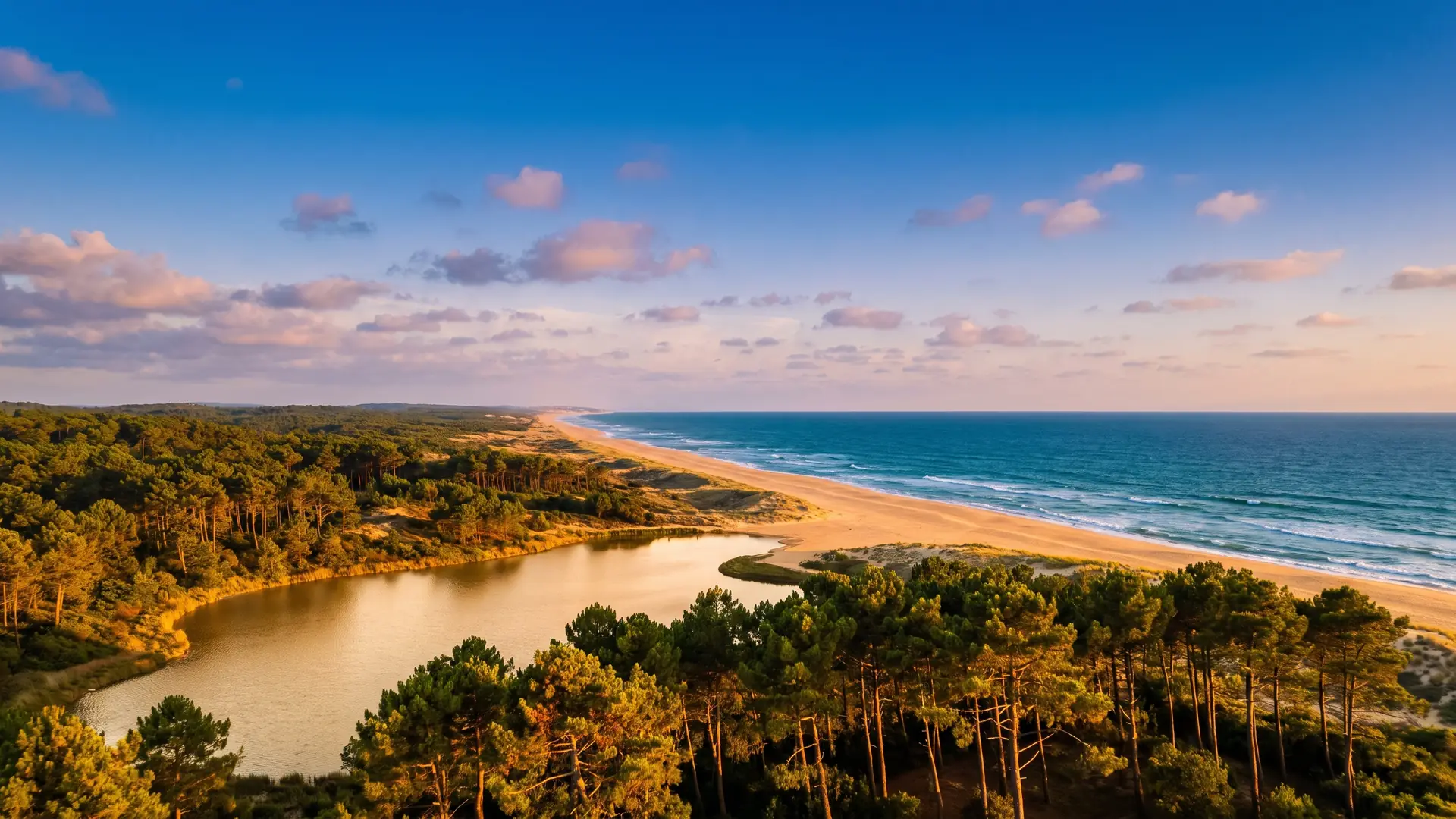
Hossegor is located on the southern coast of the Landes region, between Capbreton (5 km away) and Seignosse, half an hour north of Bayonne and the Basque Country. This is the name of the seaside resort in the town of Soorts-Hossegor (population 3,817; residents known as Hossegoriens), which was founded in the early 20th century around its marine lake, nestled among maritime pines and cork oaks. The municipality is part of the Dax district and the Maremne-Adour-Côte-Sud (MACS) community of municipalities.
Its uniqueness lies in its dual waterfront: on one side, the ocean with its powerful waves; on the other, the tranquil and sheltered marine lake—two worlds separated by a narrow strip of wooded dunes. This unique geography, between the roar of the Atlantic and the mirror-like surface of the lagoon, has made Hossegor both a surfing mecca and an elegant residential resort. Located about two hours from Bordeaux, it is one of the most popular destinations on the Aquitaine coast.
Between the ocean and a marine lake
Hossegor's strength lies in offering two atmospheres a few hundred meters apart. On the ocean, the central beach, and especially the one at La Gravière their hollow, fast-moving waves roll in, against a backdrop of dunes and pine trees—this is the realm of the surfers, seasoned swimmers and fans of spectacular marine shows. On the marine lake, everything changes: the water is calm, the atmosphere is hushed, the Villas in the Basque-Landes region They gazed at their reflections in the mirror-like lake fringed with pine trees, where people enjoy peaceful swimming, paddleboarding, and even oyster farming.
In between, the resort boasts shaded avenues, a golf course, a casino, and surfwear shops. This duality—the wild ocean and the peaceful lake—is the heart and soul of Hossegor, and what sets it apart from all the other resorts along the coast. People come here to surf and to relax, to party and to find peace and quiet.
At the gateway to the Basque Country
Hossegor enjoys a prime location at the southern tip of the Landes coast. Its immediate neighbor, Capbreton (5 km), is the only port in the Landes region; to the north, Seignosse and its beaches extend the surfers’ coast; to the south, Labenne (10 km), followed by Bayonne (27 km), mark the entrance to the Basque Country—Biarritz and the Basque Coast are just half an hour away. Inland, Dax and its thermal spas are about 40 minutes away.
Hossegor is thus located in the heart of an area rich in attractions—beaches, a harbor, a lake, a Basque town, and thermal baths—making it an ideal base for exploring southern Aquitaine. The resort does not have a train station (the nearest one is in Saint-Vincent-de-Tyrosse, 8 km away), and getting there in the summer is notoriously complicated due to traffic and parking. This is where a private transfer really comes in handy: door-to-door drop-off, including surfboards and luggage, and a return trip at the time of your choice—without spending hours circling looking for a parking spot.
The marine lake: a sea that breathes
The Hossegor saltwater lake is the peaceful heart of the resort: a body of saltwater that fills and empties with the tides, connected to the ocean by the Boucarot Channel—a remnant of the Adour River’s former course. A unique geographical wonder and the most elegant setting on the coast. Here is its verified history.
According to the City of Soorts-Hossegor, the canal, which opened in 1876, connected the pond to the Boucarot strait and the ocean. The body of water has since become a marine lake subject to tidal fluctuations, which also support oyster farming on its eastern shore.
Seawater that ebbs and flows with the tides
The marine lake d'Hossegor is no ordinary lake: it is a saltwater lagoon in which the water of the Atlantic comes in and leaves twice a day, with the ebb and flow of the tides. The connection to the ocean is through the Boucarot Pass (also known as Boudigau), via the nearby port of Capbreton. Covering an area of about one square kilometer (2,300 meters long by 300 meters wide), the lake is a remnant of the former Adour estuary: The river, which once flowed into the sea at Capbreton, was diverted toward Bayonne in the 16th century century, leaving this lagoon behind.
The Hossegor channel The canal connecting it to the ocean is a Second Empire-era project: ordered by Napoleon III in 1868, construction began in 1869, was interrupted by the war of 1870, and it was not actually opened until March 11, 1876 — said to have been accomplished not by men but by a storm and a strong tide. People also practice oyster farming: Yes, oysters are harvested from Lake Hossegor.
A Relaxing Swim and a Walk Around the Lake
The marine lake offers the behind the scenes of the ocean: calm, sheltered waters, ideal for family swim, the paddle, kayaking, or simply taking it all in. At high tide, it fills up and becomes a vast turquoise mirror bordered by pine trees and Villas in the Basque-Landes region — one of the most beautiful sights along the Aquitaine coast. At low tide, it partially empties, revealing mudflats and sandbars where birds are busy at work.
A walk or bike ride around the lake along the shaded paths is Hossegor’s signature outing: you’ll pass Art Deco and Neo-Basque villas, piers, and oyster beds, all amid the hushed tranquility of a chic residential resort. It’s the perfect counterpoint to a morning of surfing or relaxing on the beach: after the roar of the ocean, the serenity of the lake. A chauffeur service can drop you off at the lake or the beach without any parking worries—a true luxury in the summer. Swimming conditions, which vary with the tides, should be checked on site.
Hossegor, the surfing capital
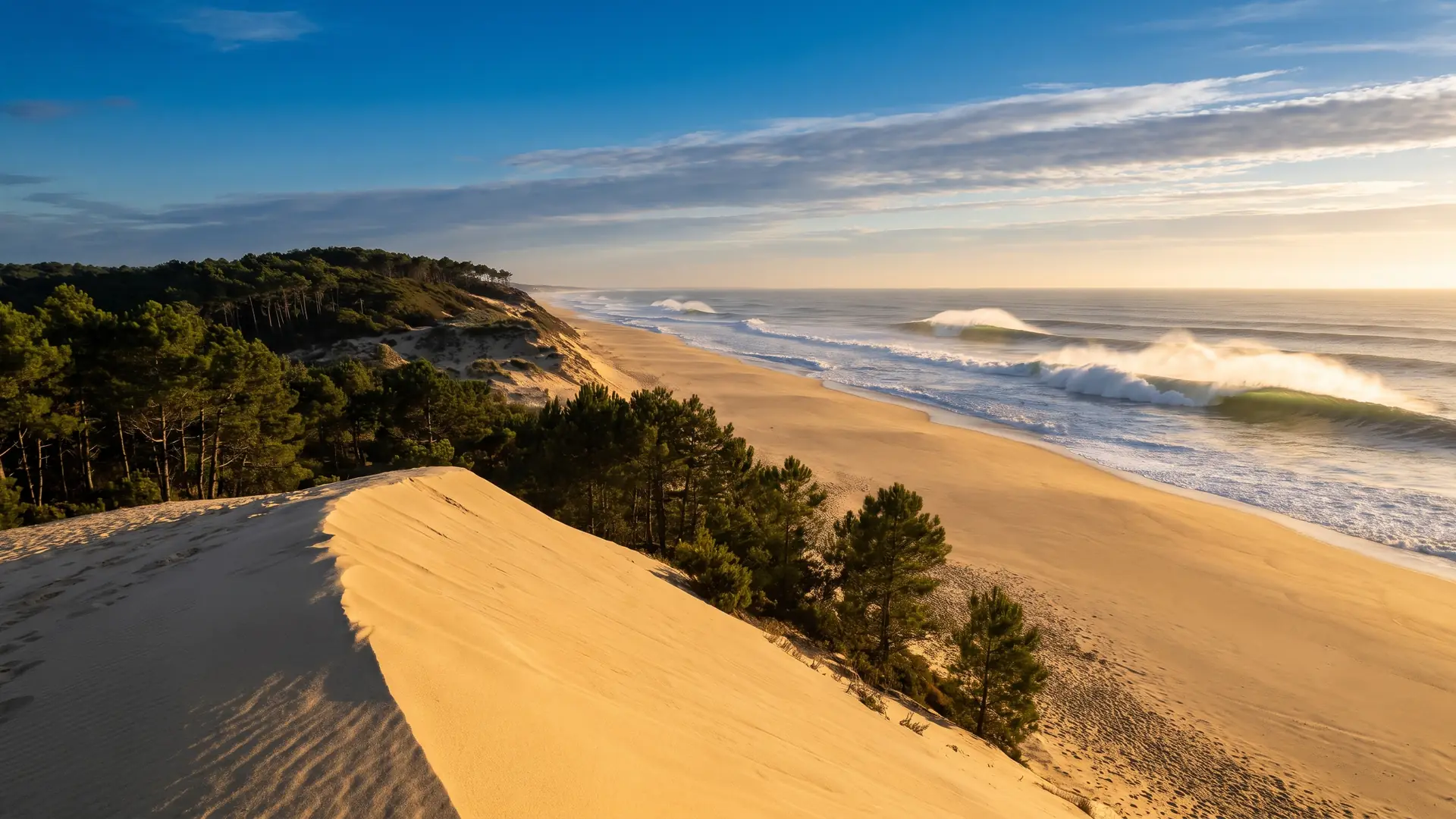
Hossegor is often touted as the surfing capital of Europe: its waves—particularly La Gravière—are among the most renowned in the world, and the resort hosted the world’s top surfers until 2019. A reputation that warrants closer examination. Here’s what the sources have to say.
La Gravière and the Legendary Waves
What has made Hossegor famous are its waves. La Gravière Beach is a legendary beach break: hollow, fast-breaking waves that form spectacular tubes, among the most beautiful in Europe. The nearby spot, La Nord, rounds out the experience. The secret to this power lies just below the surface: the Gouf de Capbreton, an underwater canyon that begins just 300 meters from the shore and channels the Atlantic swell toward these sandbars.
The result: waves of exceptional quality that have been attracting the world's best surfers for decades. The resort is also the surfing capital in Europe: Rip Curl Europe has been headquartered there since 1985, just like Billabong and the French Surfing Federation — hence the nickname “Surf Valley.” (To clarify, since confusion is common, Quiksilver Europe, on the other hand, is located a little further south, in Saint-Jean-de-Luz, and not in Hossegor.)
A competitive stage, through 2019
According to the French Surfing Federation, On October 11, 2019, Jérémy Florès won the 31st and the final edition of the Championship Tour at Hossegor. The Landes event became part of the Challenger Series starting in 2021 and no longer counts toward the world title race.
When it comes to sports, precision is key. Hossegor has long been home to a round of the World Surfing Championship (the WSL elite circuit) — the Quiksilver Pro France, held every year in early October across Hossegor, Seignosse, and Capbreton. But this race is not has not competed in the World Championships since 2021: she switched to Challenger Series, the qualifying circuit, one level below the elite. The final round of the world championship The match played here dates back to 2019 — won by the Frenchman Jérémy Florès, a symbolic finale.
Therefore, we should not write, in the present tense, that Hossegor “welcomes the world’s elite.” Its historical record is nonetheless prestigious: Kelly Slater has won there in three different eras (1992, 1996, 2012), and Mick Fanning holds the record with four victories. As for the title “European surfing capital,” it is a media and marketing nickname, established through common usage (brand headquarters, competition history), but not an official title—we present it as such. The reality speaks for itself: Hossegor is a world-class surfing destination.
| Surfing at Hossegor | Details (according to sources) |
|---|---|
| Spotlights | La Gravière (a famous beach break), La Nord |
| Origin | The Capbreton Gulf concentrates the swell about 300 m from the shore |
| Competition | Quiksilver Pro France, early October (Challenger Series since 2021) |
| World Championship | WSL events from 1987 to 2019 (the most recent won by J. Florès) |
| Industry | European headquarters of Rip Curl and Billabong, French Surfing Federation |
Basque-Landes Architecture and Golf
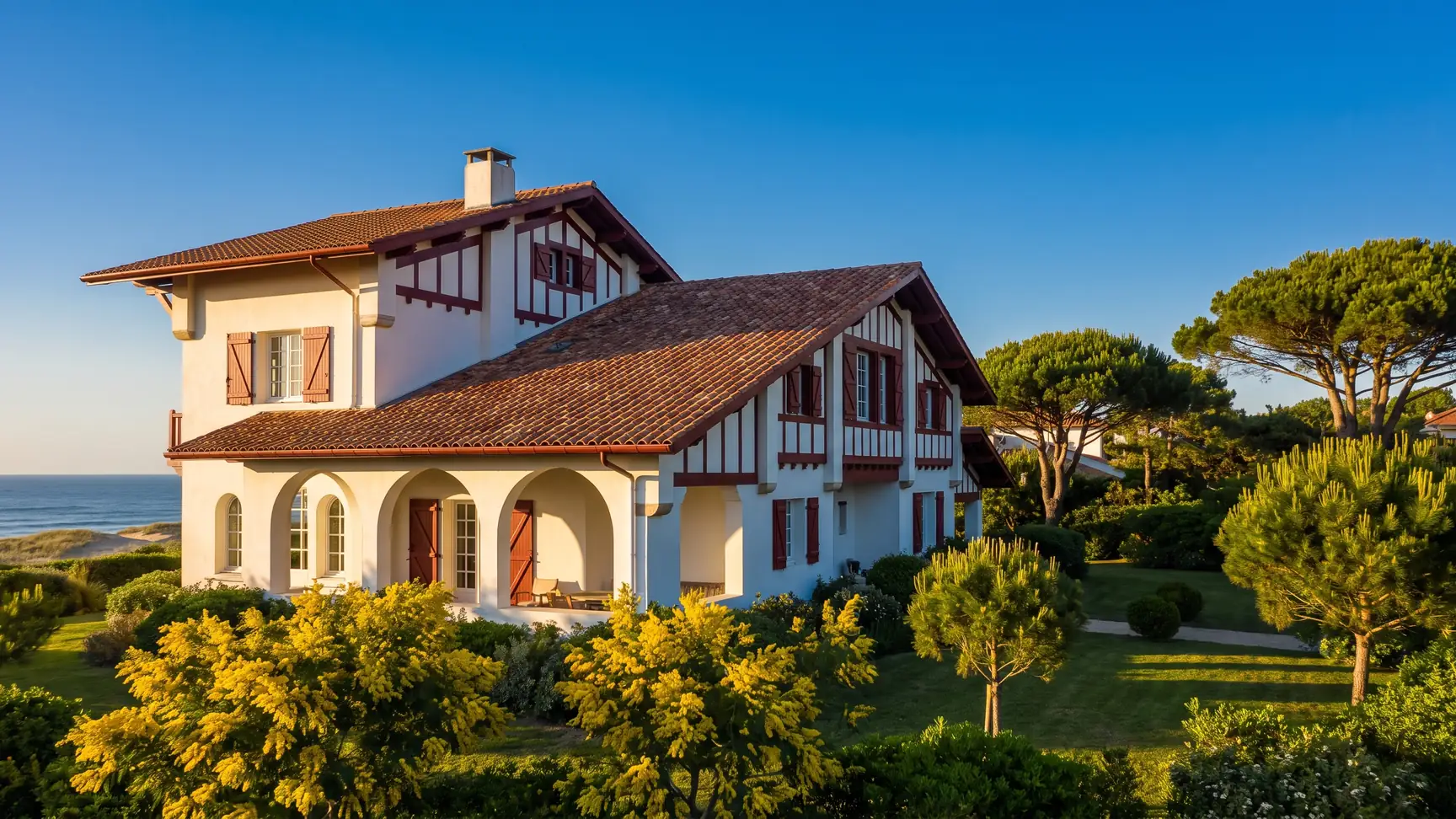
Founded in the 1920s as a “park city” of villas nestled among pine trees, Hossegor pioneered a new style: the Basque-Landes style. Its Sporting-Casino, listed as a Historic Monument, and its 1930s golf course round out this unique Art Deco ensemble. This is what the sources confirm.
The Basque-Landes style and the role of the people of the Landes
Hossegor is a rare example of a “park city” designed in a single vision during the 1920s and 1930s: a resort where villas are scattered among the pine trees, each with its own garden, without any urban alignment—the antithesis of a seaside promenade. Architects of the interwar period gave rise to a unique regional style here, known as Basco-Landes (or Neo-Basque): white walls with dark red half-timbering, wide overhanging roofs, and loggias, blending the influences of the Basque house and the seaside villa.
At the heart of this project is the Place des Landais, built in the early 1930s by the Gomez brothers. Strolling through Hossegor is like walking through an open-air museum of Roaring Twenties architecture: Art Deco and Neo-Basque villas vie for elegance between the lake and the tree-lined avenues. It is this well-preserved architectural quality that gives the resort its unique character—chic, wooded, and timeless, a world away from the concrete of typical seaside resorts.
The Sporting-Casino and the 1930 Golf Course
According to the Ministry of Culture’s POP information sheet, the Sporting-Casino was built in two phases, from 1927 to 1931. Its facades, roofs, and several interior spaces have been partially designated as Historic Monuments since the decree of December 18, 1991.
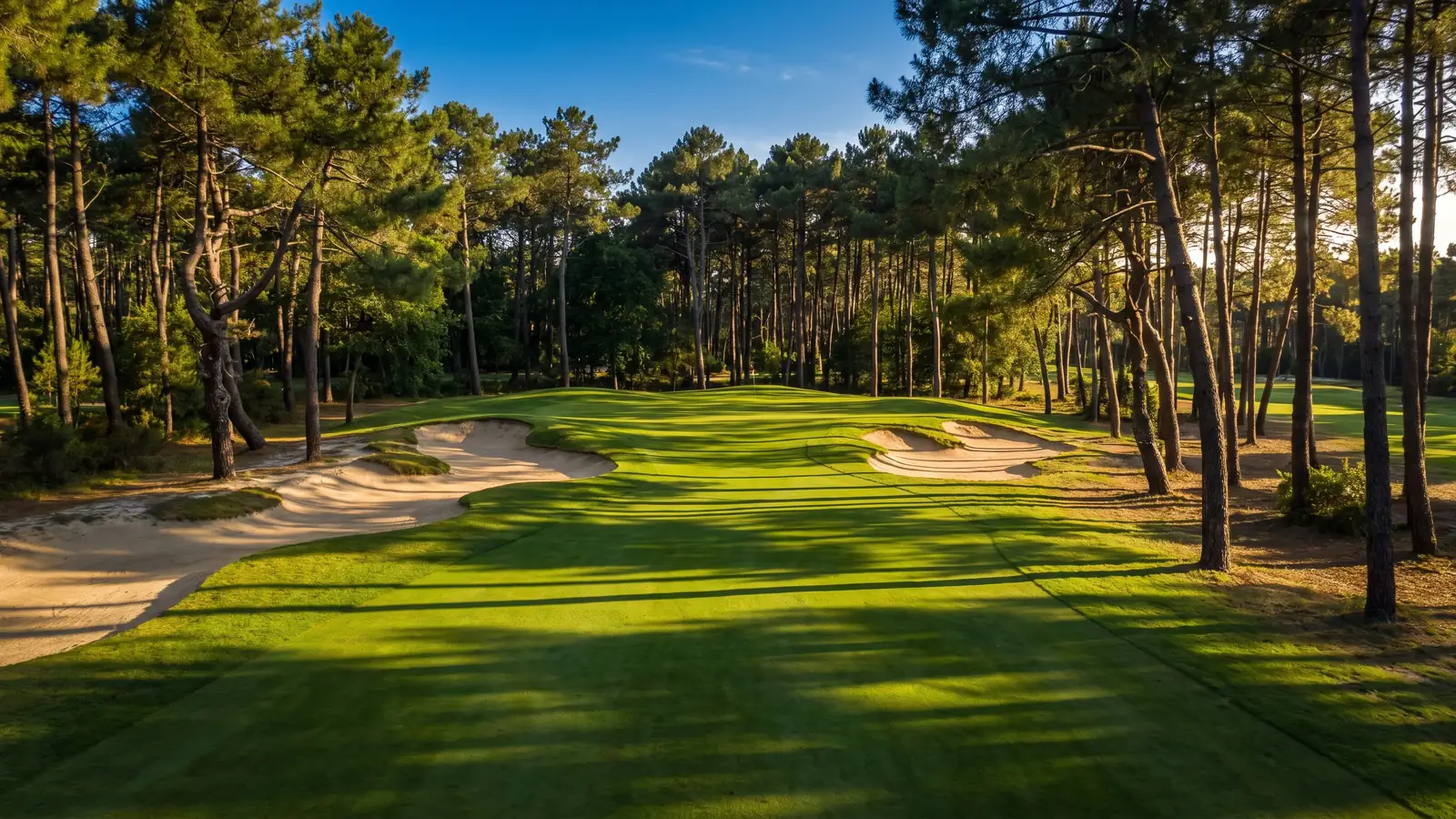
Two iconic buildings crown this golden age. The Sporting-Casino, a jewel of the Neo-Basque style, has been listed as a Historic Monument since December 18, 1991—listed, not “classified”; the distinction is important. And the Hossegor golf course, inaugurated in 1930, features 18 holes nestled among pine trees and cork oaks: its British-style layout is the work of English architect John Morrison—one of the most beautiful wooded courses on the coast, renowned and challenging.
These two projects reflect the ambition of the founders of Hossegor: to transform the resort into a refined vacation destination, where sports, gaming, and architecture come together to create a way of life. Even today, the golf course, the casino, the villas, and the lake form a cohesive and elegant ensemble, a legacy of the interwar period. This is the other side of Hossegor, alongside surfing: that of a historic resort, best discovered while strolling, with a golf club or a lake pier as a backdrop. an executive car service will take you from one site to another without having to worry about parking.
A resort born from its lake
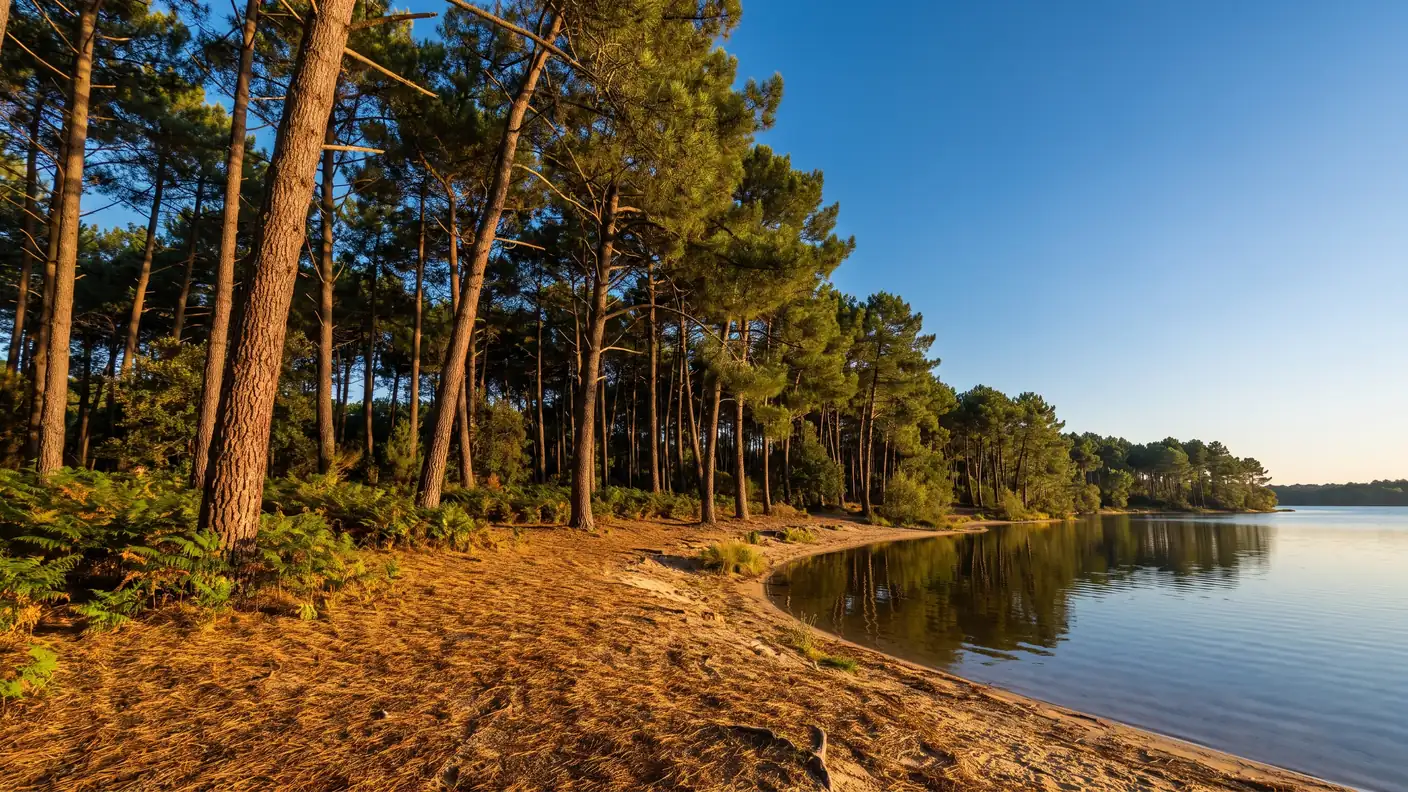
Hossegor is a young resort, founded in the early 20th century around its marine lake—so much so that the municipality of Soorts added the lake’s name to its own in 1913. A story about a name that deserves to be told accurately. Here are the verified facts.
Soorts-Hossegor: The Resort Born from the Lake
It all began with the old village of Soorts, inland, and its lake named “Hossegor.” Contrary to what is sometimes reported, there was no “merger” of two villages: the The seaside resort of Hossegor was established, in the early 20th century, in the Soorts area, around the lake. In 1913, the town of Soorts simply with the name of the lake next to his name — becoming Soorts-Hossegor.
In other words: The resort grew out of the lake, not the other way around. It was around this body of water, amid the pine trees, that the founders—writers, artists, and forward-thinking developers—envisioned a new kind of resort, the “park city,” which flourished in the 1920s and 1930s. Hossegor is thus a 20th-century work century, which explains the coherence of its architecture and the absence of an old medieval center: here, everything grew out of the sea, the lake, and a seaside dream from the interwar period.
From a Seaside Dream to the Surf Valley
The 20th century shaped the history of Hossegor in two distinct phases. First came the elegant resort of the Roaring Twenties: the Basque-Landes-style villas, the golf course built in 1930, the casino, the writers, and the beachgoers—a chic resort in the style of the time, focused on the lake and the good life.
Then, starting in the 1960s and 1970s, the surfing revolution: the waves at La Gravière attracted pioneers, international competitions took root, and surfwear brands set up shop in Europe—and Hossegor became a global surfing capital: young, athletic, and cosmopolitan.
These two sides—the historic resort and the surfing mecca—coexist today, and they’re what make this place so special: here you’ll find golfers and surfers, Art Deco villas and surfboard shapers, the calm of the lake and the roar of the ocean. It’s this rare dual identity that makes Hossegor so endearing—and explains why people come here for such a wide variety of reasons. A private chauffeur makes each of these discoveries easy, with door-to-door service from Bordeaux.
Championship, casino, capital: what we often read
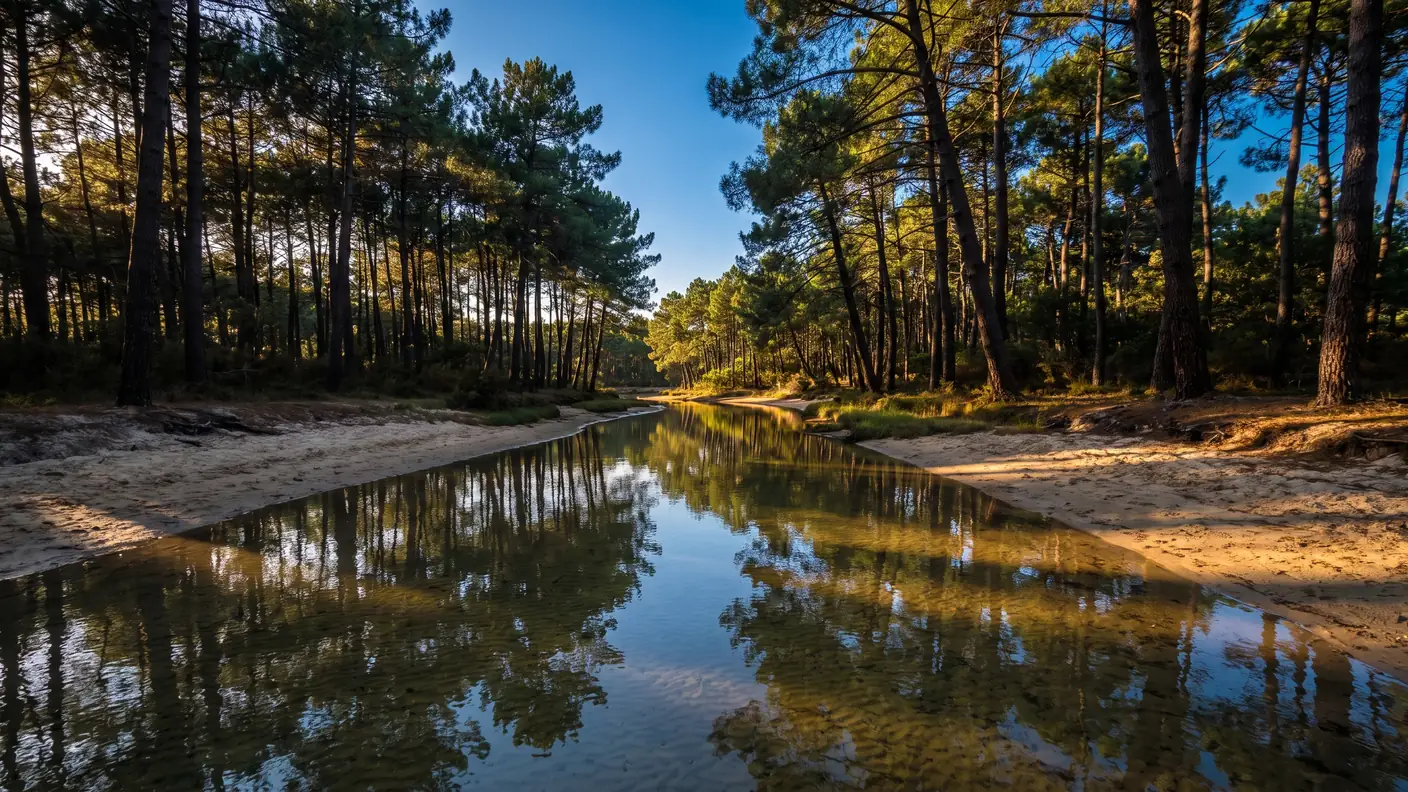
Several claims are circulating about Hossegor that warrant correction, backed by sources—which is the whole point of a reliable guide. The competition, the nickname, the casino, the brands: here’s what’s true and what’s false.
The World Championship was held until 2019
The most significant correction concerns the competitive surfing. These days, we often read that Hossegor “is hosting a stop on the World Surfing Championship”: it’s false since 2021. The Quiksilver Pro France and the Roxy Pro France are not more World Championship games (the elite WSL Championship Tour); they moved up to Challenger Series, the qualifying round. The final round of the world championship The competition held at Hossegor dates back to 2019 (won by Jérémy Florès; the 2020 edition was canceled due to COVID-19).
Therefore, one should write “hosted the world’s elite until 2019,” never in the present tense. Similarly, the title “European surfing capital” is a media and marketing nickname—established through common usage, but not an official or encyclopedic title: it should be presented as a reputation. These nuances in no way diminish the status of Hossegor: it is a world-renowned surfing destination, with exceptional waves and the European headquarters of major brands. They simply state the truth, as it stands today.
A registered casino, a lake (not just a canal)
A few more clarifications. The Sporting-Casino is registered listed as a Historic Monument (1991), not “classified”—and its construction date of “1930,” which is sometimes cited, is not sourced. On the surf brands: Rip Curl Europe and Billabong are indeed in Soorts-Hossegor, but Quiksilver Europe (Na Pali) is located in Saint-Jean-de-Luz — not to be confused with. Regarding the lake, we distinguish between the Hossegor channel (the man-made channel connecting the lake to the ocean) of the Boucarot Pass (the mouth of the river, on the Capbreton side).
Finally, be wary of the names of beaches and surf spots: only “La Gravière” and “La Nord” are confirmed as surf spots; other names in circulation (“La Sud,” “Les Culs Nus”) are not confirmed by encyclopedic sources. These distinctions—verified using the Mérimée database, the business registry, and Wikipedia—are what set a reliable guide apart from a copied text. They in no way detract from the prestige of Hossegor; quite the contrary.
What is there to do in Hossegor?
At Hossegor, you can surf (or watch others surf) at La Gravière, go for a swim and walk around the marine lake, stroll among the Basque-Landes villas and on the Place des Landais, play golf on the 1930s course, and explore Capbreton, Bayonne, and the Basque Country. Here, in a nutshell, are the real, verified activities of the surfing capital.
- Surfing at La Gravière—one of the world’s most beautiful beach breaks; surf schools for all skill levels (the Labenne area is ideal for beginners)
- A Tour Around the Saltwater Lake — a leisurely swim, paddleboarding, and a stroll among the villas and oyster beds
- Basque-Landes architecture—Art Deco and Neo-Basque villas, Place des Landais (Gomez brothers), and the Sporting-Casino, a listed historic monument
- The Hossegor Golf Course — An 18-hole course from 1930 set among the pine trees, designed in the British style by John Morrison
- The Boucarot Canal and Waterway — the walk to the mouth of the canal, on the Capbreton harbor side
- The Quiksilver Pro France — the surfing competition held in early October (now part of the Challenger Series)
- Capbreton and the Gouf—the harbor and the underwater canyon 5 km away; Labenne and Bayonne nearby
Surfing, lakes, and beaches
The day in Hossegor is all about the water, in both of its forms. On the ocean, we surf to the Gravel Pit — where you can settle down on the sand to watch the waves break, a spectacle in its own right —, with a school to get you started (beginners are better off heading to the gentler beach at Labenne, just nearby). Be careful of the Atlantic’s power and the baïnes: Swimming is permitted in the supervised area during supervised hours.
On the marine lake side, the pace changes: sheltered swimming with the family, stand-up paddleboarding, kayaking, or simply a walk or bike ride around the lake, winding through villas and piers. In between, the bike paths through the pine forest connect the beach, the lake, and the woods. It’s this contrast—the thrill of the ocean in the morning, the tranquility of the lake in the afternoon—that gives Hossegor its unique charm. A chauffeured transfer, dropping you off and picking you up at the beach or the lake, saves you the hassle of parking—a summer nightmare at the resort. School schedules and lifeguard hours vary and should be confirmed on site.
Villas, Golf, and the Art of Living
The other side of Hossegor is traditional and refined. We stroll among the Villas in the Basque-Landes region from the 1920s and 1930s—white walls, red half-timbering, overhanging roofs—we pass through the Place des Landais and in front of the Sporting-Casino listed as a Historic Monument, nestled in the hushed tranquility of the avenues lined with pine trees. Golfers can enjoy a round at the Hossegor Golf Course, a British trail dating from 1930 that winds through the cork oak forest. Food lovers can enjoy the oysters the lake and the resort's restaurants; surfwear enthusiasts scour the factory outlets of major brands located here.
And every early October, the Quiksilver Pro France—now part of the qualifying circuit—brings back the excitement of competition. Hossegor offers the best of both worlds: the adrenaline rush of surfing and the charm of a chic resort, with golf, a lake, and villas. A professional chauffeur who knows the area will tailor your day to your preferences—surfing, cultural sites, fine dining—and drive you back to Bordeaux so you don’t have to worry about driving. Event dates are subject to change and are to be confirmed.
| Activity | Where / When | Good to Know |
|---|---|---|
| Surfing / Beach | La Gravière, Central Beach | A well-known beach break, patrolled during the season; rip currents |
| Marine Lake | walk around the lake, swimming | sheltered waters, paddleboarding, oysters, tides |
| Basque-Landes Architecture | Place des Landais, villas | Sporting-Casino, registered as MH (1991) |
| Hossegor Golf Course | in the pine forest | An 18-hole course dating from 1930, designed by John Morrison |
| Quiksilver Pro France | early October | surfing competition (Challenger Series) |
What is there to see around Hossegor?
From Hossegor, you can reach Capbreton and its harbor in 10 minutes, Labenne and the Orx Marshes in 15 minutes, Bayonne and the Basque Country in half an hour, and Dax and its thermal spas in 40 minutes. The resort is in the heart of the surfers’ coast and at the gateway to the Basque Country: here are the must-see destinations, with the actual driving distances.
Capbreton, Labenne, and the Surfers' Coast
The town immediately adjacent to Hossegor is Capbreton (5 km, 10 minutes), the only port in the Landes region: its fish market, its estacade—the wooden pier jutting out into the ocean—its bustling docks, and its famous gouf, the underwater canyon that begins 300 meters from the shore and gives the entire coast its powerful waves. On the opposite side, to the south, Labenne (10 km) offers a gentler beach, ideal for learning to surf, and above all the Marais d’Orx Nature Reserve, a sanctuary for migratory birds open to everyone free of charge. To the north, Seignosse and its wild beaches extend the coastline. These resorts, best explored with Hossegor, make up the heart of the southern Landes coast—surfing, the harbor, the lake, and nature. A private driver allows you to visit these sites—which are often crowded in the summer—without the hassle of parking, so you can fully enjoy each stop.
Bayonne, the Basque Country, and Dax
To the south, the Basque Country begins just half an hour away. Bayonne (27 km, 25 minutes) boasts its market halls along the Nive River, its Gothic cathedral, its red half-timbered houses, and its chocolate; beyond that, Biarritz and the Basque Coast open up to the wide-open seas for surfers and vacationers alike. Inland, about 40 minutes away, Dax—France’s leading spa destination, with its 64°C hot spring and trio of Art Deco landmarks—offers a getaway of a different kind.
Hossegor is thus situated at the crossroads of several worlds: the Landes coast, the Basque Country, and the thermal spas—an ideal hub for exploring southern Aquitaine. With a private transfer, you can customize your itinerary—surfing in the morning, a Basque town in the afternoon, or thermal baths and golf—with your luggage on board and a flexible schedule. It’s the simplest and most comfortable way to enjoy this popular coastline without dealing with the traffic and parking hassles of the high season. A chauffeur service will take you back to Bordeaux at the agreed-upon time.
When is the best time to visit Hossegor?
Hossegor is open to visitors year-round, with very different atmospheres: the seaside in summer, competitive surfing in the fall, and the milder seasons for relaxation and golf. The summer (July–August) is peak season: crowded beaches, a bustling marine lake, terraces and shops in full swing—the resort’s chic and sporty atmosphere is at its peak, but traffic and parking are notoriously difficult (all the more reason to come by private transfer). The early fall (September–October) is perhaps the best time to go: the water is still nice, the waves are often fantastic, the crowds are thinning out, and in early October the Quiksilver Pro France brings back the excitement of competitive surfing. It’s also the perfect season for golf and a tour of the lake, bathed in golden light.
The spring (April–June) gently awakens the resort: villas in full bloom, a peaceful lake, the first surfers—the calm before the crowds. The winter has a rare charm: Hossegor deserted, the raging ocean offering its biggest waves to seasoned surfers, the Basque-Landes villas bathed in the low light, and the golf course open to enthusiasts. No matter the season, the tides determine access to the lake and the quality of the waves—it’s essential to check the tide schedule before heading out for the day. Plan on a day trip to the resort (surfing, the beach, the lake, or the villas), or a weekend to include Capbreton, Bayonne, or Dax. About two hours from Bordeaux, Hossegor showcases its dual identity—surfing capital and historic resort town—year-round, an experience made all the more enjoyable by the fact that your executive car service spares you the hassle of traffic.
| Season | Atmosphere | Ideal for |
|---|---|---|
| Summer (July–August) | lively resort, crowded beaches | family, surfing, lake (transfer available) |
| Fall (Sept.–Oct.) | Great waves, Quiksilver Pro | surfing, golf, a return to tranquility |
| Winter | deserted station, big waves | experienced surfers, villas, golf |
How to Get to Hossegor from Bordeaux
Hossegor is about 171 km from Bordeaux, which is about a 2-hour drive via the A63. The resort does not have a train station; the nearest one is in Saint-Vincent-de-Tyrosse, 8 km away. For a day at the beach, surfing, or playing golf, a private door-to-door transfer is the simplest—and most relaxing—option in the summer.
| Route | Distance | Duration | Details |
|---|---|---|---|
| Bordeaux → Hossegor | ~171 km | ~2 hours | Starting at ~€292 for a private chauffeur service |
| Bordeaux-Mérignac Airport → Hossegor | ~175 km | ~2 hours | pickup at the terminal |
| Hossegor → Capbreton | ~5 km | ~10 min | harbor, jetty, cove |
| Hossegor → Bayonne | ~27 km | ~25 min | Gateway to the Basque Country |
By car, it takes about two hours to reach Hossegor from Bordeaux via the A63, through the Landes pine forest. The resort does not have a train station: the nearest one is Saint-Vincent-de-Tyrosse (8 km), on the Bordeaux–Hendaye line, from which you’ll need to take local transportation. Above all, Hossegor is known for being difficult to reach by car in the summer: heavy traffic, parking lots that fill up early in the morning, and narrow streets between the villas.
That’s where a private transfer really makes a difference: door-to-door, it drops you off right at the beach, by the lake, at your villa, or at the golf course—boards and luggage included—and can then take you on to Capbreton, Bayonne, or Dax, completely saving you the hassle of finding parking. Whether it’s a day of surfing, a weekend of golf, a family getaway, or a night out at the resort, it’s the simplest, most flexible, and most comfortable option. For groups, it’s often the most economical choice as well.
Whether you’re heading to La Gravière to surf, taking a tour around the marine lake, or strolling among the Basque-Landes villas, booking a private chauffeur guarantees a comfortable and punctual ride—book a chauffeured transfer from Bordeaux → Hossegor or explore all our destinations.
Frequently Asked Questions
Where is Hossegor located?
Hossegor is a seaside resort on the southern coast of the Landes region, in the municipality of Soorts-Hossegor, between Capbreton (5 km) and Seignosse, half an hour north of Bayonne. It is located about 171 km from Bordeaux, or a 2-hour drive via the A63. The town, with a population of 3,817 (known as Hossegoriens), is part of the Dax district and the Maremne-Adour-Côte-Sud (MACS) community of municipalities.
What makes it unique is its dual waterfront: the ocean and its powerful waves on one side, and the calm, sheltered marine lake on the other, separated by a strip of wooded dunes. Founded in the early 20th century around its lake, Hossegor is renowned for surfing (La Gravière), its Basque-Landes architecture, and its golf course. The resort has no train station (the nearest is Saint-Vincent-de-Tyrosse, 8 km away), and access is difficult in the summer: a private door-to-door transfer is the simplest solution.
How much does a transfer from Bordeaux to Hossegor cost?
We offer a fixed-price transfer from Bordeaux to Hossegor, starting at approximately €388 one way (about 171 km, approximately 2 hours via the A63), in a Mercedes sedan or van seating up to 8 passengers, with a professional chauffeur. The trip is direct, door-to-door: pickup at your home, Mérignac Airport, or Saint-Jean Train Station, and drop-off at the beach, lakeside, your villa, or the golf course—including surfboards and luggage.
The fixed-price quote is provided and confirmed in writing before departure, with no surprises on the meter. This is the ideal option for Hossegor, which is known to be difficult to reach by car in the summer (traffic, full parking lots): the driver saves you the hassle of finding parking and can take you on to Capbreton, Bayonne, or Dax. Whether it’s a day of surfing, a weekend of golf, or a family getaway, this is the most flexible and relaxing option. For groups, it’s often the most economical choice.
What is the Hossegor marine lake?
This is the peaceful heart of the resort: a saltwater lagoon into which Atlantic water flows and ebbs twice a day, with the tides, through the Boucarot Channel (via the port of Capbreton). Covering about one square kilometer, the lake is a remnant of the former Adour estuary—the river, which once flowed into Capbreton, was diverted toward Bayonne in the 16th century.
The canal connecting the lake to the ocean is a Second Empire-era project: ordered by Napoleon III in 1868, it wasn’t actually opened until 1876, when a storm finally completed it. The lake offers a stark contrast to the ocean: calm waters, family swimming, stand-up paddleboarding, kayaking, and even oyster farming (oysters are harvested here). Lined with pine trees and Basque-Landes-style villas, it is one of the most beautiful sights on the Aquitaine coast. A walk or bike ride around it is the quintessential Hossegor outing—the perfect counterpoint to a morning of surfing.
Can you go surfing at Hossegor?
Yes—it’s one of the world’s top surfing destinations. La Gravière Beach is a legendary beach break, with hollow, fast-breaking waves that form some of the most beautiful tubes in Europe; the nearby spot, La Nord, rounds out the experience. The secret behind this power is the Gouf de Capbreton, an underwater canyon that begins 300 meters from the shore and concentrates the swell. Hossegor is also the European capital of the surf industry (home to the headquarters of Rip Curl Europe, Billabong, and the French Surfing Federation).
Please note: Hossegor hosted a round of the World Surfing Championship until 2019, but the event (the Quiksilver Pro France, held in early October) has since moved to the Challenger Series, the qualifying circuit—it is no longer part of the World Championship. Beginners are advised to start out at the gentler beach at Labenne, which is nearby. Swimming and surfing are permitted in the supervised area during the season, but be wary of rip currents, which can be dangerous.
What is there to do in Hossegor?
You can surf (or watch others surf) at La Gravière, one of the world’s most beautiful beach breaks, which also has a school where you can learn. You can go for a swim and explore the marine lake—with its calm waters, paddleboarding, villas, and oyster beds. Take a stroll among the Basque-Landes villas from the 1920s and 1930s, on the Place des Landais, and in front of the Sporting-Casino, a listed historic monument. Play a round of golf at Hossegor, a British-style course from 1930 nestled among the pine trees.
We head all the way to the canal and the Boucarot Pass, on the Capbreton harbor side. In early October, the Quiksilver Pro France (now part of the Challenger Series) brings back the excitement of surfing. Nearby: Capbreton and its “gouf” (5 km), Labenne and the Orx Marshes (10 km), Bayonne and the Basque Country (27 km), Dax and its thermal baths (~40 min). A chauffeured transfer lets you enjoy surfing, the lake, local heritage, and excursions without worrying about parking—a summer nightmare at the resort.
Is Hossegor really the surfing capital?
“European Surfing Capital” is a media and marketing nickname that has become established through common usage, but it is not an official or encyclopedic title—it should be presented as a reputation. That said, this reputation is based on solid facts: the waves at La Gravière are among the most renowned in the world; the European headquarters of Rip Curl and Billabong, as well as the French Surfing Federation, are located in Soorts-Hossegor; and the resort has long hosted a round of the world championship.
Important note: This event (the Quiksilver Pro France) has not been part of the World Championship since 2021—it has moved to the Challenger Series, the qualifying circuit. The last World Tour event in Hossegor took place in 2019 and was won by Jérémy Florès. It’s also worth noting that Quiksilver Europe, contrary to what is sometimes reported, is based not in Hossegor but in Saint-Jean-de-Luz. Hossegor remains, nonetheless, a world-renowned surfing destination, thanks to its exceptional waves and thriving surfing industry.
What is the distance between Bordeaux and Hossegor?
About 171 km by road, or about a 2-hour drive on the A63, through the Landes pine forest. With a professional chauffeur, the fare is fixed and provided in advance, starting at about €292 one way. The resort does not have a train station: the nearest one is Saint-Vincent-de-Tyrosse (8 km), on the Bordeaux–Hendaye line, from which you’ll need to take local transportation. Above all, Hossegor is known for being difficult to reach by car in the summer: heavy traffic, parking lots that fill up early in the morning, and narrow streets between the villas.
A private transfer therefore offers a clear advantage: door-to-door service from your home, the airport, or the train station; drop-off directly at the beach, the lake, your villa, or the golf course; surfboards and luggage included; and the freedom to explore Capbreton, Bayonne, or Dax. For a day of surfing or a weekend on the coast, this is the simplest and most relaxing option; when traveling with others, it’s often the most economical.
What is the Basque-Landes style of Hossegor?
It is the architectural style that gives Hossegor its unique character. Founded in the 1920s and 1930s as a “park town”—with villas scattered among the pine trees, each set in its own garden and without direct beachfront access—the resort saw the emergence of a distinctive regional style, the Basco-Landaise (or Neo-Basque) style: white walls with dark red half-timbering, wide overhanging roofs, and loggias, blending the Basque house with the seaside villa. At the heart of this project is the Place des Landais, built in the early 1930s by the Gomez brothers.
Two buildings epitomize this golden age: the Sporting-Casino, listed as a Historic Monument since 1991, and the Hossegor golf course, inaugurated in 1930, whose British-style layout was designed by the English architect John Morrison. Strolling through Hossegor is like walking through an open-air museum of Roaring Twenties architecture, between the lake and the tree-lined avenues—the resort’s other side, alongside surfing: that of a chic and timeless vacation destination.
What is there to see around Hossegor?
Hossegor is located in the heart of the southern coast of the Landes region and at the gateway to the Basque Country. Just 5 km (10 min) away is Capbreton, the only port in the Landes region, featuring its fish market, pier, and the famous “gouf”—an underwater canyon that begins 300 meters from the shore. Just 10 km away, Labenne offers a gentler beach (ideal for learning to surf) and the Marais d’Orx Nature Reserve, a bird sanctuary with free admission. To the north lie Seignosse and its wild beaches.
Just 27 km (25 min) away, Bayonne serves as the gateway to the Basque Country: market halls along the Nive River, a Gothic cathedral, and chocolate; beyond that lie Biarritz and the Basque Coast. Inland, about 40 minutes away, Dax and its thermal spas offer a different kind of getaway. Hossegor is thus at the crossroads of several worlds—the Landes coast, the Basque Country, and the thermal spas. A private driver allows you to visit these destinations—which are often crowded in the summer—without worrying about parking, and to return to Bordeaux at the agreed-upon time.
When is the best time to visit Hossegor?
All year round, with very different vibes. Summer (July–August) is peak beach season: crowded beaches, a bustling lake, packed outdoor cafes—the chic and sporty atmosphere is at its peak, but traffic and parking can be a challenge (all the more reason to arrive via private transfer). Early fall (September–October) is perhaps the best time: the water is still warm, the waves are often superb, the crowds have thinned out, and in early October, the Quiksilver Pro France takes place. Spring gently awakens the resort (villas in full bloom, a peaceful lake). Winter has a rare charm: Hossegor is deserted, the rough ocean offers its biggest waves to seasoned surfers, the Basque-Landes villas are bathed in low light, and the golf course is open. No matter the season, the tides dictate access to the lake and the quality of the waves: a quick glance at the tide chart is a must. Plan on a day trip for the resort, or a weekend to include Capbreton, Bayonne, or Dax.
Is there a train station in Hossegor?
No, the town of Soorts-Hossegor does not have a train station. The nearest one is in Saint-Vincent-de-Tyrosse, about 8 km away, on the Bordeaux–Hendaye line served by TER trains: from there, you’ll need local transportation to reach the resort, the beach, or the lake. This is one of the reasons why private transfers are particularly convenient for Hossegor. The other reason is the difficulty of accessing the area by car in the summer: the resort, with its narrow streets winding between the villas and its parking lots that fill up quickly, is known for its parking challenges during peak season.
A chauffeur service solves both problems at once: he picks you up door-to-door from Bordeaux (your home, the airport, or the Saint-Jean train station) and drops you off right where you want to go—the beach, the lake, a villa, a golf course, including your surfboards and luggage—and completely saves you the hassle of finding a parking spot. For a day or a weekend with Hossegor, it’s the simplest and most comfortable solution.
Further Reading
- The neighboring resort and its marsh: see the Labenne Guide (beginner's beach and the Orx Marsh Nature Reserve, 15 minutes away)
- The spa town in the Landes region: see the Dax Guide (Fontaine Chaude at 64 °C, about 40 min away)
- The Prefecture of the Three Rivers: see the Mont-de-Marsan Guide (Lacataye Keep and sculpture)
- Understanding our rates and vehicles: see the "Book a Driver" page (sedan & van, fixed-price quote)
- Plan your trip: Book an executive car service from Bordeaux to Hossegor or explore all our destinations
Sources and References
- Wikipedia — Soorts-Hossegor — a resort that developed around the lake; in 1913, Soorts adopted the name of its lake, “Hossegor”; a neo-Basque park city from the 1920s and 1930s; a marine lake; the Sporting-Casino, designated a historic monument in 1991; and a golf course dating from 1930
- Wikipedia — Lake d'Hossegor — a marine lake connected to the ocean by the Boucarot Channel, a remnant of the former Adour estuary; a canal opened on March 11, 1876 (decree of Napoleon III, 1868); oyster farming
- Wikipedia — Quiksilver Pro France — a stop on the World Surfing Championship from 1987 to 2019 (the last world title was won by Jérémy Florès); part of the Challenger Series since 2021; held in early October
- Hossegor Golf Course — an 18-hole course opened in 1930, designed in the British style by English architect John Morrison, nestled among pine and cork oak trees
- POP Mérimée — Sporting-Casino d'Hossegor — a Neo-Basque-style casino listed as a Historic Monument by decree dated December 18, 1991
- Wikipedia — Capbreton Gouf — an underwater canyon beginning about 300 m off the coast of Capbreton; it concentrates the swell and explains the power of the waves at Hossegor (La Gravière, La Nord)
Article updated in July 2026.
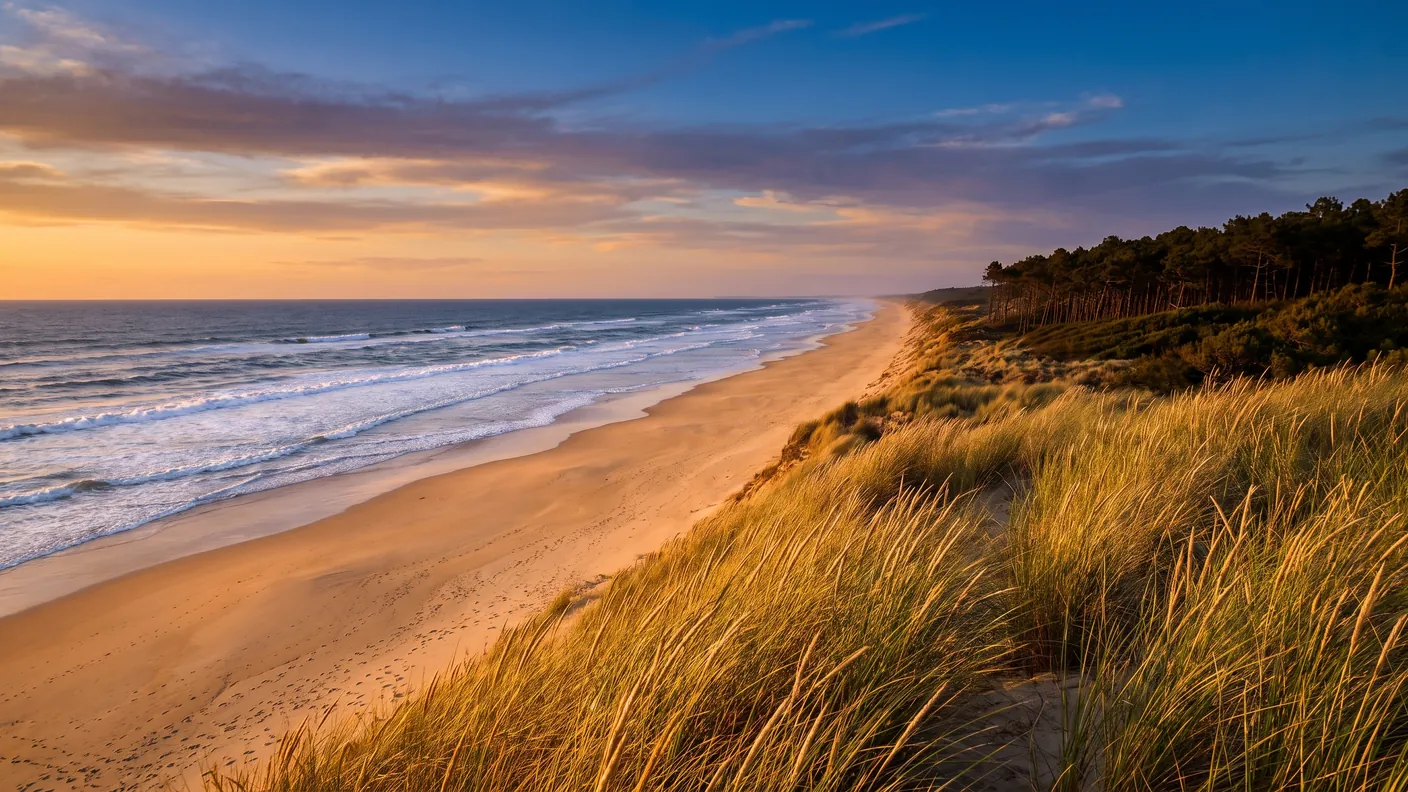
Heading to the surfing capital
Direct transfer from Bordeaux (~2 hours via the A63) to Hossegor, with its marine lake and waves—from your home, the airport, or the train station to the beach, the lake, or your villa, including surfboards and luggage, then on to Capbreton or the Basque Country. Fixed-price written quote—no surprise meter charges.