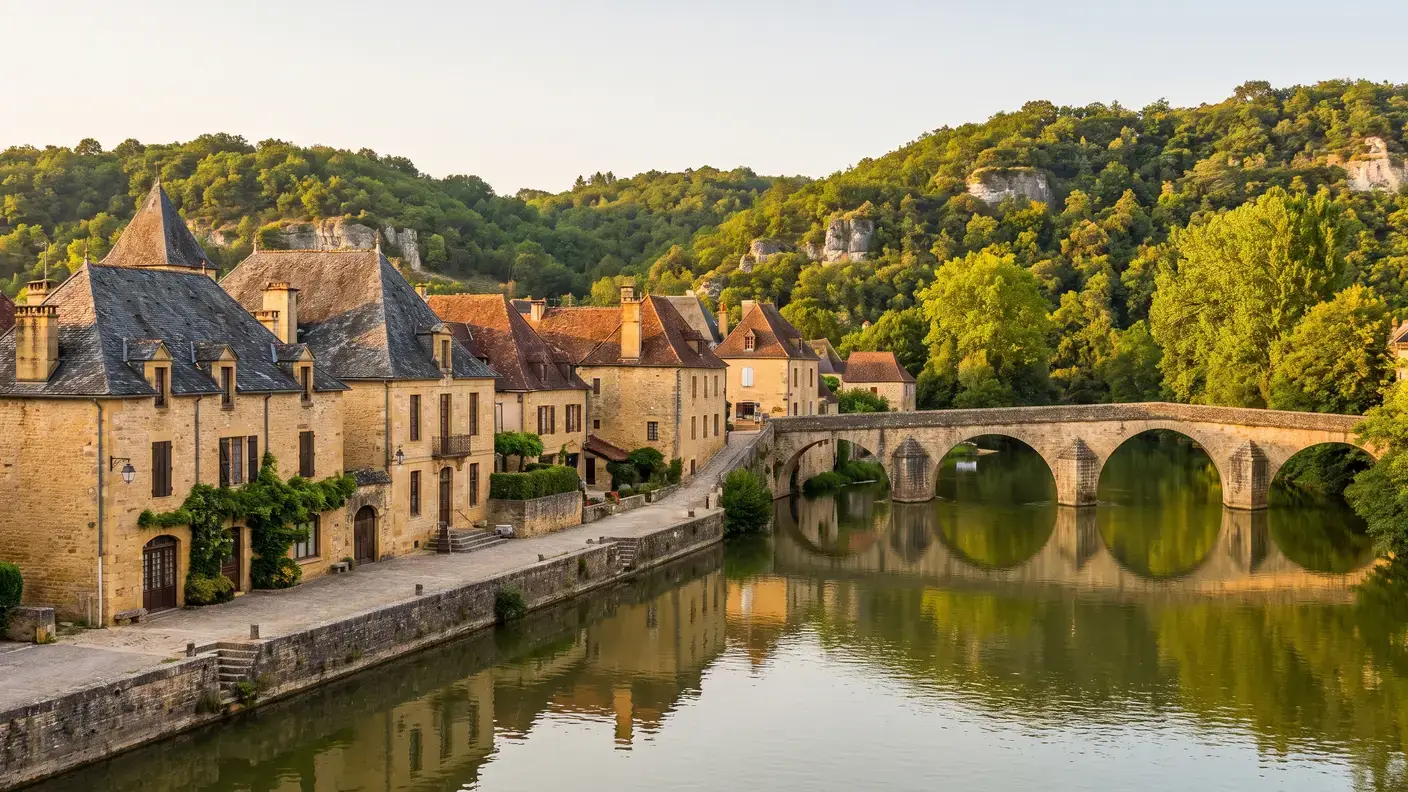
Bordeaux to Le Bugue: Proumeyssac, Le Bournat and the Tuesday market
A market established by the king in 1319, the “crystal cathedral” of Proumeyssac, a truly ornate cave just 1 km from downtown, the early-20th-century village of Le Bournat—and the home turf of Bruno, Chief of Police. Everything you need to know before you go, about 2 hours and 15 minutes from Bordeaux.
Le Bugue at a Glance
Le Bugue is a village in the Dordogne situated on a bend in the Vézère River, in the Périgord Noir region. Its Tuesday market was established by a royal decree issued by Philip V in November 1319 and remains a major gathering place. Nearby, the Proumeyssac chasm is located in the town of Audrix, while the decorated cave of Bara-Bahau is about one kilometer from the town center. Le Bournat and the Périgord Noir Aquarium are the main family attractions. Le Bugue also provides quick access to Limeuil, Campagne, and Les Eyzies. From Bordeaux, the route described on this page is approximately 172 km and takes 2 hours and 15 minutes via the A89. The listed private chauffeur service rate starts at 292 € one-way in a sedan, with a fixed price confirmed in writing and the option for travelers to make stops along the way.
Detailed Guidelines
- Le Bugue (population 2,663; the Buguois) is THE market town of the Vézère Valley. The market in Le Bugue was established on Tuesdays by a decree issued by Philip V the Long in November 1319; it is still held on Tuesdays today.
- The name comes from the Gaulish word *albuca (“white marly soil”): first attested in 856, it is one of the two or three known Carolingian “hundreds” in the entire Périgord region.
- Around 964, Adelaide of Montignac founded a nunnery there—which was sold along with “the port served by boatmen” for 200 silver sols: the deed still exists.
- Just outside the town, the Proumeyssac Cave—a 42-meter-high “crystal cathedral” (158,000 visitors per year)—can be explored in a rotating gondola, just as it was in 1907.
- In the town itself: the Bara-Bahau Cave (featuring engravings dating back ~17,000 years, discovered by Casteret in 1951—NASA named a Martian site after him).
- As for family attractions, Le Bugue draws approximately 380,000 visitors per year: the 1900 Village at Bournat, France’s largest private freshwater aquarium, and the Big Bird Trail.
- The writer Martin Walker has set the story there, featuring his hero Bruno, a police chief—and the chemist Jean Rey preceded Lavoisier by 140 years, in 1630.
- From Bordeaux: ~172 km, about 2 hours and 15 minutes — starting at 292 € for a chauffeured transfer, door-to-door.
Before You Go: What Le Bugue Really Is
Tuesday, 9 a.m., in the market hall. The market stalls—nearly 300 in the summer—spill out from the Place de l’Hôtel-de-Ville all the way to the Rue de Paris and the Place de la Farge. Above the market umbrellas stands City Hall: the 1848 market hall and city hall literally houses the city council right above the crates of strawberries. And on a pillar, a ceramic plaque reproduces the decree that established it all: November 1319, Philip V the Long, “that the market be held perpetually on Tuesdays.” You’re doing your shopping under a seven-century-old royal decree.
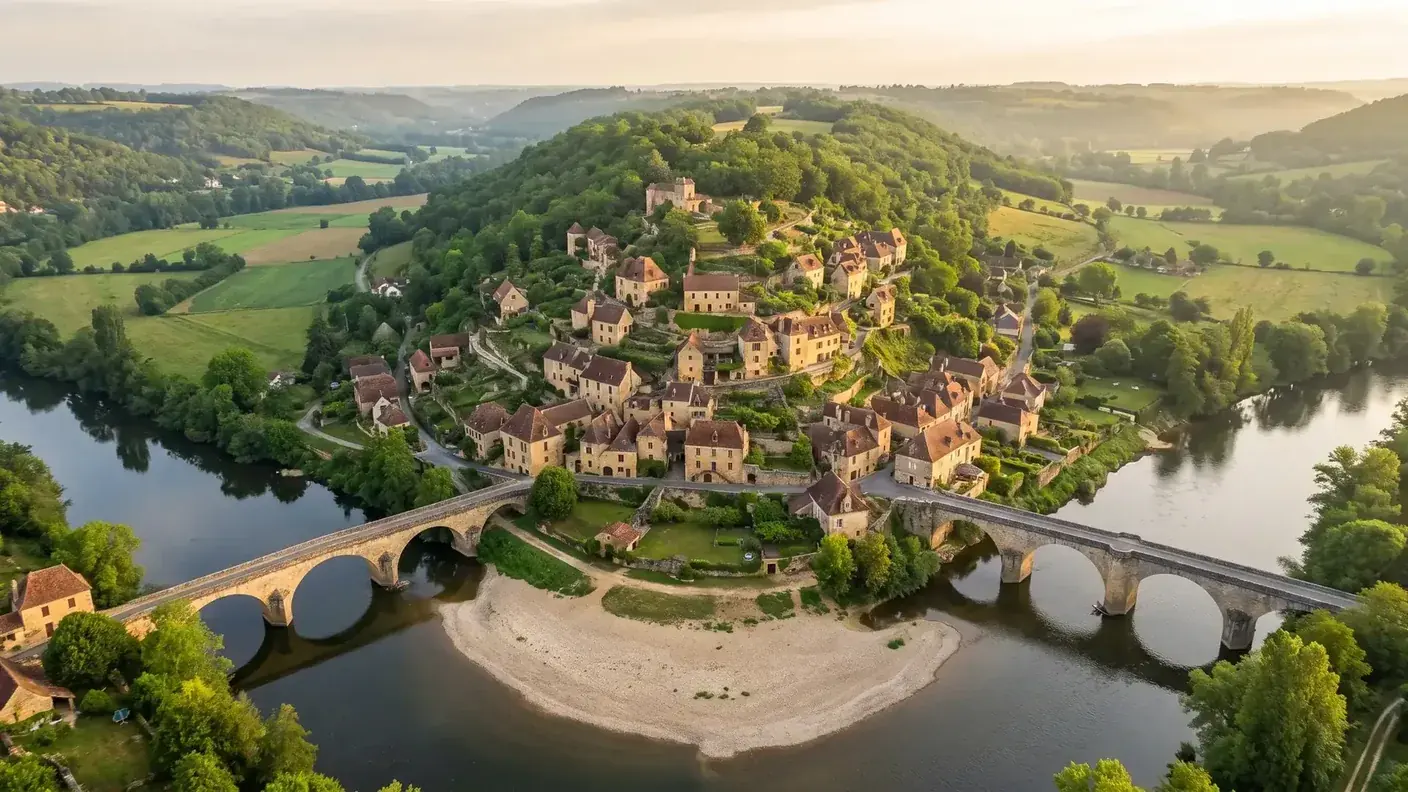
Le Bugue is neither a museum village nor a stagnant bastide: it is a bustling town center that thrives year-round—the INSEE classifies it as an “isolated town,” a small, self-sufficient hub with 1,222 jobs for 2,663 residents, complete with shops, a middle school, and a hypermarket. Its location says it all: nestled on a bend in the Vézère River (the “Cingle du Bugue”), 7.5 km from its confluence with the Dordogne, and 11 km from Les Eyzies, it has always been a crossroads—an administrative seat since the 9th century and a market town since the 14th.
This guide delves into what the brochures only touch on: a Gallic name that took a thousand years to become “Le Bugue,” an abbey sold in 964—the deed for which details even the fishing grounds—a royal market, the most spectacular chasm in the Périgord, a genuine decorated cave just 1 km from the center, and the largest family-friendly destination in the department. Includes verified 2026 rates and actual driving distances.
A quick note: Le Bugue Station is a simple stop with no ticket office, located 2 km from the town center, and there are no direct trains from Bordeaux. If you’re not driving, hiring a chauffeur service from Bordeaux is still the easiest way to get there—about 2 hours and 15 minutes, door-to-door.
A Village on a River Bend: Geography and Demographics
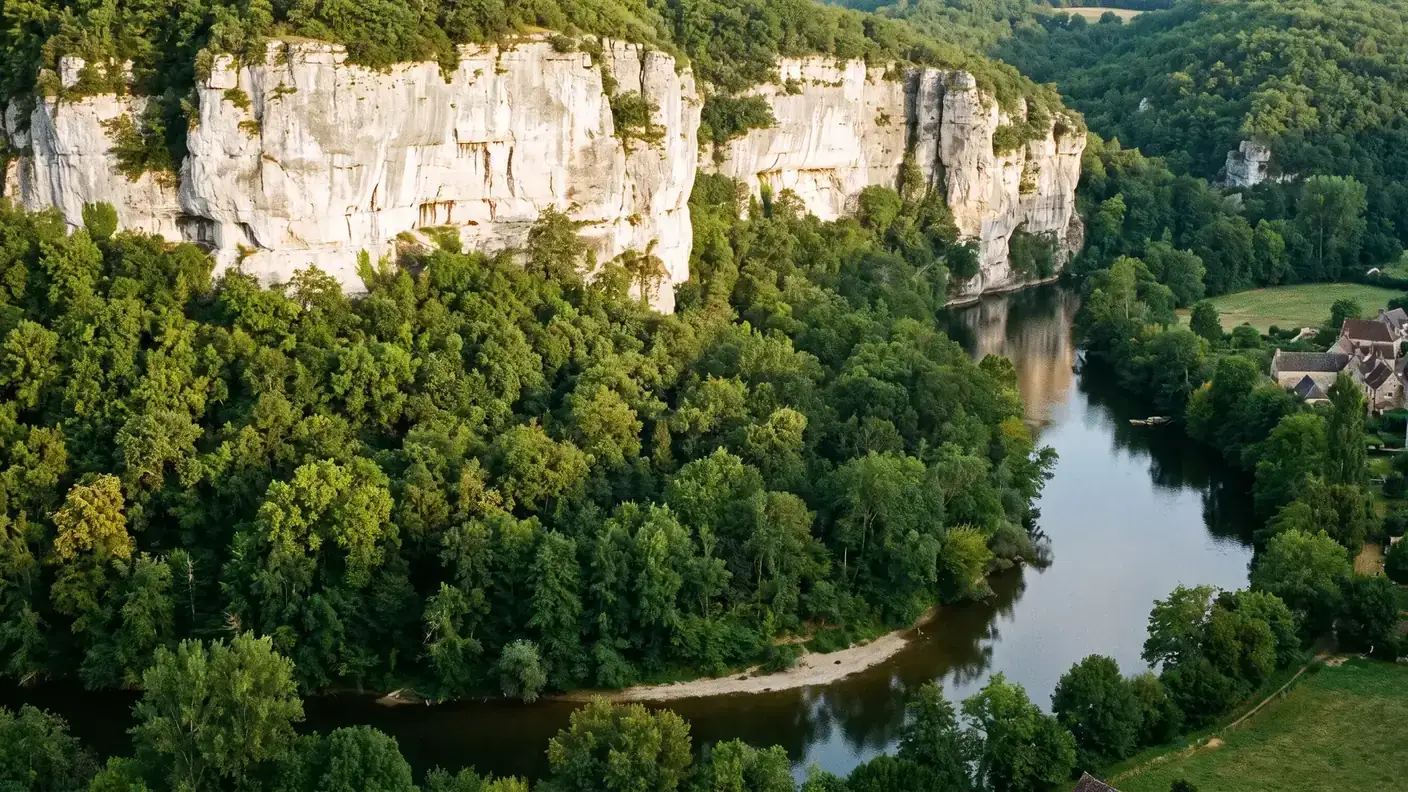
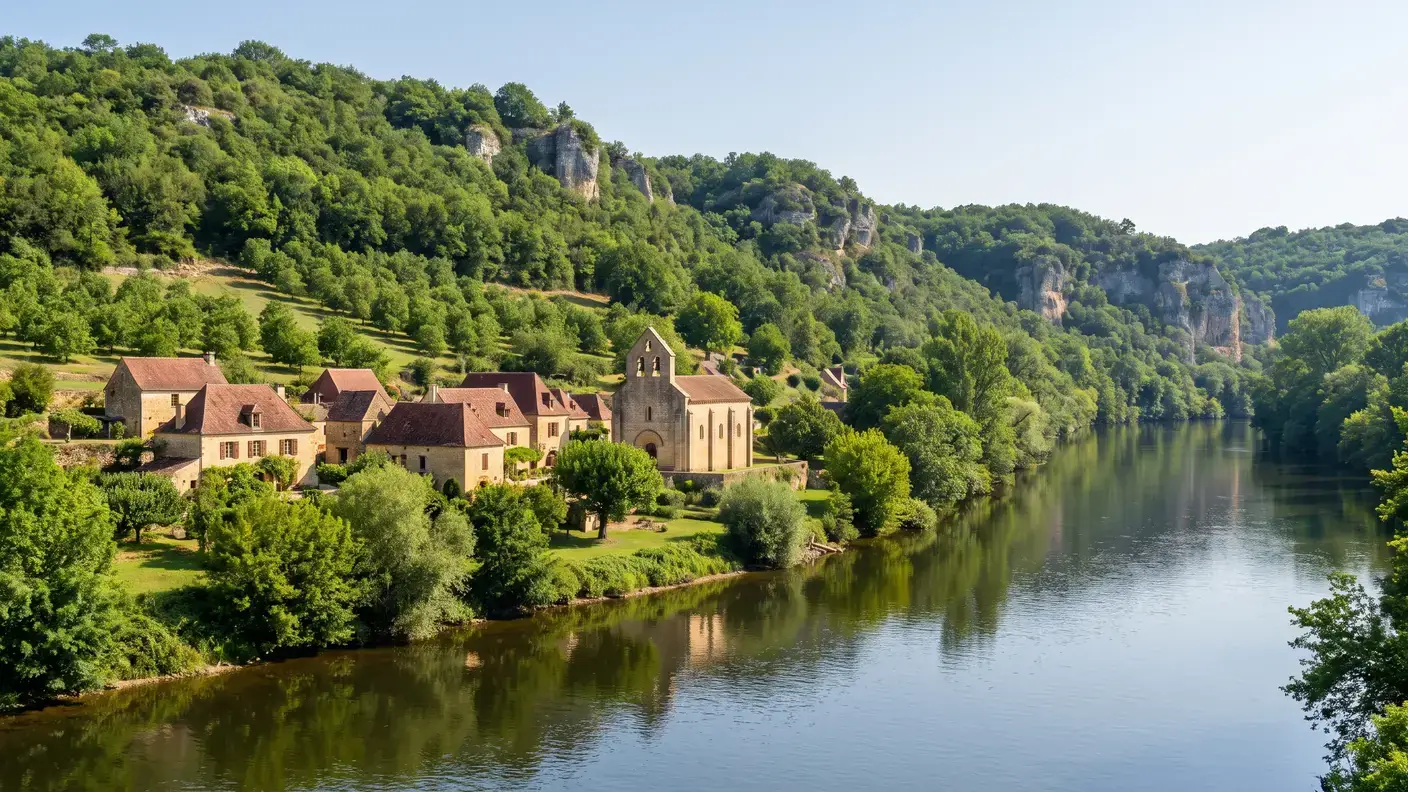
The Vézère River flows through the town, tracing a tight arc—known as the Cingle du Bugue—with houses lining its “amphitheater-like” curve, from the aquarium to the Granelle Rock. The cliffs flanking the river are composed of Coniacian limestone (86 to 90 million years old), approximately 70 meters thick according to the BRGM geological map—which is officially designated as “sheet Le Bugue.” It is this limestone mass, dissolved by seepage water, that carved out Proumeyssac and Bara-Bahau.
| Data | Value |
|---|---|
| Status | Town Center, former county seat (1790–2015) |
| Population | 2,663 residents (2023) — the Buguois |
| Area | 28.96 km² (population density: 92 people/km²) — 51% forest |
| Elevation | 48 m to 245 m (~60 m in the village) |
| Waterways | the Vézère (approximately 9 km within the municipality) and the Ladouch |
| Intermunicipal Cooperation | Municipal Council of Vallée de l'Homme · Sarlat-la-Canéda District |
| Labels | Station Verte · 1 Flower (2025) · 1st Place, Departmental Award 2005–2008 |
| Economy | 1,222 jobs, 416 establishments — “isolated city” (INSEE) |
| Distance from Bordeaux | ≈ 172 km (~2 hours and 15 minutes via the A89) |
86 deaths, 12 births… and a growing population
Buguois demographics are an accepted paradox: in 2023, the town recorded 12 births and 86 deaths (natural increase of -74)… and yet the population is growing—up 2.94% since 2017. All of this growth comes from newcomers—both working professionals and retirees—drawn to this well-equipped town in the heart of the valley. The 20th-century peak was in 1982 (2,784 residents); the all-time high was in 1866, with 3,005 residents, at a time when the railroad had just arrived.
A bit of contemporary history that brings honor to the town: In September 1939, Le Bugue took in evacuees from Marckolsheim (Alsace)—the two towns have been sister cities since 1986. A more recent anecdote: a twinning agreement signed in 2025 with Dire Dawa (Ethiopia) was canceled by the city council in 2026—the Ethiopian city has a population 225 times larger than that of Le Bugue. And the river sometimes reminds us who’s in charge: the record flood of October 1960 reached 1,360 m³/s at Montignac, a ~250-year return period event that has shaped the town’s urban planning since the 2000 flood prevention plan.
From Albuca to Le Bugue: A Name a Thousand Years in the Making
It all starts with a reconstructed Gallic word, *albuca* — “white marly stone,” “clay soil” — which blends perfectly with the light-colored limestones of the Cingle. The word is still in use: Occitan albuga always refers to clay soils, with regional variants (aubue in Burgundy, boxwood in the Loire Valley). And the toponymic family is a prestigious one: Albi and Le Pecq (Alpicum) are built on the same foundation—three sites perched above a river.
The first written record dates back to 856: a Carolingian document refers to a villa donated to Saint-Martial of Limoges “in centena Albucense”—in the centena of Albuca. This detail is invaluable: the centaine (a judicial and military district of Merovingian origin, led by a centenier) is known in Périgord from only two or three examples—and Le Bugue was its seat. The town thus enters history indirectly, as an administrative district, a century before its first direct mention (“villa Albuca,” 936).
What follows is a linguistic delight: Albuca becomes Albuga in Occitan, and then speakers reinterpret the first syllable as the article al (“au”)—this is known as deglutition, which occurred between the 13th and 17th centuries: Al Buga, “Au Bugue”… hence “Le Bugue” in French. The town was even called “Le Bugne” in the 1793 census, before adopting its final form in 1801. In Occitan, it is still called Al Buga—the original name, unchanged.
Religious status followed administrative status: an archpriesthood of Le Bugue is mentioned as early as the 10th century—it would eventually comprise 19 parishes after ceding 10 to Audrix upon the creation of the Diocese of Sarlat (1317).
964: The Abbey Sold for 200 Silver Sols—and Its Extraordinary Fate
A deed of sale that captures an entire world
Around 964, Grimoald and his wife Adelaide of Montignac sold their estates in Le Bugue to Guigues, abbot of Paunat, to establish there a Benedictine nunnery dedicated to Saint-Sauveur. The deed—discovered in the 19th century among the manuscripts of Saint-Martial de Limoges by the Bugue archivist Jean-Léon Dessalles—specifies the price, “two hundred silver sols,” and lists “lands, fields, forests, vineyards, meadows, mills, fisheries, and the port served by boatmen”: proof that a boatmen’s port existed on the Vézère as early as the 10th century. A delightful exception: “except for the church of Saint-Sulpice”—the exact name of the current parish church, a thousand years later.
A manuscript from the early 13th century still requires the abbess to light a candle every year, on the eve of Saint Luke’s Day, “before Lady Adélaïde, who was from Montignac”—a perpetual tribute to the founder, eight centuries before our own commemorations.
Fires, the English, and a Protestant abbess
The history of the house is a series of rebirths—for the political landscape had shifted: married in 1152 to Henry Plantagenet, Eleanor of Aquitaine became Queen of England in December 1154, and the Périgord fell under English influence. Le Bugue, which had prospered until then, became a border town between the two kingdoms—and paid dearly for it. Around 1160, Lord Guillaume de Gourdon set the town ablaze and destroyed the convent, which was rebuilt in the 13th century. In 1264, the town and convent came under the control of the lords of Limeuil. The Hundred Years’ War did the rest: in 1414, the abbey was “on the verge of ruin” and Le Bugue fell into English hands; by the mid-15th century, only two nuns remained.
The most dramatic episode occurred during the Wars of Religion: in 1563, the abbess herself—Gabrielle du Breuil—converted to Protestantism, closed the Church of Saint-Marcel, and had a Protestant church built. All that remains today is the name of the Place du Temple. The nuns were expelled in 1575, the abbey was plundered in 1577, and it was not reestablished until 1608. Rebuilt on the banks of the Vézère in 1677, designated a “royal abbey” in its 1763 statutes, and destroyed by fire in 1759, it was sold as national property beginning in 1791.
Where has the abbey gone? Right under your feet
Nothing is visible anymore—but everything is still there, beneath the surface. The remains of the convent lie dormant beneath the backfilled esplanade of the Royal Vézère; the ground floors of the former church and the rectory, leveled in 1876 to make way for the Rue de Paris leading to the new bridge, are buried beneath the Place de l’Hôtel-de-Ville—a stone cross on the parapet marks the spot, and a crypt remains beneath the square. The current church, Saint-Sulpice (Neo-Gothic, 1871–1876), houses two treasures: 27 stained-glass windows by Jean Besseyrias—“among the most beautiful in the Dordogne”—and a large Gaston Maille organ from 1886. As for the 14th-century medieval bridge, destroyed during the Fronde, it was replaced by a ferry for two centuries—the current stone bridge dates from the 1870s.
Three medieval landmarks, however, still stand in the village: the Barde Mill on the Ladouch River, with its castle-like appearance, which successively produced flour, oil, cloth… and later the village’s electricity; the 13th-century Moulin Bas; and the 14th-century Vigier House. Inside the church, don’t miss the carved wooden panel depicting The Last Supper (2 m × 1.20 m, designated a historic monument in 1979)—a copy of Poussin’s *The Eucharist*, likely commissioned by the abbey after 1687.
November 1319: The Market That the King Made Last Forever
In November 1319, King Philip V designated Tuesday as the day for the Bugue market. The town hall notes that this weekly market continues to this day; Tuesday mornings remain the main general market, supplemented by a farmers’ market on Saturday mornings. [Mairie du Bugue 2026]
The town owes its charter entirely to one man: Pierre de Galard, Baron of Limeuil and Master of the Crossbowmen of France—one of the great knights of the royal entourage, appointed as early as 1310 by Philip the Fair—who submitted the request to the king. A market charter in the 14th century was no trivial matter: it provided legal protection for the market against any challenges from the local lord, attracted merchants, and elevated the town to the rank of the kingdom’s merchant cities.
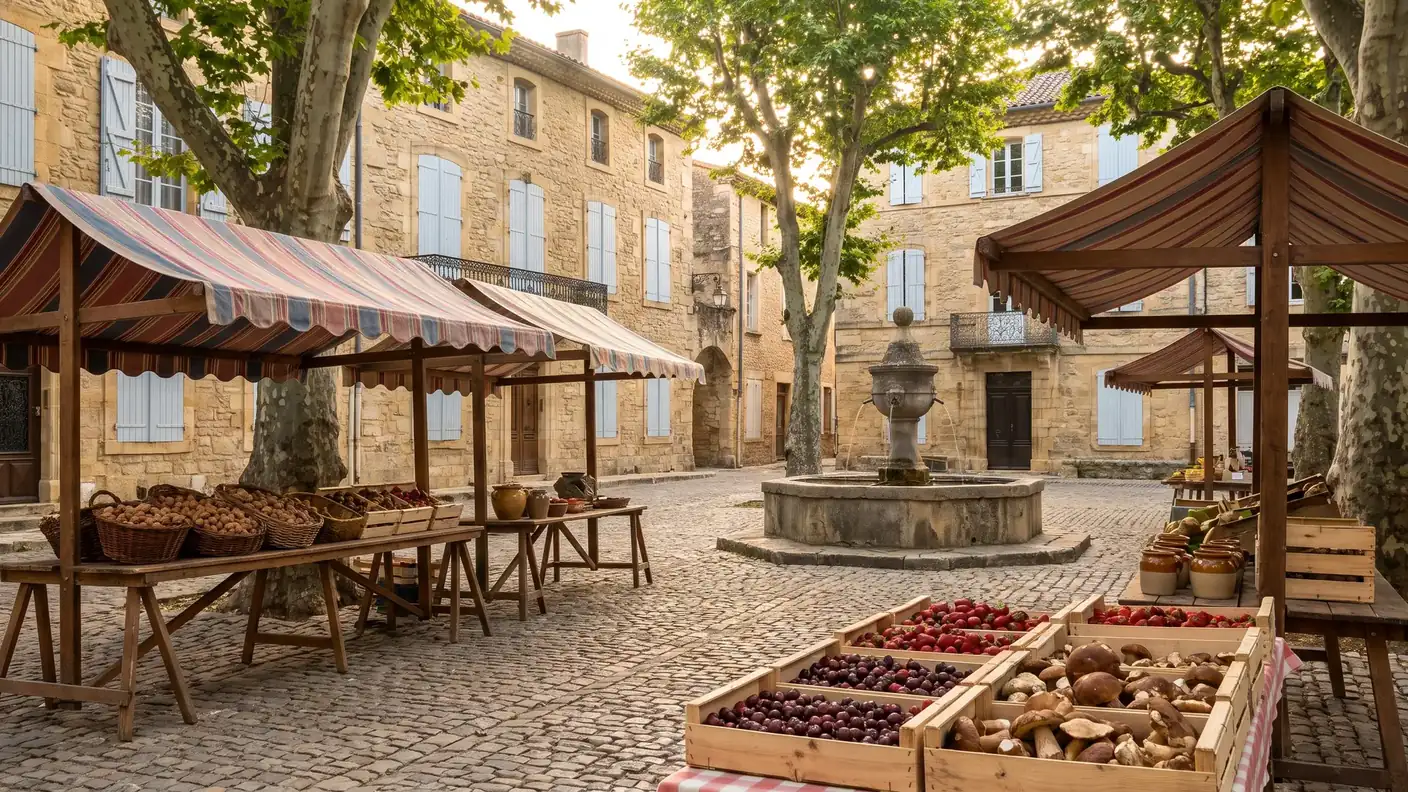
Its longevity commands respect: the market has weathered the Wars of Religion, the French Revolution, and both world wars— “This market continued even during the war,” recalled Maurice Clavière, 96, during the 700th anniversary celebration in November 2019. Since June 17, 2006, an enameled ceramic plaque, crafted by local artisans, has reproduced the royal charter beneath the market hall—a market hall that is itself a curiosity: the market hall-town hall (1848–1852) houses the city hall above the market.
Today, the main attractions include the large Tuesday morning market (nearly 300 stalls in the summer, stretching from the market hall to Rue de Paris and Place de la Farge), a Saturday morning food market, and the gourmet market on Tuesday evenings in July and August along the banks of the Vézère. Driver’s tip: On Tuesdays, don’t drive through the center—park your car and take a stroll. Local legend has it that Saint Louis himself stopped here on his way to the Crusades—hence the Place du Pré-Saint-Louis and the big festivals in August.
Proumeyssac: From the Devil's Hole to the Crystal Cathedral
4.3 km from the center (7 minutes, in the neighboring town of Audrix) lies the most spectacular underground site in the Périgord: the Proumeyssac Cave, 42 m deep, with 158,000 visitors in 2022—the 6th most-visited tourist site in the Dordogne, and “the largest developed cave in the Périgord.” [Proumeyssac 2026][CDT Dordogne 2022]
Two Centuries of Terror
Before it became a marvel, the “ Cro de Proumeissat "was a local nightmare. In the 18th century, its condensation vapors were mistaken for volcanic smoke—theOryctology A scholar from 1755 stated: “It is a veritable volcano”—and our forefathers saw it as “a mouth of hell.” Situated along the old Sarlat-Bergerac road, the hole is said to have been used by bandits “to dispose of the bodies of robbed travelers”; in 1778, Inspector Latapie threw stones into it and timed their fall at four seconds. It is even said that ducks thrown alive into the abyss resurfaced a few days later… swimming on the Vézère River. Exasperated, Royal Judge Pélissier de Barry had the entrance walled up—offering room and board to the region’s vagrants in exchange for their labor on the project.
March 10, 1907: Galou Descends into the Chasm
When part of the roof collapsed in early 1907 in a chestnut wood owned by Pierre Francès, he called local daredevil Gabriel Galou, a well-digger and owner of the Restaurant du Paradis. On Sunday 10 March 1907, Galou descended alone on ropes with makeshift lighting. He returned stunned: “It surpasses the wildest imagination; I cannot describe it.” The renowned speleologist Édouard-Alfred Martel arrived on 26 July 1907 and described hollow triangular crystals found in only three French caves. That same year, a three-seat gondola lowered the first visitors, winched by a horse and spinning unpredictably. The operating company, founded on 21 May 1907 at a notary’s office in Le Bugue, still belongs to the discoverers’ descendants.
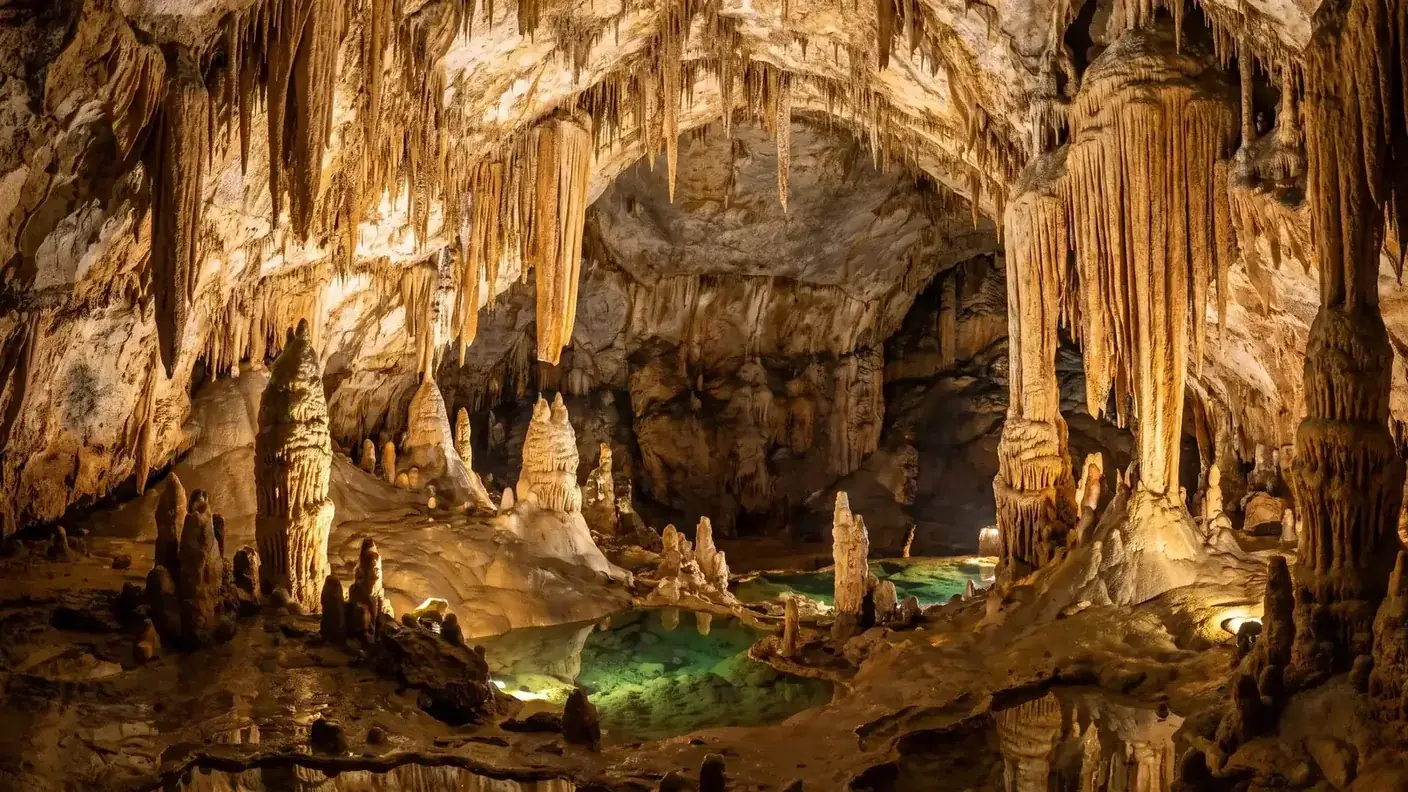
Today's tour: gondola, light show, and power-generating bikes
The image of a “cathedral” comes from the Buguois poet Jean Vézère (1925); the expression “crystal cathedral” became widely used upon the reopening in 1957, when a 112-meter tunnel (broken through on February 28, 1957) replaced the decommissioned elevator—it leads to a 23-metric-ton panoramic platform designed by Raoul Jourde, the Bordeaux architect behind the Bordeaux stadium. The guided tour lasts 60 minutes (14 °C, immersive pre-show, 360° 3D-mapped sound-and-light show—a first in France). The highlight of the experience remains the rotating gondola (modern 2012 version, 11 seats, descent only, additional fee—book several days in advance in August). 2026 Rates: €14.60 for adults, €10.40 for children, gondola €24.70. Details that make all the difference: France’s first cave certified by Tourisme et Handicap, bicycle-generators to produce part of the electricity for your visit, free charging stations in the parking lot—and Claude Chabrol filmed a scene from *Le Boucher* (1969) there, before *Les Fauves* in 2017.
The site’s history, in fact, continued to unfold underground: the triumphant reopening on August 6, 1950 (5,000 visits in one month) came to an abrupt end when the elevator was shut down in 1952; excavations in 1973–1975 removed 400 m³ of debris and unearthed bones, tools, and a box of bronze coins from the time of Francis I, now on display at the site’s museum; and a test pit dug in 1956 did not reach the bottom at a depth of 33 m below the chamber—“it is not impossible that a lake exists,” Casteret speculated. One last tradition to know: dipping your fingers in the petrifying basin brings good luck—young women used to toss a silver coin into it to ensure they would marry within the year. New for 2026: a brasserie and a museum space, “La Grange aux Souvenirs,” narrated by “the voice of Galou.”
Bournat, the Giant Aquarium, Big Bird: the Périgord’s Family Hub
Le Bugue is home to two major family attractions along the Vézère River: the Parc du Bournat, dedicated to the Périgord of 1900, and the Périgord Noir Aquarium. Their 2022 visitor numbers—150,000 at the Bournat and 230,800 for the entire Univerland complex—account for the town’s significance as a tourist destination. [CDT Dordogne 2022]
Le Bournat: A Village from 1900 Built by a Collector
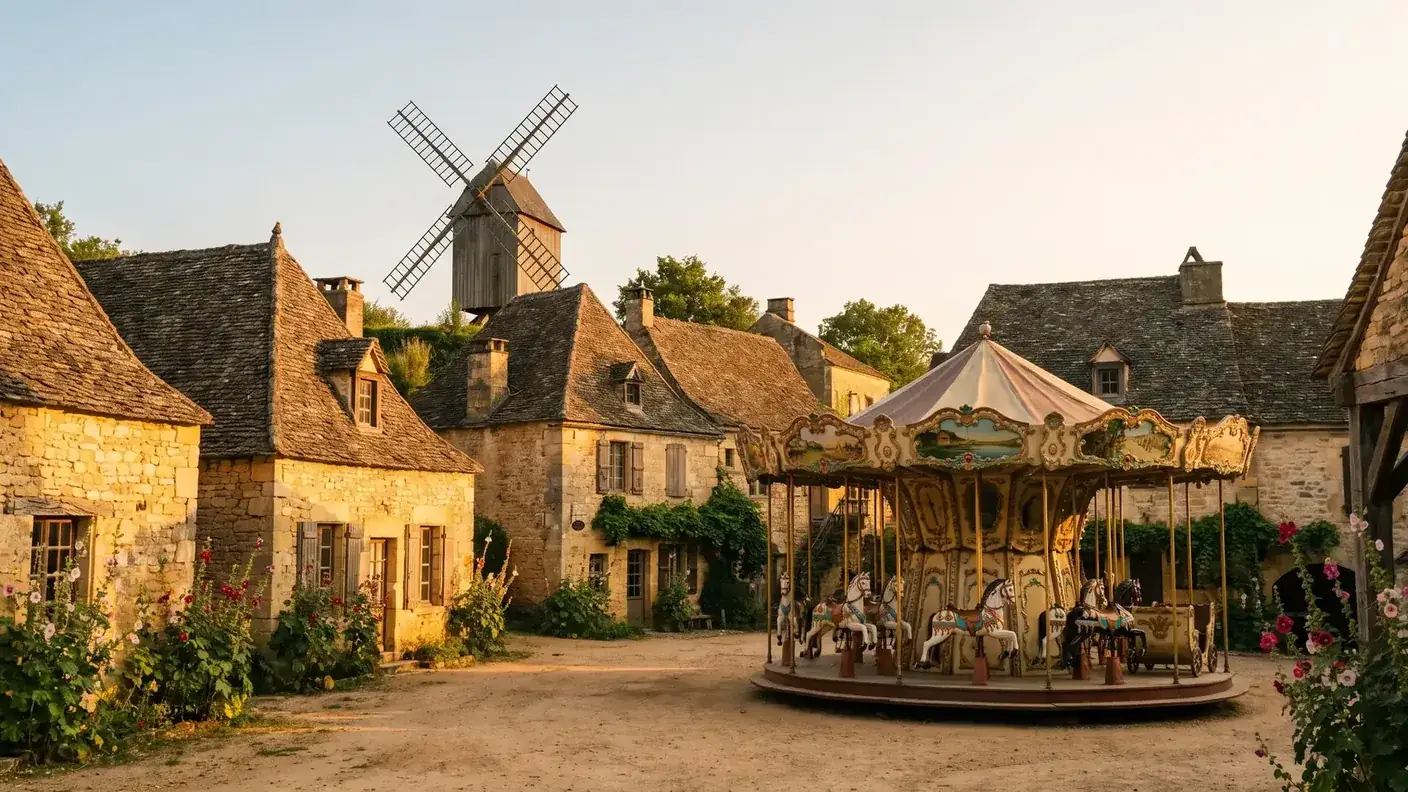
The Bournat Park is the work of a lifetime: that of Paul-Jean Souriau, an industrialist in the electronics industry who fell in love with Le Bugue in the 1960s and had been collecting since he was 18—with 10,000 items to his credit. After two years of construction and 1,000 metric tons of stone transported to the site, his 1900s-era Périgord village opened in July 1992; he was 71 years old at the time. Spanning 8 hectares, the park features a walnut oil mill, a distillery, a fairground organ, horse-drawn carriages—and a 1900-style carnival whose century-old rides (included with admission) are well worth the visit: the caterpillar ride is said to be one of only two remaining in France, and the Ferris wheel comes from a World’s Fair. 150,000 visitors in 2022 (7th most-visited site in the Dordogne)[CDT Dordogne 2022]; his children and grandchildren still run the park. 2026 admission prices: starting at €22.50 for adults, €13.40 for children—second visit free.
The Aquarium: 6,000 fish and an alligator park
Opened on July 11, 1989, the Aquarium du Périgord Noir is today the largest private freshwater aquarium in France (the park even claims to be Europe): more than 6,000 fish, 3 million liters, 4,000 m² — pike, giant catfish, sturgeon. The site has continued to expand: Jungle Golf (2000), Iguana Parc (2009), Alligator Park (2014, 2,000 m² of Louisiana bayous), Prehistoric Labyrinth (2016), and Big Bird (2017), billed as France's first "aerial and urban" acrobatic course—57 obstacles up to 20 meters high. The Univerland complex attracted 230,800 visitors in 2022, the third-largest tourist destination in the Dordogne. [CDT Dordogne 2022] The aquarium alone costs €19.90, or you can purchase multi-attraction passes (33 to 63 €).
Bara-Bahau: a genuine decorated cave one kilometer from the center
Located 1 km from downtown—a three-minute drive or a short walk away—Le Bugue has its own decorated cave, and it’s a unique one: Bara-Bahau, the southernmost of the decorated caves in the Vézère Valley. Its name is an Occitan onomatopoeia meaning “badaboum,” a reference to the collapsed rock blocks in the first chamber. [Bara-Bahau 2026]
The first gallery had been “known since time immemorial”; the story of the discovery of the decorated room, on the other hand, is a charming tale: the April 1, 1951, the renowned speleologist Norbert Casteret explores it with his daughter Maud — the first to recognize the engravings. Father Breuil came to inspect them on August 15 of that year; Father Glory took over in 1955, followed by Brigitte and Gilles Delluc; they were designated a historic monument in 1961. Carved from limestone so soft that André Glory nicknamed it “fromage blanc,” 26 figures engraved about 17,000 years ago (Magdalenian): horses (including one of 2.10 m), aurochs, a bear, a hand, a phallus—mixed in with the cave bear claw marks, which predate the engravings and have earned the site its nickname, “Sanctuary of the Bear.”
Three reasons to go: it's a unique cave (not a facsimile) that poses “no conservation issues,” the 35-minute guided tour costs €8.70 (€6 for children, April–September season), and you’ll have the place to yourselves—about 10,000 visitors a year, a hundred times fewer than at Lascaux. [CDT Dordogne 2022] Unexpected Glory: In March 2021, NASA named a target for analysis by the Curiosity rover on Mars "Bara Bahau", like other French place names. Since 2017, management of the cave has been taken over by the Bournat team—the three flagship sites in Le Bugue are now all part of the same organization. Additional information in town: the Wildlife Center and its collection of about a thousand taxidermied birds and mammals spread over 400 m² (9 rue de la République), a collection originally owned by a family of taxidermists and later acquired by the municipality.
Jean Rey and Bruno, the police chief: Le Bugue’s two heroes
Jean Rey, the man who beat Lavoisier to the punch by 140 years
Born and died in Le Bugue (1583–1645), Jean Rey, a doctor of medicine from Montpellier, conducted experiments in his brother’s forges. His *Essays* of 1630 were the first to explain why tin and lead gain weight during calcination: “a portion of the air combines with the metal”—more than 140 years before Lavoisier’s treatise (1774). Here’s a delightful anecdote: the book was so ahead of its time that Lavoisier admitted to suspecting it was a backdated forgery—and is even said to have had the copies in circulation bought back. Bonus: His letter of January 1, 1632, to Father Mersenne contains the first description of a liquid-filled thermometer. His house can still be seen on Rue du Couvent.
Martin Walker: Le Bugue, the capital of the Périgord crime novel
The other local celebrity is still alive and does his shopping at the Tuesday market. Martin Walker, a Scottish journalist (who spent 28 years at *The Guardian*, working out of the Moscow and then Washington bureaus), has been living between Washington and Le Bugue for a quarter of a century. His crime series *Bruno, Chief of Police* ” (19 novels since 2008, translated into 18 languages, with over 2.5 million copies sold in the German-speaking world alone) is set in “Saint-Denis”—a village modeled after Le Bugue. The ultimate nod: the hero’s name is Bruno Courrèges, after the hamlet of Les Courrèges between Le Bugue and Limeuil. The local winery Julien de Savignac has dedicated a “Bruno” cuvée to him, and Anglo-Saxon tour operators sell “Bruno’s Périgord” tours—the tourist office describes him as “a true ambassador of the Périgord Noir.”
Honorable Mentions: Jean-Léon Dessalles (1803–1878), the archivist who unearthed the 964 document and wrote *The History of Le Bugue*; schoolteacher Jean Lafille, who discovered the Roc de Marsal and the skeleton of a Neanderthal child in Campagne; and Gérard Fayolle, mayor from 1983 to 2008 and a senator, after whom the media library is named. The town’s sporting heart, meanwhile, beats to the rhythm of rugby: the Bugue Athletic Club (1902) was the French third-division champion in 2007, and its school rugby tournament brings together about a thousand young players every June.
Around Le Bugue: Limeuil, Campagne, Cadouin, and the Vézère River
Given its location at a crossroads, Le Bugue extends in three directions: the Vézère Valley upstream, the Dordogne to the south, and the Périgord Pourpre to the west. Road distances verified.
Limeuil (7.5 km / 9 min)
One of the Most Beautiful Villages of France, perched on a hill above the exact confluence of the Vézère and Dordogne rivers, with its two bridges bent at right angles. At the top, the panoramic gardens occupy the site of the former castle—created in 1902 by Dr. Linarès, personal physician to the Sultan of Morocco, and restored since 2007. Don’t miss the Church of Saint-Martin (1194): a church built as an act of atonement for the murder of Thomas Becket, commissioned by Richard the Lionheart—its dedication stone mentions the pope, Philip Augustus, and Richard. In July, the potters’ market (28th edition in 2025).
Campagne (4.1 km / 6 min)
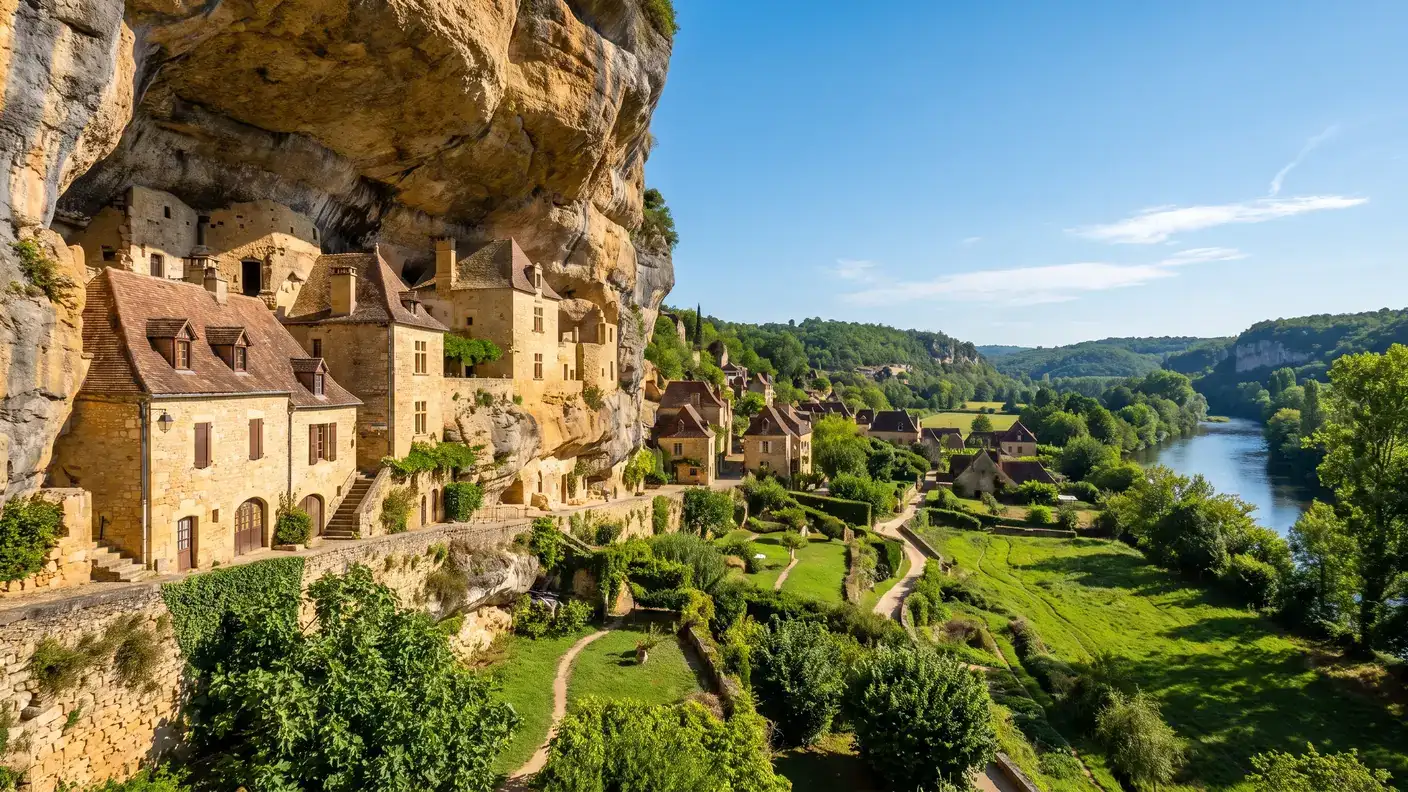
The valley’s garden village: the Château de Campagne (15th–18th centuries), bequeathed to the state in 1970 by the last marquis, belongs to the department—its 6-hectare romantic park, designated a “remarkable garden,” and its 337 hectares of forest are open to the public free of charge. It is also home to the village of Roc de Marsal, where the famous skeleton of a Neanderthal child was discovered.
Les Eyzies (11 km / 14 min)
The “World Capital of Prehistory”: Font-de-Gaume, the National Museum, Cro-Magnon. Our comprehensive guide to Les Eyzies provides details on visitor limits and reservations—the Le Bugue (family-friendly) + Les Eyzies (caves) combo works wonderfully.
Le Buisson and Cadouin Abbey (10–19 km)
To the south, Cadouin Abbey (founded 1115–1119) is listed by UNESCO as part of the Routes of Santiago de Compostela: a Flamboyant Gothic cloister funded by Louis XI, and a story about a relic that’s hard to believe—the “Shroud of Christ,” which attracted pilgrims for eight centuries, turned out in 1934 to be an 11th-century Egyptian Fatimid cloth embroidered with an invocation to the caliph; the bishop canceled the pilgrimage in 1936.
Saint-Cyprien (13.4 km / 17 min)
To round out the market week: every Sunday morning, 150 to 180 vendors in the summer—voted “the most beautiful market in the Périgord” in the 2019 TF1 contest.
On the water and by bike
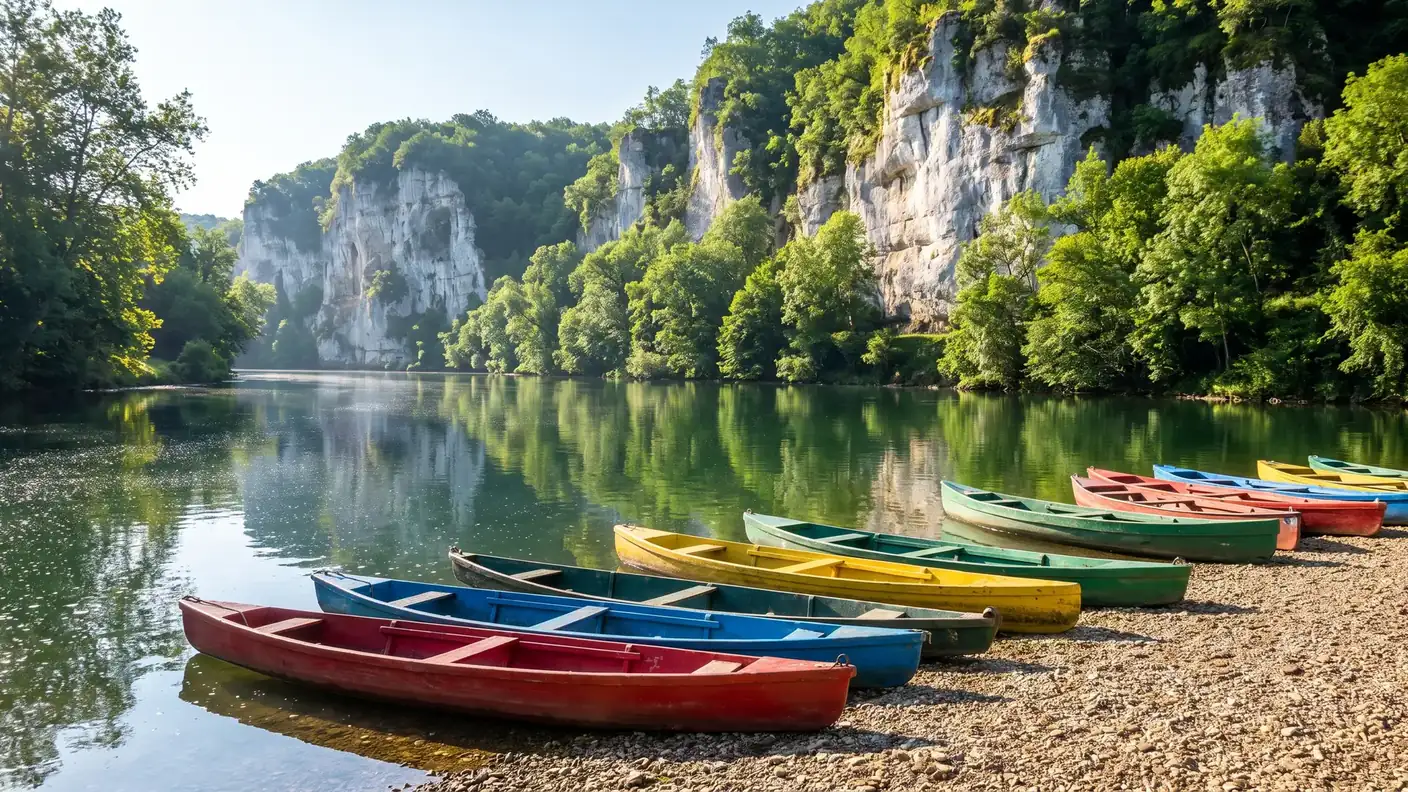
Canoeing is available right from Le Bugue (Canoës du Bournat and other outfitters: routes ranging from 5 to 21 km on the Vézère and Dordogne rivers, for ages 5 and up). For cyclists, the Vézère by Bike route (inaugurated in 2022) offers a safe, family-friendly 23-km section passing through Le Bugue and its Courrèges footbridge—a 60-metric-ton structure spanning the river. On foot, the Cingle Loop (13.8 km) connects Le Bugue to Limeuil via the hills.
| Field Trip | Road | The Argument |
|---|---|---|
| Bara-Bahau | 1 km · 3 min | Original Decorated Cave, €8.70 |
| Campagne | 4.1 km · 6 min | Castle + free park designated a “remarkable garden” |
| Proumeyssac (Audrix) | 4.3 km · 7 min | The Crystal Cathedral, Gondola |
| Limeuil | 7.5 km · 9 min | Most Beautiful Village, river confluence, gardens |
| Le Buisson-de-Cadouin | 9.7 km · 11 min | Pivot Station, abbey 19 km away |
| Les Eyzies | 11 km · 14 min | Capital of Prehistory |
| Saint-Cyprien | 13.4 km · 17 min | The Sunday Market |
| Sarlat-la-Canéda | 30.7 km · 33 min | Capital of the Périgord Noir |
| Lascaux IV (Montignac) | 35.5 km · 39 min | Complete facsimile |
When to Visit: Experience a Tuesday, Avoid the Pitfalls
| Period | Crowd | For | Against |
|---|---|---|---|
| April–June | Moderate | Flower Fair, parks open (starting April 4), Vézère Verte | A Few Busy Weekends |
| July–August | Maximum | Tuesday Night Gourmet Market, Canoeing, Bournat Night Tours | Busy downtown on Tuesday and Saturday; gondola reservations required |
| September | Moderate | Golden Light: Sites Open Through the End of September | Gradual closures beginning in October |
| October–March | Minimum | Authentic Tuesday Market: Porcini Mushrooms and Truffles | Bournat, Bara-Bahau, and Proumeyssac are operating at reduced capacity or are closed |
The local calendar is full of character: the Flower Fair on a spring Sunday (34th edition in 2025), the BriKaBrak children’s festival at Pentecost (23rd edition in 2026), and above all Noir Vézère in July—a crime fiction festival, of course, in Bruno’s homeland. On the third weekend of August, the Saint-Louis festivities (fair, yard sales, fireworks) commemorate the legendary stop made by the Crusader king. The best strategy: plan your stay for a Tuesday—the historic market in the morning, the gourmet market in the evening during the summer.
From Bordeaux: 172 km to the Tuesday market
Le Bugue is about 172 km from Bordeaux—roughly 2 hours and 15 minutes via the A89 and then through the valley. Ignore the “119 km” figure you’ll find on some websites: that’s as the crow flies. And keep in mind: the Bugue train station does exist, but it’s a stop without a ticket window, located 2 km from the town center, with no direct trains from Bordeaux.
| Mode of travel | Duration | Estimated cost | Details |
|---|---|---|---|
| Car | ~2 hours and 15 minutes | 35–45 € (gas + tolls) | A89, then D710 via Le Buisson or D47 |
| Chauffeured transfer | ~2 hours and 15 minutes | Starting at 292 € · one-way | Door-to-door, with stops along the way |
| Train (TER) | ~2.5–3 hours | ~25 € | Bordeaux → Le Buisson (Sarlat line), then transfer — 1 stop |
| Airplane | — | — | Bergerac Airport, 45.6 km away (~50 min) |
By train: the Buisson connection
The train route passes through Le Buisson Station (9.7 km from Le Bugue), a junction station since 1879 where the Bordeaux-Sarlat and Périgueux-Agen TER trains meet: one more stop and you’ll arrive at the Le Bugue station—opened in 1863, with a an unstaffed halt with open platform access. Allow 2½ to 3 hours depending on your connection, followed by a 25-minute walk (or a taxi ride) to the town center. Direct TER trains also connect Périgueux to Le Bugue in about 35 minutes. [SNCF TER 2026]
By private chauffeur: door-to-door service
The direct trip from Bordeaux to Le Bugue by sedan costs 292 € one way (1–3 passengers, fixed price confirmed in writing). The benefits are clear: you’ll arrive right at your accommodation, even on market days (the driver knows the best routes to avoid traffic), with flexible stops along the way—such as Saint-Émilion and Limeuil—and easy access to the valley’s attractions. Request a quote: written response within 30 minutes, 8-passenger van available, English-speaking driver.
Practical Information: Getting Organized in Le Bugue
How much time should I set aside?
One day is enough for the market (if it’s Tuesday) + Proumeyssac + Bara-Bahau. Two days allow you to add Le Bournat or the aquarium and Limeuil. For a family base camp, 3 to 5 days cover the parks, canoeing, Les Eyzies, and Sarlat—it’s one of the few towns in the valley where children have their own program.
Sleeping, Eating, Getting Supplied
The town offers everything you’d expect from a true town center: hotels and bed-and-breakfasts in town, campgrounds along the Vézère River (Le Rocher de la Granelle at the foot of the Cingle, the Bournat campground across from the park), and all your shopping needs right on site — Le Bugue even has its own hypermarket, one of the area’s largest employers. When it comes to dining, look for market produce: walnuts, Périgord strawberries, porcini mushrooms in season, and the “Bruno” vintage from the Julien de Savignac winery to take home as a souvenir.
| Profile | Daily budget (excluding transportation) | The Program |
|---|---|---|
| Small budget | ≈ 45-65 € | Camping, Tuesday market, Bara-Bahau (€8.70), Free visit to Campagne, Cingle Loop |
| Comfort | ≈ 110-160 € | Bed and Breakfast, Proumeyssac + gondola ride, canoeing, dinner in town |
| Family | ≈ 150-220 € | Bournat OR Univerland Pass, Tuesday Night Food Market, Limeuil |
Good to Know
- Tuesday and Saturday mornings: Do not drive through the town center (this warning comes from Proumeyssac’s official website) — park on the outskirts and walk.
- Reservations: For the Proumeyssac gondola, book several days in advance in August; the rest of the time, it’s no problem.
- Electric vehicle charging: Free 7-kW charging stations at the Proumeyssac parking lot.
- Accessibility: Proumeyssac is the first cave in France to receive the “Tourisme et Handicap” certification; Bara-Bahau, on the other hand, is not wheelchair-accessible.
- Season: Bournat and Bara-Bahau are open from April 4 through the end of September; Proumeyssac is closed in January.
Frequently Asked Questions
Where does the name "Le Bugue" come from?
From the Gaulish *albuca, “white marly stone,” attested as early as 856 (“centena Albucense”). The name became Albuga in Occitan but underwent a “misinterpretation”: Al Buga was understood to mean “at the Bugue”—hence “Le Bugue.” In Occitan, the town is still called Al Buga, and Albi shares the same root.
On which days is the market in Le Bugue held?
The main market is held on Tuesday mornings. The tradition of holding it on Tuesdays dates back to a royal decree issued by Philip V the Long in November 1319; the current market continues this tradition. In addition, there is a farmers’ market on Saturday mornings and, in July and August, a gourmet market on Tuesday evenings along the banks of the Vézère River.
Why does the market date back to 1319?
Because the market was held “sometimes on one day, sometimes on another”: at the request of Pierre de Galard, Baron of Limeuil and Master of the Crossbowmen of France, King Philip V the Long established it “perpetually” on Tuesdays by a sealed decree. The 700th anniversary was celebrated in November 2019, and a ceramic plaque reproducing the charter is displayed beneath the market hall.
Is the Proumeyssac Chasm in Le Bugue?
Almost: It’s located in the neighboring town of Audrix, 4.3 km (7 min) from the center of Le Bugue—it’s the town’s signature attraction. Allow 60 minutes for the guided tour; €14.60 (2026); 14°C year-round. For the ride in the rotating gondola (€24.70, 11 seats), be sure to book several days in advance during August.
Is the Bara-Bahau Cave worth a visit?
Yes—it’s an original decorated cave (not a replica) located 1 km from the center: 26 Magdalenian engravings dating back ~17,000 years, including a 2.10-meter-long horse, intermingled with cave bear scratch marks. Guided tour: 35 min, €8.70, only ~10,000 visitors per year. NASA even named a site on Mars “Bara Bahau” in 2021.
What can you do in Le Bugue with kids?
It’s THE family destination in the Périgord Noir (about 380,000 visitors per year): the 1900s-themed village of Le Bournat with its century-old rides, the giant aquarium with Alligator Park, the Big Bird adventure course, the Prehistoric Maze, canoeing for kids ages 5 and up, and the 23-km family bike trail. On rainy days: Proumeyssac and Go Kids Park (Journiac, 7 km).
Is this where the "Bruno, Chief of Police" novels take place?
Yes: Martin Walker’s “Saint-Denis” is modeled after Le Bugue, where the Scottish author lives part of the year. The series (19 novels, 18 languages) even has local roots: Bruno’s last name is Courrèges, after the nearby hamlet, and the Julien de Savignac winery has dedicated a vintage to him. You can run into the author at the Tuesday market.
Who was Jean Rey?
A physician and chemist who was born and died in Le Bugue (1583–1645) and who, in his *Essays* of 1630, explained the increase in weight of calcined metals as a result of their combination with air—140 years before Lavoisier. He also described one of the first liquid-filled thermometers (1632). His house can still be seen on Rue du Couvent.
Is Limeuil close to Le Bugue?
7.5 km by road (9 minutes): one of the Most Beautiful Villages of France, perched above the confluence of the Vézère and Dordogne rivers, with its panoramic gardens and its church dating from 1194, built as penance for the murder of Thomas Becket. In the summer, you can even paddle down to it by canoe from Le Bugue.
Can you get to Le Bugue by train from Bordeaux?
Yes, with a transfer at Le Buisson station (Bordeaux-Sarlat line, then one stop toward Le Bugue): allow 2.5 to 3 hours. Please note: the Bugue stop has no ticket window and is 2 km from the center (~25 min on foot). Direct TER trains also connect to Périgueux in ~35 min.
How much does an executive car service cost from Bordeaux to Le Bugue?
Starting at 292 € one-way in a sedan (1–3 passengers), approximately 2 hours and 15 minutes door-to-door, fixed price confirmed in writing before booking. 8-passenger van available, with flexible stops along the way (Saint-Émilion, Limeuil), and day trips to the Vézère Valley available upon request.
When is the best time to visit Le Bugue?
May–June and September are the best times to visit for a peaceful experience, with all sites open. In the summer, there’s also the gourmet market on Tuesday evenings and canoeing—but be sure to book the Proumeyssac gondola. A golden rule for any time of year: plan your visit for a Tuesday, when the 700-Year Market is held.
Is Le Bugue a good base for exploring the Périgord Noir?
Excellent, especially for families: a fully equipped town (shops, market, hypermarket), campgrounds along the Vézère River, and everything within easy reach—Proumeyssac 7 min away, Les Eyzies 14 minutes, Limeuil 9 minutes, Sarlat 33 minutes, Lascaux 39 minutes. Le Bugue is a convenient base thanks to its shops, market, accommodations, and road connections to Limeuil, Les Eyzies, Sarlat, and Lascaux.
Further Reading
- The Capital of Prehistory, 14 minutes away: see the Guide to Les Eyzies (Font-de-Gaume, Cro-Magnon)
- Across the river from Proumeyssac: See the Coux-et-Bigaroque Guide (beach, canoeing)
- The capital of the Périgord Noir: see the Sarlat Guide
- The world's most famous cave: see the Lascaux Guide
- Plan your trip: Book a private chauffeur from Bordeaux to Le Bugue or explore all our destinations
Sources and References
- Le Bugue City Hall — Le Bugue Then and Now — Market Held on Tuesdays Since 1319
- Proumeyssac Cave — Official History — Discovery and Development
- Dordogne Departmental Tourism Committee — 2022 Report — Site Visitor Numbers
- Bournat Park — The Origins — The Park's Official History
- Périgord Noir Aquarium — Official Website — Facilities and Visits
- Bara-Bahau Cave — Official Website — Decorated Cave and Tours
- Le Bugue City Hall — Weekly Markets — Tuesday and Saturday
- Le Bugue City Hall — Insights into Le Bugue — Municipal Heritage
- INSEE — 2023 Reference Population for Le Bugue — Municipal Population
- Lascaux-Dordogne Vézère Valley Tourist Office — Tours and the Region
- Le Bugue City Hall — SNCF TER Nouvelle-Aquitaine — Rail Access
Article updated in July 2026.
Off to the market town
Direct trip from Bordeaux (~2 hours 15 minutes), with stops along the way as desired—Saint-Émilion, Limeuil. Written fixed-price quote within 30 minutes; sedan or 8-passenger van; English-speaking driver.