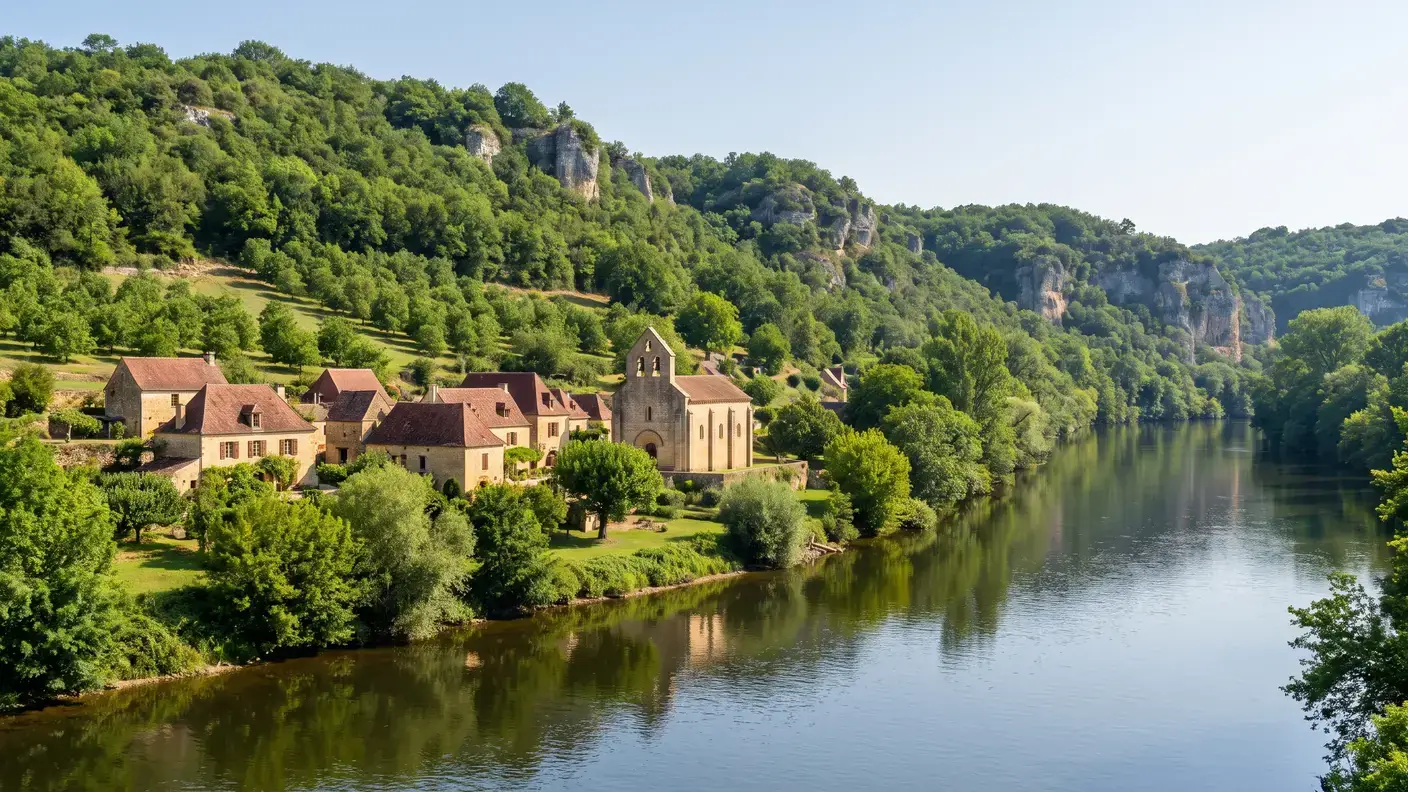
Coux-et-Bigaroque: Three Villages in One
The town with three villages: Mouzens, the Visigoth settlement; Coux, the river toll station; and Bigaroque, the castrum purchased by the future Pope Clement V—plus a lifeguard-patrolled beach, a clever canoe route where all trips end in the village, and Proumeyssac, Le Bugue, and Belvès as neighbors. Get the full picture before you come—it’s about 2 hours and 20 minutes from Bordeaux.
In a nutshell
- Coux-et-Bigaroque-Mouzens is not a single village but three, brought together through two mergers: a royal decree of 1825 (Coux + Bigaroque) and the creation of a new municipality on January 1, 2016 (+ Mouzens).
- 1,244 residents (2023) — the Couzensois, a portmanteau demonym chosen by the residents in 2021, combining “Couxois” and “Mouzensois.”
- An inventory from the Gironde Departmental Archives dates back to 1304 and lists lands in Bigarroque as part of the possessions of the Archdiocese of Bordeaux, which was then led by Bertrand de Got, the future Clement V.
- Before him, the castellany had as its suzerains Richard the Lionheart and his retainer Mercadier—and then the archbishops of Bordeaux held it until 1789.
- The town borders the Dordogne River but has no road bridge within its boundaries; it still has a lifeguard-patrolled beach, a canoe center, and the memory of the Old ferry boats from Bigaroque and Port-Muzard.
- The only historic monument is Monsec Castle (Mouzens), which has been in the same family since 1610—but the churches house 44 listed or registered artifacts, including two 17th-century altarpieces.
- Less than 15 minutes away: the Proumeyssac Cave, Le Bugue and its “perpetual” market dating back to 1319, Belvès, Saint-Cyprien, and Limeuil.
- The Siorac train station, 3.7 km away, is on the Bordeaux–Sarlat TER line—a rare luxury for a village of this size.
- It's about 184 km and roughly 2 hours and 20 minutes from Bordeaux, through the Dordogne Valley.
Before You Go: What Coux Is Really Like
In the summer, Coux Beach offers swimming, canoeing, and an open-air café along the banks of the Dordogne. Lifeguard coverage and activity schedules vary by season: check with city hall and the service providers before you visit. This peaceful setting contrasts with the site’s former role as a tax collection point, long associated with the lands of the archbishops of Bordeaux.
Coux-et-Bigaroque-Mouzens is a “nested” municipality: three villages, each with its own history. Mouzens, the estate of the Visigothic chieftain Mozo; Coux, the river toll station and its watchtower; Bigaroque, the castrum “said to be impregnable” that guarded the right bank of the Dordogne. The local government merged them in two stages, in 1825 and then in 2016—though history had linked them since the Middle Ages.
It’s also the most low-key destination in this guide: no fortress for €12.50, no lines—just a beach, canoes, two churches with carved bestiaries, a movie-worthy castle you can admire from the road, and the best base camp imaginable between Le Bugue, Belvès, and Saint-Cyprien.
This guide covers everything in order—the mergers, Bigaroque and its pope, Coux and its toll, Mouzens and its castle, the river and the surrounding area—as well as practical information, including how to get there from Bordeaux by car, by train via Siorac, or with a private chauffeur.
Coux-et-Bigaroque-Mouzens at a Glance
The town stretches between the Dordogne River—opposite Allas-les-Mines and Berbiguières—and the foothills of the Bessède Forest. To cross the river by road, the route leads to the bridge at Siorac-en-Périgord; the Departmental Archives also preserve records of the former ferries at Bigaroque and Port-Muzard.
| Data | Value |
|---|---|
| Official Name | Coux and Bigaroque-Mouzens (INSEE spelling) |
| Status | New municipality (January 1, 2016), Dordogne (24), Périgord Noir |
| Population | 1,244 residents (2023) — the Couzensois |
| Area | 27.47 km² (population density ~45 people/km²) |
| Elevation | 45 m to 245 m |
| Banks of the Dordogne | right bank — with no road bridge in the town |
| Le Bugue | ≈ 12.5 km (15 min) |
| Sarlat-la-Canéda | ≈ 31 km (~30 min) |
| Distance from Bordeaux | ≈ 184 km (~2 hours and 20 minutes through the valley) |
The demographic data reveal three trends: Mouzens peaked at 785 residents in 1726 (barely 150 in the 14th century, when the “swampy” valley drove people away); Bigaroque was nothing more than a hamlet of 117 people at the time of its last municipal census (1821); and the combined population has been rising steadily since the merger—up 1.97% between 2017 and 2023.
Two key features define the region’s terroir: the bedrock is a limestone plateau whose oldest outcrops date back to the Upper Jurassic (Kimmeridgian–Tithonian), and 100% of the territory is covered by the UNESCO Dordogne Basin Biosphere Reserve—which includes two Natura 2000 sites, four designated sites, and 26 km of waterways. Mild oceanic climate (average temperature of 13.3 °C, ~870 mm of rainfall per year): life in the valley revolves around the outdoors for much of the year.
1825, 2016: How Three Villages Became One Municipality
The Ordinance of 1825
The Dordogne Departmental Archives, accessed in July 2026, indicate that Coux and Bigaroque were merged on September 23, 1825. This first merger created Coux-et-Bigaroque; the current municipality is the result of a second merger with Mouzens, which took effect on 1st January 2016.
The New Municipality of 2016
Second step, 191 years later: the decree of December 21, 2015 (No. PREF/DDL/2015/0229) established the new municipality of Coux and Bigaroque-Mouzens effective January 1, 2016, by incorporating Mouzens—972 residents on one side, 238 on the other (according to the official population figures in effect at the time). The transition had its share of quirks: an oversized municipal council of 26 elected officials, with the two former municipalities designated as “delegated municipalities” until their dissolution on January 1, 2020.
All that remained was to name the inhabitants. In February 2021, after consultation, the city council approved "Couzensois" — a portmanteau combining the Couxois and the Mouzensois, a lovely metaphor for the municipality itself. The seat of the municipality, however, remained in the village of Le Coux, at the intersection of Departmental Roads 51 and 703; the first mayor of the new municipality was Michel Rafalovic, who was succeeded in 2020 by farmer Jean-Louis Chazelas.
| Date | Step |
|---|---|
| Middle Ages | Three parishes: Le Coux, Bigaroque, Mozens (first mentioned in 1333) |
| September 23, 1825 | Royal Decree: Coux + Bigaroque = Coux-et-Bigaroque |
| December 21, 2015 | Prefectural Decree Merging Mouzens |
| January 1, 2016 | The Creation of the New Municipality (1,210 “official” residents) |
| January 1, 2020 | Elimination of Delegated Municipalities |
| February 2021 | The residents become known as the people of Couzens |
To wrap up, here’s a bit of trivia about longevity: The first mayor of Mouzens, Jean-Baptiste de Touchebœuf-Lafage, son of the lord of Monsec, was elected in 1793 at the age of 20… and remained in office for 60 years, until his death in 1854. Mouzens’ status as a delegated municipality, on the other hand, lasted only four years.
Bigaroque: The Castrum That a Future Pope Bought for Bordeaux
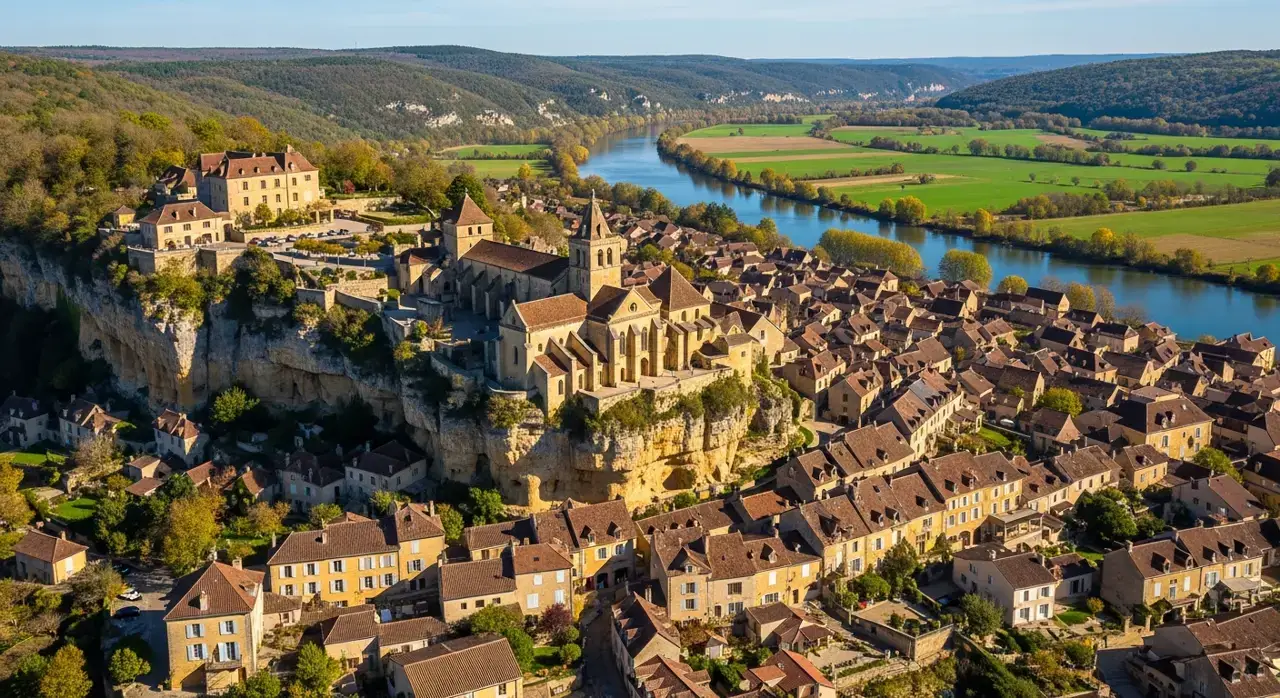
This is the most astonishing story in the town—and it’s often left out of guidebook drafts. Bigaroque (in Occitan, Bigaròca, “the village on the rock” according to the tourist office, castrum of Bigarupe in Latin texts) marked the end of the right bank of the Dordogne—“like Beynac, with which it shared the same lord as early as the 11th century,” according to the town. A 16th-century cartulary describes it in detail: two towers, a well, a barbican gate, a Saint-Blaise chapel, and about 160 households—700 inhabitants—at the end of the 14th century.
1304: Bigaroque in the lands of the archdiocese
An analytical inventory of the Gironde Departmental Archives, consulted in July 2026, lists lands in Bigarroque among the archdiocese’s possessions during the pastoral visit conducted in 1304 by Bertrand de Got. He was elected pope in June 1305 under the name Clement V. The archival summary alone does not allow us to determine a precise date for the purchase of the castrum.
The archbishops of Bordeaux retained the castellany until 1789—with a spectacular homage ceremony established by a charter from 1333: at each inauguration, the prior of Saint-Cyprien would place the key to his highest tower on the altar, after which the archbishop’s men would climb to the top and shout “Bordeaux!” three times and “Bigarupe!” three times.”—the first such homage paid by Prior Hugo as early as 1307. As late as 1609, the archbishop was still paying homage to the king for Belvès, Bigaroque, Couze, Mauzac, and Milhac. The castellany comprised about ten parishes and extended its rights as far as the Abbey of Cadouin, the Monastery of Saint-Cyprien, Siorac, and Campagne.
The area was contested even before the Hundred Years' War: the June 8, 1312, a truce requires Hélie d'Estissac, “English captain of Bigaroque”, to return the square to the archbishop. And the auctions of the port’s revenues were held—in a nod to the head of the church—around St. John the Baptist's Day.
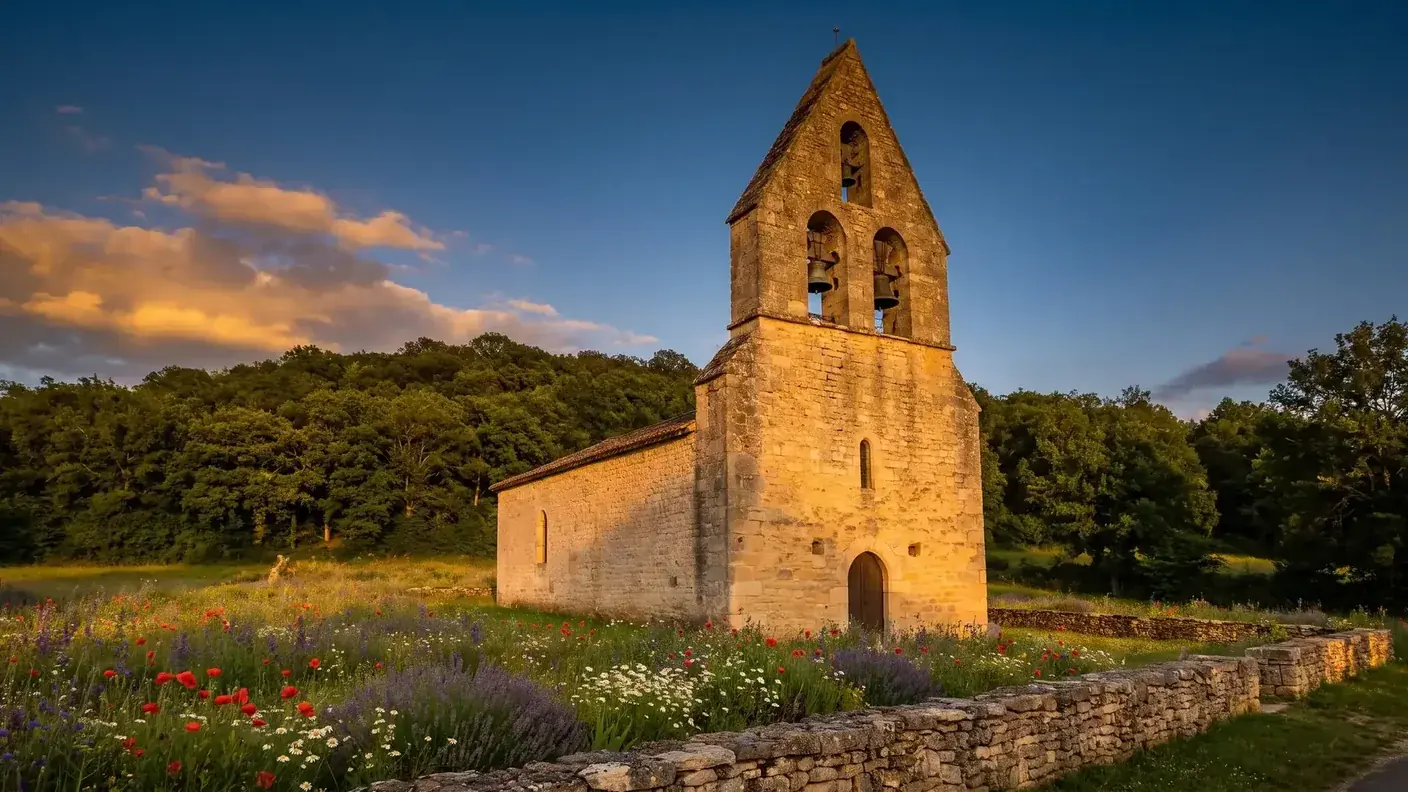
"Unassailable" — so it was bought out, then demolished
During the Hundred Years' War, the fortress held out against the English “without being attacked or besieged, because it was considered impregnable " (Tarde). In 1393, the three departments of the Périgord, meeting in Sarlat, therefore preferred to buy off its garrison. Recaptured by the English in 1407—under Captain Guiraud del Peyrounenq—and besieged by the Constable of France in 1409, it was dismantled for the last time in 1415 — the archbishop’s archives “stolen, lost, and scattered.” The toll is staggering: from 160 bundles in 1307 to 18 "very poor" fires in 1415, and a castellany that had been “uninhabited for thirty years or more.” Reused during the Wars of Religion, the site was reportedly razed once and for all in 1625 (according to the municipality).
Today, all that remains is the hamlet, a few sections of thick walls—first noted as early as 1910—on the plateau, the Pope’s Church—whose 12th-century stone altar is said to have come from the now-vanished Saint-Blaise Chapel—and protected status as a listed site since January 25, 1944. One final accounting detail: in 1337, the tithe of wheat from Bigaroque amounted to exactly 430 setiers, with oats making up the bulk of the harvest. The archbishops certainly knew how to keep their accounts.
Coux: The River Toll and the Barn That Kept Watch Over Everything
Le Coux—Lo Cos in Occitan—drew its livelihood from the river. The territory fell under the jurisdiction of the castellany of Bigaroque, whose suzerains epitomize a century of momentous history: Richard the Lionheart, who died at Châlus in 1199; his captain of mercenaries, Mercadier, assassinated in Bordeaux on Easter Monday, 1200; then Martin Algai, a Navarrese mercenary who became seneschal of Gascony and Périgord on December 4, 1202— “We value Martin Algais’s service more than that of any other person,” wrote John Lackland, who had even ransomed him after his capture by the troops of Philip Augustus. It was a mistake for him to betray his lord: after fleeing the battlefield at Saint-Martin-Lalande (1211) and joining the Toulouse camp, Simon de Montfort captured him at the siege of Biron (July 1212), had him dragged by a horse through the army, and then hanged him.
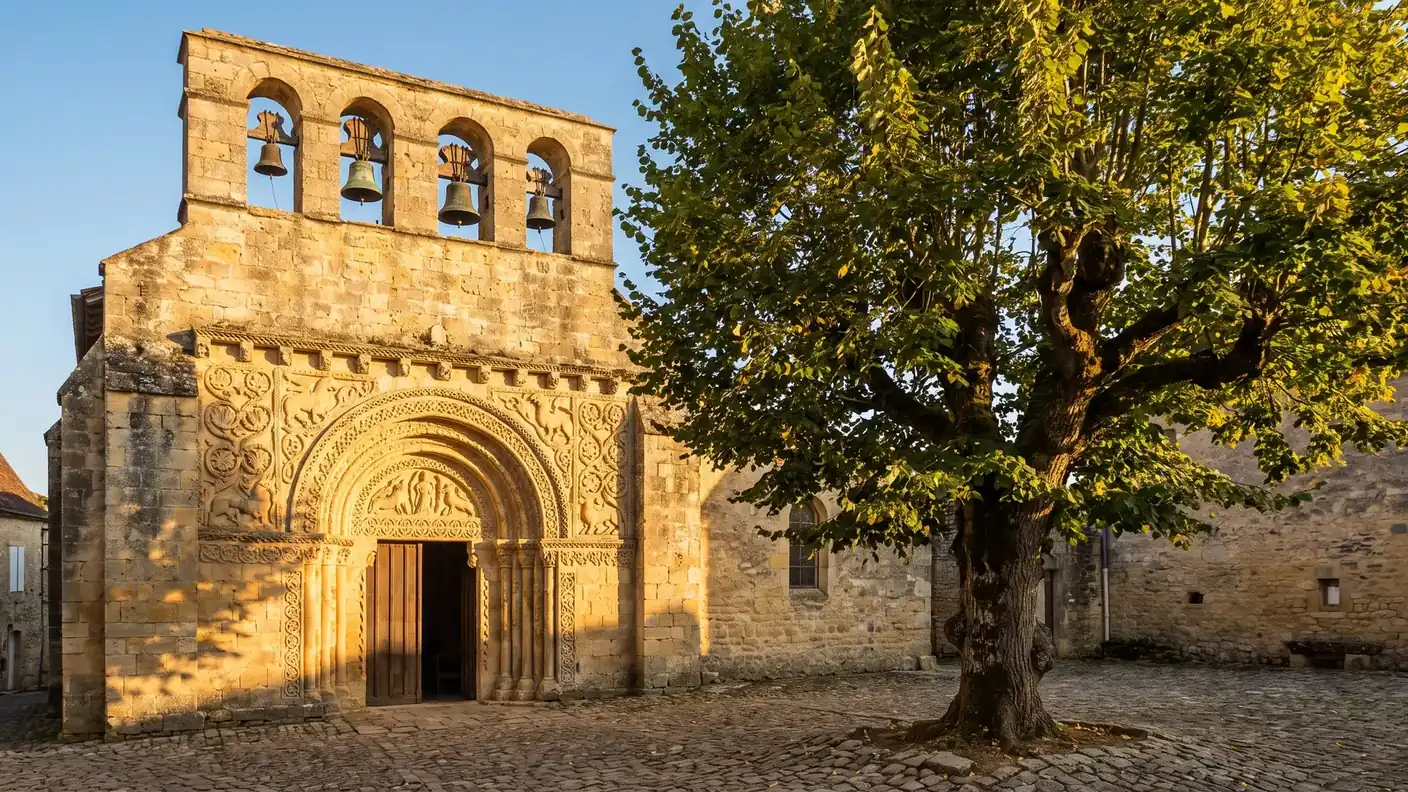
Saint-Martin and Its Bestiary
The Church Saint Martin is worth a stop for its late 12th-century façade and its carved bestiary delicious: a siren, a acrobat, a musician playing the viola — and, at the keystone, a man who pulls his beard with both hands. A bell tower with four windows, restored in 1782 and 1844; a bell tower with a gallery was added in 1888. Inside, a 17th-century altarpiece from Fongauffier Abbey, which is listed as a Historic Monument—the church itself is not listed, but it houses part of the 44 protected objects from the town, all the way to a 20th-century “Swiss costume.”
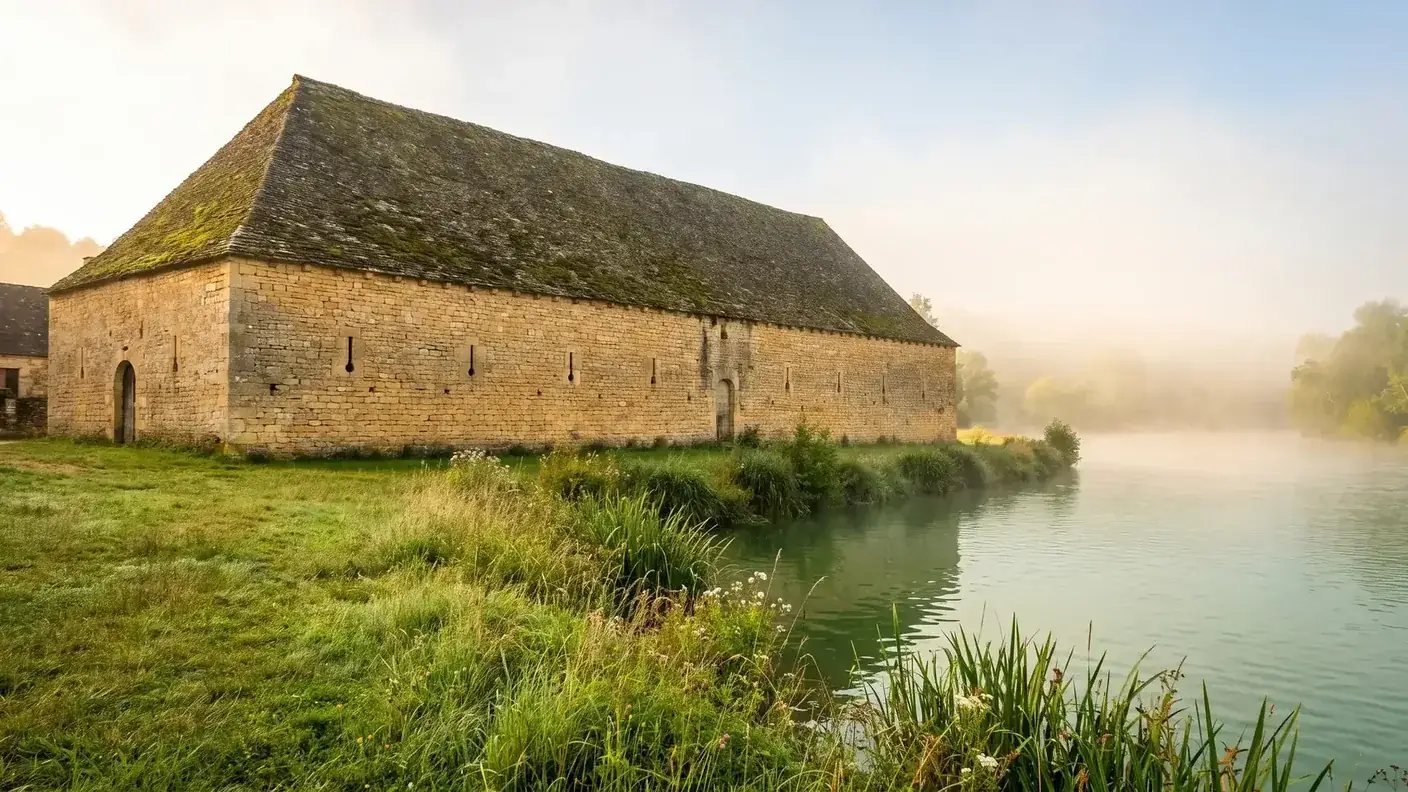
The tithe barn, customs house of the Dordogne
On the waterfront, in the hamlet of Bigaroque, the "tithe barn" — a half-timbered building with a turret — served as a storehouse and dormitory for land and river customs officials: monitoring traffic, relaying signals, and assisting boatmen. The collection of the tithe itself remains hypothetical, local historians caution—but the toll is certain: the port of Bigaroque, “by land and by water,” was leased out 200 pounds per year. On the way down, the cargo consisted of oak staves, wine, wheat, millstones, walnut oil, hides, and chestnuts; on the way up, salt and salted fish.
Two interesting facts to wrap up: in 1891, a Gallo-Roman villa was unearthed near the church (mosaics, bronze artifacts—now in the Périgueux Museum); and the Dordogne River literally changed course—ancient riverbanks discovered near the church prove that the village once stood on the water’s edge, before the river shifted its course. Even older: the Eybral burial cave yielded Neolithic skulls bearing traces of trepanation… that was successful—the nearby plateau yielded polished axes, arrowheads, and pebbles used as weights for fishing nets. And in Saint-Georges, the remains of an open-air Gallic forge that is believed to have operated until the 13th century: thirty centuries of human activity documented within a single municipality.
Mouzens: The Visigoth, the Movie Castle, and the Kiwis
The third village owes its name to Mozo, the chieftain of a Visigothic tribe that occupied Aquitaine in the 4th and 5th centuries. The parish first appears in 1333 (“Mozens”); in 1365, it had 27 and a half households—150 people living on the hillsides, as the valley was “marshy and unsafe.” Its peak population was long ago: 785 inhabitants in 1726.
Notre-Dame-de-l'Assomption: Louise, Marie, and a Listed Altarpiece
The Church of Notre-Dame-de-l'Assomption (with a 12th-century choir) houses the village’s treasure: a monumental 17th-century altarpiece—5 meters by 4 meters, made of polychrome wood painted to look like gold—originally from the Benedictine convent of Fongauffier, acquired during the Revolution and designated a Historic Monument in 1980. In 1618, François de Sourdis, Cardinal-Archbishop of Bordeaux, granted the family of the château the right to a family pew and a funeral banner—the black ribbon was still visible at the beginning of this century. And since 1901, the two bells, Louise and Marie, have rung every day at 7 a.m., noon, and 7 p.m.: the smaller one strikes three sets of three chimes, while the larger one rings out in a full peal.
Monsec, the Viking-proof fortress that became a movie set
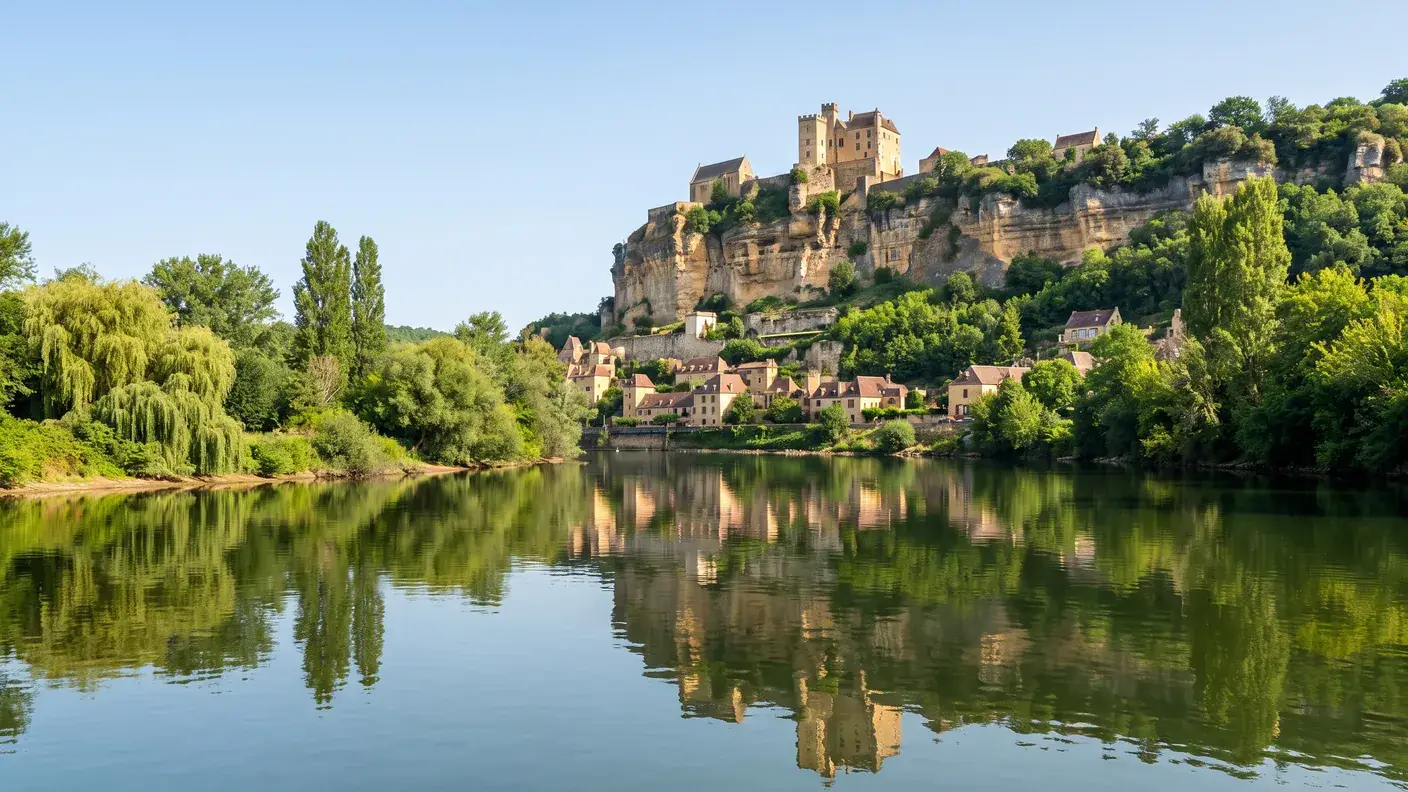
Perched on its promontory, the Monsec Castle — built on the foundations of a Gallo-Roman oppidum — once guarded the river against intruders: the Vikings had burned Saint-Cyprien in the 9th century. Known as early as the 14th century and rebuilt from the 15th to the 19th century, it has remained in the same family since 1610, the year Anne de Feletz married François de Clermont. It is the only historic monument of the town (listed in 2005, up to its “Tour de la Vierge”)—and a movie set: Léon Poirier filmed there Jeannou in 1943. Private property: you can admire it from the road. Among its cataloged treasures is a chocolate pot listed as a Historic Monument—perhaps the most stylish everyday object in the Périgord.
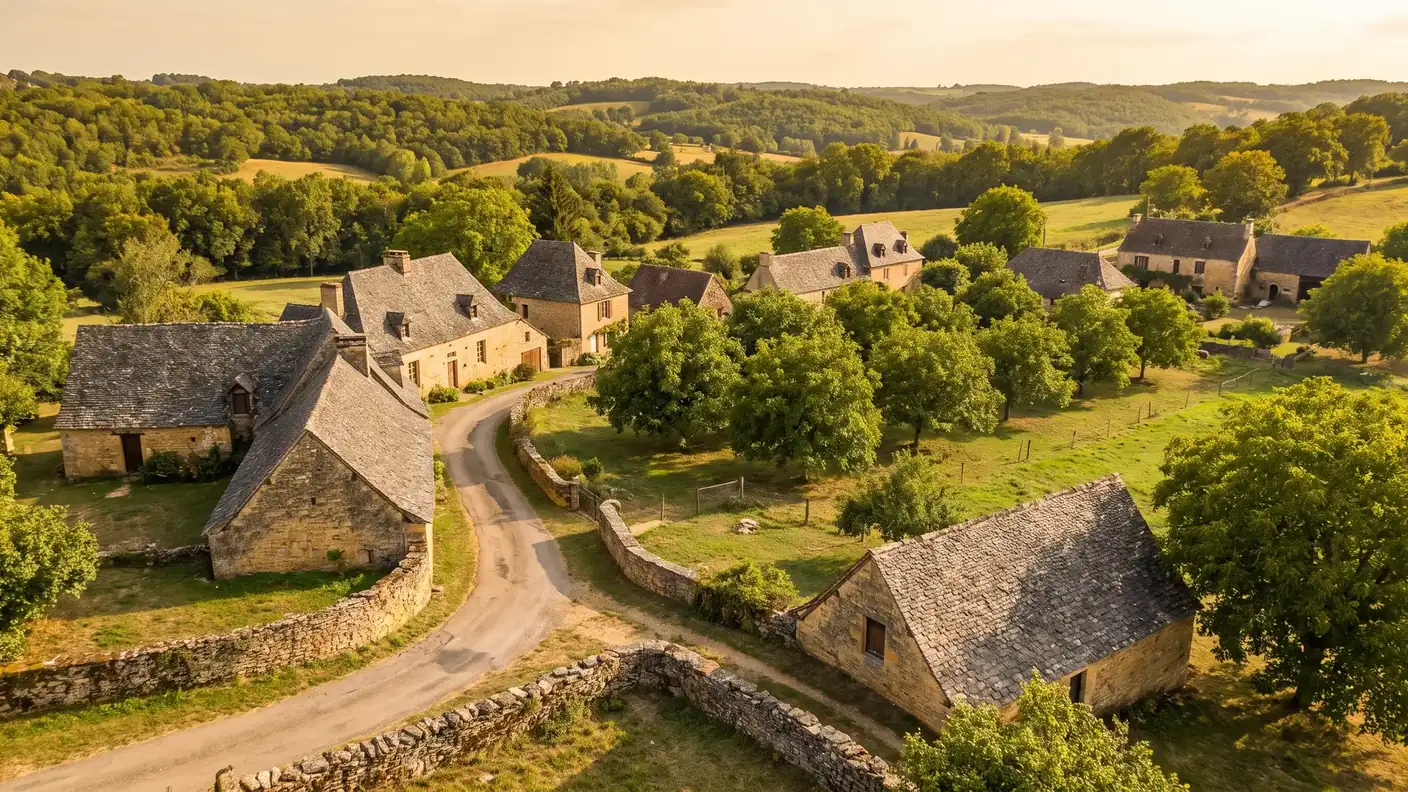
Today, walnuts are grown on the Mouzens floodplain… and the kiwi, which is gaining ground over corn and tobacco—an unexpected twist on the foie gras-truffle cliché. The village also has its own notable figures: Doctor Boissel (1872–1939), a poet who wrote in the Sarladais dialect of Occitan; Pigeon de la Grange, one of the sixty delegates from the Sarlat district to the Fête de la Fédération, on July 14, 1790, in Paris; and a house so typical of the Périgord region, on Place du Docteur-Boissel, that a scale model of it is displayed at the Museum of Folk Art in Strasbourg. Seven members of the Feletz and Clermont-Touchebœuf families, who were buried before 1774, rest in the church's crypt.
What the municipality keeps in reserve
Guide’s note: None of the three churches is listed as a Historic Monument—the only building with that status is Monsec. But the inventory holds some surprises: 44 protected movable objects (altarpieces, a vermeil chalice and paten, an 18th-century pulpit, chasubles…), a little-known record for a town of 1,244 residents.
In the 17th century, the region was home to some twenty noble estates—Salibourne, Le Suquet, La Pomarède, Les Bretoux, Les Constancies, the Milhale Charterhouse… Jean-Baptiste Charles d’Abzac (1754–1794), an officer in the American War of Independence who was guillotined in Agen as an émigré in 1794, was born at the Château de Cazenac. All of these estates are privately owned.
Add the small-scale heritage sites—washhouses, fountains, bread ovens, dry-stone huts, dovecotes, the Bigaroque Fishery and the Port Muzard Dry Dock — and a comprehensive bibliography: “ We, from Coux and Bigaroque-Mouzens in the Périgord " by Monique Bourgès Audivert (2022), 400 pages devoted to a single town. The density of history per square kilometer here isn’t visible from the road—it has to be told.
The beach, the canoe, and the river with no road bridge
Coux Beach
The Dordogne-Périgord Tourisme departmental website, accessed in July 2026, lists Coux Beach as one of the supervised swimming areas. Since dates, hours, facilities, and health and safety conditions vary by season, be sure to check the official listing and information from the town hall before you go.
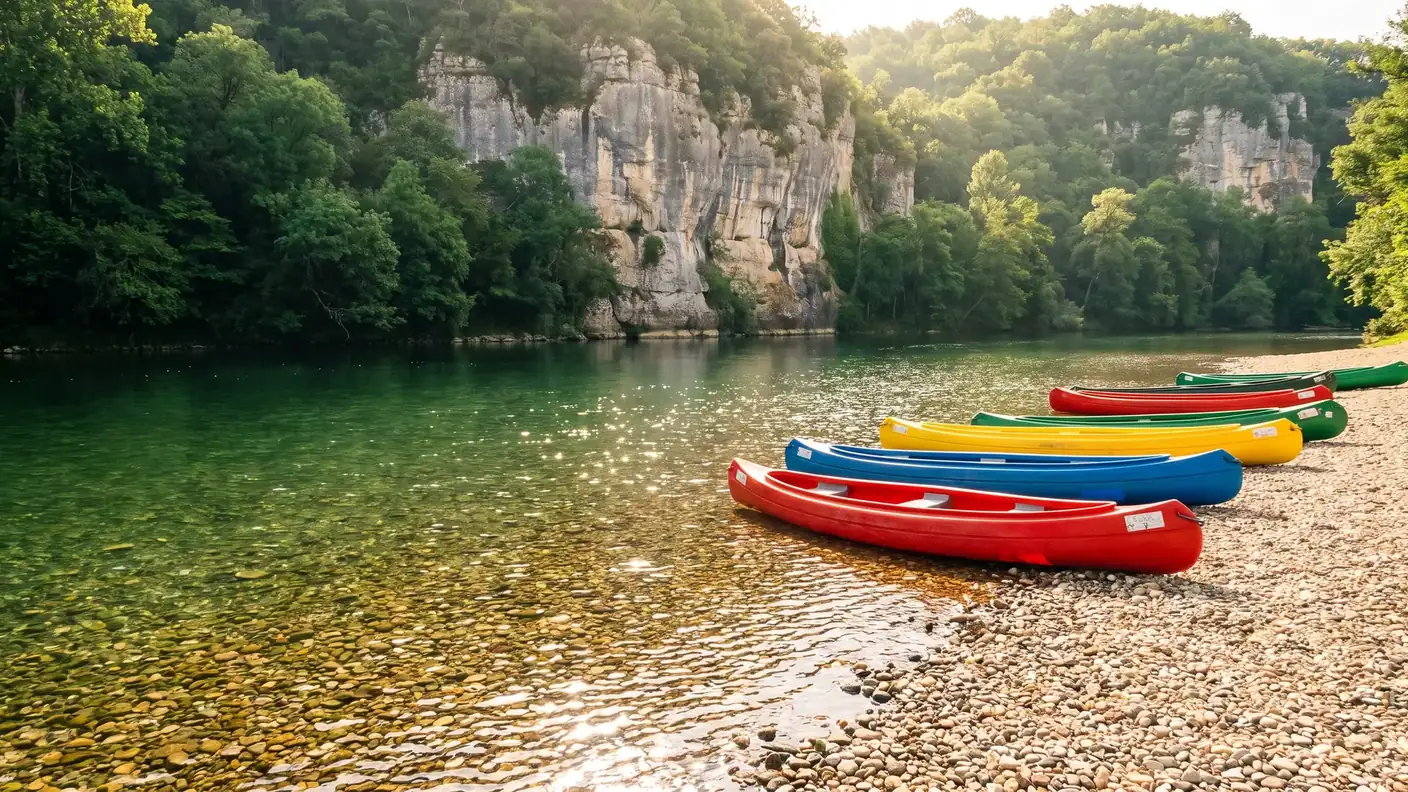
Smart Canoeing: All Routes Lead Here
Route de la Plage is home to a canoeing center, but the routes, shuttle services, rates, and operating hours vary by season. The official Canoë de Dordogne-Périgord Tourisme webpage, accessed in July 2026, allows you to compare rental companies and check the current terms and conditions before booking.
The River Without a Bridge
The municipality borders the Dordogne River but has no road bridge within its boundaries; the road crosses the river at Siorac-en-Périgord. The catalog of the Dordogne Departmental Archives, consulted in July 2026, contains records of the former ferries at Bigaroque and Port-Muzard, noting that the river was once crossed locally by boat.
The water system doesn't end at the river: 26 km of waterways flow through the town, including the Aurival stream — which has its source right there — and the Boule. And the future is taking shape on two wheels: a connection to the V91 bike route. A project for a “Dordogne Valley” route between Castels-et-Bézenac and Coux is currently under consideration, spearheaded by the community of municipalities—for now, we’re cycling on the small roads, which are perfect for it.
Around Coux: Proumeyssac, Le Bugue, Belvès, and the valley
A discreet base camp with exceptional reach: the Dordogne’s sites and monuments drew nearly 3.5 million visitors in 2024, and several of the most popular attractions are less than a quarter of an hour away.
The Proumeyssac Cave, the “Crystal Cathedral” (10 min)
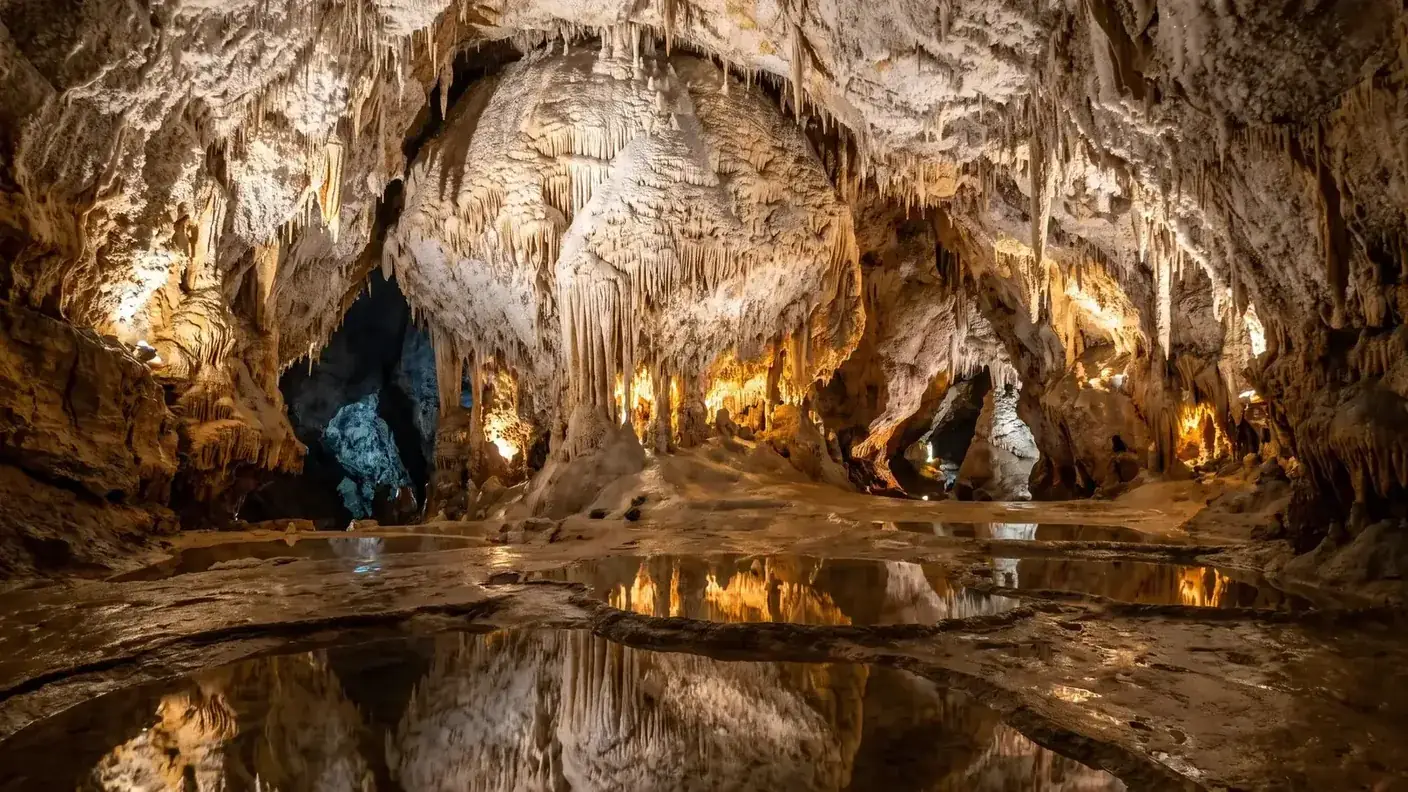
In Audrix, the largest developed cave in the Périgord (158,000 visitors in 2022) can be explored through a sound-and-light show beneath a vaulted ceiling some 50 meters high. The big thrill: the descent in a rotating gondola—in 1907, the pioneers descended in groups of three, in the dark, in a basket pulled by a horse; today’s gondola carries 11 people while rotating 360°. Bonus: a “petrifying” fountain that transforms pottery into limestone within a year, and triangular crystals found in only three caves in France.
Le Bugue: The “Perpetual” Market of 1319 (15 min)
In Le Bugue, the Tuesday market has been held “perpetually” by royal decree of Philip the Long since November 1319—the decree is still in effect. The small capital of the Vézère region is home to the Village du Bournat (a Périgord village “as it was in 1900” spread over 8 hectares, ranked among the top 5 most-visited sites in the Dordogne in 2024 with 150,000 visitors) and the Périgord Noir Aquarium, which bills itself as Europe’s largest private freshwater aquarium—together, they attract 270,000 visitors annually. The Univerland complex (aquarium, prehistoric maze, Jungle Golf, and the Big Bird Tower—22 meters tall with 57 acrobatic courses) recorded a total of 230,800 visitors in 2022. Notable connections: Martin Walker, the Scottish author of the “Bruno, Chief of Police” crime novels, lives in Le Bugue—the birthplace, four centuries earlier, of Jean Rey (1583–1645), the chemist who formulated the law of conservation of mass before Lavoisier and invented the thermoscope, the precursor to the thermometer.
Belvès, the "beautiful view" with seven bell towers (9 min)
9 minutes away through the Nauze Valley, Belvès (Most Beautiful Villages of France — Bellovidere, “beautiful view,” attested as early as 1351) overlaps seven church steeples… and hides the most important parts beneath its cobblestones: eight cave dwellings inhabited by the poorest residents from the 13th to the 18th century, which can be visited 6 meters below the 15th-century market hall (€7). A direct connection to Bigaroque: the Lord of Belvès was none other than Bertrand de Got — Clearly, the future Clement V ruled the entire neighborhood. Local traditions: an air show every August 15 since 1913, and the ultra-distance race of the "100 km from Belvès".
Saint-Cyprien: The Sunday Market and the “Eiffel-style” Bridge (12 min)
Just 12 minutes away, Saint-Cyprien hosts a market every Sunday that was voted “the most beautiful in the Périgord” (TF1, 2019)—80 vendors in the winter, up to 180 in the summer, with the street closed to traffic starting at 6 a.m. Two interesting side notes: Joséphine Baker, lady of the neighboring Château des Milandes, was the patron of the local rugby club (founded in 1904); and the Garrit Bridge, a 176-meter-long “Eiffel-style” steel structure dating from 1894, reopened to pedestrians and cyclists on June 8, 2024—the area’s newest and freshest stroll.
Limeuil, Cadouin, Campagne, Les Eyzies
Just a quarter of an hour away, Limeuil (PBVF) overlooks the confluence of the Dordogne and Vézère rivers from its panoramic gardens, and Cadouin Abbey (UNESCO) showcases its cloister, commissioned by Louis XI—and its “shroud,” which was revealed in 1934 to be a Fatimid fabric from Egypt. Even closer: the Campagne departmental estate, featuring a château and a park designated a “Remarkable Garden,” with free admission (12 min). And in Les Eyzies (18 min), the world capital of prehistory, the polychrome Font-de-Gaume Cave admits only 78 visitors per day—book early.
| Field Trip | Directions from Coux | Why Go There |
|---|---|---|
| Siorac-en-Périgord | ≈ 3 km · 3 min | TER Station, Wednesday Market — see our guide |
| Belvès | ≈ 9 km · 9 min | PBVF, cave dwellers beneath the market hall |
| Proumeyssac Cave | ≈ 10 km · 13 min | The “Crystal Cathedral,” a 360° observation deck |
| Campagne Estate | ≈ 10 km · 12 min | Castle and departmental park, free admission |
| Saint-Cyprien | ≈ 11 km · 12 min | The Sunday market voted the most beautiful in the Périgord |
| Le Bugue (Bournat, Aquarium) | ≈ 12.5 km · 15 min | Market from 1319, village from 1900, giant aquarium |
| Limeuil | ≈ 15 km · 16 min | PBVF, confluence of the Dordogne and Vézère rivers |
| Cadouin Abbey | ≈ 16 km · 17 min | Flamboyant Cloister, UNESCO |
| Les Eyzies | ≈ 16 km · 18 min | Font-de-Gaume, Capital of Prehistory |
| Beynac | ≈ 21 km · 23 min | The Valley Fortress — see our guide |
When to Visit Coux
- Tuesday evenings in July and August: the Coux gourmet market, starting at 7 p.m. at the Place de la Salle des Fêtes;
- During the summer season: beach and canoeing, subject to the dates and conditions published by the town hall and the operators;
- A nearby market almost every day: Le Bugue on Tuesday, Siorac on Wednesday, Le Buisson on Friday, Belvès on Saturday, Saint-Cyprien on Sunday;
- Spring and fall: the valley all to yourself, major attractions without lines.
| Season | Atmosphere | Strengths | Good to Know |
|---|---|---|---|
| Spring (April–June) | Green, secret | Canoeing starting in May, empty villages, ever-changing landscapes | Our Favorite Season |
| Summer (July–August) | Family-friendly | Supervised beach, gourmet market, open-air café | This area remains quiet compared to the upper valley |
| Fall (Sept.–Oct.) | Golden | Walnuts, porcini mushrooms from nearby markets, lights | Perfect for photography and biking |
| Winter (Nov.–March) | Silent | Truffles in Sarlat: A Treasure All to Yourself | Beach and Canoeing Closed |
The perfect pace: a morning in Proumeyssac or Le Bournat, lunch in town, an afternoon at the beach or canoeing (equipment provided on site!), and on Tuesday evening, a gourmet market—the laid-back side of the Périgord Noir.
How to Get to Coux from Bordeaux
Coux is about 184 km from Bordeaux—allow about 2 hours and 20 minutes via the Dordogne Valley. Be careful with the “as the crow flies” distances you see online (120–130 km): by road, it’s actually 180-plus kilometers.
| Transport mode | Travel time from Bordeaux to Coux | Estimated cost | Good to Know |
|---|---|---|---|
| Personal car | ≈ 2 hours 20 minutes (181–184 km) | Gas ≈ 25–35 € (few tolls) | D936 via Bergerac, then through the valley |
| Private chauffeur service (door-to-door) | ≈ 2 hours 20 minutes | Starting at €312 · one-way | Optional stops (Saint-Émilion, Bergerac, Limeuil, etc.) |
| TER + 4 km | ≈ 2 hours + 5 minutes | ≈ 15–25 € + taxi | Siorac Train Station, 3.7 km away (Bordeaux–Sarlat line) |
| Coach | — | — | No practical service |
By train, via Siorac
The Bordeaux-Sarlat TER stops at Siorac-en-Périgord, 3.7 km from the village (a 5-minute drive)—with about 5 round trips per day, starting at 1 hour and 56 minutes. The Buisson rail hub, 10 km away, provides access to the Périgueux–Agen line. For a village of this size, being just 5 minutes from a station with direct TER service to Bordeaux is a rare luxury.
By car
Valley route: D936 via Libourne, Castillon, and Bergerac, then Lalinde and the banks of the Dordogne—virtually toll-free, with a stop in Saint-Émilion or Bergerac. Highway alternative: Take the A89 toward Périgueux, then head down through Le Bugue—comparable in travel time. Useful landmarks: Bergerac is 48 km (~55 min) away, and Sarlat is 31 km (~30 min) away.
As a private driver
The door-to-door service really shines on this route: a stop in Saint-Émilion on the way there, arrival via Limeuil and the valley, drop-off at the campground or bed-and-breakfast—then explore Proumeyssac, Belvès, and the markets without worrying about parking. With a private chauffeur and a fixed rate guaranteed in writing, starting at €312 one-way for 1 to 3 passengers.
Practical Information
How long will you be there?
Coux is seen as base camp : a half-day That's enough for the historic sites (the two churches, the tithe barn, and Monsec as seen from the road), but it's in 2–4 days that's when the whole experience really comes together—the beach and canoeing in the afternoons, a major attraction every morning, and a different market every day.
On site
- Shops in town: a bar, tobacco shop, and newsstand; a wine shop; the “Les Croquants” farmers’ market; two hotel-restaurants—all the essentials are there;
- Gourmet Market: Tuesday evenings in July and August starting at 7:00 p.m. (no weekly market—Siorac on Wednesdays, 3 km away);
- Beach: Route de la Plage, lifeguarded in July and August, free parking;
- Campgrounds: Le Clou (4★) and Slow Village Séveilles (13 ha, pond) on the hillsides;
- Designation: “Our Village, Land of the Future” (Agenda 21) · twinned with Schœnau (Alsace).
Estimated Budget
| Profile | Daily Budget | Accommodations | Catering |
|---|---|---|---|
| Small budget | 45-70 € | Campgrounds (Le Clou, Séveilles) | Gourmet Market + Beach Picnic |
| New Couple | 100-150 € | Bed-and-breakfasts and hotels with restaurants in the town center | Tables from the Périgord region |
| Comfort | 150-220 € | Charming Homes in the Valley | Fine Dining in Saint-Cyprien or Sarlat |
Families: a lifeguard-patrolled beach + canoe rentals with drop-off on-site + the Proumeyssac gondola + Bournat = the perfect combination. Good to know: there’s no ticket office or lines here—the village itself is free; only the major nearby attractions require reservations in the summer.
Frequently Asked Questions
Why is the town called Coux-et-Bigaroque-Mouzens?
Because it brings together three former villages through two mergers. The Dordogne Departmental Archives date the merger of Coux and Bigaroque to September 23, 1825; the prefectural decree of December 21, 2015, subsequently added Mouzens and created the new municipality on 1st January 2016. The official spelling is “Coux et Bigaroque-Mouzens.”
What does “Couzensois” mean?
This is the demonym chosen by the residents and approved by the city council in February 2021: a portmanteau combining “Couxois” (residents of Coux-et-Bigaroque) and “Mouzensois” (residents of Mouzens)—a lovely metaphor for the municipal merger itself, five years after the new municipality was formed.
What is the connection between Bigaroque and Pope Clement V?
The Gironde Departmental Archives mention lands in Bigarroque in 1304 among the possessions of the archbishopric headed by Bertrand de Got. He became Pope Clement V in June 1305. However, the archival summary consulted does not document a specific date of purchase for the castrum; this cautious wording avoids turning a local tradition into a certainty.
Who were the lords of the Bigaroque castellany?
A parade of historical figures: Richard the Lionheart (died in 1199), his captain of the Routiers, Mercadier (assassinated in Bordeaux in 1200), followed by Martin Algai, seneschal of Gascony and Périgord—captured at the siege of Biron in 1212, dragged behind a horse, and hanged for betraying Simon de Montfort. Next, the archbishops of Bordeaux, from 1305 until the Revolution.
What remains of the Bigaroque castrum?
The castrum with its two towers, “said to be impregnable,” was purchased from the English by the States of Périgord in 1393, dismantled in 1409 and 1415, and then completely razed in 1625, according to the municipality. All that remains is the hamlet, a few sections of thick walls, the Church of Saint John the Baptist commissioned by Clement V—and protection as a listed site since 1944.
Is there a beach in Coux-et-Bigaroque?
Yes. Dordogne-Périgord Tourisme lists Coux Beach as a supervised swimming area. Since the dates, hours, and facilities may vary from season to season, please check the official information sheet and the town hall’s website before you go.
Where can you go canoeing in Coux?
There is a rental location on Route de la Plage. Since the routes, shuttle services, rates, and operating hours vary by season, compare the options on the “Canoeing” page of the Dordogne-Périgord Tourisme website, then confirm the details directly with your chosen rental company.
Can we visit Monsec Castle?
No—it’s private property that has been in the same family since 1610. It can be admired from the road and the valley: built on a Gallo-Roman oppidum to keep watch over the Dordogne (the Vikings had burned Saint-Cyprien in the 9th century), listed as a Historic Monument in 2005, it served as the setting for Léon Poirier’s 1943 film “Jeannou.”
How do I get from Bordeaux to Coux-et-Bigaroque-Mouzens?
By car: ~184 km, about 2 hours and 20 minutes — D936 via Bergerac then through the valley, with almost no tolls (be wary of the “120–130 km” figures you see: that’s as the crow flies). By train: Take the TER Bordeaux-Sarlat to Siorac (starting at 1 hour 56 minutes), then 3.7 km. By private driver, door-to-door: starting at €312 one way (1–3 passengers), with stops along the way as desired.
Is there a market in Coux?
No weekly market—but a gourmet night market every Tuesday evening in July and August, starting at 7 p.m. at the Place de la Salle des Fêtes. And a nearby market almost every day: Le Bugue on Tuesdays (held continuously since 1319!), Siorac on Wednesdays (3 km away), Le Buisson on Fridays, Belvès on Saturdays, and Saint-Cyprien on Sundays—voted the most beautiful market in the Périgord in 2019.
What is there to see around Coux-et-Bigaroque?
A very packed 15-minute radius: the Proumeyssac Cave and its rotating gondola (13 min), Belvès and its cave dwellings (9 min), the free Campagne estate (12 min), Saint-Cyprien and its market (12 min), Le Bugue with the Bournat and the Aquarium (15 min), Limeuil at the confluence (16 min), Cadouin (17 min)—and Beynac, 23 minutes away.
Why isn't there a bridge over the Dordogne River in Coux?
The municipality does not have a road bridge over its section of the Dordogne River; the road route passes through Siorac-en-Périgord. The Dordogne Departmental Archives’ records document the former ferries at Bigaroque and Port-Muzard, which were once used to cross the river.
Traveling with kids: Is it a good idea?
Excellent: a supervised pebble beach with a playground, a canoe trip that ends right there (no need to wait for a shuttle), a ride down in a rotating gondola to the Proumeyssac chasm, the “1900s”-style village of Le Bournat, and the giant aquarium in Le Bugue—all within a 15-minute radius, with an open-air café for an afternoon snack.
Further Reading
- The train station and the bridge are 3 minutes away: see the Siorac-en-Périgord Guide
- The Valley Fortress: see the Beynac-et-Cazenac Guide (castle, gabarres)
- The hilltop bastide and its cave: see the Domme Guide
- The capital of the Périgord Noir: see the Sarlat Guide
- Plan your trip: Book a private driver from Bordeaux to Coux or explore all our destinations
Sources and References
- Wikipedia — Coux and Bigaroque-Mouzens — Geography, Demographics, Heritage
- Wikipedia — Coux-et-Bigaroque — History of the Former Municipality
- Wikipedia — Mouzens — place names, Château de Monsec
- Town Hall — History and Heritage — castellany, tithe barn, castrum
- Dordogne-Périgord Tourism — Swimming Spots — Rating of Coux Beach and Seasonal Conditions
- Dordogne-Périgord Tourism — Canoeing — Official Directory of Rental Companies and Practical Information
- Mérimée/Palissy Database (POP) — Monsec Castle, altarpieces, 44 protected objects
- Proumeyssac Cave — the “Crystal Cathedral”
- The Village of Bournat — The Village of 1900
- Périgord Noir Aquarium — The Freshwater Giant of Le Bugue
- Saint-Cyprien City Hall — Sunday Market
- INSEE — Demographic Data
Article verified on .
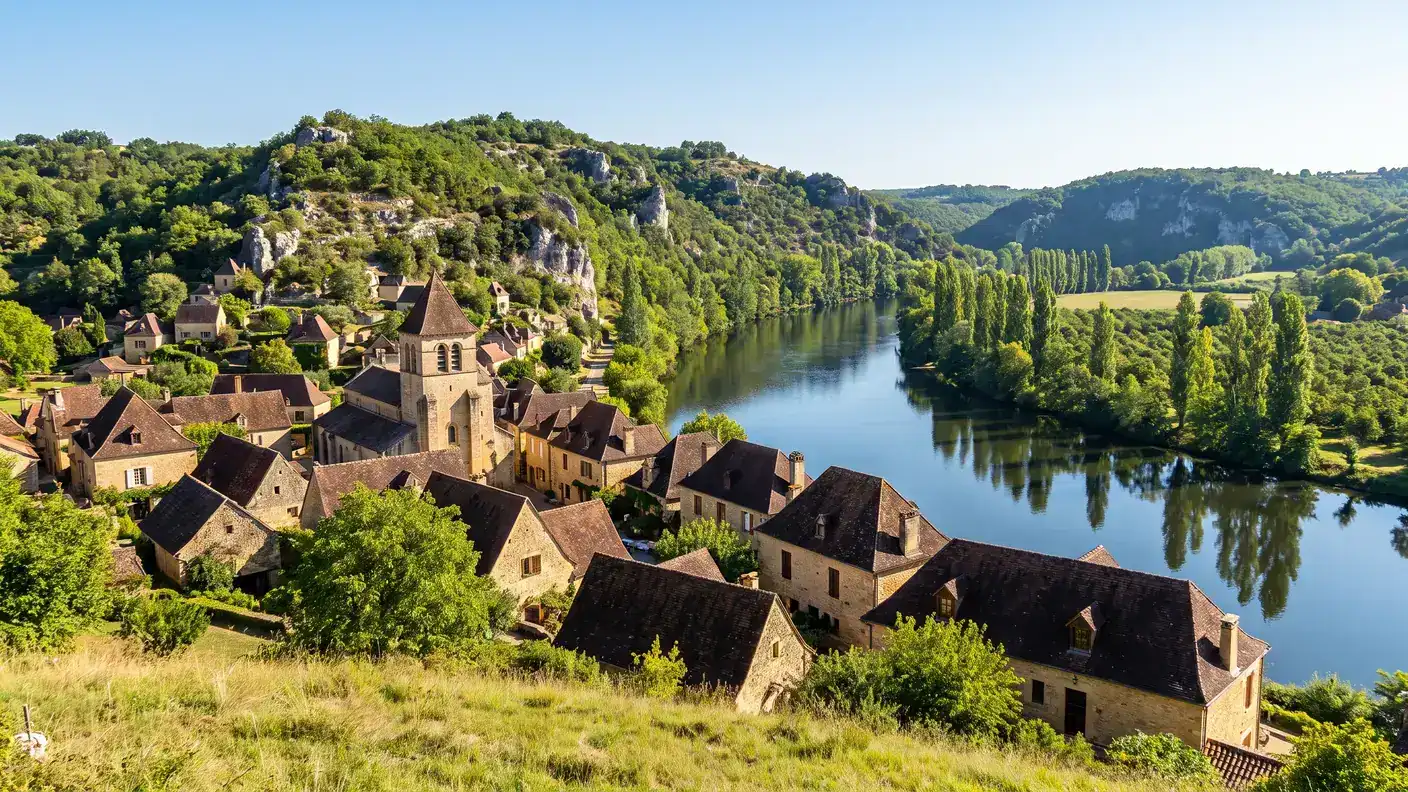
On the way to the three villages
Direct trip from Bordeaux (~2 hours 20 minutes), with stops along the way as desired—Saint-Émilion, Bergerac, Limeuil. Written fixed-price quote within 30 minutes; sedan or van; English-speaking driver.