Private driver from Bordeaux to Montendre: château and La Double forest
A small town in the southern part of Haute-Saintonge, centered around its medieval castle and surrounded by one of the department’s largest forest areas: the ruins of the fortress, the Forest of La Double and its ponds, the 19th-century market halls, Bons Bois cognac, and a major festival—just 1 hour and 7 minutes from Bordeaux.
Montendre at a glance
Montendre is a small town in the southern part of Haute-Saintonge, in Charente-Maritime, centered around its castle and bordered by the Forest of La Double. According to INSEE, it had a population of 3,222 in 2023. The town also has a direct rail connection to Bordeaux.
The distance of 64 km, the travel time of approximately 1 hour and 7 minutes, and the fare starting at 125 € are the figures displayed by the booking engine for the route Bordeaux → Montendre.
| Landmark | Details |
|---|---|
| Department | Charente-Maritime (17), Nouvelle-Aquitaine |
| Status | Rural village · Jonzac district · seat of the Trois Monts canton |
| Population | 3,222 residents (INSEE 2023) · the residents of Montendras |
| Area | ≈ 25.1 km² · partner municipalities of Chardes and Vallet |
| Don't miss it | The castle, the Forest of La Double, the market halls, the Freemusic Festival |
| Distance from Bordeaux | 64 km · about 1 hr 7 min |
| Train Station | Montendre · Direct TER connection to Bordeaux-Saint-Jean |
A word of honesty right off the bat: Montendre is burdened by a few misconceptions that this guide corrects, with supporting sources. Its medieval castle, of which beautiful ruins remain, is not a protected historic monument—no building in the town is. Its famous octagonal market halls are not medieval but date from the 19th century (1863), and its Saint-Pierre Church is Neo-Romanesque, not Romanesque. Its vineyard is in the Bons Bois appellation, not Fins Bois. Finally, its name does not come from “mont tendre” (tender mountain), but from the ancient “Monte Andronis.” Throughout this guide, we distinguish between verified facts and commonly repeated claims.
Here’s a rundown of everything you need to know before you come: Montendre’s location at the edge of the vineyards and the forest, its castle and history, the Double Forest, its market halls and heritage, the churches of Chardes and Vallet, the origin of its name, its music festival, Bons Bois cognac, notable sites in the surrounding area, and the easiest way to get there from Bordeaux.
Where is Montendre located?
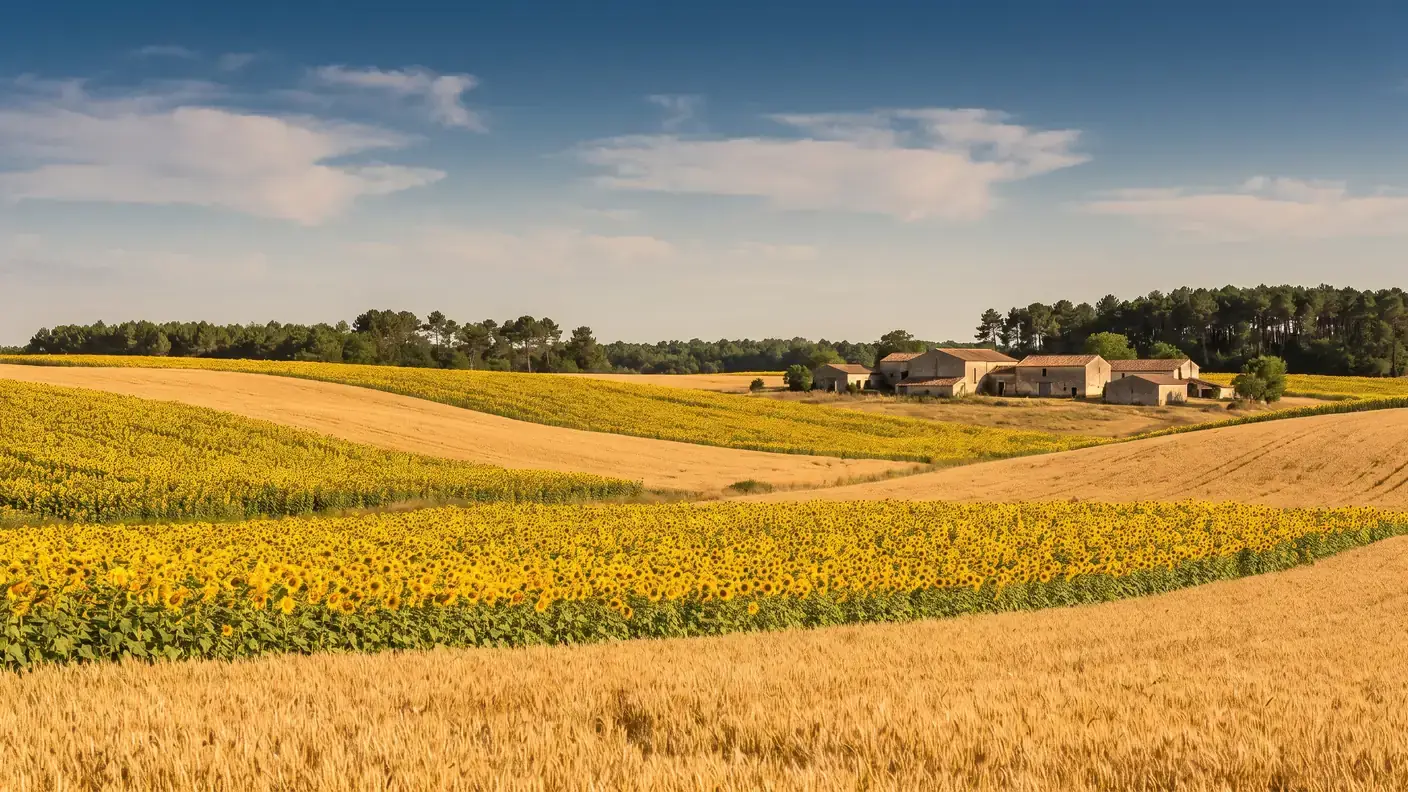
Montendre is located in the far south of Charente-Maritime (17), in Nouvelle-Aquitaine, in the Haute-Saintonge region, on the edge of the Bordeaux region of Guyenne. It is a small town within the Jonzac arrondissement and the seat of the Trois Monts canton, a member of the Haute-Saintonge Community of Communes—one of the largest intermunicipal communities in France, comprising more than 100 communes. It covers an area of approximately 25.1 km², at an elevation ranging from 44 to 120 meters, and includes two associated municipalities, Chardes and Vallet, which have been part of the town since 1973. It occupies a pivotal location: to the north, the limestone hillsides where grain is grown; to the south, the acidic, sandy soils of the vast Double Forest.
Between the “champagnes” and the forest
What makes Montendre truly unique is its location at the crossroads of two worlds. To the north of the town lie the “champagnes”—these Cretaceous limestone soils that yield grains, oilseeds (wheat, corn, sunflowers), and, on the sun-facing slopes, vineyards. To the south, everything changes: the soil becomes acidic and sandy, and this is the domain of the Double Saintongeaise Forest, one of the largest forested areas in Charente-Maritime, with its maritime pines and ponds. Montendre lies at this geological and landscape boundary, which explains the diversity of its territory—vineyards, fields, woods, and water—and its dual character, as both a land of cognac and a land of forests. A rare treasure, all concentrated within a single municipality.
This pivotal position is also geographical in the broadest sense: Montendre is located in the borders of three departments — Charente-Maritime, Charente, and Gironde — and several former provinces, Saintonge and Guyenne. Far from any major urban center (Bordeaux is the nearest major city, much closer than La Rochelle, the department’s capital, which is more than 110 km away), the town looks resolutely south toward Bordeaux, of which it is the “neighbor” in Saintonge. This explains its role as a regional hub for an entire rural area, and its appeal to those seeking—just an hour from the Gironde metropolis—a land of forests and vineyards away from the crowds.
A town center with a population of 3,200
According to INSEE, Montendre had a population of 3,222 in 2023, with a population density of 128.6 inhabitants per square kilometer. Its residents are known as Montendrais. The town serves as the regional center for southern Haute-Saintonge, offering local shops, services, and amenities.
Montendre Castle
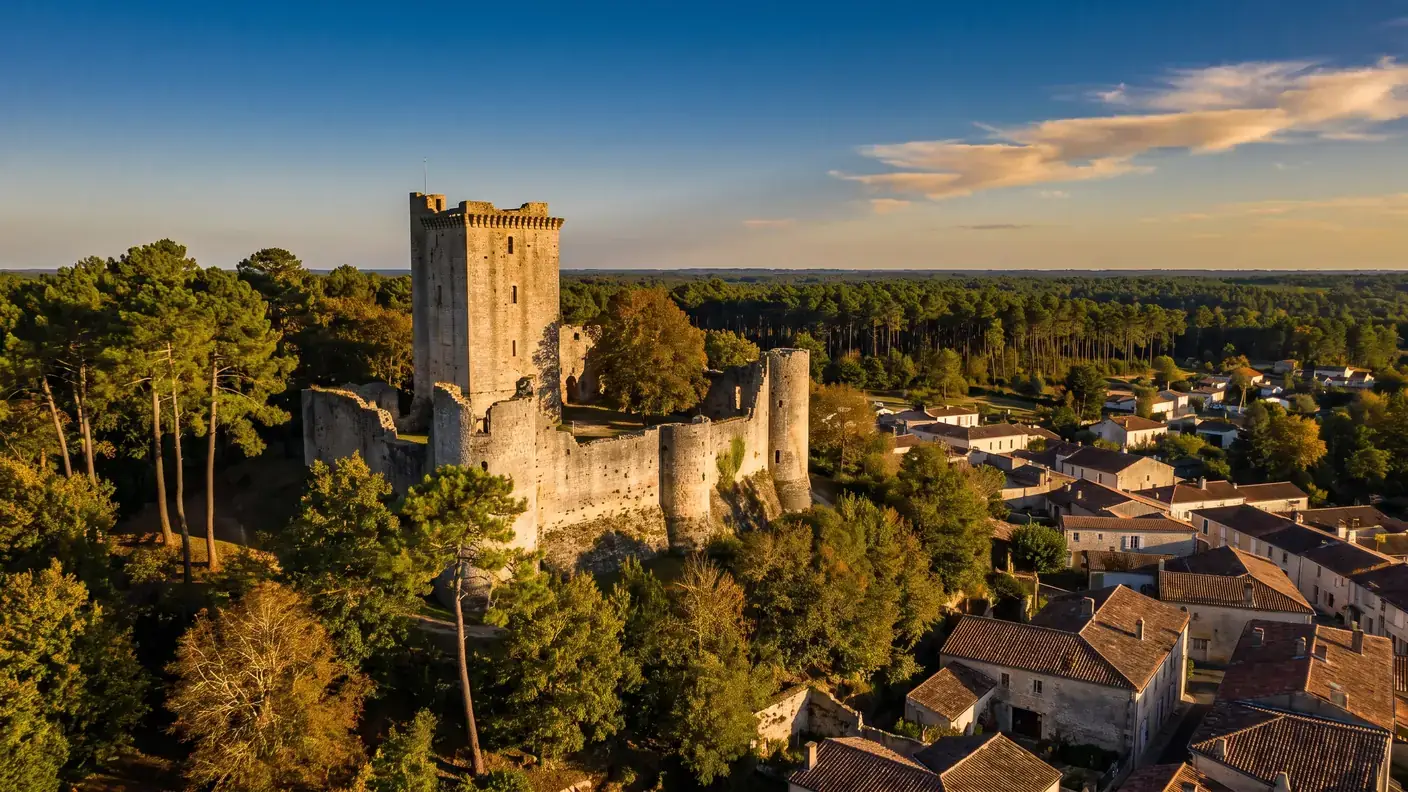
Montendre grew up around its castle, perched on a rocky outcrop overlooking the town: a medieval fortress of which beautiful ruins remain, now owned by the municipality. This is the historic heart of the city, a must-see—even if, once again, it’s necessary to correct a few common misconceptions.
A fortress in Haute-Saintonge
The site has been occupied for a very long time: an early castle, likely made of wood, is dated by historical records to around the 9th century and stood on a hill rising to about 114 meters.
Rebuilt in stone in the 12th century and extensively remodeled in the 15th, the castle was one of the major strongholds of Haute-Saintonge. Today, what remains includes a tall square tower (15th century, which houses a small museum of folk art and traditions), a round tower, part of the outer walls and ramparts, underground passages, and the ruins of an 18th-century residence. The site is actually defined by two hills facing each other: the castle hill, the higher of the two, a former fortified “mountain” where a Gallo-Roman camp is believed to have stood, and the church hill, which is slightly lower. These ruins, scattered among the greenery, form an evocative ensemble—but take note: no building in the town, including the castle, is protected as a historic monument (the only historic monument listing that mentions a “Castle of Montendre” is actually that of the Château de Gramont, which refers to it in connection with the Battle of the Seven in 1402).
From the La Rochefoucaulds to the Resistance
The castle has a rich history. The lordship passed from the lords of Didonne to the Tonnay family, then, at the end of the 15th century, to the powerful House of La Rochefoucauld, which gave rise to a branch known as “de Montendre.” Fiercely contested during the Hundred Years’ War, the stronghold later became a Protestant bastion, established as a place of refuge under Henry IV. Tradition recounts two notable episodes—to be taken for what they are, stories: the “Battle of the Seven,” on May 19, 1402, in which seven French knights are said to have faced off against seven English knights at the foot of the castle, and the “surprise attack on Montendre” of 1608, when the town was taken without a fight by a band of adventurers. Bequeathed to the town in 1953, the castle site now houses an open-air theater, built in 1959.
The Battle of the Seven (1402)
The castle owes its place in the history books to a chivalric episode: the Battle of the Seven, the May 19, 1402. In a meadow at the foot of the fortress, seven French knights faced off against seven Anglo-Aquitanian knights, in the spirit of the famous Breton “Battle of the Thirty.” The event was so renowned that it is even mentioned in the official description of the Gramont Castle (Mérimée database), where he fought Arnaud Guilhem de Barbazan, “the knight without blemish.” Two centuries later, in 1608, the town would witness another spectacular feat, the “Surprise of Montendre,” captured without a shot fired by a handful of adventurers—truly, this modest little town in the Saintonge region has seen more assaults than many a grand citadel.
The Double Saintonge Forest
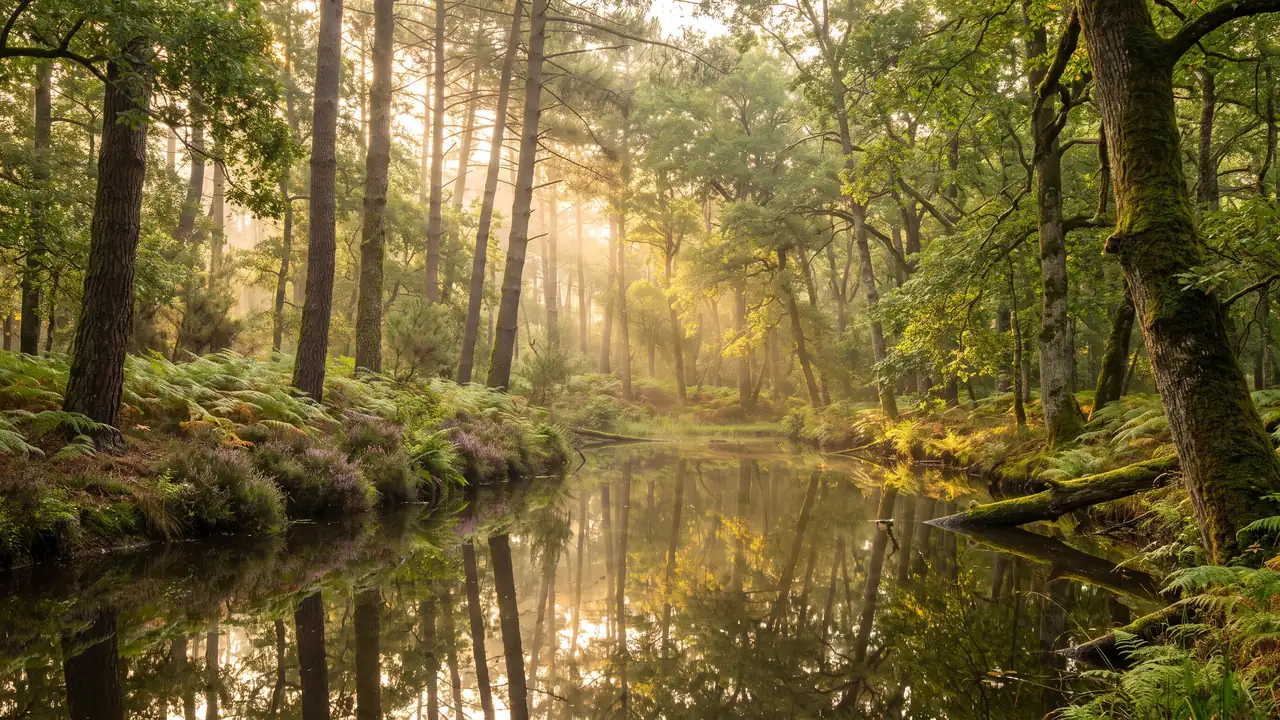
Just outside Montendre lies the Double Saintongeaise Forest, one of the largest wooded areas in Charente-Maritime—a vast, untamed expanse dotted with ponds that gives the town its forest-like character. It is one of the destination’s major attractions, a natural area unlike any other.
A forest of pine trees and ponds
The Double Forest—known as the “Saintonge Forest” to distinguish it from the Double Forest in the Périgord region of the Dordogne, which is now referred to simply as “the Double”—extends across the southern part of Charente-Maritime, the Charente, and the northeastern part of the Gironde. It is dominated by maritime pine, intermingled with pedunculate oaks, chestnut trees, and Tauzin oaks, along with wet heathlands covered in heather and peat bogs. On these acidic, sandy, and impermeable soils, water does not seep away; the region is therefore dotted with numerous ponds, some of which have been developed for swimming and recreation. Long considered barren land, La Double was extensively reforested with pine trees during the Second Empire, much like the neighboring Landes de Gascogne; today, it covers nearly 39% of the municipal territory and, contrary to what is sometimes believed, remains primarily privately owned.
These clay soils also hold another treasure: clay and kaolin, long mined in the Double region, near Clérac and Oriolles, for ceramics and refractory products—an industrial legacy that Montendre preserves through its historic brickworks. It is this same clay that, by retaining water, created the massif’s countless ponds: geology, economy, and landscape are closely intertwined here. This forest, born of poor soil and shaped by human hands, has over time become one of Montendre’s greatest assets — a green lung and a natural refuge, from which the town now derives part of its tourist appeal, from the Freemusic festival by the lake to the hiking trails beneath the pine trees.
A sanctuary of biodiversity
This forest is a remarkable reservoir of biodiversity. Two large Natura 2000 sites cover the area around Montendre: the Landes de Touvérac-Saint-Vallier and the Lary and Palais Valleys, which protect heathlands, peat bogs, and acidic fens. Rare and endangered species can be found here: the European pond turtle (a small freshwater turtle), the otter, the European mink—one of the continent’s most endangered mammals—the ocellated lizard, and rare dragonflies. The GR 360 long-distance hiking trail crosses the massif, and a nearby Forest Center offers insights into this ecosystem. For visitors, it’s an ideal place to explore, with its ponds, pine forests, and heathlands—perfect for enjoying on foot or by bike, far from the hustle and bustle.
The Market Halls and the Town's Heritage
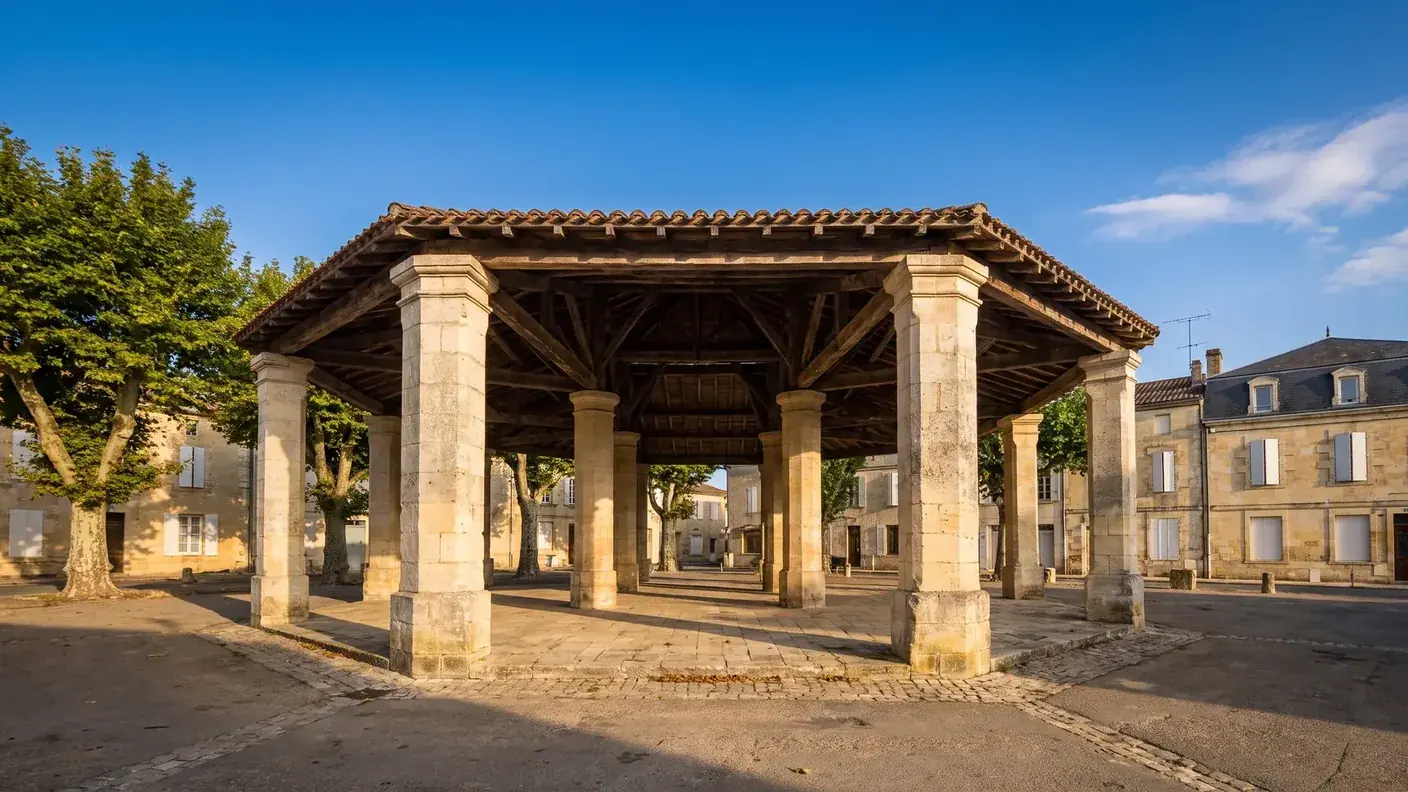
The historic center of Montendre, with its winding streets dating back to the Middle Ages, holds some lovely surprises—starting with its intriguing octagonal market halls. It’s a small-town heritage site, modest yet full of character, best explored on a leisurely stroll.
19th-century market halls
The Montendre market halls are one of the city's landmarks: a building with an octagonal floor plan, quite unusual, with a self-supporting structure shaped like the “bottom of an upside-down boat”—without a single pillar. Let’s clarify, since confusion is common: these market halls are not medieval, but date from the 19th century (1863). They are, however, the successors to the medieval market halls around which the town was organized, and they carry on an old market tradition. Not far away, St. Peter's Church also deserves a closer look—without being misled by its age: it is a Neo-Romanesque building, built between 1812 and 1821 to replace the ruined medieval church. Its style imitates the Romanesque, but it is not medieval—a distinction that, once again, is essential.
Temple, brickworks, and listed treasures
Montendre retains other traces of its past. A neoclassical Protestant church, built beginning in 1822, serves as a reminder of the importance of the Reformation in this former Huguenot refuge. The town also has an industrial heritage: the Amand brickworks, founded in the 1930s and later renamed Morgan Thermic, specialized in refractory products and crucibles, and employed up to 450 people in the 1950s. Finally, while no buildings in the town are listed, several artifacts are: in the churches of the associated municipalities, two antique bells (1660 and 1727) and a beautiful sculpted group depicting the Virgin of Mercy (a Pietà from the late 15th century), all classified as cultural artifacts. These are all discreet, scattered treasures that reward the curious visitor.
Strolling through old Montendre is a pleasure in itself. The historic center has retained its medieval layout, with winding streets that meander between stone houses and old buildings, surrounding the market halls and the church. You can still sense the layout of a market town that grew up at the foot of its castle, shaped by the market and the two hills that frame it. It is a heritage without any spectacular monuments, yet one of genuine coherence, that tells the story of a small town in Saintonge—at once a stronghold, a trading center, and a crossroads. A stroll through these narrow streets, between the castle, the market halls, and the church, is enough to capture its atmosphere—that of an authentic provincial town, vibrant and proud of its past, where people take the time to enjoy life.
| Heritage of Montendre | Status / Date |
|---|---|
| Medieval castle (ruins, 15th-century square tower) | unprotected · municipal property (museum) |
| Octagonal Market Halls | unprotected · 19th century (1863) |
| St. Peter's Church (town) | unprotected · Neo-Romanesque (1812–1821) |
| Bells of Vallet (1660) and Chardes (1727) | Categorized by subject · Palissy |
| Virgin of Mercy (Pietà, Croix-Genté Chapel) | Classified as an "object" in 1979 · POP/Palissy |
Chardes and Vallet, the sister villages
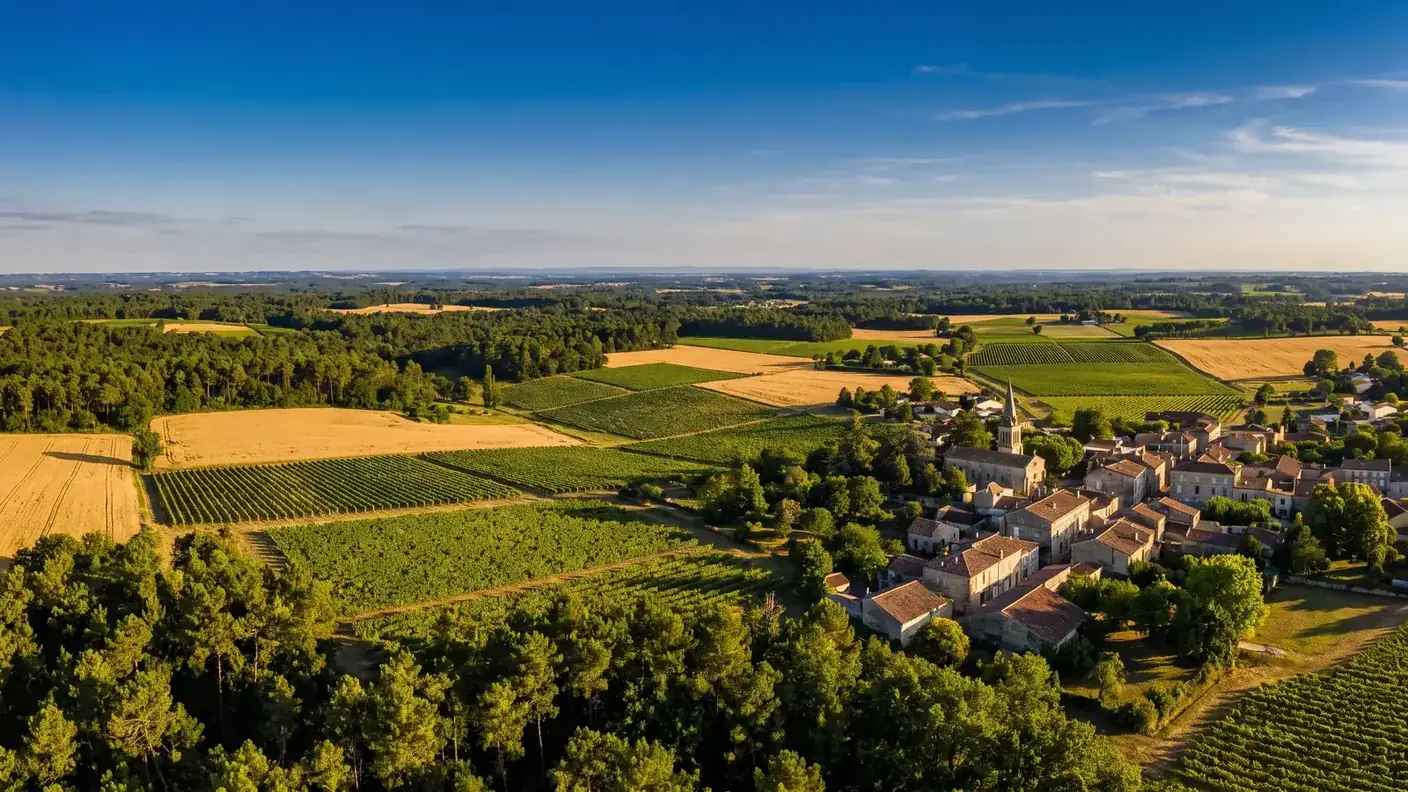
Montendre is more than just its town center: the municipality includes two associated villages, Chardes and Vallet, which were incorporated in 1973 and each retain their own church and identity. These secluded hamlets are worth a visit for anyone who appreciates unassuming rural heritage.
Two churches with Romanesque origins
The churches of Chardes and Vallet have ancient origins, likely dating back to the 11th–12th centuries, but here again, some qualification is needed: both were extensively rebuilt, particularly in the 17th century following the Wars of Religion, and then remodeled in the 19th century (the façade of the church in Chardes dates from 1891, and the bell tower in Vallet from 1860). The true Romanesque gem of the area is hidden in Vallet: the crypt of Saint-Babylas Church, dating from the late 11th or early 12th century, with its “archaic Romanesque” vaults supported by two piers—a moving remnant of early Romanesque art. It is also home to the listed bells, and, in the Croix-Genté Chapel, the beautiful polychrome stone Pietà from the late Middle Ages.
A rural heritage on a human scale
These neighboring villages tell the story of rural life in the Saintonge region, where every hamlet had its own church, cemetery, and stone farmhouses. Vallet and Chardes, with their few hundred residents, have preserved this intimate, rural character—stone churches surrounded by their cemeteries, nestled among fields and woods. Exploring them extends your visit to Montendre with a closer look at rural Saintonge—the region of small rural parishes and their modest yet authentic heritage. Here, one can appreciate the unsuspected richness of this corner of Charente-Maritime, where history is hidden in even the smallest villages, just a few minutes from the bustling town center.
Where does the name Montendre come from?
The name Montendre seems obvious—a “tender mountain,” a gentle hill—but this apparent simplicity is misleading: the true origin is quite different. There are two false leads circulating that must be ruled out.
Neither a “tender hill” nor a Roman officer
The first common misconception is that “Montendre” comes from “mont tendre,” meaning “gentle hill.” This is a popular etymology, a later reinterpretation: the original form, attested as early as 1116, is “Monte Andronis,” the second element of which is a man’s name, not the adjective “tendre.” The second legend, more romantic in nature, attributes the name to a certain Andron, a Roman officer and lieutenant of Crassus, who is said to have founded a camp there during the conquest of Aquitaine. This is pure legend: there is no trace of the name before the Middle Ages, and “Andron” is not a Roman name. The castle succeeding a Roman camp, Charlemagne stopping at the site—these are all appealing but unproven traditions that should be recounted as such.
The canton's "three mountains"
The scholarly explanation is more straightforward: “Montendre” combines “Mont-” with a personal name, likely the Germanic name Andar, Latinized as “Andronis.” We find exactly the same pattern in neighboring municipalities, which gave its name to the canton of Trois Monts, of which Montendre is the seat: Montendre, Montguyon (“Monte Guidonis,” Guy’s hill), and Montlieu. Three towns in southern Saintonge built on the same medieval model—a fortified hill bearing a man’s name. The canton thus preserves a lovely, coherent, and ancient series of place names that tells the story of the birth of these strongholds on their hills. The true “mont” of Montendre is indeed the castle hill—but the “tendre” is merely a linguistic illusion.
The Freemusic Festival
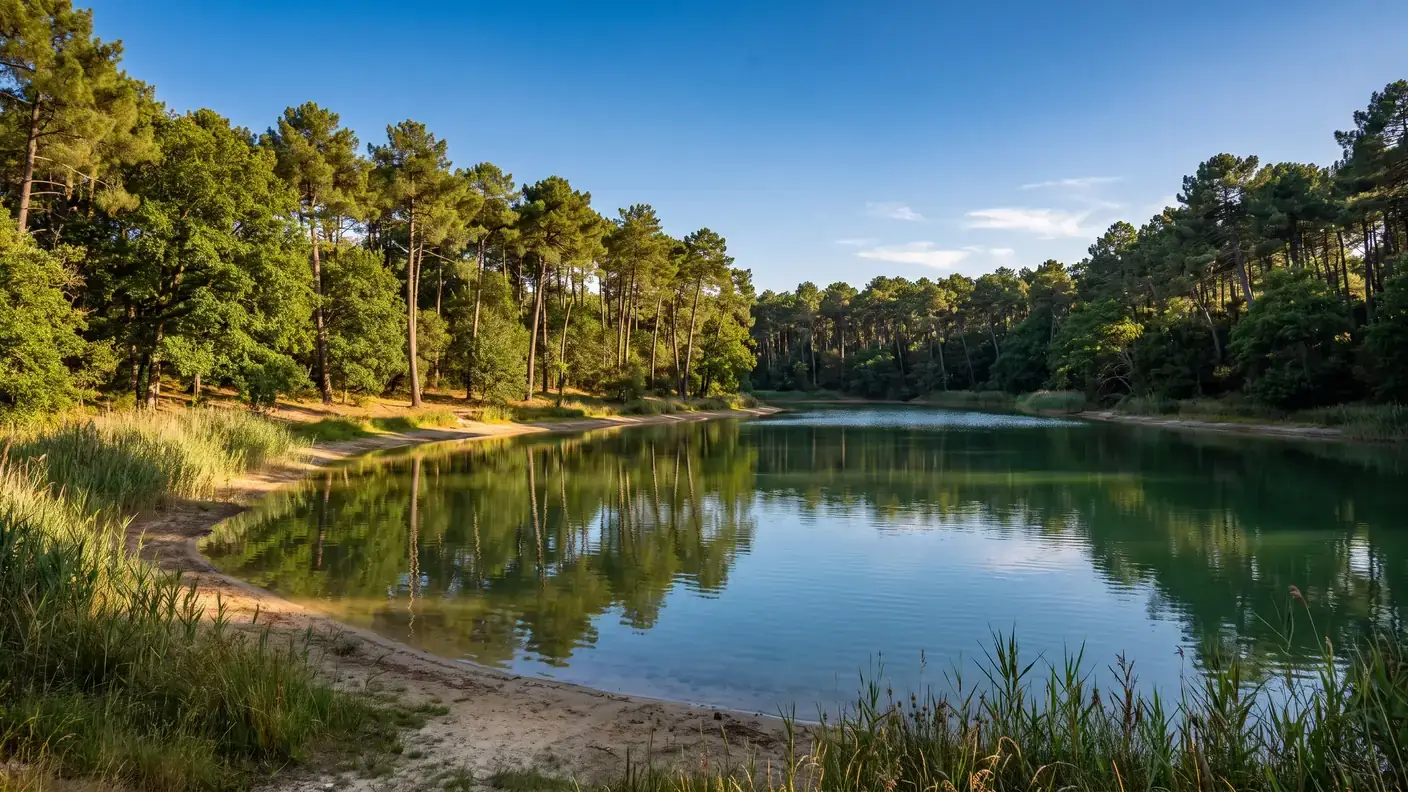
Every summer, the Freemusic Festival takes place on the shores of Lake Baron-Desqueyroux. Dates, artists, capacity limits, and admission policies vary by year: please check the official program before you come.
From a community hall to a major festival
The Freemusic Festival got its humble beginnings in 2001 at the Montendre multipurpose hall, thanks to the efforts of a local association (“à donf”) and its founder, Samuel Vincent. It moved to the castle in 2002 and then, starting in 2003, to the shores of Lake Baron-Desqueyroux, deep in the forest, where it has continued to grow ever since.
The first internationally renowned band, Nada Surf, performed there in 2003; since then, the lineup has featured major names from the French and international music scenes. Run by a team of volunteers, the festival showcases the cultural vibrancy of this small town and its ability to transform its forest and lake into a stunning setting for music—a striking contrast to the calm of the rest of the year, when Montendre returns to its peaceful life as a typical town in the Saintonge region. For visitors, attending the festival is a wonderful way to discover the town at its most festive, set against a unique natural backdrop.
Bons Bois Cognac
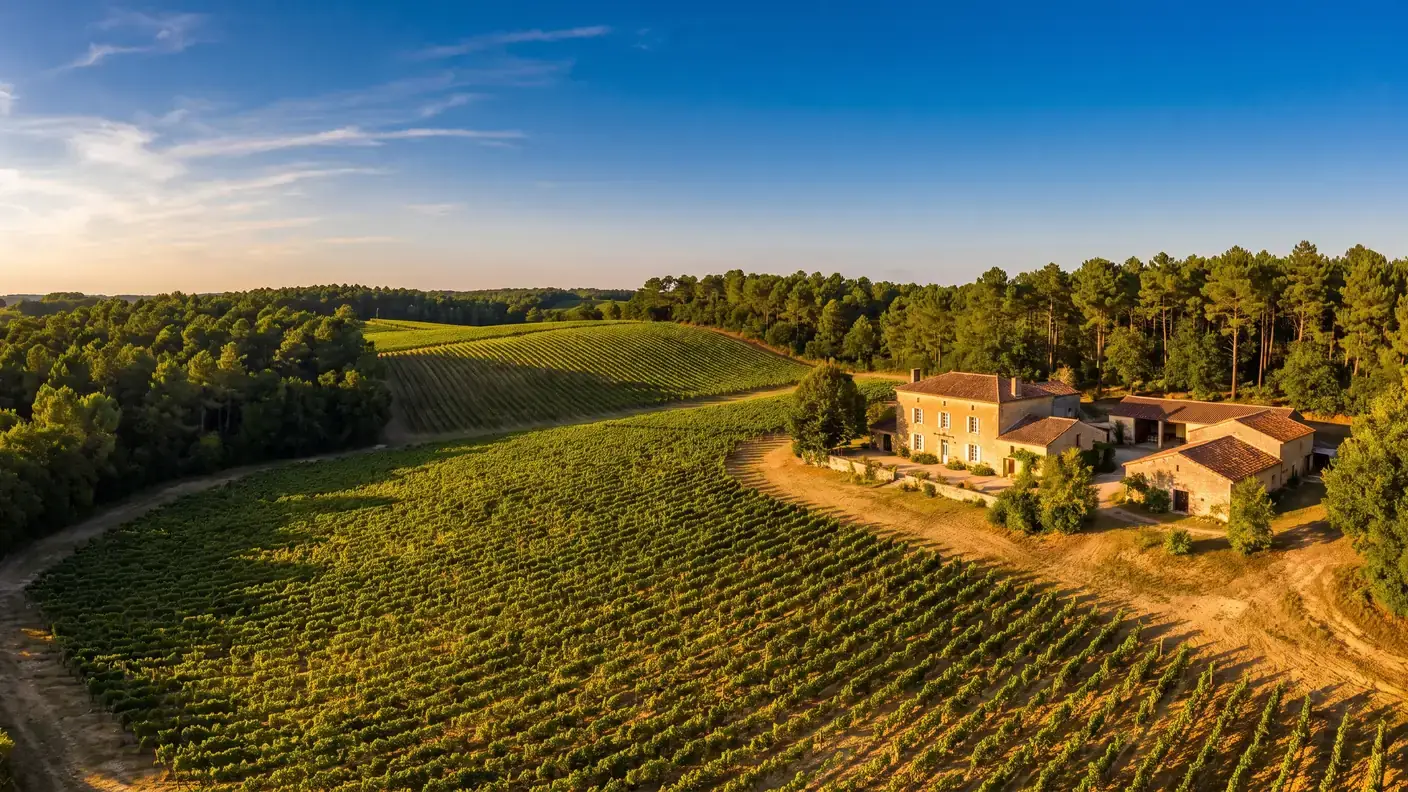
Like the rest of this part of Haute-Saintonge, Montendre is located in Cognac country—specifically in the Bons Bois appellation, which must be named precisely. A terroir on the edge of a vineyard and a forest, with a very distinctive character.
The Bons Bois Cru on Sandy Soils
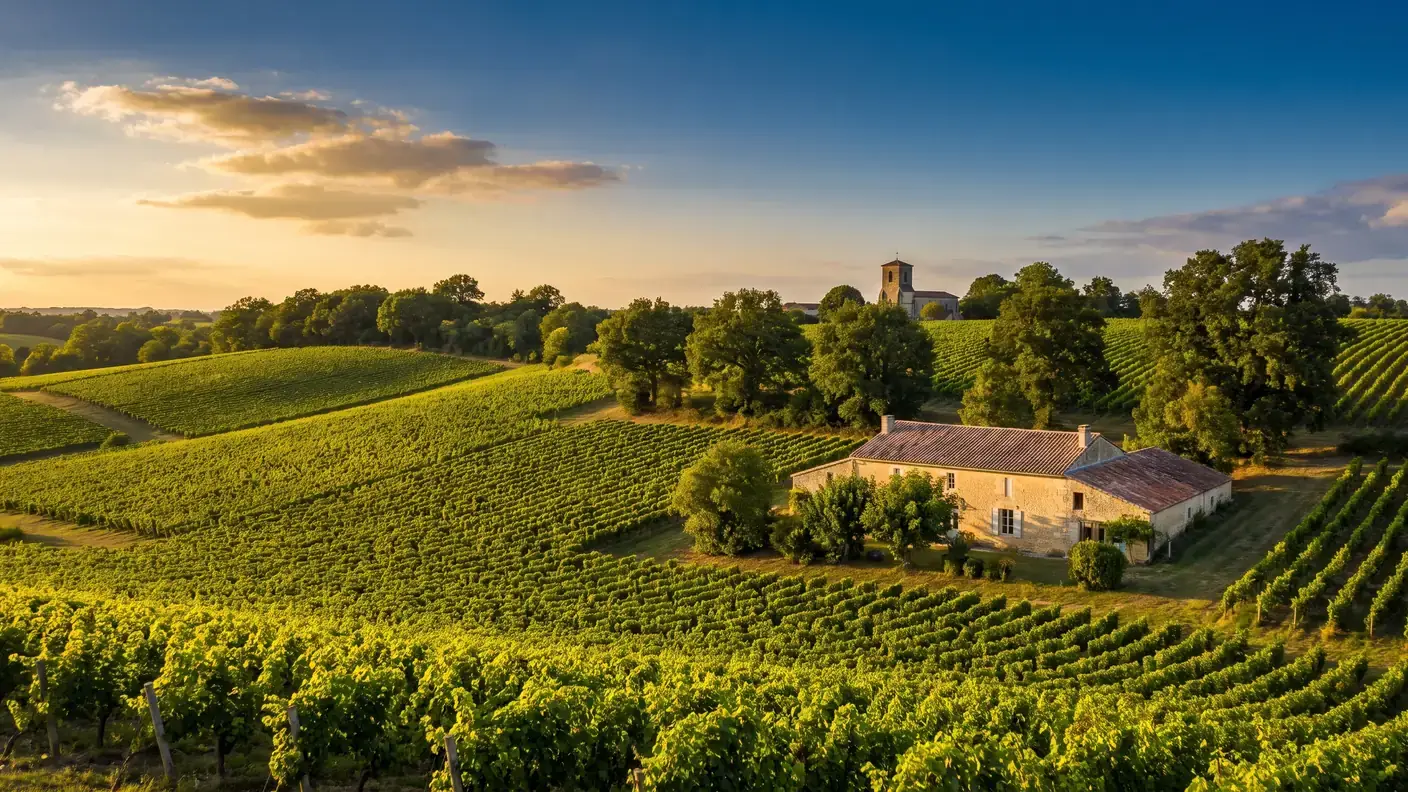
According to the official boundaries of the Cognac AOC published by the INAO, Montendre falls within the Bons Bois cru (official source). The official list of Fins Bois, meanwhile, includes Mirambeau to the north (official source). The Bons Bois form a wide outer belt around the central crus, on partly sandy soils—these sands “brought by erosion from the Massif Central,” which are characteristic of the southern part of the vineyard. The brandy produced here is renowned for its fruity aromas, rapid aging, and a distinct “taste of the terroir”—it is the cognac for family gatherings, straightforward and convivial, in contrast to the great, long-aged cognacs from the chalky Champagnes. At Montendre, the vineyards are mainly located on the north-facing slopes of the limestone “champagnes,” while the southern part of the town, which is sandy and acidic, is covered by forest. Here we are at the very edge of the vineyard, at the southernmost tip of the Cognac region, where the last rows of vines give way to the first pine trees of La Double.
Cognac and Pineau des Charentes
In addition to cognac, Montendre also produces Pineau des Charentes, a liqueur created by blending grape must with cognac brandy, whose appellation area exactly matches that of cognac. As throughout the appellation, the dominant grape variety is Ugni Blanc, distilled twice in Charentais stills and aged in oak barrels. But the town is also—and perhaps above all—a land of mixed farming: the “champagnes” in the north are home to large fields of wheat, corn, and sunflowers, while the south is covered by forest. For visitors, this is an opportunity to discover an authentic and lesser-known cognac from local producers, far from the major houses—a cognac that reflects the terroir, much like this town on the edge of the forest.
| The Six Cognac Grape Varieties | Location |
|---|---|
| Grande Champagne | heart of the region, chalky soils — the most prestigious |
| Petite Champagne | around Barbezieux, Archiac, and Jonzac |
| Borderies | the smallest wine-growing region, north of Cognac |
| Fine Woods | Wide ring — 1er cru in terms of area |
| Bons Bois (Montendre) | outer belt, sandy soils — second-largest in area |
| Wines from Specific Regions | coastal zone and islands |
What's there to see around Montendre?
Montendre is an excellent starting point for exploring Haute-Saintonge, its forest, and the Cognac region, at the border of three departments. Distances are short, and it’s easy to travel from a forest to a spa town, or from a vineyard to a charming village.
Mirambeau, Jonzac, and the Forest
Nearby, less than twenty kilometers away, Mirambeau—the “gateway to the Bordeaux region”—and its grand château (now a luxury hotel) offer further opportunities to explore Haute-Saintonge. About twenty kilometers away, Jonzac, the subprefecture, charms visitors with its castle, thermal baths, and historic district. To the east, Montlieu-la-Garde is home to the Maison de la Forêt, a departmental nature center that introduces visitors to the ecosystem of the Double—ideal for extending a walk through the forest. Further on, in the same wooded area, you’ll come across Brossac (in Charente) and its Vallier Pond, on the edge of the same Double region of Saintonge. This entire area forms a little-known and peaceful landscape of forests, ponds, and cognac.
Toward the estuary and the vineyards
If you venture a little further afield, you’ll quickly reach the area’s major attractions. To the west lies the Gironde estuary and its wine-growing villages; to the southwest, Blaye and its UNESCO-listed Vauban citadel, the gateway to the Bordeaux wine region. To the north lies the Cognac region proper, along with the picturesque little towns of Pons (home to its UNESCO-listed pilgrims’ hospital) and Barbezieux, in Charente. With an executive car service, you can easily plan a customized loop—through the forest, a vineyard, a château, or a spa town—whatever takes your fancy, without worrying about driving or parking. That’s the real appeal of exploring from Montendre, at the crossroads of Saintonge, Guyenne, and the Cognac region.
More broadly, Montendre opens the door to a little-known part of Haute-Saintonge—this region in the south of Charente-Maritime that vacationers often speed through on their way to Bordeaux or Spain without stopping. Yet it is a charming region, nestled between the Cognac hillsides, forests dotted with ponds, and small spa towns, where the food is excellent and life moves at a leisurely pace. The Haute-Saintonge Community of Communes—one of the largest in France, comprising over a hundred municipalities—brings together this entire rural and gourmet region. For those seeking an authentic Southwest, far from the crowds, the Montendre region—with its forests, vineyards, and stone villages—is an ideal starting point, made all the easier to explore with a driver who effortlessly connects these sites scattered across the countryside and beneath the pine trees.
| Around Montendre | Distance | Interest |
|---|---|---|
| Mirambeau | ~18 km | Château (luxury hotel), gateway to the Bordeaux region |
| Jonzac | ~20 km | Subprefecture, thermal baths |
| Montlieu-la-Garde | ~15 km | Forest House (Nature Center) |
| Blaye | ~29 km | Vauban Citadel (UNESCO), vineyard |
| Barbezieux (Charente) | ~40 km | Château, the Cognac Region |
Travel to Montendre from Bordeaux
Montendre is located 64 km from Bordeaux, which is about a 1-hour, 7-minute drive, according to the booking engine. The town also has a train station served by direct TER trains to Bordeaux-Saint-Jean; check the daily schedule on SNCF Connect.
Train or chauffeured transfer?
The train is an option for getting to Montendre itself. To explore the forest, Jonzac, Mirambeau, or the vineyards, a private chauffeur offers a direct ride with scheduled stops. The fare shown by the search engine is €125 for a one-way trip in the Eco class, based on a distance of 64 km and a travel time of approximately 1 hour and 7 minutes from downtown Bordeaux.
This is the perfect option for a nature getaway in the Forêt de la Double, a tour of the château, a cognac tasting, a visit to the Freemusic Festival, or a transfer to the Bordeaux-Mérignac Airport. You can travel alone, with your family, or in a small group of up to 8 people, with luggage, and request stops in Mirambeau, Jonzac, or at a winery along the way. Booking is simple: just provide your pickup address in Bordeaux and your destination at Montendre, along with the date, time, and number of passengers, and you’ll receive a fixed-price quote in writing. On the day of travel, the driver picks up the passengers at the agreed-upon address and takes them directly to Montendre, without any detours.
| Route | Distance | Duration | Landmark |
|---|---|---|---|
| Bordeaux → Montendre | 64 km | 1 hour 7 minutes | Starting at €125 for a professional chauffeur |
| Montendre → Mirambeau | ~18 km | ~19 min | castle, gateway to the Bordeaux region |
| Montendre → Jonzac | ~20 km | ~22 min | subprefecture, thermal baths |
| Montendre → Blaye | ~29 km | ~33 min | Vauban Citadel |
For a wonderful day trip starting from Bordeaux, you can enjoy a series of discoveries: a walk through the Forest of La Double and along the banks of a pond, a visit to the château and its museum, a stroll through the old town and under the market halls, a Bons Bois cognac tasting at a producer’s—and why not make a detour to Mirambeau or the Jonzac thermal baths, both nearby. All of this within a radius of about twenty kilometers, along small country roads lined with vineyards and pine trees. This is the kind of flexible itinerary—blending nature and heritage—that you can’t experience by train alone, and which truly comes into its own with a driver: the freedom to set your own schedule, stops whenever the mood strikes, and the pleasure of discovering the secret, forested Southwest.
Whether you come for the castle and its museum, the vast Double Forest and its ponds, the market halls and the town’s heritage, Bons Bois cognac, or the Freemusic Festival, Montendre is a treat for lovers of the authentic Southwest, nestled among vineyards, stone buildings, and pine trees.
Whether it’s for a day trip to explore Haute-Saintonge, a nature getaway, or an event, booking a door-to-door car service guarantees a comfortable and punctual ride—book a driver from Bordeaux to Montendre or explore all our destinations.
Frequently Asked Questions
Where is Montendre located?
Montendre is a small town in Charente-Maritime (17), in the far south of Haute-Saintonge. According to INSEE, it had a population of 3,222 in 2023. Centered around its castle and bordered by the Double Forest, it is located about 1 hour and 7 minutes from Bordeaux—a distance of 64 km, according to the search engine’s results—and has a direct TER train connection.
What is the distance between Bordeaux and Montendre?
The booking engine shows a distance of 64 km, a travel time of approximately 1 hour and 7 minutes, and fares starting at €125 for a one-way trip from downtown Bordeaux in Economy class. Montendre also has a train station served by direct TER trains to Bordeaux-Saint-Jean. Check today’s SNCF schedules before deciding between the train and a door-to-door trip.
Is Montendre Castle a designated historic site?
No: No buildings in the municipality of Montendre—castles, market halls, churches—are designated as historic monuments. The castle consists of the ruins of a medieval fortress (first mentioned around the 9th century, rebuilt in the 12th century, and remodeled in the 15th century), of which a tall square tower housing a museum, a round tower, ramparts, and underground passages remain. Owned by the municipality since 1953, the site is home to an open-air theater. Only movable objects within the churches are classified as historic monuments.
Are the market halls in Montendre medieval?
No, despite their old-fashioned appearance: the octagonal market halls of Montendre date from the 19th century, specifically 1863. They are, however, the successors to the medieval market halls around which the town was organized, and they carry on a long market tradition. Their unusual octagonal layout makes them a distinctive and iconic building in the town. Similarly, the town’s Saint-Pierre Church, which appears to be Romanesque, is in fact Neo-Romanesque (1812–1821) and not medieval.
Which Cognac cru includes Montendre?
According to the official AOC Cognac boundaries published by the INAO, Montendre falls within the Bons Bois cru. The official list of Fins Bois, meanwhile, includes Mirambeau to the north. The Bons Bois form a wide outer belt around the central crus, on soils that are partly sandy and originate from the Massif Central; the eau-de-vie produced here is fruity and ages quickly. Vineyards are found primarily on the limestone hillsides in the northern part of the commune, while the southern part is forested. Montendre also produces Pineau des Charentes.
What is the Double Forest in Montendre?
It is one of the largest forest areas in Charente-Maritime, stretching just outside Montendre: the Double Saintongeaise Forest, a vast expanse of maritime pines, oaks, and chestnut trees, dotted with numerous ponds (some of which are equipped for swimming). On its acidic, sandy soils, it is home to rare wildlife protected by two Natura 2000 sites: the European pond turtle, the otter, and the European mink. The GR 360 hiking trail runs through it, and a nearby Forest Visitor Center offers insights into its ecosystem.
Where does the name Montendre come from?
Contrary to popular belief, “Montendre” does not come from “mont tendre” (a gentle hill); that is a folk etymology. The original form, attested as early as 1116, is “Monte Andronis,” meaning “Mont-” followed by a man’s name (likely the Germanic “Andar”). The legend of a Roman officer named Andron, a lieutenant of Crassus, is also unfounded. The same name pattern is found in the neighboring towns of Montguyon and Montlieu, which give their name to the Trois Monts canton.
What is the Freemusic Festival?
This is the Montendre music festival. It began modestly in 2001 at the multipurpose hall and has been held since 2003 on the shores of Lake Baron-Desqueyroux, deep in the forest. It has hosted big names from the international music scene, including Nada Surf as early as 2003. Created by a local nonprofit, the festival showcases the city’s cultural vitality and, for one summer, transforms its forest into a magnificent musical setting.
What to see in Montendre?
The ruins of the medieval castle and its museum tower; the unique 19th-century octagonal market halls; the Neo-Romanesque Saint-Pierre Church and the Protestant church; the churches of Chardes and Vallet, including the Romanesque crypt of Saint-Babylas; and above all, the vast Double Forest, with its ponds and protected wildlife (Natura 2000, GR 360). In the summer, the Freemusic Festival. Nearby, Mirambeau, Jonzac and its thermal baths, the Maison de la Forêt in Montlieu-la-Garde, Blaye, and the estuary.
How many people live in Montendre?
According to the 2023 census, the town had a population of approximately 3,222, making it one of the main towns in southern Charente-Maritime, with a population density of nearly 130 people per square kilometer. After peaking at nearly 3,500 residents in 1975, the population has stabilized at around 3,200, with a slight decline due to an aging population. Montendre remains a lively little local hub, featuring shops, a middle school, and a cultural center. Its residents are known as Montendrais.
Is there a train station in Montendre?
Yes, which is rare for a town of this size in this rural area: Montendre has an active passenger train station on the Chartres–Bordeaux-Saint-Jean line, served by the Nouvelle-Aquitaine TER trains. The town is therefore directly connected to Bordeaux by rail. The train is a convenient way to reach Montendre itself, but to explore the surrounding forest, vineyards, and villages—which have limited public transportation—hiring a chauffeured car from Bordeaux remains the most flexible option.
What's there to see around Montendre?
Mirambeau, the “gateway to the Bordeaux region,” and its castle-turned-luxury hotel (~18 km); Jonzac, the spa town and subprefecture (~20 km); the Maison de la Forêt in Montlieu-la-Garde (~15 km); Brossac and its Vallier Pond, in the same Double Forest; Blaye and its Vauban citadel, a UNESCO World Heritage Site (~29 km); Pons and its UNESCO-listed pilgrims’ hospital. We are in the heart of a region of forests, ponds, and cognac, at the border of Saintonge, Guyenne, and Charente.
Can I book an executive transfer from Bordeaux to Montendre?
Yes. We offer the Bordeaux → Montendre route, which is listed as 64 km, taking approximately 1 hour and 7 minutes, and costing €125 one-way in the Eco class from downtown Bordeaux. The trip is direct and door-to-door, with the option to make scheduled stops—convenient for a getaway to the Forêt de la Double, a visit to the castle, a cognac tasting, or a trip to the Freemusic Festival.
Further Reading
- The gateway to the neighboring Bordeaux region: see the Mirambeau Guide (the château-turned-luxury-hotel and the Fins Bois cognac), 18 km away
- Another village in the Double region: see the Brossac Guide (Vallier Pond, the Gallo-Roman villa, and Bons Bois cognac)
- The Land of Cognac: See the Cognac Guide (the major houses, the Charente method, and the six crus)
- Plan your trip: view the route from Bordeaux to Montendre, check the listed fares, and book your trip, or explore all our destinations
Sources and References
- Wikipedia — Montendre — geography, demographics, history, castle, heritage, forest
- Wikipedia — Cognac Regions — General Overview of the Regions and the Appellation Area
- INAO — Cognac Bons Bois — official boundaries; Montendre included in the municipal list (accessed July 24, 2026)
- INAO — Cognac Fins Bois — official boundaries; Mirambeau included in the list of municipalities (accessed July 24, 2026)
- POP / Palissy Collection — Virgin of Mercy (Croix-Genté) — listed artifact (February 6, 1979), late 15th-century Pietà
- Wikipedia — Double Saintongeaise — pine forest, ponds, protected wildlife, Natura 2000
- INSEE — Regional Comparison Tool, Montendre (17240) — 2023 population: 3,222 residents
- SNCF Connect — Montendre to Bordeaux schedules — direct TER connections; check schedules based on the date
Article updated in July 2026.
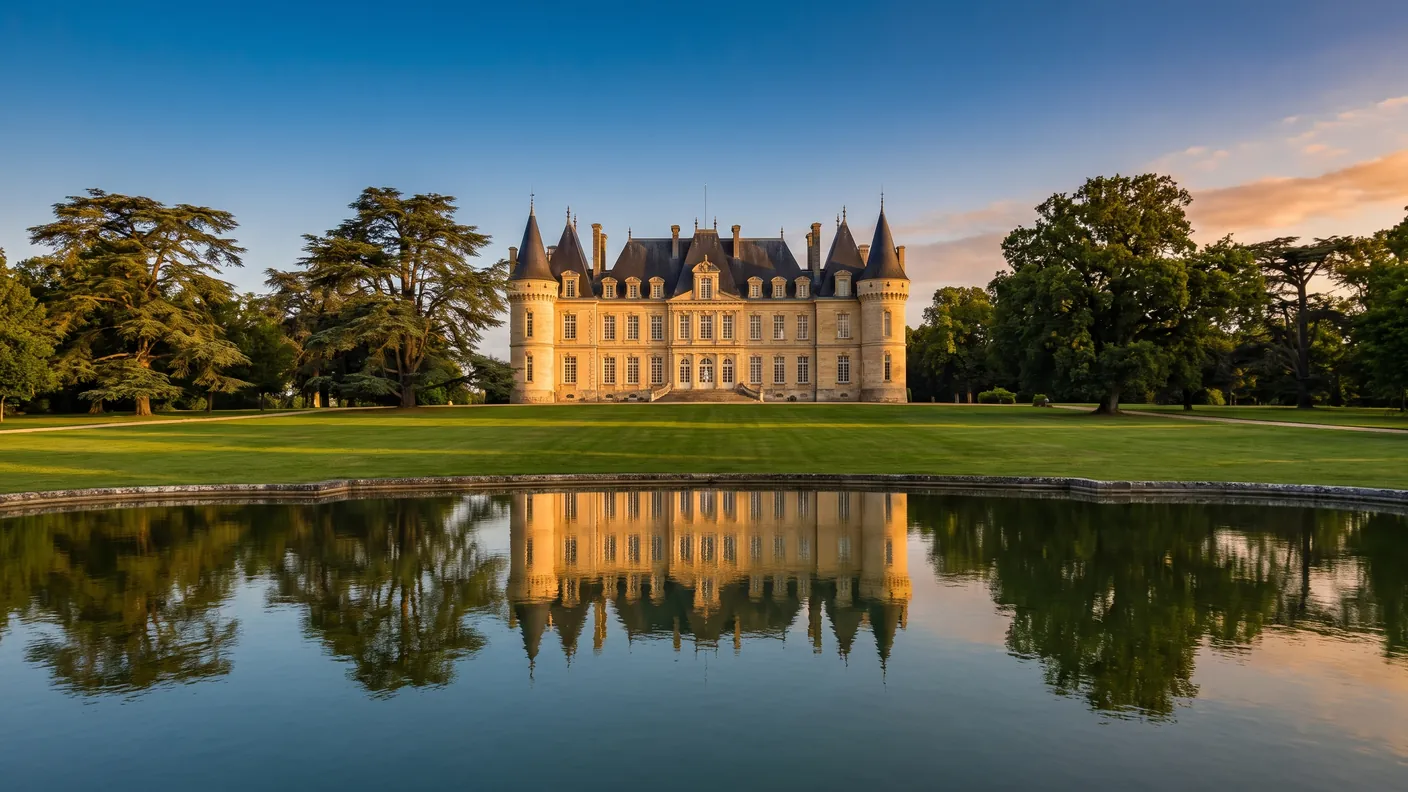
Off to the Double Forest
Direct trip from Bordeaux (~1h07) to Montendre, with its forest and castle; stop wherever you like along the way—Mirambeau, Jonzac, and a Cognac vineyard. Written fixed-price quote—no surprises on the meter.