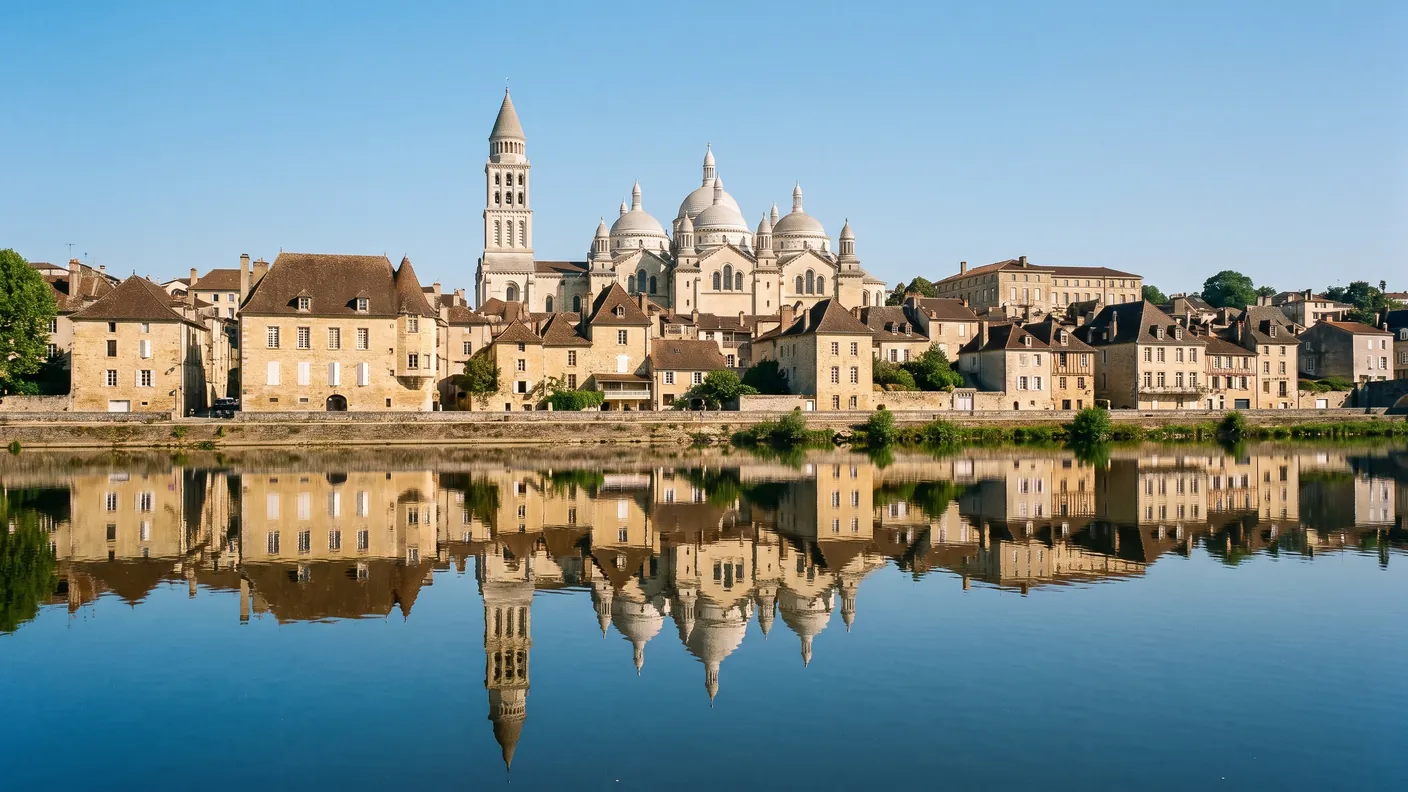
Bordeaux to Périgueux: Vesunna and Saint-Front
The “mille-feuille” city of Périgord: a Gallic temple and a Roman amphitheater open to the public, two rival medieval towns united in 1240, a cathedral that inspired the Sacré-Cœur, and a domus under a glass roof designed by Jean Nouvel. Everything you need to know before you visit, about 1 hour and 45 minutes from Bordeaux.
Périgueux at a Glance
- Périgueux (population 29,055, prefecture of the Dordogne) is a city with a history spanning two thousand years: beneath its streets lies Vesunna, the Gallo-Roman capital of the Petrocores, of which a temple, an amphitheater, and a domus under a glass roof still stand.
- The present-day city was formed by the merger of two rival towns—La Cité and Le Puy-Saint-Front—under a treaty signed on September 16, 1240… which did not prevent two rival mayors from holding office from 1299 to 1368.
- Its cathedral Saint-Front, five Greek cross-domed churches listed on theUNESCO, served as a model for the Sacré-Cœur in Montmartre — same architect, Paul Abadie.
- The Vésone Tower (24.46 m), the cella of the temple dedicated to the goddess of the same name, and the Jardin des Arènes—an amphitheater with a capacity of 18,000 that has been converted into a public park—are open to visitors free of charge.
- The Vesunna Museum, designed by Jean Nouvel (2003), shelters a richly decorated Roman domus beneath a glass roof shaped like a bell—surrounding a preserved century-old oak tree.
- City of markets: Wednesdays and Saturdays around the cathedral, the Coderc Market Hall every day, and the famous truffle market on Place Saint-Louis from December through February.
- A Michelin-starred restaurant (L'Essentiel), the MIMOS festival, one of France's first designated conservation areas (1970)—and a stage of the 2026 Tour de France.
- From Bordeaux by car: ~135 km, about 1 hour and 45 minutes via the A89 — starting at 230 € for a private driver, door-to-door.
Before You Go: What Périgueux Really Is
Saturday, 10 a.m., Place de la Clautre. The market stalls are set against the white domes of Saint-Front—a silhouette you’d swear you’d seen in Montmartre, and you wouldn’t be wrong. A ten-minute walk away, a 25-meter-tall Roman cylinder rises from a public park; a little further on, first-century arches frame a children’s playground. Périgueux doesn’t just visit its history—it walks right through it, crosses it, and does its shopping there.
Périgueux is a rare urban tapestry: a former Gallic and then Gallo-Roman capital (Vesunna), a medieval city born from two rival towns that cordially detested one another, a pioneering historic preservation district dotted with Renaissance hotels, and a vibrant prefecture with 29,055 residents—the largest city in the Dordogne, at the heart of a metropolitan area of over 100,000 people (INSEE, municipal report, accessed July 24, 2026). The entire area is irrigated by the Isle River and supplied by a single spring, the Abîme, which provides 35,000 m³ of water per day.
This guide separates fact from legend: the true area of Vesunna (60 hectares according to the museum, not 80), the exact name of the dignitary who donated the amphitheater “out of his own pocket,” the quote from Victor Hugo that no one has ever been able to trace, the Byzantium-Venice debate that has been stirring scholars since 1851, and the very tangible connection linking Saint-Front to the Sacré-Cœur—right down to the chandeliers from Napoleon III’s wedding that hang beneath the domes. Includes 2026 rates, market days, and actual driving distances.
In terms of logistics, the Périgueux station provides access to Bordeaux via the TER. Schedules, travel times, and frequency vary depending on the day and any construction work: be sure to check your chosen route before departure. To explore Brantôme, Lascaux, or Les Eyzies from there, a private chauffeur from Bordeaux turns the prefecture into a base camp for the Périgord region.
29,055 residents, a river, a spring: Périgueux today
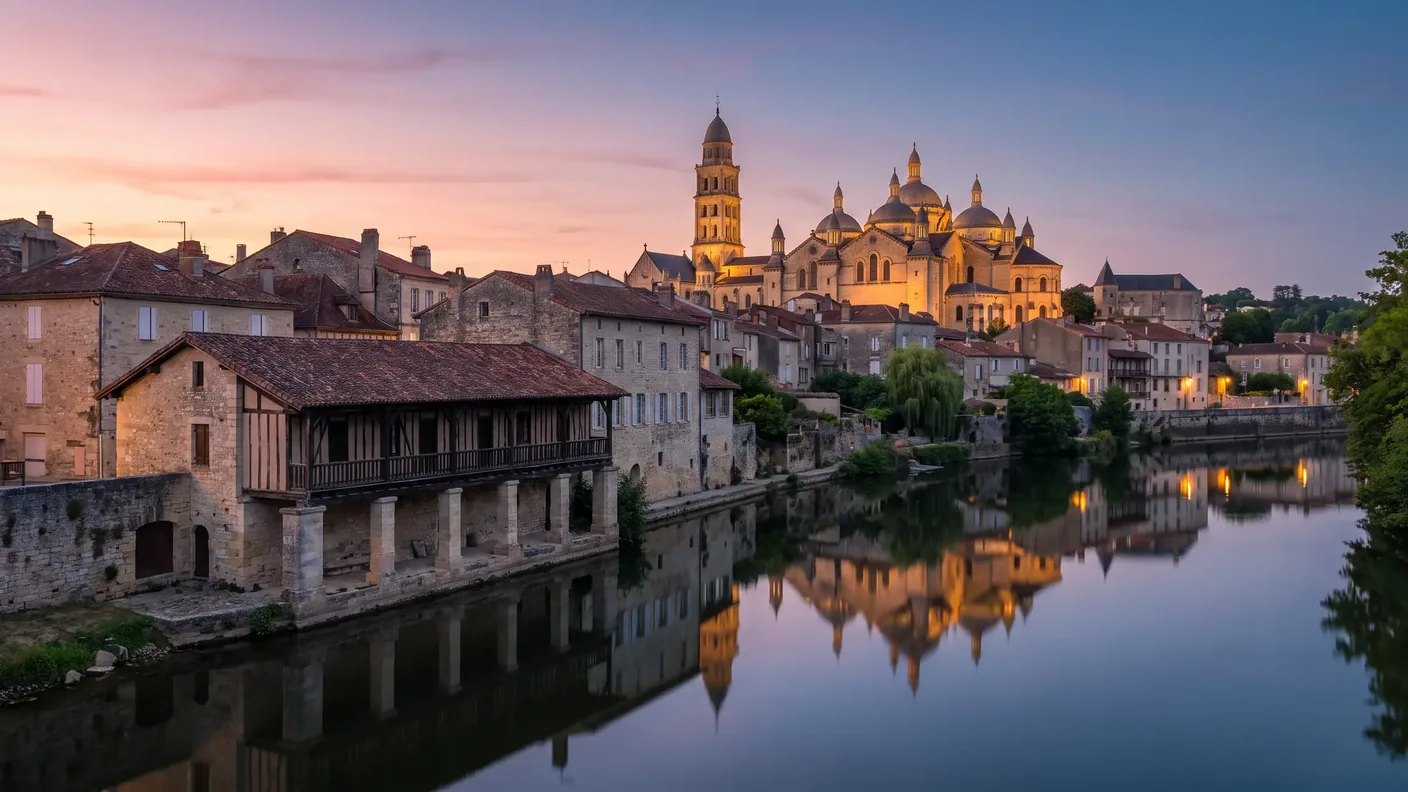
Périgueux covers 9.82 km²—one of the smallest prefectures in France by area, resulting in a population density of nearly 3,000 inhabitants per km². The Isle River, which is 255 km long in total, flows through the prefecture from east to west for 8.5 km; it was the river’s meander on the right bank that shaped the ancient city, and today its riverbanks offer the most picturesque view of the cathedral. A little-known but verified fact: the entire city draws its water from a single spring, the Abîme, a Vaucluse resurgence in the Toulon neighborhood that discharges an average of 35,000 m³ per day—tapped since 1835, and of such high quality that it requires no pretreatment.
| Data | Value |
|---|---|
| Status | Dordogne Prefecture — the department's largest city |
| Population | 29,055 residents (2023) — Périgourdins, or Pétrocoriens |
| Metropolitan Area | urban area: 65,799 residents · catchment area: 114,362 residents (49 municipalities) |
| Area | 9.82 km² (population density ≈ 2,959 people/km²) |
| River | l'Isle (255 km), crossing over 8.5 km |
| Label | City of Art and History (1987) · Pioneering Preserved Area (1970) |
| UNESCO | Saint-Front Cathedral (Routes to Santiago de Compostela, 1998) |
| Distance from Bordeaux | ≈ 135 km (~1 hour 45 minutes via the A89, Exit 15) |
The Isle hasn’t always been merely decorative: it was navigable for 87 km, equipped with forty locks between Périgueux and its confluence with the Dordogne at Libourne—where flatboats carried timber and wine downstream toward Bordeaux. It can also turn fierce: the once-in-a-century flood of December 8, 1944, submerged a large part of the left bank. In fact, it was the railroad, more than the river, that shaped the modern city: the arrival of the train in 1857 caused the population to skyrocket from 16,291 (1856) to 31,439 (1891)—the railroad workshops transformed the prefecture into a working-class city.
The demographic trends of the 20th century then tell the story of medium-sized French cities in fast-forward: an all-time high of 40,865 residents in 1946, followed by a long decline (−14.1% between 1946 and 1975) as people moved to the suburbs — the city center has stabilized at around 29,000–30,000 residents since the 1990s, while its catchment area has continued to grow. Residents are known by two demonyms: “Périgourdins,” the more common term, and “Pétrocoriens,” the scholarly one—which literally links today’s residents to the founding Gallic people. For it all began with them.
Vesunna: The Gallic Capital Lying Beneath the City
The Pétrocores, “the four armies”
Before Rome, the country belonged to the Pétrocores — in Gaulish petru-corios, “the four armies” or “four clans,” according to the most common interpretation. A people skilled in working iron (Strabo praised their metallurgy), who sent approximately 5,000 warriors under Vercingetorix in 52 B.C. and lived in a fortified settlement on high ground at La Boissière. The two names derive from this people: Périgueux and Périgord. During Augustus’s major reorganization of Gaul, a new city was founded in a bend of the Isle River, between 25 and 16 B.C. : Vesunna, named after the patron goddess of the Petrocores—probably a goddess of the waters, like Nemausus, who gave Nîmes its name. Capital of the Petrocores, one of the 21 cities in the province of Aquitaine.
In the 1st and 2nd centuries, the thriving city covered an area of about 60 hectares (up to 80 according to some estimates): a monumental temple, an amphitheater, a forum, thermal baths, aqueducts, and opulent residences. Then came the upheaval of the late 3rd century—an invasion traditionally attributed to the Alemanni, or more prosaically, the general climate of insecurity. The city shrank abruptly to 5.5 hectares, behind a rampart built between 276 and 290 by dismantling monuments from the High Empire: 24 towers, 23 curtain walls, 4 gates, and walls 10 meters high. The fortified core took the name Civitas Petrucoriorum—the future “Cité” district. The name of the people had already begun to supplant that of the goddess.
The Tower of Vésone: The Holy of Holies of the Goddess
This cylinder, which is 24.46 meters tall (27 m from the foundation rock), 19.60 m in diameter, and has walls 2.10 m thick, is not a tower: it is the cella—the most sacred part—of the temple of the goddess Vesunna. Built between the late 1st century and the first half of the 2nd century (dedicated around 121–150 according to the epigraphy), the entire sanctuary was colossal: the cella surrounded by a circular peristyle, a pronaos with six columns, all raised on a podium in the center of a porticoed courtyard measuring 141 m by 122 m—nearly two hectares. And nothing was left bare: marble slabs covered the stone. The architecture combines the Celtic fanum (centered plan) with the classical Roman temple—the Romanized Gallic elites displayed their loyalty to both traditions in a single gesture.
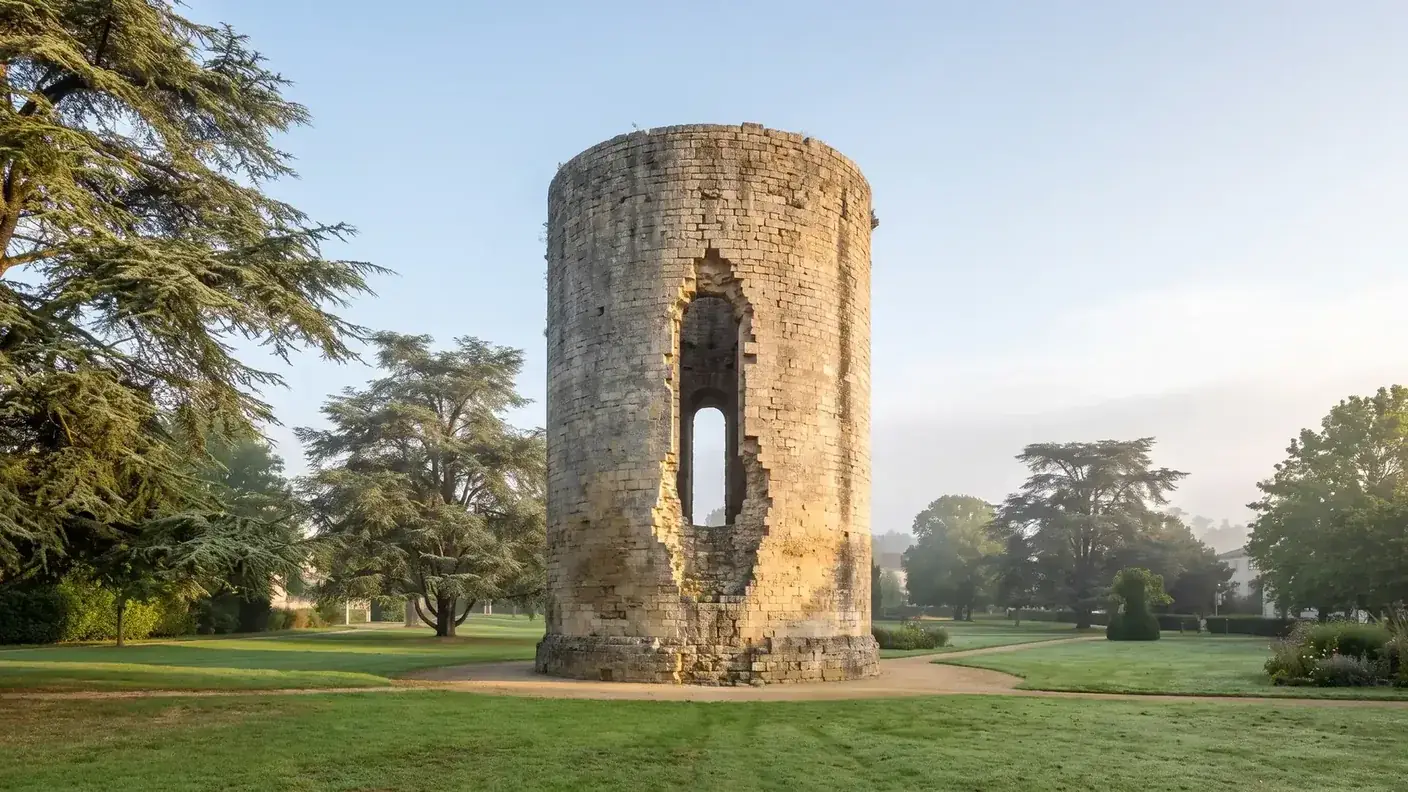
The a breach nearly 9 meters wide There are two explanations for the gaping hole on the east side. The documented one: the removal of the large blocks that formed the entrance gate—likely reused for the later rampart—caused the upper section to collapse. The legendary one: Saint Front is said to have broken through the wall with a blow from his staff while driving out the demons that had taken refuge in the tower. The monument’s modern history is fascinating: the first excavations, launched in 1751 by the bishop, were halted “following a panic among the workers”; they were resumed in 1820 by the Count of Taillefer—who believed the temple was dedicated to Isis, before the inscriptions revealed Tutela Vesunna. Designated a historic monument in 1846 (Official Mérimée Record PA00082762(accessed July 24, 2026), the tower now stands in a public park free, 50 meters from the Vesunna Museum—and right next to the railroad tracks, the construction of which destroyed the sanctuary’s enclosure in the 19th century.
The amphitheater: larger than the one in Nîmes, now a kindergarten
Here's a fact that few visitors know: the footprint of the Périgueux amphitheater—an ellipse measuring approximately 141 × 118 meters — exceeds that of the arenas in Nîmes and Arles. To be honest: its capacity (approximately 18,000 spectators (spanning four tiers of seating, ~30 m high) remained smaller. It is nonetheless one of the largest amphitheaters in Gaul, construction of which began under Tiberius and completed in the second half of the 1st century—donated by a local dignitary, Aulus Pompeius, a military tribune and prefect of the workers, whose dedicatory inscription proudly states that he donated “the amphitheater with all its ornaments, out of his own pocket ».
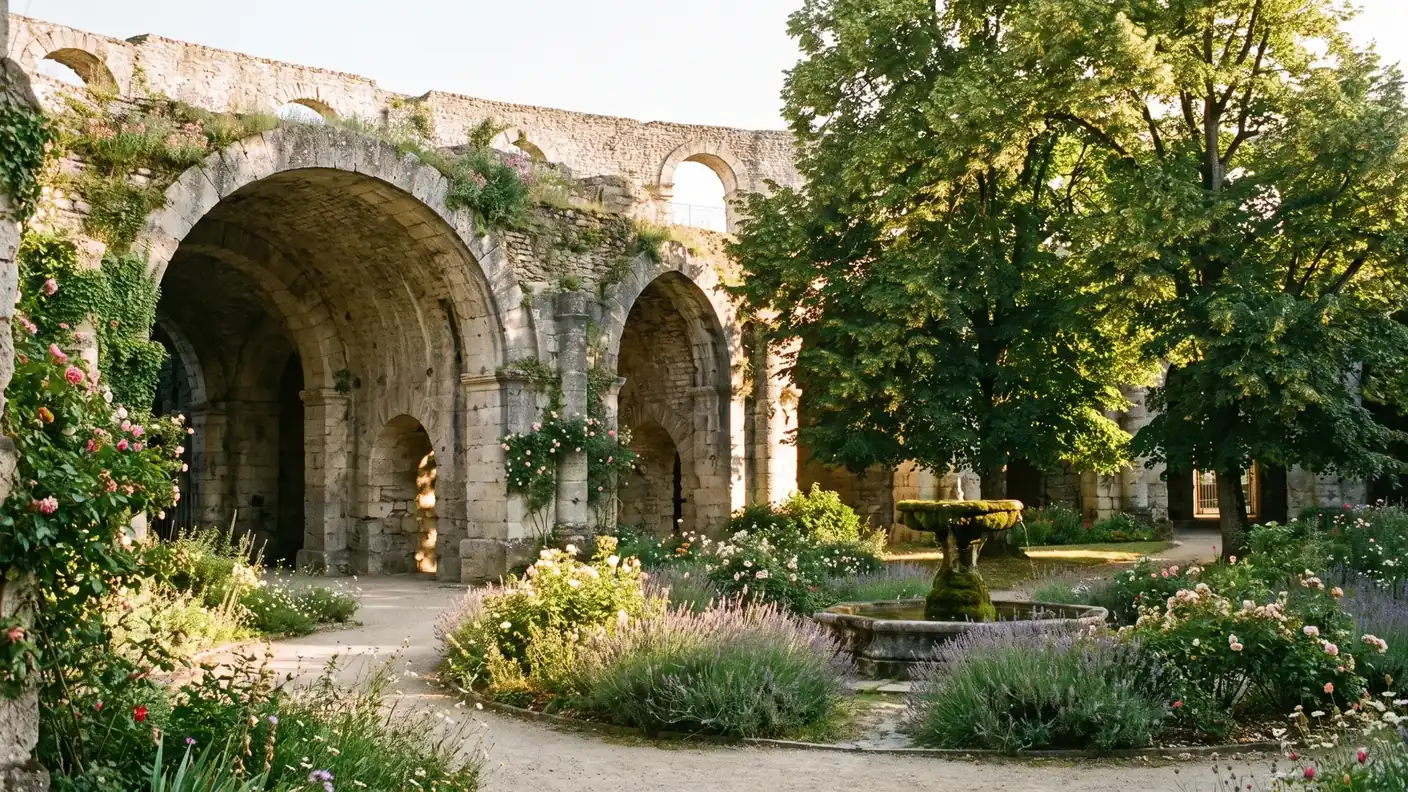
Its successive incarnations encapsulate the entire history of the city. In the 4th century, the shrinking city enclosed it within its ramparts: the entertainment venue became a bastion. In the Middle Ages, the Count of Périgord built his keep there—the Château de la Rolphie, which was captured and demolished by the inhabitants in 1390–1391. An engraving from 1575 still shows it as “almost intact, with two tiers of seating”: it was not invasions that destroyed it, but the modern era. Starting in 1644, the Visitation Sisters dismantled it to build their convent’s church; in 1688, they had statuettes of Roman goddesses discovered on the site—deemed “pagan idols”—smashed. Listed as early as Mérimée’s famous 1840 inventory, transformed into a public garden in 1875, the site is now the Jardin des Arènes: free and open to the public, featuring arcades and vaulted passageways—and, since 2021, water play areas for children in the center of the former arena. The gladiators would approve.
A city born from two rival cities (and the treaty of 1240)
La Cité vs. Le Puy-Saint-Front
For centuries, there was not just ONE city here, but two—a few hundred meters apart, each behind its own walls. La Cité, the direct successor to Vesunna within the 3rd-century fortified perimeter, was the city of the bishop and the count, with its Saint-Étienne Cathedral built on the site of a temple to Mars. And Le Puy-Saint-Front, founded at the end of the 10th century around the monastery built by Bishop Frotaire on the presumed tomb of Saint Front, the legendary evangelizer of the Périgord. Driven by pilgrims on the Way of St. James and trade, the merchant town quickly became the more prosperous of the two, remaining loyal to the King of France, while the Count’s city shifted allegiances with the tides of war… sometimes siding with the English.
The September 16, 1240, after decades of rivalry, the two communities signed a treaty of union: mutual forgiveness of grievances, mutual assistance, and a single city—a universitas — governed by a mayor and about ten council members… of which only two are for the Cité. The balance of power is reflected in the numbers. A telling detail: the plan for a common defense structure provided for in the treaty was not never achieved — Each city kept its walls. And the rivalry lived on in writing: from 1299–1368, each of the two towns elected its own mayor. It took more than a century for the union on paper to become a de facto city.
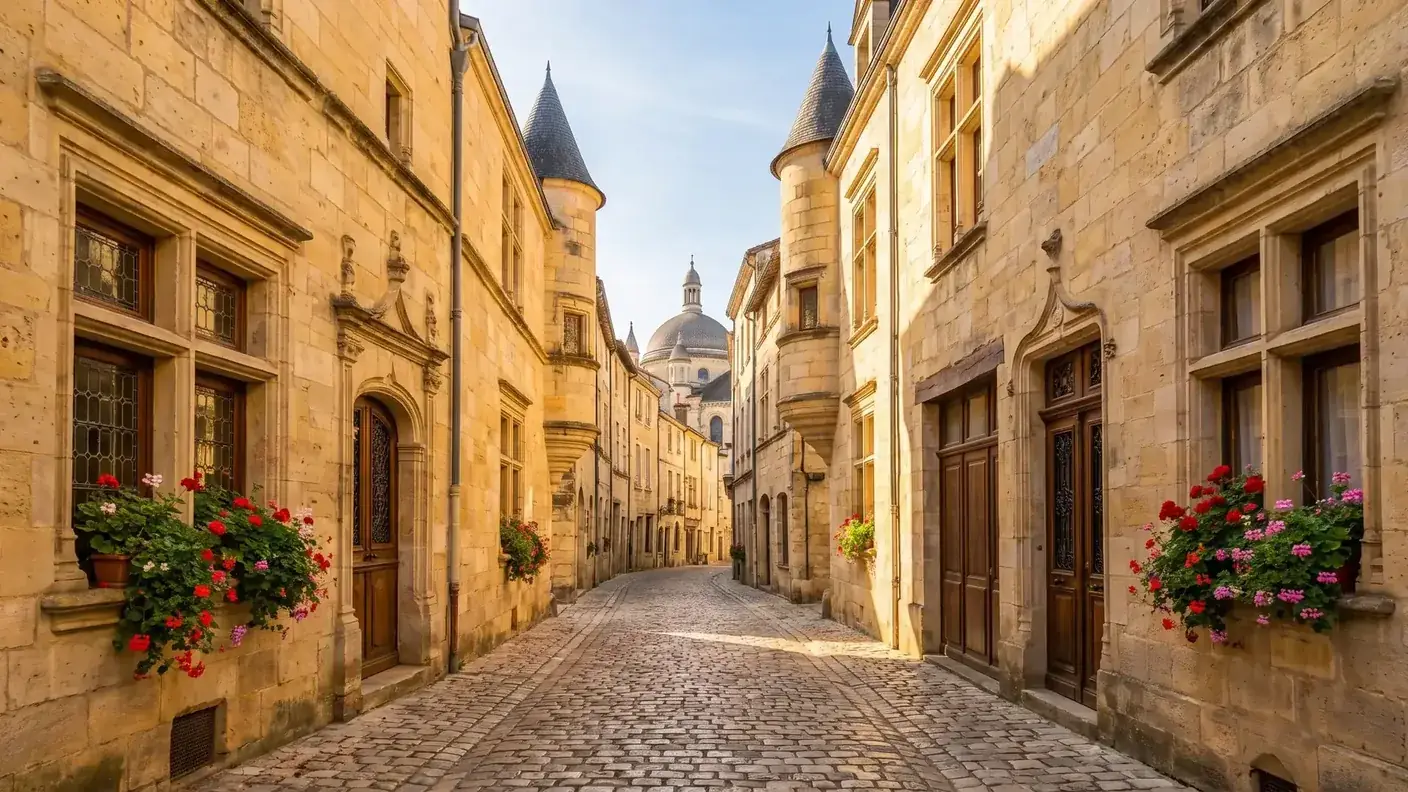
All of this medieval and Renaissance heritage—known as Périgueux—can be explored today within the protected historic district—established on January 29, 1970, one of the very first in France following the Malraux Law, and currently being expanded to 42.8 hectares. Must-see landmarks: the Mataguerre Tower (the last of the 28 towers of the Puy-Saint-Front city walls, rebuilt in 1477, designated a historic monument in 1840 when the ramparts were razed in 1876), Rue Limogeanne and its Renaissance facades, the listed staircase of the Hôtel de Lestrade on Rue de la Sagesse, and the Maison des Dames de la Foi on Rue des Farges—a Romanesque house once associated with the Knights Templar. Two neighborhoods, two atmospheres: eight centuries later, the urban fabric still bears the traces of the two towns that never quite merged.
Saint-Front: Byzantium in the Périgord (and a scholarly debate dating back to 1851)
The history of the Dordogne’s most famous monument is a history of destruction: a first church built by Bishop Chronope between 500 and 536, destroyed by the Normans in 845; a large abbey church consecrated on March 21, 1047, ravaged by fire in 1120. From this disaster arose the current building, completed between 1160 and 1170: a Greek cross plan topped by five domes supported by pendentives—unique in France on this scale—with a 62-meter bell tower. The abbey church, a major stop for pilgrims to Santiago de Compostela on the Via Lemovicensis, did not become a cathedral until 1669—replacing Saint-Étienne-de-la-Cité, which had been severely damaged by the Wars of Religion. It has been listed as a UNESCO World Heritage Site since 1998 as part of the Routes of Santiago de Compostela.
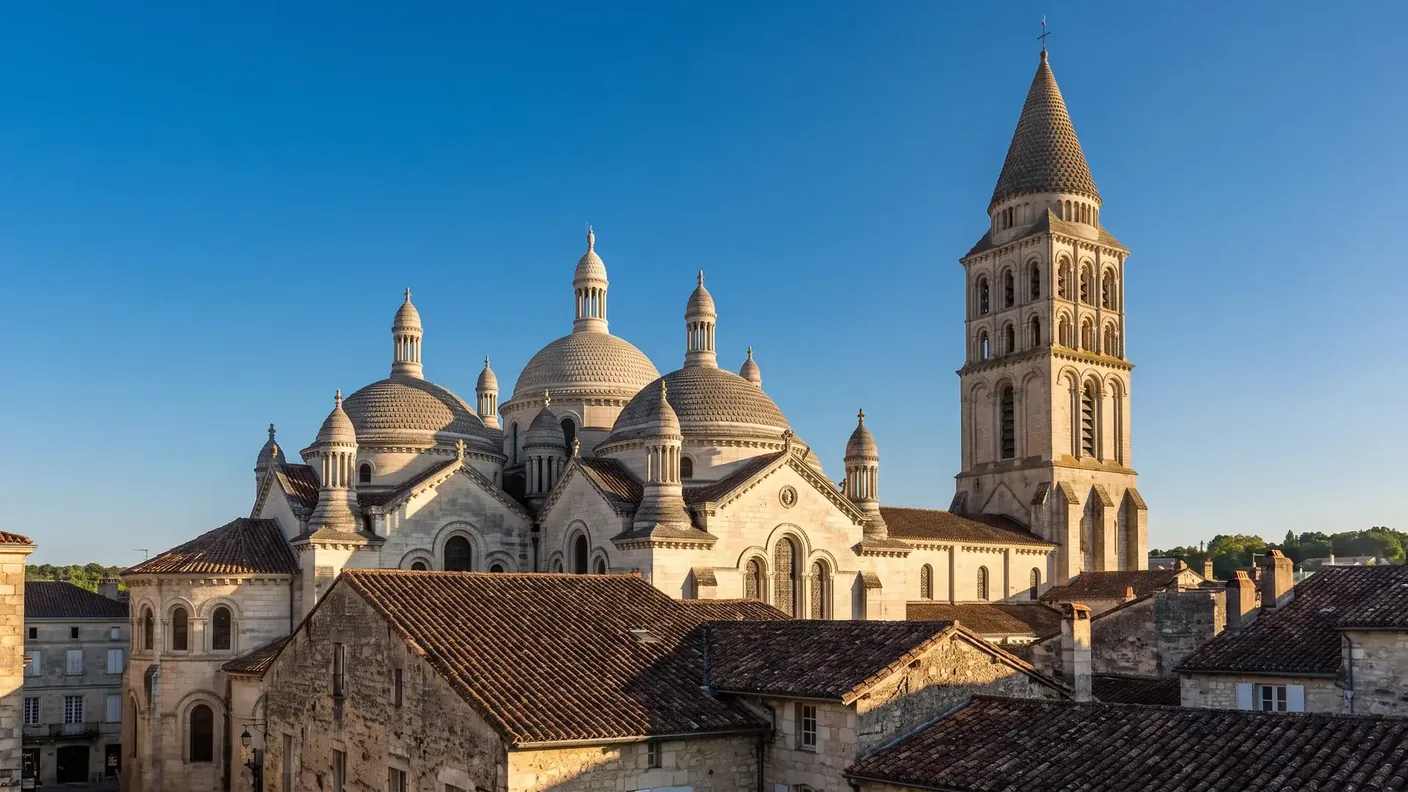
Where does this Eastern figure come from? The debate has been stirring up scholars since 1851, when Félix de Verneilh coined the phrase “Byzantine architecture in France” in reference to Saint-Front, seeing it as a copy of St. Mark's in Venice ; others pointed to the church of the Holy Apostles of Constantinople — the common model from which Saint Mark’s Gospel also derives. The similarity in structure is real, but the exact lineage remains a matter of debate. As for the famous phrase, “ Grand Mosque of Périgueux ", it is attributed to Victor Hugo—but no one has ever traced its source: a persistent local tradition, to be cited as such.
The saint who started it all deserves his own epilogue. The church was consecrated on March 3 1173 was home to the tomb of Saint Front, carved in 1077 by Guinamond, a monk from La Chaise-Dieu—a masterpiece that has since been lost. The relics, solemnly “invented” (discovered) in 1261, rested there for three centuries… until 1575, when the Huguenots seized it and the threw into the Dordogne. The pilgrimage outlived the saint; the church, for its part, gained a large one in the 19th century Baroque altarpiece from 1652 (restored in 1974), a 2,000-pipe organ (1903), and the five lustres suspended beneath the domes—we come back to this: their history is imperial.
Info 2026: Work to reinforce the south dome, which began in 2025 (cracks were repaired using tie rods inserted into the walls), is ongoing—but the cathedral remains open to visitors during the work.
Paul Abadie: The Man Who “Re-Created” Saint-Front… and Then Designed the Sacré-Cœur
The “perfect” silhouette we photograph today owes almost everything to the 19th century. Appointed diocesan architect in 1854, Paul Abadie undertook a radical renovation project beginning in 1852: the cathedral was “dismantled and then reassembled stone by stone,” the medieval domes—of varying sizes—were remodeled to a uniform size, and the elegant pinnacles with small columns that give the building its charm are… Abadie’s invention, absent from the Romanesque church. Criticism that the project was “reconstruction rather than restoration” was documented as early as 1877. Most tellingly, Abadie requested permission to demolish the 12th-century bell tower—a ministerial commission refused. The cathedral’s only authentic medieval element nearly disappeared during its “restoration.”
In 1874, Abadie won the competition to design a new basilica in Paris, on Montmartre Hill: the Sacré-Cœur. His Roman-Byzantine design drew direct inspiration from his own work in the Périgord region—white domes, bell turrets, and the overall silhouette. Anyone who has seen the Sacré-Cœur has already seen, without realizing it, a version of Saint-Front. The cornerstone was laid in 1875; Abadie died in 1884, well before the consecration in 1919—as was the case at Périgueux, where his successors completed the project in the early 20th century.
And there’s this little-known twist in history: the five chandeliers hanging beneath the domes of Saint-Front were designed by Abadie… for Notre-Dame de Paris, where they illuminated the wedding of Napoleon III and Eugénie on January 29, 1853. The decor from a Parisian imperial wedding now hangs in a cathedral in the Périgord, the work of the same man who later brought the silhouette of that cathedral to the Paris skyline. Few French monuments can boast such a round-trip journey.
Vesunna: The Roman Domus Beneath Jean Nouvel’s Glass Roof
In 1959, an excavation near the Vésone Tower uncovered a large Gallo-Roman residence—the Domus of Vésone (originally named the “Villa des Bouquets”), designated a historic monument in 1963: covering approximately 4,000 m² of floor space, organized around a garden with a pond, featuring rooms heated by a hypocaust, private baths, and wall paintings preserved to a height of one meter—including a 2nd-century frieze depicting marine fauna against a red background. Graffiti suggests that the Pompeii family—the family of the amphitheater’s donor—lived there. To protect and showcase it, the city entrusted the project in 1993 to Jean Nouvel, a native of Fumel and future Pritzker Prize laureate: its museum complex opened on July 12, 2003 (official website of the Vesunna Museum, accessed July 24, 2026).
The architectural design has remained famous: a glass-and-steel “umbrella roof” supported by 14 pillars, each 9 meters tall, spanning the ruins like a bell; glass walls that allow the city to gaze upon its past; suspended walkways from which visitors can look out over 2,400 m² of ruins without ever setting foot on them—and, preserved at the heart of the building, a century-old oak tree around which Nouvel built the structure. The entire complex was designated “Remarkable Contemporary Architecture” in 2020. Practical Information 2026: €8 (reduced €5, free for those under 18), combined ticket €12 with the MAAP—the Périgord Museum of Art and Archaeology, whose prehistoric collection ranks 4th in France (the Regourdou Neanderthal skeleton, the “Man of Chancelade”). Free admission on the first Sunday of every month (except during the summer); the immersive exhibition “Antiquity Around the Corner” has been extended through the end of August 2026.
Markets, truffles, and a Michelin star: Périgueux, a gourmet capital
Markets: Two Thousand Years of Tradition
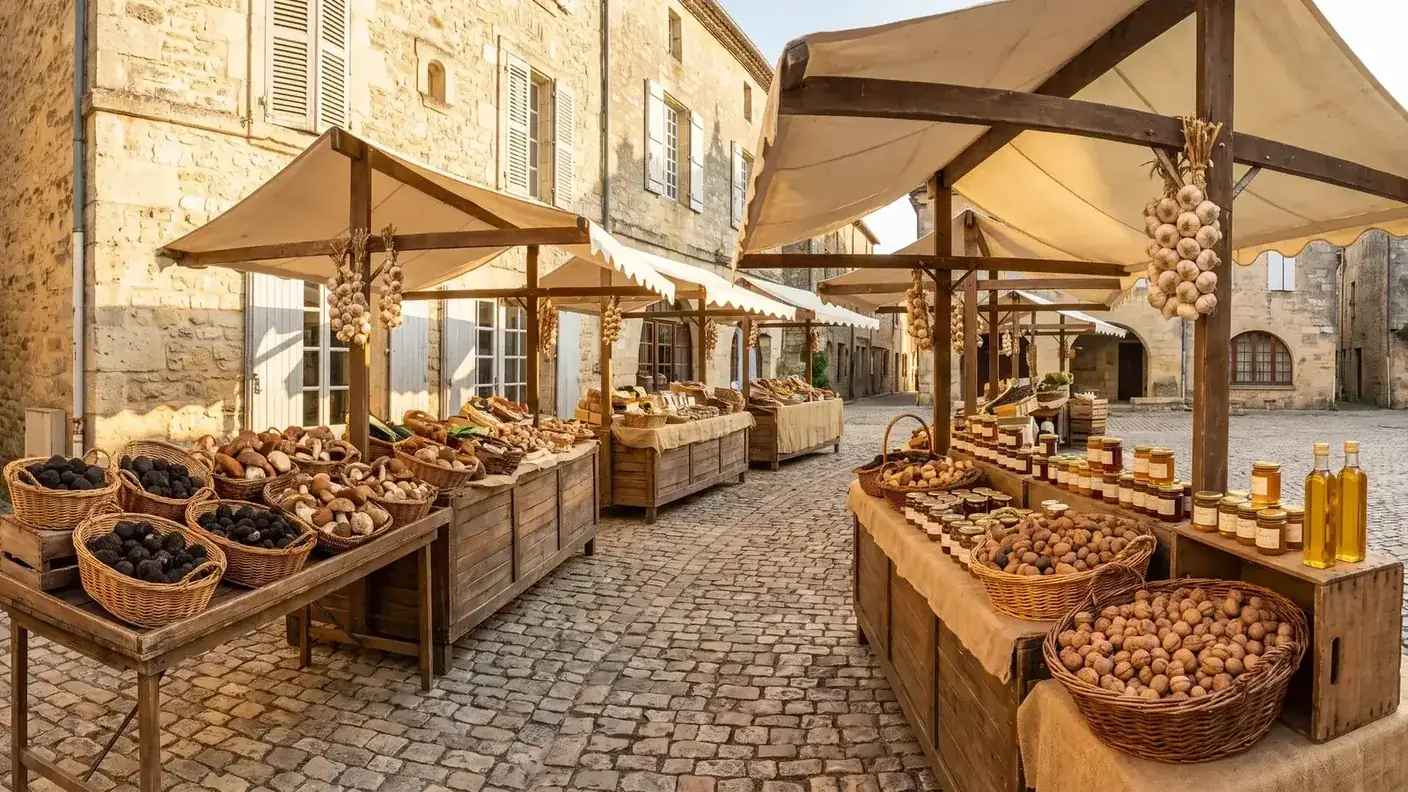
Périgueux is a city of markets, just as other cities are known for their spas. The Wednesday and Saturday mornings, the market stalls are set up in the Place de la Clautre (at the foot of the cathedral), the Place de l'Ancien-Hôtel-de-Ville, and the Place du Coderc; the Coderc Hall, she, opens every day from 7 a.m. to 1 p.m. And from December through February, at Place Saint-Louis, one of the South West's major culinary events takes place: the market for fatty meats and truffles — Tuber melanosporum, weighed by the gram every Saturday morning (2025–2026 season: December 6 through February 14, with special sessions on December 24 and 31, the days before Christmas Eve and New Year’s Eve).
At the table, the standard is L’Essentiel, 8 rue de la Clarté: Chef Éric Vidal's restaurant is Michelin-starred, a restaurant with a star in the 2026 guide (menus ranging from 72–110 €) — reservations are required. Upcoming events: MIMOS, the international festival of mime and physical theater founded in 1983, will hold its 43rd edition in early July (150 performances over 5 days—Périgueux calls itself the “world capital of physical theater”); the Gourmet Book Festival, which has become an annual event, takes place in November; and 2026 offers a bonus: Périgueux is stage town on the Tour de France. To stretch your legs between meals: the Isle Riverbank Greenway A 15-km pedestrian and bike path runs through the metropolitan area, extending via the V90 bike route toward the Gironde.
The city also tells its story through guided tours: designated a “City of Art and History” since 1987, it offers guided tours, workshops, and exhibitions year-round through the tourist office. And to commemorate its greatest moments: in July 2019, Périgueux hosted the 100th Félibrée, the major Occitan festival that rotates among towns in the Dordogne — 300,000 paper flowers strung above the streets, 30,000 visitors, and the Occitan language in all its glory beneath the domes. The festival has moved on to other parts of the department, but the photos remain everywhere.
Bordeaux → Périgueux: ~135 km via the A89, about 1 hour and 45 minutes
This is the easiest destination covered in this blog: the Bordeaux bypass, then the A89— “the Trans-European,” nicknamed the “presidents’ highway”—to Exit 15 Périgueux-south/center, and then the N21 to the docks. ~135 km, about 1 hour and 45 minutes door-to-door. The “109 km” sometimes cited is the distance as the crow flies; this page lists approximately 135 km by road.
| Option | Duration | Good to Know |
|---|---|---|
| Chauffeur Service (Executive Car Service) | ~1 hour 45 minutes | Door-to-door, starting at 230 € — stop wherever you like (Saint-Émilion, Brantôme, etc.) |
| Personal car | ~1 hour 45 minutes | A89 (toll road), Exit 15 · Paid parking in the city center |
| Direct TER | Check the travel time and frequency for the selected train on TER Nouvelle-Aquitaine | |
| Regional bus | — | slower than the TER; limited appeal on this route |
From the Périgueux station, you can reach Bordeaux by TER. Schedules, travel times, and frequencies vary depending on the day and any construction work: be sure to check your chosen route before departure. Helpful note: It’s on the Coutras–Tulle line and the terminus of the Limoges line—not on the Paris–Toulouse route, which passes through Limoges and Brive; for Paris, expect a transfer. The real advantage of a private chauffeur on this route is therefore not the direct trip—the TER is perfectly adequate—but the door-to-door service and the rest of the journey: you can travel from Périgueux to Brantôme, Lascaux, or Les Eyzies all in the same day, without having to switch vehicles, and with a stop in Saint-Émilion on the way there if the mood strikes.
Around Périgueux: The Entire Périgord as a Hub
Périgueux is the crossroads of the department: Brantôme to the north, the prehistoric Vézère region to the southeast, and Bergerac to the south. All distances listed below are by road and have been verified.
| Destination | Route from Périgueux | Key points |
|---|---|---|
| Brantôme | 30 km · 36 min | the “Venice of the Périgord,” a cave abbey—see our guide |
| Les Eyzies | 47 km · 51 min | The Capital of Prehistory, Font-de-Gaume — see our guide |
| Lascaux (Montignac) | 56 km · 48 min | The "Sistine Chapel" of Prehistory — see our guide |
| Bergerac | 61 km · 50 min | Old Town, Monbazillac vineyards |
| Sarlat-la-Canéda | 67 km · 1 hour 10 minutes | capital of the Périgord Noir — see our guide |
| Vieux-Mareuil / Mareuil | ~43 km · 45 min | The birthplace of the barony, Mareuil Castle — see our guide |
| Bergerac Airport | 50 km · 52 min | Seasonal flights to the UK |
A culinary highlight for travelers: three of the Dordogne’s seven 2026 Michelin-starred restaurants are located along the routes starting from Périgueux—the Moulin de l’Abbaye in Brantôme (36 min), Le 1862 in Les Eyzies (51 min), and Le Petit Léon in Saint-Léon-sur-Vézère, on the road to Lascaux. A typical day as a driver: morning at Vesunna and Saint-Front, Michelin-starred lunch in Brantôme, afternoon at the Abbey Caves, and return via the Dronne Valley. Or the prehistory version: Périgueux in the morning, Lascaux IV in the afternoon, dinner in Les Eyzies.
Our Tips for Success with Périgueux
- Come on a Saturday: the market around the cathedral in the morning, the bustling old town—and from December through February, the truffle market at Place Saint-Louis as a bonus.
- Visit the three ancient sites in this order: the Vesunna Museum (to learn more), the Vésone Tower (50 m away), and the Jardin des Arènes (a 10-minute walk) — a half-day tour, including two free sites.
- Get the Vesunna + MAAP combo ticket (€12): Jean Nouvel’s Domus, followed by France’s fourth-largest prehistoric collection—and free admission on the first Sunday of the month (except during the summer).
- Look up in Saint-Front: the five chandeliers beneath the domes illuminated Napoleon III’s wedding at Notre-Dame—the anecdote never fails to impress.
- Head up to the Quai de l'Isle at sunset: the left bank, near the Pont des Barris, offers THE perfect reflection of the domes—the photo that captures the essence of the city.
- Make a reservation at L'Essentiel (Michelin-starred, set menus 72–110 €) several days in advance—or check out the bistros in the historic district on Rue Limogeanne.
- In early July, it's MIMOS: 150 mime and physical theater performances in the streets—check the dates if you're looking for some peace and quiet… or a party.
- Combine this with the Périgord Vert or Périgord Noir: Brantôme is 36 minutes away, Lascaux 48—a chauffeur service from Bordeaux (~1 hour 45 minutes, starting at 230 €) will take you to all these destinations without having to worry about schedules.
Périgueux is the only city in the region where, in the course of a single morning, you can walk through a Roman domus beneath a glass roof designed by Jean Nouvel, touch the cella of a Gallic temple, pass through two medieval towns that were at odds with each other for a century, and buy a truffle at the foot of domes that inspired the Sacré-Cœur. Two thousand years of history packed into 9.82 km², with no lines or ticket offices for the most part. The prefecture of the Dordogne isn’t just a stop along the Périgord route: it’s the essence of the Périgord—and it’s just 1 hour and 45 minutes from Bordeaux.
Frequently Asked Questions
How much does a private chauffeur service from Bordeaux to Périgueux cost?
The Bordeaux → Périgueux trip with a chauffeur service starts at 230 € one-way (1–3 passengers, sedan), door-to-door. The price is fixed and quoted in advance—no meter and no surprise surcharges. An 8-seat van is available for families and small groups. Request a quote: you’ll receive a written response in less than 30 minutes.
How long does the trip from Bordeaux to Périgueux take?
Allow about 1 hour and 45 minutes for ~135 km: take the Bordeaux bypass, then the A89 “La Transeuropéenne” to Exit 15 (Périgueux-south/center). The “109 km” sometimes cited is a straight-line distance. It’s the quickest route to the Périgord from Bordeaux—and a stop in Saint-Émilion fits easily into the trip there.
What is Vesunna?
The ancient name of Périgueux: a city founded between 25 and 16 B.C. as the capital of the Petrocores—the Gallic people who gave their names to Périgueux and the Périgord. Covering approximately 60 hectares at its peak, it had shrunk to 5.5 fortified hectares by the end of the 3rd century. Three major sites remain: the Tower of Vésone, the amphitheater in the Jardin des Arènes, and the domus at the Vesunna Museum.
Why is it said that Périgueux was born from two cities?
Because two rival, fortified cities coexisted for centuries: the City (successor to Vesunna, the city of the bishop and the count) and the Puy-Saint-Front (a market town founded in the late 10th century around the presumed tomb of Saint Front). They were united by treaty on September 16, 1240 — but each retained its own city walls, and even elected two rival mayors from 1299 to 1368.
What is the connection between Saint-Front and the Sacré-Cœur in Paris?
The same architect: Paul Abadie, who restored—and largely reinvented — Saint-Front beginning in 1852, won the 1874 competition for the Sacré-Cœur in Montmartre with a Roman-Byzantine design directly inspired by his project in the Périgord: white domes, bell turrets, and the overall silhouette. Anyone who has seen the Sacré-Cœur has already seen, without realizing it, a version of Saint-Front.
Is Saint-Front Cathedral really Byzantine?
His plan in Greek cross with five domes on pendentives It is indeed Byzantine in style—identical to that of St. Mark’s in Venice, both of which trace their origins to the Church of the Holy Apostles in Constantinople. But the exact lineage has been a subject of debate among historians since 1851. And the famous phrase “the Great Mosque of Périgueux,” attributed to Victor Hugo, has never been found in his writings—a persistent local tradition, to be taken as such.
What is the Vésone Tower?
The cella—the inner sanctuary—of the temple of the goddess Vesunna, protector of the ancient city: a cylinder 24.46 meters high and 19.60 meters in diameter, built between the late 1st century and the first half of the 2nd century, once clad in marble and situated in the center of a courtyard covering nearly two hectares. Its breach is said to have been caused by the removal of the blocks from the gate—or, according to legend, by the passage of Saint Front as he drove out demons. Free admission in the public garden.
Can we visit the Périgueux amphitheater?
Yes, freely and at no cost: today it is the Jardin des Arènes, a public garden that follows the outline of the ancient ellipse (141 × 118 m—a footprint larger than that of the Nîmes Amphitheater). Visitors can see 1st-century arcades and vaulted passageways; the rest lies buried under 3.50 m of fill. Open daily, 7:30 a.m.–9:00 p.m. in the summer.
Is the Vesunna Museum worth a visit? What are the admission prices and hours?
It is one of the most beautiful on-site museums in France: Jean Nouvel’s glass roof (2003) suspended above a 4,000 m² Roman domus, featuring original murals and a century-old oak tree preserved within the building. Admission is €8 (reduced rate €5, free for those under 18); a combined ticket with the MAAP costs €12. In the summer, it’s open daily from 10 a.m. to 7 p.m. The immersive exhibition “Antiquity Around the Corner” has been extended through the end of August 2026.
On which days are the Périgueux markets held?
The main markets are held on Wednesday and Saturday mornings around the cathedral (Place de la Clautre, Place de l'Ancien-Hôtel-de-Ville, and Place du Coderc); the Coderc market hall is open daily from 7 a.m. to 1 p.m. From December through mid-February, the foie gras and truffle market takes over Place Saint-Louis every Saturday morning—one of the South West’s major culinary events.
Where can you eat well in Périgueux?
The go-to restaurant is L'Essentiel (8 rue de la Clarté), a Michelin-starred establishment—its star confirmed in the 2026 guide—with menus ranging from 72–110 €; reservations are required. The historic district is also brimming with Périgord bistros around Rue Limogeanne. And for travelers on the go, three other Michelin-starred restaurants in the department are less than an hour away: Brantôme, Les Eyzies, and Saint-Léon-sur-Vézère.
Can you get to Périgueux by train from Bordeaux?
From the Périgueux station, you can travel to Bordeaux by TER. Schedules, travel times, and frequency vary depending on the day and any construction work: be sure to check your chosen route before departure.
What's there to see around Périgueux?
The entire Périgord region within easy reach: Brantôme and its cave abbey, 36 minutes away, Les Eyzies (the capital of prehistory) 51 minutes away, Lascaux 48 minutes away, Bergerac and its vineyards 50 minutes away, Sarlat 1 hour and 10 minutes away—and the Périgord Vert region of the Barony of Mareuil 45 minutes away. Périgueux is the ideal base camp for exploring the region with a driver.
Further Reading
- The Venice of the Périgord, 36 minutes away : see the Guide to Brantôme (cave abbey, Dronne, thousand-year-old bell tower)
- The Capital of Prehistory: See the Guide to Les Eyzies (Font-de-Gaume, Cro-Magnon)
- The birthplace of the Barony of Périgord: see the Vieux-Mareuil Guide (domed church, Mareuil Castle)
- The capital of the Périgord Noir: see the Sarlat Guide
- Plan your trip: Book an executive car service from Bordeaux to Périgueux or explore all our destinations
Sources and References
- Wikipedia — Périgueux — geography, demographics, history, protected area
- Wikipedia — Vesunna — founding, siege, ramparts 276–290
- Wikipedia — Tower of Vésone — dimensions, cella, excavations, legend of Saint Front
- Wikipedia — Périgueux Amphitheater — dimensions, Visitandines, Jardin des Arènes
- Wikipedia — Saint-Front Cathedral — dates, Abadie, chandeliers, UNESCO
- Vesunna Museum (official website) — Ancient Vesunna, domus, admission prices and hours for 2026
- MAAP (official website) — collections, prices, combo ticket
- Basilica of the Sacred Heart (official website) — 1874 design competition, timeline of construction
- Mérimée Database — Vésone Tower — Listed in 1846
- City of Périgueux — markets, truffles, historic district, Source of the Abyss
- Michelin Guide — Périgueux — L'Essentiel, 1 star 2026
- INSEE — Complete Report Périgueux — Population, Catchment Area
Article updated in July 2026.
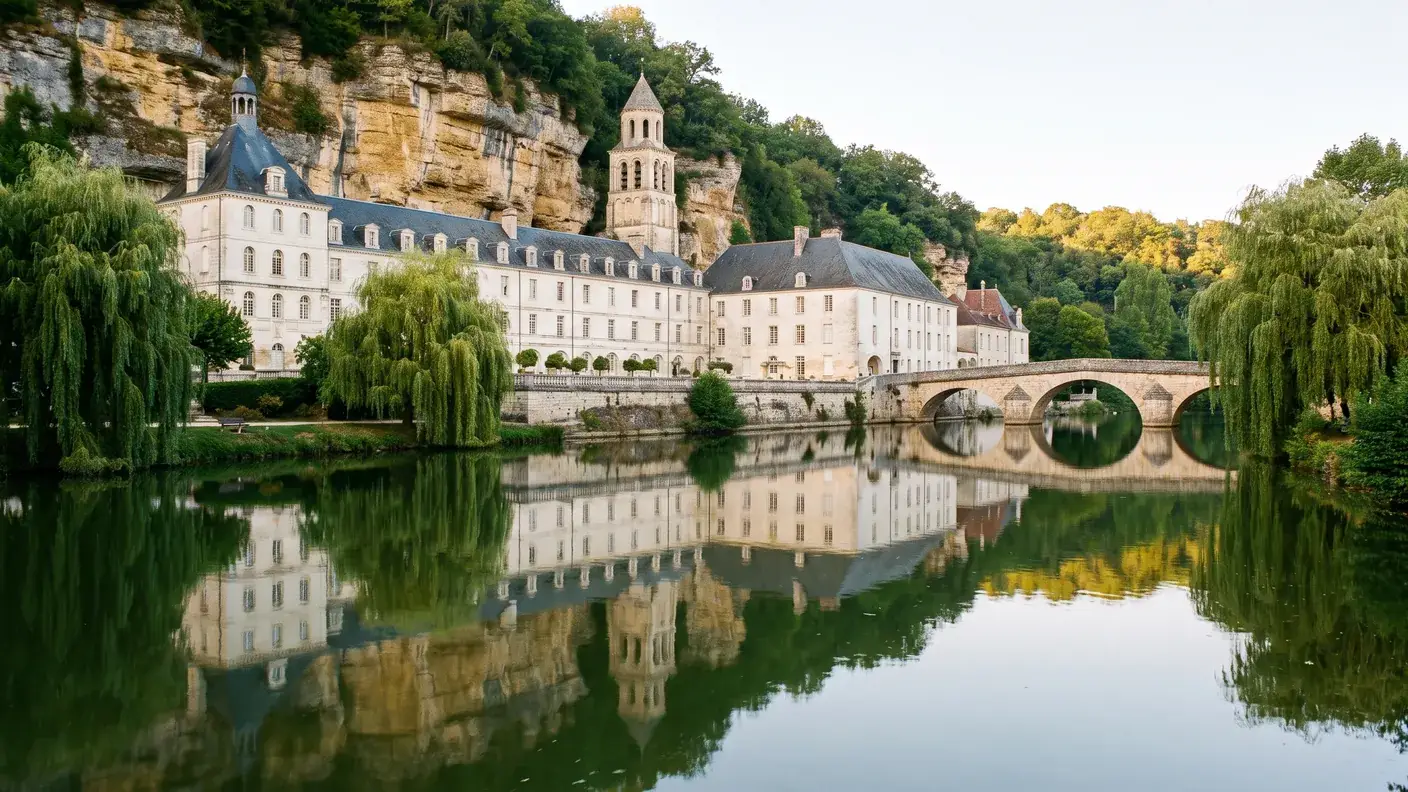
On the way to the capital of the Périgord
Direct trip from Bordeaux (~1 hour 45 minutes) via the A89, with stops of your choice along the way—Saint-Émilion on the way there, Brantôme or Lascaux during the day. Written fixed-price quote within 30 minutes; sedan or 8-passenger van; English-speaking driver.