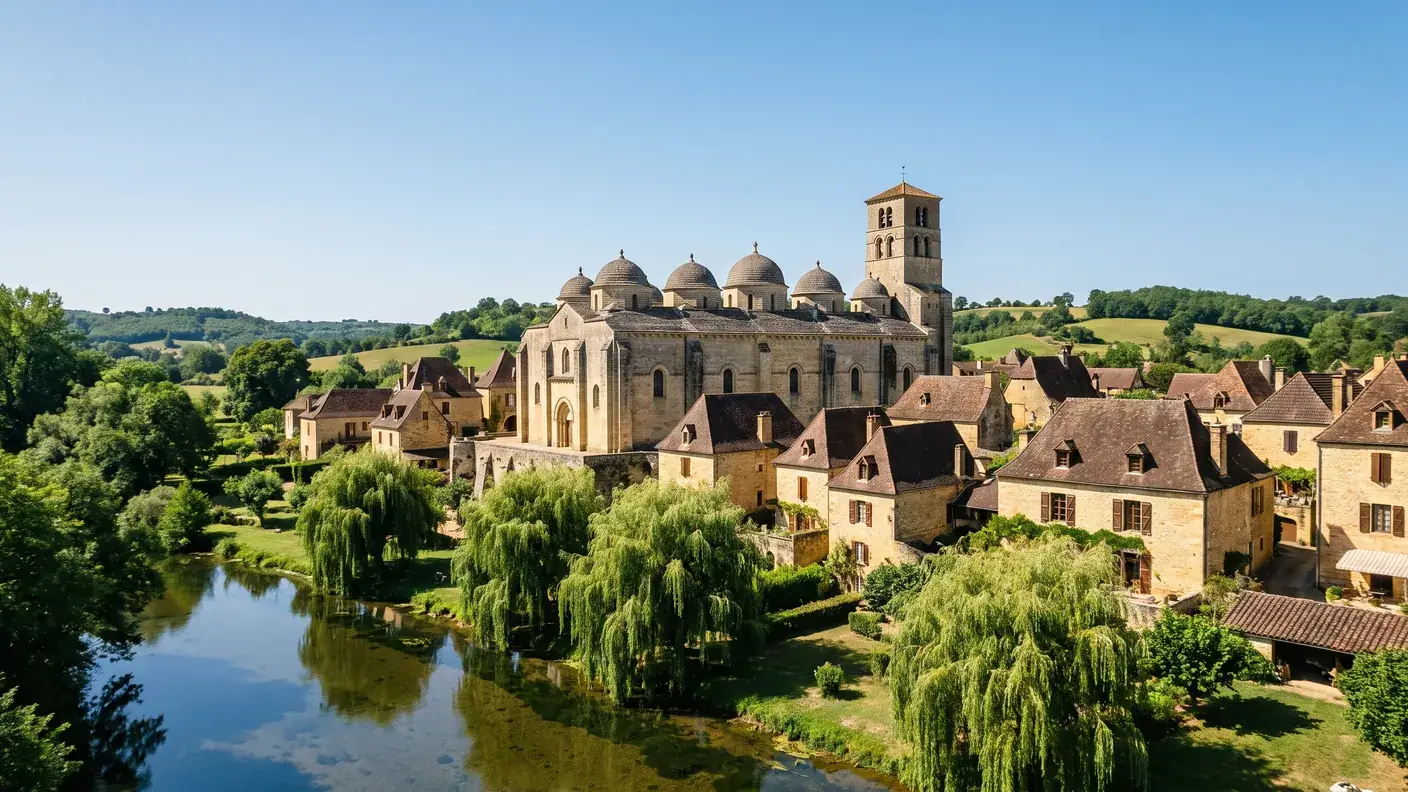
Vieux-Mareuil from Bordeaux: birthplace of a Périgord barony
The village where it all began: a 12th-century domed fortress church, the birthplace of one of the four baronies of Périgord, Talleyrand’s tithes, and an ornate cave designated a historic site in 2024. Everything you need to know before you visit, about 2 hours from Bordeaux.
Vieux-Mareuil at a Glance
- Vieux-Mareuil (population 314, the Vieux-Mareuillais) is the birthplace of the Barony of Mareuil, one of the four historic baronies of the Périgord, along with Beynac, Biron, and Bourdeilles—the “first,” according to local tradition.
- Its Gallic name—maro + ialo, “the great clearing”—is attested as early as 1109; the “Vieux” (Old) part dates from the 13th century, when the lord moved his castle 5 km downstream, founding what is now Mareuil.
- Its Saint-Pierre-ès-Liens Church (12th century, listed since 1912) is a fortress church with a row of domes, bristling with machicolations and watchtowers during the Hundred Years' War.
- In 1789, the barony belonged to the Talleyrand family—which had acquired it through a marriage in 1587 to the daughter of Marshal de Monluc—and collected half of the tithes there.
- The Fronsac Cave, adorned with Magdalenian engravings that are exceptionally rare in their depiction of human figures, was designated a historic monument on March 14, 2024 (closed to the public).
- Located 6.5 km away, the Château de Mareuil (15th century, Flamboyant Gothic) is open to visitors in the summer—along with its museum dedicated to Marshal Lannes, housed in the residence of the Dukes of Montebello.
- The village is located in the Périgord-Limousin Regional Nature Park: the Belle Valley is home to otters, European minks, and 18 species of wild orchids.
- From Bordeaux by car: ~147 km, about 2 hours on the A10 via Angoulême — starting at €254 with a private driver, door-to-door.
Before You Go: What Vieux-Mareuil Really Is
6:00 p.m., on the square in front of Saint-Pierre-ès-Liens. Not a sound, except for the Belle River flowing behind the gardens. Look up: a row of stone domes, traces of machicolations, a bretèche above the gate—a church built like a keep, in a village of 314 residents. Seven centuries ago, this tiny village was the seat of an archpriesthood comprising 22 parishes, and its name ruled over one of the four baronies of the Périgord. Then power moved on, five kilometers downstream. It just forgot to take the church with it.
Vieux-Mareuil is a classic example from the Périgord: the original village, the one that gave its name to everything else—the barony, the castle, the new commune of Mareuil-en-Périgord (the largest in the Dordogne)—and which has watched it all drift downstream since the 12th century. What remains is a Gallo-Roman market town built atop its ancient villa, a rare fortress church, a river with a charming name, and a history disproportionate to its size: Bouvines, Talleyrand, a troubadour, and a recently designated decorated cave.
This guide distinguishes fact from fiction: the Gallic etymology versus the legend of the Roman Marullus (and the argument that debunks it), the astonishing ritual of the four barons bearing the throne, the capture of a Count of Flanders at Bouvines in 1214, the Monluc-Talleyrand lineage leading to France’s most famous diplomat, and the exact status of visits in 2026. With all the figures and actual driving distances—the “107 km from Bordeaux” figure sometimes cited is a straight-line distance: expect 147 km by road.
Vieux-Mareuil does not have a train station. Regional Line 310 connects the area to Périgueux and Angoulême on a variable schedule; check the official timetable before you leave. To travel from Bordeaux and explore the surrounding area—including Mareuil Castle, Brantôme (18 minutes away), and the Belle Valley—hiring a private chauffeur from Bordeaux remains the simplest option (~2 hours via the A10 through Angoulême).
314 residents: the all-time low for a very old village
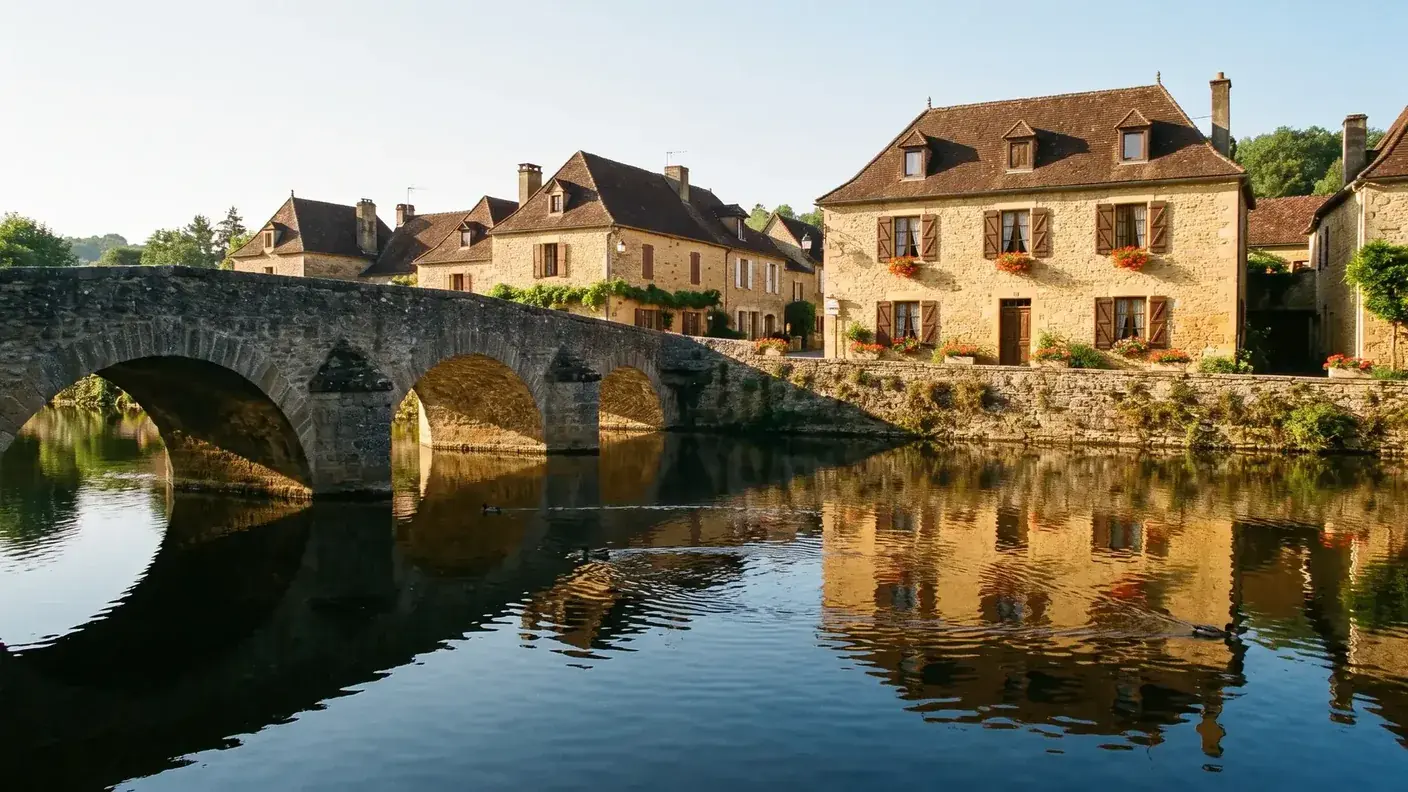
Vieux-Mareuil is located in the valley of the Beautiful, a small river 15.59 km long that originates in Monsec; it is a tributary of the Nizonne, which in turn flows into the Dronne. The village was established where the river has carved its way between limestone hillsides and meadows—exactly at halfway between Périgueux and Angoulême (43 km from each, via the former National Route 139, now the D939). Since January 1, 2017, it has no longer been an independent municipality: having merged with eight neighboring municipalities, it is one of the nine delegated municipalities of Mareuil in Périgord — the largest municipality in the Dordogne (150.48 km²) and the one with the most neighboring municipalities (17, including 3 in Charente).
| Data | Value |
|---|---|
| Status | A delegated municipality of Mareuil en Périgord since 2017 (Nontron district) |
| Population | 314 residents (2023) — the Vieux-Mareuillais |
| Area | 27.00 km² (population density ~12 people/km²) |
| Elevation | 109 m to 226 m |
| River | the Belle (15.59 km), a tributary of the Nizonne and then of the Dronne |
| Natural Park | PNR Périgord-Limousin since its creation in 1998 |
| Motorway | D939, the former National Route 139 (Angoulême–Périgueux corridor) |
| Distance from Bordeaux | ≈ 147 km (~2 hours via the A10/N10 through Angoulême) |
From 1,109 residents to 314: two centuries of population decline
The population trend is a textbook example of rural exodus: 1,109 residents at its peak in 1836, 916 in 1881, 568 in 1936 (a 38% decline over half a century of agricultural revolution), 425 in 1962… and 314 in 2023—the lowest level ever recorded since the first census in 1793. In 230 years of record-keeping, the village has never been so sparsely populated; it has lost 71.7% of its population since 1836. Archival records even allow us to go back further: 360 tax households in 1692, plummeting to 201 in 1694—a stark reminder of the Great Famine of 1693–1694 under Louis XIV.
The current profile is that of the heart of the Périgord Vert: across the new municipality, 46.5% of residents are 60 or older, one in five homes is a second home, and the neighboring Nontronnais region is one of the most “British” areas in the Dordogne—the top department for residents from across the Channel (7,198 according to the 2016 census). Vieux-Mareuil, for its part, is home to a renowned inn, a campground on the banks of the Belle River… and a bilingual French-Occitan welcome sign: Vielh Maruelh.
"The Great Clearing": Etymology, Legend, and the Decisive Argument
The Gaul First
According to the etymology accepted by toponymists (Tanet & Hordé, Dauzat & Rostaing), “Mareuil” is derived from the Gallic maro (“large”) and -ialo (“open space”): the large clearing—a name derived from land clearing, perfectly logical for a community settled in the middle of the woods, on the banks of its river. The name is attested in the 12th century in the cartulary of Uzerche, in the forms Maroll/Maroli (1109) and then Maroill (1151); followed by Marolium (1243), Marollium (1364), and notably Vetus Marolium—“Old Mareuil”—as early as the 13th century. In the 16th century, Occitan distinguished between Mareul-Neuf and Vielh-Mareulh, which was Frenchified to Vieux-Mareuil.
The Legend of Lucius Marullus (and Why It Doesn't Hold Up)
Local tradition tells a more compelling story: a certain Lucius Marullus, one of the ten Roman officials stationed at the Tower of Vesone in Périgueux, is said to have had a summer residence—the Villa Marulla—built on the banks of the Belle River; the inhabitants of the cluzeaux and the surrounding woods are said to have settled there under the protection of his troops, and Marulla is said to have become Mareuil. It’s a lovely story, and it has a basis in reality: the village is built on the site of a Gallo-Roman villa. But toponymists debunk it with a decisive argument: the IGN lists 18 places named “Mareuil” in France—it’s hard to imagine eighteen founding Marullus. The Gallic term *maro-ialo*, on the other hand, explains them all.
As for the villa itself, there is nothing legendary about it. Excavations in 1884 unearthed an ancient mosaic—which was placed in the department’s archaeological museum but has since disappeared. And in 2024, preventive excavations conducted prior to the renewal of the town’s water systems unearthed ceramic shards from the 1st–2nd centuries, 4th-century masonry, and a one-meter-long fragment of a polychrome mosaic dating from the 3rd–5th centuries. One hundred and forty years after the lost mosaic, the subsoil has returned the favor.
The Day Power Left: The Story of “Old” Mareuil
Originally, there was only one Mareuil: this one. It began as a Gallo-Roman villa, then became a parish attested as early as around the year 800, and later served as the seat of an archpriesthood. But in the 12th century, the lord of Mareuil moved: he settled five kilometers downstream from the Belle River, near the village of Saint-Priest, and built a fortified castle there, whose moat was once fed by the river. This new settlement took the name Mareuil and became the seat of the barony; the old site, meanwhile, came to be known as “the old one”—Vetus Marolium in 13th-century texts, precisely the period when its current church was built.
The irony is that, in spiritual terms, the hierarchy remained reversed for a long time: until the Revolution, Vieux-Mareuil was the seat of an archpriesthood comprising 22 parishes (according to the 13th-century parish register)—and Mareuil, though the seat of the barony, was ecclesiastically subordinate to it. The “Old” ruled over souls, the “New” ruled over arms. It was only after the Concordat of 1801 that the deanery moved to Mareuil, the canton seat since 1790: Vieux-Mareuil was then reduced to “nothing more than a simple commune.” The decline, which began with the relocation of the castle in the 12th century, took seven centuries to run its course.
Saint-Pierre-ès-Liens: A Fortress Disguised as a Church
The village's most notable landmark is its 12th-century church, Saint-Pierre-ès-Liens, designated a historic monument as early as September 3, 1912 (Mérimée Database, Ministry of Culture, accessed in July 2026). It is a prime example of the a Perigord-style building with a row of domes: a single nave with three bays, each topped by a dome resting on pendentives—the same architectural style as the Saint-Front Cathedral in Périgueux or the abbey church of Trémolat. This type of church is found almost exclusively in the former diocese of Périgueux and its outlying areas, lending these tiny villages an Eastern-style silhouette.
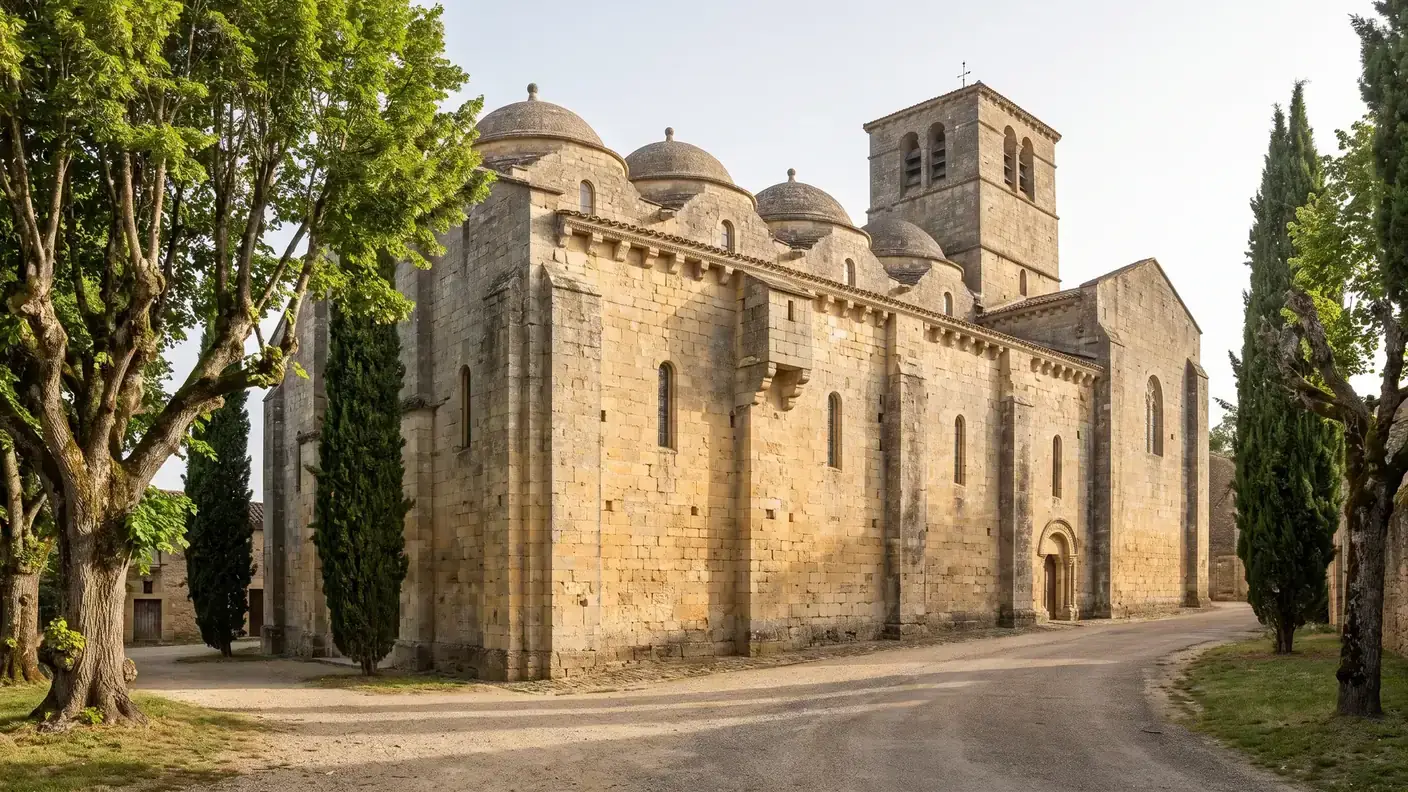
Its second life was as a military structure. During the Hundred Years’ War, in the face of the motorwaymen who were plundering the valley, the church was fortified: traces of machicolations, a bretèche above the entrance, and corner watchtowers can still be seen—enough to transform the house of God into a defensive stronghold where the population could take refuge. The square bell tower, however, is newer than it appears: it was rebuilt after a fire caused by a lightning strike in 1940. Inside, there are three paintings from the 18th and 19th centuries, designated as historic monuments in 2006.
The rest of the built heritage is unassuming but dense for an area of 27 km²: Chanet Castle (15th-century crenellated tower, 16th-century residential wing, 17th-century chapel, designated a Historic Monument in 2009—with the protection order extending to “a well, a cluzeau, and silos”), Chaveroche Castle (15th–17th centuries), the Fronsac Manor (17th century), washhouses, fountains, and the Roc de Rappe shelter—a “cluzeau,” one of those shelters carved into the limestone and reused from time immemorial through the turmoil of the Middle Ages. At Vieux-Mareuil, even the castle has its own cluzeau.
One of the four baronies of Périgord—and the ritual of the throne bearers
Four barons above all others
Feudal Périgord included four baronies at the top of its hierarchy, just below the count: Mareuil, Beynac, Biron, and Bourdeilles, created between the late 9th and 10th centuries (Mareuil-en-Périgord Town Hall, accessed in July 2026). Gourgues, in his 1873 topographical dictionary, even bestows upon Mareuil “the title of the first barony of the Périgord.” Their most astonishing privilege, as recounted by tradition: during the solemn entry of a new bishop into Périgueux, it was required that four barons to carry the bishop's throne on their shoulders. The ceremony turned into a showdown more than once: in 1532, upon the arrival of Bishop Foucauld de Bonneval, the lords of Bourdeilles and Biron, disputing precedence, each arrived with 3,000 to 4,000 armed men—to avoid bloodshed, the consuls of Périgueux carried the throne themselves.
Bouvines, 1214: The Mareuil brothers capture a count
The first lord known by name is Guillaume de Mareuil, mentioned in a charter dated February 1099 concerning the church of Beaussac. But the family’s moment of glory came on Sunday, July 27 1214, at Bouvines — the battle that laid the foundation for the Capetian national narrative. The brothers Hugues and Jean de Mareuil they capture Ferrand, Count of Flanders, one of the coalition’s leaders: “covered in blood and wounds,” he was “forced to surrender to the two lords of Mareuil.” This account is well-documented—based on the chronicles of Guillaume le Breton and the works of Dominique Barthélemy—and proved highly rewarding: Hugues received the lordship of Villebois in Angoumois as a reward, hence the name Villebois-Mareuil. Ferrand, for his part, spent twelve years in the Louvre Tower.
Two other figures round out the family portrait. Arnaut de Mareuil, a troubadour active from about 1171 to 1190, a cleric from a poor family born at the castle, whose 25 to 29 songs have survived—six with their music—and who sang of Countess Azalaïs, with a king of Aragon as his rival. And Raymond de Mareuil, the hero of an escape worthy of Froissart (who recounts it): having defected to France in 1369, he was captured by the English, and Edward III placed a bounty of 6,000 francs on his head, intending to make an example of him; he escaped… by promising his English guard “half and half” of his fortune. Vieux-Mareuil—what’s the connection to all this? The village has never constituted a separate seigneury: a simple rural community in the barony, it was the cradle of its place names—the place where it all began.
From Monluc to Talleyrand: The Thread That Leads to the “Lame Devil”
Here's the most unexpected fact about this village of 314 residents: in 1789, on the eve of the Revolution, “M. de Talleyrand” exercised judicial authority there—delegated to a parish judge—and collected half of the tithes. The barony of Mareuil, to which Vieux-Mareuil belongs, had been in the hands of the family of France’s most famous diplomat for nearly two centuries. The family came to own it through a marriage with strong literary ties: Isabeau de Beauville, the marshal's second wife Blaise de Monluc — the author of the Comments —, had purchased the castle; his daughter Jeanne-Françoise brought it into 1587 to her husband Daniel de Talleyrand-Périgord, Prince of Chalais. Hence the official title of the senior branch: “Baron of Mareuil, by inheritance from the House of Montluc.”
The son of the heiress of Mareuil is the most tragic of the Talleyrands: Henri, Count of Chalais, beheaded in Nantes on August 19, 1626, for plotting against Richelieu—by an improvised executioner, a condemned man pardoned for the occasion, who had to strike 29 times before succeeding. Chalais’s execution remains one of the most horrific in French history.
And what about Charles-Maurice, the “Talleyrand of the history textbooks”? The connection exists, but we must be honest about it: the barony belonged to the elder branch of the Princes of Chalais, not to his father—a penniless courtier who, it was said, lived “on the crumbs that fell from the tables of Versailles.” It was a strategic marriage in 1743 that placed Mareuil under the care of Gabriel-Marie de Talleyrand—Charles-Maurice’s half-uncle—who had married the heiress of Chalais to keep the fortune within the family. No source documents a stay by the future minister at Mareuil; his only regional connection from childhood is the Château de Chalais, in Charente, where he lived with his great-great-grandmother (1758–1761)—51 km away by road. The Talleyrands, however, retained the château until 1883, when the last Prince of Chalais, having died without issue, bequeathed it to the town’s hospital—which converted it into a farm.
This “administrative” link between a tiny rural community and one of France’s most prominent families reveals the inner workings of the Ancien Régime: baronies held by houses that the inhabitants never saw—even the branch that owned them “lived there only rarely ”—yet on which justice, tithes, and administrative fate depended. The final word goes to Louis XVIII, who mocked the family’s genealogical claims: “Mr. de Talleyrand is off by only one letter in his claims; he is from the Périgord and not from Périgord.”
Mareuil Castle: The barony is open to visitors (in the summer, at the Montebello residence)
The castle that the 12th-century lord built downstream no longer exists: destroyed during the Hundred Years' War, it was rebuilt in the early 15th century by Geoffroy de Mareuil as a vacation home Flamboyant Gothic — a lowland fortified castle, a rarity in the Périgord, whose moat was once fed by the Belle River. The entrance complex is remarkably well-preserved: a gate tower on the counterscarp, a ramp-bastion about 30 meters long Gun ports, a stone bridge formerly equipped with a drawbridge, a double-leaf gate defended by a portcullis, and two round towers with embrasures. Listed as a historic monument on the list of 1862.
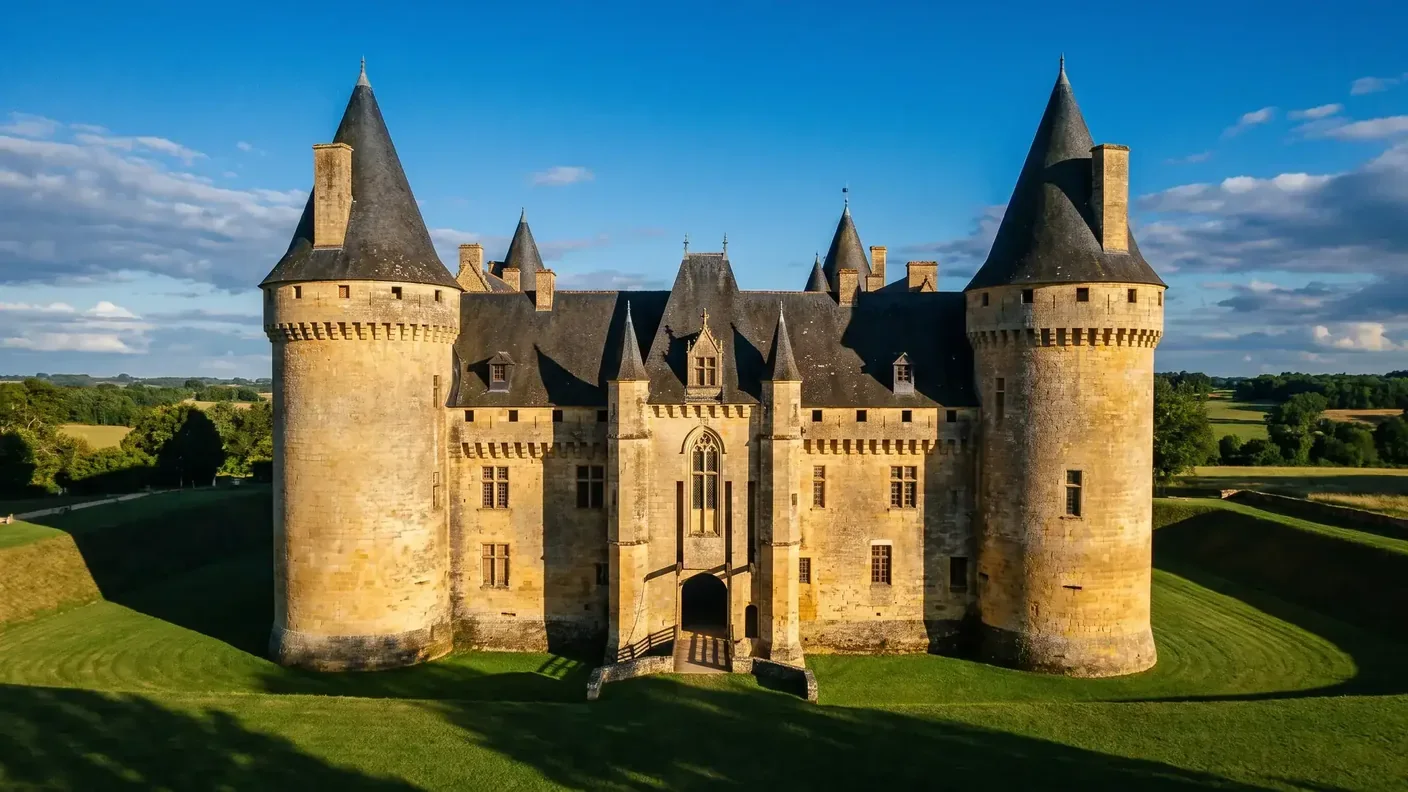
Its modern history is the stuff of a novel: burned down during the Wars of Religion, abandoned during the Revolution, bequeathed in 1883 to the Chalais Hospital, which turned it into a farm… then purchased and saved in 1963 by the Duke of Montebello, a direct descendant of Imperial Marshal Jean Lannes. The family still lives there—and the irony is delightful: the Talleyrand château now houses a First Empire museum dedicated to Marshal Lannes, complete with Louis XV, Louis XVI, and Regency-era furnishings. Talleyrand’s great rival at the chessboard has ended up taking center stage.
Mareuil Castle is open to visitors during the season, by guided tour only. Opening days, hours, admission prices, and accepted forms of payment are subject to change: please check the official information before you go.
The Fronsac Cave: Designated a protected site in 2024—and unlike any other
Long before the Gauls of the “great clearing,” the area was inhabited by the people of the Magdalenian — 17,000 to 10,000 years ago, the very same period as Lascaux. Their most precious legacy lies in a place called Fronsac: a decorated cave discovered in August 1983 by speleologist Christian Carcauzon, first studied in 1984 by Brigitte and Gilles Delluc — 106 meters of galleries on two levels, 83 graphic works engraved during the late Magdalenian period.
What makes it rare is its subject matter: whereas cave art overwhelmingly features animals, Fronsac is dominated by human figures and symbols—including the famous “schematic female figures” in profile and sexual depictions—with a spatial arrangement that separates animal and female figures by gallery. It is precisely this uniqueness that led to its designation as a historic monument by decree on March 14, 2024 (Mérimée Database, Ministry of Culture, accessed in July 2026; it had only been listed since 1997). What you should know before you start dreaming: the cave is private property and closed to the public—it tells its own story, but cannot be visited.
The limestone bedrock also holds other stories: an old underground quarry worked using the “rooms and pillars” method, now abandoned—and listed as a filming location on the official Film France database. The area’s limestone, which is white-ochre in color and resembles marble, has also received official recognition: the “Pierre de Mareuil” geographical indication, approved by the INPI on November 18, 2024—an industry that has been in operation since the Middle Ages and supports approximately 120 jobs.
The Belle Valley: otters, orchids, and a GR trail that stretches from the English Channel to the Pyrenees
That's where the true luxury of Vieux-Mareuil lies: an unspoiled valley, protected in ZNIEFF within the regional nature park Périgord-Limousin (of which the town has been a part since the park’s creation in 1998). La Belle — a charming French adaptation of the Occitan name bella aiga, “beautiful water”—unless it is a Celtic root referring to watercress—rises in Monsec at an elevation of 202 meters and drops 106 meters over fifteen kilometers, flowing fast enough to remain cold and clear.
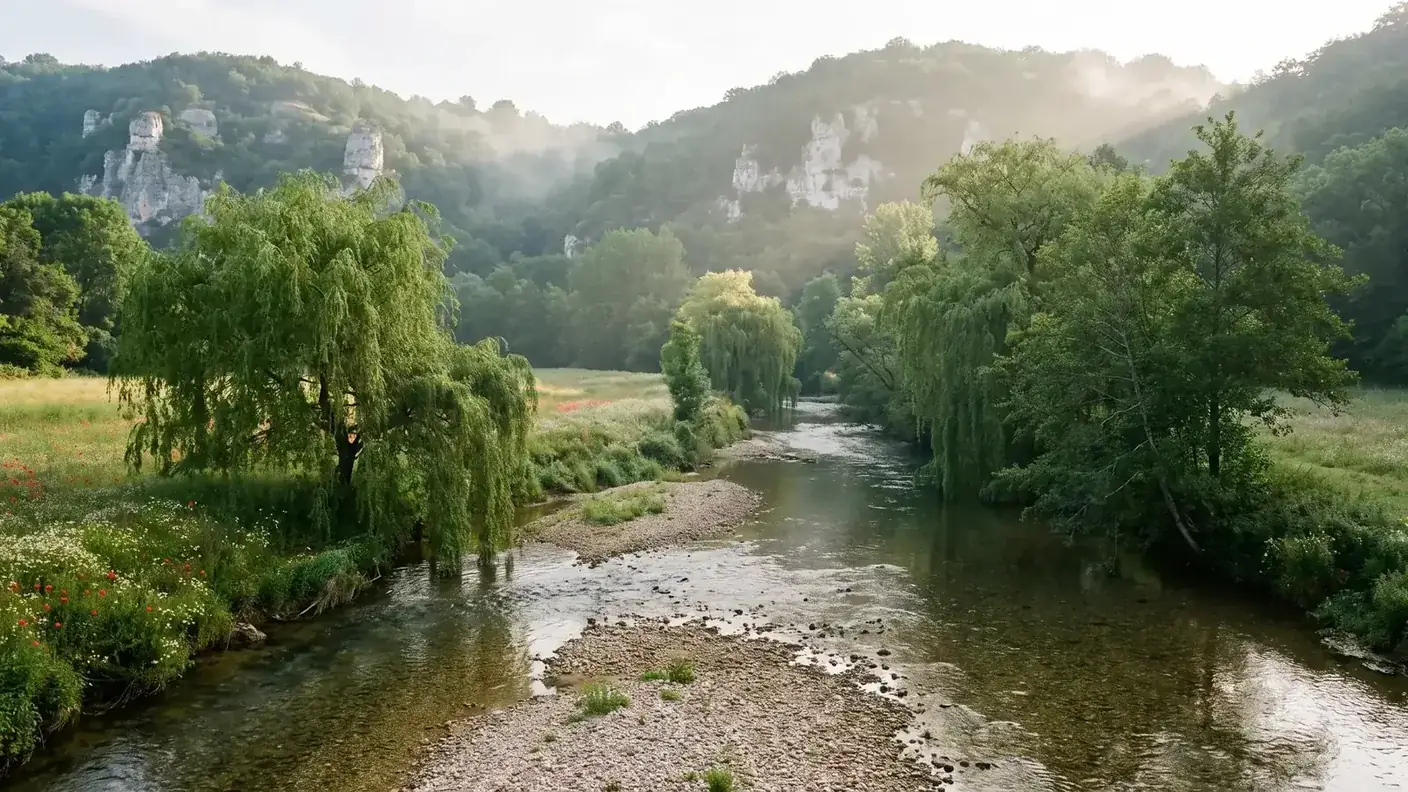
The biodiversity is impressive for such a small valley: the European otter and the critically endangered European mink inhabit the river, 18 species of bats have been recorded, the spotted skunk cabbage blooms in the wet meadows—and the limestone slopes are home to 18 species of wild orchids, from ophrys to pyramidal orchids, at their peak bloom between April and June.
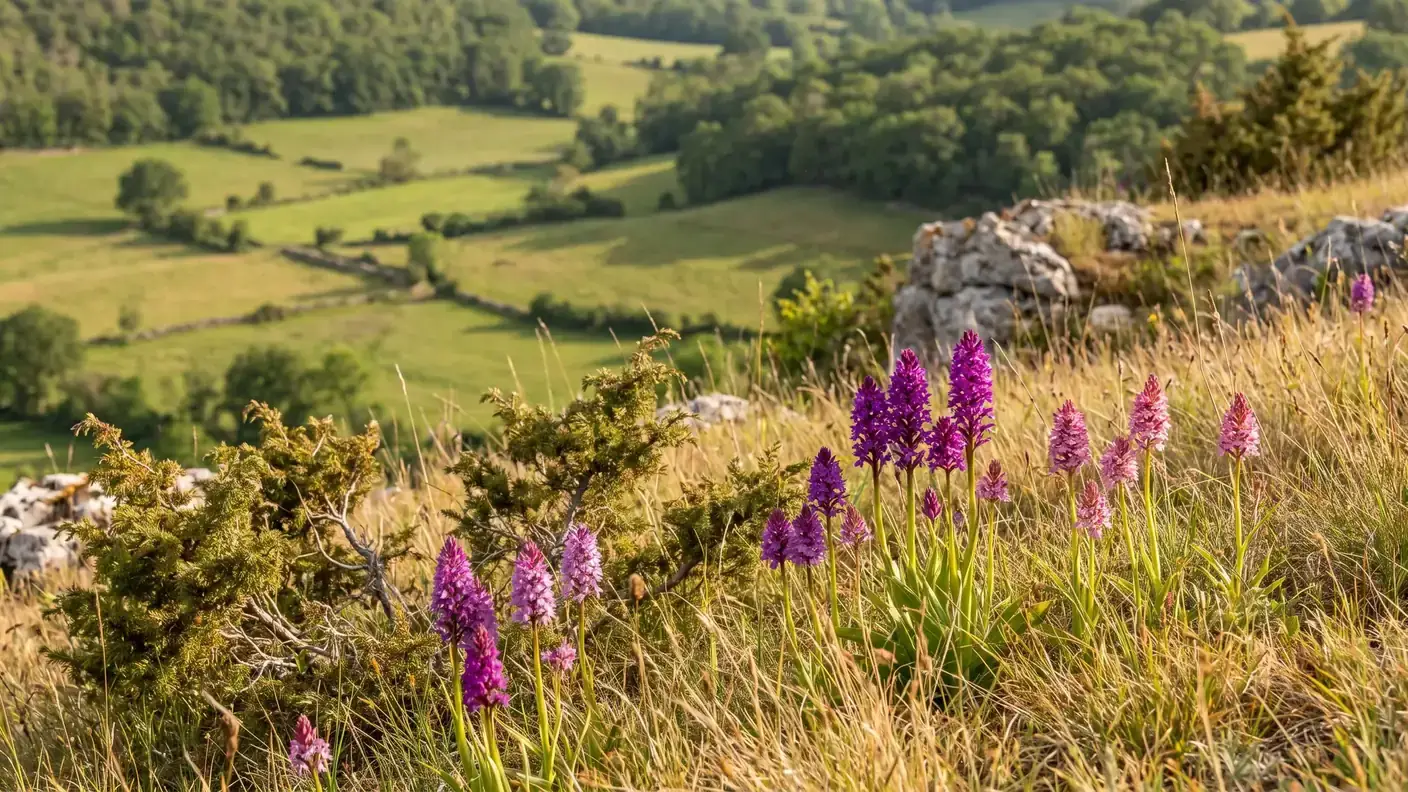
To explore all of this: the GR 36—the “From the English Channel to the Pyrenees” trail—runs through the Mareuil en Périgord region for nearly 25 km, and a heritage discovery loop starts right in the town of Vieux-Mareuil. Plan for a leisurely stroll past the fortified church, washhouses, the bridge over the Belle River, and hillsides dotted with orchids. The hamlet known as “Le Moulin du Roc,” on the riverbank, is a reminder of the valley’s former milling tradition—though, it should be noted, it has no connection to the famous hotel of the same name in Champagnac-de-Belair, near Brantôme.
Bordeaux → Vieux-Mareuil: ~147 km, about 2 hours… via Angoulême
Route surprise: the fastest route from Bordeaux doesn't go through not via Périgueux. The best route goes through the N10 toward Angoulême (the Bordeaux-Poitiers corridor), exits south of the city, and then joins the D939 For the last thirteen kilometers: ~147 km, about 2 hours. The “Périgord” route via the A89, Périgueux, and Brantôme is more scenic but longer: 188 km and about 20 minutes longer—best saved for a leisurely return trip, with a stop in Brantôme.
| Option | Duration | Good to Know |
|---|---|---|
| Private chauffeur (executive car service) | ~2 hours | Door-to-door, starting at €254 — stop wherever you like (Angoulême, Mareuil Castle, etc.) |
| Personal car | ~2 hours | Take the N10 (toll-free) to Angoulême, then the D22/D5/D939 |
| Route through the Périgord | ~2 hours 25 minutes | A89 → Périgueux → Brantôme → D939 (188 km, more scenic) |
| TER + road | ≈ 2 hours 30 minutes+ | Bordeaux → Périgueux: 1 hour 10 minutes, then a 43-km drive to arrange |
| Regional Bus 310 | — | Périgueux ↔ Angoulême, “Vieux Mareuil-le Bourg” stop, ≈3/day, €2.50 |
Vieux-Mareuil does not have a train station. Regional Line 310 connects the area to Périgueux and Angoulême on a variable schedule; check the official timetable before departing. The two most convenient train stations are equally convenient: Périgueux (TER to Bordeaux) and Angoulême (TGV to Paris in 1 hour and 45 minutes), each 43 km away. With a chauffeured transfer, the trip is direct, at a fixed price provided in writing—and the route via Angoulême allows for a quick stop at Saint-Pierre Cathedral or the city walls without extending the day.
Near Vieux-Mareuil: Brantôme is 18 minutes away, and the Périgord Vert is within easy reach
Vieux-Mareuil is an ideal and secluded base: the “Venice of the Périgord” is a quarter of an hour away, the Château de la Baronnie is eight minutes away, and the entire Périgord Vert region spreads out before you.
| Website | Route from Vieux-Mareuil | The Essentials |
|---|---|---|
| Mareuil Castle | 6.5 km · 8 min | Mareuil Castle is open to visitors during the season, by guided tour only. Opening days, hours, admission prices, and accepted forms of payment are subject to change: please check the official information before you go. |
| Brantôme | 16.5 km · 18 min | the “Venice of the Périgord,” Charlemagne’s abbey — see our guide |
| La Rochebeaucourt | 13.5 km · 13 min | Western entrance to the Périgord-Limousin Regional Nature Park |
| Nontron | 21.6 km · 26 min | capital of the Périgord Vert, cutlery |
| Bourdeilles | 23.7 km · 25 min | Another of the four baronies: keep + Renaissance palace |
| Saint-Jean-de-Côle | 34.8 km · 37 min | "Most Beautiful Villages of France," donkey-back bridge |
| Périgueux | 43.1 km · 44 min | Saint-Front Cathedral, Gallo-Roman city |
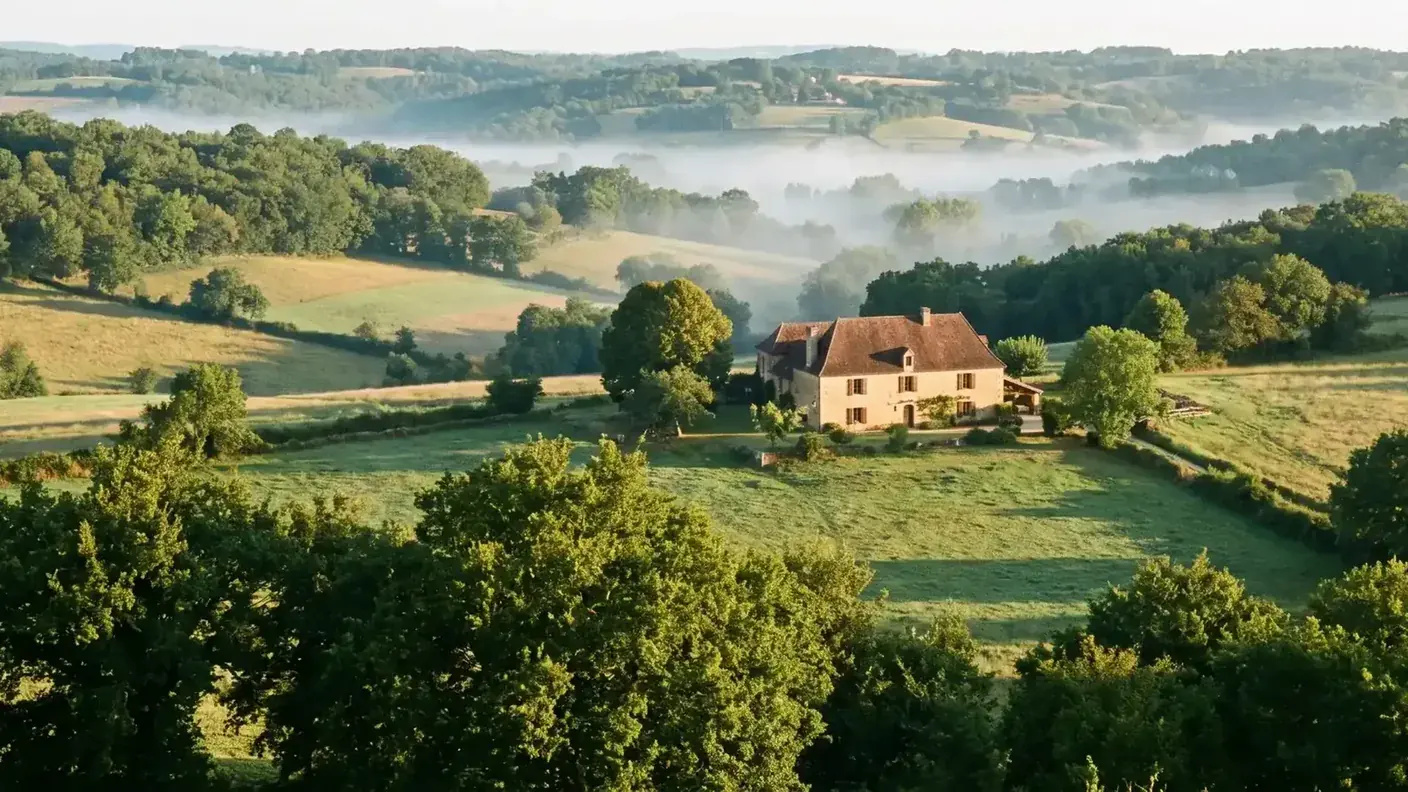
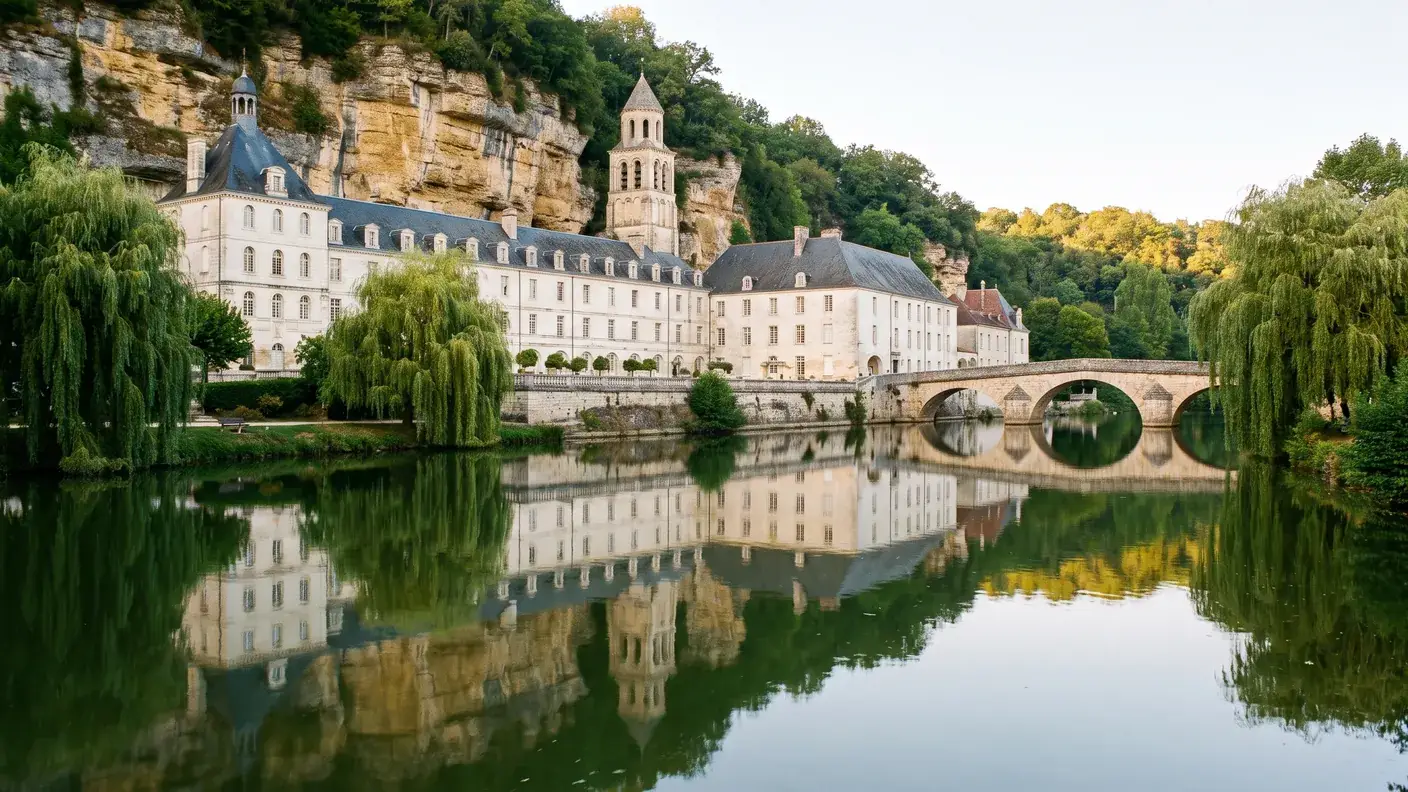
The most natural pairing is Brantôme: same latitudes, same source river (the Dronne, which the Belle joins via the Nizonne), and two complementary faces—the spectacular abbey on one side, the hidden village on the other. A typical day for a driver: morning in Brantôme (abbey, caves, Friday market), lunch along the Dronne, afternoon at Mareuil Castle and a loop along the Belle, returning via Angoulême. History buffs will prefer to complete the “Four Baronies” circuit: Mareuil and Bourdeilles in the morning, then head southeast toward Beynac and Biron—all four “throne bearers” in a single (long) day.
Tips for Visiting Vieux-Mareuil
- Mareuil Castle is open to visitors during the season, by guided tour only. Opening days, hours, admission prices, and accepted forms of payment are subject to change: please check the official information before you go.
- Start with the Church of Saint-Pierre-ès-Liens: domes, a bretèche, and machicolations—this monument encapsulates the entire village, and admission is free.
- Mareuil Castle is open to visitors during the season, by guided tour only. Opening days, hours, admission prices, and accepted forms of payment are subject to change: please check the official information before you go.
- Take the heritage loop trail starting from the village, or a section of the GR 36 “From the English Channel to the Pyrenees” trail in the Belle Valley.
- On Tuesday mornings, there’s a market in Mareuil (8 a.m.–1 p.m.); on Friday mornings, head to Brantôme—you can combine both with a visit.
- Dining and lodging on site: the Auberge de l'Étang Bleu (Logis, 11 rooms, 9-hectare grounds) is the village’s top choice; the Domaine de Vieux-Mareuil (Château de Chanet) is available for exclusive rental.
- Don't go looking for the Fronsac cave: it's private property and closed to the public—you'll find it in the Dellucs' books, not out in the field.
- Vieux-Mareuil does not have a train station. Regional Line 310 connects the area to Périgueux and Angoulême on a variable schedule; check the official timetable before you leave. A private chauffeur from Bordeaux (~2 hours, starting at €254) remains the only door-to-door option.
Vieux-Mareuil is the opposite of a tourist destination: a village with a historically stable population, no train station, and no paid-admission monuments—and yet one of the places in the Périgord Vert with the richest history. It was here that the name of a barony—which captured counts at Bouvines—originated; here that Talleyrand collected his tithes without ever setting foot in the village; here that a cave engraved with exceptionally rare art has just been designated a historic site amid general indifference. The Gallic “great clearing” has never been more aptly named: an open, peaceful space where history surfaces like limestone beneath the grass. All you have to do is come—it’s two hours from Bordeaux, and it’s never crowded.
Frequently Asked Questions
How much does a private chauffeur service from Bordeaux to Vieux-Mareuil cost?
The Bordeaux → Vieux-Mareuil trip with a chauffeur service starts at €335 one-way (1 to 3 passengers, sedan), door-to-door. The price is fixed and quoted in advance—no meter and no surprise surcharges. A 7-seat van is available for families and small groups. Request a quote: you’ll receive a written response in less than 30 minutes.
How long does the trip from Bordeaux to Vieux-Mareuil take?
Allow about 2 hours for ~147 km—and via a route that might surprise you: the fastest route goes along the N10 to Angoulême and then the D939, not through Périgueux. The “Périgord” route via the A89, Périgueux, and Brantôme is 188 km (~2 hours 25 minutes) and more scenic—ideal for the return trip, with a stop in Brantôme.
Why is the village called “Vieux”-Mareuil?
Because this is the original Mareuil. The Gallic name (maro + ialo, “the great clearing”) originally referred to this village, built on the site of a Gallo-Roman villa. In the 12th century, the lord moved his castle five kilometers downstream—creating the “new” Mareuil, seat of the barony. As early as the 13th century, historical records distinguish Vetus Marolium, “Old Mareuil,” which was later Frenchified from the Occitan Vielh-Mareulh.
What is the Barony of Mareuil?
One of the four historic baronies of the Périgord, along with Beynac, Biron, and Bourdeilles—established between the late 9th and 10th centuries, directly under the Count of Périgord. According to tradition, the four barons jointly carried the episcopal throne during the entry of a new bishop into Périgueux. Verified feat of arms: at Bouvines in 1214, Hugues and Jean de Mareuil captured Ferrand, Count of Flanders. Vieux-Mareuil, a simple rural community, was the birthplace of this event without ever having been a separate seigneury.
What is the connection between Vieux-Mareuil and Talleyrand?
In 1789, the barony of Mareuil belonged to the Talleyrand family, who administered justice there and collected half of the tithes from Vieux-Mareuil. The family had acquired the barony through the marriage, in 1587, of Daniel de Talleyrand, Prince of Chalais, to the step-granddaughter of Marshal de Monluc. The famous Charles-Maurice de Talleyrand-Périgord belonged to the younger branch of the family: the barony was held by his half-uncle, and there is no indication that he ever stayed in Mareuil.
Can we visit Mareuil Castle?
Mareuil Castle is open to visitors during the season, by guided tour only. Opening days, hours, admission prices, and accepted forms of payment are subject to change: please check the official information before you go.
Can we visit the Fronsac Cave?
No—and this is important to know before you come: the Fronsac Cave is private property and closed to the public. Designated a historic monument on March 14, 2024, it contains 83 engravings from the late Magdalenian period, featuring an extremely rare focus on human figures (schematic female figures). It can be explored through the publications of prehistorians Brigitte and Gilles Delluc, not on-site.
What is there to see in Vieux-Mareuil, anyway?
The Fortress Church Saint-Pierre-ès-Liens (12th century, with a row of domes, machicolations, and a bretèche; listed as a historic monument since 1912) is the main landmark, open to the public free of charge. Nearby: the village built on the site of its Gallo-Roman villa, the bridge over the Belle River, the wash houses, the heritage hiking loop, and the hillsides dotted with orchids. Chanet Castle (listed as a historic monument) is available for exclusive rental but is not open to the public.
Where to stay and eat in Vieux-Mareuil?
The village’s main attraction is the Auberge de l’Étang Bleu: an 11-room Logis hotel and restaurant set in 9 hectares of grounds, featuring a rustic dining room with a fireplace and serving regional cuisine. For groups or events, the Domaine de Vieux-Mareuil (Château de Chanet, 15th–17th centuries, a listed historic monument) is available for exclusive rental—11 rooms, private chef upon request. Alternatively, Brantôme and its gourmet mills are just 18 minutes away.
On what day is the market held?
The local farmers’ market is held in Mareuil every Tuesday from 8 a.m. to 1 p.m. at the market square—featuring local producers, meats, and cheeses. The large market nearby is in Brantôme, on Friday mornings (7:30 a.m.–1:00 p.m.), one of the most renowned in the Dordogne, featuring foie gras and truffle markets from December through February.
How do I get to Vieux-Mareuil without a car?
Vieux-Mareuil does not have a train station. Regional Line 310 connects the area to Périgueux and Angoulême on a variable schedule; check the official timetable before you leave. The nearest useful train stations are 43 km away: Périgueux (TER from Bordeaux, 1 hour 10 minutes) and Angoulême (TGV, 1 hour 45 minutes to Paris). A executive car service from Bordeaux to Vieux-Mareuil (~2 hours, starting at 254 €) is the only direct option.
How many people live in Vieux-Mareuil?
314 residents as of January 1, 2023—the lowest figure ever recorded since the first census in 1793. The village had a population of 1,109 at its peak in 1836: it has lost 71.7% of its population over two centuries of rural exodus, a classic example of the situation in the Périgord Vert region. Since 2017, it has been a delegated commune of Mareuil-en-Périgord (total population of 2,326).
What is there to do around Vieux-Mareuil?
Brantôme, the “Venice of the Périgord,” is 18 minutes away (16.5 km)—featuring a cave abbey and canoeing on the Dronne River. Mareuil Castle is 8 minutes away, Bourdeilles (another barony, featuring a keep and a Renaissance palace) is 25 minutes away, Saint-Jean-de-Côle (one of the Most Beautiful Villages of France) is 37 minutes away, and Nontron, the cutlery capital of the Périgord Vert, is 26 minutes away. Périgueux and its Saint-Front Cathedral round out the loop at 44 minutes.
Further Reading
- The "Venice of the Périgord," just 18 minutes away: see the Brantôme Guide (Charlemagne's Abbey, caves, the Dronne River)
- Another of the four baronies: see the Beynac Guide (the vertiginous castle of the Dordogne)
- Prehistory You Can Explore: See the Guide to Les Eyzies (Font-de-Gaume, Cro-Magnon)
- The Abbey-Fortress of the Périgord Noir: See the Saint-Amand-de-Coly Guide
- Plan your trip: Book a chauffeured transfer from Bordeaux to Vieux-Mareuil or explore all our destinations
Sources and References
- Wikipedia — Vieux-Mareuil — geography, history, demographics, heritage
- Wikipedia — Mareuil en Périgord — 2017 merger, record area, Regional Nature Park
- Wikipedia — Mareuil Castle — 15th-century reconstruction, Talleyrand, Montebello
- Wikipedia — House of Talleyrand-Périgord — title of Baron of Mareuil, branches
- SHAP Bulletin, Vol. 25 (1898) — Mareuil monograph — the Mareuil family line, Bouvines, Raymond's escape
- Mérimée Database — Fronsac Cave — Designated as a Historic Monument on March 14, 2024
- Mérimée Database — Saint-Pierre-ès-Liens Church — listed in 1912, domes, fortifications
- Hominides.com — Fronsac Cave — discovered in 1983, Delluc study, 83 engravings
- Dordogne Périgord Tourism — Château de Mareuil — official profile; accessed July 24, 2026
- Mareuil en Périgord Town Hall — Tuesday market, place names, community life
- Transports Nouvelle-Aquitaine — regional coaches in Dordogne, Line 310 Périgueux–Angoulême — official timetable search; accessed July 24, 2026
- INSEE — Complete Report on Mareuil en Périgord — Population, Age Groups, Housing
Article updated in July 2026.
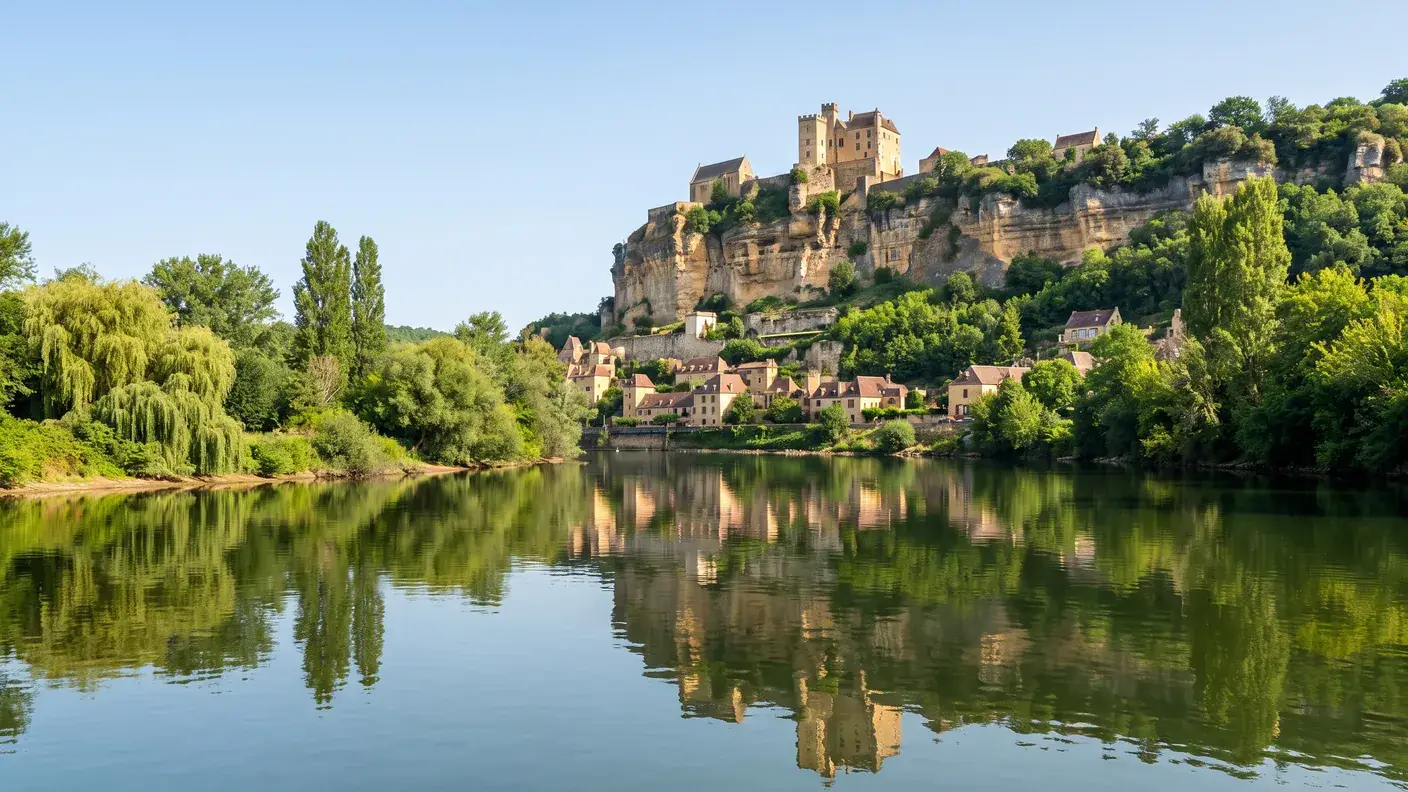
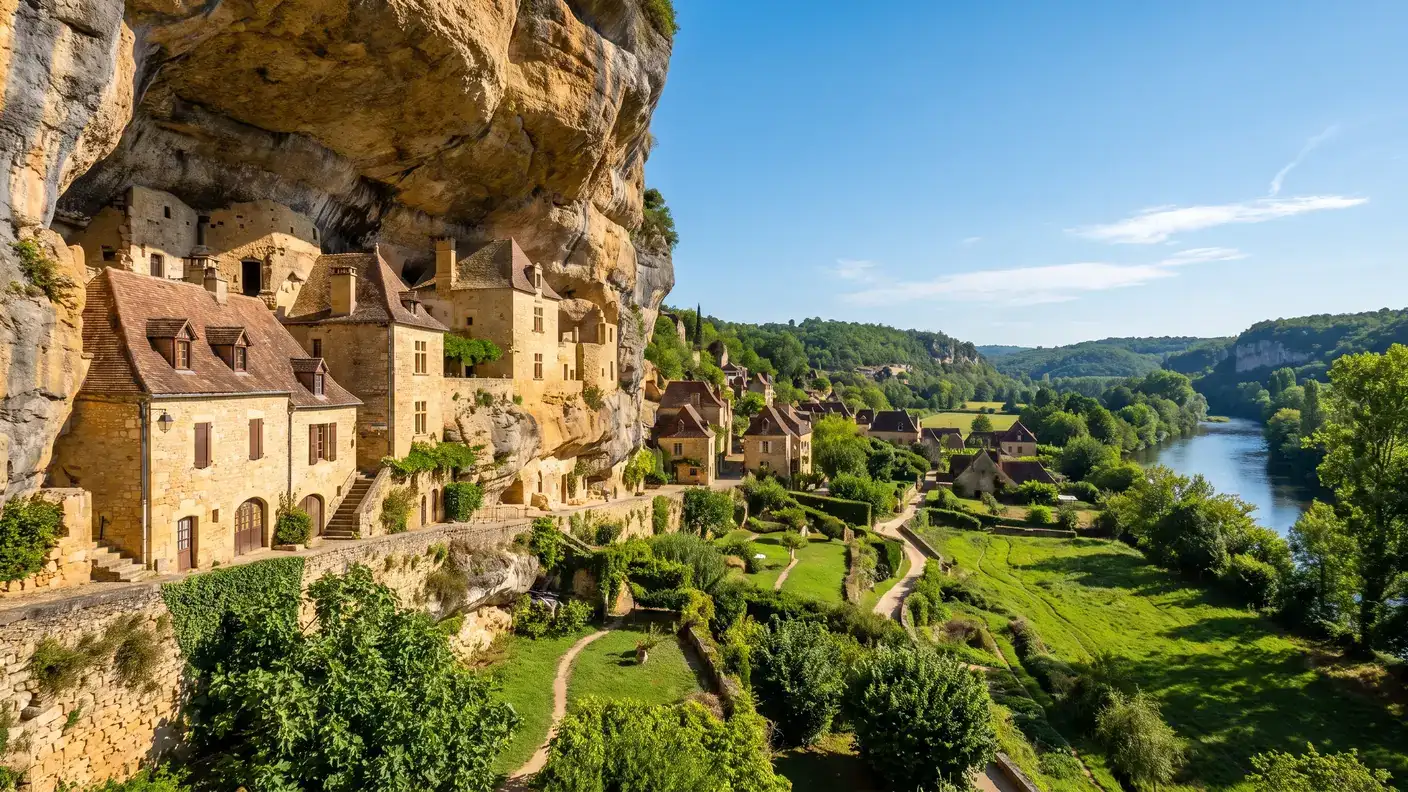
On the way to the birthplace of the barony
Direct trip from Bordeaux (~2 hours) via the N10 through Angoulême, with stops of your choice along the way—Angoulême, Mareuil Castle, and Brantôme on the way back. Written fixed-price quote within 30 minutes; sedan or 7-passenger van; English-speaking driver.