Bordeaux to Brantôme: the Venice of Périgord
A 300-meter-long island surrounded by the Dronne River, an abbey founded by Charlemagne and carved into the cliff face, the oldest bell tower in France, and an abbot who saved his monastery… with a feast. Learn all about it before you visit—it’s about 2 hours from Bordeaux.
Brantôme at a Glance
- Brantôme in the Périgord (population 3,763) is known as the “Venice of the Périgord”: its town center is situated on an island about 300 meters in diameter, completely surrounded by the Dronne River. The nickname has an official origin: President Raymond Poincaré, on September 15, 1913.
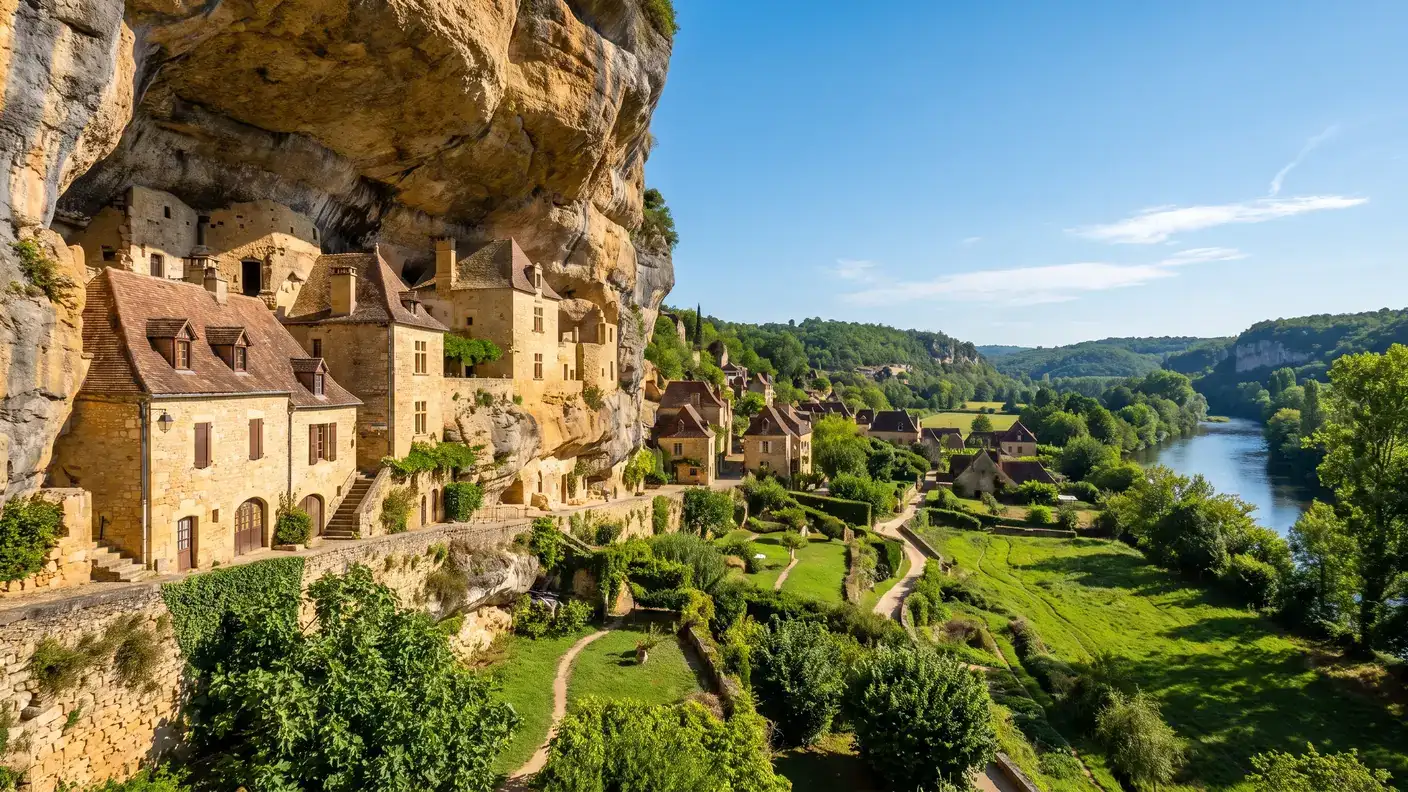
- Its abbey is said to have been founded in 769 by Charlemagne, who, according to tradition, placed the relics of Saint Sicaire there; the monks lived as cave dwellers in the cliff as early as the late 8th century.
- The 11th-century bell tower, built not on the church itself but on the 12-meter-high rocky outcrop that overlooks it, is considered the oldest bell tower in France.
- Behind the abbey, the Cave of the Last Judgment and its “Triumph of Death”—carved into the rock—attract 45,000 visitors a year — the second most-visited site in the Périgord Vert, open to visitors according to the official schedule verified in July 2026.
- The most famous abbot was Pierre de Bourdeille, known as Brantôme, chronicler of *Les Dames galantes*—he saved the abbey from looting twice during the Wars of Religion… including once by throwing a feast.
- On the water: canoe trip from Brantôme to Bourdeilles (12 km, 3–3.5 hours), guided tour on an electric boat, and even a lifeguard-patrolled beach on the Dronne River in the summer.
- Nearby, the Périgord Vert region is home to Bourdeilles (9 km), the Château de Puyguilhem (14.5 km), the Villars Cave (17 km), and Saint-Jean-de-Côle (20.5 km), one of the Most Beautiful Villages of France.
- From Bordeaux by car: ~147 km, about 2 hours — starting at 254 € in Economy class, door-to-door.
Before You Go: What Brantôme Is Really Like
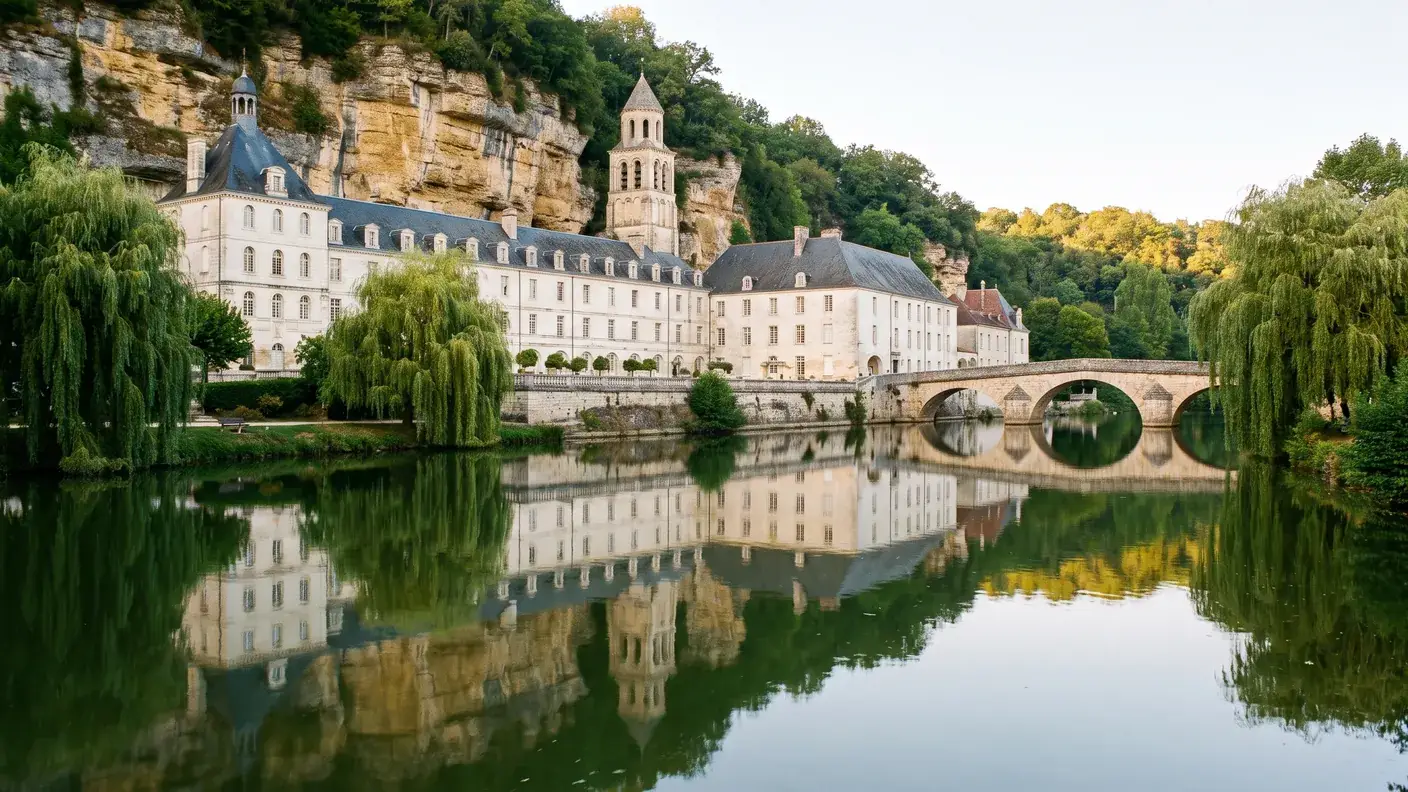
9 a.m., on the curved bridge. The only bridge in France, they say here, that turns at a right angle in the middle of the river. To your left, the Dronne flows smoothly beneath the willows; to your right, the monks’ garden and its Renaissance benches. And before you, the complete scene: the long white facade of the abbey set against its golden cliff, riddled with caves, and that stone bell tower perched on the rock above the rooftops—it was already ringing when William set out to conquer England.
Brantôme is a setting that’s almost too perfect: a round island 300 meters in diameter surrounded by green water, five bridges, a thousand-year-old abbey half-carved into the cliff, and a scandalous memoirist who took his pen name from the town. It is also, following the municipal mergers of 2016 and 2019, a mosaic-like municipality spanning 133 km²—the second-largest in the Dordogne—where camper vans are manufactured, where the Friday market has been held for centuries, and where NASA went to find a name for a Martian rock.
This guide separates fact from legend: Charlemagne’s founding of the site (a tradition, not a historical fact), the bell tower described as “the oldest in France” (and what archaeologists really say about it), the mysterious Triumph of Death and its competing interpretations, the incredible life of Pierre de Bourdeille, and the exact status of the troglodytic site in 2026—reopened in the spring, but not for much longer. With all figures, prices, and driving distances verified.
As for transportation, let’s be clear: Brantôme hasn’t had a train station since 1949, and the regional bus mainly serves Périgueux and Angoulême. To get here from Bordeaux and then explore the surrounding area—Bourdeilles, Villars, Saint-Jean-de-Côle—hiring a private driver from Bordeaux remains the simplest option (~2 hours via the A89).
A 300-meter-long island: why is it called “the Venice of the Périgord”?
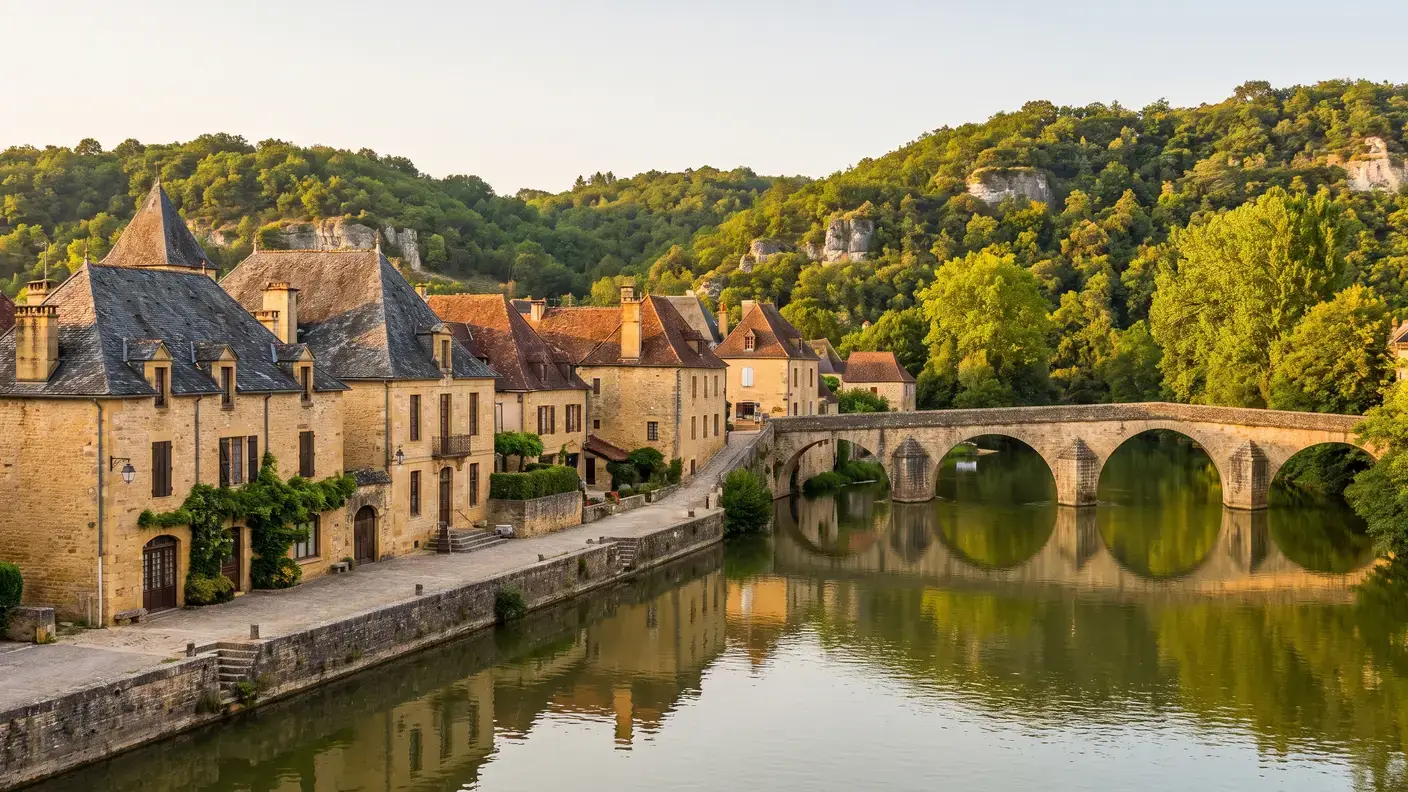
The nickname wasn't made up by the tourism office—it came from the president. The September 15, 1913, on an official trip to Périgord, Raymond Poincaré first coined the phrase “Venice of the Périgord” while gazing at the sight of the town nestled on the water—the 100th anniversary of the phrase was celebrated in 2013. A century later, it remains well-deserved: Brantôme is the only town in the Dordogne whose center is bounded by the perimeter of an island, an oval measuring approximately 300 meters in diameter formed by the Dronne River and its canal—the channel that once supplied water to the abbot’s mill—and connected to the banks by five bridges.
The star of these five bridges is the angled bridge, built in the first half of the 16th century during the abbacy of Pierre de Mareuil to connect the abbey to its gardens on the left bank. Its ten arches, three of which are right-angled, form a corner in the middle of the river’s course—a design dictated by the need to span both the Dronne River and its millrace. Severely damaged by the flood of 1735 and restored from 1736 to 1738, it has been classified as a historic monument since January 13, 1912, along with the three Renaissance display cases from the neighboring monks' garden. At its far end, on the abbey side, stand the Renaissance pavilion known as the “Corps de Garde” and its round tower, which have been listed as historic monuments since 1891.
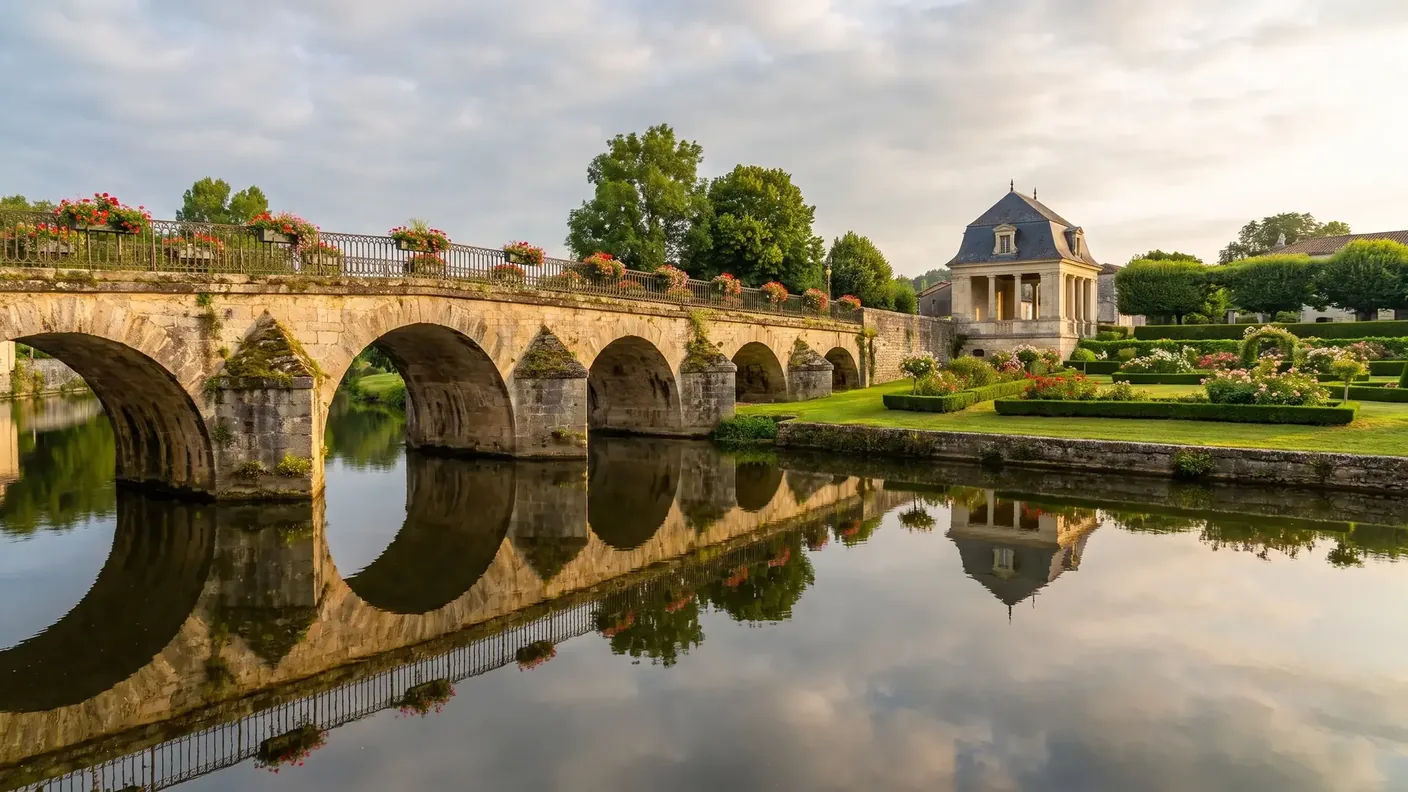
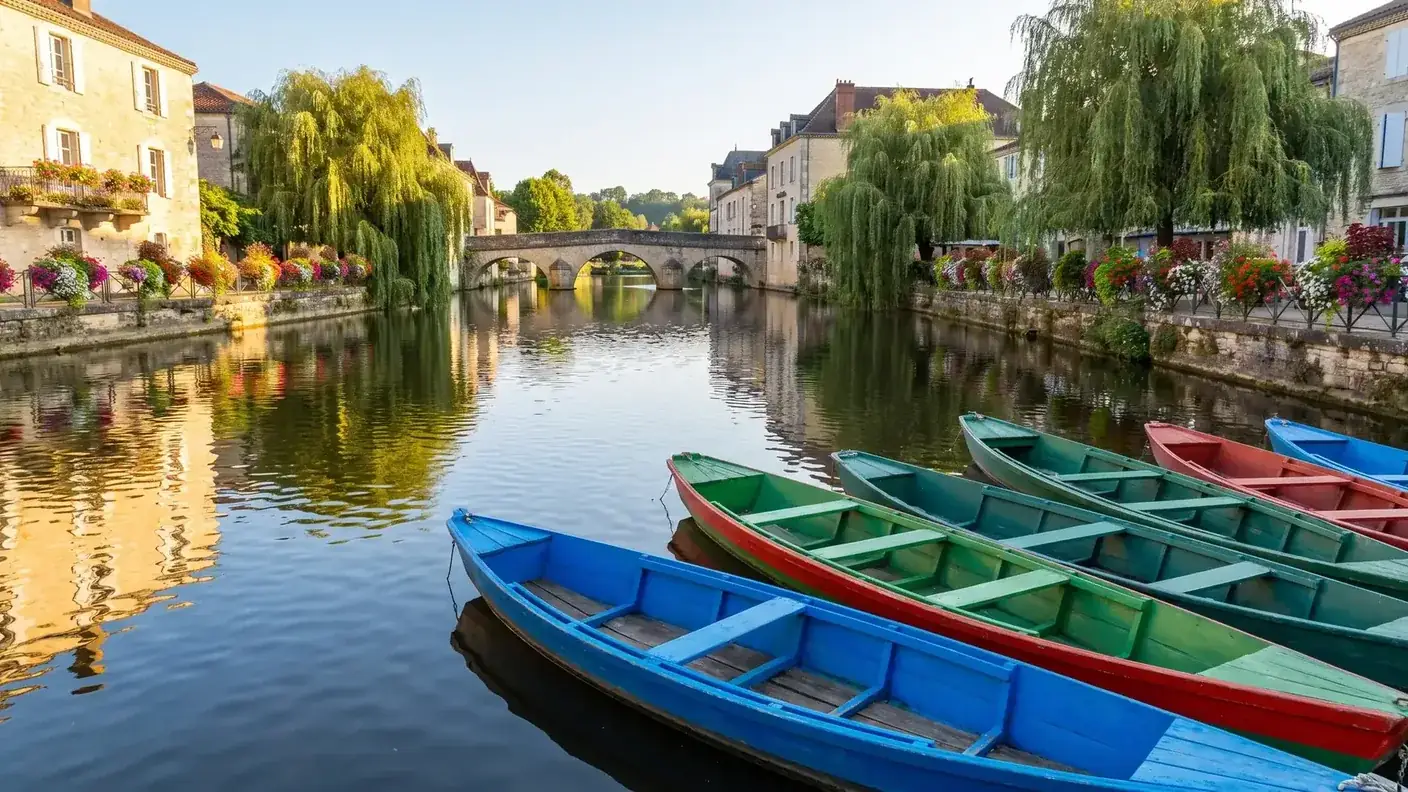
The river at the heart of all this drama, the Dronne, rises at an elevation of 479 meters in Bussière-Galant, in the Haute-Vienne department, and flows 200.6 km to the Isle—16 km of which run through the town. It is in exceptional condition: 80% of its course is designated as a Natura 2000 site or a ZNIEFF area. In Brantôme, it flows crystal-clear among weeping willows, clean enough to swim in (there’s a supervised beach in the summer—we’ll come back to that) and calm enough for the reflections of the abbey to remain undisturbed all day long.
A mosaic of communities: 8 villages, 133 km², 3 postal codes
Administratively, Brantôme has undergone a major change in scale over the past few years. On January 1, 2016, the municipality merged with Saint-Julien-de-Bourdeilles; on January 1, 2019, six other villages joined it (Cantillac, Eyvirat, La Gonterie-Boulouneix, Saint-Crépin-de-Richemont, Sencenac-Puy-de-Fourches, and Valeuil). The result: Brantôme-en-Périgord, comprising 8 former municipalities and covering 133.33 km²—the second-largest municipality in the Dordogne, behind Mareuil-en-Périgord. An amusing remnant of the double merger: a single INSEE code, but three postal codes; and a city council that had 54 elected members in 2019, before being reduced to 31.
| Data | Value |
|---|---|
| Status | New municipality (2016–2019), Nontron district, Brantôme canton in Périgord |
| Population | 3,763 residents (2023) — known as Brantômais and Brantômaises |
| Area | 133.33 km² (2nd largest in Dordogne) — population density 28 people/km² |
| Elevation | 92 m (Capinet Dam) to 246 m (Puyssegné) |
| Rivers | the Dronne (16 km within the municipality) + 62 km of waterways in total |
| Labels | France's Most Beautiful Detours · Tourist Town (2016) · 2 Flowers (2022) |
| Tourist Region | Green Périgord (a name attributed to Jules Verne) |
| Distance from Bordeaux | ≈ 147 km (~2 hours via the A89, Périgueux-Ouest exit) |
The population, meanwhile, has remained remarkably stable: 3,596 residents in 1968 (based on the current, reconstructed boundaries), 3,763 in 2023—half a century of stability, at a time when so many towns in the Périgord have been depopulating. INSEE explains the dynamics: a natural population change of −0.9% per year, exactly offset by a +0.9% increase in new residents. The historic town center alone has a population of about 2,100; the rest are spread across the hamlets and outlying villages, including Saint-Crépin-de-Richemont, the only part of the municipality included in the Périgord-Limousin Regional Nature Park.
An economic surprise in the land of abbeys: Brantôme is a small industrial hub. The company Font Vendôme has manufactured camper vans since 1978 — 270 employees as of early 2021; 43% of production is exported. The rest of the local economy relies on tourism, the Friday market, and a network of businesses that many subprefectures would envy. As for “Périgord Vert”, the name is attributed to Jules Verne, who admired “the green hues of the woods and meadows”. It remains a tourism label; geographers, meanwhile, classify Brantôme as part of the Central Périgord. We won’t hold it against them.
769: Charlemagne, Saint Sicaire, and the Drakkars on the Dronne River
An imperial foundation (according to tradition)
According to the standard account, Saint-Pierre Abbey is traditionally said to have been founded in 769 by Charlemagne himself, who is said to have consecrated it by placing the relics of Saint Sicaire — one of the Holy Innocents massacred by Herod. The historian qualifies this: it is a tradition, and sources differ (some mention Pepin the Short, a consecration by Pope Leo III in 804, or a grant in 817), and the first solid documented reference is the presence of an abbot from Brantôme at the Council of Aachen of 817, that of Louis the Pious’s great monastic reform. But the legend has left very real traces: two 17th-century gilded wooden panels in the choir of the abbey church still depict Charlemagne’s donation—and the relics of Saint Sicaire are still there.
A detail that says it all about the venue's longevity: the “ Rock Fountain "dedicated to Saint Sicaire, along the cave trail, existed before the abbey — The sacred spring predated the monastery. Twelve centuries later, it is still revered for its fertility-enhancing properties.
848 and 857: destroyed twice by the Vikings
The first abbey did not last long: the Vikings destroyed it twice, in 848 and again in 857, as their ships sailed up the Dordogne, the Isle, and then the Dronne rivers to the foot of the cliff. Around 900, Bernard, Count of Périgord, returned the abbey’s property to the monks, allowing them to rebuild; prosperity returned in the 10th century—to the point that in 991, Abbot Grimoard of Mussidan, appointed Bishop of Angoulême, partially financed his new cathedral… with revenues from Brantôme. In 1080, Count Élie ceded his rights to the abbot of La Chaise-Dieu: a reformed monastic community, a new era of growth, and a place on the Way of St. James (via Lemovicensis). In 1271, King Edward I of England even granted the town a charter of franchise to loosen the monks’ hold on it.
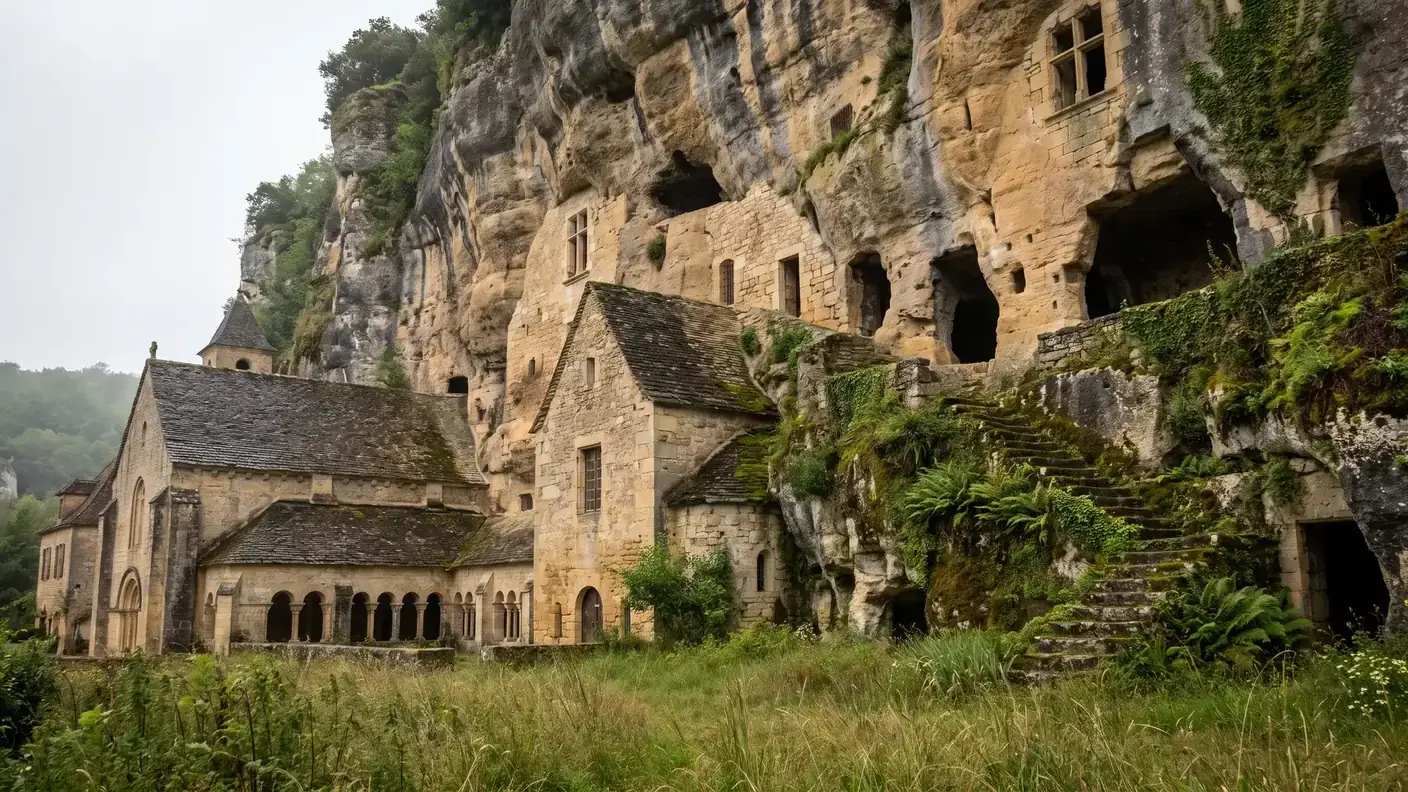
For this is the great founding paradox: the first abbey was not a building, but the cliff itself. As early as the late 8th century, Benedictine monks lived as cave dwellers, with the limestone providing them both shelter and building stone. Of the very first monastery, “nothing remains, not even knowledge of its exact location,” historians note—but the dozen or so converted caves running behind the current buildings preserve the memory of this life carved into the rock: a heating room, a washhouse, a mill, a dovecote, and even a fish farm.
The oldest bell tower in France (and it's not attached to a church)
Look up above the abbey church: the bell tower isn’t attached to the church. It stands beside it, on the 12-meter-high rocky overhang against which the church rests—a campanile, in the literal sense, built directly on the edge of the cliff. Dated to the mid-11th century based on archaeological analysis of the structure and stylistic comparisons, it is “certainly the oldest campanile in France,” to use the standard phrase—though the more cautious write “among the oldest campanile bell towers in France.” In either case: when it was completed, the conquest of England had not yet taken place.
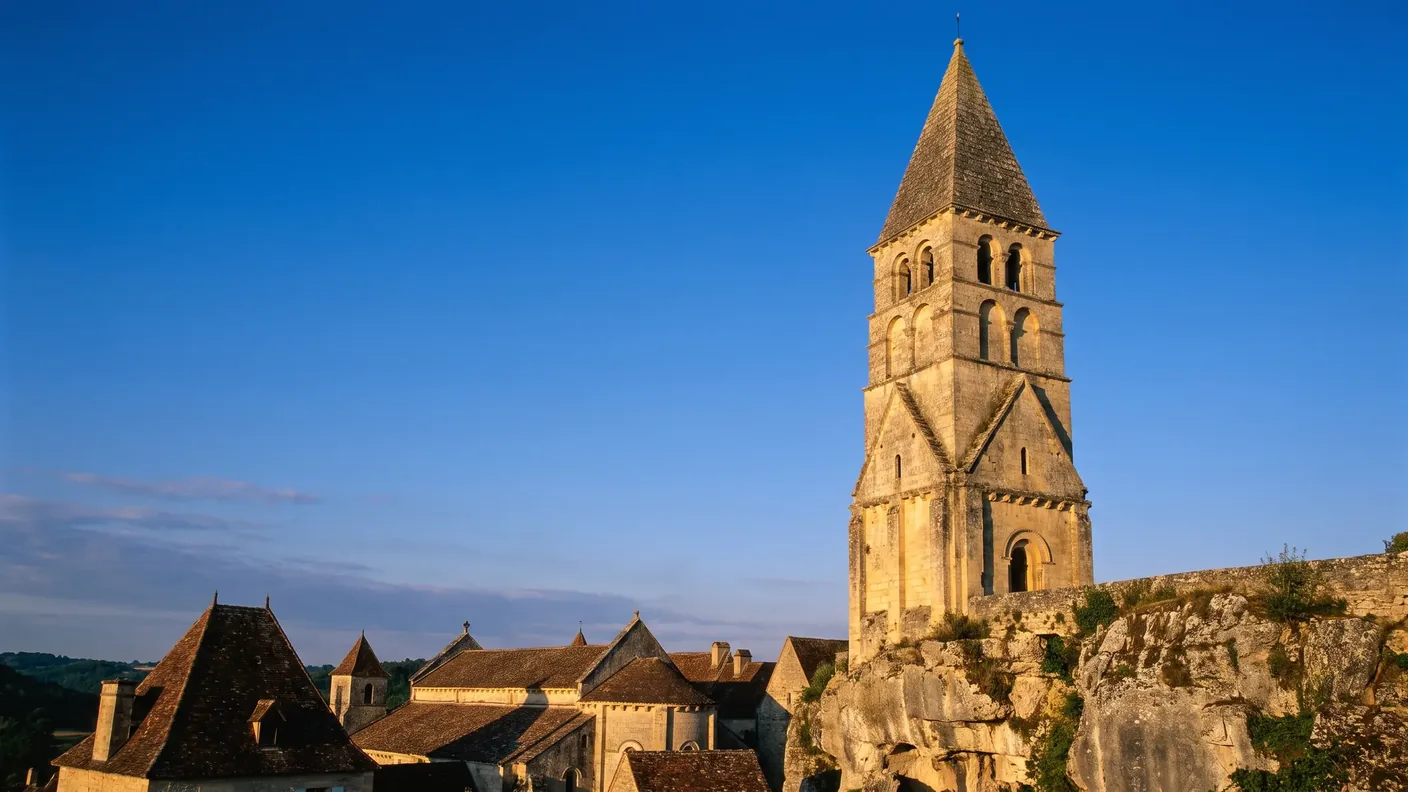
Its architecture is a prime example of the Limousin style: four successive recessed stories, crowned with gables (those triangular pediments above the windows), all topped by a quadrangular stone pyramid. Viollet-le-Duc considered it extraordinary enough to publish its plan, cross-section, and elevations in his *Dictionnaire*—his drawn cross-section still illustrates the entries today. The abbey church, for its part, appears on the very first list of historic monuments, that of 1840—the 1,034 sites selected by Prosper Mérimée.
The 11th–13th-century abbey church has had an eventful history: it was converted into a fortress by the English in 1404 during the Hundred Years’ War, restored in 1465, and given a new Gothic vault in the 15th century. Then came the 19th century, and Paul Abadie — the future architect of the Sacré-Cœur in Paris — who carried out such an intrusive restoration that he in 1858, he removed three of the cloister's four galleries from the 15th century. Inside, be sure to see the bas-relief depicting the Baptism of Christ (14th century), the gilded panels of Charlemagne, and the reliquary of Saint Sicaire.
Practical: The climb to the bell tower can only be done by guided tour (€8.50 full price, €6.50 reduced price; tickets available at the tourist office), limited to 18 people per tour—one of the most beautiful viewpoints in the Périgord Vert. The church, an active place of worship, remains open to the public during operating hours, subject to service schedules.
The Cave of the Last Judgment: A Mystery Carved into the Cliff
The Triumph of Death
Behind the abbey, the troglodytic trail features about ten converted caves—culminating in the Cave of the Last Judgment, a vast chamber converted in the 15th century. On its wall is a monumental bas-relief measuring 7 to 8 meters, attributed to the late 15th century: beneath a dominant figure with crossed arms, Death Triumphant—a skeleton wielding a scythe, flanked by angels blowing trumpets, while the dead rise from their tombs and a crowned head wears a purse around its neck. The lesson seems clear: Death spares neither kings nor the wealthy. But the most fascinating aspect lies elsewhere: no contemporary text explains the sculpture. A reworked panel, an earlier deity, Christ in glory, the Virgin and Child? Competing interpretations have coexisted ever since the relief—long forgotten—was rediscovered in the 19th century. Next to it, an Italian-inspired Crucifixion (early 17th century) seems almost subdued.
The rest of the tour recounts the monks’ daily life in the rock: the Saint-Sicaire fountain and its fertility properties, the cave-dwelling dovecote with 240 nesting boxes—the pigeon niches also served as a unit of measurement for land wealth, and the droppings were sold as fertilizer—and the remains of a fish farm where the monks raised salmon fry. About thirty bilingual panels mark the self-guided tour (~45 min). The ticket also grants access to the Fernand-Desmoulin Museum, one of the most unusual in the Périgord: the “automatic” drawings that this engraver, a friend of Zola’s, created while in a trance between 1900 and 1902, signed by three successive spirits—works now recognized by the art brut community and exhibited as far afield as the LaM in Lille.
Status verified in July 2026: the tour is available to visitors
In July 2026, the official tourism office website lists the cave tour as open to visitors and lists the admission fee as €5 for self-guided tours. Since conditions may change due to safety improvements, please check the schedule before visiting. Source: Périgord Dronne Belle Tourist Office, page verified in July 2026.
| Tour | 2026 Rates | Good to Know |
|---|---|---|
| Cave Tour (self-guided) | 5 € | ~45 min · includes the Fernand-Desmoulin Museum · ~30 signs in French and English |
| Guided tour (cave, bell tower, or residence) | €8.50 | €6.50 (reduced rate) · Bell tower limited to 18 people |
| Combination Ticket: Caves + Guided Bell Tower Tour | 11 € | The Recommended Pair |
| Two guided tours | 14 € | Tourist Office ticket office or on-site ticket machine (credit card) |
| Nocturnes | — | Mondays at 9:30 p.m. in July and August (cloister, church, grotto) |
| Summer Hours | — | 10 a.m.–7 p.m. in July and August · Check the schedule before your visit |
Prices and schedules verified in July 2026 with thePérigord Dronne Belle Tourist Office — Brantôme Abbey.
Pierre de Bourdeille, known as Brantôme: The Abbé Who Wasn't a Priest
If the name Brantôme evokes anything other than a village, it is thanks to him. Pierre de Bourdeille, born in Bourdeilles around 1537–1540 and raised at the court of Marguerite d’Angoulême—his mother and grandmother were among the “narrators” of the *Heptaméron* — received the Abbey of Brantôme in 1556, at the age of about twenty, as a favor from Henry II, in compensation for his brother’s heroic death in battle. As a commendatory abbot, he received the abbey’s revenues without ever having been ordained a priest—and he would sign his name “Brantôme” throughout his life, after the name of his abbey.
His youth was an adventure story: in 1561, he escorted Mary Stuart, the young widow of Francis II, to Scotland; he traveled throughout Italy, spent three and a half months with the Knights of Malta, and in 1564 took part in the Spanish expedition against Badis, in Morocco, where he commanded two companies—his only true feat of arms, for which he was rewarded by King Sebastian of Portugal (who was only ten years old at the time!) with knighthood in the Order of Christ. Next came the Wars of Religion: Dreux, Saint-Denis, La Rochelle, the court of Charles IX, and the confidences of Catherine de’ Medici after the St. Bartholomew’s Day Massacre.
In 1569, Admiral de Coligny and his Protestant troops approached Brantôme. The abbot, who had remained on good terms with him, invited them… to a lavish feast. After feasting to their hearts’ content, the Huguenots left without looting anything—and spared the abbey once again on their second visit, on October 15, 1570. The abbey may have been saved twice by a list of contacts.
The turning point comes in 1584: A fall from a horse—a white horse, which would leave him with a lifelong phobia—left him bedridden for two years. Convinced he was going to die, the disillusioned courtier (Henry III had denied him a promised position) retired to the castle of Richemont, which he had built 7 km from his abbey, and dictates his memoirs to his secretary, Mathaud. He would live another thirty years. The result— The Lives of Courtesans, Lives of Illustrious Women, The Lives of Great Commanders — was not published until after his death, in 1665–1666, printed in Holland under a pseudonym. Intimate Portraits of Catherine de’ Medici, Mary Stuart, and Queen Margot: it has been nicknamed “ History's valet "for everything he reports from behind the scenes of power."
He died in July 1614 and is buried in the chapel of his castle in Richemont—beneath an epitaph he wrote himself, in a will that prohibited the sale of the castle and authorized its transfer through the female line: the 14th generation of his descendants still lives there (summer tours are available in Saint-Crépin-de-Richemont, now part of the municipality of Brantôme). The “Brantôme triangle”—Bourdeilles, where he was born; the abbey he led; and Richemont, where he is buried—can be explored in half a day: 9 km + 7 km.
From the Revolution to NASA: The Ten Lives of the Abbey
The abbey that Bourdeille saved was already in decline: 37 monks in 1564, fewer than ten at the time of the Revolution — accompanied, incidentally, by a crisis worthy of a soap opera, when the community, now reduced to 13 monks, elected in 1501 two rival priests, and then saw five claimants vie for the crosier for eighteen years. Contrary to legend, the 17th- and 18th-century reconstructions did not repair war damage (the abbey was spared, thanks to the feast) but rather addressed simple decay: the Maurists, who arrived in 1636, rebuilt the convent buildings—including the corbelled stone staircase known as “ by Vauban ", a work by Father Le Prestre, a relative of the marshal.
Sold as national property in 1790-1791, the abbey has a long history of secular life: middle school, begging station of the department in 1812, a plan for a spinning mill in 1849, acquisition by the municipality in 1862, magistrate's court, schools starting in 1880, and later town hall. It wasn't until the 1980s that tourism-related developments truly breathed new life into the town. The latest development: The town hall moved out of the abbey in July 2025 for the new facilities at Place du Champ-de-Foire—many guidebooks are out of date. Still housed within these walls are the media library, the Fernand-Desmoulin Museum, the ticket office for tours, and the temporary exhibitions under the magnificent hull structure of the former monks' dormitory; a project to restore the monument is currently underway.
And the most unexpected of accolades: In February 2021, NASA named a rock sample “Brantôme”, analysed by the Curiosity rover on Mars. From Charlemagne to the Red Planet—few abbeys can claim the same.
Bordeaux → Brantôme: ~147 km via the A89, about 2 hours
The route is simple and consists almost entirely of highway driving: the Bordeaux bypass, then A89 "the Trans-European Highway" to the Périgueux-Ouest exit, the northwest bypass around Périgueux via Chancelade, and finally the D939 — the old Angoulême–Périgueux national highway — all the way to Brantôme. Allow ~147 km and about 2 hours door-to-door. A fun fact about the finish: the section of the D939 that leads into Brantôme is called “ Route of the Old-Time Tacot "— in memory of the small meter-gauge train that ran between Périgueux, Brantôme, and Saint-Pardoux, which rattled along from 1888 to 1949 before disappearing."
| Option | Duration | Good to Know |
|---|---|---|
| Chauffeur service | ~2 hours | Door-to-door, starting at 254 € in Economy class — flexible stops (Périgueux, Bourdeilles, etc.) |
| Personal car | ~2 hours | A89 (toll road) then D939 · free parking on the outskirts of town |
| TER + road | ≈ 2 hours | Bordeaux → Périgueux: 1 hour 10 minutes (10–11 direct trains per day) + 27 km by car (to be arranged) |
| Regional Bus 310 | — | Périgueux ↔ Angoulême via Brantôme, ≈3 round trips/day, €2.50 — no direct service to Bordeaux |
| Nearest TGV station | — | Angoulême (59 km / 1-hour drive) — Paris via the high-speed rail line in 2 hours |
That's the village's weak point: No train station, and no direct transportation from Bordeaux. The train stops in Périgueux, 27 km away, and you still have to get to Brantôme; bus 310 runs from Périgueux to Angoulême via the town three times a day. With an executive car service, the journey is direct, with a fixed price confirmed in advance — and the evening return trip isn't tied to any schedule. Suggested itinerary: Since the A89 runs right past Périgueux, a stop at Saint-Front Cathedral or a brief visit to Bourdeilles fits naturally into the route.
Canoeing, boat tours, swimming, markets: Brantôme on the Dronne River
River running is a popular activity
The classic route is Brantôme → Bourdeilles: 12 km, 3 to 3.5 hours on the crystal-clear Dronne River, winding between cliffs and mills, for 25–30 € per canoe (rental companies in town: Brantôme Canoë, Allo Canoës—minibus shuttles for the return trip, accessible to children ages 5 and up). For those looking for a less strenuous option: Les Croisières de Brantôme takes 49 passengers aboard the electric boat Drona for a 50-minute guided tour at the foot of the curved bridge (April–October), with evening tasting cruises in the summer on a second 12-passenger boat. And for children, the rare luxury of a supervised river beach: fine sand, picnic tables, and free, supervised swimming from approximately July 7 to August 24.
Friday is market day (it has been for centuries)
The Friday morning market (8:00 a.m.–12:30 p.m., year-round) is one of the most renowned in the Dordogne. Source: Périgord Dronne Belle Tourist Office; calendar verified in July 2026. It usually brings together about 40 exhibitors, and December through February: the lard and truffle markets — foie gras, whole ducks, Tuber melanosporum sold by the gram. In the summer, there’s also a farmers’ market on Tuesday mornings (about 120 vendors during the season). On the calendar of verified festivals: the July 14 Water Sports Competition on the Dronne River (9 p.m., fireworks at 11 p.m.), the “Au fil de l'eau” pottery market in early August, the Baroque music festival Sinfonia in Périgord In August, the Rendez-vous des métiers d'art at the abbey—and at Christmas, a video projection on the abbey's facade with rides on illuminated boats. The latest addition: the Bimbillou Park, a fun cave site that opened in 2023 (8,500 visitors as of 2024).
Two Mills, One Star: Where You Can Dine Right by the Water
Brantôme has a specialty in the hospitality industry: the Moulins-sur-la-Dronne. The flagship is the Abbey Mill — Relais & Châteaux since 1981, a 4-star hotel spread across three buildings (the Moulin, the Maison du Meunier, and the 13th-century Maison de l'Abbé), and, above all, a gourmet restaurant Michelin-starred whose terrace faces the curved bridge. Dinner by the water, with the illuminated abbey in the background: it’s the quintessential image of the “Venice of the Périgord”—two adjacent bistros (“Au Fil du Temps,” “Au Fil de l’Eau”) offer the same experience on a simpler scale.
8 km away, in Champagnac-de-Belair, the Moulin du Roc tells a different story—one that’s very 2020: In this mill dating back to 1670—now a 5-star hotel with 15 rooms—chef Alain Gardillou—trained under Robuchon, heir to a restaurant that held a Michelin star for nearly 40 years (and two from 1982 to 1990)—voluntarily gave up his Michelin star to create Ròda (“the wheel” in Occitan), a more free-spirited restaurant. Two mills, two philosophies, the same river flowing beneath the windows. Reservations are strongly recommended for both—and the great advantage of having a private chauffeur: no one counts the glasses of Bergerac you drink with dinner.
Around Brantôme: castles, an ornate cave, and the most beautiful village
Brantôme is the ideal base for exploring the Périgord Vert: everything listed below is less than 25 minutes away. An elegant common thread: most of these sites are linked to the same families—the Bourdeilles of the writer, and the La Marthonies of Puyguilhem and Saint-Jean-de-Côle.
| Website | Directions from Brantôme | The Essentials |
|---|---|---|
| Bourdeilles Castle | 9 km · 13 min | 2 castles in 1: 13th-century keep + Renaissance palace · €10.10 |
| Moulin du Roc (Champagnac) | 8 km · 11 min | 5-star hotel in a mill dating from 1670 |
| La Chapelle-Faucher | 10 km · 13 min | a tragic castle from 1569, visible from the road |
| Puyguilhem Castle | 14.5 km · 21 min | "A Loire Valley-style castle in Périgord" · €7, free for visitors under 26 (EU) |
| Villars Cave | 17 km · 22 min | paintings dating back ~20,000 years + Hall of Chaos (new in 2026) · €12.80 |
| Saint-Jean-de-Côle | 20.5 km · 25 min | Most Beautiful Villages of France · 12th-century donkey-back bridge |
| Périgueux | 27 km · 31 min | Saint-Front Cathedral, Gallo-Roman city |
Bourdeilles: Two Castles in One
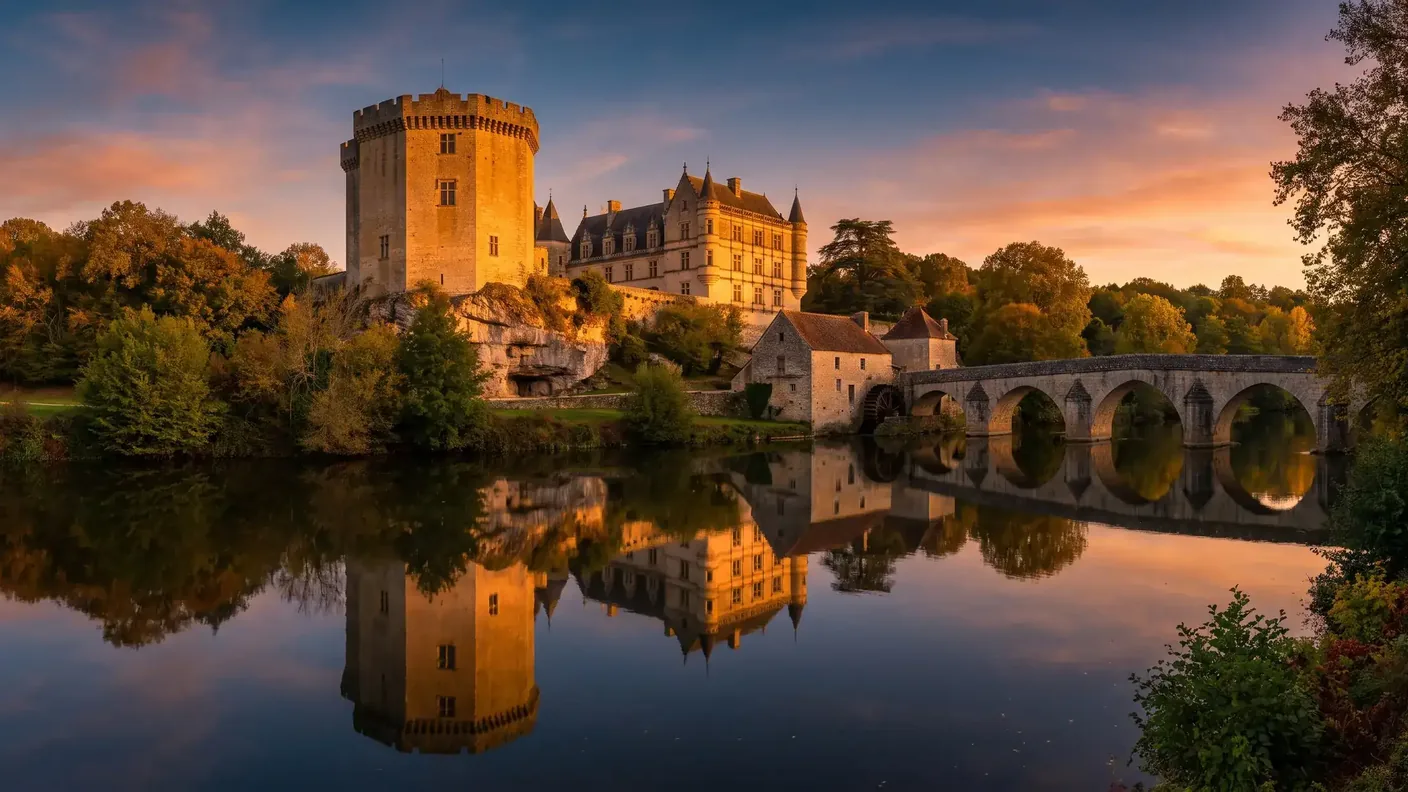
9 km downstream—by canoe if you like—, Bourdeilles was the site of one of the four baronies of the Périgord (along with Biron, Beynac, and Mareuil). On its rocky outcrop above the Dronne River stands a 13th-century fortress alongside the 35-meter octagonal keep (2.50-meter-high walls, panoramic terrace) and a Renaissance palace built between 1588 and 1598 to designs by a woman, Jacquette de Montbron — sister-in-law of the writer Brantôme. Inside, there is a gilded and painted salon, the “bed of paradise” said to have belonged to Charles V, and one of the finest collections of furniture in Nouvelle-Aquitaine. In 1369, the castle withstood an eleven-week siege by the Black Prince, before being recaptured in 1377 by an army led by du Guesclin.
Puyguilhem, Villars, Saint-Jean-de-Côle: the Périgord Vert Loop
In the north, three sites can be visited in a single half-day. Puyguilhem (1513–1535), built for Mondot de La Marthonie, the first president of the Parliament of Paris under Francis I, is a A Loire Valley castle lost in the Périgord — Expropriated and left in ruins in 1938, it took twenty years to restore it. The Villars Cave, meanwhile, hides within its ~13 km of tunnels (one of the largest networks in the Périgord) paintings measuring approximately 20,000 years — including the famous “little blue horse,” whose color comes from a calcite film over the black line — and reveals since April 2026, his “Hall of Chaos”, which had long been inaccessible. Finally Saint-Jean-de-Côle, population 354, the only village in the Périgord Vert region listed among the Most Beautiful Villages of France: a 12th-century “donkey-back” bridge paved with cobblestones, the Château de la Marthonie, brown-tiled roofs that have won the “Toits de France” award—and the Floralies, held every second weekend in May since 1982.
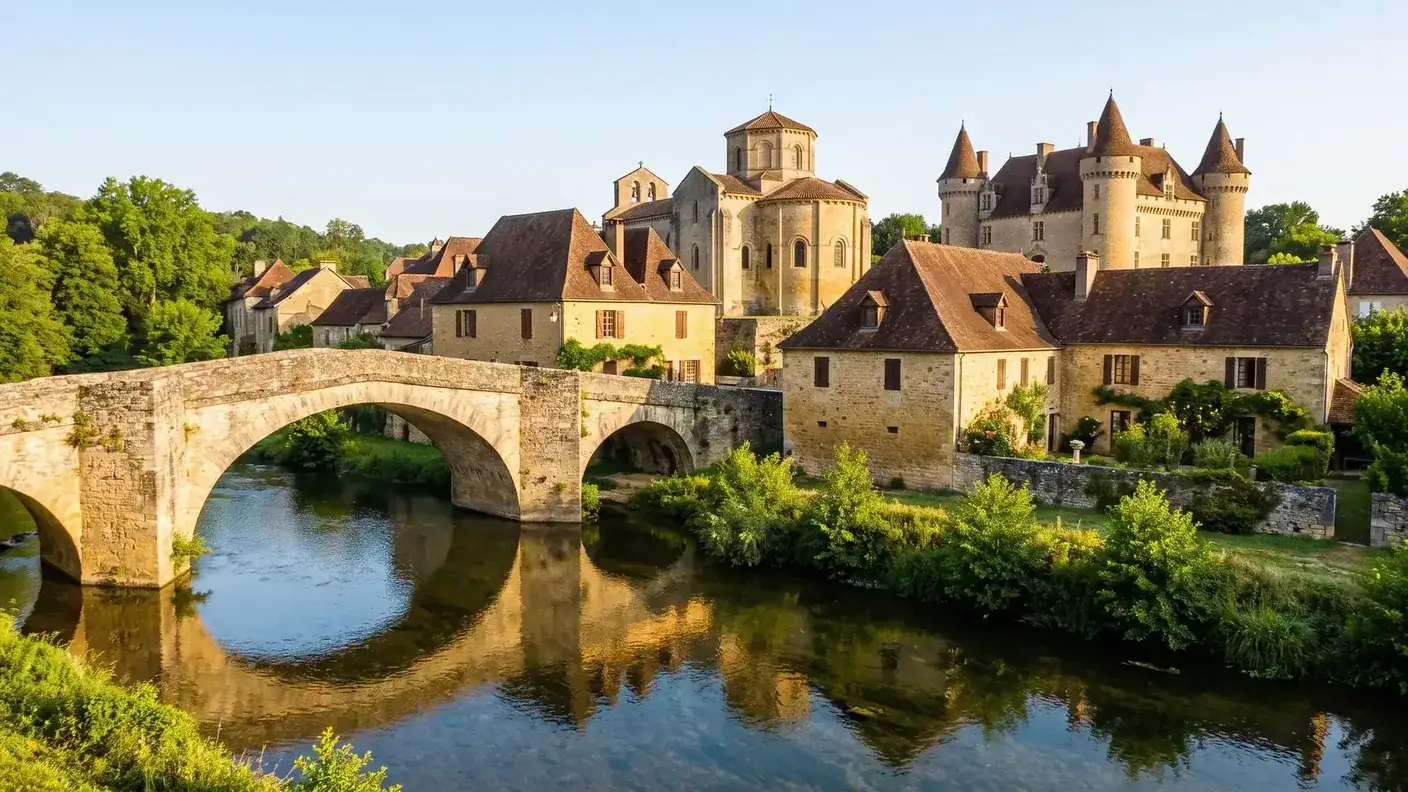
A bonus for fans of dark history: in La Chapelle-Faucher (10 km away), the castle bears witness to one of the worst episodes of the Wars of Religion—in 1569, Coligny’s army locked 300 peasants inside before setting the castle ablaze. The contrast with the feast at Brantôme that same year, just a few kilometers away, speaks volumes about Pierre de Bourdeille’s very personal role. And in Villars, the romantic ruins of the Cistercian Abbey of Boschaud (1163) blend Cistercian architecture with Romanesque domes—concerts are held there in the summer.
Our Tips for Success in Brantôme
- Come on a Friday: the morning market (8:00 a.m.–12:30 p.m.) is one of the most beautiful in the Dordogne—and from December through February, it turns into a market featuring fatty meats and truffles.
- Check the cave's schedule: the tour is listed as open as of July 2026, but conditions may change. The combined cave and bell tower ticket is priced at 11 €.
- Don't miss the Monday evening tour (9:30 p.m., July–August): explore the cloister, church, and Grotto of the Last Judgment by lamplight—an atmosphere you won't find during the day.
- Combine water and history: canoe from Brantôme to Bourdeilles in the morning (12 km), tour of the castle in the afternoon—the rental company’s shuttle will take you back.
- The Bourdeille Triangle: Bourdeilles (birthplace), the abbey (the name), Richemont (the tomb, open to visitors in the summer)—the chronicler’s life in half a day.
- Head on to Saint-Jean-de-Côle (25 min): the village, the Villars Cave, and Puyguilhem come together to form a beautiful loop in the north.
- Dine right by the water: the Michelin-starred terrace at Moulin de l'Abbaye, facing the curved bridge, or Ròda at Moulin du Roc—be sure to make reservations early in the summer.
- If you don't have a car, plan ahead: there's no train station, and only three buses run per day. A chauffeured transfer from Bordeaux (~2 hours, starting at 254 € in Economy class) remains the only door-to-door option.
Brantôme is one of those places that seem made for photography—an island, a cliff, a thousand-year-old bell tower, reflections. But it’s only when you dig deeper that you understand why people keep coming back: an abbey that survived the Vikings, the Huguenots, and Paul Abadie—a writer who saved his monastery with a dinner party; a carved cave whose true meaning remains a mystery; and a river so clear that people still swim in it. Poincaré’s “Venice of the Périgord” has only one drawback: it takes some effort to reach, with no train or direct connection. Perhaps that is what keeps it intact.
Frequently Asked Questions
How much does a private driver from Bordeaux to Brantôme cost?
The trip from Bordeaux to Brantôme with a professional chauffeur starts at 254 € in Economy for a one-way trip (1 to 3 passengers), door-to-door. The price is fixed and confirmed in advance, with no meter and no unexpected surcharges. An 8-seat van is available for families and small groups. Request a quote: we reply in writing within 30 minutes.
How long does the trip from Bordeaux to Brantôme take?
Allow about 2 hours for ~147 km: take the Bordeaux bypass, then the A89 to the Périgueux-Ouest exit, follow the Périgueux bypass, and then take the D939 to Brantôme. Since the route passes just outside Périgueux, it’s easy to add a stop at Saint-Front Cathedral or in Bourdeilles.
Why is Brantôme nicknamed the “Venice of the Périgord”?
Because its downtown is located on an island about 300 meters in diameter, completely surrounded by the Dronne River and its channel, and connected to the banks by five bridges—it is the only city in the Dordogne bounded by an island. The nickname was first used by President Raymond Poincaré on September 15, 1913, during an official trip to the Périgord.
Will the Cave of the Last Judgment be open in 2026?
Yes, as of the July 2026 update: the tourist office lists the troglodyte trail as open to visitors and indicates that self-guided tours cost €5. Since conditions may change, please check the official calendar before visiting. Source: Périgord Dronne Belle Tourist Office, verified in July 2026.
Who was Pierre de Bourdeille, known as Brantôme?
A courtier, soldier, and memoirist (c. 1537–1540 – 1614), commendatory abbot of Brantôme from 1556 onward—without ever having been ordained a priest. He escorted Mary Stuart to Scotland, fought in Morocco, and then, immobilized by a fall from a horse in 1584, dictated his *Lives of the Gallant Ladies* and other chronicles, which were published after his death. Nicknamed “History’s valet,” he saved his abbey from looting twice during the Wars of Religion—including once by hosting a feast for Admiral de Coligny.
Is the bell tower in Brantôme really the oldest in France?
It’s the standard line: the mid-11th-century campanile is “certainly the oldest campanile in France”—though cautious sources describe it as “one of the oldest campaniles.” Its true uniqueness lies elsewhere: it is not built on top of the church but on the 12-meter-high rocky outcrop that towers above it, with four recessed stories adorned with Limousin Romanesque gables. Viollet-le-Duc considered it remarkable enough to publish its plans.
How can I visit Brantôme Abbey, and what are the admission fees?
The abbey church is open to the public (except during services). The rest of the site can be visited through the tourist office: self-guided troglodyte tour for €5 (caves + Fernand-Desmoulin Museum, ~45 min), guided tours for €8.50 (cave, bell tower—limited to 18 people—or living quarters), combined ticket: €11; two guided tours: €14. Tickets are available at the tourist office (located in the former Notre-Dame Church) or from the on-site ticket machine.
On what day is the Brantôme market held?
Friday mornings, year-round (8:00 a.m.–12:30 p.m.)—one of the most renowned markets in the Dordogne. From December through February, it hosts the foie gras and truffle markets. In July and August, there’s also a farmers’ market on Tuesday mornings, and in early August, the “Au fil de l’eau” pottery market.
Is it possible to go canoeing in Brantôme?
Yes, this is the premier canoeing route in the Périgord Vert: Brantôme → Bourdeilles, 12 km in 3–3.5 hours (~25–30 € per canoe, return shuttle included, open to children ages 5 and up). For a more leisurely option: the 50-minute guided tour on an electric boat at the foot of the curved bridge (April–October), or the supervised beach on the Dronne River right in the town center (free swimming, mid-July through late August).
What is there to see around Brantôme?
The best of the Périgord Vert in less than 25 minutes: the Château de Bourdeilles (9 km, octagonal keep + Renaissance palace), Puyguilhem (14.5 km, “a Loire Valley château in the Périgord”), the Villars Cave (17 km, ~20,000-year-old paintings and the new “Salle du Chaos” since April 2026), and Saint-Jean-de-Côle (20.5 km, one of the Most Beautiful Villages of France). Périgueux and its Saint-Front Cathedral are 31 minutes away.
How can you get to Brantôme without a car?
That’s the downside: Brantôme hasn’t had a train station since 1949. From Bordeaux, you’ll need to take a TER train to Périgueux (1 hour 10 minutes) followed by a 27-km drive—or the regional bus 310 (Périgueux ↔ Angoulême, about 3 trips per day, €2.50). A private driver from Bordeaux to Brantôme (~2 hours, starting at 254 € in Economy) is the only direct door-to-door option, with a return trip at the time of your choosing.
Where can you stay or find a good place to eat in Brantôme?
Two mills on the Dronne River are the epitome of luxury: the Moulin de l'Abbaye (a Relais & Châteaux property since 1981, with a Michelin-starred restaurant, terrace facing the curved bridge) and, 8 km away, the Moulin du Roc in Champagnac-de-Belair—a 5-star hotel housed in a mill dating from 1670, whose chef voluntarily gave up his star to create the restaurant Ròda. Reservations are essential during peak season.
Can you swim in the Dronne River in Brantôme?
Yes—and this is rare enough to be worth noting: Brantôme has a supervised river beach with fine sand and picnic tables, open free of charge from around July 7 to August 24 (supervised Tuesday through Sunday, 11:30 a.m.–5:45 p.m.). The Dronne is one of the best-preserved rivers in the region: 80% of its course is designated as a Natura 2000 site or a ZNIEFF area.
Further Reading
- The market town on the Vézère: see the Le Bugue guide (Proumeyssac, Bournat, market established in 1319)
- The Capital of Prehistory: See the Guide to Les Eyzies (Font-de-Gaume, Cro-Magnon)
- The Abbey-Fortress of the Périgord Noir: See the Saint-Amand-de-Coly Guide
- The capital of the Périgord Noir: see the Sarlat Guide
- Plan your trip: Book a chauffeur service from Bordeaux to Brantôme or explore all our destinations
Sources and References
- Wikipedia — Brantôme in Périgord — geography, municipal mergers, demographics, events
- Wikipedia — Saint-Pierre Abbey — founding, Vikings, bell tower, caves, historic monument designations
- Wikipedia — Brantôme (writer) — biography of Pierre de Bourdeille, published by
- Wikipedia — Château de Bourdeilles — keep, Renaissance palace, sieges
- Périgord Dronne Belle Tourist Office — Brantôme Abbey — tours, prices, and hours verified in July 2026
- CDT Dordogne-Périgord — The Venice of the Périgord, bell tower, market, cave
- Périgord Dronne Belle Tourist Office — Cave of the Last Judgment — status and prices verified in July 2026
- Fondation du Patrimoine — Pillar Restoration Project, Fundraising
- Mérimée Database — Heritage Protection Status for the Abbey and the Guardhouse
- Villars Cave — Paintings, Admission Prices, the Hall of Chaos
- Bourdeilles Castle — Admission Prices, Hours, Collections
- INSEE — Complete Report on Brantôme in Périgord — Population, Density, Net Migration
Article updated in July 2026.
Off to the Venice of the Périgord
Direct trip from Bordeaux (~2 hours) via the A89; stop wherever you like along the way—Périgueux, Bourdeilles, Saint-Jean-de-Côle. Written fixed-price quote within 30 minutes; sedan or 8-passenger van; English-speaking driver.