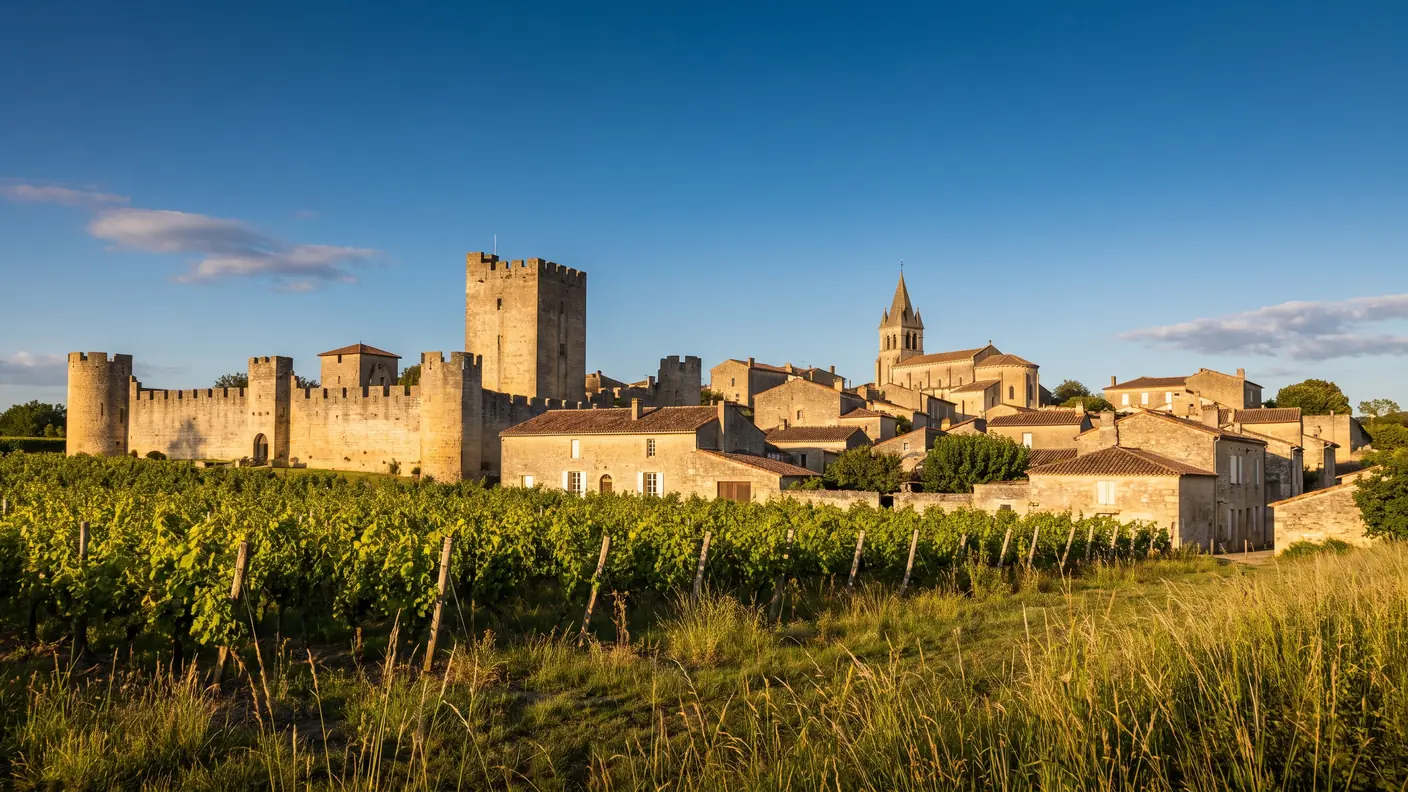
Bordeaux to Rions: a fortified village on the Garonne
An “English-style” fortification dating from 1330, designated a Historic Monument in 1862: Rions, a walled village on the right bank of the Garonne, with its machicolated Lhyan Gate, its Charles VII Cave, and its three appellations—plus your private door-to-door transfer from Bordeaux, without having to rent a car.
Rions at a glance
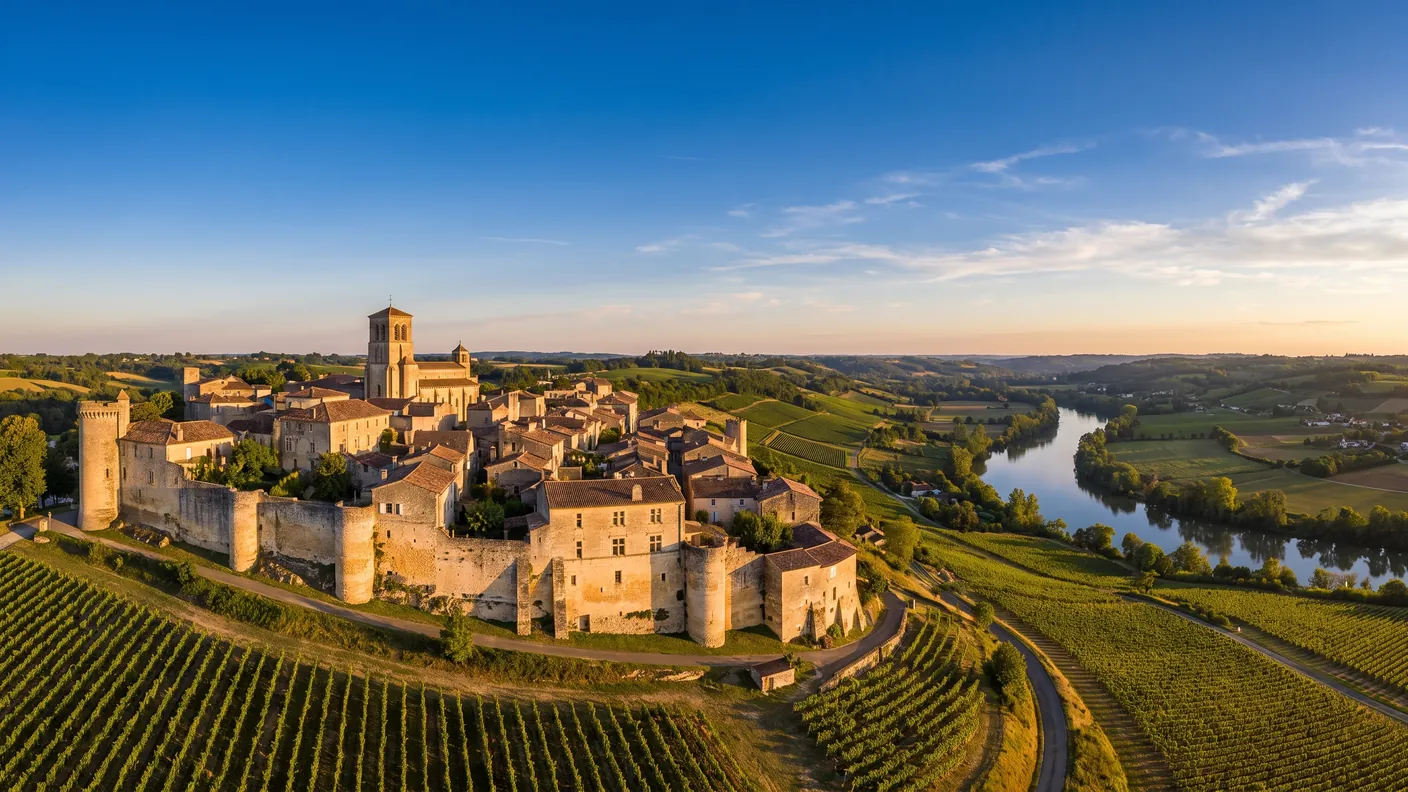
Rions is a fortified village in the Gironde department, on the right bank of the Garonne River, between Cadillac-sur-Garonne and Langoiran, about 32 km southeast of Bordeaux—one of the best-preserved and least-known medieval sites in the department. Its 14th-century church This 14th-century structure, built in 1330 under the authority of Edward III of England, has been listed as a Historic Monument since the 1862 list—one of the oldest designations of its kind in France. The Lhyan Gate with its machicolations, the tower known as “La Citadelle” facing the river, the Charles VII Cave, and the listed Romanesque church come together to form a rich tapestry of history in a village of 1,470 residents. This guide distinguishes fact from fiction: Rions is not not A bastide—its nickname, “Little Carcassonne of the Gironde,” is unofficial—and the siege of 1295 was part of the War of Guyenne, not the Hundred Years’ War. Next, we’ll show you the easiest way to get there: a private door-to-door transfer.
Here are the key details to know before you go. Distances are calculated door-to-door from Bordeaux; the fare listed is for a private driver reservation at a fixed price provided in advance, with no unexpected meter charges. Information on cultural heritage and demographics has been verified using the Mérimée database, Wikipedia, INSEE, the Rions town hall, and the standard historical monograph; schedules are subject to change and should be confirmed on site.
| Landmark | Details |
|---|---|
| Village | Rions (Gironde, Langon District) |
| Location | the right bank of the Garonne, between Cadillac-sur-Garonne and Langoiran |
| Residents | 1,470 residents of Rion (2023) |
| Must-See | the city walls, designated a historic site in 1862; the Lhyan Gate; the Citadel; and the Church of Saint-Seurin |
| Distance from Bordeaux | about 32 km · about a 40-minute drive |
Where is Rions located?
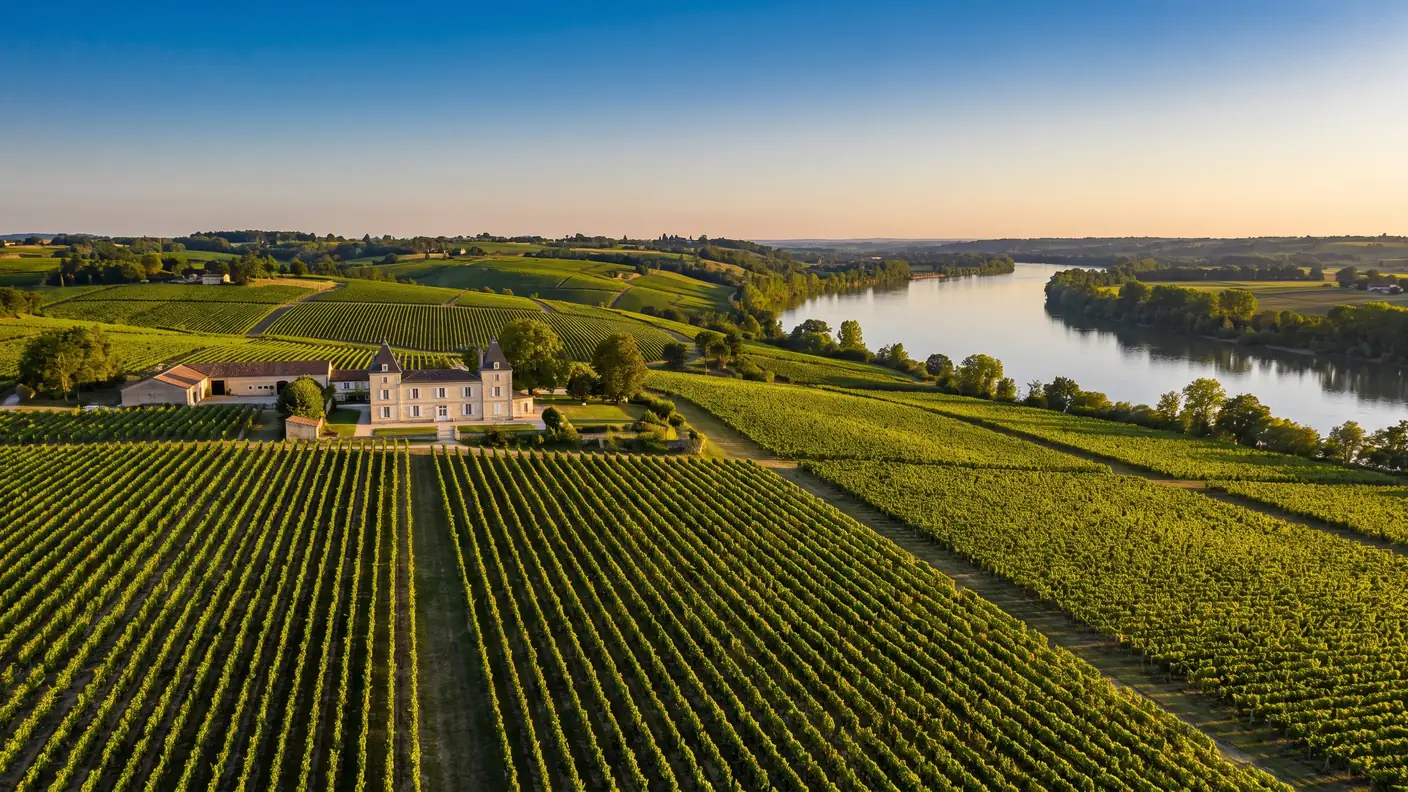
Rions is located on the right bank of the Garonne River, about 32 km southeast of Bordeaux, between Cadillac-sur-Garonne (5 km away) and Langoiran (7 km away). It's the land of first ribs: these steep hillsides overlooking the river, covered with vineyards and dotted with stone villages and castles. The municipal territory, covering 10.65 km², rises from 2 meters at the banks of the Garonne to 117 meters up the hillsides—a natural balcony overlooking the valley. Administratively, Rions falls under the district of Langon, the canton of Entre-Deux-Mers, and the Convergence Garonne community of municipalities; across the river, on the left bank, lie Podensac and Virelade, at the gateway to the Graves region. The village, with a population of 1,470—the from Rion —, lives in tune with the vineyard: nearly three-quarters of the region is farmland. Its location on a river terrace and at a crossroads of wine-growing regions explains its entire history and makes it an ideal getaway today, less than 45 minutes from Bordeaux.
A fortified balcony overlooking the Garonne
Rions occupies a strategic location: a promontory on the right bank, where the hillsides slope down toward the river. In the Middle Ages, this position commanded the Garonne River, its tolls, and its wine trade—hence the fortress that was built there, and the covetousness it attracted. The village has inherited a unique character from this history: a medieval wall that is still clearly visible, towers, a fortified gate with machicolations, and narrow cobblestone streets tucked behind the walls. Unlike its neighbors Cadillac or Créon, Rions is not a bastide with a grid-like layout: it is an ancient settlement, formed around a Gallo-Roman villa and its church—which makes it more organic, and more mysterious as well. Guidebooks describe it as “spared from mass tourism”: just a few minutes from the major sites of the Sauternes and Entre-deux-Mers regions, it remains a well-kept secret, best explored on foot, amid ramparts and vineyards.
In the heart of the Bordeaux wine region
Surrounding Rions lies one of the most beautiful wine-growing regions on the right bank of the Garonne: the Côtes de Bordeaux. The village boasts three appellations—the reds of Cadillac-Côtes-de-Bordeaux, the sweet wines of the Cadillac AOC, and the sweet whites of Premières-Côtes-de-Bordeaux—a rare variety for a single commune. Across the river, on the left bank, lie the Graves, and a little further upstream, the great sweet wines of Sainte-Croix-du-Mont and the Sauternes region. It is a wine-tasting paradise, where family-run châteaux welcome visitors by appointment, starting with Château Carsin de Rions, run organically by a… Finnish family. From the village, you can visit all these destinations in a radial pattern: Cadillac-sur-Garonne is 7 minutes away, Langoiran 12 minutes, Sainte-Croix-du-Mont 12 minutes, and the Abbey of La Sauve-Majeure 20 minutes. A chauffeur service allows you to visit these destinations one after another—and enjoy tastings—without worrying about driving or parking.
An "English-style" enclosure listed as early as 1862
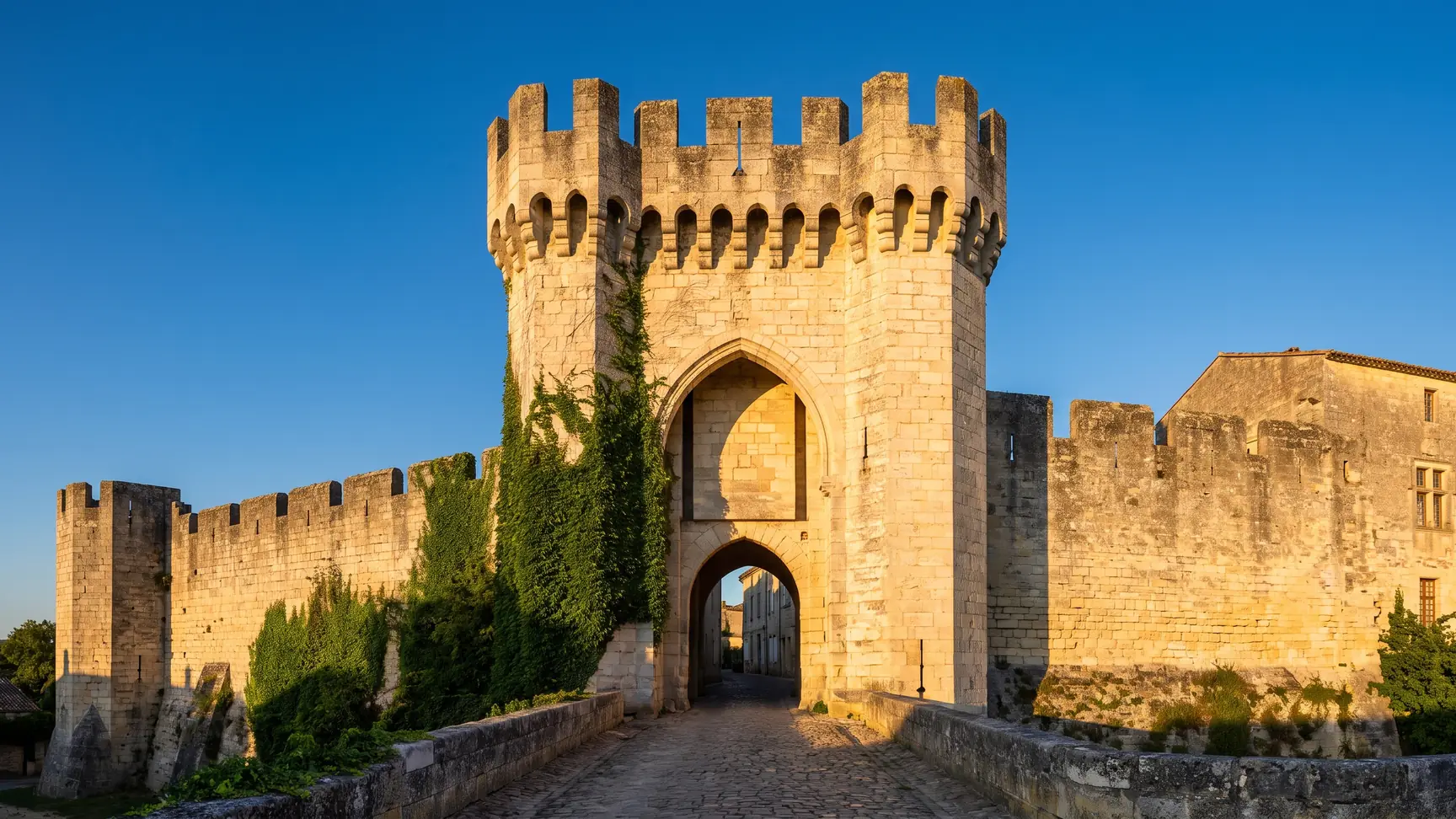
Rions's greatest treasure is its 14th-century church Century: Built beginning in 1330 by Lord Guillaume Seguin with English authorization, it has been listed as a Historic Monument since the 1862 list—one of the oldest designations of this kind in France. Here is what the sources document, in detail.
1330: High walls built under Edward III
The history of the ramparts begins with a disaster: in 1295, during the War of Guyenne, the city is taken by Charles of Valois, brother of the King of France, who had his fortifications demolished. A generation later, in 1330, the King of England Edward III — Duke of Aquitaine — authorizes and finances the local lord, Guillaume Seguin, to fortify the city: the Gascon Records preserve the document, “ for the construction of walls around the village of Rynuncio ". The walls we walk along today are therefore a city wall "English", built to defend against the King of France—a delightful paradox of medieval Guyenne. The defensive system was comprehensive: curtain walls, towers, and gates preceded by barbicans, and rare remnants of a double parallel ditch separated by a strip of land featuring a palisaded rampart walk, which is still visible on the south side. The complex is Designated a Historic Monument in 1862 (Official Mérimée Record PA00083702, accessed July 24, 2026) — the very first major ranking list, half a century before the church: a rare distinction for a village of 1,470 residents.
The Lhyan Gate, machicolations, and battlements
The village's monumental entrance is the Gate of Lhyan (also known as the “Lhyan Tower”—both names refer to the same structure), which controls access from the south. Built in the 14th century, it rises above Rue du Lhyan with machicolations and crenellations—the iconic image of Rions. A note of honesty: its upper section (the crowning structure) is an 1881 restoration, designed by the architect Léon Drouyn — not to be confused with his father, Léo Drouyn, the great Girondin archaeologist and illustrator who sketched Rions around 1860. Stepping through the gates of Lhyan is like stepping straight into the Middle Ages: cobblestone alleys, tightly packed stone houses, small squares—all within an area that’s easy to explore on foot. The town also offers a “ A stroll along the base of the ramparts ", which follows the outer perimeter of the walls: the best way to get a feel for the site, nestled between medieval stonework and vineyard-covered hillsides.
The Citadel, the Watchtower, and the Charles VII Cave
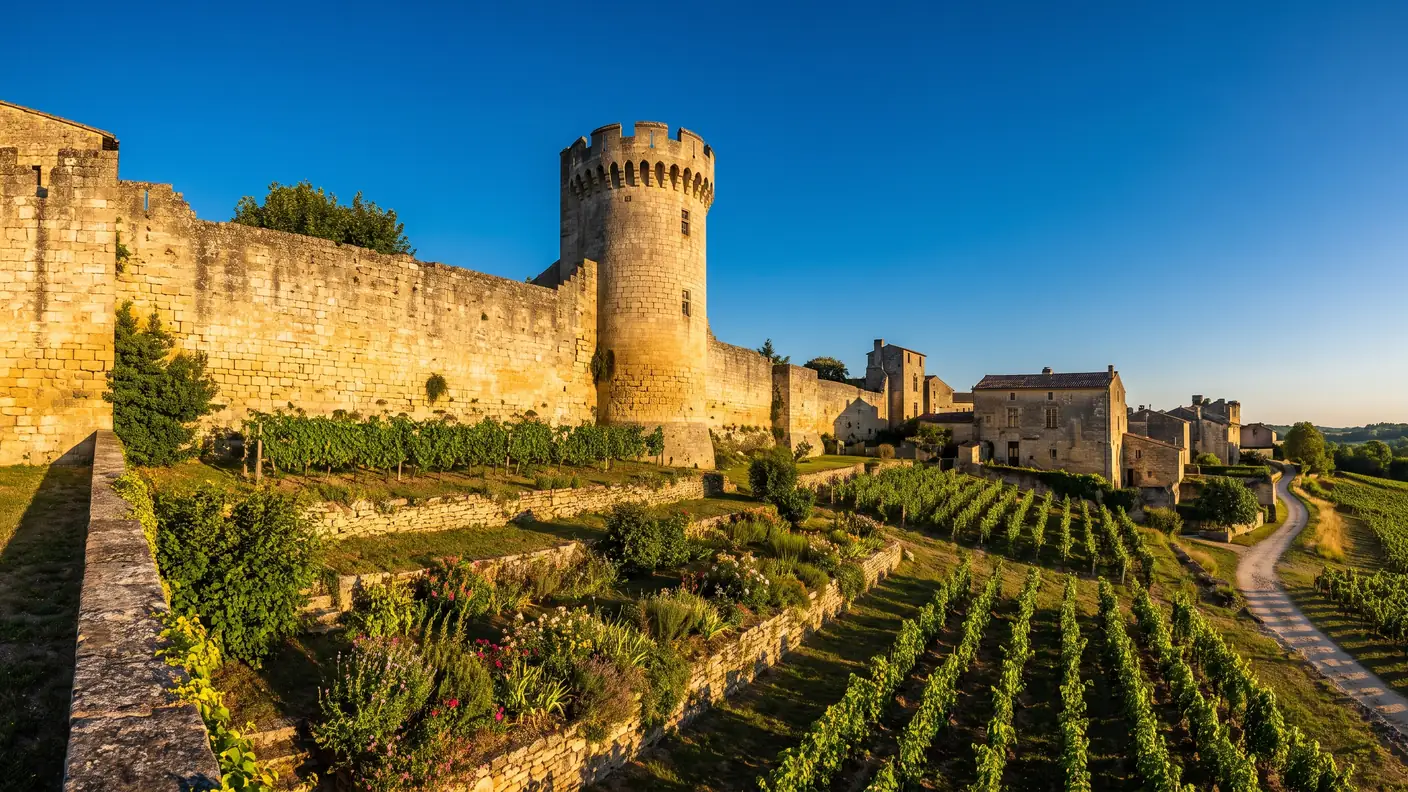
Along the ramparts, a series of structures can be seen: the tower known as “La Citadelle,” facing the Garonne; the Guet Tower, hidden behind the church; and, beneath the western ramparts, the mysterious Charles VII Cave and its spring. A small defensive complex to explore on foot. This is what the sources confirm.
The Citadel: A Tower, Not a Fortress
Let's make this clear from the outset, since confusion is common: “ the Citadel " by Rions is not a citadel-fortress in the generic sense—it is the proper noun for a 14th-century square tower century of the fortress, standing facing the Garonne near Place Jules de Gères, whose keep overlooked the old port. From there, the square overlooked the river, its wine convoys, and its tolls. Elsewhere in the village, the Guet Tower can be found in a small alleyway behind the Romanesque apse of Saint-Seurin Church—one of the most photogenic spots in Rions, where medieval stone seems to close in on passersby. The west-side ramparts...run along the outer edge, following the “at the foot of the ramparts” walking path: this is where the wall displays its most beautiful masonry, overlooking the gardens and vineyards. A complete loop—the Lhyan Gate, the Citadel, the Guet Tower, and the western flank—can be leisurely walked in an hour, taking in all the details.
The Charles VII Cave and Its Spring
At the foot of the western ramparts, adjacent to the Citadel Tower, lies Rions’s most unique attraction: the cave known as “Charles VII’s Cave” — a rib-vaulted chamber containing a natural spring, which has been used as a washhouse “since time immemorial.” According to local legend, the king Charles VII there would be rested and quenched his thirst during the conquest of Guyenne in the mid-15th century—a tradition recounted by local scholars, to be taken at face value, but one that adds to the charm of the place. The Gothic hall, cool and resonant, with its clear water beneath the vaults, is a brief moment of magic that most visitors to the region are unaware of. It also speaks to the very practical purpose of these fortifications: to protect a spring, a port, a market—the very life of a small medieval town on the Garonne. It is this blend of military architecture and everyday life that makes a visit to Rions so endearing, a world away from the overcrowded tourist sites.
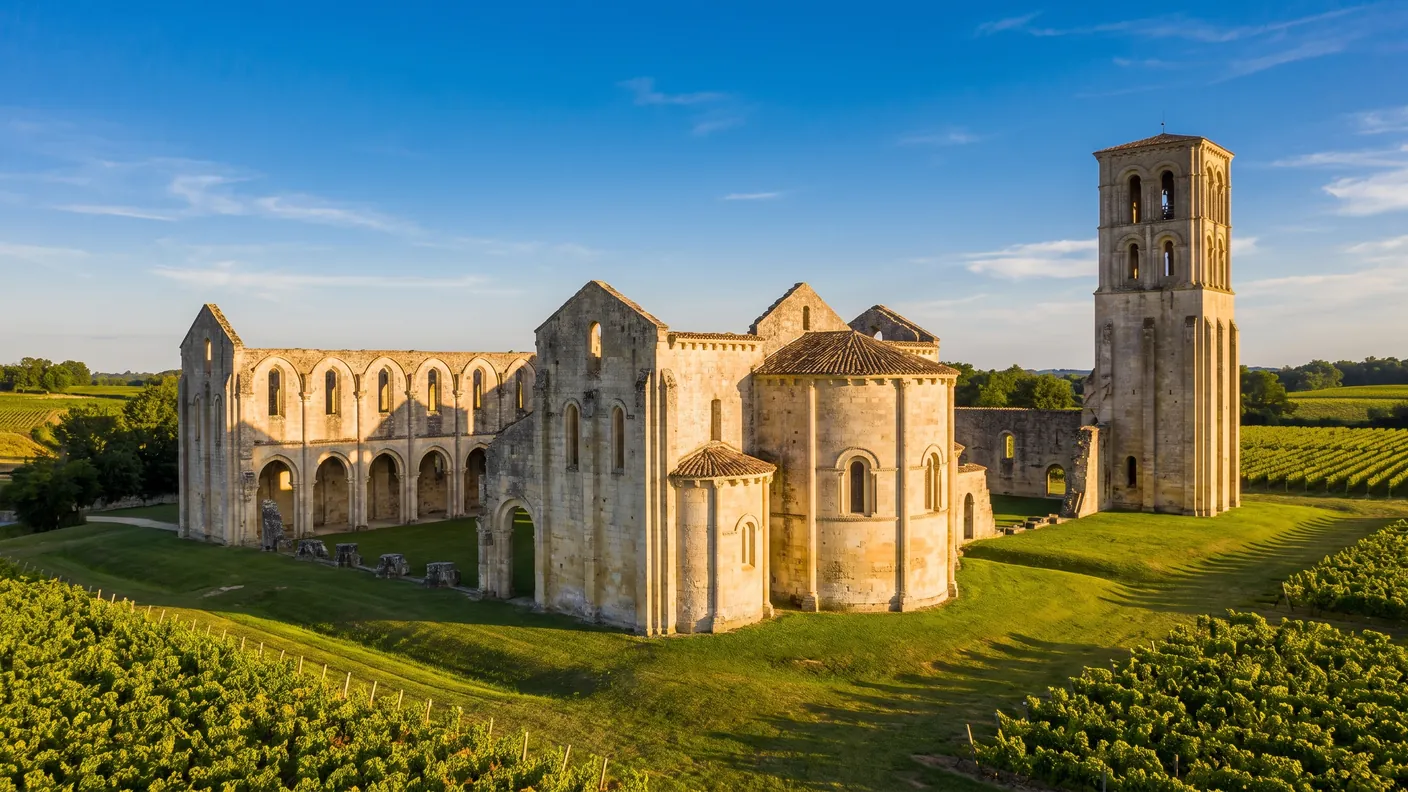
Saint-Seurin, a Romanesque church listed as a historic landmark since 1908
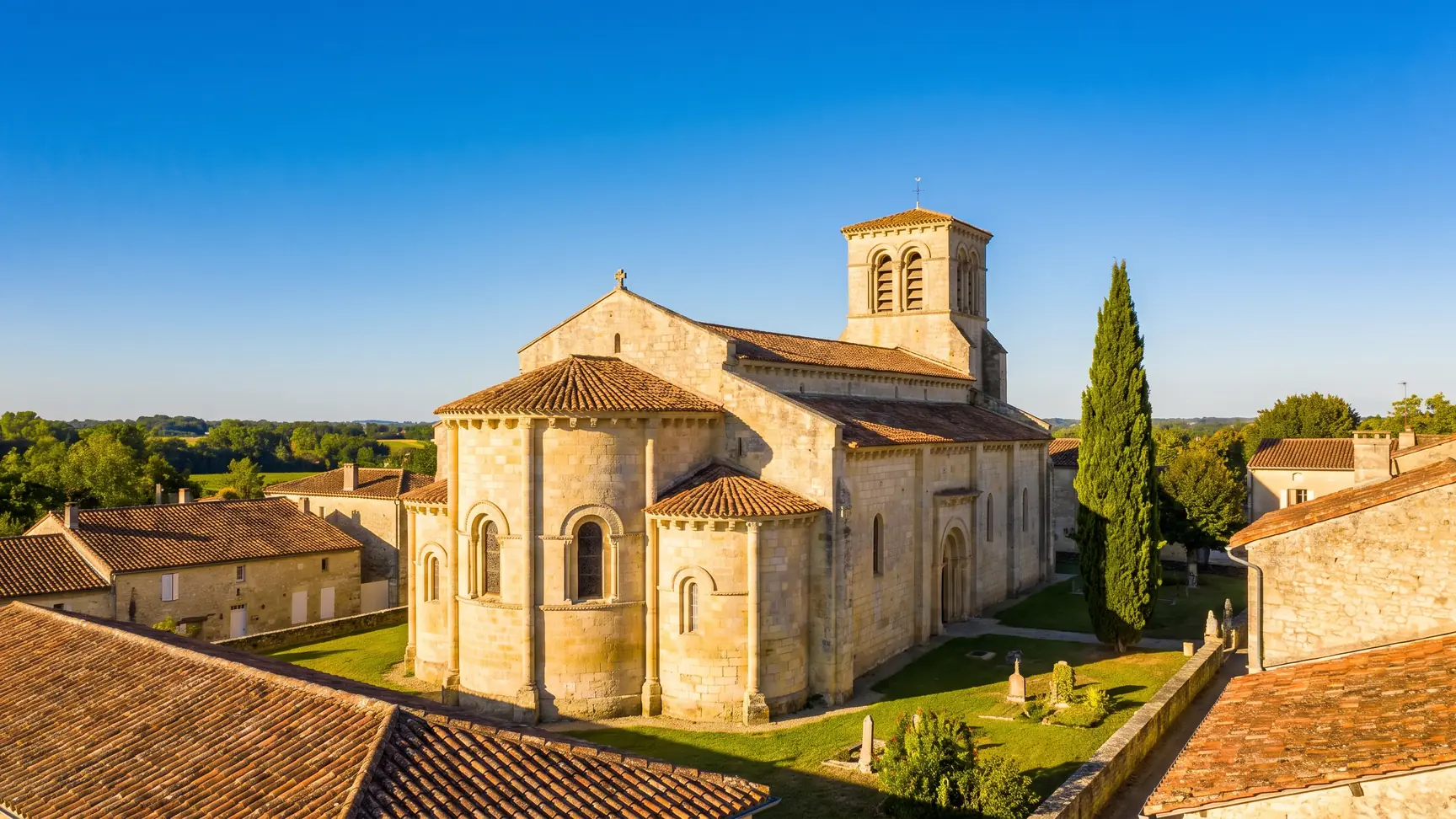
The second historic monument in the village, the Church of Saint-Seurin, is a composite structure: its apse and capitals date from the 12th century; nave rebuilt in the 14th century during the fortification of the city, a 19th-century Neoclassical bell tower — listed since the 1st December 1908. Official Mérimée Record PA00083701 Accessed on July 24, 2026. Here is what the sources say, without adding anything further.
A building that blends styles, from Romanesque to Neoclassical
Saint-Seurin (not to be confused with the basilica of the same name in Bordeaux) encapsulates eight centuries of architecture in a single building. From the church 12th-century novel century remain the nightstand with its absidioles and remarkable carved capitals — including one the Sacrifice of Abraham and a Daniel in the Lions' Den, two great classics of Romanesque iconography treated here with verve. The nave was rebuilt in the 14th century with two side aisles, at the very time the town was being fortified—a sign of renewed prosperity behind the new walls. The Neoclassical bell tower, finally, dates from the 19th century. The complex is Designated a Historic Monument since the 1st December 1908 (Mérimée entry PA00083701). With the 1862 wall, Rions therefore has two listed monuments — and only two: neither the washhouse, nor the market hall, nor a chapel are listed as protected sites, contrary to what is sometimes reported.
The Marble Head That Everyone Misses
The church has a detail that 99% of visitors miss: an ancient marble head — Emperor Commodus? A local aristocrat? — inserted at the window keystone of the building. This Gallo-Roman reuse is a reminder of the site’s very ancient origins: Rions developed around a Gallo-Roman villa (the ancient Reontium), and its church is first mentioned as early as the 6th century by Gregory of Tours. A Roman epitaph dated May 26, 466 (the year of Tatien's consulship), discovered in Rions, is now housed at the Aquitaine Museum in Bordeaux. Another stone detail: above the bell tower door, the coat of arms of Charles d'Albret, the Captal of Buch—the “pals” of Foix and the cows of Béarn, which have been incorporated into the town’s coat of arms. These are all details to look for on site, turning a visit to this little church into a scavenger hunt through seventeen centuries of Gironde history.
From Reontium to the goddaughters of Bordeaux
A Gallo-Roman villa that became a stronghold contested between France and England, designated the “goddaughter of Bordeaux” in 1379, Rions has weathered seventeen centuries of history—and holds within it astonishing tales, from the hangings of 1295 to the bombardment of 1420. Here are the verified facts.
1295: The Sack of Charles de Valois
The first major documented tragedy involving Rions occurred in 1295: during the War of Guyenne (1294–1297)—not to be confused with the Hundred Years' War, which did not begin until 1337—the city was besieged and captured by Charles of Valois, brother of Philip the Fair. The incident was marked by calculated brutality: according to the standard historical monograph, Valois did to hang sixty prominent figures in front of the city walls captured at Podensac; terrified, the English garrison fled to its ships... pursued by the people of Rion, furious at having been abandoned. The defenses were razed. It was from this humiliation that, in 1330, the current town walls. The seigneury passed to 1327 from Guillaume Seguin, who had gone blind and had no descendants, to Bérard I from Vayres, from the powerful house ofAlbret — which later produced illustrious rulers for Rions: the Captal of Buch, the King of Navarre, and later Henry IV and Louis XIII themselves.
Bordeaux's Goddaughter, the Bombarde, and the Capitulations
On July 18, 1379, Rions was granted a unique title: it became one of the eight “goddaughters of Bordeaux,” alongside Blaye, Bourg, Libourne, Saint-Émilion, Castillon, Cadillac, and Saint-Macaire—an alliance of mutual loyalty recorded in the Livre des Bouillons, Bordeaux’s great cartulary. This did not prevent family feuds: in 1420, the pro-English Jurade of Bordeaux laid siege to its own “goddaughter” with a bombard firing stone cannonballs weighing “VII quintaus”—about 350 kilograms—the expenses for which, along with orders to the gunners, are recorded in the municipal registers.
Rions did not return to French control until 1451, under a treaty dated June 20, two years before the Battle of Castillon. Its walls, built in 1330, continued to serve their purpose: in 1590, they secured an honorable surrender from Marshal de Matignon; in 1652, the people of Rion repelled the Marquis de Galapian; and in 1814, after the Battle of Toulouse, Lord Beresford once again issued a formal ultimatum to “the ancient stronghold”—the commander of the National Guard signed a formal surrender. This was an unusual military longevity for a wine-growing village.
"Little Carcassonne," bastide, citadel: what you often read
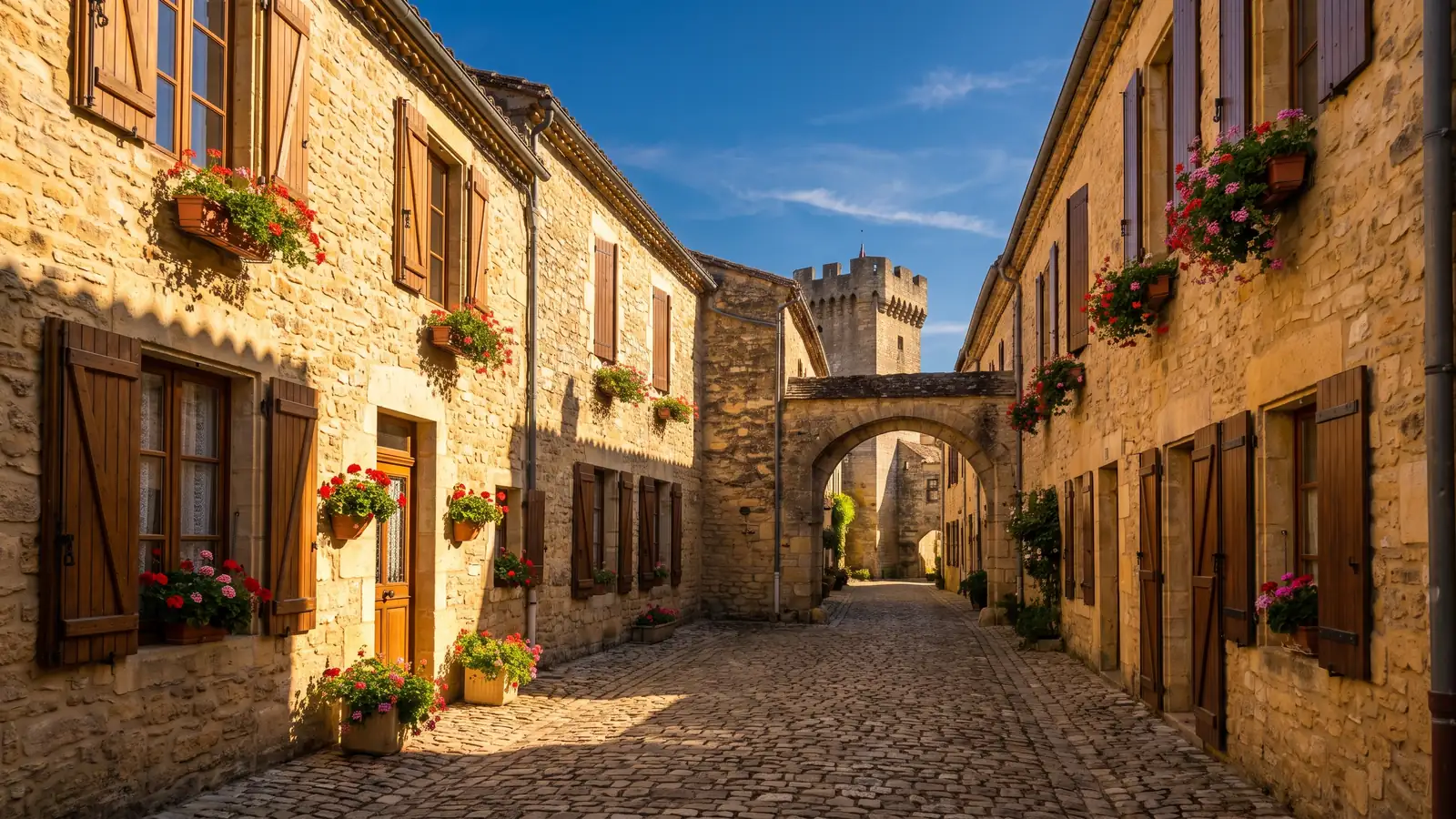
Several claims are circulating about Rions that warrant correction, backed by sources—which is the whole point of a reliable guide. The nickname, the “bastide,” the “citadel,” the dates: here’s what’s true and what’s false.
An unofficial nickname, not a country house
Rions is often described as “the little Carcassonne of the Gironde”: the nickname is appealing, but it’s important to note that it’s unofficial—it appears only in blogs and tourist guides, not on the town’s website, not on the Gironde Tourism site, and not on Wikipedia. We therefore use it in quotation marks, as a metaphor, not as an official name. Similarly, Rions is not a bastide: unlike its neighbors Cadillac (founded in 1280) or Créon, it does not have a grid-like layout—it is an ancient settlement, formed around a Gallo-Roman villa and its church, as confirmed by local historians. Finally, the “Citadel” is not a separate fortress but the name of a tower in the walled enclosure, facing the Garonne. These three nuances in no way detract from the charm of the place—they actually clarify it: Rions is an organically developed fortified village, in its own way rarer than just another bastide.
1295 is not the Hundred Years' War
Another common misconception: the raid of 1295 is often attributed to the Hundred Years’ War, or even to Du Guesclin. This is incorrect on two counts: the episode took place during the War of Guyenne (1294–1297), forty years before the start of the Hundred Years’ War (1337), and no source links du Guesclin to Rions. Similarly, one sometimes reads that “the market hall dates from the 13th century”: the pea market hall on Rue Lavidon dates from the 18th century. As for the figures, the distance from Bordeaux is approximately 32 km (not 35), and the village has a population of 1,470 (2023 census). As for the legend of “Rions, the ancient capital of Aquitaine,” it is not based on any reliable sources—its Gallo-Roman origin (Reontium), on the other hand, is well documented, right down to the epitaph from 466 preserved at the Musée d’Aquitaine. It is these distinctions—verified one by one using the Mérimée database and historical sources—that set a reliable guide apart from a simply copied text.
Three appellations and a Finnish château
Rions boasts three Appellations d'Origine Contrôlée (AOCs)—the reds of Cadillac-Côtes-de-Bordeaux, the sweet wines of the Cadillac AOC, and the sweet whites of the Premières-Côtes-de-Bordeaux—a rare variety for a town of 1,470 residents. And the village is home to a unique wine-related curiosity. Here is the Rionnais terroir, backed by verified facts.
Red, sweet, and semi-sweet: the trio of the Côtes region
The Rions vineyard exemplifies the subtlety of the Right Bank appellations. For the red, the municipality is one of the 39 in the AOC Cadillac-Côtes-de-Bordeaux (decree of October 29, 2009), successor to the former "Premières Côtes de Bordeaux" red wines. For the sweet, it is one of the 22 municipalities in the AOC Cadillac (1973 decree), with about 70% Sémillon—an appellation that has become a niche market: from ~6,000 hectoliters in 2008 to ~1,000 today, covering ~58 hectares. And for the fluffy white ones, the name Bordeaux Premier Côtes still exists (contrary to what some sources claim, it did not disappear in 2009: only the red ones changed their names). However, despite its geographic location, Rions is not not within the Entre-deux-Mers AOC (dry white wines), which excludes the municipalities along the Garonne River. Three AOCs, then—but not just any AOCs: those of a terroir consisting of south-facing hillsides above the river.
Château Carsin: Organic and... Finnish
Rions’s wine-related curiosity is called Château Carsin: this approximately 18-hectare estate, farmed organically, has been owned since 1990 by the Berglund family—Finns who fell in love with the slopes of the Garonne and have turned it into one of the few “Finnish” vineyards in France. The estate embraces a “from grape to table” philosophy and hosts tastings by appointment; please contact the estate to confirm pricing. It’s the perfect stop after a stroll through the fortified village. And for a bit of historical trivia, Rions was once a veritable little wine republic: a privilege granted in 1328 by Bérard d’Albret decreed that any “rebellious and foreign” wine brought into the town was to be seized, smashed in the public square, and distributed to the poor—the barrels burned. Seven centuries later, protectionism has disappeared, but the pride in winemaking remains. Visiting hours at the wineries vary and should be confirmed directly with each estate.
| Wine at Rions | Details (according to sources) |
|---|---|
| Reds | Cadillac-Côtes-de-Bordeaux AOC (39 municipalities, 2009 decree) |
| Sweet | Cadillac AOC (22 municipalities, ~70% Sémillon, now a niche appellation) |
| Soft Whites | AOC Premières-Côtes-de-Bordeaux (in effect since 2009) |
| ⚠️ No Entre-deux-Mers | The AOC area (dry white wines) excludes Rions, Langoiran, and Paillet |
| Estate to Visit | Château Carsin — the Finnish Berglund family, organic — tastings by appointment; pricing to be confirmed with the estate |
What is there to do in Rions?
In Rions, you walk through the Lhyan Gate, take a stroll along the base of the ramparts, look for the Charles VII Cave and the marble head in the church, enjoy a meal at Château Carsin—and then head out to Cadillac-sur-Garonne, Langoiran, and Sainte-Croix-du-Mont, all less than a quarter of an hour away. Here, in concrete terms, are the actual, verified activities—and to be honest: for a village of 1,470 residents, much of the action takes place in the immediate vicinity.
- The Fortifications Tour—the Lhyan Gate, the tower known as the Citadel, the Watchtower, the western ramparts, and the “walk along the base of the ramparts” offered by the town
- The Charles VII Cave—a rib-vaulted chamber with its spring and washhouse, beneath the western ramparts
- Saint-Seurin Church — Romanesque capitals (Abraham, Daniel), an ancient marble head serving as a keystone, the Albret coat of arms
- The Pea Market — an 18th-century market hall on Lavidon Street, a reminder of the area’s agricultural past
- Wine tasting at Château Carsin—an organic estate owned by the Finnish Berglund family—tastings by appointment; pricing to be confirmed with the estate
- The Summer Heritage Walk — The town occasionally offers heritage walks; check the official Rions calendar for upcoming dates and registration details.
- The Cadillac-sur-Garonne Market — Saturday mornings (8:00 a.m.–12:30 p.m., ~100 vendors), 7 minutes away
In the village: ramparts, a cave, and stone details
The Rions tour is a attention to detail. You enter through the Gate of Lhyan, with the machicolations at the forefront, and then we deliberately lose ourselves in the cobbled alleys — the Guet Tower is well worth the effort, hidden behind the church's apse. You walk around the outside via the “ A stroll along the base of the ramparts "To get a sense of the scale of the 1330 enclosure, head down toward the tower of the Citadel overlooking the Garonne, and we're looking for the Charles VII Cave and its spring beneath the western slope. Inside the church Saint-Seurin, three clues to find: the Romanesque capitals at the apse, the antique marble head in the shape of a window key, and the coat of arms ofAlbret above the bell tower door. We'll finish with the Pea Market (18th century), on Lavidon Street. Allow an hour and a half to two hours for a leisurely stroll. The town occasionally offers heritage tours; check the official Rions calendar for upcoming dates and registration details. In December, the village comes alive with a Christmas market on the cobblestone streets.
Nearby: market, tidal bore, and tastings
Rions does not have a weekly market listed: the main event is the market in Cadillac-sur-Garonne, every Saturday morning (8 a.m.–12:30 p.m., about 100 vendors), just 7 minutes away—a great opportunity to combine shopping with a visit to the ducal castle. On the river side, the mascaret—that tidal wave that surges up the Garonne, from the Gascon term “spotted ox”—can be observed at the famous spots of Langoiran and Podensac, just downstream, with waves reaching 2.5 meters during high tidal coefficients. As for wine, beyond Château Carsin, the hillsides are lined with estates from the three AOCs; and on the other bank of the river, Sainte-Croix-du-Mont and the Sauternes region open up the realm of sweet wines. An executive car service familiar with the area can tailor the day to your preferences: Rions in the morning, the market or Château de Cadillac at noon, wine tastings in the afternoon—and a return to Bordeaux with unlimited glasses. Opening hours for sites and estates vary and should be confirmed on-site.
| Activity | Where / When | Good to Know |
|---|---|---|
| Fortifications Tour | in the village | Lhyan Gate, Citadel, Watchtower, walk along the base of the ramparts |
| Charles VII Cave | beneath the western ramparts | ribbed vaulted room, spring and washhouse |
| Saint-Seurin Church | in the village | Romanesque capitals, antique marble head |
| Château Carsin Wine Tasting | Rions, by appointment | organic, Finnish family-owned; tastings by appointment; pricing to be confirmed with the winery |
| Market | Cadillac-sur-Garonne, Saturday, 8:00 a.m.–12:30 p.m. | ~100 shops, 7 min away |
What's there to see around Rions?
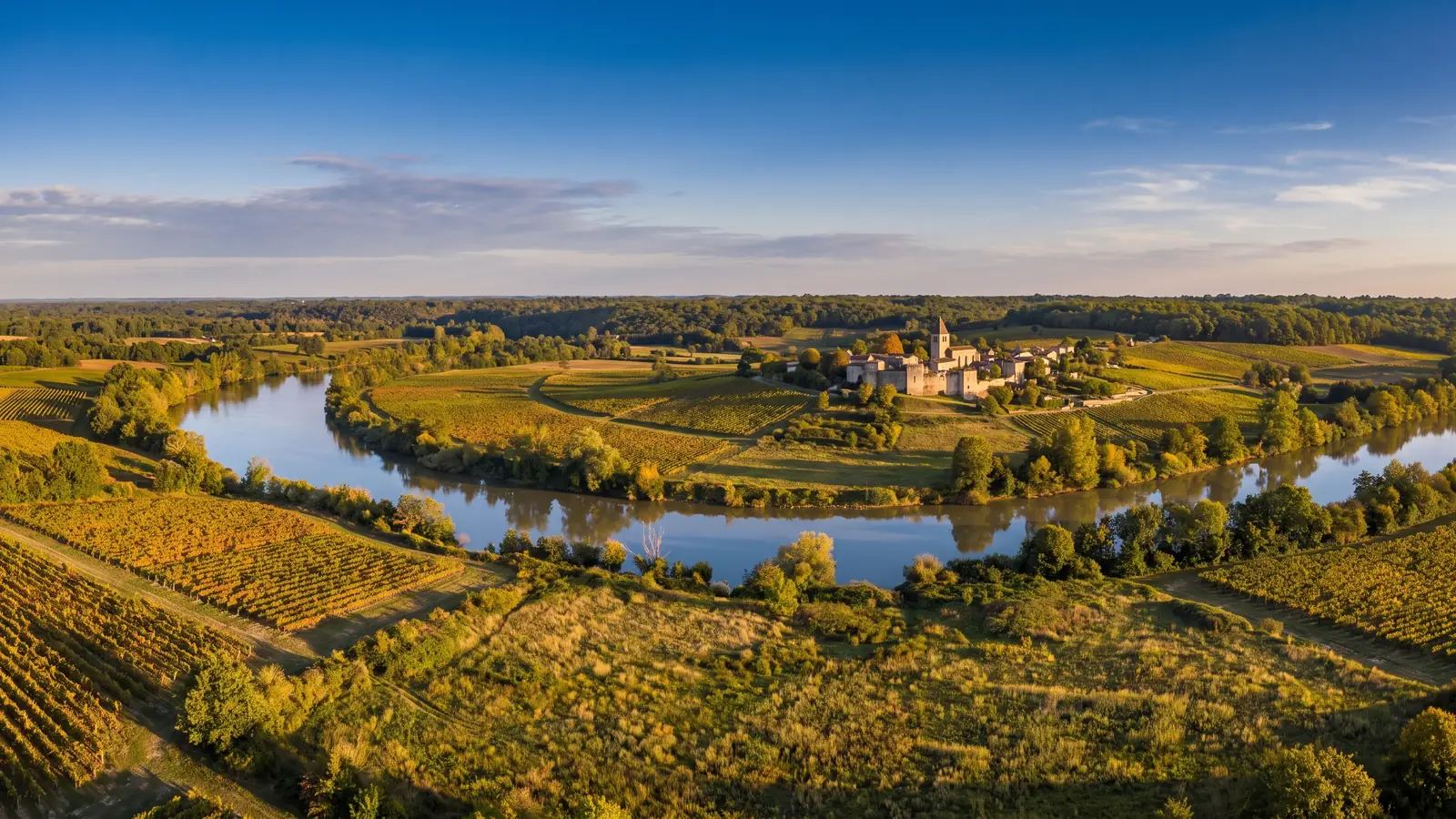
From Rions, there are four major attractions within a twenty-minute drive: the Ducal Castle of Cadillac-sur-Garonne, the fortified castle of Langoiran, the hillsides of Sainte-Croix-du-Mont, and the UNESCO-listed Abbey of La Sauve-Majeure. Here are the must-see attractions, verified with actual driving distances.
Cadillac-sur-Garonne and Langoiran, the neighboring towns
To 5 km (7 minutes), Cadillac-sur-Garonne — the official name of Cadillac since 2022 — is the neighboring bastide, founded in 1280 by Jean I de Grailly, with its Mer and Horloge gates, which were designated historic landmarks as early as 1862. Its crowning jewel is the Castle of the Dukes of Épernon, a vast palace built between 1598 and 1634 Built by the first Duke of Épernon, managed by the Centre des monuments nationaux, and open year-round: painted ceilings, tapestries, monumental fireplaces—and a fascinating history of women's prison from 1822 to 1951, before its revival. In 7 km (12 minutes) downstream, Langoiran raises its fortified castle of the 13th-16th centuries, listed in 1892, with its 14th-century cylindrical keep restored since 1972 by a dedicated association. In between, Rions completes a medieval triptych on the right bank—a bastide, a fortified castle, and a walled village—which can easily be visited in the same half-day.
Sainte-Croix-du-Mont and La Sauve-Majeure
9 km (12 minutes) upstream, Sainte-Croix-du-Mont’s sweet wine vineyards (a 450-hectare AOC) are terraced on a hill that is actually an ancient reef: its famous cave is carved into a bed of fossilized oysters dating back some 20 million years—a unique geological site, crowned by the Château de Tastes (14th century, now the town hall) and the Romanesque portal of its church. Fifteen kilometers (20 minutes) inland, the Abbey of La Sauve-Majeure, founded in 1079 and designated a UNESCO World Heritage Site as part of the Routes of Santiago de Compostela, features Romanesque ruins and 80 carved capitals (the site is managed by the Centre des monuments nationaux; check the official admission prices before your visit)—with this little-known connection: it was a lord from Rions, named Auger, who donated half of the land on which the abbey was founded in 1079–1080. A chauffeured transfer allows you to seamlessly connect these highlights—heritage, geology, and great sweet wines—without worrying about the itinerary or parking, and to return to Bordeaux at the agreed-upon time.
When should you visit Rions?
Rions is open to visitors year-round: the fortified village is a great place to visit in any season, though it’s especially charming in the spring and fall, and there are two events to look forward to—the summer heritage walk and the Christmas market. The spring (April–June) is ideal: soft light on the golden stone, soft-green hillsides, flower-lined streets—and the terraces of Cadillac-sur-Garonne just seven minutes away. The summer (July–August) offers a cool respite from the heat in the narrow alleyways and the Charles VII Cave during the hottest part of the day. The town occasionally organizes heritage walks; check the official Rions calendar for upcoming dates and registration details. The fall (September–October) is the winemaker’s season: grape harvests across the three appellations, low-angled sunlight glinting off the ramparts, and the sweet wines of Cadillac and Sainte-Croix-du-Mont at their finest.
The winter has its own understated charms: the mist rising from the Garonne at the foot of the Citadel, the medieval stone in the low light, and the Christmas market that brings the cobblestone streets to life in December. No matter the season, the Saturday is still a good choice: the Cadillac-sur-Garonne market in the morning, Rions and its fortifications in the afternoon. Allow an hour and a half to two hours for the village alone; half a day if you add a wine tasting at Château Carsin; a full day for the Rions–Cadillac–Langoiran trio or a side trip to Sainte-Croix-du-Mont and La Sauve-Majeure. About 40 minutes from Bordeaux, it’s one of the most authentic—and least crowded—medieval getaways in the Gironde.
| Season | Atmosphere | Ideal for |
|---|---|---|
| Spring (April–June) | golden stone, green hillsides | fortifications, photo, terraces |
| Summer (July–August) | the coolness of the alleyways, a heritage walk | guided tour (July 29, 2026), cave |
| Fall (Sept.–Oct.) | grape harvest, low-angle light | wine tourism, sweet wines, tranquility |
Join Rions from Bordeaux
Rions is about 32 km from Bordeaux, or about a 40-minute drive. The route follows the right bank of the Garonne along the hillside road that passes through Langoiran—an enjoyable drive between the river and the vineyards. A private door-to-door transfer is the most direct way to reach the fortified village.
| Route | Distance | Duration | Details |
|---|---|---|---|
| Bordeaux → Rions | ~32 km | ~40 min | Starting at ~77 € for a private chauffeur |
| Bordeaux-Mérignac Airport → Rions | ~40 km | ~45 min | pickup at the terminal |
| Rions → Cadillac-sur-Garonne | ~5 km | ~7 min | Ducal Castle, Saturday Market |
| Rions → Langoiran | ~7 km | ~12 min | fortified castle, Mascaret viewing spots |
Through the road, you can reach Rions from Bordeaux in about 40 minutes by following the right bank along the Garonne—the picturesque hillside road that winds through Langoiran, Le Tourne, and Rions, with the river below and the vineyards above. That’s the whole appeal of the private transfer: The driver will pick you up at the airport, at the Saint-Jean train station, or at your hotel in Bordeaux and drop you off right at the doorstep of Le Lhyan. The driver can then take you to the various stops on your itinerary—the Château de Cadillac-sur-Garonne, a wine tasting at Château Carsin or Sainte-Croix-du-Mont, the Langoiran fortress—and bring you back to Bordeaux at the agreed-upon time. Whether you’re looking for a half-day of medieval exploration, a wine-tasting tour of the Bordeaux coast (where you want to taste wine without driving), or a Saturday at the market in Cadillac, this is the simplest and most flexible option.
Whether you’re heading to Le Lhyan, searching for the Charles VII Cave, or sampling the village’s three wine appellations, booking a professional chauffeur guarantees a comfortable and punctual ride—book a driver from Bordeaux → Rions or explore all our destinations.
Frequently Asked Questions
Where is Rions located?
Rions is a fortified village in the Gironde department, on the right bank of the Garonne River, between Cadillac-sur-Garonne (5 km away) and Langoiran (7 km away), about 32 km southeast of Bordeaux—a drive of about 40 minutes through the hillsides of the right bank. Administratively, it belongs to the Langon arrondissement, the Entre-Deux-Mers canton, and the Convergence Garonne community of municipalities; Podensac and Virelade lie across the river on the left bank. The terrain rises from 2 to 117 meters in elevation, from the river to the vineyard-covered hillsides. The village has a population of 1,470 (2023); its residents are known as Rionnais. Its 14th-century city walls, designated a Historic Monument in 1862, make it one of the best-preserved—and least known—medieval complexes in the department. A private transfer from Bordeaux is the most direct way to get there.
How much does a transfer from Bordeaux to Rions cost?
We offer a fixed-price transfer from Bordeaux to Rions, starting at approximately €85 one way (about 32 km, about a 40-minute drive), in a Mercedes sedan or van seating up to 8 passengers, with a professional driver. The trip is direct, door-to-door: pickup at the airport, Saint-Jean train station, or your hotel in Bordeaux, and drop-off right at the entrance to Le Lhyan. The fixed-price quote is provided and confirmed in writing before departure, with no unexpected meter charges. This is particularly convenient for a day trip to the Bordeaux coast: the driver can take you to Château de Cadillac-sur-Garonne, followed by a wine tasting at Château Carsin, Langoiran, or Sainte-Croix-du-Mont, and then bring you back to Bordeaux—ideal when you want to enjoy wine without driving. For groups, this is often the simplest and most economical option.
Why are the Rions ramparts so exceptional?
For two reasons. First, its history: the ramparts were built beginning in 1330 by Lord Guillaume Seguin, with the authorization and funding of King Edward III of England, then Duke of Aquitaine—the Gascon Roles preserve the deed. It is therefore an “English” fortification, built to defend against the King of France following the sacking of 1295 by Charles de Valois. Second, its protected status: the wall has been listed as a Historic Monument since the 1862 list—the very first major wave of designations in France, placing it on par with the great national monuments, half a century before the village church (1908). An extremely rare distinction for a town of 1,470 residents. Today, visitors can see the Lhyan Gate with its machicolations, the tower known as the Citadel facing the Garonne River, the Guet Tower, the ramparts on the western flank, and the remains of double moats with barbicans.
Is Rions really the “little Carcassonne of the Gironde”?
The nickname is widely used—but it’s unofficial. It’s found only in blogs and tourist guides: neither the town’s official website, nor Gironde Tourisme, nor Wikipedia use it. It should therefore be taken as a flattering nickname, in quotes, not as an established name. The reasoning behind it is understandable, however: Rions is indeed a village enclosed by medieval ramparts, with a fortified gate featuring machicolations, towers, and cobblestone streets—a silhouette that evokes, in miniature and with simple charm, the fortified towns of the Midi. Unlike Carcassonne, Rions is genuinely untouched by mass tourism, according to the guidebooks themselves: no souvenir shops, no crowds—a lively wine-growing village behind its walls dating back to 1330. It is precisely this contrast that makes it one of the most charming medieval getaways in the Gironde.
What is the Charles VII Cave?
This is the most unique attraction at Rions: a rib-vaulted chamber hidden beneath the western ramparts, adjoining the Citadel tower, which houses a natural spring that has been used as a washhouse “since time immemorial.” Local legend has it that King Charles VII rested and quenched his thirst there during the conquest of Guyenne in the mid-15th century—a tradition recounted by local scholars, to be taken as such, but one that gave the place its name. The cool, acoustically rich Gothic hall, with its clear water beneath the vaults, offers a brief moment of magic that most visitors to the region are unaware of. It also serves as a reminder of the practical purpose of the fortifications: to protect a spring, a port, and a market—the daily life of a small medieval town on the Garonne. Be sure to explore it during the “walk along the base of the ramparts” offered by the town.
What is there to do in Rions?
We’ll start with the tour of the fortifications: the Lhyan Gate and its machicolations, the cobblestone alleys, the Guet Tower hidden behind the church, the tower known as the Citadel facing the Garonne River, and the “walk along the base of the ramparts,” which circles the outer perimeter of the 1330 walls. Next, look for the Charles VII Grotto and its spring, beneath the western flank. Inside Saint-Seurin Church, a listed historic site since 1908, there are three details to find: the Romanesque capitals (The Sacrifice of Abraham, Daniel in the Lions’ Den), the ancient marble head set into a window keystone, and the Albret coat of arms above the bell tower door. We finish at the 18th-century pea market hall on Rue Lavidon, before a tasting at Château Carsin (organic, by appointment). In the immediate vicinity: the ducal castle of Cadillac-sur-Garonne (7 min), the fortified castle of Langoiran (12 min), Sainte-Croix-du-Mont (12 min), and the UNESCO-listed Abbey of La Sauve-Majeure (20 min).
What are the “Bordeaux goddaughters”?
A unique medieval alliance: On July 18, 1379, eight towns in Guyenne—Rions, Blaye, Bourg, Libourne, Saint-Émilion, Castillon, Cadillac, and Saint-Macaire—became the “goddaughters of Bordeaux,” bound to the capital by a pact of mutual loyalty recorded in the Livre des Bouillons, Bordeaux’s great cartulary. This status did not prevent family feuds: in 1420, the pro-English Jurade of Bordeaux laid siege to its own “goddaughter” in Rions with a bombard firing stone cannonballs weighing about 350 kilos—the Bordeaux municipal records preserve the appropriations voted and the orders given to the gunners. This episode illustrates the complexity of medieval Guyenne, where allegiances to England and France divided even allied cities. Rions did not return to French control until 1451, through the treaty of June 20, two years before the Battle of Castillon, which brought an end to three centuries of English rule in Aquitaine.
What wines are produced at Rions?
Rions boasts three appellations—a rare feat for a town with a population of 1,470. The reds fall under the Cadillac-Côtes-de-Bordeaux AOC (39 municipalities, 2009 decree, successor to the Premières-Côtes-de-Bordeaux reds). The sweet wines belong to the Cadillac AOC (22 municipalities, approximately 70% Sémillon), which has become a niche appellation: about 1,000 hectoliters per year from ~58 hectares. And the sweet whites can claim the Premières-Côtes-de-Bordeaux appellation, which has remained in use for this style since 2009. However, despite its location, Rions is not within the Entre-deux-Mers AOC (dry whites), which excludes the communes along the Garonne River. The village’s flagship estate is Château Carsin: ~18 hectares of organic vineyards, owned by the Finnish Berglund family since 1990—one of the few “Finnish” vineyards in France—tastings by appointment, pricing to be confirmed with the estate.
What is the distance between Bordeaux and Rions?
About 32 km by road, or about a 40-minute drive—not “35 km” as is sometimes stated. The most pleasant route follows the right bank of the Garonne along the Route des Coteaux, which passes through Langoiran, Le Tourne, and Rions, between the river and the vineyards. With a door-to-door car service, the fare is fixed and provided in advance, starting at around €77 one way. A door-to-door transfer is the most direct option here: it drops you off right at the doorstep of Le Lhyan, then can take you to nearby destinations—Cadillac-sur-Garonne (7 minutes away), Langoiran 12 minutes away, Sainte-Croix-du-Mont 12 minutes away, and the Abbey of La Sauve-Majeure 20 minutes away—before taking you back to Bordeaux at the agreed-upon time, which is ideal for a wine-tasting day when you want to enjoy the experience without having to drive.
What's there to see around Rions?
Four major attractions within twenty minutes. 5 km (7 min) away, Cadillac-sur-Garonne: the 1280 bastide and the Château des Ducs d’Épernon (1598–1634), managed by the CMN and open year-round—with its surprising history as a women’s prison (1822–1951); market on Saturday mornings. 7 km (12 min) away, Langoiran and its 13th–16th-century fortified castle, listed as a historic monument in 1892, whose keep overlooks the Garonne; along with Podensac, it’s also one of the best-known spots for the tidal bore. 9 km (12 min) away, Sainte-Croix-du-Mont, with its sweet wine vineyards and a cave carved into a 20-million-year-old bed of fossilized oysters. 15 km (20 min) away, the Abbey of La Sauve-Majeure, a UNESCO World Heritage Site—founded in 1079 on land half of which was donated by a lord of Rions. A chauffeured car can plan a hub-and-spoke itinerary, freeing you from the hassle of driving or finding parking.
Is the church in Rions a designated historic site?
Yes—the Saint-Seurin Church has been designated a Historic Monument since December 1, 1908 (Mérimée entry PA00083701; not to be confused with the Saint-Seurin Basilica in Bordeaux). It is a composite structure: from the 12th-century Romanesque church, the apse, its apsidioles, and beautiful carved capitals remain—including a depiction of the Sacrifice of Abraham and Daniel in the lions’ den; the nave was rebuilt in the 14th century, with two side aisles, at the time the town was fortified; the neoclassical bell tower dates from the 19th century. Along with the city walls (listed since 1862), it is one of only two Historic Monuments in the town—neither the washhouse, nor the pea market, nor any chapel is protected, contrary to what is sometimes reported. A detail to look for: the ancient marble head set into the keystone of a window, a Gallo-Roman reused element inherited from the ancient Reontium.
When should you visit Rions?
All year round—the fortified village has its own charm in every season. Spring (April–June) offers the most beautiful light on the golden stone and lush green hillsides. In summer, the narrow streets and the Charles VII Cave stay cool. The town occasionally offers heritage walks; check the official Rions calendar for upcoming dates and registration details. Fall is harvest season across the three wine appellations, with superb low-angle light on the ramparts. Winter brings the mists of the Garonne at the foot of the Citadel and a Christmas market in the cobblestone streets. Saturday is a good choice year-round: the Cadillac-sur-Garonne market in the morning (8 a.m.–12:30 p.m.), and Rions in the afternoon. Allow an hour and a half to two hours for the village, half a day including a tasting at Château Carsin, and a full day for the Rions–Cadillac–Langoiran itinerary or the Sainte-Croix-du-Mont–La Sauve-Majeure excursion.
Further Reading
- The nearby castle: see the Langoiran Guide (14th-century keep and spots to watch the tidal bore, 12 minutes away)
- The UNESCO-listed abbey founded with Rions: see the Guide to the Abbey of La Sauve-Majeure (land donated by a lord of Rions in 1079)
- Another town twinned with Bordeaux: see the Guide to Saint-Macaire (a medieval town with ramparts on the Garonne River)
- Understanding our rates and vehicles: see the "Book a Driver" page (sedan & van, fixed-price quote)
- Plan your trip: Book an executive transfer from Bordeaux to Rions or explore all our destinations
Sources and References
- POP Mérimée — Fortified Enclosure of Rions — 14th-century enclosure listed as a Historic Monument under the 1862 list; walls erected beginning in 1330 by Guillaume Seguin with the authorization of Edward III (Gascon Rolls), following the razing of 1295 by Charles de Valois
- POP Mérimée — Saint-Seurin Church in Rions — a composite church listed as a historic monument on December 1, 1908: 12th-century Romanesque apse and capitals (The Sacrifice of Abraham, Daniel), nave rebuilt in the 14th century, 19th-century Neoclassical bell tower
- Wikipedia — Rions — a village on the right bank of the Garonne, population 1,470. (2023), Gallo-Roman origins (Reontium, epitaph from 466 at the Musée d’Aquitaine), a subsidiary town of Bordeaux (1379), became part of France in 1451, 18th-century pea market
- Wikipedia — Rions Enclosure — Lhyan Gate/Tower (upper sections restored in 1881 by Léon Drouyn), the tower known as the Citadel facing the Garonne, the Watchtower, the Charles VII Cave (a rib-vaulted chamber with a spring), double moats, and barbicans
- Rions City Hall — Heritage and Tour Schedule; please verify the date before visiting
- Gironde Tourisme — Château Carsin — an organic estate of approximately 18 ha in Rions, owned by the Finnish Berglund family since 1990; wine tastings by appointment; pricing to be confirmed with the estate
Article updated in July 2026.
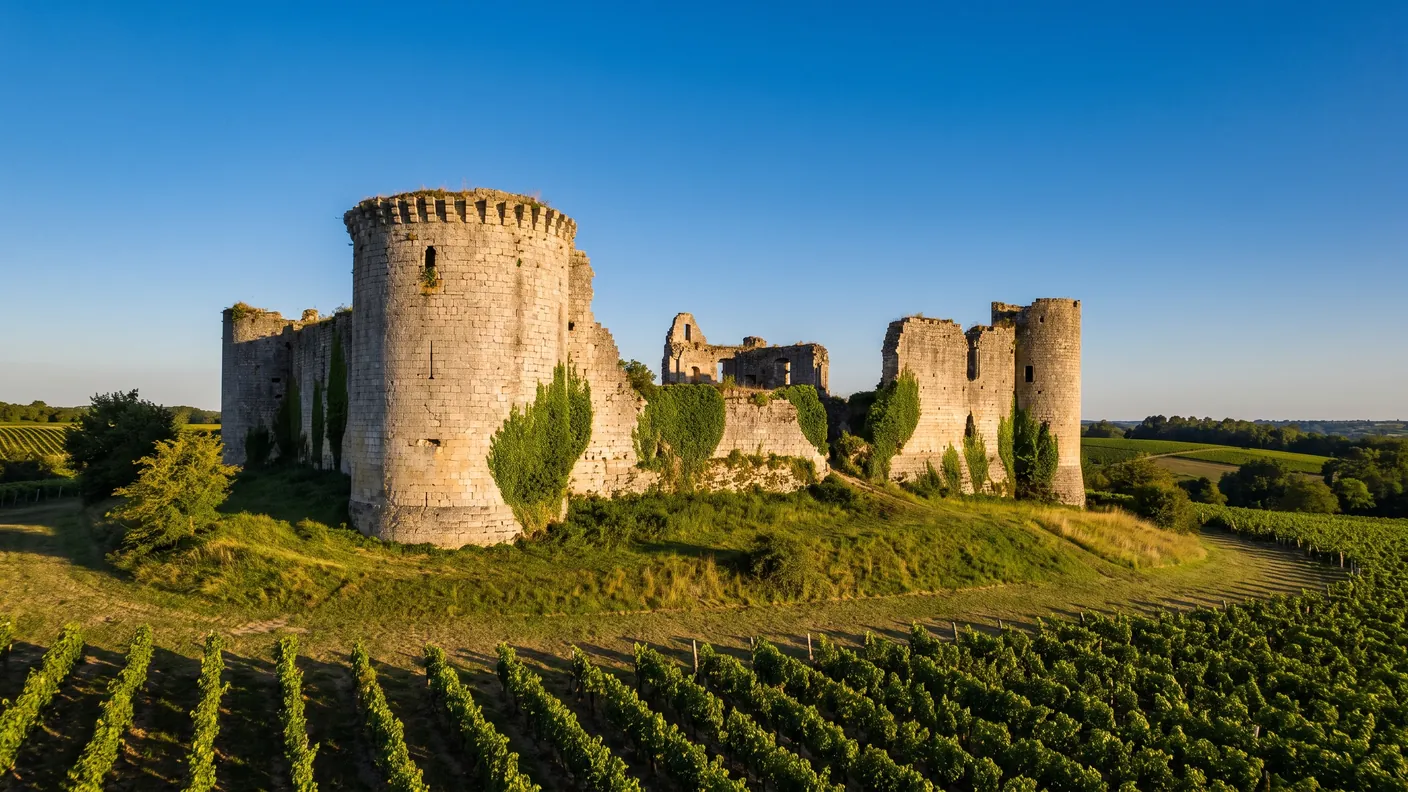
On the way to the fortified village
Direct transfer from Bordeaux (~40 min) to Rions and its 1330 ramparts—from the airport, train station, or hotel to the Porte du Lhyan, then on to Cadillac-sur-Garonne, Langoiran, or the Côtes de Bordeaux vineyards. Written fixed-price quote, with no unexpected meter charges.