Bordeaux to Rocamadour: cliffside sanctuary and Black Madonna
A village of 597 residents perched on a cliff in the Lot region—and 1.5 million visitors a year. A body discovered intact in 1166, a Black Madonna designated a historic monument in 1908, a Book of Miracles written in 1172: the fourth holiest site of medieval Christendom, where documented history meets legend. About 2 hours and 55 minutes from Bordeaux.
Rocamadour at a Glance
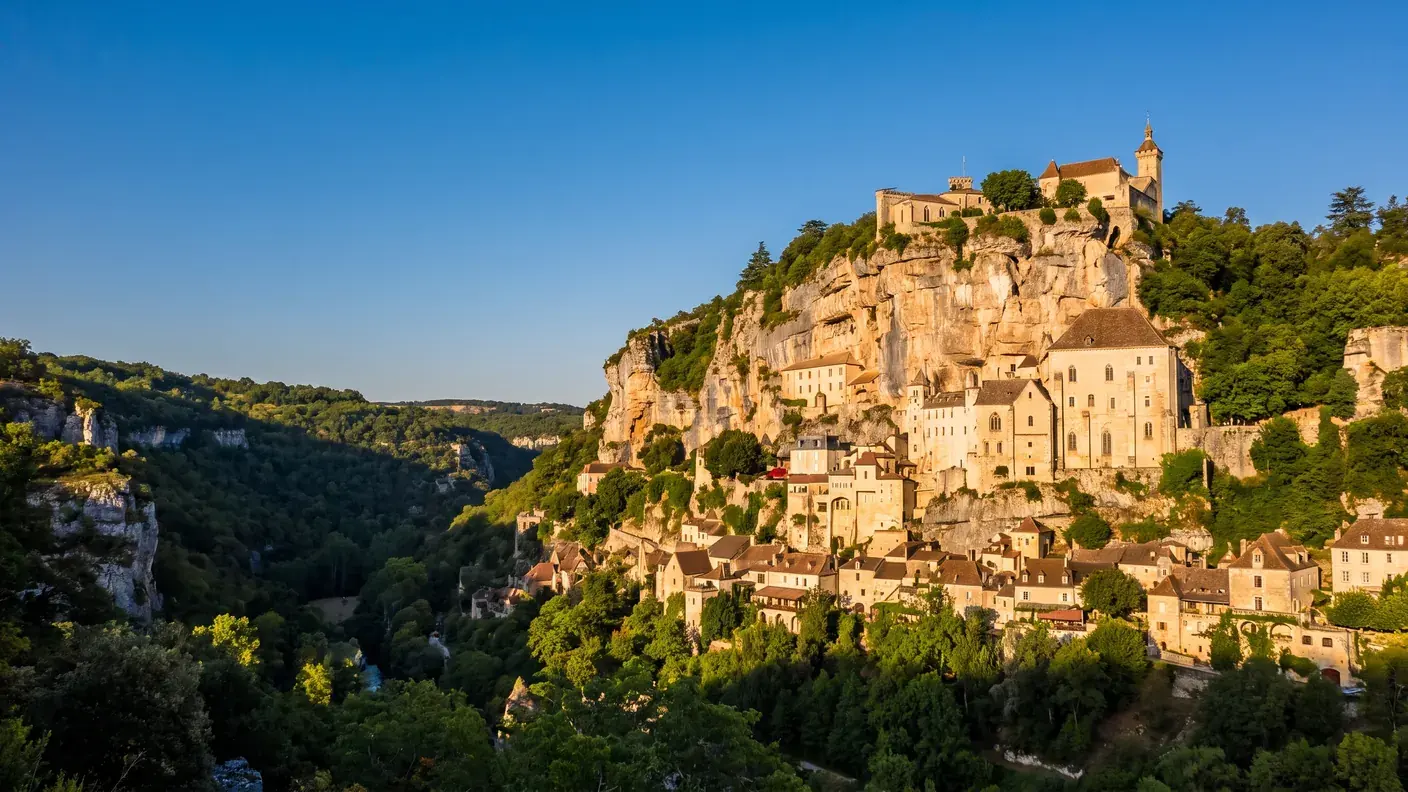
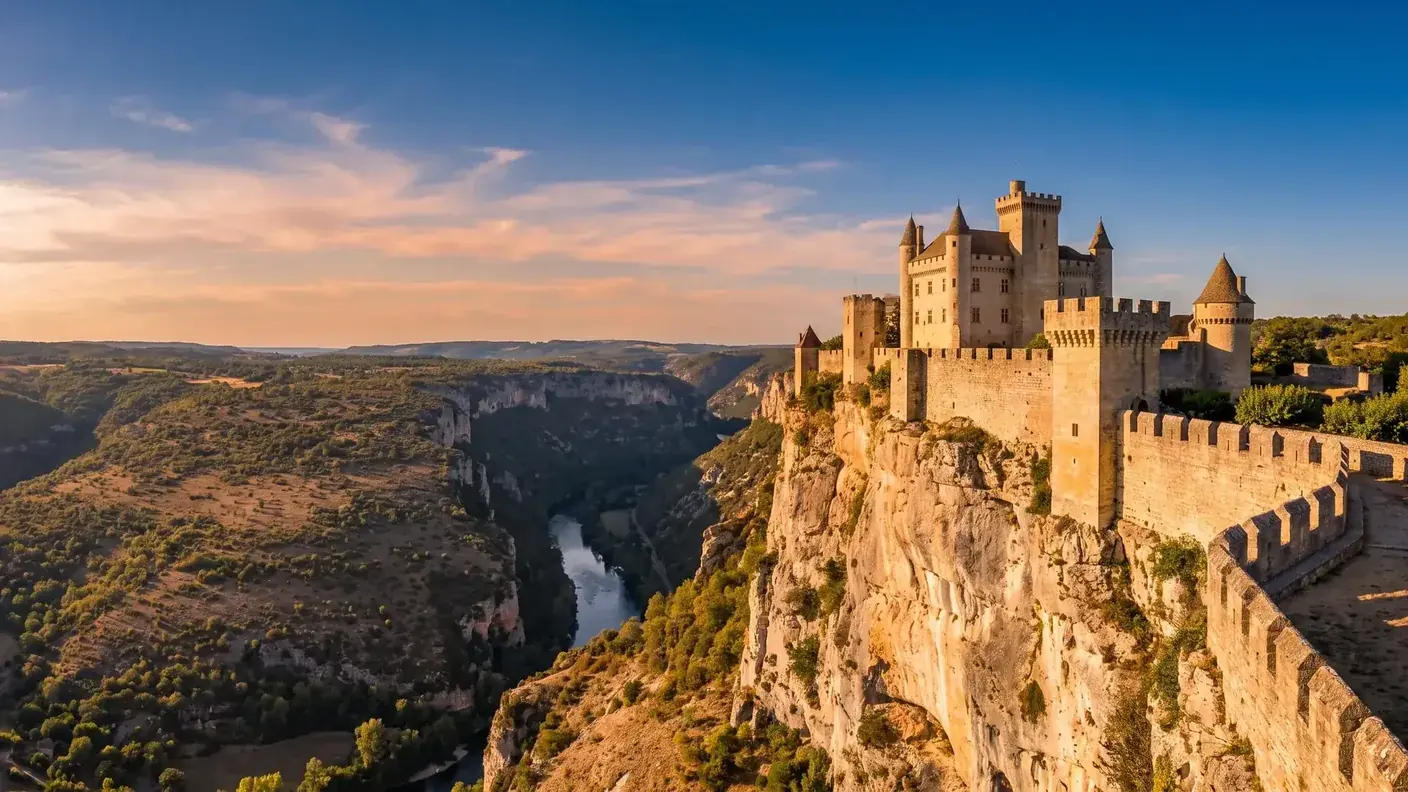
- Rocamadour (the Amadourians) is a village-sanctuary in the Lot department (46500), in Occitanie, perched on a cliff that towers about 150 meters above the Alzou Canyon.
- The contrast speaks for itself: 597 residents (2023)… and about 1.5 million visitors a year—one of the most visited sites in France.
- In 1166, the discovery of an intact body in the ground at the shrine—identified as Saint Amadour—triggered an unprecedented influx of pilgrims.
- Its Black Madonna, carved from walnut (66 cm), has been designated a Historic Monument since 1908; its black color is not mentioned in any written records prior to 1632 (official entry Palissy PM46000242, accessed July 24, 2026).
- The Book of Miracles, written around 1172 by a monk at the shrine, records approximately 126 miracles that occurred between 1148 and 1172 — a major source on medieval piety (Presses universitaires du Midi on OpenEdition, accessed July 24, 2026).
- In the 13th century, Rocamadour was considered the fourth holiest site in Christendom, after Jerusalem, Rome, and Santiago de Compostela; Saint Louis made a pilgrimage there in 1244.
- The site has earned numerous certifications: UNESCO Global Geopark the Causses du Quercy (2017) and the Dordogne Basin UNESCO Biosphere Reserve (2012).
- From Bordeaux: ~254 km, about 2 hours and 55 minutes by car — starting at €420 with a private driver. Rocamadour-Padirac train station is ~1.5 km away.
Before You Go: What Rocamadour Really Is
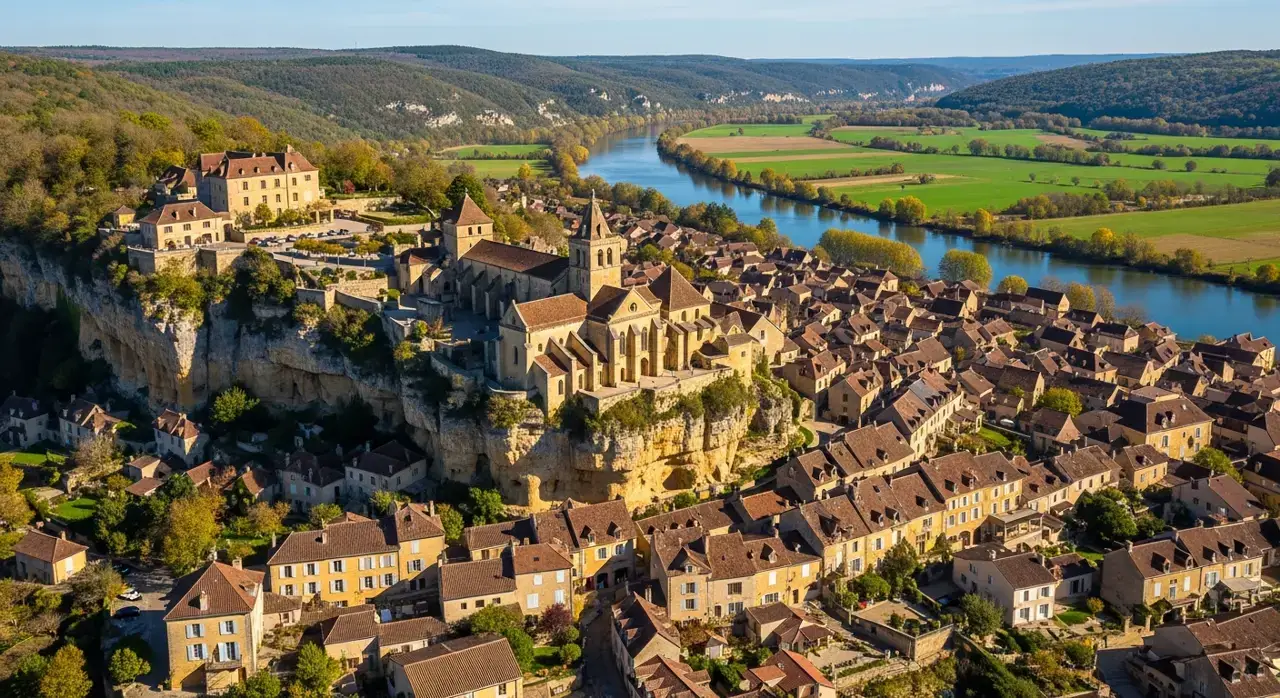
Late afternoon on the edge of the Causse, facing the cliff. The sun glints off the ochre stone, and the village suddenly comes into view, stacked vertically: the houses at the bottom, the seven sanctuaries in the middle, the castle at the very top—like three levels suspended between the canyon and the sky. In an instant, you understand why medieval pilgrims saw this place as a sign. Rocamadour is not just a postcard-perfect setting: it is a sanctuary whose history, documented as early as 1105, reached all the way to Rome—and whose influence drew kings of England and kings of France. Welcome to the “fourth holiest site in Christendom.”
Rocamadour is a sanctuary village in the Lot region, built on a cliff overlooking the Alzou Canyon, in the heart of the Causses du Quercy. The settlement is arranged on three levels: the lower village, the complex of seven sanctuaries, and the castle at the summit. Pilgrimages to the site have been documented since the 12th century, notably through the discovery of a body attributed to Saint Amadour in 1166 and the *Book of Miracles*, written around 1172. The Chapel of Our Lady houses a Virgin Mary statue carved from walnut wood, carbon-14 dated to between 1160 and 1270. The Grand Staircase has 216 steps leading from the village to the religious complex. From Bordeaux, the page lists a road trip of approximately 254 km and 2 hours 55 minutes, with a chauffeur service starting at 420 € one way. The Rocamadour-Padirac train station partially serves the area; parking and schedules should be checked before your visit on the sanctuary’s official website (accessed July 24, 2026).
A Cliff on the Causse: The Site and Its Certifications
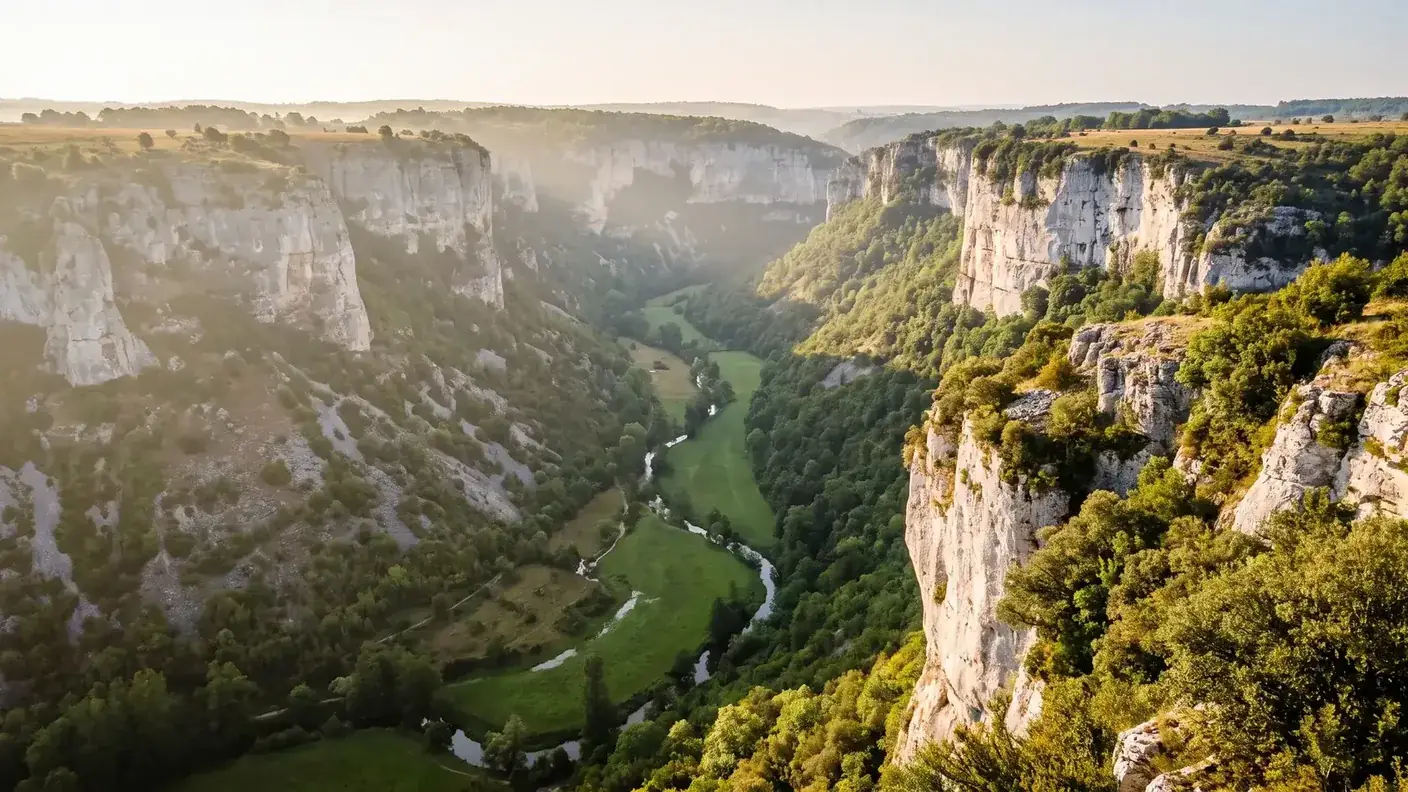
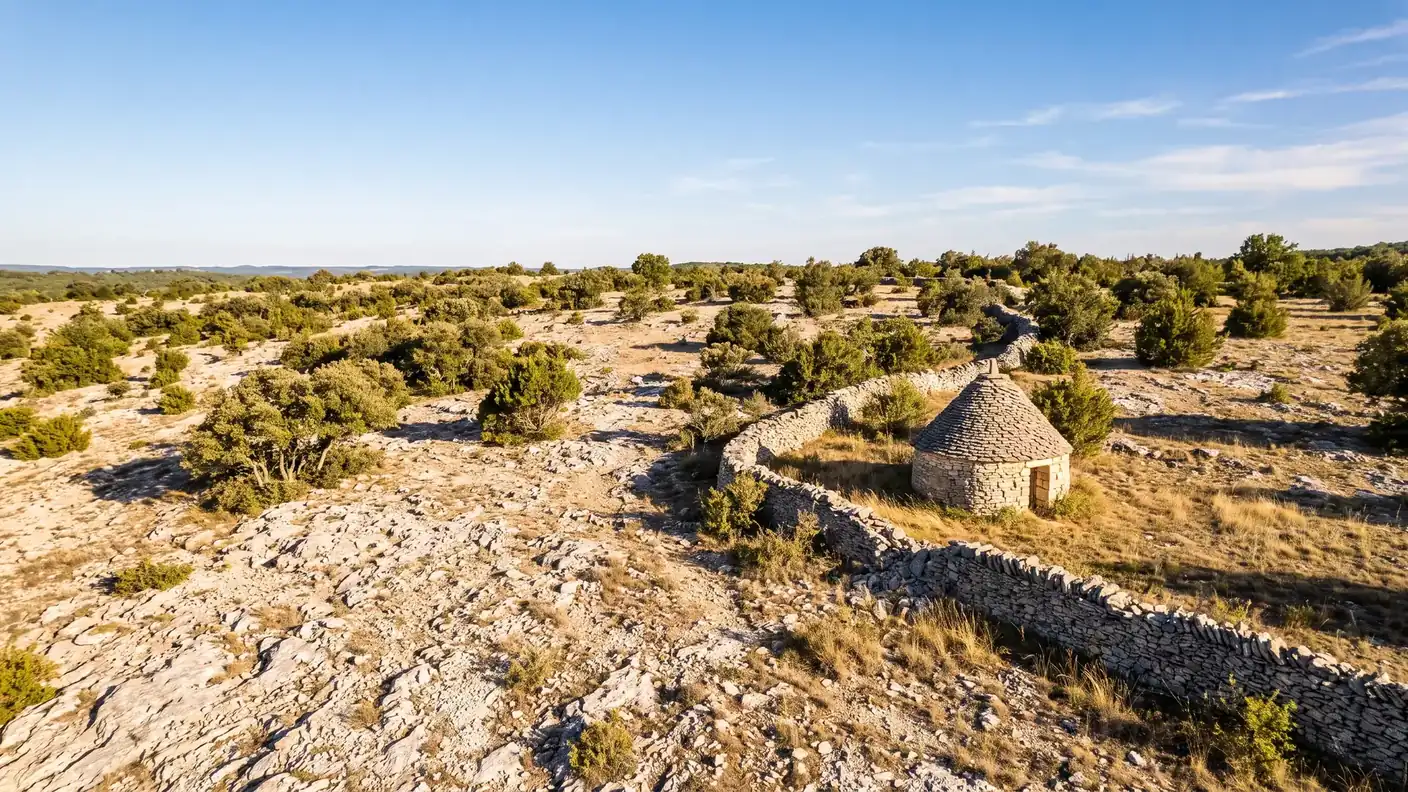
The first thing that strikes you is the topography. The village literally clings to a limestone cliff that towers about 150 meters above the canyon carved out by the Alzou, a modest stream that has carved a spectacular gorge into the limestone plateau. The municipality thus stretches across an elevation range of 110 to 364 meters, covering a vast area of 49.42 km²—because beyond this iconic site, Rocamadour also encompasses an entire plateau of arid limestone, stunted oak trees, low stone walls, and dry-stone huts.
A territory with three layers of protection
The area is covered by multiple protected status designations. It is part of the Causses du Quercy Regional Nature Park (102 municipalities), which was designated a UNESCO Global Geopark in 2017 for its exceptional karst geology. It is also part of the UNESCO Dordogne Basin Biosphere Reserve (2012), the largest in France at nearly 24,000 km². Finally, the “Vallées de l’Ouysse et de l’Alzou” Natura 2000 site protects some 3,000 hectares of natural habitats around the canyon.
A few details for those who like exact figures. The Natura 2000 site “Vallées de l'Ouysse et de l'Alzou” (code FR7300902) specifically covers 3,009 hectares spanning five municipalities—Calès, Couzou, Gramat, Lacave, and Rocamadour. The Dordogne Basin Biosphere Reserve, designated by UNESCO on July 11, 2012, while it extends over 23,870 km², making it the largest in France. Add to that the UNESCO Global Geopark designation awarded to the Causses du Quercy in 2017, and Rocamadour finds itself at the heart of a region with two UNESCO designations in terms of its natural heritage—an extremely rare combination for a town with fewer than 600 residents.
| Data | Value |
|---|---|
| ZIP Code / INSEE | 46500 / 46240 |
| Department / Region | Lot / Occitanie (Gourdon District) |
| Area | 49.42 km² |
| Elevation | 110 m to 364 m |
| Population | 597 residents (2023) — the people of Amadour |
| Attendance | ~1.5 million visitors per year |
| Labels | UNESCO Geopark (2017), Biosphere Reserve (2012), Natura 2000 |
| Must-See | Religious quarter, Black Madonna, Grand Staircase, castle, and ramparts |
As you approach via the road that overlooks the site—notably the L'Hospitalet lookout point—you can understand what medieval pilgrims must have felt: this vertical village, rising from the rock between the sky and the canyon, seems to defy gravity. It is this visual impact, as much as faith, that has made Rocamadour a place unlike any other for nearly a thousand years.
597 residents, 1.5 million visitors
The demographics of Rocamadour are characterized by a paradox. The town reached its peak in 1800, with 1,695 residents—a rural trend typical of the Quercy region at the time, with no direct link to the pilgrimage, which had already declined significantly by then. Then the long decline of rural areas took its toll: 1,179 residents in 1901, 806 in 1954, and 597 in 2023.
| Year | Population |
|---|---|
| 1793 | 1,055 residents |
| 1800 | 1,695 (all-time high) |
| 1901 | 1 179 |
| 1954 | 806 |
| 1999 | 614 |
| 2023 | 597 residents |
This trend is continuing right before our eyes: INSEE recorded 623 residents in 2019, compared to 597 in 2023—a decrease of −1.49% from 2017. Given the municipality’s area of 49.42 km², this results in a population density of 12.1 inhabitants per km²—one-tenth of the French average. The Causse is a human desert; the village, however, remains bustling.
The highest ratio in France
In contrast to these 597 permanent residents, approximately 1.5 million people pass through the gates of the sanctuary and the town each year—that is, nearly 4,000 visitors per day during peak season, and a staggering ratio of about 2,500 visitors per resident per year. Very few French municipalities show such a disparity: Rocamadour is regularly cited as one of the most visited sites in France, ranking just behind Mont-Saint-Michel among villages.
An economy focused on hospitality
This imbalance shapes local life: an economy almost entirely focused on tourism (hotels, restaurants, the famous Rocamadour AOP cheese—a small goat’s-milk “cabécou” named after the village), seasons that are starkly different, and a village that regains its silence—and its magic—off-season, early in the morning or late at night, when the tour buses have left and the cliff is bathed once more in the low-angled light.
From the “Major Rock” to Saint Amadour: A Name That Invented Its Own Saint
The name Rocamadour has not always referred to a saint. The earliest known written mention dates back to 968, in the form of "Rocamador" ; a scholarly Latinization, "Rupis Amatoris", first appears in 1186. The most widely accepted etymological hypothesis interprets it as the Occitan Roca Major — “the great rock shelter,” “the major rock” —, a purely topographical description, predating any sacred connotation. Other linguists see it instead as a man’s name (Amator) : The exact origin remains a matter of debate, and we present it as such.
The name that gave rise to the saint
The most fascinating aspect is the process that followed. Beginning in 1166, with the discovery of the body, the place name came to be interpreted as a hagiotoponym: the “major rock” retrospectively became “the rock of Saint Amadour” (a form attested in 1473). In other words—and this is a textbook example of medieval folk etymology—it was the place name that gave rise to the saint, and not the other way around: from the topographical name Rocamador, an “Amadour” was derived that simply had to be embodied.
The archives allow us to trace this transformation of the name almost century by century—a 650-year-long toponymic saga:
| Date | Attested form | What It Tells Us |
|---|---|---|
| 968 | Rocamador | First known written mention — no saints in sight |
| 1105 | St. Mary's / Notre-Dame Church | Pascal II's bull attests to a structured Marian devotion |
| 1166 | Christianization of the place name | The discovery of the body reinterprets the name as that of a saint |
| 1186 | Rupis Amatoris | Scholarly Latinization — “The Lover’s/Devotee’s Rock” |
| 1473 | "La Roque de Saint-Amadour" | The hagiotoponym has become firmly established |
| 1618 | "Roquemadour" (Tarde map) | The modern form is gradually taking shape |
Zacchaeus, a 15th-century graft
Hagiographic tradition has taken on this task, in successive layers. The anonymous hermit of the early days became a companion of Saint Martial, then—at the Only the 15th century, three centuries after its discovery—it is identified as Zacchaeus, the tax collector from the Gospel of Luke, the one who climbed a sycamore tree to see Jesus pass by. According to the full legend, Zacchaeus, after his conversion, married Véronique (the veiled woman from the Stations of the Cross), fled Palestine by sea, landed at Soulac in Gironde, and then spent the rest of his days as a hermit in a hollow in the Quercy cliffs.
Let's put it this way, with the necessary caution: this account falls under entirely from medieval hagiography, a genre intended to establish a place’s spiritual legitimacy, not to report facts. No ancient source corroborates the identity of the body from 1166, nor any connection to Zacchaeus. But this legend, enriched from generation to generation, is an integral part of the site’s identity—it is what pilgrims came to experience firsthand, and it is what still gives the sanctuary its romantic depth.
1105, 1166: the bubble, the intact body, the tilt
Even before the event that would change everything, Rocamadour was already a recognized center of Marian devotion. A papal bull issued by Pope Paschal II, dated 1105, mentions the Church of Our Lady of Rocamadour—proof that an organized Marian devotion existed on this rock more than sixty years before the name of Saint Amadour was associated with it. And the major construction project for the shrines began as early as 1152: the influx of pilgrims preceded the discovery, which would amplify it spectacularly.
This bull from 1105 is worth noting, as it is the first dated document in the entire history of the place. Its purpose is prosaic—to settle the ownership of the Church of Saint Mary of Rocamadour, transferred to the monks of Saint-Martin de Tulle—but its significance is decisive: sixty years before the name of Saint Amadour, Rome was already aware of this rock and its Marian church. As for the construction project launched in 1152 under Abbot Géraud d’Escorailles, it reveals something often forgotten: one does not build a complex of sanctuaries for a pilgrimage that does not yet exist. The fervor was there; 1166 gave it a face.
1166: The Body Intact
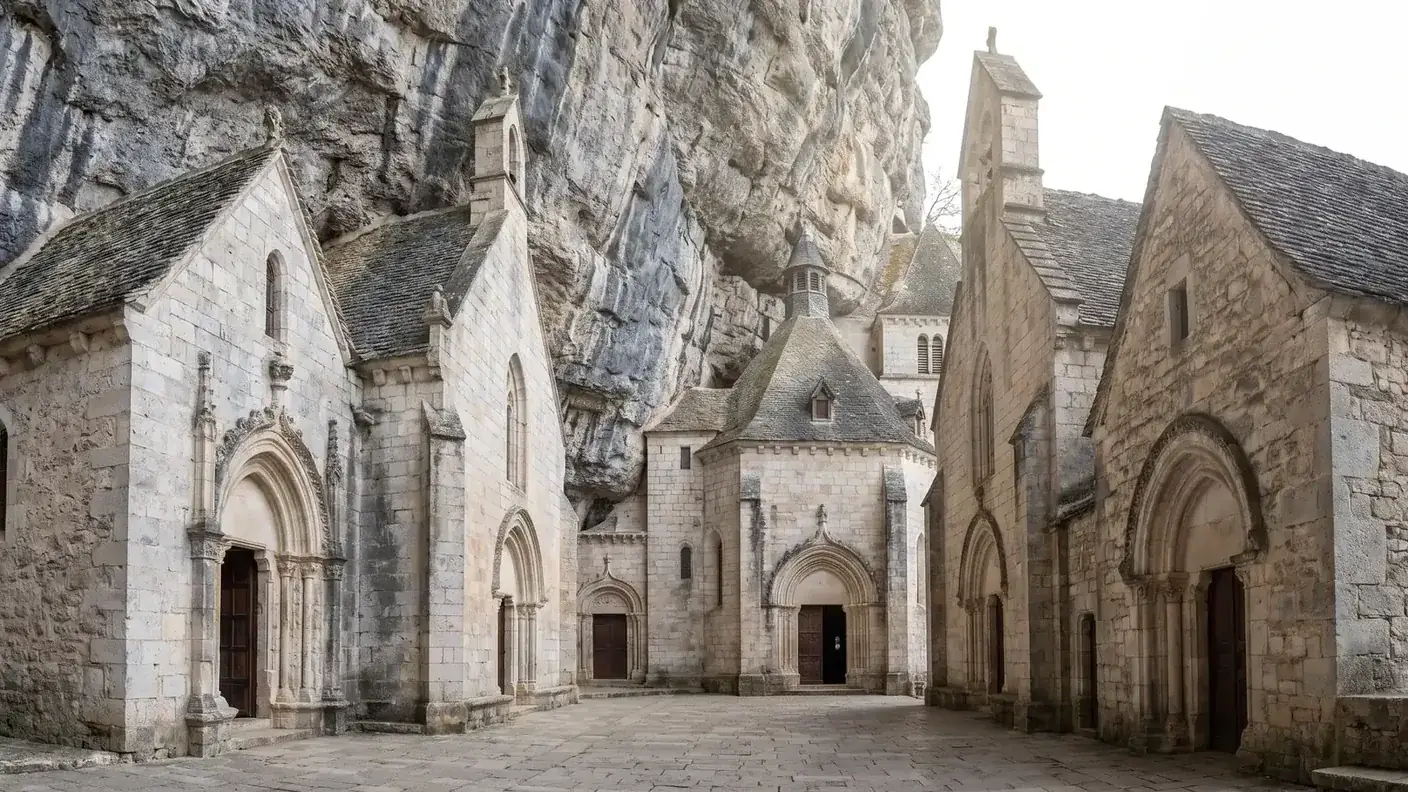
It was in 1166 and everything is turned upside down. From the floor of the sanctuary, a intact body, unspecified — the event is reported by the Norman chronicler Robert de Torigni, a primary contemporary source. The discovery was immediately interpreted as a supernatural sign, and the body was identified as that of the legendary founding saint of the place: Saint Amadour. In the eyes of the faithful in the 12th century, the incorruptibility of a body was tangible proof of holiness.
The impact was electrifying. Within a few years, this local Marian shrine became one of the most popular pilgrimage destinations in the West. The combination was rare and powerful: on one hand, a statue of the Virgin Mary that was already venerated and credited with miracles; on the other, the bodily relic of a local saint. A shrine to the Virgin Mary and a saint’s tomb in the same place—that is what explains the meteoric rise of the pilgrimage. Crowds flocked from the Kingdom of France, but also from England, Spain, and the Holy Roman Empire.
The Black Madonna: Eight Centuries of Devotion, A Mystery of Color
At the heart of the Chapel of Our Lady stands the statue that has been the beating heart of the sanctuary for more than eight centuries: Our Lady of Rocamadour. It is a modest work in size—66 centimeters tall, carved from a block of walnut, with the Infant Jesus attached separately to her left knee—but one of rare intensity: a Virgin in Majesty (Sedes Sapientiae, “Throne of Wisdom”), solemn and facing forward, with a serious expression and half-closed eyes. It has been classified as a Historic Monument since 1908.
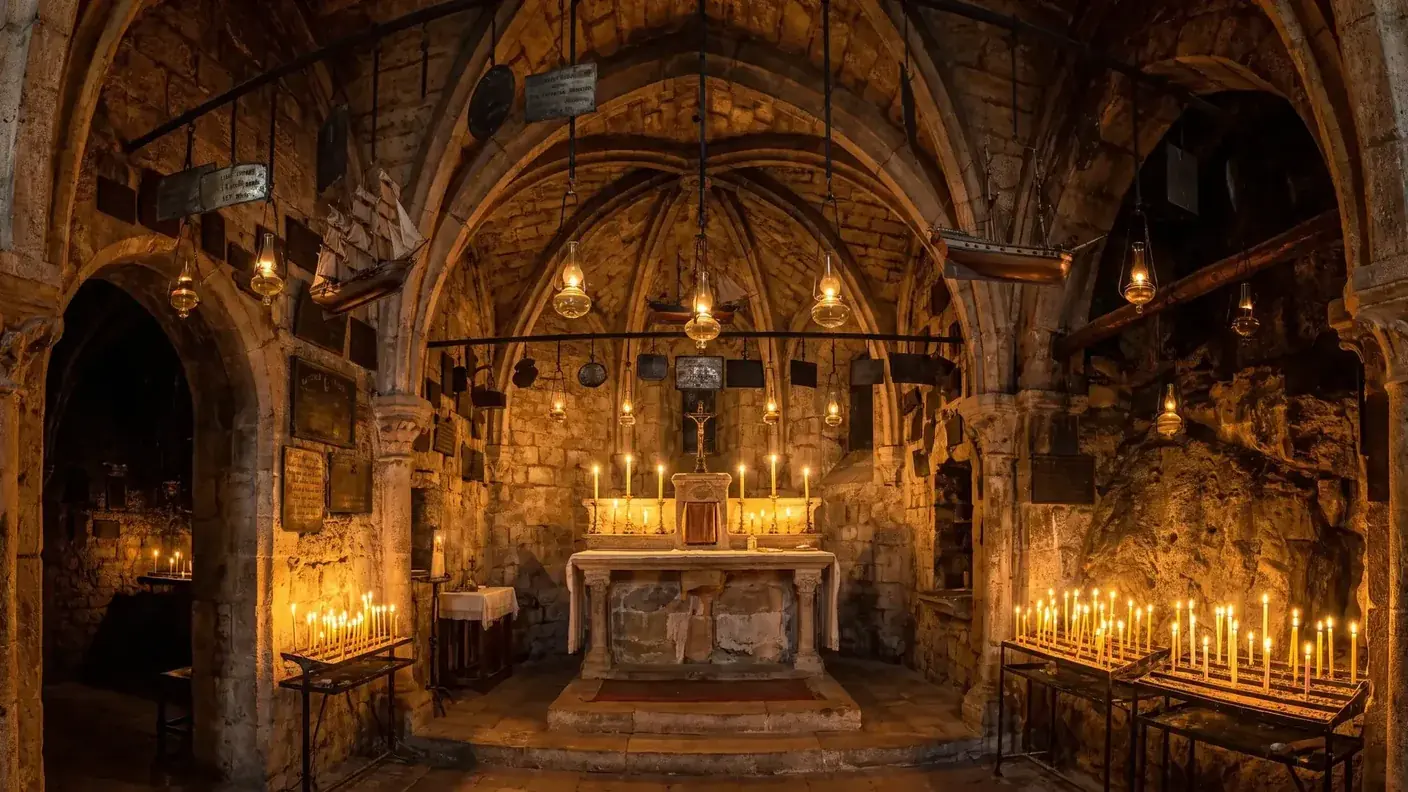
A close examination of the statue reveals some fascinating details. The body and the seat are carved in one piece made of walnut (exactly 66 × 21 × 19 cm); the silver plates that partially cover it were cast, embossed, and gilded. Its original polychromy, as determined by analysis, was clear: beige face, green seat, silver-plated body—a far cry from today's somber image. Above all, the back of the seat conceals a square rebated housing, most likely a reliquary or a tabernacle: the statue was not merely an image; it was itself a sacred vessel. Its designation as a Historic Monument dates precisely to July 8, 1908 (record PM46000242 from the Palissy database).
A Date That Is the Subject of Debate
Its dating is a matter of scholarly debate. The only definite reference point is the Carbon-14 dating conducted in 2016: between 1160 and 1270 — a period that straddles the end of the Romanesque period and the beginning of the Gothic period. Stylistic analyses differ: the late 12th century according to some (1170–1180, consistent with the rise of pilgrimage after 1166), second quarter of the 13th century for the more recent work by art historian Nicolas Bru (2013), which puts forward an intriguing hypothesis: a connection between the statue and the visit to St. Louis in 1244. As things stand, there is no source that allows us to reach a definitive conclusion—and we respect this cautious approach.
How long has it been black?
The most surprising mystery remains: there is no written record of its black color prior to 1632 (first mentioned by Odo de Gissey). Throughout more than four centuries of devotion, no known document describes the Virgin of Rocamadour as black. In the Middle Ages, the statue was adorned with precious metals—it still retains plates of gilded silver—and its original polychrome coloring was light. Its dark hue results from two well-documented phenomena: the patina of the centuries (smoke from candles and incense) and a deliberate black dye applied in the 16th and 17th centuries, at a time when “Black Madonnas ” (Le Puy, Chartres, etc.) became objects of devotion in their own right. The statue finally underwent a major restoration in 1949 (consolidation of the wood through bakelization, under the direction of Jean Taralon) to stabilize eight centuries of wear and tear.
The records regarding this 1949 restoration are delightfully detailed: the project was entrusted to the André House for 36,000 francs, edited by Jean Taralon, inspector of Historic Monuments. As for the carbon-14 dating results published in the journal Techné In 2022, its gross value is 840 ± 30 BP, calibrated to two standard deviations over the range 1160–1270—the only scientific certainty in a matter where, for a century, each generation of art historians has proposed its own date.
The Book of Miracles: Medieval Piety Captured in the Moment
While the Black Madonna is the most visible object of devotion, the most valuable document for understanding her remains little known: the Book of Miracles. This Latin collection was compiled around 1172 by a monk at the shrine—who dated it himself as “six years after” the discovery of 1166, a rare and valuable internal dating. It records approximately 126 accounts of miracles that occurred between 1148 and 1172, more than half of which are healings; the text has come down to us through medieval copies, preserved notably at the Bibliothèque nationale de France.
How many miracles, exactly? The round figure of “126” is a popular estimate; the scholarly count, compiled by the Presses universitaires du Midi, lists 127 accounts, including 65 healing miracles—representing 51% of the total. No autograph manuscript has survived: the text has come down to us through medieval copies, including three at the BnF (Latin manuscripts 12593, 16565, and 17491) and one in Toulouse (ms 482). The standard edition is that of the British historian Marcus Bull (Boydell, 1999), following the pioneering work of Edmond Albe (1907), which was later expanded upon by Jean Rocacher (1996). An interesting detail: the author specifies that the miracles were “attested before a notary”—medieval piety also had its formalities.
Healings, Shipwrecks, and Repentant Bandits
What's striking is the diversity situations: healings of the blind and the paralyzed, sea rescues attributed to Our Lady of Rocamadour (linked to the legend of the sanctuary’s bell, which is said to ring on its own when a sailor is saved far away—a devotional tale, it should be noted), the release of prisoners, the conversion of repentant bandits, healings of the possessed, and punishments of sacrileges. An example often cited by researchers: the miracle of a blind, pregnant woman from Burgundy, who regains her sight at the end of the pilgrimage—recorded with sufficient precision to map the pilgrims’ actual point of origin.
A top-notch source
That is precisely what makes this text so valuable: few medieval shrines have such an early and well-organized body of writings. Recorded in writing barely six years after the founding event, the Book of Miracles provides a vivid account of the workings of 12th-century popular piety—where the pilgrims came from, what hardships drove them onto the roads, and how society interpreted the inexplicable. For historians, it is a source of the highest order; for visitors, it is proof that the fervor that built this place is not a romantic reconstruction, but a reality set down in black and white 850 years ago.
The Fourth Holy Place: Kings, the Grand Staircase, and Durandal
Driven by the relic, the statue, and the spread of the Book of Miracles, the pilgrimage reached its peak in the 13th century. It was then that Rocamadour was commonly referred to as the fourth holiest site in Christendom, after Jerusalem, Rome, and Santiago de Compostela. This “ranking” stems more from tradition than from an official Church hierarchy—but it reflects a reality: pilgrims came from all over Western Europe, from the British Isles to the Iberian Peninsula.
Kings of England and France
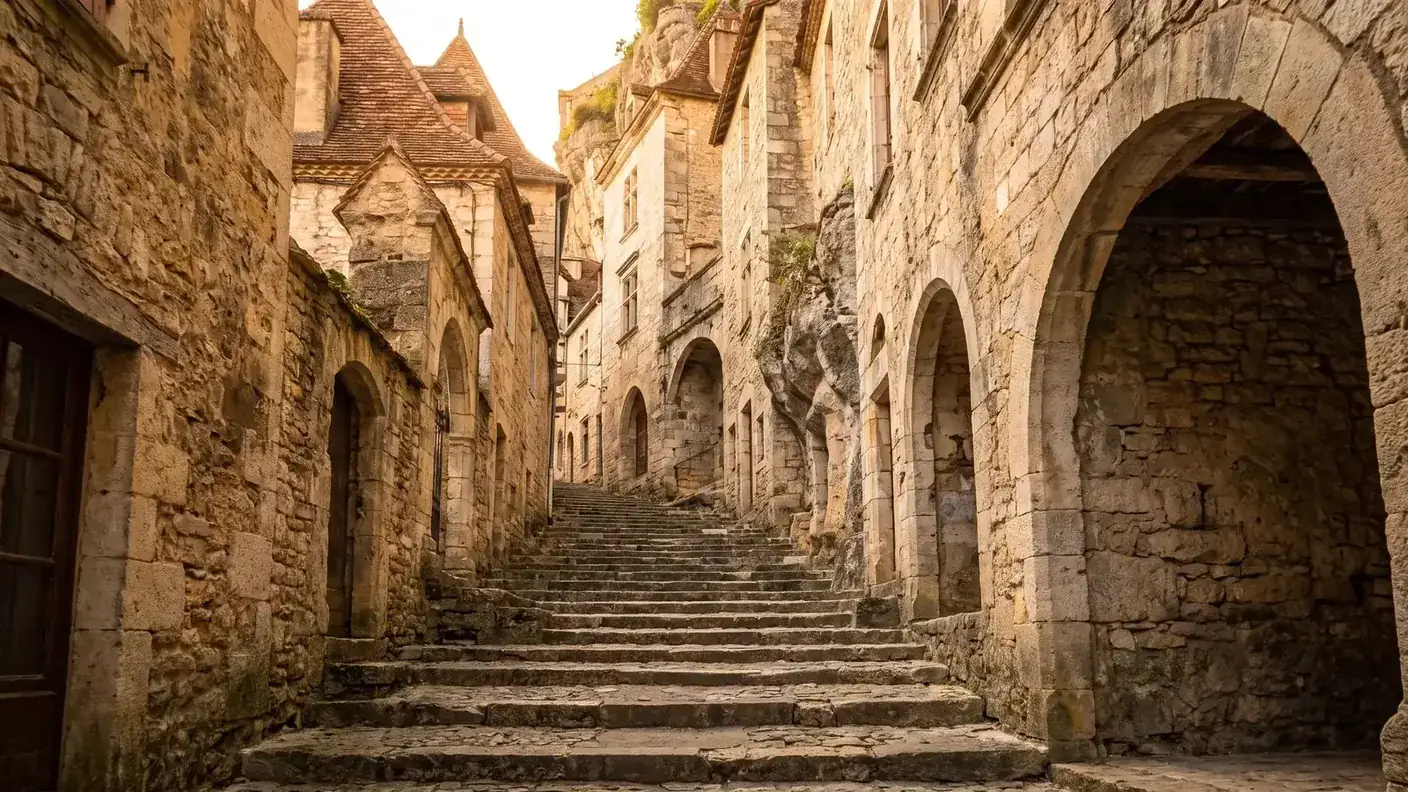
Famous pilgrims are a measure of the site’s influence. Henry II Plantagenet, King of England and one of the most powerful rulers in the West, came in 1170—the only visit dated with certainty, as recorded by Robert de Torigni—to thank the Virgin Mary for a healing. The most famous pilgrimage remains that of Saint Louis in 1244, accompanied by his mother Blanche of Castile: the “golden age” of the shrine. The faithful, for their part, would climb the Grand Staircase of 216 steps—built along with the rest of the sanctuary complex beginning in 1152—often on their knees, each step experienced as an act of penance before venerating the statue.
Two historical clarifications are in order here. Regarding Henry II, tradition often mentions two visits, in 1159 and 1170; in reality, only the 1170 visit is firmly dated by Robert de Torigni—the 1159 date is the result of an indirect calculation by historians, and the notion of two distinct stays is a matter of reconstruction. And the Plantagenet family also provides the most ironic counterpoint to this story: around 1183, Henry the Young, the rebellious son of Henry II who was short on money to pay his mercenaries, is said to have ordered the plundering of the very sanctuary his father had come to thank—before dying of illness a few days later, which his contemporaries were quick to interpret as divine punishment.
The Grand Staircase also has its own legend: it is said that the Virgin Mary built it prune in a single night carved into the rock. The story is charming; the reality is more prosaic—the staircase is part of the major construction project that began in 1152 and continued between the late 12th and 13th centuries. Contrary to what is sometimes claimed, it does not “date” from 1166: it accompanied the rise of the pilgrimage rather than resulting from it.
Durandal: The Stolen Legend
And then there is Durandal. According to the epic legend, Roland, Charlemagne’s nephew, entrusted his famous sword to the sanctuary—or Saint Michael the Archangel brought it there—where a blade was indeed embedded in the crevice of the cliff above the forecourt. Pure legend, of course, born of the Song of Roland. A replica on display in the cliff was reported stolen in late June 2024. The site’s presentation may change: check for the latest information with the Rocamadour sanctuary before your visit. Even without its sword, the rock retains its story: at Rocamadour, legend is woven into the very stones.
1562: The Sacking—Then a Long Slumber and a Rebirth
The history of Rocamadour is not a continuous thread of enthusiasm. In 1562, in the midst of the Wars of Religion, Protestant troops led by Captain Jean Bessonias, Lord of Bessonie, and the lord of Duras seized the sanctuary—the same campaign that struck Gramat, Martel, Souillac, and Sarlat. The treasury of Notre-Dame, accumulated through centuries of donations, was completely ransacked: the plea sent by the canons to the pope Pius IV in 1563 figure of 20,000 pounds the sums collected, which were remitted to the Prince of Condé's army.
The Hammer Relics
The fate of the relics speaks to the symbolic significance of the act: the body, discovered in 1166 and venerated for four centuries, was smashed with a hammer and then burned—tradition attributes these terrible words to Bessonias: “I will smash you, since you refused to burn.” ” Fragments of bones, saved from the flames, are now on display in the Saint-Amadour crypt; they were solemnly put back on display on August 25, 2016, to mark the 850th anniversary of the discovery.
1829–1872: The Renaissance
A long slumber of two centuries followed, during which the pilgrimage survived but without fanfare. The revival came in the 19th century: the healing of Father Caillau, a pilgrim in 1829, revived devotion, and the bishops of Cahors spearheaded—especially between 1858 and 1872—a massive restoration project that restored the religious city to its present appearance. It was this movement, continued into the 20th century (with the restoration of the statue in 1949), that enabled Rocamadour to regain—and surpass—its status as a major pilgrimage site and tourist destination.
The timeline of this revival is worth detailing, given how rapidly it unfolded once the spark was ignited. After his pilgrimage in 1829, Father Caillau returned to preach a mission in September 1835, then purchased the fortress on September 11, 1836, to establish a community there. Bishop Bardou, Bishop of Cahors from 1842 to 1863, took over, and a diocesan lottery launched in 1855 financed the bulk of the work—hence the major restoration campaign of 1858–1872 that gave the religious complex the appearance we know today. In the space of some forty years, a sanctuary that had lain dormant for two centuries once again became one of France’s foremost pilgrimage sites.
Travel from Bordeaux and explore the Causse region
From Bordeaux, it’s about 254 km and a 2-hour, 55-minute drive (take the A89, then head down to the Causse via Souillac, or take the A62/A20). Rocamadour has a small train station, Rocamadour-Padirac, on the Brive–Capdenac line, about 1.5 km from the site; however, most visitors arrive by car—and during peak season, finding a parking spot can be a challenge. The site is best explored on foot, between the lower village, the religious quarter, and the castle: be sure to wear sturdy shoes, or use the elevators.
A few words about this station with the double name: Rocamadour-Padirac is located on the line Brive–Toulouse via Capdenac, opened in 1862 — The railroad thus arrived on the Causse at a time when pilgrimages were experiencing a resurgence and a campaign to restore the shrines was in full swing (1858–1872). Today, service remains limited, and the station at Gramat, on the same line about 9 km away, sometimes offers more convenient schedules.
| From / To | Distance | Weather |
|---|---|---|
| Bordeaux → Rocamadour | ~254 km | ~2:55 |
| Souillac | ~23 km | ~25 min |
| Padirac Chasm | ~10 km | ~15 min |
| Sarlat-la-Canéda | ~51 km | ~50 min |
| Cahors | ~60 km | ~50 min |
Shining Bright on the Causse and the Dordogne
The surrounding plateau is home to some of the most beautiful sites in Quercy and neighboring Périgord: the Padirac Chasm and its underground river (~15 min), Souillac and its Byzantine abbey church, the Dordogne Valley (Carennac, Loubressac, Autoire—three of the “Most Beautiful Villages of France”), and Sarlat, less than an hour away. To visit Rocamadour and Padirac in a single day from Bordeaux—door-to-door and without worrying about parking—a executive car service departing from Bordeaux remains the most comfortable option. A fixed, written quote is provided before departure.
One last insider tip: arrive early in the morning or at the end of the day. That’s when the cliff glows in the low-angle light, when the Grand Escalier regains its silence, and when Rocamadour, for the space of an hour, becomes once again what it was for eight centuries: a sacred rock suspended between the sky and the canyon.
Frequently Asked Questions
Why is Rocamadour called the “fourth holiest site in Christendom”?
Because in the 13th century, at the height of the pilgrimage, the shrine was commonly ranked—by tradition rather than by any official Church hierarchy—just after Jerusalem, Rome, and Santiago de Compostela. This reputation was based on a rare combination: a venerated statue of the Virgin Mary credited with miracles, and the tomb of a local saint whose body had been discovered intact in 1166.
Who was Saint Amadour?
Historically, this is unknown: it was the intact body exhumed in 1166 from the ground of the sanctuary that was identified as that of the site’s legendary founding saint. Hagiographic tradition then built up his story in layers: first as an anonymous hermit, then as a companion of Saint Martial, and finally—only in the 15th century—as Zacchaeus, the tax collector from the Gospel, and the supposed husband of Saint Veronica. This account is a legend, not documented history, and the sanctuary itself presents it as such.
How old is the Black Virgin of Rocamadour?
The only definitive scientific evidence is the carbon-14 dating conducted in 2016: between 1160 and 1270. Stylistic analyses range from the late 12th century (1170–1180) to the second quarter of the 13th century—the latter hypothesis, proposed by Nicolas Bru in 2013, suggests a possible connection to Saint Louis’s visit in 1244. The statue, made of walnut wood, measures 66 cm and has been classified as a Historic Monument since 1908.
Why is the Virgin of Rocamadour black?
This is the mystery of the site: its black color is not mentioned in any written records prior to 1632. In the Middle Ages, the statue was adorned with precious metals, and its original polychromy was light in color. Its current hue is the result of centuries of patina (from candle smoke and incense) and a deliberate black dye applied in the 16th and 17th centuries, at a time when Black Madonnas became a phenomenon of devotion in Europe.
What is Rocamadour's Book of Miracles?
A Latin collection compiled around 1172 by a monk at the shrine, six years after the discovery of the body of Saint Amadour. It records approximately 126 accounts of miracles that occurred between 1148 and 1172: healings, rescues at sea, the release of prisoners, and the conversion of bandits. Preserved through medieval copies (notably at the BnF), it is one of the most valuable sources on popular piety in the 12th century.
Which kings made the pilgrimage to Rocamadour?
Henry II Plantagenet, King of England, came in 1170 to thank the Virgin Mary for a healing—the earliest documented royal visit. The most famous pilgrimage was that of Saint Louis in 1244, accompanied by his mother, Blanche of Castile. Other names (Louis XI, Charles the Fair) are mentioned in local tradition, but without solid documentary evidence.
How much does a trip from Bordeaux to Rocamadour cost with a chauffeured transfer?
Starting at €420 for a one-way, door-to-door trip for 1 to 3 passengers (economy vehicle) — approximate price for ~254 km and about 2 hours and 55 minutes of driving time. The exact price depends on the schedule, the vehicle (sedan or van for up to 7 passengers), and any requested stops—many travelers combine a visit to Rocamadour with a trip to the Padirac Chasm or Sarlat. A fixed, written quote is provided before departure.
What happened in Rocamadour in 1562?
In the midst of the Wars of Religion, Protestant troops led by Captain Jean Bessonias and the Lord of Duras plundered and ransacked the sanctuary: the treasury was confiscated (20,000 livres, according to the petition addressed to Pope Pius IV in 1563), and the body of Saint Amadour was smashed with a hammer and then burned. Fragments of bones saved from the flames are now on display in the Saint-Amadour crypt, where they were solemnly re-exhibited in 2016 to mark the 850th anniversary.
What is Rocamadour's Durandal sword?
A blade was embedded in the crevice of the cliff above the forecourt: according to legend—derived from *The Song of Roland*—this was Durandal, Roland’s sword, entrusted to the sanctuary or brought there by the Archangel Saint Michael. This is an epic tale, not a historical fact. A replica on display in the cliff was reported stolen in late June 2024. The site’s presentation may change: please check the current information with the Rocamadour sanctuary before your visit.
Is Rocamadour served by a train?
Yes, partially: the Rocamadour-Padirac train station, on the Brive–Capdenac line, is located about 1.5 km from the site (the Gramat station is about 9 km away). However, most visitors arrive by car—Bordeaux is about 2 hours and 55 minutes away, and Sarlat and Cahors are less than an hour away. During peak season, parking can be difficult—which is one of the advantages of door-to-door service with a private chauffeur.
How many steps are there on the Grand Staircase at Rocamadour?
The Grand Staircase has 216 steps, connecting the lower village to the religious quarter—pilgrims in the Middle Ages often climbed them on their knees as an act of penance. Contrary to the legend that the Virgin Mary had it carved in a single night, it is part of the major construction project for the sanctuaries launched in 1152 under Abbot Géraud d’Escorailles and continued between the late 12th and 13th centuries. It therefore does not date from 1166: its construction accompanied the rise of the pilgrimage rather than resulting from it.
What's there to see around Rocamadour?
The Padirac Chasm and its underground river (~15 min), Souillac and its abbey church (~25 min), the Dordogne Valley with Carennac, Loubressac, and Autoire (Most Beautiful Villages of France), and Sarlat-la-Canéda less than an hour away. Nearby, the Quercy Plateau—a UNESCO Global Geopark—offers its dry-stone landscapes, and the village is home to its famous Rocamadour AOP goat cheese.
Further Reading
- The capital of the Périgord Noir, about 50 minutes away: see the Sarlat Guide (market, old town)
- The royal bastide overlooking the Dordogne: see the Domme Guide (cave, panoramic view)
- The lively capital of Lower Limousin: see the Brive-la-Gaillarde Guide (market, collegiate church)
- The Sistine Chapel of Prehistory: see the Lascaux Guide
- Plan your trip: Book a professional chauffeur from Bordeaux to Rocamadour or explore all our destinations
Sources and References
- Wikipedia — Rocamadour — geography, demographics, place names, history, the 1562 sacking
- Shrine of Our Lady of Rocamadour — papal bull of 1105, discovery in 1166, royal pilgrimages, relics (2016)
- Wikipedia — Our Lady of Rocamadour — the Black Madonna: material, dating, 1949 restoration, listed as a historic monument in 1908
- Presses universitaires du Midi — *The Book of Miracles* — a collection from ~1172, a corpus and typology of miracles
- POP / Palissy Collection — Statue of Our Lady of Rocamadour — Listed as a cultural artifact on July 8, 1908
- La Dépêche du Midi, July 1, 2024 — Theft of the Durandal Replica
- INSEE — Rocamadour (46240) — population, demographic series, peak in 1800
Article updated in July 2026.
On the Way to the Sacred Rock of Quercy
Direct trip from Bordeaux (~2 hours 55 minutes) to Rocamadour and the Quercy Plateau, with stops along the way as desired—the Padirac Chasm, Souillac, the Dordogne Valley, and Sarlat. Fixed-price quote in writing within 30 minutes; sedan or 8-passenger van; English-speaking driver.