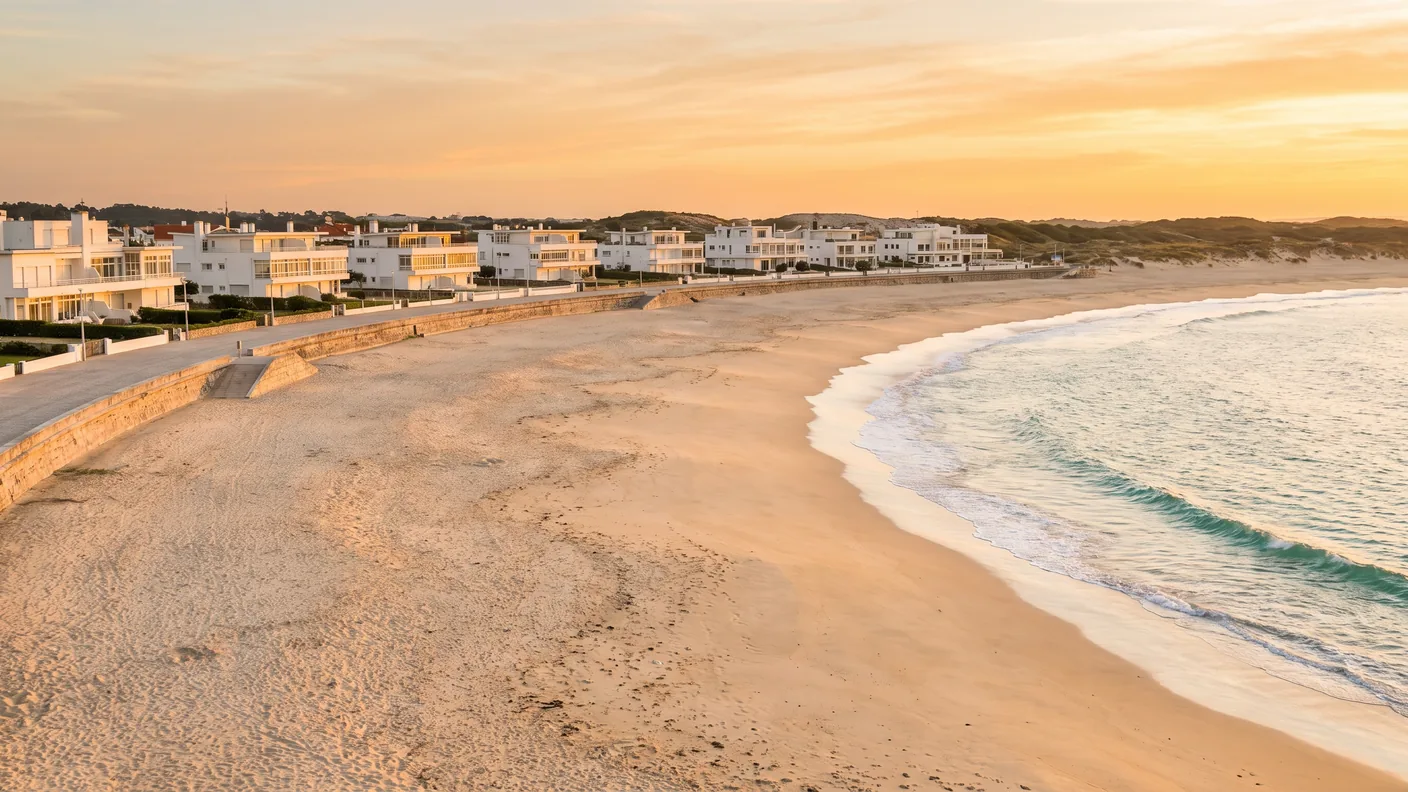
Bordeaux to Royan: beaches, 1950s architecture and the Côte de Beauté
A seaside resort razed in 1945 and later rebuilt as a laboratory for modern architecture, a concrete “ship-like” church, five beaches arranged in a semicircle, and the mouth of the Gironde River. The capital of the Côte de Beauté, Royan blends surviving Belle Époque architecture with the boldness of the 1950s, about 1 hour and 46 minutes from Bordeaux.
Royan at a glance
Royan is a seaside resort in Charente-Maritime, the capital of the Côte de Beauté, situated on the right bank of the Gironde estuary, about 134 km and a 1-hour-46-minute drive from Bordeaux. Its uniqueness stems from a tragedy and a rebirth: razed to the ground at the very end of World War II, it was rebuilt in the 1950s as a veritable laboratory of modern architecture. Visitors can explore a church shaped like a ship made of exposed concrete, Notre-Dame; a covered central market crowned by a massive dome; and a waterfront with clean, sweeping curves that gave its name to the “École de Royan.” Surrounding it, five beaches arranged in a semicircle—the famous “conches”—open out onto the Atlantic. With traces of the Belle Époque still visible in some places and the bold style of the 1950s elsewhere, Royan can be explored in a day from Bordeaux, starting at €232.
| Landmark | Details |
|---|---|
| Department | Charente-Maritime (17) · Nouvelle-Aquitaine |
| Status | Municipality, the principal town of the Côte de Beauté · City of Art and History (2010) |
| Population | 19,425 residents (2023), the Royannais |
| Codes | INSEE 17306 · ZIP code 17200 |
| Must-Sees | Notre-Dame Church · Central Market · Les Cinq Conches · The Waterfront, 1950 |
| From Bordeaux | ~134 km · ~1 hr 46 min drive · starting at €232 |
Few French cities tell the story of their century as vividly as Royan. In January 1945, when France was almost entirely liberated, the seaside town was trapped in the German Atlantic pocket and destroyed on a scale rarely seen. What could have condemned it to the anonymity of hasty reconstruction instead turned it into a manifesto: the government designated it an exemplary urban planning project, and a generation of architects and engineers came there to experiment with concrete, curves, and light. The result baffles visitors accustomed to Belle Époque resorts: here, the heritage belongs to the 1950s.
You have to approach Royan without preconceived notions. It is sometimes called “ugly,” because people fail to understand that it is coherent: its light-colored buildings, its rounded balconies, and its roofs as slender as shells are the result of a unified design, not mere accidents. Traces of the 19th-century resort town linger in a few surviving villas in the Parc, Pontaillac, and Foncillon neighborhoods, but the heart of the city is an open-air architecture museum. Add five beaches, a marina from which cruises depart for the estuary, and the salty Atlantic air: Royan is a complete getaway—part cultural, part seaside—just a day’s trip from the Gironde.
One last bit of trivia to set the scene: in Bordeaux, the word “royan” didn’t just refer to the city. In the past, “a royan” referred to a sardine caught off the coast of Royan—a usage long attested to in old dictionaries. The city and its estuary thus provided food for the tables of the Gironde region long before it became a weekend getaway destination. This ancient connection between Bordeaux and Royan—forged by the river and the fish trade—has now evolved into a vacation destination: the people of Bordeaux now head to its beaches and historic sites for a day of fresh sea air.
Where is Royan located?
Royan occupies a strategic location, at the crossroads of two worlds: the open Atlantic to the north and the Gironde Estuary to the south. The town stands on the right bank of the mouth of Western Europe’s largest estuary, where the river meets the ocean in a constant interplay of currents, sandbars, and light. Its coordinates—approximately 45°37′ north latitude and 1°01′ west longitude—place it in the southern part of Charente-Maritime, of which it is one of the major maritime gateways. Surrounding it is the Côte de Beauté, a ribbon of coastline stretching from the Pointe de la Coubre to the river’s mouth, of which Royan is the natural capital and primary service center.
It is a resort town in the truest sense of the word: its population doubles—sometimes triples—as soon as summer returns. There are roughly 7,000 vacation homes for about 8,000 primary residences, a sign of a city designed as much for those who live there year-round as for those who come to relax. This dual nature explains the character of Royan: a dense network of shops, a lively waterfront, marinas and fishing ports, hotels and a casino, but also peaceful residential neighborhoods nestled among the pine trees. As for the town’s name itself, its origin remains uncertain: the most commonly cited theory suggests it is a diminutive of “mouillère,” meaning a marshy meadow, which would align with the nearby marshes of Pousseau and Pontaillac, but there is no evidence to confirm this with certainty.
How far is it from Bordeaux?
You sometimes read that Royan is “85 km from Bordeaux.” That’s true as the crow flies, but misleading for anyone traveling by road: the estuary lies in between, and you have to go around it. By road, expect a distance of 134 km and a travel time of about 1 hour and 46 minutes, taking the A10 highway toward Saintes and then the N150 road, which heads west. There’s a maritime alternative—slower but more scenic: head to Le Verdon-sur-Mer through the Médoc, then cross the estuary on the Gironde ferry, which drops you off just a few hundred meters from Royan’s waterfront. This route literally crosses the river and turns the trip into a short cruise.
| From Royan to… | Driving distance | Approximate duration |
|---|---|---|
| La Palmyre (Les Mathes) | ~18 km | 20–25 min |
| Talmont-sur-Gironde | ~17 km | ~25 min |
| Saintes | ~40 km | ~45 min |
| Rochefort | ~40 km | ~45 min |
| Bordeaux | ~134 km | ~1 hr 46 min |
This central location makes Royan an excellent base from which to explore the Charentes region: La Palmyre Zoo, the hilltop village of Talmont, the Gallo-Roman town of Saintes, and the Rochefort Arsenal are all less than an hour away. From Bordeaux, the whole experience feels like a day trip to the coast, with the added convenience of not having to drive or search for a parking spot during peak season.
The city’s geography also explains its unique climate. Shielded from prevailing winds by the orientation of its inlets and tempered by the combined influence of the ocean and the estuary, Royan enjoys abundant sunshine and mild temperatures, which have earned it a reputation as a resort town since the 19th century. The hackberry trees, palm trees, and umbrella pines that grow in its gardens bear witness to this almost southern mildness. It is this rare combination—the open Atlantic Ocean on one side, the relative tranquility of the estuary on the other—that made Royan, long before any architectural competitions, a place where people came to breathe freely.
1945: The City of Martyrdom
To understand Royan, we must go back to the winter of 1945. While nearly all of French territory had been liberated, several German pockets still held out along the Atlantic coast, blocking strategic estuaries. Royan was trapped in one of these pockets—the Royan pocket—which controlled the mouth of the Gironde River and thus maritime access to Bordeaux. The city would pay dearly for this military status—not at the start of the war, but at the very end, in the final months of a conflict that had already been all but won. This is what makes its history so unique—and so tragic.
The Raid of January 5, 1945
On the night of January 4–5, 1945, a British air operation targeted the German fortifications in the pocket. Royal Air Force Lancaster bombers dropped more than 2,000 metric tons of bombs on the city between approximately 4:00 a.m. and 5:43 a.m. The result was devastating: Royan was laid to waste, but the German military positions that the raid was supposed to destroy remained virtually intact. The target had been missed. It has been described as a “tragic irony”: the city was razed to the ground without the military objective being achieved—as if it had been destroyed for nothing. The death toll remains a subject of debate among historians to this day; conservative estimates put the number of civilian casualties from this single raid on January 5 at more than 500, with more than 1,000 wounded.
The extent of the destruction also varies depending on the source. Some reports state that 95% of the city was destroyed, while others cite a figure closer to 80%. It is more accurate to say that between 80 and 95% of Royan—that is, virtually the entire city—was wiped out, without settling on a single percentage that would give a false sense of precision. What is certain is that the Belle Époque seaside resort, with its villas, casinos, and hotels, ceased to exist within a few hours.
April 1945: The Breakout from the Pocket
However, the city had not yet been liberated. It would not be until spring and Operation Vénérable—the Allied offensive of April 14 and 15, 1945—that the Royan pocket was finally overrun. These battles were marked by the massive use of napalm—some 725,000 litres—on German positions and their surroundings. Royan was liberated between April 15 and 17, 1945, just a few weeks before the German surrender. One detail illustrates the absurdity of these final battles: among the American airmen involved in the April napalm bombings was a young man named Howard Zinn, a future historian, who would later make Royan a textbook example of the military futility of certain operations.
A childish, costly, and pointless victory. — Historian Rémy Desquesnes, on the April 1945 assault
These words sum up the feeling many still have about the end of the Royan pocket: a city sacrificed in the very last weeks of a war Germany had already lost. It is from this field of ruins—and from this painful memory—that the Royan we visit today will emerge. The reconstruction will not be merely physical; it will also, in a certain sense, be an aesthetic and deliberate response to the tabula rasa.
When discussing these events, we must guard against both sensationalism and false precision. Historians continue to debate the toll, the responsibilities, and the actual military value of these late-stage bombings. What is widely agreed upon is the disproportion: a seaside resort reduced to ashes at a time when the Allied victory was no longer in doubt. This history still weighs heavily on the city’s identity, which it now fully embraces by honoring the memory of its destruction as much as it celebrates the pride of its rebirth. Understanding 1945 is therefore not a detour: it is the key that unlocks everything else—from the architecture to the urban landscape.
Reconstruction and the Royan School
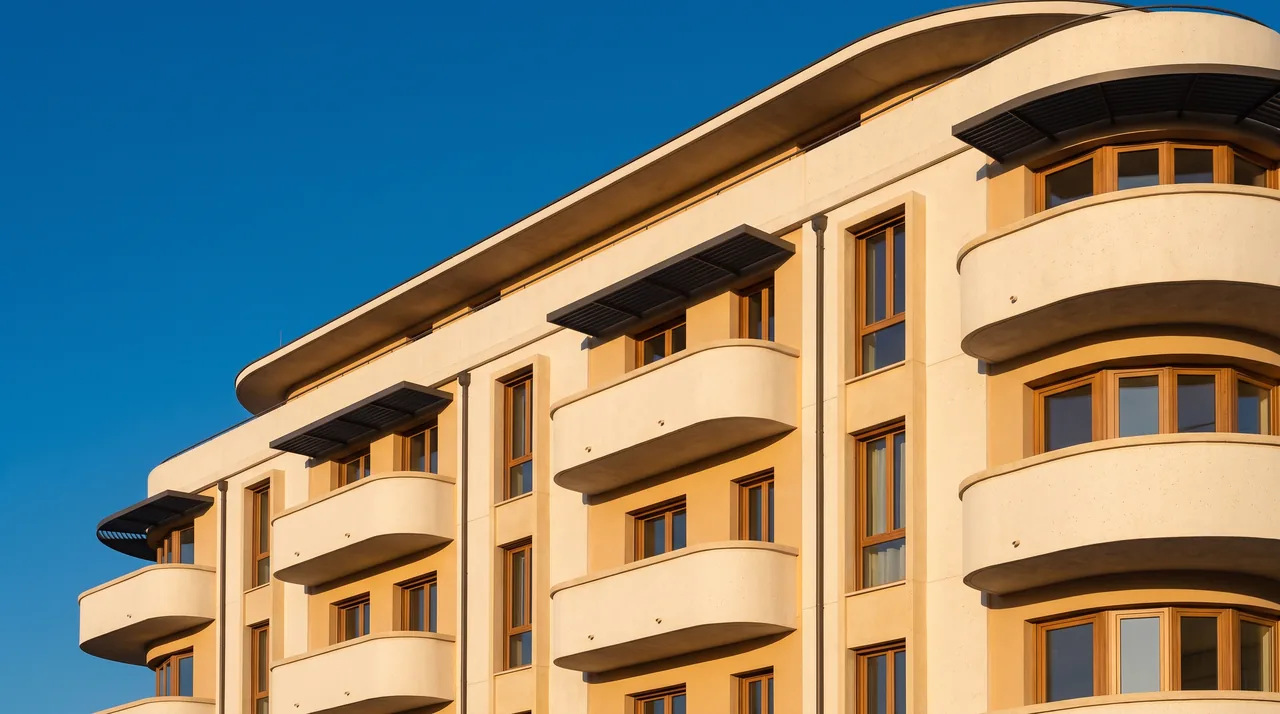
The reconstruction of Royan could have been rushed, like so many other devastated cities. But a different course was chosen. In 1949, the town was designated a laboratory for urban planning and modern architecture, just like Le Havre, Dunkirk, and Saint-Dié—all cities serving as testing grounds where the goal was to envision the city of tomorrow rather than simply rebuild it exactly as it was. This status as a laboratory changed everything. Royan would not be a reconstruction, but a creation, with a master plan, an architectural vocabulary, and a clear ambition: to turn necessity into a work of art.
Claude Ferret and the Royan Style
The chief architect for the project is Claude Ferret. Under his leadership, an architectural style has emerged that is so distinctive it has been given a name: the “Royan School.” This style blends late Art Deco, postwar modernism, and a bold Brazilian influence—characterized by curves, exposed concrete, and color. Balconies are rounded, roofs are light and airy, and facades play with vertical rhythms and recesses. The waterfront, the villas, and the Palais des Congrès are the most visible examples of this style. Where other reconstruction projects have resulted in monotony, Royan has sought—and often found—elegance.
We must gauge the extent of the loss to appreciate what was built. Of the approximately 4,000 villas that existed in Royan before the war, only about 250 survived the destruction of 1945, scattered throughout the Parc, Pontaillac, and Foncillon neighborhoods. In other words, the vast majority of the city we walk through today dates from the Reconstruction period. The few surviving Belle Époque houses, with their bow windows and balusters, now stand in contrast to the clean lines of the 1950s, offering the attentive visitor a striking glimpse into two eras of resort life.
| Period | What's Left of It |
|---|---|
| The Belle Époque (before 1945) | ~250 villas out of ~4,000 (Parc, Pontaillac, and Foncillon neighborhoods) |
| January–April 1945 | Almost the entire city was destroyed (Royan pocket) |
| Reconstruction (beginning in 1949) | Urban Planning Laboratory, urban planner Claude Ferret, “École de Royan” |
| Acknowledgments | 20th-Century Heritage Designation · City of Art and History (2010) |
This consistency has finally been recognized. Long looked down upon, Royan’s 1950s architecture is now protected as cultural heritage; the city applied in 2010 for the “City of Art and History” designation, which it received in 2011. These landmarks are documented by the City of Royan and in the POP listing for Notre-Dame Church. What was once considered ordinary concrete has become a heritage site that is protected, documented, and open to visitors. Two buildings, more than any others, embody this bold vision: Notre-Dame Church and the covered central market.
The Brazilian influence is worth noting, as it gives Royan its unique character. During those years when Oscar Niemeyer and the South American modernist school were captivating Europe, the architects of Royan drew inspiration from the tropics, embracing free-flowing curves, sunshades, spiral ramps, and bold colors. The Villa Boomerang, the stepped buildings along the waterfront, and the Palais des Congrès play with these motifs with a cheerfulness that stands in stark contrast to the supposed grayness of the postwar era. A stroll through Royan is thus like reading, facade by facade, a conversation between France during its postwar reconstruction and Brazil’s “happy concrete” era—a dialogue that no other French city offers on this scale.
The Church of Notre-Dame by Guillaume Gillet
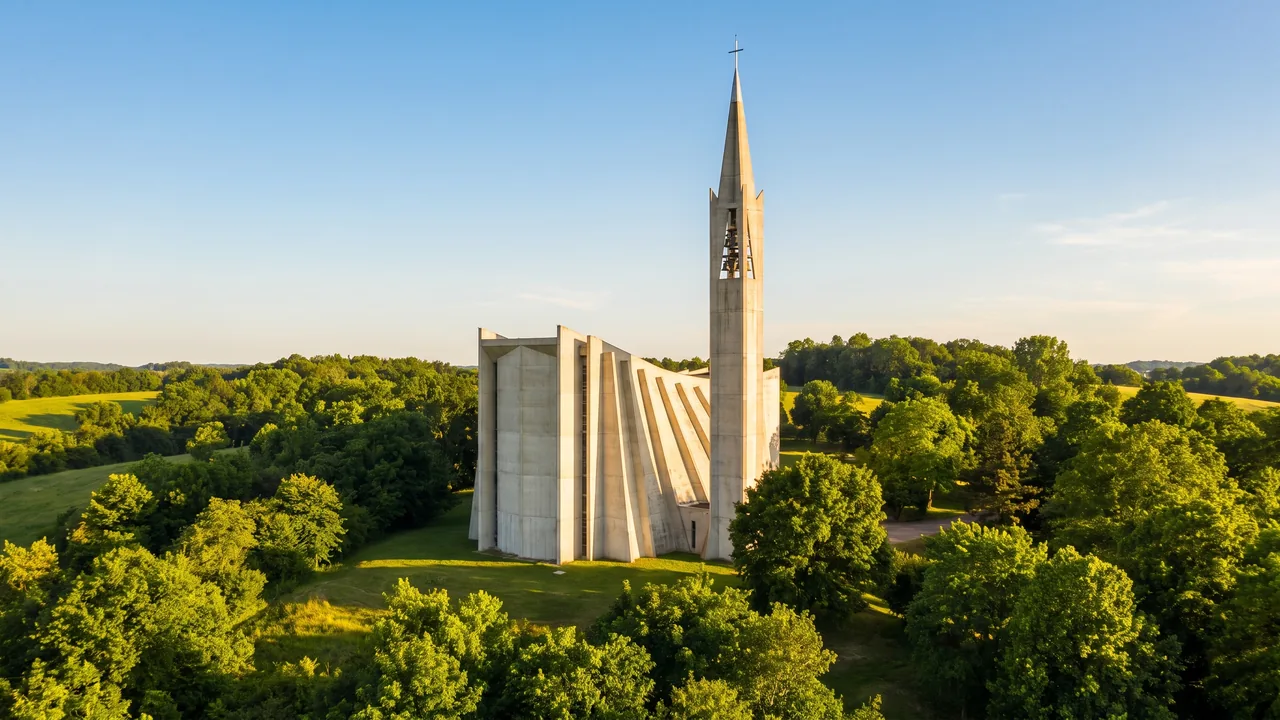
If Royan had only one monument to show, it would be this one. Notre-Dame Church is the masterpiece of the Reconstruction era and one of the most stunning religious buildings of 20th-century France. It can be seen from afar, its slender silhouette towering over the city like a ship standing upright on its bow. Up close, the surprise is complete: this is not a Neo-Gothic church in disguise, but a structure of raw concrete, fully in keeping with its time, whose verticality evokes the Gothic style without ever copying it.
A vessel made of raw concrete
The building is the work of architect Guillaume Gillet, assisted by co-architect Marc Hébrard, and engineers Bernard Laffaille and, later, René Sarger, who took over the project after Laffaille’s death. Notre-Dame belongs to the Brutalist movement: it is constructed of prestressed V-shaped concrete panels, using the system developed by Laffaille, which allows for large spans to be supported by a material of astonishing thinness. Gothic inspiration is evident in the silhouette, the vertical soaring, and the filtered light, but this is by no means a pastiche: it is the structure itself—the exposed concrete and its ribs—that serves as the ornament.
The figures are staggering. The cornerstone was laid on July 17, 1955, and the church was dedicated on July 10, 1958. The bell tower rises to a height of about 60 meters, topped by a 6-meter cross. The elliptical nave measures 45 meters by 22 meters. But the most astonishing fact lies elsewhere: the vault—the roof of this immense nave—is only about 8 centimeters thick, proportionally as thin as an eggshell. Inside, some 500 square meters of stained-glass windows, designed by Henri Martin-Granel, bathe a space capable of accommodating nearly 2,000 people.
| Our Lady of Royan | Data |
|---|---|
| Architect | Guillaume Gillet (co-architect: Marc Hébrard) |
| Engineers | Bernard Laffaille, followed by René Sarger |
| Construction | Cornerstone laid on July 17, 1955 · Inaugurated on July 10, 1958 |
| Dimensions | Bell tower ~60 m (+ 6 m cross) · nave 45 × 22 m · roof ~8 cm thick |
| Stained-glass windows | ~500 m² (Henri Martin-Granel) · capacity: ~2,000 people |
| Status | Designated a Historic Monument in 1988 · 20th-Century Heritage designation |
The Architect's Tomb
Designated a Historic Monument in 1988 and recognized as part of the 20th-Century Heritage, Notre-Dame finally received the official recognition that its bold design deserved. But the most moving story involves its architect. Guillaume Gillet considered this church his masterpiece, so much so that he wished to be laid to rest there: his tomb has been located in the church’s ambulatory since 1996. Few architects have thus become part of their life’s work—in stone, or rather, in concrete. Visitors who take the time to walk through the interior therefore pass, often without realizing it, near the grave of the man who envisioned this sacred space.
The experience inside is striking and worth experiencing at different times of day. In the morning, the low-angled light illuminates Henri Martin-Granel’s stained-glass windows and casts colorful patches onto the exposed concrete; in the afternoon, the elliptical nave grows darker and more austere, and one can then truly appreciate its dizzying height. The concrete, left in its raw state, is anything but cold: it bears the imprints of the formwork, it shimmers in the backlight, and it lends the whole structure an almost monastic solemnity. Looking up at this impossibly slender vault, one understands why the engineers Laffaille and Sarger are, as much as the architect, the heroes of this story. Without their mastery of structural engineering, such a structure would never have stood.
The Central Covered Market
A few blocks from the church, another concrete masterpiece awaits visitors—less spectacular from a distance but just as masterful: the central covered market. Seen from the outside, it is a vast, light-colored dome, scalloped along its rim, set in the heart of the city like an upside-down shell. Seen from the inside, it’s a feat of engineering: a vast, open space, without a single pillar, where light streams down from above onto the market stalls. Few covered markets in France offer such structural purity.
A dome without pillars
The building is the work of architects Louis Simon and André Morisseau—both of whom deserve credit—and the same engineers who worked on the church: Bernard Laffaille and then René Sarger. Designed in 1955—the very year Laffaille died in the spring—it was completed shortly thereafter in 1955–1956. Its dome is a concrete shell only about 8 centimeters thick, with a diameter of approximately 52.40 meters and a height of about 10.50 meters. It rests on just 13 support points distributed around its circumference, which leaves the interior space entirely unobstructed: not a single pillar interferes with movement or the view. It is this apparent lightness—this span supported by such a thin material—that makes the building a textbook example of shell architecture.
People like to compare these two major structures from Royan’s post-war reconstruction, as they share the same feat of engineering. The market’s dome and the church’s roof are both approximately 8 centimeters thick: two record-breaking concrete shells, proportionally as thin as an eggshell, designed by the same engineers. This interplay between the “ship-like” church and the “dome-like” market alone encapsulates the technical genius that drove the city’s rebirth.
| Book | Concrete shell | Designated a Historic Monument |
|---|---|---|
| Central Market (Dome) | ~8 cm thick · diameter ~52.40 m · 13 support points | 2002 |
| Notre-Dame Church (roof) | ~8 cm thick · nave 45 × 22 m | 1988 |
The market was designated a Historic Monument in 2002, fourteen years after the church: these are two distinct dates that should not be confused. Beyond its architectural value, it remains a vibrant market where people come to buy oysters, fish from the estuary, Charente specialties, and fresh produce. The central market hosts vendors year-round and generally sees increased activity during peak season; be sure to check the official days and hours published by the City of Royan before your visit. Strolling beneath this dome on a Sunday, basket in hand, is undoubtedly the best way to understand that Royan’s 20th-century heritage is not a static museum, but a living environment.
The feat can be better appreciated when considered in context. In the mid-1950s, prestressed concrete was still a relatively new technology, and covering a market with a single shell spanning more than fifty meters—without a single central support—was a real gamble. The very shape of the dome—undulating along its rim like the edge of a seashell—is not merely an aesthetic whim: these folds stiffen the shell and allow it to remain so slender. Beauty and engineering merge seamlessly, which is the hallmark of all Royan architecture. This is also what makes the city so valuable in the eyes of engineers and architecture students, who come from far and wide to study these twin shells.
The Five Coves and the Beaches
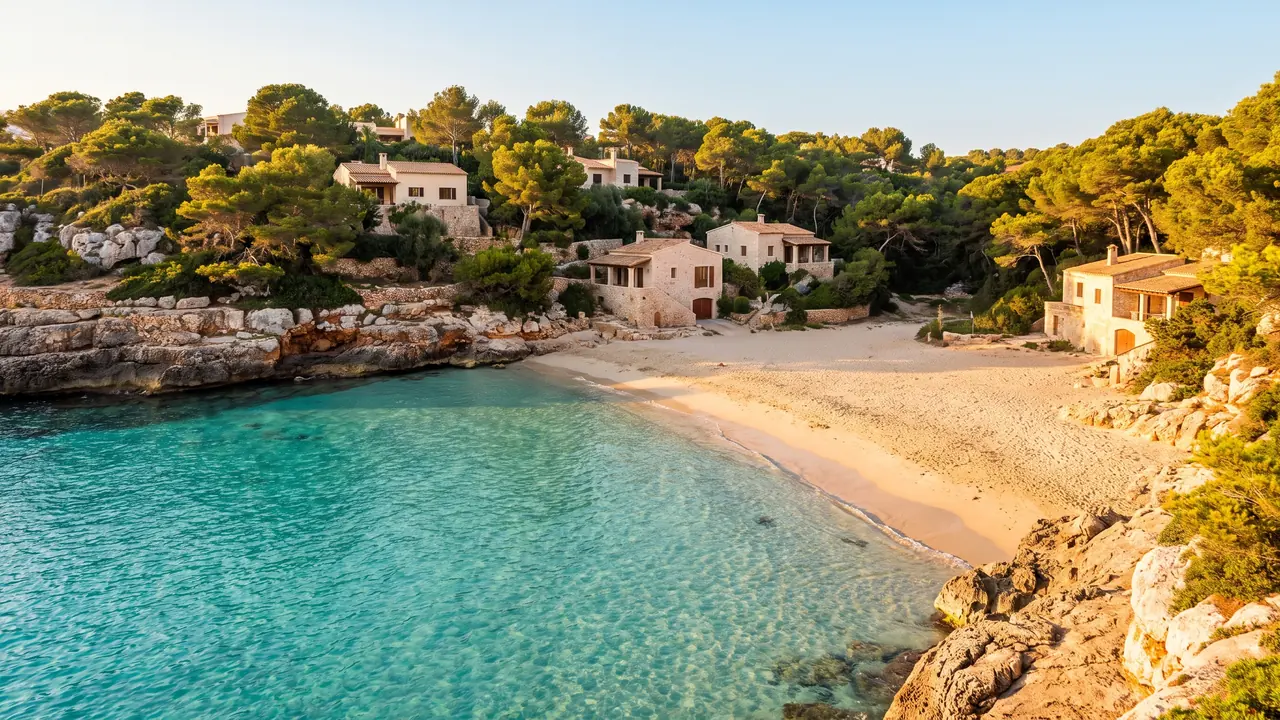
Royan also owes its reputation to its beaches—and more specifically to its “conches,” those crescent-shaped beaches nestled between the rocky headlands of the coast. The term is local and perfectly describes these crescent-shaped stretches of sand fringed by low cliffs and pine trees. The town has five of them, each with its own character, level of popularity, and history—ranging from the vast, popular stretch to the intimate, sheltered cove.
Five beaches, five atmospheres
The most famous and longest is the Grande Conche, which stretches for some 2,600 meters of sand at the foot of the waterfront: it’s the town’s central beach, perfect for family swimming, sandcastles, and—every summer—the big concert on the sand. Pontaillac, at the other end of the town, is the most fashionable: a small, sheltered cove dominated by light-colored villas and the casino, where the elegant clientele of the seaside resorts once gathered. In between lie Foncillon, Le Chay, and Le Pigeonnier—the latter being a small, well-protected beach, ideal when the wind picks up. From one cove to the next, you can go from the open sea to a secluded spot in just a few minutes’ walk.
| Conche | Character |
|---|---|
| Grande Conche | The longest (~2,600 m) · at the foot of the waterfront · concerts in the summer |
| Pontaillac | Small, sophisticated, sheltered · casino and villas |
| Foncillon | Close to downtown and the harbor |
| Le Chay | Intermediate, family-sized conche |
| The Dovecote | Small and sheltered, off the beaten path |
A resort founded in the 19th century
Royan’s history as a seaside resort dates back well before the Reconstruction. It really took off during the Second Empire, when the trend of sea bathing spread throughout the Atlantic coast. The arrival of the railroad around 1875 opened up the resort and brought in a bourgeois clientele seeking sea air and a vacation destination; it was then that Pontaillac experienced its boom and became dotted with villas. It would be wrong, however, to imagine that the splendor of that era survived the century intact: the war took its toll. The one point that requires clarification is the Pontaillac casino. It is not a 19th-century Belle Époque building, but rather the Sporting Casino of 1931, an Art Deco masterpiece by architect Bluysen, which today operates as the Casino Barrière following its acquisition in 1986. It is the only casino in Royan to have escaped the destruction of 1945: the 19th-century establishments, on the other hand, have all disappeared. Thus, even Royan’s glamour bears the mark of its turbulent century.
The cliff, the pine trees, and nature
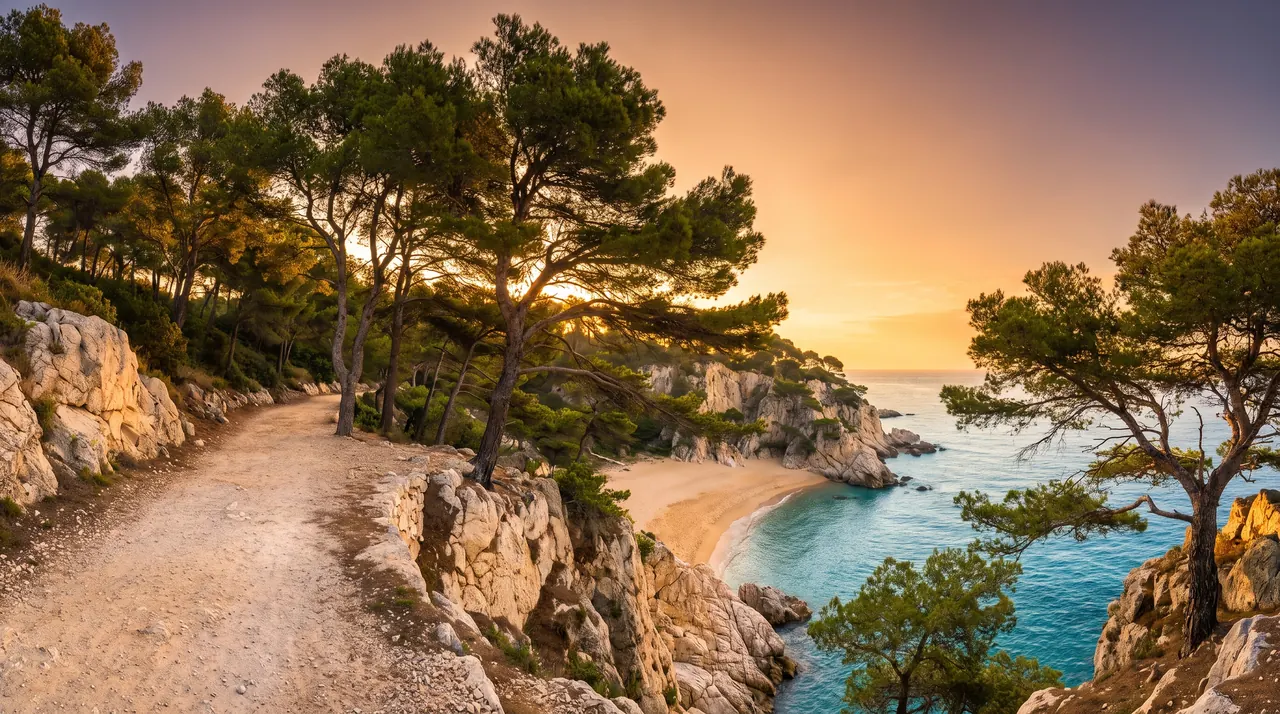
Between architectural tours, the Corniche offers a welcome respite. This seaside trail connects the coves, hugging the coastline as it winds its way through stands of maritime pines, tamarisk trees, and unobtrusive villas. You walk in the shade of the trees, with—on your right or left, depending on which way you’re heading—turquoise water, small sandy coves, and, in the distance, the estuary’s horizon blending into the ocean. It’s one of the most beautiful walking routes on the Côte de Beauté, easily accessible and dotted with benches and lookout points.
The Côte de Beauté itself—the coastline stretching from the Pointe de la Coubre to the mouth of the Gironde—owes its name to this alternation of beaches, gentle cliffs, and coastal forests. Right next to Royan lies the vast Coubre Forest, a pine grove planted in the 19th century to stabilize the dunes, now a haven for hikers and cyclists. Dunes, the Pousseau and Pontaillac marshes, and shaded trails: nature is never far from the concrete, and you can tailor your day by balancing the built environment with the great outdoors as you please. It is this diversity of landscapes—just minutes apart—that gives the resort its enduring charm and invites visitors to return during the off-season, when the coastal road regains its tranquility.
What is there to do in Royan?
In Royan, you can easily fill an entire day without ever getting bored, alternating between the beach, historic sites, and water activities. The morning is perfect for exploring the central covered market, beneath its large dome, and visiting Notre-Dame Church; midday is perfect for swimming in one of the five coves or taking a boat tour from the harbor; the afternoon is ideal for a leisurely stroll along the waterfront and the coastal road. The city, designated a “City of Art and History,” offers a tour dedicated to 1950s architecture that provides insight into the post-war reconstruction, and the tourist office is brimming with ideas depending on the season. Here are the must-see attractions around which to build your itinerary.
- Swim at the five coves—from Grande Conche to Pontaillac—on beaches that are patrolled during the season.
- Visit the Notre-Dame Church and the Central Covered Market, the two concrete gems of the Reconstruction era.
- Follow the “1950s Architecture” tour offered by the City of Art and History.
- The central market is open year-round, with vendors typically increasing their presence during peak season; be sure to check the official days and hours published by the City of Royan before your visit.
- Set sail on a cruise from the port to the Cordouan Lighthouse and the Gironde Estuary.
- "Un Violon sur le Sable" is a music festival held at the Grande Conche in Royan. The lineup, dates, admission requirements, and capacity vary by year: be sure to check the official program before heading out.
- Try your luck at the Casino Barrière in Pontaillac, the only casino spared in 1945.
- Continue on to La Palmyre Zoo, about 20 minutes away, near Royan.
"Un Violon sur le Sable" is a music festival held at the Grande Conche in Royan. The lineup, dates, admission requirements, and capacity vary by year: be sure to check the official program before heading out.
Depending on the season, we’ll of course adjust the itinerary. In the height of summer, it’s best to focus on sightseeing in the morning, when the church and market are still cool and the light is beautiful, and save the afternoon for swimming or a boat cruise. In the off-season, it’s the opposite that appeals: the deserted coves, the silent cliffside, and the concrete washed by the sea spray offer a more intimate, almost private Royan, where you can admire the 1950s architecture without the crowds. No matter the time of year, the tourist office remains your best resource for finding out the tide schedules, market times, and current events.
| Desire | To Royan |
|---|---|
| 20th-Century Heritage | Notre-Dame Church · Central Market · 1950s Architecture Tour |
| Beach | The five coves, which have lifeguards on duty during the season |
| On the water | Cruises from the Port of Royan → Cordouan and the Estuary |
| Market | The central market is open year-round, with vendors typically increasing their presence during peak season; be sure to check the official days and hours published by the City of Royan before your visit. |
| Event | "Un Violon sur le Sable" is a music festival held at the Grande Conche in Royan. The lineup, dates, admission requirements, and capacity vary by year: be sure to check the official program before heading out. |
| With the family | La Palmyre Zoo, about 20 minutes away (near Royan) |
The ferry, Cordouan, and the estuary
Royan is centered around the water, and visitors can enjoy two maritime experiences: crossing the estuary on the ferry and sailing toward France’s oldest lighthouse still in operation. These are two complementary ways to understand why the mouth of the Gironde has played such an important role in the city’s history—as a strategic gateway in the past and as a natural spectacle today.
The Gironde Ferry
The Gironde ferry connects Royan, in Charente-Maritime, to Le Verdon-sur-Mer and Pointe de Grave, on the Gironde side of the Médoc. The crossing is approximately 6 kilometers long and takes 20 to 25 minutes. The service is operated by the Gironde Department using its vessels, La Gironde and L’Estuaire, and is unique in that it crosses a departmental border in the middle of the water. For those coming from Bordeaux via the Médoc, it’s an attractive alternative to driving: you drive to Le Verdon (about 102 km from Bordeaux) and then board the ferry—by car or on foot—to reach Royan by sea. The crossing itself—with the wind, the seagulls, and the city growing larger on the horizon—is worth the trip all on its own.
Cordouan, the Versailles of the Sea
Out at sea, perched on a sandbar at the mouth of the estuary, stands the Cordouan Lighthouse, nicknamed the “Versailles of the Sea.” Beware of a common misconception: although it can be visited from Royan, Cordouan belongs neither to Royan nor to Charente-Maritime. Administratively, it is part of the municipality of Le Verdon-sur-Mer, in Gironde. Built between 1584 and 1611 under the direction of engineer Louis de Foix, who died before the structure was completed, it is the oldest lighthouse in France still in operation. Standing approximately 67.5 meters tall, designated a Historic Monument in 1862, and inscribed on the UNESCO World Heritage List in July 2021, it is also the only lighthouse in the world to have a consecrated chapel, where weddings and baptisms can still be held. It is said that the 27 years of construction consumed Louis de Foix’s fortune: a royal extravagance in the midst of the waves.
| On the estuary | Details |
|---|---|
| Gironde Baccalaureate | Royan (17) ↔ Le Verdon / Pointe de Grave (33) · ~6 km · 20–25 min |
| Ferry Operator | Gironde Department (ships La Gironde and L'Estuaire) |
| Cordouan Lighthouse | Town of Le Verdon-sur-Mer (Gironde), visited by Royan |
| Cordouan at a Glance | 1584–1611 · ~67.5 m · Listed as a Historic Monument in 1862 · Designated a UNESCO World Heritage Site in 2021 · Consecrated chapel |
Near Royan: La Palmyre, Talmont, Saintes
Royan is also an ideal base for exploring the Charentes region, provided you know exactly where each site is located, as the names can often be confusing. There are three must-see excursions just outside the city: a famous zoo, one of the most beautiful hilltop villages in France, and two cities steeped in history. All are less than an hour away.
La Palmyre Zoo and Talmont-sur-Gironde
La Palmyre Zoo is one of the most popular family attractions in the region, but it is not located in Royan: it is located in the town of Les Mathes, about 18 kilometers away, and “La Palmyre” is not actually a town but a seaside resort within Les Mathes. Founded in 1966 by Claude Caillé, the park covers 18 hectares and is home to approximately 1,600 animals representing some 115 species; it welcomes more than 700,000 visitors a year, while maintaining a family-friendly atmosphere. It opened with about sixty animals on three hectares and had already attracted nearly 130,000 visitors by the end of its first season, in August 1966.
Talmont-sur-Gironde, about 20 minutes south, also deserves a clarification: despite its name, this village is not in the Gironde department but in Charente-Maritime, on the right bank of the estuary, and should not be confused with Talmont-Saint-Hilaire, in Vendée, which is completely unrelated. Listed among the Most Beautiful Villages of France, Talmont has a population of just 77. It is an ancient bastide, founded in 1284 by King Edward I of England, whose landmark is the Romanesque Church of Sainte-Radegonde, perched on the cliff facing the river. Contrary to popular belief, it should be noted that the building was not founded by Saint Radegonde, the queen: it is simply dedicated to her, having been built around 1140–1170 by Benedictine monks, some six centuries after the 6th-century Frankish saint. The church has been classified as a Historic Monument since 1890.
Saintes and Rochefort
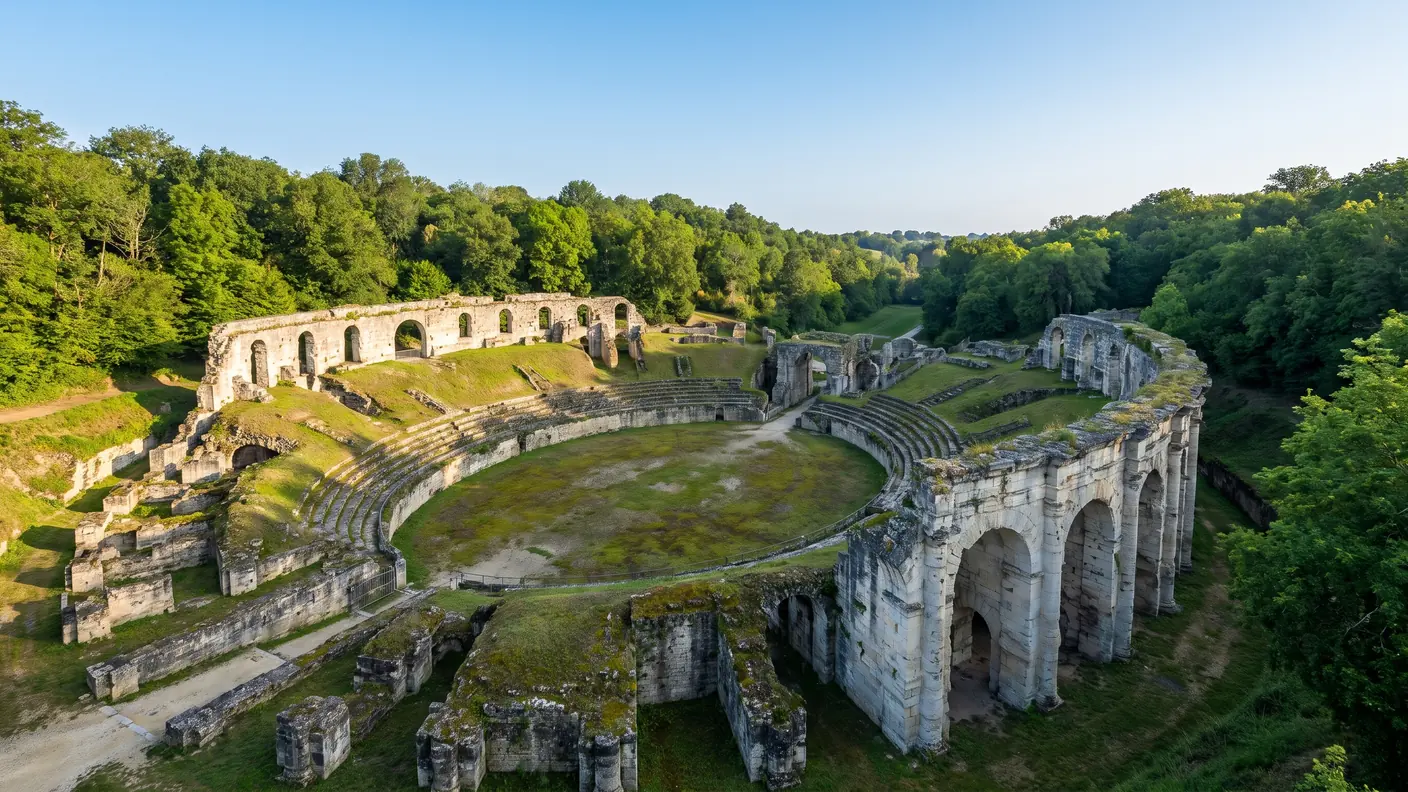
A little further on, about 40 kilometers away, two cities round out the picture. Saintes, the ancient Gallo-Roman capital of Aquitaine, boasts an ancient amphitheater, the Arch of Germanicus, and the Abbaye aux Dames on the banks of the Charente River. Rochefort, a city conceived by Colbert, preserves its royal arsenal, the spectacular Corderie Royale, and the shipyard where the frigate Hermione is being rebuilt. One tells the story of Roman Gaul, the other of the Sun King’s navy: enough to extend, for a day or two, a getaway that began at Royan.
The proximity of such contrasting sites is one of Royan’s major strengths as a starting point. In a single week, you can go from the brutalist concrete of the 1950s to the Roman ruins of Saintes, from the monkeys at La Palmyre Zoo to the suspended Romanesque church in Talmont, and from the open Atlantic Ocean to the calmer waters of the estuary. Few areas along the Atlantic coast boast such a variety of heritage sites within such a small radius. For visitors coming from Bordeaux, this means that a first day at Royan almost always sparks the desire for a second day, this time devoted to the wonders of the surrounding area.
| Nearby site | Where | Distance from Royan |
|---|---|---|
| La Palmyre Zoo | Municipality of Les Mathes (17) | ~18 km · 20–25 min |
| Talmont-sur-Gironde | Charente-Maritime (17) | ~17 km · ~25 min |
| Saintes | Charente-Maritime (17) | ~40 km · ~45 min |
| Rochefort | Charente-Maritime (17) | ~40 km · ~45 min |
For more information, see also our related guides: La Palmyre and its zoo, Gallo-Roman Saintes, and Rochefort and its arsenal—all within easy reach on a single getaway from the Gironde.
Join Royan from Bordeaux
That leaves the practical question: what’s the best way to get to Royan from Bordeaux? The city isn’t the easiest to reach, precisely because the estuary lies in the way, and the trip requires a bit of planning, especially during peak season when traffic and parking become more challenging along the entire Côte de Beauté.
How much does the ride cost?
From Bordeaux, it’s about 134 kilometers and a 1-hour, 46-minute drive via the A10 highway and then the N150. There is an alternative route through the Médoc and via the Gironde ferry: about 102 kilometers to Le Verdon-sur-Mer, followed by a 20- to 25-minute ferry ride that drops you off just steps from the waterfront. For a private transfer, the direct trip starts at €232 during the day for a sedan accommodating 1 to 3 passengers, at a fixed price confirmed in writing in advance, with no meter. A surcharge applies at night, on weekends, and on holidays, and extensions to La Palmyre or Talmont are subject to a quote.
| Route | Distance / Duration | Rates |
|---|---|---|
| Bordeaux → Royan | ~134 km · ~1 hr 46 min | starting at €232 |
| Bordeaux-Mérignac Airport → Royan | By address | based on a quote |
| La Palmyre or Talmont Extension | Approximately +18 km | based on a quote |
Why hire a private driver?
Royan is particularly well-suited for a day trip, as long as you don’t waste your time in summer traffic jams and searching for a parking spot. Leaving the driving to a chauffeur service turns the trip into a relaxing experience: you depart from your address in Bordeaux or the airport, enjoy the scenery of the estuary, and are dropped off directly at the waterfront, the market, or the cruise ship terminal. It’s a comfortable alternative to driving your own car, designed for those who want to experience Royan, its beaches, and its 1950s heritage without any logistical hassles. Request a fixed, no-obligation quote in advance for a stress-free day on the Côte de Beauté.
Frequently Asked Questions
How much does a trip from Bordeaux to Royan cost, and how long does it take?
Private transfer service is available starting at €232 during the day for a sedan accommodating 1 to 3 passengers, at a fixed price confirmed in writing in advance and without a meter. The trip is approximately 134 kilometers and takes 1 hour and 46 minutes, via the A10 highway and then the N150. A surcharge applies at night, on weekends, and on holidays. Pickups are available at your address in Bordeaux or at Mérignac Airport, with direct drop-off at the waterfront, the market, or the Royan marina.
How far is Royan actually from Bordeaux?
We often read that Royan is “85 km from Bordeaux,” but that’s the distance as the crow flies. By road, the Gironde estuary lies in the way, so you’ll need to go around it: expect a trip of about 134 kilometers and 1 hour and 46 minutes, via the A10 and then the N150. There’s an alternative route by sea through the Médoc and via the Gironde ferry, covering about 102 kilometers to Le Verdon-sur-Mer, followed by a 20- to 25-minute crossing. This second option turns the trip into a short cruise along the estuary.
What to see and do in Royan in one day?
A full day combines history, the beach, and the water. In the morning, visit the central covered market beneath its concrete dome and the Notre-Dame Church; around midday, go for a swim in one of the five coves or set out on a cruise; in the afternoon, take a stroll along the waterfront and the pine-lined promenade. The City of Art and History offers a tour dedicated to 1950s architecture. “Un Violon sur le Sable” is a music festival held at the Grande Conche in Royan. Its lineup, dates, admission requirements, and capacity vary by year: check the official program before heading out.
Why is the Notre-Dame de Royan Church famous?
Notre-Dame is the masterpiece of the Reconstruction era and one of the most daring religious buildings of the 20th century. Designed by architect Guillaume Gillet in collaboration with engineers Bernard Laffaille and later René Sarger, it is a Brutalist-inspired structure of exposed concrete featuring prestressed V-shaped ribs. Built between 1955 and 1958, it rises to a height of approximately 60 meters; its nave measures 45 by 22 meters, and its roof is only 8 centimeters thick. Designated a Historic Monument in 1988, it houses the tomb of its architect, who has been buried in the ambulatory since 1996.
Why was Royan rebuilt in the 1950s?
Royan was destroyed at the very end of World War II, trapped in the German Atlantic pocket. The British air raid on January 5, 1945, razed nearly the entire city without hitting the targeted fortifications, and Operation Venerable in April 1945 completed its liberation. Between 80 and 95 percent of the city was destroyed. In 1949, the government designated Royan as a laboratory for urban planning and modern architecture: the current city, with its church, market, and waterfront, dates from this reconstruction carried out under the direction of urban planner Claude Ferret.
What are Royan conches?
The “conches” are the crescent-shaped beaches that have made Royan famous as a seaside resort. The town has five of them: the Grande Conche, the longest with about 2,600 meters of sand at the foot of the boardwalk; Pontaillac, small, fashionable, and sheltered, dominated by its casino; then Foncillon, Le Chay, and Le Pigeonnier, the latter being petite and well-protected. Each has its own atmosphere, ranging from a large family-friendly beach to an intimate cove. During the season, they are patrolled, and you can move from one to the next along the coastal road lined with maritime pines.
Is the Royan Central Market worth a visit?
Absolutely. The covered central market is, along with the church, one of the two major concrete landmarks of the Reconstruction era. Designed by architects Louis Simon and André Morisseau, it is topped by a concrete dome approximately 8 centimeters thick and 52.40 meters in diameter, resting on just 13 support points, with no interior pillars. Designated a Historic Monument in 2002, it remains a bustling market: oysters, fish, and products from the Charente region. The central market hosts vendors year-round and generally sees increased activity during peak season; be sure to check the official days and hours published by the City of Royan before your visit.
Can you visit the Cordouan Lighthouse from Royan?
Yes, cruises depart from the port of Royan to the Cordouan Lighthouse and the Gironde Estuary. Please note, however: although it can be visited from Royan, Cordouan is administratively part of the municipality of Le Verdon-sur-Mer, in Gironde, and not in Charente-Maritime. Built between 1584 and 1611 and standing approximately 67.5 meters tall, it is the oldest lighthouse in France still in operation, designated a Historic Monument in 1862 and inscribed on the UNESCO World Heritage List in July 2021. Nicknamed the “Versailles of the Sea,” it is the only lighthouse in the world with a consecrated chapel.
Is La Palmyre Zoo in Royan?
No, contrary to what you sometimes read. La Palmyre Zoo is located in the town of Les Mathes, about 18 kilometers and 20 to 25 minutes from Royan; “La Palmyre” itself is not a town but a seaside resort in Les Mathes. Founded in 1966 by Claude Caillé, the park covers 18 hectares, is home to approximately 1,600 animals representing some 115 species, and welcomes more than 700,000 visitors a year. It remains a very popular family park and makes for an excellent day trip near Royan, especially with children.
Is Royan accessible and suitable for a car-free outing?
Royan is a great option for a day without a personal car, which helps you avoid summer traffic jams and the difficulty of finding parking on the Côte de Beauté. With a private transfer, you’ll be picked up at your address in Bordeaux or at the airport and dropped off directly at the waterfront, the market, or the cruise ship terminal. The city center, the market, the church, and the Grande Conche are all close to each other and easily accessible on foot. The coastal path then connects the coves via a flat, shaded trail that’s enjoyable for everyone.
What is the “Un Violon sur le Sable” festival?
"Un Violon sur le Sable" is a music festival held at the Grande Conche in Royan. The lineup, dates, admission requirements, and capacity vary by year: be sure to check the official program before heading out.
What are some good day trips to take around Royan?
Royan is an ideal base for exploring the Charentes region. About twenty minutes away are the La Palmyre Zoo (in the town of Les Mathes) and the village of Talmont-sur-Gironde—listed among the “Most Beautiful Villages of France”—with its Romanesque Sainte-Radegonde Church perched on the cliff. About 40 kilometers away are Saintes, the ancient Gallo-Roman capital with its ancient amphitheater, and Rochefort, known as “Colbert’s City,” with its royal arsenal and the Corderie. Note that Talmont-sur-Gironde is actually in Charente-Maritime despite its name, and not in the Gironde department.
Can you get to Royan by taking the Gironde ferry?
Yes, it’s an appealing alternative to the direct route. The Gironde ferry connects Le Verdon-sur-Mer and Pointe de Grave, on the Gironde side of the Médoc, to Royan in Charente-Maritime. The crossing covers about 6 kilometers and takes 20 to 25 minutes; it is operated by the Gironde Department using the vessels La Gironde and L’Estuaire. From Bordeaux, you can reach Le Verdon via the Médoc (about 102 kilometers) before boarding the ferry. The crossing of the estuary, facing the open sea, offers a beautiful maritime arrival into the city.
Further Reading
- The zoo and nearby beaches: see the La Palmyre Guide (the zoo, the forest, and the Côte de Beauté, about 20 minutes from Royan).
- The "Rome of Aquitaine": see the Saintes Guide (Roman amphitheater, Arch of Germanicus, and Abbaye aux Dames on the Charente River, ~40 km away).
- Colbert's Arsenal: see the Rochefort Guide (the Royal Arsenal, the Royal Rope Factory, and the frigate Hermione, about 40 km from Royan).
Sources and References
- Royan Atlantic Tourist Office — beaches, coves, 1950s architecture, events calendar, cruises
- Mérimée Database / POP (Ministry of Culture) — Notre-Dame Church, designated a historic monument in 1988; Central Market, designated a historic monument in 2002
- City of Royan — City of Art and History — Reconstruction, Royan School, 20th-century heritage
- INSEE — Municipality of Royan (17306) — Demographics
- "A Violin on the Sand" Festival — official program for this edition
- City of Royan — Central Market — Official Days and Hours (accessed July 24, 2026)
Article updated on July 24, 2026.
Off to the Côte de Beauté
Direct transfer from Bordeaux (~1 hr 46 min) to Royan, with its beaches and 1950s architecture. Written, fixed-price quote with no obligation.