Bordeaux to Souillac: Romanesque art on the Dordogne
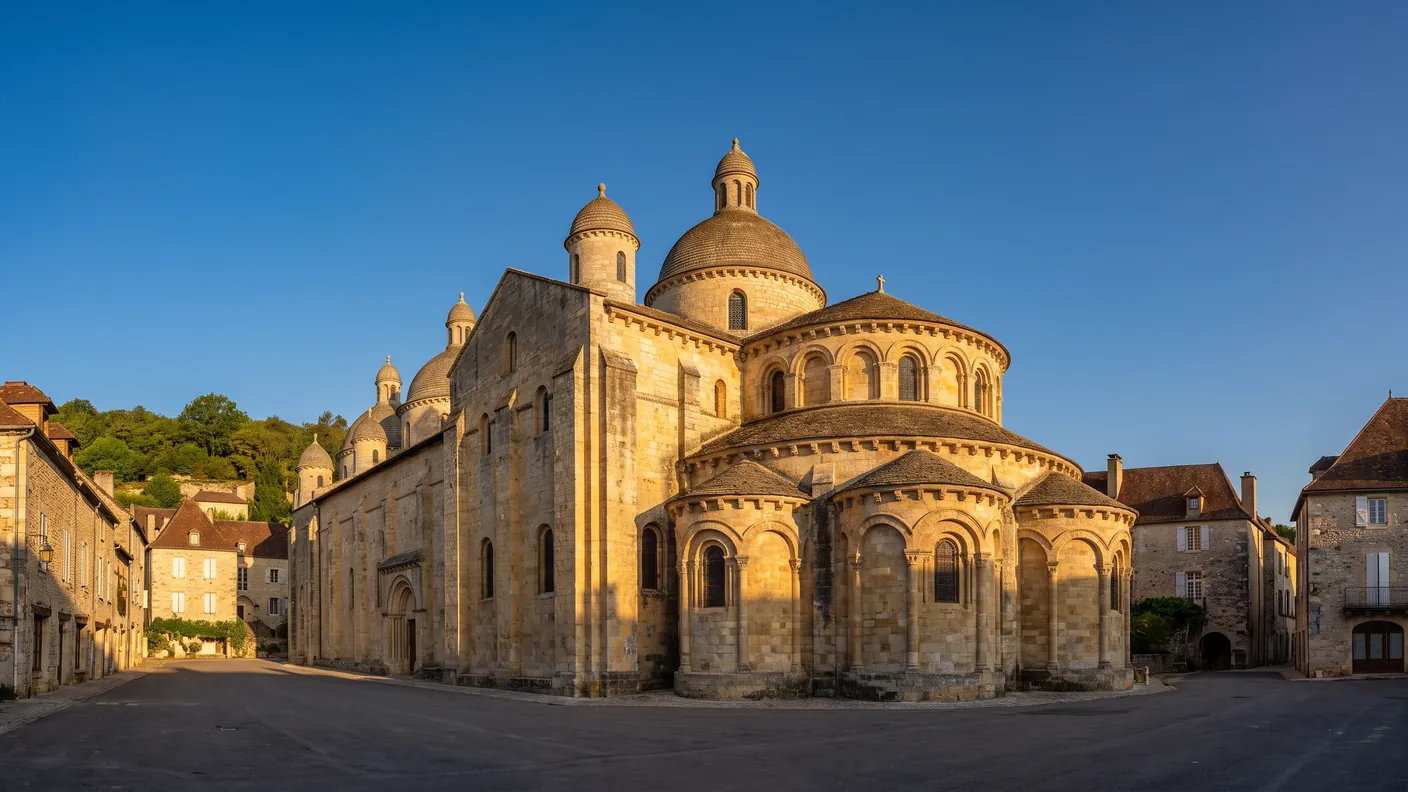
A small town in the Lot region, between Rocamadour and Sarlat, whose Romanesque abbey church with domes houses two masterpieces: the Prophet Isaiah, a pinnacle of Romanesque sculpture, and the tympanum depicting the legend of Theophilus—a pact with the devil, a distant ancestor of Faust. About 2 hours and 35 minutes from Bordeaux.
Souillac at a Glance
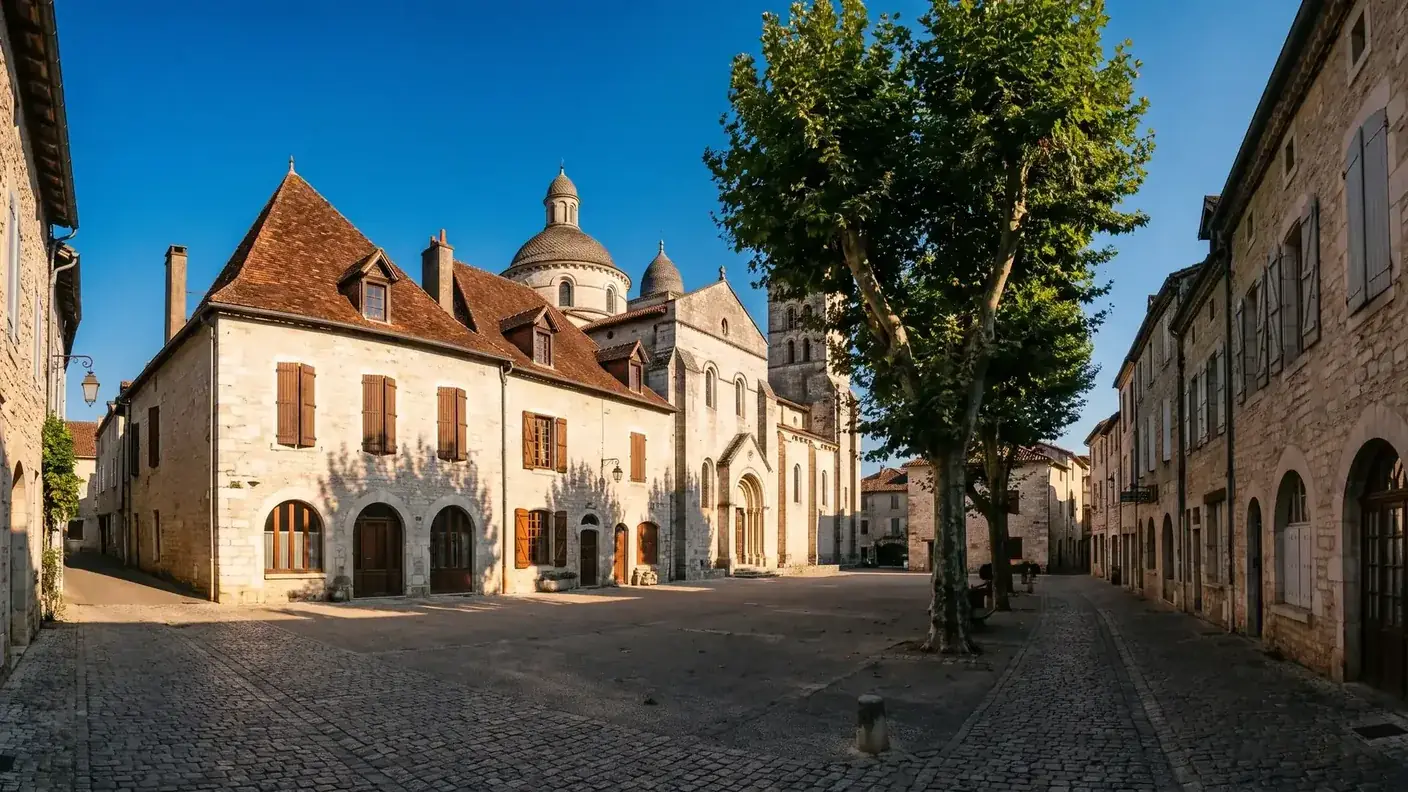
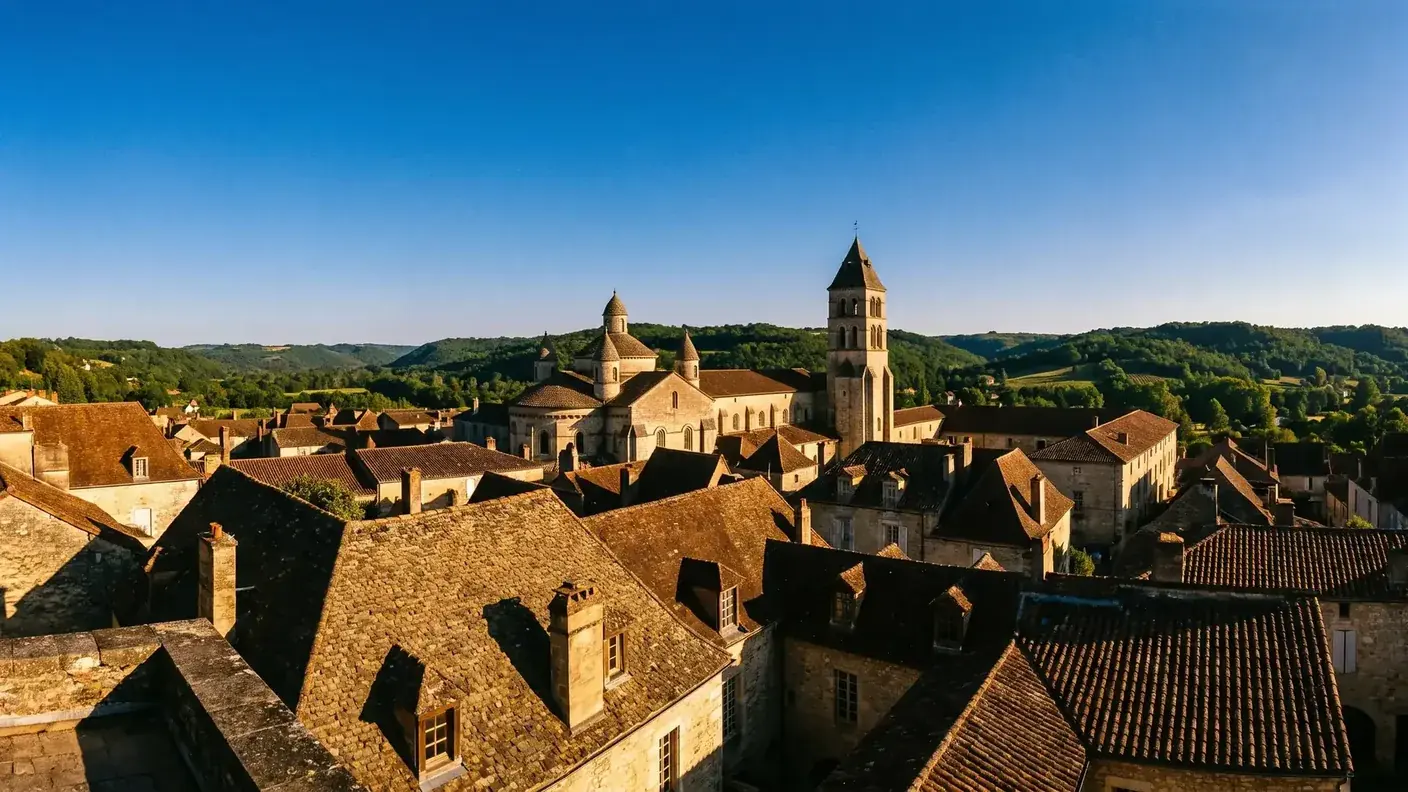
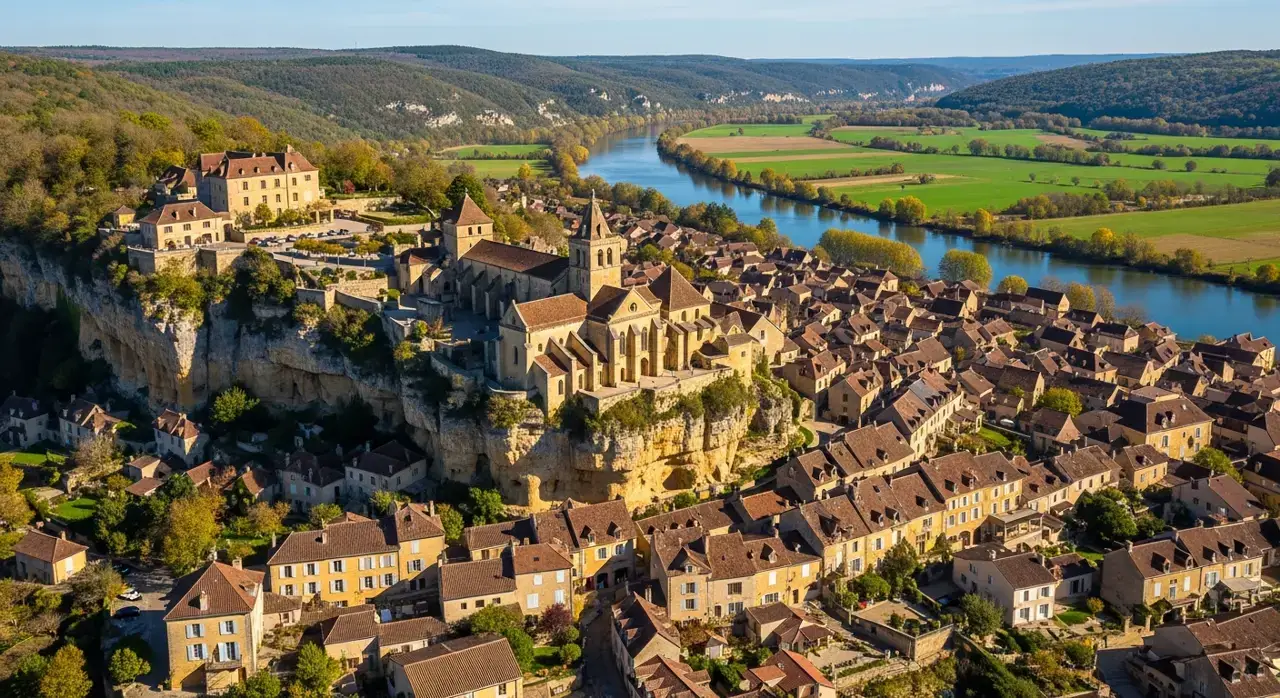
Souillac is a small town in the Lot department located on the Causse de Martel, on the banks of the Dordogne River, between Rocamadour and Sarlat. Its main landmark is the Abbey Church of Sainte-Marie, built in the 12th century and designated a historic monument in 1840. Its nave is covered by three domes supported by pendentives, an architectural feature rarely seen in Aquitaine Romanesque architecture. The building preserves two major sculptural ensembles: the prophet Isaiah, dated to around 1120–1140, and the tympanum depicting the legend of Theophilus, which recounts the pact and subsequent salvation of a medieval cleric. The priory was established through a donation by Géraud d’Aurillac around 909 and became an abbey in 1508. The National Museum of Automata closed in 2022. The train station also places the town on the Paris–Toulouse rail line. From Bordeaux, the journey is approximately 238 km and takes 2 hours and 35 minutes by car; the fixed price listed on the website starts at €387, subject to the conditions indicated on the booking page.
- Souillac (Les Souillagais) is a small town in the Lot department (46200), in Occitanie, on the Causse de Martel, between Rocamadour and Sarlat—on the banks of the Dordogne River.
- Its Romanesque abbey church, Sainte-Marie (12th century), is one of the few “row of domes” churches in Aquitaine, similar to Saint-Front in Périgueux and the cathedral in Cahors.
- It houses a masterpiece of Romanesque sculpture: the bas-relief of the prophet Isaiah (circa 1120–1140), a twisted figure of astonishing virtuosity.
- Its tympanum depicting the Legend of Theophilus is one of only two sculpted representations of this story—the pact with the devil, a distant precursor to Faust—dating from before the 13th century.
- The abbey was founded following a donation by Géraud d'Aurillac around 909; the town is first mentioned in 1253, but the priory was not elevated to the status of an abbey until 1508.
- The city lived through the Hundred Years' War (during which it was occupied by the English) and the Wars of Religion (its monastery was burned down in 1573).
- From 1988 to 2022, it housed a National Museum of Automata that was unique in France (the Roullet-Decamps collection, now at the MUCEM in Marseille).
- From Bordeaux: ~238 km, about 2 hours and 35 minutes by car — starting at €387 with a private chauffeur. Train station on the Paris–Toulouse line.
Before You Go: What Souillac Really Is
One summer morning on the Place de l’Abbaye. Before you stands a mass of pale stone topped by a strange row of round domes, like a fragment of the Orient set in the Quercy region. Inside, in the dim light, two carved stones alone are enough to justify the journey: a prophet twisted upon himself in a whirlwind of drapery, and a tympanum that tells, eight centuries before Goethe, the story of a man who sold his soul to the devil. Souillac is not merely a stopover between Rocamadour and Sarlat: it is one of the great “books in stone” of European Romanesque art. But one must know how to read it—distinguishing, as always, fact from legend.
Souillac is located in the Lot department, at the junction of Quercy and Périgord, on the Martel Plateau bordered by the Dordogne River. It is a small town rich in heritage, once prosperous but now more low-key—yet its abbey church remains one of the major monuments of Southern Romanesque architecture, situated along the route of the major sites of the Lot and Dordogne regions.
This guide carefully distinguishes between established facts and tradition—and there is plenty to explore, as local tales have embellished the actual history. Was it founded by Saint Eloi in the 7th century? A pious legend, with no documentary evidence. The etymology “wild boar”? A charming piece of folklore, illustrated by the coat of arms, but secondary to the scholarly origin. And above all, this point that specialists have corrected: Souillac did not influence Moissac; it is the other way around—Moissac is the model, while Souillac is the later and derivative work. We are setting the record straight on these points, with supporting sources.
Finally, a word about a common misconception: the abbey church of Souillac is not listed as a UNESCO World Heritage Site under the Routes of Santiago de Compostela (it is not included among the components of the property). It was indeed a stop on the pilgrimage route leading to Rocamadour—but let’s be precise. To explore Souillac and continue on to Rocamadour, Sarlat, or the Padirac Chasm without worrying about the itinerary, a private driver from Bordeaux remains the most comfortable option.
Between the Causse and the Dordogne, on the border between two departments
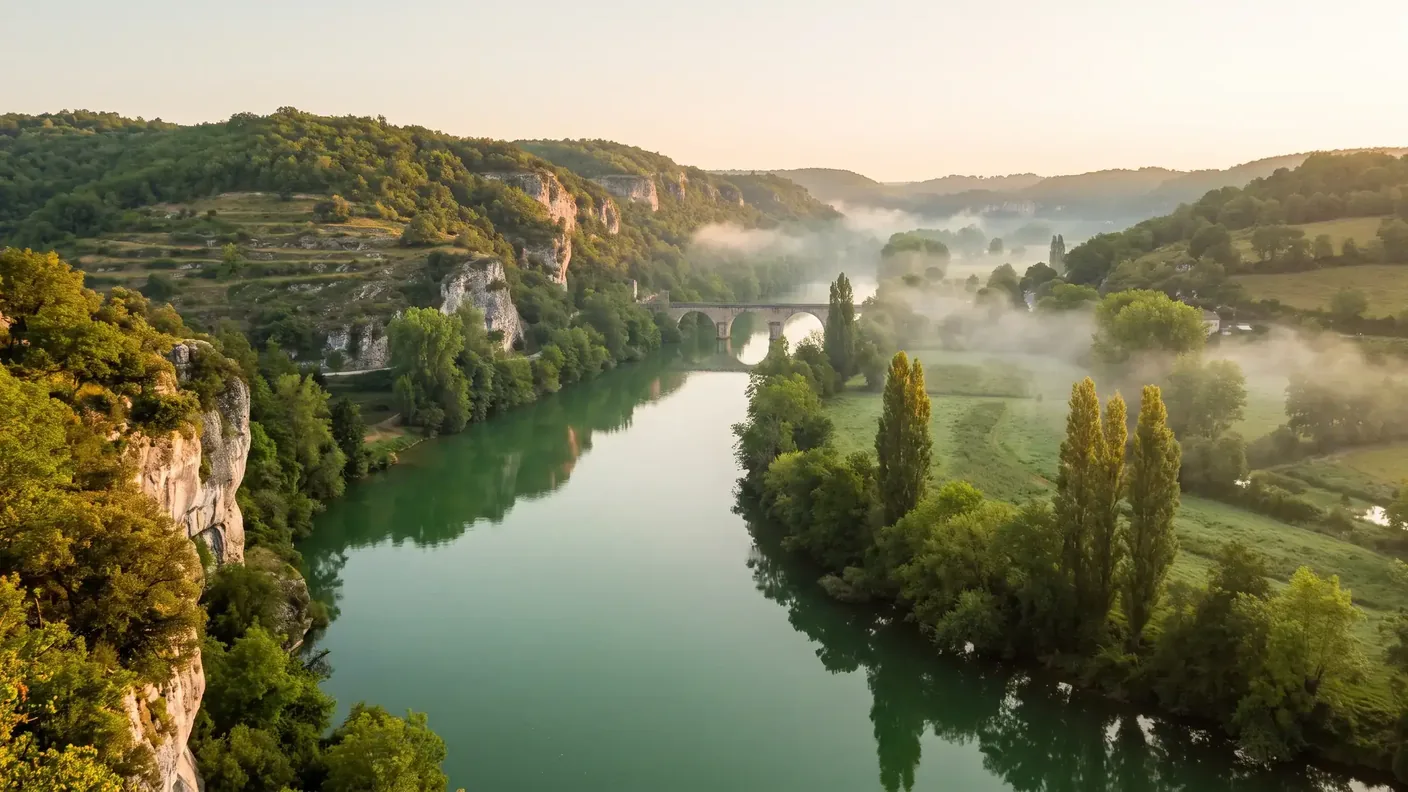
Souillac occupies a pivotal location. The town is built on the Causse de Martel, the northernmost of the four causses of Quercy—an arid limestone plateau that stands in stark contrast to the valley. To the south, the Dordogne River forms the town’s natural boundary; within the town flows a more discreet but equally defining watercourse, the 22-kilometer-long Borrèze Stream, which joins the Dordogne at a place called “Les Cuisines,” at an elevation of barely 85 meters.
A municipality straddling two departments
This fact is little known: Souillac is a border town. Of its eight neighboring towns, three are already in the Dordogne (Borrèze, Salignac-Eyvigues, Pechs-de-l'Espérance). This location on the border between the Lot and the Périgord is no mere coincidence: it explains the constant exchanges between the two regions and the fact that Souillac feels as much a part of Quercy as it does of the Périgord. The town serves as the administrative center for its canton, covering an area of 25.92 km².
| Data | Value |
|---|---|
| ZIP Code / INSEE | 46200 / 46309 |
| Department / Region | Lot / Occitanie (Gourdon District) |
| Occitan name | Solhac |
| Area | 25.92 km² |
| Elevation | 80 m to 314 m |
| Population | 3,192 residents (2023) — the residents of Souillages |
| Rivers | the Dordogne, La Borrèze |
| Must-See | Sainte-Marie Abbey Church (Historic Monument, 1840), the Prophet Isaiah, tympanum by Théophile |
A region at the heart of a world reserve
The Dordogne Valley, here, enjoys exceptional recognition. The Dordogne Basin was designated a biosphere reserve by UNESCO on July 11, 2012—and it is the first in the world to cover an entire watershed, the largest in France at 23,870 km², spanning eleven departments and more than 1,400 municipalities. The area also benefits from a Natura 2000 site (“Quercy Dordogne Valley”), which protects nearly 7,000 hectares of natural habitats. A setting that matches the splendor of its built heritage.
A small town that grew, then declined
Souillac followed a bell-shaped trajectory, typical of rural town centers. From 1,306 residents in 1793, the town grew rapidly in the 19th century—driven in particular by the absorption of neighboring towns—reaching a first peak of 3,627 residents in 1886, then experiencing a “roller-coaster” history: the low point during World War I (around 2,460 residents in 1921) would not be recovered from until the 1960s and 1970s.
| Year | Population |
|---|---|
| 1793 | 1,306 residents |
| 1886 | 3,627 (first summit) |
| 1921 | ~2,461 (postwar low) |
| 1975 | 3 845 |
| 2006 | 3,970 (all-time high) |
| 2023 | 3,192 residents |
Three communes absorbed, and a revolutionary name
The growth of the 19th century owes much to the government: Souillac has absorbed three neighboring municipalities — Saint-Étienne-Lacombe (218 residents, circa 1795–1800), Bourzoles (87 residents, circa 1801–1806), then Beaurepos (population 202), incorporated in 1819 after being transferred from the Dordogne to the Lot. An interesting detail from the Revolutionary period: the town was once called "May 31", named after one of the major days of the Revolution.
The population peaked in 2006, with nearly 3,970 residents. Since then, the town has been slowly declining—3,192 residents in 2023, representing a decrease of about 2.8% compared to 2017—and its population density has fallen from 151 to 123 residents per square kilometer over the past fifteen years or so. This trend is shared by many town centers in the Lot department, even as the department as a whole remains stable. Souillac, however, remains a true small service town and the central hub of its catchment area.
The Solius Estate — and the wild boar on the coat of arms
Where does the name Souillac come from? There are two competing explanations, and we need to rank them. The scholarly etymology, favored by toponymists, links the name to a Gallo-Roman personal name: Solius, combined with the Gallic suffix -acon—Latinized to -acum—which denotes an estate. Souillac would therefore originally have meant “the estate of Solius”—a classic pattern throughout the Southwest, at the root of countless names ending in “-ac.” The Occitan name, Solhac, retains this trace.
The second explanation, which is more popular, is based on Occitan souilh (or soil) : the muddy wallow where wild boars wallow, reminiscent of the wetlands of the Borrèze. It’s alluring—but it’s just folklore, not a linguistic demonstration. The city’s coat of arms, which indeed features a wild boar, does not prove this: it is a “ a canting coat of arms ", a heraldic play on the name (the coat of arms of the de Thou family, whose flies were replaced by a wild boar for the occasion). In other words, the image derives from the name, not the other way around—the wild boar illustrates the popular etymology; it does not validate it.
Around 909: The Benedictine foundation
The documented history of Souillac begins with a monastic act. Around 909, Géraud of Aurillac, count and saint, donated lands to the Benedictines of Saint-Pierre Abbey in Aurillac, Auvergne, so that they might found a priory at Souillac. This date is given with some uncertainty—it is a traditional attribution, and 909 is also the year of Géraud’s death—but it firmly anchors the site within the broader Benedictine network of Aquitaine and Auvergne.
Saint Eloi: A Legend, Not a Fact
An older tradition attributes Souillac’s founding to an earlier date, in the 7th century, under the guidance of Saint Eloi—the famous goldsmith who became bishop of Noyon and advisor to King Dagobert. It’s a beautiful story, but it should be treated with caution: no archaeological excavations or contemporary documents corroborate it. It falls into the realm of pious legend, not established fact. The solid date remains 909.
Monks Draining a Swamp
The Benedictines did more than just pray: they developed the land. They drained the marsh that once covered the site—the former “Souillès Plain”—to turn it into a fertile agricultural estate. The priory prospered to such an extent that, at its peak, it presided over some 80 churches and priories. A town grew up around it, granted a charter of customs as early as 1253.
A priory elevated to the status of an abbey… in 1508
Notable fact: Despite this power, the institution remained for a long time a simple priory under the jurisdiction of Aurillac. It was not until 1508—only the year is confirmed; the date often cited is unverifiable—that a papal bull, obtained by Cardinal Amanieu d’Albret, elevated it to the status of a full-fledged abbey. This was a belated elevation, nearly six centuries after its founding, and long after the Romanesque church had already been standing since the 12th century.
The Abbey Church of Sainte-Marie: A Church with a Row of Domes
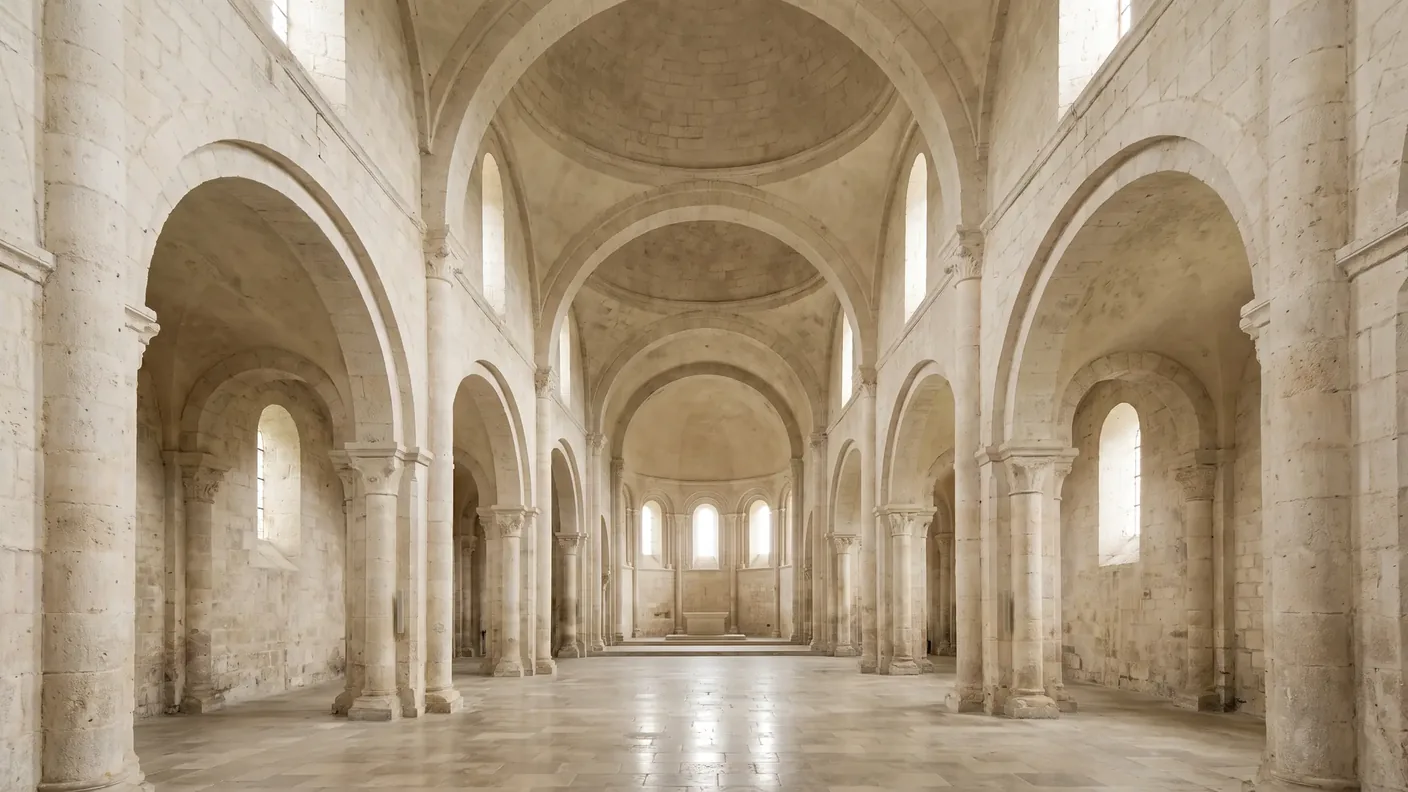
The abbey church of Souillac was built in the 12th century, during the height of Southern Romanesque art. It belongs to a well-defined architectural movement: the Roman-Byzantine style, known as “Périgordine,” characteristic of a group of churches in the Périgord and Haut-Quercy regions. Its defining feature? The use of a dome supported by pendentives rather than the classic barrel vault—a Byzantine influence that spread to Aquitaine, notably through the Cathedral of Saint-Front in Périgueux.
Three domes in a row
At Souillac, the church preserves not one but a row of three domes above the nave—a rare feature that places it among the small group of "Churches with rows of domes" in Aquitaine, alongside Saint-Front in Périgueux, Cahors Cathedral, and Fontevraud. The floor plan adds to this uniqueness: a chancel with radiating apses, a particularly extensive transept, and above all a single nave, without side aisles. Without the colonnades, which elsewhere break up the space, the eye is drawn directly toward the choir and the light streaming down from the domes.
Restored, preserved, and designated a historic site as early as 1840
The building has undergone numerous restoration projects: 1839–1848 (the apsidioles), 1881–1895 under the direction of architect Paul Gout, then 1933–1936—when the domes were rebuilt in concrete to support the slabs and lanterns—and most recently by the Mission Patrimoine in 2021. Its recognition dates back a long time: the abbey church is among the very first listed monuments in France, appearing on the 1840 list. The convent buildings were listed in 1991, and the organ—an instrument by Jean-Baptiste Stoltz (1850)—was listed in 1978. This proves that heritage value is not limited to the stone structures.
The Prophet Isaiah: A World-Renowned Masterpiece of Romanesque Sculpture
Heritage Value and Access: The statue of the prophet Isaiah remains a major work of Romanesque sculpture housed in the Abbey Church of Sainte-Marie. However, its heritage value does not guarantee its visibility: access to it is currently closed for renovations through July 24, 2026. Please check the official tourism source for the latest information before visiting.
If one had to choose just one work by Souillac, it would be this one. The bas-relief known as “The Prophet Isaiah” is today considered one of the absolute pinnacles of Romanesque sculpture worldwide. Dated to around 1120–1140, it depicts a prophet in mid-twist: his body twisted upon itself, his legs crossed, while the drapery of his garment swirls in swirling volutes that seem almost animated by a movement of their own.
The same hand as in Moissac
The most compelling comparison, as established by experts, is not with the Eve of Autun—which is sometimes cited—but with the Jeremiah from the trumeau of Moissac Abbey Church: the same virtuosity, the same treatment of the twist and drapery, to the point that one recognizes the same hand or the same workshop. And this is where we must correct a persistent misconception: it was not Souillac that influenced Moissac, but the other way around. Moissac (c. 1110–1130) is the model; Souillac, created somewhat later, is its heir—a highly accomplished one, but an heir nonetheless.
From Ancient Egypt to Fauvism
Critics were captivated by this work. Some art historians have drawn parallels with ancient Egyptian art, as the stylization of the body and the linear precision of the drapery are so reminiscent of Pharaonic conventions—a well-established scholarly interpretation. And the relief has enjoyed an unexpected legacy: the pose of the central figure in André Derain’s *La Danse*, one of the manifestos of Fauvism, derives directly from Souillac’s *Isaiah*. A technical detail that sheds light on everything: this relief is a relocated portal fragment—a remnant of a large western portico that was never built, designed after the model of Moissac. A work conceived for a larger project, and saved by a miracle.
The Pillar and the Tympanum of Théophile: A Pact with the Devil
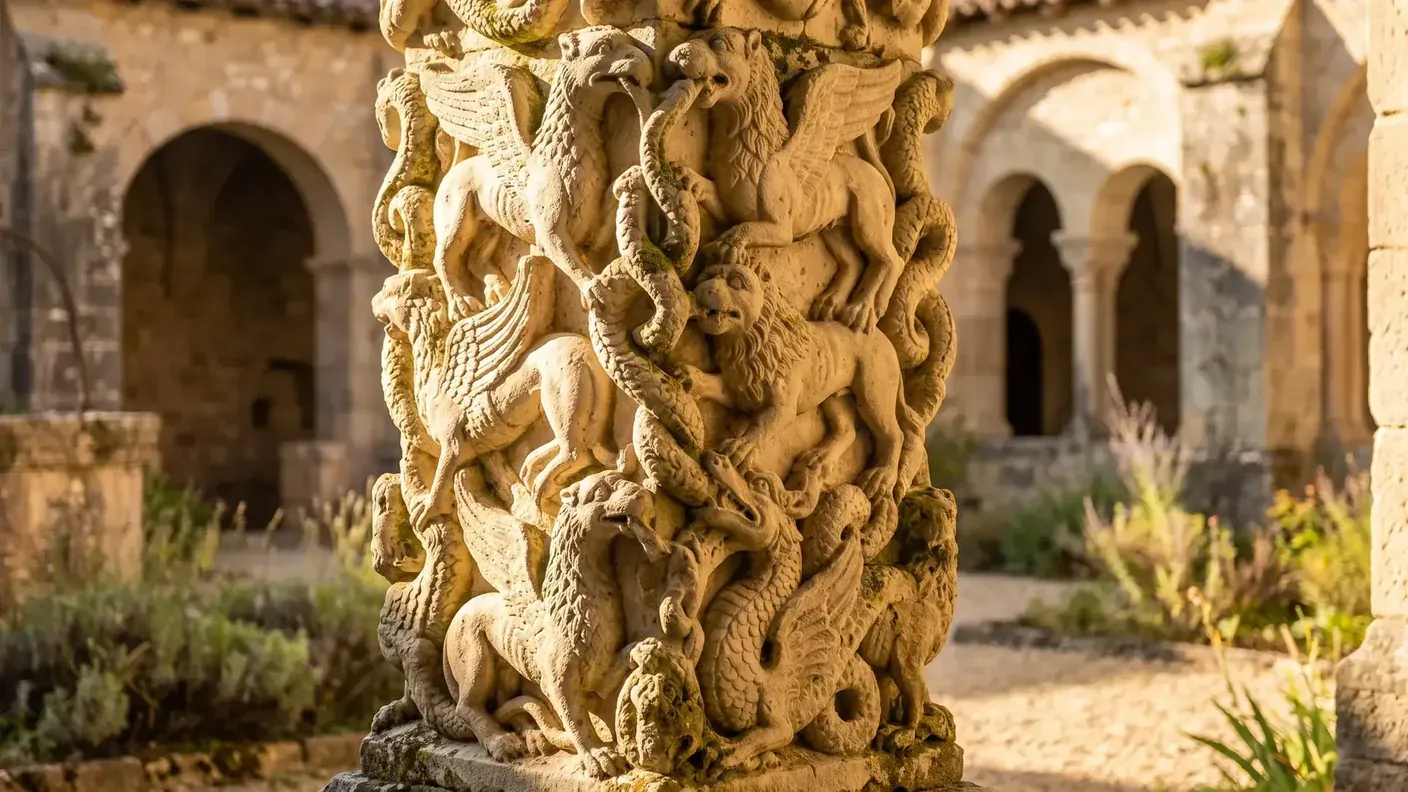
Next to the Isaiah painting stands another centerpiece: the pillar (or trumeau) of the gate. It is a dizzying sculpture: a tangle of hellish monsters devouring one another, hybrid creatures—half-animal—entwined with one another in an organized chaos—evil and temptation made visible. On the left side, a well-known biblical scene: the Sacrifice of Isaac, where Abraham is about to sacrifice his son before God intervenes.
One of the oldest depictions of a diabolical pact
But the most remarkable feature is the inner tympanum, framed by the figures of Saint Benedict and Saint Peter. It depicts, in superimposed registers, the legend of Theophilus—of Greek origin (6th century), introduced to the West through a 9th-century Latin translation. The story: Theophilus, a cleric disappointed at not obtaining the bishopric he coveted, strikes a pact with the devil; consumed by remorse, he implores the Virgin Mary, who snatches the cursed contract from the demon’s hands. It is a story of salvation in spite of sin—and a distant precursor to the myth of Faust.
A Remarkably Early Example
This tympanum is a milestone in the history of art. Featuring a single initial from an 11th-century manuscript, it is one of only two depictions of the legend of Theophilus predating the 13th century—and the only monumental one. It predates Rutebeuf’s *The Miracle of Theophilus* (1260s) by several decades, a work that would popularize the story throughout Europe. This subtlety was first noted by Émile Mâle: the pact is carved twice—first the renunciation, then the vassalic homage (the *immixtio manuum*, hands clasped)—a feudal interpretation of the pact, in which the man literally becomes the devil’s vassal. (Note: The tympanum was moved indoors at a later date; only its installation, not its carving, is of a later period.)
The Hundred Years' War and the Wars of Religion: The Abbey in Turmoil
The history of Souillac has not been merely a peaceful succession of construction projects. The city paid a heavy price during major conflicts. During the Hundred Years’ War, the Quercy region became a contested border area: Souillac was occupied by the English beginning in October 1352, and on several occasions until the mid-15th century (until 1444). Ruins and pillaging were a recurring theme. An illuminating detail regarding the economic brutality of the war: in January 1353, the towns of Quercy paid 5.000 écus to the Anglo-Gascon companies to secure their departure—one of the first “ransoms” of the Hundred Years’ War.
1573: The monastery was set on fire
A century later, a new wave of violence swept through the city—this time driven by religious tensions. The monastery was ransacked for the first time in 1562. Then, in April 1573, the Protestant troops of the Lord of Gourdon set fire to the monastery buildings. The Saint-Martin Bell Tower, this bell tower, which once stood next to the abbey church, was destroyed—tradition has it that a charge of gunpowder placed under one of its pillars brought it down. Its silhouette has disappeared from the landscape for good.
This destruction partly explains why the abbey church has required so many restoration campaigns since the 19th century. Every fire, every act of vandalism has left scars that have had to be patiently mended, century after century. Far from being merely a picturesque backdrop, Souillac bears within its stones the memory of conflicts that shaped an entire region—feudal rivalries, the Anglo-French War, and religious strife.
The Automata Museum: A Mechanical Heritage from Paris
Souillac has long been home to a unique institution, unparalleled in France in this form: the National Museum of Automata, dedicated to antique automata and mechanical toys. A striking contrast, just a few steps from the thousand-year-old abbey church: on one side, 12th-century carved stone; on the other, the mechanical ingenuity of the Industrial Age.
The collection comes from Parisian workshops Roullet-Decamps, a company based in the Marais founded in 1865 which handcrafted automatons for over a century, until it closed in 1995. In 1984, the French government purchased the collection from the Bellancourt family—the fourth generation of the Roullet-Decamps family—for 3.8 million francs, with a view to establishing a public museum in Souillac, the hometown of the couple who had assembled the collection. The museum, open from July 9, 1988, to October 31, 2022, had more than 300 pieces, automatons, and mechanical toys from the late 19th and early 20th centuries.
The history of this collection is a short story in itself. It had been split into two parts: the first part was on display at Souillac; the second, focusing on the animated electric scenes in the windows of Parisian department stores, was transferred in 2015 to the Museum of Automata in Falaise (Calvados). Since its closure in 2022, the national collection has been housed at the MUCEM in Marseille. It marks the end of an era for Souillac, but remains a precious testament to this exceptional craftsmanship that blends mechanics, textiles, and sculpture.
Travel from Bordeaux and explore the Quercy region
Souillac is easily accessible. The city has a train station, which opened in 1889, on the main Paris-Toulouse line (the POLT corridor, via Limoges, Brive, and Cahors): Brive is about 25 minutes away, and Toulouse is about 2 hours away. From Bordeaux, it’s about 238 km and 2 hours and 35 minutes by road (take the A89, then head down toward the Lot). It’s a natural stopover for anyone exploring this corner of Nouvelle-Aquitaine and Occitanie, at the crossroads of the Périgord Noir, Quercy, and the Dordogne Valley.
| From / To | Distance | Weather |
|---|---|---|
| Bordeaux → Souillac | ~238 km | ~2:35 |
| Martel | ~11 km | ~15 min |
| Rocamadour | ~23 km | ~25 min |
| Sarlat-la-Canéda | ~27 km | ~30 min |
| Brive-la-Gaillarde | ~37 km | ~35 min |
A hub of major attractions
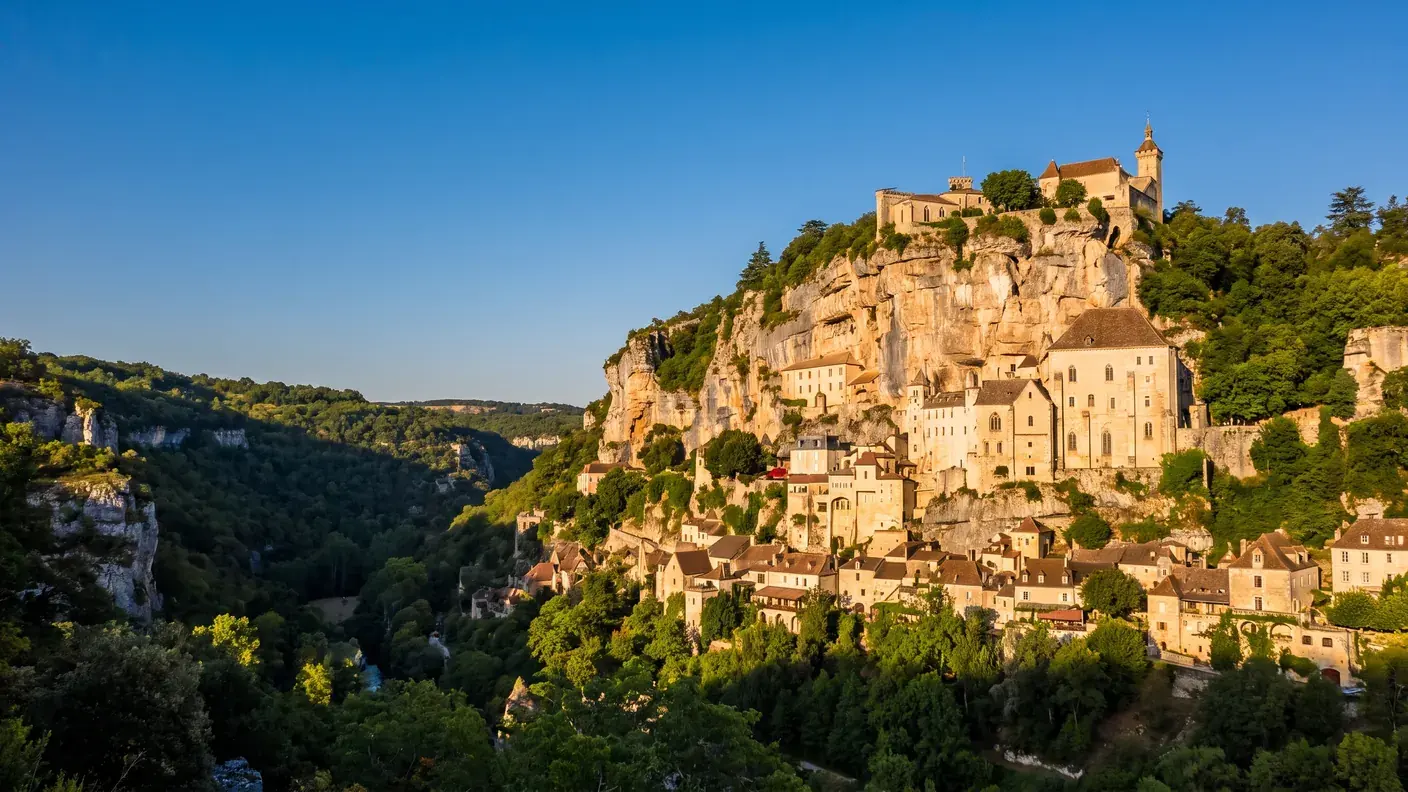
Few cities boast so many wonders within a thirty-kilometer radius. Rocamadour, the cliffside sanctuary, is about 25 minutes away—Souillac was, in fact, a stop along the Chemin d'Amadour, the pilgrimage route that led pilgrims there. Sarlat, the capital of the Périgord Noir, is about 30 minutes away; Martel, the “town of seven towers,” is about 15 minutes away; the Padirac Chasm and its underground river, as well as the villages of the Dordogne Valley (Carennac, Loubressac, Autoire), are all nearby.
To visit Souillac, Rocamadour, and Padirac in a single day from Bordeaux—without worrying about the route or parking (which can be difficult during peak season)—a chauffeured transfer from Bordeaux can take you from door to door at your own pace. A fixed, written quote is provided before departure. Before adding the Prophet Isaiah to your itinerary, check its status on the official tourism website: it is listed as closed for renovations through July 24, 2026.
Frequently Asked Questions
Where is Souillac located?
In the northern part of the Lot department, in Occitanie, on the Causse de Martel, along the Dordogne River, at the junction of Quercy and Périgord (three of its neighboring municipalities are in the Dordogne). ZIP code 46200. It is a small town with a population of about 3,192, located roughly 238 km (2 hours and 35 minutes) from Bordeaux, between Rocamadour (~23 km) and Sarlat (~27 km).
Why is the abbey church at Souillac so famous?
For two reasons. First, its architecture: it is a rare Romanesque church with a “row of domes” (three domes supported by pendentives), built in the Romano-Byzantine style, similar to Saint-Front in Périgueux. Second, its sculptures: the bas-relief of the prophet Isaiah, considered a world-renowned masterpiece of Romanesque art, and the tympanum depicting the legend of Theophilus, one of the oldest sculpted representations of this story in Europe.
Who is the prophet Isaiah from Souillac?
It is a Romanesque bas-relief carved around 1120–1140, depicting a prophet in a twisted pose of exceptional artistry, with swirling drapery. Experts recognize the same artistic hand as that of the Jeremiah on the Moissac trumeau. A masterpiece of Romanesque sculpture, it even inspired, eight centuries later, the pose of the central figure in André Derain’s *La Danse*.
What is the Legend of Theophilus?
This is a medieval tale of a cleric who, having seen his ambitions dashed, makes a pact with the devil, only to be saved by the intervention of the Virgin Mary, who tears up the cursed contract. Of Greek origin (6th century), the legend is a distant ancestor of the Faust myth. The tympanum of Souillac features one of only two known sculpted depictions predating the 13th century—and the only monumental one.
When was Souillac Abbey founded?
The Benedictine priory is said to date back to a donation by Géraud d'Aurillac around 909 (a traditional attribution). One tradition mentions an earlier foundation linked to Saint Éloi in the 7th century, but this is not documented. The priory, which had long been under the jurisdiction of Aurillac, was not elevated to the status of a full-fledged abbey until 1508, by a papal bull obtained by Cardinal Amanieu d’Albret.
Did Souillac suffer during the wars?
Yes, on two occasions. During the Hundred Years' War, the town was occupied by the English beginning in October 1352, and repeatedly thereafter until the mid-15th century. During the Wars of Religion, the monastery was sacked in 1562, and its cloister buildings were set on fire in April 1573 by the troops of the Lord of Gourdon, who also destroyed the Saint-Martin bell tower and porch.
How much does a trip from Bordeaux to Souillac cost with an executive car service?
Starting at €387 for a one-way, door-to-door trip for 1 to 3 passengers (economy vehicle) — approximate price for ~238 km and about 2 hours and 35 minutes of driving. The exact price depends on the schedule, the vehicle (economy car or van for up to 7 passengers), and any requested stops—many passengers combine Souillac with a trip to Rocamadour or Sarlat. A fixed, written quote is provided before departure.
Does the Souillac Automata Museum still exist?
No: The National Museum of Automata, which was open from 1988 to 2022, closed its doors on October 31, 2022. It featured more than 300 automata and mechanical toys from the Parisian Roullet-Decamps workshops, whose collection the French government had acquired in 1984. This national collection is now housed at the MUCEM in Marseille; another part is located at the museum in Falaise, in the Calvados department.
Is Souillac on the Camino de Santiago?
Souillac was a stop on a pilgrimage route, but it’s important to be precise: its abbey church is not listed as a UNESCO World Heritage Site under the Routes of Santiago de Compostela (it is not included among the components of the property). The best-documented local route is the Chemin d’Amadour, which led pilgrims from Souillac to the nearby sanctuary of Rocamadour.
What's there to see around Souillac?
A collection of the most beautiful sites in the Lot and Périgord regions, all within 40 minutes: Rocamadour and its cliffside sanctuary, Sarlat-la-Canéda and its medieval old town, Martel, the “town of seven towers,” the Padirac Chasm and its underground river, and the villages of the Dordogne Valley (Carennac, Loubressac, Autoire), listed among the Most Beautiful Villages of France.
Further Reading
- The cliffside sanctuary, about 25 minutes away: see the Rocamadour Guide (Black Madonna, Grand Staircase)
- The capital of the Périgord Noir, about 30 minutes away: see the Sarlat Guide (market, old town)
- The royal bastide overlooking the Dordogne: see the Domme Guide (cave, panoramic view)
- The valley’s iconic castle: see the Beynac Guide
- Plan your trip: Book a private driver from Bordeaux to Souillac or explore all our destinations
Sources and References
- Dordogne Valley — Souillac — Access to the Prophet Isaiah reported as closed for construction; accessed July 24, 2026
- Wikipedia — Souillac — geography, demographics, place names, history, Automata Museum
- Wikipedia — Sainte-Marie Abbey in Souillac — foundation, domed architecture, sculptures (Isaïe, Théophile)
- POP/Mérimée Database — Souillac Abbey Church — Listed as a Historic Monument (1840 list), restorations, organ
- Wikipedia — The Legend of Theophilus — Greek origin, Rutebeuf, medieval iconography
- Wikipedia — Automata Museum — Roullet-Decamps, acquired in 1984, 1988–2022, MUCEM
- INSEE — Souillac (46309) — population, demographic series, 2006 peak
Article updated in July 2026.
On the Way to Romanesque Quercy
Direct trip from Bordeaux (~2 hours 35 minutes) to Souillac and the Dordogne Valley, with stops along the way as desired—Rocamadour, Sarlat, the Padirac Chasm, Martel. Fixed-price quote in writing within 30 minutes; sedan or 7-passenger van; English-speaking driver.