Villeneuve-sur-Lot from Bordeaux: the bastide on the Lot
A 13th-century bastide straddling the Lot River: its medieval Pont-Vieux bridge, its two surviving gate towers, its brick church, and the region famous for Agen prunes, about 2 hours from Bordeaux.
Villeneuve-sur-Lot at a Glance
Villeneuve-sur-Lot is a 13th-century bastide built on both banks of the Lot River in Lot-et-Garonne (Nouvelle-Aquitaine). As the department’s second-most populous town and a subprefecture, it boasts a rare medieval heritage—a fortified bridge, two gate towers, and a town layout laid out with a straightedge—along with the local produce that has made it world-famous: the Agen prune, whose trade association is headquartered right here. It’s an ideal stopover combining heritage, a market, and fruit-growing countryside, about a two-hour drive from Bordeaux.
Here are the key details to know before you go. The driving distances listed are calculated door-to-door; the rates are for a private driver booked from Bordeaux, with a fixed price provided in advance.
| Landmark | Details |
|---|---|
| Department | Lot-et-Garonne (47), Nouvelle-Aquitaine |
| Status | Subprefecture · District Seat |
| Population | 22,350 residents (INSEE 2023) — the 2nd-largest municipality in the department |
| Area | 81.32 km² · elevation ranging from 42 to 209 m |
| River | The Lot River, which flows through the city from east to west |
| Distance from Bordeaux | about 146 km · about a 2-hour drive |
| Nearest train station | Agen (~29 km) — there is no passenger train station in Villeneuve |
| Don't miss it | The Pont-Vieux, the Paris and Pujols Gates, the Church of Sainte-Catherine, and Agen prunes |
Let’s be honest right off the bat: we often read that Villeneuve is said to be “the capital of Agen prunes.” The reality is more nuanced—the city shares this title with its neighbor, Sainte-Livrade-sur-Lot, and the appellation bears the name of Agen, not its own. But there is one strong argument in its favor, and we’ll come back to that.
This guide covers everything you need to know before you come: where the town is located and what makes it unique, the history of its founding as a bastide, its three major landmarks—the Pont-Vieux, the city gates, and the church— the prune-growing region, the notable villages in the surrounding area, the best time to visit, and, finally, the easiest way to get there from Bordeaux.
Where is Villeneuve-sur-Lot located?
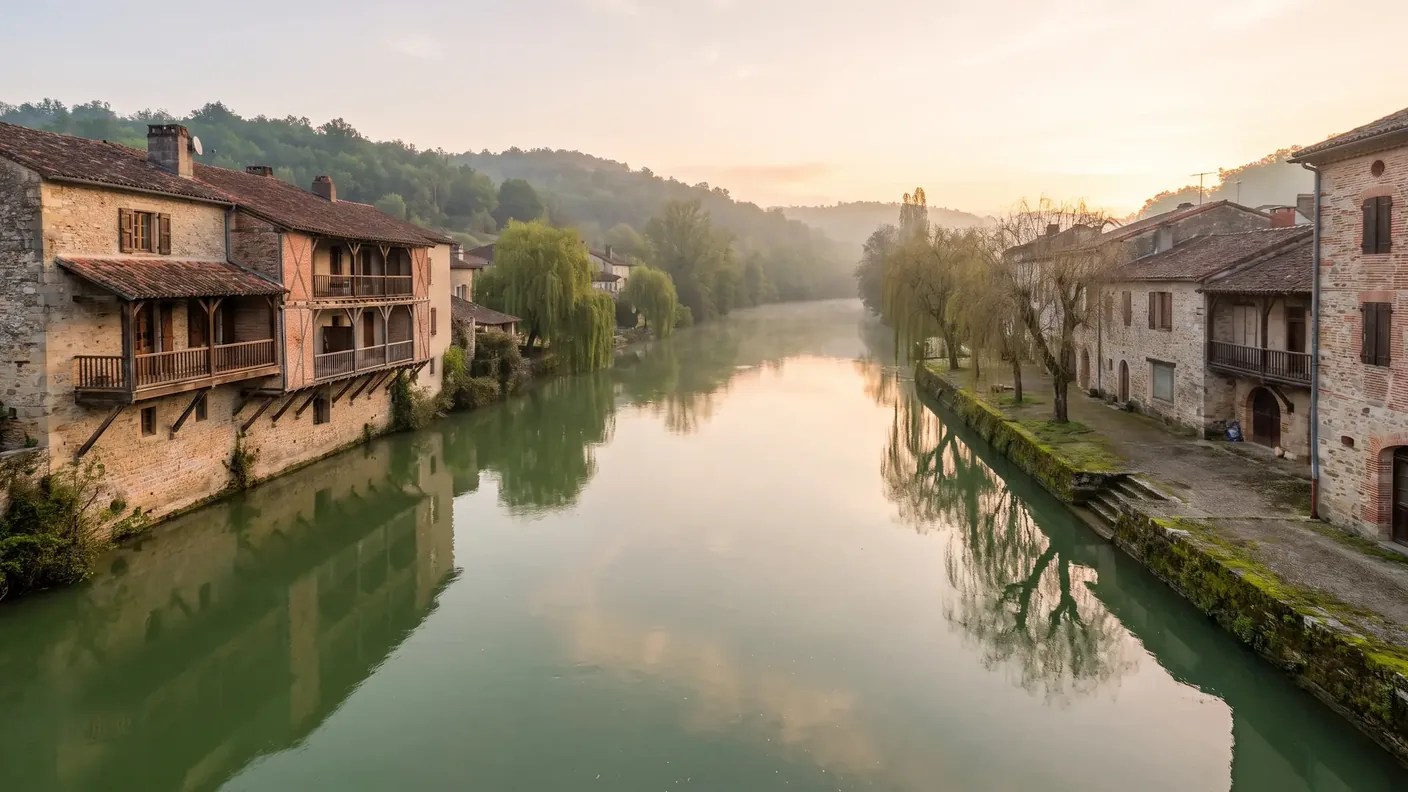
Villeneuve-sur-Lot is located in Lot-et-Garonne (47), in the Nouvelle-Aquitaine region, halfway between Agen to the south and the Périgord Pourpre to the north. The city is crossed from east to west by the Lot, the river that gave it its name and along which it developed. Its coordinates are 44.41° N and 0.70° E; its INSEE code is 47323, and its ZIP code is 47300. With 22,350 residents (2023 census), it is the second-most populous municipality in the department, behind the prefectural seat of Agen, and is itself a subprefectural seat (INSEE, 2023 population figures, accessed July 24, 2026). It covers 81.32 km², at an elevation ranging from 42 to 209 meters, and is located about 146 km from Bordeaux, or about a two-hour drive.
It is a subprefecture: it is the seat of the Villeneuve-sur-Lot district, one of three in the department along with Agen and Marmande. This administrative status makes it the second-largest city in Lot-et-Garonne, but only in terms of population: Agen remains the prefecture. In practice, Villeneuve fully fulfills its role as a regional hub: it serves as the center for public services, shops, a hospital, middle schools, and high schools for an entire rural catchment area that extends well beyond its municipal boundaries. It is the town where people from within a forty-minute radius come to shop, run errands, and visit the market.
A sprawling town along the waterfront
The municipality covers 81.32 km², a generous area that encompasses much more than just the historic center: hillsides, orchards, and hamlets stretch on either side of the river, at elevations ranging from 42 to 209 meters. Villeneuve has twelve neighboring municipalities—Bias, Castelnaud-de-Gratecambe, Hautefage-la-Tour, Lédat, Monflanquin, Penne-d’Agenais, Pujols, Saint-Aubin, Saint-Sylvestre-sur-Lot, La Sauvetat-sur-Lède, Savignac-sur-Leyze, and Trentels—several of which are among the most beautiful villages in the area.
Since 2010, the city has been the heart of the Greater Villeneuvois Urban Community, which brings together the surrounding municipalities. Its residents are known as Villeneuvois.
A stable population following a slight decline
Villeneuve had a population of 22,350 according to the 2023 census. This figure should be viewed over time: after peaking at nearly 23,500 residents in 2013, the town’s population declined to about 21,600 in 2021, before rebounding. We are therefore seeing stabilization, or even a slight recovery, rather than continuous growth. It remains the second-most populous municipality in Lot-et-Garonne, behind Agen (about 32,500 residents) and ahead of Marmande.
A bastide built as part of a shared lordship agreement in the 13th century
Villeneuve-sur-Lot is a bastide, that is, a new town founded in the Middle Ages according to a regular grid plan. Its very name says it all: in Occitan, a villanova is a “new town.” It was founded in the mid-13th century at the instigation of Alphonse de Poitiers, Count of Poitiers and Toulouse, brother of King Louis IX—Saint Louis. A few years later, the same prince would found the neighboring bastide of Monflanquin.
What is a bastide?
A bastide is a new town founded between the mid-13th century and the early 14th century in southwestern France, built according to a regular layout and as part of a political project. There are several hundred of them in the former Gascony, the Agenais, the Périgord, and the Quercy. Their purpose was to organize a territory, attract and settle a population, and develop trade. To this end, the founders—counts, kings of France or England, and abbeys—granted the inhabitants a charter of privileges: tax exemptions, the right to build on allocated land, municipal freedoms, and military protection. In exchange, the settlers populated the town and brought it to life.
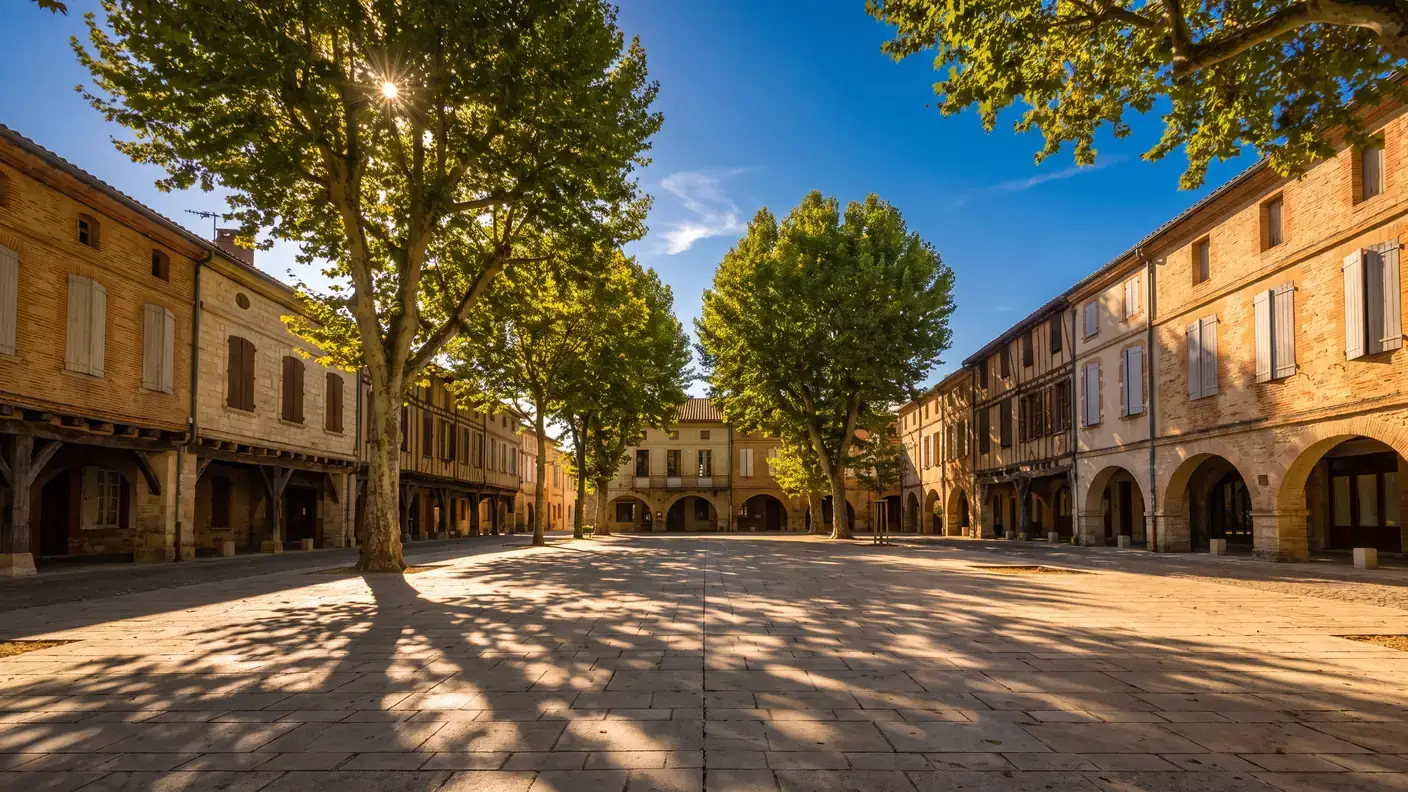
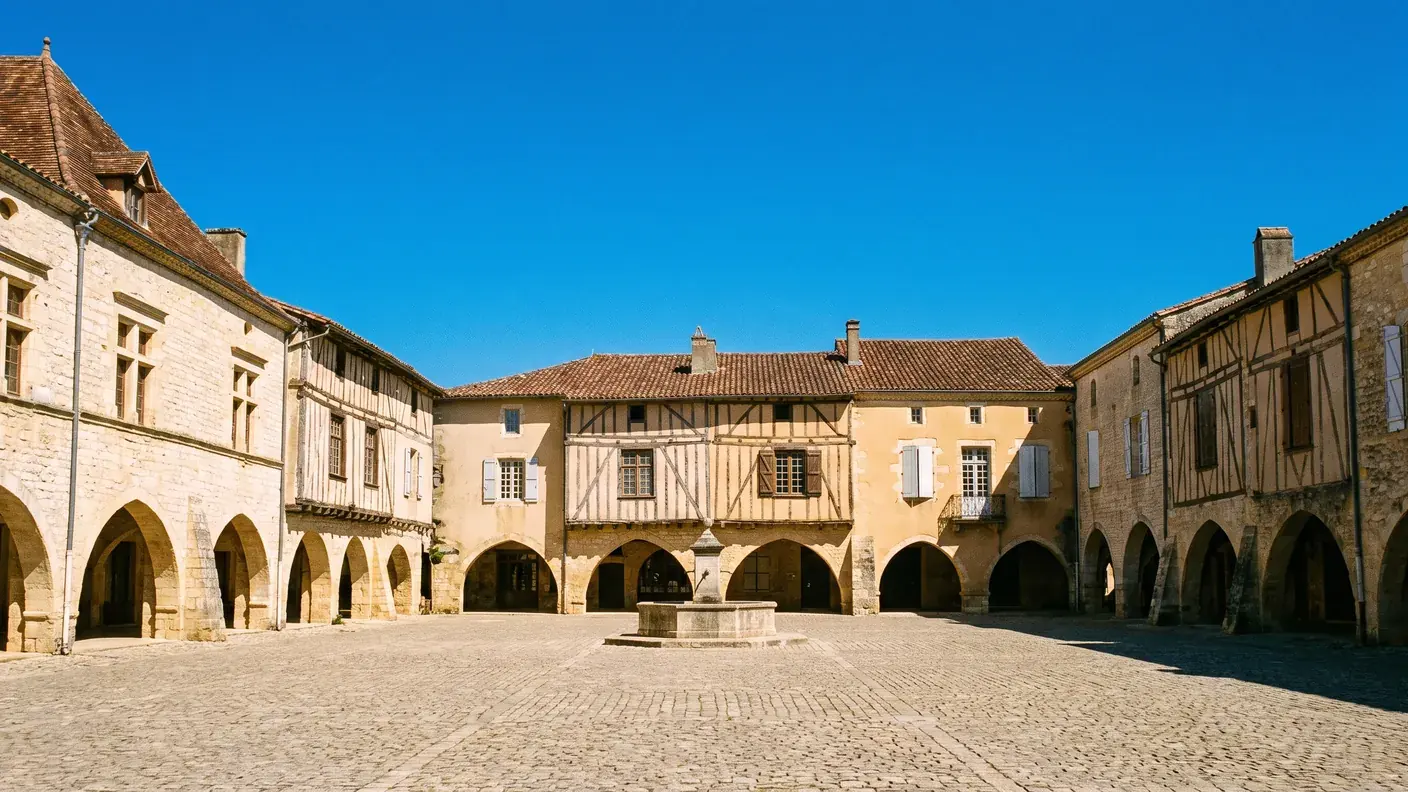
Three distinctive features characterize a bastide: a grid-like, orthogonal layout; a central square with covered arcades (known as *les cornières*) that hosts the market; and a market hall or belfry nearby. Villeneuve-sur-Lot checks all these boxes—with the added bonus of boldly spanning a river, which is rare.
A foundation established through a joint endowment, with no single date
We sometimes read “founded in 1253” or “in 1264”: the truth is more nuanced, and we must be wary of any date that is too precise. Villeneuve emerged from a process that spanned a decade around 1254–1264, formalized by an act of paréage—a partnership agreement—between Alphonse de Poitiers and the Benedictine Abbey of Eysses, which owned the lands. The bastide is therefore not a “pure” royal foundation: it brought together a great secular lord and a monastic community, who shared the revenues and the administration of justice. A charter of customs consisting of 46 articles, granted to the inhabitants between 1264 and 1266, established their rights and freedoms.
This method of founding towns through land grants was common for the bastides of the Southwest: it helped populate and develop the land by offering newcomers attractive privileges—exemption from certain taxes, building lots, and safety behind ramparts.
A perfectly laid-out plan, straddling the Lot River
Villeneuve’s great originality lies in its geometry. Unlike most bastides built on a single riverbank, it stretches on both sides of the Lot, with the two halves connected by a bridge. The layout is orthogonal: eight main streets laid out at right angles, drawn with a straightedge, divide the town into regular blocks. At the center beats the commercial and social heart of any bastide: a square lined with covered arcades.
This square, now known as Place Lafayette, was once called Place des Cornières, named after the arcades—the “cornières” or “couverts”—under which merchants and market stalls sought shelter on market days. Lined with brick and stone houses built atop arcades, it remains the lively heart of the city: markets, outdoor cafes, and events come and go here, eight centuries after it was first laid out.
The Pont-Vieux: Six Centuries Over the Lot River
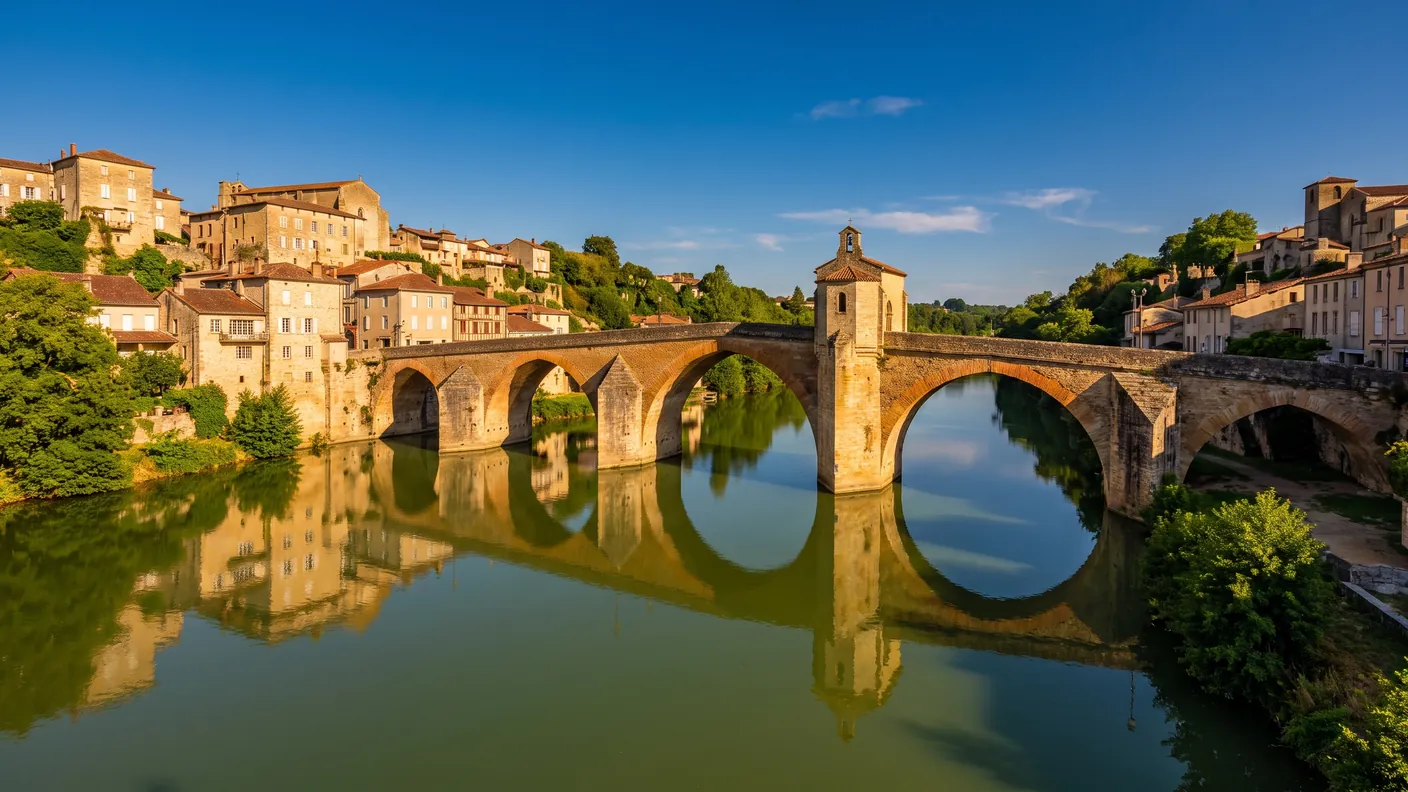
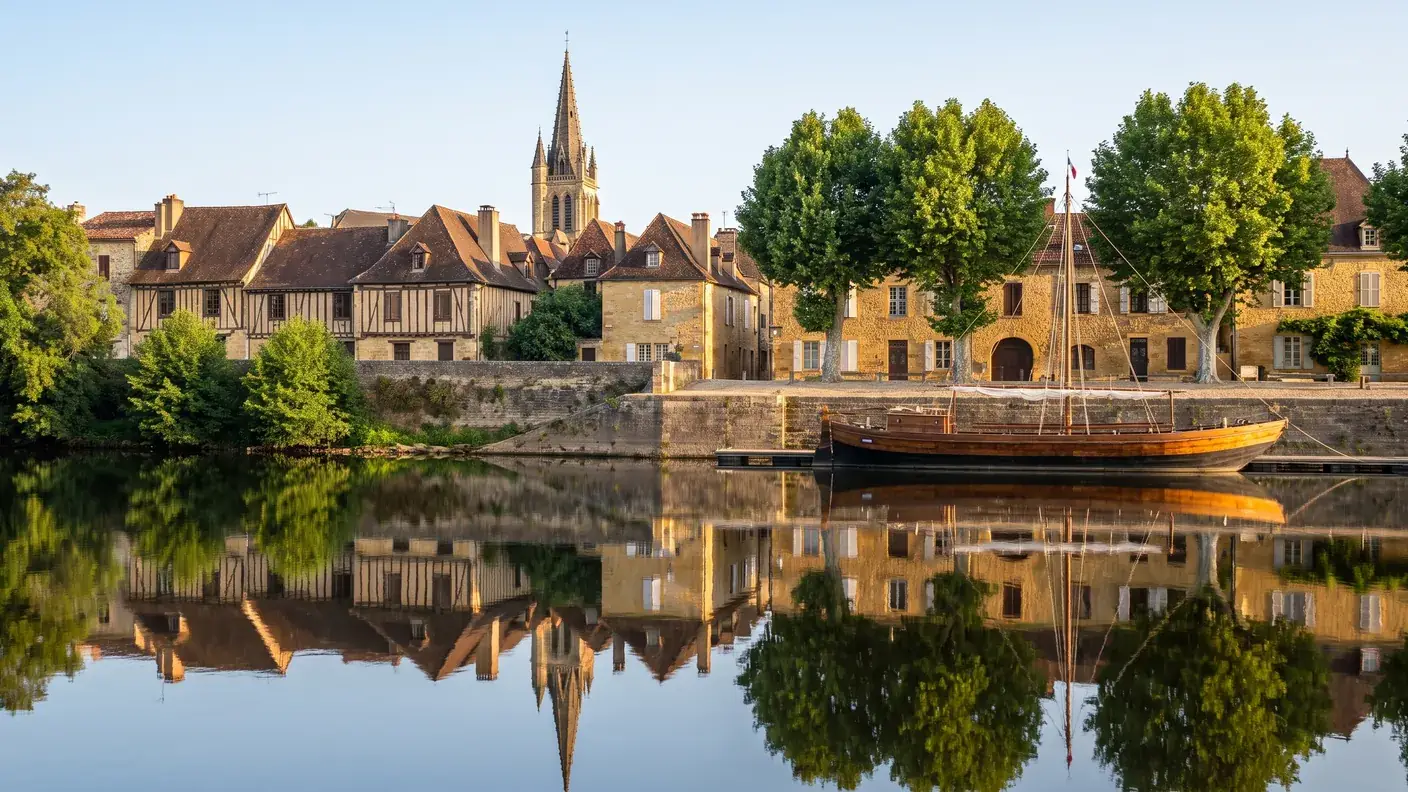
The Pont-Vieux, or Pont des Cieutats, is the iconic landmark of Villeneuve-sur-Lot: a stone and brick bridge spanning the Lot River, built at the end of the 13th century. Built between 1282 and 1289, originally featuring three defensive towers to control access across the river, it has been listed as a historic monument since 1951 (POP/Mérimée PA00084273, accessed July 24, 2026). It is the symbol of the town, reflected in the calm waters of the river at dawn—a medieval crossing that has remained in use ever since, seven centuries after its construction. At one end, the small chapel at Bout-du-Pont recalls the days when boatmen would pray there before setting out on the Lot.
A bridge built under English supervision (1282–1289)
Its date of construction is precise, though often misreported: the Pont-Vieux dates strictly to the 13th century, having been built between 1282 and 1289. An interesting detail from the history of the medieval Southwest: construction took place under English supervision, at a time when the Agen region was under the rule of the English crown. Originally, the structure was fortified, featuring three square defensive towers built of heavy brick, which controlled the passage and could close it off.
The large arch on the right bank is not original: it was rebuilt in the 17th century after a major flood of the Lot River in 1600 damaged the structure. The bridge thus combines cut stone and brick, materials typical of the architecture of the Agen region, where abundant clay has long provided brick at a lower cost than stone.
The Bout-du-Pont Chapel and a Legend About Sailors
At one end stands a small chapel, officially known as Notre-Dame-de-Grâce-et-de-Toute-Joie, but better known as the Bout-du-Pont Chapel. Founded in 1289, it is linked to a legend among boatmen: it is said that a statue of the Virgin Mary, found in the Lot River, was venerated there by the boatmen who traveled up and down the river. Also damaged by the flood of February 1600, it was rebuilt using unused materials from the bridge.
Both the Pont-Vieux and its chapel are protected as historic monuments, but to varying degrees—a distinction that few visitors notice:
| Monument | Protection | Year | Reference |
|---|---|---|---|
| Pont-Vieux (Cieutats Bridge) | Listed as a Historic Monument | 1951 | PA00084273 |
| Bout-du-Pont Chapel | Listed as a Historic Monument | 1950 | PA00084267 |
| Gates of Paris and Pujols | Listed as Historic Monuments | 1901 | PA00084274 |
| St. Catherine's Church | Listed as a Historic Monument | 2022 | PA47000104 |
The name “Pont des Cieutats” comes from Nicolas de Cieutat, Baron of Pujols and Tombebouc, and his son Arnaud, who were among the city’s defenders in 1585. “Classification” (gates, church) provides stronger protection than “listing” (bridge, chapel): the gate towers, which were recognized earlier, enjoy the highest level of protection.
The combination of cut stone and brick is by no means a mere footnote: it is the architectural hallmark of the Agen region. In this region, where clay is abundant but high-quality stone is scarce, fired brick has been the material of choice since the Middle Ages—for bridges, churches, and the houses of the bastide. The Pont-Vieux is the prime example of this, and the same warm ochre hue can be seen on the facades of the buildings on Place Lafayette and, later, on the walls of Sainte-Catherine Church. For a long time, this bridge was also linked to river trade: goods and fruit were transported along the Lot River, and the bridge controlled their passage.
The Gates of Paris and Pujols
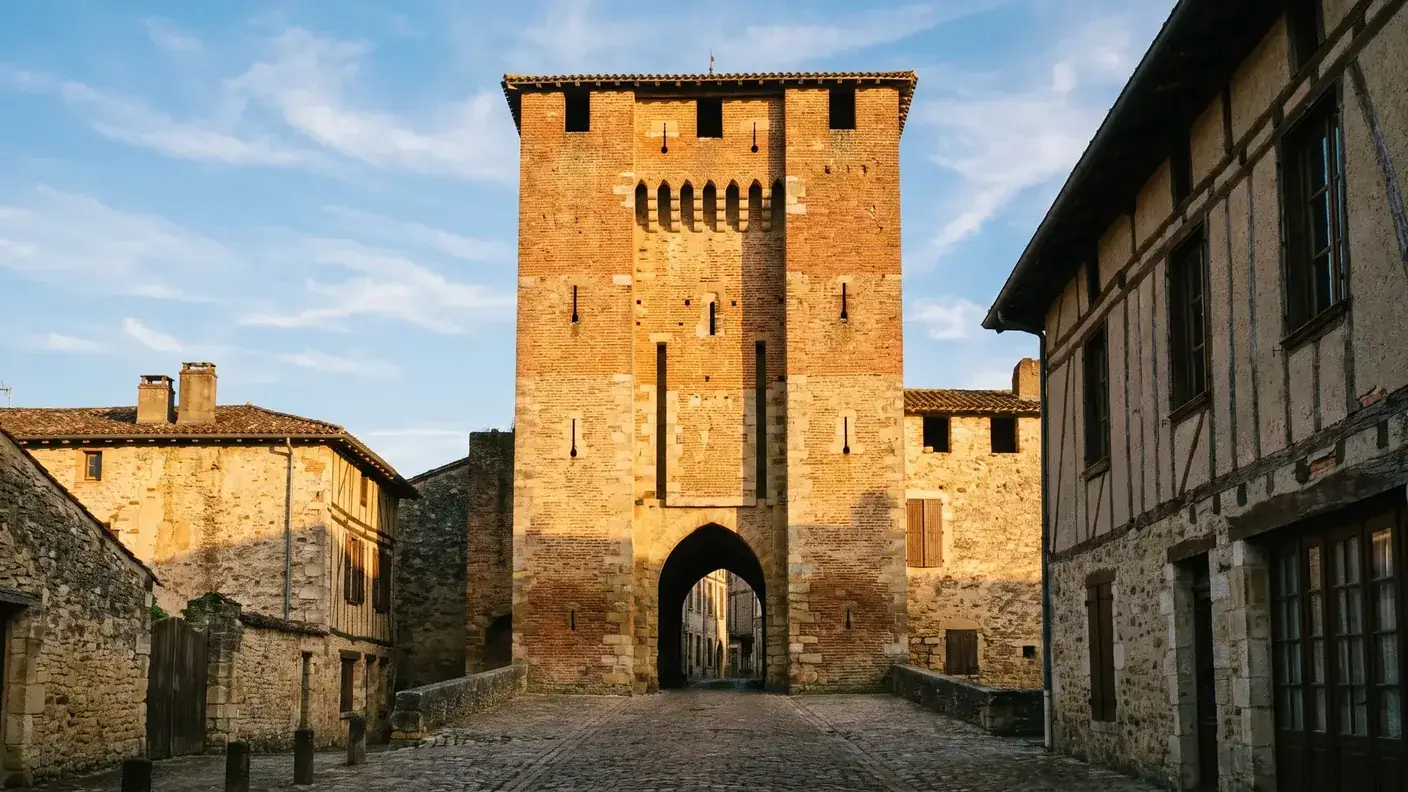
Of Villeneuve’s medieval ramparts, only two gate towers remain: the Porte de Paris and the Porte de Pujols. They once guarded the entrances to the walled city; today they still frame the historic center, tall structures of brick and stone pierced by arched passageways and crowned with battlements and machicolations.
Two survivors out of seven gates
The bastide originally had seven gates in its walls. The walls we see today are not the original ones: they were rebuilt in the last quarter of the 14th century, in the midst of the Hundred Years’ War, when the town had a vital need for protection. Of the seven gates, only two have survived the centuries: the Porte de Paris and the Porte de Pujols.
One historical detail is worth noting: the Porte de Paris was not always called that. It was originally named the Porte de Monflanquin, after the direction it pointed toward the neighboring bastide. The two gate towers were restored in 1908 by architect Henri Rapine, which explains their good state of preservation.
Together, these two gates have been listed as historic monuments since 1901 (reference PA00084274)—the oldest and most significant recognition of Villeneuve’s heritage. Together with the Pont-Vieux and Place Lafayette, they form a one-hour walking tour through the heart of the bastide, which retains its original layout in its entirety.
The architecture of these towers speaks volumes about their function: a vaulted passageway that could be closed off, machicolations—those corbelled openings from which projectiles and debris were hurled at attackers—arrowslits, and a parapet walk at the top. Built of brick on a stone foundation, they marked the boundary between the inside and outside of the walled town, at a time when security was essential to prosperity. Today, they serve as landmarks to help find your way around the city center: passing through the Porte de Paris or the Porte de Pujols is like symbolically entering the bastide founded in 1264.
Walking from the Porte de Paris to the Porte de Pujols means crossing the city along its medieval width: eight streets, a covered square, a fortified bridge—the 1264 city plan still lies beneath your feet.
St. Catherine's Church, a 20th-century brick structure
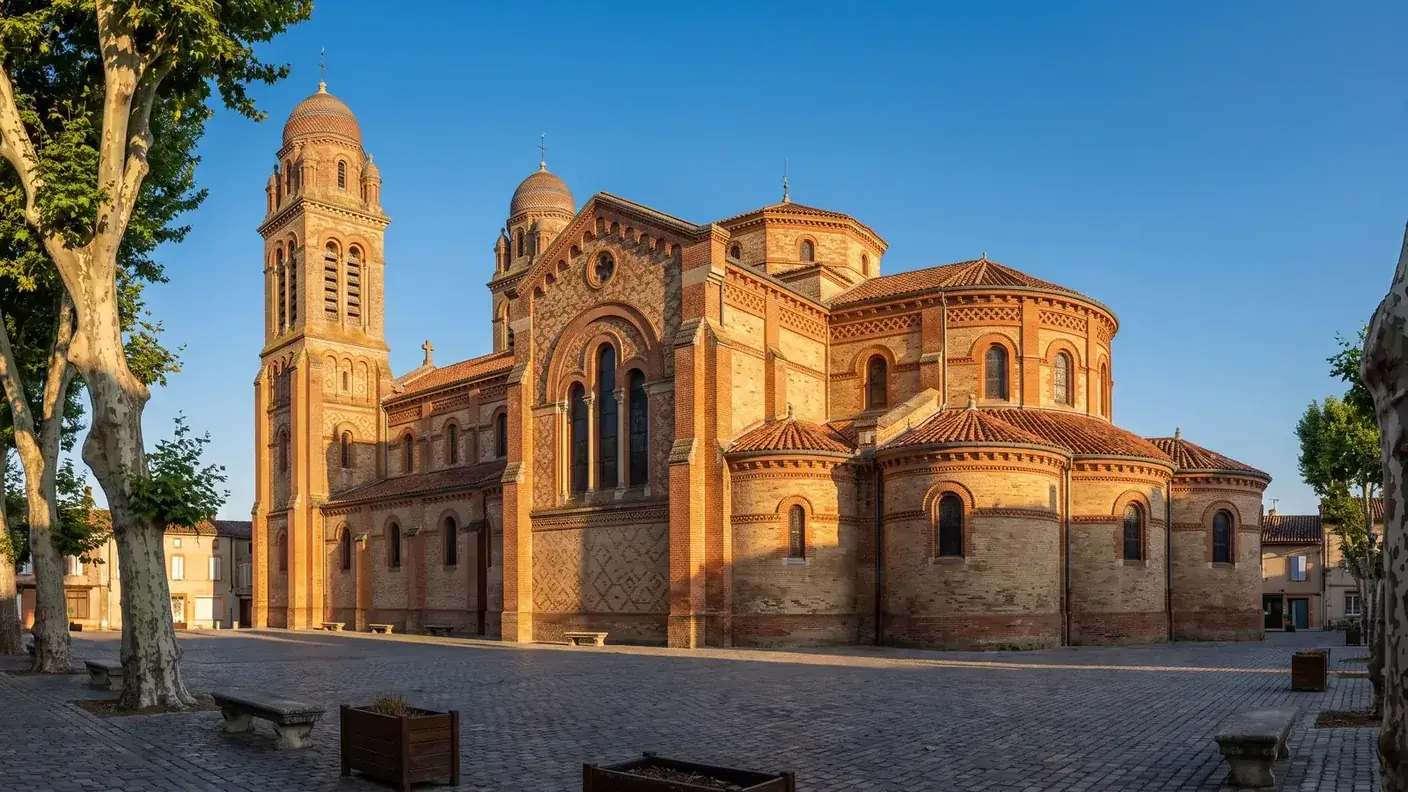
The Church of St. Catherine is surprising: this large Neo-Byzantine building made of red brick is not medieval, but dates from the early 20th century. Its massive silhouette, topped with domes and rounded apses, stands in stark contrast to the rest of the bastide and marks the town center from afar. Rebuilt between 1898 and 1937 after the vault of the old church collapsed, it combines a facade of local brick with a modern framework of reinforced concrete and metal. Inside, it preserves Renaissance-era stained-glass windows (15th–16th centuries) salvaged from the previous building and an organ dating from 1874. Designated a historic monument since 2022 (POP/Mérimée PA47000104, accessed July 24, 2026), it is one of the most remarkable examples of religious architecture of its generation in southwestern France—a 20th-century structure disguised as an Eastern cathedral.
A collapse, followed by forty years of construction
The history of its reconstruction has been eventful. In 1897, the vault of one of the side aisles of the old church collapsed—it was this accident, and not a “leaning” building as is sometimes claimed, that prompted the decision to rebuild the entire structure. Work began as early as 1898. The project, interrupted in particular by the 1905 law separating Church and State, spanned nearly four decades: the choir was consecrated in 1911, the old church (dating from the 13th–15th centuries) was demolished in 1914, and the final consecration did not take place until 1937.
The resumption of construction after the halt in 1905 was largely due to Georges Leygues, a prominent politician from Villeneuve; the plans had been entrusted to architect Jules-Édouard Corroyer.
Modern brickwork, Renaissance stained-glass windows
The church is in the Neo-Byzantine style (also known as Romano-Byzantine). Its exterior is clad in brick—sourced from the Berger brickworks—but it rests on a much more modern framework: reinforced concrete and metal. It is a 20th-century building cloaked in medieval attire. Another unique feature is its north-south orientation, which is atypical for a church that is traditionally oriented east-west.
Sainte-Catherine's treasure lies in its windows: it reused antique stained-glass windows, from the 15th and 16th centuries, salvaged from the old church. Of particular note is a Passion cycle dating from around 1530 and a cycle dedicated to Saint Catherine, both reinstalled in the new building by master glassmaker Félix Gaudin. The organ, however, is older than the walls that house it: built in 1874 by Jules Barthélémy Magen, it has been preserved. The church is designated a historic monument since 2022, after being designated a “20th-Century Heritage Site” in 2007.
The choice of the Neo-Byzantine style was no coincidence for that era: at the turn of the 19th and 20th centuries, French religious architecture readily drew on ancient styles—Romanesque, Gothic, Byzantine—to create grand and symbolic structures. In Villeneuve, local brick meets domes and semicircular arches from the Christian East, set upon a state-of-the-art concrete and steel framework. The result is a bold, hybrid structure that speaks as much to the craftsmanship of the brickmakers of the Agen region as it does to the ambition of a city eager to build a grand place of worship. The fact that construction was able to resume and be completed after the 1905 law speaks volumes about the local support for the project.
The Agen prune, the heart and soul of the Villeneuve region
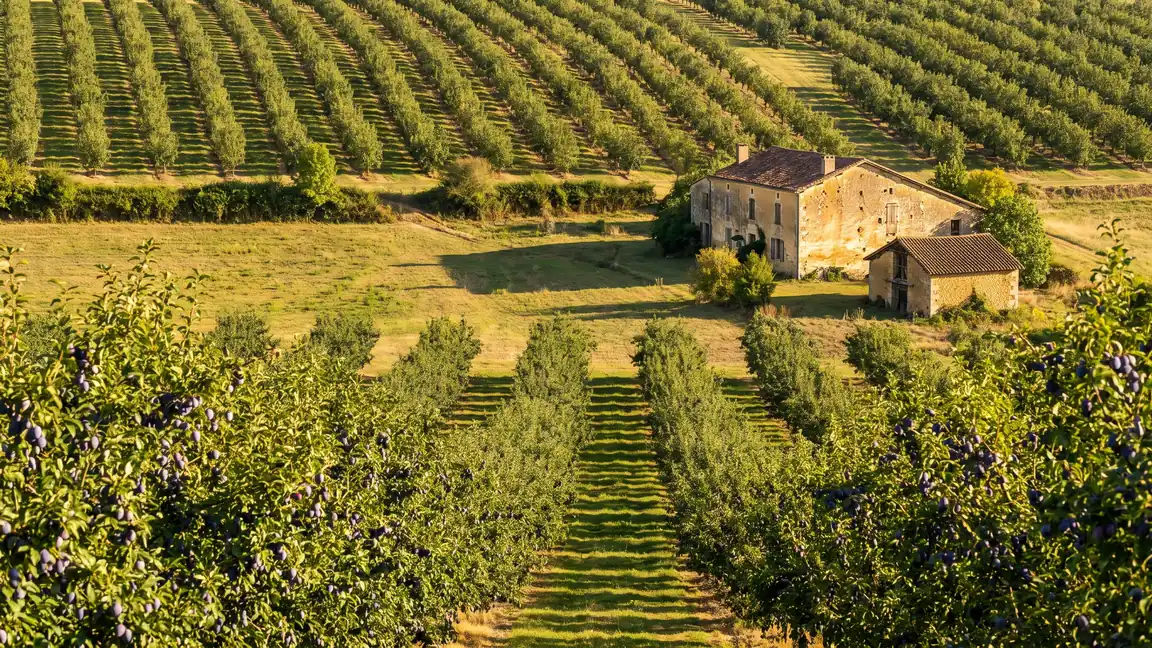
The Agen prune is inextricably linked to the Villeneuve region: it is here that the plum—which has made the Southwest famous—has been grown, dried, and sold for centuries. The prune has held a Protected Geographical Indication (PGI) since 2002 (INAO, official record accessed on July 24, 2026); it is produced by drying the Ente plum, a variety whose name comes from the verb “enter,” meaning to graft.
Six departments, with Villeneuve at its heart
The “Pruneau d’Agen” PGI region covers six departments in southwestern France—Lot-et-Garonne, which is the dominant one, as well as Gironde, Dordogne, Lot, Gers, and Tarn-et-Garonne. Lot-et-Garonne is the main producing department. Villeneuve-sur-Lot is its historic heart, where the trade in and drying of Ente plums have been documented since the 19th century.
But does that mean we should call Villeneuve “the prune capital”? Caution is advised: the town shares this title with Sainte-Livrade-sur-Lot, and the designation itself bears the name of Agen. This is due to history: prunes were exported from the port of Agen, on the Garonne River, as early as the 18th century—Villeneuve produced them, while Agen lent its name through river trade.
One factor, however, firmly anchors Villeneuve at the top of the industry: the headquarters of the BIP (National Interprofessional Prune Office), the trade association that governs the entire industry, is located in Villeneuve-sur-Lot itself. The city is, in fact, the administrative capital of the prune industry.
A fruit-growing region that offers much more than just prunes
Prunes are just one aspect of a deeply agricultural department. Lot-et-Garonne is France’s leading producer of strawberries and prune plums, and accounts for approximately 55% of the country’s hazelnut production—around 6,000 metric tons per year. As for tomatoes, which are often mentioned, the department ranks only third nationally, not first.
| Agen Prunes at a Glance | Data |
|---|---|
| Protection | IGP since 2002 |
| Variety | Dried Ente Plum |
| Geographic Area | 6 departments in the Southwest |
| Leading producer | Lot-et-Garonne is the leading producing department |
| Headquarters of the Interprofessional Organization (BIP) | Villeneuve-sur-Lot |
| Origin of the name "d'Agen" | River port of embarkation (from the 18th century onward) |
From Ente Plums to Prunes
A prune is nothing more than an Ente plum. dried — but the secret lies in this drying process. Harvested at full ripeness in late summer, the plums are dried until they lose most of their moisture: it takes several kilograms of fresh fruit to make one kilogram of prunes, which explains their intense flavor. In the past, people used ovens and dryers traditional — those small buildings that can still be found on farms in the Villeneuve region; today, hot-air tunnels ensure controlled drying.
This tradition, passed down from generation to generation on farms in Lot-et-Garonne, is the region’s true intangible cultural heritage. Around Villeneuve, the Ente plum orchards shape the landscape: neat rows of trees on the hillsides, ochre-colored farmhouses, drying sheds—a scene that, in late August, comes alive with the rhythm of the harvest.
As for the legendary origin of the prune—monks who are said to have brought it back from the East during the Crusades and cultivated it in the orchards of the Clairac monastery—this is a matter of tradition, not established fact. What is documented, however, is the local refinement of the Ente plum and its drying process—a craft patiently perfected on the farms of Lot-et-Garonne.
Eight centuries of history on the banks of the Lot
From its medieval founding to the industrial era of fruit processing, Villeneuve-sur-Lot has evolved in step with wars and river trade. A strategic fortified town, a river port, and the capital of the canning industry: its history sheds light on what it has become.
A bastide that was contested during the Hundred Years' War
Located in the Agenais region, a disputed territory between the kings of France and England, Villeneuve changed sides more than once. In 1337, at the very beginning of the Hundred Years’ War, the town was captured on July 10 by Raoul de Brienne, Constable of France—the inhabitants, it is said, having opened the gates to him. But this episode was short-lived: Villeneuve remained under French control for only about six years before being recaptured by the English following the truce of 1347. These shifts in allegiance explain the reconstruction of the ramparts at the end of the 14th century.
The Wars of Religion: A Place That Stands Its Ground
In the 16th century, during the Wars of Religion, Villeneuve was a contested stronghold that withstood two attempts to capture it. In 1585, Queen Marguerite de Valois—known as “Queen Margot”—who had sided with the League, failed to capture it; it was here that Nicolas de Cieutat and his son distinguished themselves, and the Pont-Vieux was later named after them. In 1591, the Duke of Joyeuse unsuccessfully laid siege to the town. The stronghold’s resilience stands out, though it should not be labeled with a strict religious affiliation.
The Lot: A Motorway Ahead of Its Time
Villeneuve’s development owes much to navigation on the Lot River. The town had a full-fledged commercial port—it was, along with Cahors, the only one on the river to have one. On flat-bottomed boats called gabares, goods were transported down the Lot and then the Garonne toward Bordeaux and the estuary: wine, wheat, wood, and, of course, fruit and prunes left the Agen region via this waterway. This river connection partly explains why the name “pruneau d’Agen” became established: it was at the port of Agen, on the Garonne, that the goods changed hands and set sail.
In the 19th century, the baton was passed to the rail. The railroad revolutionized the fruit trade: prunes were now being exported by the train carload, faster and farther, to Paris, northern Europe, and beyond. This was the industry’s golden age, a time when Lot-et-Garonne prunes gained an international reputation and when the trading houses that would make the region’s fortune began to take shape.
The Golden Age of Canned Foods
This fruit-based economy gave rise to an industry. The Pauliac cannery, founded in 1905 by Octave Pauliac (the building was designed by Gaston Rapin), employed as many as 100 workers before production in Villeneuve ceased in 1965. Green peas, green beans, prunes: For many years, Villeneuve preserved the bounty of its region in cans.
| Timeline | Event |
|---|---|
| c. 1254–1264 | Foundation of the bastide through a joint venture (Alphonse de Poitiers and the Abbey of Eysses) |
| 1264-1266 | A charter of customs consisting of 46 articles granted to the residents |
| 1282-1289 | Construction of the Pont-Vieux, under English supervision |
| 1337 | Capture of the city by Raoul de Brienne (Hundred Years' War) |
| late 14th century | Reconstruction of the city walls and their gates |
| 1585 & 1591 | Two sieges repelled during the Wars of Religion |
| 1898-1937 | Reconstruction of St. Catherine's Church |
| 1905 | Founding of the Pauliac Canning Plant |
What's there to see around Villeneuve-sur-Lot?
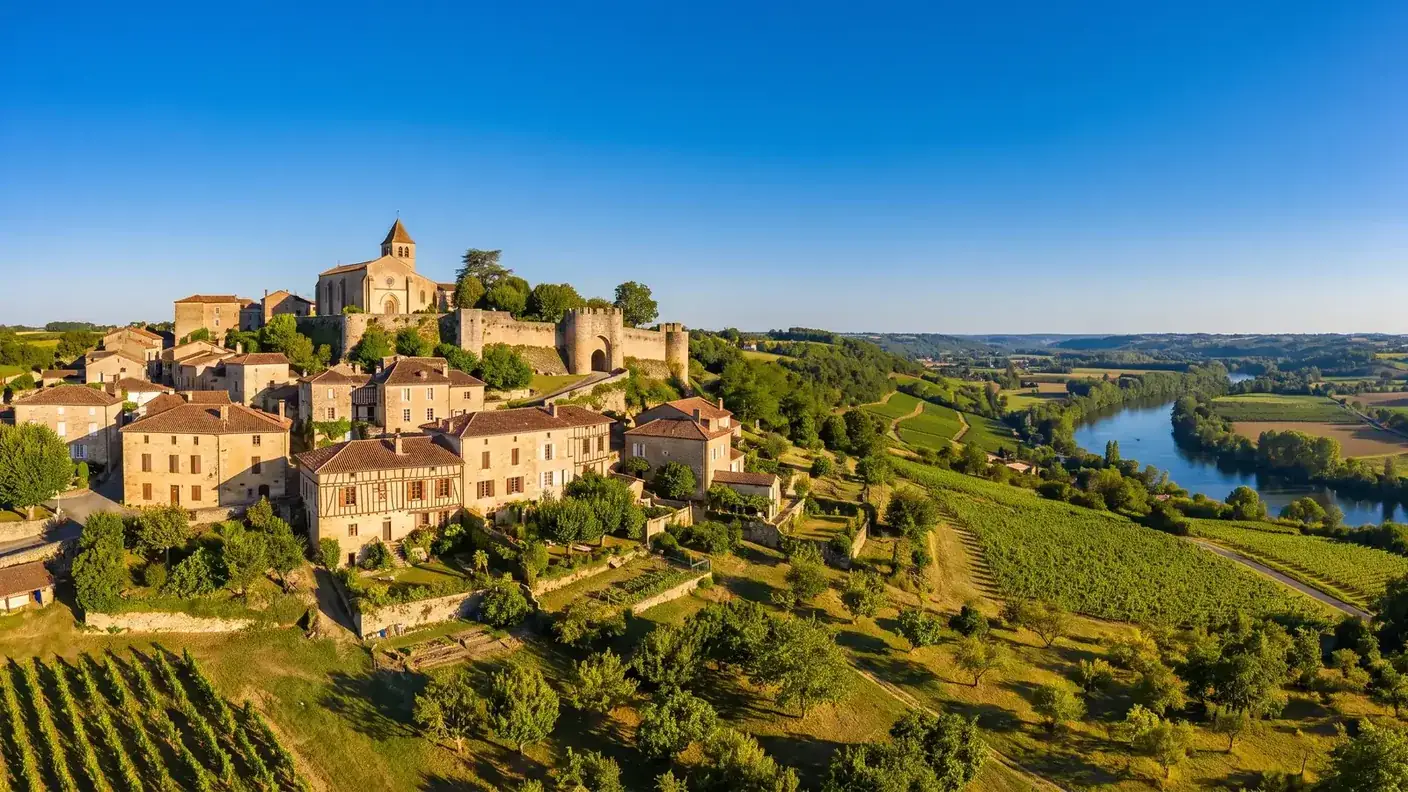
Villeneuve-sur-Lot is a great starting point: three of the “Most Beautiful Villages of France” are located within thirty kilometers. This makes it an ideal base for exploring the Agenais region without having to change accommodations—you stay in Villeneuve and visit the surrounding area.
Three of France's Most Beautiful Villages Within Easy Reach
Pujols, about 4 km away, is the closest: a fortified village perched on a hill, it overlooks the Lot Valley and has been designated one of the “Most Beautiful Villages of France.” Monflanquin, another bastide founded by Alphonse de Poitiers (in 1256), holds the same distinction and features a remarkably well-preserved covered square. Finally, Penne-d’Agenais is a village perched on a rocky outcrop that overlooks the Lot by about 120 meters, crowned by the Basilica of Peyragude.
Each one is worth a visit. Pujols is best explored on foot, through a maze of cobblestone alleys, half-timbered houses, and small squares, with sweeping views down into the valley. Monflanquin, also perched on a hill, preserves one of the region’s most beautiful bastide layouts, centered around its covered square and the house known as the “Black Prince’s House.” Penne-d’Agenais winds its way through medieval alleyways to the Basilica of Notre-Dame de Peyragude, where the view takes in the entire countryside.
Added to this is Casseneuil, a charming little town at the confluence of the Lot and the Lède, with facades reflected in the water, and lush natural surroundings—hillsides, orchards, and towpaths along the river. In a single day starting from Villeneuve, you can easily visit two or three of these villages: the distances are short and the country roads are pleasant.
Caves, Parks, and Recreation
For a change of pace, the Fontirou Caves—located in the town of Castella, with “Fontirou” being merely a local place name—offer a tour of stalactites and stalagmites and underground passages. For entertainment, the Walygator Sud-Ouest amusement park (formerly Walibi, renamed in 2021) is located in the town of Roquefort, near Agen; it welcomes around 300,000 visitors a year across more than 30 hectares and is adjacent to Aqualand Agen.
| Around Villeneuve | Distance / Marker | Interest |
|---|---|---|
| Pujols | ~4 km | One of the Most Beautiful Villages in France, a hilltop village |
| Penne-d'Agenais | ~10 km | Hilltop village, Peyragude Basilica |
| Monflanquin | ~17 km | Alphonse de Poitiers' Bastide, "Most Beautiful Village" |
| Fontirou Caves | Castella Municipality | Caves with concretions |
| Walygator Southwest | toward Roquefort / Agen | Amusement park (~300,000 visitors per year) |
| Agen | ~29 km | Prefecture, nearest TER-TGV station |
When is the best time to visit Villeneuve-sur-Lot?
Villeneuve is worth visiting any time of year, but late summer offers the best of both worlds: the mild climate of the Southwest and the highlight of the local harvest season—the plum harvest.
From late August through September, the Ente plum orchards yield their fruit: this is the peak of the fruit-growing season, a chance to see firsthand where prunes come from. The markets are then overflowing with fresh plums, summer fruits, and farm-fresh produce. The Villeneuve market, in and around Place Lafayette, is a must-visit destination no matter what month it is.
The spring (April–June) brings a burst of blooms to the countryside and orchards in full bloom, with ideal temperatures for walking through the bastide and along the Lot River. The summer is warm and sunny, perfect for swimming and outdoor activities along the river. The fall, after the harvest, takes on stunning colors on the hillsides. The winter It's quieter, but you can explore the historic sites—the bridge, the gates, the church, and the narrow streets—without the crowds, and the driving distances remain the same.
For a one-day heritage getaway from Bordeaux, spring and early fall are ideal: the light is beautiful, the weather is warm enough to explore the bastide on foot, and you can visit Villeneuve, Pujols, and a third village at a leisurely pace.
An example of a full day: arrive in Villeneuve in the late morning, take a walking tour of the bastide—Pont-Vieux, Place Lafayette, the Paris and Pujols gates, and the Church of Sainte-Catherine—then have lunch at a restaurant; in the afternoon, a trip up to Pujols to enjoy the view and the narrow streets, before a final stop in Penne-d’Agenais or Monflanquin, depending on your preference. With a driver handling the transportation, you can fit all of this into a single day, including the return trip to Bordeaux.
How to get to Villeneuve-sur-Lot from Bordeaux
Villeneuve-sur-Lot is located about 146 km from Bordeaux, which is about a two-hour drive. An important detail to note before planning your trip: the city no longer has a passenger train station in operation. The rail line is closed to passenger traffic; service is provided by TER buses between Agen and Villeneuve—a regional bus service with varying schedules; check the official schedule before departure.
By train + bus: the detour through Agen
The nearest TER-TGV station is in Agen, about 29 km to the south. From Bordeaux, you’ll need to take the train to Agen, then catch a bus to Villeneuve—which means two modes of transportation, one transfer, and schedules to keep an eye on, especially in the evening or on weekends. For a couple, a family, or a small group traveling with luggage, the cost and travel time can add up quickly.
By car or with a private chauffeur: door-to-door service
By car, it’s about 146 km and roughly two hours from Bordeaux. This is where a chauffeur service (private chauffeur service) really comes into its own: a direct trip, with no transfers or station changes, door-to-door, and the option to make stops along the way—in Pujols, at an orchard, or for a first stop in Villeneuve before heading out to Monflanquin and Penne-d’Agenais.
From Bordeaux, we offer this route at a fixed price quoted in advance: starting at 255 € for a one-way trip in the Eco class, in a sedan for 1 to 3 passengers. The van for 4 to 7 passengers is available upon request. You’ll receive a written quote, with no surprises on the meter.
| Route | Distance | Duration | Landmark |
|---|---|---|---|
| Bordeaux → Villeneuve-sur-Lot | ~146 km | about 2 hours | Starting at 255 € for the Eco private chauffeur service |
| Villeneuve → Agen (train station) | ~29 km | ~30 min | Nearest TER-TGV station |
| Villeneuve → Bergerac | ~60 km | ~1 hour | Purple Périgord, vineyard |
| Villeneuve → Pujols | ~4 km | ~10 min | Most Beautiful Village in France |
The appeal of door-to-door service is best experienced with others. Whether as a couple, a family, or a small group, the chauffeur service eliminates the need for separate train and bus tickets, the transfer in Agen, waiting on a platform, and lugging luggage from one mode of transportation to another. You get on in Bordeaux and get off right in front of Place Lafayette: the ride becomes part of the journey, not a hassle. And for those who want to visit the hilltop villages in the area, the driver can wait or take you directly from one stop to the next—something no regular bus route can offer.
Whether it’s for a day of sightseeing, a business trip, or a transfer to Bordeaux-Mérignac Airport, booking an executive car service guarantees a comfortable, punctual ride without any logistical stress—book a driver from Bordeaux to Villeneuve-sur-Lot or explore all our destinations.
Frequently Asked Questions
Where is Villeneuve-sur-Lot located?
Villeneuve-sur-Lot is a town in Lot-et-Garonne (47), in the Nouvelle-Aquitaine region, through which the Lot River flows. It is a subprefecture and the second-most populous municipality in the department (22,350 residents), located about 146 km southeast of Bordeaux and 29 km north of Agen.
What is the distance between Bordeaux and Villeneuve-sur-Lot?
About 146 km by road, or about a two-hour drive. For a chauffeured transfer from Bordeaux, the rate is fixed and provided in advance, starting at 255 € for a one-way trip in the Eco class (sedan for 1 to 3 passengers; van for 4 to 7 passengers, price upon request).
Is there a train station in Villeneuve-sur-Lot?
No, Villeneuve-sur-Lot no longer has any passenger stations in operation: the rail line is closed to passenger traffic. Service is provided by TER buses from Agen, whose TER-TGV station (about 29 km away) is the closest. A private chauffeur allows you to avoid the transfer and travel directly from Bordeaux.
Who founded the Villeneuve-sur-Lot country estate, and in what year?
The bastide was founded in the mid-13th century, around 1254–1264, by Alphonse de Poitiers—Count of Poitiers and Toulouse, brother of Saint Louis—in partnership with the Benedictine Abbey of Eysses, through a paréage agreement. There is no single founding date: it was a process, completed by a charter of customs granted between 1264 and 1266.
What is the Pont-Vieux at Villeneuve-sur-Lot?
This is the city’s iconic medieval bridge, also known as the Pont des Cieutats, built between 1282 and 1289 under English rule. Constructed of stone and brick, it was originally fortified with three square towers. The large arch on the right bank was rebuilt in the 17th century following the flood of 1600. The bridge has been listed as a historic monument since 1951.
Why is St. Catherine's Church so new?
Because it was completely rebuilt after the vault of one of the side aisles of the old church collapsed in 1897. The work, carried out from 1898 to 1937, resulted in a large Neo-Byzantine brick building supported by a reinforced concrete and metal framework. It retains historic stained-glass windows (15th–16th centuries) reused from the old church and has been designated a historic monument since 2022.
Is Villeneuve-sur-Lot the capital of Agen prunes?
It is a historic heart of the industry, but this title should be qualified: Villeneuve shares this epicenter with Sainte-Livrade-sur-Lot, and the appellation bears the name of Agen, the port city from which prunes were exported. However, there is one strong argument in favor of Villeneuve: the headquarters of the National Interprofessional Prune Office (BIP) is located there.
What exactly is an Agen prune?
This is a dried Ente plum, protected by a PGI since 2002. Its production area covers six departments in southwestern France; Lot-et-Garonne is the main producing department. The “prune d’Ente” variety takes its name from the verb “enter,” meaning to graft.
Which villages are worth visiting near Villeneuve-sur-Lot?
Three of the “Most Beautiful Villages of France” are within 30 km: Pujols (~4 km, hilltop village), Monflanquin (~17 km, a bastide founded by Alphonse de Poitiers), and Penne-d'Agenais (a hilltop village overlooking the Lot River). You can also add Casseneuil, the Fontirou caves (in the town of Castella), and the Walygator Sud-Ouest park near Agen to the list.
How many medieval gates are left in Villeneuve-sur-Lot?
Two of the seven gates that once stood in the bastide: the Porte de Paris (formerly the Porte de Monflanquin) and the Porte de Pujols. These two gate towers, built of brick and stone and featuring battlements and machicolations, have been classified as historic monuments since 1901—the earliest form of heritage protection in Villeneuve.
How many people live in Villeneuve-sur-Lot?
With a population of 22,350 according to the 2023 census, it is the second-most populous municipality in Lot-et-Garonne, behind Agen. After peaking around 2013 and reaching a low around 2021, the population has stabilized.
When is the best time to visit Villeneuve-sur-Lot?
Spring and early fall are ideal for strolling through the bastide in the soft light. Late August and September coincide with the Ente plum harvest and the bustling markets—the best time to discover the region’s prune culture.
Can I book a chauffeur service from Bordeaux through Villeneuve-sur-Lot?
Yes. We offer the Bordeaux → Villeneuve-sur-Lot route (~146 km, approximately 2 hours) at a fixed price, starting at 255 € one-way in the Eco class, in a sedan for 1 to 3 passengers; the van for 4 to 7 passengers is available upon request. The trip is direct, door-to-door, with stops as agreed upon in the quote.
Further Reading
- Another bastide in Lot-et-Garonne: see the Guide to Armillac, a village in the Dropt Valley
- The English bastide near the "Purple Périgord": see the Eymet Guide (arcaded square, medieval castle)
- A bastide in the Dropt Valley: Discover Castillonnès, its square with corner towers, and its history
- On the Way to the Duras Region: Planning a Stop in Lévignac-de-Guyenne and Its Bastide
- The town of Cyrano, one hour north: see the Bergerac Guide (old town, wines, gabarres)
- Plan your trip: Book an executive car service from Bordeaux to Villeneuve-sur-Lot or explore all our destinations
Sources and References
- Wikipedia — Villeneuve-sur-Lot — geography, demographics, bastide, history, heritage
- Wikipedia — Pont-Vieux in Villeneuve-sur-Lot — dated 1282–1289, Bout-du-Pont Chapel, listed as a historic monument
- Wikipedia — St. Catherine's Church — reconstruction 1898–1937, architectural style, stained-glass windows, designated as a historic landmark in 2022
- Wikipedia — Agen Prune — PGI 2002, Ente plum, production area, industry
- POP/Mérimée Database — Old Bridge
- POP/Mérimée Database — Chapel of Our Lady of Grace and All Joy
- POP/Mérimée Database — The Towers of Pujols and Paris
- POP/Mérimée Database — Sainte-Catherine Church
- INSEE — Municipality of Villeneuve-sur-Lot (47323) — 2023 population, area, municipal data
Last editorial review: .
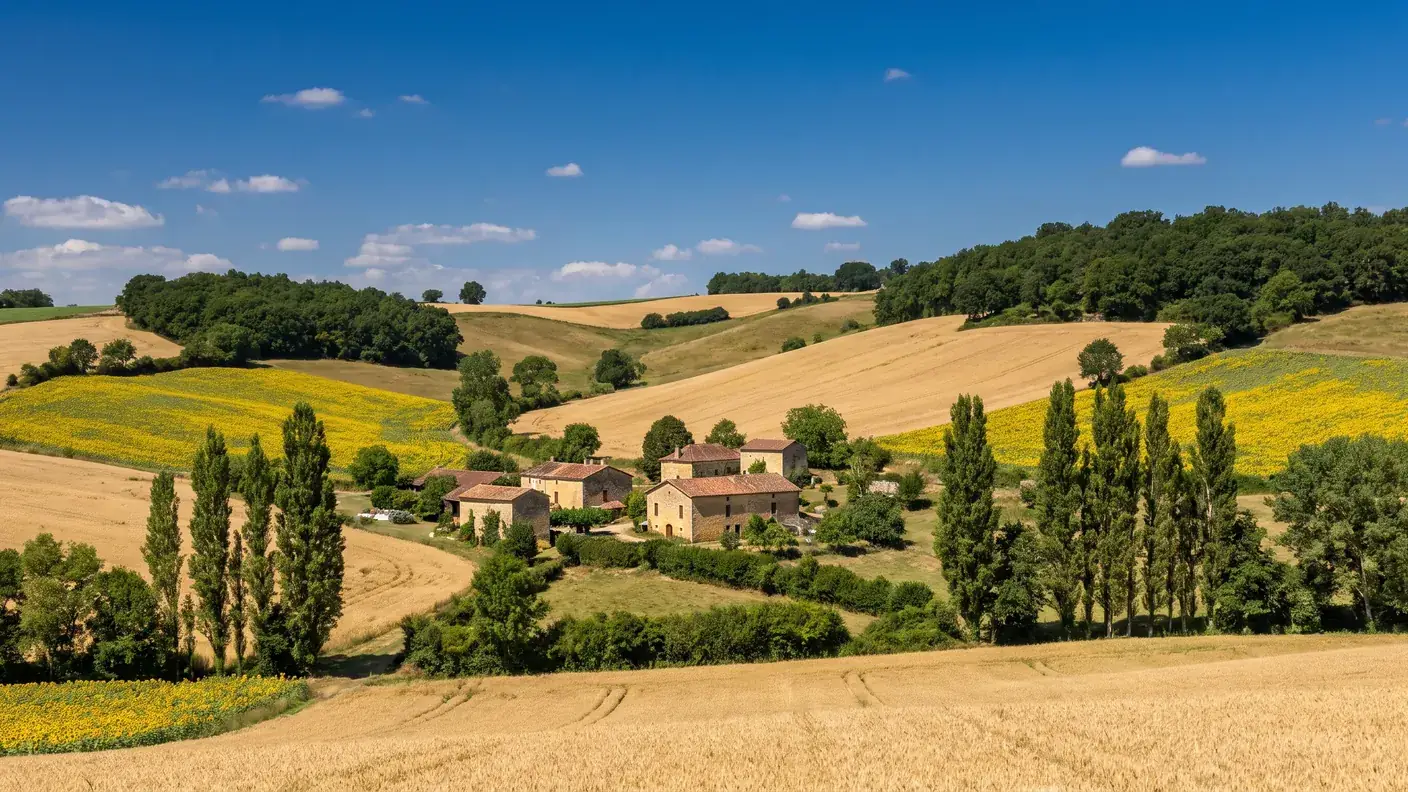
Off to the bastide and the land of prunes
Direct trip from Bordeaux (~2 hours) to Villeneuve-sur-Lot, with stops along the way as desired—Pujols, an orchard, Monflanquin. Fixed, written quote—no surprises on the meter.