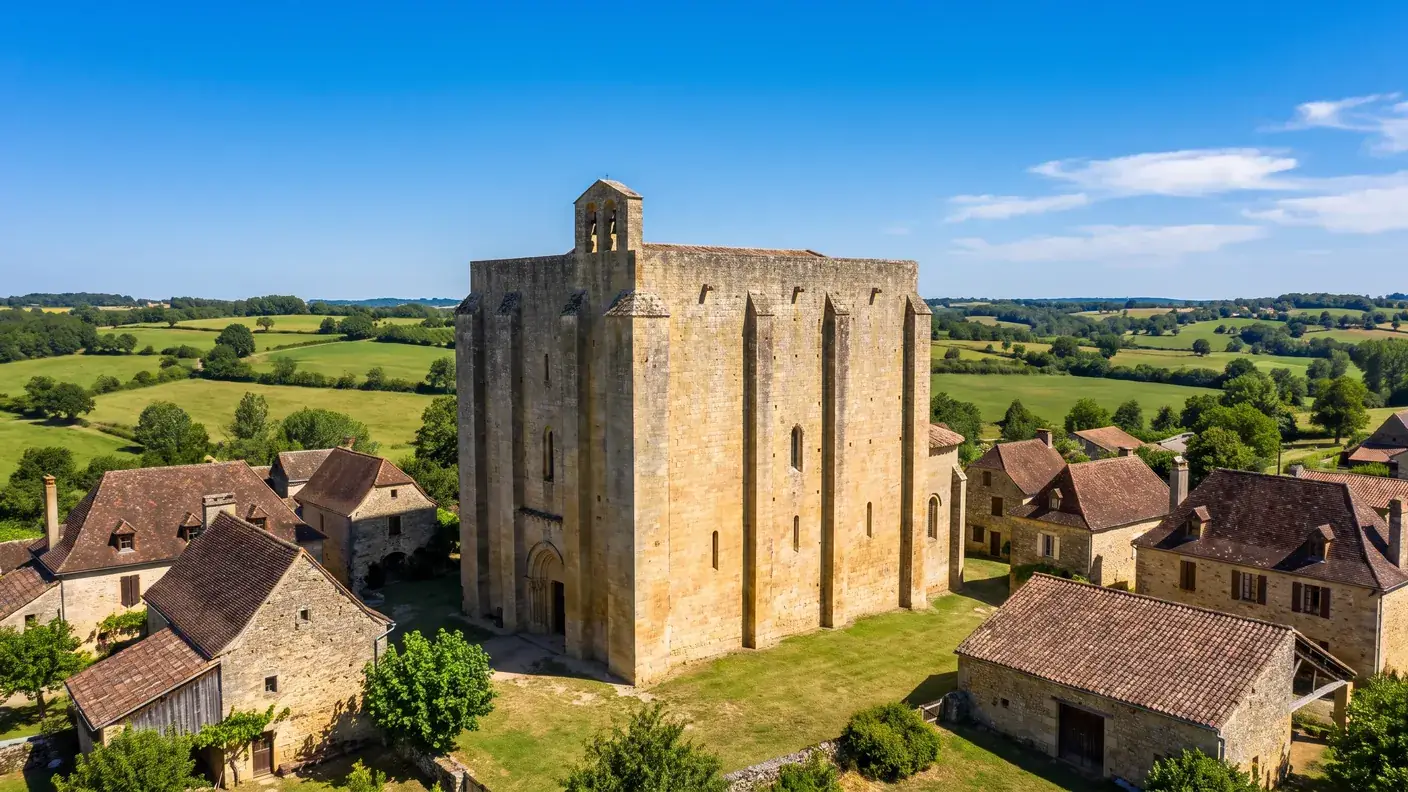
Celles, the keep-church of the Ribérac region
The quiet village in the Périgord Vert: a fortress church that looks like a keep, a forgotten Charente priory, a parish of the great barons of the Périgord—and the gateway to the land of domed churches. Everything you need to know before you visit, 1 h 26 min from Bordeaux.
Celles at a Glance
Celles is a village with a population of 619 in the Ribérac region of the Dordogne; it should not be confused with Celles-sur-Belle. [11]Its main landmark is the Church of Saint-Pierre, a 12th-century Romanesque building fortified in the 14th century, nicknamed the “keep church” due to its defensive structure. The church is listed in the General Inventory under reference IA24000412, but is neither classified nor listed as a historic monument.[2] In 1481, the village fell under the jurisdiction of the castellany of Bourdeilles and is also home to the private castle of Lascoux. Around Celles, Grand-Brassac, Ribérac, Bourdeilles, Aubeterre-sur-Dronne, and Brantôme form a loop connecting fortified churches, castles, and the Dronne Valley. From Bordeaux, the marked route covers approximately 113.7 km; there is no direct train service to the village. The bibliography at the end of the article distinguishes between official heritage records and encyclopedic sources. It thus serves as a well-documented gateway to the Périgord Vert, far from the most heavily traveled tourist routes.
- Celles (population 619; the residents are known as Cellois) is a village in the from Ribérac, in the Périgord Vert—not to be confused with Celles-sur-Belle, in the Deux-Sèvres department.
- Its Saint-Pierre Church (12th century, fortified in the 14th) is a rare “keep-church”: an austere stone structure with flat buttresses, designed to serve as a refuge for the entire population.
- The name comes from the Latin *cella* (monastic cell): the village was originally a Benedictine priory affiliated with Le Peyrat, in Charente—a fine example of the “Périgord Charentais.”
- In 1481, the parish was part of the castellany of Bourdeilles, one of the four historic baronies of the Périgord.
- Just 9 minutes away, Grand-Brassac and its listed fortress church (1885): the area’s true heritage treasure, in the heart of the “land of Romanesque churches with domes.”
- The village is bucking the trend with population growth: +5.45% since 2017, while the Ribérac region as a whole is losing population.
- The Dronne River flows nearby (canoeing, swimming, Natura 2000)—and Ribérac, the market town and birthplace of the troubadour Arnaut Daniel, is just 10 minutes away.
- From Bordeaux by car: ~113.7 km, approximately 1 h 26 min — starting at 196 € for a private driver, door-to-door. There are no trains serving the Ribérac region.
Before You Go: What Celles Really Is
9 a.m., at the town square. What stands before you is not a church: it is a monolith. A mass of honey-colored limestone rising straight toward the sky, almost windowless, bristling with flat buttresses—more like a keep than a place of worship. For eight centuries it has watched over this village of 619 souls, which is why scholars have dubbed it a “keep-church.” All around, the silence of the Ribérac region: fields, woods, and the Dronne River flowing to the south. Nothing spectacular at first glance. And yet, everything is right there.
Celles is a quiet village—one of those small towns in the Green Périgord that the guidebooks on the Périgord Noir overlook. No iconic castles, no crowds, just one real attraction: its fortress church. But that is precisely what makes it an ideal gateway to a lesser-known part of the Périgord, namely the Ribérac and its Romanesque churches with domes, that of the medieval baronies and the Dronne Valley. A village that, against all odds, gains residents when his neighbors are losing theirs.
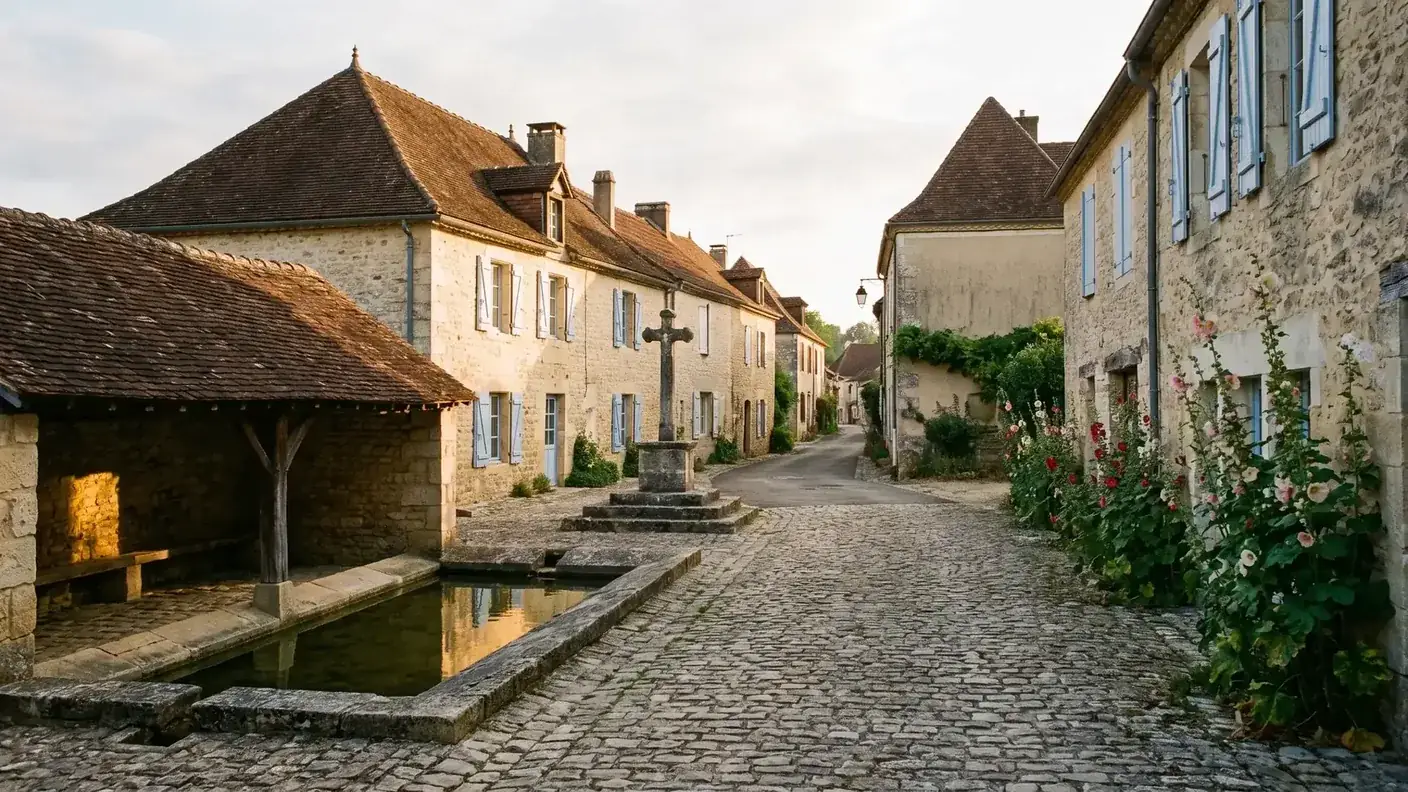
This guide distinguishes between verified facts and hearsay—because the subject is tricky. Here and there, one reads that the church has a carved tympanum depicting the Ascension (unverifiable, and likely nonexistent), that it is “listed as a historic monument ” (false: it is only listed in the inventory), or that the Château de Lascoux features a 700-year-old staircase and a monumental stove (details borrowed from a real estate listing for another estate). We stick to the verified facts: the church’s actual architecture, the Priory of Le Peyrat, the castellany of Bourdeilles, and above all, the true treasures of the surrounding area.
In terms of transportation: the Ribérac area is a rail desert. Ribérac no longer has passenger rail service; no trains run through it.[12] The only useful train station is Périgueux, 38 km away, and regional buses do not serve the hamlets. To travel from Bordeaux and explore the surrounding area—Grand-Brassac, Bourdeilles, Brantôme—a private driver from Bordeaux is a door-to-door option with no transfers all the way to the village (1 h 26 min).
619 residents and a rising trend: Celles bucks the trend
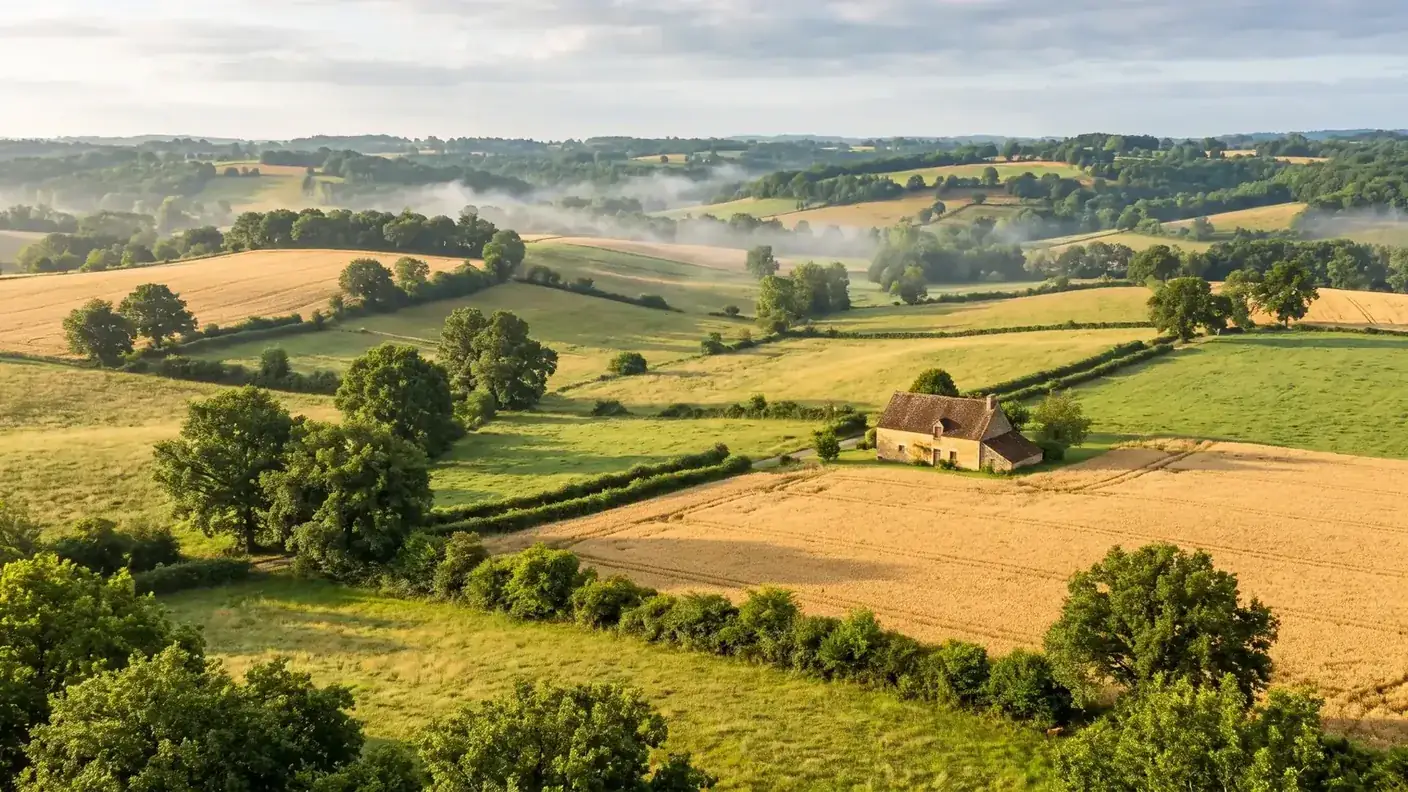
Celles is situated on a rolling plateau typical of the Ribérac region, ranging from 61 meters (the Dronne Valley, to the southwest) to 213 meters (near Pauliac), on a bed of Cretaceous limestone—that honey-colored stone from which all the houses are built. The village is crossed by the Tournevalude, a small tributary of the Dronne that flows for more than eight kilometers before joining the river. The Dronne River itself borders the town to the south for 2.5 km—a valley designated as a Natura 2000 site, a refuge for the white-clawed crayfish and the European mink.
| Data | Value |
|---|---|
| Status | Municipality in the Ribérac region, Ribérac canton (Périgueux district) |
| Population | 619 residents (2023)[11] — the residents of Cellois |
| Evolution | +5.45% since 2017 (Dordogne: +0.97%) — bucking the trend |
| Area | 27.83 km² (population density ~22 people/km²) |
| Elevation | 61 m (Dronne) to 213 m (Pauliac) |
| Rivers | Le Tournevalude (village) + La Dronne (south, Natura 2000) |
| Intermunicipal Cooperation | Périgord Ribéracois Community of Communes (44 municipalities) |
| Distance from Bordeaux | ≈ 113.7 km (1 h 26 min via the A89, take the Mussidan exit, then head toward Ribérac) |
What truly sets Celles apart is its demographic trend. Like the rest of the Périgord Vert region, the village experienced a population decline over two centuries: 1,798 residents in 1793, followed by a nearly continuous decline until it reached a low of 552 in 1999—a loss of two-thirds of the population. Then, since the 2000s, the trend has reversed: 563 in 2012, 611 in 2022, and 619 in 2023. This represents a 5.45% increase since 2017—well above the departmental average—driven by the residential appeal of a quiet village just ten minutes from Ribérac. A concrete sign of vitality: since 2022, Celles has shared a school district with its neighbor, Grand-Brassac. This is rare in the Ribérac region, where most towns continue to lose population.
"Cella": a name that tells the story of a forgotten priory
The name Celles says it all about its origin. It comes from the Latin *cella*—the monastic cell, a small religious community dependent on a larger abbey. In Occitan, the language spoken in the Périgord region until the 20th century, the village is still called Cela, staying true to its roots. For Celles was originally a priory: a satellite religious community attached to a mother house located on the other side of what would later become the border between the Dordogne and the Charente. [2]
This mother house still exists and can be found: the Benedictine priory of Le Peyrat (sometimes called “Le Peyrat Abbey”), founded in 1065 in what is now the town of Blanzaguet-Saint-Cybard, in Charente—in the locality that is today, appropriately enough, “l’Abbaye.” This Charente priory oversaw several parishes beyond its own province, including this small settlement in the Ribérac region. This is a classic example of the “Charente Périgord”: that fringe region where parishes of the Diocese of Périgueux were under the jurisdiction of monasteries now located in the Angoumois—a forgotten medieval legacy that modern administrative geography has erased.
The priory of Celles was thus a link in a vast network of Benedictine dependencies that developed between the 11th and 13th centuries in northern Aquitaine. Nothing visible remains of the religious community itself—except for the church, which served as its heart and which, two centuries later, would experience a second, far less peaceful chapter in its history.
St. Peter's Church: A Fortress Disguised as a Church
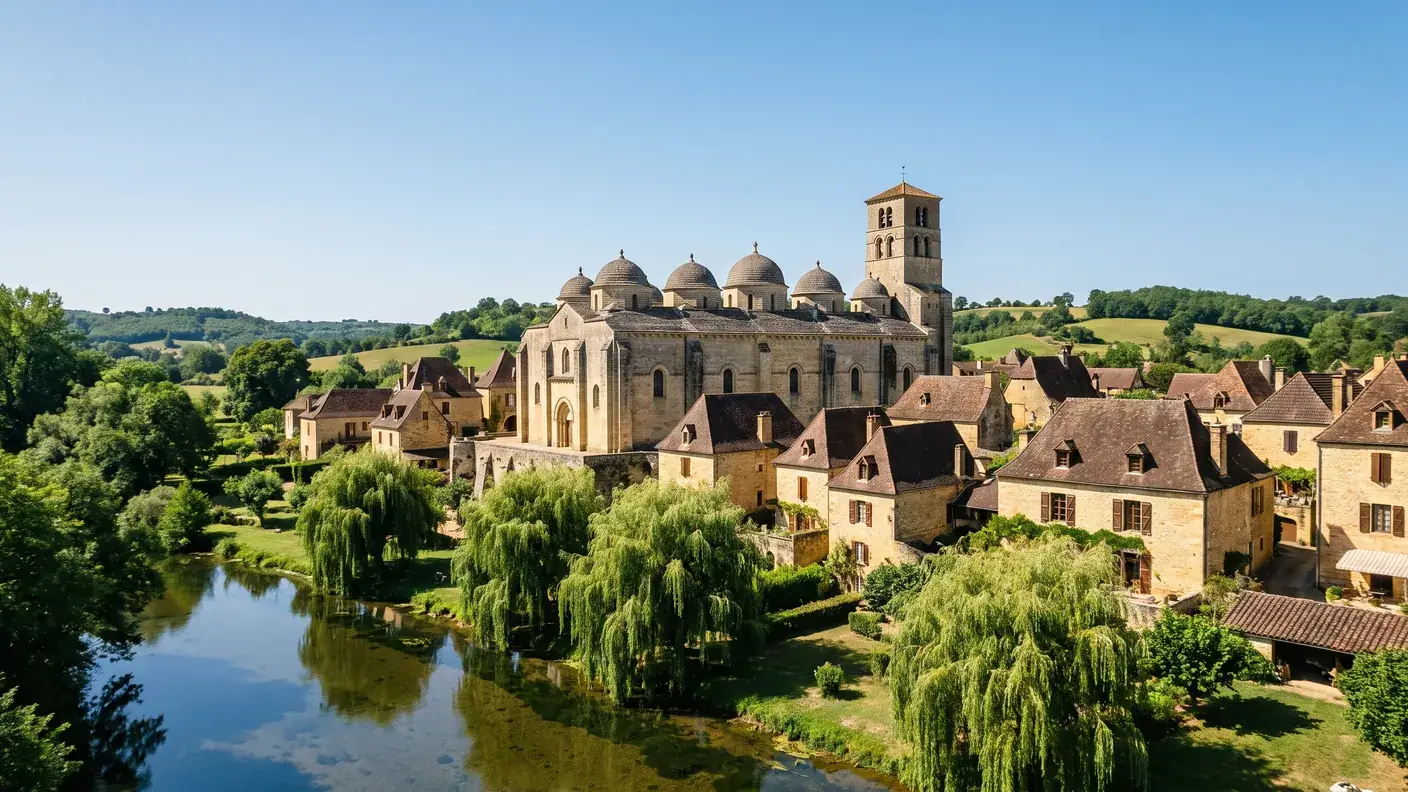
This monument is worth the detour. TheSt. Peter's Church is a building 12th-century novel — a nave with three bays and a barrel vault, a choir with a flat apse, and a western portal framed by two massive buttresses connected at the top by an arch, a bell tower with two rectangular towers topped by a hipped roof. Originally, it bore no resemblance to a fortress. Everything changed in 14th century : Like dozens of churches in the Périgord during that turbulent period, it is fortified to provide a refuge for the population. It is being expanded by flat buttresses With its varying width, its walls are made thicker—and its silhouette takes on a military appearance.
It is this particularly extensive fortification that has earned it the nickname “keep-church.” The term is not insignificant: a keep is the main tower of a castle, the last stronghold to which one can retreat. When applied to a church, it denotes a level of fortification that goes beyond that of a simple fortified church, evoking—through its mass and sturdiness—a true defensive structure. The Périgord is full of fortified churches—the Hundred Years’ War left its mark there—but few deserve this designation, which is reserved for the most accomplished examples. Celles, however, does deserve it: it is a house of God that looks like a watchtower.
Two clarifications, since there are many distorted accounts circulating about this subject. First, the church is neither classified nor listed as a historic monument: it is merely recorded in the General Inventory of Cultural Heritage (reference IA24000412)—a documentary record, not legal protection. Second, it is sometimes said to have a carved tympanum depicting the Ascension: the official description states that the portal has no tympanum at all, and such decoration—which is extremely rare in the Périgord—would have been noted—so it’s best not to expect to see it. What you will actually see: stocky Romanesque architecture, Gothic side chapels added in the 14th–15th centuries (including the Jardel Chapel, with its ribbed vault), and this unique defensive structure. The church, a former priory, is documented as a parish church as early as 1382[2]; it was restored in the 20th century by the architect Lambert. It is open to the public free of charge year-round.
Lascoux Castle: A Peace Conference and a Martyr
Just south of the church stands the Château de Lascoux (or Château de Celles), a private property that is not open to the public—it can be seen from the outside. Its origins date back to the 14th century, when it belonged to the Montardy family, but the current building was rebuilt in the 16th century by the Pontbriand family: a rectangular central section flanked by two wings, a watchtower at the corner, and a hexagonal stair turret to the north. Don’t bother looking for the “700-year-old staircase” or the “monumental stove” that you sometimes read about: these details come from a real estate listing for an entirely different estate.
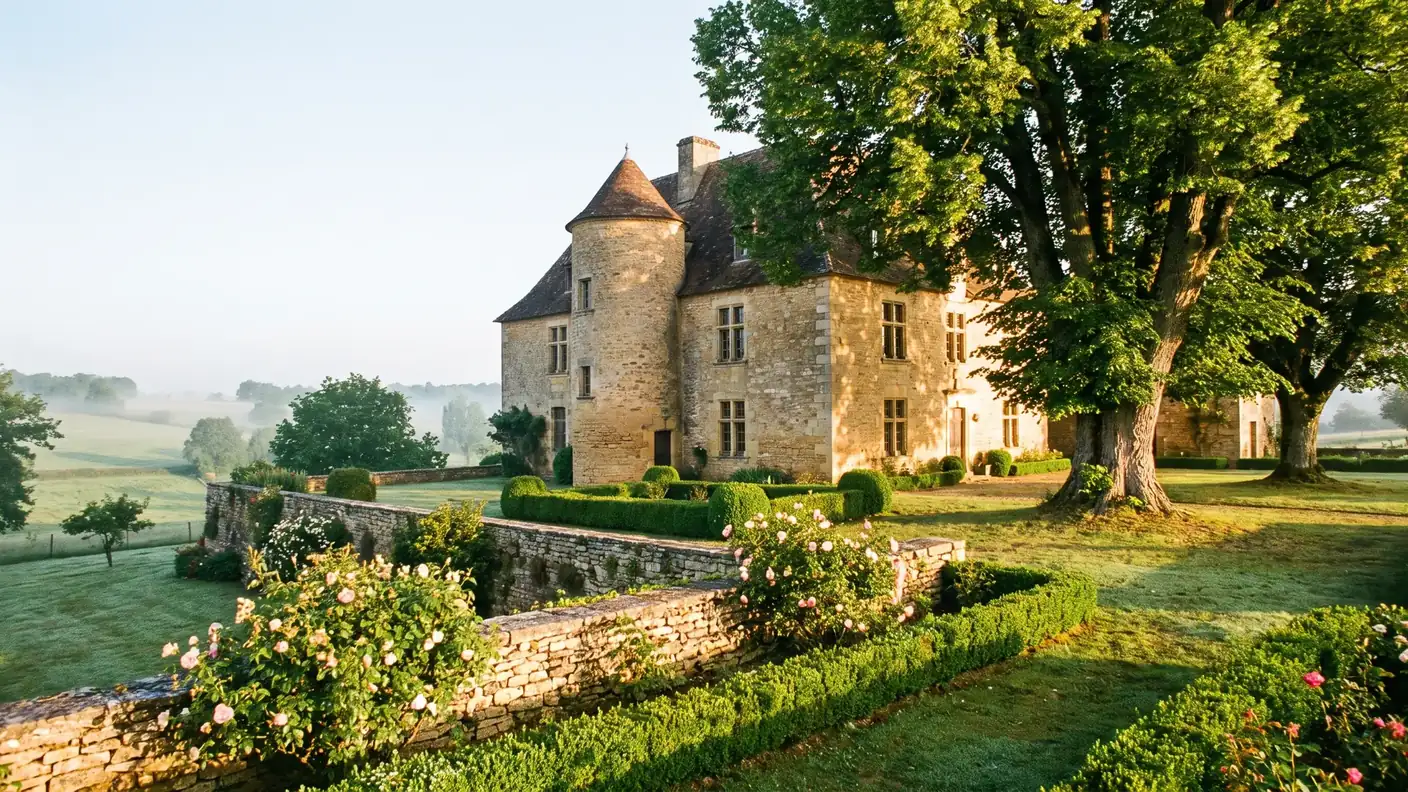
What makes Lascoux truly remarkable isn't its stones, but its history. In 1593, in the midst of the Wars of Religion, the castle hosted a Conference between Catholics and Huguenots — The Ribéracois region, a meeting point between the two sides, was then seeking a way to restore peace. And it was here that, in 1751, Armand de Foucauld de Pontbriand, future vicar general of Périgueux: arrested during the Revolution, he was massacred at the Carmes Prison in Paris in September 1792, during the September massacres, and will be beatified among the September Martyrs. From a peace conference to a revolutionary martyr, two centuries of French history in a village manor. Celles also features a second château, the 19th-century Château de la Pauze.
1481: Celles, the castellany of Bourdeilles, and the four barons
To place Celles within the broader context of the Périgord’s feudal history, we must go back to four historic baronies — Bourdeilles, Biron, Beynac, and Mareuil —, founded in the 10th century, were the most prestigious lordships in the province, second only to the Count of Périgord. Their ceremonial privilege has remained famous: upon the solemn entry of a new bishop into Périgueux, it was required that four barons to carry the bishop's throne on their shoulders. An honor so fiercely contested that it was turning into a confrontation: January 1 1532, the lords of Bourdeilles and Biron each arrived, escorted by three to four thousand armed men to compete for precedence.
Celles is linked to this system through its dependency on Bourdeilles : in 1481, the parish falls under the jurisdiction of the Bourdeilles Castle District. Yet Bourdeilles was then a dual entity, literally split in two since the 13th century: on one side, the barony, run by the de Bourdeille family, with a leaning toward the English side; on the other, the châtellenie (the Count's share), on the side of the King of France. The decisive turning point occurred in 1340, when Philip VI of Valois traded his half of Bourdeilles for Bergerac with the Count of Périgord. Celles was under the jurisdiction of this royal castellany.
1481 was, in fact, the year of reconciliation: after the Hundred Years’ War, François de Bourdeille bought the count’s share from Alain d’Albret and finally united the barony and the castellany under a single family. His wife, Anne de Vivonne, was none other than the ancestor of Pierre de Bourdeille, known as Brantôme, the famous Renaissance chronicler. A small village like Celles thus found itself, through no choice of its own, at the heart of the realignments among the great feudal houses of the Périgord—and the Château de Bourdeilles, 18 km away, can be visited today (two castles in one, classified as historic monuments since 1919).
Grand-Brassac: A True Treasure, Just 9 Minutes from Celles
If the keep-church at Celles has whetted your appetite for defensive architecture, the masterpiece is at 6 km, 9 minutes : the fortified church Church of Saints Peter and Paul in Grand-Brassac, its immediate neighbor and partner in the school district. Here, the fortifications reach their peak: a fortress church with a row of domes (12th–13th centuries), topped by loopholes, a parapet walk, and arrow slits, which served as a refuge during the Hundred Years' War and the Wars of Religion. Unlike the one on Celles, it is designated a historic monument since 1885.
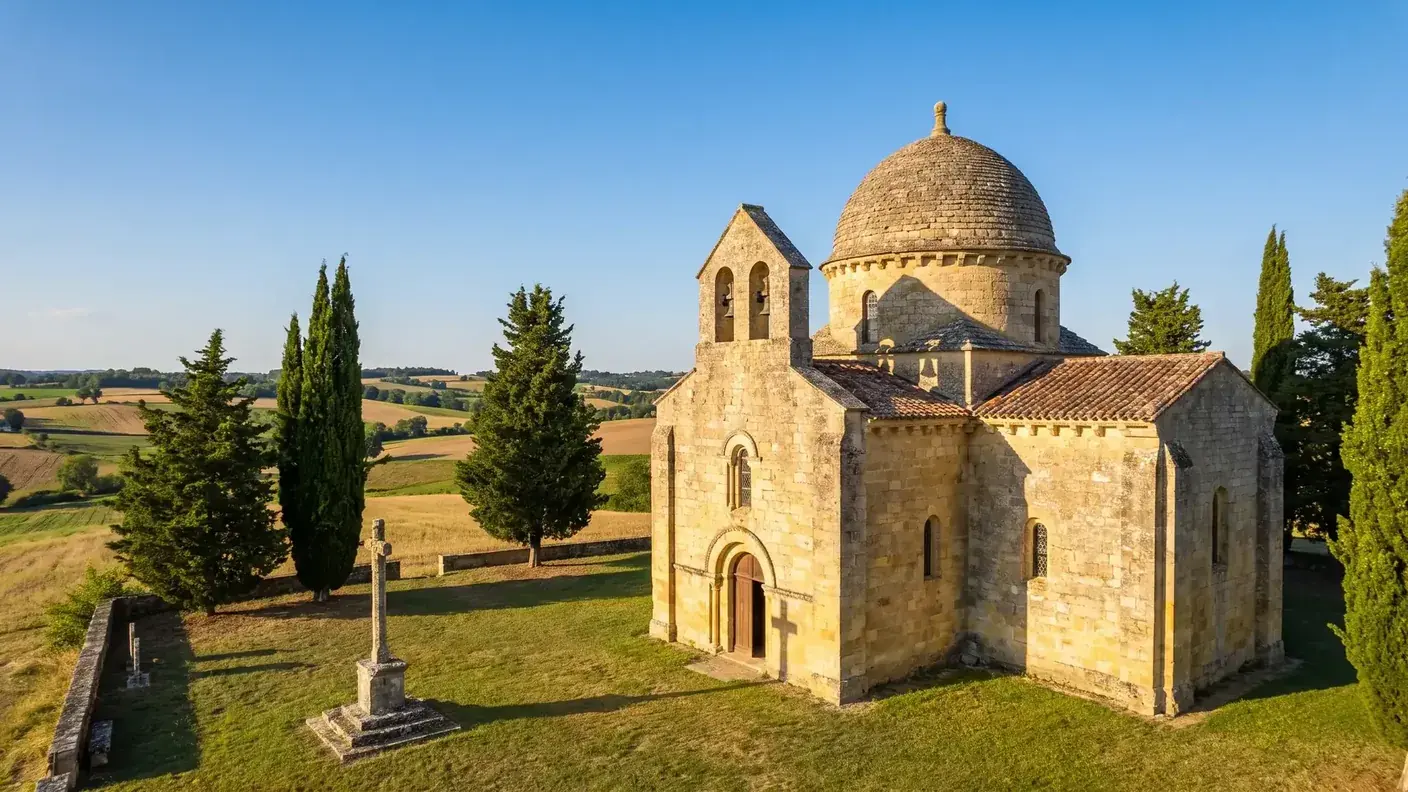
Its treasure: on the north facade, a carved gate home to a Adoration of the Magi — five polychrome statues from the 16th century, classified separately since 1908. Grand-Brassac is no exception: Celles is located in the heart of the "The land of the Romanesque churches with domes in the Ribérac region", a route that connects some thirty 12th-century buildings. By distributing the load, the dome made it possible to build walls thick enough to house defensive chambers—hence the countless fortress-churches. A lovely half-day loop: Celles, Grand-Brassac, Bourg-du-Bost, Faye, Saint-Martial-de-Viveyrol, Siorac-de-Ribérac—from one bell-tower keep to the next, through the bocage.
Ribérac: Dante’s Market Capital and Best Blacksmith
To 10 km, 13 minutes, Ribérac (population 3,734) is the capital of the Ribérac region—the town where Celles does its shopping and runs errands. Its main event is the Friday morning market, one of the most renowned in the Périgord Vert: about 150 vendors year-round, along with specialty markets at the nuts (November) and at the truffle (December through mid-March). It’s also a town on the water, situated on the Dronne River, where you can canoe down the river (the rental center is at the municipal campground).
Ribérac harbors an unexpected literary treasure: it is the birthplace of the troubadour Arnaut Daniel, born around 1150, one of the greatest poets of the Occitan language. Dante places him in Purgatory in his Divine Comedy and describes him as “il miglior fabbro del parlar materno”—the finest craftsman of the mother tongue. Nothing less. The people of Ribérac, moreover, like to describe their town as “the last land of Occitania before the regions of the langue d’oïl”—a linguistic and cultural border as much as an administrative one. Also worth seeing: the former Notre-Dame collegiate church (12th century, now an exhibition hall, listed as a historic monument in 1975).
The Dronne Valley: the “land along the river”
The Dronne is the heart and soul of the Ribérac region—this “land along the river” of gentle hillsides, mills (some dating back centuries) spanning the river, and villages with orange-roofed houses watched over by their domed churches. As the main tributary of the Isle (200 km), it borders Celles to the south, and its valley is designated as a Natura 2000 site: clear water, white-clawed crayfish, and European mink. It is one of the most beautiful rivers for canoeing in the Southwest, calm and crystal-clear.
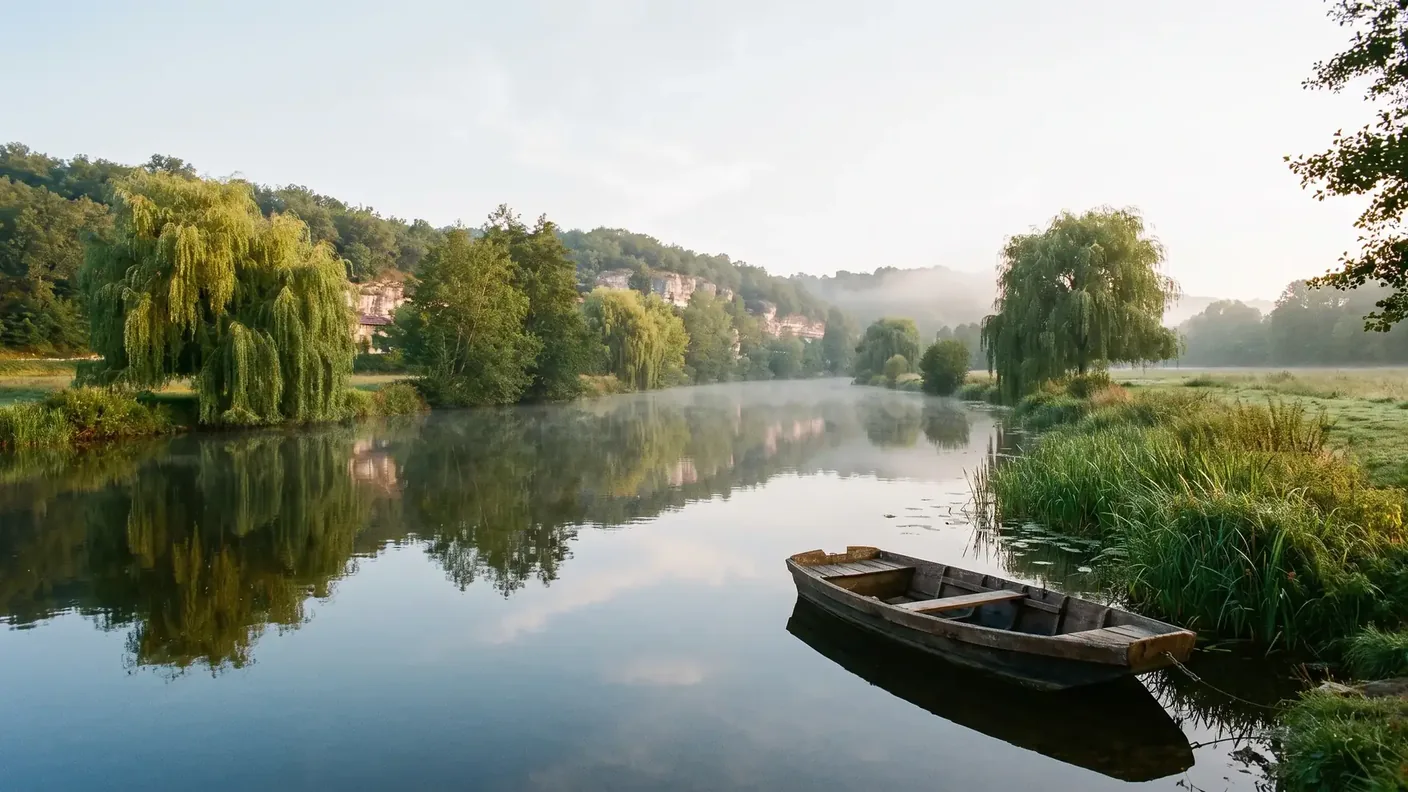
You can paddle down the river starting from Ribérac (trips ranging from 1 hour and 30 minutes to a full day) or from Aubeterre, a little further downstream in the Charente (trips ranging from 5 to 50 km, with a lifeguarded beach). In Tocane-Saint-Apre (14 km from Celles), there’s a designated swimming area and canoe rentals, kayaks, and gabarres round out the experience—plus, for the curious, the Monday morning market and, in July, the amazing “Irish Music Festival.” For cyclists, the Val de Dronne Cycle Route connects Ribérac to Aubeterre along 23 km of quiet roads running alongside the river and its churches—not to be confused with the Flow Vélo (V92), which runs further north.
Around Celles: castles, a monolithic village, and the "Venice of the Périgord"
Celles is a convenient starting point for exploring the entire northwestern Périgord region and the Charente area. Must-see attractions, all within 40 minutes:
| Website | Directions from Celles | The Essentials |
|---|---|---|
| Grand-Brassac | 6 km · 9 min | listed fortress church (1885), polychrome statues |
| Ribérac | 10 km · 13 min | Capital Market (Friday), Canoe, Arnaut Daniel |
| Tocane-Saint-Apre | 14 km · 17 min | Swimming in the Dronne River, Monday market |
| Bourdeilles | 18 km · 24 min | "Two castles in one" (fortress + Renaissance), designated as historic monuments |
| Aubeterre-sur-Dronne | 26 km · 31 min | "Most Beautiful Villages of France," monolithic church (Charente) |
| Brantôme | 27 km · 37 min | the “Venice of the Périgord,” a cave abbey |
| Périgueux | 38 km · 42 min | Vesunna, Saint-Front Cathedral |
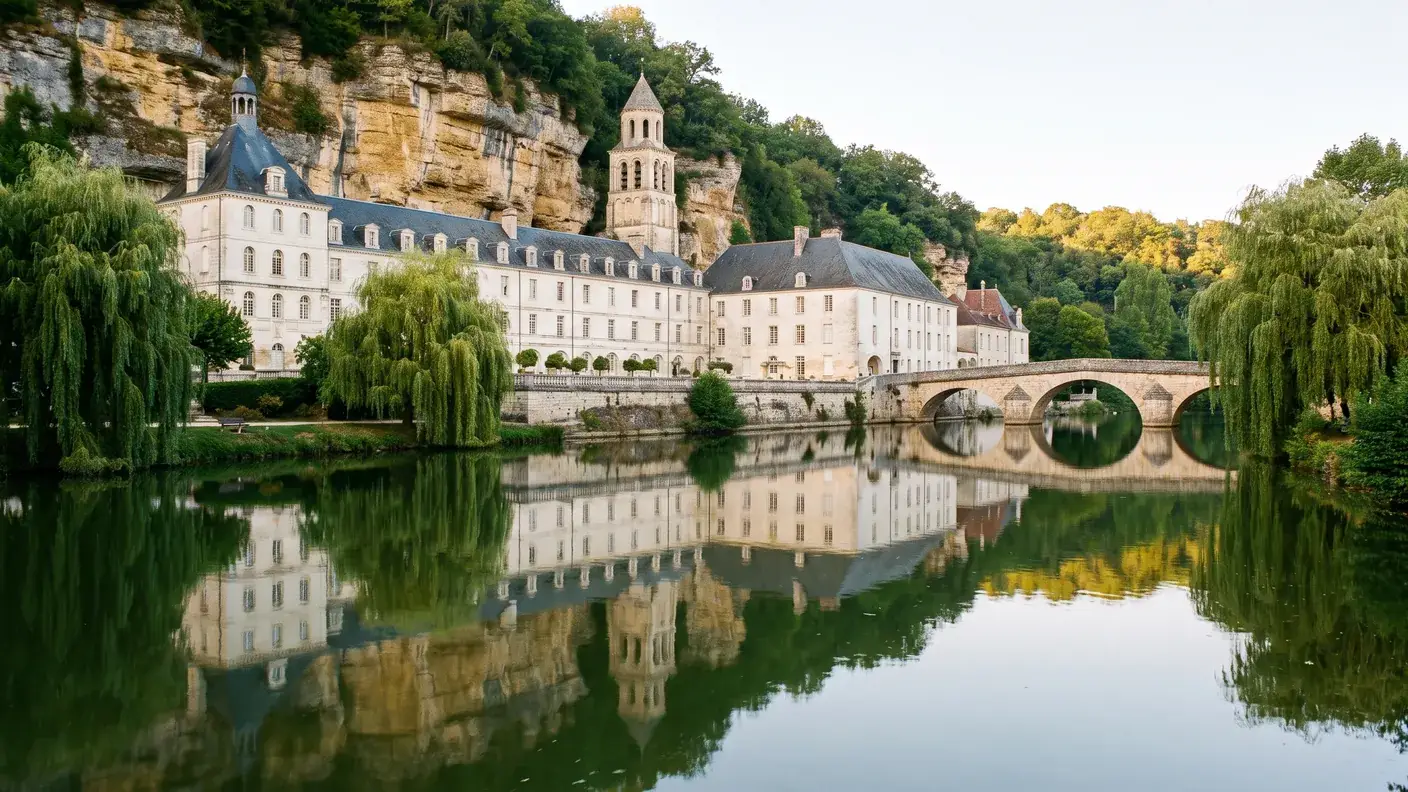
Two must-see highlights. Aubeterre-sur-Dronne (26 km, in Charente) is listed among the Most Beautiful Villages of France and is home to the monolithic Saint-Jean Church—the largest underground church in Europe, carved out as early as the 8th century: a 20-meter-high nave, 9,000 m³ of excavated rock, a 6-meter-tall monolithic reliquary inspired by the Holy Sepulcher in Jerusalem, and nearly 80 medieval sarcophagi. And Brantôme (27 km), the “Venice of the Périgord,” with its thousand-year-old abbey carved into the cliff—one of the most beautiful stops in the Périgord Vert. From Celles, these two marvels are just half an hour away, in opposite directions along the Dronne Valley.
Bordeaux → Celles: ~113.7 km, 1 h 26 min
The route follows the highway almost all the way to the end: the Bordeaux bypass, then the A89 “the Trans-European” to the Mussidan exit, and finally the Ribérac regional roads—the D708 toward Ribérac, then the D99 and D93 to the town of Celles. Allow for ~113.7 km and 1 h 26 min door-to-door. Previous estimates of 145–165 km are outdated; the currently mapped route covers 134 km.
| Option | Duration | Good to Know |
|---|---|---|
| Private Driver (Private Driver Service) | 1 h 26 min | Door-to-door, starting at 196 € — flexible stops (Ribérac, Grand-Brassac, etc.) |
| Personal car | 1 h 26 min | A89 (toll road), Mussidan exit, then D708/D99/D93 |
| Train + Road | ≈ 3+ hours | TER from Bordeaux to Périgueux (1 hr 10 min), then 38 km—to be arranged |
| Direct public transportation | — | No access to Celles — no train station, no shuttle bus from the hamlet |
The Ribérac section is the absolute weak point of the Périgord rail network. Ribérac does not have no more passenger rail service. [12] The only useful train station is Périgueux, 38 km away, with a TER train service—though you’ll need to check the frequency and schedule on the TER Nouvelle-Aquitaine website before departure—but you still have to get to Celles, and regional buses don’t serve the hamlets. In other words, for a village like Celles, the private driver from Bordeaux (1 h 26 min, starting at 196 € is a door-to-door option with no transfers all the way to the village.
When to Visit Celles
Life in the Ribérac region is best experienced during the warmer months, in tune with the rhythm of the river and the markets. Here are some highlights.
- May–June: The Dronne River is high and cool, the bocage is vibrant, and the Romanesque churches are bathed in beautiful light—the ideal season for canoeing and the “Circuit des Coupoles.”
- July–August: supervised swimming at Tocane and Aubeterre, rafting down the Dronne River, farmers’ markets—but also extreme heat (41.7 °C recorded in the area on August 11, 2025).
- June 24: the pilgrimage to the Saint-Jean-de-la-Lande Chapel in the woods of Celles—a true local tradition, rather than a conventional votive festival.
- Fall: On Fridays, the Ribérac walnut market (November); the countryside turns shades of gold and purple.
- December through mid-March: the Ribérac truffle market, every Friday—a gourmet winter in the Périgord Vert.
- All year round : The keep-church at Celles and the fortified church at Grand-Brassac are open to the public free of charge.
Our Tips for Success with Celles
- Start with the keep-church: you can explore it on your own. Take a closer look at the flat buttresses to see why it’s been nicknamed a fortress.
- Next, head to Grand-Brassac (9 min): the listed fortress church and its polychrome statues are the true highlight of the area’s cultural heritage.
- Take the "Dome Loop": Celles, Grand-Brassac, Bourg-du-Bost, Faye, Siorac-de-Ribérac—a half-day tour of fortified Romanesque churches through the bocage.
- Preferably on a Friday: the Ribérac market (150 vendors) is one of the most beautiful in the Périgord Vert—walnuts in November, truffles in winter.
- Canoe down the Dronne River from Ribérac or Aubeterre: the river, designated a Natura 2000 site, is exceptionally pristine.
- Continue on to Aubeterre (31 min): the underground monolithic church—the largest in Europe—is worth the trip across department lines all on its own.
- Combine this with Bourdeilles and Brantôme: just 24 and 37 minutes away, these two gems of the Périgord Vert are the perfect way to extend your day.
- Don't count on the train: Ribérac no longer has a passenger station.[12] A private driver from Bordeaux (1 h 26 min, starting at 196 €) is a door-to-door option with no transfers all the way to the village.
Celles doesn’t reveal its charm at first glance—it’s a village with no celebrities, no crowds, and no castle with a ticket office. But that is precisely what makes it special: a fortress-church that looks like a keep, a forgotten Charente priory, a parish that once revolved around the great barons of Périgord, and a village that—almost alone in the Ribérac region—is seeing its population grow again. All around, a whole unassuming region unfolds—the domed churches, the crystal-clear Dronne River, Grand-Brassac, Aubeterre, Brantôme. People don’t come to Celles just for Celles itself: they come for the gateway it provides to the most authentic part of the Périgord Vert. And that gateway is just two hours from Bordeaux.
Frequently Asked Questions
How much does a private chauffeur service from Bordeaux cost via Celles?
The trip from Bordeaux to Celles (Dordogne) with a private driver starts at 196 € one way (1 to 3 passengers, sedan), door-to-door. The price is fixed and quoted in advance—no meter and no surprise surcharges. An 8-seat van is available for families and small groups. Request a quote: you’ll receive a written response in less than 30 minutes.
How long does the trip from Bordeaux to Celles take?
Allow 1 h 26 min for ~113.7 km: the Bordeaux bypass, the A89 to the Mussidan exit, then the Ribérac regional roads (D708 toward Ribérac, D99, D93). The old estimates of 145–165 km are outdated; the currently mapped route covers 134 km.
Is Celles in the Dordogne the same as Celles-sur-Belle?
No, they are two separate municipalities. Celles in the Dordogne (zip code 24600) is a village in the Ribérac region of the Périgord Vert, with a population of 619. Celles-sur-Belle, in the Deux-Sèvres department, is a municipality much better known for its royal abbey church—which has no administrative or geographical connection to the former.
What is a “keep church”?
This is the term used to describe the Church of Saint-Pierre in Celles, whose fortifications (added in the 14th century) are so extensive that, given their size and sturdiness, they resemble a true castle keep rather than a simple fortified church. The Périgord region has many fortified churches, but few deserve this designation, which is reserved for the most accomplished examples. Note: The church is listed in the heritage inventory, but it is neither classified nor registered as a historic monument.
Where does the name "Celles" come from?
From the Latin *cella* (“monastic cell”); in Occitan, the village is called *Cela*. The name recalls that Celles was originally a Benedictine priory, subordinate to the Priory of Le Peyrat (sometimes referred to as an “abbey”), founded in 1065 in Blanzaguet-Saint-Cybard, in Charente. It is a fine example of the “Périgord Charentais”: a parish in the Diocese of Périgueux affiliated with a monastery in the Angoumois region.
What is there to see at Celles?
The Saint-Pierre keep-church (12th century, fortified in the 14th) is the main attraction, with free admission: stocky Romanesque architecture, flat buttresses, a bell tower with two pavilion-style towers, and Gothic side chapels. You can also see the Château de Lascoux (16th century, privately owned, not open to the public) and the Saint-Jean-de-la-Lande Chapel, a pilgrimage destination on June 24. The real highlight of the area’s heritage, however, lies in the immediate surroundings.
What is the connection between Celles and Bourdeilles?
In 1481, the parish of Celles was part of the castellany of Bourdeilles, one of the four historic baronies of the Périgord (along with Biron, Beynac, and Mareuil). At that time, Bourdeilles was divided into two parts—a pro-English barony and a royal castellany, to which Celles belonged—which were reunited in 1481 by François de Bourdeille. The Château de Bourdeilles, located 24 minutes away, is open to visitors (it has been a listed historic monument since 1919).
Does the church at Celles have a carved tympanum?
Probably not. We sometimes read that it has an Ascension tympanum, but the official heritage description describes a western portal flanked by two massive buttresses connected by an arch, with no carved tympanum at all. Such decoration would be extremely rare in the Périgord and would certainly have been noted. What we can see for certain is a Romanesque nave with a barrel vault, a choir with a flat apse, and Gothic side chapels.
What's there to see around Celles?
The best of the Ribérac region. Grand-Brassac (9 min) and its listed fortress church with polychrome statues; Ribérac (13 min), the market town; Bourdeilles (24 min) and its two castles; Aubeterre-sur-Dronne (31 min), one of the “Most Beautiful Villages of France” with its underground monolithic church; and Brantôme (37 min), the “Venice of the Périgord.” All connected by the Dronne Valley.
Is it possible to go canoeing near Celles?
Yes: The Dronne River runs along the southern edge of Celles and is one of the most beautiful rivers for canoeing in southwestern France—with clear water and designated as a Natura 2000 site. You can paddle down the river from Ribérac (trips ranging from 1.5 hours to a full day; rental center at the municipal campground) or from Aubeterre further downstream (trips ranging from 5 to 50 km; supervised beach). There’s also a designated swimming area in Tocane-Saint-Apre, 17 minutes away.
How can I get to Celles without a car?
It's very difficult: the man from Ribérac hasn't no more passenger stations. [12] The only useful TER station is Périgueux, 38 km away, with a TER train service—the frequency and schedule of which should be checked on the TER Nouvelle-Aquitaine website before departure—but you’ll then need to make your way to Celles, and regional buses do not serve the hamlets. The Private Driver in Bordeaux → Celles (1 h 26 min, starting at 196 € is a door-to-door option with no transfers all the way to the village.
How many residents are there in Celles?
619 residents according to the 2023 census, an increase of +5.45% since 2017—a growth rate significantly higher than the departmental average (+0.97%). After losing two-thirds of its population over two centuries (1,798 residents in 1793, dropping to a low of 552 in 1999), Celles has been on the rise again since the 2000s, bucking the trend of most villages in the Ribérac region.
What is the “land of domed churches” in the Ribérac region?
A remarkable heritage site: a about thirty Romanesque churches with domes from the 12th century, scattered around Ribérac. By transferring the load to very thick walls, the dome made it possible to incorporate defensive chambers—hence the countless fortress churches (Grand-Brassac, Siorac-de-Ribérac, Saint-Martial-de-Viveyrol…). Celles, with its keep-church, serves as a gateway to this region. A marked trail connects them through the bocage.
Further Reading
- The Venice of the Périgord, 37 minutes away : see the Guide to Brantôme (cave abbey, Dronne, thousand-year-old bell tower)
- Another parish in the barony: see the Guide to Vieux-Mareuil (domed church, Mareuil Castle)
- The 2,000-Year-Old Prefecture: See the Guide to Périgueux (Vesunna, Saint-Front)
- The capital of the Périgord Noir: see the Sarlat Guide
- Plan your trip: Book a private driver from Bordeaux → Celles or explore all our destinations
Sources and References
- Wikipedia — Celles (Dordogne) — geography, demographics, place names, history
- Mérimée Database (General Inventory) — Saint-Pierre Church — architecture, flat buttresses, unprotected status
- CDT Dordogne-Périgord — Saint-Pierre Church in Celles — Date and Visitor Information
- Wikipedia — Château de Lascoux — Pontbriand, 1593 conference, Foucauld de Pontbriand
- Wikipedia — Bourdeilles — 4 baronies, castellany, exchange in 1340, merger in 1481
- Wikipedia — Grand-Brassac Church — a fortress church listed as a historic monument in 1885, with polychrome statues
- Wikipedia — Blanzaguet-Saint-Cybard — Peyrat Priory, founded in 1065, Charente
- Wikipedia — Ribérac — market, Arnaut Daniel, collegiate church, canoe
- Tourist Office of the Ribéracois Périgord — domed churches, Val de Dronne, along the river
- Wikipedia — Aubeterre-sur-Dronne — Most Beautiful Villages, monolithic church
- INSEE — Municipality of Celles (24090) — 2023 Population and Municipal Data
- TER Nouvelle-Aquitaine — Network, Stations, and Schedules — Check Current Stations and Passenger Service Routes
Article updated on .
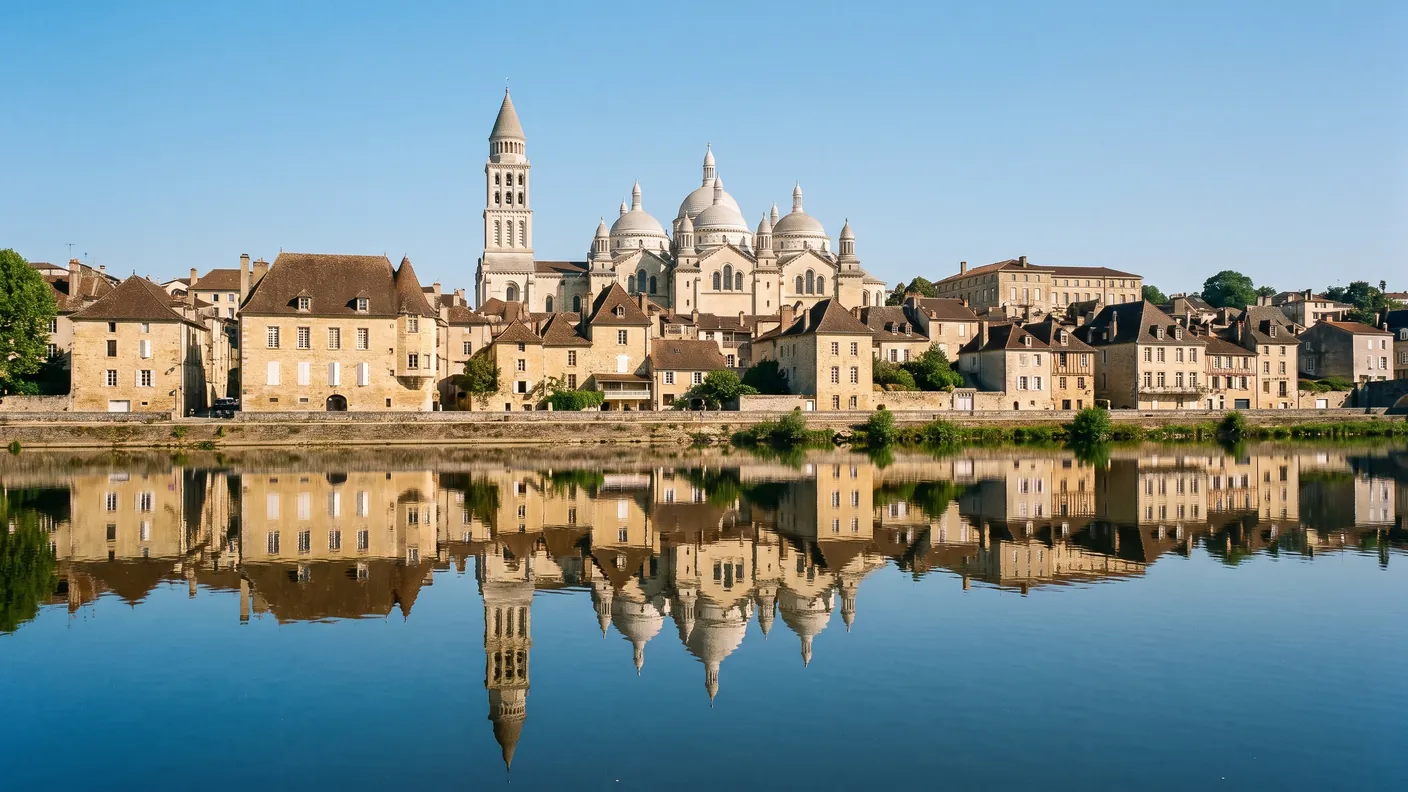
Off to the Ribérac region
Direct trip from Bordeaux (1 h 26 min) via the A89, with stops along the way as desired—Grand-Brassac, Ribérac, Bourdeilles. Written fixed-price quote within 30 minutes; sedan or 8-passenger van; English-speaking driver.