Bordeaux to Siorac-en-Périgord: the crossroads of the Périgord Noir
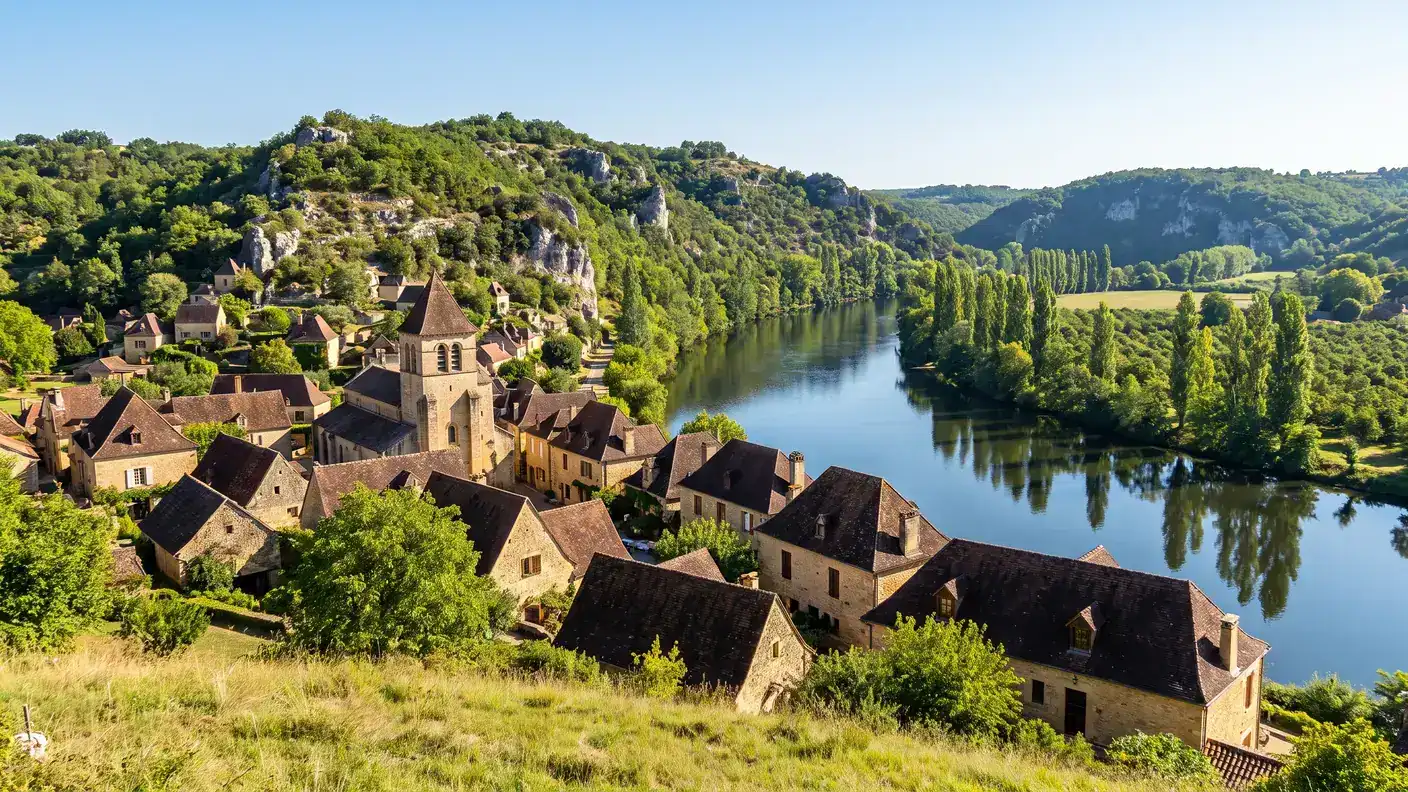
The crossroads village of the Périgord Noir: the confluence of the Dordogne and Nauze rivers, two castles—one of which is now the town hall, a train station dating from 1863 that’s still in use on the Sarlat line, a name engraved on Mars by NASA—and Belvès, Cadouin, Les Eyzies as neighbors. Everything you need to know before you visit, about 2 hours and 20 minutes from Bordeaux.
In a nutshell
- Siorac-en-Périgord has a population of 1,082 (2023)—a 38% increase since 1968, a rare trend for a rural village in the Périgord.
- The village was founded in confluence of the Dordogne and the Nauze — a crossroads of waterways, roads, and railroads that explains its entire history.
- First written record: A papal bull issued by Pope Eugene III in 1153 lists the “curtes de Ciourac” among the parishes of Sarlat Abbey.
- The village has two castles—and the town hall is located in the 18th-century castle, which was designated a historic monument in 2013.
- The town has only been called “Siorac-en-Périgord” for a Decree of November 22, 1923 — it used to be called Siorac-et-Fongauffier… and the mail went missing.
- The station, built in 1863, is still going strong: served by the Bordeaux-Sarlat TER, its ridership has increased sixfold since 2020 (23,491 passengers in 2024, SNCF Open Data).
- The Wednesday market dates back to a royal charter issued by Louis XIII (1612)—more than 400 years of continuous operation.
- In March 2021, the NASA has named it "Siorac" A target for analysis by the Curiosity rover—the village is named after him on Mars.
- Count ~2 hours and 20 minutes from Bordeaux by road (about 163 km via Bergerac) — or the Direct TER in less than 2 hours.
Before You Go: What Siorac Is Really Like
8:45 a.m., a Wednesday in July. In the square, the market stalls are setting up—just as they have every Wednesday since Louis XIII granted the village this privilege in 1612. Near the train station, the TER from Bordeaux glides along the platform; two cyclists step off, their panniers full, heading for the valley. Between the two, the bridge built in 1857 spans the Dordogne exactly where the ford once stood that Blaise de Monluc crossed with his army in 1562. Siorac isn’t just a backdrop: it’s a crossroads that’s still very much alive.
Don’t look here for the Beynac cliff or the bastide town of Domme: Siorac is a village at a river confluence—where the Nauze meets the Dordogne—and a stopover. A strategic ford, then a toll bridge, then a railway junction: three centuries of serving the same purpose. It’s also one of the few villages in the Périgord that has been gaining residents for the past half-century, precisely because it has retained its train service, its market, and its shops.
And it holds some astonishing stories: a castle that houses the town hall, a co-lord who served as a weather vane and was executed in 1439, a name engraved on Mars by NASA, and the hero of a saga that has sold 6 million copies — Pierre de Siorac, from *Fortune de France* — who gave the town its name.
This guide covers everything in order—the origins, the Hundred Years' War, the two castles, the 1923 name, the train station, the river, and the surrounding area—as well as practical information, including how to get to Siorac from Bordeaux by train, by car, or with a private driver.
Siorac at a Glance: Geography and Demographics
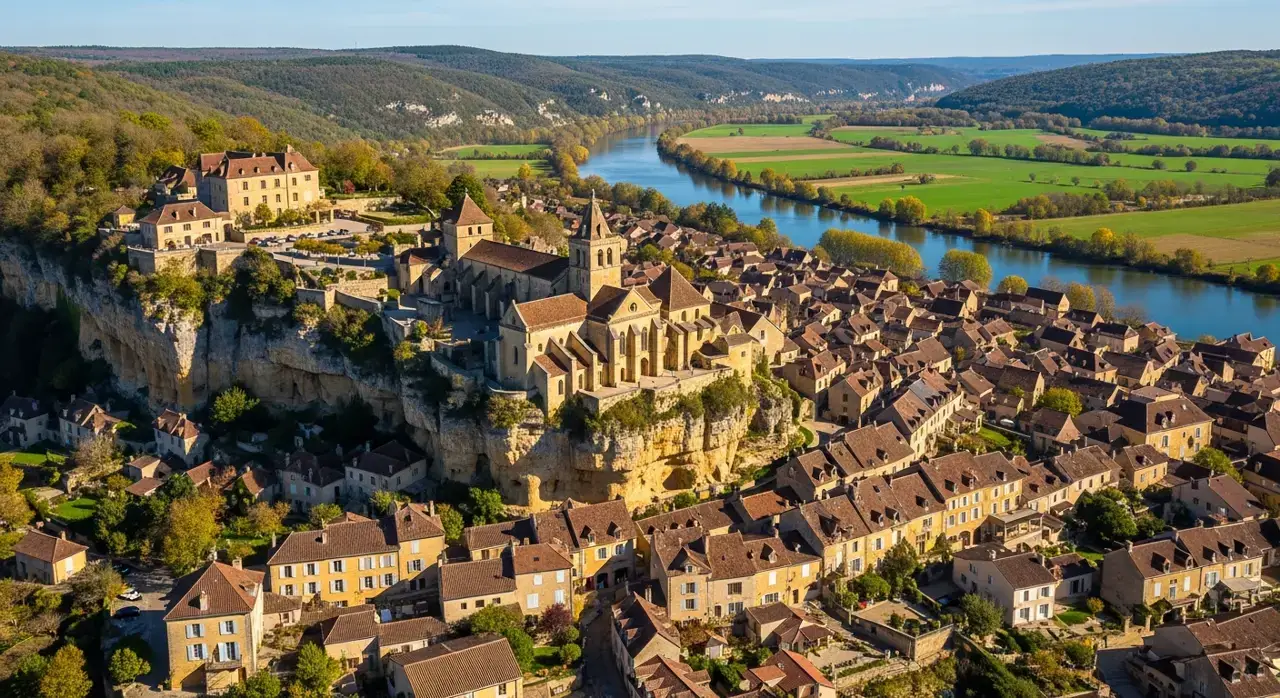
Siorac is located on the left bank of the Dordogne, southwest of the Black Périgord. The river runs along the edge of the town for 6.5 km ; the Nausea, flowing down from Belvès, runs parallel to it for more than 4 km before joining it—the confluence is within the municipality, across from Coux-et-Bigaroque. A third watercourse, the Valley, completes this transportation hub.
| Data | Value |
|---|---|
| Status | Municipality in the Dordogne (24), Périgord Noir |
| Population | 1,082 residents (2023) — the residents of Siorac |
| Evolution | +38% since 1968 · +2.75% since 2017 (Dordogne: +0.97%) |
| Elevation | 46 m to 193 m |
| Area | 11.77 km² |
| Label | 1 flower — Towns and Villages in Bloom (2025) |
| Belvès | ≈ 6.5 km (7 min) |
| Sarlat-la-Canéda | ≈ 29 km (just under half an hour) |
| Distance from Bordeaux | ≈ 163 km via Bergerac · ~2 hours 20 minutes (direct TER train: less than 2 hours) |
The population trend tells two stories. The long-term one: a peak of 1,377 residents in 1846, rural depopulation, and a low of 784 in 1968. The more recent, more surprising one: a nearly continuous rise since then—nearly 300 residents gained over half a century, while so many neighboring villages are emptying out. The National Institute of Statistics and Economic Studies (INSEE) classifies the town as “rural with scattered settlements,” outside any urban catchment area: Siorac owes this growth solely to its own assets—the train station, the bridge, the shops, and the valley.
Seven municipalities border it, including Le Buisson-de-Cadouin to the northwest and Sagelat to the southeast—where the hamlet of Fongauffier is located today, the former abbey town that gave the municipality its name until 1923. Beneath our feet lies the Upper Cretaceous limestone plateau—the Santonian stage, with its oyster and flint limestones—the same pale-colored stone used to build the church, the castles, and the houses in the village.
The Origins: Severus, a Papal Bull, and an English Bastide
From the dolmen to the Gallo-Roman estate
The oldest monumental site in the area dates back to prehistoric times: the Cayre Leva dolmen, south of the village. The village’s name, meanwhile, dates back to antiquity: Siorac derives from the Gallo-Roman surname Severus—it was the “estate of Severus,” formed with the suffix -acum. In Occitan, it is still known as Sieurac de Perigòrd.
1153: The “Curtes of Ciourac” in a Papal Bull
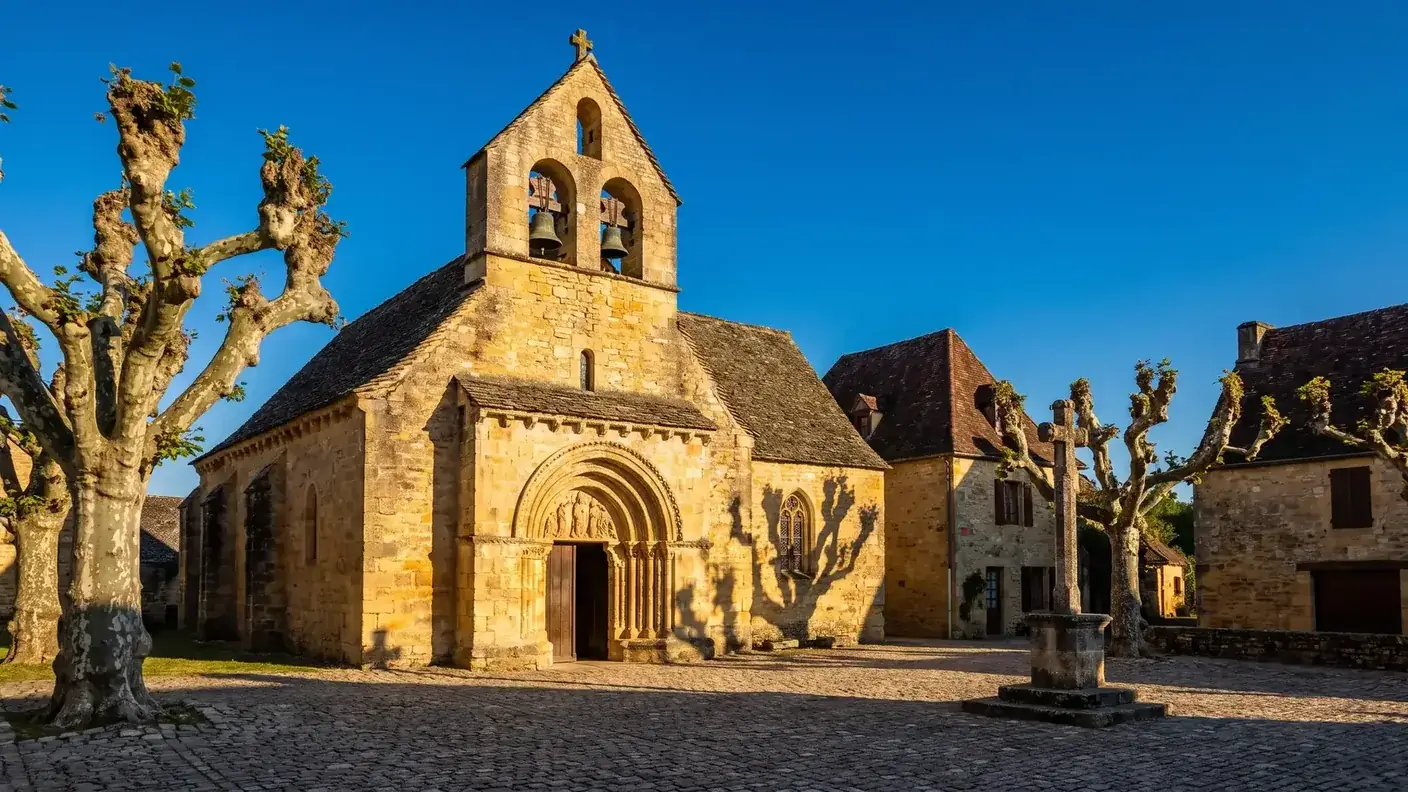
The first written record is a notable one: in the first half of 1153, a few months before his death, Pope Eugene III issued a papal bull to the Benedictine Abbey of Sarlat that listed the “curtes de Ciourac” among its parishes. Ten years earlier, in 1143, the village’s first church—now known as Saint-Pierre-ès-Liens—had been built. Destroyed during the Hundred Years’ War, rebuilt in the Gothic style, burned down by the Protestant troops of the Viscount of Turenne, and repaired in the early 17th century: the current building alone encapsulates the turbulent history of the Périgord. Its four chapels were built by the co-lords of Siorac as their burial places; its largest bell dates from 1764, its stained-glass windows are the work of Jean Besseyrias and Antoine Bernard, and the cemetery surrounded it until 1900.
Fongauffier: A Duke Murdered and an Abbey Founded by a Woman
The village’s other origin lies in Fongauffier, on the Nauze River. Tradition holds that this is where Waïfre, the last Duke of Aquitaine, fled: taken by surprise by Pepin the Short’s soldiers while he was cooling off at the fountain—which took his name, Font-Gauffier—he is said to have “crossed the Dordogne at the Siorac ford” before being assassinated in 768. This is a local legend, to be taken as such—but the Abbey of Fongauffier, founded in 1095 by a woman named Eubolène—a rarity for the time—and affiliated with Saint-Géraud d’Aurillac, is well documented; its abbey town had been established as early as 1094.
Castel-Réal, the English-style fortified town that ended up in court
Before May 1288, the English founded a bastide in the hamlet of "Castel-Réal" — “royal castle” — on the Siorac estate, owned by the Abbey of Sarlat. The matter escalated into a legal dispute: the case went all the way to the Paris Parliament, with legal documents dating from 1268 and 1291. All that remains of this bastide today is its name—but few villages can trace their neighborhood disputes back to the 13th century.
The Hundred Years' War: The Coalition of 1373 and the Abzac Weather Vane
Due to its strategic location, Siorac found itself on the front lines of the Hundred Years' War: its fortress—built around 1100—was occupied by the English.
May 1373: The Périgord Coalition
In May 1373, in the midst of Charles V’s reconquest, a coalition largely composed of forces from the Périgord region attacked the castle: Gilbert de Domme, Pons de Beynac—Lord of Commarque—and the troops of the town of Sarlat. The English withdrew from the stronghold… only for troops in their pay to reoccupy it. The victory was short-lived: in this valley, nothing was ever certain.
Bertrand d'Abzac, co-lord of Girouette
The most colorful figure of this period was a co-lord of Siorac: Bertrand d'Abzac. A captain in the service of the English, he defected to the King of France in 1414 —his marriage to Jeanne de Beynac brought him Domme-Vieille as a dowry—; he was taken by surprise in Domme in 1417 by the English captain Bertrand Suran… and defected back to the English, who rewarded him with the governorship of Domme. Captured in 1438 by Jean de Carbonnières and handed over to the king, he was executed in Limoges on March 11, 1439—he “was quartered,” according to the sources. The ambiguity of allegiances in this border region, encapsulated in a single life.
1440: The Plague, and a ransom called “sufferte”
In 1440, the plague struck the region—and the consuls of Sarlat, in order to buy peace, paid a “sufferte” (ransom) to the English garrisons that still held the area: Cuzorn, Belvès, Montferrand, Berbiguières, Castelnaud… and Siorac. The village is specifically named on the list of English strongholds that were paid off to ensure peace. A family epilogue: after being captured, Bertrand d’Abzac watched as his sons Jean and Gantonet surrendered Domme under the terms of the Treaty of Gourdon, signed on September 15, 1438.
1595: The Croquants lay down their arms… in Siorac
A century and a half later, Siorac made its mark on national history one last time: After their defeat near Saint-Crépin on August 26, 1595, the Croquants—the great peasant uprising of the Périgord—held a meeting in Siorac and decided there to lay down their arms. In 1596, the king granted a remission of tax arrears. The first Croquants revolt thus came to an end here, on the banks of the Dordogne.
The two castles in Siorac—and the town hall, which is housed in one of them
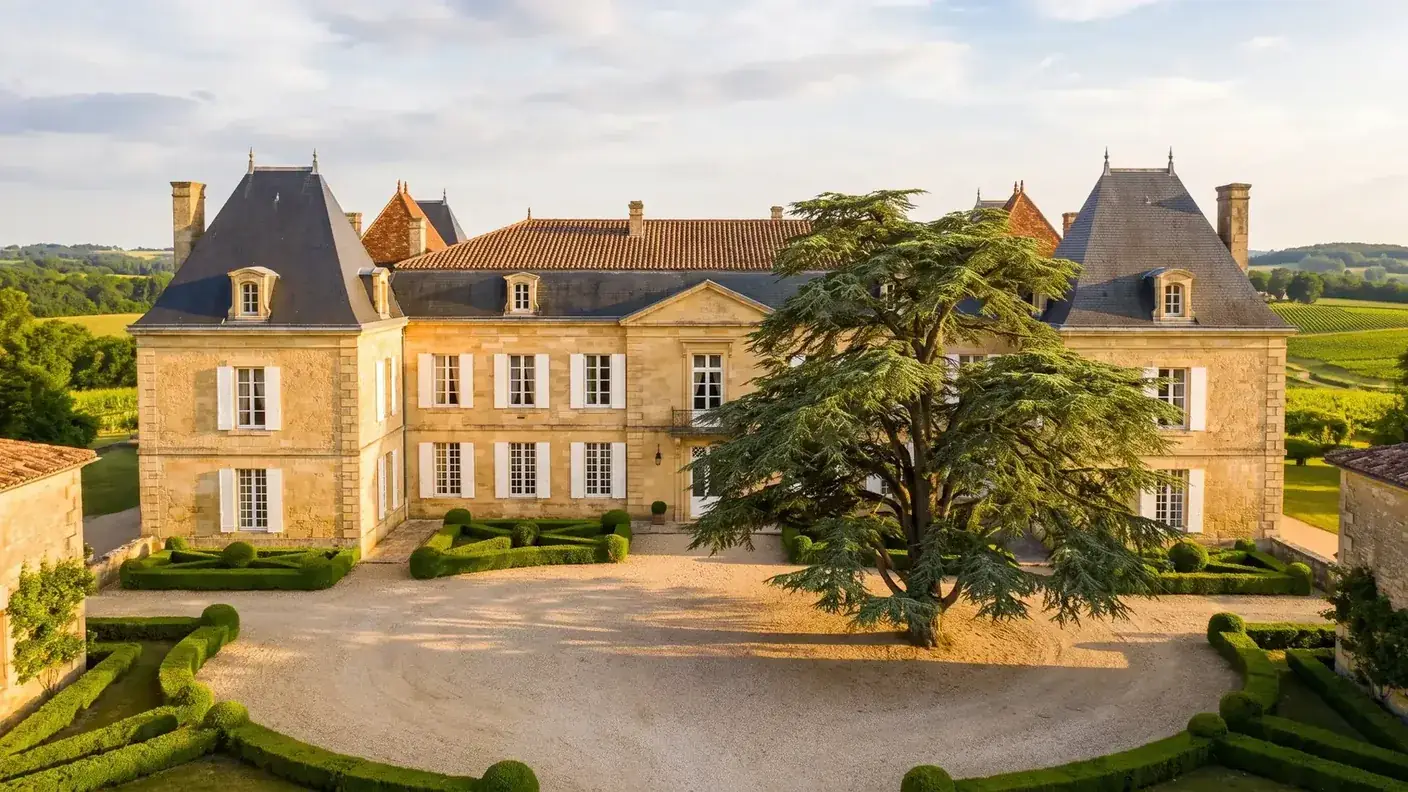
A surprise for anyone who skims through brochures too quickly: Siorac has two castles. The parish priest Robert Laguionie noted this as early as 1838: “Siorac has two castles; one is modern, since it is only 61 years old. ”—it is this very sentence that allows us to date the completion of the large castle to around 1777.
Four lineages over five centuries
| Period | Family | Key Takeaways |
|---|---|---|
| Middle Ages → 1585 | from Abzac | Co-owners for about two centuries; the widow Marquèze d'Abzac sold the property in 1585—for 40,000 livres |
| 1585 → 1598 | from Sireuil | In 1612, “Captain Sireuil” obtained from Louis XIII the right to hold two fairs and a Wednesday market |
| 1598 → ~1706 | Leo | Barons of Belcastel; Jean du Lion married Damaris de Vivans in 1657, a descendant of the famous Geoffroy |
| ~1706 → 19th century | de Laverrie de Vivans | They earned the right to add “de Vivans” to their name in 1745, following a lawsuit; they built the current castle |
A few key dates mark this long family history. The house appears in a Parliamentary decree of 1281 — nearly 750 years of documented history. Among the d'Abzac family, we come across Adémar (died in 1414), also lord of La Douze and Montastruc, then Jean, known as "Pochi", who married Hélène de Montferrand in 1460, and Jean II “the Younger” (1474–1546). In the Sireuil family, the "Captain Sireuil" — an illegitimate son legitimized by Henry III in 1583 — distinguished himself in 1597 at the Amiens Conspiracy against the Spanish: after being captured, he was exchanged for prisoners. As for the transfer of the Laverrie estate, it was settled in court: the du Lion family’s property was awarded in 1705 by the Bordeaux Parliament, with possession taken in May 1706.
The 18th-Century Castle: From the Reign of Terror to City Hall
François-Antoine de Laverrie de Vivans (1742–1798) had the castle built between 1760 and 1780 — a two-story residence situated between two asymmetrical pavilions, built on top of an older structure of which the cellars and masonry still remain. The Revolution caught up with it: its furnishings were requisitioned by the district of Belvès on March 16, 1794, the lord of the castle and two of his daughters were imprisoned, and his eldest son went into exile—before the amnesty of 1804. In 1818, the west wing was sold; the municipality requisitioned it as early as 1825 to serve as the rectory… and that is how the The Siorac Town Hall is now located in a castle, listed as a Historic Monument on May 23, 2013 — the only historic monument in the town.
And what about the other castle? That’s the medieval one—built around 1100, associated with the English and the coalition of 1373, burned down during the Wars of Religion, purchased in ruins around 1810 by the de Lavalle family, and rebuilt using its own stones. It faces the town hall: the two castles of Siorac look at each other. Please note: the interior is not open to the public—a museum of culinary arts and tableware has been set up in the historic castle, but check its opening hours with the town hall before visiting.
1923: The Year Siorac Changed Its Name (Because of the Mail)
Here’s the village’s favorite administrative anecdote—one that many tour guides get wrong. Before 1923, the town was officially called Siorac-et-Fongauffier (spelled “Sivrac et Fongaufier” in the 1801 Bulletin des lois). But in common usage—and on the pediment of the train station—everyone called it “Siorac-de-Belvès.” Two names for the same village: the mail would get lost.
The March 11, 1923, the city council notes that this dual name is causing “significant delays in the delivery of mail” and requests a single name. The Dordogne Departmental Council approves the April 25, with the approval of the Postmaster General — and the Decree of November 22, 1923 Approves the new name: Siorac-en-Périgord. The station was renamed that same year.
| Period | Official name of the municipality |
|---|---|
| 1793 | Siorac |
| 1801 | Siorac-et-Fongauffier (“Sivrac and Fongaufier”) |
| Common usage | "Siorac-de-Belvès" (name of the train station from 1863 to 1923) |
| Since 1923 | Siorac-en-Périgord |
Three official names in 130 years, plus a common name: the current name celebrated its centennial in 2023. And to clear up a common misunderstanding: Siorac-de-Ribérac, the other Siorac in the Dordogne, is a completely separate town in the western part of the department—unrelated to this story.
Siorac Station: 160 Years of Railways and a New Lease on Life
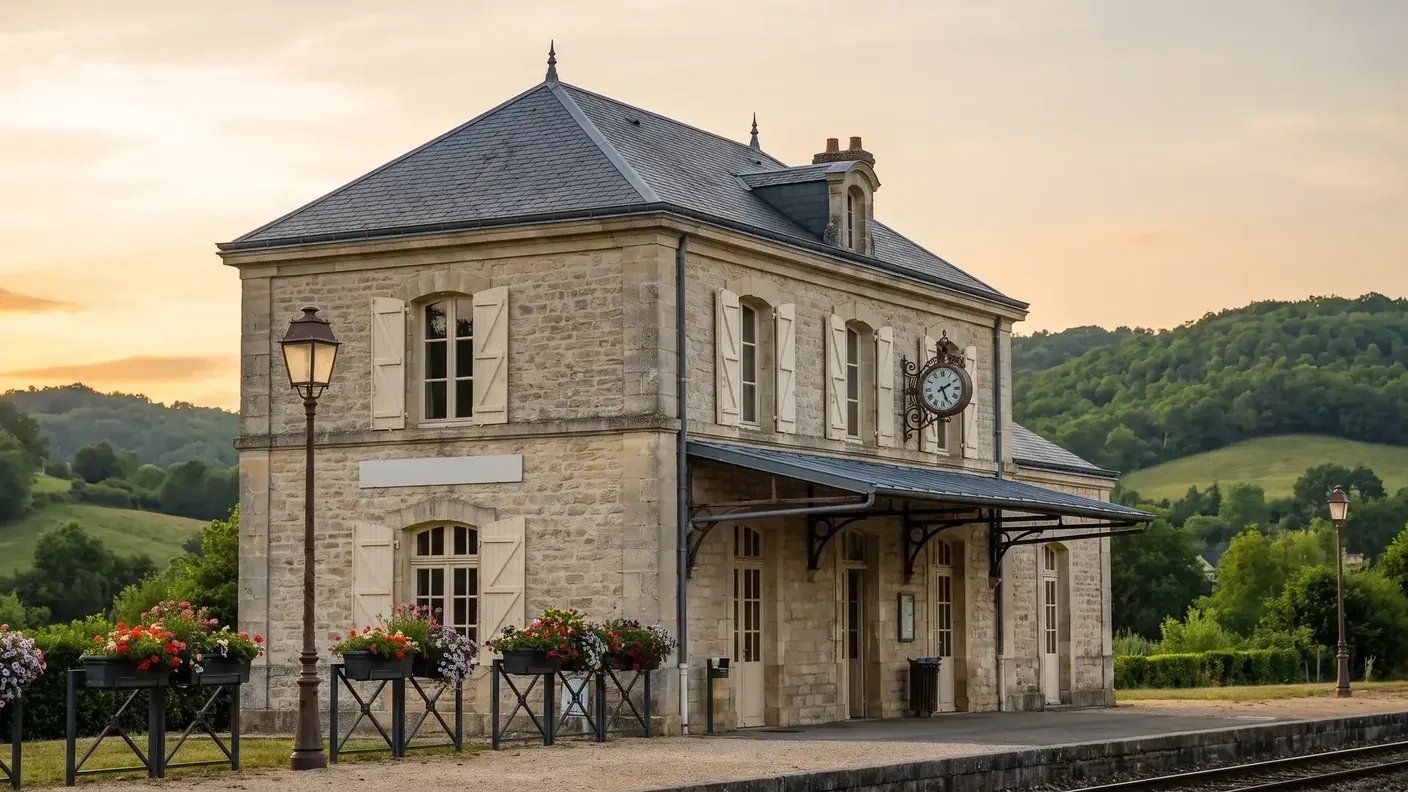
If there is one common thread running through Siorac's modern history, it is the railroad tracks. The "Siorac Station" opens the August 3, 1863, on the Niversac–Agen line of the Compagnie du Paris-Orléans—a route envisioned as early as 1853 by the Count of Morny as a section of a Paris-Madrid. When the line opens, there will be three direct trains a day between Agen and Paris; the fastest takes 14 hours and 45 minutes.
1882: The Turning Point That Changed Everything
The July 2, 1882, the line to Sarlat Opens from Siorac: the village becomes junction station. The recipes speak louder than words: 73,225 francs in 1878, 143,339 in 1881 — nearly double that. As early as 1883, the passenger station had to be expanded (the original had only two entrances, and the vestibule served as a waiting room), and a second track had to be laid from Le Buisson. In 1943, the German occupiers dismantled one of the two tracks heading south: the current configuration—double track up to Siorac, single track beyond—dates from that time.
| Date | Railway Timeline |
|---|---|
| August 3, 1863 | Put into service by the Compagnie du Paris-Orléans (Niversac–Agen line) |
| July 2, 1882 | Opening of the line to Sarlat — Siorac becomes a junction |
| 1883 | Expansion of the passenger terminal + 2nd track at Le Buisson-Siorac |
| 1923 | The "Siorac-de-Belvès" station is being renamed "Siorac-en-Périgord" |
| June 1, 1980 | Closure of the Sarlat-Cazoulès section (decommissioned in 1992) |
| 2007 / 2013 | Modernized station (71,000 €) / track rehabilitation (25.000 metric tons of ballast) |
| 2024 | 23,491 passengers — a sixfold increase since 2020 (SNCF Open Data dataset, 2015–2024) |
The route that bypassed Villeneuve-sur-Lot
A behind-the-scenes railway anecdote: The reason the line runs through Siorac and the Lémance Valley rather than through Villeneuve-sur-Lot is that the Compagnie du Paris-Orléans, owner of the Fumel ironworks, insisted on a route that served its own factories. Le Bugue, however, had made its case by touting its shipments of fattened cattle, chestnuts, truffles, and truffle-stuffed poultry—the 19th-century sales pitch in all its glory. After the golden age, the decline was abrupt: the station’s revenue plummeted from 143,339 francs (1881) to 41,721 francs in 1886.
Today: The TER, and Ridership Skyrocketing
The Siorac station connects the town to the Bordeaux–Sarlat and Périgueux–Agen TER lines. For the Bordeaux–Siorac route, SNCF Connect listed five daily trips and a best travel time of 1 hour and 55 minutes on July 24, 2026; schedules vary by date. This service maintains Siorac as a rail access point to the center of the valley (official source).
Passenger traffic, as measured by SNCF Gares & Connexions, is expected to rise from 3,943 passengers in 2020 to 23,491 passengers in 2024, according to the “Station Passenger Traffic” dataset covering 2015 through 2024. The track was also upgraded in 2013, and Sarlat is now the terminus of the branch line.
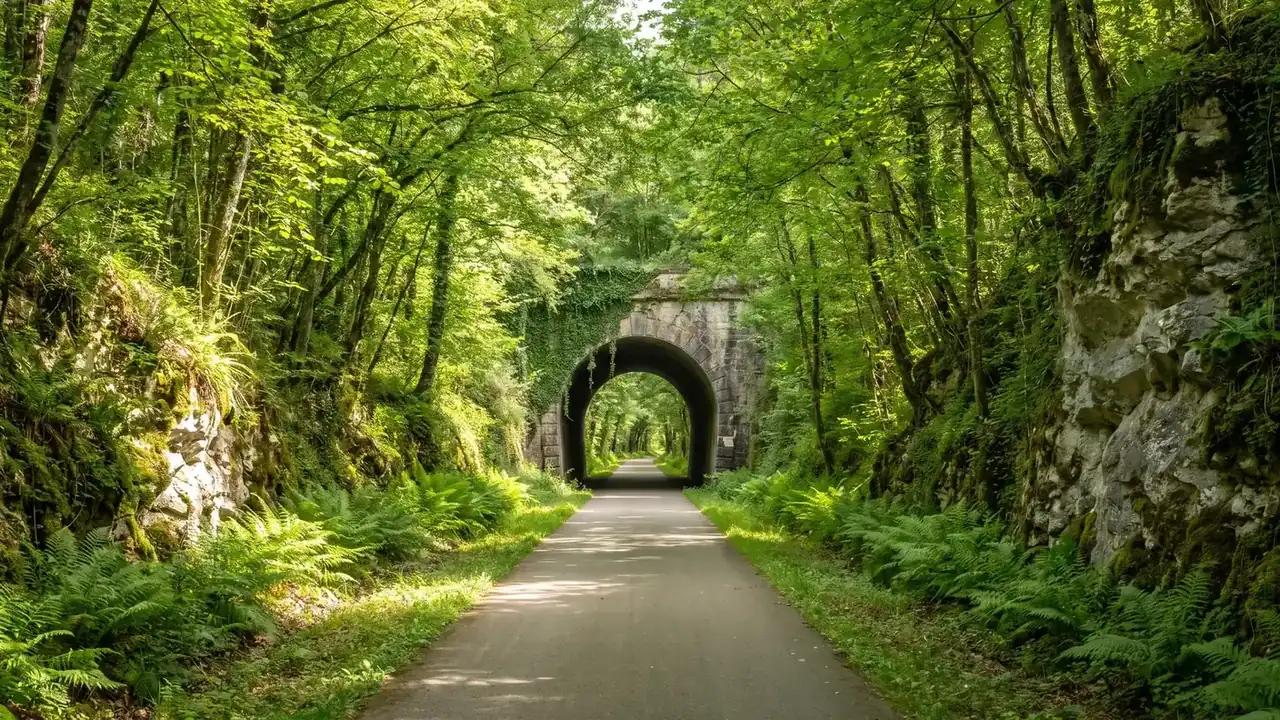
As for the Sarlat-Cazoulès section, which closed in 1980, it has been given a new lease on life: its right-of-way has been transformed into a 21-kilometer greenway—including a 464-meter tunnel. You can start the route in Sarlat (half an hour from Siorac): it’s the perfect way to round out a day of cycling in the valley.
Tobacco, truffles, and local supply chains: the economy of a stopover town
Tobacco: The Rise and Fall of an Industry
The alluvial soils of the Périgord valleys have long supported the tobacco, a demanding but profitable crop for small farms — the Bergerac Tobacco Museum, which has been located in the Peyrarède house since 1983 and is the only one of its kind in France, tells the story of this epic era, and there is still a cooperative called “Périgord Tabac.” The decline began in: the France's last tobacco processing plant closed in September 2019… in Sarlat, half an hour from Siorac. The Périgord Noir was the first and last stronghold of the French tobacco industry.
Truffles: Beware of Myths
You sometimes read that a “truffle market” is said to have brought fame to Siorac—but be wary: the famous “Truffadou” is actually the train that transported truffles from the market in Martel, in the neighboring Lot department (up to 10 metric tons were offered!), to Bordeaux and Paris. What is well-documented in Siorac is a thriving freight operation: the station’s freight hall still stands—and the former freight station now houses the Comptoir des Producteurs, a farm-to-consumer market. From railcar to local food system: the perfect transformation.
A Working Town
With 127 businesses listed (retail stores, artisans, service providers), Siorac serves as a hub for the entire valley—its supermarket generated 13 million euros in revenue, ranking 48th among retail businesses in the Dordogne: not bad for a village of just a thousand residents. A native son who became an industrialist: Élie Creyssensac, born in Siorac in 1896, founded the air compressor company in 1934 that still bears his name within the Atlas Copco Group. And four centuries later, the Wednesday morning market continues to honor the letters patent issued by Louis XIII.
Siorac on Mars, Siorac in Bookstores: A Low-Key Celebrity
A Martian rock named Siorac
This is the most unlikely anecdote in this guide: In March 2021, NASA named one of the Curiosity rover’s analysis targets “Siorac,” located on a rock outcrop on Mars. At the time, the mission was naming its targets after villages in the Périgord region—the Nontron area even gave its name to a mineral, nontronite. A village of 1,082 residents whose name is etched on the Red Planet: that’s sure to be a talking point at the Wednesday market.
Pierre de Siorac, the hero of *Fortune de France*
The other claim to fame associated with the name is literary. Robert Merle (1908–2004) identified in Siorac the opening of his grand historical fresco Fortune of France — thirteen volumes, 6 million copies copies sold, including one million for the first volume alone. Its hero, Pierre de Siorac, a young Protestant nobleman from the Sarlat region, is the namesake of the village. Since September 2024, the TV adaptation is airing on France 2—filmed in part at the Château de Beynac, sixteen minutes from here. Reading Merle before you come means arriving on familiar ground.
The Bridge, the Ford, and the River: Siorac on the Dordogne Side
From the Waïfre Ford to the Toll Bridge
Before the bridge, there was the ford — the one from the legend of Waïfre, the one that the Catholic army of Blaise de Monluc, reinforced by Spanish troops, crossed the October 6, 1562 in the midst of the Wars of Religion. The bridge built in 1857, built during the Second Empire slightly upstream from the ford and dedicated to the Virgin Mary, replaced several structures that had been swept away by floods—and was initially toll road. The Bridge Festival, on the first weekend of August, joyfully keeps the memory alive (fireworks included).
Canoeing: The Dordogne, France's Premier River
The Departmental Tourism Committee puts it plainly: the Dordogne is “France’s top destination for recreational canoeing.” In Siorac itself, the A Canoë Raid outpost (at Le Port, in Campeyral) offers routes ranging from 7 to 28 km, lasting from a few hours to several days, on both the Dordogne and the Vézère rivers. Due to the direction of the current, you’ll paddle downstream from here toward Le Buisson and Limeuil; for the spectacular scenery of the castles, the rental companies will shuttle you upstream—the classic Beynac → Saint-Cyprien descent (13 km) takes you past cliffs and fortresses.
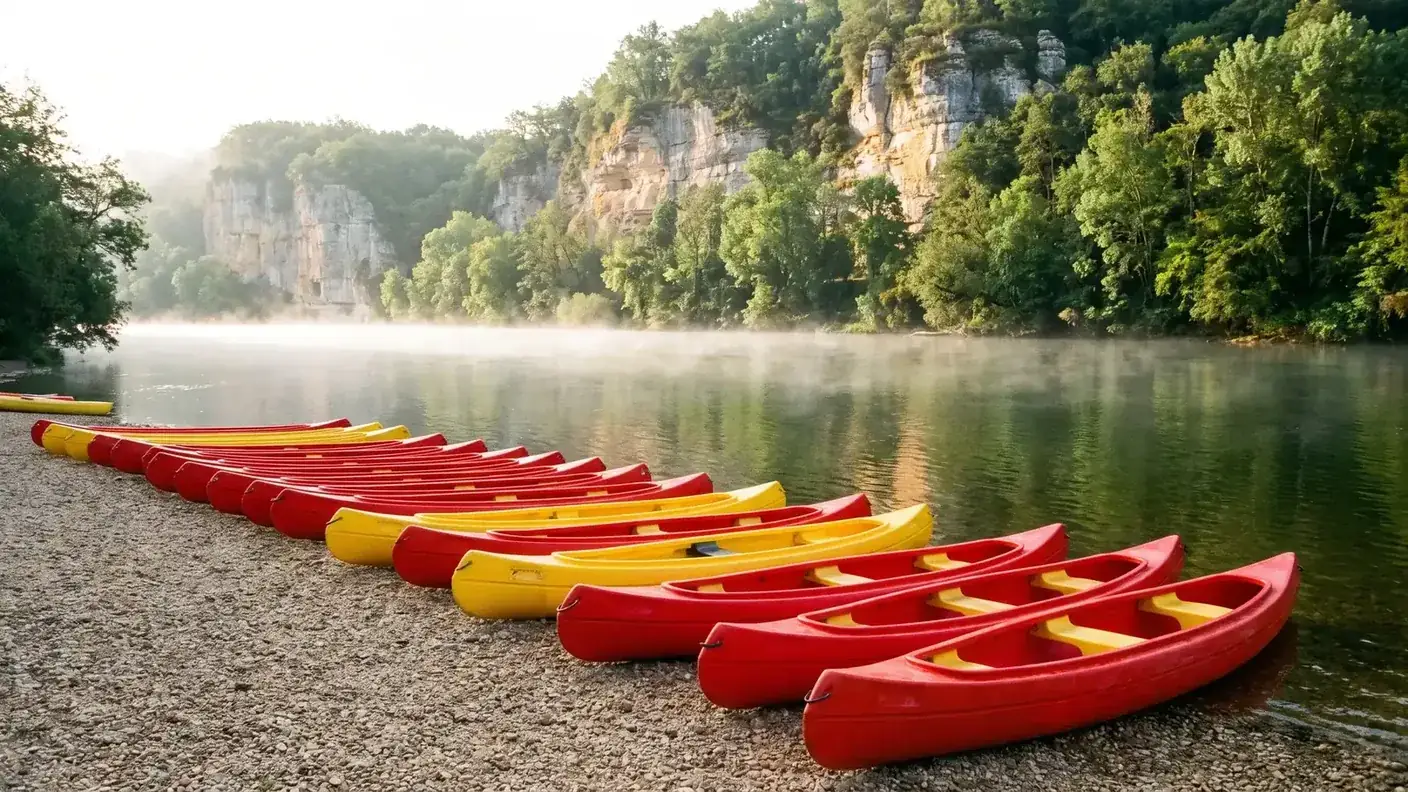
For swimming: you can take a dip along the river near the bridge (unsupervised), and the nearest supervised beach is in Coux-et-Bigaroque, less than 3 km away. The Port Campground (3-star), located on the banks of the Dordogne with an on-site canoe and paddleboard center, rounds out the river activities. Good to know: The major floods that used to wash away bridges have been mitigated for over half a century by the Argentat and Bort-les-Orgues dams upstream—the river’s flow in summer is gentle and steady.
Around Siorac: Belvès, Cadouin, Les Eyzies, and the valley
That’s another major draw of Siorac: it’s a hub for day trips. Within a 20-minute radius, you’ll find two of France’s “Most Beautiful Villages,” a UNESCO-listed abbey, a “star-filled” cave, and the world capital of prehistory.
Belvès, the town of seven bell towers (7 min)
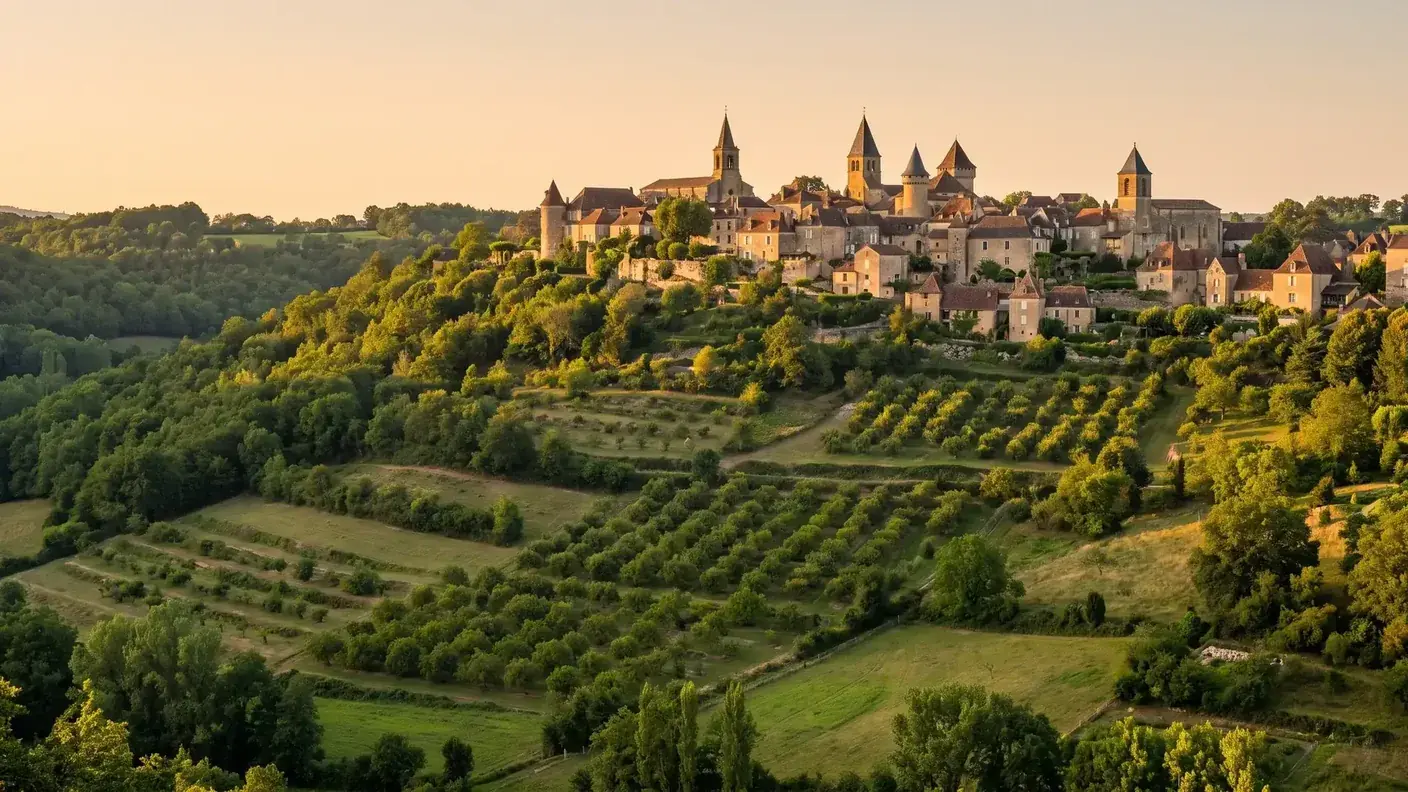
Perched above the Nauze River, Belvès (one of the Most Beautiful Villages of France) boasts seven bell towers—and hides its most astonishing attraction beneath the town square: eight cave dwellings occupied by the poorest residents from the 13th to the 18th century, which can be visited 6 meters underground (7 €). The 15th-century market hall rests on 23 pillars, one of which still bears the remains of the pillory. An unexpected connection: Bertrand de Got, Lord of Belvès, was elected pope in 1305—Clement V, the pope associated with the Templar affair. The village also cherishes its traditions: an air show held every August 15 since 1913, the Bach Festival (25th edition in 2025), and the legendary “100 km de Belvès” ultra-marathon, which began in the 1970s and hosted the 2013 European Championships.
Cadouin: Louis XI’s Cloister and a “Shroud” from Egypt (14 min)
TheCadouin Abbey (founded in 1115, listed on theUNESCO (in 1998 as part of the Routes of Santiago) owes its Flamboyant Gothic cloister to Louis XI, who financed its reconstruction in 1482. For eight centuries, pilgrims came there to venerate the “Shroud of Christ”… until 1934, when a Jesuit read the Kufic inscriptions on the fabric: a textile Fatimid Egypt of the late 11th century, which opens with the Islamic creed. The pilgrimage was canceled in 1936—but the fabric, one of only two known intact Fatimid pieces in the world, remains a treasure (a facsimile has been on display since 2012). The poetry of builders: at each equinox, a ray of sunlight streams through the three aligned oculi of the abbey church, which was consecrated in 1154. The site (31,000 visitors in 2022) is complemented by the village market hall—also a gift from Louis XI.
On the road, in Le Buisson, the Maxange Caves show off their famous eccentrics, these formations that grow in all directions (~40,000 visitors/year). Their story is like a fairy tale: they were discovered on August 15, 2000 by Angel Carallero at the family's building stone quarry, which was open to the public on Easter Sunday, 2003—the family closed the quarry to make way for the cave. The name? A contraction of Maximilien and Angel, the father and the son.
Saint-Cyprien, Limeuil, Les Eyzies
Just 9 minutes away, Saint-Cyprien hosts a market every Sunday that was named “the most beautiful market in the Périgord” (TF1, 2019)—80 vendors in the winter, up to 180 in the summer. Thirteen minutes away, Limeuil (one of the “Most Beautiful Villages of France,” population 342) overlooks the confluence of the Dordogne and Vézère rivers from its panoramic gardens—created after 1902 by Fernand Linarès, physician to the Sultan of Morocco, and purchased by the town in 1997. They even brew “La Lutine” there, an organic beer… made with walnuts, and the pottery market is holding its 28th edition.
And just 20 minutes away is Les Eyzies, the “world capital of prehistory”: the National Museum of Prehistory (approximately 6 million artifacts, housed in a building designed by Jean-Pierre Buffi that’s built into the cliff) and the Font-de-Gaume Cave, one of the last major polychrome caves open to the public — 78 visitors per day, not a single one more, to allow the cave to “recover” each night. In 2026, a study used radiocarbon dating to determine the age of its large bison painting: it was painted approximately 13,300 years ago.
| Field Trip | Directions from Siorac | Why Go There |
|---|---|---|
| Belvès | ≈ 6.5 km · 7 min | PBVF, 7 church steeples, cave dwellings beneath the market hall |
| Le Buisson / Maxange Caves | ≈ 7–8 km · 8–10 min | The “Star Caves” and Their Eccentrics |
| Saint-Cyprien | ≈ 8.4 km · 9 min | The Sunday market voted the most beautiful in the Périgord |
| Limeuil | ≈ 12.3 km · 13 min | PBVF, confluence of the Dordogne and Vézère rivers, panoramic gardens |
| Cadouin Abbey | ≈ 13 km · 14 min | Flamboyant cloister, UNESCO, the Fatimid “shroud” |
| Beynac | ≈ 17 km · 16 min | The fortress on the cliff — see our guide |
| Les Eyzies | ≈ 18.5 km · 21 min | Font-de-Gaume, Capital of Prehistory |
| Sarlat-la-Canéda | ≈ 29 km · 29 min | Capital of the Périgord Noir — see our guide |
When to Visit Siorac
- Wednesday morning, all year round : the market—a direct descendant of the letters patent issued by Louis XIII (1612);
- Friday evenings in July and August: gourmet markets at Place du Général-de-Gaulle (food trucks, concerts, starting at 6:30 p.m.);
- First weekend in August: the Pont Festival—fireworks over the Dordogne;
- Third Sunday in August: wine and regional products fair;
- Sunday morning: the big market in Saint-Cyprien, 9 minutes away.
| Season | Atmosphere | Strengths | Good to Know |
|---|---|---|---|
| Spring (April–June) | Green, peaceful | Canoeing starting in May, a valley in full bloom, villages without crowds | Our Favorite Season |
| Summer (July–August) | Alive | Gourmet markets, the Pont Festival, swimming, canoeing | The valley is filling up — Siorac remains a place where you can breathe easily |
| Fall (Sept.–Oct.) | Golden | Walnut groves, lights, porcini mushrooms at the markets | Perfect for biking and photography |
| Winter (Nov.–March) | Silent | Truffles at nearby markets, an authentic village | Canoeing and swimming are closed |
The perfect pace: Wednesday morning market, canoeing, or a trip to Belvès in the afternoon—and the major attractions (Cadouin, Les Eyzies, Sarlat) as day trips from the village, one per half-day.
How to Get to Siorac from Bordeaux
A rare feature for a village of 1,000 residents: Siorac has a direct TER train from Bordeaux—which is often easier than driving. By car, the trip takes about 2 hours and 20 minutes.
| Mode of travel | Travel time from Bordeaux to Siorac | Estimated cost | Good to Know |
|---|---|---|---|
| Direct TER | from 1 hr 56 min | ≈ 15-25 € | Bordeaux–Sarlat line, ~5 direct trains per day, arriving in the heart of the village |
| Personal car | ≈ 2 hours 20 minutes (163 km via Bergerac) | Gas ≈ 25–35 € (few tolls) | 163 km via the D936 and Bergerac, or via the A89 through Périgueux, with tolls |
| Private chauffeur service (door-to-door) | ≈ 2 hours 20 minutes | Starting at 279 € · one-way | Optional stops (Saint-Émilion, Bergerac, Belvès…) |
| Coach | — | — | No relevant direct link |
By train: the smart choice
The Bordeaux-Sarlat TER (Line 33: 166.6 km and 24 stops end-to-end, operated by dual-mode railcars) serves Siorac directly—best travel time 1 hour 56 minutes, with about 5 round trips per day via Libourne and Bergerac. The station is free to enter, with parking and bike racks; it’s a five-minute walk from the bridge and the market. Few destinations in this guide can say the same—in fact, this is the only one where we can say without hesitation: the train is often the best option. Just be careful on the return trip: there are no evening services.
By car
Valley route: D936 via Libourne, Castillon, and Bergerac, then along the banks of the Dordogne—163 km, very few tolls, with the option to stop in Saint-Émilion or Bergerac. Highway route: A89 via Périgueux, then down into the valley, with tolls—slightly longer in kilometers, but comparable in travel time.
By chauffeured car
Door-to-door service has two advantages: the luggage and the late return (the last TER leaves early), and the circuit — a stop in Saint-Émilion on the way there, a detour through Belvès or Cadouin, and drop-off at the campground or bed-and-breakfast. With a chauffeur service, a fixed rate guaranteed in writing, starting at 279 € One-way ticket for 1 to 3 passengers.
Practical Information
How long will you be there?
Siorac sees itself as base camp more than just a quick visit: a half-day That's enough for the town (the two castles, the church, the bridge, the train station), but the village really comes into its own at 2–3 days, in a star-shaped itinerary—canoeing one morning, Belvès and Cadouin one afternoon, Les Eyzies or Sarlat the next day. The Port campground and the bed-and-breakfasts in the valley are ideal for this.
On site
- Market: Wednesday morning (8:30 a.m.–12:30 p.m.), in front of the multipurpose hall;
- Farmers' Market: direct farm sales in the former freight station (Mon.–Sat.);
- TER Station: open-access stop, parking lot, and bike rack;
- Swimming: in the river near the bridge (unsupervised); supervised beach in Coux, 3 km away;
- Parking: easy in town outside of peak summer season—a luxury in this valley.
Estimated Budget
| Profile | Daily Budget | Accommodations | Dining |
|---|---|---|---|
| Small budget | 45-70 € | Camping du Port (on the banks of the Dordogne) | Market + Gourmet Markets in the Summer |
| New Couple | 100-150 € | Bed and Breakfasts in the Village and Valley | Périgord-style tables in the village |
| Comfort | 150-220 € | Historic Homes (Valley, Belvès, Sarlat) | Gastronomy: Winter Truffles in Sarlat |
Families: canoeing (short routes starting at 7 km), the Maxange Caves, the Belvès cave dwellings, and arriving by train—a winning combination. Cycling: quiet roads through the valley while we wait for the V91 bike route, and the Sarlat greenway just half an hour away.
Frequently Asked Questions
Where does the name Siorac-en-Périgord come from?
From the Gallo-Roman surname Severus: Siorac was the “estate of Severus” (suffix -acum). In Occitan, it is called Sieurac de Perigòrd. The first written record dates back to 1153: a papal bull issued by Pope Eugene III lists the “curtes de Ciourac” among the parishes of the Abbey of Sarlat. The suffix “en-Périgord,” however, dates back only to 1923.
Why did the town change its name in 1923?
Because the mail used to get lost. The municipality was officially named Siorac-et-Fongauffier, but common usage—and the train station—referred to it as “Siorac-de-Belvès”: two names for the same village, resulting in “significant delays in the delivery of mail .” Resolution of March 11, 1923; approval by the General Council on April 25; decree on November 22, 1923: Siorac-en-Périgord was born.
Are Siorac-de-Belvès and Siorac-en-Périgord the same village?
Yes—but “Siorac-de-Belvès” was never the official name of the municipality: it was a common name, and the name of the train station from 1863 to 1923. The official names in chronological order are Siorac (1793), then Siorac-et-Fongauffier (1801), and finally Siorac-en-Périgord (1923). Not to be confused with Siorac-de-Ribérac, another municipality in the Dordogne, located in the western part of the department.
Who built Siorac Castle?
The village has two! The castle, listed as a Historic Monument (2013), was built between 1760 and 1780 by François-Antoine de Laverrie de Vivans—the town hall now occupies its west wing. Across from it stands the other castle, a medieval structure (~1100), which was occupied by the English during the Hundred Years’ War, burned down during the Wars of Religion, and rebuilt around 1810 using its own stones.
Can we visit Siorac Castle?
Both castles can be freely explored from the outside, in the heart of the village—and the town hall occupies the west wing of the 18th-century castle. A museum of culinary arts and tableware has been set up there, but you should check with the town hall regarding its current opening hours before visiting. The Church of Saint-Pierre-ès-Liens, on the other hand, is open to the public at any time.
How do I get from Bordeaux to Siorac-en-Périgord?
The easiest option is often the direct TER train from Bordeaux to Sarlat: from 1 hr 56 min, with about 5 trains per day, arriving in the heart of the village. By car: ~2 hours and 20 minutes via the D936 through Bergerac (163 km, almost no tolls) or via the A89 through Périgueux, with tolls. By executive car service (door-to-door): starting at 279 € one way (1–3 passengers), with optional stops in Saint-Émilion or Bergerac.
Is Siorac Station still in service?
Yes: The station is served by the Bordeaux-Sarlat and Périgueux-Agen TER trains, and ridership has increased sixfold since 2020 (3,943 passengers in 2020, 23,491 in 2024, according to SNCF Open Data). Opened in 1863 by the Compagnie du Paris-Orléans, it became a branch line to Sarlat in 1882.
On what day is the Siorac market held?
On Wednesday mornings (8:30 a.m.–12:30 p.m.), in front of the multipurpose hall—and this is no coincidence: in 1612, Captain Jean de Sireuil obtained letters patent from Louis XIII establishing two fairs per year and a market “every Wednesday.” More than 400 years of continuity. In the summer, gourmet markets are held there on Friday evenings.
Where can you go canoeing or swimming in Siorac?
The A Canoë Raid center in Le Port (Campeyral) offers routes ranging from 7 to 28 km on the Dordogne and Vézère rivers—and the Dordogne is officially “France’s top destination for recreational canoeing.” For a scenic route past the castles, take the classic descent from Beynac to Saint-Cyprien. Swim on your own near the bridge (unsupervised) or at the supervised beach in Coux-et-Bigaroque, 3 km away.
What is there to see around Siorac?
An exceptional 20-minute radius: Belvès and its cave dwellings (7 min), the Maxange Caves and their stalactites and stalagmites (10 min), the Sunday market in Saint-Cyprien (9 min), the UNESCO-listed Cadouin Abbey (14 min), Limeuil at the confluence of the Dordogne and Vézère rivers (13 min), Beynac (16 min), Les Eyzies and Font-de-Gaume (21 min), Sarlat (29 min).
Why is Siorac's name on Mars?
In March 2021, NASA named one of the Curiosity rover’s analysis targets “Siorac,” located on a Martian rock outcrop—at the time, the mission was naming its targets after villages in the Périgord region (the Nontron region even gave its name to the mineral nontronite). A village of 1,082 residents whose name is now etched on the Red Planet.
What is the connection between Siorac and “Fortune de France”?
Robert Merle set the beginning of his 13-volume historical epic in Siorac: his hero is Pierre de Siorac, a young Protestant nobleman from the Sarlat region. The series has sold 6 million copies, and its TV adaptation has been airing on France 2 since September 2024—filmed in part at the Château de Beynac, 16 minutes from the village.
Siorac with kids: a good idea?
Highly recommended: arrive by train (an adventure in itself), canoe short routes starting at 7 km, the Maxange caves with their “star-shaped” stalactites and stalagmites, a tour of the Belvès troglodyte dwellings 6 meters below the town square, swimming, and camping along the Dordogne River. All this in a village at a crossroads where everything is within walking distance.
Further Reading
- The Valley Fortress, 16 minutes away : see the Guide to Beynac-et-Cazenac (castle, gabarres)
- The hilltop bastide and its cave: see the Domme Guide
- The capital of the Périgord Noir: see the Sarlat Guide (market, old town)
- Prehistory of the Vézère: see the Lascaux Guide
- Plan your trip: Book a chauffeured transfer from Bordeaux to Siorac or explore all our destinations
Sources and References
- Wikipedia — Siorac-en-Périgord — history, geography, demographics
- Wikipedia — Siorac-en-Périgord Station — 160 Years of Railroad History, Ridership
- Wikipedia — Château de Siorac — The Four Noble Lineages
- Wikipedia — Cadouin Abbey — the cloister and the shroud
- Wikipedia — Belvès — the town of seven bell towers
- Siorac-en-Périgord City Hall — Local Life, Market
- Sarlat-Périgord Noir Tourist Office — Tours and the Valley
- Belvès Region — Sites — Cave Dwellings
- Maxange Caves — the “Caves of the Stars”
- Mérimée Database (POP) — Protection of the Castle (2013)
- INSEE — Demographic Data
- SNCF Open Data — Passenger Traffic at Siorac-en-Périgord Station — Travelers 2015–2024
Article published on .
On the way to the confluence
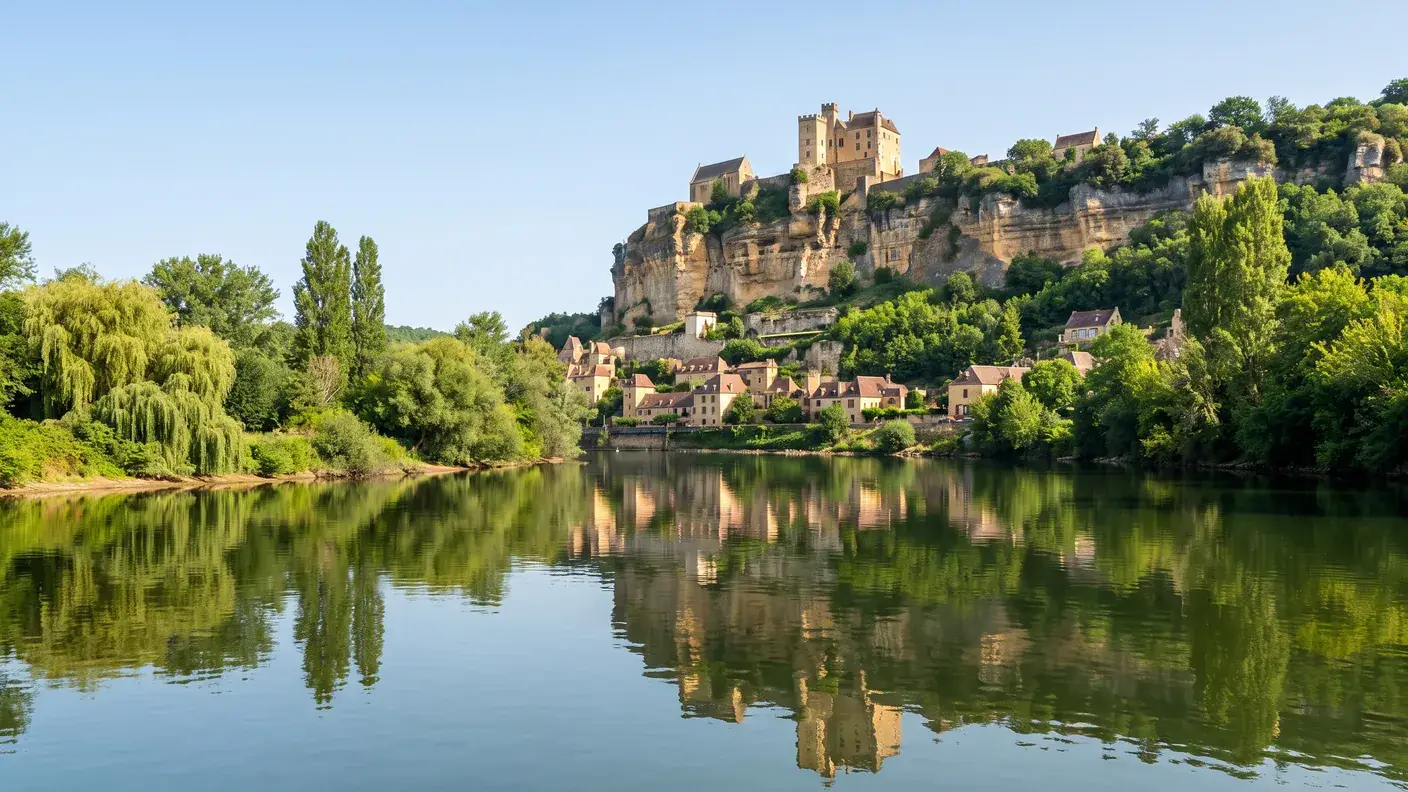
Direct trip from Bordeaux (~2 hours 20 minutes), with stops along the way as desired—Saint-Émilion, Bergerac, Belvès. Written fixed-price quote within 30 minutes; sedan or van; English-speaking driver.