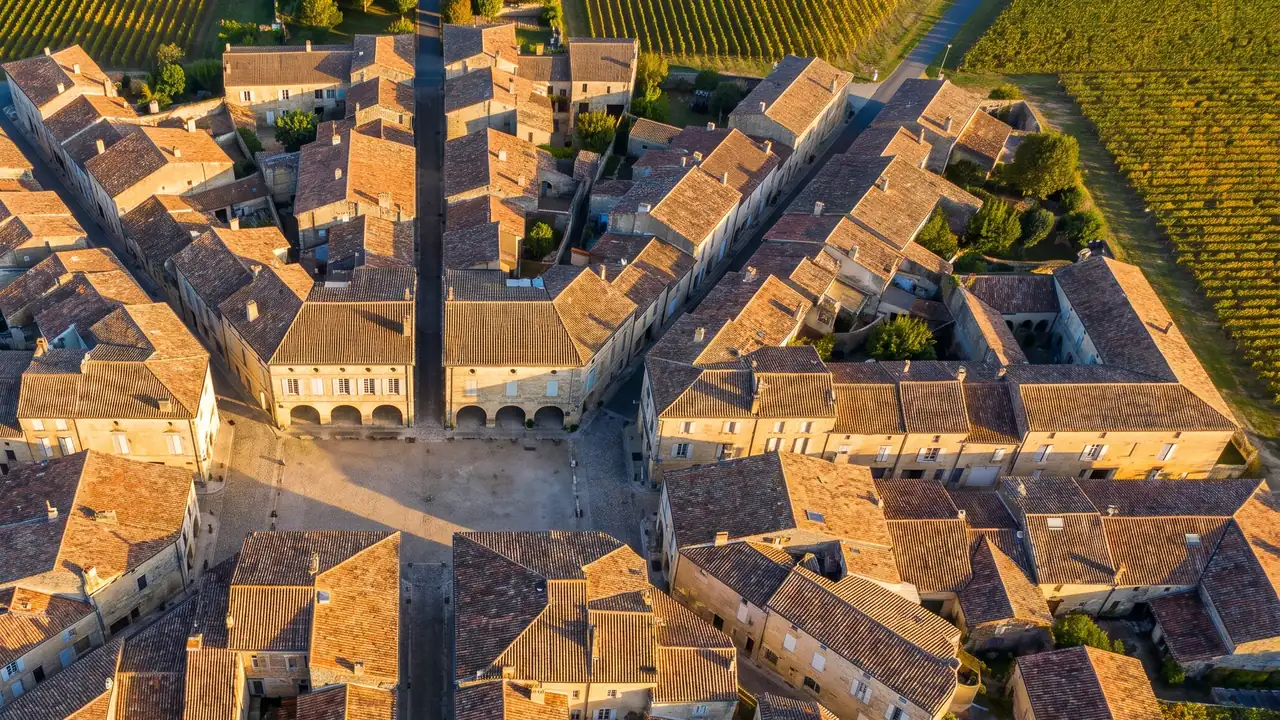
Créon, the Bastide on the Greenway
An English bastide dating back to 1315 that has become the cycling capital of the Gironde: Créon, with its arcaded square and seven-century-old Wednesday market, its pioneering bike station inaugurated by Bernard Hinault, and the legendary Roger-Lapébie greenway—the comprehensive mega-guide, plus your private door-to-door transfer from Bordeaux, bikes included.
Créon at a Glance
Créon is a medieval bastide in the Entre-deux-Mers region, founded in 1315 for the King of England, about 26 km east of Bordeaux—and the “cycling capital” of the Gironde, the beating heart of the Roger-Lapébie Greenway. This dual character is what makes it so fascinating: on one hand, an authentic medieval town, with its arcaded square, its seven-century-old Wednesday market, and its grid-like layout; on the other, the old train station, now one of France’s very first “bike relay points,” inaugurated by Bernard Hinault, located along a legendary bike path built on a former railroad track.
This mega-guide covers both: the bastide AND the greenway, history AND practical information—routes, kilometer markers, tunnels, repurposed train stations, bike rentals, and marked loop trails. As always, we’ve separated verified facts from common assumptions: exact dates, distances backed by sources, and what’s changed (the Ouvre la Voix festival, for example, is on hiatus in 2026). And the easiest way to get there: a private door-to-door transfer, including bikes if needed.
Here are the key details to know before you go. Distances are calculated door-to-door from Bordeaux; the price listed is for a private driver reservation, with a fixed rate provided in advance—no meter surprises. Information on cultural heritage, cycling routes, and demographics has been verified using Wikipedia, the Mérimée database, INSEE, Gironde Tourisme, France Vélo Tourisme, AF3V, the Créon City Hall, and Station Vélo; schedules are subject to change and should be confirmed on site.
| Landmark | Details |
|---|---|
| City | Créon (Gironde, Bordeaux district) |
| Location | in the heart of the Entre-deux-Mers region, known as its “capital” |
| Residents | 4,950 residents of Créon (2023) |
| Must-See | Place de la Prévôté, the Wednesday market, the greenway, La Sauve Abbey (4 min away) |
| Distance from Bordeaux | about 26 km · about a 40-minute drive (or 23 km by bike on the trail) |
Where is Créon located?
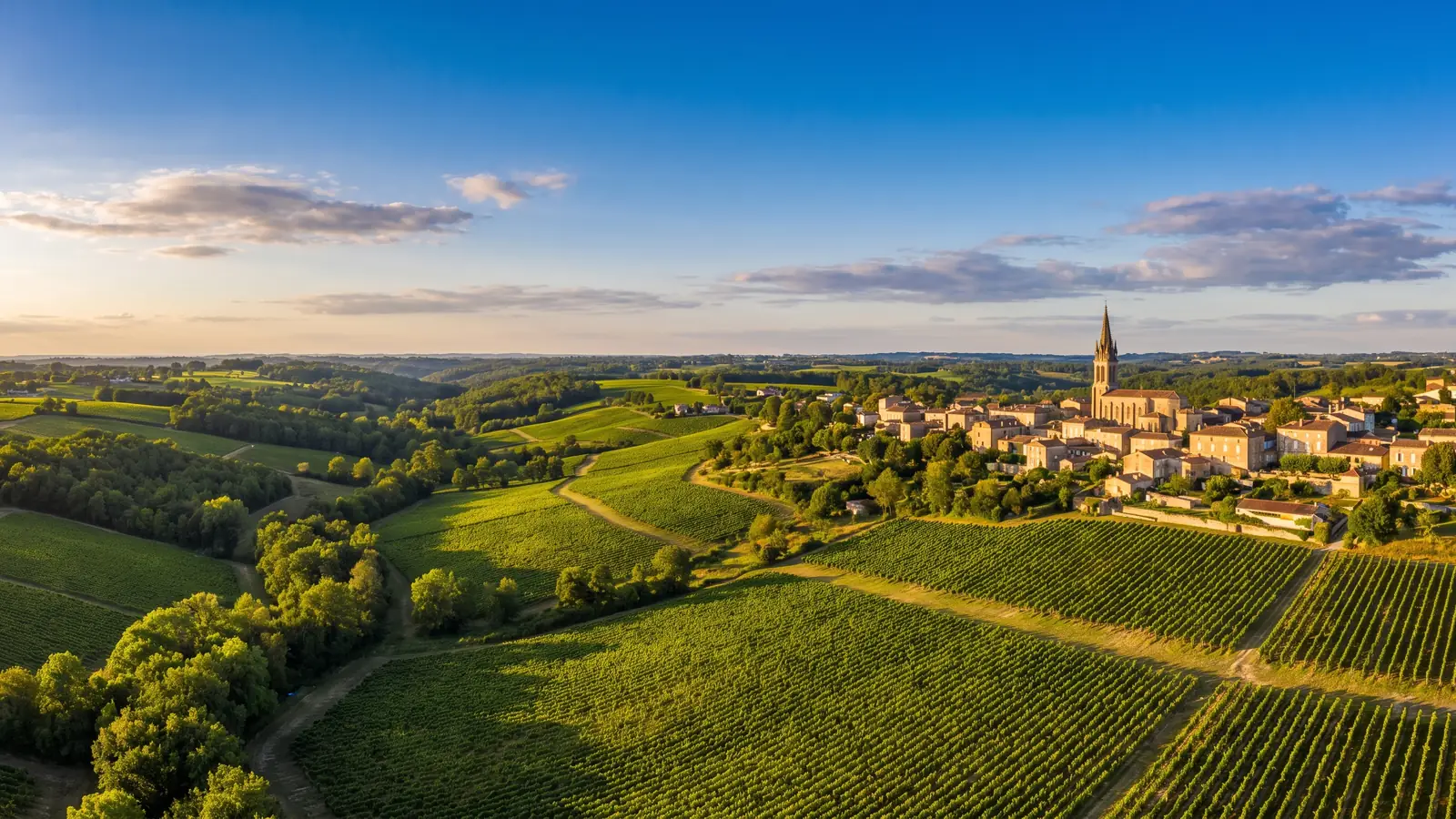
Créon is located about 26 km east of Bordeaux, in the heart of the Entre-deux-Mers—that vast plateau of vineyards and valleys nestled between the Garonne and the Dordogne, of which it is known as the “capital.” The town, with a population of 4,950, is part of the Bordeaux arrondissement and gives its name to the Créonnais, its community of municipalities. The nickname “capital” is well-deserved: under the Ancien Régime, Créon was the seat of the Royal Provostship of Entre-deux-Mers, whose jurisdiction extended over 48 parishes. Today, this central role is expressed in a different way: Créon is the major cycling hub of the Gironde, roughly halfway along the Roger-Lapébie greenway, with its pioneering bike-sharing station located in the former train station. Just a half-hour drive from Bordeaux—or 23 km along a flat, safe bike path—it’s the ultimate green getaway from the city.
The “Capital of the Entre-deux-Mers”
The name is a nickname, but it has a real historical basis. For centuries, Créon served as the seat of the Royal Provostship of Entre-deux-Mers: the king’s provost administered justice there and governed a territory comprising 48 parishes, until the Revolution. The central square of the bastide still bears this name—Place de la Prévôté—and City Hall stands on the site of the former royal institution. This role as a small rural capital has never wavered: as the county seat and headquarters of the Créonnais Community of Communes, Créon serves as a hub for shops, services, a middle school, and amenities for a large catchment area. Its population figures reflect this: 4,697 residents in 2017, 4,950 in 2023—a thriving medieval bastide, driven by its proximity to Bordeaux and an enviable quality of life. For visitors, it’s a truly vibrant little town, not just a backdrop: a renowned market, outdoor cafés under the arcades, and local artisans and winemakers in the surrounding area.
The Gironde's Green Crossroads
Créon's other central theme is bike-friendly. The city is located at marker 25.5 (measured from the Place de la Bourse in Bordeaux) of the Roger-Lapébie Greenway, the former Entre-deux-Mers railroad line converted into a trail—a little before the exact halfway point of the route to Sauveterre-de-Guyenne, making it the highlight of the route and its natural hub. Its former 1892 train station is home to the tourist office and the famous Bike Station, one of France's very first “Bike Relay Points”: rentals, information, and services. From there, marked trails lead towards the vineyards and villages. The main route itself is the Gironde section of the national bike route V80 “Cycling the Canal des 2 Mers”, which connects Royan to Sète over a distance of about 750 km. In the space of a quarter-century, Créon has thus become a benchmark for slow tourism in the Gironde: people come here to bike, stroll, and enjoy local cuisine—just 30 minutes from Bordeaux.
An English bastide founded in 1315
Créon is a bastide: a new town from the Middle Ages, founded in 1315 by Amaury III de Craon, seneschal of Aquitaine, for King Edward II of England—and one of the few French towns to bear the name of its founder. Its grid-like layout and arcaded square are still clearly visible seven centuries later. Here is its verified history.
Amaury de Craon, a founder whose name became a place name
The charter of customs presented by the town hall of Créon is dated 1315—this is the founding date to be noted (it was subsequently authenticated by the Ducal Court of Bordeaux on March 9, 1316, and then confirmed by an edict from Westminster: hence the “1316” that is sometimes cited). The founder, Amaury III de Craon, was seneschal of Aquitaine—the highest-ranking representative of King Edward II of England, Duke of Aquitaine, of whom he was, incidentally, a first cousin once removed. A descendant of the powerful House of Craon in Anjou, of which he was the last hereditary seneschal, he gave his surname to the new town: “Craon” became “Créon.” Few French municipalities can claim the same. The charter granted the inhabitants privileges, a weekly market, and six annual fairs—the classic economic framework of the bastides, those towns founded to settle the land, conduct trade, and assert authority over the territory.
A Gascon chessboard: carreyras and carreyrous
Like all bastides, Créon was laid out in a single stroke: an orthogonal grid plan, organized around an undeveloped central square. The Gascon terminology for this grid layout has survived: the main streets are called carreyras, and the cross streets are called carreyrous—words found in studies of the bastide that reveal the southern origins of this urban planning. The Federation of Aquitaine Bastides even notes that Créon’s layout “precedes that of Geaune” (1318): the town served, in a sense, as a prototype. Walking today along the straight streets that converge on the Place de la Prévôté, one can trace this urban plan from 1315 as if reading an architect’s blueprint—seven centuries of history have not obscured the design. This is one of the great pleasures of the visit: understanding, on the scale of a small, vibrant town, what a “new town” was like in the Middle Ages, designed for commerce and community life.
Place de la Prévôté and its market dating back to 1315
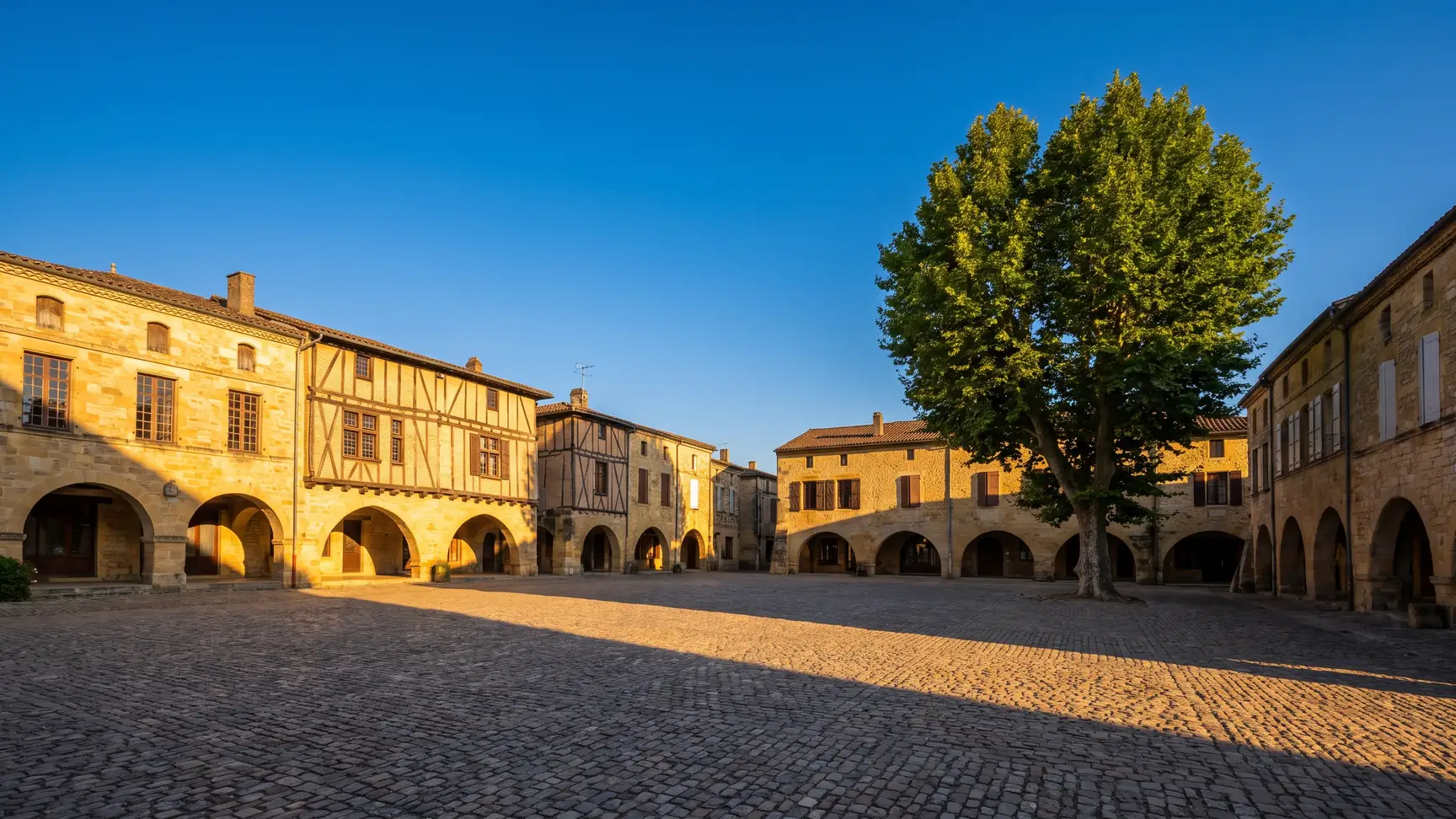
The heart of Créon is its Place de la Prévôté, lined with arcades on three sides—and its Wednesday morning market, established by the charter of 1315, which is still held seven centuries later with about a hundred vendors. Few places in Gironde offer such continuity. Here is what the sources reveal.
Arcades Designed for Retail
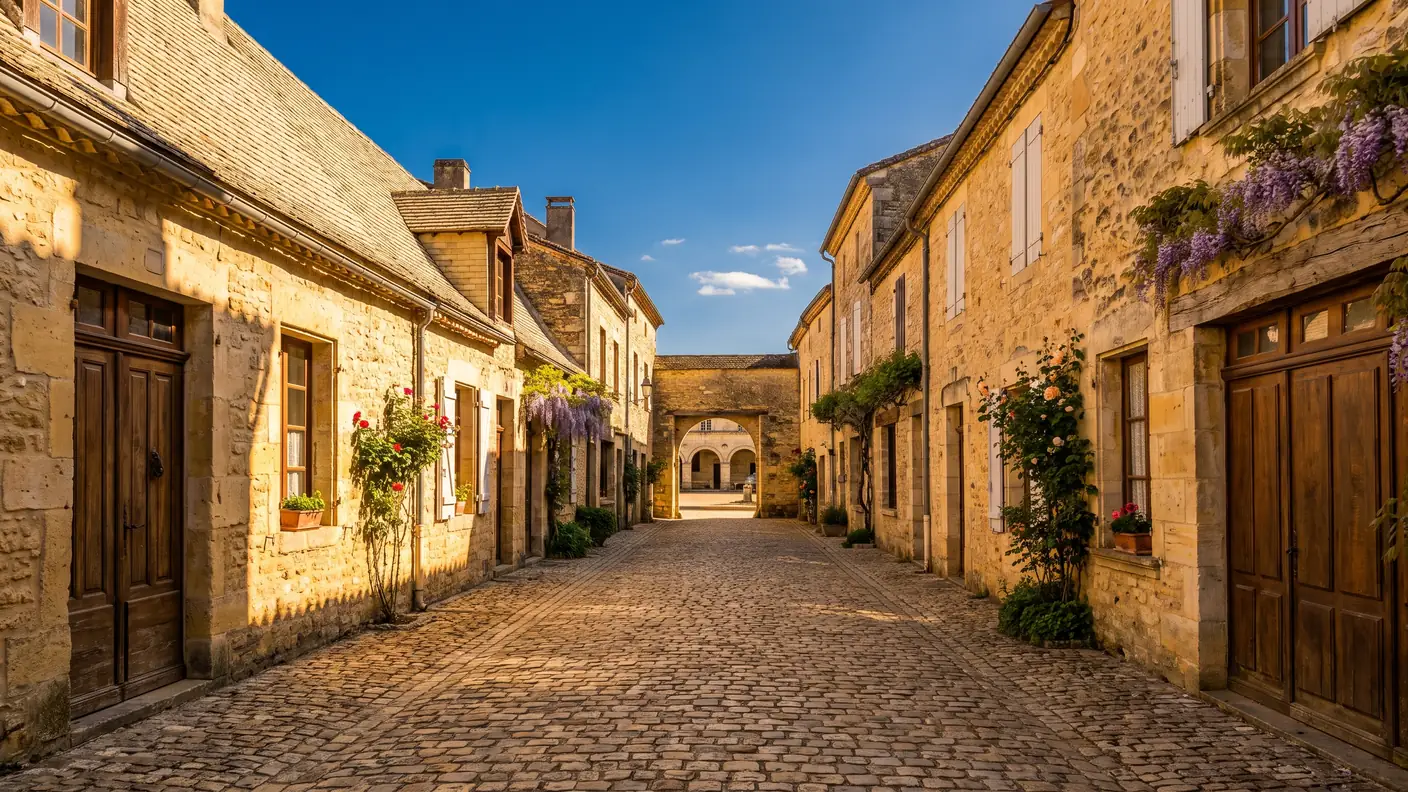
Place de la Prévôté—approximately 60 to 70 meters on each side, depending on the source—is the quintessential bastide square: a vast, open quadrilateral surrounded by arcaded houses (the “couverts”), beneath which market stalls and merchants found shelter. To be precise: the arcades line three sides of the square, not all four, contrary to what is often written. An interesting urban planning detail: originally, the arcades met at the corners of the square, so that all traffic—including carts—had to pass under the arcades; the corner arcades were later demolished to reroute vehicles. The square’s name recalls the Royal Provost’s Office, which was once located here and administered 48 parishes; the current town hall stands on that site. All around, café terraces, shops, and historic facades create a setting that is both grand and familiar—the true heart of a town.
Seven Centuries of Wednesday Markets
Créon's big event is his Wednesday morning market (8 a.m.–1 p.m.), which the town hall lists on Place de la Prévôté and the adjacent streets: about 100 merchants, with priority given to local producers, a turnout that makes it—according to the Federation of Bastides—the 7th-largest market in Gironde. It has an exceptional lifespan: the Charter of 1315 had already granted the bastide a weekly market... scheduled for Wednesday, specifically to compete with the Tuesday market at the nearby Abbey of La Sauve-Majeure — a medieval trade war whose legacy is still evident in the current schedule. More than 700 years later, the market is still held on Wednesdays (while absolute continuity over seven centuries is a matter of tradition, the charter and the day of the week are documented). A second, more modest event—with about ten vendors—brings life to the square on Saturday morning. If you want to experience Créon, come on a Wednesday: that’s when the bastide truly fulfills the purpose for which it was founded.
From the Hundred Years' War to the modern-day bastide
Founded by the English, plundered during the Hundred Years’ War, fortified, and then peacefully established as the county seat: Créon has endured seven centuries while retaining its layout and its role as a small rural capital. Here are the verified milestones, from 1315 to the present day.
Looted, set on fire, fortified
The young bastide had a turbulent start. Its very founding was an act of defiance: a new town established by the King of England just a few kilometers from the powerful Abbey of La Sauve-Majeure, whose economic dominance it challenged—right down to the choice of market day. The Hundred Years’ War soon caught up with it: around 1337–1338, Créon was pillaged and burned. The response was military: between 1342 and 1351, the bastide fortified itself with moats, palisades, and four gates. These defenses have disappeared, but they serve as a reminder that the Entre-deux-Mers region was a contested territory between the crowns of France and England for over a century. Once peace returned, Créon resumed its life as a market town: the Royal Grand Provost’s Office was established there, making it the administrative center of the plateau—the “capital of the Entre-deux-Mers,” a nickname that has survived the Ancien Régime.
Notre-Dame Church, a Flamboyant Gothic structure, signed and dated
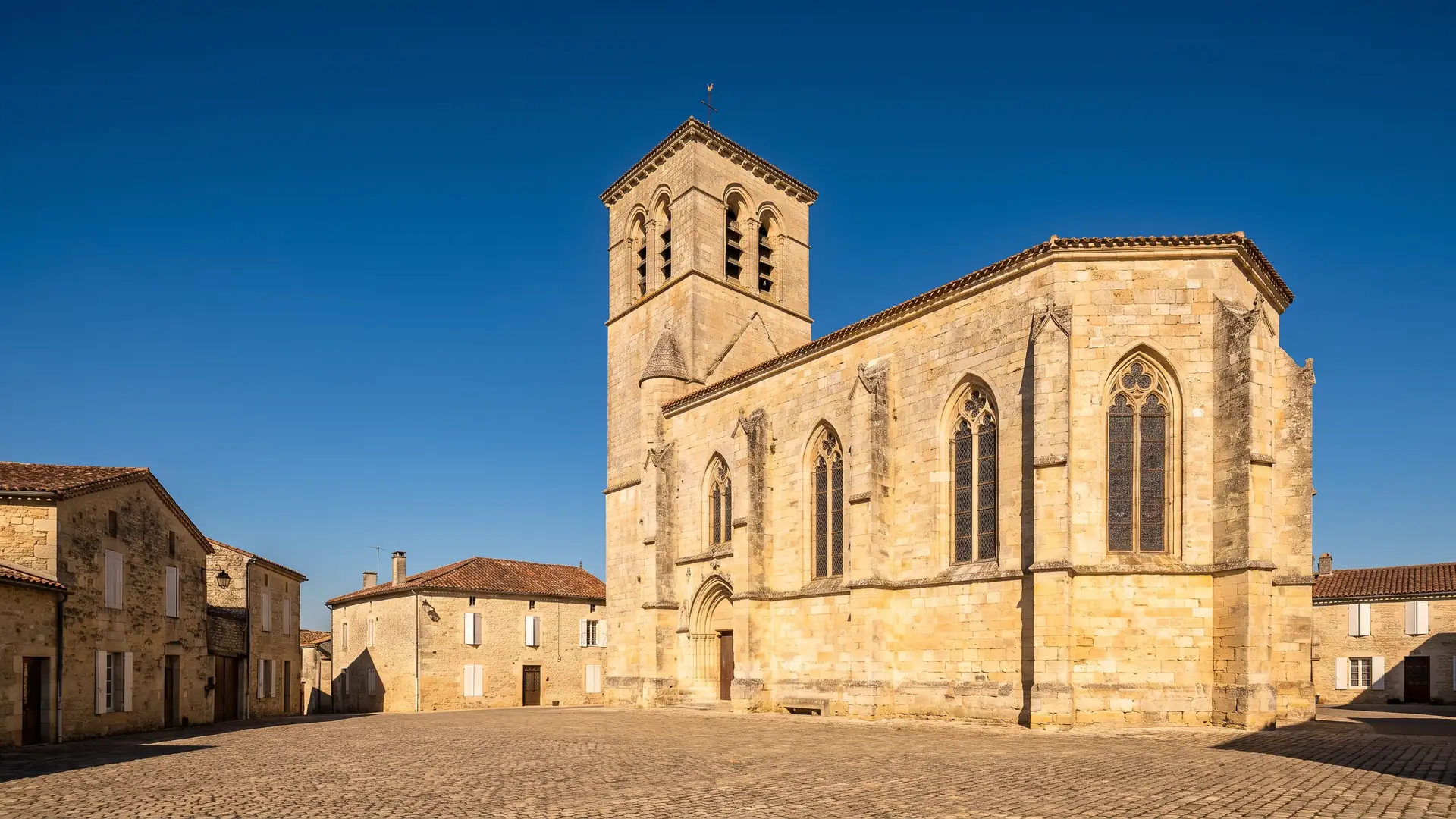
The town's most notable landmark is Notre-Dame Church, which borders the square. The current building is not from the time of the church’s founding: an earlier church (1316–1320) preceded it, but what we see today is in the Late Gothic and Flamboyant Gothic styles, built between the late 15th and 16th centuries. Two dates are carved in stone : 1490 on the western gate, 1538 on the apse — with the signature of master mason Marsault Roux, a rare example of a medieval artisan who “signed” his work. A single-nave church with five bays covered by a ribbed vault, a pentagonal apse, and an ogee portal beneath a 17th-century bell tower-porch: the whole building is officially listed as a Historic Monument since April 16, 2002 (Mérimée entry PA00083530)—registered, not “classified”; the distinction is accurate. Together with the town square, the carreyras, and the market, the church completes the picture of a bastide that has preserved everything: its layout, its stonework, and its traditions.
The Roger-Lapébie Greenway: The Legendary Trail
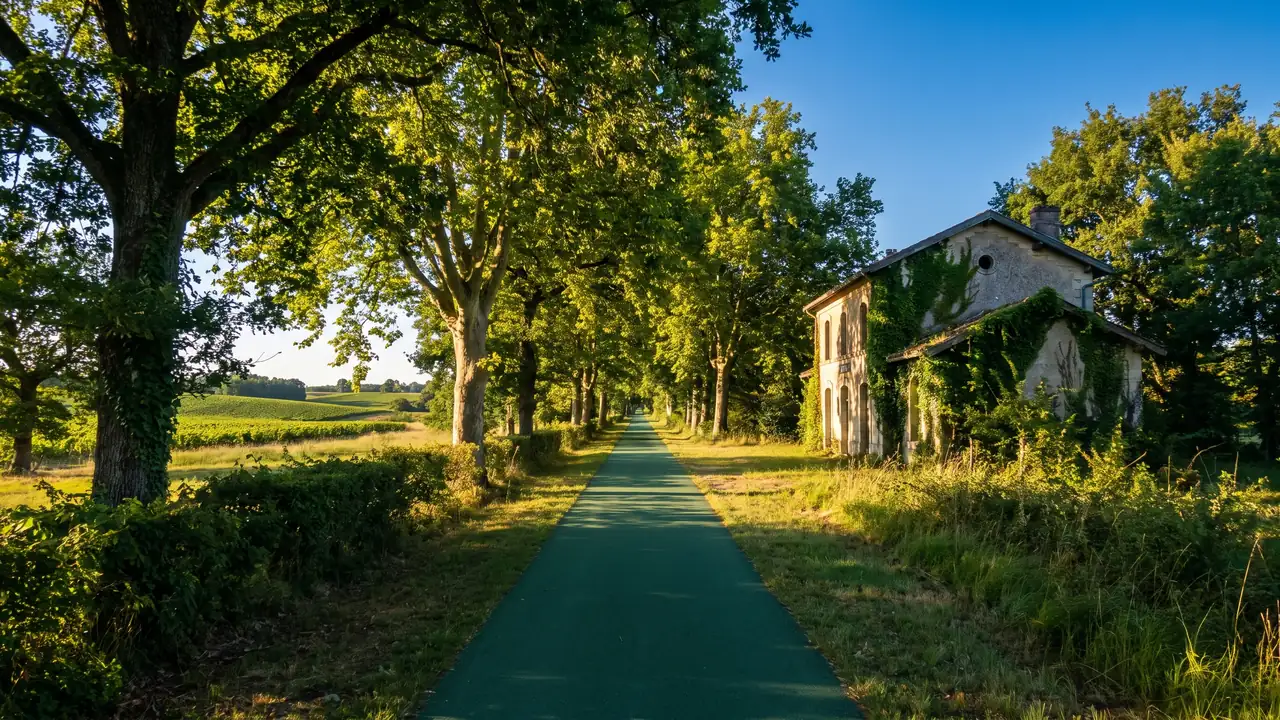
The Roger-Lapébie Greenway is THE bike path in the Gironde: about 55 km from Bordeaux to Sauveterre-de-Guyenne along a former railroad track—a smooth, flat, car-free stretch of asphalt that crosses the Entre-deux-Mers region, with Créon as its highlight. Route, exact distances, tunnel, atmosphere: here’s the verified guide to the route.
47, 54, or 57.5 km? The actual distances
The figures vary depending on the guidebook, and for good reason: it all depends on the starting point. The Roger-Lapébie greenway, as documented by Gironde Tourisme, connects Latresne to Sauveterre-de-Guyenne over a distance of 47 km. From Bordeaux, the official stages listed by France Vélo Tourisme indicate 23 km to Créon, then 31 km to Sauveterre; the Gironde Tourisme route starting from Place de la Bourse, on the other hand, is 57.5 km—including about 10 km of riverfront paths and urban connections before reaching Latresne. Keep in mind “about 55 km” and, above all, the terrain: smooth asphalt, a railway-grade slope (virtually flat—only 95 m of cumulative elevation gain between Bordeaux and Créon, with the highest point at 98 m), and no cars. The trail, managed by the Gironde Department, is the Gironde section of the V80 “Canal des 2 Mers à Vélo” (Two Seas Canal by Bike), the national Royan–Sète route (~750 km).
The Pimpine Valley and the La Sauve Tunnel
The route offers its own landscapes and local color. From Latresne to Sadirac, the trail winds its way up the Pimpine Valley, a small, cool, wooded tributary—featuring woodlands, meadows, and shaded stretches—before opening onto the vineyards of the Créon Plateau. After Créon and La Sauve, the route’s most iconic structure awaits cyclists: the La Sauve Tunnel, a 259-meter-long, illuminated underground passage built for the railroad—the only tunnel on the route (it is sometimes referred to as the “Lignan Tunnel” or “Sadirac Tunnel,” but this is incorrect). It even has its own modern-day legend: during the Ouvre la Voix festival, it served as the venue for the “grand shouting contest”—the acoustics are perfect for it. Beyond that, the trail winds through Espiet, the old quarries of Frontenac—whose stone was used to build part of Bordeaux—and Saint-Brice, all the way to the gates of the bastide of Sauveterre-de-Guyenne. Three medieval gems are strung along the route: the bastide of Créon (1315), the Abbey of La Sauve-Majeure (1079, UNESCO), and Sauveterre (1281).
| Boundary Marker (from Place de la Bourse) | Stop | What You'll Find There |
|---|---|---|
| 10.5 km | Latresne | Start of the greenway; former train station = café-restaurant |
| km 17.5 | Lignan-de-Bordeaux | Old train station = Bistrot de la Pimpine |
| km 20 | Sadirac | Former train station = Créonnais Natural Heritage Center |
| 25.5 km | Créon | Old train station = tourist information office + bike rental |
| km 29.5 | La Sauve | UNESCO-listed abbey just a stone's throw away; 259-meter tunnel right after that |
| km 33 | Espiet | old train station = country-style restaurant |
| km 45 | Frontenac | former stone quarries; the nearby Sallebruneau Commandery |
| km 57.5 | Sauveterre-de-Guyenne | Terminus: A bastide dating from 1281 with four gates; bike stop |
The Old Railroad That Built Bordeaux
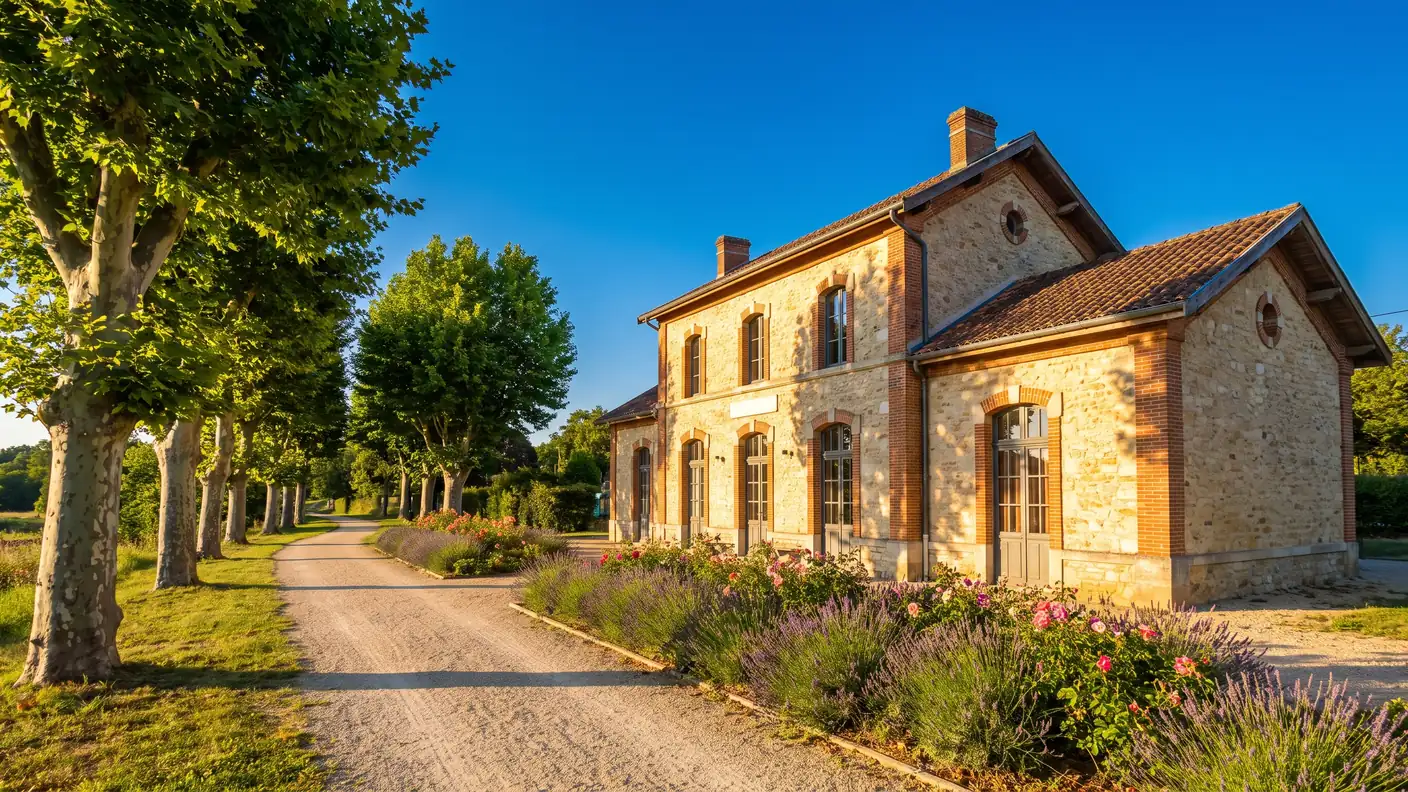
Before bicycles, there were trains: the greenway follows the right-of-way of the Bordeaux–Benauge line to La Sauvetat-du-Dropt, which opened in 1873 — a line built to transport limestone from the Entre-deux-Mers region to Bordeaux, whose facades literally traveled along this route. A little-known chapter in railway history, verified using the most reliable sources.
1873–1994: the “Eymet Method”
The line — officially the Bordeaux-Benauge line to La Sauvetat-du-Dropt, nicknamed the “Eymet Line”—even though it never actually reached Eymet—was declared a public utility by imperial decree on 1st May 1869 and opened to the public in spring 1873 (the first section, Bordeaux–La Sauve, which was delayed by the war of 1870–71), and then extended to La Sauvetat-du-Dropt in 1899 — a total of 78.8 km of single track. Its primary purpose: to transport the limestone from the quarries of the Entre-deux-Mers to construction sites in Bordeaux—then wine, mushrooms from the underground quarries, and cement. The decline was a long one: the end of traffic passengers in 1951, partial closures beginning in 1954... but the line survived 43 years of service to its passengers thanks to the trains of the Espiet Cement Plant, which kept it running until 1987, before it closed permanently in 1994. The Gironde Department then purchased the right-of-way from the SNCF and developed the greenway in stages, from the 1980s to the 2000s — the result, too, of a long-standing community campaign that has been documented since 1982.
Train Stations Given a Second Life as Gourmet Destinations
Much of the trail’s charm lies in its old train stations, almost all of which have been repurposed—a string of stops that punctuate the route. In Latresne (km 10.5), the station has been turned into a café-restaurant; in Citon-Cénac, a stopover lodge welcomes travelers on the V80; in Lignan-de-Bordeaux, the Bistrot de la Pimpine has taken up residence in the 1873 building; in Sadirac (km 20), the station houses the Créonnais Natural Heritage Center and its exhibits on the valley; in Créon (km 25.5), the tourist office and the bike station; in Espiet (km 33), a country-style restaurant. Finally, in Sauveterre, the terminus is accompanied by a bike service station. (You sometimes read that the Frontenac station is a café: this claim is unsourced—in Frontenac, it’s the quarries and the nearby Sallebruneau Commandery that are worth a stop.) For cyclists, these stops make all the difference: you pedal from terrace to terrace, along the quays where Bordeaux stone was once loaded.
Roger Lapébie, the 1937 Tour champion
The track is named after Roger Lapébie, winner of the 1937 Tour de France—the first Tour contested with derailleurs—and an adopted son of the Gironde region, where he lived from the age of six until his death in Pessac in 1996. A list of achievements and a remarkable legend, verified at the source. Here is the man behind the name.
From Bayonne to Talence: A Girondin by adoption
First, a clarification of the facts: the champion's name was Henri Fernand Lapébie, “said Roger”—and he wasn’t a Girondin by birth. Born in Bayonne January 16 1911, he grew up in Talence, where his family settled in 1917, and where he died in Pessac October 11 1996 : a A resident of Gironde by choice, which explains the naming of the greenway (Gironde Tourisme simply states: “a famous cyclist from the Gironde region, winner of the 1937 Tour de France”—though the legend that he trained along the route is not documented anywhere). His record is impressive: French road champion in 1933, winner of Paris-Nice in 1937, two National Critériums, and nine Tour de France stages — including five in the 1934 race alone, where he finished 3rd. Cycling was a family affair: his younger brother Guy Lapébie was a two-time Olympic champion in 1936 and finished 3rd in the 1948 Tour ; his son Christian and his nephew Serge also went on to compete professionally.
1937: The first Tour with derailleur gears—and what a Tour it was!
His victory in the 1937 Tour de France was historic in two ways. First, from a technical standpoint: it was the first Tour contested with derailleurs, which Jacques Goddet had authorized that year—no more removing the wheel to change gears; a perfect nod to a course accessible to riders of all fitness levels. Second, because of the drama: the race was nothing short of incredible.
Lapébie received a 90-second penalty for being pushed and then discovered, before a Pyrenean stage, that his handlebar stem had been sawn through. At the finish of the 16th stage in Bordeaux, his home city, a 15-second penalty imposed on Belgian race leader Sylvère Maes triggered a storm of protest: Maes reported stone-throwing, a closed level crossing, and even pepper being sprayed into his eyes. The entire Belgian team withdrew, clearing the way for the Frenchman, who went on to win the race with a 7-minute, 17-second lead over the Italian Mario Vicini. A victory that will forever be debated—and forever belong to Bordeaux. His career came to an end in 1939, at the finish line of the Bordeaux-Paris race: after colliding with a gate that had not been properly closed at the Parc des Princes and fracturing his kneecap, he narrowly escaped having his leg amputated. The name of the greenway honors this extraordinary life.
The Pioneering Bike Station at the Old Train Station
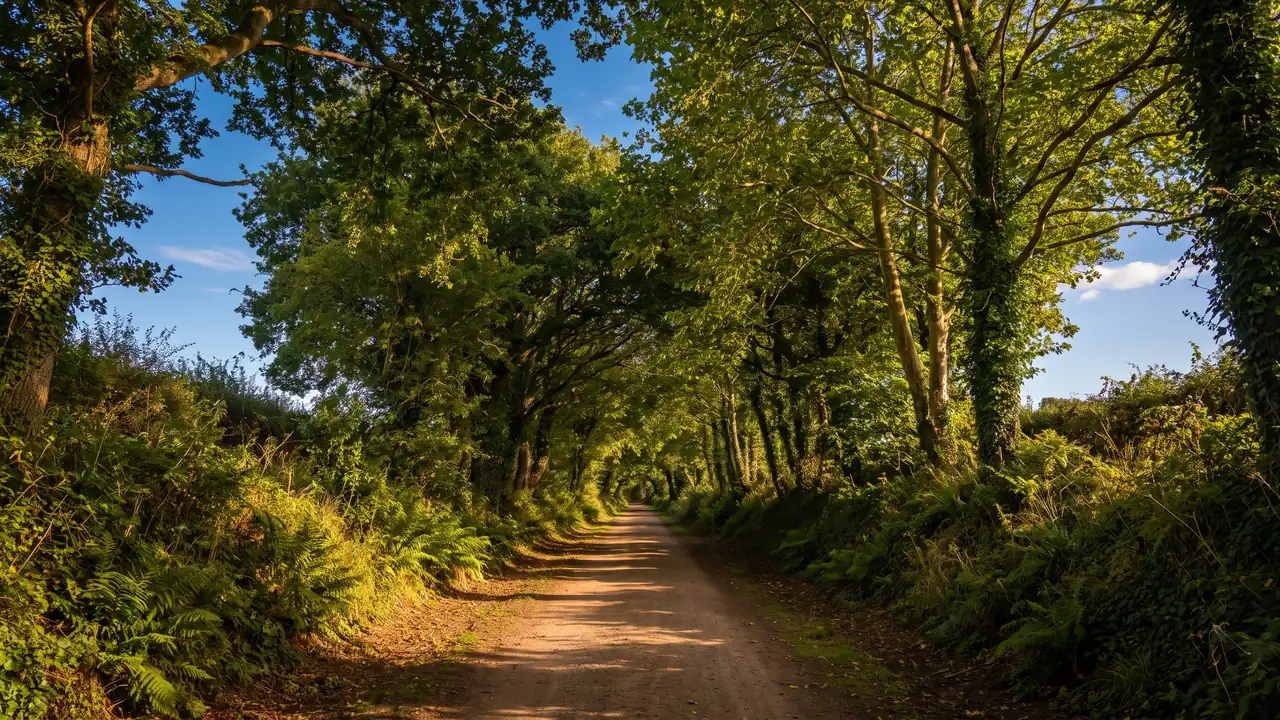
The former Créon train station (1892) is home to one of France’s very first “bike rental stations”—a national pilot project launched in 1999 and inaugurated on July 23, 2003, by Bernard Hinault himself. Rentals, services, and exemplary accessibility: here’s what Station Vélo actually offers visitors—as verified.
A Pioneer Inaugurated by Hinault
The story deserves to be told accurately: In the late 1990s, Créon was selected for a national pilot project called “Point relais vélo” (starting in 1999), which resulted in the renovation of the old train station and a grand opening ceremony on July 23, 2003—presided over by Bernard Hinault, five-time winner of the Tour de France. Often cited as “France’s first bike station,” it is more accurately described as “one of the very first” (no official designation settles the superlative). The official Station Vélo profile, accessed in July 2026, specifies that the Créon town hall owns the premises and the bicycles, and that Entre-deux-Mers Tourisme manages the facility under an agreement. The station shares the train station with the tourist information office, right next to the bike path—an ideal location for getting ready for an impromptu ride. It holds the “Accueil Vélo” and “Tourisme et Handicap” certifications and helps foster the local cycling community: a cycling school for adults since 2018, “Sortie de Piste,” “Échappées Créonnaises,” “Vélonotte,” and a bike swap.
Rent, inflate, ride: verified services
When it comes to rentals, the selection is remarkably wide: private chauffeur service, electric-assist bikes, tandems, children’s bikes, trailers, and baby seats—and, unusually, a truly accessible fleet: tricycles, handbikes, and electric cargo bikes adapted for wheelchair users. The rates published by city hall give a general idea of the cost: children’s bikes starting at €6, hybrid bikes starting at €10, e-bikes starting at €17, and adapted cargo bikes starting at €20 per day. Useful note: the station offers a tire-inflation station and a self-service tool kit, but no on-site repair shop—an independent repair shop (Évasion Cycles) operates in town. Operating hours are seasonal: open 7 days a week from June through September (9 a.m.–1 p.m. / 2 p.m.–7 p.m.), on weekends, holidays, and during school breaks in April–May and October–November; closed in winter—check before visiting during the off-season. For a family arriving from Bordeaux via transfer, the scenario is unbeatable: drop off at the Créon train station, rent a bike on site, and the trails open up to the right and left.
Planning Your Bike Ride from Créon
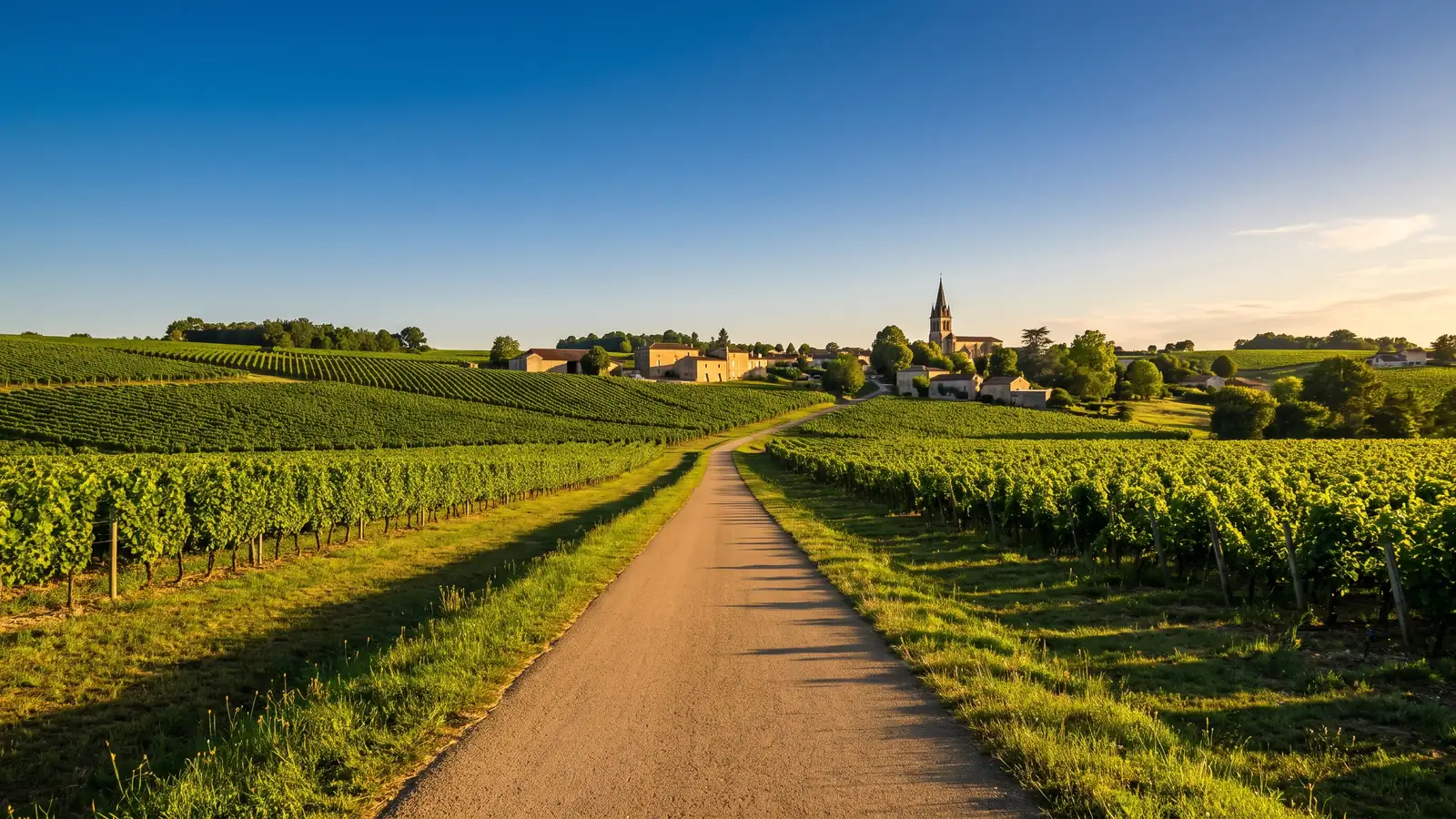
Starting from Créon, it’s all straightforward: the trail is flat, the old train station rents out bikes, gourmet stops dot the route from one old station to the next, and two marked loops lead off toward the vineyards. Here are the verified routes, ranging from a one-hour family ride to the full loop—with the tip of taking a shuttle back.
Three typical rides, from the easiest to the longest
Family outing (1–2 hours): from Créon to La Sauve (marker 29.5, 4 km away), combining a very easy round trip with a visit to La Sauve-Majeure Abbey and, right after the stop, a walk through the 259-meter tunnel—a guaranteed thrill for the kids, as the tunnel is lit. Half-day: the descent to Latresne through the cool Pimpine Valley (15 km), with possible stops at the Bistrot de la Pimpine (Lignan) and the Maison du Patrimoine Naturel (Sadirac); return in the opposite direction or by car. Full day: the route to Sauveterre-de-Guyenne (31.4 km official stage), via Espiet, the Frontenac and Saint-Brice quarries, all the way to the “bastide with four gates”—then return by private shuttle with the bikes, an option that saves you from having to ride the same kilometers in reverse. There are also two marked loops documented by the tourist office: the Citon-Cénac loop and the Créon bastide loop, which leave the trail to explore the hillsides and villages.
The logistics tip: bike on the way there, driver on the way back
The downside of any linear greenway is the return trip: cycling 25 or 30 km back in the other direction isn’t for everyone, especially when traveling with family or after a wine tasting. That’s why this option is such a hit: bike there, take a private shuttle back—a van that seats up to 8 people picks up passengers and bikes from Sauveterre, Créon, or any stop along the trail, and brings you back to Bordeaux or your lodging at the agreed-upon time. It works the other way around, too: a morning drop-off in Créon with or without your bikes (La Station Vélo rents bikes on-site, including e-bikes), a day on the trail and in the villages, and a flexible return trip.
It’s also the perfect solution for mixed-interest groups—the cyclists ride, while the others visit the abbey and the bastide, and everyone meets up at a restaurant in a former train station. Finally, note that the cycling-and-music festival Ouvre la Voix, which used to liven up the dance floor every early September (21st edition in 2025, with a shouting contest in the tunnel), is on hiatus in 2026. The event was cancelled by the Rock School Barbey. We'll keep an eye out for its return.
| Exit | Distance | Who is this for? / Good to know |
|---|---|---|
| Créon → La Sauve (abbey + tunnel) | ~4 km (one way) | families; UNESCO-listed abbey + 259-meter-long illuminated tunnel |
| Créon → Latresne (Pimpine Valley) | ~15 km | half-day; stops at bistros in Lignan, exhibition in Sadirac |
| Créon → Sauveterre-de-Guyenne | 31.4 km (official stage) | day trip; return trip by van with bikes is possible |
| Marked trails | Citon-Cénac · Créon Bastide | Start: Bike Station, Hills and Villages |
| Bike Rental | Hybrid bikes starting at €10, electric bikes starting at €17/day | June–September, 7 days a week; for people with limited mobility: tricycles, handbikes, adapted cargo bikes |
Dates, lengths, superlatives: what we often read
Créon and its greenway come with their share of inaccuracies: conflicting founding dates, contradictory lengths, and unverified superlatives. A reliable guide sets the record straight, backed by sources—here’s what’s true and what’s false, in two parts: the bastide, then the trail.
The Bastide District: 1315, a seneschal of Aquitaine, a listed church
First, the date of founding: depending on the website, you’ll find 1312, 1315, or 1316. The correct reference is the Charter of Customs dated 1st June 1315 (The “1316” refers to subsequent confirmations—the Ducal Court of Bordeaux, followed by the Edict of Westminster). Next, the title of Amaury III of Craon: the sources state "Seneschal of Aquitaine", not “of Guyenne.” The Notre-Dame Church, according to its POP listing, updated in March 2026, is not “14th-century Gothic”: The current building dates from 1490 and 1538, and it is officially listed as a Historic Monument since 2002, but not “classified”—note, however, that the Mérimée entry shares the same name as another “Notre-Dame Church” in the Gironde region, which causes confusion. The Place de la Prévôté features arcades along three sides, not four. And the slogan “land of 1,000 winemakers,” which one sometimes comes across: nowhere to be found in the sources—the Entre-deux-Mers AOC encompasses approximately 300 winemakers. “Capital of the Entre-deux-Mers,” on the other hand, is a nickname with a well-documented historical basis: the Royal Provostship and its 48 parishes.
On the Track: The Tunnel, the Kilometers, and the Festival
Regarding the greenway, three points need to be clarified. Length: neither “50” nor “57 km” plain and simple—47 km of the greenway proper (Latresne–Sauveterre), ~54 km from downtown Bordeaux, 57.5 km from Place de la Bourse; always specify the starting point. The tunnel: the only one on the route is the La Sauve underpass (259 m), just past La Sauve toward Sauveterre—the “Lignan or Sadirac tunnels” sometimes mentioned do not exist. Status: The trail is part of the national V80 cycle route (“Canal des 2 Mers à Vélo”), not a “EuroVelo.”
Also, do not specify a single opening date for the greenway (it was developed step by step, from the 1980s to the 2000s, on the line that closed in 1994), nor that the Frontenac station would be a café (unsourced). Finally, the news that’s changing plans: the festival "Ouvre la Voix" will not take place in 2026 — Cancellation announced by the Rock School Barbey and confirmed in July 2026, due in part to cuts in subsidies. And the Station Vélo is “one of the very first” of its kind in France—though the absolute superlative has never been officially recognized by any certification body.
Entre-deux-Mers, Créon's terroir
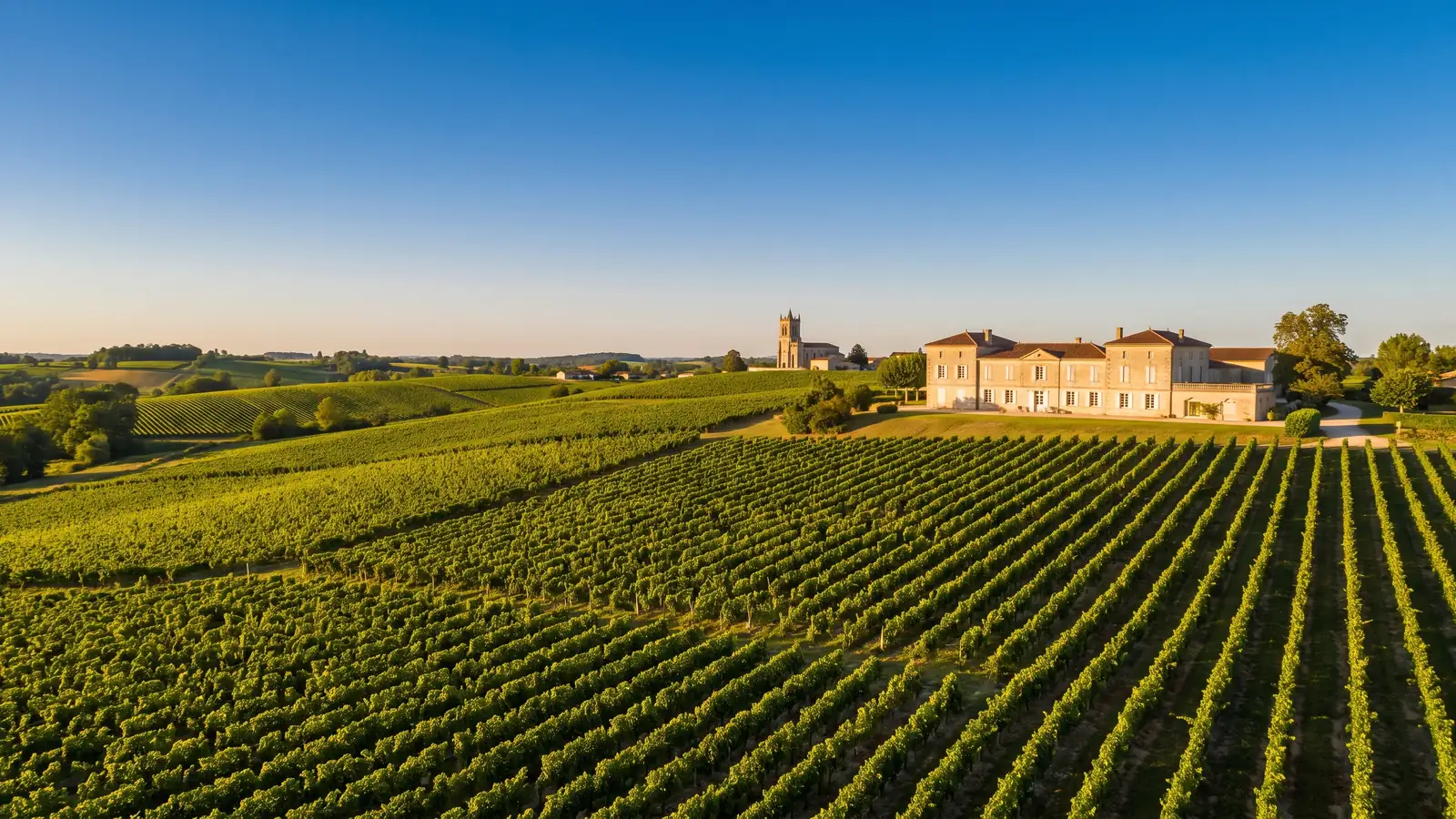
Créon lies at the heart of the Entre-deux-Mers AOC, the appellation for dry white wines established in 1937—the very same year as the Tour de Lapébie—and whose official showcase, the Maison des Vins, is housed in a 14th-century tithe barn, at the foot of La Sauve Abbey, 4 minutes from the bastide. Here is the terroir, verified.
Some dry whites—and a brand-new red
The Entre-deux-Mers AOC was established by decree on July 31, 1937 — A delightful coincidence: in the very same year that Roger Lapébie won the Tour de France, two icons from 1937 are sharing the route. Historically, this is a designation for dry whites : Sauvignon Blanc as the main variety, along with Sémillon, Muscadelle, and Sauvignon Gris, producing lively, aromatic wines that are classic pairings for oysters from the Bassin. A new development that few guides mention: the red has been authorized to do so since August 2023 — the first vintage (2023) has been on sale since January 2025; until then, the region’s red wines fell under the Bordeaux AOC. The appellation encompasses approximately 300 winemakers on stage. Around Créon, the family castles dot the hillsides, and the marked bike trails literally wind through the rows of vines: here, wine tourism is enjoyed by bike—in moderation for those riding, or with complete freedom for those with a driver.
La Maison des Vins, in a tithe barn
The premier wine tourism stop is the Entre-deux-Mers Wine Center, at La Sauve — that is, 3.6 km and 4 minutes from Créon, at the foot of the abbey. The place alone is worth the visit: a 14th-century abbey tithe barn, where the monks of La Sauve-Majeure once collected the tithe, is now a showcase for the 240 winegrowers and 1,500 hectares of the appellation. Here you can taste—a tried-and-true formula: Three wines with commentary for €65 —, where you can buy items at cost, and the exhibition “Monks and Wine in the Middle Ages” connects monastic history to the glass you’re holding. The perfect afternoon itinerary: the UNESCO-listed abbey, the tithe barn, followed by a château in the Créonnais region by appointment. This is where a private transfer really comes into its own: you can taste to your heart’s content without worrying about driving, the driver takes you from one stop to the next, and the boxes travel in the trunk. The opening hours of the Maison des Vins and the vineyards vary and should be confirmed before your visit.
| Wine in the Créon Area | Details (according to sources) |
|---|---|
| Designation | Entre-deux-Mers AOC, decree of July 31, 1937 (the year of the Tour de Lapébie) |
| Colors | Traditional dry whites; reds permitted starting in 2023 (first vintage available for sale in 2025) |
| White Grape Varieties | Sauvignon (the predominant variety), Sémillon, Muscadelle, Sauvignon Gris |
| Scope | ~300 winemakers; a showcase of 240 winemakers / 1,500 ha at the Maison des Vins |
| Where to Enjoy | Maison des Vins (14th-century tithe barn, La Sauve, 3 wines for €5) · châteaux by appointment |
What is there to do in Créon?
In Créon, you can visit the Wednesday market under the arcades, rent a bike at the old train station to ride the Roger-Lapébie greenway, visit the UNESCO-listed La Sauve-Majeure Abbey, just 4 minutes away, enjoy a tasting at the Maison des Vins, and continue on to Sadirac, the potters’ village. Here are the actual, verified activities—in the bastide and its immediate surroundings.
- The Wednesday morning market—8 a.m.–1 p.m., Place de la Prévôté, ~100 vendors: the market established by the charter of 1315, the 7th market in Gironde
- Exploring the Bastide on Foot — the arcaded square, the carreyras and carreyrous, and Notre-Dame Church (1490–1538, designated a Historic Monument)
- La Station Vélo — rental service offering hybrid bikes, e-bikes, tandems, and adapted bikes at the old train station (rates from 6 up to €65/day, June–September, 7 days a week)
- The Roger-Lapébie Greenway — toward La Sauve and its tunnel (4 km), Latresne (15 km), or Sauveterre (31 km)
- La Sauve-Majeure Abbey — 3.6 km (4 min) away: Romanesque ruins listed by UNESCO, over 80 capitals, panoramic bell tower (CMN)
- The Maison des Vins de l'Entre-deux-Mers — a 14th-century tithe barn in La Sauve: guided tasting of 3 wines, €5
- The Maison de la Poterie in Sadirac — 10 minutes away: over 200 ceramic pieces from the 14th to the 19th centuries, free admission (Tue–Sat, 2:00 p.m.–6:00 p.m.)
A Perfect Wednesday in the Bastide
The perfect scenario begins on a Wednesday morning : the market is in full swing under and around the arcades—about a hundred vendors, local farmers, and the atmosphere of an institution that was founded along with the city in 1315. We then stroll through the checkerboard : the straight-lined carreyras, the Church of Notre-Dame and its engraved dates (1490 on the portal, 1538 at the apse), the historic facades on Place de la Prévôté, and a café with outdoor seating under the arcades. The afternoon shifts focus to nature and heritage: La Sauve-Majeure Abbey — founded in 1079, designated a UNESCO World Heritage Site as part of the Routes of Santiago de Compostela, and managed by the Centre des monuments nationaux — is just 4 minutes ; you can climb the bell tower there to enjoy the panoramic view of the entire Entre-deux-Mers region, before the House of Wines neighboring town for a guided tasting. Return via Créon, or take a detour through Sadirac (10 minutes), a pottery village since ancient times — in the 18th century, there was “at least one potter in every family”—whose Pottery House, which is free, features more than 200 ceramic artifacts from local excavations.
A Turnkey Day of Cycling
Another side of a day in Créon is all about cycling. You’ll be dropped off at the old train station—where Station Vélo provides bikes for everyone, from e-bikes to tandems, handbikes, and wheelchair-accessible cargo bikes (certified by Accueil Vélo and Tourisme et Handicap)—and then you choose your itinerary: a family round trip to La Sauve and its 259-meter tunnel; the Pimpine Valley route to Latresne, from the old train station bistro to the heritage house; or the long ride to Sauveterre-de-Guyenne (31.4 km), with a return trip by van, bikes loaded. The marked loops around Citon-Cénac and the bastide add hillsides and villages to the itinerary. Along the way, every opportunity is an excuse to stop: a wine tasting at the Maison des Vins, lunch at the restaurant in the former Espiet train station, or a visit to the Frontenac quarries, whose stone was used to build Bordeaux. This is slow tourism at its finest in the Gironde—relaxed, safe, and indulgent—just half an hour from Bordeaux. Be sure to check the Station Vélo’s seasonal hours before visiting.
| Activity | Where / When | Good to Know |
|---|---|---|
| Bastide Market | Place de la Prévôté, Wednesday, 8 a.m.–1 p.m. | ~100 vendors; small market on Saturdays |
| Bicycle Rental | Bike Station (former train station) | E-bikes starting at €17/day; accessible for people with disabilities; June–September, 7 days a week |
| Roger-Lapébie Greenway | Marker 25.5, at the foot of the train station | La Sauve, 4 km away; Sauveterre, 31 km away |
| La Sauve-Majeure Abbey | 3.6 km / 4 min | UNESCO, CMN; panoramic bell tower |
| Maison des Vins / Sadirac Pottery | 4 min / 10 min | 3 wines for €5 · Free admission to the museum Tue–Sat 2:00–6:00 p.m. |
What's there to see around Créon?
Everything is close by in the area around Créon: the UNESCO-listed Abbey of La Sauve-Majeure is 4 minutes away, Sadirac—the potters’ village—is 10 minutes away, Targon and Haut-Benauge are 12 minutes away, the bastide town of Sauveterre is 28 minutes away—and Bordeaux is half an hour away. Here are the verified day trips, with the actual driving distances.
La Sauve-Majeure, the nearby UNESCO site
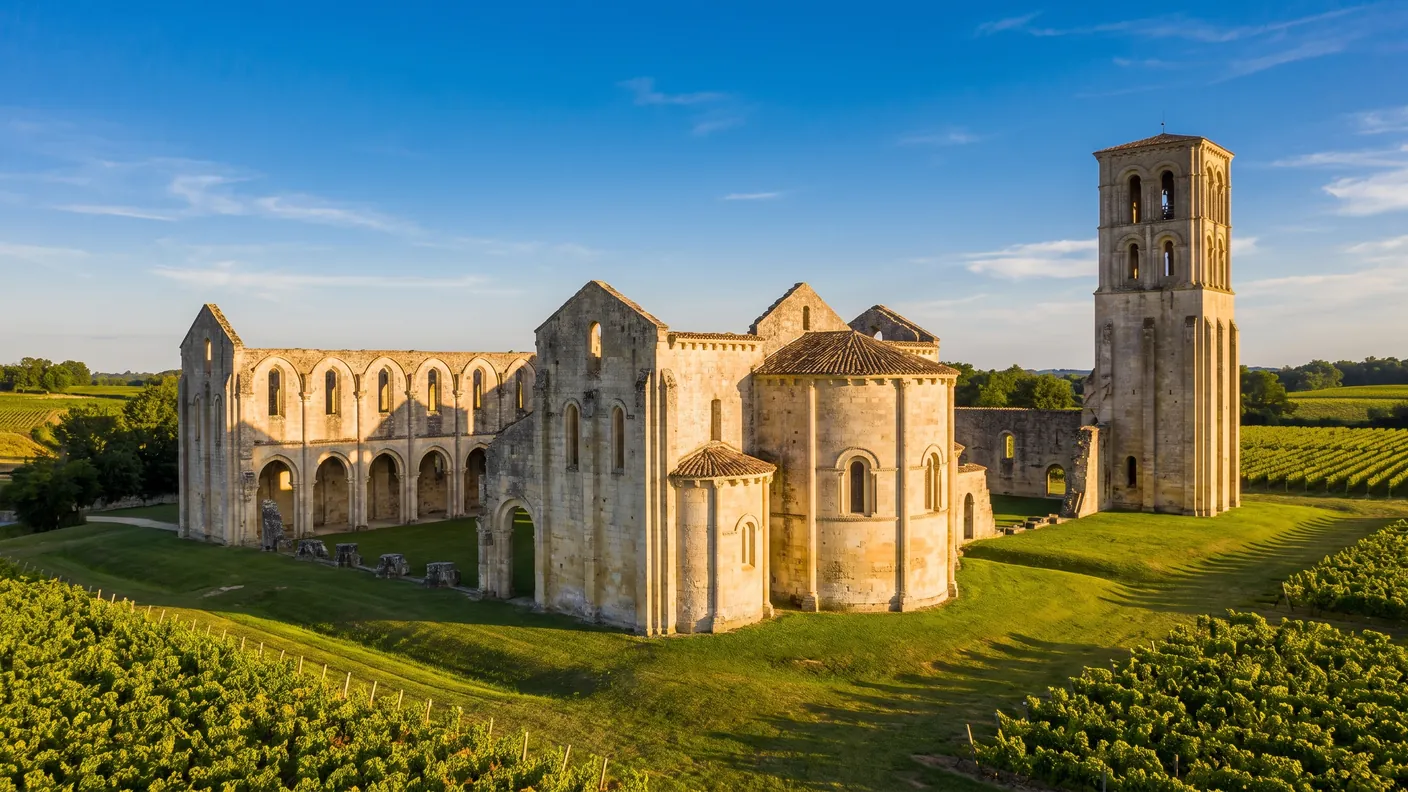
You can't visit Créon without going all the way to La Sauve-Majeure Abbey, at 3.6 km (a 4-minute drive, or about 20 minutes by bike on the trail): founded in 1079 by Gérard de Corbie with the support of the Duke of Aquitaine, this ruined Romanesque masterpiece—a designated historic site— UNESCO in 1998 as part of the Santiago de Compostela pilgrimage routes — includes more than 80 carved capitals and offers, from the top of its 13th-century bell tower, a panoramic view of the entire Entre-deux-Mers region. The site is managed by the Centre des monuments nationaux. The irony of history brings a smile: the bastide of Créon was founded in 1315 precisely to compete with the mighty abbey—right down to the decision to hold the market on Wednesday instead of the monks’ Tuesday. Seven centuries later, the two rivals form the most beautiful pair of attractions on the plateau, connected by a four-kilometer greenway. At their feet, the House of Wines At the Dîmière Barn, it all comes full circle—stone, history, and wine tasting, all in one afternoon.
Sadirac, Targon, Sauveterre: the star-shaped plateau
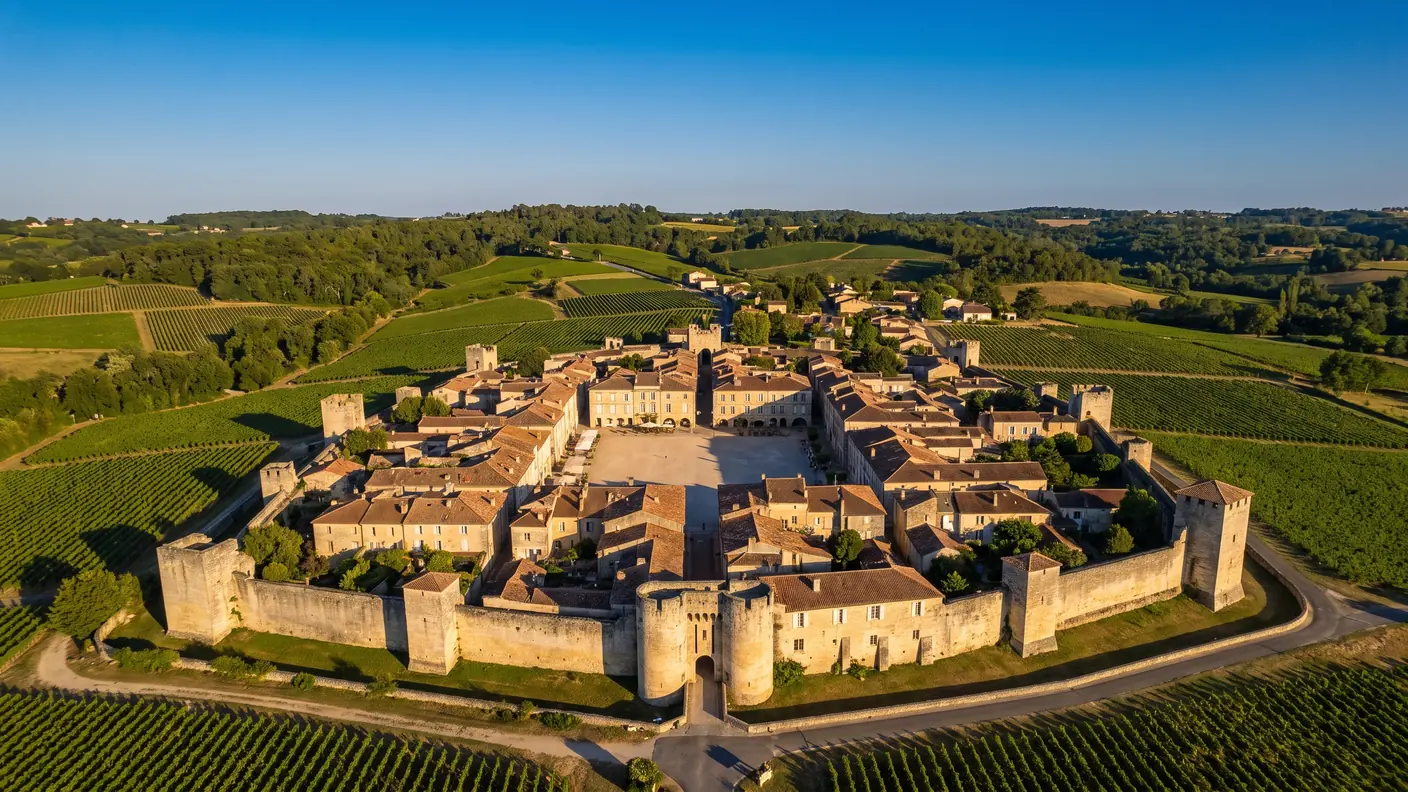
The other excursions radiate out in a star-shaped pattern. At Sadirac (6.7 km, 10 minutes)—it’s the clay that tells the story: village potter Since ancient times, it has housed the Natural Heritage Center in its old train station and, in the village, the Pottery House — a free museum featuring 200 ceramics from the 14th to the 19th century, along with ceramic workshops. At Targon (9.4 km, 12 minutes), the fortified church of Saint-Romain and the Templar ruins of Montarouch stand guard over the heart of the plateau, at the gateway to the Haut-Benauge wine region. At Sauveterre-de-Guyenne (26.4 km by road, or 31.4 km on trails), the bastide founded in 1281 and its four-door These listed sites mark the end of the greenway. And Bordeaux is only 26 km : You can stay in town and explore the Entre-deux-Mers region on day trips. A private chauffeur who knows the area will tailor the itinerary to your preferences—abbeys, pottery studios, bastides, wine tastings—without the hassle of driving or parking; and if part of the group is cycling, the driver will meet up with them, bikes included.
When is the best time to visit Créon?
Créon is open to visitors year-round, but the greenway sets the pace: from May through September, the bike station is in full swing and the trail is a joy to ride—with Wednesday, market day, being the best day of the week. The spring (April–June) is ideal: soft-green vineyards, the cool undergrowth of the Pimpine Valley, bike rentals available (on weekends in April and May, then every day), and terraces under the arcades. Summer (July–August) is the peak cycling season: the bike station is open 7 days a week, the rest stops at the old train stations are bustling, and the shade of the checkerboard-patterned path and the La Sauve Tunnel offer cool refuges during the hottest hours of the day. Fall (September–October) is a favorite among connoisseurs: grape harvest In the Entre-deux-Mers region, golden sunlight on the slopes, fewer visitors—and the bike station is still open on weekends through November.
Winter, the bike station is closed, but the bastide is still alive and well: the Wednesday market continues uninterrupted—it has hardly ever been interrupted since 1315—the Abbey of La Sauve-Majeure can be visited in beautiful low-angle light, and the trail remains open to hikers and cyclists with the proper gear. Whatever the season, the Wednesday The highlight of the day remains: the market in the morning, the abbey and the Maison des Vins in the afternoon—that’s the perfect day in Créon. Allow half a day for the bastide alone, a full day if you’re biking or visiting nearby sites, and a weekend to complete the entire greenway route with an overnight stay in Sauveterre and a drive back. Just 30 minutes from Bordeaux, Créon is the easiest green getaway from the city—four seasons in twelve months.
| Season | Atmosphere | Ideal for |
|---|---|---|
| Spring (April–June) | tender vines, fresh Pimpine | bicycle, abbey, Wednesday market |
| Summer (July–August) | Open 7 days a week, lively stops | family, tunnel, full days |
| Fall (Sept.–Oct.) | grape harvest, golden light | wine tourism, hillside loops |
How to Get to Créon from Bordeaux
Créon is about 26 km from Bordeaux, which is about a 40-minute drive—or 23 km along a flat, safe bike path. It’s the most accessible day-trip destination in the Entre-deux-Mers region. There is no active train station: private transportation or cycling are the two best ways to get there.
| Route | Distance | Duration | Details |
|---|---|---|---|
| Bordeaux → Créon | ~26 km | ~30 min | Starting at ~€65 for a private chauffeur service |
| Bordeaux-Mérignac Airport → Créon | ~35 km | ~40 min | pickup at the terminal |
| Bordeaux → Créon by bike (bike path) | 23 km | ~1 hour 30 minutes | A total elevation gain of just 95 m |
| Créon → La Sauve-Majeure (abbey) | ~3.6 km | ~4 min | UNESCO, also 4 km away via the greenway |
By car, Créon is just under half an hour from Bordeaux—the easiest day trip from the plateau. By bike, the official Bordeaux–Créon leg of the V80 is 23 km long with a cumulative elevation gain of 95 m: one of the gentlest finishes in France, along the right-bank quays and then through the Pimpine Valley. Since the rail line closed to passengers in 1951, there are no trains: that’s the whole point of the private transfer, which picks you up at the airport, at Saint-Jean Station, or at your hotel and drops you off door-to-door—at Place de la Prévôté for the market, at the old train station to rent bikes, or directly at La Sauve-Majeure Abbey. The driver then takes you through your stops (Maison des Vins, Sadirac, Targon, Sauveterre...) and, if needed, handles the famous return trip with the bikes from any stop along the trail. For a day spent exploring bastides, abbeys, and the greenway—especially with wine tastings—this is the most flexible and relaxing option.
Whether it’s for the Wednesday market, a family bike ride along the Roger-Lapébie greenway, or the “abbey and wine tasting” tour, booking a private chauffeur guarantees a comfortable and punctual ride—book a driver from Bordeaux to Créon or explore all our destinations.
Frequently Asked Questions
Where is Créon located?
Créon is a medieval bastide in the Gironde department, about 26 km east of Bordeaux (a 40-minute drive), in the heart of the Entre-deux-Mers region, where it is known as the “capital ”—a title with genuine historical roots, as it was the seat of the Royal Provostship, whose jurisdiction covered 48 parishes until the Revolution. The town, with a population of 4,950 (2023), is part of the Bordeaux arrondissement and lends its name to the Créonnais community of municipalities. It is also the department’s major cycling hub: the Roger-Lapébie greenway passes through at kilometer marker 25.5, and its former train station houses one of France’s very first bike-sharing stations. The UNESCO-listed Abbey of La Sauve-Majeure is 4 minutes away, Sadirac is 10 minutes away, and Sauveterre-de-Guyenne is 28 minutes away. There is no active train station; the only ways to reach the town are by private transportation or by bike along the greenway (23 km from Bordeaux).
How much does a transfer from Bordeaux to Créon cost?
We offer a fixed-price transfer from Bordeaux to Créon, starting at approximately €72 one way (about 26 km, about a 40-minute drive), in a Mercedes sedan or van seating up to 8 passengers, with a professional driver. The route is direct, door-to-door: pickup at the airport, Saint-Jean train station, or your hotel in Bordeaux, and drop-off at Place de la Prévôté, the bike station at the old train station, or La Sauve-Majeure Abbey. The fixed-price quote is provided and confirmed in writing before departure, with no surprises on the meter. The van can also carry bicycles: this is the ideal option for cycling there and taking the van back along the greenway, or for picking up a group in Sauveterre at the end of the crossing. For groups, this is often the simplest and most economical way to reach the bastide and its bike path.
Who founded the bastide of Créon, and when?
Créon was founded by Amaury III of Craon, seneschal of Aquitaine—that is, the highest-ranking representative of King Edward II of England, Duke of Aquitaine, of whom he was a first cousin. The charter of customs is dated June 1, 1315: this is the date of foundation to be noted (it was subsequently authenticated by the Ducal Court of Bordeaux on March 9, 1316, and then confirmed by an edict from Westminster—hence the “1316” that is sometimes cited). A descendant of the powerful House of Craon in Anjou, Amaury gave his surname to the new town: “Craon” became “Créon”—one of the few French municipalities to bear the name of its founder. The charter granted market privileges, including a weekly market held on Wednesdays (to compete with the Tuesday market at the nearby Abbey of La Sauve-Majeure) and six annual fairs. The grid-like layout, the arcaded square, and the Wednesday market carry on this urban plan from 1315.
What is the Roger-Lapébie Greenway?
This is the Gironde’s main bike path, developed by the Department along the former Entre-deux-Mers railway line (the Bordeaux-Benauge to La Sauvetat-du-Dropt line, opened in 1873 and permanently closed in 1994). The greenway itself runs from Latresne to Sauveterre-de-Guyenne over 47 km; according to the official guide, it’s about 54 km from downtown Bordeaux, or 57.5 km from Place de la Bourse. Paved with smooth asphalt, virtually flat (95 m of cumulative elevation gain between Bordeaux and Créon), and reserved for non-motorized traffic, it is the Gironde section of the national bike route V80, “Canal des 2 Mers by Bike ” (Royan–Sète). Its converted former train stations (a café in Latresne, a bistro in Lignan, exhibitions in Sadirac, and a restaurant in Espiet), its 259-meter-long illuminated tunnel past La Sauve, and its three medieval gems—Créon, the Abbey of La Sauve-Majeure, Sauveterre—make it one of the most beautiful greenways in France. It honors Roger Lapébie, winner of the 1937 Tour de France.
Who was Roger Lapébie?
Henri Fernand Lapébie, known as Roger (1911–1996), was one of the great French cyclists of the interwar period—and a resident of Gironde by choice: born in Bayonne, he settled in Talence at the age of six and died in Pessac. His achievements include: 1933 French Road Champion, Paris-Nice in 1937, nine stages of the Tour de France (including five in 1934, the year he finished third), and above all, the overall victory in the 1937 Tour de France—the first Tour contested with derailleurs. It was a dramatic race: penalized for using pushcarts, and after his handlebar stem was sawed off, he watched the entire Belgian team withdraw following a penalty imposed on the yellow jersey wearer, Sylvère Maes, in Bordeaux, and went on to win with a lead of 7 minutes and 17 seconds. His career ended in 1939 with a fractured kneecap at the finish of the Bordeaux-Paris race. His brother Guy was a two-time Olympic champion in 1936 and finished third in the 1948 Tour. The Entre-deux-Mers greenway is named in his honor as a tribute to the Gironde champion.
Can you rent bikes in Créon?
Yes—it’s actually one of the city’s specialties. The Créon Bike Station, located in the former train station built in 1892 alongside the tourist information office, is one of the very first bike stations in France: born out of a national pilot project in 1999, it was inaugurated on July 23, 2003, by Bernard Hinault. The city owns both the facility and the bikes. Available for rent: hybrid bikes, electric-assist bikes, tandems, children’s bikes, bike trailers—and a rare accessible fleet (tricycles, handbikes, wheelchair-accessible electric cargo bikes), certified with the Accueil Vélo and Tourisme et Handicap labels. Price ranges published by the city hall: children’s bikes starting at €6, hybrid bikes starting at €10, e-bikes starting at €17, adapted cargo bikes starting at €20 per day. On-site: self-service tire inflation and tool kit (no permanent repair shop). Seasonal hours: open 7 days a week from June through September; weekends and holidays in April–May and October–November; closed in winter.
What is there to do in Créon?
The typical itinerary combines a visit to the bastide with cycling. In the bastide: the Wednesday morning market (8 a.m.–1 p.m., ~100 vendors; the market is governed by the charter of 1315), the Place de la Prévôté and its arcades, the checkerboard-patterned streets, Notre-Dame Church (Flamboyant Gothic, dated 1490–1538, listed as a Historic Monument). For cycling: rent a bike at the Station Vélo at the old train station, then take the Roger-Lapébie greenway—a family-friendly round trip to La Sauve and its 259-meter tunnel, a descent through the Pimpine Valley toward Latresne, or a ride across to Sauveterre-de-Guyenne (31.4 km). 4 minutes away: the UNESCO-listed Abbey of La Sauve-Majeure (over 80 carved capitals, panoramic bell tower) and the Maison des Vins de l’Entre-deux-Mers in its tithe barn (tasting of 3 wines for €5). 10 minutes away: Sadirac, a pottery village, and its free Maison de la Poterie. Enough to fill a full day—or a weekend with a complete hike along the trail.
On what day is the Créon market held?
The main market is held on Wednesday mornings, from 8 a.m. to 1 p.m., on Place de la Prévôté and the adjacent streets: about 100 vendors, with priority given to local producers—the Federation of Bastides of Aquitaine ranks it as the 7th largest market in Gironde. Its longevity is exceptional: the founding charter of 1315 already established a weekly market on Wednesdays, specifically to compete with the Tuesday market at the Abbey of La Sauve-Majeure—a medieval trade war whose legacy is still evident more than 700 years later. A second, more modest market (with about ten vendors) brings life to the square on Saturday mornings—not to be confused with the main market. If you can only visit Créon once, be sure to choose a Wednesday: the market in the morning, La Sauve-Majeure Abbey, and the Maison des Vins in the afternoon—the perfect day in Créon, just 30 minutes from Bordeaux.
Is there a tunnel on the Roger-Lapébie Greenway?
Yes, just one—and it’s well worth the detour: the La Sauve Tunnel, 259 meters long, built for the railroad in the 19th century, located just past the La Sauve stop on the way to Sauveterre. It is well-lit and easy to walk through; for children, emerging from it is often a thrilling experience. You may sometimes see it referred to as the “Lignan Tunnel” or the “Sadirac Tunnel,” but this is incorrect—no source places the tunnel anywhere other than after La Sauve. The tunnel even has its own folklore: during the “Ouvre la Voix” cycling and music festival, it served as the venue for the “grand shouting contest,” taking advantage of its exceptional acoustics (the festival is on hiatus in 2026, as that year’s edition was canceled by the Rock School Barbey). From Créon, the tunnel is about 5 km away via the bike path: the round trip, combined with a visit to La Sauve-Majeure Abbey, makes for the ideal family outing—flat, shaded, and spectacular.
Is it possible to ride a bike from Bordeaux to Créon?
Yes, and it’s one of the most beautiful routes: the official Bordeaux–Créon stage of the V80 “Canal des 2 Mers by Bike” route is 23 km long, with a total elevation gain of just 95 m (highest point at 98 m)—an ideal profile for families. The route follows the right-bank quays, joins the start of the greenway at Latresne (km 10.5), then heads up the cool Pimpine Valley through Lignan-de-Bordeaux and Sadirac, all the way to the old Créon train station and its bike rental station. Allow about 1 hour and 30 minutes at a leisurely pace on smooth asphalt, with no cars from Latresne onward. Many visitors combine the following: cycling there in the morning, visiting the market or the abbey at noon, then returning by private shuttle with their bikes—a van with up to 8 seats picks up cyclists and their bikes from Créon or any stop along the trail. The reverse is also possible: drop-off at Créon, on-site bike rental, and a customized day on the trail.
What's there to see around Créon?
Everything is nearby. Just 3.6 km (4 minutes) away is the Abbey of La Sauve-Majeure—founded in 1079, designated a UNESCO World Heritage Site as part of the Way of St. James, and managed by the CMN—and, at its foot, the Maison des Vins de l’Entre-deux-Mers, housed in its 14th-century tithe barn. 6.7 km (10 minutes) away is Sadirac, a pottery village since ancient times, featuring its free Maison de la Poterie (with over 200 ceramic pieces) and the Maison du Patrimoine Naturel in the former train station. 9.4 km (12 minutes) away, Targon, with its fortified church and the Templar ruins of Montarouch. 26.4 km (28 minutes) away—or 31.4 km via the trail—is Sauveterre-de-Guyenne, a bastide founded in 1281 with four listed gates, and the terminus of the greenway. Finally, Bordeaux is only 26 km away: you can stay in the city and explore the area on day trips. A private chauffeur will customize your itinerary between these stops and, if needed, handle the logistics for your bikes.
Is the church in Créon a designated historic site?
It has been listed as a Historic Monument—in its entirety since April 16, 2002 (Mérimée entry PA00083530)—which provides a genuine level of protection, though distinct from its classification. Be careful, however, when searching for the entry not to confuse it with a church named Notre-Dame in another town in the Gironde department. The current building is not contemporary with the 1315 foundation: an earlier church (1316–1320) preceded it, and what we see today belongs to the Late Gothic and Flamboyant styles, built between the late 15th and 16th centuries. Two dates are carved into the stone—1490 on the western portal and 1538 on the apse—along with the signature of master mason Marsault Roux, a rare example of a craftsman who “signed” his work. A single nave with five bays under a ribbed vault, a pentagonal apse, and an ogee portal beneath a 17th-century bell tower-porch: a fine example of Bastide Gothic architecture, worth seeing as you stroll from the Place de la Prévôté.
What is the Ouvre la Voix Festival?
Ouvre la Voix is the Rock School Barbey’s traveling cycling-and-music festival: every early September, concerts and events took place along the Roger-Lapébie greenway, with stops in Créon, Sauveterre, Latresne, Sadirac, and Bordeaux—mostly free (the 2025 headliner, Dominique A at Les Arcades in Créon, required a ticket), with shuttle buses running between Créon and Sauveterre on Saturday and the unusual “big shouting contest” held in the La Sauve tunnel. The 21st edition took place from September 5 to 7, 2025. Important information for your plans: the 2026 edition has been officially canceled by the Rock School Barbey (due to funding cuts and the election season)—the festival is therefore on hiatus, and its return remains to be seen. The greenway, of course, is open year-round, and the stops at the old train stations remain the best part of the route, festival or no festival.
What is the distance between Bordeaux and Créon?
About 26 km by road (26.1 km measured from the center), or about a 40-minute drive—Créon is the most accessible destination in the Entre-deux-Mers region. By bike, the official V80 route covers 23 km along the riverbanks and the greenway, which is almost entirely flat. If you hire a private driver, the fare is fixed and provided in advance, starting at around €78 one way—a van is available to transport bikes. There is no train service: the Entre-deux-Mers railway line closed to passengers in 1951 (and permanently in 1994); the greenway runs precisely along the route of that former railway right-of-way. A private transfer is therefore the door-to-door solution: drop-off at the market, the Station Vélo, or La Sauve-Majeure Abbey, followed by a customizable series of stops (Maison des Vins, Sadirac, Targon, Sauveterre), followed by a return to Bordeaux at the agreed-upon time—with bikes loaded if needed.
When is the best time to visit Créon?
The summer season sets the pace: from May to September, the Station Vélo is in full swing (open 7 days a week from June to September), the bike path is a joy to ride, and the rest stops at the old train stations are open. Spring brings the tender vineyards and the coolness of the Pimpine Valley; summer, the shade of the checkerboard-patterned path and the tunnel; fall, the grape harvest and golden light on the hillsides—the station remains open on weekends through November. In winter, the bike station closes, but the bastide comes alive: the Wednesday market continues uninterrupted (it has hardly ever been interrupted since 1315), and La Sauve-Majeure Abbey is open to visitors year-round. The best day is still Wednesday: market in the morning, the abbey and the Maison des Vins in the afternoon. Allow half a day for the bastide, a full day if you’re biking, and a weekend to complete the entire greenway route with a ride back from Sauveterre.
Is the greenway accessible to people with limited mobility?
Yes, remarkably—this is one of the destination’s proven strengths. The greenway itself is paved with smooth asphalt, is virtually flat (the Bordeaux–Créon leg has a total elevation gain of just 95 m), is car-free, and is officially open to people with limited mobility as well as pedestrians and inline skaters. Most importantly, the Créon Bike Station offers a fleet of adapted bikes that’s rare in France: tricycles, handbikes, and even an electric cargo bike adapted for transporting wheelchairs (starting at €65 per day), all certified under the “Tourisme et Handicap” label—in addition to the “Accueil Vélo” label. The station has also offered a cycling school for adults since 2018. Combined with a private door-to-door transfer from Bordeaux (in a van accessible for luggage and equipment), this makes the Roger-Lapébie greenway one of the most inclusive nature outings in the region—including a visit to the Abbey of La Sauve-Majeure and a tasting at the tithe barn.
Further Reading
- The rival abbey that became an ally: see the Guide to La Sauve-Majeure Abbey (a UNESCO-designated Romanesque masterpiece just 4 minutes away)
- The trail's endpoint: see the Guide to Sauveterre-de-Guyenne (the bastide with four gates, at the end of the 57.5 km)
- The nearby Templar village: see the Targon Guide (fortified church and Montarouch commandery, 12 minutes away)
- Understanding our rates and vehicles: see the "Book a Driver" page (sedan & 8-passenger van, bicycles allowed, fixed-price quote)
- Plan your trip: Book a private driver from Bordeaux to Créon or explore all our destinations
Sources and References
- Wikipedia — Créon (Gironde) — a bastide founded in 1315 by Amaury III de Craon, seneschal of Aquitaine under Edward II; charter dated June 1, 1315; population 4,950 (2023); sacked c. 1337–38, fortified 1342–51; bike station inaugurated in 2003 by Bernard Hinault
- Gironde Tourisme — The Créon Bike Station & the Roger-Lapébie Trail — official guide to the greenway (kilometer markers, converted train stations, tunnel after La Sauve), Roger Lapébie, “winner of the 1937 Tour de France”; the station, “one of the first in France”
- France Vélo Tourisme — Bordeaux/Créon — an official 23-km stage of the Canal des 2 Mers bike route
- France Vélo Tourisme — Créon/Sauveterre — official 31-km stage on a bike path
- Wikipedia — Bordeaux–Benauge Line to La Sauvetat-du-Dropt — line opened in 1873, passenger service until 1951, Espiet cement plant until 1987, closed in 1994; La Sauve tunnel (259 m)
- Wikipedia — Roger Lapébie — Henri Fernand, known as Roger Lapébie (Bayonne 1911 – Pessac 1996), winner of the 1937 Tour de France (the first Tour to feature derailleurs), 1933 French champion, 1937 Paris–Nice, and 9 stages of the Tour
- Créon City Hall — Markets — Wednesday Market 8 a.m.–1 p.m. and Saturday Events
- Créon City Hall — Bike Station — Information on management, services, hours, and rates
- POP Mérimée — Notre-Dame de Créon Church — Flamboyant Gothic church (1490 portal – 1538 apse, master mason Marsault Roux), listed in its entirety as a historic monument on April 16, 2002
- Rock School Barbey — Cancellation of “Ouvre la Voix 2026” — the cycling and music festival along the greenway (21st edition, September 5–7, 2025) will not take place in 2026
Information and schedule verified on .
Our Latest Guides
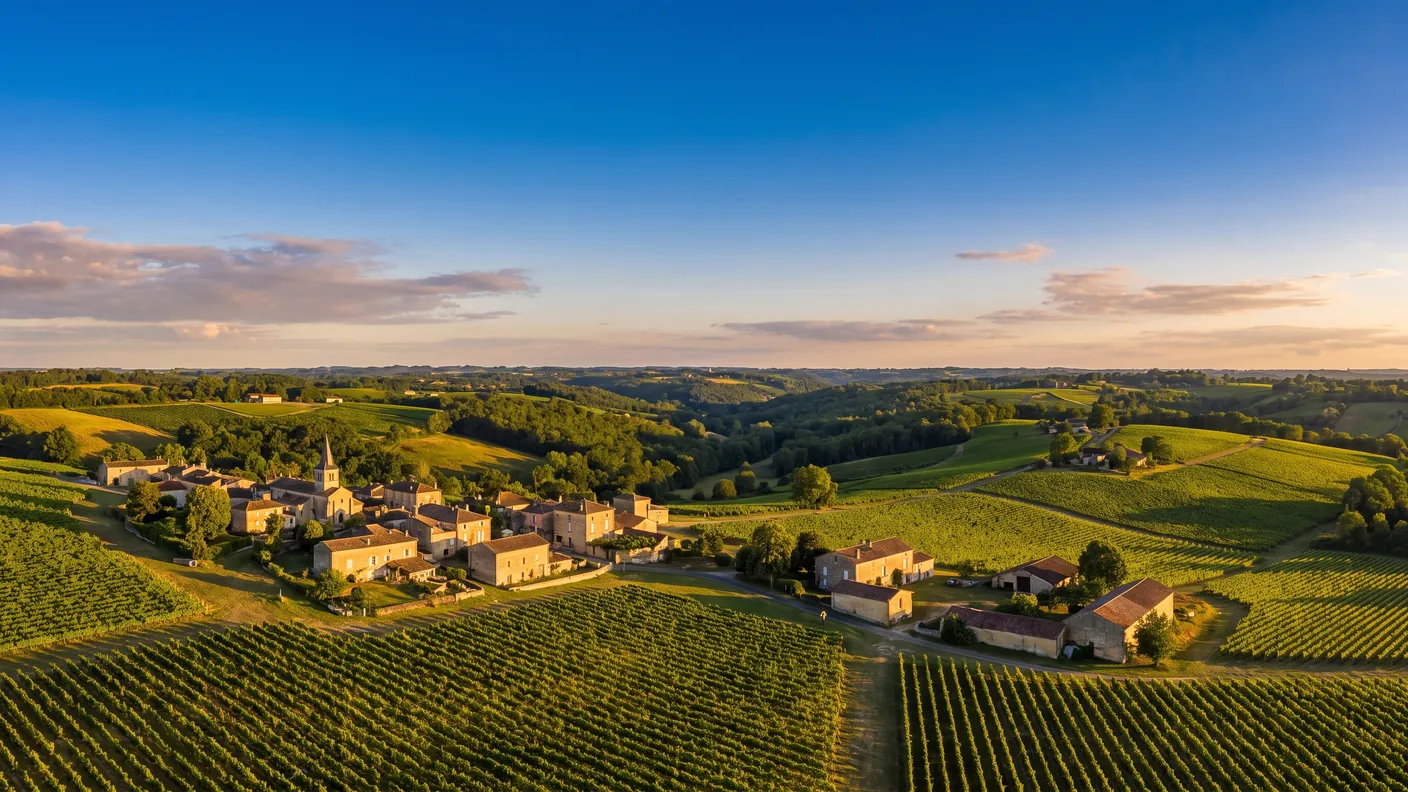
Off to the bastide and the greenway
Direct transfer from Bordeaux (~30 min) to Créon—the market in the bastide, the bike station at the old train station, or the Abbey of La Sauve-Majeure. 8-passenger van, bikes on board, return from any stop along the trail. Fixed, written quote—no surprises on the meter.