
From Bordeaux to Moissac: abbey and Chasselas
One of the greatest masterpieces of Romanesque art: Saint-Pierre Abbey, with its cloister dating from 1100 and its Apocalypse tympanum—both designated UNESCO World Heritage Sites—the capital of the golden Chasselas grape, and a major stop on the Camino de Santiago—less than two hours from Bordeaux.
Moissac at a Glance
Moissac, in Tarn-et-Garonne, is home to Saint-Pierre Abbey and its Romanesque cloister, which have formed part of the UNESCO-listed Routes of Santiago de Compostela since 1998 (source: UNESCO). The town has a population of approximately 13,400 (source: INSEE) and is known for its PDO Chasselas table grapes (source: INAO). From Bordeaux, the trip covers 187 km and takes about 2 hours and 5 minutes; the listed chauffeur-service fare starts at 315 € one way and is confirmed in writing before booking.
Moissac: Key Points
| Landmark | Details |
|---|---|
| Department | Tarn-et-Garonne (82), Occitanie · Bas-Quercy |
| River | the Tarn (near its confluence with the Garonne) |
| Population | ≈ 13,400 residents (INSEE 2023) |
| Don't miss it | Saint-Pierre Abbey, the cloister (1100), the tympanum |
| Rankings | cloister and abbey listed as UNESCO World Heritage Sites (1998) |
| Distance from Bordeaux | about 187 km · about 2 hours and 5 minutes by car |
A brief note helps place Moissac precisely. The town lies in Tarn-et-Garonne (82), in Occitanie, not in the neighbouring Lot department. It belongs to Bas-Quercy, on the southern edge of Quercy, in the plain bordering the Tarn. With about 13,400 residents, it is not a large town, yet its abbey gives it one of the most prestigious heritage ensembles in south-west France. Moissac is the administrative centre of its canton, while nearby Castelsarrasin is the subprefecture; it is also a market town rooted in its terroir and the capital of Chasselas. The information in this guide draws on verifiable sources, including Wikipedia, the Mérimée database, INSEE, and INAO, all cited at the end of the article.
Where is Moissac located?
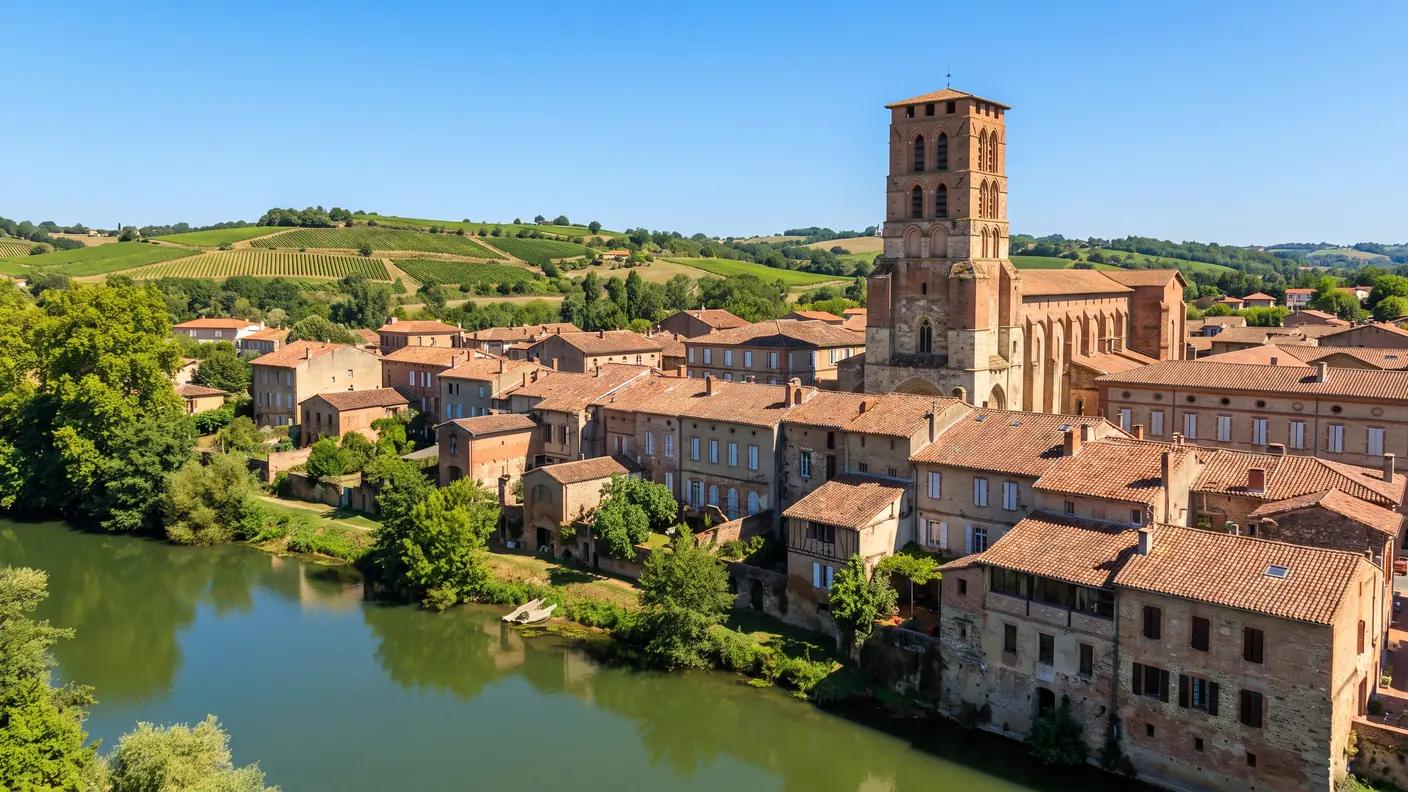
Moissac is located in the Tarn-et-Garonne department (82), in the Occitanie region, in Bas-Quercy, on the banks of the Tarn, just before the river joins the Garonne. The town occupies a pivotal position between the hills of Quercy to the north and the vast, almost perfectly flat alluvial plain that stretches toward Castelsarrasin. It is a region of orchards and vineyards—Moissac is the capital of the Chasselas grape—as well as rivers and canals, with the mild climate of southwestern France. Note, for precise location: the Tarn River flows through Moissac, but its confluence with the Garonne is located slightly downstream, near Saint-Nicolas-de-la-Grave; the city is therefore on the banks of the Tarn, very close to the confluence, though not exactly at the confluence itself. This location, on the major routes connecting Bordeaux to Toulouse and on the pilgrimage routes to Santiago de Compostela, has made Moissac a major crossroads and stopping point since the Middle Ages.
At the gateway to Quercy, on the Tarn River
Moissac is the southern gateway to Quercy, a natural and historical region that spans the Lot department and the northern part of Tarn-et-Garonne. The town marks the transition between Lower Quercy and the Garonne Plain: to the north lie the slopes of Quercy Blanc (toward Lauzerte and Montcuq), with their white limestone hills; to the south lies the fertile plain, a land of crops and orchards. The Tarn River, wide and calm at this point, runs alongside the town and has caused many floods here, including the devastating flood of 1930. This riverside location, where the hills meet the plain, explains the early establishment of a monastery and the prosperity of Moissac, sustained by the waters, the land, and the roads. It is a gentle, sun-drenched landscape, typical of western Occitanie, between Quercy and Gascony, where it is a pleasure to stroll.
A Small Town with a Rich Heritage
With about 13,400 residents, Moissac is a small town, but its cultural heritage far exceeds its size: Saint-Pierre Abbey, with its cloister and portal, ranks among the world’s great masterpieces of Romanesque art. This contrast, a modest provincial town guarding a universal treasure, gives the visit much of its appeal. Moissac is also lively, with its market, riverbanks, canal bridge, and fruit-growing tradition, led by the famous Chasselas. A major stop on the Via Podiensis (GR 65) to Santiago de Compostela, it welcomes between 15,000 and 20,000 pilgrims each year. Pilgrims, art lovers, and food enthusiasts come from around the world for the beauty of the cloister and the calm of its setting.
Saint-Pierre Abbey
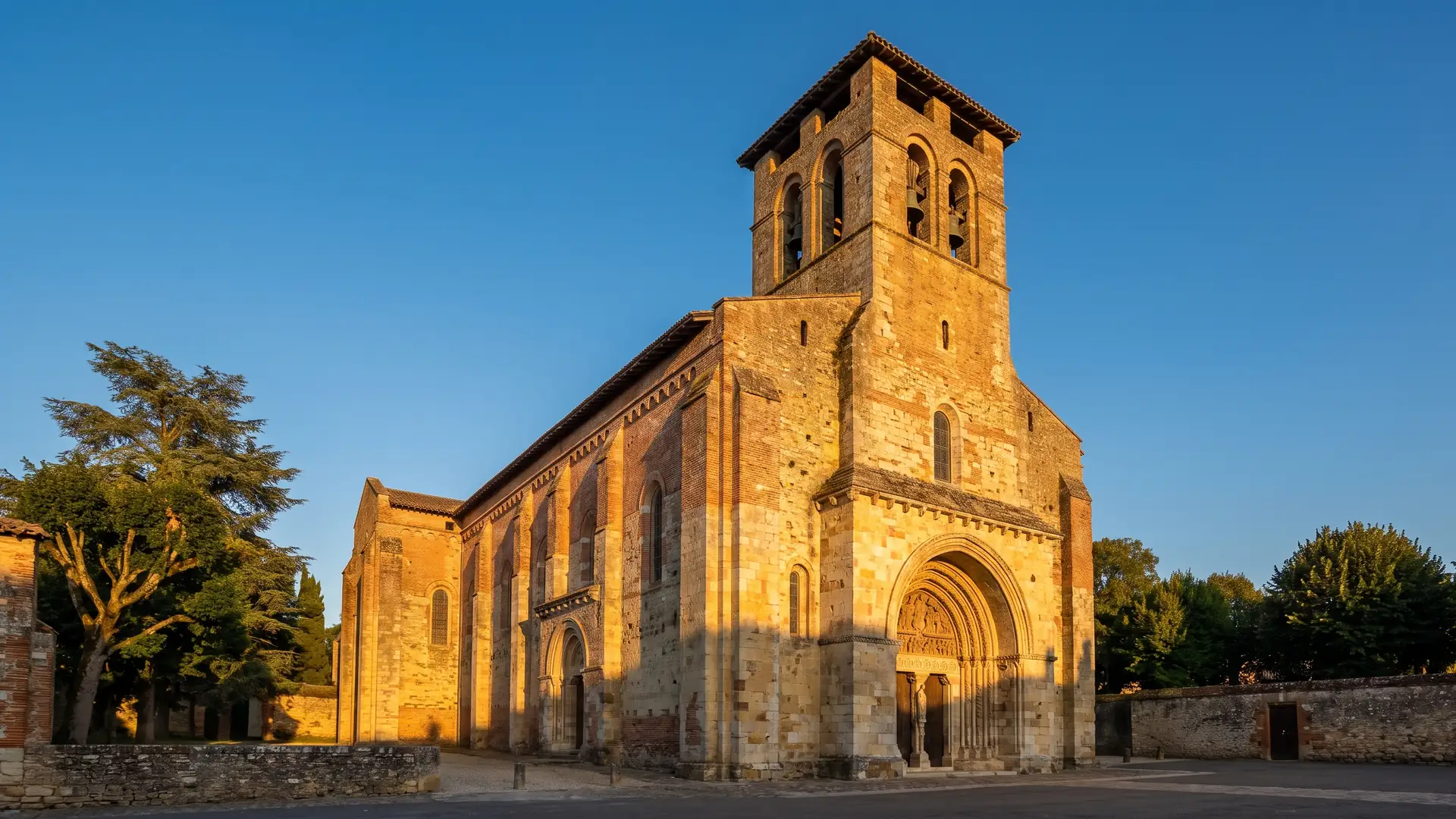
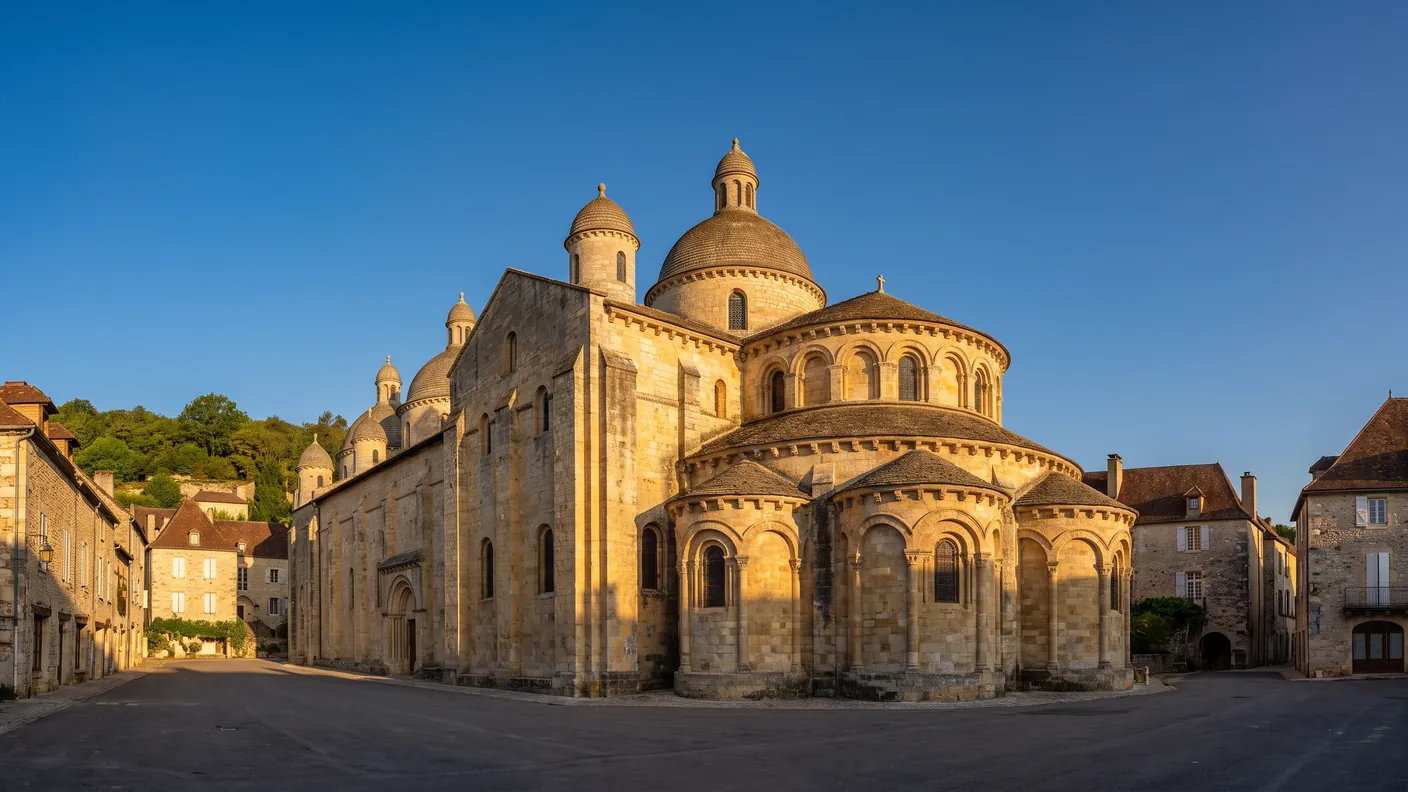
Saint-Pierre Abbey in Moissac is a former Benedictine monastery, affiliated with the Order of Cluny in 1048, which enjoyed immense influence during the Middle Ages: its workshop helped shape the Romanesque style of Languedoc. Founded well before the year 1000, the abbey became one of the great spiritual and artistic centres of southern France under Cluny. Today, the abbey church, cloister, and portal, jewels of Romanesque art and part of a UNESCO World Heritage inscription, bear witness to that standing. They form the heart of Moissac: an exceptional monastic complex where visitors can admire, in one place, some of the finest masterpieces of 12th-century sculpture. Exploring Saint-Pierre Abbey is to enter the world of medieval art and faith in a setting of rare intensity.
A large Cluniac abbey
The abbey’s origins are ancient and partly legendary. Tradition attributes its foundation to Clovis in 506, but this account belongs to monastic legend rather than history: the monastery was probably founded toward the end of the 7th century. A major turning point came in 1048, when Moissac was affiliated with the powerful Abbey of Cluny under Abbot Durand de Bredon (1048–1071). This made it one of south-west France’s most important Cluniac abbeys, wealthy, influential, and responsible for numerous priories. That prosperity enabled the construction of the cloister and portal in the 11th and 12th centuries, as well as the rise of a leading sculpture workshop. The abbey became a major spiritual, intellectual, and artistic centre on the pilgrimage route to Santiago de Compostela.
A UNESCO World Heritage Site
The Abbey Church of Saint-Pierre, with its imposing fortified bell tower made of brick and stone, blends Romanesque and Gothic styles. But it is above all the cloister and the portal that have earned it worldwide renown. The former abbey is listed as a historic monument—the church appears on the very first list from 1840, compiled by Prosper Mérimée— and the complex (abbey church and cloister) has been inscribed on the UNESCO World Heritage List since 1998 as part of the “Routes of Santiago de Compostela in France.” This dual recognition speaks volumes about the site’s exceptional value. Inside the abbey church, visitors will discover beautiful furnishings and remarkable sculptures; but the highlight of the visit remains the cloister and the great portal, two absolute masterpieces of Romanesque sculpture, which we will describe in detail. Moissac is, in and of itself, a lesson in medieval art, set in a well-preserved environment.
The Romanesque cloister dating from 1100
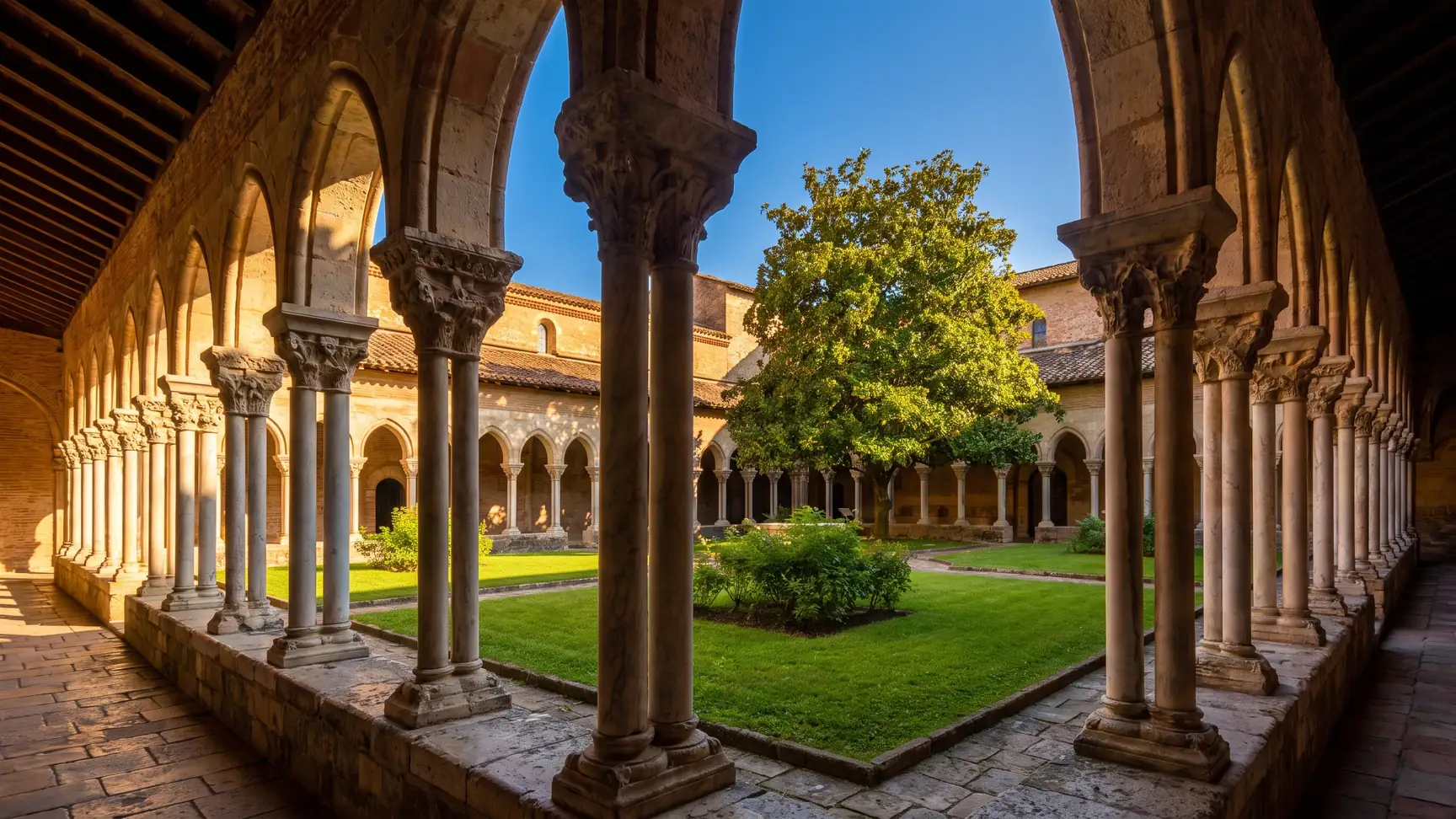
The cloister at Moissac, completed in 1100, is one of the most beautiful and best-preserved in the Christian West: its 76 carved capitals, 47 of them historiated, make it an unrivalled masterpiece of Romanesque sculpture. It is the abbey’s treasure and one of the reasons visitors travel to Moissac from around the world. Slender marble columns and richly worked capitals create a narrative ensemble of exceptional depth, ranging from biblical scenes and saints’ lives to real and fantastical animals and plant motifs. Walking through the quiet galleries around the garden is a striking, timeless experience. Few Romanesque cloisters have survived in such condition: Moissac stands at the summit of late 11th-century art.
A cloister dated to the exact year
The cloister is also exceptional for the precision of its dating. An inscription engraved on the central marble pillar dates it to 1100, an extremely rare degree of certainty for a Romanesque cloister. It was built during the abbacy of Dom Ansquitil (abbot from 1085 to 1108), at the height of the abbey’s Cluniac period. The cloister forms a large quadrilateral, approximately 31 metres by 27, bordered by galleries supported by 116 marble columns, alternating between single and paired shafts. The exact year and the identity of the commissioning abbot give the site exceptional documentary value for art historians and make it a benchmark for European Romanesque sculpture.
The historiated capitals
The heart of the cloister lies in its capitals. There are 76 in total, of which 47 are historiated, meaning they carry carved narrative scenes; the others feature plant or geometric motifs. This distinction matters because the figure “76 historiated capitals” is often repeated incorrectly: there are 76 capitals, but only 47 tell a story. Together they unfold a rich repertoire of medieval imagery: scenes from the Old and New Testaments, the lives and martyrdoms of saints, episodes from Revelation, real and fantastical beasts, interlacing, and foliage. Each capital is a small picture in stone. Looking at them one by one in the gallery light is one of the great pleasures of Moissac, a medieval picture book carved in marble more than nine centuries ago.
The Portal, the Tympanum, and History
The abbey church’s grand south portal, carved around 1110–1130, and its immense tympanum depicting the Vision of the Apocalypse and Christ in Majesty, are among the greatest masterpieces of Romanesque sculpture. Together with the cloister, it represents the pinnacle of Moissac’s art.
The Tympanum of the Apocalypse
Above the south door of the abbey church is one of the most famous tympanums of the Romanesque period. Carved in the first third of the 12th century (around 1110–1130), it measures approximately 6.5 meters wide by 4.5 meters high and depicts the Vision of the Apocalypse of Saint John: Christ in Majesty, immense, enthroned at the center, surrounded by the symbols of the four Evangelists and the twenty-four elders of the Apocalypse, their heads raised toward him, in an extraordinary collective movement. The composition, with its striking power and majesty, is considered a masterpiece of medieval sculpture and is studied worldwide. The portal itself, with its central trumeau carved with interlocking lions and its jambs adorned with prophets, forms, together with the tympanum, a whole of unparalleled coherence and beauty—one of the most beautiful Romanesque portals in existence.
An eventful history
The abbey’s history was not always peaceful. After its Cluniac heyday in the 11th and 12th centuries, Moissac endured the Albigensian Crusade, the Hundred Years’ War, and the Wars of Religion. Secularised during the Revolution, it later came close to losing its cloister: in the mid-19th century, the planned route of the Bordeaux–Sète railway threatened the galleries. Scholars and the Historic Monuments authorities intervened just in time. In 1930, a catastrophic flood of the Tarn devastated the lower town and claimed approximately 120 lives in Moissac, one of the greatest tragedies in its history. The abbey and cloister nevertheless survived these ordeals intact.
Chasselas, the golden grape
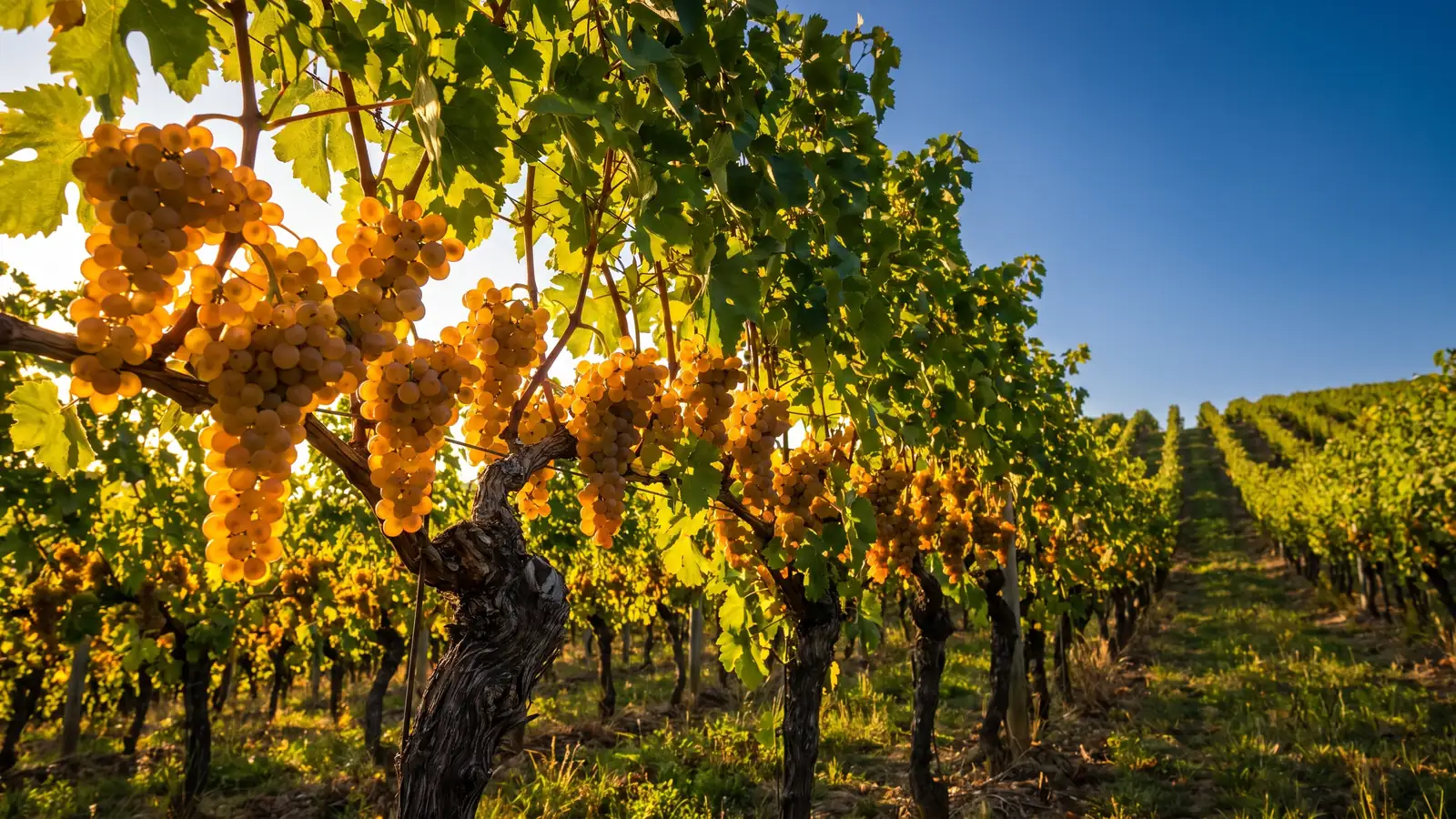
Moissac is the capital of Chasselas, a golden, sweet table grape that has been protected by an AOC designation since 1971 (and an AOP designation since 1996): it is France’s largest producer of table grapes. A treasure both in terms of culinary delight and cultural heritage.
An exceptional table grape
The Chasselas from Moissac is a table grape—a grape meant to be eaten, not made into wine—with golden, translucent, and delicately sweet berries, renowned as one of the best in France. Grown on the clay-limestone slopes around Moissac, it has held an AOC designation since 1971 and a European AOP designation since 1996—a rare distinction for a fresh fruit that highlights both the terroir and the expertise involved. Moissac is France’s largest production area for table grapes (over 4,000 metric tons harvested in 2012). Each cluster is carefully picked and “trimmed” by hand. Note: The Chasselas grape variety does not originate from Moissac (it takes its name from a village in Saône-et-Loire); it is the terroir and the Moissagais craftsmanship that are protected. Golden and fragrant, this grape is the city’s culinary symbol, celebrated every fall with a grand festival.
A region of orchards and fruit
Chasselas is just the star of a much larger terroir. The Moissac region, in the lower Tarn Valley and on the hillsides of Bas-Quercy, is one of the great orchard regions of the Southwest: in addition to grapes, apples, plums (including the Reine-Claude variety), pears, kiwis, and many other fruits are grown here, thriving thanks to the mild climate and fertile alluvial soils. The colorful and bountiful markets of Moissac invite you to sample all these products as the seasons change. The region is also known for its wine (from the neighboring hillsides), Quercy melons, saffron, and gourmet specialties. This abundance of fruit, a legacy of a long tradition of market gardening and fruit-growing, makes Moissac a destination for lovers of fine produce as much as for art enthusiasts. A stopover in Moissac also means enjoying a bountiful meal and a basket of sun-kissed fruit.
| Moissac's Chasselas | Details |
|---|---|
| Type | table grape (for eating, not for winemaking) |
| Color | golden, translucent, sweet grains |
| AOC | since 1971 · European PDO since 1996 |
| Rank | France's leading producer of table grapes |
| Season | Late-summer to fall harvest · Chasselas Festival |
The Canal and the Routes to Santiago de Compostela
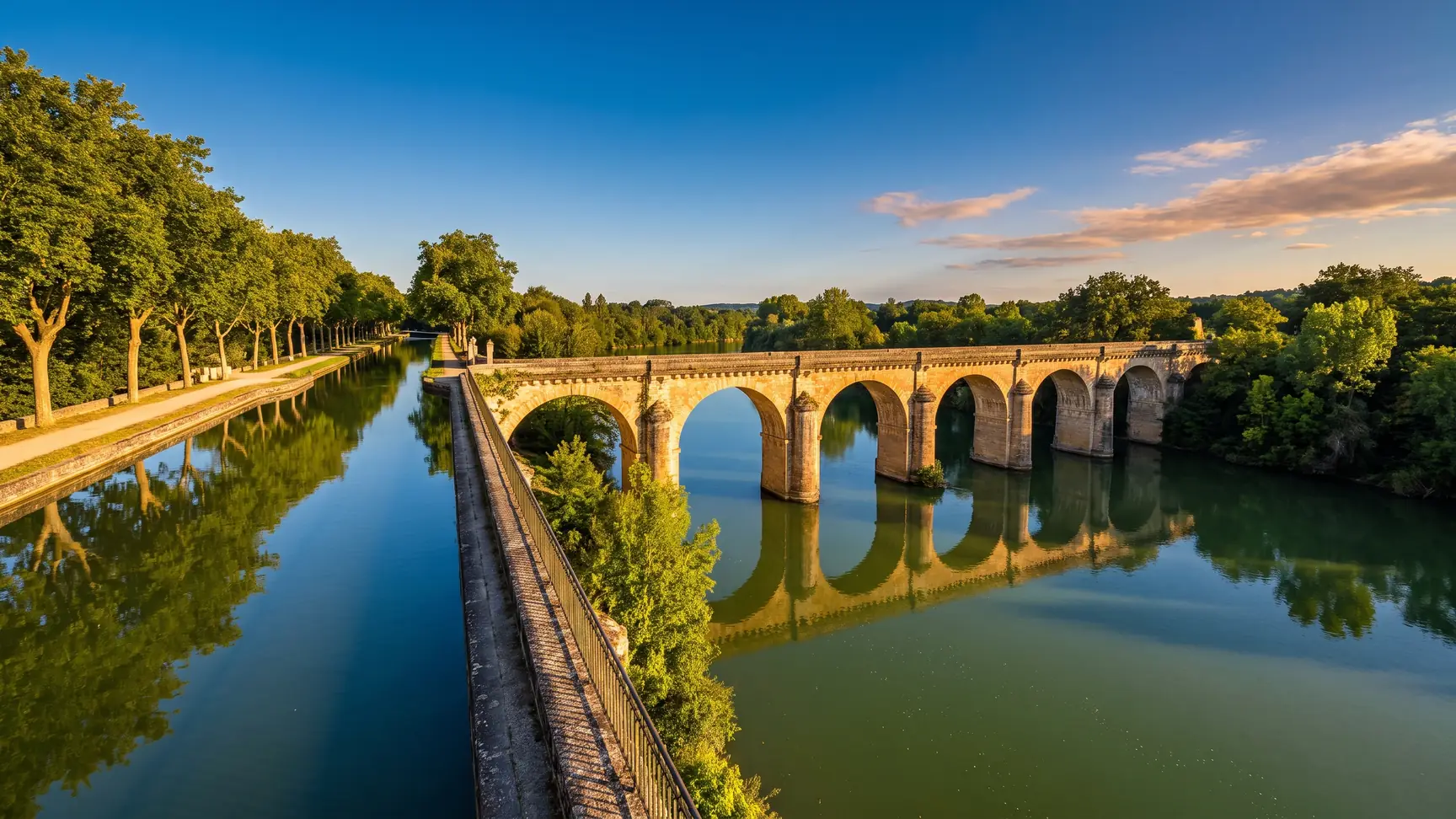
Moissac is crossed by the Canal Latéral à la Garonne—an extension of the Canal du Midi—with its remarkable Cacor canal bridge spanning the Tarn; the city is also a major stop on the Way of St. James. Water and pilgrimage through the centuries.
The Cacor Canal Bridge
Moissac lies on the Garonne Side Canal, which extends the Canal du Midi beyond Toulouse; together, they form the Canal des Deux Mers, linking the Mediterranean and the Atlantic. At Moissac, the waterway crosses the Tarn on the magnificent Cacor Canal Bridge, built around 1845: a stone structure approximately 356 metres long, carried high above the river. It has thirteen large 20-metre arches flanked by two earthwork arches, an elegant feat of engineering and one of France’s longest canal bridges. The towpath is open to walkers and cyclists beneath the plane trees, beside calm water and with fine views of the Tarn below.
Major Stage on the Camino de Santiago
Since the Middle Ages, Moissac has been one of the major stops along the pilgrimage routes to Santiago de Compostela. The town lies on the Via Podiensis, the route from Le Puy-en-Velay (GR 65), one of France’s principal ways to Santiago. The abbey, cloister, and portal offered pilgrims a place to pray and rest before continuing towards Spain. That tradition remains active: between 15,000 and 20,000 pilgrims stop in Moissac each year. This role explains the abbey’s inclusion in the UNESCO World Heritage property “Routes of Santiago de Compostela in France”. Its centuries-old spiritual dimension remains central to Moissac, a town of passage, hospitality, and contemplation on one of the world’s great pilgrimage routes.
The Tarn Valley and the Surrounding Area
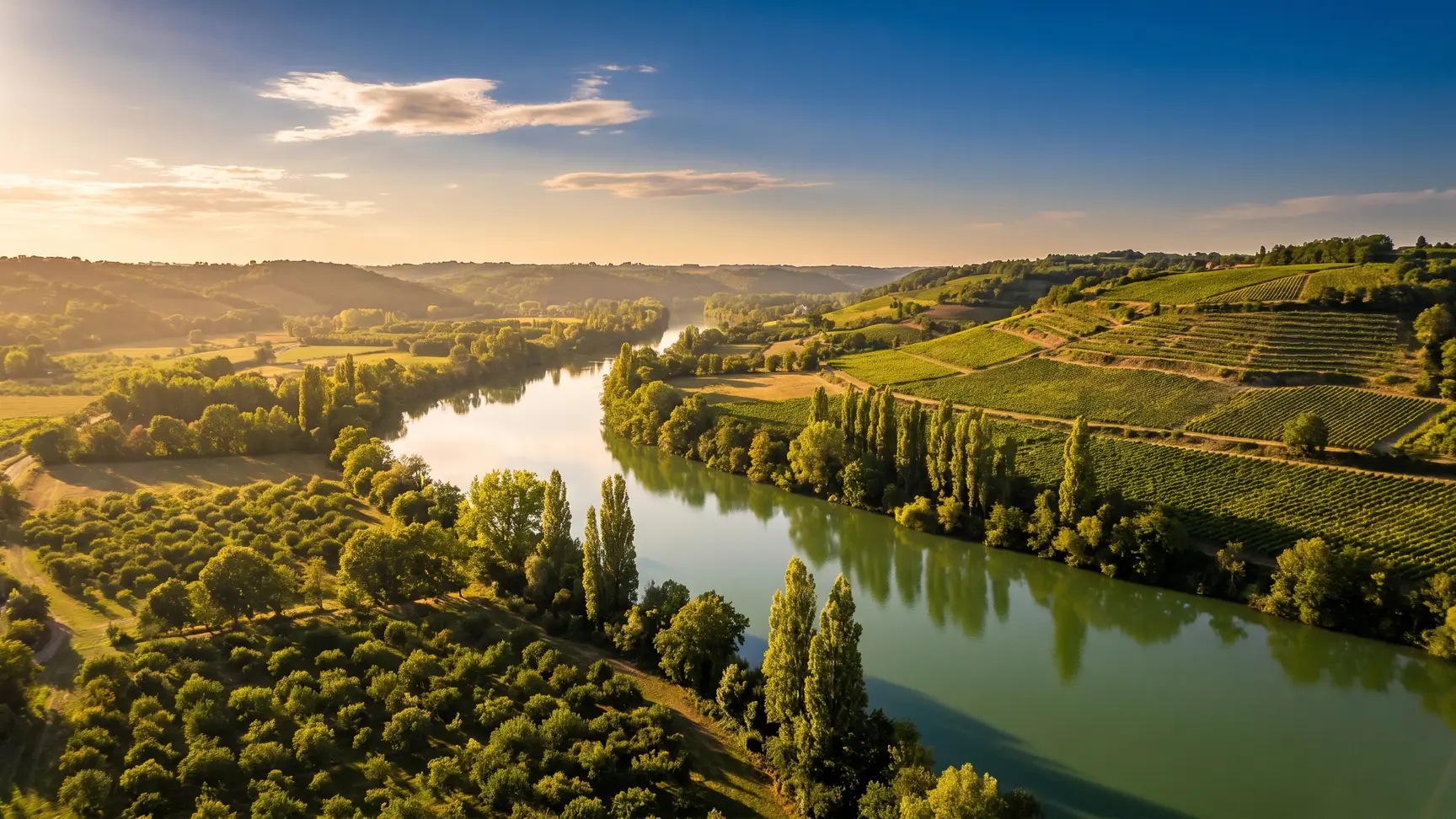
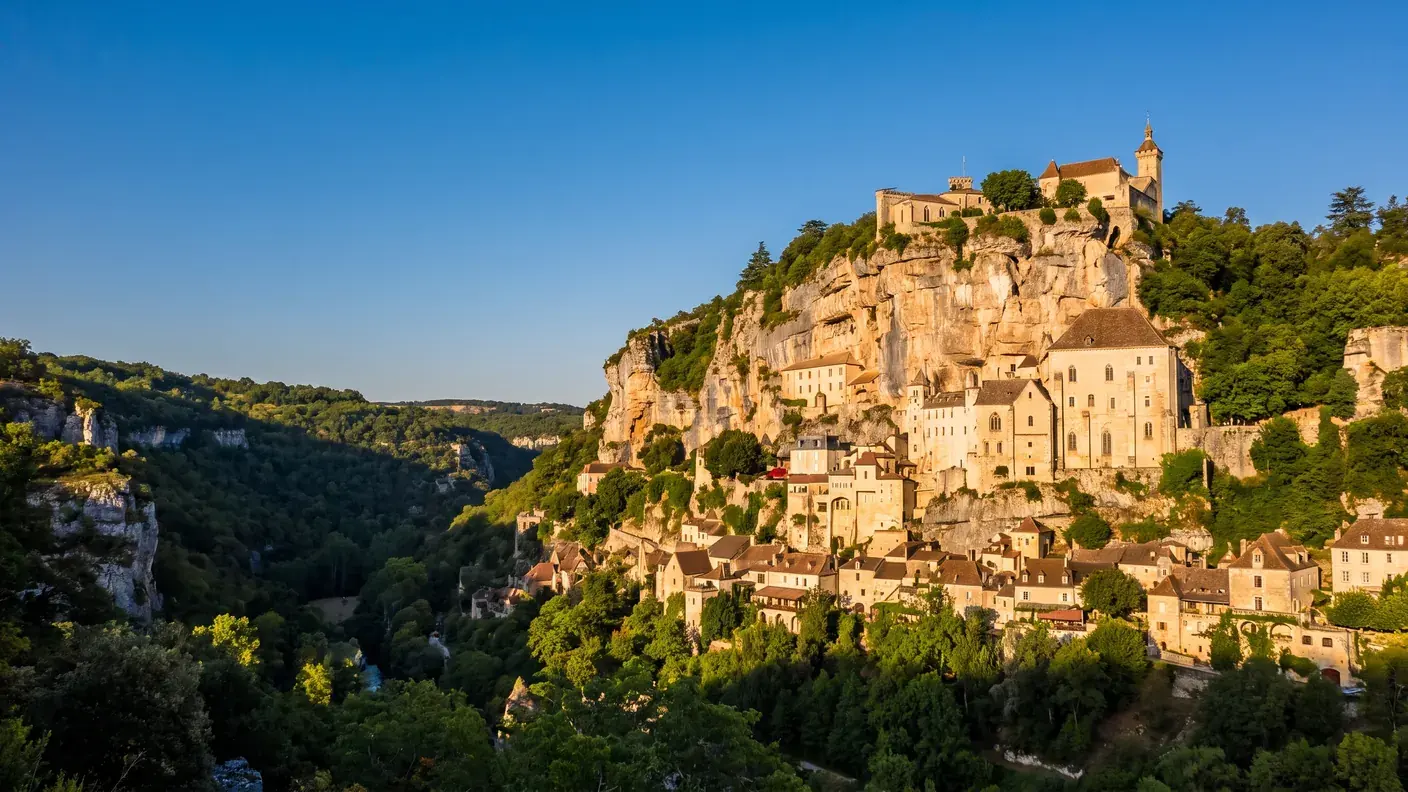
Near Moissac, the Tarn Valley and the Quercy hills offer beautiful scenery and a rich cultural landscape: Montauban, known for its brick, Auvillar and its round market hall, and the hills of Quercy Blanc. A region to explore as you drive through it.
The Tarn Valley and the Hillsides
Moissac is an ideal starting point for exploring the Tarn Valley and the surrounding hillsides. The wide, peaceful river flows between orchards, poplar trees, and hills covered with vineyards and fruit trees—a gentle, bountiful landscape typical of the Bas-Quercy region. To the north lie the hills of Quercy Blanc, with their white limestone slopes, hilltop villages (such as Lauzerte, one of the “Most Beautiful Villages of France”), and mills; to the west, the valley opens up toward the Garonne and Agen. You can also follow the canal on foot or by bike, or take a boat ride on the Tarn. This countryside, nestled between the water and the hillsides, invites you to stroll and explore the villages, markets, and fruit orchards. This is the charm of an authentic, gourmet Occitanie, bathed in soft light, to be savored as you meander along its winding roads.
Montauban, Auvillar, and Quercy
The area around Moissac is full of beautiful places to visit. About thirty kilometers away, Montauban, the prefecture of Tarn-et-Garonne, is a stunning town built of pink brick, known as the “City of Ingres” (the painter’s birthplace), featuring its arcaded Place Nationale, the Ingres-Bourdelle Museum, and its cathedral—a must-see. Nearby, Auvillar, listed among the “Most Beautiful Villages of France,” charms visitors with its remarkable round market hall (dating from 1830), its triangular square, and its commanding view of the Garonne River. To the north, the hilltop villages of Quercy Blanc (Lauzerte, Montcuq) and, further afield, the major sites of Quercy and Périgord (Cahors, Rocamadour) round out the possibilities. From Moissac, it’s easy to plan wonderful days of exploration—combining art, charming villages, and local cuisine—in one of the most endearing corners of Occitanie, at the crossroads of Quercy and Gascony.
| About Moissac | Distance | Interest |
|---|---|---|
| Auvillar | ~15 km | "Most Beautiful Villages," round market hall (1830), Garonne |
| Montauban | ~30 km | Pink Brick, Cité d'Ingres, Place Nationale |
| Lauzerte | ~25 km | "Most Beautiful Villages," a hilltop village in Quercy Blanc |
| Agen | ~40 km | Lot-et-Garonne Prefecture, canal bridge, prune |
| Cahors / Rocamadour | ~65–90 km | Quercy, Pont Valentré, Sacred City |
When is the best time to visit Moissac?
Moissac is open to visitors year-round, but spring, summer, and especially late summer—the Chasselas season—are the best times to visit. It’s the perfect time for a great getaway.
The Seasons and the Chasselas Festival
Spring brings flowers and greenery to the Tarn Valley, with mild days well suited to the abbey and canal. Summer, warm and bright, is the height of the visitor and pilgrimage season; the shaded cloister offers welcome relief from the heat. The most distinctive period is late summer and autumn, the Chasselas season, when table grapes are harvested, market stalls fill with fruit, and the city holds its Chasselas Festival in September. Autumn colours the hillsides while the weather remains mild. Winter is quieter and allows the abbey and cloister to be seen in a more contemplative atmosphere. Moissac retains its appeal in every season.
A day trip
Moissac is perfect for a day trip from Bordeaux, given how close the city is (less than two hours) and how rich its heritage is. A good half-day is enough to see the highlights—the cloister, the tympanum, the abbey church, and the banks of the Tarn—leaving you time in the afternoon to stroll through the old town, walk along the canal and the Cacor canal bridge, or venture out to a nearby village. To fully enjoy the local flavor, it’s best to plan a lunch there featuring regional products (fruit, Chasselas grapes in season, Southwestern specialties), and why not stop at a vineyard or a market? With a driver, you can tailor this day to your liking, free from the constraints of a schedule or driving: art in the morning, local culture in the afternoon, and a leisurely return to Bordeaux in the evening. It’s the perfect way to explore Moissac at a leisurely pace, amidst the gentle beauty of a landscape of orchards and rivers.
Visit the Abbey and Plan Your Trip
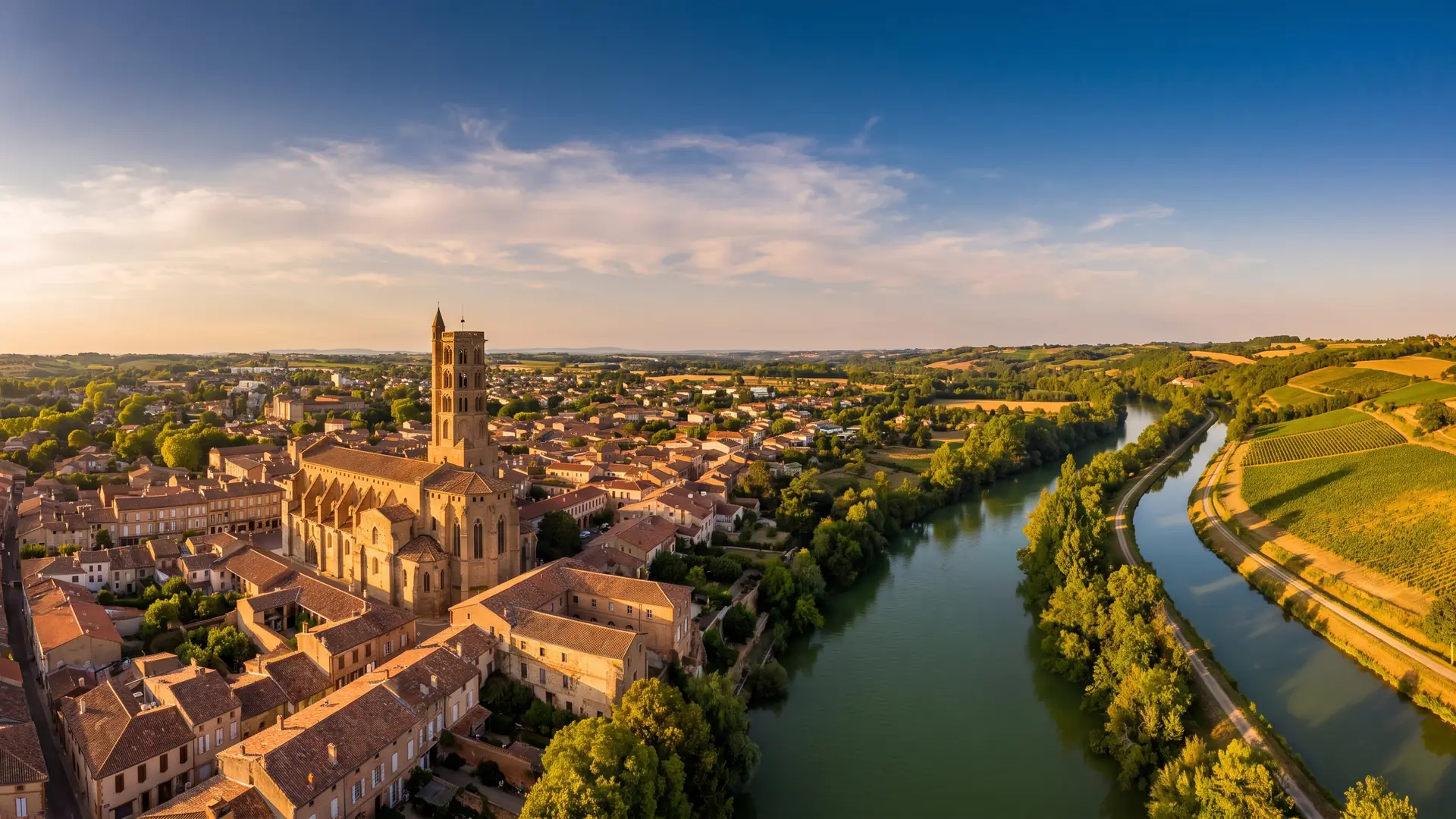
Here are a few tips to help you plan your visit to Moissac and its abbey. Everything you need to easily organize a wonderful getaway filled with art and local culture.
See the cloister and the gate
The portal and its tympanum are located on the south side of the abbey church. Before your visit, check with the official Moissac visitor center for the hours, admission fees, and access conditions for both the abbey church and the cloister: these may vary depending on the season, church services, and construction work. Allow one to two hours when both areas are open.
Getting there and exploring the area
Moissac is easy to reach from Bordeaux by motorway. The town has a railway station on the Bordeaux–Sète line, but a car is much more practical for exploring Montauban, Auvillar, Quercy Blanc, and Agen, as the sites are dispersed. With a private chauffeur, the day can be tailored without the concerns of driving or parking: the abbey in the morning, a lunch built around local produce, then a characterful village or fruit estate in the afternoon. It is a comfortable format for a cultural and culinary outing with family or friends in this landscape of orchards, vineyards, and rivers.
| Visit Moissac | Details |
|---|---|
| Must-See | cloister (1100), Apocalypse tympanum, abbey church |
| Recommended duration | half a day to a full day |
| Terroir | Chasselas, fruit, markets · Chasselas Festival (Sept.) |
| Around | Montauban, Auvillar, Quercy Blanc, canal |
| From Bordeaux | ~187 km / ~2:05 · chauffeur service from ~315 € |
How to get to Moissac from Bordeaux
Moissac is located about 187 km from Bordeaux, which is about a 2-hour and 5-minute drive via the A62 highway (Bordeaux-Toulouse), taking the Castelsarrasin-Moissac exit. It’s a simple and direct route—one of the shortest to the Quercy region. The town is a few kilometers from the highway, in the Tarn plain. You can take the train (Moissac has a station on the Bordeaux-Sète line) or drive your own car, but for a day trip to explore the abbey and the surrounding area, a door-to-door chauffeur-driven car is by far the simplest and most flexible solution—with no worries about driving, parking, or schedules, and with the freedom to explore the region afterward.
Train or chauffeured car?
For Moissac, and particularly for combining the abbey with Bas-Quercy, an executive car service from Bordeaux offers genuine flexibility: a direct, door-to-door journey with no changes and the option of stops in Agen, Auvillar, or Montauban. This is especially useful on a cultural and culinary outing when you may wish to sample Chasselas and local wines without driving afterwards. We offer the route at a fixed price provided in advance: allow about 467 € one way in a Mercedes saloon or a van seating up to 7 passengers, with a professional chauffeur. The price agreed at booking does not vary with traffic or stops, unlike a taxi meter.
This is the perfect option for a family trip, a getaway with friends, a pilgrimage along the Camino de Santiago, or an exploration of the Quercy region’s heritage and local culture. You can travel alone, as a couple, or in a small group of up to 7 people, with your luggage and gourmet purchases (Chasselas grapes, fruit, wine), and request stops at Moissac, in Auvillar, or in a charming village. In practice, booking is quick and easy: simply provide your departure address in Bordeaux and your destination at Moissac (or your hotel or vacation rental), along with the date, desired time, and number of passengers, and you’ll receive a written, fixed-price quote in return. On the day of the trip, the driver picks up the passengers at the agreed-upon address and takes them directly to Moissac, without any detours—so you can start your day of art and local culture with peace of mind.
| Route | Distance | Duration | Landmark |
|---|---|---|---|
| Bordeaux → Moissac | ~187 km | ~2:05 | Starting at ~315 € for a private chauffeur service |
| Moissac → Agen | ~40 km | ~35 min | canal bridge, prune |
| Moissac → Montauban | ~30 km | ~30 min | Pink Brick, Cité d'Ingres |
| Moissac → Auvillar | ~15 km | ~20 min | "Most Beautiful Villages," round market hall |
Whether you come for the abbey and its cloister, the Camino de Santiago, the Chasselas wine and the local terroir, or to explore the Quercy region and head toward Montauban, Moissac is a treat for lovers of Romanesque art and the good life—a small town with world-class heritage, less than two hours from Bordeaux.
Whether for a cultural break, a pilgrimage, or a food-focused day out, booking a chauffeur provides a comfortable and punctual ride: book Bordeaux → Moissac or explore all our destinations.
Frequently Asked Questions
Where is Moissac located?
Moissac is a small town in Tarn-et-Garonne (82), in Occitanie and Bas-Quercy, on the banks of the Tarn shortly before the river joins the Garonne; the confluence lies a little further downstream. It has approximately 13,400 residents (INSEE 2023) and is not in the neighbouring Lot department. Known for Saint-Pierre Abbey, its Romanesque cloister, and Chasselas table grapes, it is a major stop on the Way of St James (GR 65). From Bordeaux, Moissac is about 187 km away, or 2 hours and 5 minutes by the A62. A chauffeured transfer is door to door, without the concerns of driving or parking.
What is the distance between Bordeaux and Moissac?
Approximately 187 km by road, or about 2 hours and 5 minutes, via the A62 motorway (Bordeaux–Toulouse), taking the Castelsarrasin–Moissac exit. This is one of the shortest and easiest routes to Quercy from Bordeaux. With a chauffeur service, the fare is fixed and provided in advance, starting at approximately €467 one way (saloon or van, door-to-door price). Moissac has a railway station on the Bordeaux–Sète line, but a vehicle is more practical for combining the abbey with Montauban, Auvillar, or Quercy Blanc. Stops can be arranged on the way, for example in Agen or Auvillar.
What's there to see in Moissac?
A must-see is Saint-Pierre Abbey, a masterpiece of Romanesque art listed as a UNESCO World Heritage Site. You absolutely must see the cloister, completed in 1100, one of the best-preserved in the Western world, with its 76 carved capitals (47 of which are historiated) and its slender marble columns; and the grand south portal with its Apocalypse tympanum (circa 1110–1130), depicting Christ in Majesty—a pinnacle of medieval sculpture. The surrounding area—the old town, the banks of the Tarn, the Cacor canal bridge, and the markets (famous for their Chasselas grapes)—is well worth a stroll. Allow half a day to a full day. The surrounding region (Montauban, Auvillar, and the Quercy Blanc) rounds out a wonderful getaway.
Why is the cloister at Moissac so famous?
Because it is one of the most beautiful and best-preserved in the entire Christian West, and one of the few Romanesque cloisters that can be dated to within a year: an inscription carved on the central pillar dates it to 1100, during the abbacy of Ansquitil. It features 76 carved capitals, 47 of which are historiated (adorned with narrative scenes: the Bible, lives of the saints, the Apocalypse, and the bestiary), supported by 116 marble columns surrounding a garden. This ensemble, of exceptional richness and finesse, is an absolute masterpiece of Romanesque sculpture, studied throughout the world. Together with the abbey church’s tympanum, it earned Moissac its inscription on the UNESCO World Heritage List (1998) and its universal renown.
What is Moissac Chasselas?
It is a golden, sweet, and translucent table grape, for which Moissac is the capital: a grape that is eaten (rather than made into wine), renowned as one of the best in France. It has held an AOC designation since 1971 and a European AOP designation since 1996—a rare distinction for a fresh fruit. Moissac is France’s leading table grape-producing region (over 4,000 metric tons in 2012), and each cluster is picked and “trimmed” by hand. Note: The Chasselas grape variety does not originate from Moissac (its name comes from a village in Saône-et-Loire); it is the terroir and the expertise of Moissac that are protected. A major Chasselas festival celebrates the grape every fall.
Was Moissac Abbey really founded by Clovis?
No: that is a legend. Monastic tradition attributes the abbey’s founding to Clovis in 506, following a victory over the Visigoths, but this account has no historical basis. The monastery was actually founded toward the end of the 7th century. The abbey’s major turning point came with its affiliation with the Cluniac Order in 1048, under Abbot Durand de Bredon: Moissac then became one of the most important Cluniac abbeys in southwestern France, both wealthy and influential. It was this prosperity that made possible, in the 11th and 12th centuries, the construction of the cloister (1100) and the portal—the masterpieces we admire today. Here, as is only right, we distinguish between legend and verified history.
What does the Moissac tympanum depict?
The large carved tympanum above the south portal of the abbey church, created around 1110–1130, depicts the Vision of the Apocalypse of Saint John: Christ in Majesty, immense, enthroned in the center, surrounded by the symbols of the four Evangelists and the twenty-four elders of the Apocalypse, their heads raised toward him. It measures approximately 6.5 meters wide by 4.5 meters high. This composition, of striking power and majesty, is considered one of the greatest masterpieces of Romanesque sculpture. The portal, with its central panel carved with interlocking lions and its prophets, forms, together with the tympanum, a composition of extraordinary coherence and beauty that is studied throughout the world.
What is the Cacor Canal Bridge?
This is a magnificent canal bridge at Moissac that allows the Garonne Side Canal (the extension of the Canal du Midi) to cross the Tarn River. Built around 1845, it is a long stone bridge approximately 356 meters in length, carrying the waterway high above the river, with thirteen large 20-meter arches flanked by two earthen arches—one of the longest canal bridges in France. You can walk or bike along the towpath, shaded by plane trees, with beautiful views of the Tarn. Please note: the canal that passes through Moissac is not the Canal du Midi (which ends in Toulouse) but the Canal Latéral à la Garonne; together, the two form the Canal des Deux Mers.
What's there to see around Moissac?
There’s plenty to see. About thirty kilometers away lies Montauban, the prefecture of Tarn-et-Garonne—a stunning city built of pink brick and the birthplace of the painter Ingres (the “City of Ingres”), featuring its arcaded Place Nationale and its museum. Nearby is Auvillar, listed among the “Most Beautiful Villages of France,” with its remarkable round market hall (1830) overlooking the Garonne River. To the north are the hilltop villages of Quercy Blanc, such as Lauzerte (one of the “Most Beautiful Villages”). Further afield, Agen (the canal bridge, prunes), and the major sites of Quercy and Périgord (Cahors and its Valentré Bridge, Rocamadour). From Moissac, it’s easy to plan wonderful days of exploration, combining art, charming villages, and local cuisine.
When is the best time to visit Moissac?
Moissac is open to visitors year-round. Spring dresses the Tarn Valley in greenery and brings mild days, perfect for exploring the abbey and the canal. Summer is the peak tourist and pilgrimage season; the shaded cloister offers a welcome respite from the heat. The most iconic time of year is late summer and fall, the Chasselas season: this is when table grapes are harvested, markets are brimming with fruit, and the great Chasselas Festival takes place (in September). Fall paints the hillsides with beautiful colors, and winter, a quieter time, allows visitors to explore the abbey and cloister in a spirit of contemplation. No matter the season, Moissac’s cultural heritage and relaxed way of life are sure to charm you.
Can I book a private driver from Bordeaux to Moissac?
Yes. We offer the Bordeaux → Moissac route (approximately 187 km, about 2 hours and 5 minutes via the A62) at a fixed price, starting at approximately €422 one-way, in a Mercedes sedan or a van seating up to 7 passengers, with a professional driver. The trip is direct, door-to-door, with flexible stops—ideal for a cultural and culinary getaway (the abbey, followed by a lunch featuring local specialties in Auvillar or Montauban), a pilgrimage along the Camino de Santiago, or a family visit. You can bring along luggage and local purchases (Chasselas grapes, fruit, wines). The fixed-price quote is provided and confirmed in writing before departure, with no surprises on the meter. It’s the simplest and most flexible way to explore Moissac and Bas-Quercy from Bordeaux.
Further Reading
- The capital of Gascony: see the guide to Auch (the UNESCO-listed cathedral, d'Artagnan, and Armagnac)
- Quercy and Cahors wine: see the guide to Douelle (the Lot Valley and the Cahors vineyards)
- The neighbouring department of Lot-et-Garonne: see the guide to Agen (the canal bridge, old town, and prunes)
- Plan your trip: book a private chauffeur from Bordeaux to Moissac or explore all our destinations
Sources and References
- UNESCO — The Routes to Santiago de Compostela in France — inscribed on the World Heritage List since 1998
- Wikipedia — Moissac — Tarn-et-Garonne, Bas-Quercy, demographics, Chasselas, GR 65
- Wikipedia — Saint-Pierre Abbey in Moissac — Cluny 1048, cloister 1100, 76 capitals (47 with figurative decorations), tympanum, UNESCO 1998
- Mérimée Database — Moissac Abbey (PA00095785) — Listed as a Historic Monument (1840, 1923…)
- INAO — Chasselas de Moissac — AOP table grapes and production area
- Wikipedia — Cacor Canal Bridge — a side canal of the Garonne, ~356 m, 13+2 arches, circa 1845
- INSEE — Municipality of Moissac (82112) — Official Population and Municipal Records
Article updated in July 2026.
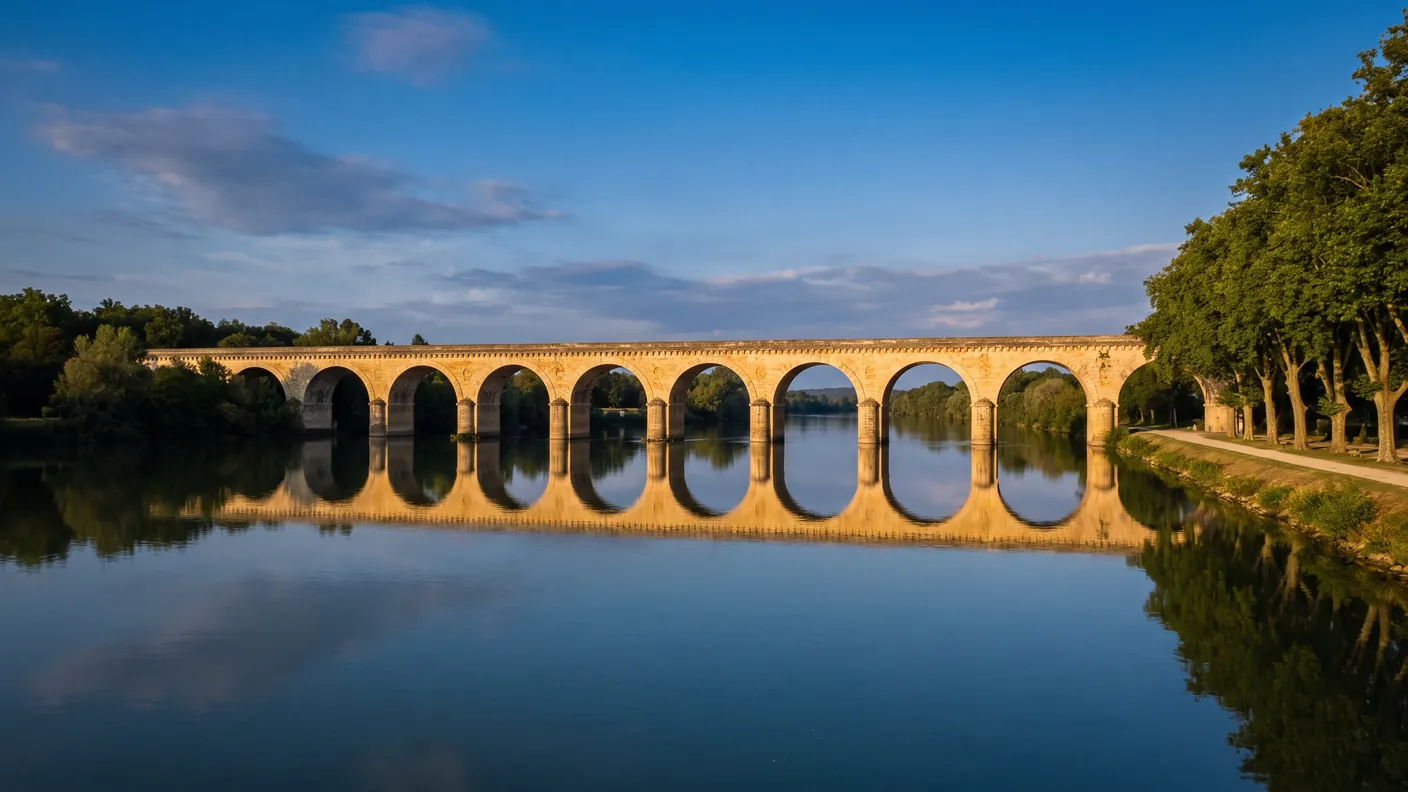
On the way to Moissac
Direct trip from Bordeaux (~2 hours 5 minutes) to Moissac and its abbey, with optional stops in Agen, Auvillar, or Montauban. Written fixed-price quote, with no taxi-meter surprises.