
Bordeaux to Ribérac: Périgord Vert, the market and Arnaut Daniel
A large market town with an unexpected literary heart: a former subprefecture, capital of the Ribéracois region, Ribérac is, above all, according to tradition, the birthplace of the troubadour Arnaut Daniel—the man whom Dante, followed by Ezra Pound and T.S. Eliot, hailed as “il miglior fabbro.” A large market, two Notre-Dame cathedrals, and a region full of domed churches. About 1 hour and 38 minutes from Bordeaux.
Ribérac at a Glance
- Ribérac (the Ribéracois) is the capital of the Ribéracois, in the heart of the Périgord Vert, in the Dordogne (24600) — INSEE code 24352, Périgueux district.
- 3,734 residents (2023), spread over 22.79 km², in the Dronne Valley: it serves as the commercial and service hub for an entire rural region (headquarters of an intermunicipal association comprising 44 municipalities).
- Its claim to fame: according to tradition, it is the birthplace of the troubadour Arnaut Daniel (born around 1150), whom Dante hailed as “the finest master of the mother tongue.”
- Arnaut invented the sextine, a poetic form with strict constraints, with “Lo ferm voler qu'el cor m'intra.”
- His influence extends from Petrarch to Ezra Pound and T.S. Eliot, who dedicated The Waste Land to Pound using Dante’s very words: “il miglior fabbro.”
- The city served as a subprefecture of the Dordogne from 1801 to 1926—a span of 125 years that explains its large squares and 19th-century administrative buildings.
- The weekly market in Ribérac is usually held on Friday mornings at Place du Général-de-Gaulle. Hours, the number of vendors, and seasonal markets may vary: check the official calendar of the City of Ribérac before you go.
- From Bordeaux: ~114 km, about 1 hour and 38 minutes by car — starting at €199 for a private driver, door-to-door. No train station (Périgueux is ~39 km away).
Before You Go: What Ribérac Really Is
One Friday morning, at Place du Général-de-Gaulle. Stalls are overflowing with strawberries, nuts, cheeses, and duck; residents from dozens of surrounding villages are doing their weekly shopping. Just a stone’s throw away, on a hill, an old Romanesque church stands watch—the former chapel of a castle that no longer exists. And somewhere beneath these stones, nearly nine centuries ago, one of the greatest poets of the European Middle Ages was born—the man whom Dante himself ranked at the very top. This is Ribérac: a large market town in the Périgord Vert with an unexpected literary heart.
Ribérac is the capital of the Ribéracois, a region of rolling hills and wooded countryside in northern Dordogne. Formerly a subprefecture, it serves as a hub for shops, a middle school, a high school, a hospital, and government offices for the entire surrounding area. But its true uniqueness lies elsewhere: it is the hometown of Arnaut Daniel, the troubadour whom Dante, Petrarch, and—in the 20th century—Ezra Pound and T.S. Eliot elevated to the pinnacle of literary fame. Few towns of this size can boast such a lasting literary legacy.
This guide distinguishes between verified facts and hearsay. When it comes to Arnaut Daniel, we must be honest: his birthplace “in Ribérac” comes from his medieval vita, not from any document—and the few contemporary sources describe him instead as a juggler deep in gambling debts. We therefore present this lineage as a tradition, which in no way diminishes its significance. On the other hand, Dante’s tribute, the invention of the sextina, and his influence extending all the way to Eliot are firmly established.
As for access, Ribérac does not have no more train stations (the line closed to passengers in 1940): You can get there by car—it’s about 1 hour and 38 minutes from Bordeaux. To explore the town, its market, and the Romanesque heritage of the Ribéracois region without being tied to a schedule, a chauffeur service from Bordeaux offers the simplest door-to-door service.
The capital of the Ribéracois region, in the Dronne Valley
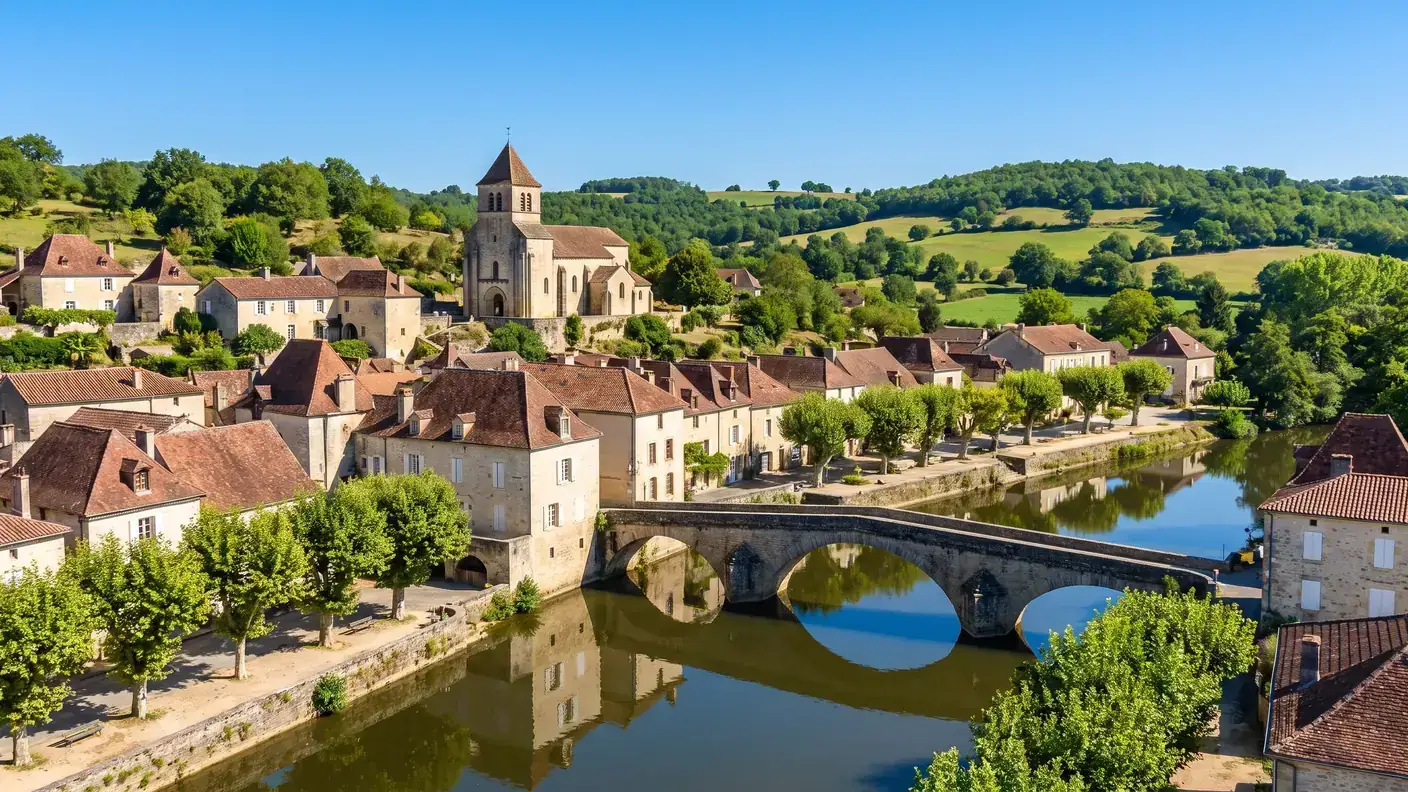
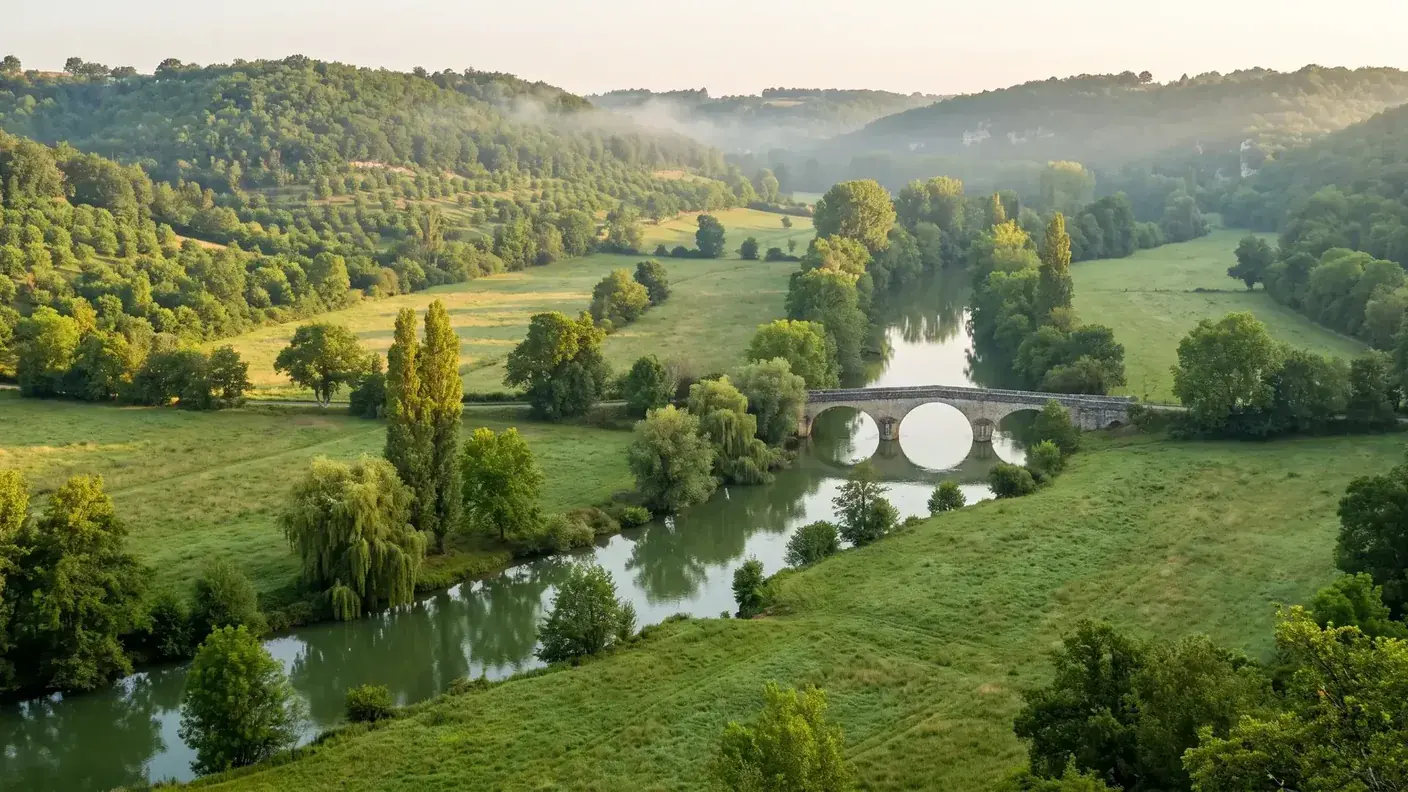
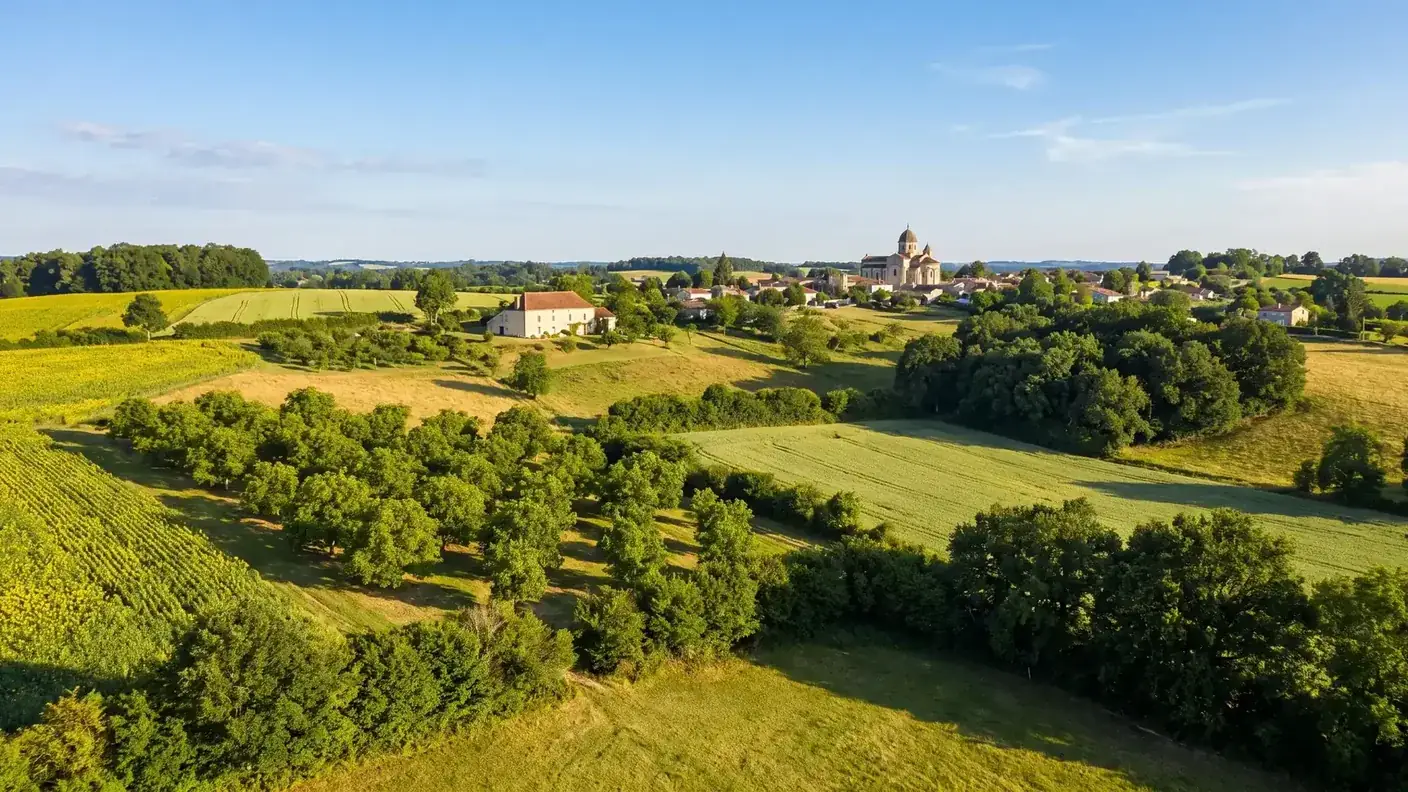
Ribérac is located in the northwestern part of the Dordogne, in the Ribéracois natural region, which is part of the vast Périgord Vert—the northern part of the department where cultivated hills and wooded pastures contrast with the cliffs of the Périgord Noir. The area is known for growing grains, sunflowers, and walnuts. The town covers an area of 22.79 km²; it is bordered to the north by the Dronne (a tributary of the Isle, which joins the Dordogne near Libourne), although the town itself has developed on both sides of a small tributary, the Ribéraguet.
The Périgord Vert Service Hub
Ribérac is the urban hub of the entire region: it is the seat of the Périgord Ribéracois Community of Municipalities, which comprises 44 municipalities with a population of approximately 19,500 spread across nearly 684 km². Shops, a middle school, a high school, a local hospital, a gendarmerie, and government offices are all concentrated here, making it a hub for the entire catchment area.
| Data | Value |
|---|---|
| ZIP Code / INSEE | 24600 / 24352 |
| Natural Region | Ribéracois, Périgord Vert |
| Borough | Périgueux |
| Area | 22.79 km² |
| Population | 3,734 residents (2023) — the residents of Ribérac |
| Intermunicipal Cooperation | Périgord Ribéracois Community of Communes (44 municipalities) |
| River | the Dronne (to the north) |
| Celebrity | Arnaut Daniel, troubadour (c. 1150) |
A Declining Population: A Local Paradox
In terms of population, Ribérac is experiencing a slight decline (−3.29% between 2017 and 2023, compared with +0.97% for the Dordogne), a steady decline since the 1990s (when the population was ~4,100). A striking contrast: its immediate neighbor Celles, just 650 meters from the village, has, on the contrary, up 5.45% Over the same period—economic activity is concentrated in Ribérac, while residential development is shifting toward neighboring, more rural municipalities.
Arnaut Daniel, the Troubadour, and the Invention of the Sextine
A life more legendary than documented
The name that has ensured Ribérac’s enduring fame is that of Arnaut Daniel, a troubadour born around 1150—according to his medieval vida, in Ribérac or its vicinity (the same vida places him “in the region from which Arnaut de Mareuil came”). The confirmed biographical details are sparse, as is often the case with 12th-century Occitan poets: a member of the minor nobility (gentils hom) and a man of letters, he composed in the langue d’oc between approximately 1180 and 1200. His vita attributes to him a connection to Richard the Lionheart and a friendship with Bertrand de Born—alluring traditions, but unproven. The only somewhat substantiated link is with Philip Augustus, whose coronation (1180) Arnaut himself claims to have witnessed.
It is worth taking a closer look at what *la vida*—this short, anonymous biography copied at the beginning of medieval songbooks—actually says. It states that Arnaut “was from a castle named Ribairac” (d’un chastel que a nom Ribairac) and that he “was well-educated” (amparet ben letras)—an educated man, in other words, which was rare outside the ranks of the clergy. Tellingly, it also locates him by comparison: he is said to be “from the region where Arnaut de Mareuil came from,” the other great troubadour from the Périgord—a scholar’s identification, not a birth certificate. As for Philip Augustus, it is Arnaut himself who claims this connection: in his song “Doutz brais e critz,” he writes “coronar fui del bon rei d’Estampa”— “I was present at the coronation of the good king of Étampes,” that is, at the coronation of 1180. This self-attestation is more reliable than all the anecdotes in the vida: it is the only dated event in his life based on his own words.
Eighteen Pieces, Master of the Catalan Trobar
All that remains of his career are eighteen works (including sixteen songs)—a limited body of work, yet one of exceptional stylistic depth. Arnaut is the master of trobar ric (“rich poetry”) and trobar clus (“closed poetry,” hermetic): a form of poetry of extreme formal rigor—rare, sometimes invented rhymes, refined sounds, complex syntax, and challenging imagery—in stark contrast to the simpler trobar leu. This virtuosity was not without purpose: in the Occitan courts, mastering a rare language was proof of the most refined talent. A poignant detail: of his entire body of work, only a single melody has survived, notated more than a century after his death.
The sextine: “Lo ferm voler qu'el cor m'intra”
We owe Arnaut Daniel the invention of a form that has remained famous: the sextine. It is a feat of structure: six stanzas of six lines each, followed by a three-line conclusion. Its unique structure is based not on rhyme, but on the repetition of the same six words at the end of each line, following a spiral pattern (the sequence 6-1-5-2-4-3) that carries them throughout the entire poem. The seminal text—the first known example in all of Western literature—is “Lo ferm voler qu’el cor m’intra” (“The firm desire that enters my heart,” c. 1200)—whose six key words (intra, cambra, ongla, oncle, arma, verga) recur in a pattern of almost mathematical precision, serving a theme of obsessive love. This form has fascinated eight centuries of poets, right up to the Oulipo in the 20th century.
From Dante to T.S. Eliot: “il miglior fabbro”
The Encounter in Purgatory
If Arnaut Daniel occupies a unique place in literary history, it is thanks to a tribute from Italy a century after his death: that of Dante, in *The Divine Comedy*. In Canto XXVI of Purgatory, on the ledge where the sin of lust is atoned for, the Italian poet Guido Guinizzelli points out to Dante a soul amidst the flames and greets it with words that have remained famous: he “was the finest craftsman in the mother tongue” (miglior fabbro del parlar materno). That soul is Arnaut Daniel (text of Canto XXVI on Wikisource, accessed July 24, 2026).
What makes this scene unique among the hundred songs of the Comedy, that's the answer. While all the characters speak Italian, Arnaut is the only one to respond in his own language, Occitan (the only modern foreign language in the entire poem): “ So I come to your court to sing… I am Arnaut, who weeps and sings " (“Your gracious request pleases me so much… I am Arnaut, who weeps and sings”). This shift to Occitan is by no means accidental: it is a gesture of supreme recognition. By making the poetry of the troubadours the foundation of all European love poetry, Dante elevates Arnaut to the status of the ultimate master of the “mother tongue.”
From Petrarch to Ezra Pound
This tribute has endured through the centuries. In the 14th century, Petrarch hailed Arnaut as a “great master of love” in his *Triumph of Love*. But the most spectacular rediscovery came in the 20th century, courtesy of Ezra Pound, who began studying and translating the troubadours as early as 1910 (in The Spirit of Romance, where he considers Arnaut “the greatest poet who ever lived”).
In Pound’s work, the influence of the troubadour from Ribérac is everywhere. In The Spirit of Romance, the chapter he devotes to Arnaut is already titled “Il miglior fabbro”—Dante’s phrase, taken verbatim. And this influence extends even to Eliot himself: the title of the European edition of his second collection, Ara Vos Prec (1920), is borrowed from an Occitan verse by Arnaut Daniel—specifically the words that Dante attributes to him in *Purgatorio* (“*Ara vos prec*,” “now I beg you”). Even before The Waste Land, the two great Anglo-American modernists were thus already, each in his own way, placing themselves under the patronage of the poet whom tradition holds to have been born in Ribérac.
"The Best Blacksmith," from Dante to Eliot
The circle closes in a striking way. It was Pound who revised the manuscript of The Waste Land from T.S. Eliot (1922), cutting it by nearly half. In recognition of this, Eliot dedicated the poem to Pound with these three words: “ il miglior fabbro "—repeating, with full knowledge of the facts, the exact phrase that Dante had dedicated to Arnaut Daniel six centuries earlier. The compliment paid to the troubadour of Ribérac by a character in the The Divine Comedy Thus, in the 20th century, it became a modernist poet’s tribute to another. Few towns in the Périgord can boast such a long literary tradition—from 12th-century Occitan to Anglo-American modernism.
One detail of the book’s publishing history deserves clarification, as it is often misrepresented: in 1922, the dedication “il miglior fabbro” was handwritten—Eliot wrote it by hand in the copy of the Boni & Liveright edition that he gave to Pound. It was not printed until the 1925 reprint. Pound’s work on the manuscript had been extensive: he reduced the poem by nearly half, resulting in the 434 lines of the published text. The dedication was therefore not a mere formality, but an acknowledgment of a true collaboration—hence the aptness of the word fabbro, “craftsman.”
| Date | A Milestone in the Legacy of Arnaut Daniel |
|---|---|
| c. 1150 | Arnaut's birth, according to tradition, in Ribérac (his life story) |
| 1180 | The Coronation of Philip Augustus, which Arnaut himself claimed to have witnessed |
| c. 1180–1200 | The period of his activity for which the most evidence is available (only one poem is dated with certainty: 1181) |
| c. 1200 | “Lo ferm voler qu’el cor m’intra,” the oldest known sextine |
| Early 14th century | Dante, Purgatory XXVI: “miglior fabbro del parlar materno” |
| 14th century | Petrarch: “gran maestro d'amor” (Triumph of Love) |
| 1910 | Ezra Pound, The Spirit of Romance — chapter “Il miglior fabbro” |
| 1920 | T.S. Eliot, Ara Vos Prec — a title borrowed from an Occitan verse by Arnaut |
| 1922-1925 | Dedication in The Waste Land to Pound: “il miglior fabbro” (handwritten in 1922, printed as early as 1925) |
The Normans at the First Castle
848: A Fort Against the Normans
The urban history of Ribérac begins long before Arnaut Daniel and is linked to the Norman invasions of the 9th century. In 848—the very year the Normans, moving up the Dronne River, sacked the nearby abbey of Brantôme—the first fortified settlement, a castellarium, was built near a river ford at a place called Le Chalard. In 866, Count Wlgrin (Vulgrin I of Angoulême) stationed a representative there. This first site, deemed too vulnerable, was merely a temporary measure.
The Year 1000: Alchier the Deaf and the Castellum Ribairac
It was around the year 1000 that a man named Alchier the Deaf, a viscount representing the count’s authority, moved the fief to the top of a hill—the one where the cemetery stands today. There, the first castle of Ribérac was built, referred to in Latin texts as Castellum Ribairac. This move from the vulnerable riverbanks to a commanding position marked the true birth of the town. The castle subsequently passed into the hands of prominent families—the Turennes, Talleyrands, Bergeracs, Pons, d’Aydies, and then the Chapt family—and it is there, according to tradition, that Arnaut Daniel was born.
Nothing of this castle remains visible today—but its location can still be discerned in the city’s topography. The hill on which it stood is the one where the current cemetery, right next to the former Notre-Dame Church: the old Romanesque collegiate church that still overlooks Ribérac is none other than the castle's former chapel (12th century). In other words, the city’s oldest monument is the last remaining structure of the vanished fortress—and the only place where one can still physically stand “at the Château de Ribairac” mentioned in the vida by Arnaut Daniel.
1801–1926: Ribérac Subprefecture
Beyond its medieval past, Ribérac has long played a leading administrative role. Following the Napoleonic administrative reorganization (Year VIII, 1800), it became one of the subprefectures of the Dordogne, alongside Bergerac, Nontron, and Sarlat. It served as the district seat from 1801 to 1926—a period of 125 years during which it centralized the administration of the entire Ribérac region.
1926: The Poincaré Decree
The function ends in 1926: the Decree-Law of September 10, 1926 (known as the “Poincaré Decree”) abolishes, throughout France, 106 subprefectures deemed redundant. The Ribérac district is being dissolved, and the municipality is being incorporated into the district of Périgueux. The Ribérac Canton, which was established in 1790, survived for much longer, until the cantonal redistricting of 2015—and its name remains associated with the current canton.
City Hall, a residence that became the town hall
One building in particular epitomizes this history: the current city hall. Built between 1856 and 1865, it was never intended for administrative use: it was originally a private residence, built by Dr. Simon, the mayor, for his daughter. It became a subprefecture (around 1882), then a high school after 1926, before housing the city hall. These 125 years as a subprefecture explain the current layout of Ribérac: its large squares, its 19th-century buildings, and its dense commercial fabric for a town of this size.
Two Notre-Dames: From the Romanesque to Reinforced Concrete
The Former Collegiate Church: From the Castle to the Exhibition Hall
The religious heritage of Ribérac is reflected in two buildings, located a few hundred meters apart. The first is the former Notre-Dame Collegiate Church, dates back to the 12th century: it was originally the castle chapel, before being designated a collegiate church on May 2, 1500 by Odet of Aydie and Anne of Pons, who expanded it with two side aisles. Burned down in 1568 by Huguenot troops during the Wars of Religion, it has since been restored and is Listed as a Historic Monument (1975) (Official Mérimée Record PA00082781, accessed July 24, 2026). No longer used for worship, it now serves as exhibition hall and features contemporary stained-glass windows by Henri Guérin.
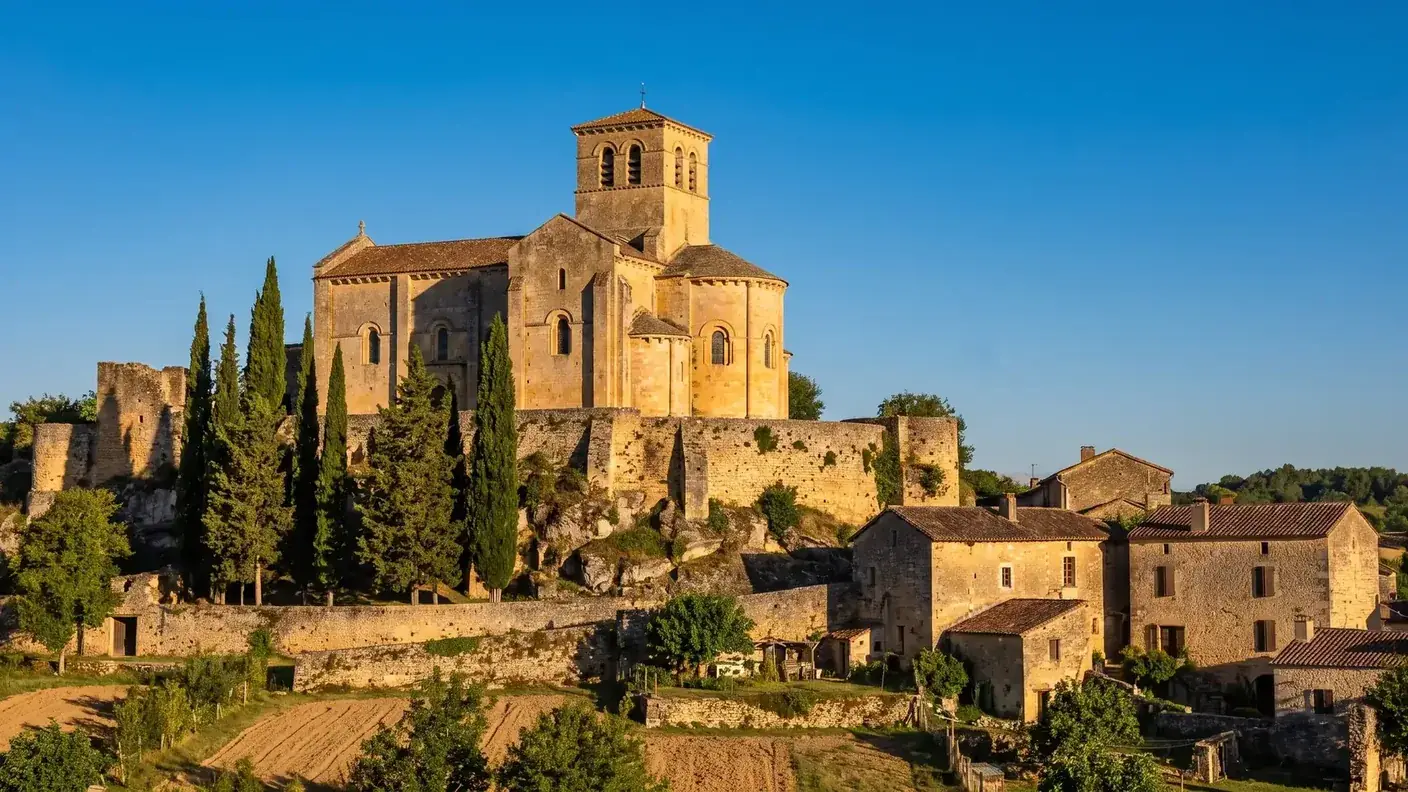
The fire at 1568, set ablaze by Captain d'Assiel's Huguenot troops, did not destroy everything: the apse and the base of the bell tower retain their original walls, which still allow us to see the building’s early Romanesque form. As for the murals The works of art that adorn the interior are the subject of debate regarding their dating: tourist sources tend to date them to the 17th century, but the official entry in the Historic Monuments registry attributes them to “ likely due to the 19th-century redevelopment ". So, caution is called for—a debate over authorship that, on a modest scale, is reminiscent of the one surrounding the birth of Arnaut Daniel.
Notre-Dame-de-la-Paix: Reinforced Concrete, Domes, and Art Deco
The second one, the Notre-Dame-de-la-Paix Church, is much more recent: built in 1933-1934 Designed by architect Jacques Laffillée (Chantiers du Cardinal), it is a building made of reinforced concrete — a highly innovative technique for its time —, with a massed layout and domes directly inspired by the cathedral Saint-Front in Périgueux and its Byzantine architecture. Lit by stained-glass windows by Francis Chigot, a master glassmaker from Limousin, it now serves as the parish church. It houses a painting by Jean-Paul Laurens (a state-owned work on loan), which was unfortunately damaged by a hailstorm in June 2022. It has been listed as a Historic Monument since 2000 (Mérimée Official Record PA24000026, accessed July 24, 2026).
A stylistic clarification is in order, as the terms used vary depending on the source. The component Byzantine The building's architectural style is undeniable—with its massing and domes in the style of Saint-Front, right down to the bell tower, designed to resemble the one at the cathedral in Périgord. However, official heritage descriptions characterize the decor asArt Deco: Notre-Dame-de-la-Paix is a building of its time—the 1930s—in which a tribute to the medieval architecture of the Périgord blends with the aesthetics and techniques of the 20th century. This interplay between the Roman-Byzantine dome and reinforced concrete makes it an almost unique example in the Dordogne.
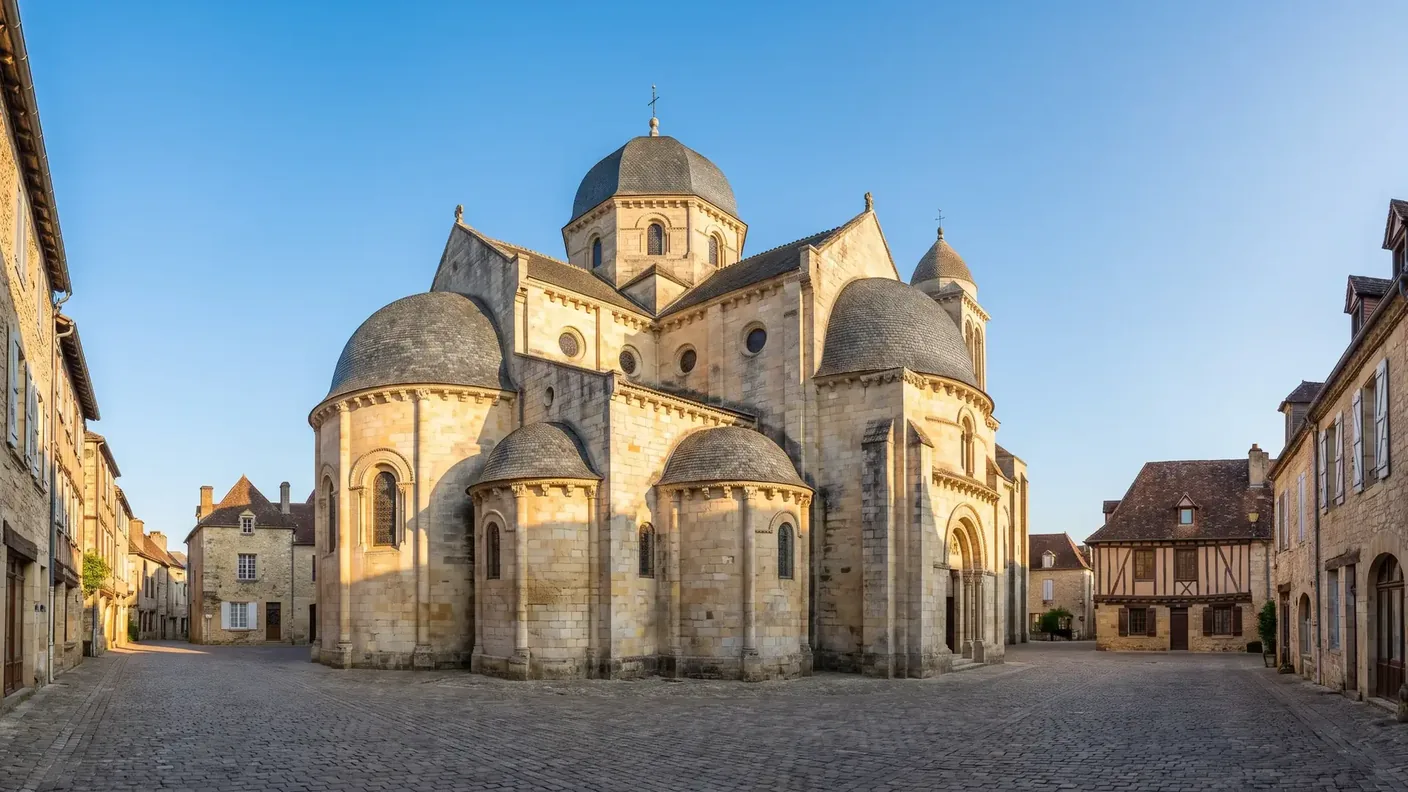
The Friday market, a long-standing tradition in the Périgord Vert
The weekly market in Ribérac is usually held on Friday mornings at Place du Général-de-Gaulle. Hours, the number of vendors, and seasonal markets may vary: check the official calendar of the City of Ribérac before you go.
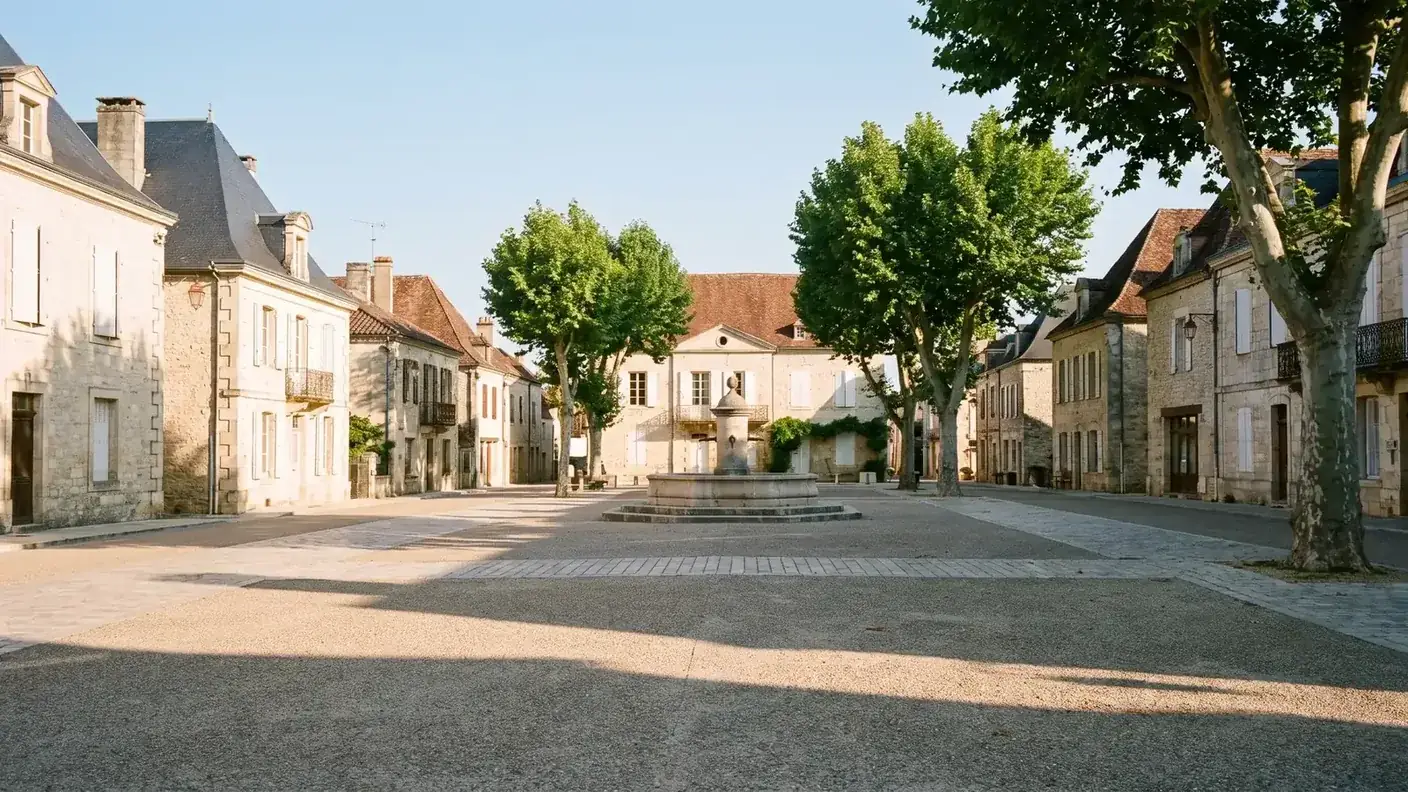
This market isn't just a picturesque setting: it's the weekly event for an entire community. The central town has only 3,734 residents, but the intermunicipal association it chairs has a total population of nearly 19,500, spread across 44 municipalities — and it is this scattered population that converges on Friday mornings. Thus, every week, the market fulfills the role that the subprefecture played for 125 years: making Ribérac the gathering place for the people of Ribérac.
What to See Around Ribérac
Ribérac is the best base from which to explore the Ribérac region, famous for its countless Romanesque churches with domes—an architectural feature unique to the area. Here are the actual driving distances from the city:
| Destination | Distance / time from Ribérac | Interest |
|---|---|---|
| Celles | ~2 km · ~4 min | A neighboring village that is growing rapidly |
| Aubeterre-sur-Dronne | ~20 km · ~25 min | "Most Beautiful Villages of France," monolithic church (Charente) |
| Bourdeilles | ~25 km · ~30 min | Medieval and Renaissance castle on the Dronne River |
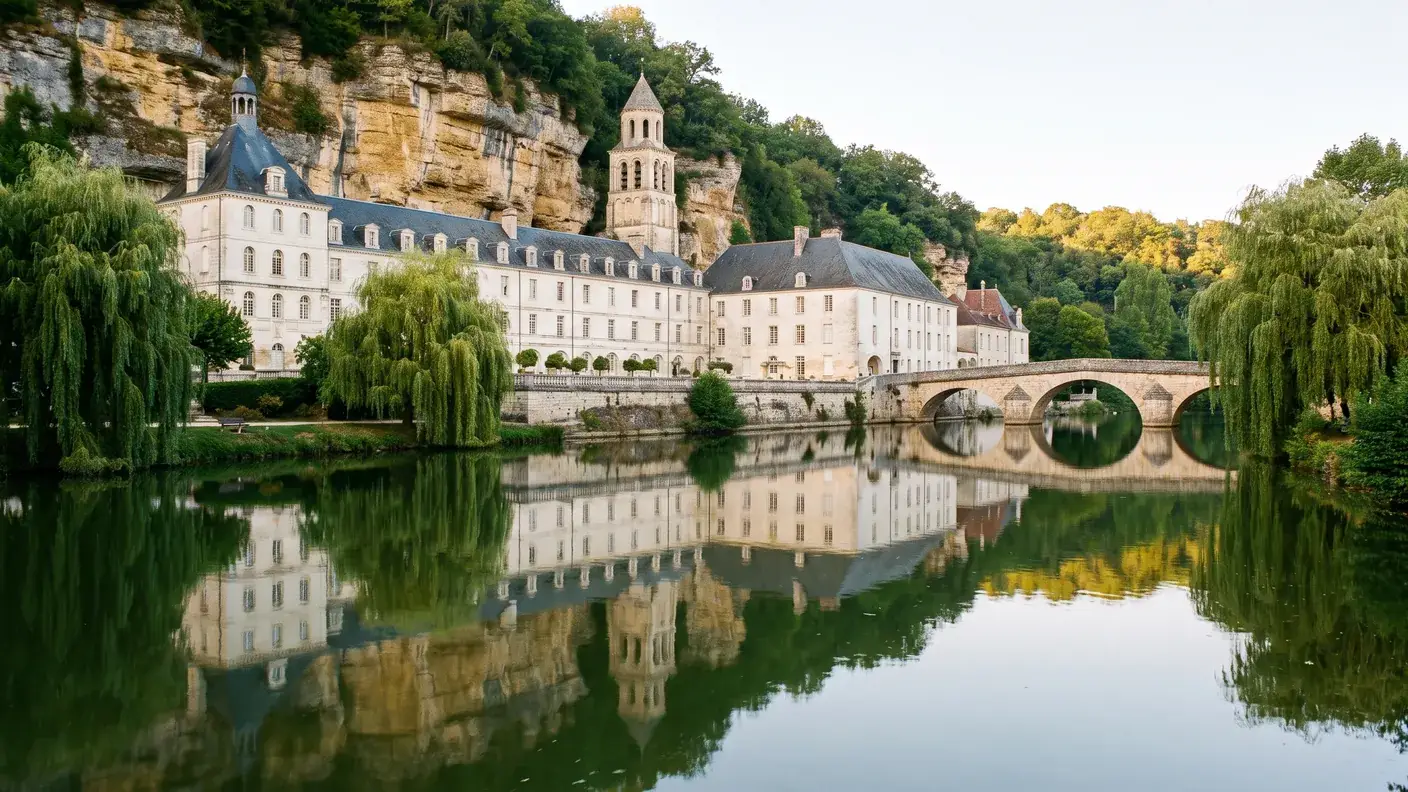
| Brantôme | ~35 km · ~40 min | Abbaye, the “Venice of the Périgord” on the Dronne River |
| Périgueux | ~39 km · ~45 min | Gallo-Roman Vesunna, Saint-Front Cathedral |
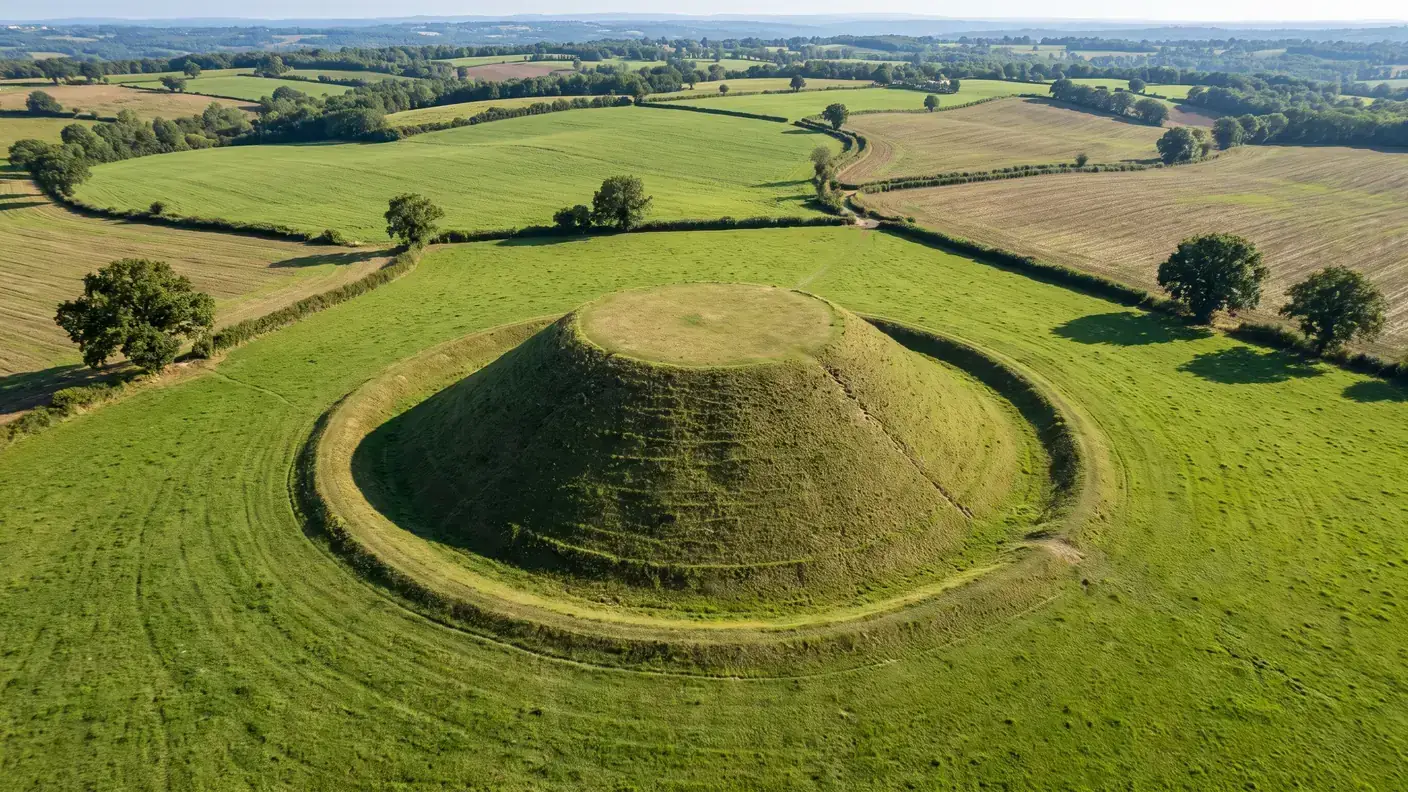
| Verteillac / La Chapelle-Grésignac | ~13–18 km · ~20 min | Former county seat, the Grésignac castle mound |
Don’t miss the Romanesque churches with domes that dot the Ribéracois region (Grand-Brassac, Saint-Martin-de-Ribérac, Siorac-de-Ribérac…): this string of 12th-century buildings, topped with domes supported by pendentives, constitutes one of the most unique Romanesque ensembles in southwestern France.
Getting to Ribérac from Bordeaux
Ribérac is about 114 km from Bordeaux, or ~1 hour and 38 minutes by car (The distance ranges from ~115 to ~125 km depending on the route—much more than the “90 km” sometimes cited, which is only a straight-line distance.) The city has no more train stations since its passenger service was discontinued in 1940; access is by road.
| Fashion | Duration | Estimated cost | Details |
|---|---|---|---|
| Executive car service (Chauffeured transfer) | ~1 hr 38 min | Starting at €199 · one-way | Door-to-door service from Bordeaux, with stops at your choice (Saint-Émilion, La Dronne) |
| Personal car | ~1 hr 38 min | ~22–28 € for gas and tolls | Via the main roads heading north from the Dordogne |
| Train + Transfer | 2–3 hours | ~15–25 € (TER) + road trip | Take the TER to Périgueux (~39 km), then drive to Ribérac |
The railway chapter of Ribérac came to a close more than 80 years: the La Cave–Ribérac railway line was closed to travelers on June 10, 1940 — in the midst of the rout, a few days before the armistice —, and the train never returned there. For those arriving by plane, the Bordeaux-Mérignac Airport is the natural starting point: allow about 125 km by road, or about 1 hour and 45 minutes, a direct transfer without going through downtown Bordeaux.
The nearest train station is that of Périgueux (~39 km), on the route to Bordeaux, Limoges, and Paris; but after that, it’s just the road. If you’re coming from Bordeaux, take advantage of the Friday market and explore the Romanesque region of Ribéracois at your leisure, the private chauffeur from Bordeaux is the simplest option: a direct trip of ~1 hour and 38 minutes, door-to-door, with stops as desired (Saint-Émilion is along the way), a fixed fare known in advance, starting at €199 one-way ticket.
Practical Information
- Recommended duration: one day—the Friday morning market, the former collegiate church, Notre-Dame-de-la-Paix, and then the domed churches in the surrounding area.
- The big event: the weekly market in Ribérac is usually held on Friday mornings at Place du Général-de-Gaulle. Hours, the number of vendors, and seasonal markets may vary: check the official calendar of the City of Ribérac before you go.
- Must-see: the former Notre-Dame Collegiate Church (exhibition hall, stained-glass windows by Henri Guérin), the Notre-Dame-de-la-Paix Church (Neo-Byzantine domes, stained-glass windows by Chigot).
- Shops & Services: Ribérac is a very well-equipped regional center (shops, market, hospital, services)—a true hub for the entire northern Dordogne.
- Transportation: There is no train station. A car or professional chauffeur is recommended. The nearest TER station is Périgueux (~39 km).
- When to visit: Check the official calendar of the City of Ribérac before your trip, then plan your visit to the Dronne River and the Romanesque churches according to the season.
Frequently Asked Questions
Where is Ribérac located?
Ribérac is located in the northwest of the Dordogne department, in the Nouvelle-Aquitaine region, within the Ribéracois natural region, in the heart of the Périgord Vert. The town is about 39 km from Périgueux and ~114 km (a 1-hour-38-minute drive) from Bordeaux.
Who is Arnaut Daniel, the troubadour of Ribérac?
Arnaut Daniel was an Occitan troubadour born around 1150, according to tradition in Ribérac. The author of 18 works and a master of *trobar ric* and *trobar clus*, he is considered the inventor of the sextine. Dante regarded him as the “finest craftsman of the mother tongue.”
Was Arnaut Daniel really born in Ribérac?
This is a tradition, not a documented fact: the claim that he was born “in Ribérac” stems from his medieval legend, and the few contemporary sources mainly describe Arnaut as an indebted juggler. So we write, “born around 1150, according to tradition, in Ribérac”—which in no way diminishes local pride.
Why does Dante mention Arnaut Daniel?
In Canto XXVI of Purgatory, Dante has Guido Guinizzelli say that Arnaut was “the finest master of the mother tongue.” This is unique in the Divine Comedy: Arnaut is the only character to speak in his own language, Occitan—the only modern foreign language in the entire poem.
What is the sextine invented by Arnaut Daniel?
The sextine is a poetic form consisting of six stanzas of six lines each, followed by a three-line coda, in which six key words recur at the end of each line in a specific sequence (6-1-5-2-4-3), without traditional rhyme. The seminal poem is “Lo ferm voler qu’el cor m’intra.”
What is the connection between Arnaut Daniel, Ezra Pound, and T.S. Eliot?
Ezra Pound studied and translated Arnaut as early as 1910, considering him the greatest of the troubadours. He then revised the manuscript of T.S. Eliot’s *The Waste Land*, and Eliot dedicated the poem to him with the phrase “il miglior fabbro”—echoing Dante’s tribute to Arnaut Daniel.
From when to when was Ribérac a subprefecture?
Ribérac was a subprefecture of the Dordogne from 1801 to 1926, a period of 125 years. It lost this status when 106 subprefectures were abolished by the decree-law of September 10, 1926; its district was then incorporated into that of Périgueux.
When is the Ribérac market held?
The weekly market in Ribérac is usually held on Friday mornings at Place du Général-de-Gaulle. Hours, the number of vendors, and seasonal markets may vary: check the official calendar of the City of Ribérac before you go.
How many people live in Ribérac?
Ribérac had a population of 3,734 according to the 2023 census, a slight decrease (−3.29% compared to 2017). It is the main urban center of the Ribérac region and the seat of an intermunicipal association comprising 44 municipalities.
How far is Ribérac from Bordeaux?
About 114 km, or ~1 hour and 38 minutes by car. With a door-to-door car service, door-to-door service is available starting at €199 one way. The city no longer has a train station; the nearest one is in Périgueux (~39 km).
What is the origin of Ribérac Castle?
An early fort (castellarium) was built in 848 near a ford on the Dronne River in Le Chalard, the very same year that the Normans sacked Brantôme as they moved upriver; in 866, Count Wlgrin of Angoulême stationed a representative there. Around the year 1000, Alchier the Deaf moved the fief to the hill where the current cemetery stands: this marked the birth of Castellum Ribairac, the cradle of the town, where, according to tradition, Arnaut Daniel was born. All that remains today is the old chapel, which has since become a collegiate church.
Can we visit the former Notre-Dame de Ribérac Collegiate Church?
Yes: No longer used for worship, the former collegiate church (12th century, listed as a Historic Monument in 1975) now serves as an exhibition hall. It features contemporary stained-glass windows by Henri Guérin, and both the apse and the base of the bell tower retain their original walls, which were spared by the Huguenot fire of 1568.
What is there to see in Ribérac and the surrounding area?
In Ribérac: the former Romanesque Notre-Dame Collegiate Church, the Notre-Dame-de-la-Paix Church (with Neo-Byzantine domes), and the Friday market. In the surrounding area: the Romanesque domed churches in Ribéracois, Aubeterre-sur-Dronne, Bourdeilles, and Brantôme.
Further Reading
- The immediate neighboring town (650 m), which is growing rapidly: see the Celles Guide
- The jewel of the Périgord Vert, on the Dronne River: see the Brantôme Guide (abbey, caves, “Venice of the Périgord”)
- The Ribéracois castle mound, nearby: see the Guide to La Chapelle-Grésignac
- The 2,000-Year-Old Prefecture: See the Guide to Périgueux (Vesunna, Saint-Front)
- Plan your trip: Book a chauffeured car from Bordeaux to Ribérac or explore all our destinations
Sources and References
- Wikipedia — Ribérac — geography, history, castle, subprefecture, heritage
- Wikipedia — Arnaut Daniel — troubadour, sextine, trobar ric, Dante, Pound
- INSEE — Complete Report Ribérac (24352) — 2023 Population, Density, CC 44 Municipalities
- POP/Mérimée Database — Notre-Dame Collegiate Church — 12th-century castle chapel, collegiate church from 1500, designated a Historic Monument in 1975
- POP / Mérimée Database — Notre-Dame-de-la-Paix — 1933–34, reinforced concrete, domes, listed as a historic monument in 2000
- Official Calendar of the City of Ribérac — Markets and Events, accessed July 23, 2026
- Périgord Ribéracois Community of Communes — 44 municipalities, territory, services
- Dante — Purgatory, Canto XXVI — “miglior fabbro del parlar materno,” Arnaut’s reply in Occitan
Article updated on July 23, 2026.
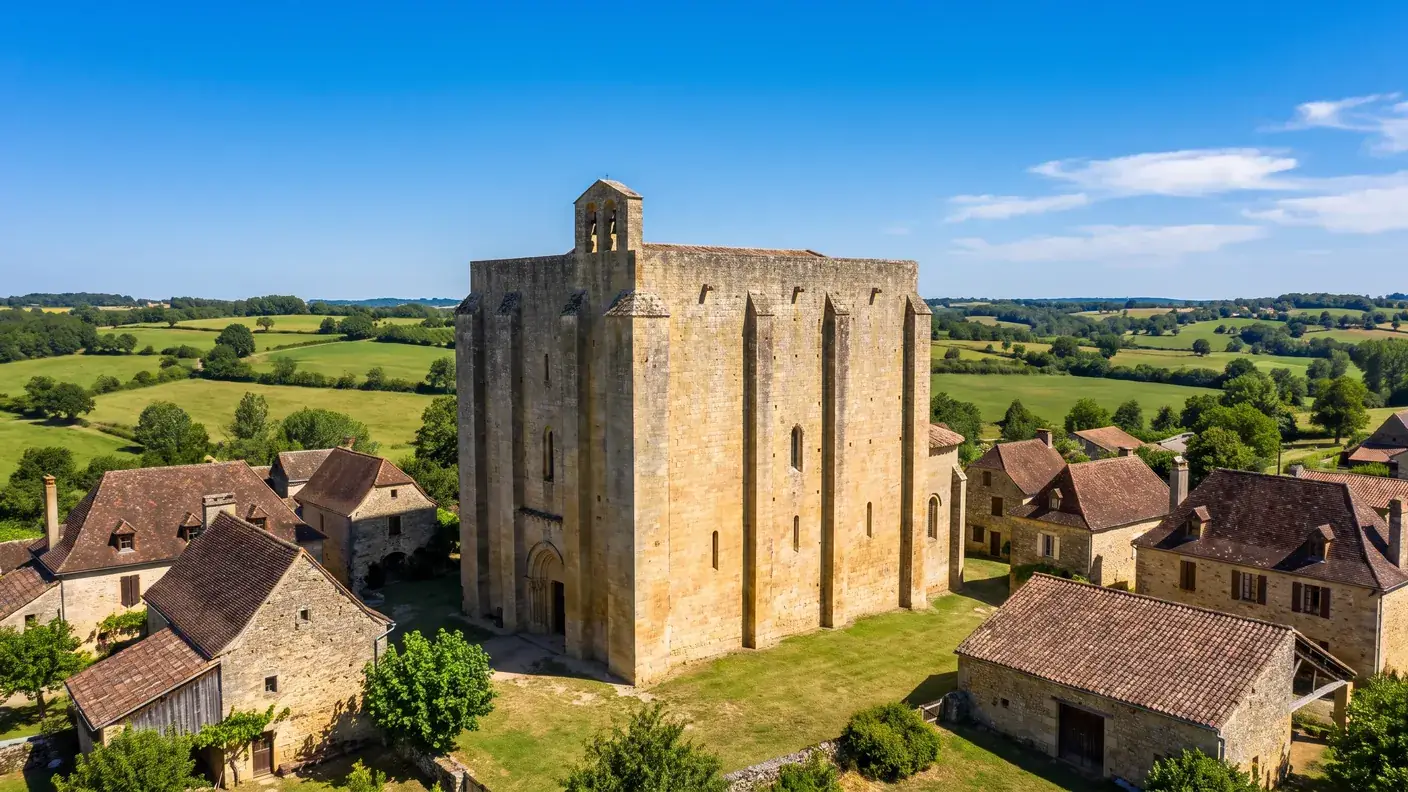
Off to the Périgord Vert
Direct trip from Bordeaux (~1h38) to the capital of the Ribéracois region, with stops along the way as desired—Saint-Émilion, the Dronne Valley, and the domed churches. Fixed-price quote in writing within 30 minutes; sedan or 8-passenger van; English-speaking driver.