
Bordeaux to Saillat-sur-Vienne: a crater and a town founded in 1928
A village of 840 residents in the northwest of Haute-Vienne, in the Limousin region. Founded in 1928 amid a rift between farmers and factory workers, situated atop a 207-million-year-old meteorite crater, and home to a paper mill that is the only one of its kind in France. A young town built on very old rocks. About 2.5 hours from Bordeaux.
Saillat-sur-Vienne at a Glance
- Saillat-sur-Vienne (the residents of Saillat) is a town with a population of 840 located in the northwestern part of the Haute-Vienne department (87720), in the Limousin region, on the border with the Charente department.
- This is the most recently established municipality in the department: created on January 2, 1928 after a split with Chaillac-sur-Vienne, following a conflict between factory workers and farmers.
- Its subsoil bears the scars of a cosmic collision: Saillat lies on the edge of the Rochechouart-Chassenon astrobleme, a meteorite crater approximately 207 million years old—the only known astrobleme in France.
- Since 1894, the town has revolved around a large paper mill (now Sylvamo)—the only integrated plant in France, processing raw wood into finished paper.
- Its young parish did not get its church, Notre-Dame-des-Anges, until 1934—built on the very field where Mass had previously been celebrated outdoors.
- Before 1928, this territory was part of the viscountcy of Rochechouart, whose house is the oldest surviving noble family in France after the Capetians.
- From Bordeaux: ~187 km, about 2 hours and 30 minutes by car — starting at €316 with a private driver. There is a train station on the Limoges-Angoulême line (Limoges is only ~42 km away).
Before You Go: What Saillat-sur-Vienne Really Is
One morning on the banks of the Vienne River, in western Limousin. At first glance, Saillat-sur-Vienne looks nothing like a picture-perfect village: a river, wooded hills, and above all, a vast factory whose smokestacks are visible from afar. Yet this small area of 6 km² is home to three extraordinary stories: that of a town born out of a rift between farmers and factory workers, that of a meteorite crater buried beneath its fields, and that of a paper mill unlike any other in France. Welcome to Saillat-sur-Vienne, a young village—less than a century old—perched on rocks that are over 200 million years old.
A young village built on very old rocks
Saillat-sur-Vienne is located in western Limousin, in the northwestern part of Haute-Vienne, right on the border with Charente. It is a region of rivers, forests, and rolling countryside, off the beaten path—yet rich in an extraordinary industrial, geological, and feudal history. People don’t come here for a monument, but to understand a place.
Distinguishing Between Original and Copied Content
This guide distinguishes between verified information and approximations—and there’s plenty to sort through, since online entries are rife with oversimplifications. The factory “founded in 1894 by Aussedat-Rey”? In reality, the site opened in 1894… as a tannery, and didn’t switch to paper production until the 1920s; the name Aussedat-Rey came much later. The “19-km crater”? That’s the residual deformed area: the original crater was actually 40 to 50 km across. And Limoges, often listed as “85 km away,” is actually only 42 km away by road. We’re setting the record straight on all of this, with sources to back it up.
In terms of transportation, Saillat has a train station on the Limoges-Angoulême line—a legacy dating back to 1875—but for those coming from Bordeaux (~2.5 hours) and wanting to explore the surrounding area, a chauffeur service from Bordeaux remains the most flexible door-to-door option.
A small area along the Vienne River, on the border with Charente
Saillat-sur-Vienne is located in the northwestern part of the Haute-Vienne department, in the Nouvelle-Aquitaine region (formerly Limousin), within the Rochechouart district and the Saint-Junien canton. It is a tiny area: 6.29 km², or 629 hectares—one of the smallest municipalities in the region. The terrain is gentle, ranging in elevation from 153 to 254 meters, typical of western Limousin.
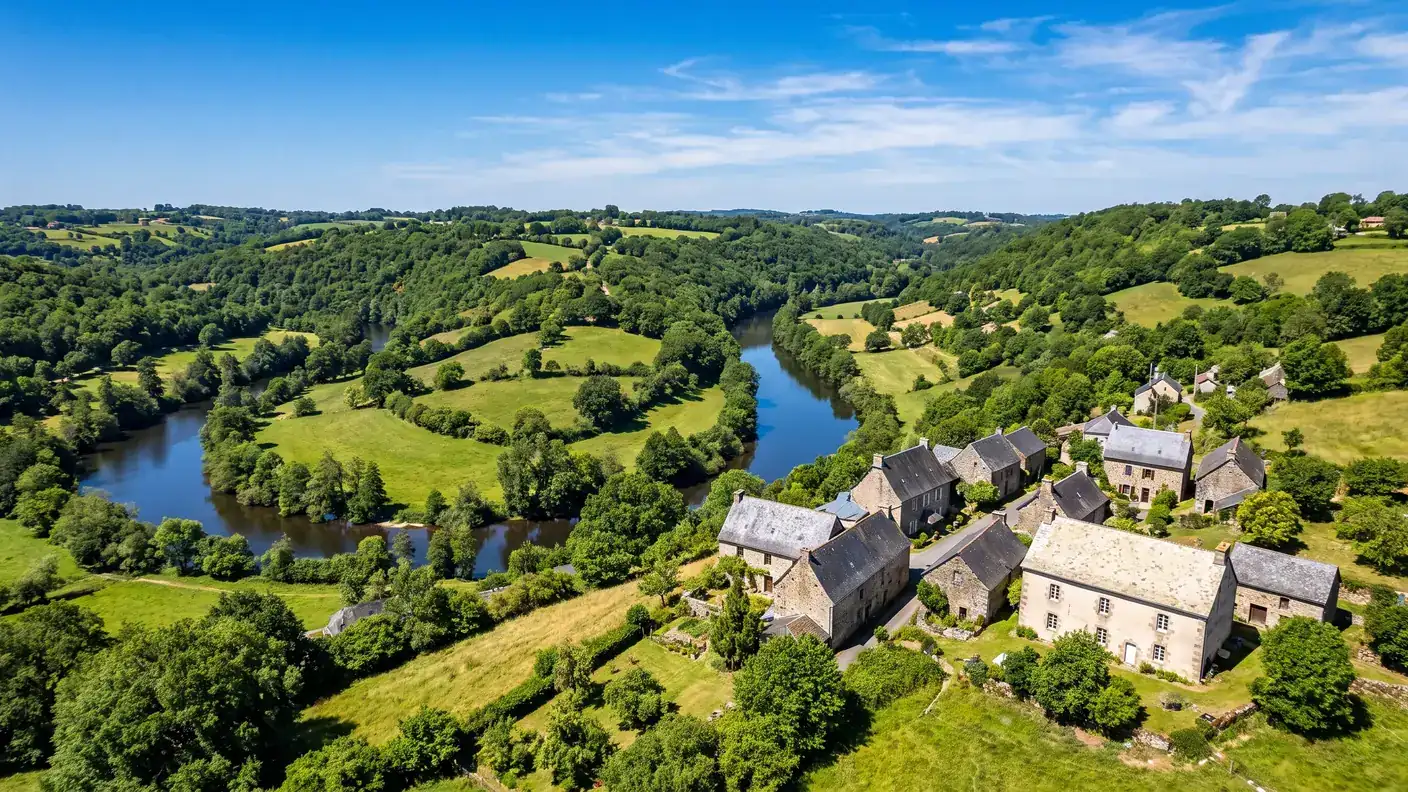
The Vienne and the Gorre: A Confluence on the Border
The town is crossed by the Vienna, this 363-km-long river that originates on the Millevaches Plateau, at the foot of Mount Audouze, and flows much further downstream to join the Loire at Candes-Saint-Martin. At Saillat, the Vienne is fed by the Gorre, a small tributary—and here’s a nice detail: this confluence is located exactly on the departmental border, between Haute-Vienne and Charente. The river flows into the main river right at the border between the two departments.
A few figures give a sense of the scale of this river, which has shaped everything here. The Vienne stretches exactly 363.3 kilometers and rises at high altitude, between 860 and 885 meters, at Mont Audouze on the Millevaches Plateau—the “water tower” of the Limousin region. By the time it reaches Saillat, it is only about 150 meters above sea level: the river has already descended most of its slope and now flows wide and steady, ideal for the industrial uses that would bring local prosperity. As for the confluence with the Gorre, it lies exactly on the boundary between the municipalities of Saillat and Étagnac—which coincides with the border between the Haute-Vienne and Charente departments. A point on the map where two rivers, two municipalities, and two departments meet.
| Data | Value |
|---|---|
| ZIP Code / INSEE | 87720 / 87131 |
| Department / Region | Haute-Vienne / Nouvelle-Aquitaine |
| District / Township | Rochechouart / Saint-Junien |
| Area | 6.29 km² (629 ha) |
| Elevation | 153 m to 254 m |
| Population | 840 residents (2023) — the residents of Saillat |
| Density | ~134 people per km² |
| Must-See | Rochechouart Meteorite Crater, Notre-Dame-des-Anges Church, Vienne |
Five neighbors, two departments
The town borders five neighboring municipalities: Chaillac-sur-Vienne (its former parent municipality), Rochechouart, and Saint-Junien—all three in Haute-Vienne—as well as Chassenon and Étagnac, which are in Charente. This border location, straddling the Limousin and Angoumois regions, has shaped its entire history—from the medieval viscountcy to modern industry.
A curve shaped by the factory
Saillat's demographics are inextricably linked to its factory. Founded in 1928, the town reached its all-time low — 780 residents in 1936, shortly after its founding. Then, driven by the growth of the paper industry in the 20th century, the population rose to a peak of 1,268 residents in 1975. It was a time of massive hiring and working-class neighborhoods.
| Year | Population |
|---|---|
| 1931 | 884 residents |
| 1936 | 780 (all-time low) |
| 1962 | 1 005 |
| 1975 | 1,268 (all-time high) |
| 1990 | 962 |
| 1999 | 905 |
| 2006 | 822 |
| 2020 | 799 (recent low) |
| 2023 | 840 residents |
A slow ebb, then a tremor
Since 1975, the trend has reversed in step with industrial changes: the population has declined by about one-third, reaching a recent low of around 799 residents in 2020. Since then, a slight rebound has been taking shape: 813 in 2021, 826 in 2022, and 840 in 2023. The population density, at about 134 residents per square kilometer, remains high for a rural municipality—a sign of the concentration of working-class housing centered around the industrial site within such a small area.
A closer look at the data reveals a gradual decline rather than a sharp drop: 962 residents in 1990, 905 in 1999, 822 in 2006, followed by a long period of stagnation around 832 residents in the 2012 and 2017 censuses—two identical figures five years apart, a fact rare enough to be worth noting. In total, the municipality has lost about 34% of its population since the peak in 1975, but the most recent trend is positive: between 2017 and 2023, Saillat is gaining residents, representing an increase of about +0.96% over the period. Though modest in absolute terms, this slight uptick stands in stark contrast to decades of decline—and to the fate of many comparable industrial towns.
The town is a rural community, outside any urban area, with a population that is aging somewhat but not excessively so. It is nothing like a traditional farming village: here, for the past century, the demographic trend has mirrored that of industrial employment—rising until 1975, then declining, and recently stabilizing. Saillat literally lives to the rhythm of its factory.
1928: A Town Born Out of a Social Conflict
Here is the most remarkable fact about Saillat: it is the most recently established municipality in Haute-Vienne, made official on January 2, 1928 through the division of its neighboring town, Chaillac-sur-Vienne. To understand the reason for this, we must go back to 1875, the year the Limoges-Angoulême railroad line was built. The hamlet of Saillat, which at the time was part of Chaillac, was given a train station. This infrastructure changes everything: it attracts a factory to set up near the railroad tracks, and with it comes a working-class population that settles in and grows rapidly.
A train station, a factory, two worlds
Over the course of a few decades, a real divide has emerged within the town of Chaillac-sur-Vienne. To the east, farmers continue to live in tune with the land. To the west, around the train station and the factory, a working-class population has emerged, with urban lifestyles and very different economic interests. Two worlds coexist, without understanding one another.
The Strike, the Bill, the Breakup
The crisis broke out in the 1920s. A strike action affects the factory workers, and the conflict escalates: the strikers damage the facilities. The owners then submit the repair bill to the Chaillac town hall, the relevant local authority. That’s when everything changes: the farmers from the east categorically refuse to pay for damage caused, on the other side of the country, by a labor dispute that has nothing to do with them. The disagreement—which involves both financial and identity-related issues—proves to be irreconcilable.
The only solution was a radical one: to administratively separate the two populations. The municipality of Saillat was thus created through a split on January 2, 1928. This is a rare case in the 20th century—most municipal splits date back much further and were driven by religion or distance. Here, the cause was purely socioeconomic: the coexistence of a traditional agricultural community and an emerging working-class community had become impossible. Finally, the name would change: by a decree dated August 3, 1953, Saillat officially became Saillat-sur-Vienne.
The Astrobleme: A Cosmic Collision Right Under Our Feet
This is the most spectacular—and least visible—feature in the history of Saillat: the town lies on the edge of an authentic meteorite crater, the Rochechouart-Chassenon astrobleme. The word “astrobleme” (literally “star wound”) refers to the scar left in the Earth’s crust by the impact of a celestial object, once erosion has taken its toll. Here, there is no longer a crater visible to the naked eye—but the rocks still bear the mark.

An impact that occurred about 207 million years ago
The impact occurred approximately 207 million years ago (late Triassic), well before the age of the large dinosaurs. The object responsible is generally estimated to have been about 1.5 km in diameter. The residual structure visible today measures about 19 to 23 km, while reconstructions of the original crater suggest a diameter of about 40 to 50 km. It is one of the largest impact sites in Europe and the only known astrobleme in France.
Recent scientific research has refined these figures with remarkable precision. The most precise dating places the impact at 206.9 ± 0.3 million years, in the Rhaetian, the very last stage of the Triassic—that is, approximately 5.6 million years before the Triassic–Jurassic boundary and its major extinction event: the two events, which were long thought to be closely related, are in fact quite distinct. The energy released is estimated to be about 283,000 megatons of TNT. According to the rankings, Rochechouart-Chassenon is among the five or six of the largest impact structures in Europe — and beneath the feet of the people of Saillat, these are no ordinary hills, but the warped floor left behind by that cataclysm.
From the 1967 memo to the 1969 cones
The scientific evidence was established in two stages, which are often confused. In 1967, the French geologist François Kraut wrote the paper establishing the site's meteoritic origin—but it was his colleague Jean Orcel who presented it to the Academy of Sciences. Then, in 1969, the field discovery of "percussion cones" (shatter cones)—these striated rock structures that form only under extreme shock waves—have definitively settled the debate. To protect this natural heritage, the Astroblème National Nature Reserve was established on September 18, 2008, on approximately 50 hectares spread across a dozen sites, straddling the Haute-Vienne and Charente departments. Here, you can literally walk on the remains of a catastrophe that occurred 200 million years ago—and see its rocks even in the walls of nearby villages, such as Chassenon.
The history of this discovery deserves to be recorded with its exact dates, since they are so often confused. Kraut's founding paper was read at the Academy of Sciences May 8, 1967 — and, in a delightful twist, not by its author: Jean Orcel is the one presenting it on her behalf. The famous percussion cones, meanwhile, have been located in the field August 8, 1969. Two years thus elapsed between the written hypothesis and its field verification—a time span that online entries often condense into a single date. As for the crater itself, we must face the facts: after 200 million years of erosion, no traces of it remain. The landscape has completely erased it; all that remains are the distorted base and the floor of the structure, whose impactites can be seen in the building stones of the villages.
Notre-Dame-des-Anges: A Parish Without a Church
A direct and amusing consequence of this belated establishment: in 1928, the brand-new municipality of Saillat had no church. A real irony for a parish. Before the split, and until 1919, the faithful made do with a schoolroom converted into a chapel; afterward, the situation became even more rustic: Masses were held outdoors, in a meadow made available for the occasion, for lack of a better option.
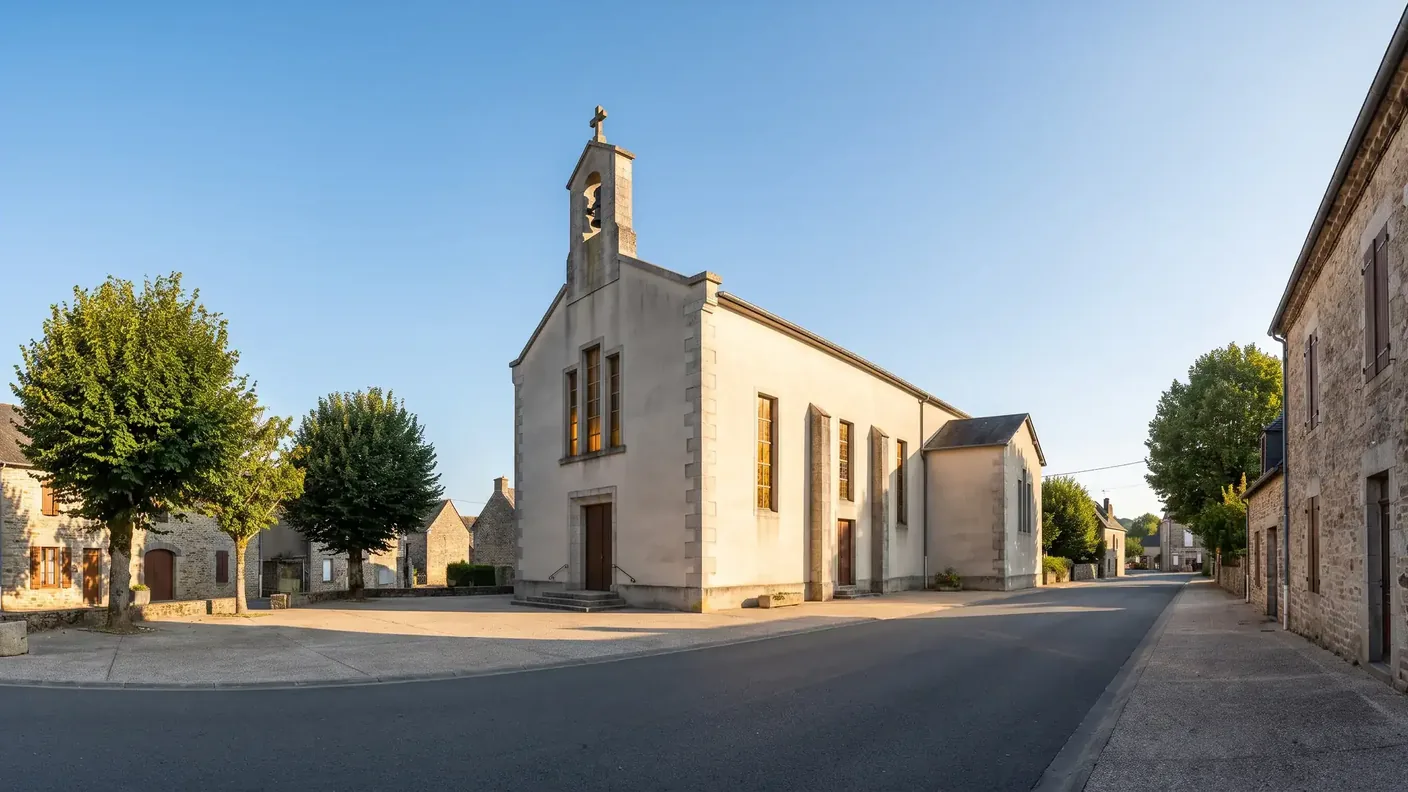
Ten months of construction on the Pré des Messes
It wasn't until the early 1930s that the problem was solved—and the detail is touching: the church was built right there on the field where Mass was celebrated outdoors. The cornerstone of Our Lady of the Angels is asked on June 18, 1933 by Bishop Flocart of Limoges. Construction proceeded rapidly: the building was completed in just ten months and blessed the April 2, 1934, Easter Monday.
Architecturally, the church stands in stark contrast to the rural architectural style typical of the Limousin region. Its rectangular nave measures 25 meters by 8 is distinguished by a slender vault, shaped like a “ upside-down vessel "— the image of the church as a ship carrying the faithful. The stocky exterior conceals an interior bathed in light by stained-glass windows in warm tones, a far cry from the austere gloom of the neighboring Romanesque churches. A modern, almost daring choice for a small town in the 1930s, one that lived up to its brand-new identity.
The Paper Industry: 130 Years of Industry, and a Distinctively French Tradition
It’s impossible to talk about Saillat without mentioning its industry: it was the industry that gave birth to the town and has sustained it ever since. But here again, we need to correct a common misconception. The site opened in 1894—not as a paper mill, but as a tannery (leather industry). It wasn’t until the 1920s that it switched to paper pulp production. The choice of location was no accident: the Vienne River provided the water for the processes, and the Limousin forest supplied the wood.

From a tannery to a paper giant
The plant expanded rapidly: its capacity increased tenfold in 1955, and it “took off” in 1963, with its paper products selling all over the world. In 1989, it was acquired by the North American giant International Paper, becoming its main European unit; then, in 2021, operations were transferred to Sylvamo, a company spun off from International Paper. What sets it apart: it is the only mill in France to control the entire production chain, from raw wood to finished paper. Most paper mills purchase their pulp from other sources; here, everything is done on-site—approximately 1.4 million metric tons of wood processed annually, yielding 320,000 metric tons of pulp, 240,000 metric tons of white paper, and 95 million reams. The facility handles a steady stream of 40 to 50 truckloads of wood per day and is classified as a low-threshold Seveso site.
Specifically, annual production consists of 240,000 metric tons of white paper and 22,000 metric tons of colored paper, packaged notably into 95 million reams of A4 and A3 paper—enough to give you an idea of just how likely it is that a simple pack of office paper has passed through this corner of the Limousin region. As for the wood, it flows continuously down from the Millevaches Plateau, at the other end of the department, in the daily stream of trucks that sets the pace on the local roads.
| Saillat Stationery in Numbers | Value |
|---|---|
| Opening of the facility (tannery) | 1894 |
| Conversion to paper pulp | the 1920s |
| Processed Wood | ~1.4 million metric tons per year |
| Dough produced | ~320,000 metric tons per year |
| White / colored paper | 240,000 metric tons / 22,000 metric tons per year |
| A4-A3 reams | ~95 million/year |
| Direct / Indirect Jobs | ~600 / ~4,000 (2019 data) |
| Procurement | 40 to 50 truckloads of wood per day |
Two factories and a bet on the fuel of the future
Its economic impact is considerable: approximately 600 direct jobs and nearly 4,000 indirect jobs throughout the Limousin region (forestry, transportation, maintenance). Note that a second plant, a separate company, is also based in Saillat—that of Smurfit Kappa, focused on corrugated cardboard made from recycled paper. LICHEN is a project to produce hydrogen, e-methanol, and synthetic aviation fuel in Saillat-sur-Vienne and Étagnac. As of June 11, 2026, it was still described as a project under development in a question posted by the Senate. The most recent official procedural status identified is the CNDP decision of October 1, 2025: The preliminary consultation period has ended, and a liaison officer is ensuring that the public is kept informed until the public hearing begins.
The Smurfit Kappa plant, which has been located in Saillat since 1880—even before the tannery was established in 1894—operates in the downstream sector: it produces corrugated cardboard from recycled paper, complementing Sylvamo’s virgin pulp operations.
Before 1928: the Viscountcy of Rochechouart
Even before it existed as a municipality, the territory of Saillat was part of a prestigious feudal domain: the Viscounty of Rochechouart. The family is not only “one of the oldest noble houses in France”—it is the oldest surviving French noble family after the Capetians, able to trace its lineage back to 980 and having celebrated its millennium in 1980.

Aimery, known as “Ostofrancus,” and the dowry of 980
The founder, Aimery (nicknamed “Ostofrancus”), became the first Viscount of Rochechouart around 980 upon marrying Ève Taillefer, daughter of the Count of Angoulême, who brought these lands to him as a dowry. Notably, the viscountcy was part not of the neighboring Limousin region but of the province of Poitou: its viscounts were vassals of the Count of Poitiers, while enjoying a high degree of autonomy in this border region.
The English Wars and the Charter of 1296
This family remained largely loyal to the King of France during the Anglo-French Wars. The most dramatic event was the death of Jean de Rochechouart, who was killed in 1356 at the Battle of Poitiers while protecting King John II the Good. After the Treaty of Brétigny (1360), the region briefly came under English control; but as early as 1372–1373, Louis de Rochechouart, advisor and chamberlain to Charles V, played an active role, alongside Du Guesclin, in the reconquest of Poitou and Limousin. Another notable development, of a more social nature: in 1296, Viscount Aimery XI issued a charter of emancipation that abolished direct taxes and compulsory labor—a bold move for the time, which remained in effect until the Revolution, spanning nearly five centuries.
It is worth clarifying a few points, as local accounts tend to confuse them. The Treaty of Brétigny was signed on May 8, 1360 and assigns Poitou and Limousin to England—but Rochechouart itself is not surrendered to the English as late as 1362, two years later. Ève Taillefer, Aimery's wife, is the daughter of William II, Count of Angoulême — hence the fief of Rochechouart, a key area between Angoumois and Limousin. The feudal attachment of the viscountcy to the Poitou County, which has been disputed over the centuries, will be definitively settled only by a judgment of 1468. And the famous charter of 1296 specifically abolished the size, the quest, and chores — the heaviest feudal levies —, which explains why it has remained so firmly etched in local memory.
The Vienne River, the bocage, and the name Saillat
Beyond its factory and its crater, Saillat is first and foremost a land of rivers and wooded countryside. Here, the Vienne is still a peaceful Limousin river, lined with willows and alders and punctuated by rapids—a watery landscape that, from the very beginning, shaped the layout of the town and later its industry. All around, the bocage of western Limousin unfolds with its small, hedge-lined fields, its pastures for livestock, and its granite farmhouses with slate roofs.

Salhac, a name dating back to antiquity
As for the name “Saillat,” it comes from the Occitan form Salhac, derived from the suffix -acum, of Gallic origin and later Latinized—the very same suffix that gave rise to the countless names ending in “-ac” in Limousin, Périgord, and Charente. These place names generally refer to the estate of a Gallo-Roman landowner; since the precise etymology of “Salhac” is not documented for this town, we’ll err on the side of caution: it was likely the estate of an ancient landowner whose name has been lost. The suffix “-sur-Vienne,” on the other hand, was not added until 1953 to specify the location.
This natural setting, long serving merely as a backdrop to the region’s industrial history, is also an asset: trails along the Vienne River, the forests of Limousin, and the proximity to the Astrobleme Nature Reserve, several sites of which can be visited in the surrounding area. A quiet region where nature and history intertwine at every turn.
Coming from Bordeaux: Distances and Directions
Saillat-sur-Vienne has an asset it has inherited from its history: a train station on the Limoges-Angoulême railroad line, which has been in service since 1875—the very same line that gave rise to the factory and, later, the town. From Bordeaux, allow about 187 km and 2 hours and 30 minutes by road. A pleasant surprise: Limoges is only about 42 km away (35 min) — much closer than online listings often indicate, as they confuse the distance as the crow flies with the actual distance.
| From / To | Distance | Weather |
|---|---|---|
| Bordeaux → Saillat-sur-Vienne | ~187 km | ~2 hours 30 minutes |
| Limoges (prefecture) | ~42 km | ~35 min |
| Rochechouart | ~5 km | ~8 min |
| Saint-Junien | ~7 km | ~10 min |
| Angoulême | ~71 km | ~1:00 |
From here, it’s easy to explore the surrounding area: Rochechouart and its castle (seat of the viscountcy) about 5 km away, Saint-Junien and its collegiate church, about 7 km away, and above all the sites of the Astroblite Nature Reserve, straddling the Haute-Vienne and Charente departments—notably the meteorite museum in Rochechouart and the Gallo-Roman site of Chassenon (Cassinomagus), built with impact rocks.
For a day of exploration in this little-known corner of the Limousin region—Saillat, with its crater and industrial heritage, Rochechouart, Saint-Junien, and Chassenon—without worrying about the route or parking, an executive car service departing from Bordeaux lets you visit each stop door-to-door, at your own pace. A fixed, written quote is provided before departure.
Frequently Asked Questions
Where is Saillat-sur-Vienne located?
In the northwest of Haute-Vienne, in Limousin (Nouvelle-Aquitaine), on the border with Charente, in the Rochechouart district and the Saint-Junien canton. ZIP code 87720. It is a small town with a population of about 840, covering an area of just 6.29 km², located about 187 km (2 hours and 30 minutes) from Bordeaux and 42 km from Limoges.
Why is Saillat-sur-Vienne considered “the newest” municipality in Haute-Vienne?
Because it is the most recently created municipality in the department through a split (ex nihilo), officially established on January 2, 1928, by separation from Chaillac-sur-Vienne. Since then, the only new municipalities created have been those resulting from mergers, which are of a different nature. Saillat thus retains this unique status as the last municipality to have been created through a separation.
Why did Saillat and Chaillac split up in 1928?
Because of a labor dispute. In the 1920s, striking factory workers damaged the facilities; the owners sent the bill for repairs to the Chaillac-sur-Vienne town hall. Farmers in the eastern part of the town refused to pay for a labor dispute that did not concern them. This irreconcilable disagreement led to the administrative separation of the working-class community (centered around the factory) from the farming community.
What is the Rochechouart-Chassenon astrobleme?
It is the geological scar left by the impact of an asteroid approximately 1.5 km in diameter nearly 207 million years ago. The original crater measured about 40 to 50 km across (the residual structure visible today is 19 to 23 km across). It is the only known astrobleme in France and has been protected since 2008 as a national nature reserve. The crater itself has disappeared, eroded away over time; only the rocks bear witness to its existence.
How long has the Saillat-sur-Vienne paper mill been in operation?
The facility opened in 1894—initially as a tannery (leather industry)—and then switched to pulp production in the 1920s. It was acquired by International Paper in 1989 and then transferred to Sylvamo in 2021. Today, it is the only mill in France to manage the entire production chain, from raw wood to finished paper, and provides approximately 600 direct jobs.
When was the church in Saillat built?
The cornerstone of the Notre-Dame-des-Anges Church was laid on June 18, 1933, by Monsignor Flocart, Bishop of Limoges; the building, completed in ten months, was consecrated on April 2, 1934, Easter Monday. Interestingly, it was built on the very same field where, in the absence of a church, Mass had previously been celebrated outdoors.
How much does a trip from Bordeaux to Saillat-sur-Vienne cost with a private chauffeur?
Starting at €316 for a one-way, door-to-door trip for 1 to 3 passengers (economy vehicle) — approximate price for ~187 km and about 2 hours and 30 minutes of driving. The exact price depends on the schedule, the vehicle (sedan or van for up to 7 passengers), and any requested stops. A fixed, written quote is provided before departure.
Who were the Viscounts of Rochechouart?
The House of Rochechouart is the oldest surviving French noble family after the Capetians, with a proven lineage dating back to 980. The founder, Aimery, became a viscount upon marrying Ève Taillefer, daughter of the Count of Angoulême. The viscountcy, a vassal of the County of Poitou, ruled over the territory of present-day Saillat for nearly a thousand years, with figures such as Jean de Rochechouart, who died in Poitiers in 1356.
Can you see the meteorite crater at Saillat-sur-Vienne?
No: after about 200 million years of erosion, the crater no longer has any visible features—the landscape has completely erased it. What remains is the deformed floor of the structure and its impact rocks (impactites, breccias, impact cones), which have been protected since 2008 by the Astrobleme National Nature Reserve, spread across a dozen sites between Haute-Vienne and Charente. These rocks can also be spotted in the walls of nearby villages, particularly in Chassenon, and visitors can explore the meteorite museum in Rochechouart.
What is the e-SAF project planned for Saillat-sur-Vienne?
LICHEN is a project to produce hydrogen, e-methanol, and synthetic aviation fuel in Saillat-sur-Vienne and Étagnac. As of June 11, 2026, it was still described as a project under development in a question posted by the Senate. The most recent official procedural status identified is the CNDP decision of October 1, 2025: The preliminary consultation period has ended, and a liaison officer is ensuring that the public is kept informed until the public hearing begins.
Is Saillat-sur-Vienne served by a train?
Yes: The town has a train station on the Limoges–Angoulême line, which opened in 1875. This station was actually the catalyst for Saillat’s development, as it made it possible for the factory to be established there and, indirectly, led to the town’s founding in 1928. Limoges is only about 42 km away.
Further Reading
- The Green Périgord, near Limousin: see the Lanouaille Guide (Bugeaud, Pomme d'Or)
- A village in Corrèze on the edge of Limousin: see the Juillac Guide (castles, market)
- The capital of the neighboring department of Corrèze: see the Brive-la-Gaillarde Guide (market, collegiate church, rugby)
- Plan your trip: Book a chauffeured transfer from Bordeaux to Saillat-sur-Vienne or explore all our destinations
Sources and References
- Wikipedia — Saillat-sur-Vienne — geography, demographics, founded in 1928, paper mill, church
- Wikipedia — Rochechouart-Chassenon Astrobleme — age ~207 Ma, crater, discovered in 1967–1969, RNN 2008
- Wikipedia — House of Rochechouart — Aimery and Ève Taillefer (980), the oldest noble family after the Capetians
- Astroblème National Nature Reserve — sites, impactites, established September 18, 2008
- INSEE — Saillat-sur-Vienne (87131) — population, demographic series, peak in 1975
- LiCHEN Project — Project Manager's Report — March 2025 version, published on April 2, 2025, accessed on July 23, 2026
- Légifrance — CNDP LICHEN decision of October 1, 2025 — monitoring of public information leading up to the public hearing · accessed July 24, 2026
- Senate — Written Question on the LICHEN Bill — Status of the Bill as of June 11, 2026 · Accessed July 24, 2026
Article updated in July 2026.

Off to Western Limousin
Direct trip from Bordeaux (~2.5 hours) to Saillat-sur-Vienne and the Rochechouart region, with stops along the way as desired—Rochechouart, Saint-Junien, and the Chassenon site. Fixed-price quote in writing within 30 minutes; sedan or 8-passenger van; English-speaking driver.