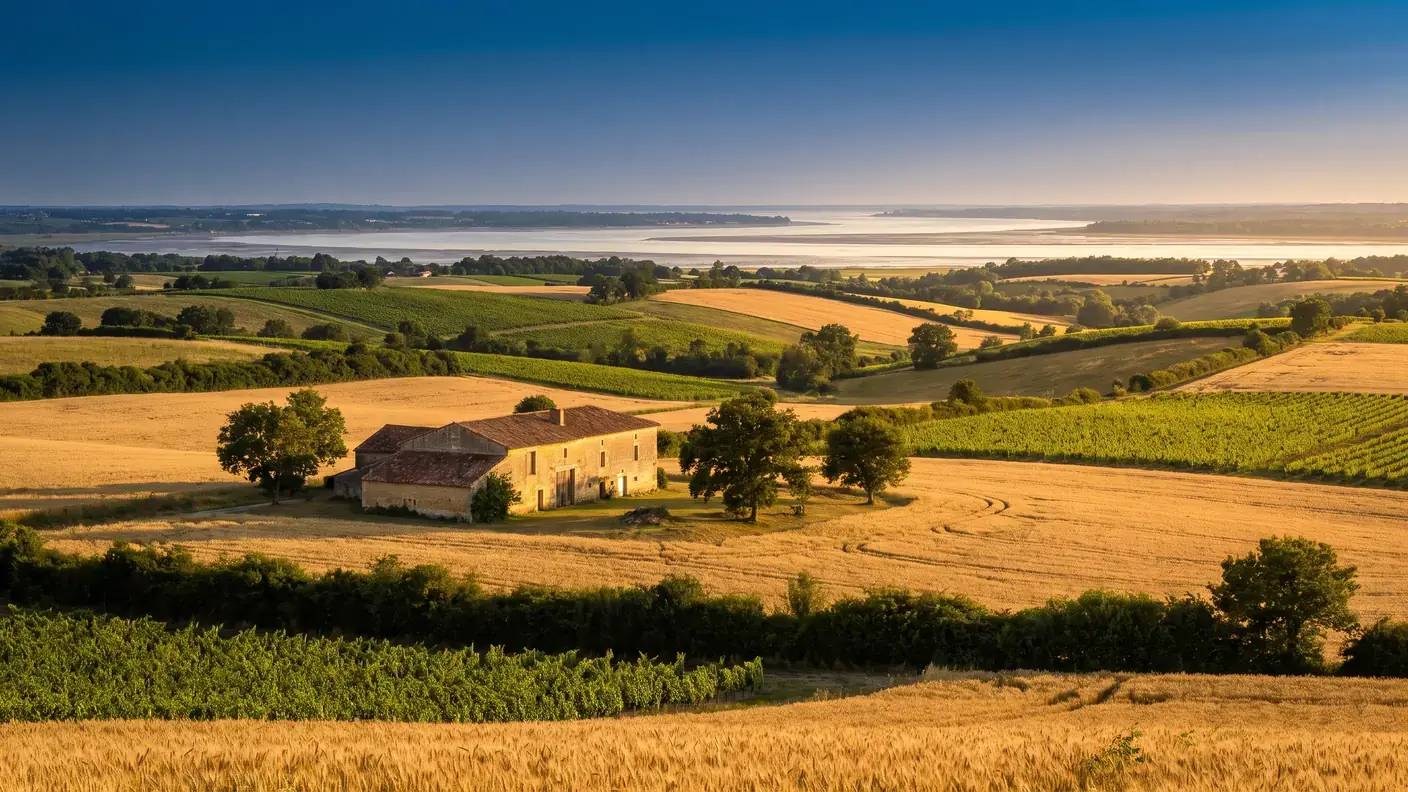
Sainte-Ramée from Bordeaux: the windmill and historic cross
One of the smallest villages in Charente-Maritime, in the hinterland of the Gironde Estuary: a 16th-century processional cross listed as a historic monument, the Chez Guillet mill, which is registered as a historic site, a “false saint” that conceals Saint Rémy, and Fins Bois cognac—just an hour from Bordeaux, in the heart of Haute-Saintonge.
Sainte-Ramée at a Glance
Sainte-Ramée is one of the smallest villages in Charente-Maritime: with just over a hundred residents, it lies in the heart of Haute-Saintonge, in the hinterland of the Gironde estuary. An agricultural hamlet, surrounded by vineyards and fields, that seems unremarkable—yet it harbors two little treasures: a 16th-century processional cross listed as a historic monument, and a restored windmill, also listed. Even its name is a curiosity: “Sainte-Ramée” actually honors a very masculine saint, Saint Rémy. Here we find ourselves in a secret, rural corner of Saintonge, off the beaten tourist path, about an hour from Bordeaux—one of those tiny villages where history is hidden in the details.
Here are the key details to know before you go. Driving distances are calculated door-to-door; the rate is for a private driver booked from Bordeaux, with a fixed price provided in advance.
| Landmark | Details |
|---|---|
| Department | Charente-Maritime (17), Nouvelle-Aquitaine |
| Status | Small rural town · Jonzac district · Pons canton |
| Population | approximately 113 residents (INSEE 2023) · Les Ramillons |
| Area | ≈ 4.7 km² · 100% agricultural, in the hinterland of the estuary |
| Don't miss it | The listed processional cross, the Chez Guillet mill, and the Saint-Rémy Church |
| Distance from Bordeaux | about 81 km · a one-hour drive |
| Nearest train station | Jonzac (~25 km) · TER and Intercités |
Let me be honest right off the bat, because even such a small village is not immune to stereotypes. Sainte-Ramée is now part of the Pons Canton, and no longer part of Mirambeau (the former administrative division prior to 2015). It is not located on the estuary: the village lies inland, a few kilometers from the shore. Saint-Rémy Church itself is not protected; its processional cross is classified as an object, while the Chez Guillet Mill is listed as a building. Its vineyards lie within the Fins Bois cru, not Bons Bois. And “Ramée” is not a saint, but a corruption of Saint Rémy. Throughout this guide, verified information is clearly distinguished from repeated claims.
Here we go over everything you need to know before you come: the location of Sainte-Ramée in the estuary’s hinterland, its damaged Romanesque church, its listed processional cross, the Chez Guillet mill, the mystery of its name, its agricultural character, Fins Bois cognac, the notable sites in the surrounding area, and the easiest way to get there from Bordeaux.
Where is Sainte-Ramée located?
Sainte-Ramée is located in the southern part of Charente-Maritime (17), in Nouvelle-Aquitaine, in the Haute-Saintonge region, a few kilometers northeast of the Gironde estuary. It is a very small rural municipality—about 4.7 km²—belonging to the Jonzac district and the Haute-Saintonge Community of Municipalities. Contrary to what its surroundings might suggest, it is not on the banks of the estuary : It is a landlocked municipality, with an elevation ranging from 8 to 80 meters, and whose nearest shoreline lies five or six kilometers to the west, toward Saint-Thomas-de-Conac. We will therefore refer to it as hinterland of the estuary, never a riverside town—a distinction this guide is careful to maintain.
A village with 113 residents
With only 113 residents according to the 2023 census, Sainte-Ramée is one of the smallest villages in Charente-Maritime—a tiny municipality with a highly dispersed population, located outside any urban area. Its residents have a charming demonym: the Ramillons and the Ramillonnes. Like many of these rural micro-municipalities, Sainte-Ramée has been experiencing a long-term decline: it had 186 residents in 1968, 126 in 1999, and continues to see a slow decline (it has lost a few more residents since 2017). These figures, given such a small population, are obviously fragile: just a few people moving away or moving in are enough to cause significant fluctuations in the percentages. But they reflect a reality: that of a farming village left behind by modernity, which only serves to enhance its charm and authenticity.
100 percent agricultural
The defining feature of Sainte-Ramée is its territory entirely agricultural. According to the European Land Cover Database, 100% of the municipality consists of cultivated land—vineyards, grains, and various crops—with no urbanized, forested, or water areas significant enough to be recorded. It is an open landscape of fields and hillsides, dotted with isolated farms and a few stone hamlets, beneath the vast sky of Saintonge. A word of caution, however, for anyone building or visiting: the commune’s clay soils make it highly susceptible to Shrinkage and swelling of clays — More than three-quarters of its area is classified as having moderate or high risk, a phenomenon that causes cracks to form in buildings during dry summers. This is the downside of these beautiful vineyard lands: living clay that swells and shrinks with the changing seasons.
A Secret and Unspoiled Saintonge
Perhaps the most precious thing Sainte-Ramée has to offer is its timeless charm. Here, there are no major tourist attractions, no crowds, no traffic—just a tiny farming village, with its farms, church, and mill, lost in a sea of vineyards and fields. This is the most authentic part of Saintonge—the one that hurried travelers pass through without noticing, speeding down the highway toward Royan or Spain. For those who take the time to stop here, it offers the understated charm of places that have nothing to prove: the beauty of a vast sky, the silence of the country roads, the light glinting off the rows of vines, and the warm, unpretentious welcome of the locals. At a time when tourism is concentrated on a few overcrowded sites, these tiny, unspoiled villages offer a rare luxury—that of space, tranquility, and authenticity.
The Romanesque Church of Saint-Rémy
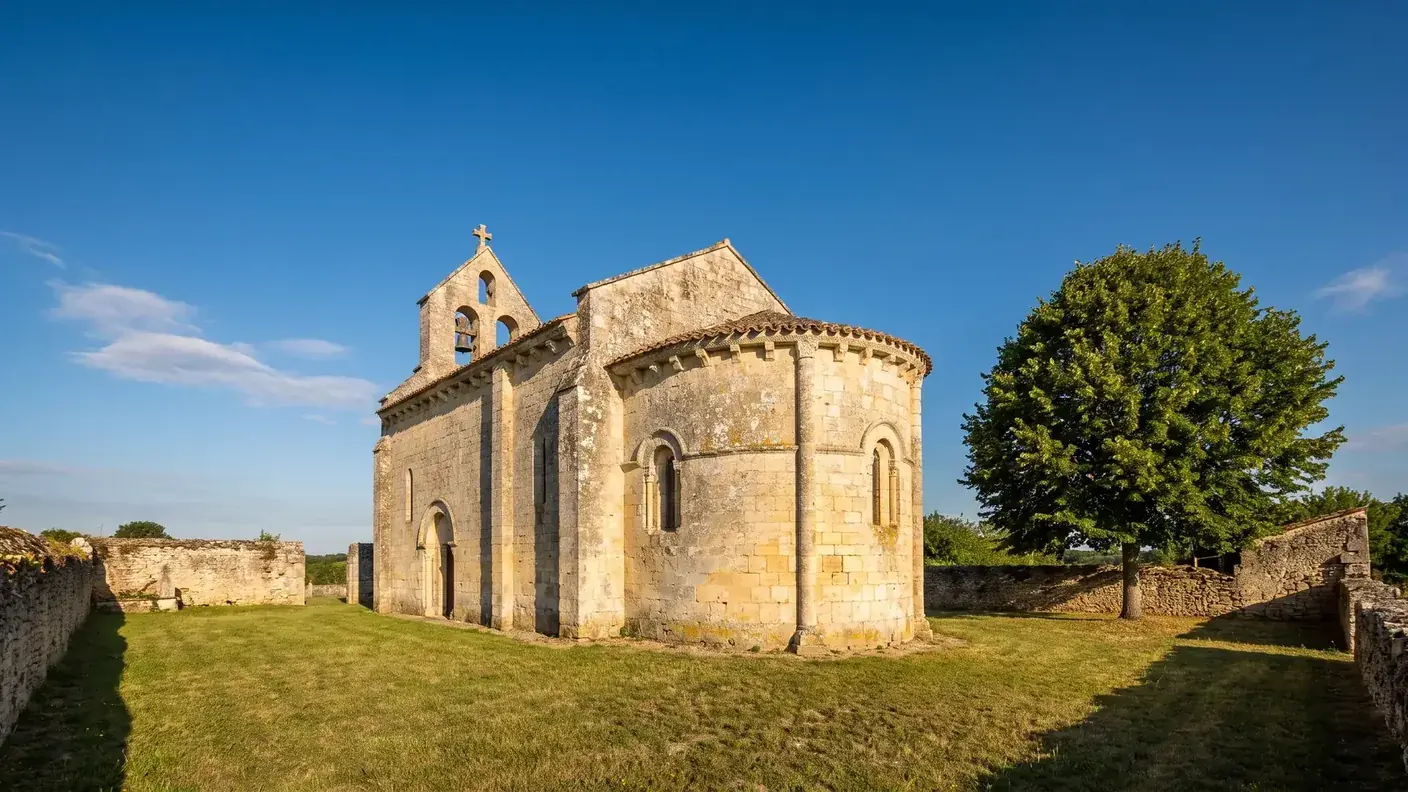
In the heart of the hamlet stands the Church of Saint-Rémy, a 12th-century Romanesque building that was once one of the most beautiful in the Saintonge region—before being partially damaged. Let’s make this clear from the outset, as confusion is common: the church, as a building, is not protected as a historic monument (it has no Mérimée listing). What is protected at Sainte-Ramée is an object it houses (the processional cross) and another building (the mill). This humble country church, dedicated to Saint Rémy, the bishop who baptized Clovis, is nonetheless worth a visit: it preserves beautiful Romanesque features and bears, in its stone, the traces of past grandeur and a heritage tragedy.
A facade demolished in 1954
For the Church of Saint-Rémy has suffered an irreparable loss. Its Romanesque façade—a semicircular portal with voussoirs, a diamond-pointed string course, a gallery of five arches—was considered “among the most remarkable in Saintonge,” one of those sculpted facades that are the pride of the region’s Romanesque art. But, cracked by water seepage and deemed too costly to restore, it was completely demolished in 1954 and replaced by a simple, utilitarian wall. This is one of those quiet tragedies of postwar rural heritage, when cash-strapped towns had to sacrifice masterpieces because they lacked the means to save them. All that remains of this lost splendor are a few carved modillions, salvaged and reassembled—a meager testament to what was once one of the most beautiful facades in the Saintonge region.
The Remaining Romanesque Treasures
The church is dedicated to Saint Remi, the bishop of Reims who, according to tradition, baptized Clovis, king of the Franks, around the year 500—a prestigious patronage for such a modest parish, and a sign of its antiquity. Like all the country churches of the Saintonge region, it was the heart of village life for centuries: a place of worship, but also a gathering place, a place of remembrance, and a refuge. Its turbulent history—a beautiful façade built, admired, and then lost—epitomizes the fate of so many small rural buildings, dependent on the resources of their communities and the vagaries of time. Visiting it means experiencing firsthand the fragility of this modest heritage, which enjoys neither the glory nor the funding of grand monuments.
Fortunately, not everything has been lost, and the interior holds some wonderful surprises for lovers of Romanesque art. The church retains its Romanesque apse, as well as two historiated capitals on the triumphal arch, carved with winged dragons and a demon spewing foliage—a reflection of the Middle Ages’ fantastical and moralizing imagination. The five surviving modillions on the façade are themselves delightful: a pig’s mask sticking out its tongue, two human heads, a goat’s mask, and scrolls—the pig symbolizing gluttony, the goat lust, in a sculpted moral lesson. Finally, on the south wall of the bell tower, traces remain of at least three canonical dials (liturgical sundials, likely from the 12th–13th centuries), a rarity for such a small parish. The central window of the apse is adorned with a stained-glass window signed by the Toulouse master glassmaker Louis-Victor Gesta.
The Listed Processional Cross
The true treasure of Sainte-Ramée is not a monument, but an object: a 16th-century processional cross, designated a historic monument—a masterpiece of Renaissance craftsmanship. Source: Palissy Database PM17000721, Ministry of Culture (accessed July 24, 2026). Let’s be clear about its status, as it is higher than is often believed: this cross is classified as an object (decree of October 23, 1991, Palissy reference PM17000721), and not merely “listed”—classification being the highest level of protection. One sometimes sees “listed” here and there: this is an error that the official Palissy database helps to correct. So here, in an unprotected village church, is an object of the highest heritage status.
A 16th-century masterpiece
This processional cross is a fine example of Renaissance religious metalwork. It is 65 centimeters tall and 40 centimeters wide, and is made of embossed and gilded copper on a wooden core. It depicts the Christ surrounded by the tetramorph — the symbols of the four evangelists (Matthew’s angel, Mark’s lion, Luke’s bull, and John’s eagle) —, with each branch ending in a fleur-de-lis motif. Described as “one of the finest examples of the skill of 16th-century artisans,” it is now preserved in the sacristy of the church, which is owned by the municipality. The fact that such a small village possesses such an object speaks volumes about the richness of the religious heritage scattered throughout the countryside of Saintonge—wonders that are often overlooked, hidden in churches we pass by without stopping.
Listed object, unprotected building: the distinction
The case of Sainte-Ramée perfectly illustrates a distinction that visitors would do well to understand: the difference between the protection of a building and that of an object. In France, historic monuments are categorized into two main databases: the Mérimée database, which lists immovable properties (buildings, ruins, gardens), and the Palissy database, which lists movable objects (statues, paintings, silverware, bells). Thus, a single church may not be protected as a building, yet house a classified object. This is exactly the case here: the Church of Saint-Rémy has no Mérimée protection, but its processional cross is classified in the Palissy database. Understanding this nuance means understanding why so many treasures are hidden in seemingly ordinary village churches—and why you sometimes have to step inside to discover them.
| Sainte-Ramée's Protected Heritage | MH Status |
|---|---|
| Processional cross (object) | Classified under "Object" (Oct. 23, 1991) · Palissy PM17000721 |
| Chez Guillet Mill (building) | Listed (Nov. 13, 1989) · Mérimée PA00105309 |
| Saint-Rémy Church (building) | unprotected (facade demolished in 1954) |
The Chez Guillet Mill
The second protected monument in Sainte-Ramée is a windmill: the Chez Guillet Mill, designated a historic monument, a rare milling complex that has survived almost intact to the present day. It stands in the hamlet known as “Au Moulin,” on the hills above this agricultural town where wheat once reigned supreme. It is the only protected building in the town: it is listed as a historic monument (decree of November 13, 1989, Mérimée reference PA00105309). The designation is partial but comprehensive: it covers the mill and its internal mechanism, as well as the facades and roofs of the adjoining dwelling, including its former bakery.
A complete milling set
What makes the Chez Guillet mill so valuable is that it forms a complete milling complex—a rare occurrence. Built in 1803 (source: Mérimée Database PA00105309, Ministry of Culture, accessed July 24, 2026), it remained in operation until 1919, before ceasing operations like so many others during the era of industrial flour milling. Its wings have disappeared, to be sure, but the essentials have been preserved: the interior mechanism, the oven, and the bakery, as well as the miller’s house, remain in place, offering a valuable glimpse into the miller’s life of yesteryear. The roof was rebuilt in 1984, and the building is now maintained by a volunteer association, the “Friends of the Chez Guillet Mill.” For a town of 113 residents, caring for such a heritage site requires a deep commitment—and it is this local dedication that keeps alive the memory of these wheat-covered hills, now overtaken by vineyards and cornfields.
The Wind: The Driving Force of a Vanished World
The mill at Chez Guillet, like the one in the neighboring town of Saint-Thomas, tells the story of the transformation of the Saintonge landscape. In the 18th and 19th centuries, the hills of Haute-Saintonge were covered with grain fields, and every wind-swept ridge had its own windmill—at that time, wind, along with river water, was the only energy source available for grinding grain. These winged silhouettes dotted the horizon and set the rhythm of village life. Then came steam, electricity, and large flour mills: the windmills stopped turning one by one, and most fell into ruin or disappeared. That Sainte-Ramée saved its own, complete with its mechanism and bakery, is a rare stroke of luck—a preserved fragment of a lost rural world, where life depended on the breath of the wind and the passing of the seasons.
Sainte-Ramée: A False Saint
The name Sainte-Ramée hides an interesting linguistic curiosity: this “saint” never actually existed. The village is actually named after a very masculine saint, Saint Rémy. This is what scholars call a “false saint”: a place name that, through distortion, has given rise to an imaginary saint. The generally accepted explanation—to be presented as a scholarly hypothesis, not as a fact attested by a charter—is as follows: the name comes from Saint Rémy (from the Latin Remigius, the bishop of Reims who baptized Clovis), which entered the regional language of Saintonge in the form “ Rowed " or "Ramai," then mistakenly feminized in “Ramée.” The church, its dedication, and its patron saint are, however, all masculine (Saint-Rémy): it is the name of the town alone that has become feminine.
A clue in the demonym
This etymology is supported by an interesting detail: the demonym for the town’s residents. People from Sainte-Ramée aren’t called “Sainte-Raméens,” but rather the Ramillons and Ramillonnes—a name that preserves the trace of the root “Ramé / Rémi” rather than that of a supposed “Ramée.” Thus, in the name of its inhabitants, popular usage has preserved the memory of the true patron saint, while the official name of the town has been feminized. These little quirks of toponymy—a saint who changes gender, a village that invents a female saint—are what make the history of place names so fascinating, and they remind us that behind every place name often lies a story of language and transmission, shaped by forgetfulness and shifts in meaning.
Old Saint-Rémy-de-Cosnac
Under the Ancien Régime, Sainte-Ramée would have been known as “Saint-Rémy-de-Cosnac”—a name to be treated with caution, as it is based on an unsourced scholarly assertion. It would link the village to the former county of Cosnac, that vast seigneurial territory in Saintonge, of which Saint-Thomas-de-Conac was the heart, and which lent its suffix to a whole cluster of neighboring parishes (Saint-Fort-de-Cosnac, now Saint-Fort-sur-Gironde; Saint-Sorlin-de-Conac; etc.). Be careful, however, of a possible confusion: this Cosnac in Saintonge has nothing to do with the town of Cosnac in Corrèze, near Brive—no connection has been established between the two. This affiliation with the former county, if confirmed, would explain Sainte-Ramée’s place in this string of small estuary villages, united by a shared feudal history.
A village of vineyards and wide-open skies
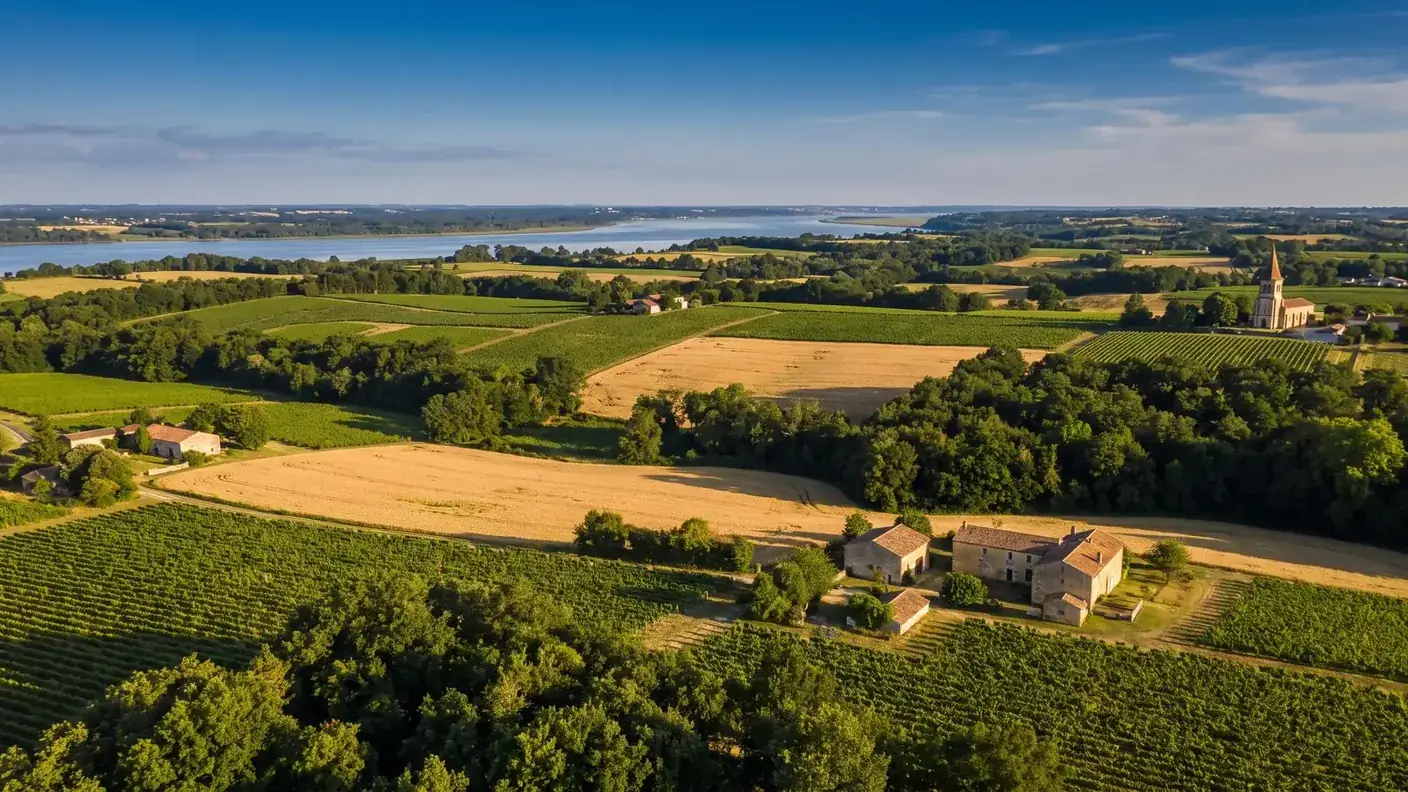
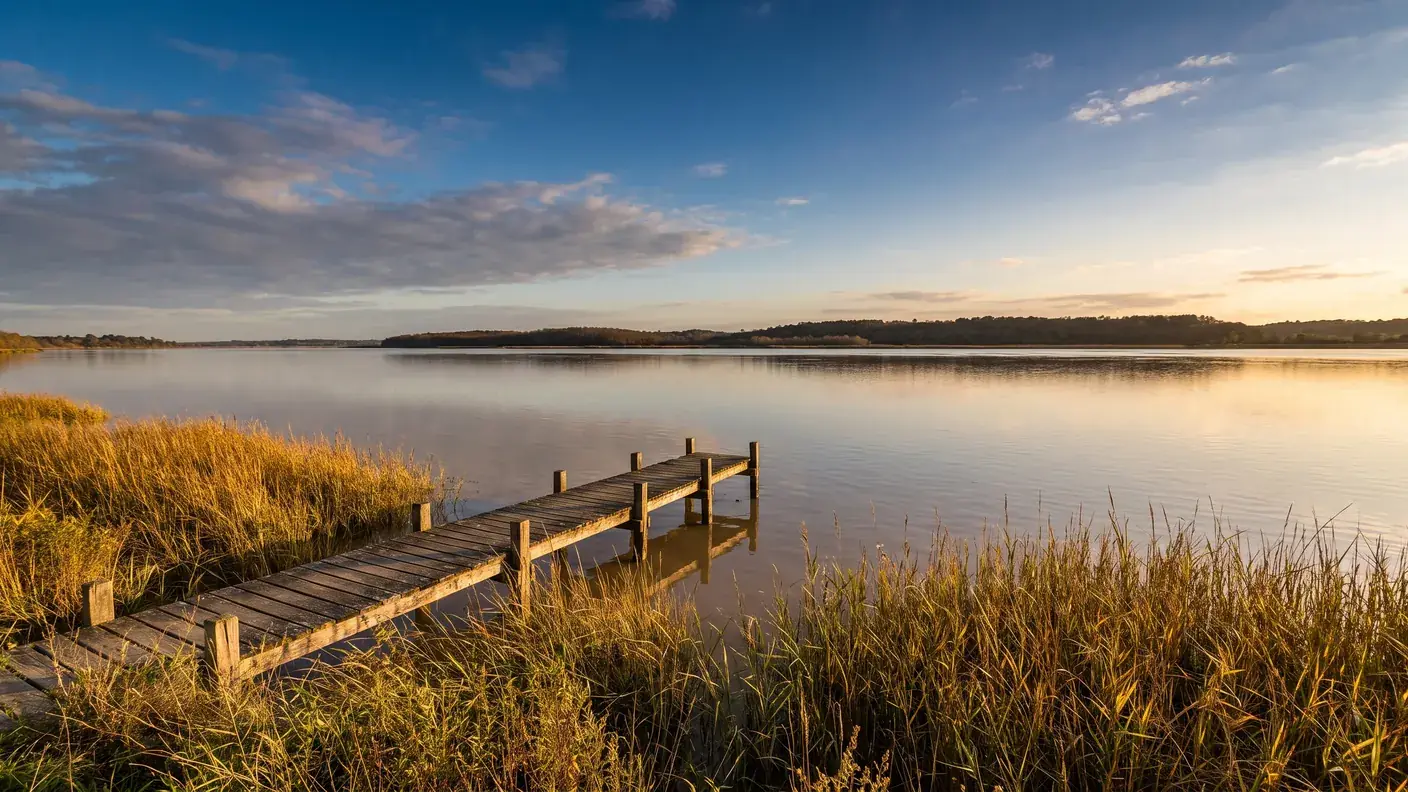
Sainte-Ramée offers the tranquil charm of the Haute-Saintonge countryside: vast horizons of vineyards and fields stretching beneath a boundless sky, just a few kilometers from the estuary. With no spectacular monuments or designated natural sites, the town’s appeal lies in its very simplicity: gentle hillsides, stone farmhouses, paths winding through the rows of vines, and that distinctive light of the Southwest—sometimes golden, sometimes silvery. It is a land of the great outdoors, where you take the time to walk, cycle between hamlets, and greet a winemaker. A setting of unspoiled countryside, a world away from the hustle and bustle, where beauty lies in the open spaces and the silence.
A mild climate and clay soil
Sainte-Ramée has an oceanic climate that is mild and sunny, with warm summers tempered by the influence of the Atlantic and the nearby estuary. Average temperatures hover around 12 to 13 °C, with annual precipitation of about 900 millimeters—an ideal climate for vineyards and crops. The subsoil consists of clay-limestone soils—the “groies” that make for excellent Cognac vineyards, but which also make the town vulnerable to drought and clay shrinkage. This geology explains both the area’s suitability for viticulture and its fragility: the same clay that nourishes the vines causes cracks in the houses during dry summers. This is the face of a living terroir, shaped by the climate and centuries of patient cultivation.
At the mouth of the estuary
Although Sainte-Ramée is not located on the banks of the Gironde River, it is fully part of its watershed: it falls within the scope of the “Gironde Estuary and Associated Environments” water management plan and is located within the 20-kilometer zone surrounding the Blayais nuclear power plant, situated on the opposite bank. The estuary, very close by, can be glimpsed on the horizon from the hills, and it has shaped the history and culture of the entire region—the salt trade, the “estuary” cognac vintages, and the former County of Cosnac. Sainte-Ramée is thus a village in between: neither quite coastal nor truly inland, it lies on the edge of the great river, in this unassuming hinterland where the vineyard-dotted Saintonge meets the marshlands of the Saintonge.
Fins Bois Cognac
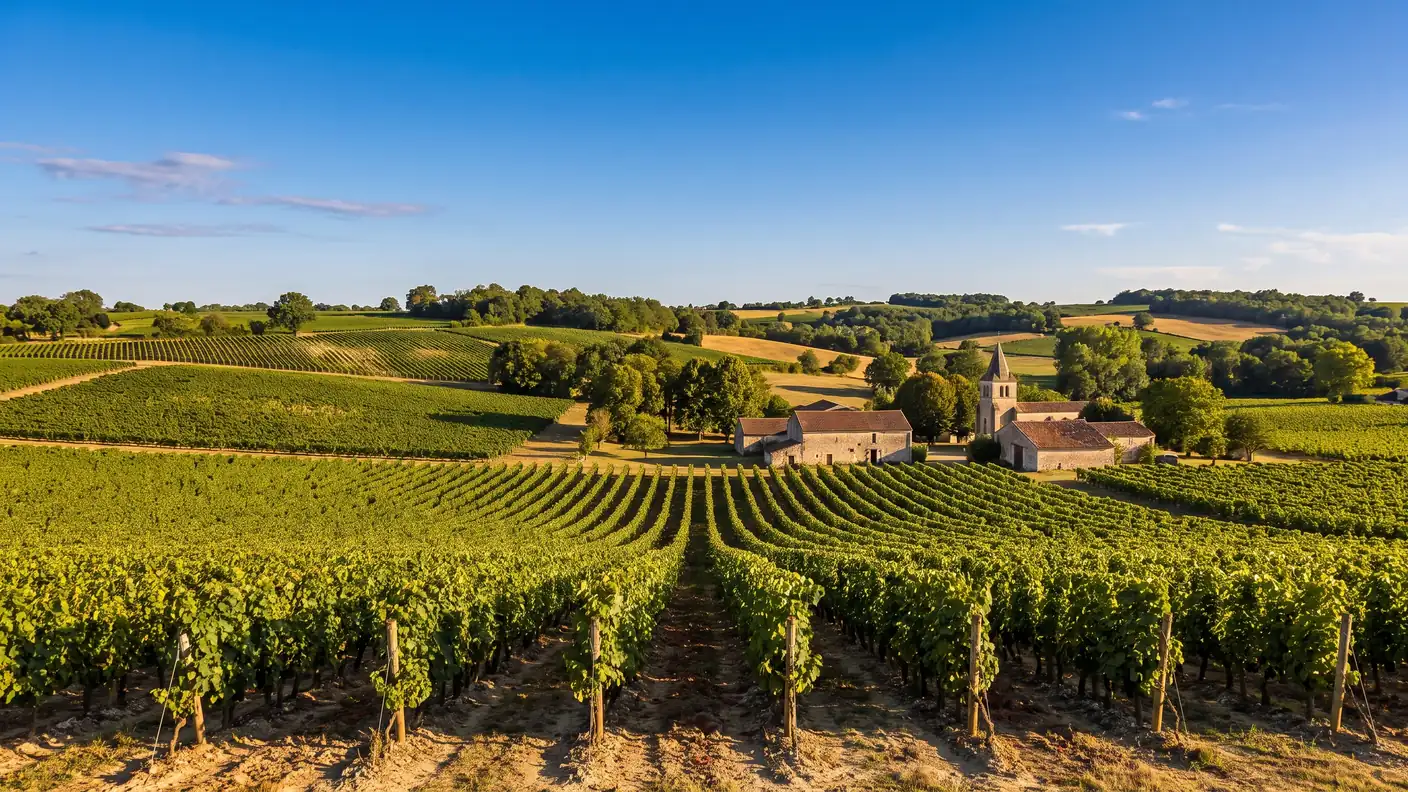
Like the rest of this part of Haute-Saintonge, Sainte-Ramée is located in Cognac country—specifically in the Fins Bois appellation, which must be named precisely. Contrary to a persistent misconception, the town is not in “Bons Bois”: according to the Cognac AOC specifications, Sainte-Ramée is entirely classified as Fins Bois. The notion that “near the estuary = Bons Bois” is incorrect: the demarcation of the crus is based on individual parcels and soil type, not simply on a gradient of distance. The entire region of the former Pays de Conac—Saint-Thomas-de-Conac, Saint-Sorlin-de-Conac, and Sainte-Ramée—is classified as “Fins Bois,” characterized by its clay-limestone “groies” soils.
Les Fins Bois, the largest of the crus
Les Fins Bois is the largest of the six geographical regions of Cognac. Sainte-Ramée is located within this appellation. Here, we refer to “ Estuarine Wood Types ", on these plateaus and hillsides overlooking the estuary: their stony, well-drained groies soils produce supple, round brandies with a bouquet reminiscent of pressed grapes, which age fairly quickly. At Sainte-Ramée, the vineyards share the land with grain crops, and the estate also produces Pineau des Charentes — this liqueur, created by blending grape must and cognac brandy, whose appellation area corresponds exactly to that of cognac. A subtle and authentic terroir, best discovered among the region’s small producers, far from the major houses.
Cognac and Pineau at the estate
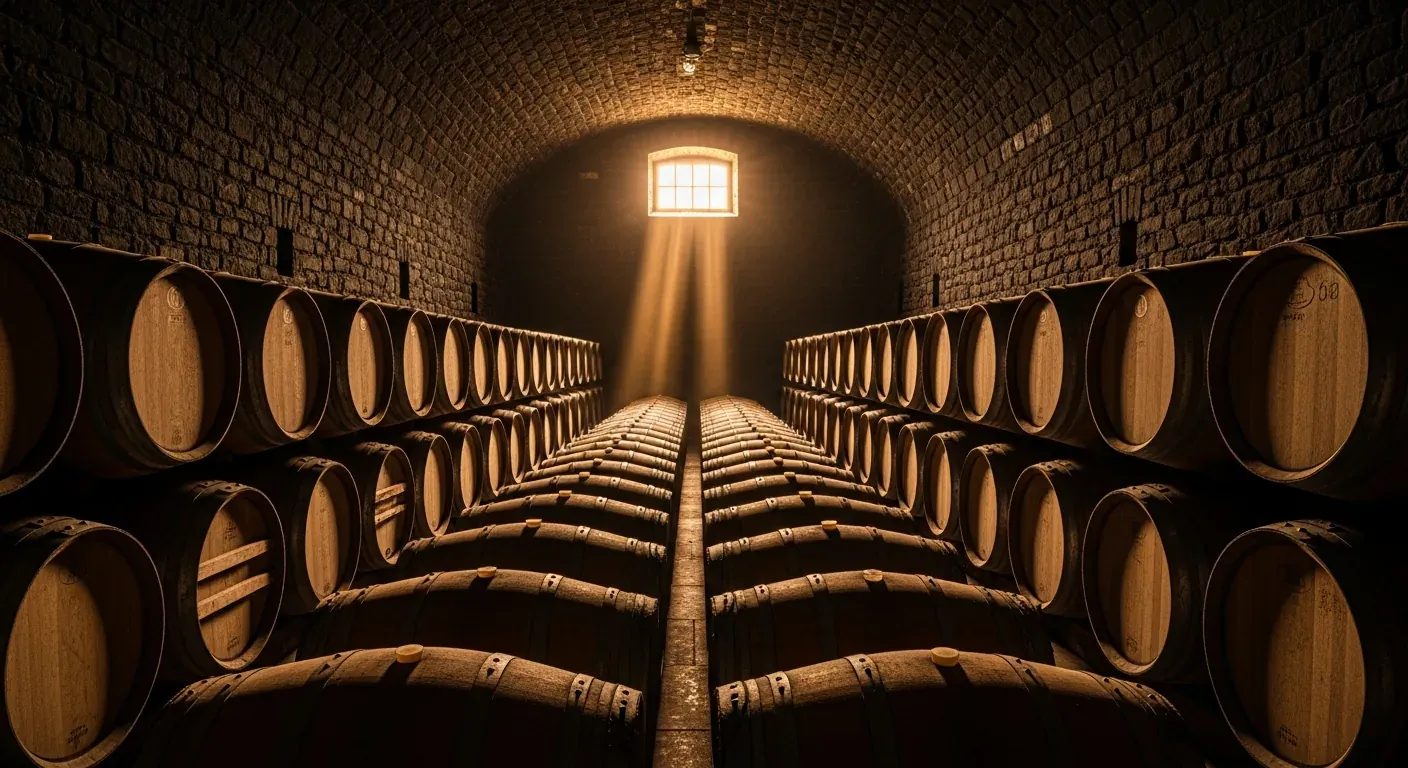
For visitors, this is a wonderful opportunity to venture off the beaten path of Cognac tourism. Far from the high-profile houses of Cognac or Jarnac, the region’s small producers—in Sainte-Ramée as well as in the neighboring villages of the former Pays de Conac—are happy to open their cellars and offer tastings at reasonable prices in a warm, family-friendly atmosphere: cognac of various ages, white or rosé Pineau des Charentes, and grape juice. It’s also a chance to gain insight into the work of the winemaker-distiller, from the grape harvest to the Charente still, including the long aging process in oak barrels. Combining a tour of the village’s heritage with a stop at a producer’s is undoubtedly the best way to capture the spirit of this corner of Saintonge, where vineyards and brandy have shaped the landscape and way of life for centuries.
| The Six Cognac Grape Varieties | Location |
|---|---|
| Grande Champagne | heart of the region, chalky soils — the most prestigious |
| Petite Champagne | around Barbezieux, Archiac, and Jonzac |
| Borderies | the smallest wine-growing region, north of Cognac |
| Fins Bois (Sainte-Ramée) | Wide ring — 1er cru in terms of area |
| Bons Bois | outer belt — second-largest in area |
| Wines from Specific Regions | coastal zone and islands |
What's there to see around Sainte-Ramée?
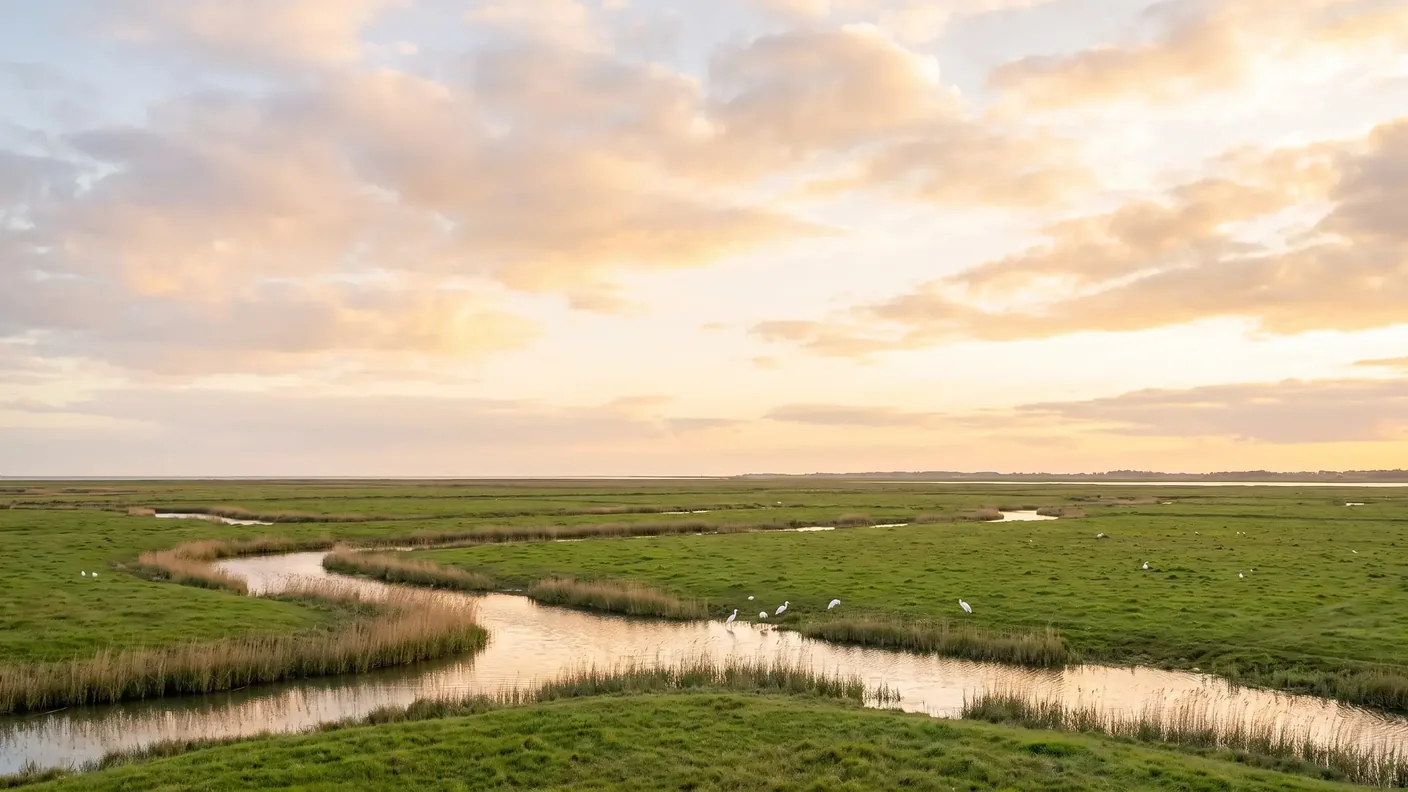
Sainte-Ramée’s small size is an asset: it invites you to explore a rich estuary region, where every neighboring village holds its own surprises. Just a few minutes away, Saint-Thomas-de-Conac—the former heart of the County of Cosnac—boasts a Romanesque church with a thousand-year-old apse, a mill, and vast estuarine marshes designated as a Natura 2000 site. A little further on, Saint-Fort-sur-Gironde and its Port-Maubert harbor tell the fascinating story of Gironde caviar. It’s a whole string of small wine-growing and estuarine villages, united by a shared history, that you discover one after another along small country roads.
Jonzac, Mirambeau, and the estuary
For services and major attractions, several towns are within easy reach. Mirambeau, about 13 km away, features a castle and a lively town center along the road to the estuary. Jonzac, the subprefecture, about 20 kilometers away, charms visitors with its thermal baths, castle, and historic district. Toward the estuary, Blaye and its UNESCO-listed Vauban citadel guard the mouth of the river, while Royan, further north, boasts its beaches and 1950s-era architecture. Across the estuary lies the prestigious Médoc wine region. With a private chauffeur, you can easily create a customized loop tour, combining villages, vineyards, and waterfront scenery, whatever your heart desires.
| About Sainte-Ramée | Distance | Interest |
|---|---|---|
| Saint-Thomas-de-Conac | ~8 km | Romanesque church, marshes, former county |
| Mirambeau | ~13 km | Château, on the Bordeaux–Saintes line |
| Jonzac | ~25 km | Subprefecture, thermal baths |
| Blaye | ~35 km | Vauban Citadel (UNESCO), vineyard |
| Royan | ~41 km | Seaside resort, beaches |
A Day in the Saintonge Region Around the Estuary
The best way to discover Sainte-Ramée is to include it in a day-long exploration of this corner of Haute-Saintonge, starting from Bordeaux. This way, you can visit one site after another without ever straying more than about twenty kilometers: the historic cross and the mill at Sainte-Ramée, the Romanesque church and the marshes of Saint-Thomas-de-Conac, the port of Port-Maubert and its caviar history in Saint-Fort-sur-Gironde, a tasting of Fins Bois cognac at a producer’s, and why not the thermal baths of Jonzac or the citadel of Blaye. All of this along small country roads lined with vineyards, with the vast estuary always on the horizon. This is a route that isn’t possible by train, and one that truly comes into its own with a driver: the freedom to set your own schedule, stops whenever the mood strikes, and the pleasure of discovering a secret, gourmet Southwest, far from the crowds.
When is the best time to visit Sainte-Ramée?
Sainte-Ramée is best visited during the warmer months, when the light and mild weather make its agricultural landscapes even more beautiful. Spring and summer are the best times to visit: the vineyards are turning green, the fields of wheat and sunflowers add a golden glow to the hillsides, and the long days invite you to take a leisurely stroll through the hamlets, whether by bike or on foot. It’s also the perfect season to visit the church and its cross, explore the Chez Guillet mill, and venture out toward the estuary and neighboring villages. In summer, the low-angled light of late afternoons offers, from the hills, beautiful views of the shimmering estuary, with the Médoc as a backdrop.
Fall, harvest season, brings color to the vineyards and bustles through the region’s cellars—a chance to learn about cognac production and taste the new Pineau. The winter, quieter and windier, has the melancholic charm of the sleepy countryside: it’s the season of vast, open skies, early sunsets, and cozy gatherings by the fire. A tiny village with no tourist crowds, Sainte-Ramée is perfect in any season for a peaceful exploration off the beaten path, for those seeking the authenticity of a rural and unassuming Southwest. It’s best to simply check the church’s opening hours or arrange a visit by contacting the town hall, as is often the case with these small rural parishes.
How to get to Sainte-Ramée from Bordeaux
Sainte-Ramée is located about 81 km from Bordeaux, which is an hour’s drive via the A10 highway (Exit 37, “Mirambeau”), followed by the small roads of Haute-Saintonge. The geographically closest train station is Mirambeau (~13 km), but it does not have regular passenger service. If traveling by train, the nearest station to use is Jonzac (~25 km); from there, you’ll need to arrange the final leg of the trip by car.
Train or chauffeur service?
Getting to a village of 113 residents like Sainte-Ramée by public transportation is a real challenge: even if you get off at Mirambeau, there are still about ten kilometers to go without regular service—which is impractical with luggage, or if you want to explore the estuary. As soon as you’re traveling with others, or want to visit several destinations in a row (Saint-Thomas, Saint-Fort, and Port-Maubert, a vineyard), an executive car service (private chauffeur service) is essential: a direct trip from Bordeaux, door-to-door, with no transfers, and flexible stops along the way. We offer this route at a fixed price quoted in advance: approximately €164 for the one-way trip, in a Mercedes sedan or van seating up to 8 passengers, with a professional chauffeur.
This is the perfect option for a getaway to the hidden gems of Saintonge, a cognac or Pineau tasting, a family visit, or a transfer to Bordeaux-Mérignac Airport. The price, set in advance, remains fixed regardless of traffic or stops—a real advantage for staying within budget, plus the convenience of a direct trip to this corner of the estuary. You can travel alone, with your family, or in a small group of up to 8 people, with luggage, and request stops in Saint-Thomas, Mirambeau, or at a winery along the way.
In practice, booking is simple: you provide the pickup address in Bordeaux and the destination in Sainte-Ramée, along with the date, time, and number of passengers, and you receive a fixed-price quote in writing. On the day of the trip, the driver picks up the passengers at the agreed-upon address and takes them directly to the village, without any detours. This is the most comfortable and reliable way to explore this small village in Haute-Saintonge and its estuary region from Bordeaux, without worrying about driving or parking—and to take the time to admire the vineyard landscapes along the way.
| Route | Distance | Duration | Landmark |
|---|---|---|---|
| Bordeaux → Sainte-Ramée | ~81 km | about 1 hour | Starting at ~€144 for a private chauffeur service |
| Sainte-Ramée → Saint-Thomas-de-Conac | ~8 km | ~12 min | Romanesque church, marsh |
| Sainte-Ramée → Jonzac (train station) | ~25 km | ~28 min | subprefecture, TER + Intercités |
| Sainte-Ramée → Jonzac | ~25 km | ~25 min | subprefecture, thermal baths |
Whether you come for the listed processional cross, the Chez Guillet mill, the mystery of its “false saint,” the Fins Bois cognac, or simply to enjoy the tranquility of a timeless farming village, Sainte-Ramée is a treat for lovers of the authentic and off-the-beaten-path Southwest, nestled among vineyards and vast skies.
Whether it’s for a day trip to explore the Saintonge region, a gourmet tour, or an event, booking a chauffeured transfer guarantees a comfortable and punctual ride—book a driver from Bordeaux → Sainte-Ramée or explore all our destinations.
Frequently Asked Questions
Where is Sainte-Ramée located?
Sainte-Ramée is a tiny village in Charente-Maritime (17), in Nouvelle-Aquitaine, in the Haute-Saintonge region, a few kilometers northeast of the Gironde estuary. Part of the Jonzac district and the Pons canton, it has a population of about 113, making it one of the smallest municipalities in the department. Contrary to popular belief, it is not located on the banks of the estuary, but in its hinterland. It is about an hour’s drive from Bordeaux (~81 km).
What is the distance between Bordeaux and Sainte-Ramée?
About 81 km by road, or a one-hour drive via the A10 highway (Exit 37, “Mirambeau”), then along the small roads of Haute-Saintonge. By private chauffeur from Bordeaux, the fare is fixed and provided in advance, starting at approximately €164 one way (sedan or van, door-to-door price). The geographically closest train station is Mirambeau (~13 km), but it does not have regular passenger service. For a train trip, the station to specify is Jonzac (~25 km); from there, you’ll need to arrange the final leg of the journey by road.
Why is Sainte-Ramée a “false saint”?
Because “Saint Ramée” never existed: the village actually honors Saint Rémy, the bishop of Reims who baptized Clovis. The accepted explanation (a scholarly hypothesis) is that the name derives from Saint Rémy (Remigius), which was adapted into the Saintonge dialect as “Ramé” or “Ramai,” and then mistakenly feminized to “Ramée.” The church, its dedication, and its patron saint remain masculine (Saint-Rémy). The demonym for the inhabitants, the Ramillons, also retains a trace of the true saint.
What is the Sainte-Ramée processional cross?
It is the village’s treasure: a 16th-century processional cross, classified as a historic monument under the “object” category (decree of October 23, 1991, reference Palissy PM17000721)—and not “listed,” as “classified” denotes the highest level of protection. Standing 65 cm tall, made of repoussé copper gilded over a wooden core, it depicts Christ surrounded by the Tetramorph (the symbols of the four Evangelists). Housed in the sacristy of Saint-Rémy Church, it is considered one of the finest examples of 16th-century craftsmanship.
Is the church in Sainte-Ramée a listed building?
No: Saint-Rémy Church, as a building, is not protected as a historic monument. It is an object housed within it (the processional cross, which is classified) and another building in the town (the Chez Guillet mill, which is listed) that are protected. The church is Romanesque, dating from the 12th century, but its beautiful façade—once among the most remarkable in Saintonge—was demolished in 1954. All that remains are some carved modillions, two historiated capitals, and some canonical dials.
What is the Chez Guillet Mill?
It is the only protected structure in Sainte-Ramée: a windmill listed as a historic monument (decree of November 13, 1989, Mérimée reference PA00105309), built in 1803 and in operation until 1919. It is a rare and complete mill complex: although its sails are gone, its mechanism, oven, bakery, and miller’s house remain in place. It is now maintained by a volunteer association, the “Friends of the Chez Guillet Mill.”
In which cognac vintage is Sainte-Ramée found?
Les Fins Bois is the largest of the six geographical regions of Cognac. Sainte-Ramée is located within this appellation.
What's there to see at Sainte-Ramée?
Despite its size, the village is home to some true treasures: the 16th-century processional cross, a listed historic monument, in the Church of Saint-Rémy; the Romanesque church itself, with its historiated capitals, surviving modillions, and canonical dials; the Chez Guillet mill, a listed, restored mill complex; and the beautiful agricultural landscapes of Haute-Saintonge. Nearby are Saint-Thomas-de-Conac, Saint-Fort-sur-Gironde, and Port-Maubert, as well as Mirambeau, Jonzac, and the Gironde estuary.
Is Sainte-Ramée located on the banks of the Gironde estuary?
No: contrary to popular belief, Sainte-Ramée is not located on the estuary. It is an inland town, located in the hinterland of the estuary, with the nearest shoreline five or six kilometers to the west, near Saint-Thomas-de-Conac. However, it is part of the estuary basin (water management plan, 20-kilometer perimeter of the Blayais power plant) and is located in Charente-Maritime, not in Gironde.
How many residents are there in Sainte-Ramée?
According to the 2023 census, it had approximately 113 residents, making it one of the smallest municipalities in Charente-Maritime. Like many small rural municipalities, it has been experiencing a long-term decline (186 residents in 1968, 126 in 1999). These figures, given such a small population, are fragile. The residents are known as Ramillons and Ramillonnes. The area is entirely agricultural, with very scattered settlements nestled among vineyards and grain fields.
Is there a train station at Sainte-Ramée?
No, the town does not have a train station. The geographically closest train station is Mirambeau (~13 km), but it does not have regular passenger service. For a train trip, the station to specify is Jonzac (~25 km); from there, you’ll need to arrange the final leg of the journey by road.
What's there to see around Sainte-Ramée?
Saint-Thomas-de-Conac, the former heart of the County of Cosnac, with its Romanesque church and estuarine marshes (~8 km); Saint-Fort-sur-Gironde and its Port-Maubert harbor, a former hub of the caviar industry; Mirambeau and its castle (~13 km); Jonzac, a spa town and subprefecture (~25 km); Blaye and its Vauban citadel, a UNESCO World Heritage Site (~35 km); Royan and its beaches (~41 km). Across the estuary lie the vineyards of the Médoc.
Can I book a chauffeur service from Bordeaux through Sainte-Ramée?
Yes. We offer the Bordeaux → Sainte-Ramée route (~81 km, about one hour via the A10, Mirambeau exit) at a fixed price, starting at approximately €164 one-way, in a Mercedes sedan or a van seating up to 8 passengers, with a professional chauffeur. The trip is direct, door-to-door, with the option to make stops as desired—ideal for exploring this part of Haute-Saintonge, Saint-Thomas, Saint-Fort, and the Cognac vineyards without the hassle of driving.
Further Reading
- The former heart of the county: see the Saint-Thomas-de-Conac Guide (the Romanesque church, the County of Cosnac, and the estuary marshes), about 8 km away
- The neighboring village and its caviar: see the Guide to Saint-Fort-sur-Gironde (Port-Maubert, Gironde caviar, and the listed Saint-Fortunat Church)
- The Land of Cognac: See the Cognac Guide (the major houses, the Charente method, and the six crus)
- Plan your journey: Book an executive car service from Bordeaux to Sainte-Ramée or explore all our destinations
Sources and References
- Wikipedia — Sainte-Ramée — geography, demographics, heritage, toponymy
- POP / Palissy Collection — Processional Cross — Listed artifact (October 23, 1991), 16th century, gilded copper
- POP/Mérimée Database — Moulin de Chez Guillet — Listed as a Historic Monument (November 13, 1989), mill built in 1803
- Wikipedia — Cognac vintages — Fins Bois vintage (INAO specifications), appellation area
- Wikipedia — Gironde Estuary — Europe's largest estuary, basin, associated ecosystems
Article updated in July 2026.
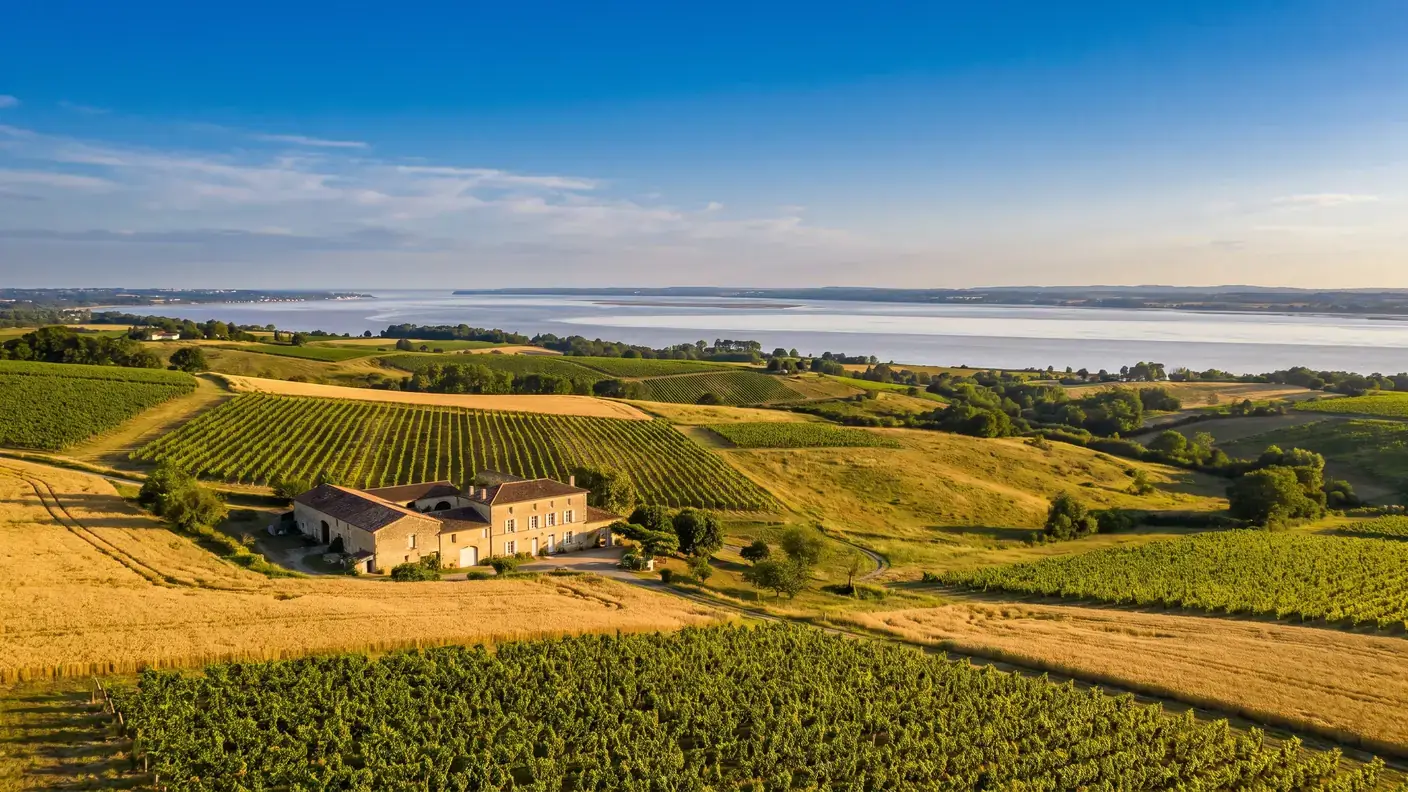
Off to Discover the Hidden Side of Saintonge
Direct trip from Bordeaux (~1 hour) to Sainte-Ramée and the estuary’s hinterland, with stops along the way as desired—Saint-Thomas, Saint-Fort, and Port-Maubert, a Cognac vineyard. Written fixed-price quote, with no unexpected meter charges.