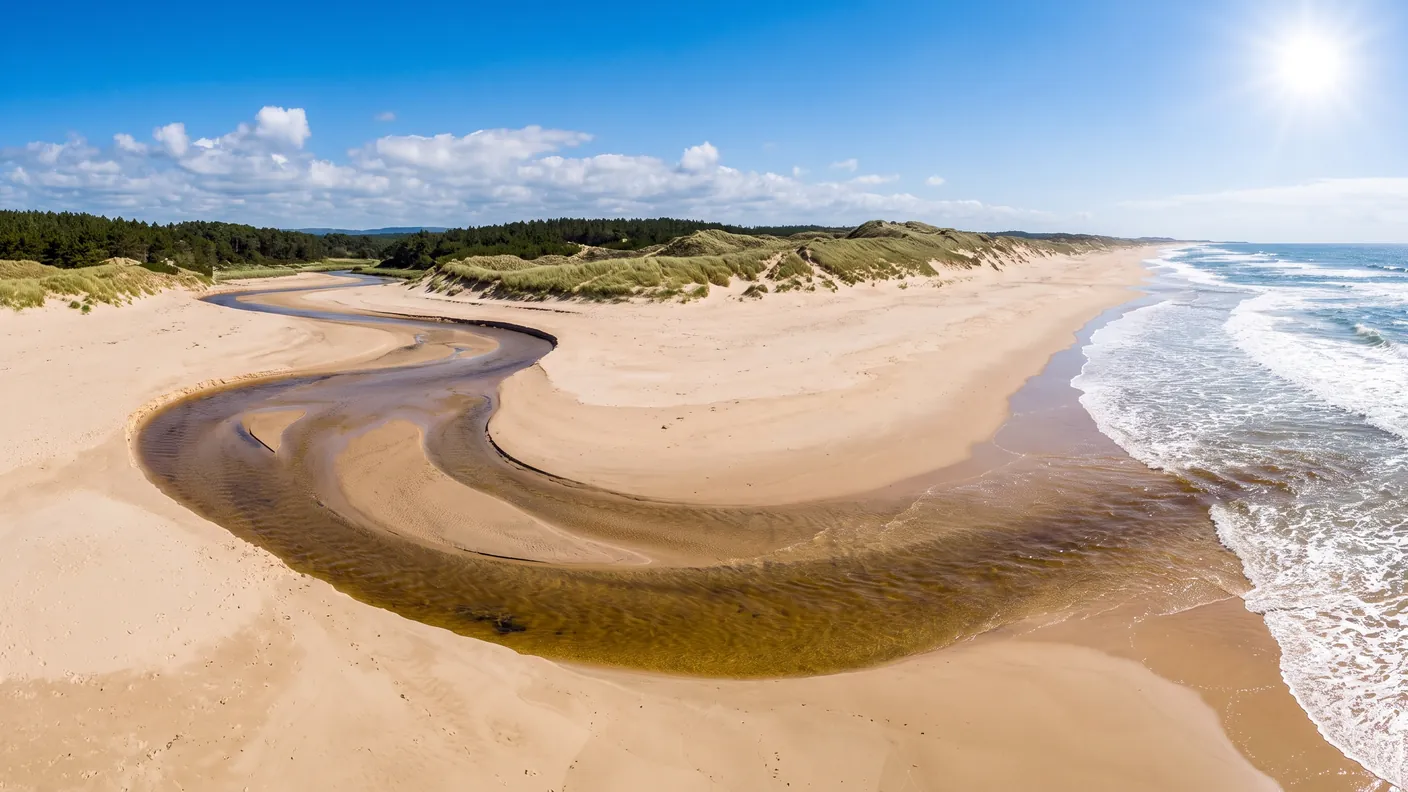
Moliets-Plage, the "Little Amazon" of the Landes
The only unstabilized estuary in the Bay of Biscay, a jungle-like river, and a legendary golf course: Moliets-Plage, on the southern coast of the Landes region, the Huchet current and its sandbars, Robert Trent Jones’s 27-hole course, and the vast ocean beaches—all less than two hours from Bordeaux.
Moliets-Plage at a Glance
Moliets-Plage is the seaside resort of Moliets-et-Maâ, a municipality with 1,299 residents in 2023 according to INSEE (source: INSEE). The Courant d’Huchet reaches the ocean here within a 618-hectare national nature reserve (official source). The resort also offers beaches, galupe boat trips, and a golf course. From Bordeaux, the journey covers 148 km and takes approximately 1 hour and 54 minutes; the listed chauffeur service fare starts at 256 € each way and is confirmed in writing before booking.
Moliets-Plage: Practical Guidelines
| Landmark | Details |
|---|---|
| Station | Moliets-Plage (Moliets-et-Maâ municipality, Landes) |
| Location | the southern coast of the Landes, between Léon and Vieux-Boucau |
| Residents | 1,299 residents (2023) |
| Must-See | the mouth of the Courant d’Huchet, the galupes, the golf course, the beaches |
| Distance from Bordeaux | about 148 km · about 1 hour 54 minutes by car (A63) |
Where is Moliets-Plage located?
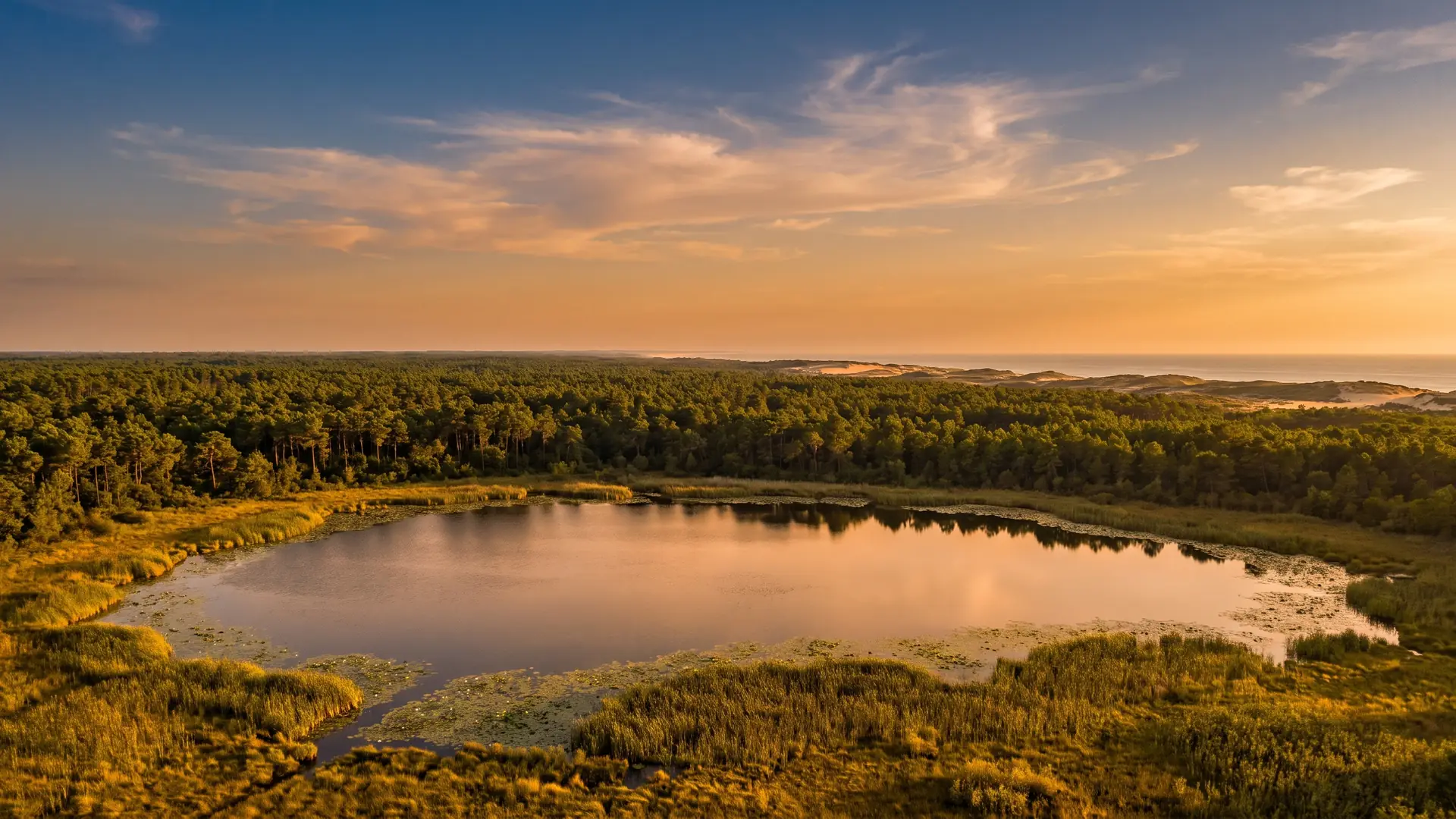
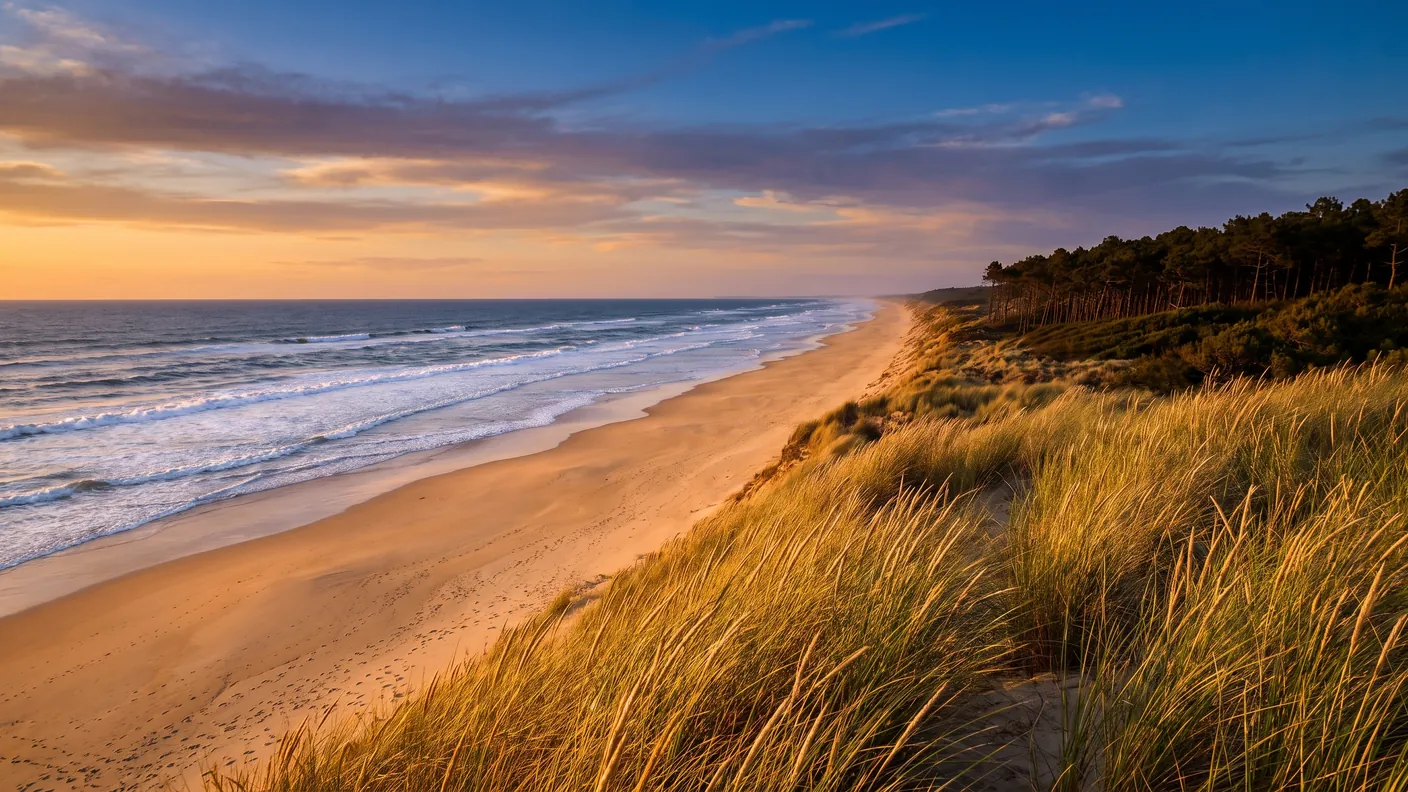
Moliets-Plage is located on the southern coast of the Landes region, between Léon (9 km) and Vieux-Boucau (10 km), about 40 kilometers north of Bayonne. It is the seaside resort of the municipality of Moliets-et-Maâ (population 1,299, according to linked demographic data; the residents are known as Molietsois), formed by the merger of two villages, Moliets and Maâ, between 1790 and 1794. The municipality is part of the Dax arrondissement, the Marensin-Sud canton, and the Maremne-Adour-Côte-Sud (MACS) community of municipalities. Its uniqueness is a rare privilege: the Huchet Channel—the outlet of the Léon Lagoon—flows directly onto its beach; its mouth is the only one in the Bay of Biscay that has not been stabilized—a free-flowing river that carves its path through the sand, never following the same course twice. Less than two hours from Bordeaux, Moliets boasts a vast ocean beach, a wild river designated as a nature reserve, and one of France’s most renowned golf courses.
Between Léon Pond and the ocean
The Moliets area offers a cross-section of the Landes coast. To the east, the hinterland of the ponds — led by the Léon River, whose Huchet branch carries its waters to the sea via 9 kilometers wooded meanders. In the center, the town Moliets and the traditional neighborhood of Maâ, with its airial and Romanesque chapel. To the west, the maritime pine forest and cork oaks, cut through by the golf course, then the dune and the vast sandy beach. This progression—lagoon, forest, dune, ocean—is the quintessential Landes landscape, and Moliets offers one of its best-preserved examples: the Courant d’Huchet Nature Reserve protects 618 hectares of wetlands, and the river mouth has never been dammed. In just a few minutes, you can go from a shaded golf course to a wild beach, from a marsh with a bird observatory to a village market.
Marensin, Côte d'Argent, MACS
Administratively, Moliets belongs to Marensin, the land of forests and ponds between the Born to the north and the Maremne to the south, on the Côte d’Argent. The resort is one of a string of destinations on the southern Landes coast—Lit-et-Mixe, Saint-Girons, Moliets, Messanges, Vieux-Boucau—connected by the Vélodyssée and the D652, which runs parallel to the ocean. Its population is growing quickly: the municipality recorded an increase of more than 11% between 2017 and 2023 (related demographic source), one of the sharpest rises on the southern coast. In summer, the resort’s population swells considerably; out of season, Moliets returns to its character as a forest village, while golfers continue to visit in winter because the course serves as a French Golf Federation training centre. A private transfer from Bordeaux makes particular sense here: the resort has no railway station, and the A63 followed by the D42 provides door-to-door access in less than two hours without a change.
The Huchet River, the "Little Amazon" of the Landes
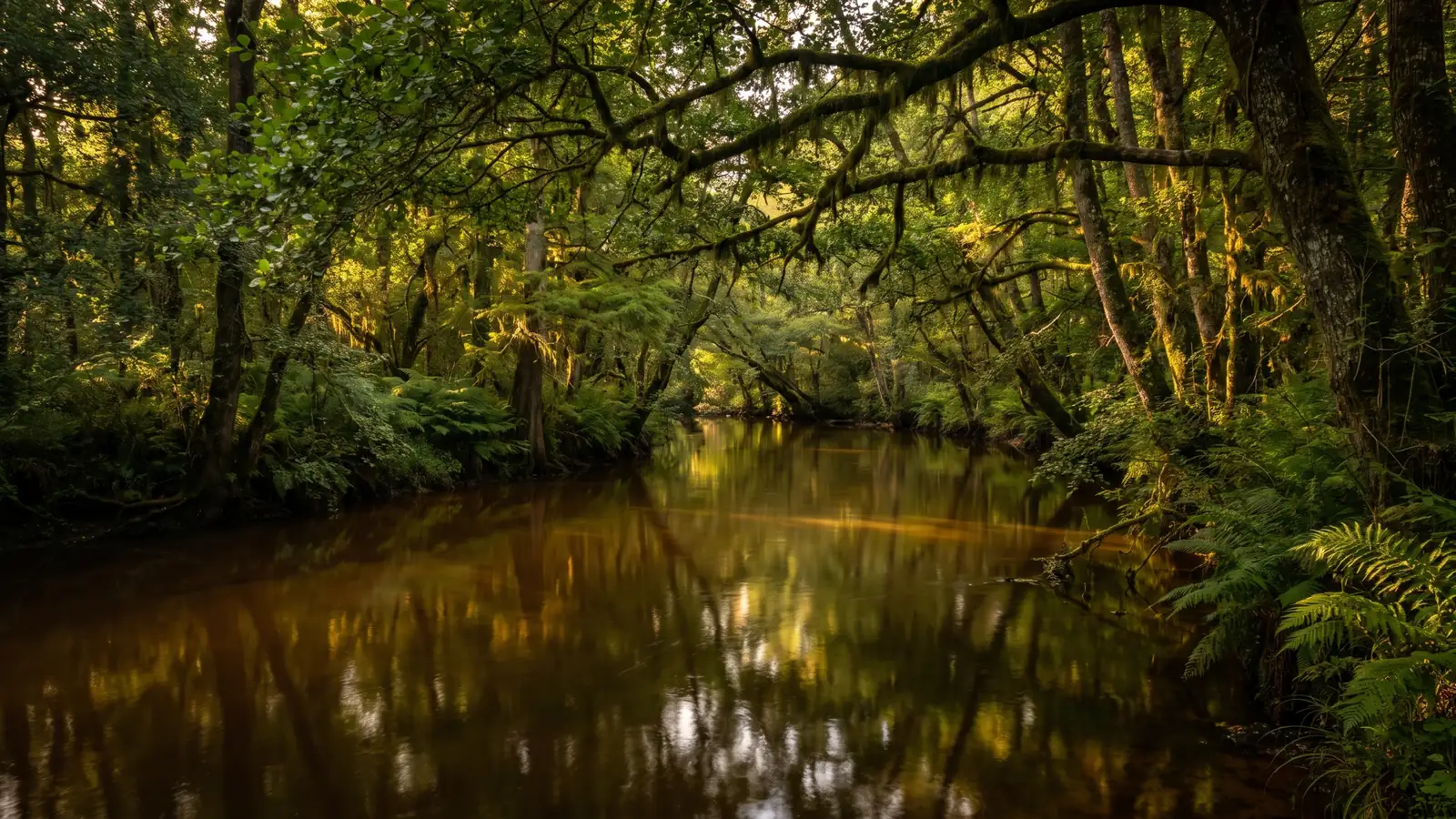
The Huchet River is a 9-kilometer-long coastal river that connects the Léon Lagoon to the ocean; it has been protected since 1981 by a 618-hectare national nature reserve—and its mouth, on Moliets Beach, is the only one in the Bay of Biscay that has not been stabilized. A free-flowing river in a tunnel of greenery: that’s what the sources say.
The only open mouth of the Bay of Biscay
Everywhere else along the coast, water outlets have been dammed, channelled, and contained. Not here. The Courant d’Huchet, the outlet of Léon Lake (with a 280 km² catchment), flows through Léon, Vielle-Saint-Girons, and Moliets-et-Maâ before reaching the Atlantic right on Moliets Beach. According to Wikipedia, its mouth is “the only one in the Bay of Biscay that has not been stabilised.” In practical terms, the river carves meanders into the sand that change with every tide, sometimes running due south, sometimes straight west, and forming warm lagoons where children splash. This free spectacle, different every day, is the resort’s hallmark. Upstream, the river becomes a jungle: Louisiana bald cypresses, royal ferns, vines, and mosses form a gallery forest that the boatmen themselves call the “Amazon of the Landes”—a tourist nickname established by common usage, which we present as such.
A 618-hectare nature reserve
Protection of the site has a long, robust history. The Courant was designated a scenic site on May 5, 1934—47 years before the reserve was created. The Courant d’Huchet National Nature Reserve was established on September 29, 1981: its original 656 hectares were revised to 617.94 hectares in 1985, spread across the three municipalities of Léon, Vielle-Saint-Girons, and Moliets-et-Maâ, including the western half of Léon Lake. The wildlife justifies this status: the European otter and extremely rare European mink frequent the riverbanks, the little bittern—Europe’s smallest heron—nests in the reed beds, the European pond turtle basks on tree trunks, and almost 200 bird species have been recorded. Private boating is prohibited: only professional boatmen are authorised to travel down the river, protecting the site from excessive boat traffic. These strict regulations allow visitors today to experience a virtually pristine river.
The "Galupe" Descent, a tradition that began in 1908
Traveling down the Huchet River in a galupe—a flat-bottomed boat propelled by a pole—is the quintessential Moliets experience: a riverboat tradition that began in 1908, which can only be booked by phone, with wait times of up to three weeks in the summer. Here is the verified history and instructions.
From Maurice Martin to D'Annunzio
The story begins in late November 1905, when the poet and journalist Maurice Martin—who coined the name “Côte d’Argent”—travelled downstream, guided by two fishermen from Léon. His account caused a sensation; inundated with requests, the fishermen founded their first boatmen’s association in 1908, beginning a tradition that has now lasted more than a century. The reserve’s official website also links the river to the Italian poet Gabriele D’Annunzio, then in exile near Arcachon, who made it a celebrated meeting place for people “of learning and good taste.” The exact date of his visit varies by source (1908 according to the reserve, 1911 according to Les Bateliers), so we conservatively place it in the early 1910s. The present organisation dates from 1982 (association) and then 1997 (GIE): the accurate wording is therefore “a boating tradition dating back to 1908”, not “uninterrupted trips since 1908.”
Today's hike: to La Perche from Pichelèbe
The galupes are traditional flat-bottomed boats propelled by a pole and limited to 6 passengers—the only boats allowed on the river. Note that information elsewhere is often outdated: boarding is no longer at Léon Lake but at Pichelèbe Bridge, on the D328 in the municipality of Moliets-et-Maâ. There are two options: the short trip (~8 km return, 1 hour 30 minutes to 2 hours, €20 per adult and €9 per child aged 6 or under) and the long trip (~12 km, 2 hours 30 minutes to 3 hours, €25/€12, afternoons in July and August only). The season runs from April 1st through the All Saints’ Day break, with two departures a day at 10 a.m. and 2:30 p.m.. Reservations are made by phone only, and the wait can reach three weeks in July and August: book this first, even before arranging your transfer.
| Walk | Journey | Duration | Rates (2026) |
|---|---|---|---|
| A Short Walk | An ~8-km loop starting from the Pichelèbe Bridge | 1 hour 30 minutes – 2 hours | €20 for adults · €9 for children (age 6 and under) |
| Long Walk | Loop ~12 km (afternoon, July–August) | 2 hours 30 minutes – 3 hours | €25 for adults · €12 for children |
| Season | April 1 → All Saints' Day break | Departures at 10 a.m. and 2:30 p.m. | Reservations by phone only |
The Moliets Golf Course, designed by Robert Trent Jones
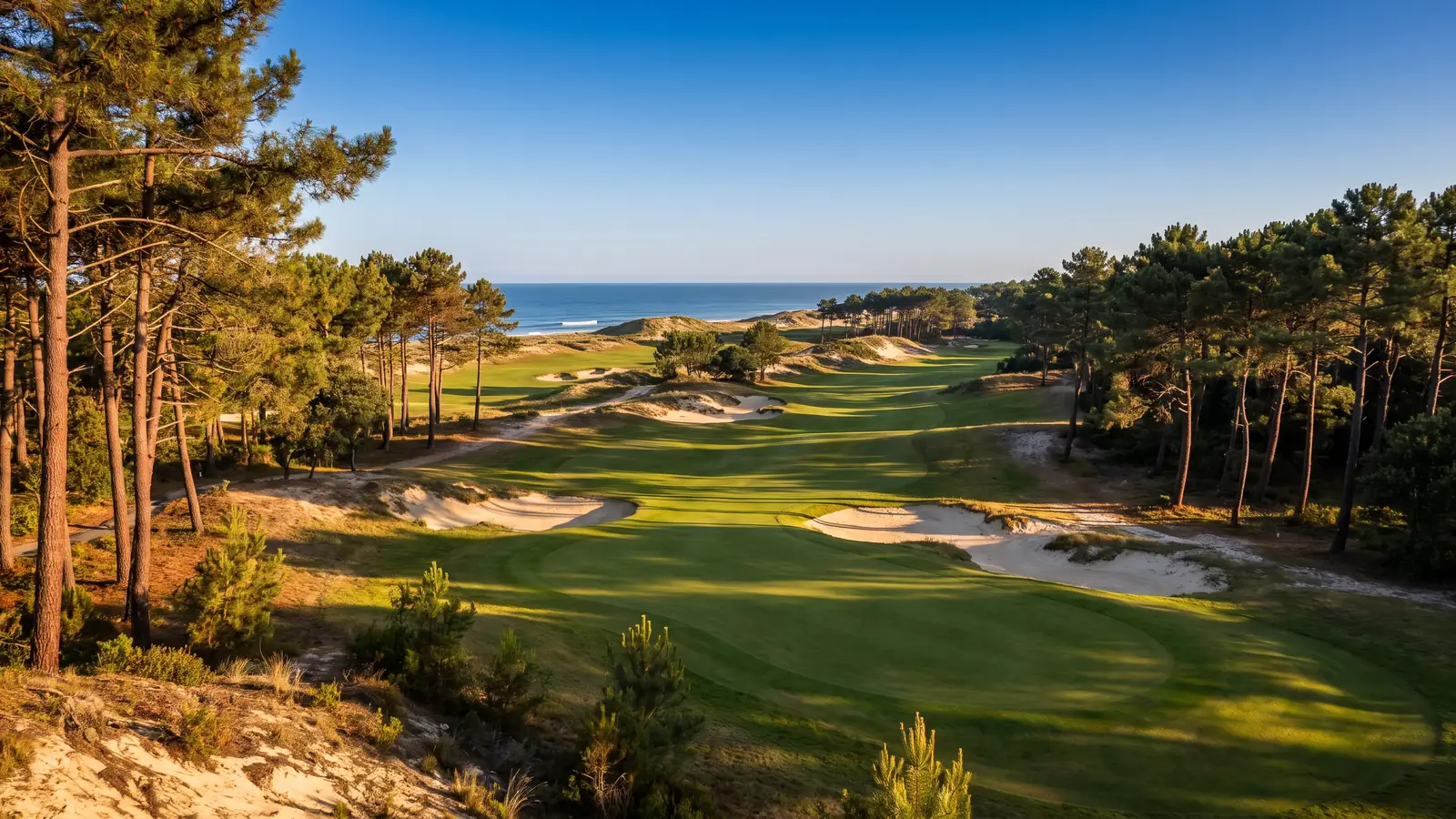
The Moliets Golf Course was designed by American architect Robert Trent Jones Sr., known as the “pope of golf course architects”: planned in 1986 and opened in 1989, it has 27 holes between the forest and the ocean and ranks 26th among courses in France. A landmark of European golf, just a few minutes from the beach. That is what the sources confirm.
A 27-hole course nestled between the forest and the ocean
The golf course features two courses: the 18-hole “La Forêt-L’Océan” (6,286 meters, par 72) and the 9-hole “Airial” (par 31). The course’s signature feature is its four links-style holes—holes 12 through 16, played in the dunes facing the Atlantic, amid beach grass and sea spray. This clarification is useful, as exaggerations abound: the official website does indeed mention four holes facing the ocean, not an “18-hole course running along the sea.” The rest of the course is played among maritime pines and cork oaks, on well-drained sandy soil that allows for year-round play—so much so that the French Golf Federation has made it one of its winter training centers, and the European Challenge Tour has held a stop there. The golf course, which will celebrate its 40th anniversary in 2026 (counting from the 1986 decision), has just inaugurated its new clubhouse.
The No. 16 par-3, a legendary hole
The course’s reputation comes down to one ranking and one hole. Moliets is ranked 26th in France (and 6th in the Southwest) by the specialist website top100golfcourses.com. Claims that it is “among the most beautiful in Europe,” however, are promotional: no quantified European ranking supports them, so we do not repeat them as fact. The par-3 16th, set in the dunes beside the beach, features in the reference book 500 World’s Greatest Golf Holes: swirling winds, a narrow green, and a hole “much harder than it looks.” Its designer, Robert Trent Jones Sr. (1906–2000), created more than 400 courses worldwide; websites that attribute Moliets to his son “Jr.” are mistaken, as both the town hall and the golf club make clear. The nearby tennis centre completes the sporting facilities with 14 courts, including 4 covered courts.
A station born out of MIACA
Moliets-Plage did not develop over time: it was built from the ground up starting in the late 1970s, when the Landes department acquired 250 hectares of forest to build a “resort of excellence”—complete with a golf course and tennis complex. This is a story of proactive development, typical of the Aquitaine coast. Here are the verified facts.
Moliets and Maâ, United During the Revolution
The municipality itself is much older than its resort. Moliets and Maâ, two neighbouring parishes in Marensin, merged into a single municipality between 1790 and 1794 during the Revolution’s major administrative reorganisation. Maâ did not disappear, however: the hamlet retains its identity, its airial—a clearing of short grass dotted with century-old oaks around a half-timbered Landes house—and its 12th-century Romanesque chapel, discussed below. The village of Moliets, 3 km from the ocean, has kept its forest character: a church, town hall, market square, and low-rise houses. This is where the municipality’s heart beats year-round, including at the Saturday market, while the seaside resort lives to the rhythm of the seasons. This clear duality between village and resort is a constant along the Landes coast, but Moliets achieves a rare balance: neither the village nor the beach has overwhelmed the other.
250 hectares for a world-class resort
The turning point came in the late 1970s. In the wake of MIACA—the Interministerial Mission for the Development of the Aquitaine Coast—the Landes Department acquired 250 hectares of forest between the village and the ocean to create a new resort. The ZAC development zone was launched in 1977, and the public-private company Satel became the concession holder in 1980. The project had a clear ambition: not a concrete marina, but a “resort of excellence” centred on sport. It produced the Robert Trent Jones golf course (1989), the tennis centre, and the low-rise Moliets-Plage seafront beneath the pines. The gamble paid off: the resort attracts families and active holidaymakers, the golf course has earned a reputation across Europe, and the municipality’s population is growing (+11% between 2017 and 2023; related demographic source). Like Vieux-Boucau and its marine lake, Moliets is a product of planned development on the Aquitaine coast—and one of its most successful examples.
The lesson in urban planning is still evident on the ground: no concrete-paved waterfront, low-rise residences blending into the pine forest, a pedestrian-only resort center, and the nature reserve serving as a buffer to the north—the exact opposite of the commuter towns that sprang up elsewhere along the French coast during the same era. It is this commitment, maintained for forty years, that explains how Moliets has been able to host a nationally renowned golf course without losing its forest character.
Notre-Dame, the Chapel of Maâ, and Santiago de Compostela
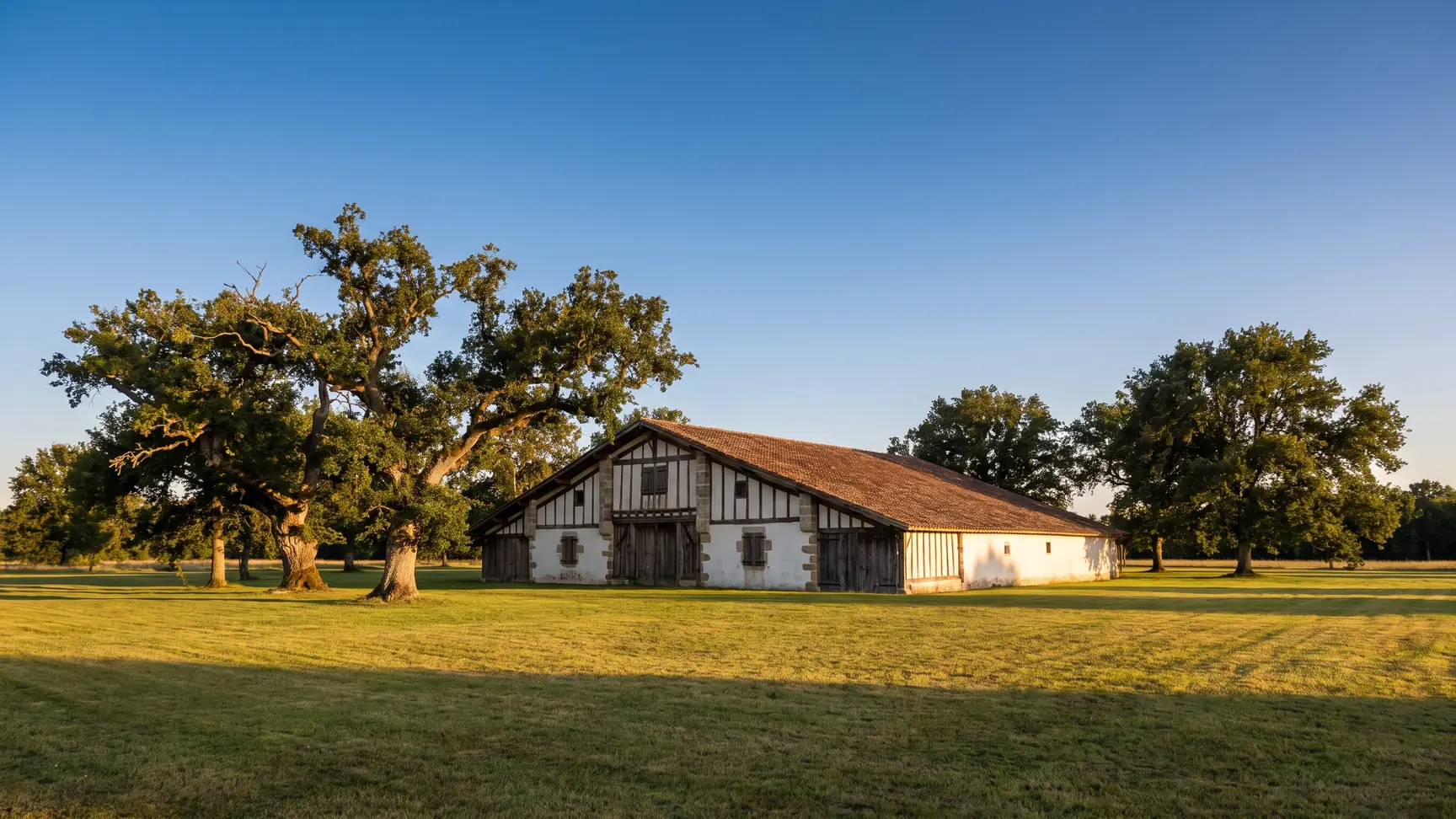
Moliets’ cultural heritage centres on two churches: Notre-Dame in the village, which houses a 12th-century stone altar, and the Saint-Laurent Chapel in Maâ, a small Romanesque building with a bell dating from 1515 and a landmark on the coastal route to Santiago de Compostela. Two modest, engaging buildings worth visiting between the beach and the forest.
Notre-Dame Church and its 12th-century altar
The village church—Notre-Dame, not “Saint-Laurent,” as is sometimes written through confusion with the chapel in Maâ—dates mainly from the 16th century. Its Gothic portal was restored in 1638, and its bell tower was raised in the 1860s. Its treasure is older still: a 12th-century stone altar from the Maâ Chapel was reassembled here, linking eight centuries of worship across the municipality’s two sanctuaries. The building is listed in the General Inventory (entry IA40001318) but is not protected as a Historic Monument; indeed, no building in the municipality is, a useful correction to guidebooks that mistakenly assign listed status. The church is open during its usual hours, and the Saturday market in the neighbouring square offers a natural opportunity to visit.
The Saint-Laurent Chapel in Maâ, bell from 1515
In Maâ, at the centre of its airial, the Chapel of Saints Fabian, Sebastian, and Lawrence—Saint-Laurent to local residents—is the municipality’s oldest building: a small 12th-century Romanesque church measuring 22 metres by 8, with a pierced bell gable and a bell dating from 1515. Restored in the 1990s, it retains an outdoor altar where summer services are still held beneath the oaks—a rare sight. The chapel marks the coastal route to Santiago de Compostela, known as the Soulac Route, which follows the coast south towards Spain; pilgrims still stop here. Tourist literature often claims “Templar origins,” but no independent historical source supports this, so we present it as a tradition. Guided tours are available through the tourist office in summer. Together with its surrounding airial, Maâ offers one of the most authentic scenes on the southern Landes coast.
Saint-Laurent, the golf course, and the 600 hectares: what we often read
Several claims are circulating about Moliets that deserve to be corrected, with supporting sources—which is the whole point of a reliable guide. The church, the golf course architect, the size of the nature reserve, and the Galupes pier: here’s what’s true and what’s false.
The church in the village is not Saint-Laurent
The first, very common misunderstanding: “the Church of Saint-Laurent in Moliets.” It is false — the village church is Notre-Dame ; the name Saint-Laurent belongs to the Maâ Chapel, 2 km away. Second clarification: the population. The “~1,100 residents” listed in the guidebooks is out of date—INSEE reports 1,299 residents related demographic source (2023 edition, effective in 2026), up more than 11% since 2017 related demographic source. Third: the nature reserve is not “600 hectares” but 617.94 hectares (established with an area of 656 ha in 1981, with the area revised in 1985), and it covers three municipalities — Léon, Vielle-Saint-Girons, and Moliets-et-Maâ —, not just Moliets. After all, the stream wasn’t protected until 1981: it was Designated a scenic site on May 5, 1934. These are all the subtle differences that distinguish what has been verified from what has been copied.
Trent Jones Sr., and no official "Top Europe" ranking
As for the golf course, there are two corrections. The architect is Robert Trent Jones senior —the town hall and the golf club are unequivocal—not his son “Jr.,” as several golf websites report. The phrase “ranked among the most beautiful golf courses in Europe” is also an overstatement: no verifiable, quantified European ranking supports it. The documented references are “26th in France, 6th in the Southwest” (top100golfcourses.com) and the 16th hole’s inclusion in 500 World’s Greatest Golf Holes. As for the galupes, boarding is no longer at Léon Lake—outdated but widespread information—but at Pichelèbe Bridge, in the municipality of Moliets. The trips are loops of 8 or 12 km, not a “full descent” from the lake to the ocean. Finally, “boat trips since 1908” is better phrased as “a boating tradition dating back to 1908”: the current organisation dates from 1982. These clarifications take nothing away from the charm; they simply make the account more accurate.
What is there to do in Moliets-Plage?
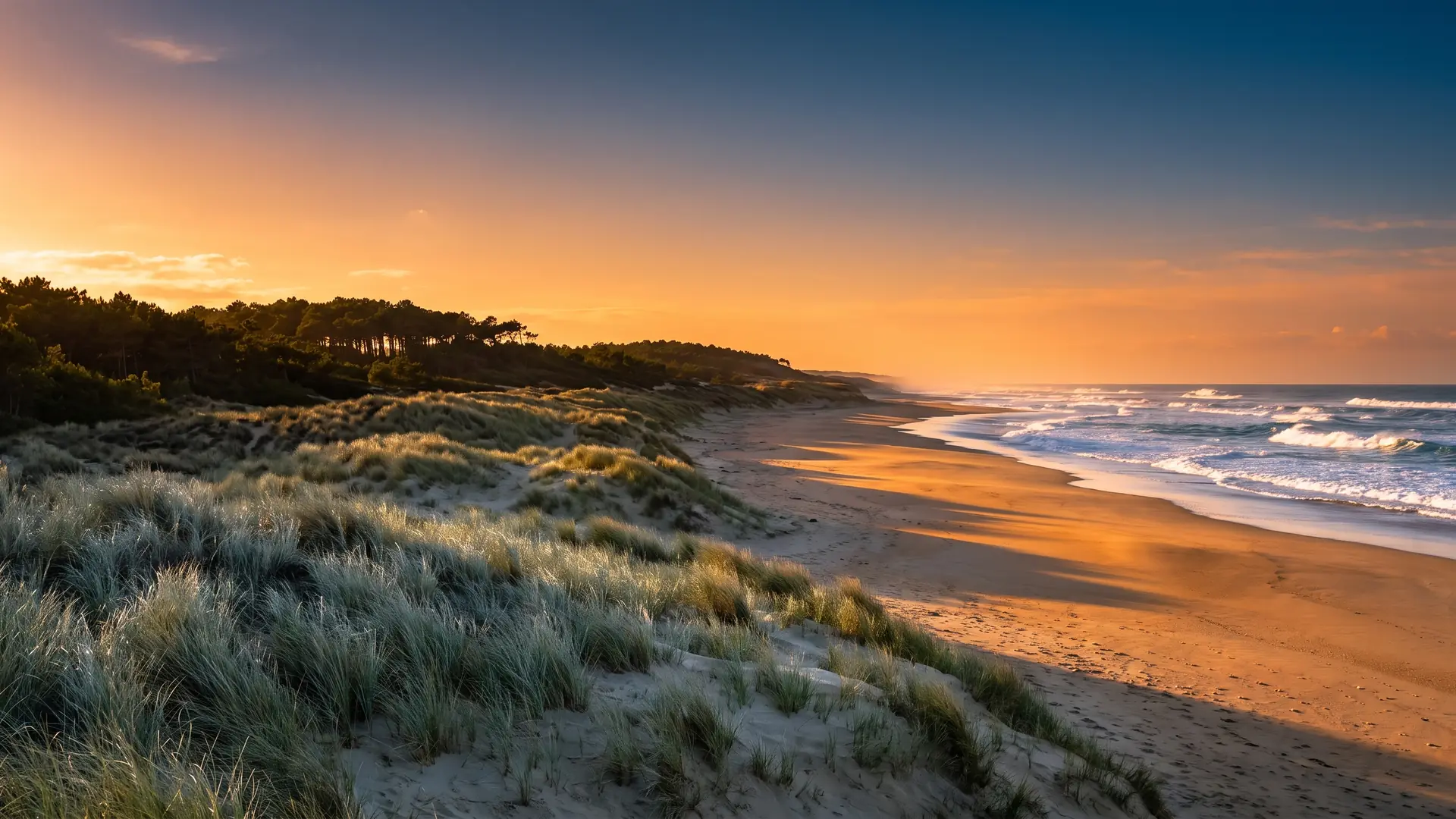
At Moliets-Plage, you can walk to the untamed mouth of the Huchet stream, take a boat ride down the river from the Pichelèbe Bridge, go for a swim at Centrale Beach or Les Chênes-Lièges, play the 27-hole Trent Jones course, go fishing at the Prade ponds, and visit the Saturday market. The resort combines protected nature and sports facilities like few others: a national nature reserve on one side, a nationally renowned golf course and 14 tennis courts on the other, connected by the Vélodyssée bike path under the pine trees. Here, in concrete terms, are the actual, verified activities—with their days, locations, and booking deadlines—which make all the difference once you’re there.
- The mouth of the Huchet River—the free, ever-changing spectacle of the only open river mouth in the Bay of Biscay, right on the beach
- The Galupe Rafting Trip — from the Pichelèbe Bridge (D328), April 1 → All Saints' Day, departures at 10:00 a.m. and 2:30 p.m., reservations by phone (about a 3-week wait in the summer)
- The Estuary Loop — Trail from the estuary to Pichelèbe via the Pipe Marsh and its bird observatory, ~9.5 km, 2–3 hours, no dogs allowed
- The beaches—La Centrale (lifeguarded from mid-May through late September) and Les Chênes-Lièges, accessible only on foot (~900 m along a forest trail)
- The Moliets Golf Course — 27-hole Robert Trent Jones course, 4 links holes overlooking the ocean, open year-round
- Surfing — 8 schools listed by the tourist office, including the Moliets Surf School on Place de la Balise
- The Prade and Moliets ponds — fishing (pike, zander, largemouth bass; permits available at the tourist office), a marked trail ~3 km long, and a fitness trail
- The market — Saturday mornings year-round at Town Hall Square; Tuesdays and Thursdays, and Friday evening markets in the summer
Beaches: La Centrale and Les Chênes-Lièges
Centrale Beach stretches for about 1.5 km of sand between the mouth of the river and Les Chênes-Lièges; it is patrolled from mid-May through late September—one of the longest patrol seasons along the coast. On days with rough seas, its sandbars serve as a playground for the eight surf schools listed by the tourist office, all of which are federally certified. Further south, Chênes-Lièges Beach can only be reached on foot: a ~900-meter trail through the cork oak forest leads to a pristine stretch of sand, which is lifeguarded only in July and August—the resort’s “secret” beach. As for the estuary area, its warm lagoons are a delight for families, but swimming there requires caution: the current lives up to its name. After the beach, the return trip is in the shade, along the resort’s forest paths.
Markets, Ponds, and the Notre-Dame Fountain
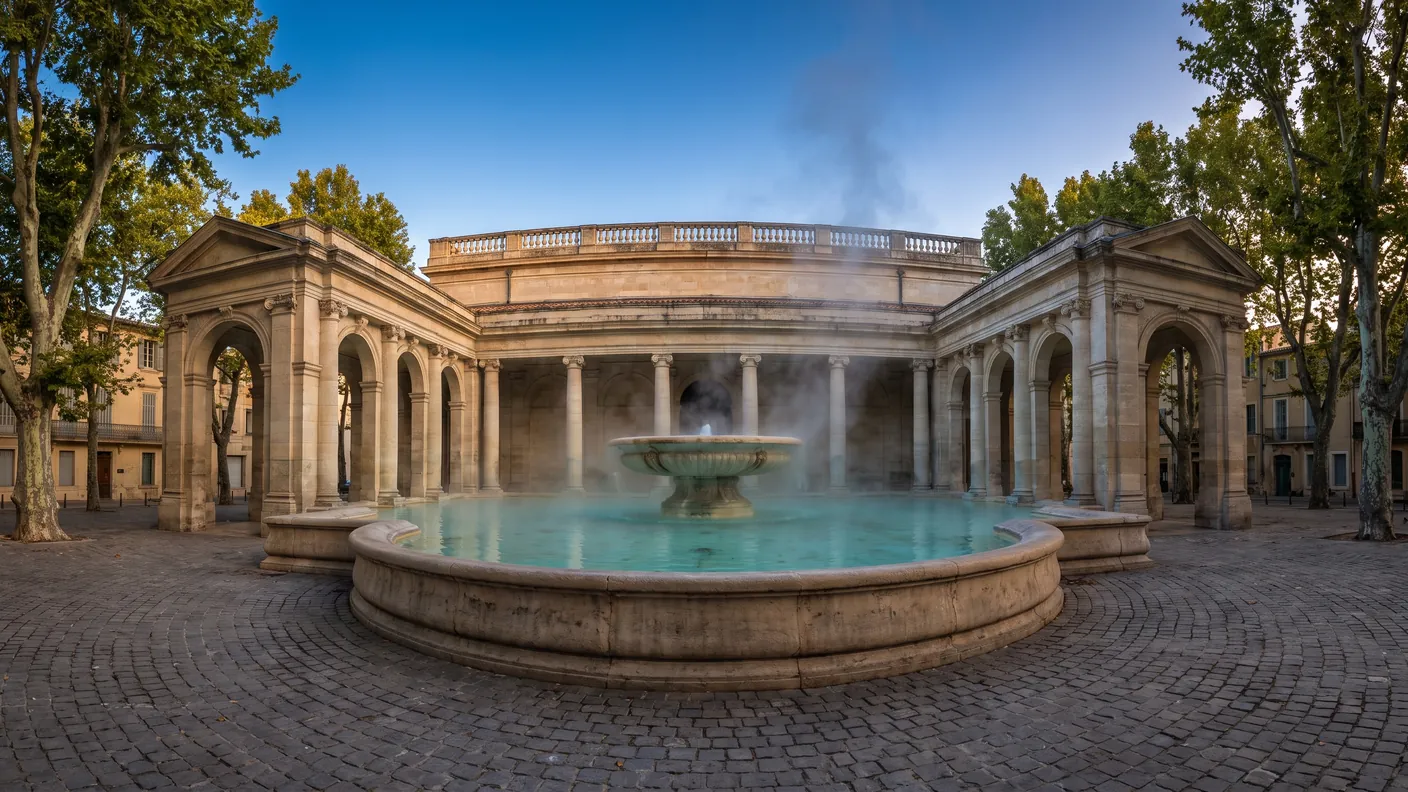
The Moliets market is held on Saturdays from 8 a.m. to 1 p.m. at the town hall square, year-round; during the summer (mid-June to mid-September), a seasonal market is also held on Tuesdays and Thursdays at Place de la Bastide, as well as a night market on Fridays starting at 6 p.m. (from July 3 to August 28, 2026) and an artisans’ market on Monday evenings at Place Rose. For a peaceful nature experience, the Prade and Moliets ponds offer fishing for pike, zander, perch, and largemouth bass (fishing permits available at the tourist office), a marked trail of about 3 km under the cork oak trees, and a fitness trail. Nearby, the Notre-Dame fountain and its washhouse preserve a long-standing tradition: its sulfurous, “malodorous” spring was believed to cure skin diseases—a popular belief, which we report as such. Enough to fill your days without ever getting back in the car.
| Activity | Where / When | Good to Know |
|---|---|---|
| Mouth of the river | Moliets Beach, free admission | The course changes with each tide |
| Galupe | Pichelèbe Bridge · April → All Saints' Day, 10 a.m. and 2:30 p.m. | Reservations by phone, ~3 weeks in the summer |
| Estuary Loop | ~9.5 km via the Pipe Marsh | 2–3 hours, family-friendly, no dogs allowed |
| Beaches | Centrale (mid-May → late Sept.) · Chênes-Lièges (on foot) | A 900-meter trail through the cork oak forest |
| 27-hole golf course | all year round | 26th-ranked course in France, links-style holes 12–16 |
| Market | Saturday, 8 a.m.–1 p.m., Town Hall Square | Late-night hours on Fridays during the summer (2026: July 3 → August 28) |
What to see nearby: Léon, Vieux-Boucau, Hossegor
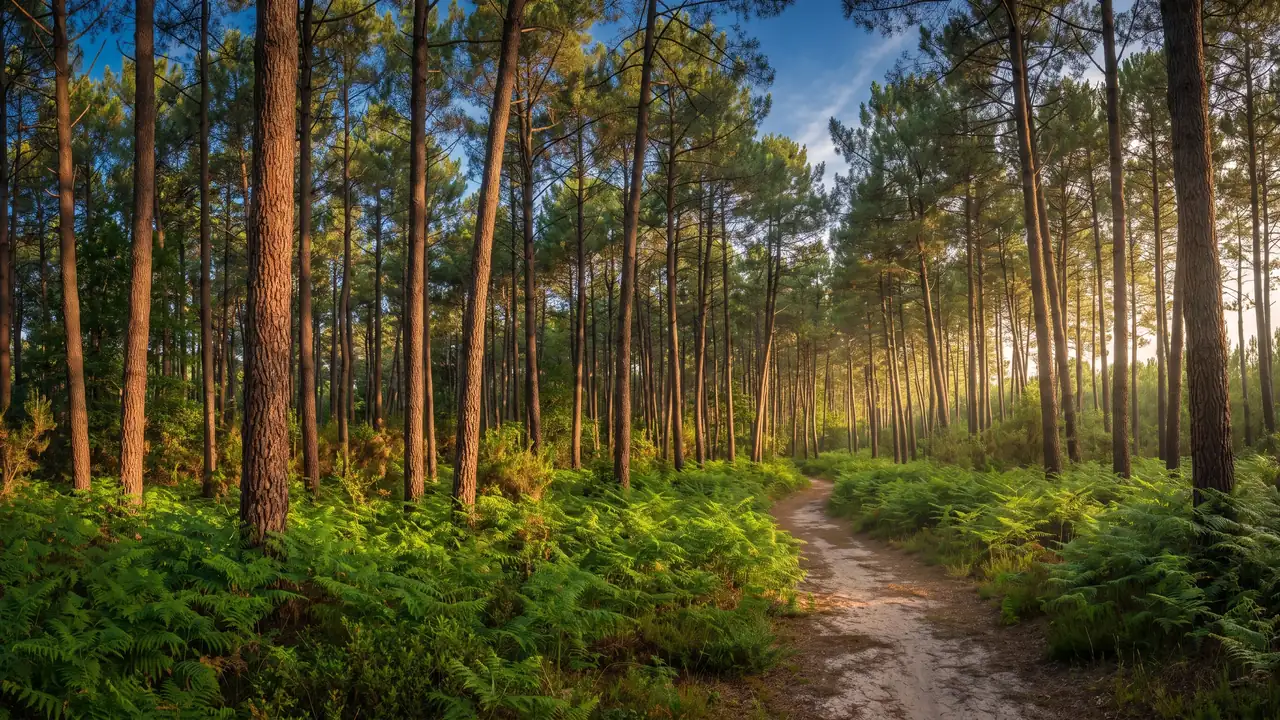
Moliets is a great base: Léon and its pond are 9 km away, Vieux-Boucau and its saltwater lake are 10 km away, Messanges lies between the two, Hossegor and Capbreton are half an hour away, and Dax and its thermal baths are 38 km away. The Vélodyssée bike path connects all these destinations through the pine forests. Here are the verified distances.
The Vélodyssée and Its Sister Routes
The area’s main cycling route is the Vélodyssée (EuroVelo 1), which passes through Moliets along a continuous greenway: the Léon → Moliets → Messanges → Vieux-Boucau section covers 13 to 15 km of easy riding, entirely through the forest—one of the most attractive family sections of the route. Léon (9 km) is known for its lake, leisure centre, and historic boatmen’s departure point; Vieux-Boucau (10 km) for the artificial marine lake at Port d’Albret and its summer activities; and Messanges, between the two, for its quiet beaches. Further south, Hossegor (about 30 minutes away) offers a marine lake, Basque-Landes villas, and La Gravière—see our guide to Hossegor—while Capbreton has its pier and harbour. Inland, Dax (38 km), France’s leading spa destination, adds the Fontaine Chaude and the arena—our guide to Dax covers it all. An executive car service lets you combine these stops without driving, aperitif included.
| Destination | Distance / time from Moliets | Must-See |
|---|---|---|
| Léon | ~9 km · 12 min | the pond, the recreation center, the boat operators |
| Vieux-Boucau | ~10 km · 13 min | the saltwater lake at Port d'Albret, the arena |
| Messanges | ~6 km · 8 min | quiet beaches, Vélodyssée |
| Hossegor | ~30 km · 32 min | Marin Lake, Basque-Landes Villas, La Gravière |
| Capbreton | ~32 km · 35 min | L'Estacade, the only port in the Landes region |
| Dax | ~38 km · 40 min | Hot Spring, Thermal Baths, Amphitheater |
When is the best time to visit Moliets?
The galupe season runs from April 1st through the All Saints’ Day break, Centrale Beach is patrolled from mid-May through late September, and summer brings night markets and Basque-Landes evenings: the heart of the Moliets season runs from April through October. Every season has its appeal, including winter golf. Here is the verified schedule.
| Season | What's in Store for You |
|---|---|
| Spring (April–June) | Opening of the Galupes (April 1); lifeguard-patrolled beach starting in mid-May; forest and stream in soft green hues |
| Summer (July–August) | markets on Tuesdays and Thursdays + Friday night markets, Basque-Landes evenings, 8 surf schools, galupes by reservation (~3 weeks) |
| Fall (Sept.–All Saints' Day) | Last waves of the season, the ocean still mild, the golf course quiet, golden light over the estuary |
| Winter | Golf course open year-round (FFGolf training center), deserted beaches, spectacular spring tides |
2026 Schedule: Check Before You Leave
Moliets-et-Maâ hosts night markets and Basque-Landes evenings during the summer. Dates, times, and seasons are subject to change: check the up-to-date calendar at city hall or the tourist office just before your visit. Do not plan your transportation based solely on this guide.
How much does the trip cost, and how do I get there?
A private transfer from Bordeaux to Moliets-Plage costs €337 in a sedan (1–3 passengers), a fixed price provided in advance, for approximately 148 km and a 1-hour, 54-minute drive via the A63. Without a car, there is no direct alternative: Moliets does not have a train station; the nearest one is in Dax (TGV), 38 km away. Here is an honest comparison of the options.
By car from Bordeaux
The route is straightforward: take the Bordeaux ring road, then the A63 south through the Landes Forest, leave at Castets, and follow the D42 towards the ocean via Léon—about 148 km, or 1 hour and 54 minutes outside the summer peaks. In summer, traffic through the resorts can add around fifteen minutes; on Saturdays in July and August, an early-morning arrival is preferable. With a private driver, the journey is door-to-door—from your home, Mérignac Airport, or Saint-Jean railway station to the resort, golf course, or Pichelèbe pier—with golf bags and surfboards loaded and no need to find parking on arrival, a genuine issue in Moliets-Plage in August. The price is fixed and quoted before the ride: 337 € in a sedan, with a 7-seat van available on request for families and groups of surfers.
Without a car: Dax, then the road
The train does not go to Moliets: the nearest station is Dax, which is served by the TGV from Bordeaux in about an hour; from there, it’s a 38-km drive with no convenient public transportation year-round—summer shuttles, when available, are limited. The smoothest option for a traveler without a car is therefore a private transfer all the way from Bordeaux, or, failing that, the TGV to Dax followed by a driver for the final third of the journey. For a vacation, not having a car isn’t a problem: the resort can be explored on foot or by bike, the Vélodyssée bike path connects neighboring resorts, and day trips (to Hossegor, Dax, Bayonne) can be arranged. The situation is the same as everywhere else along the southern coast: it’s the travel arrangements that need planning, not the vacation itself.
| Option | Duration | What You Need to Know |
|---|---|---|
| Chauffeured transfer (door-to-door) | ~1 hr 54 min | 256 € (1–3 passengers), fixed price, 7-passenger van available upon request |
| Your own car | ~1 hr 54 min | A63, take the Castets exit, then the D42; parking is difficult in August |
| TGV from Bordeaux to Dax + drive | ~1 hr + 40 min | 38 km remaining without convenient public transportation |
| Vélodyssée (cyclotourism) | In stages | Continuous greenway from Léon to Vieux-Boucau via Moliets |
Frequently Asked Questions
Where is Moliets-Plage located?
Moliets-Plage is the seaside resort in the municipality of Moliets-et-Maâ, on the southern coast of the Landes region, between Léon (9 km) and Vieux-Boucau (10 km). According to INSEE (source: INSEE), the municipality had a population of 1,299 in 2023 and is part of the Dax district. From Bordeaux, it is approximately 148 km and a 1-hour, 54-minute drive via the A63. The Huchet current flows out onto its beach.
What is the Huchet Current?
According to the Courant d'Huchet National Nature Reserve, this waterway connects the Léon Lagoon to the ocean, and its protected area covers 618 hectares (official source). Its mouth, on Moliets Beach, is the only one in the Bay of Biscay that has not been stabilized by dike construction. The reserve protects a mosaic of wetlands and forests.
How do you do the "galupe" descent?
The galupes—flat-bottomed boats propelled by a pole, with a maximum capacity of 6 passengers—depart from the Pichelèbe Bridge (D328, in the town of Moliets) from April 1 through the All Saints’ Day school break, at 10:00 a.m. and 2:30 p.m. Two options are available: a short trip (~8 km, 1.5–2 hours, €20 for adults, €9 for children) and a long trip (~12 km, 2.5–3 hours, €25/€12, in the afternoons during July and August). Reservations can only be made by phone, and there’s a wait of about three weeks during the summer: be sure to book before you even reserve your lodging.
How much does a chauffeured transfer from Bordeaux to Moliets-Plage cost?
A private transfer from Bordeaux to Moliets-Plage costs €337 in a sedan (1 to 3 passengers), with a fixed price provided before the ride—no meter and no surprise surcharges. The trip covers approximately 148 km in 1 hour and 54 minutes via the A63, door-to-door: from your home, Mérignac Airport, or Saint-Jean Train Station to your residence, the golf course, or the Galupes pier. A 7-seat van is available upon request for families, golfers, and groups of surfers, with equipment included.
What is there to do in Moliets-Plage?
Walk to the wild mouth of the Huchet stream, take a boat ride down the river from Pichelèbe, go swimming at Centrale Beach (lifeguarded from mid-May to late September) or at Chênes-Lièges (a 900-meter walk), play the 27-hole Robert Trent Jones course, learn to surf at one of the eight schools, go fishing at the Prade ponds, hike the estuary trail (~9.5 km), and visit the Saturday morning market. In the summer, there are also Friday night markets and Basque-Landes evenings.
Is the Moliets Golf Course reserved for experts?
No. The resort features an 18-hole course called “La Forêt-L'Océan ” (6,286 m, par 72)—a challenging course that’s accessible to all handicaps from its forward tees—and a 9-hole “Airial” course (par 31), ideal for beginners or for getting your swing back in shape. The golf school offers introductory lessons and clinics. Purists come for the links-style stretch of holes 12 through 16 overlooking the ocean—including the par-3 16th, listed among the “500 World’s Greatest Golf Holes.” The course, built on well-drained sand, is playable year-round.
Which beach should you choose in Moliets?
Centrale Beach is where most of the amenities are concentrated: about 1.5 km of sandy beach patrolled from mid-May through late September, surf schools, and direct access from the resort. Chênes-Lièges Beach, to the south, is accessible only on foot via a ~900-meter forest trail through the cork oak forest—it’s more rugged and is supervised in July and August. To the north, the area around the mouth of the Courant d’Huchet features ever-changing lagoons that are magical for children, but swimming there requires caution: the current certainly lives up to its name.
On what day is the Moliets market held?
The market is held year-round on Saturdays from 8 a.m. to 1 p.m. at Place de la Mairie in the town center. During the high season (mid-June to mid-September), there is also a market on Tuesday and Thursday mornings at Place de la Bastide, a night market on Fridays starting at 6 p.m. (from July 3 to August 28, 2026), and an artisans’ market on Monday evenings at Place Rose in Moliets-Plage. Local producers from the Landes region, free-range chickens, sandy-soil asparagus in the spring, and Landes pastis make up the bulk of the market stalls.
Why is it called the “Little Amazon of the Landes”?
The nickname refers to the gallery forest that spans the Huchet stream: Louisiana bald cypresses with exposed roots, royal osmunds, vines, and mosses form a lush tunnel of vegetation that, relatively speaking, evokes a branch of the Amazon. The term is used by the boatmen themselves and has been adopted by tourist offices and the media—it is a tourist nickname established through common usage, not an official name. The best view is from the galupe, between Pichelèbe and the upstream meanders.
What is the closest train station to Moliets?
Moliets does not have a railway station. The nearest station served by the TGV is Dax, 38 km away (about a 40-minute drive), with a journey time of around an hour from Bordeaux. There is no convenient year-round public transport between Dax and the resort: you must complete the journey by car, on a limited summer shuttle, or with a chauffeur service. Many visitors prefer a direct transfer from Bordeaux (148 km, ~1 hr 54 min, 337 € in a sedan), avoiding a change with luggage, surfboards, or golf bags.
When is the best time to visit Moliets?
From April through the All Saints’ Day break to enjoy the galupes (official season), from mid-May through late September for supervised swimming at Centrale Beach, and in July and August for the night markets and Basque-Landes evenings (August 11 and 18, 2026). The shoulder seasons—June and September—offer the best balance: swimmable ocean, galupes without a three-week wait, and smooth golfing. In winter, the resort caters to golfers (FFGolf training center) and walkers on the deserted beaches.
Is Maâ worth a visit?
Yes, for an hour away from it all. The hamlet of Maâ, 2 km from the town center, still features a traditional Landes-style “airial”—a clearing of short grass beneath century-old oak trees—and the Saint-Laurent Chapel, a small 12th-century Romanesque structure (22 m by 8 m) with a gable bell tower, whose bell dates from 1515. Restored in the 1990s, it still has an outdoor altar where services are held in the open air during the summer, and it marks the coastal route to Santiago de Compostela. As for its “Templar origins,” that is a matter of undocumented tradition.
Further Reading
- The nearby surfing capital: see the Hossegor Guide (marine lake, La Gravière, and Basque-Landes-style villas, 30 minutes away)
- The Old Port of Albret: see the Vieux-Boucau Guide (the marine lake and the green island, 10 km away)
- The only port in the Landes region: see the Capbreton Guide (the pier, the bay, and the market halls, 35 minutes away)
- The spa town: see the Dax Guide (Fontaine Chaude, the arena, and the peloid spa, 38 km away)
- Book your trip: book online or browse all our destinations
Sources and References
- INSEE — Municipality of Moliets-et-Maa (40187) — 1,299 residents in 2023
- Wikipedia — Courant d'Huchet — a 9-km-long river, the outlet of the Léon Pond; the only unstabilized estuary on the Bay of Biscay; RNN 617.94 ha (1981)
- Courant d'Huchet Nature Reserve — established on September 29, 1981; designated a scenic site on May 5, 1934; history: Maurice Martin / D'Annunzio
- Les Bateliers du Courant d'Huchet — boarding pier at the Pichelèbe Bridge (D328); 6-passenger boats; season, schedules, rates, phone reservations; association founded in 1908
- Moliets Golf Course — 27 holes designed by Robert Trent Jones Sr. (1989): 18-hole La Forêt-L'Océan course (6,286 m, par 72, 4 links-style holes) + 9-hole Airial course
- Moliets-et-Maâ Town Hall — golf course established in 1989, designed by Robert Trent Jones Sr.; markets (Saturdays, seasonal, evening markets in 2026); tennis complex with 14 courts
- Tourism in the Landes — Notre-Dame Church (12th-century altar); Saint-Laurent de Maâ Chapel (bell from 1515, outdoor services); the Estuary Trail
Article updated in July 2026.
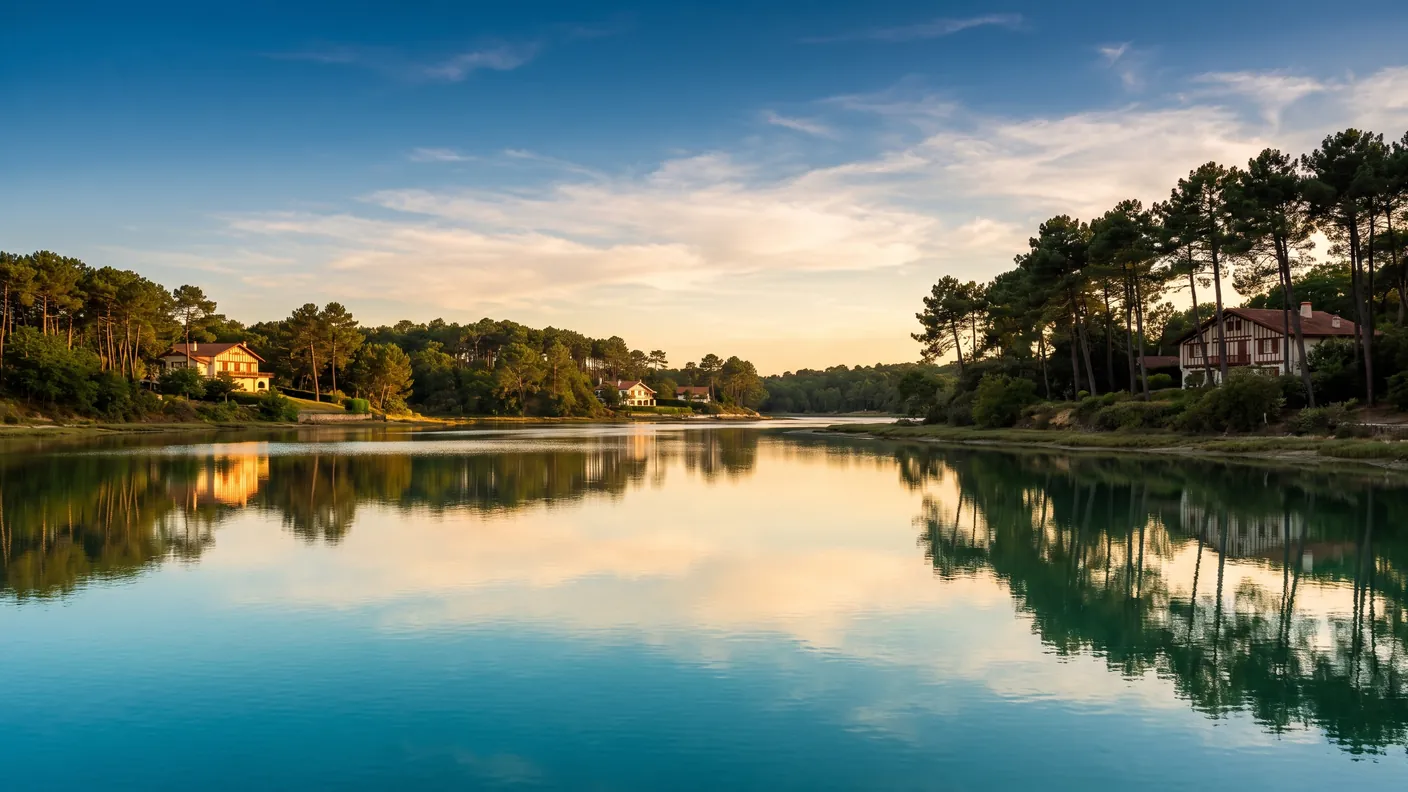
Off to the "Little Amazon" of the Landes
Direct transfer from Bordeaux (~1 hr 54 min via the A63) to Moliets-Plage, with its wild river mouth and golf course—from your home, from the airport or train station to the residence, the golf course, or the Galupes pier—bags and boards included—followed by an optional trip to Hossegor or Dax.