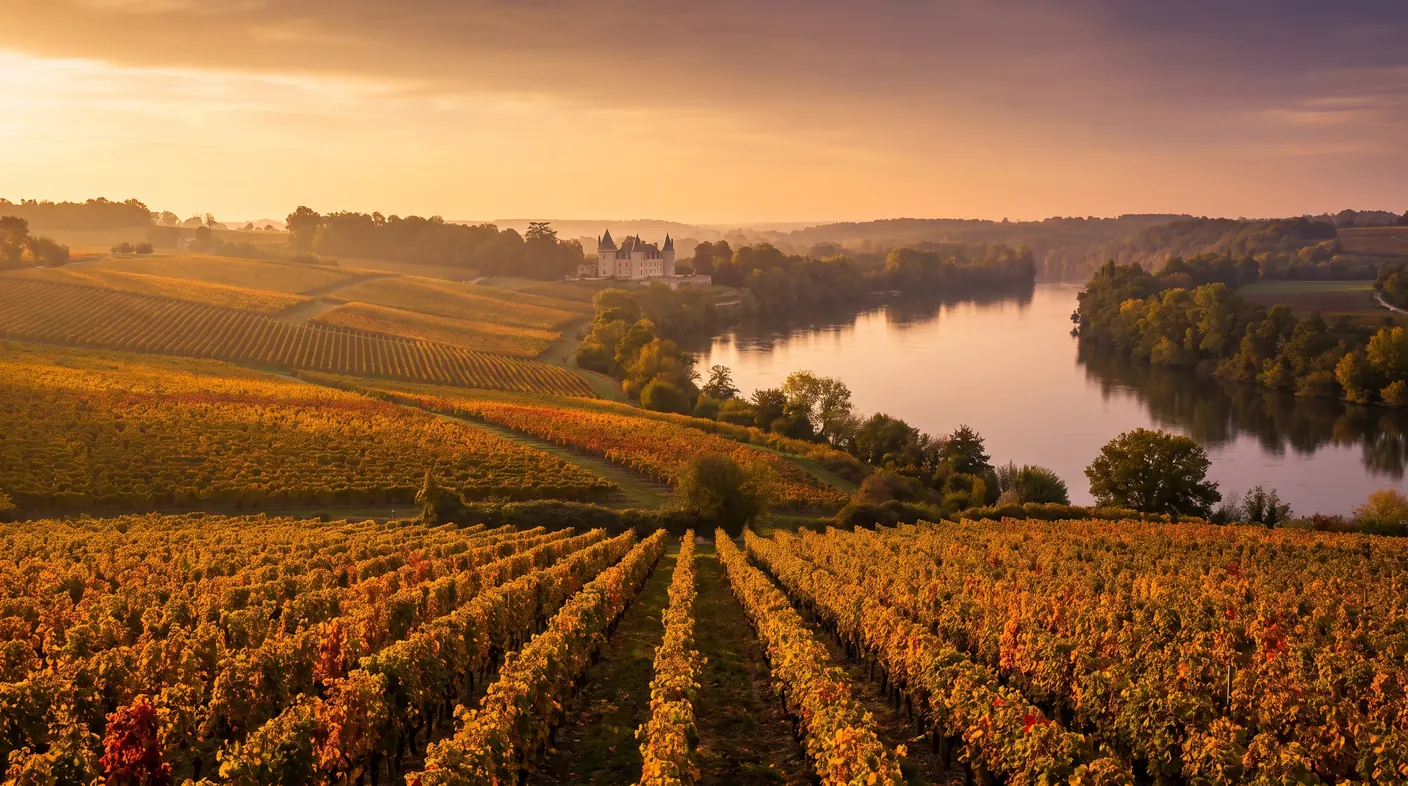
Bordeaux to Saint-Germain-de-la-Rivière: the Magdalenian Lady and the Fronsadais
A village nestled in the hills of the Fronsadais region, on the right bank of the Dordogne River, which has yielded one of the oldest decorated burial sites in Europe. The “Magdalenian Lady,” a Romanesque church, the Fronsac vineyards, and nearby, the Château de la Rivière, Libourne, and Saint-Émilion. About forty minutes from Bordeaux.
Saint-Germain-de-la-Rivière at a glance
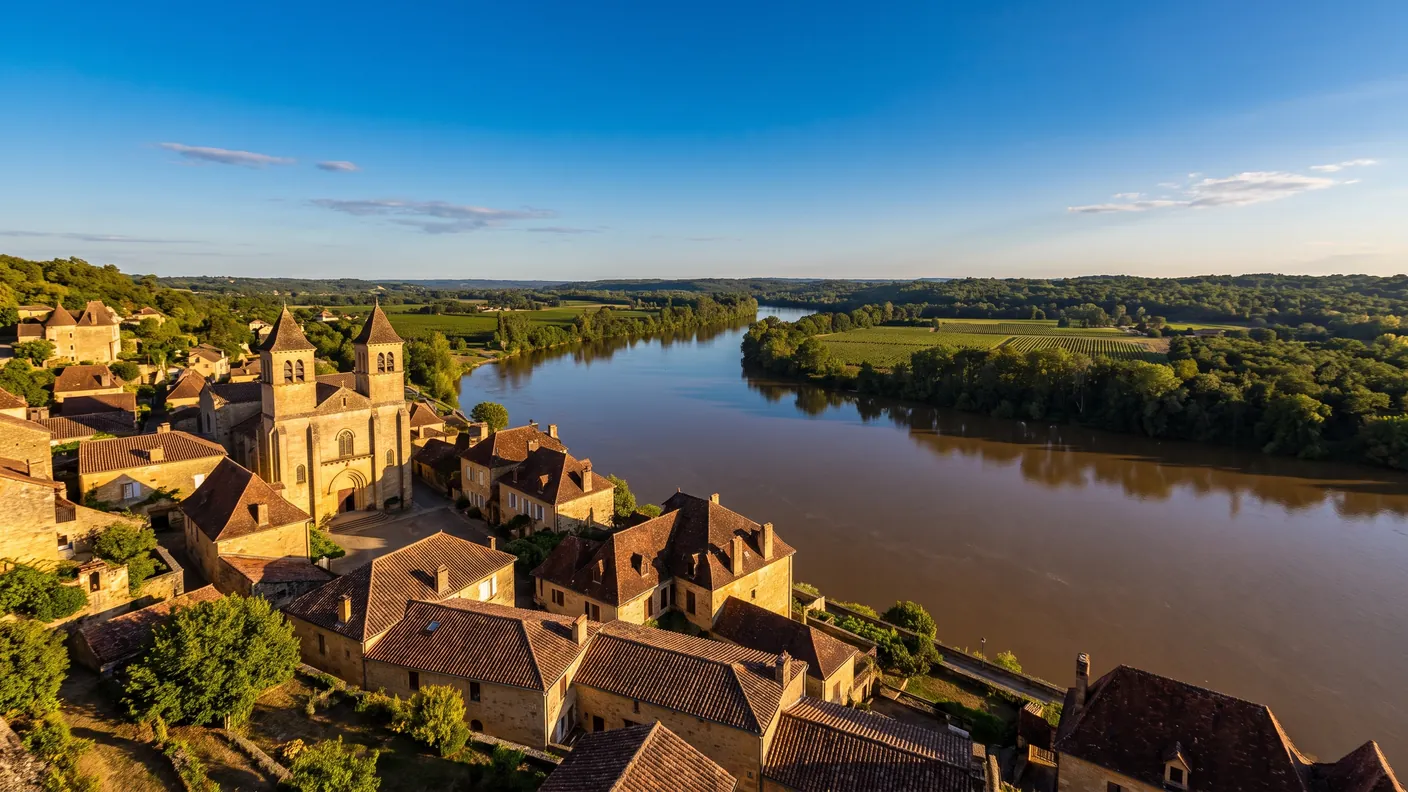
Saint-Germain-de-la-Rivière is a tiny village in the Fronsadais hills, on the right bank of the Dordogne, about thirty kilometres east of Bordeaux. Few visitors come for the village alone, yet beneath its Fronsac vineyards lay one of Europe’s oldest richly adorned burial sites: the nearly sixteen-thousand-year-old “Magdalenian Lady”. This guide separates verified fact from repetition. It presents the real Saint-Germain—its Romanesque church, hillsides and wine appellation—while placing nearby landmarks in their proper context, beginning with Château de la Rivière, which lies outside the municipality. From this intimate village, the route naturally opens towards Fronsac, Libourne and Saint-Émilion.
Before going into detail, here are the key points to help you get your bearings, understand what’s at stake here, and plan a well-informed visit—because here, more than anywhere else, the place’s appeal lies as much in its past as in what it has to offer today.
| Landmark | Details |
|---|---|
| Department | Gironde (33) · Nouvelle-Aquitaine |
| Status | Wine-growing village, Libourne district, Fronsadais Community of Communes |
| Population | ~392 residents (INSEE 2023), the Saint-Germanais |
| Area | 4.28 km² |
| Must-Sees | The Magdalenian Lady, the Fronsac AOC, the hillsides of the Dordogne |
| From Bordeaux | ~33 km · ~44 min · starting at €71 |
The village has no spectacular monuments, no museums, and no famous market. Its true treasure lies elsewhere: in soil that, in the 20th century, yielded a moving testament to the first Europeans, and in a wine appellation—Fronsac—that ranks among the most charming on the right bank. This is a guide of nuances rather than superlatives, and that is precisely what gives it its charm.
Where is Saint-Germain-de-la-Rivière located?
Saint-Germain-de-la-Rivière is a small town in the Gironde department covering just 4.28 km² (INSEE code 33414, ZIP code 33240), situated on the right bank of the Dordogne River, in the hills of the Fronsadais and Libournais regions. The village stretches between Saint-André-de-Cubzac, downstream, and Libourne, upstream, along the RD670, the former national highway that connects Bordeaux to Libourne via the river’s right bank.
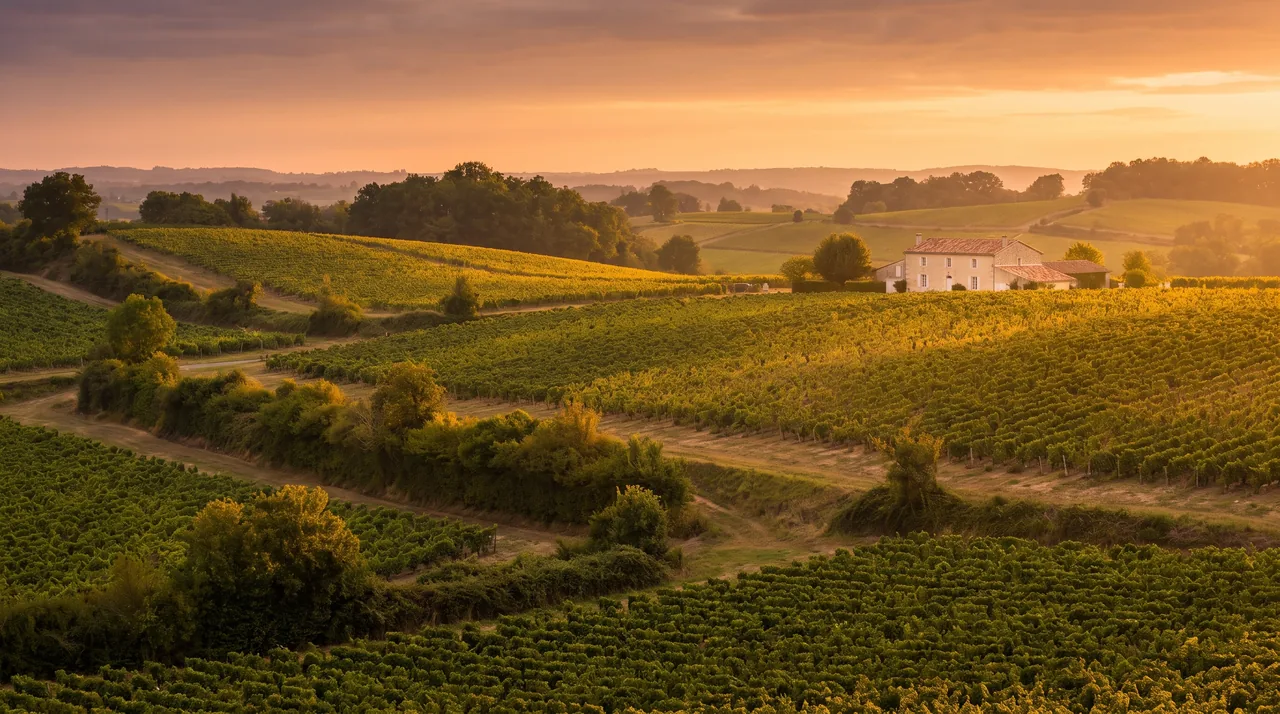
Administratively, the municipality is part of the Libourne district, the Libournais-Fronsadais canton (created in 2015 through the merger of the former cantons of Libourne and Fronsac), and the Fronsadais Community of Municipalities. It is therefore a village firmly rooted in the Libournais, this vast wine-growing region that stretches on both sides of the Isle and the Dordogne rivers, east of the Bordeaux metropolitan area.
It is important to note a geographical distinction that shapes our understanding of the entire region: the right bank of the Dordogne is neither the Médoc nor the Graves, both of which are located on the left bank of the Garonne, to the northwest and south of Bordeaux, respectively. Saint-Germain belongs to Bordeaux’s “right bank” region—the same as Fronsac, Pomerol, and Saint-Émilion—with its clay-limestone slopes, mounds topped with old stones, and a predominance of Merlot. The nearby confluence of the Isle and Dordogne rivers marks the heart of this vineyard.
How far is it from Bordeaux?
It’s about 33 kilometers and a 44-minute drive from downtown Bordeaux, based on actual road distances—not as the crow flies, since some directories list “19 km,” which is the direct distance and isn’t meaningful for a road trip. The route follows the right bank of the Dordogne or takes the main roads toward Libourne. The village is close to the entire Libourne wine region, making it a convenient base from which to explore.
| From Saint-Germain to | Driving distance | Duration |
|---|---|---|
| Bordeaux (downtown) | ~33 km | ~44 min |
| Libourne | ~12 km | ~18 min |
| Fronsac | ~9 km | ~14 min |
| Saint-André-de-Cubzac | ~14 km | ~18 min |
| Saint-Émilion | ~20 km | ~25 min |
A Name Easily Confused with Nearby Places
A small spelling distinction can cause confusion: the municipality is Saint-Germain-de-la-Rivière, while the prehistoric site is usually written Saint-Germain-la-Rivière, without the preposition. Both names refer to the same place; the shorter form became established in archaeological literature. It is useful to know when consulting sources, especially because Saint-Germain is such a common French place name.
How many people live in Saint-Germain-de-la-Rivière?
The municipality had 392 residents according to the 2023 census (INSEE), with a population density of approximately 91 residents per square kilometer. It is a rural village with scattered settlements, whose population is growing very slowly—at a rate of about 0.3% per year over the past few years. This is a far cry from expanding suburban towns: here, the population follows the peaceful rhythm of a wine-growing region. The residents are known as Saint-Germanians.
| Data | Value |
|---|---|
| Municipal Population (2023) | ~392 residents |
| Density | ~91 people per km² |
| Area | 4.28 km² |
| Elevation | from 1 m (along the banks of the Dordogne) to ~80 m (hillsides) |
| Demonym | Saint-Germanais and Saint-Germanaises |
This modest figure alone speaks to the character of the place: Saint-Germain is not a mass-tourism destination, but an authentic village where people come to experience a direct connection with the land, the vineyards, and its long history. The low population density also explains why the houses and vineyards are scattered across the hillsides, and why public transportation service is limited—which can be a challenge when planning a day of wine tastings there.
A name of uncertain origin
We would like to be able to explain the origin of the place name, but no reliable source provides precise information on the origin of the town’s name. We will therefore refrain from conjuring up a fanciful etymology: Saint-Germain obviously refers to the patron saint, and “la Rivière” to the proximity of the Dordogne, but the philological details remain unclear. It is better to admit this than to invent something—that is the rule this guide applies to itself whenever a source is lacking.
Who is the Lady of Saint-Germain-de-la-Rivière?
Saint-Germain’s true treasure was uncovered in 1934 (National Museum of Prehistory). Beneath a rock shelter overlooking the Dordogne, archaeologists discovered a burial from the Middle Magdalenian, dated to about 15,800 years ago (approximately 15,780 ± 200 years, according to the National Museum of Prehistory in Les Eyzies). One of Europe’s oldest known adorned burials, it has yielded valuable insight into hunter-gatherer societies at the end of the last Ice Age.
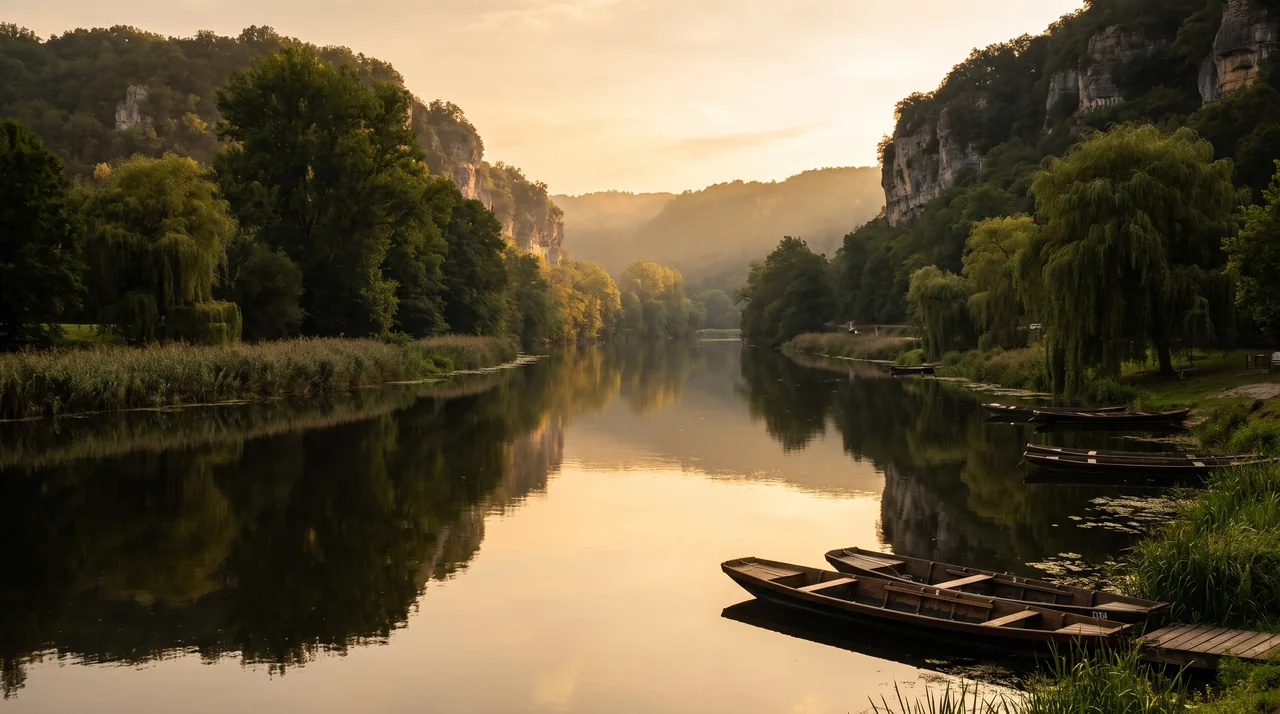
The grave contained the remains of a woman in her thirties, entirely covered in red ochre, the emblematic funerary pigment of prehistory, and richly adorned. Her ornament comprised 70 perforated deer canines, some engraved with notches and arranged across the body; the ensemble is now preserved at the National Museum of Prehistory in Les Eyzies. These teeth were far more than decoration: in the Magdalenian period they were valuable objects, laborious to prepare and charged with social meaning.
However, these canine teeth could not all have come from the immediate vicinity. Analyses have shown that some likely originated from long-distance trade—spanning tens or even hundreds of kilometers. This provides a strong clue: even at that time, human groups maintained extensive trade networks, and a woman could be buried with prestige objects that circulated across vast territories. The Lady of Saint-Germain is therefore not merely a local curiosity: she is a key piece in the broader scientific record of early European societies.
Can you see the Lady locally?
No, and it’s important to know this before you go: the remains and grave goods are now housed at the National Museum of Prehistory in Les Eyzies-de-Tayac, in the Dordogne, the capital of French prehistory. In Saint-Germain, you explore the landscape—the hillsides, the limestone shelters along the Dordogne River, the cliff that protected the tomb for millennia—and learn about its history; the original, however, can be viewed in Les Eyzies. It’s a wonderful way to connect this small village to the grand adventure of the Southwest’s prehistory, spanning Lascaux, Font-de-Gaume, and the rock-shelter sites of the Vézère Valley.
The Magdalenian Period: The Golden Age of Ice Age Hunters
To gauge the age of the Lady, we must consider the historical context. The Magdalenian is the last major culture of the Upper Paleolithic in Western Europe—the era of the great artists of Lascaux and Altamira, and of the reindeer and horse hunters at the end of the last ice age. Fifteen thousand eight hundred years ago, the climate was still cold, the Dordogne Valley was much more open than it is today, and human groups lived by hunting, fishing, and gathering as the seasons changed. The fact that, in this world, care was taken to bury a woman with so much ochre and adornment speaks volumes about the importance of funeral rites and the social complexity of these societies, which are all too often imagined as rudimentary.
Why here?
Geography explains it all: the Dordogne River flows at the foot of limestone hills dotted with natural shelters—facing south, sheltered from the wind, with water and game within easy reach. This is precisely the type of site that Magdalenian hunters sought, and we find similar settlements all along the valley, from the Gironde to the Périgord. The same cliffs that once sheltered “La Dame” now bear grapevines: from prehistory to Fronsac, the essence of this place lies in the constant dialogue between stone, water, and man—a dialogue that gives Saint-Germain a historical depth far beyond its size.
The Church of Saint-Germain and Saint-Loup
At the centre of the village, the Church of Saint-Germain and Saint-Loup displays late Romanesque architecture dating from the 13th century. Like many churches in the Bordeaux hills, it gives the settlement its shape: its bell tower is a landmark, its square a gathering place, and its cemetery a quiet record of the parish’s long history.
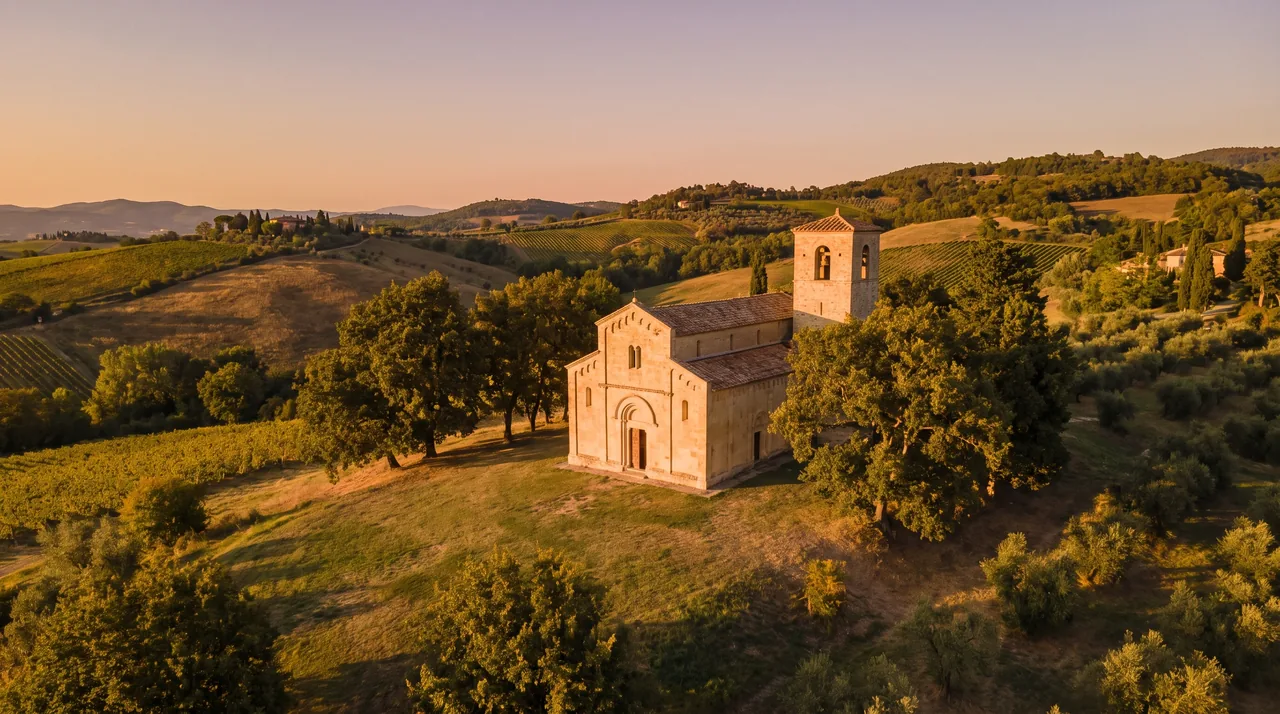
One element is officially protected: the cemetery cross, listed as a Historic Monument in 1905 (POP/Mérimée entry). This is a long-standing designation, indicating that this small piece of cultural heritage attracted attention very early on. As for the rest, let’s remain cautious: we have no source confirming that the church itself has been classified or listed as a Historic Monument, and we will therefore refrain from making such a claim. The building is nonetheless worth a visit for its Romanesque silhouette, its golden limestone, and its peaceful setting.
What is there to see around the church?
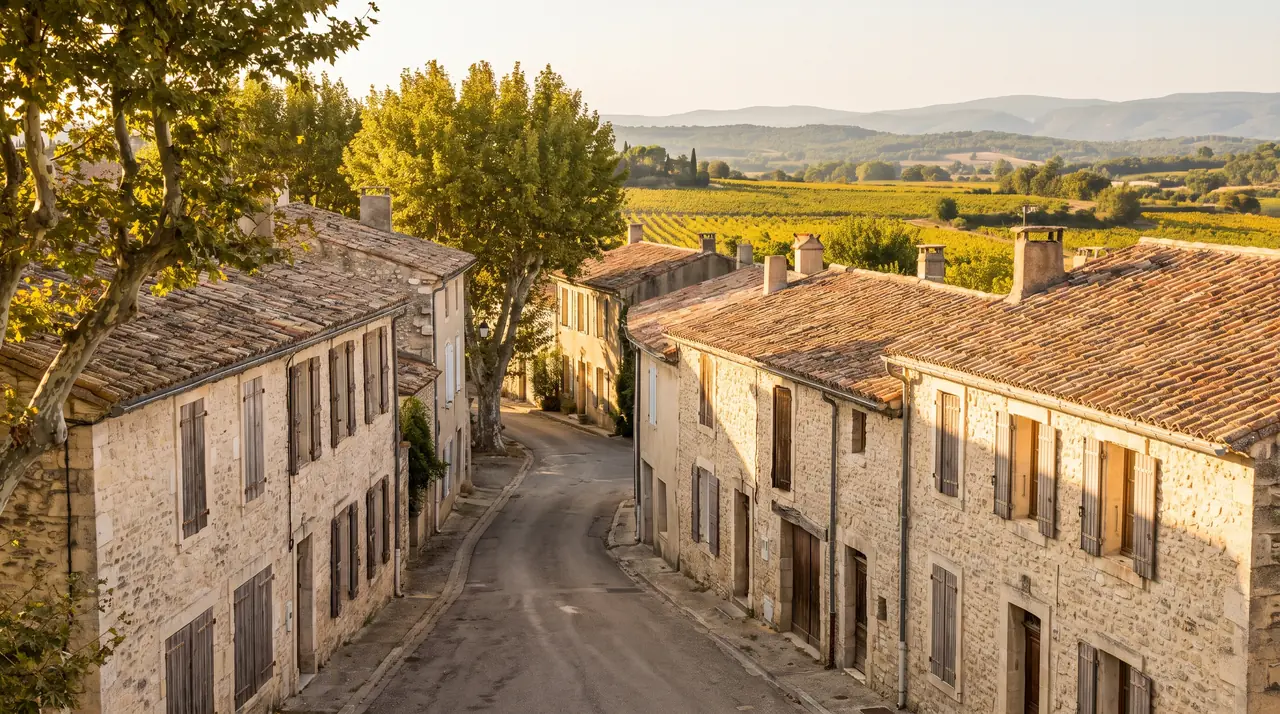
The village is modest, and should be approached as such: a few limestone houses with wooden shutters, canal-style tiled roofs, the church and its cemetery, and all around, vineyards climbing up the hillsides. It’s a quick stop—an hour or so is enough—to be combined with the viewpoints overlooking the Dordogne Valley and, of course, the major attractions in the surrounding area. Its charm is that of a genuine wine-growing village, without any pretense.
Romanesque art is everywhere in the Libourne and Fronsac regions: the churches of Saint-Michel-de-Fronsac, Saillans, and Guîtres—like that of Saint-Germain—bear witness to the region’s vitality in the 12th and 13th centuries, when local lords and abbeys vied with one another to build. If you love historic architecture, you can plan a short Romanesque tour from hillside to hillside, between wine tastings. These buildings, often modest, have the advantage of authenticity: you can visit them without crowds, in the quiet of the villages.
What wines should you try in the Saint-Germain-de-la-Rivière area?
Saint-Germain-de-la-Rivière is part of the Fronsac AOC region, one of the finest red wine appellations on the right bank. Fronsac wines are exclusively red, dominated by Merlot, grown on clay-limestone slopes at the confluence of the Isle and Dordogne rivers, northwest of Libourne. It is the terroir that established the region’s long-standing reputation: as early as the 18th century, Fronsac wines were highly sought after and sometimes valued higher than those of neighboring regions.
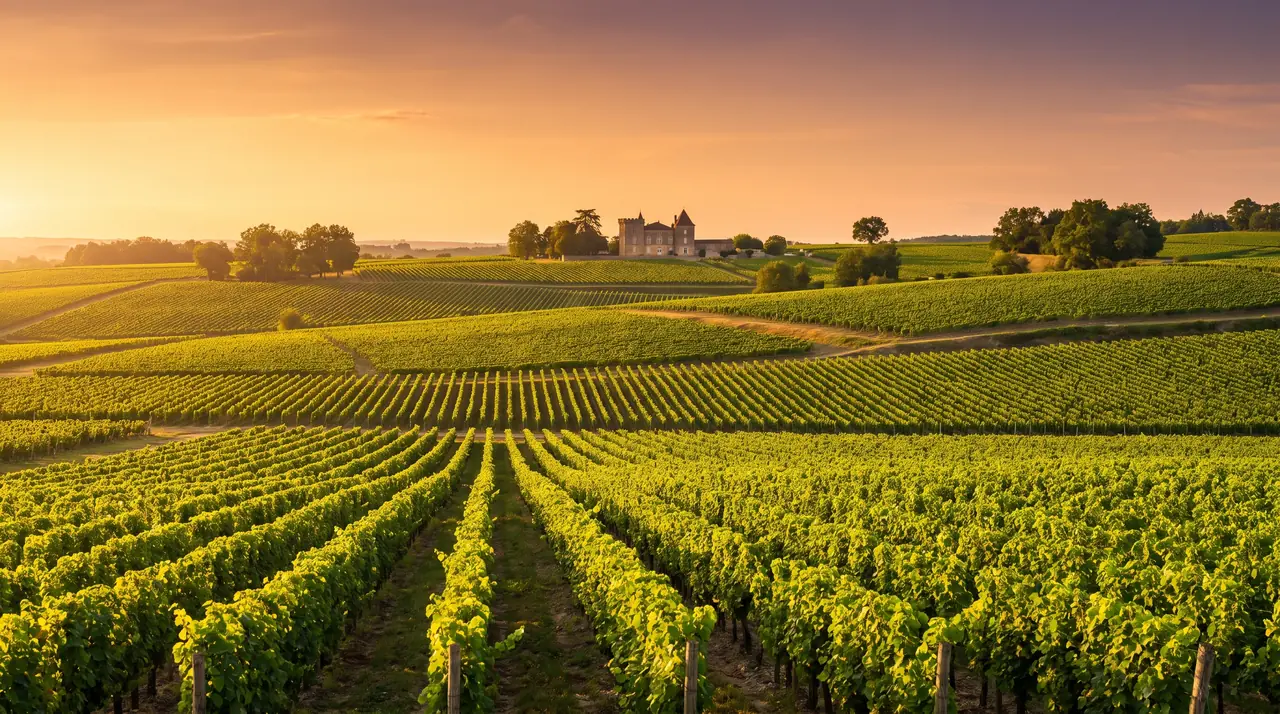
The Fronsac appellation spans seven municipalities: Fronsac, La Rivière, Saillans, Saint-Aignan, Saint-Germain-de-la-Rivière, Saint-Michel-de-Fronsac, and part of Galgon. A second appellation, Canon-Fronsac, occupies the heart of the hill, on the finest limestone soils. Together, they form a small vineyard of about 1,000 hectares, one of the highest-quality vineyards on the right bank outside the Pomerol–Saint-Émilion triangle.
Fronsac wines are age-worthy reds dominated by Merlot, produced under appellation guidelines distinct from those of Pomerol and Saint-Émilion. Their price depends on the estate, the cuvée, the vintage, and the sales channel.
What wines does Saint-Germain-de-la-Rivière produce?
Mainly red Fronsac wines. The village is home to wineries that produce wine on its own hillsides and those of neighboring towns. There are family-run estates deeply connected to their terroir, which are often happy to welcome curious visitors for tastings.
The best way to discover them is to spend half a day tasting wines there, ideally with a designated driver so you don’t have to keep track of how many glasses you’ve had—but we’ll come back to that in the practical section. The proximity of Fronsac, Pomerol, and Saint-Émilion also makes it possible to put together a remarkably diverse tour of the Right Bank, ranging from the most obscure to the most prestigious.
A terroir of clay-limestone hillsides
What gives Fronsac wines their character is the soil. Here, the hillsides are composed of clay and limestone, sometimes topped with molasse, very different from the gravel soils of the Médoc or the Graves: these cooler, clayier soils are ideally suited to Merlot, which gains both roundness and structure from them. The hillsides’ exposure toward the Dordogne Valley, the natural drainage of the slopes, and the proximity to water combine to create a favorable microclimate. It is this same limestone that, further down, was quarried into underground caverns—which now serve as wine cellars—and that outcrops in the shelters where the Lady once rested. The terroir of Saint-Germain thus links, in a single layer of stone, prehistory and great wine.
What is the story behind Saint-Germain-de-la-Rivière?
The land of Saint-Germain has been inhabited since time immemorial: the Magdalenian woman, whom we have just mentioned, was buried there nearly sixteen thousand years ago. Between that distant prehistory and the village of today lies the quiet history of a parish nestled in the hills of the Fronsadais region.
In the Middle Ages, the village was part of the Fronsac sphere of influence—the former Duchy of Fronsac, a strategic stronghold in the Dordogne Valley, whose hilltop commanding position controlled both waterways and roads. The village lived in the shadow of this feudal power and within the economic sphere of Libourne, the 13th-century port town that managed the trade of wines from the right bank to England and northern Europe. The Romanesque church bears witness to this medieval heritage, and the cemetery cross was designated a Historic Monument as early as 1905.
As is the case throughout the Libournais region, it is the vineyard that has shaped the landscape and the economy. The Fronsac vineyards are situated on clay-limestone slopes; they enjoyed their heyday in the 18th century, suffered from phylloxera in the late 19th century like the rest of the Bordeaux region, and then rebuilt themselves. Today, Saint-Germain remains what it has always been: a quiet winegrowing village, facing its river and its hillsides.
For a long time, the Dordogne was not just a backdrop—it was a highway. The gabares, those flat-bottomed boats, traveled down the river loaded with barrels bound for Libourne and then Bordeaux, from where the wines were shipped to England, the Netherlands, and the Hanseatic ports. The entire prosperity of the Libourne region was built on this river trade, before the railroad took over in the 19th century. Understanding the history of the river means understanding why the villages on the right bank turned, century after century, to viticulture and to the water.
The Château de la Rivière, just nearby
This is the guide’s essential clarification. The majestic Château de la Rivière is often described as being in Saint-Germain-de-la-Rivière. It is not: the château stands in the neighbouring, separate municipality of La Rivière (INSEE 33356). Both municipalities include “de la Rivière” in their names and share a boundary, which explains the confusion, but they remain distinct. The château is therefore presented here as a nearby excursion, about two kilometres away, never as a site within Saint-Germain.
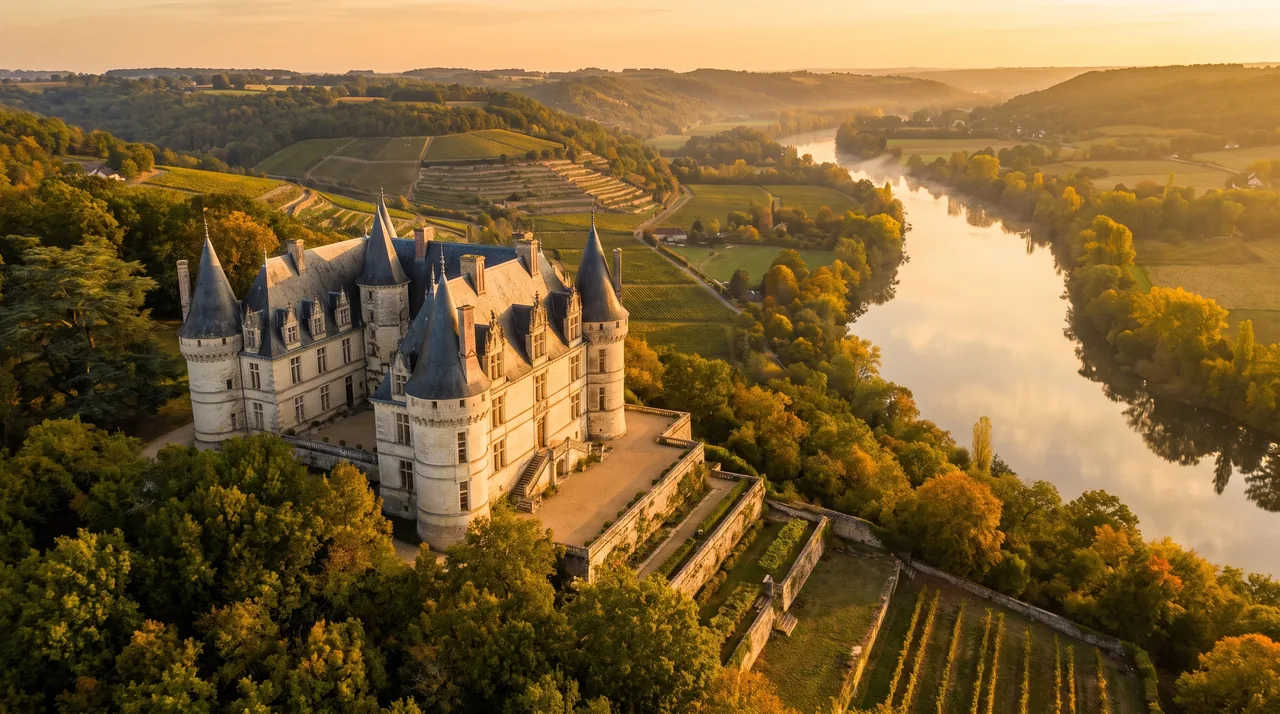
That said, the castle is worth a visit, and it’s hard to miss given how it towers over the valley. Its current structure was begun by Gaston de l’Isle, mayor of Bordeaux, and completed in 1572. It is often said that a fortified camp—a “Campus Francorum”—was established there by Charlemagne in 769, in connection with the nearby site of Fronsac: this is a legend perpetuated by the estate itself—an appealing one, but one to be taken with a grain of salt, rather than as an established historical fact.
Another useful clarification—one often overlooked in brochures—is that the 19th-century restoration was the work of Edmond Duthoit, a student of Viollet-le-Duc—and not of Viollet-le-Duc himself, as is sometimes simplistically stated. This distinction is important for anyone interested in the history of architecture: Duthoit was a talented restorer, active throughout the Southwest, and the castle bears his neo-Gothic stamp.
Is the Château de la Rivière a listed historic monument?
Caution is advised here as well: we have found no confirmed historic monument designation for the castle in Gironde. The entry that sometimes circulates (reference PA00097186) actually refers to a castle with the same name located in Pontgouin, in the Eure-et-Loir department—a classic database mix-up. The phrase “listed castle” found on commercial websites is therefore simply marketing language, not an official designation. This in no way diminishes the site’s appeal, but it’s important to state the facts accurately.
The Underground Galleries
The main attraction of the Château de la Rivière is its underground tunnels: former limestone quarries, where the stone used to build Bordeaux was quarried, now converted into aging cellars. We're talking about approximately eight hectares underground, where nearly 700,000 bottles at a constant temperature and humidity. You can tour them and sample Fronsac wines; it’s best to check the hours and make a reservation directly with the estate, as the details vary by season.
A darker note is associated with the castle’s recent history: the property was sold on December 19, 2013, to businessman Lam Kok—on the very same day that a helicopter crash claimed the lives of several people in the Dordogne, including the buyer, his son, and the former owner. The tragedy left a deep mark on the region and serves as a reminder that, behind the picture-perfect facade, these grand estates also have their share of tragedies.
Beyond the anecdote, the Château de la Rivière perfectly illustrates the history of the local limestone. The stone quarried here for centuries was used to build Bordeaux and its quays; once the quarries were exhausted, their tunnels found a second life as wine cellars, providing ideal aging conditions for the wines. This is a common feature throughout eastern Bordeaux, from Saint-Émilion to Fronsac: the same rock was first carved out, then filled with barrels. Visiting these tunnels is like stepping back into the region’s geological and human history.
What is there to do in and around Saint-Germain-de-la-Rivière?
In Saint-Germain itself, the visit is brief, and you have to accept that: you’ll admire the Romanesque church and its listed cross, stroll along the hillsides and the banks of the Dordogne to take in the views, and take a moment to imagine the Magdalenian Woman in her shelter at the foot of the cliff. The bulk of the itinerary takes place “in and around” the area, within a radius of a few kilometers that encompasses some of the most beautiful sites on the right bank: the galleries of Château de la Rivière (in a neighboring town), the Fronsac mound, the bastide town of Libourne, and the UNESCO-listed town of Saint-Émilion. You can easily plan a wonderful day by combining cultural heritage, prehistory, and wine tastings.
- Visit the underground galleries at Château de la Rivière—in the neighboring town of La Rivière; ~8 ha of former quarries converted into wine cellars, with a Fronsac tasting (details and reservations available from the estate)
- Follow the story of the Magdalenian Lady—a ~15,800-year-old burial site discovered here in 1934, along with her adornment of 70 deer canines; the original is at the National Museum of Prehistory in Les Eyzies
- Discover the Romanesque church of Saint-Germain-et-Saint-Loup—13th century—with its cemetery cross, designated a Historic Monument in 1905
- Tasting Fronsac wines—at the vineyards on the hillsides, red Merlot wines from the right bank, often by appointment
- Explore the Fronsadais — the Fronsac hill and its great wines, about 9 km away
- Continue on to Libourne—the port town of the wine trade, with its docks and large arcaded square, about 12 km away
- Spend half a day in Saint-Émilion—a UNESCO World Heritage Site located about 25 minutes away
Along the Dordogne River
The Dordogne River is the central feature of the area. Its hillsides offer beautiful panoramic views of the valley, and you can continue downstream to Saint-André-de-Cubzac—the birthplace of Commander Cousteau—with its bridges over the river. It’s a gentle landscape of vineyards and water, better suited to leisurely strolls and gourmet stops than to quick tours.
A Typical Day on the Right Bank
From Bordeaux, you can reach Saint-Germain in about 40 minutes, visit the galleries at Château de la Rivière in the morning, have lunch in Libourne, and then spend the rest of the afternoon in Saint-Émilion. With a driver, you can go from one tasting to the next without worrying about driving or parking in the narrow village streets, and return home in the evening feeling refreshed.
| Activity | Where / When | Good to Know |
|---|---|---|
| Galleries of the Château de la Rivière | Municipality of La Rivière (neighboring) | Tour + tasting, by reservation only |
| Magdalenian Woman | Context in Saint-Germain; original in Les Eyzies | ~15,800 years ago, 70 deer canines |
| Romanesque Church | The Village of Saint-Germain | Listed cemetery cross, 1905 |
| Fronsac Wine Tastings | Hillside Vineyards | Merlot reds, often available by appointment |
| Saint-Émilion | ~25 min | UNESCO City, fine wines |
Around Saint-Germain-de-la-Rivière
Saint-Germain’s true asset is its location: the village lies at the heart of the Libourne region, which is rich in remarkable sites. First and foremost is its immediate neighbor, La Rivière, with its castle featuring underground galleries. A little further on, Fronsac stands on a hill overlooking the Dordogne, with its grand cru wines from the right bank; Libourne boasts its 13th-century bastide, its quays, and its arcaded square—a reminder of its wine-trading past; and Saint-Émilion crowns the region with its UNESCO World Heritage-listed wine-growing district, its monolithic church, and its grands crus classés.
Further downstream, Saint-André-de-Cubzac—the birthplace of Commander Jacques-Yves Cousteau (born in 1910)—still boasts its bridges over the Dordogne and its fortified church. You can also continue on to Pomerol, whose famous wines are nestled in a surprisingly unassuming landscape, with almost no ostentatious châteaux.
| Destination | Distance | Interest |
|---|---|---|
| La Rivière | ~2 km | Castle + underground galleries |
| Fronsac | ~9 km | Le Tertre, Fine Wines of the Right Bank |
| Libourne | ~12 km | Bastide, riverbanks, wine trade |
| Saint-André-de-Cubzac | ~14 km | Cousteau, Bridges Over the Dordogne |
| Saint-Émilion | ~20 km | UNESCO-designated medieval city, fine wines |
You can also head over to Pomerol, where the legendary wines—starting with Petrus—are nestled in a surprisingly unassuming landscape, almost devoid of ostentatious châteaux: here, it’s all about the wine and nothing to do with the surroundings. It’s a striking contrast to the opulence of the Médoc, and a lesson in humility for the wine lover. Guîtres, a little further north, adds a beautiful Romanesque abbey church and its little tourist train along the Isle River.
Combining Visits
Most of these sites can be visited in a single day, since the distances between them are so short. You can also spread the trip out over a weekend, with an overnight stay in Libourne or Saint-Émilion, to take the time to enjoy wine tastings and the views of the two valleys—the Isle and the Dordogne. Saint-Germain then becomes a stop that is both unassuming and special—the place where the story begins—with the Dame—and where you can discover the wines without the crowds.
How to get to Saint-Germain-de-la-Rivière from Bordeaux
The trip from Bordeaux is about 33 km and takes 44 minutes, either along the right bank of the Dordogne (RD670) or via the main roads toward Libourne. It’s a short distance, but the village and the vineyards are scattered across the hillsides and are often poorly served by public transportation: the most convenient train station, Libourne, requires a transfer to a road connection to reach the vineyards; check the official TER schedule before you leave.
How much does the ride cost?
A private transfer from Bordeaux to Saint-Germain-de-la-Rivière starts at €71 during the day, in a sedan for one to three people, with a fixed price provided in advance—no meter and no surprise surcharges. A surcharge applies at night, on weekends, and on holidays; a van is available for groups of more than four passengers. Trips to neighboring estates and villages, or to the airport, are priced on a quote basis.
| Route | Distance / Duration | Rates |
|---|---|---|
| Bordeaux → Saint-Germain-de-la-Rivière | ~33 km · ~44 min | starting at €71 |
| Neighboring estates and villages | Variable | Based on a quote |
| Bordeaux-Mérignac Airport | Variable | Based on a quote |
Why hire a private driver?
Because a day on the Right Bank is, above all, about tastings: Fronsac at Château de la Rivière, grands crus in Fronsac or Saint-Émilion. With a chauffeur service, you can enjoy as many glasses as you like, you don’t have to worry about finding parking in the narrow village streets, and you can move from one estate to another at your own pace throughout the day, in complete safety. The quote is fixed, confirmed in writing, and non-binding—you know the price before you set out, and you can fully enjoy the beautiful right bank of the Dordogne.
Frequently Asked Questions
Where is Saint-Germain-de-la-Rivière located?
In Gironde, on the right bank of the Dordogne, in the hills of the Fronsadais and Libournais regions, about thirty kilometers east of Bordeaux. It is a small town in the Libourne district (INSEE 33414, ZIP code 33240), a member of the Fronsadais Community of Municipalities. It is part of the Fronsac AOC region. Neither Médoc nor Graves: we are indeed on Bordeaux’s “right bank,” home to Fronsac, Pomerol, and Saint-Émilion.
Who is the Lady of Saint-Germain-la-Rivière?
This is a prehistoric burial site discovered in 1934 beneath a rock shelter overlooking the Dordogne River (National Museum of Prehistory), dating to the Middle Magdalenian period, approximately 15,800 years ago. It contained the skeleton of a woman in her thirties, covered in ochre and adorned with a necklace of 70 perforated deer canines, some of which are believed to have come from long-distance trade. It is one of the oldest adorned burials in Europe. The remains are preserved at the National Museum of Prehistory in Les Eyzies.
Is Château de la Rivière located in Saint-Germain-de-la-Rivière?
No, and this is a very common misunderstanding. The Château de la Rivière is located in the neighboring and separate municipality of La Rivière (INSEE 33356), not in Saint-Germain-de-la-Rivière. The two municipalities border each other and both have “...de la Rivière” in their names, which is why the confusion arises. You can visit it on a day trip from Saint-Germain, which is two kilometers away, but it should not be presented as a site within the municipality.
Can we visit the Château de la Rivière?
Yes: its former limestone quarries, converted into wine cellars, form about eight hectares of underground tunnels where nearly 700,000 bottles of Fronsac are aged. The tour includes a tasting; it’s best to check the schedule and make a reservation with the estate. Please note: contrary to what is sometimes reported, the 19th-century restoration of the château was the work of Edmond Duthoit, a student of Viollet-le-Duc, and not of Viollet-le-Duc himself.
What wines does Saint-Germain-de-la-Rivière produce?
Fronsac wines—that is, red wines from the right bank dominated by Merlot. The town is one of the seven communes in the Fronsac AOC (along with Fronsac, La Rivière, Saillans, Saint-Aignan, Saint-Michel-de-Fronsac, and part of Galgon). These are age-worthy reds—structured and fresh—produced under the Fronsac AOC, with their own set of specifications. You can sample them at tastings at the wineries on the hillsides.
How much does a trip from Bordeaux to Saint-Germain-de-la-Rivière cost with an executive car service?
Private transfers start at €71 during the day, in a sedan for one to three people, for a distance of approximately 33 km and a 44-minute drive. The price is fixed, provided in advance, and there is no meter. A surcharge applies at night, on weekends, and on holidays; a van is available for groups. Trips to neighboring estates and villages, or to the airport, are priced on a quote basis.
What is there to do in Saint-Germain-de-la-Rivière?
Once there, the tour is brief: the Romanesque Church of Saint-Germain-et-Saint-Loup and its listed cross, the views of the Dordogne River, and the site of the Magdalenian Lady. The highlights are all nearby: the underground galleries of Château de la Rivière (in a neighboring town), Fronsac wine tastings, the Fronsac mound, the bastide town of Libourne, and the UNESCO-listed town of Saint-Émilion. A wonderful day combining prehistory, heritage, and wines from the right bank.
Is the Church of Saint-Germain designated as a historic monument?
The cemetery cross, which was designated a Historic Monument in 1905, is the officially protected feature. As for the Church of Saint-Germain-et-Saint-Loup itself, a late Romanesque structure from the 13th century, we have no source confirming its classification or listing; in the interest of honesty, we will not make such a claim. The building remains a fine example of Romanesque architecture that defines the town center.
How many people live in Saint-Germain-de-la-Rivière?
According to the 2023 census, it has a population of approximately 392, with a population density of about 91 people per square kilometer and an area of 4.28 km². It is a small rural village with scattered settlements, and its population is growing very slowly. Its residents are known as Saint-Germanians.
What is the difference between Saint-Germain-de-la-Rivière and La Rivière?
These are two neighboring but distinct municipalities in the Gironde department, both located within the Fronsac AOC region. Saint-Germain-de-la-Rivière (INSEE 33414) is the village known for the Magdalenian Lady and its Romanesque church; La Rivière (INSEE 33356) is the town where the Château de la Rivière and its underground galleries are located. The similarity of the names explains why the château is often—and incorrectly—attributed to Saint-Germain.
How can I get to Saint-Germain-de-la-Rivière without a car?
This is a drawback: the hillside village and its vineyards are scattered and poorly served by public transportation. The most convenient train station is Libourne, on the Bordeaux–Libourne line, but you’ll then need to take a bus to reach the vineyards. For a day of wine tastings on the right bank, a chauffeured transfer remains the simplest solution: he’ll drop you off and pick you up directly at the winery.
What is there to see around Saint-Germain-de-la-Rivière?
There’s plenty to see within a short distance: the Château de la Rivière and its galleries (in a neighboring town, ~2 km), the Fronsac hill and its fine wines (~9 km), the bastide town of Libourne (~12 km), Saint-André-de-Cubzac and its bridges (~14 km, Cousteau’s hometown), and Saint-Émilion, a medieval town listed as a UNESCO World Heritage Site (~20 km). All of these can easily be combined into a single day trip along the right bank of the Dordogne.
Does it take a whole day to visit the area?
You can see the village itself in about an hour. But once you add in the galleries at Château de la Rivière, along with one or two Fronsac, Libourne, and Saint-Émilion wine tastings, you’ll need to set aside a full day. With a driver picking you up in Bordeaux, you can make the most of the tour without worrying about driving or parking, and you can even spread it out over a weekend to enjoy both the Isle and Dordogne valleys.
Why is the Magdalenian Lady important?
Because it is one of the oldest decorated burial sites in Europe (~15,800 years old) and provides insight into Magdalenian societies. Its adornment of 70 deer canines—some of which were obtained through long-distance trade—reveals extensive social and commercial networks dating back to the end of the last ice age. It is a major artifact of the Southwest’s prehistory, now housed at the National Museum of Prehistory in Les Eyzies-de-Tayac.
Further Reading
Sources and References
- Saint-Germain-de-la-Rivière — Wikipedia — geography, demographics, heritage
- Saint-Germain-de-la-Rivière (33414) — INSEE — official population
- Cemetery Cross — POP/Mérimée PA00083746 — Protected as a Historic Monument
- Libourne Train Station — TER Nouvelle-Aquitaine — Routes and Services
- The Lady of Saint-Germain-la-Rivière — National Museum of Prehistory — Magdalenian burial
- Fronsac AOC — specifications — 7 municipalities, including Saint-Germain
- La Rivière Castle — Wikipedia — nearby castle (in the municipality of La Rivière), Duthoit
- The Quarries at Château de La Rivière — Gironde Tourism — Underground Galleries
- Saint-Émilion (UNESCO) — Gironde Tourism — nearby attractions
Article updated on July 21, 2026.
Our Latest Guides
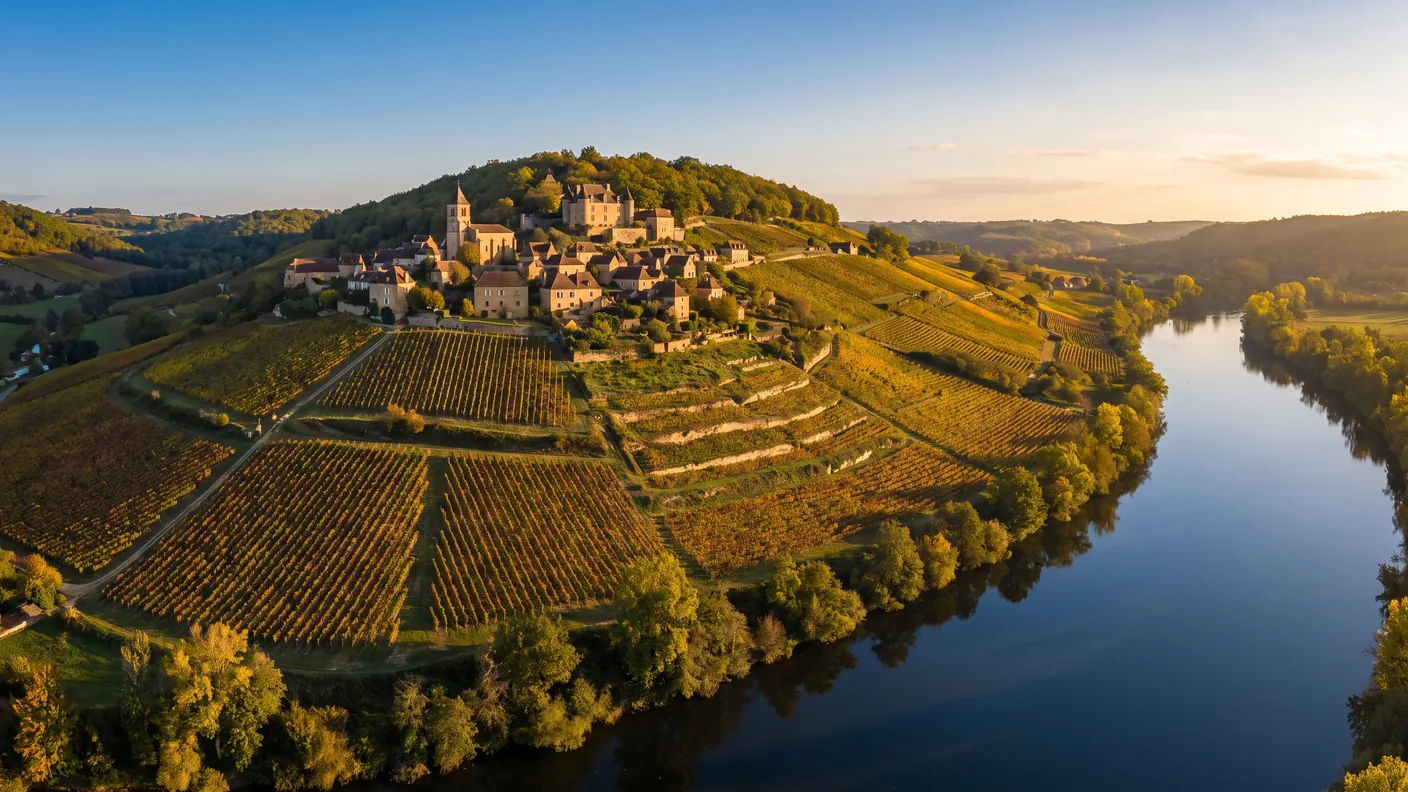
Off to the Fronsadais Region
Direct transfer from Bordeaux (~40 min) to Saint-Germain-de-la-Rivière and the Dordogne hillsides. Written, fixed-price quote with no obligation.