
Saint-Privat-des-Prés from Bordeaux: a fortified priory church in the Ribéracois
A former municipality that became a delegated commune in 2017, home to an extraordinary church: Romanesque, fortified, and designated a Historic Monument as early as 1854, it is the former abbey church of a Benedictine priory affiliated with Aurillac, through which the future Pope Clement V once passed. Its Saintonge-style façade features an eight-arched portal. About 1 hour and 29 minutes from Bordeaux.
Saint-Privat-des-Prés at a Glance
Saint-Privat-des-Prés is a delegated commune of Saint-Privat-en-Périgord, in the Ribérac region of the Dordogne. Its main landmark is the Church of Saint-Privat, the former church of a 12th-century Benedictine priory affiliated with the Abbey of Saint-Géraud in Aurillac. The building is fortified, and its Romanesque façade in the Saintonge style features an eight-arched portal. The church is protected as a historic monument; the POP record mentions a classification notice from 1854 and an entry from 1862. In 1304, Bertrand de Got, then Archbishop of Bordeaux and the future Pope Clement V, visited the priory during a pastoral tour. From Bordeaux, the guide estimates a distance of approximately 97 km and a driving time of 1 hour and 29 minutes, with a private chauffeur service available starting at €170 one way. The village does not have a passenger train station. Bus connections and the church’s opening hours should be verified with local authorities before departure.
- Saint-Privat-des-Prés (the residents of Saint-Privat) is a village in the Ribéracois, in the Dordogne (24410) — since 2017, delegated commune of the new municipality of Saint Privat en Périgord (INSEE code 24490).
- The former municipal boundaries had a population of 565 in 2014, according to the latest INSEE data available prior to the merger; subsequent figures refer to the new municipality of Saint Privat en Périgord (INSEE).
- Its crown jewel: a fortified Romanesque church designated a Historic Monument in 1854—the former church of a 12th-century Benedictine priory affiliated with Saint-Géraud Abbey in Aurillac (200 km away) (POP listing).
- Its Saintonge Romanesque-style façade features a monumental portal with eight carved archivolts, and a 3-meter-thick section converted into a defensive corridor.
- In 1304, the priory was visited by Bertrand de Got, Archbishop of Bordeaux—the future Pope Clement V. The Gironde Departmental Archives hold the inventory from this pastoral visit in 1304.
- The name honors Saint Privat, the bishop of Mende who was martyred in the 3rd century; the suffix “des Prés” was not added until 1993.
- The church houses a rare collection of furnishings inherited from the Antonine Commandery—including a statue of the Virgin Mary bearing the tau symbol of the Hospitaller Order of Saint Anthony.
- From Bordeaux: ~97 km, about 1 hour and 29 minutes by car — starting at €170 with a private driver. No train station (Ribérac is ~12 km away).
Before You Go: What Saint-Privat-des-Prés Really Is
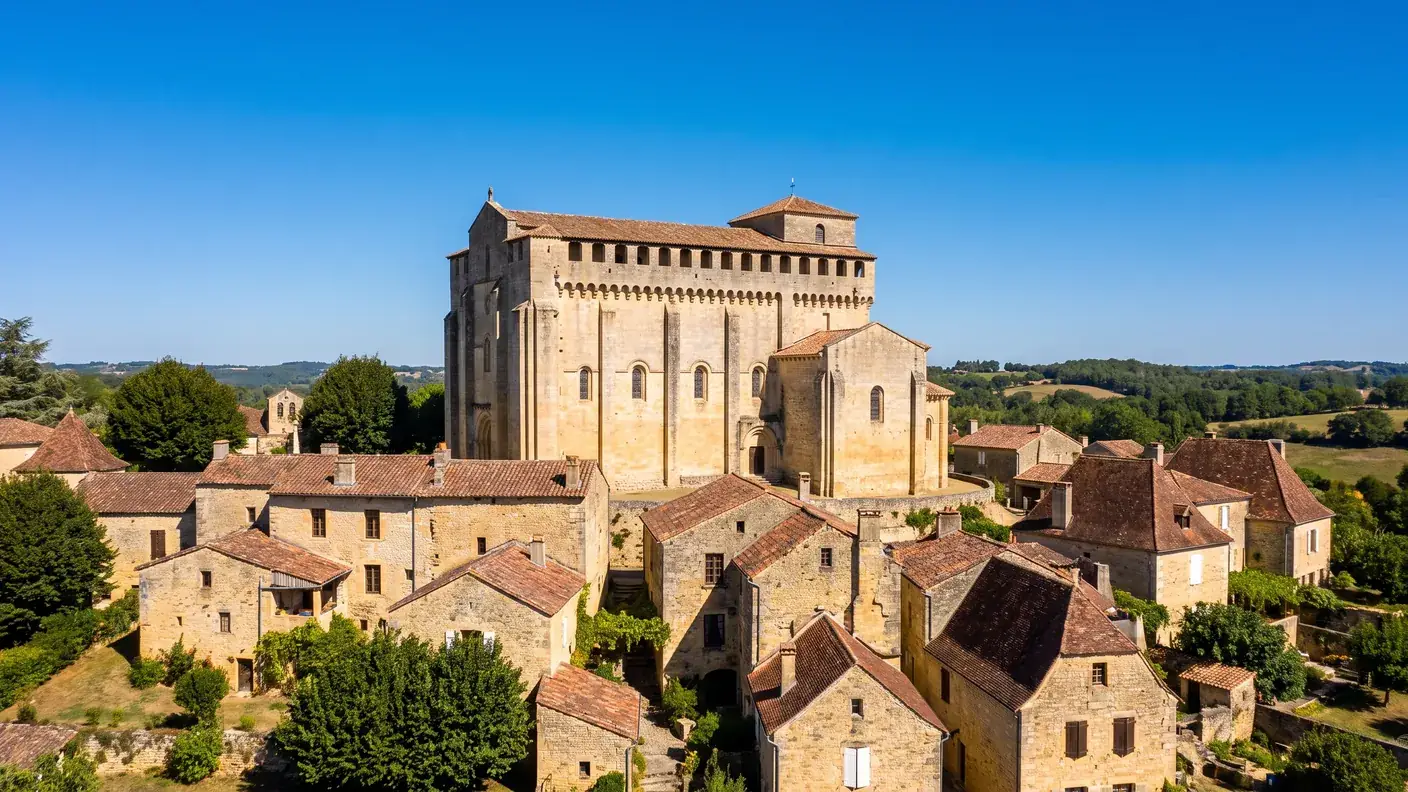
In the village square, the church stands out with its massive structure of pale stone. Its thick walls, its fortified level pierced by arrowslits above the vaults, and its façade featuring an eight-arched portal are a testament to the importance of the former Benedictine priory. Saint-Privat-des-Prés is now a delegated commune of Saint Privat en Périgord; the future Pope Clement V passed through this priory during his tour in 1304.
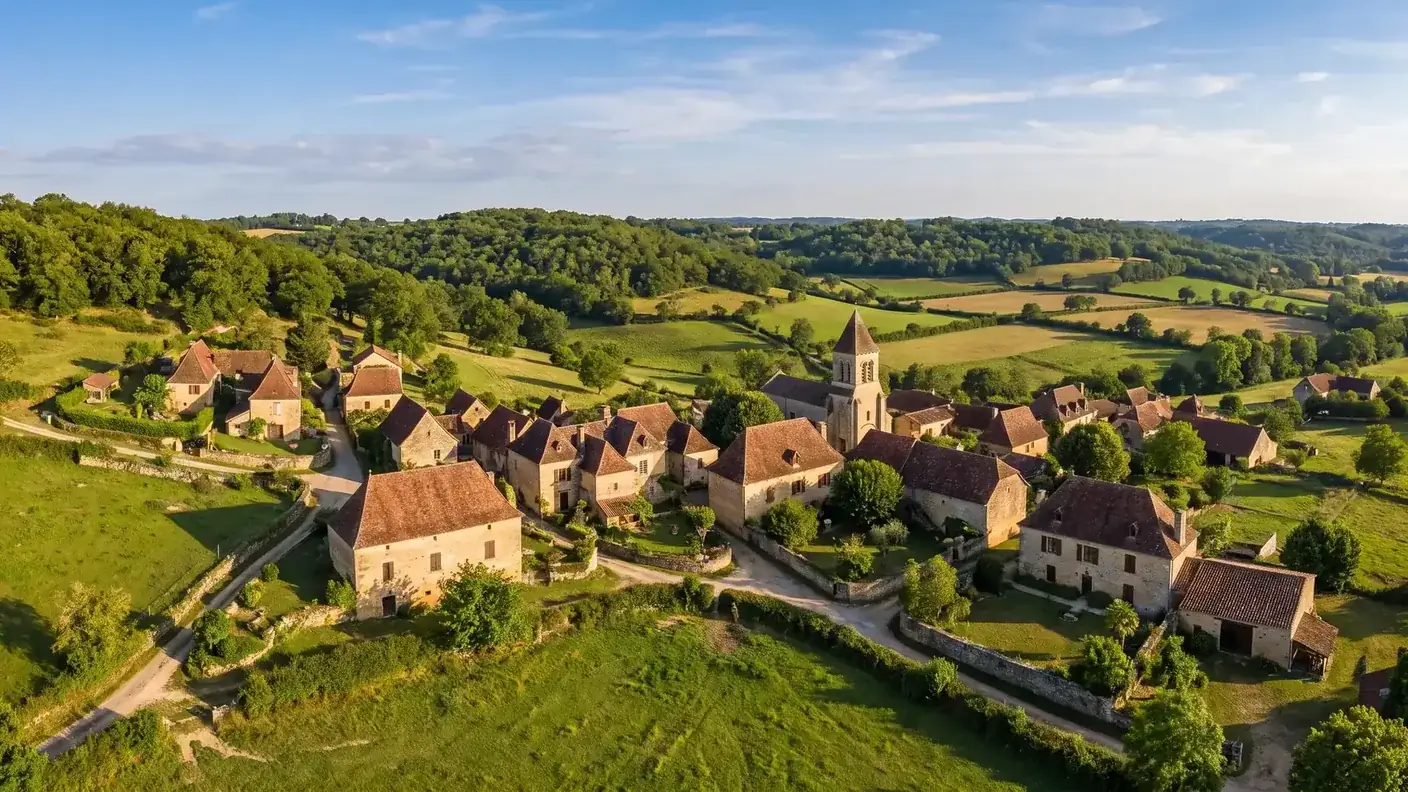
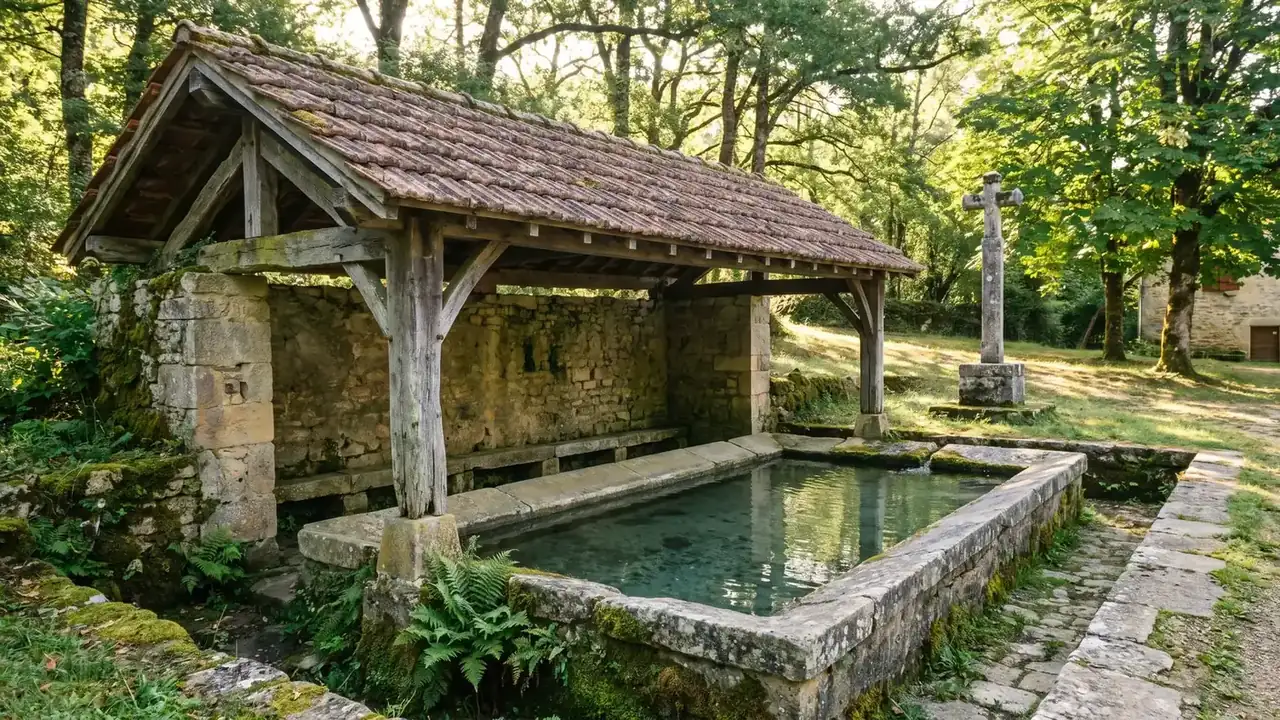
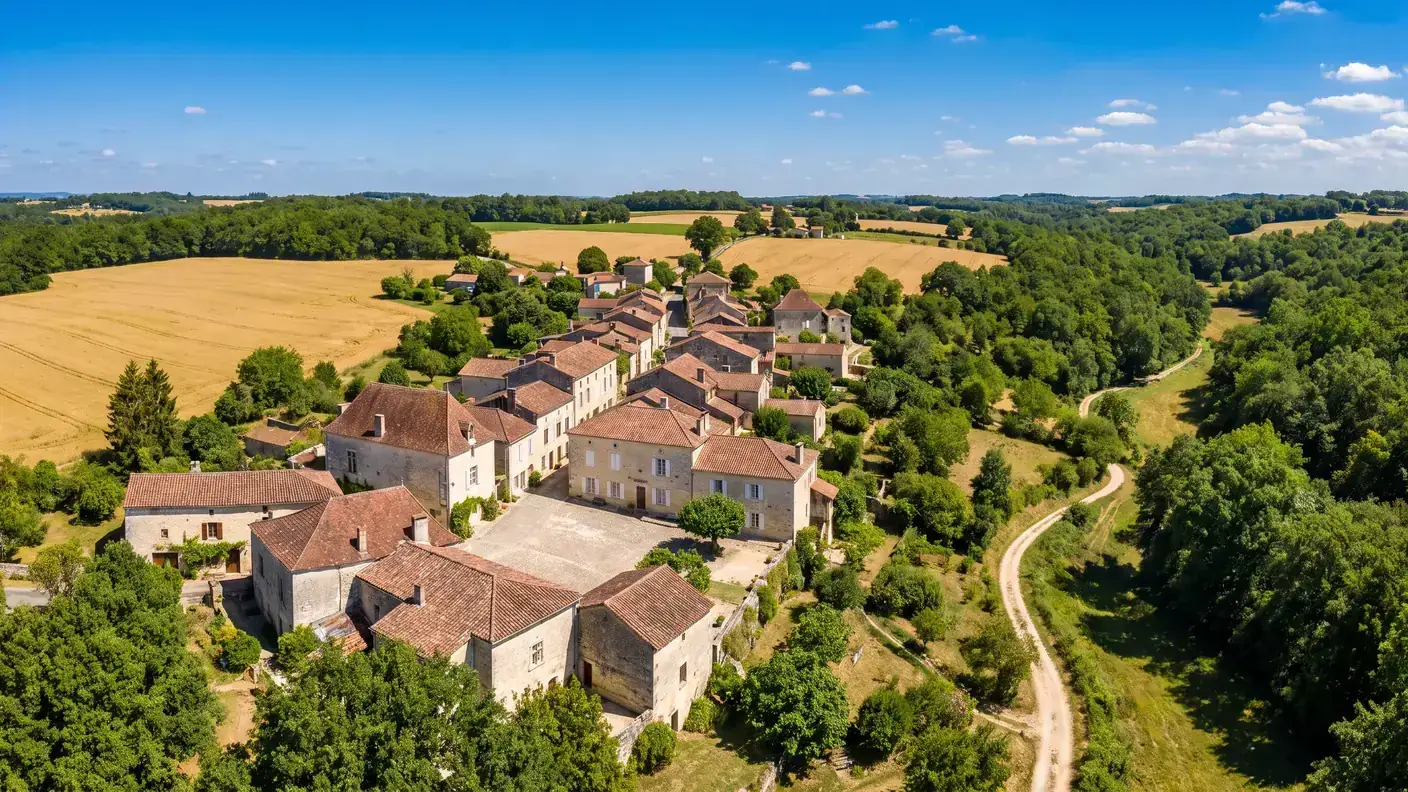
Saint-Privat-des-Prés is a village in the Ribéracois, on the border between the Dordogne and the Charente. Its appeal lies almost entirely in one monument: its fortified Romanesque church, one of the most remarkable in northern Périgord, a remnant of a once-powerful Benedictine priory. Surrounding it is a village that was once bustling (with more than 1,600 residents in the early 19th century) but is now peaceful, boasting a rich yet understated architectural heritage—fortified houses, castles, and a washhouse.
This guide distinguishes between verified information and copied information. One sometimes reads that the peak population was “1,317 in 1856” (that was already during the decline—the true peak was in 1800), that the Antonine commandery was “in Aubeterre” (it was actually in the neighboring town of Saint-Antoine-Cumond), or that the town’s status as a delegated municipality had been revoked (it is still in effect). We rely on solid evidence: the 1854 historic monument classification, the incorporation into Aurillac, and the inspection of 1304.
In terms of access, the village is off the beaten path and does not have a passenger train station. It’s accessible by road, about 1 hour and 29 minutes from Bordeaux. Check the available stations and stops in the official TER Nouvelle-Aquitaine directory before planning a connection. To explore the church and the Romanesque architecture of the Ribérac region at your own pace, or to combine your visit with a trip to nearby Aubeterre-sur-Dronne, a private chauffeur from Bordeaux remains the simplest door-to-door option.
A village in the Ribérac region, a delegated municipality since 2017
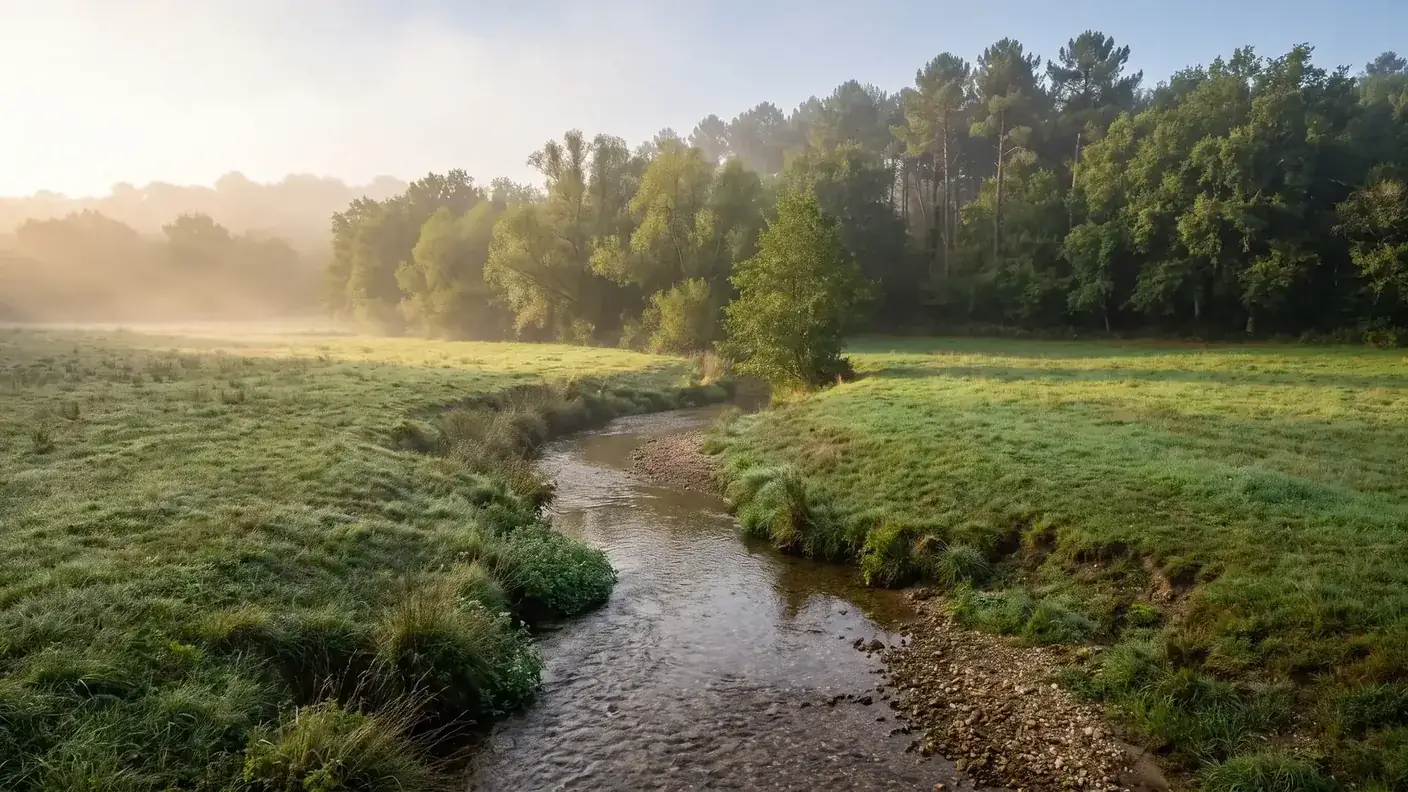
Saint-Privat-des-Prés is located in the northwestern quarter of the Dordogne department, in the Ribérac region, on the border with the Charente department (one of its neighboring municipalities, Bonnes, is actually already part of the Charente). The 19.63 km² territory features a typical rolling landscape—ranging from 35 to 132 meters in elevation—bordered to the south by the Rizonne River and to the east by its tributary, the Pontet, on the edge of the vast Double Forest.
Five neighbors, one of whom is already from Charente
In 2016, the last year of its existence as an independent municipality, Saint-Privat-des-Prés had five neighboring municipalities: Saint-Antoine-Cumond, Festalemps, Saint-Vincent-Jalmoutiers, Saint-Aulaye-Puymangou—and Bonnes. The latter has a distinctive feature that says everything about the village’s location: it is in Charente (department 16), not in Dordogne. Saint-Privat-des-Prés is therefore literally a commune straddling two departments, situated on the old road that connected Limousin to Bordeaux. This pivotal location explains a great deal: the Saintonge architectural influences from the west, the long-standing ties with Aubeterre-sur-Dronne on the Charente side, and that feeling, when traveling through the area, of constantly crossing from one region to another without any signs really indicating the change.
Delegated municipality since 2017
This point needs to be clarified, as it is prone to confusion. Saint-Privat-des-Prés existed as an independent municipality until December 31, 2016. Since January 1, 2017, it has been a delegated commune of the new municipality of Saint Privat en Périgord, formed by its merger with Festalemps and Saint-Antoine-Cumond (as announced on September 26, 2016). Saint-Privat-des-Prés remains its seat. Note the codes: “24410” is the ZIP code; the INSEE code is 24490 (that of the new municipality). The village is part of the Périgueux arrondissement, the Montpon-Ménestérol canton, and the Pays de Saint-Aulaye Community of Municipalities.
| Data | Value |
|---|---|
| ZIP Code / INSEE | 24410 / 24490 |
| Status | Delegated Municipality of Saint Privat en Périgord (2017) |
| Natural Region | Ribéracois (Dordogne) |
| Area | 19.63 km² |
| Elevation | 35 m to 132 m |
| Population | 565 residents (2014, former municipal boundaries) — the residents of Saint-Privat |
| All-time high | 1,666 residents (1,800) |
| Must-See | Fortified Romanesque church designated a historic monument (1854) |
Two Centuries of Rural Exodus: The Numbers Speak for Themselves
The demographic data reflects the rural exodus from the Périgord. Contrary to what is sometimes reported, the peak was not in 1856 (1,317 residents, already in decline) but in 1800, with 1,666 residents. INSEE recorded 565 residents in 2014 within the former municipal boundaries, prior to the merger. Subsequent data pertain to the new municipality and should not be directly compared to this local data series. This is a snapshot of rural France before mechanization, when each hamlet was home to large families living off mixed farming.
| Year | Population |
|---|---|
| 1793 | 1,430 residents |
| 1800 | 1,666 (all-time high) |
| 1856 | 1 317 |
| 1921 | 693 (low point after World War I) |
| 2016 | 530 (last year as an independent municipality) |
| 2019 | 565 (2014, previous scope) |
An illuminating detail: the sharpest decline was not caused by the wars of the 20th century. Between 1800 and 1806, the municipality had already lost more than 200 residents—well before 1914. This is a sign that the rural population had reached a peak in the early 19th century that the countryside could no longer sustain over the long term. The figures published after the merger pertain to the new municipality of Saint Privat en Périgord as a whole; for the former Saint-Privat-des-Prés area, the latest comparable data provided by INSEE is from 2014.
Saint Privat, a martyred bishop — and “des Prés” in 1993
The village's name honors Saint Privat, the first bishop of Mende, in Gévaudan (now Lozère), who was martyred in 3rd century. The account, as reported by Gregory of Tours, places the events around 255–260: Gaul was invaded by the Alamanni; Bishop Privat, who had taken refuge in a cave, was captured and ordered to hand over his people, who had taken refuge in the fortress of Grèzes. He refused, was beaten severely, and died of his injuries. His feast day is celebrated on August 21, and he remains the patron saint of the Diocese of Mende. His veneration, spread through monastic networks, explains why a priory in the Périgord—hundreds of kilometers from Mende—was dedicated to him.
A story to be read as a tradition
We need to be honest about the sources here: this account falls under the category of hagiographic tradition more than just documented history. The dates themselves (around 255–260) are, as historians admit, unreliable, and the existence of the Alemannic chieftain Chrocus, who is said to have led the invasion, has never actually been proven. Gregory of Tours, our main source, simply writes that Privat was “bishop of the land of the Gabales”—that is, of the Gévaudan —, although the seat of Mende had not yet been formally established at that time. What is certain, however, is the popularity of the cult: Saint Privat, a figure of the a good shepherd who refuses to hand over his people, has spread throughout southern France. Its feast day, the August 21, has even left its mark on the village’s Occitan folk wisdom: “ Per Sent Privat, the streams flow through the valleys ", says the local proverb—one of those calendar sayings that linked each saint to a specific time of the farming year.
"Des Prés": Added in 1993
What is less well known is that the village was simply called "Saint-Privat" for centuries. It was not until 1993 (decree of October 7, published in the Official Journal on October 14) that it officially became “Saint-Privat-des-Prés”—a geographical qualifier intended to distinguish it from the many other French municipalities with the same name (there are several Saint-Privats, notably in Lozère and Corrèze). In Occitan, the village is called Sent Privat in Prats.
A listed Benedictine priory and a visit by a future pope
This monument has made the village famous far beyond the Ribérac region. The Church of Saint-Privat is a fortified Romanesque church that has been listed as a Historic Monument since 1854. Originally, it was not simply a parish church, but a Benedictine conventual priory, built in the first half of the 12th century, first mentioned in writing in 1180 in the cartulary of La Sauve-Majeure Abbey, near Bordeaux.
A remote outpost of Aurillac
Notable fact: The prior of Saint-Privat held the right of collation for the Abbot of Aurillac — that is, Saint-Géraud Abbey in Aurillac, in the Cantal department, more than 200 km away, which appointed the prior of that monastery. This connection is confirmed by a Bull of Pope Nicholas IV (circa 1289), attesting that Sanctus Privatus is clearly linked to Saint-Géraud. Historian Jean Secret, a leading expert on the churches of the Périgord, has pointed out that a church of this size in such a small village can only be explained by its affiliation with a powerful monastic order. Saint-Privat is, in fact, among the rare churches with side aisles (side aisles) of the Périgord—all of them, without exception, of monastic origin.
This 1289 papal bull, incidentally, gives an idea of the scope of the network of which the village was a part: Nicholas IV confirmed the following to the Abbey of Aurillac more than one hundred priories, spread across seventeen dioceses. Saint-Privat was thus merely one link—albeit a strong one—in a monastic network spanning the entire south of France, from the Cantal to the borders of Saintonge. For a 13th-century traveler, this priory in the Ribérac region was a recognized stop along a much broader network, with its flow of monks, priors appointed from Aurillac, and revenues that flowed back to the mother abbey. It is this status—and not the size of the town—that explains the church’s almost unreasonable scale.
1304: Bertrand de Got's Visit
One event gives the place special significance. In 1304, Bertrand de Got, then Archbishop of Bordeaux, visited the priory of Saint-Privat during a pastoral tour of the Diocese of Périgueux (the report of this inspection was published in the Bulletin of the Historical and Archaeological Society of Périgord in 1885). The following year, in 1305, this same Bertrand de Got—born near Villandraut, in Gironde—became Pope Clement V, the man who would establish the papacy in Avignon. The future pontiff thus passed through this rural priory in the Ribérac region while still a mere archbishop.
The timeline is worth clarifying, as it gives the episode its full flavor. Bertrand de Got, born around 1264 near Villandraut, was elected pope on June 5, 1305 — barely a year after his stay in Saint-Privat — and would not settle permanently in Avignon until March 9, 1309. So it really is a Pope from the Gironde region, who was familiar with this region between Bordeaux and Périgord and who had surveyed the priory: his 1304 pastoral tour of the Diocese of Périgueux was nothing out of the ordinary for an archbishop of Bordeaux, but the twists of history made it, in retrospect, the visit of a future pope. The account of this inspection, unearthed by the scholar Augustin Charbonnel and published in 1885 The Bulletin of the Historical and Archaeological Society of Périgord provides a detailed account of this.
Three centuries of stone and an eight-arched gateway
The church's architecture tells the story of a building constructed in three phases. From the early 12th century date from the south wall and the north wall of the transept; from the late 12th century, the rest of the building; and the early 14th century, on the eve of the Hundred Years' War, the fortified upper part—of the defense chambers built above the vaults and accessible via a spiral staircase. It is this later phase that gives the church its fortress-like appearance.
1563: The Fire of the Wars of Religion
The church went through dark times. Blaise de Monluc, the famous Catholic captain, is recorded as having been in Saint-Privat in 1562; the following year, in 1563, the building was set on fire during the Wars of Religion, and the bell tower that stood at the crossing was destroyed (its base can still be seen beneath the current roof). It was not until the 17th century that a major reconstruction took place, carried out between 1632 and 1651: the vaults of the nave were rebuilt, likely in the same style as those that had been destroyed.
The Saintonge-style façade and its eight arches
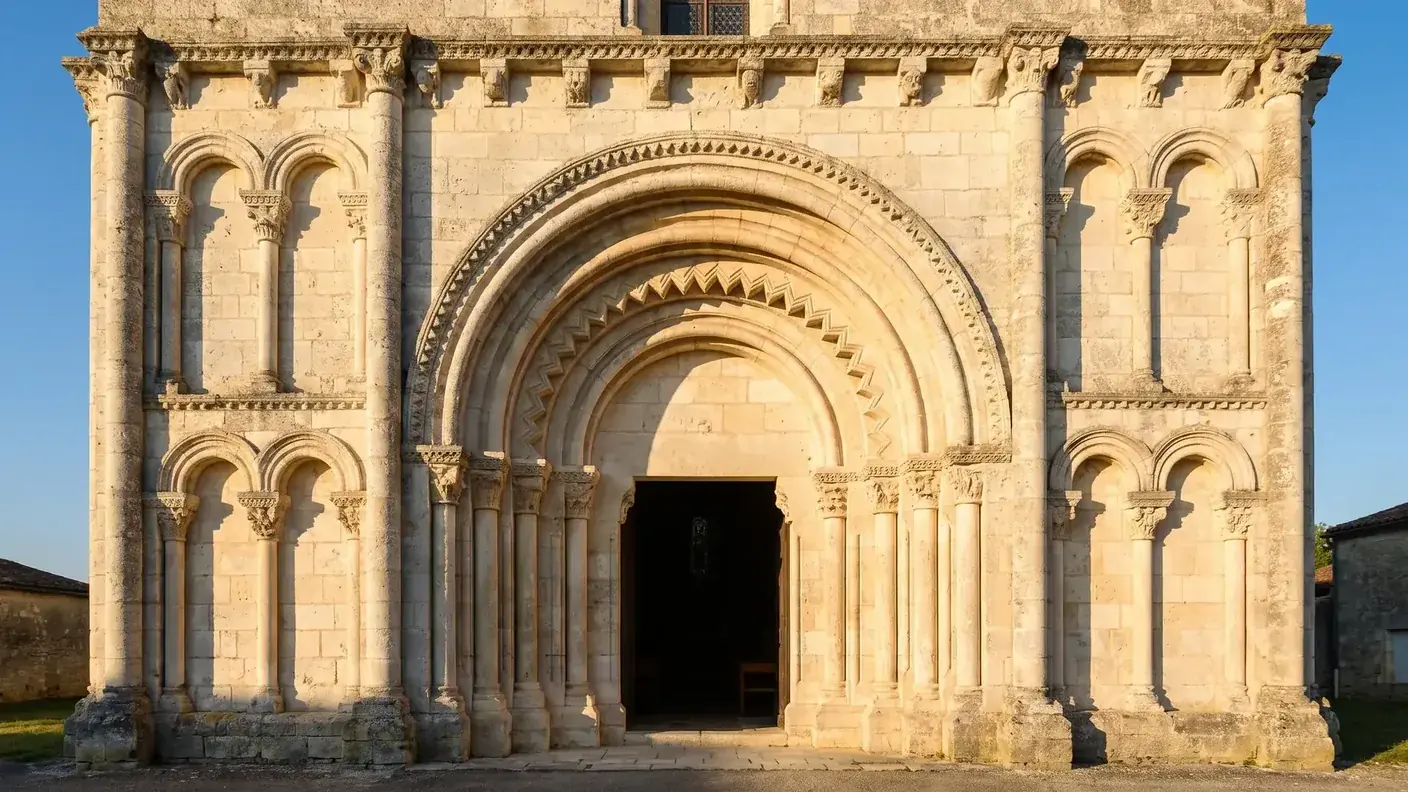
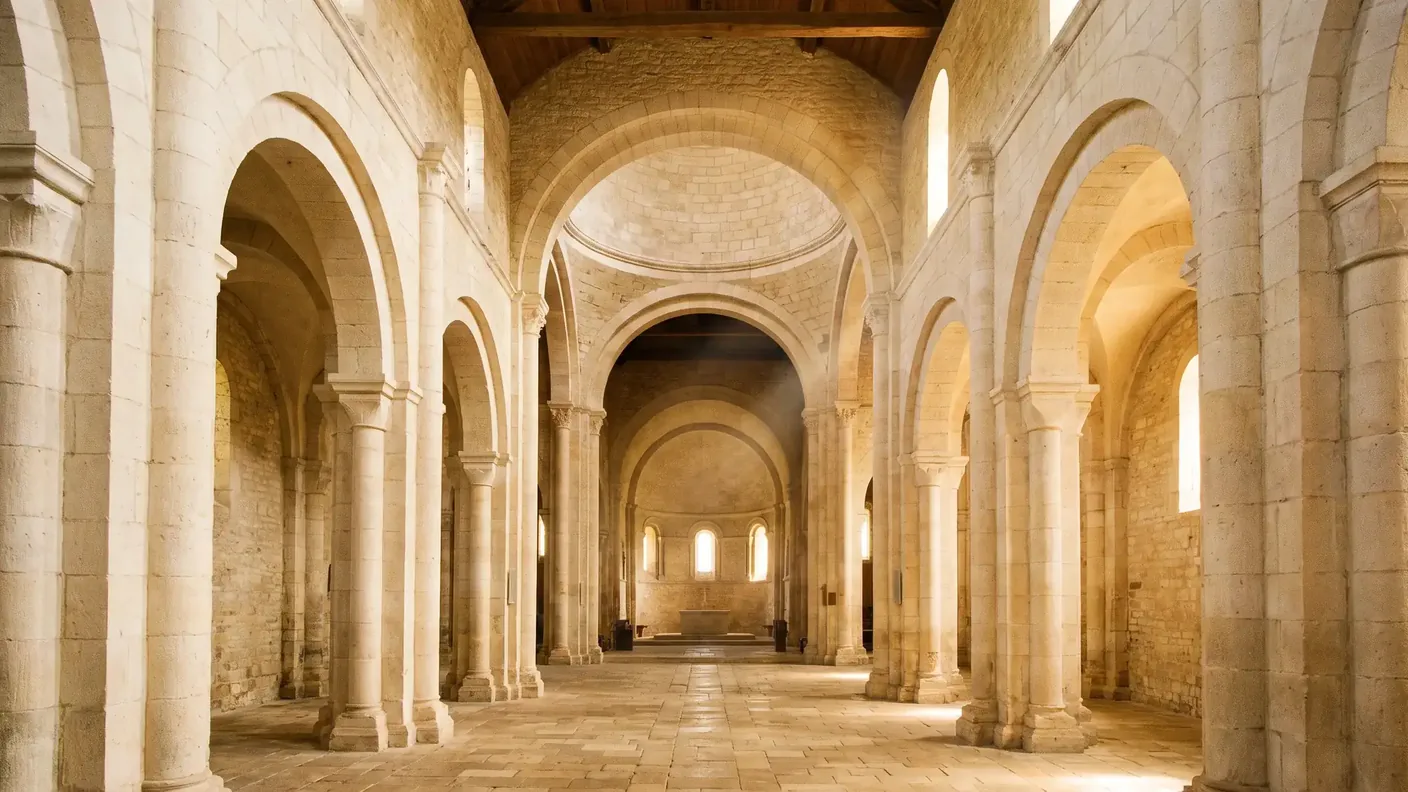
The highlight of the tour is still the west facade, such as Saintonge novel — this style, which originated in Saintonge (now Charente-Maritime), has spread widely throughout northern Périgord and the Charente. It is notable for its thickness: three meters, enough to create an internal defensive corridor. Its monumental gate consists of eight arches semicircular arches, decorated in turn with toruses, grooves, and sawtooth motifs—a decorative style also found in the abbey church of Aulnay-de-Saintonge and the church of Rioux. The stone, heavily eroded, had lost almost all of its decorative motifs; the façade was Fully restored in 1998 by the Compagnons du Devoir, who redesigned the interior to be consistent with the regional architectural style. The building is 34.78 m long by 11.80 m wide, with a nave consisting of three bays with broken barrel vaults, flanked by two narrow side aisles.
A two-date ranking
A little administrative trivia to wrap things up: even the official sources themselves are unsure of the exact date of the listing. The Ministry of Culture’s Mérimée database mentions both a Classification Notice of July 24, 1854 and a classification according to the 1862 list, whereas the General Inventory lists 1854. The most consistent interpretation is that 1854 corresponds to the notice initial and 1862 to the list which ratified it. Regardless of the date chosen, the essential fact remains: the church has been listed among protected monuments since the very first classification campaigns of the 19th century, at a time when Mérimée’s France was discovering and preserving its Romanesque heritage—a testament to its significance for a village church.
Furniture inherited from the Antonine Commandery
Little-known fact: Some of the church's furnishings do not come from the Benedictine priory itself, but from the Commandery of the Antonines — the Hospital Order of Saint Anthony, which treated, among other things, “mal des ardents.” This commandery was located in a place called Mirand—not in Aubeterre, as is sometimes stated, but in the neighboring town of Saint-Antoine-Cumond (on the Périgord side). Sold as national property during the Revolution, its church was destroyed by fire in 1830—which explains why its furnishings were moved to Saint-Privat.
The tau, the symbol of the Hospitallers
The church thus features a 17th-century altar (in the north apse, surmounted by a polychrome wooden statue of the Virgin and Child bearing the Antonine tau—the “T” symbolizing the crutch used by the infirm whom they cared for), an 18th-century altar, an octagonal baptismal font decorated with acanthus leaves, and a holy water font carved from a Gallo-Roman column. The church also houses two paintings—a Christ on the Cross and a Stations of the Cross—by the painter Louis-Jean Beaupuy (1896–1974), who lived in Saint-Privat and trained under Fernand Cormon at the École des Beaux-Arts in Paris.
This Beaupuy is worth taking a moment to consider. Born in Elbeuf, Normandy, in 1896, he trained in the studio of Fernand Cormon—the master who trained an entire generation of painters in Paris—and spent the final years of his life in Saint-Privat, where he died in 1974. His Stations of the Cross is not a single painting but a complete series of stations that punctuate the church walls, creating a curious dialogue with the Antonine Order’s antique furnishings. As for the tau marking the Virgin in the north apse, it is not a decorative ornament: this “T” was the very emblem of the Order of Saint Anthony, symbolizing the crutch of the infirm whom the hospitaller brothers cared for. It is this symbol that authenticates, better than any document, the hospitaller origin of this statue—the discreet signature of a vanished order.
Fortified Houses and Castles: A Low-Key Civil Heritage
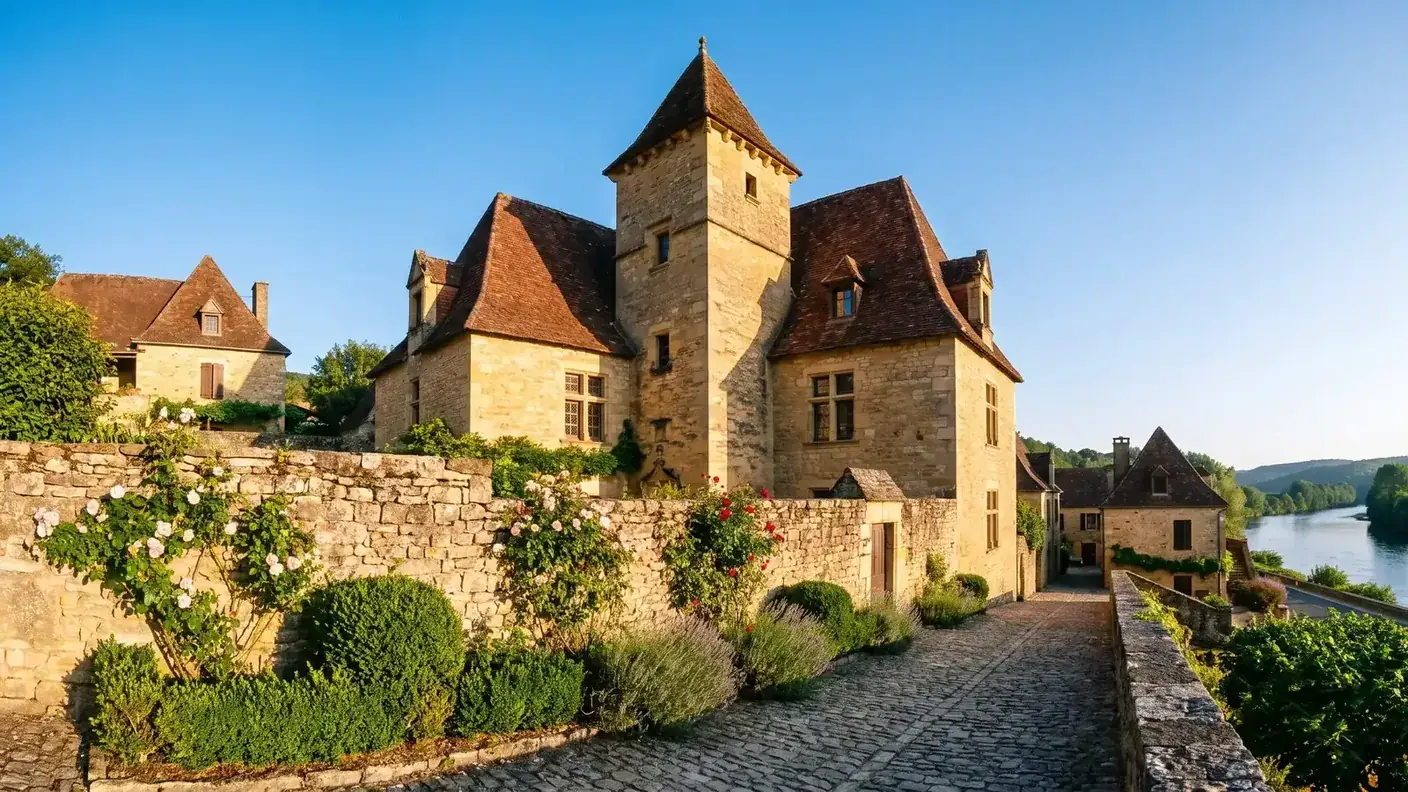
Beyond the church, the village still has several mansions that bear witness to its feudal past. The Château de la Mothe dates from the 13th century and was remodeled in the 17th century. In the heart of the village stands an 18th- and 19th-century residential castle, set in a remarkable landscaped park. A little further on, the Château de la Meynardie (early 17th century) long served as a hospital.
Two “priories” that should not be confused
We need to clear up a common misunderstanding here. Behind City Hall stands a 13th-century fortified house, traditionally known as “ Priory of Saint-Privat ", featuring a distinctive tall dovecote tower. But the A genuine Benedictine priory stood next to the church itself: this fortified house, despite its name, is separate from it (it was likely connected to the outbuildings of the priory estate). On the square, a small Village Life Museum preserves the memory of traditional rural customs in the Ribérac region.
Olympic medalist dies in the village
Fun fact: An Olympic champion died in this village. Boxer Xavier Eluère (1897–1967), who passed away in Saint-Privat, was the French heavyweight champion and won the bronze medal at the 1920 Olympic Games in Antwerp — an unexpected sporting triumph for such a small village.
Eluère was at the pinnacle of French boxing in the immediate postwar period: French heavyweight champion in 1920 and again in 1921, he stood on the Olympic podium in Antwerp the same year he won his first national title. That such an athlete chose to spend his final years in this village in the Ribérac region adds a unique touch to the local heritage—just as, in fact, as does the Château de la Meynardie, located about 1.5 km east of the village, whose role as a hospital continues, in its own way, four centuries later, the tradition of care once embodied by the Antonines of the neighboring commandery.
What to See Around Saint-Privat-des-Prés
Saint-Privat-des-Prés is an ideal base for exploring a little-known area, at the crossroads of the Ribéracois (Périgord) and the Charente — one of its neighboring towns, Bonnes, is, in fact, already part of the Charente region. The large La Double Forest, with its pine trees, chestnut trees, and ponds, stretches out nearby, while the Dronne valley and its stone villages stretch southward. Here are the actual driving distances from the village:
| Destination | Distance / time from Saint-Privat | Interest |
|---|---|---|
| Aubeterre-sur-Dronne | ~8 km · ~10 min | "Most Beautiful Villages of France," underground monolithic church (the largest in Europe) |
| Saint-Aulaye | ~10 km · ~13 min | Bastide-sur-la-Dronne, seat of the intermunicipal authority, recreation center |
| Ribérac | ~12 km · ~15 min | Capital of the Ribérac region, home to a large Friday market, and birthplace of Arnaut Daniel |
| Chalais | ~15 km · ~18 min | Talleyrand-Périgord Castle (Charente) |
| Bergerac | ~45 km · ~50 min | Cyrano, the Old Town, vineyards, and gabarres |
| Périgueux | ~55 km · ~1 hr | Gallo-Roman Vesunna, Saint-Front Cathedral |
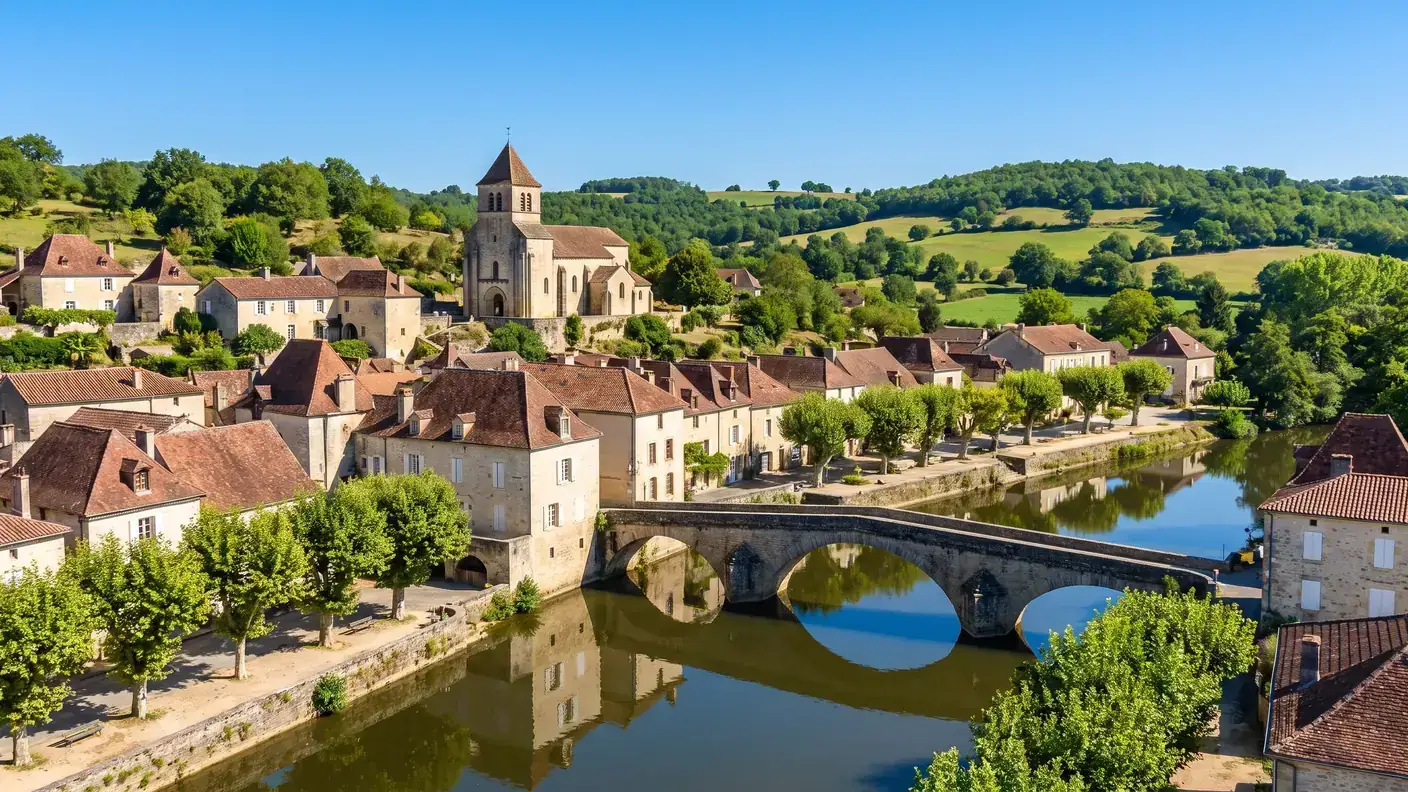
Aubeterre-sur-Dronne, just a quarter of an hour away, is an instant favorite: its white houses terraced along the cliffside, listed among the Most Beautiful Villages of France, and above all its monolithic Saint-Jean Church, entirely carved out of the rock—the largest underground church in Europe. More broadly, the Ribérac region is home to Romanesque churches with domes, a collection of 12th-century buildings that you’ll discover as you travel from village to village. It’s an authentic countryside, far from the major tourist crowds of the Périgord Noir.
Getting to Saint-Privat-des-Prés from Bordeaux
About 97 km by road from Bordeaux, or about 1 hour and 29 minutes depending on traffic conditions. The village is off the beaten path and has no train station: the nearest one is in Ribérac, about 12 km away, but it no longer serves passengers. Access is therefore by road.
| Fashion | Duration | Estimated cost | Details |
|---|---|---|---|
| Chauffeur service (executive car service) | ~1h29 | Starting at €170 · one-way | Door-to-door service from Bordeaux, with stops as desired (Aubeterre, Ribérac) |
| Personal car | ~1h29 | Cost varies depending on the vehicle, fuel, and route | Via the A89 or the roads through the Ribérac region |
| Train + Transfer | 2 hours 30 minutes+ | variable | No nearby passenger train station; driving is required |
If you're coming from Bordeaux to explore the church and discover this part of the Ribérac region — Aubeterre-sur-Dronne, one of the most beautiful villages in France, is about 8 km away — if you don’t want to rely on a car, a chauffeured transfer from Bordeaux offers the easiest door-to-door service at a flat rate starting at €170 one way.
Practical Information and the Surrounding Area
- Recommended duration: a short stop—the fortified Romanesque church (the portal, the interior, and the Antonins’ furnishings) and the museum of village life are reason enough to make the detour.
- Must-see attractions: the priory church, a listed historic monument, with its Saintonge-style façade featuring eight arches; the museum of village life; and the fortified houses in the town center.
- Combine this visit with: Aubeterre-sur-Dronne (~8 km, one of the "Most Beautiful Villages of France," with a monolithic church), Ribérac (~12 km, featuring a large Friday market), and the Romanesque region of Ribérac.
- Nature: the Rizonne Valley and the edge of the Double Forest, a landscape of pine and chestnut trees and ponds.
- Transportation: The village does not have a passenger train station; check the regional bus schedules for your chosen date, then plan for the final few kilometers.
- Please note: For any administrative matters, you should contact the town hall of Saint Privat en Périgord (new municipality); Saint-Privat-des-Prés is its seat.
Frequently Asked Questions
Is Saint-Privat-des-Prés still a municipality in its own right?
No. Since January 1, 2017, Saint-Privat-des-Prés has been a delegated commune of the new commune of Saint Privat en Périgord, formed by its merger with Festalemps and Saint-Antoine-Cumond. It remains the seat of the commune. Note the codes: 24410 is the ZIP code, but the INSEE code is 24490.
Where does the name Saint-Privat-des-Prés come from?
It honors Saint Privat, the bishop of Mende who was martyred in the 3rd century by the Alemanni in Gévaudan. For centuries, the village was simply called “Saint-Privat”; the suffix “des Prés” was added only in 1993, by decree, to distinguish it from other French municipalities with the same name.
Why is the church in Saint-Privat-des-Prés designated as a historic monument?
Because it is an exceptional fortified Romanesque church, a remnant of a 12th-century Benedictine priory affiliated with the Abbey of Saint-Géraud in Aurillac. Its Saintonge-style Romanesque façade, its eight-arched portal, and its architecture, which evolved in three distinct phases, justify its designation as a historic monument as early as 1854.
Who visited the priory of Saint-Privat in 1304?
Bertrand de Got, then Archbishop of Bordeaux, visited the priory in 1304 during a pastoral tour. Born near Villandraut, in Gironde, he became Pope Clement V the following year—the pope who would establish the papacy in Avignon. In 1304, therefore, he was still only an archbishop.
How many people live in Saint-Privat-des-Prés?
According to INSEE, the former municipal area had 565 residents in 2014. Since the 2017 merger, the official figures refer to the new municipality of Saint Privat en Périgord; therefore, they should not be presented as the population of the delegated municipality alone.
What remains of the original Benedictine priory?
The priory ceased to exist during the Revolution. All that remains is the Church of Saint-Privat, its former convent church, which has become the parish church. A nearby fortified house, known as the “Priory of Saint-Privat,” still stands near City Hall—but the actual priory building was adjacent to the church.
Where does the furniture at the Antonine Commandery come from?
The church houses furnishings from the commandery of the Hospitaller Order of Saint Anthony, located in the hamlet of Mirand, in the neighboring town of Saint-Antoine-Cumond (and not in Aubeterre). Sold during the Revolution and then destroyed by fire in 1830, the commandery bequeathed to Saint-Privat a statue of the Virgin Mary bearing the Antonine tau symbol.
What is the distance between Saint-Privat-des-Prés and Bordeaux?
About 97 km by road from Bordeaux, or about 1 hour and 29 minutes depending on traffic conditions. With a private chauffeur, the door-to-door trip starts at €170 one way. The village does not have a train station: the nearest one, Ribérac (~12 km), no longer serves passengers.
Can you get to Saint-Privat-des-Prés by train?
Not directly: the village doesn't have a train station. The most convenient option is to hire a chauffeur service from Bordeaux, which avoids driving on the rural roads of the Ribérac region and allows you to combine your visit with a trip to nearby Aubeterre-sur-Dronne.
What's there to see around Saint-Privat-des-Prés?
Aubeterre-sur-Dronne (~8 km, one of the “Most Beautiful Villages of France,” with an underground monolithic church), Ribérac and its large Friday market (~12 km), the Romanesque domed churches of the Ribérac region, and the Double Forest. An authentic rural area, at the crossroads of the Périgord and the Charente.
Why is there such a large church in such a small village?
Because it was not originally a parish church, but rather the church of a powerful Benedictine priory affiliated with the Abbey of Saint-Géraud in Aurillac—whose network included more than one hundred priories spread across seventeen dioceses. The historian Jean Secret summed it up: a church of this scale, with side aisles, can only be explained by its affiliation with a powerful monastic order.
What is the Hospitaller Order of Saint Anthony (the Antonines)?
A medieval religious order specializing in the care of the sick, particularly those suffering from “mal des ardents” (ergotism). Its emblem was the tau, a “T” symbolizing the crutch of the infirm. The furnishings from its neighboring commandery in Saint-Antoine-Cumond were transferred to Saint-Privat after the Revolution—hence the Virgin with the tau preserved in the church.
Did a future pope really visit Saint-Privat-des-Prés?
Yes. In 1304, Bertrand de Got, Archbishop of Bordeaux and a native of the Gironde, visited the priory during a pastoral tour. The following year, in 1305, he was elected pope under the name Clement V and moved the papacy to Avignon. So in 1304, he was still only an archbishop, not a pope.
Further Reading
- The capital of the Ribérac region, about 12 km away: see the Ribérac Guide (Arnaut Daniel, large Friday market)
- A village near Ribérac: see the Guide to Verteillac (shared seigneury, the La Brousse family)
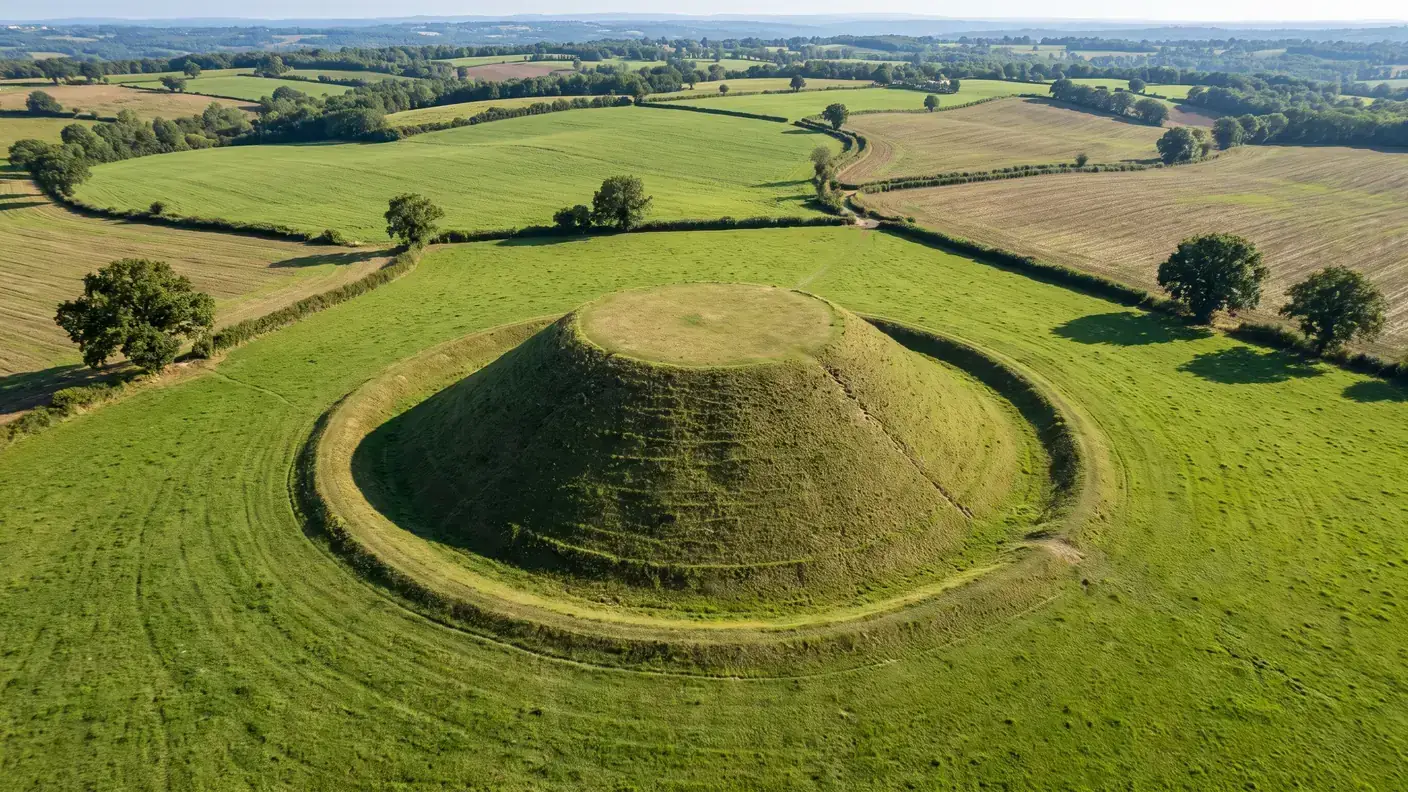
- The castle mound on the outskirts, just nearby: see the Guide to La Chapelle-Grésignac
- The 2,000-Year-Old Prefecture: See the Guide to Périgueux (Vesunna, Saint-Front)
- Further north, the capital of the Limousin region: check out the guide to Limoges, from the train station to the porcelain
- Plan your journey: Book an executive car service from Bordeaux to Saint-Privat-des-Prés or explore all our destinations
Sources and References
- Wikipedia — Saint-Privat-des-Prés — Geography, Status, Demographics, Heritage
- Wikipedia — Saint-Privat Church — priory, architecture, Saintonge-style façade, furnishings
- POP/Mérimée Database — Saint-Privat Church — Listed as a Historic Monument (1854 list, 1862 entry)
- POP/Mérimée Database — Village of Saint-Privat-des-Prés — Village Inventory, Fortified Houses
- Wikipedia — Privat of Mende — Saint Privat, a 3rd-century martyr bishop
- Wikipedia — Clement V — Bertrand de Got, Archbishop of Bordeaux, Pope in 1305
- SHAP Bulletin (1885) — visit of 1304 — report on the archiepiscopal inspection of the priory
Article published on .
On the Way to the Romanesque Region of Ribérac
Direct trip from Bordeaux (~1 hr 29 min) to the Ribérac region, with stops along the way as desired—Aubeterre-sur-Dronne, Ribérac, the Dronne Valley. Written fixed-price quote within 30 minutes; sedan or 8-passenger van; English-speaking driver.