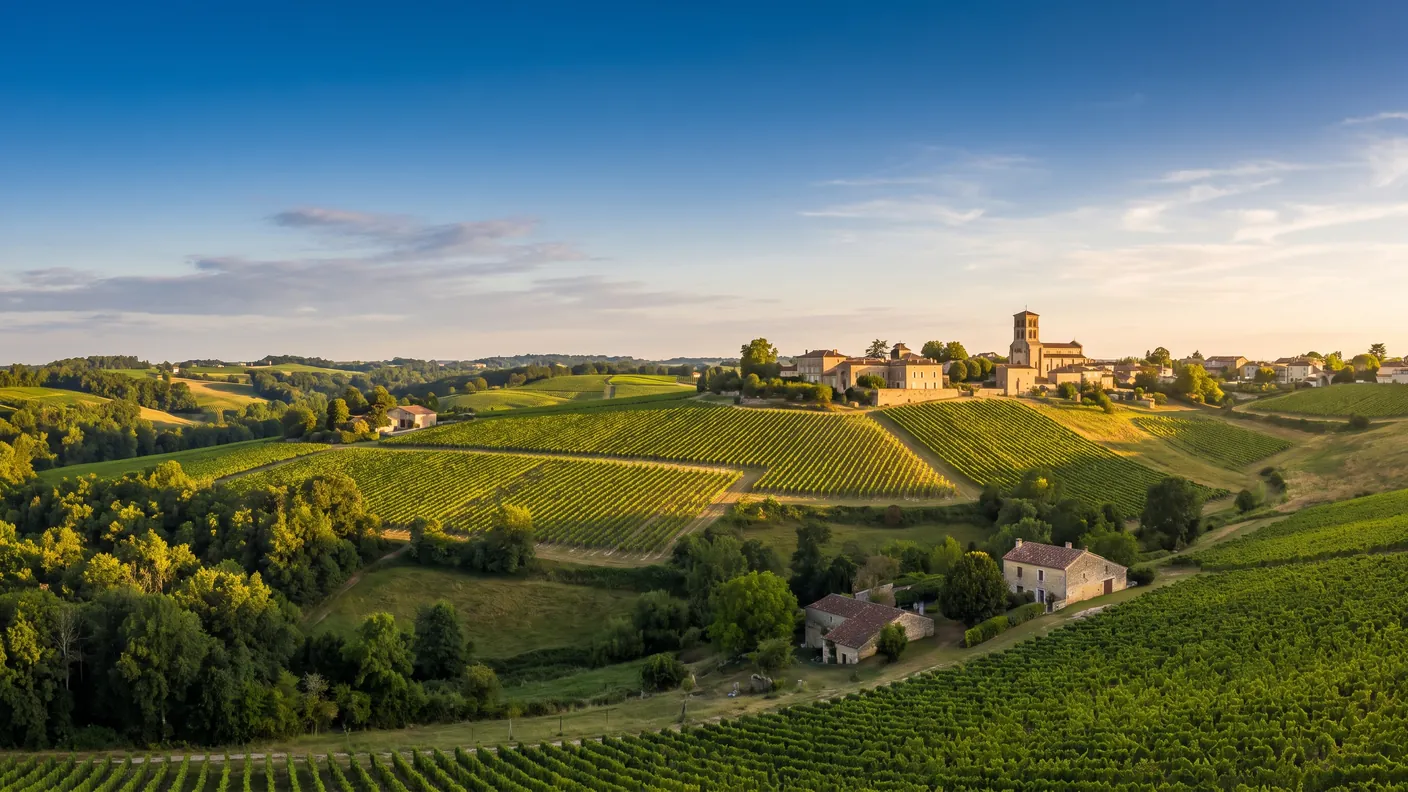
Sainte-Radegonde from Bordeaux: a listed Romanesque church and vineyards
A wine-growing village in the Entre-deux-Mers region, just outside Castillon, centered around a remarkable, listed Romanesque church: Sainte-Radegonde, with its carved tympanum depicting pilgrims on the Way of St. James, its Entre-deux-Mers and Bordeaux Supérieur wines—and your private door-to-door transfer from Bordeaux, without having to rent a car.
Sainte-Radegonde at a Glance
Sainte-Radegonde is a small wine-growing village in the Gironde department, in the Entre-deux-Mers region, about eight kilometers south of Castillon-la-Bataille and some 62 km east of Bordeaux. It is home to vineyards producing Entre-deux-Mers and Bordeaux Supérieur wines, and, above all, a remarkable Romanesque church listed as a Historic Monument, whose carved portal has inspired many pilgrims.
This guide distinguishes between verified and repeated information: the church is indeed classified (and not merely listed); it features a carved tympanum rather than frescoes; its bell tower is not “fortified”; and the village is traversed by the Lestage and Turon-Gabardon streams (not the Gamage). We then outline the easiest way to get there from Bordeaux: a private door-to-door transfer, without renting a car.
Here are the key details to know before you go. Distances are calculated door-to-door from Bordeaux; the price listed is for a private driver reservation at a fixed rate provided in advance, with no unexpected meter charges regardless of traffic or stops. Information on cultural heritage sites is verified using the Mérimée database, INSEE, and the Castillon-Pujols tourist office; opening hours may vary and should be confirmed on site.
This guide aims to distinguish between verified information and information that is simply repeated from site to site: we prioritize primary sources—Mérimée, INSEE, and tourist offices—and we honestly point out areas of uncertainty rather than making hasty conclusions. In a small village like Sainte-Radegonde, where documentation is scarce, this is the best way to do the place justice.
| Landmark | Details |
|---|---|
| Village | Sainte-Radegonde (Gironde, Libourne District) |
| Location | Entre-deux-Mers, about 8 km south of Castillon-la-Bataille |
| Residents | 408 Residents of Sainte-Radegonde (2023) · 12.48 km² |
| Must-See | the Romanesque church Sainte-Radegonde (a listed historic monument), the Entre-deux-Mers vineyards |
| Distance from Bordeaux | about 62 km · about 1 hour and 8 minutes by car |
Where is Sainte-Radegonde located?
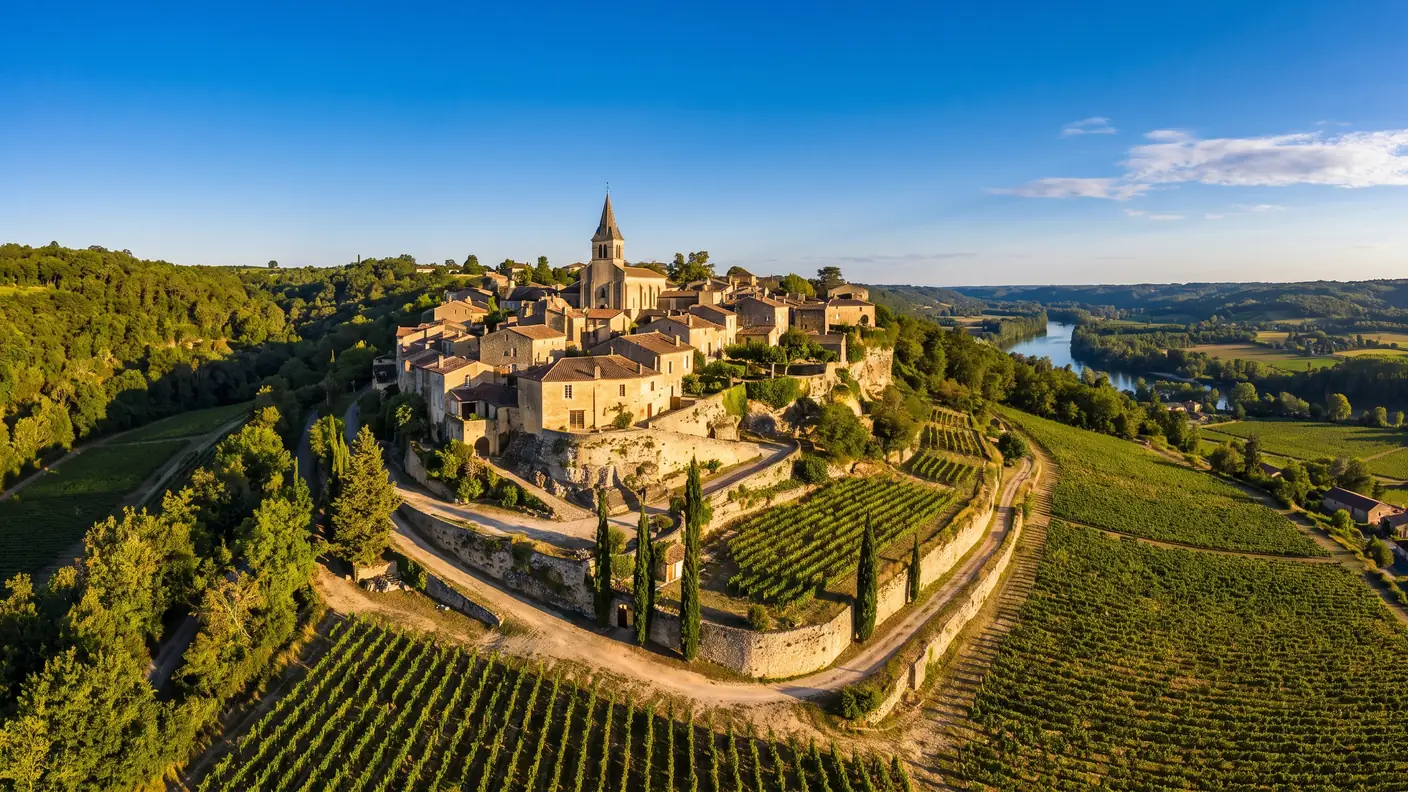
Sainte-Radegonde is located in the eastern part of the Gironde department, in the Entre-deux-Mers region, on the hillsides that slope down toward the Dordogne Valley, eight kilometers south of Castillon-la-Bataille. It is a region of vineyards, hillsides, and small streams: the Entre-deux-Mers wine region, the hills rising in terraces from 9 to 118 meters in elevation, and the Lestage and Turon-Gabardon valleys. According to INSEE, the village had a population of 408 in 2023 and is part of the Libourne district, the Coteaux de Dordogne canton, and the Castillon-Pujols community of municipalities.
We’re in a quiet, rolling countryside here, away from the main roads, between the Castillon vineyards to the north and the Sauveterrois vineyards to the south. The official “Entre bois et vignes” route starts at Sainte-Radegonde and winds through these landscapes (Gironde Tourisme). A peaceful and authentic setting at the edge of a hillside, yet just over an hour from Bordeaux.
In the Entre-deux-Mers region, just outside Castillon
The village is part of the Entre-deux-Mers, a vast wine-growing plateau nestled between the Dordogne and the Garonne rivers, renowned for its dry white wines and rolling hills. Sainte-Radegonde is situated on its northeastern edge, a few kilometers from the Dordogne Valley and Castillon-la-Bataille, famous for the 1453 battle that ended the Hundred Years’ War. The rolling hills, typical of eastern Entre-deux-Mers, are perfectly suited to viticulture: the well-exposed slopes are planted with Bordeaux grape varieties, while the valleys are home to woods and streams.
It’s an ideal base from which to explore the surrounding area: Castillon and its nighttime show to the north, the prestigious Saint-Émilion to the west, and the bastides of the Sauveterrois region to the south. A winegrowing village in the heart of authentic Gironde, far from the crowds.
A village of hillsides and streams
Despite its small size, Sainte-Radegonde offers a lovely taste of the Entre-deux-Mers region: hillsides planted with grapevines, some valleys wooded areas and two small streams, the Lestage Stream and the Turon-Gabardon Stream — and not “la Gamage,” as is sometimes mistakenly stated. The settlements, scattered in hamlets along the ridge roads, are organized around the church and its fountain, at the very heart of the village. It is a landscape of unspoiled countryside, where you come across more rows of vines than cars, and where every hillside offers a view of the neighboring hills.
For visitors, it promises a peaceful stopover—between a wine cellar tour, a visit to the historic church, and a trip to Castillon or Saint-Émilion. There’s nothing ostentatious here: no spectacular monuments, no crowds, just first-rate Romanesque art, a welcoming vineyard, and unspoiled countryside, off the beaten path. This is precisely what appeals to those seeking the authentic Gironde. A genuine winemaking village, on a human scale.
The listed Romanesque church of Sainte-Radegonde
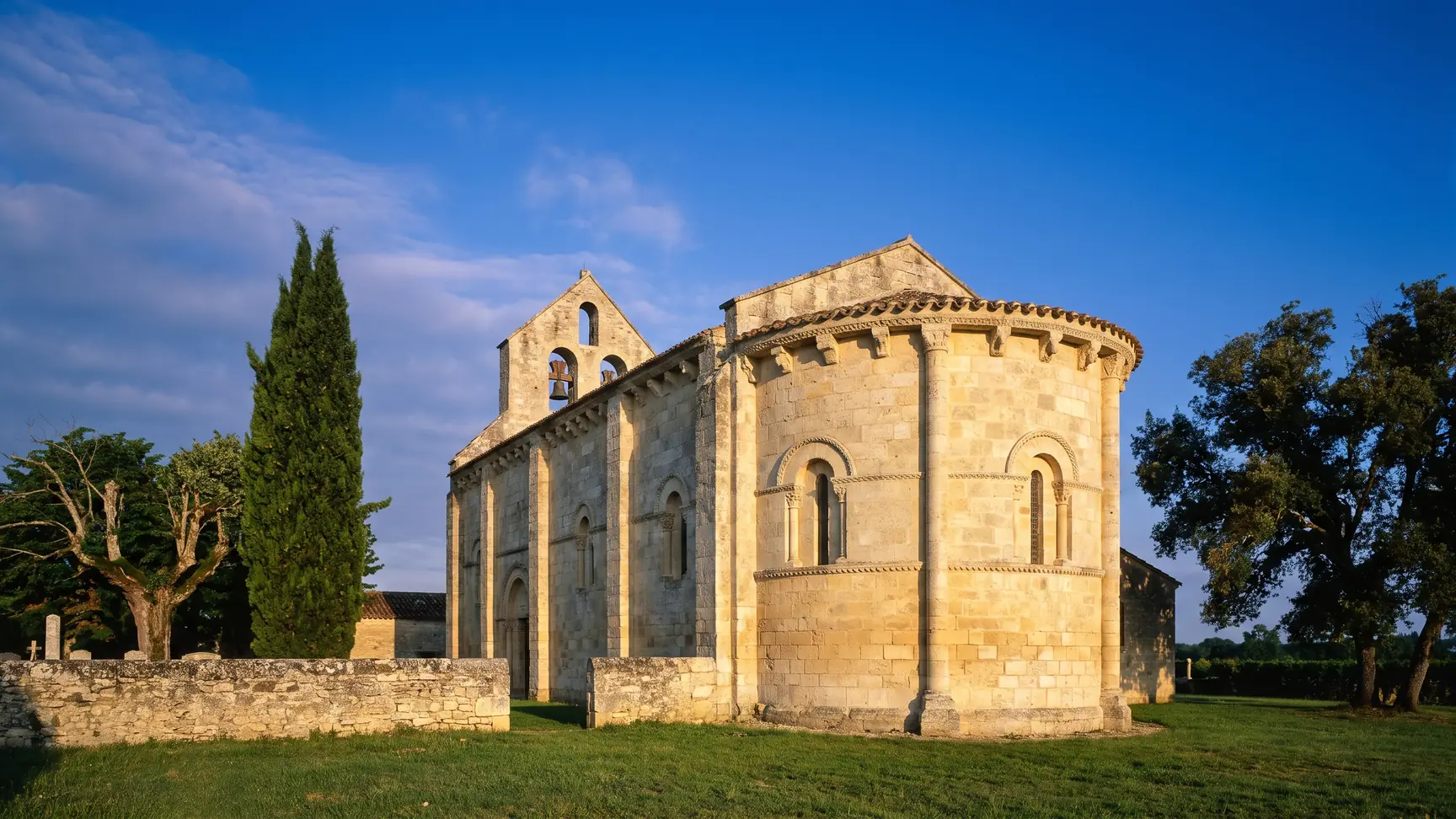
The highlight of Sainte-Radegonde is its 11th- and 12th-century Romanesque church, listed as a Historic Monument, whose portal features a carved tympanum with rare Jacobean imagery. It is one of the most beautiful small Romanesque buildings in the Entre-deux-Mers region. Here is what the sources say, without adding anything further.
A listed Romanesque church, with a pre-Romanesque building in front of it
Sainte-Radegonde Church was built in the 11th and 12th centuries, altered in the 16th century and restored in the 20th. It enjoys the highest level of protection: after an earlier listing was revoked, it was listed on February 26, 2001, then classified as a Historic Monument on November 22, 2002 (Mérimée reference PA00083823)—since this classification offers a higher level of protection than a simple listing, and we respect that distinction.
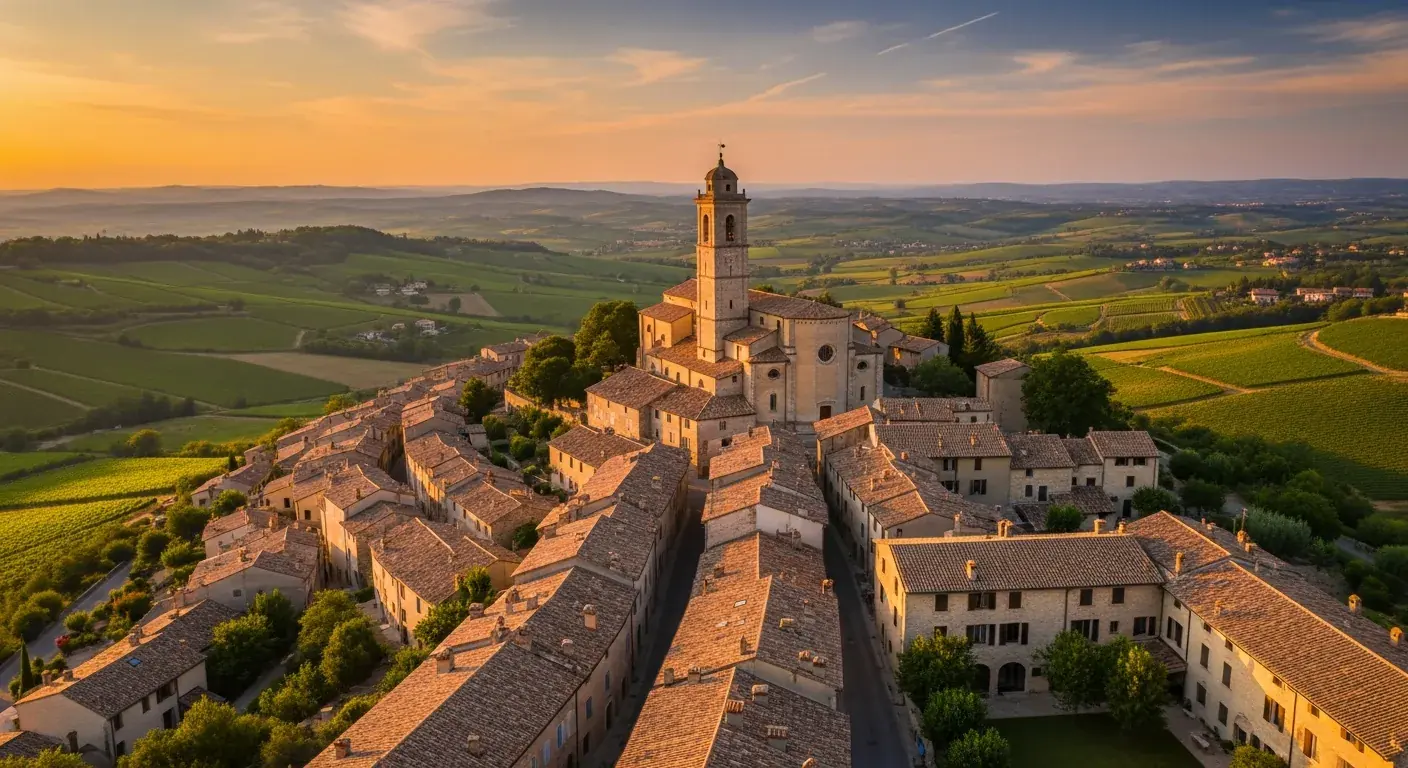
The Romanesque building was preceded by a pre-Romanesque building, of which 11th-century remains survive on the north side of the nave; the façade and apse date from the 12th century. The paneled nave still features the bases of ribbed vaults, evidence of Gothic alterations. The bell tower, built at the same time as the western facade, is adorned with two Romanesque capitals — Contrary to what is sometimes written, it is not a “fortified bell tower.” It is a fine example of Gironde Romanesque architecture, simple and harmonious.
The Tympanum Depicting the Pilgrims of Santiago de Compostela
The church’s most notable feature is its carved tympanum above the portal. It depicts Adam and Eve on either side of the Tree of Knowledge, accompanied by the apostles James, Paul, and Peter depicted as pilgrims, as well as two other pilgrims—a rather rare Jacobean iconography that evokes the routes to Santiago de Compostela passing through Guyenne. It is not a fresco (the church has none), but rather a stone sculpture, best admired up close. Inside, the semicircular apse and the austere Romanesque style create an atmosphere of contemplation.
Here, we take the time to walk around the building to appreciate its different historical periods—the pre-Romanesque remains on the north side, the façade, and the 12th-century apse, the Gothic renovations of the nave—before focusing on the portal. Few village churches contain such a wealth of history within so few stones; this is what justified its designation as a Historic Monument.
Sainte-Radegonde, a Saint, and the Hospitallers
The village owes its name to Saint Radegund, a 6th-century queen who became a nun, while its history reflects ownership by the Knights Templar and later the Knights Hospitaller. A story of faith and commanderies, typical of medieval Guyenne, crisscrossed by pilgrims. Here are the verified facts.
Radegonde, a Queen Who Became a Saint
The village's name pays tribute to Sainte-Radegonde, one of the leading figures of the Early Middle Ages. A Thuringian princess captured as a child, she became, in the 6th century, the wife of the Frankish king Clotaire I. To escape the harshness of the marriage—and after the king murdered her brother—she left the court, became a nun, and founded a monastery in Poitiers (the future Sainte-Croix Abbey). Revered for her piety and charity, she was canonized, and her cult spread throughout the Southwest.
At Sainte-Radegonde, tradition holds that the earliest religious settlement was “likely drawn by the presence of a fountain”—a motif that often recurs in shrines dedicated to the saint. The village thus bears, in its very name, the memory of a Merovingian queen—which makes the necropolis discovered near the church all the more unsettling.
Templars, Hospitallers, and Pilgrims
In the Middle Ages, according to the tradition reported by local sources, Sainte-Radegonde was a possession of the Knights Templar, who were succeeded by the Order of Saint John of Jerusalem (the future Order of Malta). These military and hospitaller orders were scattered throughout the region of commanderies that welcomed and protected the pilgrims on the way to Santiago de Compostela—which may explain the St. James iconography on the tympanum. However, we must remain cautious: while the town’s website mentions this Templar origin, the entry dedicated to the church itself does not directly confirm it; we therefore present it as a tradition and a seigneurial possession, without treating it as an architectural fact.
Nevertheless, this history of commanderies and pilgrimage routes permeates the entire region, stretching from Entre-deux-Mers to the Dordogne Valley, where small Romanesque churches dot the landscape from village to village.
The Merovingian Cemetery and the Fountain
The most unsettling story about Sainte-Radegonde lies right under its feet. Archaeological excavations conducted in the 1980s along the church walls, uncovered a Merovingian necropolis — Early Medieval burial sites, dating from the same period or nearly the same period as the saint after whom the site is named, who was herself a Merovingian queen of the 6th century. According to tradition, the original place of worship was “likely drawn by the presence of a fountain.” This is a recurring motif in shrines dedicated to Saint Radegund, often associated with a spring reputed to have healing properties.
This gives us a sense of the site’s long history: a spring, an early medieval necropolis, and an early Pre-Romanesque building dating to the 11th century, followed by the Romanesque church we see today. Archaeologists have found evidence of an ancient settlement here, situated near a water source—as is the case with so many parishes in the Southwest. For a village of 408 residents, this depth of history—from the Merovingian era to the Romanesque period—is truly remarkable, making a visit to the church much more than just a stop to see a historic site.
Listed church, streams: what we often read
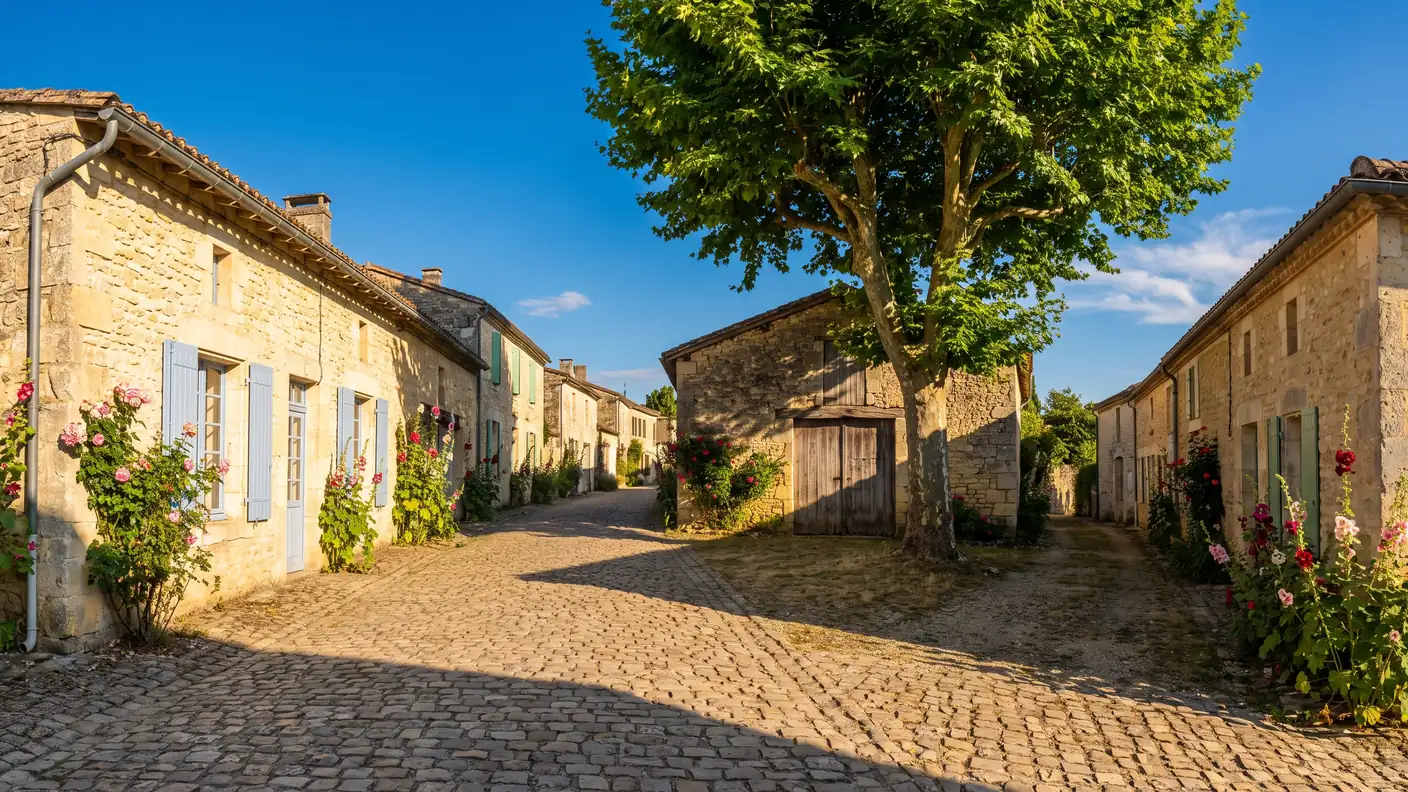
A few clarifications are in order regarding Sainte-Radegonde—not to nitpick, but because a guide must be accurate. The church’s status, its features, its waterways, and its distance: here is what is true and what is false, backed by sources.
Listed, not just registered
We sometimes read that the church is “listed” as a Historic Monument. This is incomplete: it was first listed in 2001, then designated in 2002—with “designation” being the highest level of protection under French law. This distinction matters, as it reflects the building’s heritage value. Similarly, people sometimes refer to “frescoes” or a “fortified bell tower”: neither is accurate. The notable sculpted feature is a stone tympanum (Adam and Eve, apostles dressed as pilgrims), and the bell tower, far from being fortified, is adorned with two Romanesque capitals.
Finally, the waterways in the municipality are the Lestage Stream and the Turon-Gabardon Stream, not “the Gamage,” which flows elsewhere in the Entre-deux-Mers region. These small corrections are what distinguish a reliable guide from a copied text.
An hour's drive, not 45 kilometers
One final note, which may be helpful when planning your trip: you often read that Sainte-Radegonde is “45 km from Bordeaux.” That’s the distance as the crow flies. By road, it’s about 62 kilometers and a little over an hour—since the route follows the Dordogne Valley through Libourne and Castillon before heading up into the hills. This is the kind of detail we always double-check, so that readers know what to expect.
It’s also worth noting that the village isn’t located on a major road: you reach it via small hillside roads, which is part of its charm but requires a good knowledge of the area. A driver familiar with the Entre-deux-Mers region will gladly take you there and can recommend the wineries and nearby villages worth visiting.
The wine: Entre-deux-Mers and Bordeaux Supérieur
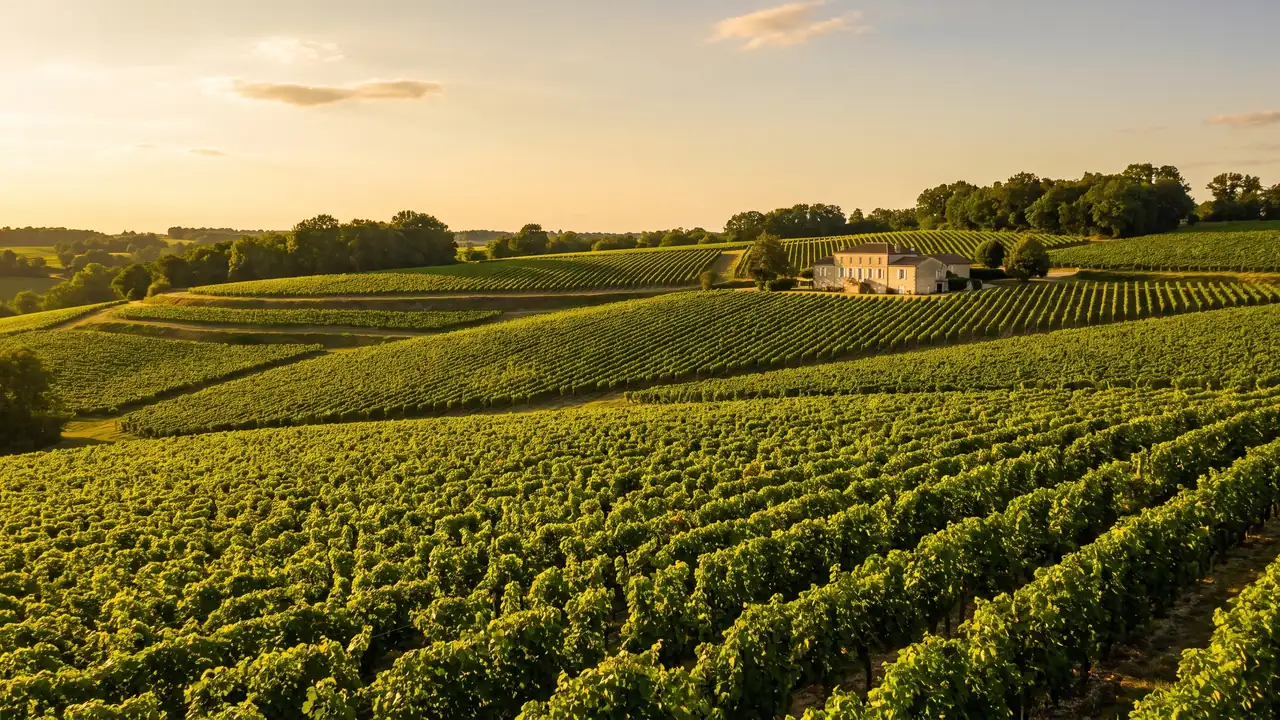
Sainte-Radegonde is a winegrowing village: its hillsides produce dry white wines under the Entre-deux-Mers appellation and red wines under the Bordeaux and Bordeaux Supérieur appellations. It is a terroir of limestone hills, located in the heart of Bordeaux’s largest region for dry white wines. Here’s what makes it unique.
The Land of the "Blancs Secs" of Bordeaux
Entre-deux-Mers is, par excellence, the region of Bordeaux’s dry white wines: the appellation, reserved for whites, covers the entire plateau between the Dordogne and Garonne rivers. In Sainte-Radegonde, the limestone-rich slopes are home to the Sauvignon, Sémillon, and Muscadelle grape varieties used for Entre-deux-Mers whites, while the Merlot and Cabernet plots produce reds classified as Bordeaux and Bordeaux Supérieur, as well as a few rosés. The village has a cooperative winery, founded in 1935, and today features vineyards cultivated using organic methods.
The wines are sold under the Entre-deux-Mers, Bordeaux, and Bordeaux Supérieur appellations; prices vary depending on the estate, the cuvée, the vintage, and the sales channel. A private chauffeur allows you to visit several estates in a row without worrying about driving back.
A Tasting Tour of the Vineyards
On the hillsides of Sainte-Radegonde and neighboring towns, family-owned wineries and the cooperative winery welcome visitors for tastings, often by appointment. This is your chance to savor the freshness of an Entre-deux-Mers white, the roundness of a Bordeaux Supérieur red, and to leave with a few bottles at a bargain price. Many estates offer direct sales; some, committed to organic farming, offer tours of their cellars and vineyards. Be sure to call ahead before visiting, especially during the off-season.
Once again, there’s a real advantage to a private transfer: you’re driven from one estate to the next, you can taste as much as you like without worrying about the distance, and you return to Bordeaux or your lodging stress-free.
Visiting hours and policies, which vary by estate, should be confirmed directly with each winemaker before your visit. This diversity—a crisp white, a red for aging, and sometimes a sweet wine or a crémant—combined with reasonable prices, makes Entre-deux-Mers an ideal destination for curious wine enthusiasts who prefer meeting a winemaker to the crowds at the big-name estates. Many estates in the region also offer guest rooms nestled among the vineyards, allowing visitors to extend their stay.
| Wine at Sainte-Radegonde | Details (according to sources) |
|---|---|
| Appellations | Entre-deux-Mers (dry whites), Bordeaux & Bordeaux Supérieur (reds, rosés) |
| Terroir | limestone hills of the eastern Entre-deux-Mers |
| Grape Varieties | Sauvignon, Sémillon, Muscadelle (whites) · Merlot, Cabernet (reds) |
| Cooperative Winery | Founded in 1935 · organic vineyards in the area |
| Good to Know | Wine tastings at the vineyards, often by appointment |
What is there to do in Sainte-Radegonde and the surrounding area?
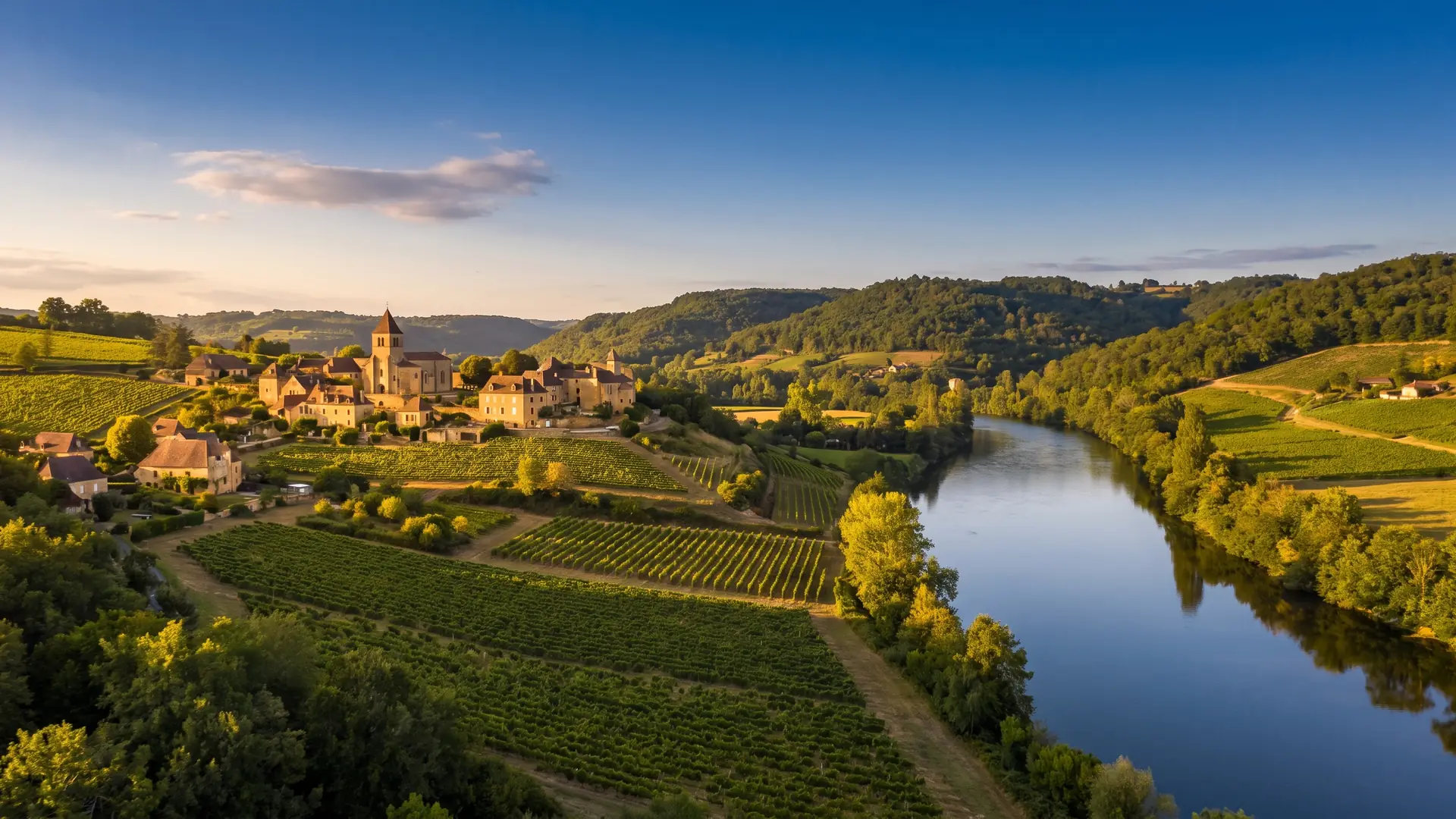
At Sainte-Radegonde, we visit the listed Romanesque church and its tympanum, taste wines from the Entre-deux-Mers region, and head out to Castillon-la-Bataille to see its spectacular nighttime show, then on to Saint-Émilion. Here, specifically, are the actual, verified activities in the area. Since the village is tiny, most of them take place just a few minutes away, in the immediate vicinity—we’ll specify this each time.
- Visit the Romanesque church Sainte-Radegonde—a listed historic monument—with its tympanum carved with pilgrims on the Way of St. James (access subject to opening hours, which vary)
- Taste the wines of Entre-deux-Mers—dry whites and Bordeaux Supérieur—at the wineries and the cooperative winery (often by appointment)
- The show “The Battle of Castillon” — about 15 km away (Belvès-de-Castillon): a grand summer nighttime spectacle featuring 600 volunteers and 40 horses
- Castillon-la-Bataille — about 12 km away: the gateway town to the region, with a market, the banks of the Dordogne, and a memorial to the Battle of 1453
- Saint-Émilion—a medieval town listed as a UNESCO World Heritage Site, with its monolithic church and grand cru wines, just half an hour away
- The Dordogne Valley—canoeing and walks along the river, a few kilometers to the north
- The villages of Entre-deux-Mers—Pujols, Rauzan, and their nearby medieval heritage
The Church, the Vineyard, and the Dordogne
The highlight of a visit to Sainte-Radegonde is, of course, its listed Romanesque church: take the time to admire its carved tympanum, its semicircular apse, and its medieval simplicity (opening hours vary—check with the tourist office). Round out your visit with a wine tasting at a local winery, where you can sample the crisp white wines of Entre-deux-Mers and the reds of Bordeaux Supérieur, at prices that make it tempting to take a few bottles home. A few kilometers to the north, the Dordogne Valley offers its riverbanks, villages, and the chance to canoe down the river during the season.
The streams in the town are also perfect for fishing activities, located near a campground—enough to keep the kids busy for an afternoon, rod in hand, in a picturesque setting. And for those who love to hike, the ridge trails connecting the hamlets and hillsides offer a new view of the vineyards and hills of Entre-deux-Mers at every turn. It’s a slow, authentic way to experience the region, set to the rhythm of the hillsides, made pleasant by the Gironde’s mild climate for much of the year.
Nature, Fishing, and Canoeing on the Dordogne River
Beyond its heritage and vineyards, Sainte-Radegonde and its surroundings offer beautiful nature getaways. Within the town itself, the Lestage and Turon-Gabardon streams are ideal, according to the tourist office, for fishing near a campground—a peaceful, family-friendly activity along the water. A few kilometers to the north, the Dordogne Valley unfolds with its riverbanks and villages: during the season, you can canoe down the river from the valley’s launch sites, winding through vineyard-covered hillsides and wooded banks.
Hiking enthusiasts will also find, along the ridge trails and paths of the Entre-deux-Mers, plenty of opportunities to explore a landscape of rolling hills and vineyards, dotted with small Romanesque churches and mills. It’s a form of slow tourism in the great outdoors, made pleasant for much of the year by the mild Gironde climate—and one that’s all the more enjoyable when you let yourself be driven, without worrying about driving or parking.
Castillon, his show, and Saint-Émilion
The industry’s major event takes place in Castillon-la-Bataille, about a dozen kilometers to the north: this small town in the Dordogne Valley is inextricably linked to the final battle of the Hundred Years’ War, fought on July 17, 1453, which restored Guyenne to the King of France. Every summer, a grand nighttime spectacle reenacts the battle in nearby Belvès-de-Castillon, featuring some 600 volunteers and 40 horses—one of the region’s largest outdoor shows.
Half an hour west lies the jewel of the region: Saint-Émilion—a medieval town listed as a UNESCO World Heritage Site, with its stunning monolithic church carved into the rock, its cobblestone streets, and its world-renowned fine wines. From Sainte-Radegonde, you can plan a trip that combines Romanesque art, history, and fine wines.
| Activity | Where / When | Good to Know |
|---|---|---|
| Listed Romanesque Church | on site | Carved tympanum, Romanesque art, 11th–12th centuries |
| Wine Tasting | Sainte-Radegonde and the surrounding area | Entre-deux-Mers, Upper Bordeaux, by appointment |
| Battle of Castillon (play) | ~15 km · summer | Nighttime mural, 600 volunteers |
| Castillon-la-Bataille | ~12 km | market, Dordogne, chronicle from 1453 |
| Saint-Émilion | ~30 min | UNESCO World Heritage Site, monolithic church, fine wines |
What's there to see around Sainte-Radegonde?
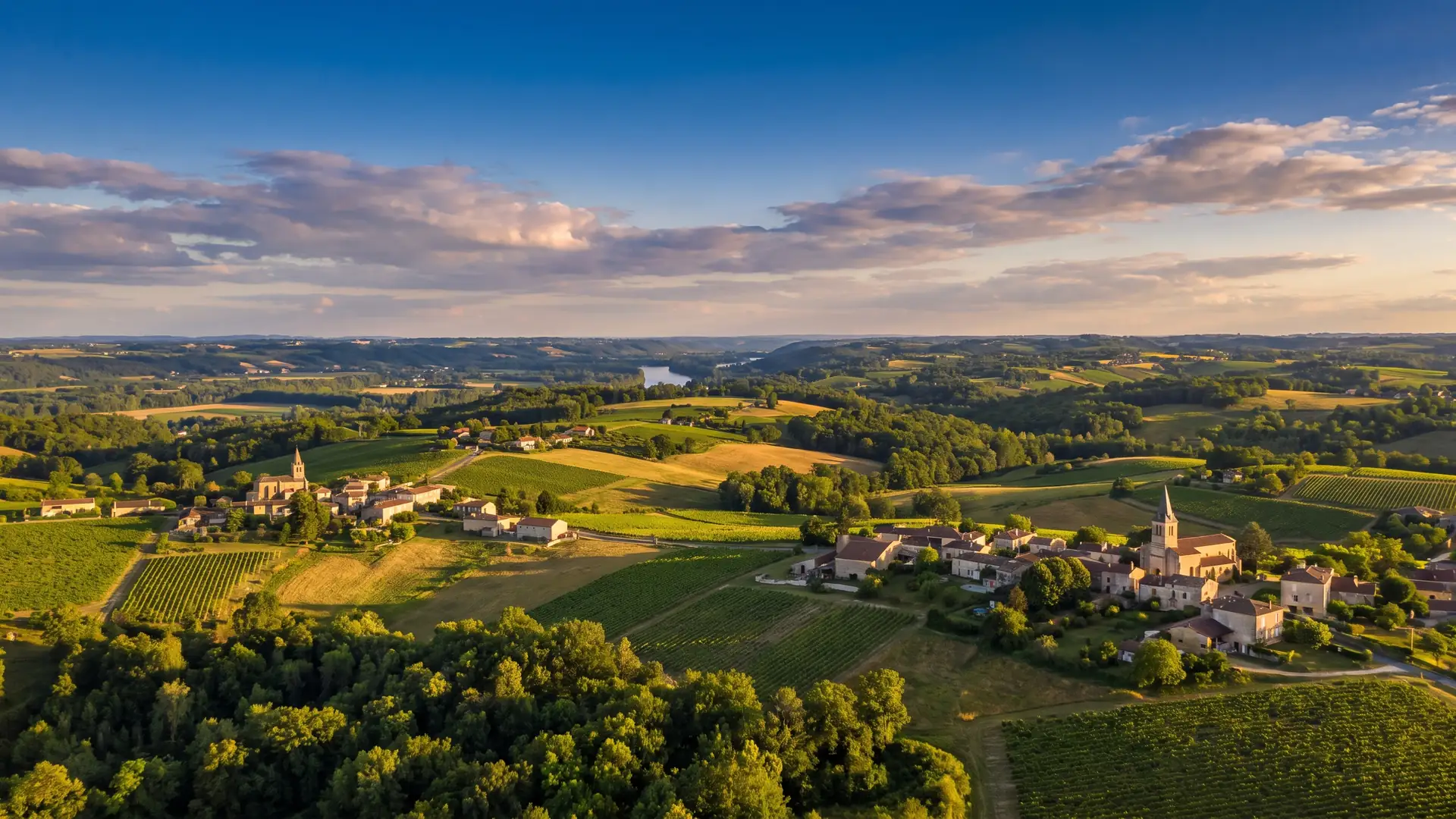
Near Sainte-Radegonde, you’ll discover Castillon-la-Bataille and its battlefield, Saint-Émilion and its grand cru wines, the medieval villages of the Entre-deux-Mers region, and the Dordogne Valley. The village is ideally situated between the Castillon and Entre-deux-Mers wine regions: here are the must-see attractions, all of which can be visited on a day trip.
Castillon, Saint-Émilion, and the Dordogne
To the north, Castillon-la-Bataille (~12 km) is the gateway town to the valley: it features a market, the banks of the Dordogne, and, every summer, the grand spectacle of the Battle of 1453. To the west, half an hour away, Saint-Émilion boasts one of the most beautiful medieval complexes in France, listed as a UNESCO : a monolithic church, cloisters, cobblestone streets, and world-renowned vineyards. Between them lies the Dordogne Valley, with its hilltop villages—such as Gensac and its view of three valleys—and the chance to canoe down the river.
You can also head east to Sainte-Foy-la-Grande, an elegant bastide on the banks of the Dordogne, famous for its Saturday market. Three worlds—viniculture, history, and the river—are all within easy reach by bike from Sainte-Radegonde.
The Villages of Entre-deux-Mers
To the south and west of Sainte-Radegonde lies the heart of the Entre-deux-Mers, one of the most charming rural areas in the Gironde, dotted with medieval villages and abbeys. Pujols and Rauzan, just a few kilometers away, preserve the ruins of castles and charming stone villages; further on, Sauveterre-de-Guyenne features the arcades of its bastide, and the Abbey of La Sauve-Majeure (a UNESCO World Heritage Site as part of the Way of St. James) stands with its majestic Romanesque ruins.
It is a land of vineyards, windmills, and small Romanesque churches, where you can take the time to stroll, savor the local flavors, and get lost on the mountain roads.
A chauffeur who knows the region will be able to put together a customized itinerary for you, tailored to your tasting and sightseeing schedule, so you don’t have to worry about driving. This way, in a single day, you can visit the Romanesque ruins of an abbey, the arcaded square of a bastide, enjoy a lunch featuring local specialties, and tour two or three wineries—all within half an hour of Sainte-Radegonde. This is one of the great pleasures of the Entre-deux-Mers region: a rich yet little-known heritage scattered throughout a landscape of vineyards, where you move from one discovery to the next without ever straying far.
When is the best time to visit Sainte-Radegonde?
Sainte-Radegonde and the Entre-deux-Mers region are best enjoyed from spring through fall, when the vineyards are green, the wineries welcome visitors, and the Castillon festival brings summer evenings to life. The spring (May–June) offers vibrant hillsides, soft light, and perfect days for visiting the church, enjoying local specialties, and taking walks. The summer (July–August) is the peak season: wine tastings, markets in Castillon, canoeing on the Dordogne, and, on summer evenings, the grand nighttime show at the Battle of Castillon nearby — this is the hottest time of year, when the coolness of the valleys is a welcome relief.
The fall (September–October) is perhaps the most beautiful time of year: it's the season of grape harvest, the light bathes the hillsides in gold and the crowds thin out; the villages of the Entre-deux-Mers take on stunning hues. No matter the season, the mild climate of the Gironde makes Sainte-Radegonde a pleasant place to visit for much of the year. A weekend is enough to experience the highlights: Romanesque architecture, vineyards, and the neighboring villages.
| Season | Atmosphere | Ideal for |
|---|---|---|
| Spring (May–June) | green hillsides, soft light | church, tastings, walks |
| Summer (July–August) | High Season, Castillon Show | family, canoeing, lively evenings |
| Fall (Sept.–Oct.) | grape harvest, golden light, tranquility | wine tourism, heritage, photography |
How to get to Sainte-Radegonde from Bordeaux
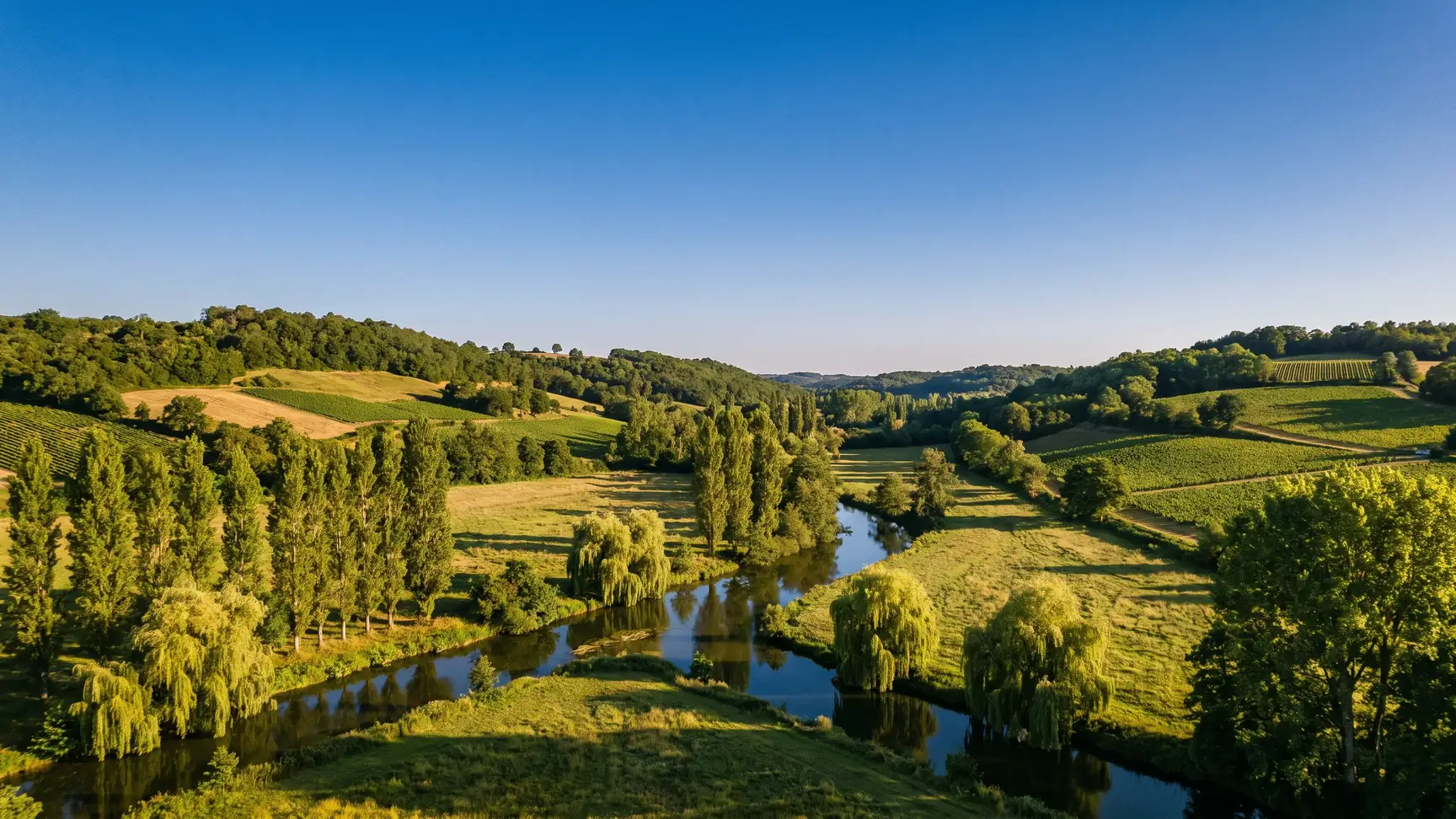
Sainte-Radegonde is about 62 km from Bordeaux, or about a 1-hour, 8-minute drive. The route heads east through Libourne and Castillon-la-Bataille, then along the hillsides of the Entre-deux-Mers region. The village does not have a train station; the nearest one is in Castillon-la-Bataille, about a dozen kilometers away, which is served by direct trains from Bordeaux.
| Route | Distance | Duration | Details |
|---|---|---|---|
| Bordeaux → Sainte-Radegonde | ~62 km | ~1:08 | Starting at ~€123 for a private chauffeur service |
| Bordeaux-Mérignac Airport → Sainte-Radegonde | ~72 km | ~1 hour 10 minutes | pickup at the terminal |
| Castillon-la-Bataille Train Station → Sainte-Radegonde | ~12 km | ~15 min | Direct TER train from Bordeaux |
| Sainte-Radegonde → Saint-Émilion | ~20 km | ~25 min | UNESCO Medieval City |
By car, it takes just over an hour to reach Sainte-Radegonde from Bordeaux: the route follows the Dordogne Valley through Libourne and Castillon-la-Bataille, then winds up the hillsides of the Entre-deux-Mers on small roads. By train, the nearest station is Castillon-la-Bataille (about 12 km away), on the TER Nouvelle-Aquitaine Bordeaux–Bergerac–Sarlat line, with direct connections from Bordeaux-Saint-Jean. From the station, it’s still about a dozen kilometers to the village, and there is no direct local transportation to the village.
That's the whole point of a private transfer: it's door-to-door, so you avoid having to make connections and are dropped off directly at Sainte-Radegonde, the estate, or the lodging of your choice, and then picked up at the agreed-upon time.
Whether you’re planning a wine-tasting getaway, a visit to a Romanesque architectural gem, or an evening at a show in Castillon, booking an executive car service guarantees a comfortable and punctual ride—book a driver from Bordeaux → Sainte-Radegonde or explore all our destinations.
Frequently Asked Questions
Where is Sainte-Radegonde located?
Sainte-Radegonde is a small wine-growing village in the Gironde, in the eastern part of the department, in the Entre-deux-Mers region. It is situated on the hillsides sloping down toward the Dordogne Valley, about eight kilometers south of Castillon-la-Bataille and some 62 km east of Bordeaux. Administratively, it belongs to the Libourne arrondissement, the Coteaux de Dordogne canton, and the Castillon-Pujols community of municipalities. According to INSEE, it had 408 residents in 2023 (municipal profile); Gironde Tourisme provides information on the local route through woods and vineyards.
From Bordeaux, it's about a 1-hour, 8-minute drive; the village doesn't have a train station, but Castillon-la-Bataille, 12 km away, is served by direct trains.
How much does a transfer from Bordeaux to Sainte-Radegonde cost?
We offer a fixed-price transfer from Bordeaux to Sainte-Radegonde, starting at approximately €140 one way (about 62 km, approximately 1 hour and 8 minutes by car), in a Mercedes sedan or van seating up to 8 passengers, with a professional chauffeur. The trip is direct, door-to-door: pickup at the airport, Saint-Jean train station, or your hotel in Bordeaux, and drop-off at your desired address in Sainte-Radegonde, including luggage. The fixed quote is provided and confirmed in writing before departure, with no unexpected meter charges.
It’s especially convenient for a wine-tasting getaway in the Entre-deux-Mers region, a visit to the listed Romanesque church, or for getting to a vineyard without renting a car—especially since the village is accessible only by small hillside roads.
Is the church in Sainte-Radegonde a listed or designated historic site?
It is listed as a Historic Monument, which is the highest level of protection under French law. The Romanesque church Sainte-Radegonde, built in the 11th and 12th centuries (altered in the 16th century, restored in the 20th century), was first listed on February 26, 2001, and then classified on November 22, 2002 (Mérimée reference PA00083823). It is sometimes stated that it is merely “registered”: this is incomplete. It deserves this classification for the quality of its Romanesque art and, above all, for its remarkable carved tympanum depicting Adam and Eve and the apostles portrayed as pilgrims on the Way of St. James—a rare example of Jacobean iconography.
Also worth noting: Excavations in the 1980s uncovered a Merovingian necropolis along its walls, a nod to Saint Radegund, a 6th-century Merovingian queen.
What does the tympanum of the Sainte-Radegonde church depict?
The carved tympanum above the portal depicts Adam and Eve on either side of the Tree of Knowledge, accompanied by the apostles James, Paul, and Peter—depicted as pilgrims—as well as two other pilgrims. This is a rather rare Jacobean iconography, evoking the pilgrimage routes to Santiago de Compostela that once crossed the region of Guyenne. Please note: this is indeed a stone carving, not a fresco (the church has no frescoes). It is one of the most remarkable features of this listed Romanesque building. Inside, the semicircular apse and the medieval simplicity create a beautiful atmosphere of contemplation.
According to tradition, the village itself owes its existence to a fountain around which the first place of worship dedicated to the saint was established.
What is the Sainte-Radegonde wine?
Sainte-Radegonde produces Bordeaux wines on its limestone hillsides in the Entre-deux-Mers region. The winery produces dry white wines under the Entre-deux-Mers appellation (made from Sauvignon, Sémillon, and Muscadelle grapes), as well as reds—and a few rosés—under the Bordeaux and Bordeaux Supérieur appellations (made from Merlot and Cabernet grapes). The village has a cooperative winery founded in 1935, and today features vineyards cultivated using organic farming methods. The wines are sold under the Entre-deux-Mers, Bordeaux, and Bordeaux Supérieur appellations; prices vary depending on the estate, the cuvée, the vintage, and the sales channel. The estates and the cooperative winery welcome visitors for tastings, often by appointment.
A chauffeured transfer lets you visit several places without having to worry about driving back.
What is there to do in Sainte-Radegonde?
People come here first and foremost for the Romanesque church, listed as a Historic Monument, with its tympanum carved with pilgrims on the Way of St. James, and to taste Entre-deux-Mers wines at the vineyards and the cooperative winery. Since the village is very small, visitors tend to explore the surrounding area: about 12 km away is Castillon-la-Bataille, and in the summer, the grand nighttime spectacle of the Battle of Castillon in Belvès-de-Castillon; half an hour away, the medieval town of Saint-Émilion (UNESCO) and its fine wines; all around, the villages of the Entre-deux-Mers region (Pujols, Rauzan) and the Dordogne Valley, where you can canoe down the river.
The streams in the town are also ideal for fishing activities. It’s enough to fill a wonderful weekend, with Romanesque art, vineyards, and history.
Is Sainte-Radegonde connected to the Knights Templar?
According to tradition as reported by local sources, Sainte-Radegonde was, in the Middle Ages, a possession of the Knights Templar, who were succeeded by the Hospitallers of Saint John of Jerusalem (the future Order of Malta). These orders dotted the region with commanderies that welcomed and protected pilgrims on their way to Santiago de Compostela—which may explain the St. James iconography on the church’s tympanum. However, caution is warranted: while the town’s website mentions this Templar origin, the entry dedicated to the church itself does not directly confirm it. We therefore present it as a tradition and a seigneurial possession, without treating it as an established architectural fact.
Nevertheless, this history of commanderies and pilgrimage routes permeates the entire region, stretching from Entre-deux-Mers to the Dordogne Valley.
Who was Saint Radegund?
Saint Radegund is one of the great figures of the Early Middle Ages. A Thuringian princess who was captured as a child, she became the wife of the Frankish king Clotaire I in the 6th century. To escape the harshness of this marriage—and following the king’s murder of her brother—she left the court, became a nun, and founded a monastery in Poitiers, which would later become the Abbey of Sainte-Croix. Venerated for her piety and charity, she was canonized, and her cult spread throughout the Southwest, giving its name to numerous villages.
At Sainte-Radegonde, in Gironde, the early religious settlement was, it is said, drawn to the site by the presence of a fountain—a recurring feature of shrines dedicated to the saint. A puzzling fact: excavations have revealed a Merovingian necropolis near the church, a direct echo of this Merovingian queen.
What is the distance between Bordeaux and Sainte-Radegonde?
About 62 km by road, or about 1 hour and 8 minutes (figures shown on the route's travel information page). The route follows the Dordogne Valley through Libourne and Castillon-la-Bataille, then winds up the hillsides of the Entre-deux-Mers region via small roads. With a private chauffeur, the fare is fixed and provided in advance, starting at approximately €123 one way. To extend your visit on foot, check out the official walking route starting from the village (Gironde Tourisme).
From the train station, a private chauffeur service takes over for the final few kilometers to the village, as there is no direct public transportation. This is the easiest way to reach this hillside village and then explore the surrounding vineyards.
How do I get to Sainte-Radegonde by train?
Sainte-Radegonde does not have a train station, but the station in Castillon-la-Bataille, about a dozen kilometers away, is well-served. It is located on the Nouvelle-Aquitaine TER line between Bordeaux, Bergerac, and Sarlat, with direct connections from Bordeaux-Saint-Jean. From the train station, it’s about twelve kilometers to the village, with no direct public transportation available—which is where a private transfer really comes in handy. You get off the train at Castillon, and a driver takes care of the final leg of the journey, door-to-door, to Sainte-Radegonde, the winery, or your chosen accommodations.
It's also the best way to explore the Entre-deux-Mers region and head toward Saint-Émilion without renting a car. Be sure to book your driver in advance, providing your train schedule.
Is Sainte-Radegonde close to Saint-Émilion?
Yes, quite close: Saint-Émilion is about 20 kilometers away, or roughly a 25-minute drive. This proximity makes Sainte-Radegonde a rural base just 25 minutes away from the famous medieval town, a UNESCO World Heritage Site. This means you can combine, all in one day, a tour of Sainte-Radegonde’s listed Romanesque church, a wine tasting at an Entre-deux-Mers estate, and a visit to Saint-Émilion, its monolithic church, and its grand cru wines. Castillon-la-Bataille, with its summer night show, is even closer (~12 km).
A chauffeur who knows the area can put together a customized itinerary for you that takes in these various sites, allowing you to enjoy the tours and tastings at your own pace, without having to worry about driving or parking.
When is the best time to visit Sainte-Radegonde?
From spring to fall, preferably. Spring (May–June) offers green hillsides and soft light, perfect for visiting the church, enjoying local specialties, and taking walks. Summer (July–August) is peak season: wine tastings, the markets in Castillon, canoeing on the Dordogne, and, on summer evenings, the spectacular reenactment of the Battle of Castillon nearby. Fall (September–October) is perhaps the most beautiful time of year: it’s harvest season, the light bathes the hillsides in gold, and the crowds thin out. The mild climate of the Gironde makes Sainte-Radegonde pleasant for much of the year.
A weekend is all it takes to experience the highlights: the Romanesque art of the historic church, the Entre-deux-Mers vineyards, and the neighboring villages—not to mention a trip to nearby Castillon or Saint-Émilion.
Further Reading
- INSEE — Regional Comparison Tool, Sainte-Radegonde (33468) — 2023 population; accessed July 24, 2026
- Gironde Tourisme — “Between Woods and Vineyards” route starting from Sainte-Radegonde — official local trail; accessed July 24, 2026
- The neighboring village on the Dordogne River: see the Guide to Mouliets-et-Villemartin (Romanesque church and commandery)
- The nearby hilltop village: see the Gensac Guide (panoramic view of three valleys)
- The nearby Cité du Vin: see the Saint-Émilion Guide (UNESCO-designated medieval town and fine wines)
- The story of the nearby battle: Discover Castillon-la-Bataille and the end of the Hundred Years' War
- Just outside Bordeaux via the Pimpine Valley: check out the guide to Lignan-de-Bordeaux
- Understanding our rates and vehicles: see the "Book a Driver" page (sedan & van, fixed-price quote)
- Plan your journey: Book an executive car service from Bordeaux to Sainte-Radegonde or explore all our destinations
Sources and References
- Wikipedia — Sainte-Radegonde (Gironde) — Entre-deux-Mers, ~8 km south of Castillon, population 408. (2023), Romanesque church designated a historic monument, formerly owned by the Knights Templar and later by the Order of Hospitallers, AOC Entre-deux-Mers/Bordeaux Sup.
- POP Mérimée — Sainte-Radegonde Church (PA00083823) — 11th–12th-century Romanesque, altered in the 16th century; registered on February 26, 2001, then listed on November 22, 2002; carved tympanum, bell tower with two Romanesque capitals
- Castillon-Pujols Tourist Office — Romanesque church (tympanum depicting Adam and Eve and pilgrims on the Way of St. James), Merovingian necropolis (excavated in 1980), fishing activities
- Wikipedia — Saint Radegund — 6th-century queen, wife of Clotaire I, who became a nun and founded the Monastery of the Holy Cross in Poitiers
- The Battle of Castillon — a theatrical performance — a summer nighttime spectacle in Belvès-de-Castillon (~15 km), 600 volunteers, 40 horses; the battle of July 17, 1453
- Wikipedia — Entre-deux-Mers — a wine-growing plateau between the Dordogne and Garonne rivers; AOC for dry white wines; La Sauve-Majeure Abbey (UNESCO); bastides
Article updated in July 2026.
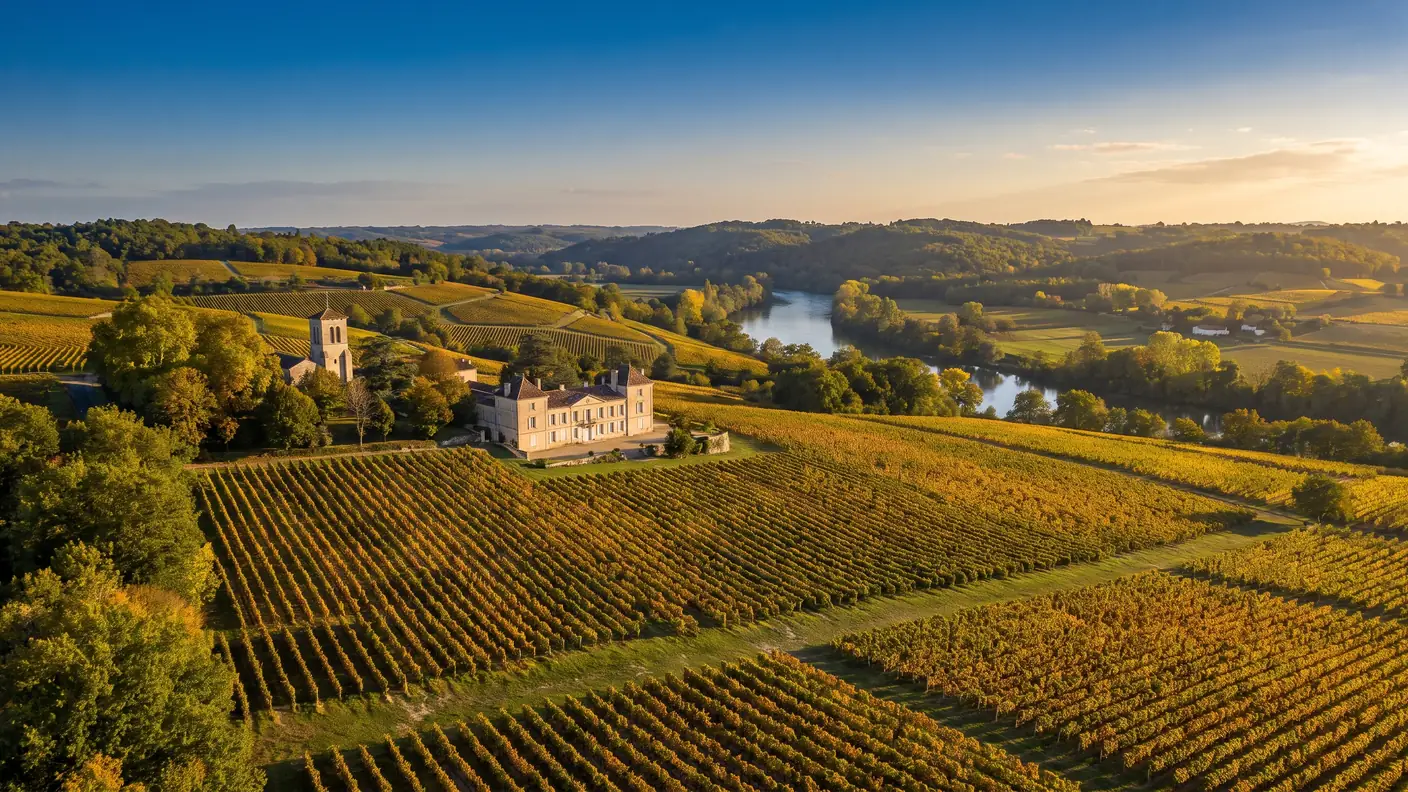
Off to Entre-deux-Mers
Direct transfer from Bordeaux (~1 hr 8 min) to Sainte-Radegonde and its listed Romanesque church, in the heart of the Entre-deux-Mers region—from the airport, train station, or hotel to the village, luggage included. Fixed, written quote—no unexpected meter charges.