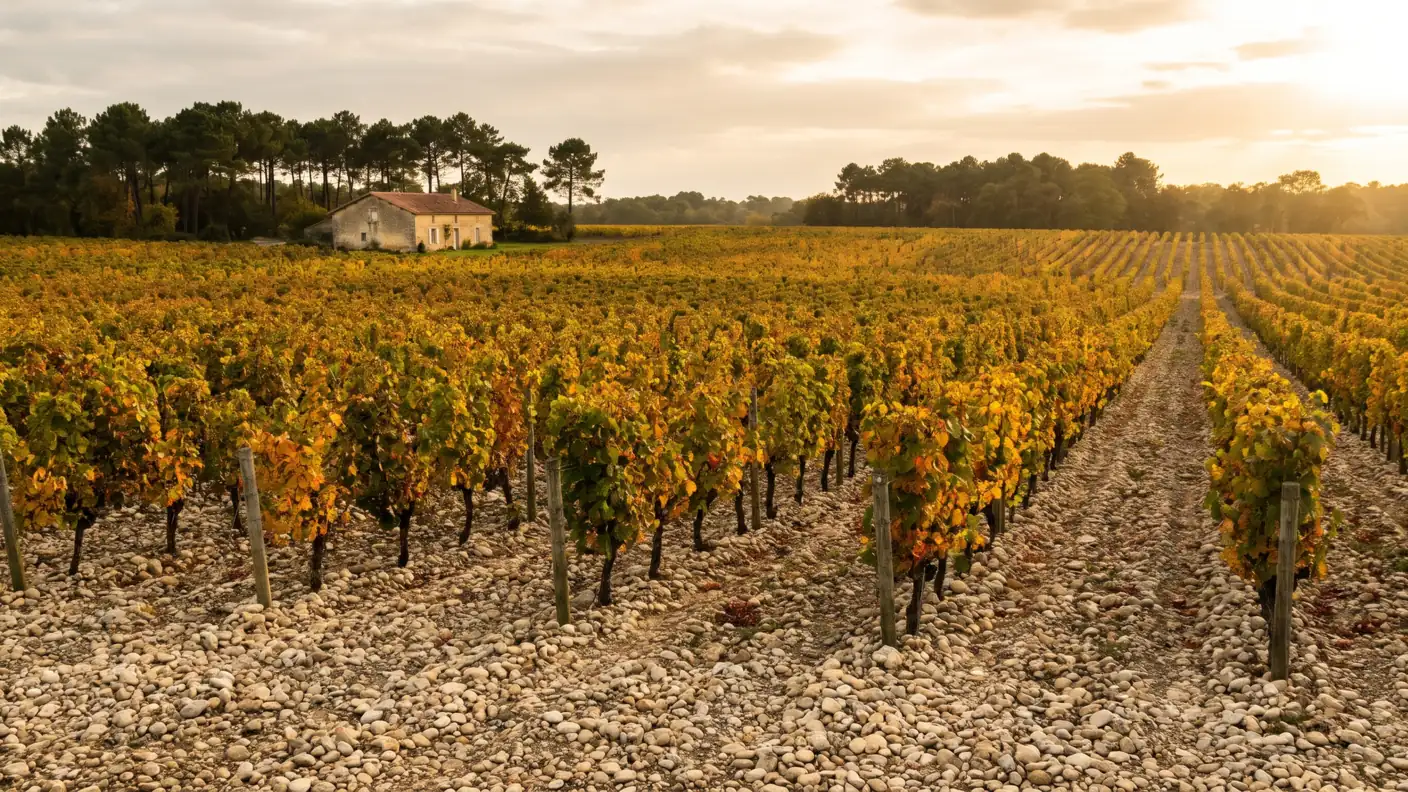
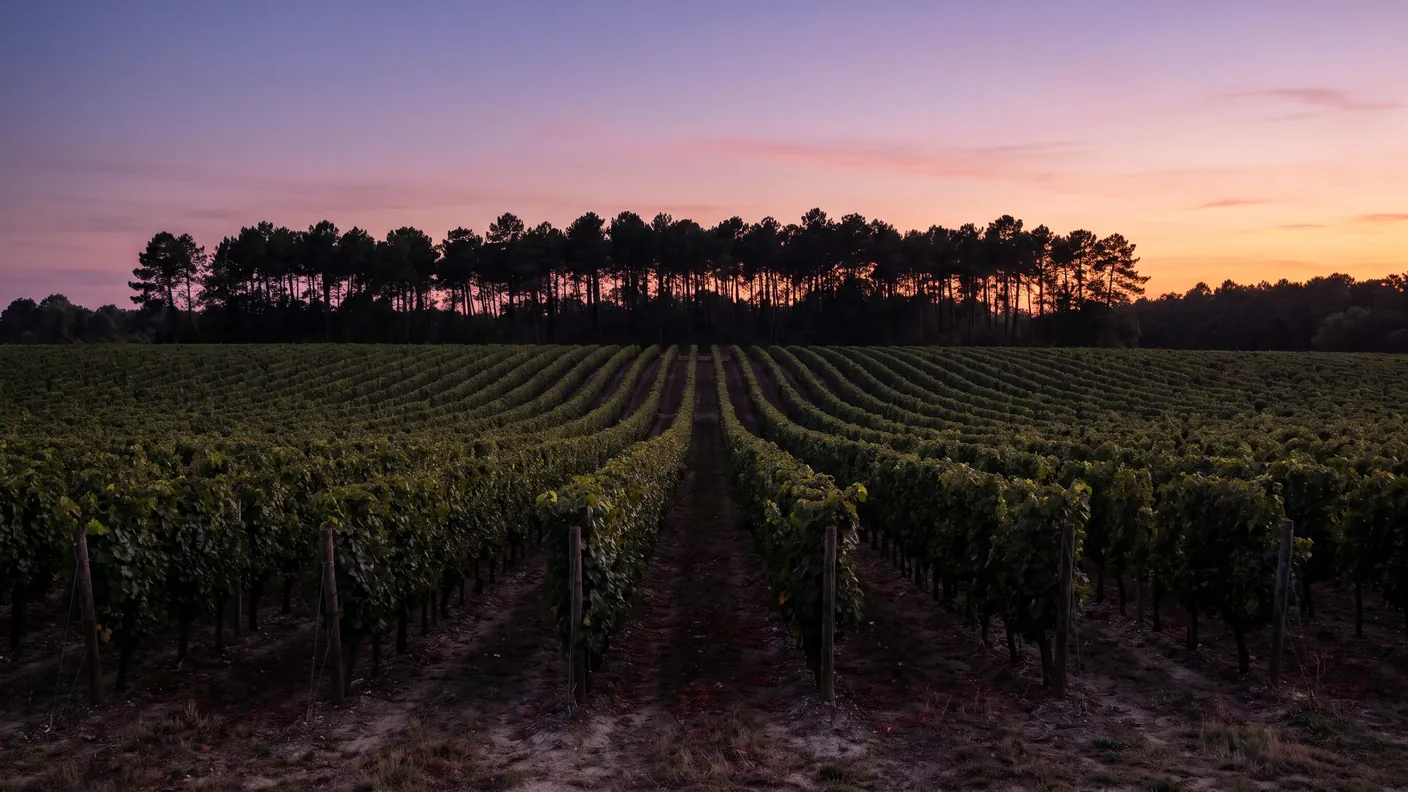
Martillac, between vineyards and forest
A Graves village of vines and woodland south of Bordeaux, outside Bordeaux Métropole. It is home to 17 Pessac-Léognan châteaux, including two Graves classified growths. The spa and restaurants at Les Sources de Caudalie also welcome visitors who are not staying the night. Add to that a 12th-century Romanesque apse and the Migelane departmental forest. About 30 min from Bordeaux.
What is Martillac? The essentials before you go
Martillac is a wine-growing, wooded commune in the Gironde, some twenty kilometres south of Bordeaux (about 30 min): 3,659 residents (2023 municipal population, INSEE), 17 Pessac-Léognan châteaux, Château Smith Haut Lafitte, Les Sources de Caudalie and the Migelane forest. On 1 May, runners in the Foulées du Vignoble Martillacais set off from the Hervé de Venancourt stadium on Route de Tout-Vent: 7 km and 17 km trail races, a 42 km trail marathon and a walk of about 10 km. Every runner goes home with a bottle of Pessac-Léognan, and on that day a municipal order allows lily of the valley to be sold in the street. For the rest of the year, you get to know the village through its wine estates, some of which welcome visitors, and its forest paths. Three misconceptions to set aside before you come: Montesquieu was born in La Brède, not here; the Garonne does not touch the commune; and the temple of Mars exists only in legend.
| Key facts | Details |
|---|---|
| Commune | Gironde (33), Nouvelle-Aquitaine; INSEE code 33274; postcode 33650, shared with six other communes |
| Population | 3,659 residents (2023 municipal population, INSEE); known as Martillacais and Martillacaises |
| Area | 17.09 km²; altitude 8 to 59 m; about 43% vineyards and 21.8% forest (Corine Land Cover 2018) |
| Local government | Outside Bordeaux Métropole; seat of the Communauté de communes de Montesquieu |
| Vineyards | AOC Pessac-Léognan (1987) and Graves (1937); 17 châteaux in the winegrowers' association directory, including 2 Graves classified growths |
| Monuments | 2 historic monuments, both listed (inscrits): the apse of the church of Sainte-Quitterie (1925) and part of the Château de Rochemorin (1990) |
| Nature | Migelane departmental forest, about 265 ha shared with La Brède and Saucats; 4 waymarked loops from 1.4 to 6.5 km |
| From Bordeaux | About 20 km, roughly 30 min |
Martillac is a village of vines and woodland in the Sud Bordeaux area. The Pessac-Léognan winegrowers' association places 17 of its 70 châteaux here, more than any other commune in the appellation except Léognan. Two of these estates are Graves classified growths: Latour-Martillac, for both red and white, and Smith Haut Lafitte, for red. On the Smith Haut Lafitte estate, Les Sources de Caudalie, opened in 1999, also welcomes visitors who are not staying overnight, at the spa and in its three restaurants. The Migelane departmental forest, shared with La Brède and Saucats, adds four waymarked loops, including a 1.4 km loop accessible by wheelchair.
Martillac is not a tourist resort. The commune has no weekly market and nowhere to swim, and its two historic monuments are both listed (inscrits), with neither classified (classé). It lies outside Bordeaux Métropole, but it hosts the headquarters of the Communauté de communes de Montesquieu and the Sud Bordeaux Tourisme office. Several visits must be booked: Smith Haut Lafitte receives visitors by appointment, Latour-Martillac asks for at least 12 hours' notice, and the spa requires a treatment booking. Montesquieu's château, in the neighbouring commune of La Brède, is closed until spring 2027.
Without a car, regional bus 482, from Bordeaux Peixotto in Talence, serves the village centre every day except Sunday; the hotel, however, cannot be reached by public transport. Our Bordeaux → Martillac page details the trip with a private driver.
Where is Martillac, and how far is it from Bordeaux?
Martillac lies in the Gironde, south of Bordeaux, some twenty kilometres and about 30 min from the city centre. It has exactly four neighbouring communes: Cadaujac to the north-north-east, Léognan to the west, La Brède to the south and Saint-Médard-d'Eyrans to the south-east. Saucats and Villenave-d'Ornon come within 105 m and 188 m respectively, without touching it. Martillac does not border any commune of Bordeaux Métropole. To the east, the D1113 runs along its boundary and separates it from Cadaujac and Saint-Médard-d'Eyrans.
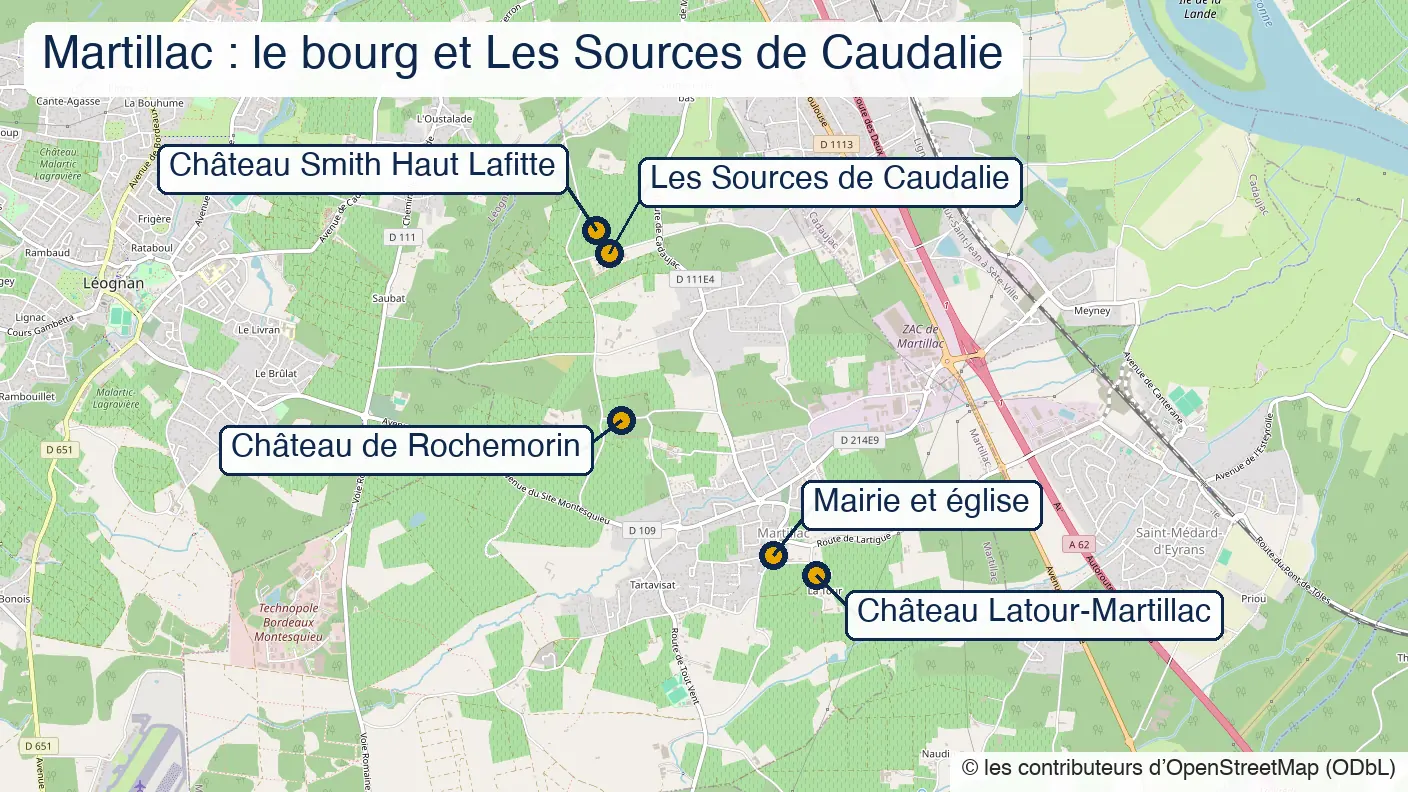
The commune belongs to the arrondissement of Bordeaux and the canton of La Brède, which groups 13 communes. It hosts the headquarters of the Communauté de communes de Montesquieu, created on 7 December 2001, at 1 allée Jean Rostand, in the Site Montesquieu resource centre. This grouping of communes covers exactly the same area as the canton: 13 communes, with a total population of 48,823. For INSEE, France's national statistics office, Martillac belongs to the urban unit, catchment area, employment zone and living area of Bordeaux, without being part of Bordeaux Métropole.
The postcode 33650 does not refer to Martillac alone. Seven communes share it: Cabanac-et-Villagrains, La Brède, Martillac, Saint-Médard-d'Eyrans, Saint-Morillon, Saint-Selve and Saucats. For GPS navigation or a postal address, write “33650 Martillac” with the street name. The commune's INSEE code is 33274.
| Neighbouring commune | Position | Useful landmark |
|---|---|---|
| Cadaujac | North-north-east, bordering | Château Bouscaut; nearest TER station to the hotel (4.1 km); Cadaujac-INRAE Météo-France weather station |
| Léognan | West, bordering | 27 châteaux in the appellation directory; Haut-Bailly, Domaine de Chevalier and La Louvière welcome the public |
| La Brède | South, bordering | Château de Montesquieu, an estate classified as a historic monument; the Scandibérique (EuroVelo 3) passes through |
| Saint-Médard-d'Eyrans | South-east, bordering | Nearest TER station to the village centre (3.4 km from the town hall); M'bus A shuttle to the Technopole |
| Saucats | Not bordering, 105 m away | Maison de la Réserve géologique, a free museum |
| Villenave-d'Ornon | Not bordering, 188 m away | Tram line C terminus, Villenave Pyrénées |
Martillac, Les Sources de Caudalie, Smith Haut Lafitte: one and the same commune
Les Sources de Caudalie and Château Smith Haut Lafitte are indeed in the commune of Martillac. Their addresses read “Bordeaux-Martillac” or “Bordeaux Martillac”: this is the spelling used by the hotel and the château, not the name of the commune, and the hotel is not in Bordeaux. Latour-Martillac, La Garde, Rochemorin and Domaine de la Solitude are also in Martillac. Château Bouscaut, sometimes listed among them, is in Cadaujac.
The hotel sits away from the village centre. From the hotel to the church of Sainte-Quitterie, the road covers 2.9 km, about 5 min without traffic. The château is about 180 m from the hotel as the crow flies, 200 m according to the hotel, and 0.57 km by road. Latour-Martillac and La Garde, by contrast, are in the village centre, 500 m and 800 m from the town hall.
Terrain from 8 to 59 m, away from the Garonne
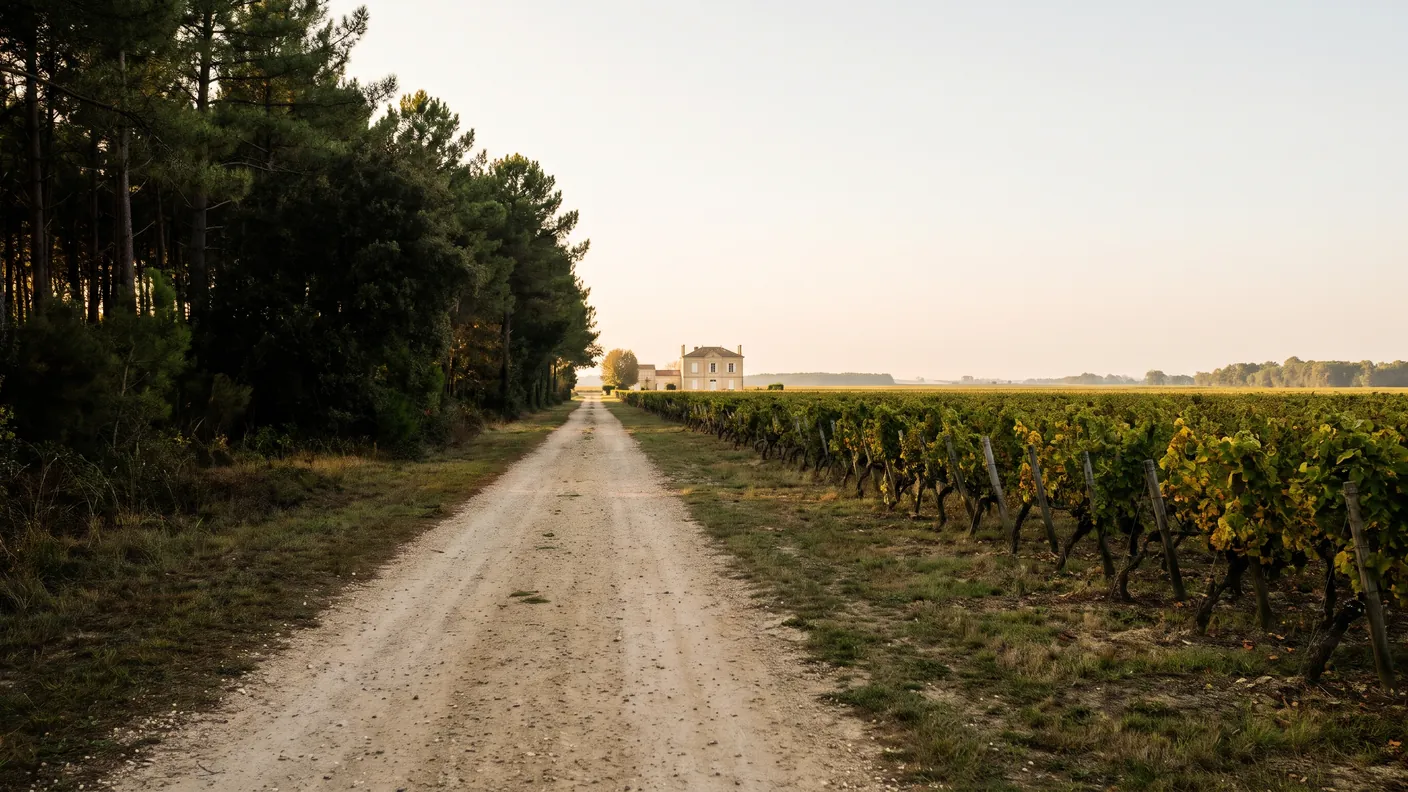
Martillac's terrain rises from 8 to 59 m above sea level, according to IGN, the national mapping agency. The lowest point is in the east, towards the Cadaujac plain; the highest, 58 to 59 m, is in the south-west. Rochemorin, sometimes described as the highest point in the commune, stands at 48.7 m at the château, on a gravel rise. These well-drained rises carry the vines, which covered about 43% of the commune's land in 2018, against 21.8% for forest.
The Garonne does not border Martillac. The river's centre line runs about 2.5 km from the commune boundary, and about 3.9 km from the hotel, as the crow flies. The commune's streams, including the Breyra, flow down towards it, to the east. Géorisques, the official natural-hazards database, records no flood risk in the commune.
How many people live in Martillac?
Martillac has 3,659 residents. This is INSEE's 2023 municipal population figure, in force since 1 January 2026. Over 17.09 km², that gives a density of 214.1 people per km². Depending on the website, you will see 3,659 or 3,697 residents: the first figure is the municipal population, the second the total population, and INSEE publishes both. The 2024 figures are due in December 2026. Residents are called Martillacais and Martillacaises, following the usage on the town hall's website; no council resolution on the matter is known.
The population grew 3.79-fold between 1968 and 2023, from 965 to 3,659 residents, and each figure in the INSEE series is higher than the one before. The commune gained 976 residents between 1990 and 2011, then 1,031 in the twelve years from 2011 to 2023.
Between 2017 and 2023, average growth reached +3.0% a year: net migration accounts for 2.1 points and natural increase for 0.8 points. Between 2017 and 2021, the commune went from 3,067 to 3,504 residents.
| Year | Residents | INSEE measure |
|---|---|---|
| 1968 | 965 | Without double counting |
| 1975 | 1,090 | Without double counting |
| 1982 | 1,309 | Without double counting |
| 1990 | 1,652 | Without double counting |
| 1999 | 2,020 | Without double counting |
| 2006 | 2,265 | Municipal |
| 2011 | 2,628 | Municipal |
| 2016 | 2,975 | Municipal |
| 2017 | 3,067 | Municipal |
| 2021 | 3,504 | Municipal |
| 2022 | 3,581 | Municipal |
| 2023 | 3,659 | Municipal |
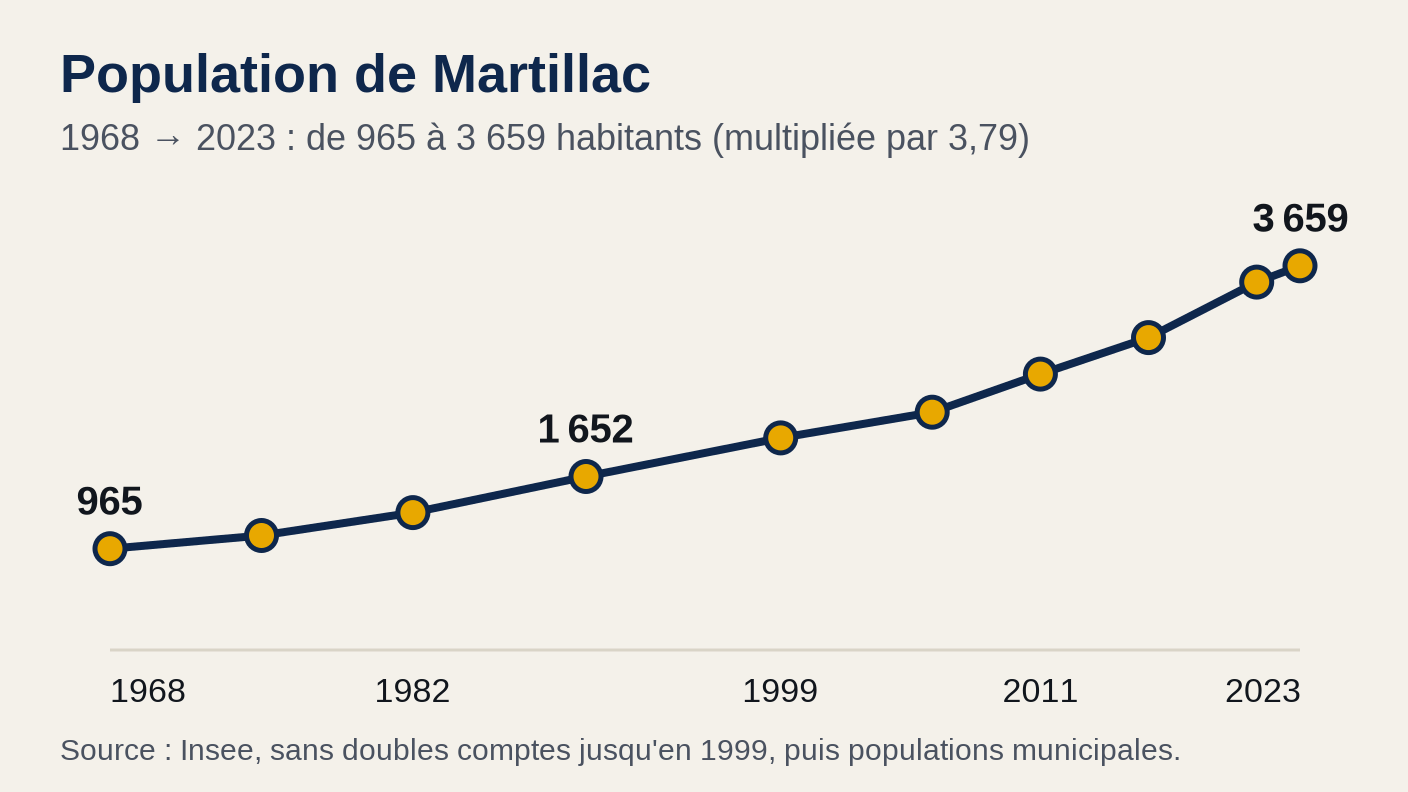
Since 1968, these figures have been based on the same commune boundaries: up to 1999, populations without double counting; from 2006, municipal populations. You will sometimes read 3,062 residents for 2016: INSEE gives 2,975.
Almost as many jobs as residents
Martillac had 3,596 jobs based in the commune in 2023, for 3,659 residents. The commune also hosts the headquarters of the Communauté de communes de Montesquieu and the “Technopôle Montesquieu” bus stops.
Before 1968: three early population figures
Early sources give an idea of the village's size. Abbé Baurein gives 418 inhabitants in 1726, citing the Dictionnaire universel de la France. Expilly records 92 “feux” in 1762, meaning households rather than people. The first census, in 1793, gives 555 inhabitants, according to the EHESS Cassini data cited by Wikipedia. These figures come from different sources and should be compared with caution.
Where does the name Martillac come from?
The name Martillac probably comes from a Gallo-Roman estate, *Martiliacum: “the estate of Martilius”. It is the only hypothesis accepted in scholarly place-name studies, from Flechia (1873) to Rohlfs (1952), by way of Skok (1906) and Bofinger (1938). The name combines a personal name with the Gaulish suffix -acum, which became -ac in Occitan-speaking areas.
The asterisk marks a reconstructed form. *Martilius is so rare that it may be attested only once, on an inscription from Pozzuoli, in Italy, which reads “Martilia Eusaevia”. According to a study by Salomies published in the journal Arctos in 2022, this reading remains disputed.
The god Mars may be in the name, but only indirectly. The accepted line of descent is Mars → Martius → *Martilius. Martius is not the god's name: it is a Roman family name, and an adjective, derived from Mars. So the god enters Martillac only through a man's name, which implies no place of worship. According to Rohlfs, the name has “cousins” outside France: Martillué, in Aragon, and Martigliano, in Italy.
Martilhac, the Gascon form
In Gascon, the commune is called Martilhac. Frédéric Mistral gives this form, marked “Gascon”, in Lou Tresor dóu Felibrige. The spelling was long used in administrative documents: the tax roll (rôle des tailles) of 1637, the ordinance of the intendant Lamoignon de Courson dated 25 June 1712, and Expilly's dictionary in 1762. Until the 18th century, even official texts written in French spell it “Martilhac”.
A first mention around 1120-1130
The oldest mention found dates from around 1120-1130, a dating the text's editor proposes with a question mark. In charter LXXXI of the cartulary of Saint-Seurin de Bordeaux, a certain Alazaïs de Martillac, named “Alazeiz de Martilac” in the text, gives the canons a piece of land in the parish of Sainte-Marie de Martillac, at a place called Lacanaus.
There are many places with similar names. The castrum de Martilhaco is at Fossemagne, in the Dordogne, and the cappella de Martilhaco is probably Martaillac, in Lot-et-Garonne. Other “Martilhacs” lead to Cahors, Albi or the Auvergne. An early form refers to Martillac only if the text places it in the Bordelais.
The legend of the temple of Mars
The town hall tells a legend and presents it as such. One of Caesar's generals is said to have seen his horse sink into a marsh, and to have escaped. Tradition links this episode to a temple of Mars, which supposedly gave the place its name. The town hall also suggests, with caution, that the church may have been built on this temple.
Nothing supports this story. No place-name scholar mentions a temple of Mars, and the 1897 archaeological inventory lists, for Martillac, only Roman coins of Valentinian. The scholarly etymology probably runs through a man, *Martilius, not a sanctuary.
What is the history of Martillac, from the parish of Sainte-Marie to the present day?
Martillac first appears in the archives around 1120-1130, with the parish of Sainte-Marie: this is the oldest mention found. Its history then follows that of its estates (Rochemorin, Smith Haut Lafitte, La Solitude) and crosses paths with the Montesquieu family, although the writer was not born here.
Around 1120-1130: the parish of Sainte-Marie
The first mention of Martillac is also that of its parish. The gift by Alazaïs de Martillac to the canons of Saint-Seurin concerns land in the parish of Sainte-Marie. The parish is now called Notre-Dame: it was already dedicated to Mary around 1120-1130, and the church that serves it bears the name Sainte-Quitterie.
12th century: the Romanesque church
The Mérimée heritage database dates the church to the 12th century; the town hall dates it back to the 11th. It is today's church of Sainte-Quitterie, the church of the Notre-Dame parish. Only its apse is protected, since 1925.
14th century: the lords of Rochemorin and the first Smith Haut Lafitte deed
The first known lords of Rochemorin date from the 14th century, according to the Mérimée record. The same record links the origin of the site to the Arab invasion only through a “tradition”. The oldest parts of the château date from the 15th and 16th centuries. Again according to Mérimée, the Montesquieu family bought Rochemorin in 1609; the current owner gives a different chronology. The château was ravaged during the Fronde, in the 17th century, then restored.
Also in the 14th century, according to the château, Verrier du Bosq signed the first deed of ownership for the Smith Haut Lafitte vines.
1494 and 1609: the parish according to Abbé Baurein
Abbé Baurein, writing in the 18th century, adds two milestones. According to him, a deed dated 7 August 1494 places the parish “en terre gasque” (in Gascon land). Again according to him, a contract of 8 September 1609, made by Thomas de Pontac in favour of Antoine Francause, detached it from the jurisdiction of L'Isle-Saint-Georges.
1716: Montesquieu's son is born in Martillac
Montesquieu was born at the Château de La Brède, on 18 January 1689, not in Martillac. He married in 1715; his wife's family, the Lartigues, owned land in Martillac. Their son, Jean-Baptiste de Secondat, later an agronomist and physicist, was born there on 10 February 1716, “probably” at Rochemorin according to the POP record.
According to the Dictionnaire Montesquieu of the ENS de Lyon, the writer's vineyard was in Martillac. He sold his wine himself, without a merchant, including to English buyers. In a letter of October 1734, he says he was shipping it to Ireland. A record in the Atlas des sites de la Gironde (DREAL) adds that he made most of the wine sold under the name “La Brède” at Rochemorin. Local tradition, repeated by the town hall, has it that he came to the Rochemorin harvest every year: nothing proves it.
Mid-18th century: George Smith
In the mid-18th century, the Scottish merchant George Smith bought the estate and gave it his name, according to the château. In the mid-19th century, the estate belonged to Lodi-Martin Duffour-Dubergier, mayor of Bordeaux from 1842 to 1848.
The Revolution: did the parish become the commune?
According to Wikipedia, which relies on a document from the Gironde departmental archives that is now offline, the Notre-Dame parish is said to have become the commune of Martillac during the Revolution.
1831: the Holy Family settles at La Solitude
On 28 May 1820, Pierre-Bienvenu Noailles founded the Congregation of the Holy Family (Sainte-Famille) in Bordeaux. According to the estate, the community settled at La Solitude in 1831, with an orphanage and farm work; the company that runs the vineyard was founded in 1854. The estate still belongs to the congregation, not to the commune.
1886-1887: the Budos aqueduct
The 41 km Budos aqueduct crosses Martillac underground. Its plans, by Samuel Wolff, date from 1883 to 1885, and it was built in 1886-1887. The water flows by gravity alone. According to Bordeaux Métropole, cited by Wikipedia, it still supplies about 15% of Bordeaux Métropole's drinking water.
1925-1930: the Préveraud de Sonnevilles and “Vendanges à Martillac”
The painters Georges and Yvonne Préveraud de Sonneville lived in Martillac from 1925 to 1930, according to Wikipedia. In 1927, Georges signed a 114 × 146 cm canvas, “Vendanges à Martillac” (Harvest at Martillac). It belongs to the Musée des Beaux-Arts de Bordeaux and has been on deposit at Bordeaux City Hall since 1976 (Joconde database): don't expect to see it in the museum's galleries.
1973: Rochemorin replanted
After 1919, Rochemorin lost its vines to the forest. On 10 October 1973, the GFA de Rochemorin (an agricultural land company), represented by André Lurton, became the owner; André Lurton then replanted the vineyard. Fourteen years later, on 9 September 1987, the Pessac-Léognan AOC was created, and Martillac is part of it.
1990 and 1999: the Cathiards, then Les Sources de Caudalie
Since 1990, Smith Haut Lafitte has been owned by the Cathiard family. In 1999, Alice and Jérôme Tourbier opened Les Sources de Caudalie on the estate.
Today: a Sud Bordeaux commune
Today Martillac is a commune in the Sud Bordeaux area, outside Bordeaux Métropole, which has hosted the headquarters of the Communauté de communes de Montesquieu since 2001. Its recent milestones are low-key: in 2015, the listing of the Parc du Thil, two plots of which lie in the commune; in 2017, the opening of the Migelane forest trails; in 2021, the inclusion of the Breyra site in the Inventory of Geological Heritage; and in November 2026, new specifications for Pessac-Léognan.
Which monuments can you see in Martillac?
Martillac has two historic monuments, both listed (inscrits) and neither classified (classé): the apse of the church of Sainte-Quitterie and part of the Château de Rochemorin. The POP heritage database records no protected movable objects in the commune. Three more features complete the picture: a listed site around Rochemorin; the Parc du Thil, two plots of which are in Martillac; and the Budos aqueduct, recorded in the Inventory without being protected.
| Feature | Status | Date | Reference |
|---|---|---|---|
| Church of Sainte-Quitterie (Notre-Dame parish) | Apse listed as a historic monument; owned by the commune | 21 December 1925 | Mérimée PA00083620 |
| Château de Rochemorin | Partly listed as a historic monument; privately owned | 6 August 1990 | Mérimée PA00083884 |
| Château de Rochemorin and its surroundings | Listed site (landscapes), 76.03 ha | 15 April 1983 | SIN0000154 |
| Park of the Château du Thil | Listed as a historic monument; attached to Léognan, two plots in Martillac | 11 May 2015 | Mérimée PA33000186 |
| Budos aqueduct | Recorded in the General Inventory, which is not a form of protection | Built in 1886-1887 | Inventory IA00067738 |
| Château de La Brède (neighbouring commune) | Estate classified as a historic monument | 7 May 2008 | Mérimée PA00083490 |
The church of Sainte-Quitterie: the 12th-century apse
The church of Sainte-Quitterie and the church of the Notre-Dame parish are one and the same; the town hall speaks of “Sainte Quitterie dedicated to Notre Dame”. Only the Romanesque apse, 12th-century according to the Mérimée record, is listed, by an order of 21 December 1925 from the Ministry of Public Instruction and Fine Arts. The copy of the order bears the words “Signé Daladier” (signed Daladier). The church belongs to the commune.
The pointed neo-Gothic bell tower is much more recent: the town hall dates it to 1880, a date no other source corroborates. According to the commune, the town hall building bears the date 1883 on its pediment; it was built between a girls' school and a boys' school. The church features on the Pistes de Robin trail and on the town hall's Boucle du Muguet (Lily of the Valley Loop).
Château de Rochemorin, a private “fortified farm”
The Château de Rochemorin has been partly listed since 6 August 1990. The protection covers the façades and roofs of the main building and the entrance pavilion, the remains of the south-west pavilion, the 18th-century north boundary wall with its gate, and two ground-floor fireplaces. Since 15 April 1983, the château and its surroundings have also formed a listed site of 76.03 ha, for their picturesque character: a landscape protection, separate from historic-monument status.
In 1982, the sites inspector described it as a “fortified farm”, with a square tower pierced with arrow slits, according to the record in the Atlas des sites de la Gironde (DREAL). The 1990 order, however, justifies the protection “as the birthplace of Montesquieu”: this is inaccurate for the writer, who was born in La Brède. His son, however, was born in Martillac, “probably” at Rochemorin according to the Mérimée record.
The château, privately owned by the GFA de Rochemorin since 10 October 1973, advertises no regular visits. It opens only during the Pessac-Léognan open days in early December.
The so-called Montesquieu boundary stones
About ten so-called “Montesquieu” boundary stones, engraved with a monogram or a symbol, marked the limits of the land, according to the town hall and the tourist office. Abbé Baurein also mentioned two stones, the “Borne Sarrasin” and the “Roche Maurin”, which he saw as a trace of the Saracens' passage: this is his interpretation, not an established fact.
The Parc du Thil, and the Château de La Brède in the neighbouring commune
The park of the Château du Thil, listed on 11 May 2015, belongs to Léognan, but its protection covers two plots registered in Martillac. It is a 19th-century park designed by Louis-Bernard Fisher; the château itself is not protected.
No monument in Martillac is classified. In the neighbouring commune, the estate of the Château de La Brède, Montesquieu's château, was classified by an order of 7 May 2008.
Which appellations cover Martillac's vineyards?
Martillac produces wines under two appellations: AOC Graves, recognised by the decree of 4 March 1937, and AOC Pessac-Léognan, recognised by the decree of 9 September 1987. The second occupies the northern part of the first, and its specifications describe it as the “original terroir” of the Graves. No official source publishes vineyard area commune by commune.
| Key facts | AOC Graves | AOC Pessac-Léognan |
|---|---|---|
| Recognition | Decree of 4 March 1937 | Decree of 9 September 1987 |
| Area | 42 communes, including Martillac | 10 communes, including Martillac |
| Wines | Red and white | Red and white, still and dry |
| Current specifications | Order of 19 September 2025 | Order of 3 November 2026 (JORF of 8 November 2026) |
| Graves classified growths | None outside the Pessac-Léognan area | 14, including 2 in Martillac |
The ten communes of Pessac-Léognan are Cadaujac, Canéjan, Gradignan, Léognan, Martillac, Mérignac, Pessac, Saint-Médard-d'Eyrans, Talence and Villenave-d'Ornon. The appellation covers only still, dry wines, red and white alike. Its current specifications, approved in November 2026, replace those of 2021. They allow “adaptation” grape varieties, up to 5% per colour: Floréal, Sauvignac and Souvignier Gris for whites, Arinarnoa and Castets for reds.
The word “graves” first refers to a soil
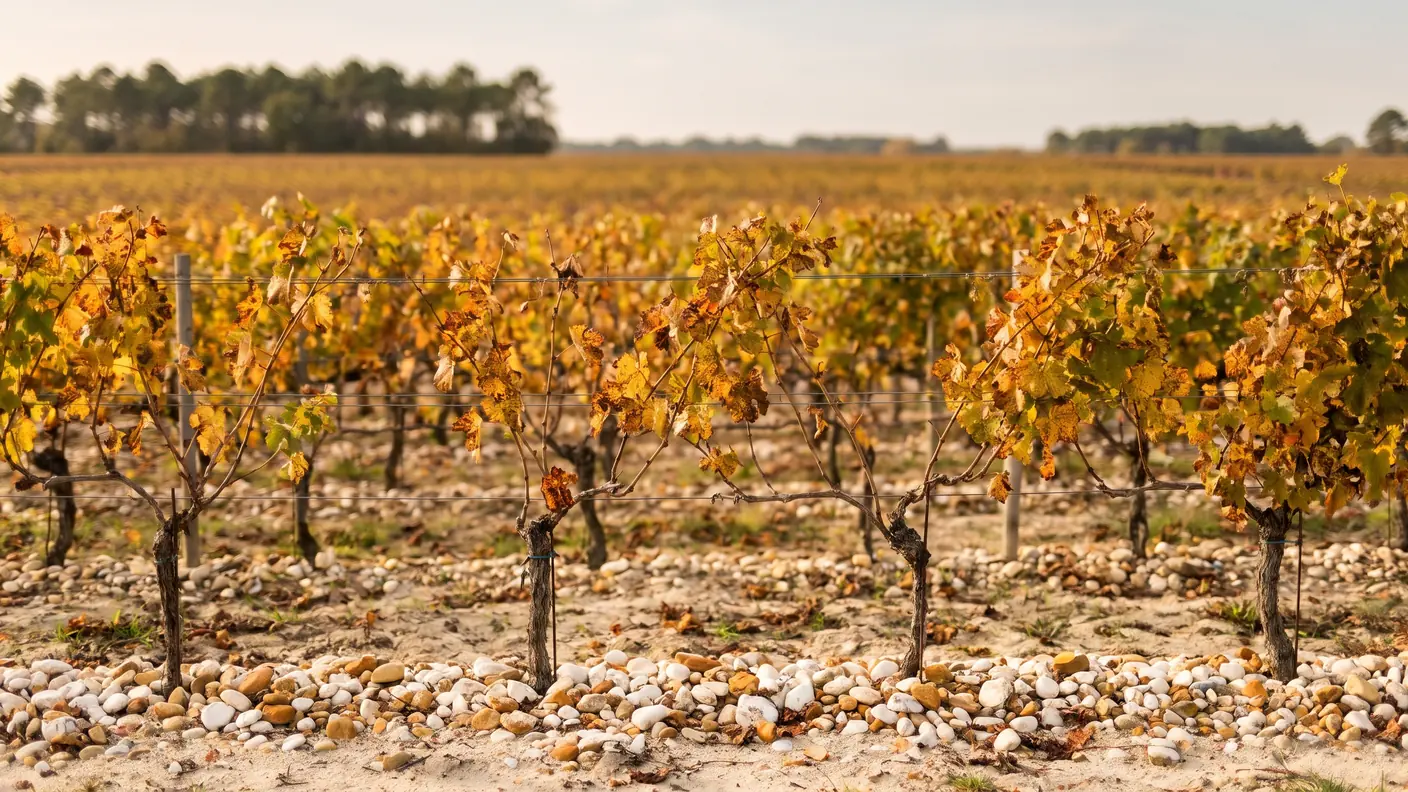
The word “graves” refers to gravel mixed with sand or clay. The Trésor de la langue française records it as early as 1525 for stony soil suited to vines. In the Middle Ages, this terroir was called “Las Grabas de Bourdeus”, as the Pessac-Léognan specifications point out.
These pebbles were rolled by ancient courses of the Garonne, as the Pyrenean glaciers melted, at the end of the Tertiary and during the Quaternary. They form layers three metres deep or more, on rises well drained by small tributaries. The Landes forest to the south and the ocean to the west moderate the climate.
In Martillac, the BRGM geological map (sheet no. 827, Pessac) identifies a Garonne terrace labelled FXb1, from the late Lower Pleistocene: sand, gravel and pebbles set in reddish clay. It surfaces at Latour-Martillac and La Garde. The BRGM dates these gravels only by period. The figures in millions of years you sometimes come across refer to the Aquitanian of the neighbouring Saucats geological reserve, not to the gravels.
An appellation born of a rescue
Pessac-Léognan was born of a rescue. Between the early 20th century and the 1970s, urban growth wiped out more than 3,000 ha of vines on this terroir. Only 550 ha remained, 100 of them under threat, according to the specifications.
The area has grown again since. The specifications counted 1,640 ha and 61 producers in 2010. The appellation's association now states more than 1,800 ha in production, 70 châteaux and 8.5 million bottles a year, figures it does not date.
The Graves classification: 14 growths, 2 of them in Martillac
The Graves classification was drawn up in 1953 under the aegis of INAO, then revised in 1959. It had 16 growths and has 14 today, all located in Pessac-Léognan. Its only official designation is “cru classé de Graves”: the one used by the specifications, the association and the Union des Crus Classés de Graves.
Two of these growths are in Martillac, and the classification distinguishes by colour: Château Latour-Martillac is classified for red and white, Château Smith Haut Lafitte for red.
17 châteaux: second only to Léognan in the appellation
The Pessac-Léognan association's directory lists 17 châteaux in Martillac out of 70 entries, as of 21 November 2026. Only Léognan, with 27, has more châteaux in the appellation. The list: Cantelys, Carrosse-Martillac, Espiot, Ferran, La Garde, Domaine de Bourgie, Haut-Nouchet, Lafargue, Lafont Menaut, Latour-Martillac, Lespault-Martillac, Clos Marsalette, Mirebeau, Roche-Lalande, Rochemorin, Smith Haut Lafitte and Domaine de la Solitude.
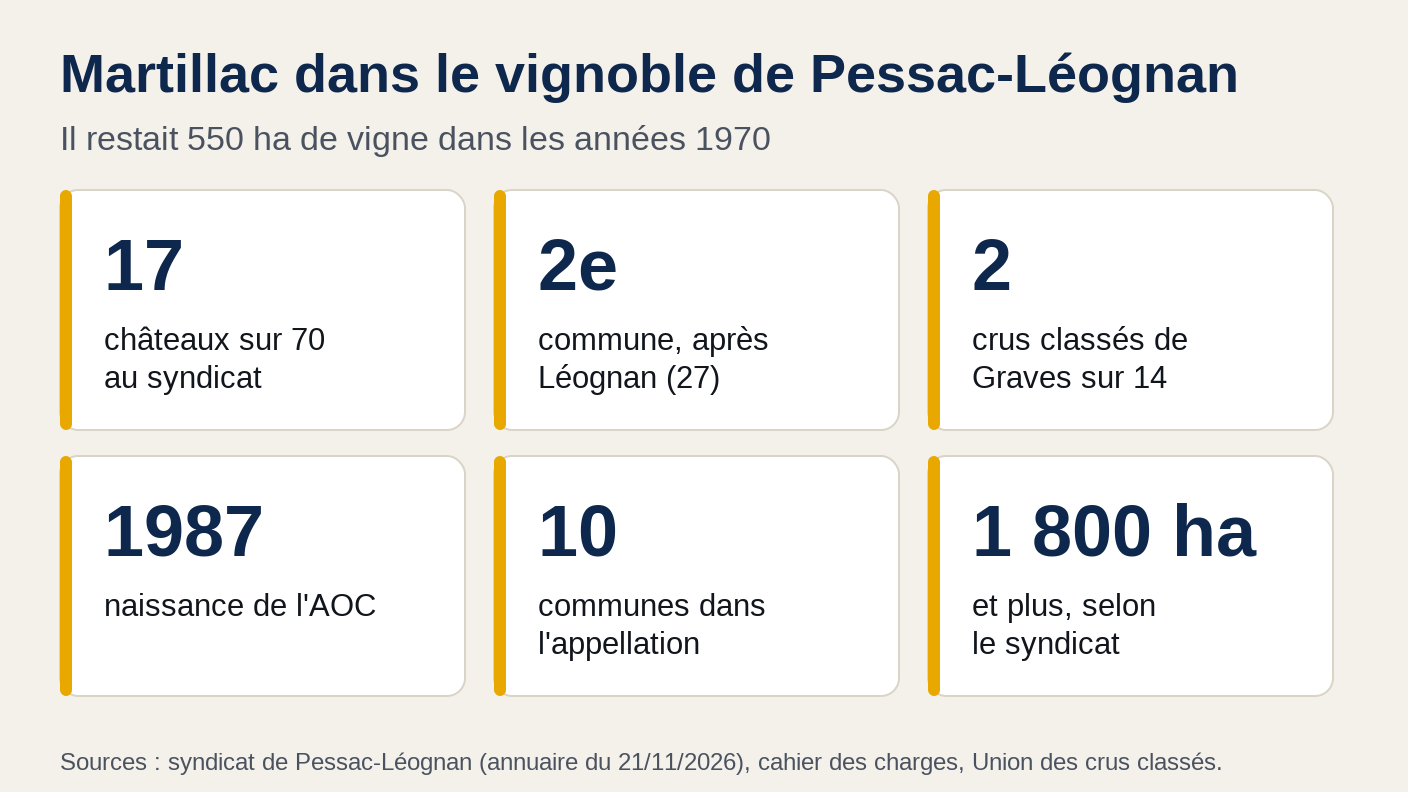
The town hall's list counts 21, but it includes Les Carmes Haut-Brion, which the association places in Bordeaux. Our Portets guide covers another commune in the Graves AOC.
Which châteaux can you visit in Martillac, and how?
Among Martillac's estates, four have year-round visitor arrangements verified for this guide: Smith Haut Lafitte, Latour-Martillac, La Garde and Domaine de la Solitude. Château de Rochemorin, by contrast, opens only for the December open days. For the commune's other properties, check with each one directly. The opening hours below, recorded on 21 November 2026, may change: check them the day before. Distances are by road, without traffic.
| Estate | Opening | Booking | Distance (road) |
|---|---|---|---|
| Château Smith Haut Lafitte | 7 days a week | By appointment: +33 5 57 83 11 22 or visites@smith-haut-lafitte.com | 0.57 km from Les Sources de Caudalie |
| Château Latour-Martillac | All year, Monday to Saturday, 10am to 12.30pm and 2pm to 6pm | Tours must be booked at least 12 hours ahead: +33 5 57 97 71 11; shop open without booking | 0.5 km from the town hall |
| Château La Garde | Monday to Saturday, 10am to 6pm, April to October; Monday to Friday the rest of the year | Details on the estate's website | 0.8 km from the town hall |
| Domaine de la Solitude | Monday to Friday, 9am to 12.30pm and 1.30pm to 6pm; weekends by appointment | With or without booking: +33 5 56 72 74 74 | In Martillac |
| Château de Rochemorin | No regular visits; Pessac-Léognan open days, early December (5 and 6 December in 2026) | The group's tours take place at Château La Louvière, in Léognan | 1.5 km from Les Sources de Caudalie |
Château Smith Haut Lafitte: by appointment, 7 days a week
The château takes its name from George Smith, a Scottish merchant who arrived in the mid-18th century. Its coat of arms sums up its past: three branches for Smith's three children, fleurs-de-lis for the Verrier du Bosq family, who signed the first deed of ownership for the vines in the 14th century, and a crescent for Bordeaux's “Port of the Moon”. The Eschenauer house, which had distributed its wines since the early 20th century, bought the estate in 1958. It has been owned by the Cathiard family since 1990.
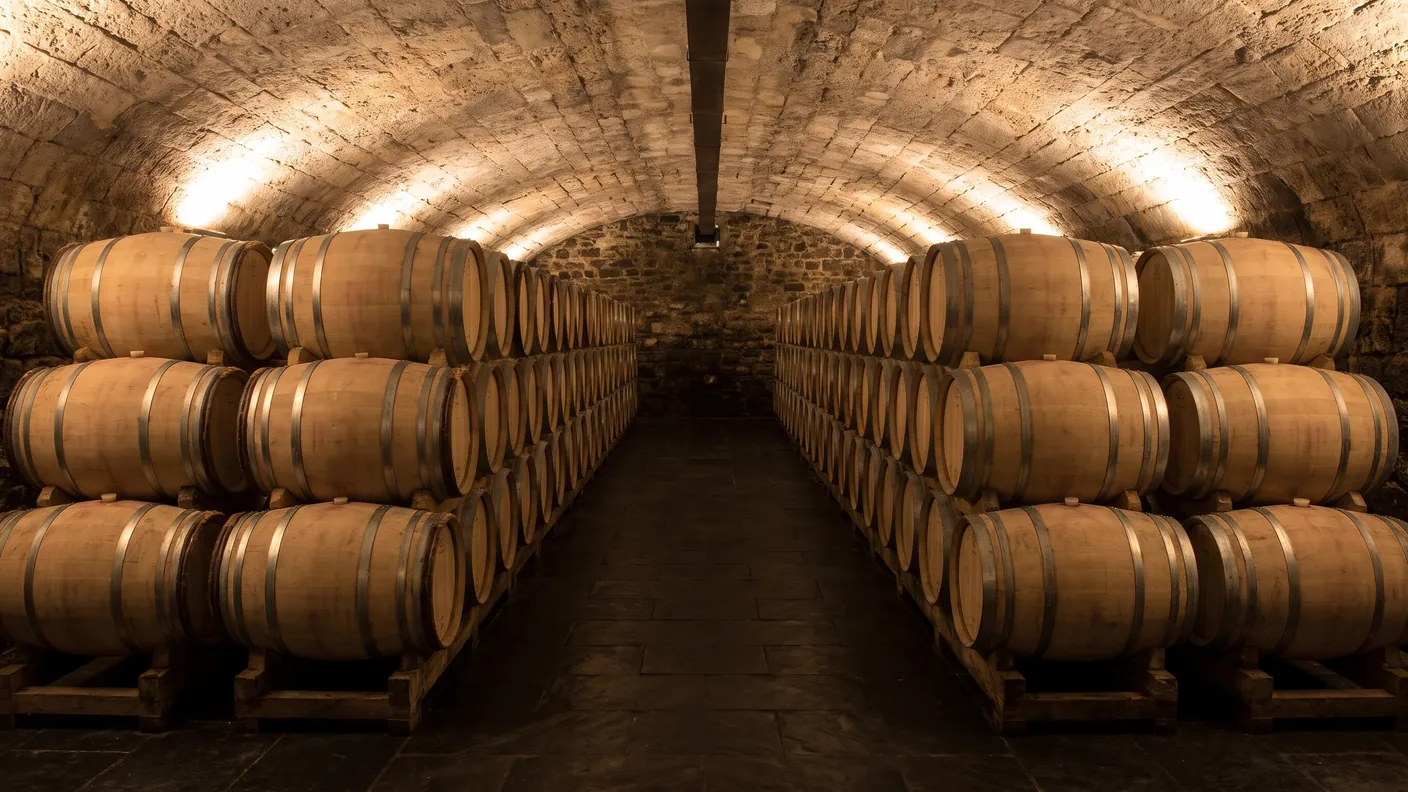
The vineyard has been certified organic since 2019, after three years of conversion. Since 2013, the vat room has been fully gravity-fed: the grapes drop into the vats by gravity alone. The château makes almost all of its barrels in its own cooperage, and its underground cellar holds around a thousand of them. A bronze hare by Barry Flanagan has greeted visitors since 1990, report World of Fine Wine and Gironde Tourisme; other contemporary sculptures are dotted around the estate.
The standard tour, as described by the neighbouring hotel, is guided and lasts 1 hr 15 min, in groups of 10. It takes in the tower, the vat room, the underground cellars and the cooperage, and ends with a tasting of the first and second wines. Smith Haut Lafitte is not on the programme for the December 2026 open days.
Château Latour-Martillac: two classified colours, near the town hall
Visits to Latour-Martillac must be booked at least 12 hours in advance; the shop, however, is open without booking. The estate advertises access for people with reduced mobility and, from May to October, a treasure trail for families.
It is one of the commune's two Graves classified growths, for red and white. Édouard Kressmann noticed the estate in 1871, and the Kressmanns bought it around 1930. According to the estate, the property was then called “Château Latour”: it took the name of the commune to avoid confusion with Château Latour in the Médoc.
Château La Garde: 800 m from the town hall
Château La Garde is at 1 chemin la Tour, 800 m from the town hall by road. It welcomes visitors on weekdays all year round, and on Saturdays too from April to October. Together with Latour-Martillac, 500 m from the town hall, it lets you combine two tastings in the village centre. The BRGM notes that the FXb1 gravel terrace surfaces at Latour-Martillac and La Garde.
Domaine de la Solitude: a free Visite Découverte
Domaine de la Solitude belongs to the Congregation of the Holy Family, established here in 1831 according to the estate. Since 1993, Domaine de Chevalier, in Léognan, has farmed the vineyard under a forty-year tenancy.
The estate welcomes visitors with or without booking, in French or English, Monday to Friday; at weekends, it is by appointment. The Visite Découverte (discovery tour), lasting about an hour, is free; the workshops are paid.
Château de Rochemorin: open days only
Rochemorin stands on a gravel rise, 1.5 km from Les Sources de Caudalie, about 4 min without traffic. The owner advertises direct sales, but no regular visits: the André Lurton group's tours and tastings take place at Château La Louvière, in Léognan, about 3 km from Les Sources (8 min without traffic). The number +33 5 56 64 75 87, sometimes given for Rochemorin, is in fact La Louvière's.
Its second wine is called Coucheroy. According to a legend that the owner itself presents as such, the name comes from a stop made by the future Henri IV after the Battle of Coutras.
Rochemorin opens during the Pessac-Léognan open-days weekend in early December: on 5 and 6 December in 2026, from 10am to 6pm according to the Lurton group. No common admission price has been announced for the weekend: check each château's programme.
The neighbours: Bouscaut, Haut-Bailly, Domaine de Chevalier, Carbonnieux
Several estates are in the neighbouring communes of Cadaujac and Léognan. Château Bouscaut, at 1477 avenue de Toulouse, is in Cadaujac, about 3 km and 5 min without traffic from Les Sources de Caudalie: it offers themed tours all year round, Tuesday to Saturday. In Léognan, Château Haut-Bailly, 5.9 km from Martillac town hall, welcomes visitors Monday to Friday by reservation; Domaine de Chevalier, 7.7 km away, does so by appointment. Château Carbonnieux, also in Léognan, is 2.9 km from Les Sources. Distances by road.
For other vineyards from Bordeaux, see our guides to Saint-Émilion and the Médoc.
What can you do at Les Sources de Caudalie without staying the night?
Without booking a room, you can spend a whole day between Château Smith Haut Lafitte and Les Sources de Caudalie: a château tour by appointment, lunch at ROUGE, which takes no reservations, then spa treatments booked in advance. The hotel was opened in 1999 by Alice and Jérôme Tourbier; it is the first hotel of the family-run Les Sources group. It stands next to the château, on chemin de Smith Haut Lafitte, 33650 Martillac.
Why “caudalie”?
A caudalie is a tasting unit: one second of flavour persisting in the mouth. The Caudalie brand was born of a meeting in 1993, during the harvest at the château, with Professor Vercauteren, a professor of pharmacy in Bordeaux who was studying grape seeds. Founded by Mathilde Thomas-Cathiard and Bertrand Thomas, it launched its first three products in 1995. Its first Vinothérapie spa opened in 1999 on the family estate, the year Les Sources de Caudalie was born.
The spa: what is open to outside guests
The spa welcomes outside guests on one condition: booking a treatment. Access is from age 16, and the treatments use Caudalie products, based on vine and grape.
- Accessible with a booked treatment: the hammam, the indoor Jacuzzi, the relaxation rooms and the thermal bath.
- Reserved for hotel guests: the two swimming pools, the outdoor hot tub and the sauna.
As recorded on 21 November 2026, the spa is open on Mondays from 10am to 7pm, Tuesday to Saturday from 9am to 7pm, and on Sundays from 9am to 1pm. It announces closures on 8, 9 and 10 December 2026 and on 4 and 5 February 2027; the ground-floor pools and saunas close from 6 to 26 February 2027. Around these dates, ask the spa to confirm what is still available.
Three restaurants open to outside guests
La Grand'Vigne, chef Nicolas Masse's fine-dining restaurant, serves dinner Wednesday to Friday, then lunch and dinner on Saturday and Sunday. Smart dress is expected, and its description highlights the house's organic kitchen garden, grown using permaculture. La Table du Lavoir is open every day for lunch and dinner: seasonal produce, “old-fashioned vegetables” and the château's wines, including by the glass. Both restaurants take bookings online, through Zenchef.
ROUGE, on the other hand, takes no reservations. It is open from 11am to 6pm Sunday to Thursday, and from 11am to 10pm on Friday and Saturday.
At La Table du Lavoir, a washhouse rebuilt stone by stone recalls the winegrowers' wives who came to do their laundry there in the 19th century. The restaurant is fully accessible to people with reduced mobility.
Parking on site
Parking is free and requires no booking, with four EV charging points; a free valet service runs 24/7. There is also a secure private car park, for a fee. The hotel cannot be reached by public transport.
A sample day: tour, lunch, spa
- Morning: the Château Smith Haut Lafitte tour, booked in advance. In the format described by the hotel, it lasts 1 hr 15 min, and the hotel says the château can be reached on foot.
- Midday: ROUGE, without booking, or La Table du Lavoir, with a reservation.
- Afternoon: the spa, with a booked treatment, from age 16.
On Sundays, the spa closes at 1pm: on that day, schedule your treatments in the morning. The château welcomes visitors 7 days a week by appointment: ask for a slot after 1pm when you book. For lunch at La Grand'Vigne, aim for Saturday or Sunday: on weekdays it serves only dinner, Wednesday to Friday.
What is there to do in Martillac: forest, walks and events?
In Martillac, you can walk in the Migelane departmental forest, shared with La Brède and Saucats (four loops from 1.4 to 6.5 km), follow the town hall's four routes, do the Pistes de Robin with children or cycle the Boucle des Crus Classés de Graves (21 km). The commune has no swimming spot and no weekly market. It hosts a few events every year, two of them centred on the vineyards.
The Migelane forest: four waymarked loops
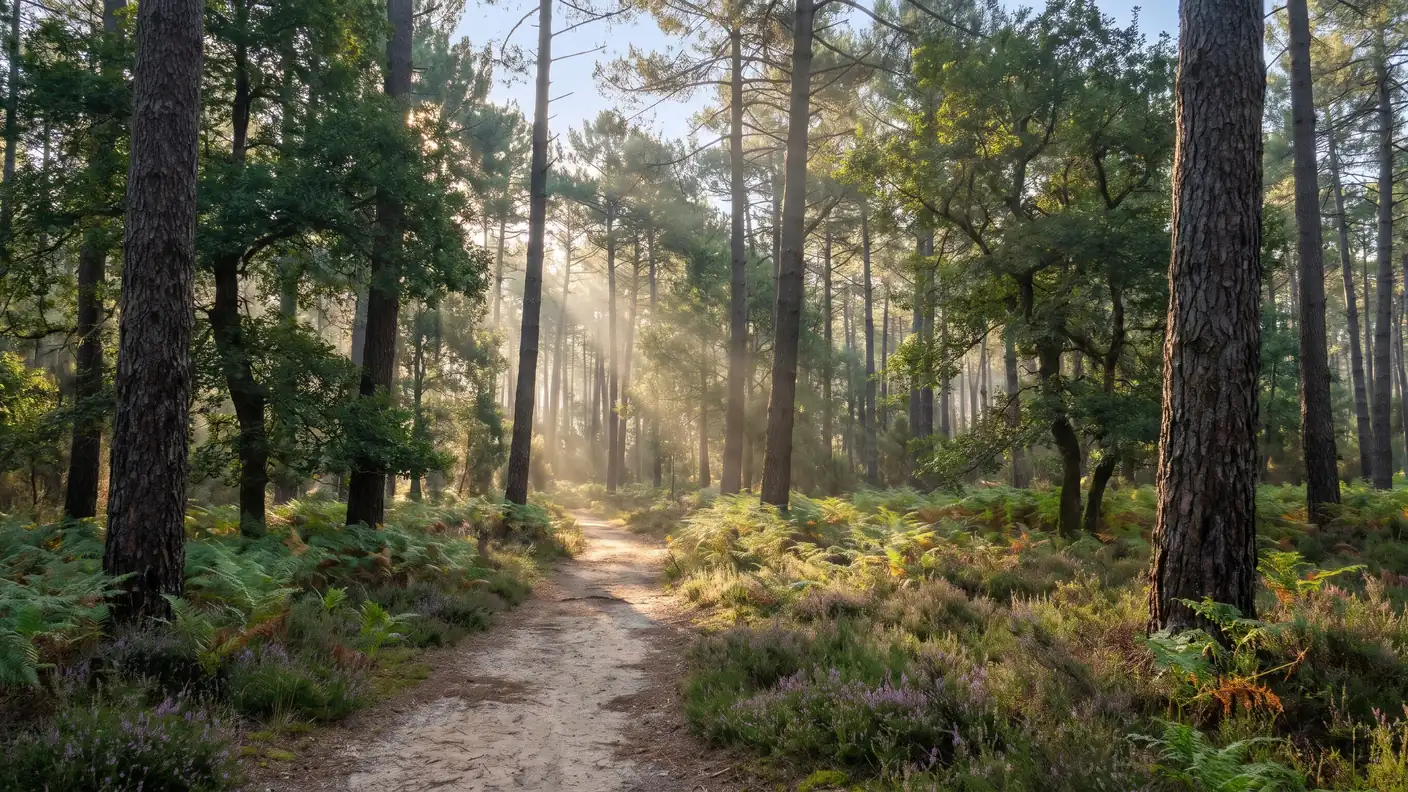
The Migelane departmental forest covers about 265 ha, shared between Martillac, La Brède and Saucats. Almost half, about 124.5 ha according to the boundaries of the ONF (National Forests Office), lies in Martillac, as does the car park. The Gironde Department bought it in 1989 and opened its trails on 25 March 2017. It is designated a sensitive natural area (espace naturel sensible).
According to the management order of 16 December 2025, which sets out how the forest is to be managed from 2025 to 2039, the forest has 230.97 ha of woodland: 81% maritime pine, 11% mixed broadleaves and 7% pedunculate oak. On 10.12 ha, senescence islands are left to develop naturally.
The forest has four waymarked loops:
- 1.4 km: the Petite Boucle (short loop), wheelchair accessible, with a guide rope and Braille markers;
- 2.7 km: the forest walk;
- 5.2 km: the geology walk, which follows the Breyra, Martillac's main stream;
- 6.5 km: the long walk.
The car park is in Martillac, on the D 111: it is the first parking area on the right after the Montesquieu technology park. There are no toilets on site. From the town hall, allow about 5 km and 8 min, without traffic. This car park has been closed for works before, in 2023 and again in August 2024: check that it is open before you set off.
At the forest entrance, the Department points out the Montesquieu oak. Tradition has it that the philosopher rested there; it remains a legend.
The town hall's four routes
The town hall publishes four routes on its website. They link the village centre, several estates and the Migelane forest:
- Boucle de la Solitude, 6.4 km: chapel, Bon Père fountain, washhouse and convent;
- Boucle du Muguet, 7.3 km: church, Château Mirebeau, Rochemorin farm, Château Smith Haut Lafitte, Les Sources de Caudalie and fields of lily of the valley, a crop the town hall showcases;
- Boucle bourg-Plaine des sports (village centre to sports ground), 4.1 km;
- Plaine des sports to Migelane forest link, 2.9 km, to reach the forest on foot.
The Pistes de Robin, for children
The Pistes de Robin are a puzzle trail run by the tourist office, under the title “Martillac d'hier et d'aujourd'hui” (Martillac past and present). The route is 2.5 km on foot, takes about 1 hour and is free. A puzzle booklet is designed for children aged 5 to 10. The trail passes the fountain on the route de Mirebeau, Château Latour-Martillac and the church.
By bike: the classified growths loop
The Boucle des Crus Classés de Graves starts from the Martillac tourist office. It is 21 km long, takes about 1 hr 30 min and is easy. A longer option, the “Iconiques à vélo : le château de La Brède” loop, covers 36.6 km, about 3 hours.
Two major cycle routes do not pass through Martillac. The Scandibérique (EuroVelo 3) goes through La Brède, the neighbouring commune. The Roger-Lapébie cycle path is on the right bank of the Garonne: it starts at Latresne, 18.6 km from the town hall by road.
Events through the year
These events are run by the La Martillacaise association and the town hall. The dates given are those of the latest editions; next year's remain to be confirmed.
- 1 May, the Foulées du Vignoble Martillacais: 7 km and 17 km trail races, a 42 km trail marathon and a walk of about 10 km, starting from the Hervé de Venancourt stadium on Route de Tout-Vent.
- The Fête de la Nature: the 3rd edition took place on 30 May 2026 at the Mille Sources school, with free entry.
- Early July, the village fête under the Rochemorin oak grove, with moules-frites (registration required) and fireworks. Latest edition: 4 July 2026.
- Late September, the Balade des Châteaux: a tasting walk of about 10 km through three properties, limited to 300 places. Latest edition: 26 September 2026.
Markets and tourist office
Martillac has no weekly market. The nearest ones are all held from 8am to 1pm: Léognan on Saturdays, 5.3 km from the town hall; La Brède on Wednesdays, 7.0 km away; Saint-Médard-d'Eyrans and Cadaujac on Sundays; Saucats on Fridays.
The Sud Bordeaux Tourisme tourist office, formerly the Montesquieu office, is in Martillac itself: 3 place Marcel Vayssière, +33 5 24 73 39 90.
What is there to see around Martillac: La Brède, Saucats, Léognan?
Three neighbouring communes round off a visit to Martillac: La Brède for Montesquieu's château, Saucats for the geological reserve and Léognan for its estates. Further afield, our guides to Cadillac, Sauternes and Langon cover other stops in southern Gironde.
The Château de La Brède, Montesquieu's birthplace
Montesquieu was born at the Château de La Brède on 18 January 1689. The estate, at 65 avenue du Château, was classified as a historic monument by an order of 7 May 2008. It is 7.9 km and about 10 min from Martillac town hall, without traffic.
The château opens only part of the year. In 2026, it welcomed visitors from 4 March to 15 November: it is therefore closed until spring 2027; check its website for reopening dates. The interior can only be visited with a guide. Arrive 20 min before your tour, as the reception is 400 m from the château.
The Saucats-La Brède geological reserve
The Saucats-La Brède National Geological Nature Reserve neighbours Martillac, but none of its land lies in the commune. Created in 1982, it covers 75.50 ha in three sectors. The association that manages it, founded in 1980, presents it as France's first geological nature reserve.
The reserve protects stratotypes, that is, reference sections for geologists: the Aquitanian at Bernachon and L'Ariey, the Burdigalian at Pont-Pourquey. You can also see Serravallian deposits, at Lassime. The Aquitanian deposits are 21.2 to 20.4 million years old. In the reserve, limestone-rich water deposits travertine on the Bernachon cliff, and you can spot kingfishers and dragonflies.
The Maison de la Réserve, at 17 allée Joseph Wresinski in Saucats, is open on weekdays, and its museum is free. Guided tours take place on Saturdays at 3pm, from May to September, booked by noon the day before. According to the managers, a car is essential to get from one site to another. From Martillac town hall, allow 13.8 km and about 17 min, without traffic.
Léognan and its estates
Léognan, to the west, is the commune with the most châteaux in the Pessac-Léognan association's directory: 27, compared with 17 in Martillac. Several welcome visitors within 8 km of Martillac town hall: Château Haut-Bailly Monday to Friday by reservation, Domaine de Chevalier by appointment, and Château La Louvière, where Rochemorin's tours and tastings take place. At the Lac Bleu in Léognan, in a forest park open all year round, swimming is prohibited.
The Breyra and nearby natural areas
Martillac's main watercourse is the Cordon d'Or, known here as the Breyra: 11 km long, about 7.3 km of it within the commune. Next come the Milan, 7 km, whose upper course is called the Ruisseau du Nouchet, and the Ruisseau de la Peguillère, 6 km, called the Ruisseau de Bourran upstream. All flow into the Garonne. The Saucats, the Gat Mort and the Eau Blanche, on the other hand, do not cross the commune.
No Natura 2000 site or ZNIEFF (natural area of ecological interest) covers Martillac. The nearest, as the crow flies, are the ZNIEFF “Bocage humide de la basse vallée de la Garonne”, about 160 m away, the Natura 2000 site “Bocage humide de Cadaujac et Saint-Médard-d'Eyrans”, about 0.8 km away, and the Natura 2000 site “Gat Mort et Saucats”, about 1.1 km away. The Landes de Gascogne Regional Nature Park is about 9 km away, as the crow flies.
Martillac has its own entry in the National Inventory of Geological Heritage: the “Séquence aquitanienne du Breyra (Martillac)”, added in 2021. This is an inventory, not a protection, and the land may be private. In 2005, two articles in the Annales de Paléontologie also reported “sables à Mactres” in Martillac (sands named after a shellfish) at the base of the Burdigalian. To see fossils, head instead to the Maison de la Réserve in Saucats.
Climate and records
The heat record at the neighbouring Météo-France station, Cadaujac-INRAE, is 41.8 °C. It was reached twice: on 11 August 2025, then on 23 June 2026. The previous record was 41.5 °C, on 23 July 2019. The station is about 2.4 km from Les Sources de Caudalie, as the crow flies.
The station's 1991-2020 climate normals give an average annual temperature of about 13.8 to 13.9 °C and 917 to 918 mm of rain a year. The cold record, −15.8 °C, dates from 17 January 1987. Géorisques lists three risks in the commune: differential ground subsidence, earthquake and forest fire. Martillac has also had 21 natural-disaster declarations.
When should you visit Martillac?
Martillac can be visited all year round. Festivities are concentrated between May and September, the Pessac-Léognan open days fall in late May or June, then early December, and the nearby Château de La Brède closes in winter.
| Period | What's on | Good to know |
|---|---|---|
| Spring | On 1 May, the Foulées du Vignoble Martillacais and lily of the valley sold in the street. The Estivales de Pessac-Léognan, the summer open days, in late May or June depending on the year. Fête de la Nature (30 May in 2026). | Estivales on 14 and 15 June in 2025, 30 and 31 May in 2026. Château de La Brède reopened on 4 March in 2026. Treasure trail at Latour-Martillac from May. |
| Summer | Village fête under the Rochemorin oak grove, early July (4 July in 2026). Guided tours of the geological reserve on Saturdays, May to September. | Record of 41.8 °C at Cadaujac, in August 2025 and June 2026. Nowhere to swim in Martillac. |
| September and October | Harvest, on dates that change every year. Balade des Châteaux in late September (26 September in 2026). | Balade limited to 300 places. Château La Garde open Monday to Saturday until the end of October. |
| Early December | Pessac-Léognan open days at some forty châteaux, eight of them in Martillac (5 and 6 December in 2026). | Rochemorin's only announced opening in 2026. Les Sources de Caudalie spa closed on 8, 9 and 10 December 2026. |
| Winter | Latour-Martillac open Monday to Saturday, Domaine de la Solitude Monday to Friday, Smith Haut Lafitte by appointment. Château de La Brède closed after 15 November 2026, until spring 2027. | Château La Garde open Monday to Friday. Spa closed on 4 and 5 February 2027; ground-floor pools and saunas closed from 6 to 26 February 2027. |
For wine in Martillac itself, two events stand out: the Balade des Châteaux in late September and the Pessac-Léognan open days in early December. On Saturday 5 and Sunday 6 December 2026, eight properties in Martillac open their doors: Carrosse-Martillac, Ferran, Haut-Nouchet, La Garde, Lafargue, Latour-Martillac, Rochemorin and Domaine de la Solitude. Smith Haut Lafitte is not taking part, and no common admission price has been announced: check each château's programme. It is a weekend of tastings when it is best not to drive.
For walking, summer calls for caution: on top of Cadaujac's heat records comes the risk of forest fire, recorded by Géorisques in the commune. The Migelane loops, from 1.4 to 6.5 km, are short enough to be walked early in the morning.
These dates and opening hours were recorded on 21 November 2026: check them with the estates or Sud Bordeaux Tourisme before you set off.
How do you get from Bordeaux to Martillac?
Martillac is some twenty kilometres from central Bordeaux, about 30 min by road. The commune is outside Bordeaux Métropole and has no railway station. Three regional bus lines serve it, but none goes as far as Les Sources de Caudalie: the nearest regular bus stop to the hotel, Le Breyra, is 3.2 km away by road.
| Mode | Time | Cost | Details |
|---|---|---|---|
| Private chauffeur | About 30 min | From 51 € · one way | Door to door, from your address to the estate or the hotel |
| Car | About 30 min | A62 toll-free as far as La Brède | Via the ring road, or via the A62 to exit 1 “Saint-Médard-d'Eyrans” |
| Bus 482 (Cars Régionaux) | 37 min from Bordeaux Peixotto to the Technopole | TBM ticket valid only within Bordeaux Métropole | Never on Sundays; 4 stops in Martillac |
| TER (line 44) | Depends on the train timetable | TER ticket | No station in Martillac: Saint-Médard-d'Eyrans for the village centre, Cadaujac for the hotel |
| Tram C, then bus 4812 | About 19 min by bus from Villenave Pyrénées | TBM ticket for the tram; valid on the bus only within Bordeaux Métropole | Bus stop 26 m from the tram, get off at Carpo |
| Airport, by public transport | About 45 min on tram F to Saint-Jean, then the TER | Tram ticket, then TER ticket | Tram F every 10 min on weekdays and Saturdays |
With a private driver
A chauffeur picks you up at the address of your choice and drops you in front of the estate, the hotel or the start of a walk. From central Bordeaux, allow about 30 min, from 51 € one way. Our Bordeaux → Martillac page details the trip and how to book.
By car: the ring road or the A62
By motorway, take the A62 to exit 1, “Saint-Médard-d'Eyrans”, at km 6: this is the exit signposted for Martillac. The section is toll-free as far as La Brède. Then reach the village centre via the D1113, then the D214. The D1113 does not cross Martillac: it runs along the commune's eastern boundary, separating it from Saint-Médard-d'Eyrans and Cadaujac.
For Les Sources de Caudalie, a route planner suggests the ring road (exit 18), then the D1113 and the D111. Without traffic, the difference from the A62 route is only about a minute. The hotel's own brochure describes the route via the A62 and exit 1, then five roundabouts. The hotel car park is free; the Migelane forest car park is on the D 111.
By bus: line 482, never on Sundays
Cars Régionaux line 482 links Bordeaux Peixotto, in Talence, on tram line B, with La Brède. In Martillac, it stops at Technopôle Montesquieu, Le Breyra, Bourg and La Cave. Allow 37 min from Peixotto to the Technopole. The bus never runs on Sundays. Its timetable is valid from 29 August 2026 to 25 June 2027.
Martillac is outside Bordeaux Métropole: a TBM ticket is valid on these buses only within the Métropole's boundaries. Two other regular Cars Régionaux lines serve the commune: the 480 Express, from Beautiran to Le Haillan (Cinq Chemins), Monday to Friday from 5.30am to 8.30pm, and the 4812, described below.
By train: no station in Martillac
Martillac has no railway station. The nearby stations are all on TER line 44 Bordeaux-Langon-Marmande-Agen: Saint-Médard-d'Eyrans, Cadaujac, Villenave-d'Ornon and Beautiran. The village centre and the hotel do not share the same nearest station. For the village centre, it is Saint-Médard-d'Eyrans, 3.4 km from the town hall (4 min without traffic). For the hotel, it is Cadaujac, 4.1 km away (8 min without traffic).
From Saint-Médard-d'Eyrans station, the Communauté de communes de Montesquieu's M'bus A shuttle runs to the Technopole, with 11 trips a day on weekdays. Engineering works can cancel all trains at these four stations, and on some days the service is reduced: check your train the day before.
By tram C, then bus 4812
Take tram C to its terminus, Villenave Pyrénées. The “Pyrénées” stop for bus 4812 is 26 m away. The bus reaches Martillac in about 19 min, at the Carpo stop, one of whose two stops is in Martillac and the other in Saint-Médard-d'Eyrans. No bus runs from this terminus to the hotel, 5.8 km away (9 min without traffic).
From the airport and Saint-Jean station
From Saint-Jean station, the road covers 15.1 km to Les Sources de Caudalie (20 min) and 17.7 km to the town hall (17 min). From Mérignac airport, allow 20.7 km between the Hall A drop-off zone and Les Sources (24 min, the same on the way back), and 24.2 km to the town hall (22 min). These times are calculated without traffic: they are minimums. The airport refers to halls, not terminals.
Without a car, tram F has linked the airport to Saint-Jean station since 6 December 2025, in about 45 min; it runs every 10 min on weekdays and Saturdays. TER line 44 then takes you to Cadaujac or Saint-Médard-d'Eyrans. The 480 Express does not go as far as the terminal building. Our guides to Mérignac airport and Saint-Jean station cover these two starting points in detail.
How much time should you allow for a day in Martillac?
A half-day is enough for two tastings in the village centre, or for a tour of Smith Haut Lafitte followed by lunch. A full day lets you add the spa, a loop in the Migelane forest or, in season, the Château de La Brède. Distances stay short: Latour-Martillac and La Garde are 500 m and 800 m from the town hall, the church 2.9 km from the hotel, and the Migelane car park about 5 km from both the hotel and the town hall.
| Profile | Itinerary |
|---|---|
| Wine lover | Latour-Martillac and La Garde, in the village centre; the free Visite Découverte at Domaine de la Solitude, on weekdays; Smith Haut Lafitte by appointment, for the 1 hr 15 min standard tour described by the hotel |
| Family | The Pistes de Robin (2.5 km, about 1 hour, puzzle booklet for ages 5-10); the Latour-Martillac treasure trail, May to October; the 1.4 km Migelane loop |
| Walker | The four Migelane loops, from 1.4 to 6.5 km; the Boucle du Muguet (7.3 km) and the Boucle de la Solitude (6.4 km), described by the town hall; by bike, the Boucle des Crus Classés de Graves (21 km), starting from the tourist office |
| Relaxing day | A tour of Smith Haut Lafitte by appointment, lunch at ROUGE without booking, then spa treatments booked in advance, from age 16 (on Sundays, the spa closes at 1pm) |
| History buff | The Romanesque apse of the church of Sainte-Quitterie, then the Château de La Brède, Montesquieu's château, 7.9 km from the town hall (open from March to mid-November in 2026) |
Accessibility
The shortest Migelane loop, 1.4 km, is wheelchair accessible, with a guide rope and Braille markers. There are no toilets on site. Château Latour-Martillac advertises access for people with reduced mobility. At Les Sources de Caudalie, La Table du Lavoir is fully accessible, according to the hotel.
Tasting and driving
If you are tasting, don't drive. Arrange a designated driver who isn't drinking, or use public transport, bearing in mind that bus 482 never runs on Sundays and that no line serves Les Sources de Caudalie. The Balade des Châteaux in late September and the December open days involve several tastings in a single day: arrange your return trip before you set off.
Check before you go
- Estate opening hours, recorded on 21 November 2026. They change with the seasons: La Garde, for example, only opens on weekdays from November to March.
- The spa: closed on 8, 9 and 10 December 2026, then on 4 and 5 February 2027; ground-floor pools and saunas closed from 6 to 26 February 2027.
- The Château de La Brède: closed until spring 2027; the interior can only be visited with a guide.
- The Migelane car park, on the D 111: it has closed for works before, in 2023 and in August 2024.
- Buses: in summer, check the timetables for lines 482 and 4812 before setting off.
- The tourist office: Sud Bordeaux Tourisme, 3 place Marcel Vayssière in Martillac, +33 5 24 73 39 90.
Frequently Asked Questions
Where is Martillac?
Martillac is a commune in the Gironde, in Nouvelle-Aquitaine, some twenty kilometres south of central Bordeaux, about 30 min by road. It borders four communes: Cadaujac to the north-north-east, Léognan to the west, La Brède to the south and Saint-Médard-d'Eyrans to the south-east. It is not part of Bordeaux Métropole. It belongs to the arrondissement of Bordeaux, the canton of La Brède and the Communauté de communes de Montesquieu, which has its headquarters in Martillac. Its postcode, 33650, is shared by seven communes.
How many people live in Martillac?
Martillac has 3,659 residents. This is INSEE's 2023 municipal population, in force since 1 January 2026; the total population is 3,697. The commune had 965 residents in 1968 (population without double counting): its population has grown 3.79-fold. Between 2017 and 2023, it grew by 3.0% a year on average. Over 17.09 km², the density reaches 214.1 people per km². Following the town hall's usage, residents are called Martillacais and Martillacaises. The 2024 figures will be published in December 2026.
Which monuments can you see in Martillac?
Martillac has two historic monuments, both listed (inscrits), neither classified (classé). The first is the church of Sainte-Quitterie, Notre-Dame parish: only its Romanesque apse, 12th-century according to the Mérimée database, is listed, since 21 December 1925. The second is the Château de Rochemorin, partly listed on 6 August 1990; the château and its surroundings have also formed a 76.03 ha listed site since 1983. Rochemorin advertises no regular visits: it opens only for the Pessac-Léognan open days, on 5 and 6 December in 2026. The Budos aqueduct, built in 1886-1887, crosses the commune underground: it is recorded in the Inventory, without being protected.
Was Montesquieu born in Martillac?
No. Montesquieu was born at the Château de La Brède, on 18 January 1689. It was his son, Jean-Baptiste de Secondat, later an agronomist, who was born in Martillac on 10 February 1716, probably at Rochemorin according to the Mérimée database. Montesquieu was certainly linked to the commune: the Lartigues, his wife's family, had land there, and his vineyard was there too. In a letter of October 1734, he says he was shipping his wine to Ireland.
Can you visit Château Smith Haut Lafitte?
Yes, by appointment only, 7 days a week: on +33 5 57 83 11 22 or at visites@smith-haut-lafitte.com. The neighbouring hotel describes the standard tour: guided, in groups of 10, lasting 1 hr 15 min. It takes in the estate's tower, vat room, underground cellars and cooperage, then ends with a tasting of the first and second wines. The château is a Graves classified growth for red, and its vineyard has been certified organic since 2019. It does not take part in the Pessac-Léognan open days in early December (5 and 6 December in 2026).
Can you use the spa or restaurants at Les Sources de Caudalie without staying there?
Yes. The spa welcomes outside visitors who book a treatment, from age 16. They have access to the hammam, the indoor Jacuzzi, the relaxation rooms and the thermal bath; the pools, the outdoor hot tub and the sauna are reserved for hotel guests. La Grand'Vigne and La Table du Lavoir can be booked online. ROUGE takes no reservations: it is open from 11am to 6pm Sunday to Thursday, until 10pm on Friday and Saturday. Parking is free.
Is there a market in Martillac?
No, Martillac has no weekly market. According to Sud Bordeaux Tourisme, the nearby markets are all held from 8am to 1pm: Léognan on Saturdays, 5.3 km from the town hall; La Brède on Wednesdays, 7.0 km away; Saint-Médard-d'Eyrans and Cadaujac on Sundays; Saucats on Fridays. On 1 May, the day of the Foulées du Vignoble Martillacais, a municipal order allows lily of the valley to be sold in the street. For wine, the Château Latour-Martillac shop is open without booking, Monday to Saturday.
How do you get to Martillac without a car?
Cars Régionaux bus 482 leaves from Bordeaux Peixotto, in Talence, on tram line B. It takes 37 min to the Technopole and makes four stops in Martillac, but never runs on Sundays. A TBM ticket is valid on it only within Bordeaux Métropole. Another option: tram C to Villenave Pyrénées, then bus 4812, which reaches the Carpo stop in about 19 min. By train, get off at Saint-Médard-d'Eyrans, on TER line 44: the M'bus A shuttle runs from there to the Technopole on weekdays. There is no public transport to Les Sources de Caudalie.
What is the appellation of Martillac's wines?
Martillac lies within both the AOC Pessac-Léognan and the AOC Graves areas. The AOC Pessac-Léognan, recognised by the decree of 9 September 1987, covers ten communes and applies only to still, dry wines, red and white. It occupies the northern part of the AOC Graves, recognised in 1937, whose area now covers 42 communes. Two of the 14 Graves classified growths are in Martillac: Latour-Martillac, classified for red and white, and Smith Haut Lafitte, classified for red. The association's directory lists 17 châteaux in the commune; only Léognan, with 27, has more in the appellation.
Which Martillac estates can you visit without an appointment?
Without an appointment, you can call in at Domaine de la Solitude on weekdays and at the Château Latour-Martillac shop Monday to Saturday. La Solitude welcomes visitors with or without booking, Monday to Friday, from 9am to 12.30pm and 1.30pm to 6pm; at weekends, it is by appointment. Its Visite Découverte, lasting about an hour, is free. At Latour-Martillac, tours must be booked at least 12 hours ahead, on +33 5 57 97 71 11. Smith Haut Lafitte receives visitors by appointment only, and Rochemorin opens only for the early-December open days. Opening hours recorded on 21 November 2026.
How long does it take to get from Bordeaux to Martillac?
Allow about 30 min for the twenty or so kilometres between central Bordeaux and Martillac. From Saint-Jean station, the road covers 15.1 km to Les Sources de Caudalie, 20 min without traffic. From Mérignac airport, allow 20.7 km between the Hall A drop-off zone and Les Sources, 24 min without traffic; both times are minimums. By bus, line 482 takes 37 min from Bordeaux Peixotto, in Talence, to the Martillac Technopole.
What can you do in Martillac with children?
The Pistes de Robin, a trail from the Sud Bordeaux Tourisme office, cover 2.5 km on foot, take about 1 hour and are free, with a puzzle booklet for ages 5 to 10. The route passes the fountain on the route de Mirebeau, Latour-Martillac and the church. From May to October, Latour-Martillac also offers a treasure trail for families. In the Migelane forest, four loops range from 1.4 to 6.5 km, with no toilets on site. In Saucats, 17 min from the town hall without traffic, the geological reserve museum is free and open on weekdays.
Further Reading
- Book your Bordeaux → Martillac transfer: fixed quote confirmed in writing, door-to-door, no obligation.
- All our destinations from Bordeaux: châteaux, vineyards and villages across the Gironde and beyond.
- Portets: Graves Vineyards, Garonne Port and Château de Mongenan, another Graves AOC commune south of Bordeaux.
- Sauternes: Sweet, Golden Wine and Château d'Yquem, our guide to sweet-wine country.
- Cadillac: The Bastide, the Ducal Castle, and the Sweet Wine, our guide to the right bank of the Garonne.
- Margaux: Château Margaux, Palmer and 21 Classified Growths, to compare with a Médoc vineyard.
Sources and References
- Church of Sainte-Quitterie, POP database (Mérimée PA00083620): 12th-century apse, listed as a historic monument on 21 December 1925
- Château de Rochemorin, POP database (Mérimée PA00083884): partial listing of 6 August 1990, first known lords in the 14th century
- Martillac, territory comparison tool (INSEE): 2023 municipal population, density, jobs
- AOC Pessac-Léognan, specifications (BO Agri): order of 3 November 2026, with the 10-commune area, gravel soils and the history of the appellation
- Pessac-Léognan appellation association, château directory: 17 châteaux in Martillac out of 70, Graves classified growths, open days
- Château Smith Haut Lafitte, the château: history of the estate, visits by appointment
- Château Latour-Martillac, tours and tastings: opening hours, booking at least 12 hours ahead, treasure trail
- Domaine de la Solitude, wine tourism: opening hours and Visite Découverte, recorded on 21 November 2026
- Migelane forest, Gironde Department: departmental forest, waymarked loops, access
- Sud Bordeaux Tourisme, tourist office: markets, Pistes de Robin, cycling loops
- Saucats-La Brède geological nature reserve: neighbouring reserve created in 1982, Maison de la Réserve, guided tours
Article updated on 22 November 2026.
Our Latest Guides
 Entre-deux-Mers & Southern Gironde
Portets: Graves Vineyards, Garonne Port and Château de Mongenan
Read the guide → Entre-deux-Mers & Southern Gironde
Sauternes: Sweet, Golden Wine and Château d'Yquem
Read the guide → Entre-deux-Mers & Southern Gironde
Cadillac: The Bastide, the Ducal Castle, and the Sweet Wine
Read the guide →On the Way to Pessac-Léognan
Direct transfer from Bordeaux (~30 min) to Martillac, its Pessac-Léognan châteaux and Les Sources de Caudalie. Fixed-price quote in writing, no obligation.