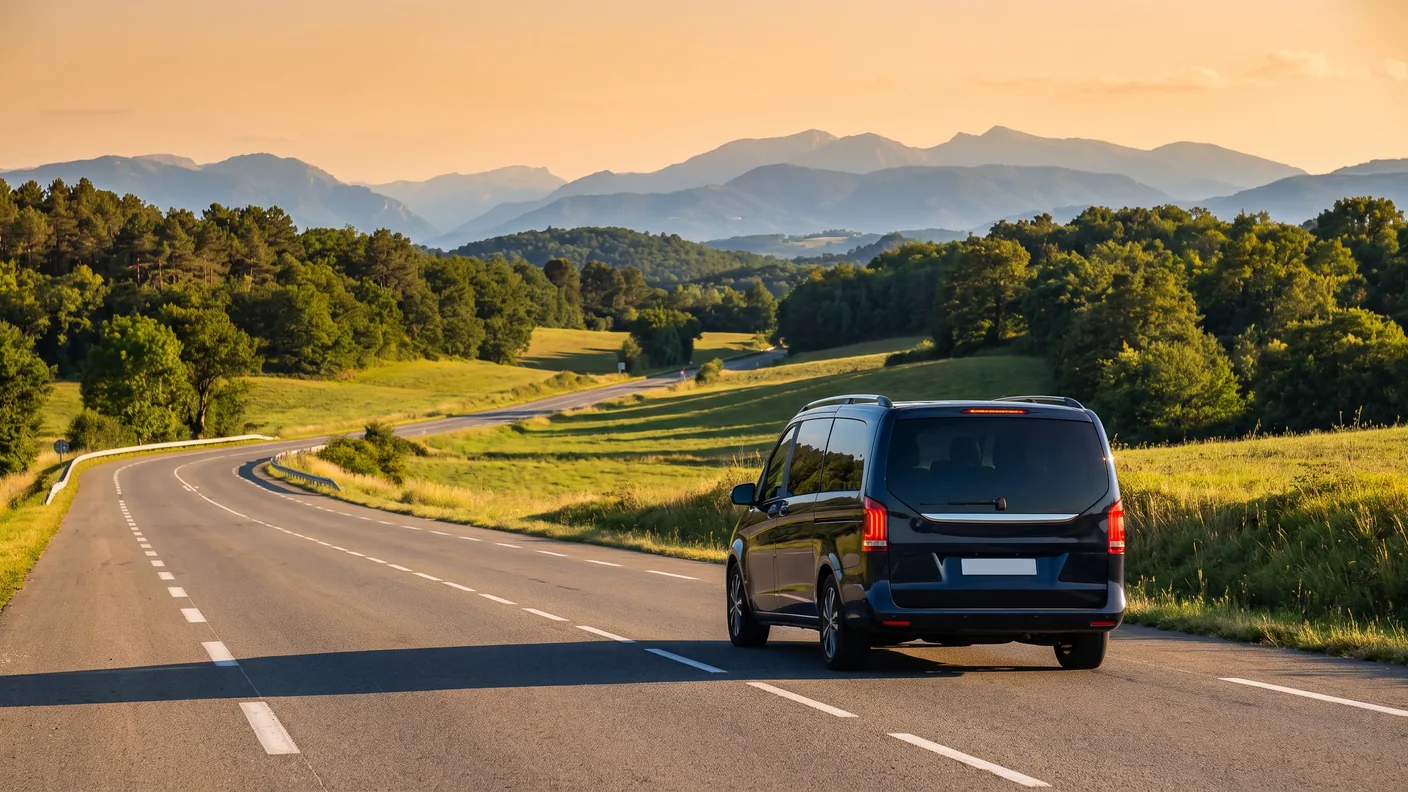
Long-distance van from Bordeaux, across France
An honest guide to long-distance van travel from Bordeaux: when a van for up to 7 passengers (8 upon request) beats the train for groups, luggage, door-to-door journeys and poorly connected destinations; when the TGV remains unbeatable; and the published fixed fares – Biarritz 434 €, Sarlat 456 €, San Sebastián 516 €, Bilbao 705 €.
Key Points at a Glance
- A long-distance van is a chauffeured vehicle booked for a longer journey from Bordeaux: up to 7 passengers (8 upon request, for an additional fee) and their luggage, door to door, at a fixed fare guaranteed in writing.
- Two categories: the Mercedes van (7 passengers) is our flagship van in the premium trim level; the eco van (up to 8 seats) is less common and must be reserved in advance upon request, for an additional fee, subject to availability.
- Honest perspective: for one or two people in a hurry between Bordeaux and Paris, the TGV (~2:04, up to ~28 trains per day) remains unbeatable (schedules checked on July 21, 2026; please verify for your travel date). The van has the edge for groups, luggage and destinations with limited public transport.
- Selected written fixed fares for the economy van: Biarritz 434 €, Sarlat 456 €, San Sebastián 516 € and Bilbao 705 €; Paris and Lyon by quote.
- For Northern Spain, there is no direct TGV: the train requires a change at Hendaye and a change of rail gauge at Irun, while the van travels straight through.
- The distances are actual road distances, and journey times are realistic estimates excluding traffic; train fares are always variable because of SNCF yield pricing.
- The Class B driver's license is enough until 8 passengers (9 seats, including the driver); anything beyond that is considered public transportation (Class D license), which is a different line of work.
- Request a quote through our booking page and receive it in writing within 30 minutes: the confirmed amount is exactly what you'll pay, including tolls.
What is a long-distance van from Bordeaux?
6:40 a.m., a suburb of Bordeaux. There are seven of you heading to the Basque Coast, with just as many suitcases, a golf bag, and a stroller. Taking the train is already a headache: getting to Saint-Jean Station, loading the luggage onto the platform, changing trains in Bayonne, and then finding final transportation to the hotel. Out in front of the house, a black van slides open its door: the group gets settled in a minute, the luggage goes into the separate cargo area, and the price is already known–confirmed in writing at the time of booking. One hundred ninety kilometers later, after about 1 hour and 45 minutes on the A63, the same van drops everyone off directly at the hotel or on the Côte des Basques, without a single transfer. This is exactly what a long-distance van solves: transporting an entire group, along with their luggage, from door to door, without any transfers and at a pre-set rate.
A long-distance van is a chauffeured vehicle reserved for a longer journey from Bordeaux, offering door-to-door travel at a fixed fare for the whole group. Instead of a short city ride, it takes you to Biarritz, the Périgord, the Charentes or Northern Spain, with one professional chauffeur and one point of contact. It may also be described as a long-distance chauffeur service or compared with a long-distance taxi. The difference is a spacious cabin for up to 7 passengers (8 upon request, for an additional fee), a dedicated luggage compartment and a fare agreed before departure rather than calculated on a running meter. French law limits this type of service to four to nine seats including the driver, for no more than eight passengers (Article R3122-1). Beyond that, the journey falls under public passenger transport rules, requiring a Class D licence and a different operator.
This guide doesn't claim that a van is always better than a train. On some routes, the train is unbeatable; on others, the van clearly has the edge. The aim is to help you choose according to your route, group and luggage. From Bordeaux Saint-Jean station, the TGV has reached Paris in about 2 hours and 4 minutes since the LGV Sud Europe Atlantique opened in 2017, with up to twenty-eight trains per day (schedules checked on July 21, 2026; please verify for your travel date). For one or two people in a hurry, no van can match it for speed. For a group with plenty of luggage, or a destination without a convenient station, the balance quickly shifts towards a van travelling directly from one address to another.
Long-distance travel: Where the city ends, where the long journey begins
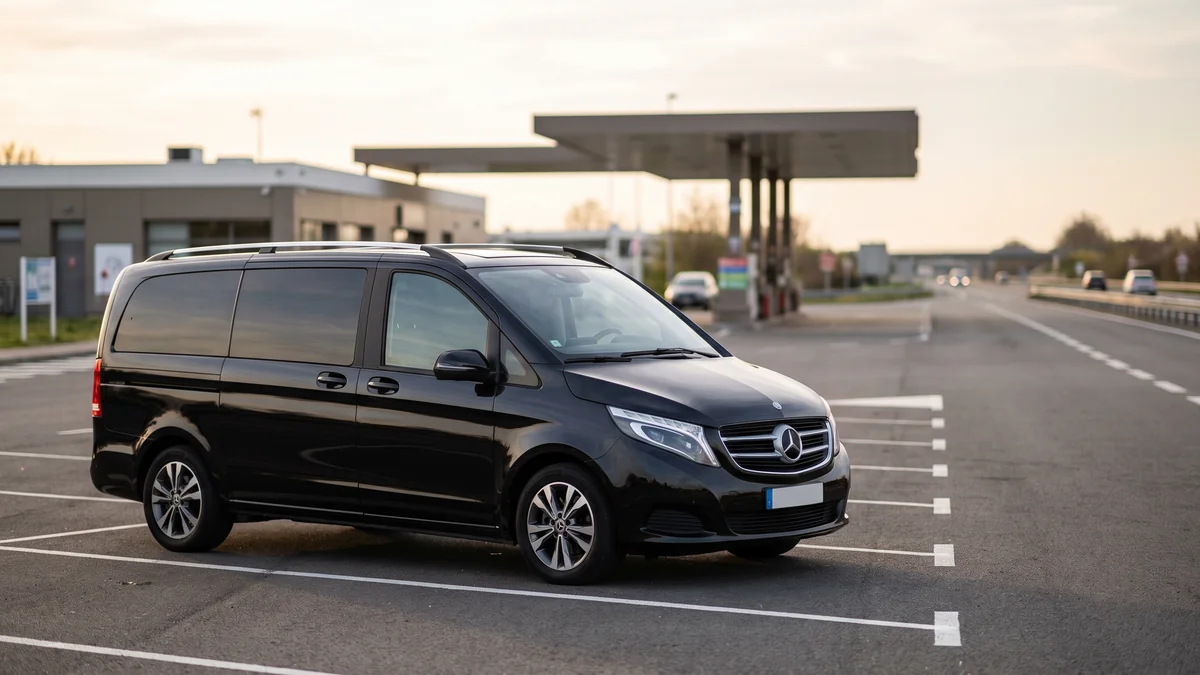
Long-distance travel begins when the journey leaves the metropolitan area to reach another city, a neighboring region, or a neighboring country. In practice, we’re talking about distances ranging from tens to a few hundred kilometers: the Basque Country, northern Spain, the Périgord, Quercy, the Charentes, Toulouse, or even Paris and Lyon for very long trips. This is no longer a few-minute airport transfer, but a trip lasting one to several hours by car. A few examples of travel distances illustrate this well: Biarritz is about 190 km (~1h45) via the A63, La Rochelle is ~180 km via the A10, Toulouse is ~245 km (~2h15) via the A62, and Bilbao is ~340 km (~3h30 to 4h00). The priorities shift: the comfort of the passenger compartment, space for luggage, and the continuity of the journey–without having to change vehicles or platforms–become just as crucial as the total travel time.
What this guide verifies, and what it refuses to invent
Every figure in this guide has been checked, and where a value varies we say so rather than offer false precision. The distances shown are actual driving distances by the usual motorway route, not straight-line measurements. Journey times are realistic ranges excluding traffic and stops: for Paris, for example, allow roughly 5 hours 30 minutes to 6 hours rather than relying on a theoretical calculator. Train fares are never presented as fixed because SNCF uses yield management: the same journey may be inexpensive on an OUIGO booked early and much dearer on a last-minute TGV INOUI. Our van fare, by contrast, is agreed in advance and includes tolls.
Van, private chauffeur service, and long-distance taxi: the categories
What is a long-distance van with a driver?
A long-distance van with a driver is a spacious vehicle, driven by a professional driver, booked in advance for a long trip at a fixed price. It transports up to 7 passengers (8 upon request, for an additional fee) and their luggage from point A to point B, without a meter: the price is calculated and quoted before departure, then guaranteed. This is the fundamental difference from a traditional long-distance taxi, where the fare is not known until arrival, once the meter has stopped. For a group traveling a long distance, this predictability is worth its weight in gold: you know, right from the time of booking, how much the trip will cost, including tolls. For external market benchmarks, consult Groupito; each provider quotes according to distance and season. For long-distance trips, only the written flat rate guarantees a fixed price. This guide expands on our section on the Van with a driver in Bordeaux, focusing on long-distance trips.
Economy van or Mercedes van: two levels of comfort
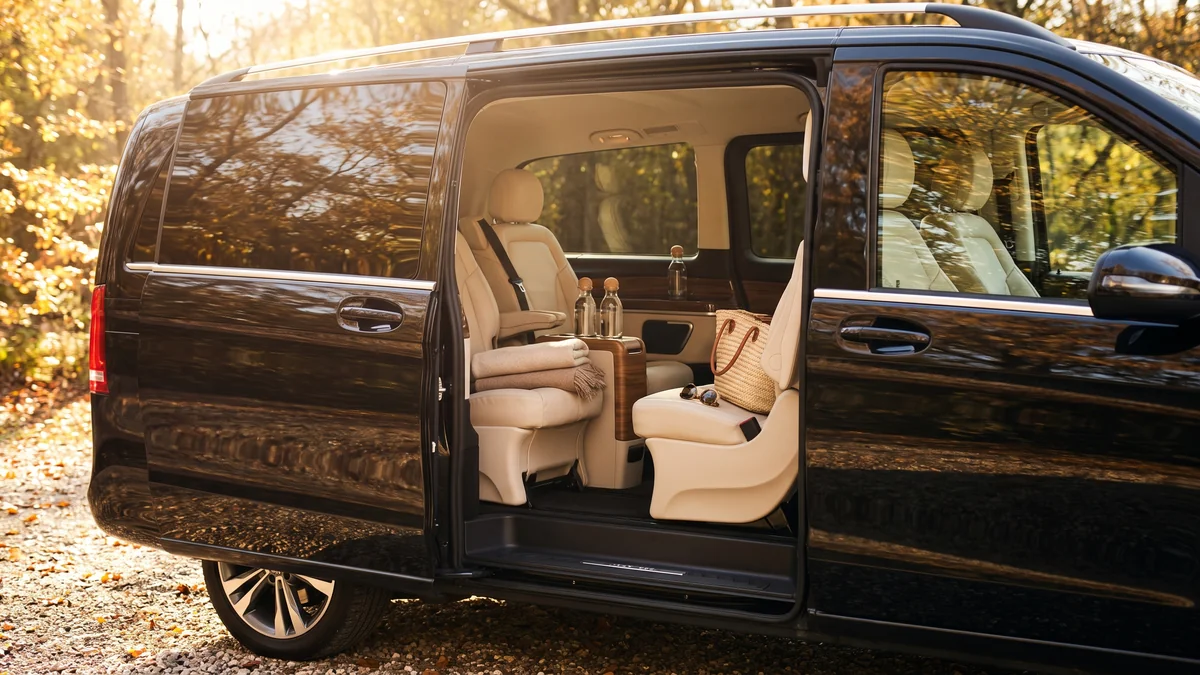
We offer two van categories to keep the choice simple. Our first choice is the Mercedes van (V-Class), which accommodates 7 passengers in a premium cabin with leather seats, extra legroom and improved sound insulation. The economy van, such as a Peugeot Traveller or Ford Transit, can accommodate up to 8 passengers, but these vehicles are less common and must be requested in advance for an additional fee, subject to availability. Both are driven by a professional chauffeur with a standard Class B licence. The Mercedes sits in a higher price bracket; in both cases, the fare is fixed and supplied in writing before departure. Mercedes vans are available in several lengths (4.90 m to 5.37 m), with rear multi-zone climate control, a touchscreen and sliding seats that make a real difference on a longer journey.
Up to 7 passengers: the 9-seat rule, including the driver
A long-distance van typically carries up to 7 passengers, plus the driver–the Mercedes V-Class van is our standard option; an eighth passenger is possible upon request, for an additional fee, subject to the availability of the less common 8-seat vans.
The law sets the upper limit–a private chauffeur-driven vehicle is capped at 9 seats total, including the driver, for a maximum of 8 passengers (Highway Code, Article R221-4; Transportation Code, Article R3122-1). A Class B license is sufficient up to this limit. For more than eight passengers, the service ceases to be a private chauffeur service and becomes public transportation, which requires a Class D license and a different service provider–that’s the realm of minibuses and tour buses, a different line of work. For a group of seven or eight traveling a long distance, a van remains the most flexible option, offering door-to-door service and the ability to book by trip. The vehicle must also meet specific requirements: it must be less than 7 years old (not 6 years), at least 4.50 m long, 1.70 m wide, and have 84 kW of power, along with a red sticker and registration in the national registry of private chauffeur services.
| Vehicle Type | Passengers (excluding the driver) | License Required | Legal Framework |
|---|---|---|---|
| Chauffeured sedan / people carrier | 4 to 5 passengers | Class B Driver's License | Pre-booked chauffeur service |
| Long-distance van | up to 7 (8 upon request) | Class B Driver's License | Pre-booked chauffeur service |
| 9-seat van | up to 8 passengers | Class B Driver's License | Pre-booked chauffeur service |
| Minibus | 9 to 16 passengers | D1 License | Public Transportation |
| Coach | 17 or more passengers | Class D License | Public Transportation |
The train travel times and frequencies in the table were recorded on July 21, 2026. They vary depending on the day, construction, and connections: check your trip using the official trip planners at SNCF Connect and Deutsche Bahn before comparing it with the road quote.
Van or Train: An Honest Comparison
No mode of transport is best in every situation. The train excels on fast intercity routes, starting with Bordeaux–Paris. The van has the advantage for groups, substantial luggage, door-to-door journeys and destinations poorly served by rail. The table below compares the two using checked 2026 figures. Compared with a taxi, the main difference is how the fare is set: taxis use regulated departmental tariffs and may apply announced supplements; request an estimate when booking, in line with the DGCCRF 2026 guidance. A chauffeured van is quoted at a fixed fare in advance. Our page on the alternative to taxis in Bordeaux explains the difference between fixed and metered pricing.
When the Train Wins: Bordeaux–Paris in a Small Group
For one or two people in a hurry between Bordeaux and Paris, the TGV is simply unbeatable. Since the LGV Sud Europe Atlantique high-speed line opened on July 2, 2017, the fastest station-to-station journey is about 2 hours and 4 minutes, compared with 3 hours and 14 minutes previously, with up to about 28 trains per day in each direction (schedules checked on July 21, 2026; please verify for your travel date). The 580-km drive takes roughly 5½ to 6 hours, excluding traffic. For a solo traveller, the train is often better value. The van serves a different need: groups with luggage, door-to-door travel and destinations where rail is less convenient. The same logic applies to Lyon (~560 km, about a 5½-hour drive): for one or two passengers, the train remains the better choice.
When a van is the best choice: groups, luggage, door-to-door service, slow train travel
The van has the edge whenever you’re traveling in a group, with luggage, or to a destination with poor rail connections. One telling detail: the time savings from high-speed travel end in Bordeaux. Beyond that–Toulouse, Bayonne, Hendaye, Spain–trains revert to standard lines, so a “TGV” to the Basque Country is hardly any faster than a van on the highway once you’ve passed Bordeaux. Specifically, a train takes about 1 hour and 50 minutes to Bayonne (11 to 15 per day; schedules checked on July 21, 2026; check for your travel date) and 2 hours and 30 minutes to 2 hours and 40 minutes to Hendaye (~13 per day; schedules checked on July 21, 2026; check for your travel date), with speeds dropping due to the lack of a new high-speed line–the Bordeaux-Toulouse high-speed line (LGV) is still only a project (GPSO), not a line in service. To San Sebastian, in fact, there is no direct high-speed rail connection. And for a village in the Périgord like Sarlat, the TER takes about 2 hours and 14 minutes to cover just 200 km, with 14 stops and only four trips per day (schedules checked on July 21, 2026; please verify for your travel date): this is where door-to-door travel really comes into its own.
| Route | By train | By van | Who wins, and when |
|---|---|---|---|
| Bordeaux → Paris | TGV ~2:04, up to ~28 trains/day (high-speed line since 2017) (schedules checked on July 21, 2026; please verify for your travel date) | ~580 km, approximately 5½–6 hours, based on an estimate | Train for 1–2 people in a hurry; van for a large group |
| Bordeaux → Toulouse | ~2 hours to 2 hours and 20 minutes (regular line, no high-speed rail) | ~245 km, ~2h15, starting at €521 | Comparable for a full van; train for a smaller party |
| Bordeaux → Biarritz / Bayonne | ~1 hour 50 minutes to Bayonne, then local transfer | ~190 km, ~1 hr 45 min door-to-door, starting at 434 € | Van for a group travelling with luggage |
| Bordeaux → Sarlat | TER ~2 hours 14 minutes, 14 stops, ~4 trips/day (schedules checked on July 21, 2026; please verify for your travel date) | ~200 km, ~2–2 hours 20 minutes nonstop, starting at 456 € | Van: slow and infrequent rail service |
| Bordeaux → San Sebastián | No direct TGV: transfer in Hendaye + track gauge change in Irun | ~240 km, ~2 hours and 30 minutes nonstop, starting at 516 € | Van: no change en route |
Price List: Long-Distance Van from Bordeaux
How to Understand Our Fixed Long-Distance Rates
Our long-distance prices are pre-set packages, shown as “from” fares for the economy van. They cover a one-way, door-to-door journey from Bordeaux, including the vehicle, chauffeur, fuel and tolls, with no surcharge for luggage or additional passengers within the vehicle's confirmed capacity. The Mercedes van offers a more premium finish at a higher fare. The written quote covers everything required for the journey, including Spanish tolls to San Sebastián or Bilbao, and does not change because traffic is heavier. The final amount depends on the exact pickup point, travel time and any requested stops; the binding fare is the one stated in your quote. For Agen, as for the Basque Coast, you know the total before you board.
| Trip (one-way) | Approx. driving distance | Starting at (economy van) |
|---|---|---|
| Bordeaux → Saintes | ~120 km | 258 € |
| Bordeaux → Bergerac | ~95 km | 262 € |
| Bordeaux → Cognac | ~120 km | 273 € |
| Bordeaux → Agen | ~140 km | 309 € |
| Bordeaux → Périgueux | ~125 km | 297 € |
| Bordeaux → La Rochelle | ~180 km | 401 € |
| Bordeaux → Biarritz | ~190 km | 434 € |
| Bordeaux → Brive-la-Gaillarde | ~200 km | 433 € |
| Bordeaux → Sarlat | ~200 km | 456 € |
| Bordeaux → Limoges | ~220 km | 497 € |
| Bordeaux → Toulouse | ~245 km | 521 € |
| Bordeaux → San Sebastián (Spain) | ~240 km | 516 € |
| Bordeaux → Lourdes | ~215 km | 541 € |
| Bordeaux → Rocamadour | ~230 km | 551 € |
| Bordeaux → Bilbao (Spain) | ~340 km | 705 € |
Paris, Lyon, and very long distances: by quote
For very long trips, such as to Paris (~580 km) or Lyon (~560 km), we provide a custom quote rather than a standard rate. At these distances, the cost depends too heavily on the route, tolls, the schedule, and a potential return trip to be stated in a single line: we prefer to calculate it precisely and confirm it in writing. As a rough estimate, allow 5 hours and 30 minutes to 6 hours for Paris via the A10 and about 5 hours and 30 minutes for Lyon via the A89 through Brive and Clermont-Ferrand, excluding traffic and breaks. Let’s be clear: for a trip from Bordeaux to Paris with one or two people, the TGV remains the fastest and often the most economical option. A van booked on a quote basis is a good option for groups, when traveling with a lot of luggage, for door-to-door service without transfers, or to a destination poorly served by rail. Request an exact quote through our online quote.
Finally, a word about the comparison with train fares, which we’re often asked about. We never publish a “fixed” train fare, because there isn’t one: the SNCF uses dynamic pricing, where the cost of the same route varies depending on the date, how far in advance you book, demand, and the operator. Comparing a train ticket to a van package therefore only makes sense on a case-by-case basis, taking into account the number of passengers. To compare the van and the train, compare the total van quote to the actual total cost of the tickets and transfers needed for the same trip. We do not publish pre-calculated per-person prices: the binding amount remains the total price listed in the quote, for the confirmed itinerary and vehicle.
Top Destinations for Long-Distance Van Trips
Vans work particularly well for destinations where rail travel involves detours, changes or infrequent services. Three regions stand out from Bordeaux: the Basque Country and Northern Spain, the Périgord and Quercy, and the Charentes and Poitou. Beyond Bordeaux, high-speed rail ends and services use conventional lines, where a train exists at all. The Basque Country and Northern Spain are 190 to 340 km away (Biarritz from 434 €, Bilbao 705 €); the Périgord and Quercy are 95 to 230 km away (Bergerac from 262 €, Rocamadour 551 €); and the Charentes and Poitou are 120 to 180 km away (Saintes from 258 €, La Rochelle 401 €). The table summarises these options, all of which also appear on our map of destinations from Bordeaux.
| Region | Examples | Approx. distance | Starting at (van) |
|---|---|---|---|
| Basque Country & Northern Spain | Biarritz, San Sebastián, Bilbao | 190–340 km | from 434 € |
| Périgord & Quercy | Sarlat, Rocamadour, Périgueux, Bergerac | 95–230 km | starting at €262 |
| Charentes & Poitou | Saintes, Cognac, La Rochelle | 120–180 km | starting at €258 |
Basque Country: Biarritz and the Coast

The Basque Coast is one of the most popular long-distance destinations, about 190 km away and a 1-hour-45-minute drive via the A63. For a group travelling to Biarritz with luggage and surfboards, the van drops everyone directly at the hotel or on the Côte des Basques, without a connection in Bayonne. The train takes about 1 hour and 50 minutes to reach Bayonne (11 to 15 daily departures; schedules checked on July 21, 2026; check for your travel date), but high-speed running ends at Bordeaux. You then need a local transfer to Biarritz and possibly another to your final address. For groups with bulky luggage, door-to-door travel is often simpler: one vehicle, one drop-off and a fixed fare from 434 €.
Northern Spain: San Sebastián and Bilbao Without Changing Trains
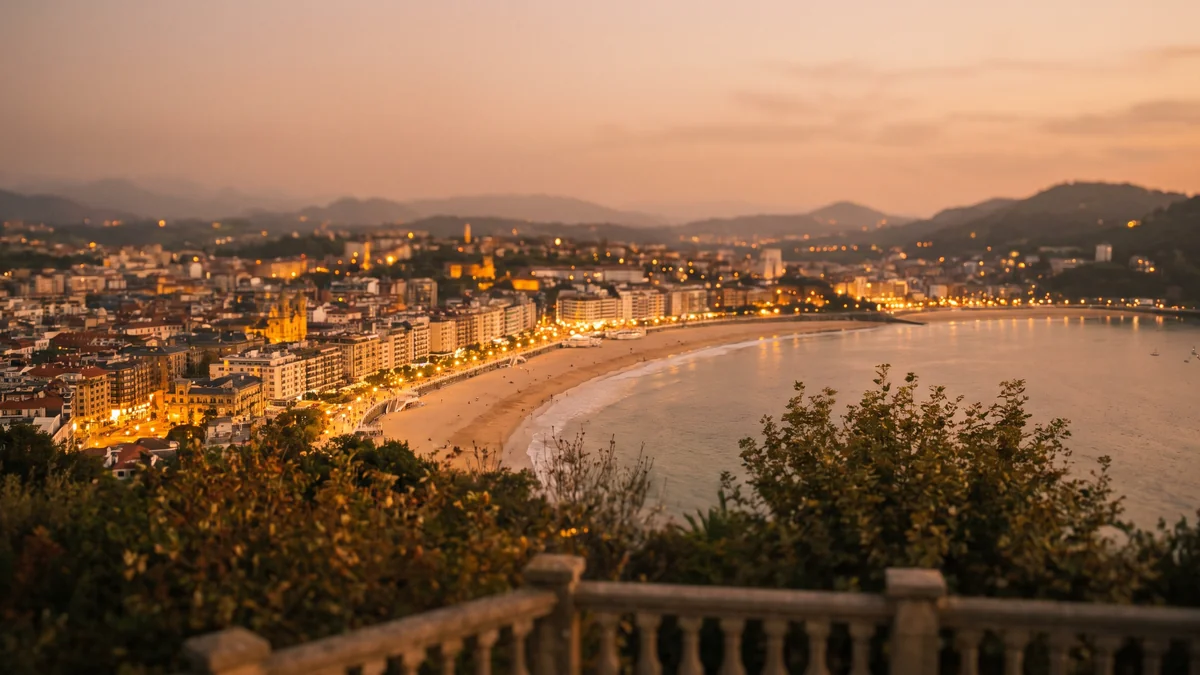
A van is especially practical for Northern Spain because there is no direct high-speed train from Bordeaux. By rail, you travel to Hendaye, change to Euskotren and cross the change of rail gauge at Irun: the Iberian gauge (1,668 mm) differs from the European standard gauge (1,435 mm). The “Topo” then takes about another 30 minutes to San Sebastián, on a separate local ticket, with luggage carried between platforms. The van completes the journey in one go: about 240 km to San Sebastián (~2½ hours) and 340 km to Bilbao (~3½–4 hours), crossing the border within the Schengen Area. Tolls on both sides (A63 in France and AP-8 in Spain) are included in the fixed fare, from 516 € for San Sebastián and 705 € for Bilbao.
Périgord, Quercy, and Charentes: Areas with Poor Train Service
The Périgord, Quercy, and Charentes regions are the van’s natural playground: beautiful destinations that are often poorly served by rail. Sarlat has only a slow and infrequent TER service; Rocamadour, a hilltop town in Quercy, is about a 230-km drive away; Périgueux and Bergerac are connected by van without going through Libourne. On the Charentes side, La Rochelle is about 180 km away via the A10; Saintes and Cognac are about 120 km away. For these trips, the van drops the group off right at the door of their vacation rental, estate, or the old port, with no need for luggage handling or transfers–and the flat rate starts at €258 to Saintes and €262 to Bergerac and €273 to Cognac. The TER train to Sarlat illustrates the problem: about 2 hours and 14 minutes for barely 200 km, fourteen stops (Cenon, Libourne, Bergerac, Le Buisson…), and only four trips per day (schedules checked on July 21, 2026; please verify for your travel date). Limoges, on the other hand, is mainly accessible via the N21, with very little highway along the route.
When should you choose a long-distance van?
The long-distance van solves a recurring problem: transporting an entire group that won’t fit in a single car to a distant destination, without turning a passenger into a driver. No one drives after a long drive or a day of wine tasting, and there’s no need to use multiple vehicles. The safety argument is clear: driving with a blood alcohol level above 0.5 g/l is a violation, and on a trip to the vineyards, only a professional driver gets behind the wheel. Added to this is the legal simplicity–for up to eight passengers, a standard driver’s license is sufficient; no commercial driver’s license or public transportation provider is required. Four key benefits stand out every time, and each is factual, not sales-driven: a single van for the entire group replaces a convoy of two sedans–one meeting point, one drop-off, and no coordination between drivers over hundreds of kilometers.
Group and Luggage: One Vehicle to Carry It All
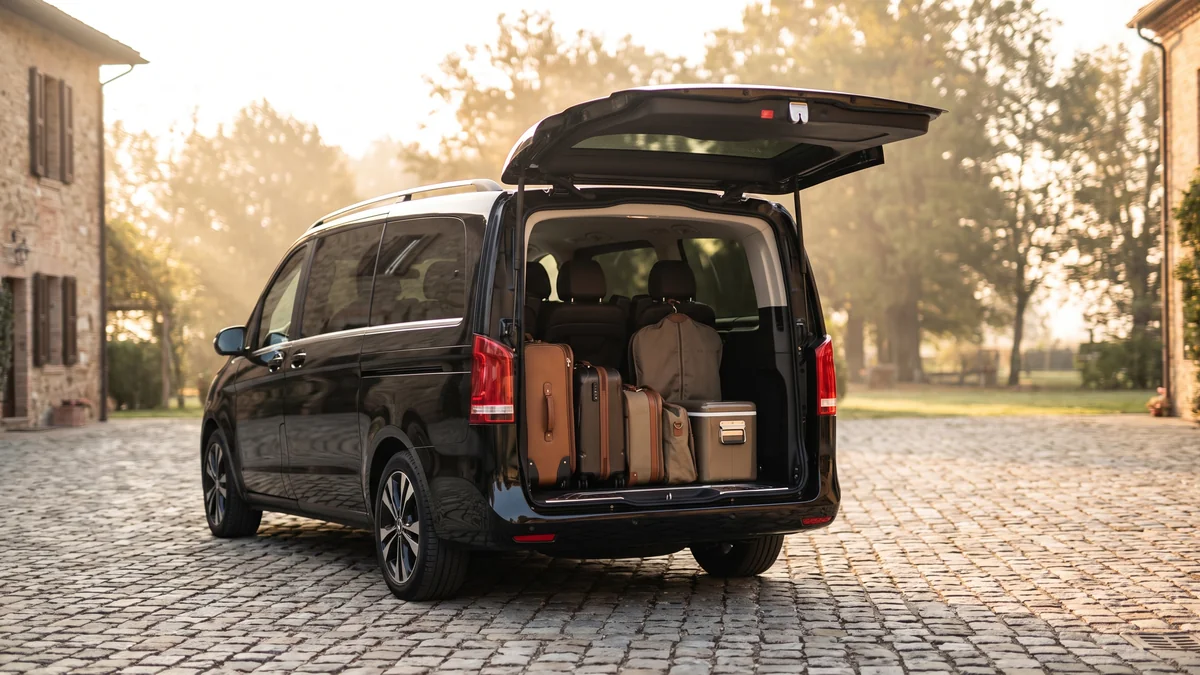
The main advantage of a van for long-distance travel is that it fits the entire group and their luggage into a single vehicle. Whereas a sedan gets crowded with just five people–leaving passengers with bags on their laps–a van can carry up to seven passengers (eight upon request) and has a trunk separate from the passenger compartment. Checked luggage, strollers, golf or ski bags, boxes of wine from a day at the vineyard–everything travels in the back, without taking up seating space and without extra baggage fees. On a flight or train, that same luggage incurs fees, gets scattered, or has to be carried along the platforms. For a long trip with a group, this capacity makes all the difference–you can all travel together, with all your belongings, without having to book a second vehicle. A Mercedes van offers 1,030 to 1,410 liters of cargo space, with sliding seats; the eco van features a large, modular cargo area. You’re never charged per piece of luggage, unlike with airlines.
Door-to-door and flexible stops: travel at your own pace
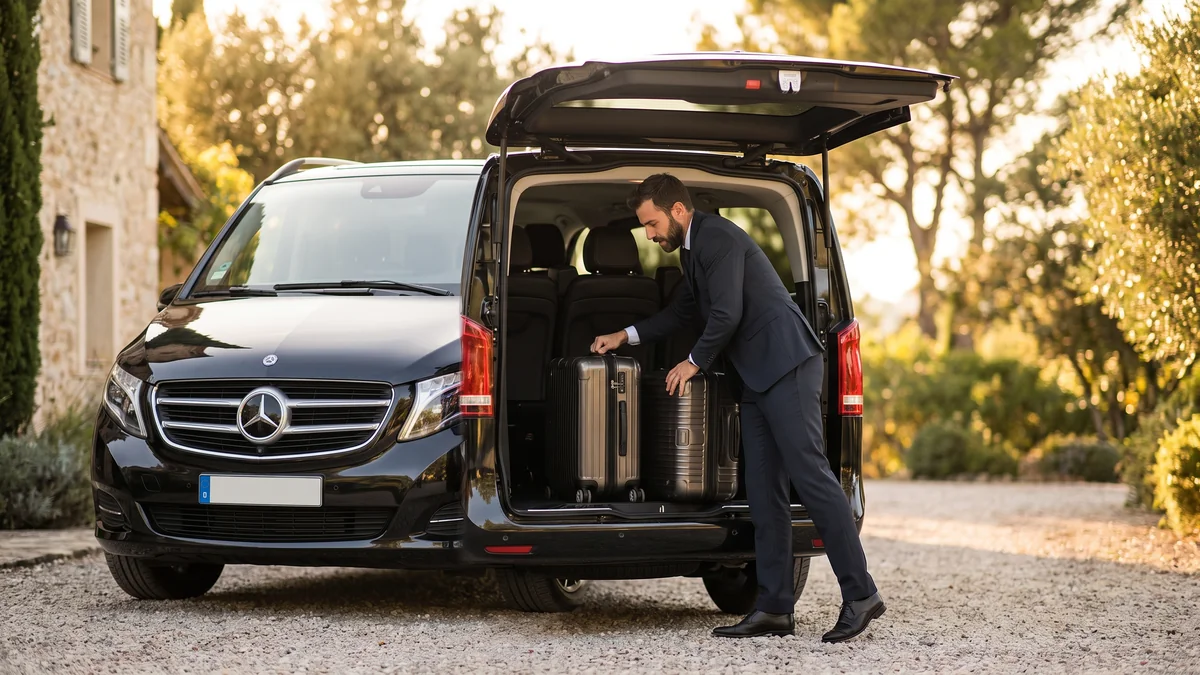
The second advantage is door-to-door service: the van collects you at your departure address and drops you at your destination, with no station journey or connection. You don't have to carry luggage to the platform, change trains or wait for another ride on arrival. You can also plan stops for lunch, a scenic viewpoint or a break along the way. On a transfer from Bordeaux-Mérignac Airport to a distant destination, such as the Périgord with a stop in Saint-Émilion, this flexibility makes a real difference. For Spain, you cross the border in one journey within the Schengen Area, while rail requires a connection and a change of network at Irun. The chauffeur works around your schedule, so nobody in the group needs to drive on the return journey.
| Use Cases | What the Long-Distance Van Offers |
|---|---|
| Group Transfer (7–8) | one vehicle instead of two sedans, a single meeting place |
| A lot of luggage (golf gear, skis, boxes of wine) | separate trunk, no extra charge per piece of luggage |
| Door-to-door | Pickup and drop-off at the exact addresses, with no station access or connections |
| Unscheduled stops along the way | lunch, scenic spot, break–all decided by the group |
| Destinations with limited transportation options (Périgord, villages, Northern Spain) | a direct route where rail travel requires detours and transfers |
Book a long-distance van and get a fixed price
A fixed, written quote in just a few minutes
Booking a long-distance van takes only a few minutes, and everything is set out in writing. Provide the exact pickup and destination addresses, the number of passengers and bags, the date, time and any requested stops. We’ll prepare a fixed quote, confirmed in writing within 30 minutes, specifying the vehicle, total price and terms. There is no meter and no surprise on arrival: the confirmed amount is what you pay, including tolls. The passenger count determines whether you need the premium 7-seat Mercedes or, for an eighth passenger, a less common 8-seat economy van available on request. Tell us about any child seats as well, so approved restraints for children under 10 can be fitted in advance. You’re booking with a licensed professional, covered by professional liability insurance and registered in France's national chauffeur registry under the Grandguillaume Act of 2016.
One-way, round-trip, and long-distance
Several formats are available for long-distance travel. A one-way journey provides door-to-door travel for a group move or a trip with no planned return. A round trip, or an hourly chauffeur service, keeps the van and chauffeur with you, which is useful for a day in the Périgord or a visit to Spain with waiting time between stops. A full-day booking works well for a Médoc or Saint-Émilion wine tour, wedding or seminar, with the chauffeur taking you from one venue to the next. We always give journey times as a range, for example 5½ to 6 hours to Paris, because actual timings depend on traffic, weather and breaks. The cancellation terms are supplied when you book.
Ready to plan your long-distance journey? Enter your route, group size and schedule to receive a guaranteed fixed fare in writing within 30 minutes, with no obligation. You’ll travel with a licensed professional covered by liability insurance and registered in the national chauffeur registry. Whether you're heading to the Basque Coast, Northern Spain, the Périgord or elsewhere in France, a comfortable van and professional chauffeur will take you door to door. If the train is the smarter choice, for example for one passenger travelling from Bordeaux to Paris, we’ll say so.
Frequently Asked Questions
Is a long-distance van a better option than the train?
It depends on the route and the number of passengers, and we’re being honest about that. For the Bordeaux–Paris route with one or two people in a hurry, the TGV is unbeatable: about 2 hours and 4 minutes from station to station and up to ~28 trains per day since the LGV opened in 2017 (schedules checked on July 21, 2026; check for your travel date). The van has the edge for groups (up to 7 people, 8 upon request), when traveling with a lot of luggage, for door-to-door service, or to destinations that are poorly served by rail, such as the Périgord, small villages, or northern Spain. The rule of thumb: take the train on major routes for small groups, and the van for larger groups with a lot of luggage or for destinations with limited rail service.
How much does a long-distance van cost from Bordeaux?
Our prices are fixed, pre-set rates, starting at “from” for the economy van: Biarritz 434 €, Sarlat 456 €, San Sebastián 516 €, Bilbao 705 €, as well as Saintes 258 €, Bergerac 262 € and Cognac 273 €, Agen 309 €, Périgueux 297 €, La Rochelle 401 €, and Toulouse 521 €. The Mercedes van is in a higher price bracket. These amounts include the vehicle, driver, fuel, and tolls, with no additional charge for luggage. Only a written quote guarantees a fixed price for your specific route, date, and group size.
How many passengers can fit in a long-distance van?
A long-distance van typically carries up to 7 passengers, plus the driver: the Mercedes (V-Class) van, in its premium trim, is the industry standard. An eighth passenger is possible, but only upon request and for an additional fee–8-seat vans (such as the Peugeot Traveller or Ford Transit economy vans) are rarer and must be reserved in advance, subject to availability. The law limits private chauffeur services to a total of 9 seats, including the driver, for a maximum of 8 passengers (Article R221-4 of the Highway Code): the 8th passenger is therefore the exception, not the standard. For more than 8 passengers, the service transitions from a private chauffeur service to public transportation, which requires a Class D driver’s license and a different service provider.
Bordeaux–Paris: Train or van?
For one or two people, the train is definitely the way to go: the TGV connects Bordeaux to Paris in about 2 hours and 4 minutes, with up to ~28 trains per day (schedules checked on July 21, 2026; please verify for your travel date), whereas the drive takes about 5 hours 30 minutes to 6 hours for ~580 km. A van for the Bordeaux–Paris route is best suited for groups, especially those with a lot of luggage, for door-to-door service without transfers, or when traveling to a location not well-served by the train station. We offer this route on a quote basis, but we’ll honestly recommend the TGV if you’re traveling light and in a small group.
Is there a direct train from Bordeaux to Spain (San Sebastián, Bilbao)?
No. There is no direct high-speed rail service between Bordeaux and Spain. By train, you must travel to Hendaye, then take a local Euskotren connection to Irun and San Sebastián, where the network uses a different rail gauge (Iberian 1,668 mm versus standard 1,435 mm). The van makes the journey in one go: about 2 hours and 30 minutes to San Sebastián and 3½ to 4 hours to Bilbao, crossing the border within the Schengen Area.
How long does a long-distance trip in a van take?
We provide an estimated time range rather than guaranteeing arrival to the minute. As a rough guide, excluding traffic and stops: Biarritz ~1h45 (~190 km), San Sebastián ~2h30 (~240 km), Sarlat ~2h to 2h20 (~200 km), Toulouse ~2h15 (~245 km), Bilbao ~3h30 to 4h (~340 km), Paris ~5h30 to 6h (~580 km). Actual timing depends on traffic, weather and breaks.
Is the price of the van really fixed for long-distance trips?
Yes. A private chauffeur service does not use a meter: the price is calculated at the time of booking based on the route and then guaranteed in writing. It does not change if traffic is heavy or if the trip takes longer, and there is no luggage surcharge. The flat rate includes the vehicle, the driver, fuel, and tolls, including Spanish tolls on the way to San Sebastián or Bilbao. This is the key difference from a long-distance metered taxi, where the fare is not known until arrival.
How much does a van ride from Bordeaux to Paris or Bordeaux to Lyon cost?
For these very long trips (Paris ~580 km, Lyon ~560 km), we provide a custom quote rather than a standard rate. At these distances, the cost depends too heavily on the route, tolls, schedule, and whether a return trip is required to be stated as a flat rate: we calculate it precisely and confirm it in writing. A friendly reminder: for the Bordeaux–Paris route with a small group, the TGV remains the fastest and often the most economical option; a van based on a custom quote is best for larger groups and when traveling with a lot of luggage.
Does the van serve villages and destinations without train stations?
Yes, that’s actually one of its biggest advantages. The van offers door-to-door service: it drops you off at the exact address, even in places where there isn’t a convenient train station–a guesthouse in the Périgord, a winery, or a village in the Quercy. This stands in stark contrast to rail travel: getting to Sarlat by TER takes about 2 hours and 14 minutes for a distance of barely 200 km, with 14 stops and only four trips per day (schedules checked on July 21, 2026; please verify for your travel date). For these destinations with limited public transportation, the van eliminates the need for transfers, waiting times, and luggage handling.
Can we make stops along the way?
Yes. On a private tour, the group decides where to stop: for lunch, at a scenic overlook, for a break, or for a stop in Saint-Émilion or Bergerac along the Périgord route. That’s not possible on a TGV or a direct flight. Please specify your desired stops when booking: they’ll be included in the quote and itinerary. The driver will tailor the route to your schedule, making the van particularly well-suited for day trips that combine multiple stops.
An economy van or a Mercedes van for a long trip?
Both options provide transportation for your group with a professional driver and a standard Class B driver's license; the difference lies in comfort and capacity. The Mercedes van (V-Class) is our flagship model: it seats 7 passengers in a premium interior–leather seats, more space, enhanced soundproofing–which is a real plus when the trip lasts several hours. The economy van (such as a Peugeot Traveller or Ford Transit) can seat up to 8 passengers, but these 8-passenger vans are rarer: they must be reserved in advance upon request and for an additional fee, subject to availability. The Mercedes van is a step up in price; in both cases, the rate is fixed and set in advance.
How much luggage can you bring on a long trip?
A lot, because the van has a cargo area separate from the passenger compartment. Checked luggage, strollers, golf or ski bags, cases of wine: luggage travels in the back without reducing seating capacity and without an extra charge per bag, unlike on a flight or in an overloaded sedan. The cargo space can be adjusted based on the number of passengers. When booking, let us know the number of passengers and pieces of luggage, as well as any bulky items: we’ll confirm the right van–Eco or Premium–to ensure everything fits without compromise.
How do I book a long-distance van and get a fixed price?
Please provide your itinerary (exact pickup and drop-off locations), the number of passengers and pieces of luggage, the date, time, and any desired stops. We’ll provide a fixed quote, confirmed in writing within 30 minutes, specifying the vehicle, total price, and terms–with no obligation. The confirmed amount is exactly what you’ll pay, including tolls–no meter, no surprises. For high-demand dates (high season from March to October, long weekends, and events), please book several days in advance, as van availability is limited.
Further Reading
- Book Your Trip: Request a Long-Distance Quote – Fixed price guaranteed in writing within 30 minutes
- The Van Pillar: our guide to the Van with a driver in Bordeaux, capacity, legal framework, and rates
- All Our Destinations: the map of All of our destinations departing from Bordeaux
- Compare with a taxi: our page on alternatives to taxis in Bordeaux, comparing fixed and metered fares
- Basque Coast: the Biarritz Guide, surfing, Rocher de la Vierge, and the Basque Country
Sources and References
- SNCF Connect – Bordeaux ⇄ Paris (frequency, travel time, dynamic pricing) – accessed: July 21, 2026 – up to ~28 trains per day; prices vary depending on the date, how far in advance you book, and the operator (yield)
- LGV Sud Europe Atlantique – opened on July 2, 2017 – Paris–Bordeaux ~2:04 (compared to 3:14 previously), 302 km at 320 km/h
- Seat61 – Trains from Bordeaux to Spain – No direct high-speed train; transfer at Hendaye/Irun, track gauge change (1668 vs. 1435 mm)
- SNCF TER Nouvelle-Aquitaine – Bordeaux ⇄ Sarlat – schedule: July 21, 2026 – ~2 hours and 14 minutes for ~200 km, 14 stops, ~4 trips per day
- Public Service – Becoming a Private Chauffeur (Form F31027) – Private chauffeur-driven vehicle with 4 to 9 seats (including the driver), for a maximum of 8 passengers
- Légifrance – Highway Code, Article R221-4 (Driver's License Categories) – Class B license for vehicles with up to 8 passenger seats in addition to the driver; Class D license for vehicles with more than 8 passenger seats
Article updated on July 21, 2026.
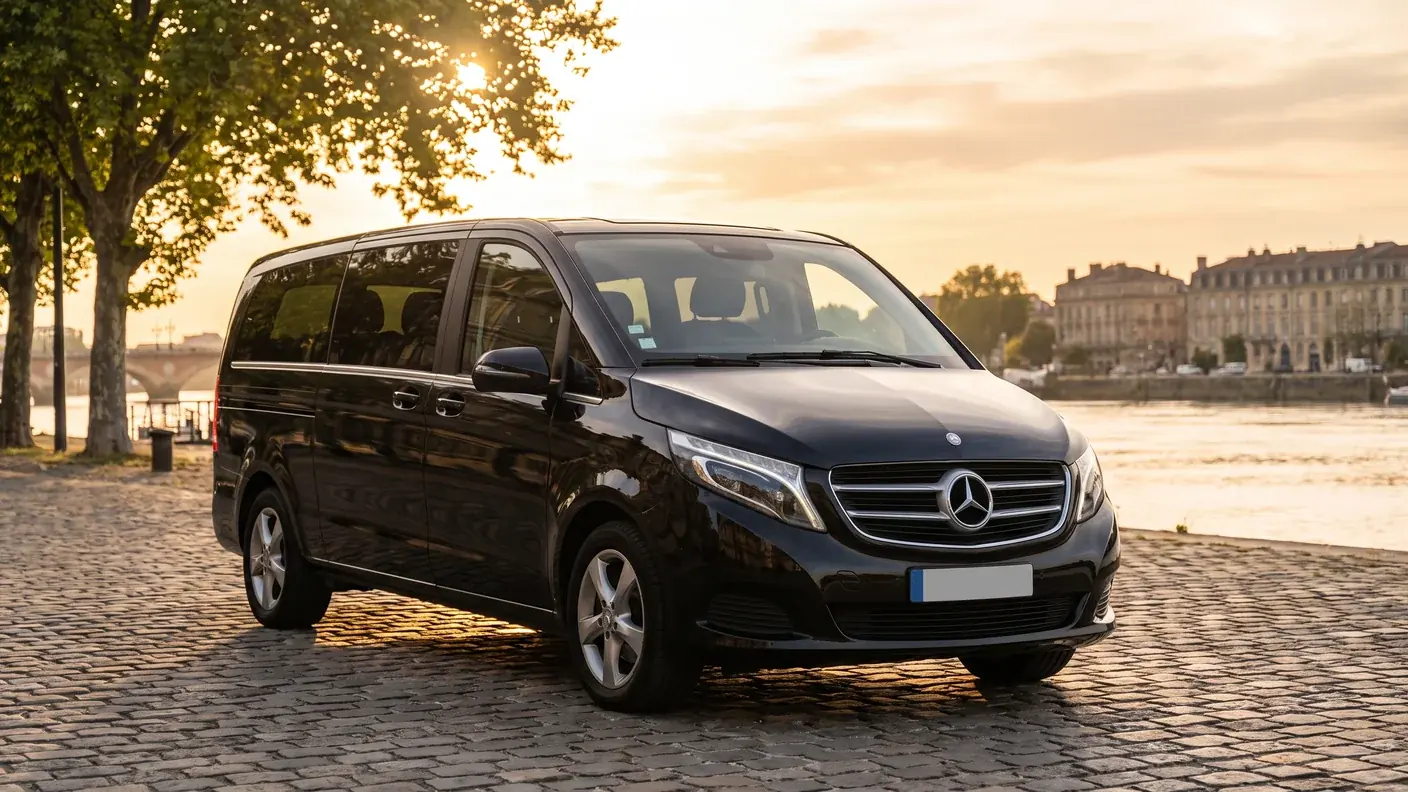


Your long-distance van from Bordeaux
Chauffeured long-distance van travel to the Basque Country, Northern Spain, the Périgord, the Charentes or anywhere in France, for up to 7 passengers (8 upon request, for an additional fee) and their luggage. Door-to-door service with a fixed fare guaranteed in writing: Biarritz 434 €, Sarlat 456 €, San Sebastián 516 €. Quote confirmed within 30 minutes.